DSSSB 2025 Previous Year Questions (PYQs) with Solutions
Real questions from the DSSSB 2025 paper, solved. Every question below shows its options, the correct answer, and a full text solution — free to read, no login needed. Open any question to practice it interactively inside its course.
- Questions:
- 200
- With solutions:
- 200
- Tagged DSSSB 2025 in the bank:
- 903
- Q1.DSSSB 2025
Teak is the most dominant species of which of the following types of forest in India?
- A.
Montane Forests
- B.
The Thorn Forests and Scrubs
- C.
Tropical Evergreen Forests
- D.
Tropical Deciduous Forests
Correct answer: D
Solution
Teak is a major and dominant tree species of tropical deciduous forests in India, especially the moist and dry deciduous belts. These forests shed leaves seasonally and include species such as teak, sal, shisham and sandalwood. Hence option D is correct.
- A.
- Q2.DSSSB 2025
Seven boxes, G, H, I, J, P, Q and R, are placed one above another, but not necessarily in the same order. Only three boxes are placed below I. Only two boxes are placed between I and R. Only J is placed above H. Q is placed at some place below P and at some place above G. Which box is placed at the second position from the bottom?
- A.
G
- B.
I
- C.
J
- D.
R
Correct answer: A
Solution
In stack/box-arrangement puzzles, absolute positions are pinned by counting clues (‘X boxes are placed below/above a box’ fixes its exact slot), ‘between’ clues fix the spacing between two boxes, and ‘only P is placed above/below Q’ clues identify the extreme (topmost or bottommost-adjacent) boxes. Combining these positional clues lets you fully order the stack before answering a positional query.
The clue ‘only three boxes are placed below I’ fixes I at the fourth position from the bottom — three slots below it and three above it, in a stack of seven.
The clue ‘only two boxes are placed between I and R’ means R sits exactly three slots away from I (with two boxes between them), so R is at position 1 or position 7.
The clue ‘only J is placed above H’ makes H the second box from the top and J the topmost box, so J occupies position 7 and H occupies position 6.
Since J already occupies position 7, R cannot also be there, so R is fixed at position 1, the bottom of the stack.
The remaining boxes G, P and Q must occupy the three leftover positions: 2, 3 and 5.
The clue ‘Q is placed below P and above G’ requires the position of G to be less than that of Q, which is less than that of P; the only way to place G, Q and P into positions 2, 3 and 5 in that ascending order is G = 2, Q = 3, P = 5.
The completed stack, from bottom to top, is: R, G, Q, I, P, H, J.
Checking every clue against this order confirms it: three boxes (R, G, Q) lie below I; exactly two boxes (G, Q) lie between I and R; only J lies above H; and G lies below Q, which lies below P. All five conditions hold.
The box at the second position from the bottom is therefore G.
- A.
- Q3.DSSSB 2025
What should come in place of question mark (?) in the given series based on English alphabetical order?
SUB OQX KMT GIP ?
- A.
CDR
- B.
CDE
- C.
CLE
- D.
CEL
Correct answer: D
Solution
Concept: In an alphabet-position series, replace each letter by its place in the alphabet (A = 1 ... Z = 26). When the corresponding letters across consecutive terms -- 1st letters together, 2nd letters together, 3rd letters together -- change by the same fixed amount each time, that column follows a constant arithmetic step; if subtracting the step takes the value below 1, wrap around the alphabet (continue counting backward from Z).
Term
1st letter (value)
2nd letter (value)
3rd letter (value)
SUB
S (19)
U (21)
B (2)
OQX
O (15)
Q (17)
X (24)
KMT
K (11)
M (13)
T (20)
GIP
G (7)
I (9)
P (16)
?
C (3)
E (5)
L (12)
Convert every letter of SUB, OQX, KMT, GIP to its alphabet position, column by column, as shown in the table above.
Column 1 (S, O, K, G = 19, 15, 11, 7) decreases by 4 each term; Column 2 (U, Q, M, I = 21, 17, 13, 9) decreases by 4 each term; Column 3 (B, X, T, P = 2, 24, 20, 16) also decreases by 4 each term once the wrap past A back to Z is accounted for (2 - 4 = -2, and -2 + 26 = 24).
Apply the same step of -4 to the last term's three columns: 7 - 4 = 3 -> C; 9 - 4 = 5 -> E; 16 - 4 = 12 -> L.
Combine the three results in column order to get the next term: C, E, L -> CEL.
Cross-check: reversing the step (+4) on C, E, L should reproduce the previous term G, I, P. C(3)+4=7=G, E(5)+4=9=I, L(12)+4=16=P -- all three match, confirming the term was derived correctly.
So the series continues with CEL.
- A.
- Q4.DSSSB 2025
This question is based on the following five, three-digit numbers:
(Left) 218 239 846 852 273 (Right) (Example- 697 — first digit = 6, second digit = 9 and third digit = 7)
If the second digit of the highest number is added to the second digit of the lowest number, what will be the result?
- A.
8
- B.
6
- C.
9
- D.
7
Correct answer: B
Solution
In digit-position number puzzles, first identify the required number by its rank (highest, lowest, etc.) among the given set, then read off the digit at the exact position stated (first, second, third, counted from the left, as illustrated by the given example), and finally carry out the arithmetic operation asked for on those extracted digits.
The five three-digit numbers given are 218, 239, 846, 852, and 273.
Arranging them in increasing order: 218 < 239 < 273 < 846 < 852.
So the highest number is 852 and the lowest number is 218.
Counting from the left as shown in the example, the digits of 852 are: first digit = 8, second digit = 5, third digit = 2.
Similarly, the digits of 218 are: first digit = 2, second digit = 1, third digit = 8.
Adding the second digit of the highest number to the second digit of the lowest number: 5 + 1 = 6.
Checking the ordering independently by comparing the hundreds digit first (8 for 846 and 852 versus 2 or 3 for the rest) and then the tens digit within each group confirms that 852 is indeed the largest and 218 the smallest of the five numbers, so the digits used above are correct.
Hence, the required result is 6.
- A.
- Q5.DSSSB 2025
What will come in place of the question mark (?) in the given series?
12 17 22 27 32 ?
- A.
35
- B.
36
- C.
34
- D.
37
Correct answer: D
Solution
Concept
A number series built on a constant arithmetic difference adds (or subtracts) the SAME fixed value to each term to get the next one - this fixed value is called the common difference of the series.
Application
Find the gap between each pair of consecutive given terms: 17-12, 22-17, 27-22, and 32-27.
Each of these gaps works out to the SAME value, confirming the series has one constant common difference throughout.
Extend the series by adding that same constant difference to the last given term, 32, to get the missing term.
Cross-check
Cross-check with the nth-term rule for such a series, T(n) = T(1) + (n-1) x d, using the first term T(1)=12 and the constant difference d found above. Substituting n=6 reproduces the same value obtained by direct addition, confirming the answer.
So the term that replaces the question mark is 37.
- A.
- Q6.DSSSB 2025
A, B, C, D, E, F and G are sitting around a circular table facing towards its centre. Counting from the left of B, only one person sits between G and B. E sits third to the right of F. C sits third to the left of D. E sits in the immediate right neighbourhood of C. A is not an immediate neighbour of C. Counting from the left of A, how many people sit between A and C?
- A.
four
- B.
three
- C.
two
- D.
one
Correct answer: D
Solution
For a circular arrangement where everyone faces the centre, the everyday left/right sense is reversed compared with facing outward: a seated person's right hand points in the anticlockwise direction and their left hand points in the clockwise direction, so a clue such as "X sits n-th to the right/left of Y" fixes X exactly n seats anticlockwise/clockwise of Y, and "immediate right/left neighbour" means one seat away in that same direction. Solve such puzzles by anchoring one person's seat as a reference, converting every directional clue into a seat offset from that anchor, and testing the seats still open against any leftover clues -- including exclusions such as "is not a neighbour of" -- until exactly one arrangement of everybody is consistent with every clue.
Fix C's seat as the reference point, seat 0, around the seven-seat circle (seats numbered clockwise).
"E sits in the immediate right-hand neighbourhood of C" places E one seat anticlockwise of C, i.e. seat 0 minus 1 = seat 6.
"C sits third to the left of D" places C three seats clockwise of D, so D sits three seats anticlockwise of C, i.e. seat 0 minus 3 = seat 4 (wrapping round the seven-seat circle).
"E sits third to the right of F" places E three seats anticlockwise of F, so F sits three seats clockwise of E, i.e. seat 6 plus 3 = seat 9, which wraps to seat 2.
C, E, D and F now occupy seats 0, 6, 4 and 2, leaving seats 1, 3 and 5 for A, B and G.
"Counting from the left of B, only one person sits between G and B" needs G two seats clockwise of B (clockwise is B's own left). Of the leftover seats, only B at seat 1 with G at seat 3 satisfies this, with F at seat 2 as the single person between them; pairing B at seat 3 would force G onto seat 5 and A onto seat 1, which the next clue rules out.
That leaves A at seat 5. Checking "A is not an immediate neighbour of C" (seat 0): C's neighbours are seats 6 and 1, and seat 5 is neither, so this arrangement satisfies every clue.
Seat (clockwise order)
Person
0
C
1
B
2
F
3
G
4
D
5
A
6
E
Cross-check: going the other way around -- anticlockwise, i.e. towards A's right, from A's seat 5 towards C's seat 0 -- passes through seats 4, 3, 2 and 1 (D, G, F and B), four people; since A and C themselves take up two of the seven seats, the two arcs between them must together hold the other five people, and 4 (the long way, via A's right) plus 1 (the short way, via A's left) accounts for all five. Counting from A's left (clockwise) side, as the question asks, the only seat passed before reaching C is seat 6, held by E -- so exactly one person sits between A and C, and the answer is "one".
- A.
- Q7.DSSSB 2025
Seven boxes G, H, I, J, P, Q and R are kept one above another, but not necessarily in the same order. No box is kept above H. Only three boxes are kept between H and J. Only one box is kept between Q and R. R is kept immediately above J. Only four boxes are kept between Q and I. P is kept at some place above G. Which box is kept at the second position below P?
- A.
G
- B.
J
- C.
H
- D.
Q
Correct answer: B
Solution
Concept: In a floor/level-based vertical arrangement puzzle, number the stack positions from the bottom (1) to the top (n). Translate every "above/below" and "boxes between" clue into a position equation, and start from any clue that pins an object to a stack boundary (top or bottom) — that fixes an exact position immediately and lets every other clue be solved by substitution.
Step-by-step:
There are 7 positions in the stack, numbered 1 (bottom) to 7 (top).
"No box is kept above H" fixes H at the topmost position, position 7.
"Only three boxes are kept between H and J" means J is 4 positions away from H (3 boxes in between + H itself). Since H is already at the top boundary, J must be 4 positions below H: J = 7 - 4 = position 3.
"R is kept immediately above J" gives R = J + 1 = position 4.
"Only one box is kept between Q and R" places Q either 2 positions above R (position 6) or 2 positions below R (position 2).
"Only four boxes are kept between Q and I" tests both options for Q. If Q were at position 2, I would need to be 5 positions away, landing on position 7 — already taken by H — so this branch is impossible. With Q at position 6, I is 5 positions away at position 1, which is free. So Q = position 6 and I = position 1.
The two positions left, 2 and 5, go to G and P. "P is kept at some place above G" means P's position number is larger, so P = position 5 and G = position 2.
Final arrangement (bottom to top):
Position
Box
1
I
2
G
3
J
4
R
5
P
6
Q
7
H
Cross-check: Every clue holds in this arrangement — H has nothing above it; exactly three boxes (positions 4, 5, 6) sit between H(7) and J(3); exactly one box (position 5) sits between Q(6) and R(4); R(4) is immediately above J(3); exactly four boxes (positions 2, 3, 4, 5) sit between Q(6) and I(1); and P(5) is above G(2).
Answer: P is at position 5. The second position below P is position 5 - 2 = position 3, which is occupied by J.
- A.
- Q8.DSSSB 2025
Following a certain logic, 78 is related to 159. Following the same logic, 56 is related to 115. To which of the given options is 99 related following the same logic? (Note: Operations should be performed on whole numbers, without breaking down the numbers into its constituent digits. For example, take 13 - operations like adding/subtracting/multiplying to 13 can be done on 13. Breaking down 13 into 1 and 3 and then performing mathematical operations on 1 and 3 is not allowed.)
- A.
241
- B.
201
- C.
212
- D.
236
Correct answer: B
Solution
A number-based analogy question gives two example pairs that are both produced by the SAME fixed rule -- a short chain of whole-number operations applied to the first number of each pair. The task is to find the one rule that fits BOTH given pairs exactly, and then apply that identical rule to the target number.
Test a rule on the first pair: multiplying 78 by 2 gives 156, and adding 3 gives 156 + 3 = 159, which matches the given pair exactly.
Check the SAME rule on the second pair: multiplying 56 by 2 gives 112, and adding 3 gives 112 + 3 = 115, which again matches exactly -- so the rule (multiply by 2, then add 3) is confirmed by both examples, not just one.
Apply the confirmed rule to 99: multiplying 99 by 2 gives 198, and adding 3 gives 198 + 3 = 201.
Working backwards confirms it: subtracting 3 from 201 gives 198, and halving 198 gives back 99. Among the four offered values, only 201 satisfies the rule that both 78 -> 159 and 56 -> 115 confirm, so 99 is related to 201 following the same logic.
- A.
- Q9.DSSSB 2025
In a certain code language, 'A + B' means 'A is the son of B', 'A - B' means 'A is the brother of B', 'A × B' means 'A is the wife of B' and 'A ÷ B' means 'A is the father of B'.
If 'D + F ÷ G × H - J', then how is D related to J?
- A.
Wife's father
- B.
Wife's brother
- C.
Brother's wife's brother
- D.
Brother's wife's father
Correct answer: C
Solution
Concept
In a coded blood-relation puzzle, each symbol is a fixed code for one direct family relation, and the chain is always read as ‘the person before the symbol is that relation of the person after it.’ A multi-symbol chain therefore encodes a small family tree link by link; decoding every link in order — and noting the gender each relation word fixes — lets the relationship between the two end-people be read straight off that tree.
Key: + = son of, − = brother of, × = wife of, ÷ = father of. Read strictly left to right, one symbol at a time, without skipping or merging any two people into one.
Step-by-step decoding
Decode D + F: D is the son of F, so F is D's parent and D is male.
Decode F ÷ G: F is the father of G, so F is also G's parent.
Since F is the parent of both D and G, D and G are siblings; as D is a son, D is G's brother.
Decode G × H: G is the wife of H, so H is G's husband.
Decode H − J: H is the brother of J, so H and J are siblings.
Combine, starting from J: J's brother is H; H's wife is G; G's brother is D.
Cross-check
Every relation word used is gender-consistent: D, F and H are all fixed male (son, father, brother, husband — matching G being called a wife), and G is fixed female (wife, and F's child alongside D). No person is used twice with conflicting genders, so the chain decodes without contradiction, confirming D is J's Brother's wife's brother.
- A.
- Q10.DSSSB 2025
What should come in place of question mark (?) in the given series based on English alphabetical order?
GIN CEJ YAF UWB ?
- A.
QES
- B.
QSE
- C.
QKI
- D.
QSX
Correct answer: D
Solution
Concept: In a letter-series puzzle built on the English alphabet, every three-letter block is produced from the block before it by shifting all three of its letters by the identical number of alphabet positions, cycling past either end of the alphabet (after Z the count continues from A, and before A it continues from Z). Numbering each letter by its alphabet position turns the letter pattern into a simple arithmetic step that must repeat identically across all three positions at once.
Application: Number each letter (A = 1, B = 2, … Z = 26) and track the three letter-columns across the four given terms:
GIN
CEJ
YAF
UWB
1st letter
G (7)
C (3)
Y (25)
U (21)
2nd letter
I (9)
E (5)
A (1)
W (23)
3rd letter
N (14)
J (10)
F (6)
B (2)
1st letters: 7 → 3 → 25 → 21. Each step is −4 places, cycling past A back to Z (3 − 4 = −1, which cycles to 25).
2nd letters: 9 → 5 → 1 → 23. The same −4 step repeats (1 − 4 = −3, cycling to 23).
3rd letters: 14 → 10 → 6 → 2. The same −4 step repeats once more.
Since all three columns follow one identical, cycling −4 step, that shared step is the rule governing the whole series — apply it once more to the last term's three letters to find the missing block.
Cross-check: Applying −4 to U (21) gives 17 = Q; applying −4 to W (23) gives 19 = S; applying −4 to B (2) gives −2, which cycles to 24 = X. Each result was reached by the same −4 step already confirmed three times over across GIN→CEJ, CEJ→YAF, and YAF→UWB, so the check does not depend on any single column.
Result: The missing term is QSX.
- A.
- Q11.DSSSB 2025
In this question, a statement is given followed by two courses of action I and II. You have to assume everything in the statement to be true and then decide which of the given courses of action logically follows based on the information in the statement.
Statement: Farming in Country X has been challenging, requiring creative ecological solutions. Today, threats like climate change, pests, soil erosion, over-exploitation, and resource depletion are unprecedented. Farmers are also facing extreme price volatility for their produce due to cartelization and hoarding.
Courses of Action: I. The government of Country X should introduce legislation to prevent hoarding of crops and strictly enforce existing anti-cartelization laws. II. Farmers of Country X should ignore soil health and ecological issues.
- A.
Neither course of action I nor II follows.
- B.
Only course of action I follows.
- C.
Both courses of action I and II follow.
- D.
Only course of action II follows.
Correct answer: B
Solution
Concept: In Statement–Course of Action reasoning, a suggested course of action follows only if it is a practical, executable step that directly addresses a cause or problem explicitly named in the statement. A course of action that contradicts what the statement itself identifies as needed, or that has no real bearing on the stated problem, does not follow — no matter how reasonable it sounds in isolation.
Application:
Course of Action I proposes legislation against hoarding along with strict enforcement of anti-cartelization laws. The statement explicitly names cartelization and hoarding as the cause of the farmers' price volatility, so a targeted legal and administrative response to exactly that cause is practical and directly relevant — it follows.
Course of Action II proposes that farmers disregard soil health and ecological issues. The statement opens by stating that farming requires creative ecological solutions precisely because of threats such as soil erosion and resource depletion; a course that tells farmers to ignore those very issues contradicts the statement's own diagnosis instead of addressing it — it does not follow.
Cross-check: A valid course of action must both target a cause the statement names and avoid contradicting the statement's own diagnosis. Course I satisfies both conditions; Course II fails the second one outright. So exactly one of the two proposed courses follows.
Answer: Only Course of Action I follows from the statement.
- A.
- Q12.DSSSB 2025
Based on English alphabetical order, three of the following four letter-cluster pairs are alike in a certain way and thus form a group. Which letter-cluster pair does not belong to that group? (Note: The odd letter-cluster pair is not based on the number of vowels/consonants or their positions)
- A.
NO - UV
- B.
OP - VW
- C.
IJ - PQ
- D.
CD - JL
Correct answer: D
Solution
In a letter-cluster classification built on consecutive alphabet steps, the shared rule is usually that every letter inside EACH half of a pair is exactly one step ahead of the previous letter (a strict run of consecutive letters, e.g. N then O). Three of the four given pairs satisfy this in both halves; the odd pair breaks it in at least one half.
Checking each pair (alphabet step size shown in brackets):
Pair
First half step
Second half step
Both halves consecutive?
N–O, U–V
N → O (step 1)
U → V (step 1)
Yes
O–P, V–W
O → P (step 1)
V → W (step 1)
Yes
I–J, P–Q
I → J (step 1)
P → Q (step 1)
Yes
C–D, J–L
C → D (step 1)
J → L (step 2, skips K)
No
Cross-check: the gap between the STARTING letters of the two halves is the same for every pair — N to U, O to V, I to P, and C to J are all 7 letters apart — so that inter-half gap is common to all four and cannot be the differentiator. The only property that actually differs is the internal step inside each half.
Since J to L skips a letter (K), the second half of the C–D, J–L pair is not a run of consecutive letters like the other three pairs, so it is the pair that does not belong to the group.
- A.
- Q13.DSSSB 2025
Read the given statements and conclusions carefully. Assuming that the information given in the statements is true, even if it appears to be at variance with commonly known facts, decide which of the given conclusions logically follow from the statements.
Statements: All chairs are mirrors. Some eagles are mirrors. No mirror is a horse.
Conclusions: (I) No horse is a chair. (II) Some eagles are horses.
- A.
Both conclusions (I) and (II) follow
- B.
Only conclusion (II) follows
- C.
Neither conclusion (I) nor (II) follows
- D.
Only conclusion (I) follows
Correct answer: D
Solution
Two syllogism rules govern this pair of conclusions. First, a universal premise ("All A are B") combined with a universal negative premise sharing the middle term ("No B is C") places the entire A category outside the C category, and a universal negative relationship converts simply: "No A is C" and "No C is A" are logically equivalent. Second, a particular premise ("Some A are B") combined with the same universal negative premise only excludes the overlapping part of A from C; it can never be strengthened into a claim that A and C share members.
"All chairs are mirrors" (universal) combined with "No mirror is a horse" (universal negative) places the entire chair category outside the horse category, so no chair is a horse.
A universal negative relationship converts simply, so "no chair is a horse" is logically equivalent to "no horse is a chair" -- exactly what conclusion (I) states, so conclusion (I) follows.
"Some eagles are mirrors" (particular) combined with "No mirror is a horse" (universal negative) can only exclude the overlapping eagles from the horse category; the statements say nothing about the eagles that fall outside the mirror category.
Because a particular-plus-negative pairing can only produce an exclusion result, it cannot be strengthened into a claim that eagles and horses share members -- so conclusion (II), which asserts exactly that, does not follow.
A quick model confirms this: let Mirrors = {1, 2, 3, 4}, Horses = {5, 6} (disjoint from Mirrors, as the third statement requires), Chairs = {1, 2} (a subset of Mirrors, as the first statement requires), and Eagles = {3, 7} (element 3 overlaps Mirrors, satisfying the second statement; element 7 lies outside Mirrors, which the statement allows). In this valid model, no horse is a chair -- confirming conclusion (I) is guaranteed -- while no eagle is a horse at all, showing conclusion (II) is not guaranteed by the statements.
Only conclusion (I) follows from the given statements.
- A.
- Q14.DSSSB 2025
If 'A' means '÷', 'B' means '×', 'C' means '+' and 'D' means '-', then which of the following will result in 22?
- A.
20 D 2 C 2 A 18 B 9
- B.
20 C 2 B 2 D 18 A 9
- C.
20 A 2 B 2 C 18 D 9
- D.
20 B 2 A 2 C 18 D 9
Correct answer: B
Solution
Concept: In letter-for-symbol coding questions, each letter is first replaced by its assigned mathematical sign, and the resulting numerical expression is then simplified using the standard order of operations (BODMAS): division and multiplication are carried out before addition and subtraction, working left to right at each level.
Substitute each letter with its sign and simplify every coded string using BODMAS:
Coded string
After substitution
Value
20 D 2 C 2 A 18 B 9
20 − 2 + 2 ÷ 18 × 9
19
20 C 2 B 2 D 18 A 9
20 + 2 × 2 − 18 ÷ 9
22
20 A 2 B 2 C 18 D 9
20 ÷ 2 × 2 + 18 − 9
29
20 B 2 A 2 C 18 D 9
20 × 2 ÷ 2 + 18 − 9
29
Step-by-step for the string that equals 22:
Multiplication first: 2 × 2 = 4.
Division: 18 ÷ 9 = 2.
Left-to-right addition and subtraction: 20 + 4 − 2 = 22.
Cross-check: division and multiplication are applied before addition and subtraction in each of the other three strings as well — they settle at 19, 29 and 29, none of which equals 22, confirming that 20 + 2 × 2 − 18 ÷ 9 = 22 is the only string that satisfies the condition.
- A.
- Q15.DSSSB 2025
15 is related to 60 following a certain logic. Following the same logic, 27 is related to 108. To which of the following is 44 related, following the same logic? (NOTE: Operations should be performed on the whole numbers, without breaking down the numbers into their constituent digits. E.g., 13 – Operations on 13 such as adding /deleting /multiplying etc. to 13 can be performed. Breaking down 13 into 1 and 3 and then performing mathematical operations on 1 and 3 is not allowed.)
- A.
174
- B.
172
- C.
178
- D.
176
Correct answer: D
Solution
Concept:
In a number-based analogy of the form ‘X is related to Y’, the two numbers in every stated pair are connected by one single, consistent mathematical operation performed on the whole number (not on its individual digits). Identify that operation from the pair(s) given, confirm it holds across all of them, then apply the exact same operation to the new number to find its match.
Applying the rule:
60 ÷ 15 = 4, so 60 is obtained by multiplying 15 by 4.
108 ÷ 27 = 4, so 108 is obtained by multiplying 27 by the same factor, 4 — confirming the operation is consistently × 4 across both given pairs.
Applying the same operation to 44: 44 × 4 = 176.
Cross-check:
Reversing the operation confirms it: 176 ÷ 44 = 4, matching the factor verified from both given pairs. Checking the remaining values against the same rule rules them out:
174 ÷ 4 = 43.5 — not a whole-number match to 44.
178 ÷ 4 = 44.5 — not a whole-number match to 44.
172 ÷ 4 = 43 — the factor applied to 43, not to 44.
- A.
- Q16.DSSSB 2025
Based on English alphabetical order, three of the following four letter-clusters are alike in a certain way and thus they form a group. Which letter-cluster does not belong to that group? (Note: The odd letter-cluster is not based on the number of vowels/consonants or their positions)
- A.
XYV
- B.
OPM
- C.
WYU
- D.
FGD
Correct answer: C
Solution
In an alphabet-classification question, each letter is replaced by its position in the English alphabet (A = 1, B = 2, ... Z = 26). Three of the four letter-clusters share one consistent step pattern between consecutive letters, and those three form the group; the cluster whose step pattern differs from that shared rule is the one that does not belong.
Convert every cluster to alphabet positions and note the step from the 1st letter to the 2nd, and from the 2nd letter to the 3rd:
Cluster
Positions
Step (1st to 2nd, 2nd to 3rd)
XYV
24, 25, 22
+1, -3
OPM
15, 16, 13
+1, -3
FGD
6, 7, 4
+1, -3
WYU
23, 25, 21
+2, -4
XYV, OPM, and FGD all step +1 and then -3 between their letters, so they follow the identical rule and form the group. WYU steps +2 and then -4, a different step pattern, so WYU is the letter-cluster that does not belong.
Cross-check: comparing only the 1st and 3rd letters gives a -2 net shift in all four clusters (X to V, O to M, F to D, and even W to U), so checking endpoints alone is misleading here. The defining rule is the exact two-step sequence (+1, then -3) shared by three clusters, not just the net displacement, which confirms WYU as the genuine outlier.
- A.
- Q17.DSSSB 2025
In a certain code language, 'P#ST' is coded as '4025' and 'RS#T' is coded as '0125'. What is the code for 'R' in that language?
- A.
2
- B.
0
- C.
1
- D.
5
Correct answer: C
Solution
In a letter-to-digit coding puzzle, when a letter common to two given code-words sits at different positions in each word, a plain left-to-right positional decode is unreliable. Instead, match sets: a letter common to both code-words must correspond to a digit common to both codes, while the one letter present in only one word must correspond to the one digit present only in that word's code.
Word
Code
P # S T
4 0 2 5
R S # T
0 1 2 5
List the letters of both code-words: 'P#ST' contains P, #, S, T; 'RS#T' contains R, S, #, T.
The letters common to both words are #, S and T; the letter present in only one word is P (only in 'P#ST') and R (only in 'RS#T').
List the digits of both codes: '4025' gives 4, 0, 2, 5; '0125' gives 0, 1, 2, 5.
The digits common to both codes are 0, 2 and 5; the digit present in only one code is 4 (only in '4025') and 1 (only in '0125').
Since P is the letter unique to 'P#ST', it takes the digit unique to '4025', so P = 4; since R is the letter unique to 'RS#T', it takes the digit unique to '0125', so R = 1.
As a check, T sits at the same relative (last) position in both words and consistently carries the digit 5 in both codes, confirming the common-letter/common-digit pairing is internally consistent. A raw position-by-position match, by contrast, would wrongly give S two different digits, since S sits third in 'P#ST' but second in 'RS#T' — which is exactly why the unique-letter-to-unique-digit rule, not blind position, is the reliable method here.
So, the code for 'R' is 1.
- A.
- Q18.DSSSB 2025
In the following triads, each group of letters is related to the next group following a certain logic. Select the option from the given options that follows the same logic.
GEAR - EGAR - RAEG LIST - ILST - TSIL
- A.
LOST - OLST - TOSL
- B.
LIFE - LFIE - EFIL
- C.
GLOW - LGOW - LOWG
- D.
FATE - AFTE - ETAF
Correct answer: D
Solution
Concept: Every triad here is built from ONE original word using two fixed operations — swapping its first two letters gives the second group, and reversing the whole word gives the third group. Both operations must hold at once for a triad to follow the stated logic.
Checking the given examples:
GEAR: swapping the first two letters (G and E) gives EGAR, which matches the given second group.
GEAR reversed letter-by-letter gives RAEG, which matches the given third group.
LIST: swapping the first two letters (L and I) gives ILST, and LIST reversed gives TSIL — both match the second example, confirming the rule.
Applying the rule to the options:
FATE: swapping the first two letters (F and A) gives AFTE, matching the second group shown.
FATE reversed letter-by-letter gives ETAF, matching the third group shown — so both checks hold together for this triad.
Cross-check on the other options:
LOST - OLST - TOSL: the swap check passes (LOST becomes OLST), but the third group is not the true reverse of LOST (which is TSOL) — TOSL only swaps LOST's first and last letters while leaving the middle two letters in place, so the reversal check fails.
LIFE - LFIE - EFIL: the reversal check passes (EFIL is the true reverse of LIFE), but the second group swaps the middle two letters (I and F) instead of the first two, so the swap check fails.
GLOW - LGOW - LOWG: the swap check passes (GLOW becomes LGOW), but the third group is a one-place left rotation of GLOW, not its reverse (the true reverse is WOLG), so the reversal check fails.
Since FATE - AFTE - ETAF is the only option where the word satisfies both the first-two-letter swap and the full reversal at once, it follows the same logic as the given triads.
- A.
- Q19.DSSSB 2025
Amit starts driving from point A and drives 13 km towards North. Then he turns right and drives 11 km, then turns right and drives 17 km. Then he turns right and drives 15 km. Finally, he turns right and stops at point P after driving 4 km. How much distance (shortest distance) and in which direction does he need to drive to reach point A again? (Until specified, all turns are 90 degree turns only)
- A.
5 km, towards West
- B.
4 km, towards East
- C.
4 km, towards West
- D.
5 km, towards East
Correct answer: B
Solution
In a direction-sense route-tracing problem, plot every straight-line leg on an X-Y grid with East as the positive x-axis and North as the positive y-axis; a “turn right” always rotates the direction of travel 90° clockwise through the cycle North → East → South → West → North. Once the final point is plotted, the shortest way back to the start is the straight-line distance between the two points, and its direction follows from the sign of the horizontal (east-west) and vertical (north-south) gap between them.
Take A as the origin (0, 0). Travel North 13 km, reaching (0, 13).
Turn right (North → East) and travel East 11 km, reaching (11, 13).
Turn right (East → South) and travel South 17 km, reaching (11, −4).
Turn right (South → West) and travel West 15 km, reaching (−4, −4).
Turn right (West → North) and travel North 4 km, reaching P at (−4, 0).
Compare P(−4, 0) with A(0, 0): both share the same north-south coordinate (0), so there is no residual north-south gap; the east-west coordinates differ by 4, with P sitting 4 km to the west of A.
As an independent check, total the north-south and east-west legs separately instead of plotting points: the north-south legs are +13 (North), −17 (South), +4 (North), which sum to 0 — confirming P is level with A. The east-west legs are +11 (East), −15 (West), which sum to −4 — confirming P is 4 km west of A. Both methods agree.
Since P is 4 km west of A with no north-south offset, the shortest way back from P to A is 4 km towards the East.
- A.
- Q20.DSSSB 2025
According to the 2011 Census, what was the population density of Uttar Pradesh?
- A.
2894 people/km²
- B.
829 people/km²
- C.
109 people/km²
- D.
1029 people/km²
Correct answer: B
Solution
Population density is the number of people living per unit of land area, calculated as Total Population ÷ Total Geographical Area, usually expressed as persons per km². It is a census statistic published state-wise for every Census of India.
Applying this to Uttar Pradesh from the 2011 Census:
Census 2011 recorded Uttar Pradesh's total population as 199,812,341 and its total geographical area as 240,928 km².
Density = Population ÷ Area = 199,812,341 ÷ 240,928 ≈ 829 persons per km², which is the figure published in the Census 2011 final tables for the state.
This figure is consistent with Uttar Pradesh's known ranking: at 829 persons per km², UP is the 4th most densely populated Indian state in the 2011 Census — behind Bihar (1,102/km²), West Bengal (1,029/km²), and Kerala (859/km²) — and well above the all-India average density of 382 persons per km², which fits UP's status as India's most populous state.
- A.
- Q21.DSSSB 2025
What is the total number of members in the Committee of Parliament on Official Language?
- A.
10 members
- B.
30 members
- C.
20 members
- D.
5 members
Correct answer: B
Solution
Article 344(4) of the Constitution of India — also given effect through Section 4(2) of the Official Languages Act, 1963 — sets up the Committee of Parliament on Official Language to review the progress made in the use of Hindi for official purposes of the Union and to make recommendations to the President. The Constitution itself fixes how this Committee is composed, drawing members from both Houses of Parliament in a set proportion.
Applying this provision: the Committee's total strength is 30 members — 20 members of the House of the People (Lok Sabha), elected by that House, and 10 members of the Council of States (Rajya Sabha), elected by that House. Adding the two contingents, 20 + 10 = 30.
10 reflects only one House's contingent on the Committee, not its combined strength.
20 likewise reflects only a single House's contingent, not the Committee's full membership.
5 is far too small for a Committee whose composition is fixed by the Constitution itself.
Hence, the Committee of Parliament on Official Language has 30 members in total.
- A.
- Q22.DSSSB 2025
Which Fundamental Duty was added by the 86th Amendment in December 2002?
- A.
To protect and improve the natural environment including forests, lakes, rivers and wildlife, and to have compassion for living creatures
- B.
To strive towards excellence in all spheres of individual and collective activity so that the nation constantly rises to higher levels of endeavour and achievement
- C.
To develop the scientific temper, humanism and the spirit of inquiry and reform
- D.
Who is a parent or guardian to provide opportunities for education to his child or, as the case may be, ward between the age of six and fourteen years
Correct answer: D
Solution
Part IVA of the Constitution (Article 51A) lists the Fundamental Duties of every citizen. The original ten duties were inserted by the 42nd Amendment Act, 1976, on the recommendation of the Swaran Singh Committee. The 86th Constitutional Amendment Act, 2002 -- the same amendment that inserted Article 21A guaranteeing the Right to Education -- added an eleventh Fundamental Duty through Article 51A(k), obliging every parent or guardian to provide educational opportunities to their child or ward.
The 86th Amendment Act, 2002 inserted Article 21A into Part III, making free and compulsory education a Fundamental Right for children aged six to fourteen.
To mirror this right as a citizen's duty, Section 4 of the same Amendment Act inserted clause (k) into Article 51A: 'who is a parent or guardian, to provide opportunities for education to his child, or, as the case may be, ward, between the age of six and fourteen years.'
This wording matches the option describing a parent or guardian's duty to provide education to a child or ward between six and fourteen years of age, confirming it as the duty added by the 86th Amendment.
The duty to protect and improve the natural environment and show compassion for living creatures is Article 51A(g), one of the original ten duties inserted by the 42nd Amendment, 1976 -- more than two decades before the 86th Amendment.
The duty to strive for excellence in individual and collective activity is Article 51A(j), also part of the original 1976 set, not a later addition.
The duty to develop scientific temper, humanism, and the spirit of inquiry and reform is Article 51A(h), likewise one of the original 1976 duties enacted well before 2002.
- A.
- Q23.DSSSB 2025
Match List-I with List-II regarding the national movements of India:
Dr. Hedgewar - a. A blueprint for a Constitution for India was prepared
Cripps Mission in 1942 - b. Proposal to grant Dominion Status to India at the end of the war was made
Nehru Report in 1928 - c. Rashtriya Swayamsevak Sangh (RSS)
Lahore Session of Congress in 1929 - d. The slogan of Purna Swaraj was adopted as the goal
- A.
1-b, 2-c, 3-d, 4-a
- B.
1-d, 2-a, 3-b, 4-c
- C.
1-a, 2-b, 3-c, 4-d
- D.
1-c, 2-b, 3-a, 4-d
Correct answer: D
Solution
A ‘Match List-I with List-II’ item on India’s freedom movement checks whether each person, mission, report, or session named in List-I is correctly paired with the outcome or role described in List-II — the pairing must follow the actual historical facts and timeline of each entry, not just superficial wording.
Dr. Hedgewar founded the Rashtriya Swayamsevak Sangh (RSS) at Nagpur in 1925 — an act of founding a nationalist organisation, which List-II describes under ‘c’.
The Cripps Mission of 1942, led by Sir Stafford Cripps on behalf of the British government, proposed granting India Dominion Status once the Second World War ended — the proposal List-II describes under ‘b’.
The Nehru Report of 1928, prepared by a committee headed by Motilal Nehru in response to the all-British Simon Commission, was the first constitutional blueprint drafted by Indians for India — the document List-II describes under ‘a’.
At the Lahore Session of the Indian National Congress in December 1929, presided over by Jawaharlal Nehru, the party adopted Purna Swaraj (complete independence) as its goal — the resolution List-II describes under ‘d’.
Lining up the dates confirms the pairing holds together: the RSS (1925) and the Nehru Report (1928) both precede the Purna Swaraj resolution (1929), which in turn precedes the Cripps Mission (1942) — each event’s role in List-II matches its actual place in this timeline, with nothing out of sequence.
1-b, 2-c, 3-d, 4-a swaps every role: it credits Dr. Hedgewar with a wartime Dominion-Status proposal and the Cripps Mission with founding an organisation, which is the reverse of what each event actually did.
1-d, 2-a, 3-b, 4-c gives Dr. Hedgewar credit for the Purna Swaraj resolution and turns the Nehru Report into a wartime Dominion-Status proposal, neither of which matches the historical record.
1-a, 2-b, 3-c, 4-d keeps the Cripps Mission’s Dominion-Status link intact but wrongly hands the constitutional blueprint to Dr. Hedgewar and the organisation-founding description to the Nehru Report.
- Q24.DSSSB 2025
Before announcing retirement from professional competition in October 2024, Dipa Karmakar was associated with which of the following sports?
- A.
Weightlifting
- B.
Gymnastics
- C.
Fencing
- D.
Tennis
Correct answer: B
Solution
General-knowledge ‘personality-to-field’ questions test whether you can match a well-known figure to the specific discipline they represent, based on documented career facts (titles, competitions, medals) rather than general fame.
Dipa Karmakar is an Indian artistic gymnast known for successfully executing the high-difficulty Produnova vault. She became the first Indian female gymnast to reach an Olympic final, finishing fourth in the vault event at the 2016 Rio Olympics, and had earlier won a bronze medal in vault at the 2014 Commonwealth Games in Glasgow. In October 2024, she announced her retirement from competitive gymnastics.
Weightlifting is the discipline of athletes such as Mirabai Chanu and Karnam Malleswari, not Dipa Karmakar.
Fencing is represented at the international level by athletes such as Bhavani Devi; Dipa Karmakar has no fencing career.
Tennis is the discipline of players such as Sania Mirza and Leander Paes; Dipa Karmakar's competitive career was entirely in gymnastics.
Hence, before her October 2024 retirement announcement, Dipa Karmakar was associated with gymnastics.
- A.
- Q25.DSSSB 2025
Which of the following statements represents the Fundamental Duty of Indian citizens?
A. To pay income tax B. To defend the country
- A.
Only B
- B.
Neither A nor B
- C.
Both A and B
- D.
Only A
Correct answer: A
Solution
Part IVA of the Constitution, inserted by the 42nd Constitutional Amendment Act, 1976 on the recommendation of the Swaran Singh Committee, lays down the Fundamental Duties of every citizen in Article 51A. These are eleven specific, enumerated obligations, ten from 1976 and an eleventh (a parent's duty to educate a child) added by the 86th Amendment, 2002. Only a statement that matches one of these eleven named clauses, (a) through (k), qualifies as a Fundamental Duty; any other civic or legal obligation of a citizen, however important, does not.
Statement B, 'to defend the country', matches Article 51A(d) almost verbatim: 'to defend the country and render national service when called upon to do so.' This is one of the eleven enumerated clauses, so it qualifies as a Fundamental Duty.
Statement A, 'to pay income tax', does not appear among Article 51A's eleven clauses at all. The obligation to pay tax instead flows from ordinary tax legislation together with Article 265, which says no tax can be levied or collected except by authority of law, a wholly different part of the Constitution from Part IVA.
Since statement B matches an enumerated clause of Article 51A and statement A does not, only statement B represents a Fundamental Duty.
'Neither A nor B' would hold only if neither statement matched Article 51A's list, but statement B (national defence) is drawn directly from clause (d).
'Both A and B' would hold only if both statements matched the list, but statement A (paying income tax) has no corresponding clause in Article 51A; it is a tax-law obligation, not a Part IVA duty.
'Only A' would hold only if the tax statement matched a clause and the defence statement did not, which is the reverse of what Article 51A actually provides.
So among the two statements, the constitutionally enumerated Fundamental Duty is the one about national defence, statement B, alone, matching the option 'Only B'.
- A.
- Q26.DSSSB 2025
With reference to the National Legal Services Authority, which of the following statements is/are correct?
I. The National Legal Services Authority (NALSA) was constituted under the Legal Services Authorities Act, 1987. II. Nyaya Deep is the official newsletter of NALSA. III. The Chief Justice of India is the Patron-in-Chief of NALSA.
- A.
Only I and III
- B.
I, II and III
- C.
Only III
- D.
Only I
Correct answer: B
Solution
NALSA is India's apex statutory authority for legal aid, created to operationalise Article 39A of the Constitution (equal justice and free legal aid to the poor). Its founding statute fixes who constitutes it, who heads it, and how it communicates its work to the public -- these are documented, checkable facts, not matters of opinion.
Statement I: NALSA was constituted under the Legal Services Authorities Act, 1987 -- the founding statute of the entire legal-services-authority structure, from NALSA down to the State and District Legal Services Authorities.
Statement II: NALSA's own official website lists the publication of 'Nyaya Deep' -- described there as the official newsletter of NALSA -- among its regular activities for disseminating information on legal-aid schemes.
Statement III: Under the Act, the Chief Justice of India holds the position of Patron-in-Chief of NALSA, while the senior-most puisne judge of the Supreme Court (nominated by the CJI) serves as Executive Chairman.
None of the three statements can be falsified against NALSA's own documentation, so all three hold together -- making 'I, II and III' the complete and correct set. Any option that drops one of them is leaving out a verifiably documented fact.
- A.
- Q27.DSSSB 2025
What does the term 'labour force' generally mean in an economy?
- A.
Total number of unemployed persons in a country
- B.
The entire population of a country, which includes both employed and unemployed persons
- C.
Total number of persons who are employed, plus those who are unemployed but actively looking for work
- D.
A group of people who are capable of working but are not actively looking for employment
Correct answer: C
Solution
Concept: In economics, the labour force (or economically active population) is defined as everyone of working age who is either currently employed, or unemployed but actively searching for and available to take up work. It is the pool of people actually participating in, or seeking to participate in, the production of goods and services — not simply everyone alive, and not simply everyone without a job.
Application: The group being asked about here must combine two components: people who already hold a job, and people who have no job but are actively looking for one. Naming both together — employed persons plus those actively looking for work — matches this definition exactly, since neither piece alone (just the employed, or just the job-seekers) equals the labour force.
Why the other descriptions don't fit:
Counting only people without a job describes unemployment on its own, not the labour force — it leaves out everyone who is currently working.
Counting the entire population, employed and unemployed together, is too wide — it would include children, the retired, students and others outside the working-age, economically active group, none of whom form part of the labour force.
People who are able to work but have stopped actively searching for a job sit outside the labour force altogether — this describes the group excluded from it, not the group that composes it.
So the labour force is the sum of the employed and the job-seeking unemployed — the working and work-seeking population of an economy.
- A.
- Q28.DSSSB 2025
In which present-day state of India was the Hoysala dynasty (1000 AD - 1346 AD) located?
- A.
Karnataka
- B.
West Bengal
- C.
Odisha
- D.
Kerala
Correct answer: A
Solution
CONCEPT: A medieval Indian dynasty's present-day state is fixed by locating its capital city, inscriptions, and surviving monuments — historians identify a dynasty's core territory from where its administrative seat and principal temple constructions physically stand today.
APPLICATION: The Hoysala dynasty (c. 1000-1346 AD) began as hill chieftains in the Malnad tract of the Deccan under the Western Chalukyas and became independent under Vishnuvardhana. Their long-serving capital, Dorasamudra, is present-day Halebeedu, and their signature star-shaped temples — the Chennakeshava Temple at Belur, the Hoysaleswara Temple at Halebeedu, and the Keshava Temple at Somnathpur — all stand within the same state, fixing the dynasty's core territory there.
West Bengal was ruled by the Pala dynasty and then the Sena dynasty through the eleventh to early thirteenth centuries, not by the Hoysalas.
Odisha was ruled by the Eastern Ganga dynasty in this period, remembered for building the Sun Temple at Konark.
Kerala was ruled by the Later Chera (Kulasekhara) dynasty in this period, a different southern power contemporaneous with the Hoysalas.
CROSS-CHECK: The Hoysala royal emblem — a warrior spearing a tiger — is carved on pillars at both Belur and Halebeedu, two UNESCO World Heritage-listed sites that independently corroborate the same location for the dynasty's core territory.
Hence, the Hoysala dynasty (1000-1346 AD) is correctly placed in Karnataka.
- A.
- Q29.DSSSB 2025
What is the name of the author of the memoir titled 'A Promised Land'?
- A.
Barack Obama
- B.
Michelle Obama
- C.
George W. Bush
- D.
John F. Kennedy
Correct answer: A
Solution
A memoir is a first-person nonfiction account in which a public figure recounts their own life experiences. To identify a memoir's author, match the exact title to its publisher and copyright record, since memoirs are written, credited, and marketed under the name of the single person who lived those experiences.
'A Promised Land,' published in November 2020, is the first volume of Barack Obama's post-presidency memoir. It covers his early political career through the 2011 operation that killed Osama bin Laden, and its publisher credits Barack Obama as the sole author.
Michelle Obama is the author of her own memoir, 'Becoming' (2018) — a different book from the one named in the question.
George W. Bush is the author of his own memoir, 'Decision Points' (2010) — a different book from the one named in the question.
John F. Kennedy is associated with 'Profiles in Courage,' published decades earlier, and did not live to write a presidential memoir of his own.
- A.
- Q30.DSSSB 2025
Which institution played an important role in India's monetary policy reforms after 1991?
- A.
Reserve Bank of India
- B.
Securities and Exchange Board of India
- C.
Ministry of Finance
- D.
Planning Commission
Correct answer: A
Solution
Monetary policy — the set of tools an economy uses to control money supply, interest rates, and credit flow to balance inflation and growth — is, by law, the responsibility of a country's central bank, not its finance ministry or its capital-market or planning bodies.
In India, the Reserve Bank of India (RBI), established under the RBI Act, 1934, is that central bank. After the 1991 balance-of-payments crisis triggered the Liberalisation-Privatisation-Globalisation (LPG) reforms, the RBI drove a major shift in how monetary policy was conducted:
Interest rates were progressively deregulated, replacing administered lending and deposit rates with market-determined ones.
Automatic monetisation of the fiscal deficit through ad hoc Treasury Bills was phased out under a 1994 agreement with the Government, reducing money-supply expansion driven purely by government borrowing.
Market-based instruments — repo, reverse repo, and open market operations — replaced direct credit controls as the primary tools of liquidity management.
Banking-sector reforms recommended by the Narasimham Committees (1991 and 1998) — prudential norms, reduced statutory pre-emptions (CRR/SLR), and greater operational autonomy for banks — were implemented under RBI's oversight.
This trajectory culminated in a formal inflation-targeting framework, with the Monetary Policy Committee (MPC) set up under a 2016 amendment to the RBI Act.
None of the other bodies carries this mandate:
The Securities and Exchange Board of India (established 1988, statutory powers from 1992) regulates capital markets and protects investors — this is securities-market regulation, not monetary policy.
The Ministry of Finance frames fiscal policy — taxation, government spending, and public borrowing — a separate lever of macroeconomic management from monetary policy.
The Planning Commission (replaced by NITI Aayog in 2015) formulated Five-Year Plans and allocated public investment — a development-planning function, not a monetary-policy one.
Because the formulation and execution of monetary policy is statutorily vested in the central bank, the Reserve Bank of India is the institution that drove India's monetary policy reforms after 1991.
- A.
- Q31.DSSSB 2025
Which of the following dynasties of India is NOT a post-Gupta dynasty?
- A.
Maukharis
- B.
Maitrakas
- C.
Mauryan
- D.
Pushyabhutis
Correct answer: C
Solution
Concept: "Post-Gupta dynasties" are the regional ruling houses of North and West India that rose to power after the political authority of the Gupta Empire (c. 320–550 CE) had broken down, in the roughly 6th-century-CE power vacuum it left behind. A dynasty qualifies as post-Gupta only if its rise follows the Gupta decline; a dynasty that had already risen and fallen before the Gupta Empire was even founded cannot be called post-Gupta — it is pre-Gupta instead.
Application: Checking each dynasty's rise against the Gupta timeline (Gupta Empire founded c. 320 CE, declined by the mid-6th century CE) settles the question directly.
Maukharis — rose to power in the Kannauj–Doab region during the 6th century CE, after Gupta central authority had weakened, so this is a post-Gupta dynasty.
Maitrakas — established at Vallabhi in Saurashtra around 470–490 CE by Senapati Bhatarka, a Gupta provincial governor who broke away as Gupta control loosened; also a post-Gupta successor state.
Pushyabhutis (Vardhana dynasty) — founded around 500–550 CE at Thanesar and reached its peak under Harshavardhana (606–647 CE), again after the Gupta collapse — a classic post-Gupta North Indian dynasty.
Mauryan dynasty — founded by Chandragupta Maurya around 322 BCE and ended around 185 BCE, roughly five centuries before the Gupta Empire itself was founded. It rose and fell entirely before the Gupta era, so it is a pre-Gupta dynasty, not a post-Gupta one.
Cross-check: Placing the four dynasties on a timeline — Mauryan (322–185 BCE) → Gupta Empire (c. 320–550 CE) → Maukharis / Maitrakas / Pushyabhutis (6th century CE onward) — confirms that only the Mauryan dynasty falls before the Gupta era rather than after it.
- A.
- Q32.DSSSB 2025
In December 2024, which Hindi writer was awarded the 34th Vyas Samman Puraskar 2024?
- A.
Rajendra Yadav
- B.
Suryabala
- C.
Kumar Vishwas
- D.
Madhav Hada
Correct answer: B
Solution
The Vyas Samman is a literary award instituted by the K. K. Birla Foundation in 1991, given annually for an outstanding Hindi-language literary work published within the preceding ten years. It carries a citation, a plaque, and a cash prize.
The 34th Vyas Samman, announced in December 2024, was awarded to Suryabala for her novel Kaun Des Ko Vasi: Venu Ki Diary, which explores the cultural and ideological conflicts faced by Indian youth living abroad.
Rajendra Yadav was a prominent Hindi writer and long-time editor of the magazine Hans, but he passed away in 2013 — well before the 34th Vyas Samman was announced, so he cannot be the 2024 recipient.
Kumar Vishwas is a well-known Hindi poet associated with kavi sammelan performances and is also active in politics, but he has not been named a Vyas Samman recipient.
Madhav Hada is a respected Hindi literary critic and scholar known for his work on Rajasthani literature, but he was not the recipient named for the 34th Vyas Samman.
So the 34th Vyas Samman 2024 was awarded to Suryabala.
- A.
- Q33.DSSSB 2025
Which region of India receives rainfall from both the South-West and North-East monsoons?
- A.
Jammu and Kashmir
- B.
Lakshadweep
- C.
Andaman and Nicobar Islands
- D.
Gujarat
Correct answer: C
Solution
India's rainfall is governed by two seasonal monsoon systems. The South-West monsoon (June to September) is the primary summer monsoon and drives most of the country's annual rainfall. The North-East monsoon (October to December), also called the retreating or winter monsoon, sets in once the South-West monsoon withdraws: winds reverse direction, blow from the northeast towards the southwest, and pick up moisture while crossing the Bay of Bengal.
The Andaman and Nicobar Islands lie in the Bay of Bengal close to where the South-West monsoon first develops over the Indian region each year (around mid-May), so they receive its rain from May-June onward. Once the South-West monsoon withdraws, the same islands lie directly in the path of the retreating North-East monsoon as it gathers moisture crossing the Bay of Bengal between October and December, bringing a second wet spell. This double exposure keeps the islands wet for almost the entire year.
Contrast with the other regions:
Jammu and Kashmir: its winter precipitation comes from Western Disturbances, temperate low-pressure systems moving in from the Mediterranean region, not from the retreating monsoon; it lies far outside the North-East monsoon's reach.
Lakshadweep: an Arabian Sea island group watered almost entirely by the South-West monsoon (June to September); the retreating North-East monsoon is centred on the Bay of Bengal side of the peninsula and does not give it a comparable second rainy season.
Gujarat: rainfall comes mainly from the Arabian Sea branch of the South-West monsoon; the state lies well outside the belt reached by the North-East monsoon in winter.
Hence, the Andaman and Nicobar Islands is the region that receives rainfall from both the South-West and the North-East monsoons.
- A.
- Q34.DSSSB 2025
Which of the following cities is known as the 'Silicon Valley of India' due to its prominence in the IT industry?
- A.
Pune
- B.
Gurugram
- C.
Hyderabad
- D.
Bengaluru
Correct answer: D
Solution
Indian cities are often given industry-based nicknames that echo global hubs when they develop a dominant, identifiable industry cluster: the label 'Silicon Valley of India' specifically marks a city with a large, long-established concentration of IT/software companies, R&D centres, and a thriving tech start-up ecosystem, paralleling how California's Silicon Valley is defined by its density of technology firms.
Bengaluru has carried this title since the IT boom of the 1980s-90s, when major Indian and multinational software and hardware companies set up large operations there. Over the following decades it added global R&D campuses and one of India's largest start-up ecosystems, giving it a scale and depth of IT-industry concentration that no other Indian city matches, which is why it is widely known as the 'Silicon Valley of India'.
Pune: known chiefly for automobile and precision-engineering manufacturing and its educational institutions, not for a comparable IT-industry concentration.
Gurugram: grown mainly around corporate offices, real estate, and financial/business services in the Delhi-NCR region, a corporate-and-finance-led profile rather than a decades-old software hub.
Hyderabad: has its own genuine and growing IT sector, but this is tied to its own distinct nickname built around its dedicated technology district, rather than the title asked about here.
- A.
- Q35.DSSSB 2025
________ achieved its 100th launch along with carrying the NVS-02 navigation satellite in January 2025.
- A.
NASA
- B.
ISRO
- C.
ESA
- D.
Roscosmos
Correct answer: B
Solution
Each country's national space agency independently plans, builds, and launches its own missions from its own spaceport(s); a launch is credited to the agency that actually conducted it, and any launch-count milestone (such as a "100th launch") belongs to that same agency's own running tally, not to any other country's programme.
The NVS-02 satellite is the second satellite in India's NVS series, which sustains the NavIC regional navigation system. It was launched aboard the GSLV-F15 rocket from the Satish Dhawan Space Centre in Sriharikota on 29 January 2025, and this mission was recorded as the 100th launch conducted from that spaceport — carried out by the Indian Space Research Organisation (ISRO).
Why the other agencies do not fit:
NASA (United States) runs its own mission count from sites such as Cape Canaveral and the Kennedy Space Center; it did not build or launch NVS-02.
ESA, the multi-national European space agency, launches chiefly from the Guiana Space Centre in Kourou; NVS-02 lies outside its mission portfolio.
Roscosmos (Russia) operates from the Baikonur and Vostochny cosmodromes; it had no role in this NavIC mission.
Since the mission, the launch site, and the milestone all trace to the same national programme, ISRO is the agency that achieved this 100th launch.
- A.
- Q36.DSSSB 2025
In polar regions such as Northern Canada and Alaska, an enchanting display of colours, known as Aurora Borealis, is seen in the sky. This happens due to:
- A.
cold temperature near the poles
- B.
charged solar flare ejecta trapped in Earth's magnetic field
- C.
atmospheric currents due to pressure difference created by temperature variations
- D.
oceanic pressure variations near the poles
Correct answer: B
Solution
Concept: Auroras (Aurora Borealis in the Northern Hemisphere) are a space-weather phenomenon: the Sun continuously emits a stream of charged particles (electrons and protons) called the solar wind, and Earth's magnetic field channels these particles toward the magnetic poles rather than letting them strike the whole globe.
Application: Near the poles, magnetic field lines converge and funnel the charged particles down into the upper atmosphere (roughly 100 to 300 km altitude). There they collide with atmospheric gases, oxygen and nitrogen, transferring energy that excites the gas molecules' electrons. As these electrons fall back to lower energy levels, they release the energy as light: oxygen gives greenish and red glows, nitrogen gives blue and purple glows, producing the shifting curtains of colour seen over Northern Canada and Alaska.
cold temperature near the poles: low temperature alone does not emit light; it explains the region's ice and climate, not a glowing display of colours.
atmospheric currents due to pressure difference: pressure-driven winds move air masses but do not excite gas molecules to emit light; that needs an external energy source.
oceanic pressure variations near the poles: ocean pressure affects currents and sea level, not atmospheric light emission at 100 plus km altitude, far above the ocean's influence.
Cross-check: The mechanism also explains why the display is confined to polar regions: the magnetic field lines that funnel the charged particles converge specifically at high latitudes, so places far from the poles rarely see it, consistent with the stem's framing of polar regions such as Northern Canada and Alaska.
Answer: The aurora is produced by charged solar particles trapped and funneled by Earth's magnetic field into the polar atmosphere, where they excite atmospheric gases to glow.
- A.
- Q37.DSSSB 2025
In 1991, the Narasimham Committee made which of the following recommendations?
- A.
Allowing the entry of private sector banks on par with public sector banks
- B.
Restriction on Foreign Direct Investment (FDI) in banking
- C.
Full government control over all banks
- D.
Increase in Cash Reserve Ratio (CRR) and Statutory Liquidity Ratio (SLR)
Correct answer: A
Solution
Concept: The Narasimham Committee (1991), headed by M. Narasimham, was set up to recommend reforms to India's financial and banking system as part of the post-1991 liberalisation. Its central thrust was to reduce direct government/administrative control over banks, increase competition and efficiency, and strengthen prudential regulation — not to tighten controls or restrict new entrants.
Application: Consistent with this pro-liberalisation thrust, the committee recommended permitting new banks to be set up in the private sector, to compete with public sector banks on an equal footing. This recommendation was implemented through RBI's 1993 guidelines for licensing new private banks, which led to the entry of banks such as ICICI Bank and HDFC Bank.
Contrast: The other proposals run counter to the committee's actual direction:
Restricting FDI in banking — the 1991 report's recommendations centred on domestic prudential and structural reform (capital adequacy, income recognition, reserve ratios); FDI ceilings in banking were set through separate policy decisions in later years, not by this committee.
Full government control over all banks — the committee's central thrust was to reduce government/administrative control over banks and grant them greater operational autonomy, the direct opposite of imposing full control.
Raising CRR and SLR — the committee recommended a phased reduction of both ratios (SLR brought down toward 25%, CRR progressively lowered) to free up funds for productive lending, not an increase.
Cross-check: This is corroborated by the subsequent policy action — RBI actually licensed new private banks in 1993–94 following the committee's report, confirming that permitting private-sector entry (not restricting FDI, tightening control, or raising reserve ratios) was the committee's recommendation.
- A.
- Q38.DSSSB 2025
Who among the following has written 'Vanity Bagh', which is based on the life of a boy from a minority community?
- A.
Anees Salim
- B.
Vikram Seth
- C.
Arundhati Roy
- D.
Anita Desai
Correct answer: A
Solution
In 'Books and Authors' questions, each celebrated literary work belongs to exactly one writer, and that authorship is a fixed biographical fact established by publication records and literary prizes -- not something inferred from an author's general reputation or themes.
'Vanity Bagh' (2013) is a novel by Anees Salim. It is set in a locality called Vanity Bagh, home to a minority community, and follows Imran Jabbari, a young sign-painter drawn into a bomb-blast case despite having no part in the crime. The book won The Hindu Prize for Fiction, announced in January 2014 at The Hindu Lit for Life festival, recognising the best fiction published in 2013.
Vikram Seth is known for 'A Suitable Boy' and 'The Golden Gate' -- a multi-generational family saga and a verse novel set in San Francisco, both unrelated to this title.
Arundhati Roy is known for 'The God of Small Things' and 'The Ministry of Utmost Happiness' -- a Kerala family drama and a sprawling Delhi-set ensemble novel, both unrelated to this title.
Anita Desai is known for 'Clear Light of Day' and 'Fasting, Feasting' -- family narratives spanning generations, unrelated to this title.
So among the four names, only Anees Salim is the author credited with 'Vanity Bagh'.
- A.
- Q39.DSSSB 2025
Which of the following food types provide energy to the body slowly due to slow metabolic activity?
- A.
Carbohydrates only
- B.
Proteins only
- C.
Both carbohydrates and proteins
- D.
Fats
Correct answer: D
Solution
CONCEPT: The three energy-yielding macronutrients -- carbohydrates, proteins, and fats -- differ in how quickly the body metabolizes them for energy. Carbohydrates break down fastest into glucose, giving a rapid but short-lived energy release. Proteins are metabolized at a moderate rate and are used mainly for building and repairing body tissue rather than as a routine energy source. Fats undergo the slowest catabolic breakdown (beta-oxidation of fatty acids), so they release energy gradually over an extended period.
APPLICATION: Because fat has the lowest rate of metabolic turnover among the three macronutrients, it supplies energy slowly and steadily -- this is why the body draws on fat reserves during prolonged, low-intensity activity and stores surplus energy as fat for later, slow-release use.
CROSS-CHECK (why the other options do not fit):
Carbohydrates alone are metabolized rapidly, producing a quick glucose-based energy spike -- the opposite of slow release.
Proteins alone are broken down at a moderate pace and serve growth/repair functions, not slow sustained energy supply.
Grouping carbohydrates with proteins is inconsistent, since carbohydrates specifically metabolize quickly, not slowly.
So the food type that provides energy slowly, owing to its slow metabolic activity, is fat.
- A.
- Q40.DSSSB 2025
A 150 m long train overtakes a man moving at a speed of 6 km/hr (in same direction) in 36 seconds. How much time (in seconds) will it take this train to completely cross another 500 m long train, moving in the opposite direction at a speed of 31 km/hr?
- A.
50
- B.
61
- C.
45
- D.
56
Correct answer: C
Solution
Concept
When two bodies move in the SAME direction, the speed at which one gains on (overtakes) the other is the DIFFERENCE of their speeds; when they move in OPPOSITE directions, the speed at which they approach or separate is the SUM of their speeds. In every crossing problem, the time taken for one moving body to completely clear another equals the total distance still to be covered (the sum of both lengths when both are extended bodies, or just the moving object's own length when passing a point such as a person) divided by this relative speed.
Application
The 150 m train overtaking the man covers a relative distance equal to its own length (150 m) in 36 s, since the man can be treated as a point. So the relative speed = 150 m / 36 s = 25/6 m/s.
Convert this relative speed to km/hr: (25/6) x (18/5) = 15 km/hr. Since both move in the same direction, this relative speed equals (train's speed - man's speed), so the train's own speed = 15 + 6 = 21 km/hr.
The train now crosses a second, 500 m long train moving in the opposite direction at 31 km/hr. Because the directions are opposite, the relative speed for this crossing = 21 + 31 = 52 km/hr.
Convert 52 km/hr to m/s: 52 x 5/18 = 130/9 m/s (approximately 14.44 m/s).
To completely cross another train, the total distance to be covered is the sum of both trains' lengths: 150 + 500 = 650 m.
Time = distance / relative speed = 650 / (130/9) = 650 x 9/130 = 45 seconds.
Cross-check
Cross-check entirely in km/hr and hours: the combined length 650 m = 0.65 km, and the combined closing speed is 52 km/hr, so time = 0.65/52 hours = 0.0125 hours = 0.0125 x 3600 = 45 seconds - the same result, confirming the working.
So the train takes 45 seconds to completely cross the second train.
- A.
- Q41.DSSSB 2025
The perimeter of the base of a right triangular prism is 44 cm and the height (length) of the prism is 8 cm. If the total surface area of the prism is 390 cm2, then what will be the total area of the two triangular bases?
- A.
20 cm2
- B.
30 cm2
- C.
38 cm2
- D.
28 cm2
Correct answer: C
Solution
For any right prism, the total surface area equals the lateral surface area plus the areas of the two identical bases: TSA = (Perimeter of base × Height) + 2 × (Area of one base). This holds for any base shape, including a triangular base.
Given values: perimeter of the triangular base P = 44 cm, height (length) of the prism h = 8 cm, total surface area TSA = 390 cm2.
Lateral surface area = P × h = 44 × 8 = 352 cm2.
Total surface area = Lateral surface area + combined area of the two triangular bases, so 390 = 352 + (combined base area).
Combined base area = 390 − 352 = 38 cm2. This 38 cm2 already represents both triangular bases together (the formula's '2 × base area' term), so no further halving or doubling is needed.
Check: 352 (lateral surface area) + 38 (combined base area) = 390 cm2, matching the given total surface area — confirming the result.
- A.
- Q42.DSSSB 2025
If the mean proportional of A and 98 is 84, then find the value of A.
- A.
74
- B.
72
- C.
69
- D.
70
Correct answer: B
Solution
For quantities a and b, the mean proportional (also called the geometric mean) is the value m such that a, m, and b form a continued proportion, written a : m = m : b. This gives the identity m2 = a × b.
Given: the mean proportional of A and 98 is 84, so A, 84, and 98 are in continued proportion — A : 84 = 84 : 98.
This continued proportion gives the identity 842 = A × 98.
Compute 842: 84 × 84 = 7056.
Solve for A: A = 7056 ÷ 98 = 72.
Cross-check: the mean proportional of 72 and 98 is √(72 × 98) = √7056 = 84, which matches the given value — confirming A = 72.
- A.
- Q43.DSSSB 2025
The volume (in m3) of a cube, each of whose edges is 36 m, is:
- A.
46483
- B.
46656
- C.
46472
- D.
46790
Correct answer: B
Solution
Concept
For a cube of edge length a, all three dimensions are a, so its volume is V = a3 = a × a × a. Volume is measured in cubic units because three lengths are multiplied.
Application
Set the edge length: a = 36 m.
Square the edge: a2 = 36 × 36 = 1,296.
Multiply by the edge once more: a3 = 1,296 × 36 = 46,656.
Therefore, V = 46,656 m3.
Cross-check
Since 36 = 62, we also have 363 = 66 = (63)2 = 2162 = 46,656, confirming the result independently.
- A.
- Q44.DSSSB 2025
Which of the following numbers is divisible by 55?
- A.
899250
- B.
899493
- C.
899122
- D.
898405
Correct answer: A
Solution
A number is divisible by 55 = 5 x 11 only when it is divisible by BOTH 5 and 11 at once. Divisibility by 5 needs the last digit to be 0 or 5. Divisibility by 11 needs the difference between the sum of digits in the odd places and the sum of digits in the even places (counted from the right) to be 0 or a multiple of 11.
Apply both tests to every option:
Number
Last digit
Divisible by 5?
Alternating digit-sum (11-test)
Divisible by 55?
899250
0
Yes
11 (a multiple of 11)
Yes
899493
3
No
not tested (fails 5-test already)
No
899122
2
No
not tested (fails 5-test already)
No
898405
5
Yes
2 (not a multiple of 11)
No
Independent check: 899250 divided by 55 gives exactly 16350, since 55 x 16350 = 899250, confirming the result with no remainder.
So 899250 is the number divisible by 55.
- A.
- Q45.DSSSB 2025
The simple interest (in ₹) on ₹3,000 at the rate of 7% per annum in 2 years is:
- A.
470
- B.
420
- C.
370
- D.
520
Correct answer: B
Solution
Simple interest is charged only on the original principal for the whole period — it does not grow on top of interest already earned. The governing relationship is: Simple Interest (SI) = (Principal × Rate × Time) / 100, where the rate is the annual percentage and the time is in years, so the same flat amount of interest accrues every year.
Applying this to the given values:
The principal is P = ₹3,000, the rate is R = 7% per annum, and the time is T = 2 years.
Substitute these into the relationship: SI = (3,000 × 7 × 2) / 100.
Multiply the principal by the rate: 3,000 × 7 = 21,000.
Multiply that product by the time: 21,000 × 2 = 42,000.
Divide by 100 to get the interest: 42,000 / 100 = ₹420.
As an independent check, the interest for a single year is 3,000 × 7 / 100 = ₹210; since simple interest is the same flat amount each year, two years give 210 × 2 = ₹420, which matches the direct calculation.
So the simple interest on ₹3,000 at 7% per annum for 2 years is ₹420.
- A.
- Q46.DSSSB 2025
Two years ago the population of a village was 12,500. Due to migration towards cities, it decreases at the rate of 16% annually. In the last 2 years, by what percentage (rounded off to 1 decimal place) did the population decrease?
- A.
29.4%
- B.
25.6%
- C.
24.9%
- D.
26.5%
Correct answer: A
Solution
CONCEPT: When a quantity falls by the same r% every year, the fall compounds — each year's r% is removed from that year's OWN (already-reduced) base, not from the original figure. So after n years the quantity becomes the original value times (1 − r/100)n, and the overall percentage fall measured against the original value is 100 × [1 − (1 − r/100)n]. For exactly two years this matches the successive-percentage-change shortcut: net fall% = 2r − r2/100.
APPLICATION:
Population two years ago, P0 = 12,500; annual fall rate r = 16%, so the yearly retention factor is 1 − 16/100 = 0.84.
After the first year: 12,500 × 0.84 = 10,500.
After the second year, the same 16% is removed from this new base of 10,500: 10,500 × 0.84 = 8,820.
Total fall over the two years = 12,500 − 8,820 = 3,680.
Percentage fall on the original population = (3,680 / 12,500) × 100 = 29.44%, which rounds to 29.4%.
CROSS-CHECK: Using the successive-percentage-change shortcut directly: net fall% = 2(16) − (162)/100 = 32 − 2.56 = 29.44%, matching the step-by-step result independently — confirming the two-year decrease is 29.4%.
- A.
- Q47.DSSSB 2025
A person goes from Kalyan-Dombivli to Rajkot at a speed of 3 km/hr and returns to Kalyan-Dombivli along the same route at a speed of 6 km/hr. What will be his average speed (in km/hr) for the entire journey?
- A.
2
- B.
1
- C.
4
- D.
5
Correct answer: C
Solution
When a journey covers the same distance in each direction at two different speeds, the average speed for the whole trip is the harmonic mean of the two speeds, not their arithmetic mean: Average speed = 2v1v2 / (v1 + v2). This is because average speed is always total distance divided by total time, and equal distances at unequal speeds take unequal times.
Let the one-way distance between Kalyan-Dombivli and Rajkot be d km.
Time for the onward leg at 3 km/hr = d/3 hours.
Time for the return leg at 6 km/hr = d/6 hours.
Total distance for the round trip = d + d = 2d km.
Total time taken = d/3 + d/6 = 2d/6 + d/6 = 3d/6 = d/2 hours.
Average speed = Total distance ÷ Total time = 2d ÷ (d/2) = 4 km/hr.
Cross-check with a convenient distance, say d = 6 km: onward time = 6/3 = 2 hours, return time = 6/6 = 1 hour, total distance = 12 km, total time = 3 hours, so average speed = 12/3 = 4 km/hr — the same result.
This confirms the average speed for the entire journey is 4 km/hr.
- A.
- Q48.DSSSB 2025
Sharad completes his journey in 11 hours. He covers half the distance of the journey at a speed of 20 km/hr and the remaining distance at a speed of 30 km/hr. Find the distance of the journey (in km).
- A.
263
- B.
269
- C.
264
- D.
255
Correct answer: C
Solution
For a journey split into two equal-distance legs travelled at speeds v1 and v2, total time = (half-distance ÷ v1) + (half-distance ÷ v2). Equivalently, the average speed for such a journey is the harmonic mean 2·v1·v2/(v1+v2), and total distance = average speed × total time.
Applying this to Sharad's journey:
Let the total distance of the journey be D km, so each half of the journey is D/2 km.
Time taken on the first half at 20 km/hr = (D/2) ÷ 20 = D/40 hours.
Time taken on the second half at 30 km/hr = (D/2) ÷ 30 = D/60 hours.
Total time = D/40 + D/60 = (3D + 2D)/120 = 5D/120 = D/24 hours.
The question states the total journey takes 11 hours, so D/24 = 11.
Solving for D: D = 11 × 24 = 264 km.
Cross-check using the average-speed formula: average speed = (2 × 20 × 30)/(20 + 30) = 1200/50 = 24 km/hr, and distance = average speed × time = 24 × 11 = 264 km, which matches. Direct verification: half of 264 km is 132 km; 132 ÷ 20 = 6.6 hours and 132 ÷ 30 = 4.4 hours, and 6.6 + 4.4 = 11 hours, exactly as given.
Hence, the distance of the journey is 264 km.
- A.
- Q49.DSSSB 2025
A hollow cylinder made of wood has an external radius of 14 cm, an internal radius of 7 cm and a height of 10 cm. Find the volume of wood in the cylinder.
- A.
1570π cm³
- B.
1420π cm³
- C.
1520π cm³
- D.
1470π cm³
Correct answer: D
Solution
The volume of material in a hollow cylinder equals the difference between the volumes of the outer (solid) cylinder and the inner (removed) cylinder: V = π(R2 − r2)h, where R is the external radius, r is the internal radius, and h is the height.
Identify the given values: external radius R = 14 cm, internal radius r = 7 cm, height h = 10 cm.
Square each radius: R2 = 142 = 196 and r2 = 72 = 49.
Find the difference of the two squares: R2 − r2 = 196 − 49 = 147.
Multiply the difference by the height: 147 × 10 = 1470, so the volume of wood is 1470π cm³.
As an independent check, find the two cylinder volumes separately and subtract: the outer cylinder's volume is πR2h = π × 196 × 10 = 1960π cm³, and the inner (removed) cylinder's volume is πr2h = π × 49 × 10 = 490π cm³. Subtracting gives 1960π − 490π = 1470π cm³, confirming the result.
So the volume of wood in the cylinder is 1470π cm³.
- A.
- Q50.DSSSB 2025
A started a business with a capital of ₹8,42,000. After 7 months, B joined him with a certain capital. At the end of one year from the start of the business, the profit was divided in the ratio of 6 : 2. How much did B invest (in ₹)?
- A.
6,56,600
- B.
6,69,100
- C.
6,73,600
- D.
6,54,300
Correct answer: C
Solution
Concept
In a partnership where partners invest different capitals for different durations, profit is shared not in the ratio of the capitals alone but in the ratio of each partner's capital multiplied by the number of months it remained invested — that is, in the ratio of their investment-months (capital × time).
Application
A's ₹8,42,000 stayed invested for the whole year, i.e., for 12 months, so A's investment-months = 8,42,000 × 12 = 1,01,04,000.
B joined 7 months after the business started, so B's capital (let it be ₹x) remained invested for only the remaining 12 − 7 = 5 months, giving B's investment-months = 5x.
The profit was divided in the ratio 6 : 2, which simplifies to 3 : 1, so A's and B's investment-months must also be in the ratio 3 : 1: 1,01,04,000 : 5x = 3 : 1.
Cross-multiplying, 1 × 1,01,04,000 = 3 × 5x, so 15x = 1,01,04,000, giving x = 1,01,04,000 ÷ 15 = ₹6,73,600.
Cross-check
With x = ₹6,73,600, B's investment-months = 5 × 6,73,600 = 33,68,000, and A's investment-months = 1,01,04,000. The ratio 1,01,04,000 : 33,68,000 reduces to 3 : 1, i.e., 6 : 2 — matching the profit split given in the question, so B's investment of ₹6,73,600 checks out.
- A.
- Q51.DSSSB 2025
Akshay spends 70% of his income. If he saves ₹36,000, then find his income (in ₹).
- A.
1,20,000
- B.
1,21,000
- C.
1,19,000
- D.
25,200
Correct answer: A
Solution
When someone spends a fixed percentage of their income, the percentage left over equals the percentage saved, and Savings = (Saved percentage) x Income. So once the saved percentage and the actual savings amount are known, Income = Savings divided by (Saved percentage as a decimal).
Percentage of income spent = 70%, so percentage saved = 100% minus 70% = 30%.
Let the income be Rs. x. The amount saved is 30% of x, i.e., 0.30x.
The savings are given as Rs. 36,000, so 0.30x = 36,000.
Solving for x: x = 36,000 divided by 0.30 = Rs. 1,20,000.
Check: 70% of Rs. 1,20,000 is Rs. 84,000 spent; subtracting this from the income leaves Rs. 1,20,000 minus Rs. 84,000 = Rs. 36,000, matching the savings given in the question.
- A.
- Q52.DSSSB 2025
In a river, water is flowing with a speed of 6 km/hr. A motor boat takes equal time in going 78 km downstream and 26 km upstream. How much time will it take to cover 75 km downstream and 15 km upstream?
- A.
4 hours 45 minutes
- B.
6 hours 40 minutes
- C.
3 hours 43 minutes
- D.
8 hours 46 minutes
Correct answer: B
Solution
In boats-and-streams problems, downstream speed equals the boat's speed in still water plus the stream's speed, and upstream speed equals the still-water speed minus the stream's speed. Since time = distance / speed, when two distances are covered in the same time, their distance-to-speed ratios must be equal - this pins down the unknown still-water speed.
Applying this to the given trip:
Let the boat's speed in still water be b km/hr. The stream speed is given as 6 km/hr, so the downstream speed is (b + 6) km/hr and the upstream speed is (b - 6) km/hr.
The boat covers 78 km downstream in the same time it covers 26 km upstream, so 78/(b + 6) = 26/(b - 6).
Cross-multiplying: 78(b - 6) = 26(b + 6), which expands to 78b - 468 = 26b + 156.
Solving: 78b - 26b = 156 + 468, so 52b = 624, giving b = 12 km/hr.
So the downstream speed is 12 + 6 = 18 km/hr and the upstream speed is 12 - 6 = 6 km/hr.
Time for the new trip = 75/18 hours + 15/6 hours = 25/6 hours + 15/6 hours = 40/6 hours = 20/3 hours = 6 hours 40 minutes.
Checking against the original trip: at 18 km/hr, 78 km takes 78/18 = 13/3 hours, and at 6 km/hr, 26 km also takes 26/6 = 13/3 hours - the two times match, confirming the still-water speed of 12 km/hr is correct, so the new trip takes 6 hours 40 minutes.
- A.
- Q53.DSSSB 2025
If the 6-digit number 7B256A is divisible by 11, then which of the following equations shows a possible correct relationship between A and B?
- A.
A = 2B
- B.
A + B = 9
- C.
A - B = 10
- D.
A + B = 10
Correct answer: D
Solution
Concept: A number is divisible by 11 exactly when the difference between the sum of its digits in the odd positions and the sum of its digits in the even positions (counted from either end) is 0 or a multiple of 11.
Label the digits of 7B256A by position from the left: position 1 = 7, position 2 = B, position 3 = 2, position 4 = 5, position 5 = 6, position 6 = A.
Sum the digits in the odd positions (1, 3, 5): 7 + 2 + 6 = 15.
Sum the digits in the even positions (2, 4, 6): B + 5 + A.
Form the alternating difference: 15 − (B + 5 + A) = 10 − A − B.
For divisibility by 11 this difference must be 0 or a multiple of 11. Since A and B are single digits (0–9), A + B can only range from 0 to 18, so 10 − A − B = 0 is the only possibility in range — hence A + B = 10.
Cross-check: With A = 4, B = 6, the number is 762564, and 762564 ÷ 11 = 69324 exactly (odd-position sum 7 + 2 + 6 = 15 equals even-position sum 6 + 5 + 4 = 15, difference 0). With A = 9, B = 1, the number 712569 = 11 × 64779, again with A + B = 10.
So the equation that correctly relates A and B whenever 7B256A is divisible by 11 is A + B = 10.
- A.
- Q54.DSSSB 2025
X sells a laptop to Y at a loss of 35% and Y sells that laptop to Z at a profit of 36%. If Z bought the laptop for ₹4,862, then what was the price (in ₹) of the laptop for X?
- A.
5761
- B.
5510
- C.
5638
- D.
5500
Correct answer: D
Solution
When an item passes through a chain of sales, each seller's selling price becomes the next buyer's cost price. A loss of L% at a stage multiplies that stage's cost by (1 − L/100); a profit of P% multiplies it by (1 + P/100). The final price after a chain of such stages equals the original price times the product of all the stage multipliers.
Let X's price (X's cost) = ₹P.
X sells to Y at a loss of 35%, so Y's cost = P × (1 − 35/100) = 0.65P.
Y sells to Z at a profit of 36%, so Z's price = 0.65P × (1 + 36/100) = 0.65P × 1.36 = 0.884P.
Z bought the laptop for ₹4,862, so 0.884P = 4,862.
P = 4,862 ÷ 0.884 = ₹5,500.
Cross-check: ₹5,500 × 0.65 = ₹3,575 (Y's cost); ₹3,575 × 1.36 = ₹4,862, which matches the price Z paid — confirming X's price was ₹5,500.
- A.
- Q55.DSSSB 2025
The diagonals of a rhombus are 65 cm and 56 cm respectively. Find the area of the rhombus (in cm²).
- A.
1790
- B.
1842
- C.
1820
- D.
1850
Correct answer: C
Solution
Concept: The area of a rhombus is half the product of its diagonals, because the diagonals of a rhombus bisect each other at right angles and divide it into four congruent right triangles whose combined area equals (d1 × d2) / 2.
Application: For this rhombus:
The two diagonals are d1 = 65 cm and d2 = 56 cm.
Multiply the diagonals: 65 × 56 = 3640.
Divide by 2 to get the area: 3640 ÷ 2 = 1820 cm2.
Cross-check: 65 × 56 can be split as (65 × 50) + (65 × 6) = 3250 + 390 = 3640, confirming the product; halving it independently, 3640 ÷ 2 = 1820, matches the direct calculation, so the working is consistent.
Result: The area of the rhombus is 1820 cm2.
- A.
- Q56.DSSSB 2025
A grocer has 18 kg of rice, a part of which he sells at 8% profit and the rest at 26% profit. He gains 24% on the whole. What will be the quantity of rice sold at 26% profit?
- A.
17 kg
- B.
14 kg
- C.
18 kg
- D.
16 kg
Correct answer: D
Solution
Concept: When two quantities of the same item are sold at different profit percentages and the combined lot shows one overall profit percentage, the two quantities split in the ratio of how far each individual profit rate is from the overall rate (Rule of Alligation): Quantity at lower rate : Quantity at higher rate = (higher rate − overall rate) : (overall rate − lower rate). Equivalently, with cost price taken as a fixed value per unit, the weighted profit of the two parts must add up to the overall profit on the whole lot.
Application:
Let the quantity sold at 26% profit be x kg; then the quantity sold at 8% profit is (18 − x) kg, since the total stock is 18 kg.
Take the cost price as ₹1 per kg (profit % is scale-invariant, so any convenient cost price works). The total profit on the whole 18 kg at the overall 24% rate is 18 × 0.24 = ₹4.32.
The same total profit, built from the two parts, is 0.08 × (18 − x) + 0.26 × x.
Equate the two expressions: 0.08(18 − x) + 0.26x = 4.32 → 1.44 − 0.08x + 0.26x = 4.32 → 1.44 + 0.18x = 4.32.
Solve: 0.18x = 2.88 → x = 16.
Cross-check: By the alligation rule: Quantity at 8% : Quantity at 26% = (26 − 24) : (24 − 8) = 2 : 16 = 1 : 8. Dividing 18 kg in the ratio 1 : 8 gives 2 kg (at 8% profit) and 16 kg (at 26% profit) — the same result as the equation method.
Result: 16 kg of rice was sold at 26% profit.
- A.
- Q57.DSSSB 2025
The length of a rectangle is 5 m more than its breadth. If its perimeter is 50 m, then find its length.
- A.
22 m
- B.
15 m
- C.
18 m
- D.
20 m
Correct answer: B
Solution
The perimeter of a rectangle equals twice the sum of its length and breadth: Perimeter = 2 x (Length + Breadth). When the length and breadth differ by a known amount, expressing both in terms of one variable turns the perimeter condition into a single linear equation.
Let the breadth of the rectangle be b metres. Since the length is 5 m more than the breadth, the length = (b + 5) metres.
Using the perimeter formula: Perimeter = 2 x (Length + Breadth) = 2 x ((b + 5) + b) = 2 x (2b + 5).
The perimeter is given as 50 m, so 2 x (2b + 5) = 50, which gives 2b + 5 = 25.
Solving the linear equation: 2b = 25 - 5 = 20, so b = 10 m.
Therefore, length = b + 5 = 10 + 5 = 15 m.
Check: with length = 15 m and breadth = 10 m, the perimeter = 2 x (15 + 10) = 2 x 25 = 50 m, which matches the given perimeter, confirming the length is 15 m.
- A.
- Q58.DSSSB 2025
Teams A and B are participating in a 4 × 100 m relay race. At the start of the race, the first athlete of team B drops the baton and restarts running after the first athlete of team A has covered a distance of 10 m. Both athletes of the first stage run at a speed of 5 m/s. If the second athlete of team A also runs at a speed of 5 m/s, then at what speed (in km/h) should the second athlete of team B run so that he can reach his team's third athlete at the same time as the second athlete of team A?
- A.
19.8
- B.
20
- C.
22
- D.
18.8
Correct answer: B
Solution
Concept: In a staggered-start timing problem, first pin down each runner's actual start and finish time using time = distance ÷ speed. To make two runners arrive together, set the required runner's finishing time equal to the target runner's finishing time — the speed needed is then simply that runner's leg distance divided by however much time is genuinely left before that shared target instant.
In a 4 × 100 m relay, each leg (each athlete's stretch) is 100 m long.
Team A's first athlete runs the first leg at 5 m/s, so he hands off to the second athlete at time = 100 ÷ 5 = 20 s from the start of the race.
Team A's second athlete also runs at 5 m/s, so he covers his 100 m leg in 100 ÷ 5 = 20 s, reaching the third athlete at 20 + 20 = 40 s. This 40 s mark is the time both teams' second athletes must reach together.
Team B's first athlete drops the baton and only restarts once team A's first athlete has covered 10 m; at 5 m/s that takes 10 ÷ 5 = 2 s, so team B's first athlete actually begins running 2 s after the race starts.
He also runs the first leg at 5 m/s, taking 100 ÷ 5 = 20 s, so he hands off to team B's second athlete at 2 + 20 = 22 s from the start of the race.
Team B's second athlete therefore has only 40 − 22 = 18 s left to cover his own 100 m leg and still reach the third athlete at the 40 s mark.
Required speed = distance ÷ time = 100 ÷ 18 = 50/9 m/s; converting to km/h by multiplying by 18/5 gives (50/9) × (18/5) = 20 km/h.
Check: starting his leg at 22 s and running at 20 km/h — the same as 100/18 m/s — team B's second athlete covers the 100 m leg in 100 ÷ (100/18) = 18 s, finishing at 22 + 18 = 40 s, exactly matching team A's second athlete's finishing time.
So the second athlete of team B must run at 20 km/h.
- A.
- Q59.DSSSB 2025
The arithmetic mean of the observations 25, 63, 86, 90, 13, 72, 74, 16 and 47 is:
- A.
63
- B.
46
- C.
54
- D.
56
Correct answer: C
Solution
Concept: The arithmetic mean (average) of a set of n observations is the sum of all the observations divided by the number of observations.
Mean = (Sum of observations) / n
List the nine observations: 25, 63, 86, 90, 13, 72, 74, 16, 47.
Add all the observations to get the total: 25 + 63 + 86 + 90 + 13 + 72 + 74 + 16 + 47 = 486.
Count the number of observations: n = 9.
Divide the total by the count: 486 ÷ 9 = 54.
Cross-check: grouping the values differently — (25+90) + (63+13) + (86+16) + (72+74) + 47 = 115 + 76 + 102 + 146 + 47 = 486 — gives the same total, confirming the mean is 486 ÷ 9 = 54.
Hence, the arithmetic mean of the given observations is 54.
- A.
- Q60.DSSSB 2025
Select the most appropriate option to fill in the blanks.
She loves _____ nature and often goes for hikes in _____ mountains.
- A.
the, a
- B.
the, No article
- C.
No article, the
- D.
the, the
Correct answer: C
Solution
Concept
Two rules govern the blanks here. First, abstract or uncountable nouns used in their general sense (love, nature, music, honesty) take no article. Second, a small set of geographical features — the sea, the desert, the mountains, the countryside — conventionally take 'the' even when no specific instance is named, because they are treated as well-known types of terrain rather than countable objects.
Application
In this sentence, 'nature' is used in its everyday general sense (the natural world as a concept), so the first rule applies and no article precedes it. 'Mountains' names a familiar type of terrain used for hiking, so the second rule applies and 'the' precedes it. Combining the two rules gives 'No article, the' as the required pair.
Cross-check
Each remaining pairing breaks one of the two rules above.
'the, a' pairs 'the' with an abstract noun used generally, and pairs the plural noun 'mountains' with the singular article 'a', which cannot combine with a plural noun.
'the, No article' pairs 'the' with an abstract noun used generally, and omits any article before 'mountains', dropping the fixed idiomatic 'the' before this class of geographic term.
'the, the' pairs 'the' with an abstract noun used generally, an error inconsistent with the first rule above.
Result
'No article, the' is the only pairing consistent with both rules.
- A.
- Q61.DSSSB 2025
Select the most appropriate adjective to fill in the blank.
Madhavi was __________ and caring towards her children and old parents.
- A.
nurturing
- B.
majestic
- C.
loyal
- D.
magical
Correct answer: A
Solution
Concept
In “select the most appropriate word” questions, treat the blank as needing a word from the same semantic and connotative family as the words already used to describe the person — a near-synonym that fits every noun in the sentence, not just a positive-sounding word in isolation.
Application
The blank is joined to “caring” by “and”, so both adjectives must belong to the same sense of warmth and support towards family. Nurturing means caring for, protecting, and encouraging the growth and well-being of someone; it fits alongside “caring” and naturally covers both her children (who need nurture to grow) and her old parents (who need attentive support) in a single description: “Madhavi was nurturing and caring towards her children and old parents.”
Contrast
majestic — grand, imposing, or dignified in appearance; describes grandeur, not caregiving.
loyal — faithful or devoted, a quality of allegiance rather than nurturing warmth.
magical — enchanting or supernatural; unrelated to caring for family.
Since only “nurturing” shares the caring, supportive sense the sentence requires, it is the most appropriate adjective.
- A.
- Q62.DSSSB 2025
Parts of a sentence are given below. While the first part is in the correct place, the remaining parts (labelled O, P, Q, and R) are jumbled up. Arrange the parts in the correct order to form a meaningful and coherent sentence.
I had been going/ from now on, I will be going (O) /to do my bit for the environment (P)/ to school by car so far, but (Q)/ by the school van (R).
- A.
QPOR
- B.
PQOR
- C.
RQPO
- D.
QORP
Correct answer: D
Solution
Concept: In a jumbled-sentence question, a single sentence is broken into unordered clauses/phrases that must be reassembled into one coherent sentence. The correct order is fixed by grammatical connectors (conjunctions such as 'but', correlative pairs such as 'so far ... but ... from now on') that signal contrast or sequence between specific clauses, and by semantic/logical adjacency, where a modifying or purpose phrase must sit next to the exact word or clause it modifies. A comma-marked adverbial unit (like 'from now on,') is built to sit immediately next to the conjunction that introduces the clause it opens — nothing may be wedged between them. Only one ordering satisfies every connector and adjacency constraint at once.
Application: Starting from the fixed opening 'I had been going', each part is placed by checking what it must connect to:
'to school by car so far, but' (Q) attaches first: 'so far' pairs with the ongoing past action 'I had been going', and 'but' is the conjunction that will introduce the contrasting decision.
'from now on, I will be going' (O) follows immediately, right after 'but': its internal comma marks it as the fronted time-adverbial for the NEW main clause, and 'from now on' is the direct correlative partner of 'so far' — nothing may separate this pair from the conjunction that joins them.
'by the school van' (R) comes next: it is the means of transport for the NEW action, mirroring 'by car' attached to the old action.
'to do my bit for the environment' (P) closes the sentence: a purpose clause explaining WHY the switch is being made belongs at the end, once the new action itself has been stated.
Contrast: none of the other orderings keep every connector and adjacency constraint resolved:
QPOR wedges 'to do my bit for the environment' between 'but' and 'from now on,' — this breaks the matched 'so far ... but ... from now on' correlative pair that the comma inside 'from now on,' is built to complete, and forces 'from now on' to attach to the purpose infinitive instead of introducing the new main clause, producing a needlessly convoluted structure instead of the direct contrast the conjunction sets up.
PQOR attaches 'to do my bit for the environment' right onto the opening 'I had been going', turning the past-habit clause into a garbled 'was going to do my bit ... to school by car' construction and burying the 'so far, but' contrast mid-sentence.
RQPO puts 'by the school van' on the very first clause, so the sentence claims the OLD daily routine used the van — clashing with 'by car', which belongs there instead.
Hence the coherent sentence is: 'I had been going to school by car so far, but from now on, I will be going by the school van to do my bit for the environment' — order Q-O-R-P (QORP).
- A.
- Q63.DSSSB 2025
Select the most appropriate homonym to fill in the blank.
Aravind is good in handling a pike. Pike here means ____________________.
- A.
a number of things lying one on top of another
- B.
a spear with a long wooden shaft
- C.
a plate stacked in a pile
- D.
a large predatory freshwater fish
Correct answer: B
Solution
A homonym is a word that keeps the same spelling and pronunciation but carries two or more entirely unrelated meanings; only the surrounding sentence context tells you which sense is intended.
In “Aravind is good in handling a pike,” the verb “handling” describes controlling or manoeuvring an object with skill. That context points to “pike” meaning a spear with a long wooden shaft — the traditional infantry weapon — because a weapon is the kind of object a person is typically described as “handling”.
Checking the other senses against the same sentence:
“a number of things lying one on top of another” is the meaning of the differently spelled word “pile”, not “pike” — a spelling trap, not a genuine sense of the tested word.
“a plate stacked in a pile” describes an everyday use of the word “pile”, not a dictionary meaning of “pike” — again a spelling-based mix-up rather than a genuine sense of the tested word.
“a large predatory freshwater fish” is a genuine dictionary sense of “pike”, but this sentence's context does not support it — a fish is not usually described as being “handled”.
So the correct sense of “pike” in this sentence is a spear with a long wooden shaft.
- A.
- Q64.DSSSB 2025
Select the most appropriate option that can substitute the underlined words in the given sentence.
The government issued an official statement to clarify the situation.
- A.
Manifesto
- B.
Degree
- C.
Annulment
- D.
Proclamation
Correct answer: D
Solution
Concept: In a word-substitution question, the correct replacement must match the underlined phrase in BOTH meaning and grammatical role — a word that only shares a loose theme with the phrase is not enough; it must denote the same specific idea the phrase expresses.
Application: The underlined phrase "official statement" describes a formal public announcement made by an authority to convey or clarify information. "Proclamation" denotes exactly this — an official public announcement issued to inform or clarify a matter — so it replaces the phrase without changing the sentence's meaning: "The government issued a proclamation to clarify the situation."
Cross-check — why the other options don't fit:
"Manifesto" is a declaration of policy, beliefs, or future intentions (e.g., a political party's manifesto) — it states what will be done, not a statement clarifying something already announced.
"Degree" denotes an academic qualification or a level/extent of a quality — it carries no sense of a public or official announcement at all.
"Annulment" means formally declaring something — a contract, a marriage — legally void; it has no connection to issuing information to the public.
Only "Proclamation" preserves both the meaning and the formal register of "official statement" in this sentence.
- A.
- Q65.DSSSB 2025
Select the most appropriate option to fill in the blanks.
She enjoyed watching _____ old documentary based on _____ historical fact.
- A.
the, an
- B.
No article, a
- C.
No article, No article
- D.
an, a
Correct answer: D
Solution
Concept: The choice between 'a', 'an', and no article depends on the SOUND that immediately follows, not the spelling. 'An' precedes a word that starts with a vowel sound; 'a' precedes a word that starts with a consonant sound — including an audibly pronounced 'h'. No article is used before a general plural or uncountable noun, not before a singular countable noun on its first mention.
Applying it here:
Identify the noun after each blank: 'documentary' (preceded by 'old') and 'historical fact' (preceded by 'historical').
'Old' begins with the vowel sound, so the article before it must be 'an' — 'an old documentary'.
'Historical' begins with an audibly pronounced consonant sound (unlike silent-h words such as 'hour' or 'honest'), so the article before it must be 'a' — 'a historical fact'.
Both nouns are singular, countable, and appear for the first time in the sentence, so a definite article ('the') or no article at all would be inappropriate for either blank.
Why the other pairs fail:
'the, an' incorrectly uses a definite article for a documentary that has not been mentioned before, and treats 'historical' as a silent-h word.
'No article, a' incorrectly drops the article before 'documentary', a singular countable noun that must take one.
'No article, No article' incorrectly drops the article before both nouns.
Result: 'an, a' is the correct pair of articles for the two blanks.
- A.
- Q66.DSSSB 2025
Select the most appropriate meaning of the given idiom.
Make light of
- A.
To ignore or neglect
- B.
To be kind and grateful
- C.
To fight with
- D.
To think for a long time
Correct answer: A
Solution
Idioms are fixed phrasal expressions whose overall meaning is figurative rather than literal — the individual words rarely combine to their dictionary sense. In "make light of", "light" is used in the sense of "not heavy or serious", so the idiom describes treating a matter as unimportant, minimising how serious it actually is.
Applied here: to "make light of" something is to disregard or play down its seriousness — to behave as though it does not deserve real attention or concern. That is the sense of treating a matter with neglect for its true weight, i.e., "to ignore or neglect" how serious it is.
"To be kind and grateful" describes warmth or thanks — unrelated to downplaying seriousness.
"To fight with" describes conflict or confrontation — unrelated to treating a matter as trivial.
"To think for a long time" describes prolonged deliberation — the opposite of dismissing something without much thought.
Cross-check with usage: "She made light of the criticism and carried on as if nothing had happened" — she disregarded and downplayed how serious the criticism was, confirming the sense of ignoring or neglecting its weight.
- A.
- Q67.DSSSB 2025
Select the most appropriate ANTONYM of the given word.
Innocuous
- A.
Harmful
- B.
Graceful
- C.
Delightful
- D.
Powerful
Correct answer: A
Solution
An antonym is a word whose meaning is the direct opposite of a given word. To identify it, first pin down the exact core meaning of the given word, then find the option whose meaning is the direct reversal of that meaning, not just any word carrying a different overall tone.
"Innocuous" means harmless — causing no injury, damage, or offence; something safe to be around. The direct opposite of "causing no harm" is "causing harm", so the antonym is the option that means harmful, injurious, or dangerous.
Checking each remaining option against this meaning-reversal:
"Graceful" describes elegance or refinement in movement or manner — it concerns aesthetic quality, not the presence or absence of harm, so it does not reverse the meaning of "harmless".
"Delightful" describes something highly pleasing or enjoyable — it concerns pleasure, not harm, so it is not a meaning-opposite of "harmless".
"Powerful" describes great strength, force, or influence — a powerful thing, such as a powerful medicine, can still be entirely harmless, so strength is not the opposite of harmlessness.
Only the option expressing "causing harm" is the direct semantic reversal of "innocuous".
- A.
- Q68.DSSSB 2025
Select the most appropriate option that can substitute the underlined words in the given sentence.
Arjun always went out of his way to help others without expecting anything in return.
- A.
Greedy
- B.
Selfish
- C.
Stingy
- D.
Generous
Correct answer: D
Solution
One-word-substitution / synonym-selection questions test whether a single word can replace a descriptive phrase while keeping the exact same sense and tone as the original wording.
The underlined phrase describes Arjun as someone who "went out of his way to help others without expecting anything in return" — freely giving his time and effort to others with no expectation of reward. This is precisely the meaning of "generous": willing to give or share freely.
Checking the remaining options against the same phrase confirms none of them fit:
"Greedy" means having an excessive desire to acquire more for oneself — the opposite of freely helping others.
"Selfish" means being concerned only with one's own interests — again the opposite of going out of one's way for others.
"Stingy" means being unwilling to give or spend — this contradicts the idea of helping without expecting anything back.
So the word that correctly substitutes the underlined phrase is "generous."
- A.
- Q69.DSSSB 2025
Select the INCORRECTLY spelt word.
- A.
Interrogate
- B.
Indispensible
- C.
Insouciant
- D.
Indomitable
Correct answer: B
Solution
English commonly confuses the adjective-forming suffixes "-able" and "-ible": "-able" typically attaches to Latin first-conjugation ("-are") verb stems or free-standing English words (dispensable, indomitable, agreeable), while "-ible" attaches to other Latin verb stems (audible, credible, visible). Because the two suffixes sound identical in speech, only the dictionary spelling of each individual word — not pronunciation — settles which one it takes.
Interrogate — derived from Latin interrogare with the regular "-ate" verb ending; spelled correctly.
Indispensible — its root verb is "dispense" (Latin dispensare, an "-are" stem), so the adjective must take "-able"; the dictionary-correct form is "indispensable", so this rendering wrongly substitutes "-ible" for "-able".
Insouciant — a French loanword retained with its original French spelling; spelled correctly.
Indomitable — built from in- + domitable with the regular "-able" suffix; spelled correctly.
Cross-checking each word against Merriam-Webster, Oxford, and Collins confirms the same picture: "indispensable" is the only dictionary-recognised spelling, while "indispensible" is a widespread but nonstandard variant; the other three words match their dictionary entries exactly.
So the incorrectly spelt word among the options is "Indispensible" (its correct spelling is "indispensable").
- A.
- Q70.DSSSB 2025
Select the most appropriate adjective to fill in the blank.
Zainab, the __________ nursing officer, comforted the patient during his stay.
- A.
flawless
- B.
hardworking
- C.
kindhearted
- D.
noteworthy
Correct answer: C
Solution
In a sentence-completion question that tests contextual vocabulary, the correct adjective must match the semantic field set up by the rest of the sentence — the action, tone, and logical cause-effect relationship — not merely sound positive.
Here, the clause 'comforted the patient during his stay' describes an act of emotional care and sympathy. The adjective describing Zainab must explain why she behaves this way. 'Kindhearted' means having and showing sympathy and consideration for others' feelings — exactly the quality that explains her comforting the patient.
The other options describe unrelated qualities:
'Flawless' means free from faults or imperfections — technical perfection, not emotional warmth; it gives no reason for the comforting behaviour.
'Hardworking' means diligent and industrious in one's duties — it explains effort at work, not interpersonal warmth.
'Noteworthy' means remarkable or deserving attention — a vague evaluative term unconnected to sympathy or comfort.
Only 'kindhearted' logically accounts for the comforting behaviour described, making it the most appropriate adjective for the blank.
- A.
- Q71.DSSSB 2025
Select the option that can be used as a one-word substitute for the given group of words.
A person who has the ability to speak several languages
- A.
Coquette
- B.
Polyglot
- C.
Demagogue
- D.
Almanac
Correct answer: B
Solution
One-word substitution questions test whether a single word carries the exact meaning of a longer descriptive phrase. Each candidate word has one fixed, dictionary-defined sense rooted in its origin, so the correct substitute must match the given phrase's meaning precisely, not merely share its general subject area.
The phrase “a person who has the ability to speak several languages” describes multilingual ability. The word formed from the Greek roots poly- (many) and glotta (tongue/language) denotes exactly a person who knows or can speak several languages, matching the phrase word for word.
Checking the remaining options against their own dictionary meanings confirms none of them fit:
Coquette names a woman who flirts and trifles with men's affections without serious intent — a term about romantic behaviour, unrelated to language ability.
Demagogue names a political leader who gains power by appealing to people's emotions and prejudices rather than reasoned argument — a term about political manipulation, not multilingualism.
Almanac names an annual reference publication listing calendar dates, astronomical data, and other recurring information — an object, not a person or an ability.
Only the word built from “many languages” matches the given phrase, confirming it as the one-word substitute.
- A.
- Q72.DSSSB 2025
Select the INCORRECTLY spelt word.
- A.
Lachrymose
- B.
Kaleidoscope
- C.
Labyrinthine
- D.
Lackadaisikal
Correct answer: D
Solution
Step 1: Understand the Directive The question asks to identify the word that is INCORRECTLY spelled among the four choices provided.
Step 2: Evaluate Each Word
Word 1: Lachrymose. We verify the spelling: L-A-C-H-R-Y-M-O-S-E. This is the correct dictionary spelling.
Word 2: Kaleidoscope. We verify the spelling: K-A-L-E-I-D-O-S-C-O-P-E. This is the correct dictionary spelling.
Word 3: Labyrinthine. We verify the spelling: L-A-B-Y-R-I-N-T-H-I-N-E. This is the correct dictionary spelling.
Word 4: Lackadaisikal. We verify the spelling against the dictionary. The standard English spelling is "Lackadaisical" (ending in -cal, not -kal).
Step 3: Final Conclusion Option 4 is the incorrectly spelled word because it incorrectly substitutes a "k" for the second "c".
- A.
- Q73.DSSSB 2025
Select the most appropriate adjective to fill in the blank.
Tejasswini was __________ by the unexpected guest.
- A.
surprised
- B.
shy
- C.
tough
- D.
uncertain
Correct answer: A
Solution
An adjective fill-in-the-blank question is answered by matching the word to both the meaning the sentence implies and the idiomatic pattern of the words around the blank — especially the preposition that immediately follows it. Participial adjectives formed from verbs (ending in "-ed", such as "surprised", "annoyed", or "excited") describe a person's emotional reaction, and they combine naturally with "by + cause" to name what triggered that reaction.
Here, the blank is immediately followed by "by the unexpected guest" — the cause of Tejasswini's reaction. An unannounced visitor arriving is a classic trigger for astonishment. "Surprised" names exactly that reaction, and "surprised by" is the standard idiom for saying an unforeseen event caused someone's astonishment — matching both the meaning and the grammar of the sentence.
Checking the remaining options against the same sentence confirms none of them fit:
"Shy" describes a lasting personality trait of being reserved around people in general, not a one-time reaction to a guest's unannounced arrival.
"Tough" describes physical or mental resilience, or how difficult a task or situation is, not a person's emotional response to being caught off guard by a visitor.
"Uncertain" describes doubt about a fact or a decision, not the astonishment caused by someone unexpectedly turning up.
So the adjective that correctly completes the sentence is "surprised."
- A.
- Q74.DSSSB 2025
Select the most appropriate meaning of the given idiom.
Mull over
- A.
Ponder
- B.
Guise
- C.
Lament
- D.
Latter
Correct answer: A
Solution
An idiom is a fixed phrasal expression whose overall meaning cannot be worked out from the literal sense of its individual words. The phrasal verb 'to mull (something) over' means to think about something carefully and for a considerable time before reaching a decision or conclusion — to deliberate or ponder over it.
Applying this to the given idiom, 'mull over' expresses the act of turning a matter over in one's mind and weighing it thoughtfully — precisely the sense carried by the word 'Ponder'.
Contrasting this with the other choices:
'Guise' refers to an outward appearance or a false pretence adopted to conceal one's real nature or intent — a sense unrelated to thinking something through.
'Lament' means to express grief, sorrow, or regret over something — it conveys emotion, not a process of careful thought.
'Latter' is a positional reference term denoting the second of two things already mentioned — it carries no meaning related to reflection or consideration.
Therefore, the idiom 'mull over' most appropriately means 'Ponder'.
- A.
- Q75.DSSSB 2025
Read the following passage carefully and answer the questions that follows:
India has the highest number of malnourished children in the world with Madhya Pradesh being the worst-affected state. About 47% children under five in the country, totalling 57 million, are underweight. Even sub-Saharan Africa is better off, with 33% of children malnourished. These shocking figures have been mentioned in UNICEF's 'Progress for Children - A Report Card on Nutrition', released globally. The other badly affected states in India are Uttar Pradesh, Rajasthan, Orissa, Bihar and Maharashtra. Over 50% children in some of these states are malnourished. However, some Indian states have better report cards. Malnourishment among children is significantly low in Goa, Kerala, Mizoram and Tamil Nadu. According to Dr Werner Schultink, UNICEF India's chief of Child Development and Nutrition Programme, the causes for this malnutrition are many: bad quality feeding, high population density, high rate of infectious diseases, high rate of illiteracy among women, gender inequality, low rate of immunisation and high rate of birth of underweight babies.
What is concerning about India?
- A.
Its growing number of population
- B.
Its comparison with Africa's children
- C.
Its report cards that are published globally
- D.
Its increasing number of malnourished children
Correct answer: D
Solution
In a Reading Comprehension 'central concern' question, the correct option is the one whose SUBJECT MATTER and severity match the passage's central claim -- not a cause it lists, a comparison it draws, or the source it cites for its data.
The passage's central claim is that India has the highest number of malnourished children in the world, quantified at about 47% of children under five (57 million) being underweight -- a level the passage itself calls 'shocking'. Every other detail -- the comparison with sub-Saharan Africa, the state-wise breakdown, the UNICEF report citation, and the causes listed by Dr Werner Schultink -- supports or explains this one central, worrying fact about malnutrition, not a different topic.
Checking each option against this:
"Its growing number of population" -- population density is listed only as one cause of malnutrition among several; the passage's central claim is about malnutrition figures, not population size.
"Its comparison with Africa's children" -- the sub-Saharan Africa figure is a supporting comparison used to show severity, not the central claim itself.
"Its report cards that are published globally" -- this names where the data came from (UNICEF's report), not what the data actually shows about India.
"Its increasing number of malnourished children" -- of the four options, this is the only one about the malnutrition figures themselves; it matches the passage's central claim (highest number in the world, 47%/57 million underweight) more closely than a cause, a comparison, or a source citation, even though the passage does not itself use the word 'increasing'.
So, among the options offered, the best-supported concern about India is its large, world-highest number of malnourished children.
- A.
- Q76.DSSSB 2025
Read the following passage carefully and answer the questions that follow:
India has the highest number of malnourished children in the world, with Madhya Pradesh being the worst-affected state. About 47% of children under five in the country, totalling 57 million, are underweight. Even sub-Saharan Africa is better off, with 33% of children malnourished. These shocking figures have been mentioned in UNICEF's 'Progress for Children – A Report Card on Nutrition', released globally.
The other badly affected states in India are Uttar Pradesh, Rajasthan, Orissa, Bihar and Maharashtra. Over 50% of children in some of these states are malnourished. However, some Indian states have better report cards. Malnourishment among children is significantly low in Goa, Kerala, Mizoram and Tamil Nadu. According to Dr Werner Schultink, UNICEF India's chief of Child Development and Nutrition Programme, the causes for this malnutrition are many: bad quality feeding, high population density, high rate of infectious diseases, high rate of illiteracy among women, gender inequality, low rate of immunisation and high rate of birth of underweight babies.
The following are some of India's states that are badly affected by malnutrition – UP, MP, Bihar, etc. What is the percentage of children who are the sufferers?
- A.
More than 50%
- B.
More than 33%
- C.
Less than 47%
- D.
Less than 50%
Correct answer: A
Solution
Concept
For a detail-based Reading Comprehension question, the answer is the exact fact the passage states for the specific subject asked about — not a related but different figure mentioned elsewhere in the same passage. When multiple percentages appear (a national average, an international comparison, a state-specific claim), the correct choice is whichever one attaches to the exact group named in the question.
Application to this passage
The question asks about the states explicitly named as badly affected — Uttar Pradesh, Madhya Pradesh, Bihar and the group described alongside them (Rajasthan, Orissa, Maharashtra). The passage's sentence about this exact group states: 'Over 50% children in some of these states are malnourished.' That sentence is the only one in the passage that speaks specifically to this group of states, so its figure and relational word give the answer: more than 50%.
Cross-check against the other figures in the passage
47% is the passage's national average for children under five across the whole country — a different, broader population than the specific states named in the question.
33% is the passage's figure for sub-Saharan Africa, used only as an international comparison to show India's national rate is worse — it describes neither India as a whole nor these specific states.
None of the other cited figures attach to Uttar Pradesh, Madhya Pradesh, Bihar and the other worst-hit states the way the '50%' sentence does, confirming that figure — and its relational word — as the one the question is asking for.
- A.
- Q77.DSSSB 2025
Read the following passage carefully and answer the questions that follow:
India has the highest number of malnourished children in the world, with Madhya Pradesh being the worst-affected state. About 47% of children under five in the country, totalling 57 million, are underweight. Even sub-Saharan Africa is better off, with 33% of children malnourished. These shocking figures have been mentioned in UNICEF's 'Progress for Children - A Report Card on Nutrition', released globally.
The other badly affected states in India are Uttar Pradesh, Rajasthan, Orissa, Bihar and Maharashtra. Over 50% of children in some of these states are malnourished. However, some Indian states have better report cards. Malnourishment among children is significantly low in Goa, Kerala, Mizoram and Tamil Nadu. According to Dr Werner Schultink, UNICEF India's chief of Child Development and Nutrition Programme, the causes for this malnutrition are many: bad quality feeding, high population density, high rate of infectious diseases, high rate of illiteracy among women, gender inequality, low rate of immunisation and high rate of birth of underweight babies.
The above report was published by __________.
- A.
POC
- B.
WHO
- C.
CDNP
- D.
UNICEF
Correct answer: D
Solution
Concept: In a reading-comprehension question asking who published, said, or reported something, the correct choice is the specific proper noun the passage explicitly attaches to that action -- usually via a direct quote, a possessive phrase ('X's report'), or a clearly stated attribution -- not any other name, title, or organisation that merely appears elsewhere in the passage for an unrelated reason.
Application: The very first paragraph states: "These shocking figures have been mentioned in UNICEF's 'Progress for Children - A Report Card on Nutrition', released globally." The possessive "UNICEF's" placed directly before the report's title is the passage's explicit attribution -- UNICEF is named as the organisation whose report carries these figures.
Cross-check: Cross-check against the other names in the passage:
WHO -- a genuine international health body, but it is never named anywhere in the passage; nothing in the text links WHO to this report.
CDNP -- short for 'Child Development and Nutrition Programme', the title of the role held by Dr Werner Schultink, the individual quoted for his views on the causes of malnutrition; it identifies a person's job title, not a publishing body.
POC -- does not correspond to any word, phrase, or abbreviation used anywhere in the passage.
Answer: Since UNICEF is the only organisation the passage explicitly credits with releasing the report, UNICEF is the correct answer.
- A.
- Q78.DSSSB 2025
Read the following passage carefully and answer the questions that follow:
India has the highest number of malnourished children in the world, with Madhya Pradesh being the worst-affected state. About 47% of children under five in the country, totalling 57 million, are underweight. Even sub-Saharan Africa is better off, with 33% of children malnourished. These shocking figures have been mentioned in UNICEF's 'Progress for Children – A Report Card on Nutrition', released globally.
The other badly affected states in India are Uttar Pradesh, Rajasthan, Orissa, Bihar and Maharashtra. Over 50% of children in some of these states are malnourished. However, some Indian states have better report cards. Malnourishment among children is significantly low in Goa, Kerala, Mizoram and Tamil Nadu. According to Dr Werner Schultink, UNICEF India's chief of Child Development and Nutrition Programme, the causes for this malnutrition are many: bad quality feeding, high population density, high rate of infectious diseases, high rate of illiteracy among women, gender inequality, low rate of immunisation and high rate of birth of underweight babies.
Select the appropriate tone of the passage from the given alternatives.
- A.
Analytical
- B.
Sarcastic
- C.
Judgemental
- D.
Informative
Correct answer: D
Solution
Tone is the writer's attitude toward the subject, read from HOW the passage presents its material — through word choice and the balance between plain fact-reporting, independent interpretation, irony, and blame — not just WHAT the passage says.
Applying this here: the passage opens with statistics (about 47% of children under five underweight, 57 million children, a 33% figure for comparison) and attributes them to a named UNICEF report; it then names the other affected states and the states with better records purely as reported facts; and the causes of malnutrition are introduced as a direct quotation from a named UNICEF official, Dr Werner Schultink, rather than as the writer's own interpretation. Throughout, the writer's role stays limited to citing data and sourced testimony.
Checking against the other options confirms the same reading: 'Analytical' would need the writer to work through cause-and-effect reasoning independently, but the list of causes here is someone else's quoted statement, not the writer's own analysis; 'Sarcastic' would need irony or mockery, but the passage uses plain statistical language throughout with no ironic turn of phrase; 'Judgemental' would need the writer to voice their own blame or criticism, but no state, official, or group is condemned in the writer's own words — the passage only relays what the report and the expert say.
This consistent pattern of citing statistics, naming the source report, and quoting a named expert — without independent analysis, irony, or blame — is what makes 'Informative' the tone that fits the passage.
- A.
- Q79.DSSSB 2025
Read the following passage carefully and answer the questions that follow:
India has the highest number of malnourished children in the world with Madhya Pradesh being the worst-affected state. About 47% children under five in the country, totalling 57 million, are underweight. Even sub-Saharan Africa is better off, with 33% of children malnourished. These shocking figures have been mentioned in UNICEF's 'Progress for Children - A Report Card on Nutrition', released globally. The other badly affected states in India are Uttar Pradesh, Rajasthan, Orissa, Bihar and Maharashtra. Over 50% children in some of these states are malnourished. However, some Indian states have better report cards. Malnourishment among children is significantly low in Goa, Kerala, Mizoram and Tamil Nadu. According to Dr Werner Schultink, UNICEF India's chief of Child Development and Nutrition Programme, the causes for this malnutrition are many: bad quality feeding, high population density, high rate of infectious diseases, high rate of illiteracy among women, gender inequality, low rate of immunisation and high rate of birth of underweight babies.
Select the most appropriate ANTONYM of the given word.
Release
- A.
Contempt
- B.
Restrain
- C.
Dedicate
- D.
Elevate
Correct answer: B
Solution
An antonym is a word that carries the exact opposite meaning of a given word. To find it, first pin down the given word's core meaning precisely, then look for the option whose meaning is a direct reversal of that meaning — not simply a word with a different or negative connotation.
"Release" means to set free, let go, or discharge something or someone from restraint, confinement, or control. The direct opposite of "freeing from restraint" is "holding under restraint" — that is, to hold back, confine, or control. "Restrain" carries exactly this reversed meaning, so it is the antonym of "Release".
Checking each remaining option against this meaning-reversal:
"Contempt" is the antonym of words like "respect" or "admiration" — it evaluates a feeling of scorn or disrespect, a quality unrelated to what "release" describes, so it does not reverse "release"'s meaning.
"Dedicate" is the antonym of words like "abandon" or "neglect" — it evaluates commitment to a cause or purpose, a quality unrelated to what "release" describes, so it does not reverse "release"'s meaning.
"Elevate" is the antonym of words like "lower" or "demote" — it evaluates a change in position or rank, a quality unrelated to what "release" describes, so it does not reverse "release"'s meaning.
Therefore, "Restrain" — to hold back or keep under control — is the most appropriate antonym of "Release".
- A.
- Q80.DSSSB 2025
What is the meaning of the Hindi proverb (lokokti) 'उगले तो अंधा, खाये तो कोढ़ी'?
- A.
Adding one flaw on top of another
- B.
Getting very little to eat
- C.
Saying the opposite of what is true
- D.
Being caught in a dilemma
Correct answer: D
Solution
A Hindi lokokti (proverb) conveys its meaning figuratively through a vivid folk image, not literally. Several common lokoktiyan use an image where every possible action leads to harm, in order to describe being trapped between two equally undesirable options — a state of dilemma.
The proverb's imagery is built on an old folk belief about a snake that has swallowed a shrew (छछूंदर/chhachhundar): if it उगले (spits it out), it becomes अंधा (blind); if it खाये (swallows it), it becomes कोढ़ी (a leper).
Both actions available to the snake — spitting it out or swallowing it — lead to a harmful outcome; there is no safe choice.
This 'harmed either way' situation is exactly what दुविधा (a dilemma) means: being stuck between two options, both of which cost you something.
Checking the proverb's imagery against each other reading confirms this and rules out the rest:
"Adding one flaw on top of another" describes faults or blame piling up, not being trapped between two harmful choices — it does not match the spit-or-swallow imagery at all.
"Getting very little to eat" over-literalizes खाये as hunger or food scarcity, ignoring that खाये is paired with उगले here to set up a forced choice, not to describe food quantity.
"Saying the opposite of what is true" misreads उगले as 'to utter or speak' rather than 'to spit out (an object)', and ignores कोढ़ी entirely, which has nothing to do with speech.
So the proverb 'उगले तो अंधा, खाये तो कोढ़ी' means दुविधा में पड़ना — being caught in a dilemma where every choice costs you something. Hindi proverb references confirm this as the standard meaning.
- A.
- Q81.DSSSB 2025
Which word correctly fills the blank as a Hindi synonym (paryayvachi) of 'अभद्र' (discourteous/impolite) in the sentence:
वर्तमान में नेता एक-दूसरे पर ________ टिप्पणियाँ करना शान समझते हैं।
- A.
क्लिष्ट
- B.
अनुचित
- C.
विबुध
- D.
अशिष्ट
Correct answer: D
Solution
पर्यायवाची (paryayvachi/synonym) questions test whether a candidate word shares the SAME core meaning as the target word — not merely a loosely related or vaguely negative sense. The test is: does the candidate word, substituted into the sentence, convey the exact quality the target word names?
अभद्र (a-bhadra, literally 'not decent/civil') means discourteous, ill-mannered, or uncivil conduct or speech. Substituting अशिष्ट — which means exactly 'impolite/uncivil in conduct or speech' — gives: 'नेता एक-दूसरे पर अशिष्ट टिप्पणियाँ करना शान समझते हैं' ('leaders consider it a matter of pride to make discourteous remarks about one another'), which reads coherently and captures the sentence's critical tone toward such behaviour.
Why the other options fail:
क्लिष्ट names difficulty/complexity of language or style — not discourtesy of manner.
अनुचित judges whether an act or demand is proper/fair — a different shade of meaning from rudeness of conduct or speech.
विबुध means wise, learned, or (classically) a deity — a positive, respectful term, the opposite register of अभद्र.
So among the offered words, only अशिष्ट matches अभद्र's sense of discourteous conduct/speech, making it the correct answer.
- A.
- Q82.DSSSB 2025
Select the correct type of adjective (viśeṣaṇ) for the underlined word —
'किसान के पास पर्याप्त अनाज है' (kisān ke pās paryāpt anāj hai — 'The farmer has sufficient grain'). In the sentence, the adjective is of the ___ type.
- A.
Demonstrative (संकेतवाचक)
- B.
Numeral (संख्यावाचक)
- C.
Qualitative (गुणवाचक)
- D.
Quantitative (परिमाणवाचक)
Correct answer: D
Solution
In Hindi grammar, विशेषण (adjectives) are classified by what they tell us about the noun they modify. परिमाणवाचक विशेषण (quantitative adjectives) are the sub-class that states the amount or measure of an uncountable/mass noun — words like थोड़ा, बहुत, ज़्यादा, कम, सारा, पर्याप्त — without giving any specific countable number; this is distinct from संख्यावाचक विशेषण (numeral adjectives, which give a definite or indefinite count), गुणवाचक विशेषण (qualitative adjectives, which name an intrinsic quality), and संकेतवाचक विशेषण (demonstrative adjectives, which merely point to a noun).
In the sentence 'किसान के पास पर्याप्त अनाज है' (the farmer has sufficient grain), the adjective 'पर्याप्त' modifies the mass noun 'अनाज' (grain, an uncountable substance). It tells how much grain there is — enough/sufficient — without specifying any exact number, which is exactly the defining test of a परिमाणवाचक विशेषण.
Contrasting the other categories confirms the classification:
संकेतवाचक विशेषण — reserved for words that point to a noun demonstratively (यह, वह); 'पर्याप्त' performs no such pointing role.
संख्यावाचक विशेषण — reserved for a definite/indefinite countable number (दस, कुछ लोग); 'पर्याप्त' gives no count, only a general measure.
गुणवाचक विशेषण — reserved for an intrinsic quality/characteristic (काला, अच्छा); 'पर्याप्त' says nothing about what kind of grain it is, only how much.
Since 'पर्याप्त' expresses the measure of an uncountable noun without any count or intrinsic quality, it satisfies only the परिमाणवाचक विशेषण test among the four categories.
- A.
- Q83.DSSSB 2025
Select the option with the correct karak (case) and its matching marker to complete the sentence below:
मोहन ने बिल्ली ........ गोद में लिया। (Mohan picked up the cat ___ into his lap.)
- A.
को - संप्रदान कारक (sampradaan karak / dative case)
- B.
को - संबंध कारक (sambandh karak / genitive case)
- C.
को - अधिकरण कारक (adhikaran karak / locative case)
- D.
को - कर्म कारक (karm karak / object case)
Correct answer: D
Solution
Concept
In Hindi grammar, karak (case) markers show the relationship between a noun/pronoun and the verb. Karm karak (marker 'को') attaches to the noun that is the direct target/result of the verb's action, whereas sampradaan karak (marker 'को' / 'के लिए') attaches to the noun for whose benefit, or to whom, the action is done. Sambandh karak (possessive) is marked by 'का/के/की', and adhikaran karak (locative) is marked by 'में/पर'.
Application
In the given sentence, 'मोहन ने' is the subject (kartā karak, marker 'ने'). The verb 'लिया' (picked up) directly acts on 'बिल्ली' (the cat) — Mohan lifts the cat into his lap, so the cat is the entity directly affected by the action. An animate direct object of this kind typically takes the 'को' marker, so the correct form is 'बिल्ली को' and the karak is karm karak (object case). The phrase 'गोद में', already present in the sentence, marks adhikaran karak (locative, 'में' = place), which is separate from the blank being tested.
Cross-check
Testing sampradaan karak: this applies when the action is done 'for the benefit of' or 'giving to' someone, e.g. 'राम ने श्याम को किताब दी' (Ram gave the book to Shyam — Shyam benefits). Here, nothing is being given TO the cat — so sampradaan karak is ruled out.
को - sampradaan karak: the 'को' marker is plausible in form, but sampradaan requires a benefit/giving sense; no such sense is present here.
को - sambandh karak: sambandh karak (possessive) is always marked by 'का/के/की' (e.g. 'मोहन की बिल्ली' — Mohan's cat); 'को' never marks sambandh karak.
को - adhikaran karak: adhikaran karak (locative) is marked by 'में/पर' — already shown in 'गोद में' — not by 'को'.
So the correct marker for the blank is 'को', and it signals karm karak — the case for the noun directly affected by the verb's action.
- A.
- Q84.DSSSB 2025
In the sentence ‘धरोहरों को सम्भालना और संरक्षण देना जरूरी है।’ which part of the sentence contains a spelling-related (वर्तनी संबंधी) error?
- A.
धरोहरों को
- B.
सम्भालना और
- C.
जरूरी है
- D.
संरक्षण देना
Correct answer: B
Solution
CONCEPT: Standard Hindi orthography, as codified by the Kendriya Hindi Nirdeshalaya (Central Hindi Directorate), prescribes writing a nasal sound with anusvara (ं) rather than the explicit homorganic nasal consonant (the panchamakshar — ङ्, ञ्, ण्, न्, म्) before a following consonant of the same class, in words such as संभव, संपूर्ण and संभालना.
Checking each segment of the given sentence against this rule:
‘धरोहरों को’ — धरोहर is correctly inflected and को is the standard postposition; no deviation.
‘सम्भालना और’ — सम्भालना uses the explicit म्+भ conjunct instead of anusvara; the prescribed form is संभालना.
‘जरूरी है’ — जरूरी is an accepted standard spelling without the optional nuqta; है is correct.
‘संरक्षण देना’ — संरक्षण and देना are both correctly spelled.
Cross-check: the Central Hindi Directorate's standardized word list explicitly records संभालना (not सम्भालना) as the prescribed spelling, independently confirming this is the segment governed by the rule above; the other three segments involve no class-consonant nasal choice and are already spelled as expected.
Result: the standard spelling is संभालना, not सम्भालना — so the spelling error lies in the segment ‘सम्भालना और’.
- A.
- Q85.DSSSB 2025
Which word correctly fills the blank as a Hindi synonym (paryayvachi) of 'गरुड़' (Garuda) in the sentence:
'गरुड़ को ........... भी कहा जाता है।'
- A.
हरियान
- B.
सारंग
- C.
विहग
- D.
निशाचर
Correct answer: A
Solution
पर्यायवाची (synonym) words in Hindi are different words that denote the same specific referent — picking the right one requires knowing exactly WHO or WHAT a word names, not merely that it belongs to a loosely related theme (animal, bird, mythical being).
गरुड़ (Garuda) is the mythological eagle who serves as the वाहन (mount) of भगवान विष्णु, also called हरि. Because Garuda carries Hari, Hindi paryayvachi references list हरियान ('Hari's carrier') as one of his synonyms, alongside more familiar ones such as वैनतेय, सुपर्ण, and खगेश — so हरियान is the word that fills the blank.
सारंग names several unrelated things (deer, peacock, cuckoo, bee, moon, camphor, lotus) but never Garuda specifically.
विहग is the generic word for 'bird' in general — it applies to any bird, not to Garuda in particular (only the compound विहगपति, 'lord of birds', narrows it to him).
निशाचर means 'night-wanderer' (used for demons/owls) and has no link to Garuda, who carries no night-associated imagery.
So among the offered words, only हरियान specifically denotes गरुड़, making it the correct answer.
- A.
- Q86.DSSSB 2025
The following phrases are parts of one sentence, given here out of order (English gloss: 1. then malaria; 2. then the shortage of grain; 3. first, the drought; 4. and cholera together began to devastate the village). Arrange them in the correct order –
1. तब मलेरिया 2. फिर अन्न की कमी, 3. पहले अनावृष्टि, 4. और हैजे ने मिलकर गांव को भूनना शुरू किया
- A.
4,3,2,1
- B.
3,2,1,4
- C.
1,2,3,4
- D.
1,4,3,2
Correct answer: B
Solution
Concept: In sentence/phrase-rearrangement questions, each fragment's opening connector word (temporal or causal, e.g. "first" – पहले, "then" – फिर/तब, "and" – और) fixes its relative position. Order the fragments by these connectors, join them into one grammatically coherent sentence, and finally read the whole sentence to confirm it makes sense.
Fragment 3, "पहले अनावृष्टि" (first, the drought) — "पहले" (first) marks it as the opening point of the chain, so it comes first.
Fragment 2, "फिर अन्न की कमी" (then the shortage of grain) — "फिर" (then) marks it as the direct consequence of the drought, so it comes second.
Fragment 1, "तब मलेरिया" (then malaria) — "तब" (then, at that point) continues the chain, so it comes third.
Fragment 4, "और हैजे ने मिलकर गांव को भूनना शुरू किया" (and cholera together began to devastate the village) — "और" (and) is a coordinating connector that attaches to the immediately preceding clause (malaria) and carries the sentence's main verb ("began to devastate"), so it closes the sentence.
This gives the order 3, 2, 1, 4, which reads as one complete sentence: "पहले अनावृष्टि, फिर अन्न की कमी, तब मलेरिया और हैजे ने मिलकर गांव को भूनना शुरू किया" ("First came the drought, then the shortage of grain, then malaria, and cholera together began to devastate the village") — grammatically and logically coherent throughout.
Why the other orderings fail:
"4,3,2,1" opens with the concluding "और" (and)-clause, but a coordinating "and" needs a preceding clause to attach to — it cannot open a sentence.
"1,2,3,4" opens with the "तब" (then, at that point) fragment, which presupposes an event already stated — none precedes it here.
"1,4,3,2" places the "पहले" (first) fragment third, after the concluding clause — a contradiction, since the opening event of a chain cannot follow its own conclusion.
- A.
- Q87.DSSSB 2025
Choose the one word that correctly conveys the meaning of the given phrase:
'जो कभी न मरे' (that which never dies)
- A.
मृत्युंजय (Mrityunjay)
- B.
अमर (Amar)
- C.
स्वयंभू (Swayambhu)
- D.
शाश्वत (Shashwat)
Correct answer: B
Solution
Concept
A 'one-word substitution' (अनेक शब्दों के लिए एक शब्द) question asks for the single precise word whose dictionary meaning exactly equals a given descriptive phrase. Several candidate words can sound related, but only one carries that exact sense — the rest describe a nearby but distinct idea (an action, an origin, or a general property).
Application
The given phrase is 'जो कभी न मरे' — 'that which never dies'. Among the options, अमर is defined precisely as 'जो कभी न मरे / न मरने वाला' (immortal, deathless) — this is the exact one-word equivalent of the phrase.
Contrast
मृत्युंजय — 'मृत्यु को जीतने वाला' (one who conquers death): describes an active victory over death, not the passive state of never dying.
स्वयंभू — 'स्वयं उत्पन्न होने वाला' (self-manifested): describes origin/source, unrelated to whether death occurs.
शाश्वत — 'सदा/नित्य रहने वाला' (eternal): a general term for lasting permanence (often used for truths or principles), not the specific idiom for a being that never dies.
So अमर is the correct one-word substitution for 'जो कभी न मरे'.
- A.
- Q88.DSSSB 2025
Select the option that gives the correct meaning of the following idiom (muhāvarā)—
'हाथों हाथ उड़ जाना' (hāthoṅ hāth uḍ jānā)
- A.
To give away things to others
- B.
To finish/end immediately
- C.
To do an impossible task
- D.
To be stolen easily
Correct answer: B
Solution
An idiom (muhāvarā) is a fixed phrase whose meaning is not the sum of its individual words' literal meanings but is fixed by established figurative usage — so the correct meaning must be drawn from how the phrase is actually used in a standard idiom dictionary, not from a literal, word-by-word translation.
In 'हाथों हाथ उड़ जाना', the verb 'उड़ जाना' (to fly away) may look literal, but in established usage the phrase figuratively describes something being sold, spent, or used up very quickly because of high demand — as seen in usage such as 'ताज़े फल हाथों-हाथ बिक गए' ('the fresh fruit sold out instantly'). This figurative sense of rapid depletion matches 'To finish/end immediately' among the given options.
Contrasting the other options makes the distinction clear:
'To give away things to others' — a donation/generosity sense that belongs to a different hand-related idiom (e.g. 'हाथ खोलना', to be open-handed), not this one.
'To do an impossible task' — a difficulty/impossibility sense that comes from unrelated idioms (e.g. 'लोहे के चने चबाना', to chew iron grams).
'To be stolen easily' — a theft/deceit sense from a different sleight-of-hand expression, not this idiom's established usage.
So 'To finish/end immediately' is the standard meaning of 'हाथों हाथ उड़ जाना'.
- A.
- Q89.DSSSB 2025
In which part of the given sentence is there an error?
राष्ट्रपति ने अमर शहीदों के स्मारक पर पुष्पांजली चढ़ाकर उन्हें श्रद्धांजलि दी।
- A.
स्मारक
- B.
राष्ट्रपति
- C.
श्रद्धांजलि
- D.
पुष्पांजली
Correct answer: D
Solution
In Hindi orthography, words derived from the Sanskrit feminine, i-ending noun 'अञ्जलि' — such as अंजलि, श्रद्धांजलि, and पुष्पांजलि — are always spelled with the short vowel इ (hrasva i) at the end, never the long ई (dīrgha ī). This is a standard spelling rule frequently tested under 'common errors' (सामान्य अशुद्धियाँ) items.
राष्ट्रपति (rāṣṭrapati) — a correctly formed compound of राष्ट्र + पति; no spelling issue.
स्मारक (smārak) — a standard word derived from the root स्मृ; correctly spelled.
श्रद्धांजलि (śraddhāñjali) — belongs to the 'अंजलि' word family and is correctly spelled with the short इ.
पुष्पांजली (puṣpāñjalī) — here the long ई is used, but as a member of the same 'अंजलि' word family, this word must also end in the short इ (correct form: पुष्पांजलि); this is the erroneous part of the sentence.
The same sentence also contains श्रद्धांजलि, correctly spelled with the short इ under the same rule — confirming that पुष्पांजली's long ई is the deviation. So the erroneous segment of the sentence is पुष्पांजली (correct form: पुष्पांजलि).
- A.
- Q90.DSSSB 2025
Choose the verb form that correctly completes the sentence.
'बालिका निबंध ________' (bālikā nibandh ________ — 'The girl ________ the essay').
- A.
लिखी है (likhī hai)
- B.
लिखेगी है (likhegī hai)
- C.
लिखावट है (likhāvat hai)
- D.
लिख रही है (likh rahī hai)
Correct answer: D
Solution
In Hindi, a well-formed verb phrase must satisfy three conditions together: the tense-aspect participle must agree in gender/number with the correct controller — the subject in a non-ने construction, or the object in a ने-marked perfective-transitive construction; the auxiliary (है/हैं/था, etc.) must match in person/number; and a single verb phrase cannot mix markers from two different tenses. The blank must also be filled by an actual verb form, not a noun.
In 'बालिका निबंध ________' (bālikā nibandh ________), the subject बालिका (bālikā, 'girl') is feminine singular, and there is no ने marker, so this is not a ने-marked perfective construction — the verb must instead agree with the subject's gender. 'लिख रही है' (likh rahī hai) combines the verb root लिख with the feminine continuous marker रही, correctly agreeing with बालिका, plus the singular present auxiliary है. This gives 'बालिका निबंध लिख रही है' — 'the girl is writing the essay' — a grammatically complete and meaningful sentence.
Checking the remaining forms confirms this: 'लिखी है' is a perfective ('has written') form, which requires a ने-marked construction for a transitive verb — absent here, so it does not fit. 'लिखेगी है' combines the future-tense marker in 'लिखेगी' with the present auxiliary है, mixing two incompatible tenses in one phrase. 'लिखावट है' uses लिखावट, a noun meaning 'handwriting/style of writing', which cannot stand in for a verb at all. Only 'लिख रही है' satisfies every condition, confirming it as the correct completion.
- A.
- Q91.DSSSB 2025
For the phrase ‘अपने आपको किसी के हाथ सौंपना या समर्पित करना’ (apne aapko kisī ke hāth saumpnā yā samarpit karnā — “to hand oneself over to someone, or to dedicate/submit oneself”), which one word (एक शब्द) correctly expresses this meaning?
- A.
परावलम्बी
- B.
आत्मसमर्पण
- C.
आत्म-सशक्तिकरण
- D.
आत्मनिर्भर
Correct answer: B
Solution
In Hindi, “वाक्यांश के लिए एक शब्द” (one-word substitution) items test whether a candidate can replace a descriptive phrase with the single word that expresses EXACTLY that sense — not a related idea, and not a partial synonym.
The phrase “अपने आपको किसी के हाथ सौंपना या समर्पित करना” describes the act of giving up one's own control and placing oneself entirely under another's authority — that is, surrendering oneself. आत्मसमर्पण (आत्म- “self” + समर्पण “handing over/entrusting”) means precisely “self-surrender” — handing oneself over — an exact lexical match for the phrase.
Why the other options fail:
परावलम्बी names a general STATE of depending on others, not the ACT of surrendering oneself.
आत्म-सशक्तिकरण names the opposite process — gaining strength/capability for oneself, not giving control away.
आत्मनिर्भर names self-sufficiency (not needing others), again the opposite sense of submitting to another.
So among the offered words, only आत्मसमर्पण matches the phrase's sense of handing/dedicating oneself over to another, making it the correct answer.
- A.
- Q92.DSSSB 2025
Complete the sentence with the most suitable adjective.
'जोरों की ________ हवा चलने लगी' (joron kī ________ havā chalne lagī — 'A ________ wind began to blow forcefully.')
- A.
पुस्तकीय (pustakīya)
- B.
पीली-पीली (pīlī-pīlī)
- C.
बर्फीली (barfīlī)
- D.
बजबजाती (bajbajātī)
Correct answer: C
Solution
In Hindi, filling an adjective blank correctly requires more than picking a grammatically valid adjective — the word must also fit the SEMANTIC FIELD of the noun it modifies, forming a natural, idiomatic collocation, not just an agreeing part of speech.
Here the noun being described is हवा (wind), and 'जोरों की' already signals its force/intensity; the blank must add a quality that naturally describes a gust of moving air. 'बर्फीली' (icy/freezing) names the wind's own temperature — a standard, idiomatic qualifier for a strong gust — giving 'जोरों की बर्फीली हवा चलने लगी', a complete and natural sentence ('An icy wind began to blow forcefully').
Checking the remaining options confirms this by contrast:
'पुस्तकीय' (bookish/literary) describes a register of writing or diction, not any physical property of air — it has no natural link to wind at all.
'पीली-पीली' (yellowish) is a colour word that would naturally pair with a visible substance the wind carries, such as dust, not with the wind's own force or character.
'बजबजाती' (foul-smelling/stagnant) describes decaying still water, not moving air — the category itself is a mismatch for a gust of wind.
- A.
- Q93.DSSSB 2025
The following sentences, given here in a jumbled order, have been labelled क, ख, ग, घ. Read them carefully and choose from the given options the one with the sentence order that forms a coherent, correctly-sequenced paragraph (English gloss — क: with this same sentiment, women have made their own life and their family's life happy; ख: Indian women have a blend of tenderness and beauty; ग: as a result, the whole world today sings the praises of Indian women; घ: along with this, they also have abundant qualities such as love, compassion, and sacrifice) –
क - इसी भावना से नारी ने अपना और अपने परिवार का जीवन खुशहाल बनाया है। ख - भारतीय नारी में कोमलता और सुंदरता का सम्मिश्रण है। ग- परिणामस्वरूप आज भारतीय नारी का गुणगान सारा विश्व कर रहा है। घ – साथ ही इसमें प्रेम, करुणा, त्याग आदि गुण अधिक हैं।
- A.
क ग ख घ
- B.
घ ग ख क
- C.
ख घ क ग
- D.
ग क ख घ
Correct answer: C
Solution
In a jumbled-paragraph (para-jumble) item, sentences link together through cohesion devices — referring words ('with this sentiment', 'along with this') and result/conclusion connectors ('as a result') that each presuppose specific information stated in an earlier sentence. The sentence that introduces the subject without depending on anything prior must open the paragraph, and a result/conclusion connector must close it; every other sentence slots in wherever its connector's antecedent has just been supplied.
ख introduces the subject — 'भारतीय नारी में कोमलता और सुंदरता का सम्मिश्रण है' (Indian women have a blend of tenderness and beauty) — with no referring word and no dependency on anything before it, so it must open the paragraph.
घ begins with 'साथ ही' (along with this) — an additive connector that needs an immediately preceding statement of qualities to attach to; ख supplies exactly that (tenderness and beauty), so घ follows ख.
क begins with 'इसी भावना से' (with this same sentiment) — referring back to the qualities (love, compassion, sacrifice) that घ has just listed, so क follows घ.
ग begins with 'परिणामस्वरूप' (as a result) — a conclusion connector that presupposes the preceding cause (making family life happy), which क supplies, so ग — as the result/conclusion sentence — closes the paragraph.
Reading the sentences in the order ख → घ → क → ग end to end: each sentence's opening word finds its referent in the immediately preceding sentence, and the paragraph moves from trait, to more traits, to personal consequence, to the wider consequence (the world's recognition) in one unbroken chain — confirming ख घ क ग as the correct order.
Why the other orders break down:
क ग ख घ — opens with क, whose 'इसी भावना से' has no preceding statement of sentiment/qualities to refer to.
घ ग ख क — opens with घ, whose 'साथ ही' presupposes qualities that are never stated before it.
ग क ख घ — opens with ग, whose 'परिणामस्वरूप' is a conclusion connector and cannot begin a paragraph — it inverts cause and effect.
- A.
- Q94.DSSSB 2025
Answer the question based on the passage.
"Maila Anchal" is Hindi's representative regional novel (aanchalik upanyas), and for this reason its narrative generally carries all the features found in any regional novel. The setting a regional novel adopts covers, in full detail, every facet of the life of that particular time and place, and every face those facets can take. Maila Anchal, too, carries the same kind of content. In Maila Anchal, the detailed and complete story of the village 'Merigunj' is presented in such a way that publicising the region's problems has remained its purpose, though that purpose stays dissolved within the act of creation itself; the novel offers a deep portrayal of both the beauty and the ugliness of the region. It also depicts casteism, bureaucratic high-handedness, opportunistic politics, and the hypocrisy of monasteries and hermitages. Renu ji's Maila Anchal stands apart at the level of both subject matter and craft. It portrays rural life through an altogether new kind of craftsmanship. Its greatest distinguishing feature is that its hero is not any single individual — rather, the region as a whole is its hero. The second major point is that this novel, composed against the backdrop of the Mithilanchal region, makes extensive use of that region's particular dialect, and this usage is so effective that it presents the desires, aspirations, customs, festivals, and thinking of the people there to the reader with complete authenticity.
What would be the most appropriate title for the given passage?
- A.
Political novel 'Maila Anchal'
- B.
Historical novel 'Maila Anchal'
- C.
Social novel 'Maila Anchal'
- D.
Regional novel 'Maila Anchal'
Correct answer: D
Solution
Concept
An 'aanchalik upanyas' (regional novel) is a Hindi literary genre in which one specific region's landscape, dialect, customs, and everyday struggles are portrayed with full, many-sided detail and effectively function as the work's protagonist, rather than any single human character. The genre is credited to Phanishwar Nath 'Renu', whose 1954 novel Maila Anchal is regarded as its defining example in Hindi.
Application
The given passage matches this definition point for point: it opens by directly calling Maila Anchal Hindi's 'representative aanchalik upanyas'; it states that every facet of the life of that time and place is present 'with full detail'; it names the village Merigunj as the site of the story and says explicitly that the region as a whole — not any individual — is the novel's hero; and it highlights the deliberate, extensive use of the Mithilanchal region's own dialect to render local people's aspirations, customs and festivals with full authenticity.
Cross-check / Contrast
A political novel keeps a struggle for political power or governance at its centre throughout; here, party politics is only one item within a longer list of regional traits, not the passage's organising theme.
A historical novel is built around reconstructing a specific past era or a real sequence of events; the passage carries no dated timeline or historical record.
A social novel keeps a single social problem or custom as its sustained central subject; here, several social ills are each named only briefly, as threads within a broader portrait, never developed as the passage's sole focus.
So the passage is best titled 'Regional novel Maila Anchal'.
- A.
- Q95.DSSSB 2025
Answer the question on the basis of the following passage (the passage is in Hindi):
“मैला आंचल” हिंदी का प्रतिनिधि आंचलिक उपन्यास है और इस कारण इसके कथ्य में प्राय: वे सारी विशेषताएं मिलती हैं, जो किसी भी आंचलिक उपन्यास में पाई जाती हैं। आंचलिक उपन्यास में जो परिवेश लिया जाता है, वह समय और स्थान के जीवन के जितने पक्ष हो सकते हैं, उन पक्षों के जितने चेहरे हो सकते हैं, वे सब उसमें पूरे विस्तार के साथ विद्यमान होते हैं। मैला आंचल भी ऐसे ही कथ्य को धारण करता है। मैला आंचल में ‘मेरीगंज’ गाँव कि विस्तृत तथा समग्र कथा को इस प्रकार प्रस्तुत किया गया है कि अंचल की समस्याओं को प्रकाशित करने का ही रहा है, हालाँकि उद्देश्य रचना प्रक्रिया में घुला हुआ है इसमें अंचल कि सुन्दरता व कुरूपता दोनों का गहरा चित्रण किया गया है। इसमें जातिवाद, अफसरशाही, अवसरवादी राजनीति, मठों और आश्रमों का पाखण्ड भी दिखाया गया है। रेणु जी का मैला आंचल वस्तु और शिल्प दोनों स्तरों पर सबसे अलग है। इसमें एक नए शिल्प में ग्रामीण जीवन को दिखाया गया है। इसकी सबसे बड़ी विशेषता यह है कि इसका नायक कोई व्यक्ति नहीं है, अपितु पूरा का पूरा अंचल ही इसका नायक है। दूसरी प्रमुख बात यह है कि मिथिलांचल की पृष्ठभूमि पर रचे इस उपन्यास में उस अंचल की भाषा विशेष का अधिक प्रयोग किया गया है और यह प्रयोग इतना सार्थक है कि वह वहाँ के लोगों की इच्छा –आकांक्षा, रीति-रिवाज, पर्व- त्यौहार, सोच-विचार को पूरी प्रामाणिकता के साथ पाठक के सामने उपस्थित करता है।
The antonym of the word 'सार्थक' (sārthak — meaningful/purposeful) is
- A.
निराशा
- B.
निर्दोष
- C.
निरर्थक
- D.
निर्मल
Correct answer: C
Solution
A विलोम शब्द (antonym) question asks for the word that expresses the exact semantic opposite of the target word's core sense — not merely a negative-sounding or loosely-related word. In Hindi, many antonym pairs are formed by adding a negating prefix (अ-, नि-/निः-, अन- etc.) to the SAME root, so the fastest check is: does the candidate share the target word's root, with only the sense reversed?
सार्थक is formed from स (with) + अर्थ (meaning/purpose) — 'having meaning or purpose'. Its direct opposite must negate the same root अर्थ: निरर्थक is formed from निः (without) + अर्थ — 'without meaning or purpose'. Both words share the root अर्थ, with only सार्थक's affirming स- flipped to निरर्थक's negating निः-, which is exactly the relationship an antonym pair requires.
निराशा negates आशा (hope), not अर्थ (meaning) — it opposes 'hopeful', not 'meaningful'.
निर्दोष negates दोष (fault), not अर्थ (meaning) — it opposes 'guilty/faulty', not 'meaningful'.
निर्मल negates मल (impurity), not अर्थ (meaning) — it opposes 'impure/soiled', not 'meaningful'.
Among the options, only निरर्थक negates the same root (अर्थ) that सार्थक affirms, making it the correct antonym.
- A.
- Q96.DSSSB 2025
Answer the question on the basis of the prose passage.
"Maila Anchal" is a representative regional novel in Hindi, and for this reason its subject matter generally contains almost all the features found in any regional novel. In a regional novel, the setting that is taken up includes, in full detail, all the possible aspects of life of that time and place, and all the possible faces of those aspects. Maila Anchal also carries such subject matter. In Maila Anchal, the detailed and comprehensive story of the village of "Meriganj" has been presented in such a way that the aim is to bring to light the problems of the region, although this aim is blended into the creative process. The novel gives a deep portrayal of both the beauty and the ugliness of the region. It also depicts casteism, bureaucracy, opportunistic politics, and the hypocrisy of monasteries and ashrams. Renu ji's Maila Anchal is distinct at both the levels of content and craft. It presents rural life in a new narrative form. Its greatest feature is that its hero is not an individual; rather, the entire region itself is its hero. Another major point is that, in this novel written against the background of Mithilanchal, the special language of that region has been used extensively, and this use is so meaningful that it presents before the reader, with complete authenticity, the desires and aspirations, customs, festivals, and ways of thinking of the people there.
State the meaning of the word 'ईर्ष्या'.
- A.
चुभन (pricking pain/sting)
- B.
दुःख (sorrow/pain)
- C.
जलन (jealousy/burning envy)
- D.
संताप (deep anguish/torment)
Correct answer: C
Solution
Concept: In synonym/word-meaning questions, the core sense of the given word must be identified and matched with the option that expresses exactly the same sense. 'ईर्ष्या' is a Sanskrit-derived word meaning the feeling of envy, resentment, and unease that arises in the mind on seeing another person’s progress, happiness, or prosperity.
Application: Among the given options, 'जलन' expresses this sense most precisely, because a jealous person inwardly 'burns' on seeing another person’s welfare or success; that is, envy arises in the person’s mind. In Hindi, 'ईर्ष्या' and 'जलन' are used as synonyms, for example: 'मित्र की सफलता देखकर उसे जलन होने लगी।'
Check: Now confirm the remaining options: 'चुभन' denotes physical or mental pain caused by something sharp or piercing; 'दुःख' denotes general sorrow or suffering; and 'संताप' denotes deep mental anguish or remorse. None of these contains the specific sense of 'envy arising on seeing another person’s welfare,' so they are not synonyms.
- A.
- Q97.DSSSB 2025
Answer the question on the basis of the following passage (the passage is in Hindi):
“मैला आंचल” हिंदी का प्रतिनिधि आंचलिक उपन्यास है और इस कारण इसके कथ्य में प्राय: वे सारी विशेषताएं मिलती हैं, जो किसी भी आंचलिक उपन्यास में पाई जाती हैं। आंचलिक उपन्यास में जो परिवेश लिया जाता है, वह समय और स्थान के जीवन के जितने पक्ष हो सकते हैं, उन पक्षों के जितने चेहरे हो सकते हैं, वे सब उसमें पूरे विस्तार के साथ विद्यमान होते हैं। मैला आंचल भी ऐसे ही कथ्य को धारण करता है। मैला आंचल में ‘मेरीगंज’ गाँव कि विस्तृत तथा समग्र कथा को इस प्रकार प्रस्तुत किया गया है कि अंचल की समस्याओं को प्रकाशित करने का ही रहा है, हालाँकि उद्देश्य रचना प्रक्रिया में घुला हुआ है इसमें अंचल कि सुन्दरता व कुरूपता दोनों का गहरा चित्रण किया गया है। इसमें जातिवाद, अफसरशाही, अवसरवादी राजनीति, मठों और आश्रमों का पाखण्ड भी दिखाया गया है। रेणु जी का मैला आंचल वस्तु और शिल्प दोनों स्तरों पर सबसे अलग है। इसमें एक नए शिल्प में ग्रामीण जीवन को दिखाया गया है। इसकी सबसे बड़ी विशेषता यह है कि इसका नायक कोई व्यक्ति नहीं है, अपितु पूरा का पूरा अंचल ही इसका नायक है। दूसरी प्रमुख बात यह है कि मिथिलांचल की पृष्ठभूमि पर रचे इस उपन्यास में उस अंचल की भाषा विशेष का अधिक प्रयोग किया गया है और यह प्रयोग इतना सार्थक है कि वह वहाँ के लोगों की इच्छा –आकांक्षा, रीति-रिवाज, पर्व- त्यौहार, सोच-विचार को पूरी प्रामाणिकता के साथ पाठक के सामने उपस्थित करता है।
In the novel 'मैला आँचल' (Maila Aanchal), which village's story has been presented?
- A.
सातकोदरा
- B.
पूर्णिया
- C.
बेलौरी
- D.
मेरीगंज
Correct answer: D
Solution
A passage-based comprehension question about an आंचलिक उपन्यास (regional novel) asks you to identify a specific fact the passage itself states about the work — here, the particular village the novel depicts. The correct answer is whichever name the passage explicitly attaches to that role; a plausible-sounding place name the passage never mentions cannot be the answer, however familiar it sounds.
The passage introduces 'मैला आंचल' as a representative आंचलिक उपन्यास and then states directly: “मैला आंचल में 'मेरीगंज' गाँव की विस्तृत तथा समग्र कथा को इस प्रकार प्रस्तुत किया गया है।” This sentence names मेरीगंज as the village whose detailed, complete story the novel presents — it is the passage's own answer to the question, not an inference drawn from outside information.
सातकोदरा is never mentioned anywhere in this passage — no sentence in the given text attaches it to 'मैला आंचल'.
पूर्णिया is a real Bihar district connected to Renu's own background, but the passage does not use it to name the village the novel depicts — that is a fact about the author, not about the passage's own wording.
बेलौरी is never mentioned anywhere in this passage — like सातकोदरा, the given text contains no sentence naming it.
Since मेरीगंज is the only village name the passage itself attaches to 'मैला आंचल', it is the village whose story the novel presents.
- A.
- Q98.DSSSB 2025
Answer the question on the basis of the following passage (the passage is in Hindi):
“मैला आंचल” हिंदी का प्रतिनिधि आंचलिक उपन्यास है और इस कारण इसके कथ्य में प्राय: वे सारी विशेषताएं मिलती हैं, जो किसी भी आंचलिक उपन्यास में पाई जाती हैं। आंचलिक उपन्यास में जो परिवेश लिया जाता है, वह समय और स्थान के जीवन के जितने पक्ष हो सकते हैं, उन पक्षों के जितने चेहरे हो सकते हैं, वे सब उसमें पूरे विस्तार के साथ विद्यमान होते हैं। मैला आंचल भी ऐसे ही कथ्य को धारण करता है। मैला आंचल में ‘मेरीगंज’ गाँव की विस्तृत तथा समग्र कथा को इस प्रकार प्रस्तुत किया गया है, जिसका उद्देश्य अंचल की समस्याओं को प्रकाशित करना ही रहा है, हालाँकि यह उद्देश्य रचना-प्रक्रिया में घुला हुआ है; इसमें अंचल की सुन्दरता व कुरूपता दोनों का गहरा चित्रण किया गया है। इसमें जातिवाद, अफसरशाही, अवसरवादी राजनीति, मठों और आश्रमों का पाखण्ड भी दिखाया गया है। रेणु जी का मैला आंचल वस्तु और शिल्प दोनों स्तरों पर सबसे अलग है। इसमें एक नए शिल्प में ग्रामीण जीवन को दिखाया गया है। इसकी सबसे बड़ी विशेषता यह है कि इसका नायक कोई व्यक्ति नहीं है, अपितु पूरा का पूरा अंचल ही इसका नायक है। दूसरी प्रमुख बात यह है कि मिथिलांचल की पृष्ठभूमि पर रचे इस उपन्यास में उस अंचल की भाषा विशेष का अधिक प्रयोग किया गया है और यह प्रयोग इतना सार्थक है कि वह वहाँ के लोगों की इच्छा –आकांक्षा, रीति-रिवाज, पर्व- त्यौहार, सोच-विचार को पूरी प्रामाणिकता के साथ पाठक के सामने उपस्थित करता है।
What kind of novel is 'मैला आँचल' (Maila Aanchal)?
- A.
Regional (आंचलिक)
- B.
Idealistic (आदर्श)
- C.
Historical (ऐतिहासिक)
- D.
Social (सामाजिक)
Correct answer: A
Solution
A passage-based ‘what kind of work is this’ question is answered by the label the passage itself explicitly attaches to the work — usually stated directly in an early sentence — rather than by inferring a genre from scattered thematic details alone. When the passage names the genre outright, that stated label is the answer; thematic content (social issues, historical references, and so on) only supports or elaborates that stated classification.
The passage opens with: “‘मैला आंचल’ हिंदी का प्रतिनिधि आंचलिक उपन्यास है…” — directly classifying the novel as हिंदी का प्रतिनिधि आंचलिक उपन्यास (Hindi’s representative regional/aanchalik novel). Every detail that follows — the region-centred protagonist, the Mithilanchal dialect used throughout, the local customs and festivals — develops precisely that stated classification.
Idealistic (आदर्श) would require the work to hold up an ideal or model; the passage instead states it depicts अंचल की सुन्दरता व कुरूपता दोनों का गहरा चित्रण — the region’s beauty AND ugliness alike — an even-handed portrayal, not an idealised one.
Historical (ऐतिहासिक) would require anchoring the story to a specific past period or event; the passage ties the work to a region and its contemporary social fabric, not to any historical era.
Social (सामाजिक) themes such as जातिवाद, अफसरशाही and राजनीति do appear, but only as elements woven inside the passage's own stated classification — they are not, by themselves, the label the passage assigns the work.
Because the passage's own opening sentence explicitly names the work आंचलिक उपन्यास (a regional novel), that is the classification the question asks for.
- A.
- Q99.DSSSB 2025
यह प्रश्न निम्नलिखित शब्दों पर आधारित है।
(बाएँ) TAB ACE SOB JIG (दाएँ)
दाएँ से तीसरे शब्द के तीसरे अक्षर और बाएँ से पहले शब्द के पहले अक्षर के बीच अंग्रेजी वर्णमाला क्रम में कितने अक्षर हैं?
- A.
14
- B.
15
- C.
12
- D.
13
Correct answer: A
Solution
अवधारणा
शब्दों की सूची में अक्षर-स्थिति संबंधी प्रश्नों में, सबसे पहले दिए गए पक्ष (बाएँ/दाएँ) से क्रमांक के अनुसार शब्द की पहचान करें, बिना सूची के मूल बाएँ-से-दाएँ क्रम को बदले; फिर उस शब्द में दिए गए क्रमांक (पहला/दूसरा/तीसरा...) पर स्थित अक्षर को पहचानें। अंत में, दोनों पहचाने गए अक्षरों की मानक अंग्रेजी वर्णमाला स्थिति (A=1 ... Z=26) के आधार पर सूत्र का उपयोग करें: दो अक्षरों के बीच स्थित अक्षरों की संख्या = |स्थिति(दूसरा अक्षर) − स्थिति(पहला अक्षर)| − 1।
प्रयोग
सूची (बाएँ से दाएँ): TAB, ACE, SOB, JIG।
दाएँ से तीसरा शब्द: दाएँ से गिनती करने पर — JIG (पहला), SOB (दूसरा), ACE (तीसरा) → शब्द ACE है।
ACE का तीसरा अक्षर: A (पहला) - C (दूसरा) - E (तीसरा) → अक्षर E है।
बाएँ से पहला शब्द: TAB (बाएँ से पहला)।
TAB का पहला अक्षर: T है।
वर्णमाला में स्थिति: E की स्थिति = 5, T की स्थिति = 20।
दोनों अक्षरों के बीच स्थित अक्षरों की संख्या = 20 − 5 − 1 = 14।
सत्यापन
E और T के बीच के अक्षरों को सूचीबद्ध करने पर: F, G, H, I, J, K, L, M, N, O, P, Q, R, S — कुल 14 अक्षर, जो परिकलित मान से मेल खाते हैं।
- A.
- Q100.DSSSB 2025
नीचे संख्याओं के दो सेट दिए गए हैं। संख्याओं के प्रत्येक सेट में पहली संख्या पर कुछ गणितीय संक्रियाएँ करने पर दूसरी संख्या प्राप्त होती है। इसी प्रकार, दूसरी संख्या पर कुछ गणितीय संक्रियाएँ करने पर तीसरी संख्या प्राप्त होती है, और इसी प्रकार आगे की संख्याएँ भी प्राप्त होती हैं। निम्नलिखित में से कौन-सा विकल्प दिए गए सेटों में अनुसरण की गई संक्रियाओं के समान सेट का अनुसरण करता है?
(नोट: संख्याओं को उनके घटक अंकों में तोड़े बिना संक्रियाएँ पूर्ण संख्याओं पर की जानी चाहिए। उदाहरण के लिए, 13 लीजिए—13 पर संक्रियाएँ जैसे 13 में जोड़ना/घटाना/गुणा करना की जा सकती हैं। 13 को 1 और 3 में तोड़ना और फिर 1 और 3 पर गणितीय संक्रियाएँ करने की अनुमति नहीं है।)
15 - 60 - 64 - 68; 16 - 64 - 68 - 72
- A.
17 - 34 - 68 - 72
- B.
12 - 36 - 40 - 44
- C.
18 - 72 - 76 - 80
- D.
8 - 24 - 32 - 64
Correct answer: C
Solution
अवधारणा
संख्या-संक्रिया शृंखला वाले प्रश्नों में, दिए गए संदर्भ सेट में एक संख्या से अगली संख्या तक पहुँचने के लिए प्रयुक्त गणितीय संक्रियाओं (जैसे गुणा या जोड़) का सटीक और क्रमबद्ध अनुक्रम निकाला जाता है, संख्या को उसके अंकों में तोड़े बिना। सही विकल्प वह है जिसके पहले पद पर ठीक वही संक्रिया-अनुक्रम लागू करने पर शेष तीनों पद प्राप्त हो जाएँ।
अनुप्रयोग
पहले संदर्भ सेट में 15 पर ×4 करने से 60 प्राप्त होता है (15 × 4 = 60)।
60 पर +4 करने से 64 प्राप्त होता है (60 + 4 = 64)।
64 पर +4 करने से 68 प्राप्त होता है (64 + 4 = 68)। अतः पहले सेट की संक्रिया-शृंखला है: ×4, +4, +4।
दूसरे संदर्भ सेट में 16 पर ×4 करने से 64 (16 × 4 = 64), फिर +4 करने से 68 (64 + 4 = 68), फिर +4 करने से 72 (68 + 4 = 72) प्राप्त होता है — यही ×4, +4, +4 शृंखला दोहराई जाती है, जिससे यह पुष्टि होती है कि संक्रिया-नियम दोनों सेटों में स्थिर है।
अब यही नियम (×4, +4, +4) संख्या-समूह "18 - 72 - 76 - 80" के पहले पद 18 पर लागू करने पर: 18 × 4 = 72, 72 + 4 = 76, 76 + 4 = 80 — प्राप्त पद इस समूह की शेष तीनों संख्याओं से पूरी तरह मेल खाते हैं।
क्रॉस-चेक
"17 - 34 - 68 - 72" में वास्तविक संक्रिया-शृंखला ×2, ×2, +4 है (17 × 2 = 34, 34 × 2 = 68, 68 + 4 = 72), जो ×4, +4, +4 से भिन्न है।
"12 - 36 - 40 - 44" में वास्तविक संक्रिया-शृंखला ×3, +4, +4 है (12 × 3 = 36, 36 + 4 = 40, 40 + 4 = 44); पहला चरण ×4 के बजाय ×3 है, इसलिए नियम मेल नहीं खाता।
"8 - 24 - 32 - 64" में वास्तविक संक्रिया-शृंखला ×3, +8, ×2 है (8 × 3 = 24, 24 + 8 = 32, 32 × 2 = 64), जो पूरी तरह भिन्न प्रकार की संक्रियाएँ हैं।
परिणाम
अतः दिए गए विकल्पों में से केवल संख्या-समूह "18 - 72 - 76 - 80" ही दोनों संदर्भ सेटों में अनुसरण की गई ×4, +4, +4 संक्रिया-शृंखला का ठीक वही पालन करता है। सही उत्तर "18 - 72 - 76 - 80" है।
- A.
- Q101.DSSSB 2025
अंग्रेजी वर्णमाला क्रम के आधार पर दी गई श्रृंखला में प्रश्न चिह्न (?) के स्थान पर क्या आएगा?
LET PIX TMB XQF ?
- A.
BUI
- B.
BJU
- C.
BJI
- D.
BUJ
Correct answer: D
Solution
अवधारणा: इस प्रकार की अक्षर श्रृंखला में, प्रत्येक पद के संगत अक्षर को अंग्रेजी वर्णमाला में एक निश्चित संख्या से आगे खिसकाकर अगला पद बनाया जाता है (A = 1, B = 2, ..., Z = 26), और गिनती 26 से अधिक होने पर Z के बाद पुनः A से शुरू हो जाती है।
प्रत्येक पद के अक्षरों को उनके वर्णमाला क्रमांक में बदलें: LET -> 12, 5, 20; PIX -> 16, 9, 24; TMB -> 20, 13, 2; XQF -> 24, 17, 6.
चारों पदों के पहले अक्षरों की तुलना करें: 12, 16, 20, 24 - प्रत्येक मान में +4 की वृद्धि हो रही है।
चारों पदों के दूसरे अक्षरों की तुलना करें: 5, 9, 13, 17 - प्रत्येक मान में +4 की वृद्धि हो रही है।
चारों पदों के तीसरे अक्षरों की तुलना करें: 20, 24, 2, 6 - यहाँ 24 + 4 = 28, और 28 - 26 = 2, अतः गिनती Z के आगे जाकर B पर पहुँच जाती है; अगला चरण 2 + 4 = 6 यह पुष्टि करता है कि रैप होने के बाद भी वही +4 नियम लागू रहता है।
अंतिम दिए गए पद XQF (24, 17, 6) पर वही +4 नियम लागू करके पाँचवाँ पद ज्ञात करें: 24 + 4 = 28 -> 28 - 26 = 2 -> B; 17 + 4 = 21 -> U; 6 + 4 = 10 -> J.
अतः पाँचवाँ पद B, U, J है।
क्रॉस-चेक: तीनों स्थानों की वृद्धि को स्वतंत्र रूप से सूचीबद्ध करने पर - स्थान 1: 12, 16, 20, 24, 28(->2); स्थान 2: 5, 9, 13, 17, 21; स्थान 3: 20, 24, 2, 6, 10 - प्रत्येक स्थान पर प्रत्येक चरण में ठीक 4 (mod 26) की वृद्धि होती है, जो यह पुष्टि करता है कि यह प्रतिरूप पूरी श्रृंखला में सुसंगत रूप से लागू होता है।
- A.
- Q102.DSSSB 2025
अंग्रेजी वर्णमाला क्रम के आधार पर, निम्नलिखित चार अक्षर-समूह युग्मों में से तीन एक निश्चित तरीके से एकसमान हैं और इस प्रकार वे एक ग्रुप बनाते हैं। कौन-सा अक्षर-समूह युग्म उस ग्रुप से संबंधित नहीं है?
(नोट: असंगत अक्षर-समूह युग्म, व्यंजनों/स्वरों की संख्या या उनकी स्थिति पर आधारित नहीं है।)
- A.
UQ - PK
- B.
OK - JF
- C.
TP - OK
- D.
NJ - IE
Correct answer: A
Solution
अवधारणा: वर्णमाला-क्रम पर आधारित ग्रुपिंग प्रश्न में, प्रत्येक दो-अक्षरीय क्लस्टर के हर अक्षर को अंग्रेजी वर्णमाला में उसके स्थान (A = 1, B = 2, ..., Z = 26) में बदलें, फिर चार-अक्षरीय युग्म में क्रमागत स्थान-अंतर ज्ञात करें। दिए गए चार युग्मों में से तीन में तीन क्रमागत अंतरों का क्रम समान होगा; जिस युग्म का अंतर-क्रम इस समान पैटर्न को तोड़ता है, वही ग्रुप से संबंधित नहीं है।
OK - JF के अक्षरों को वर्णमाला के स्थानों में बदलें: O = 15, K = 11, J = 10, F = 6। क्रमागत अंतर 15 - 11 = 4, 11 - 10 = 1, और 10 - 6 = 4 हैं, जिससे क्रम 4, 1, 4 प्राप्त होता है।
TP - OK के अक्षरों को वर्णमाला के स्थानों में बदलें: T = 20, P = 16, O = 15, K = 11। क्रमागत अंतर 20 - 16 = 4, 16 - 15 = 1, और 15 - 11 = 4 हैं, जिससे वही क्रम 4, 1, 4 प्राप्त होता है।
NJ - IE के अक्षरों को वर्णमाला के स्थानों में बदलें: N = 14, J = 10, I = 9, E = 5। क्रमागत अंतर 14 - 10 = 4, 10 - 9 = 1, और 9 - 5 = 4 हैं, जिससे वही क्रम 4, 1, 4 प्राप्त होता है।
UQ - PK के अक्षरों को वर्णमाला के स्थानों में बदलें: U = 21, Q = 17, P = 16, K = 11। क्रमागत अंतर 21 - 17 = 4, 17 - 16 = 1, और 16 - 11 = 5 हैं, जिससे क्रम 4, 1, 5 प्राप्त होता है।
चारों क्रमों की तुलना करने पर: OK - JF, TP - OK, और NJ - IE में से प्रत्येक 4, 1, 4 के पैटर्न का अनुसरण करता है, इसलिए ये तीनों युग्म एकसमान हैं और ग्रुप बनाते हैं। UQ - PK में 4, 1, 5 का क्रम है, जो अंतिम चरण में समान पैटर्न को तोड़ता है।
युग्म
अक्षर (वर्णमाला में स्थान)
अंतर-क्रम
OK - JF
O(15), K(11), J(10), F(6)
4, 1, 4
TP - OK
T(20), P(16), O(15), K(11)
4, 1, 4
NJ - IE
N(14), J(10), I(9), E(5)
4, 1, 4
UQ - PK
U(21), Q(17), P(16), K(11)
4, 1, 5
पुनः जाँच: UQ - PK की स्वतंत्र रूप से पुनर्गणना करने पर विसंगति की पुष्टि होती है: U से Q तक 4 स्थानों (21 से 17) की कमी होती है और Q से P तक 1 स्थान (17 से 16) की कमी होती है, जो यहाँ तक समान पैटर्न से मेल खाती है, लेकिन P से K तक 4 के बजाय 5 स्थानों (16 से 11) की कमी होती है। चूँकि वास्तविक समान पैटर्न के लिए ग्रुप के सभी तीन क्रमागत अंतरों का मेल खाना आवश्यक है, इसलिए UQ - PK वह युग्म है जो इसे तोड़ता है।
अतः, UQ - PK वह अक्षर-क्लस्टर युग्म है जो OK - JF, TP - OK, और NJ - IE द्वारा बनाए गए ग्रुप से संबंधित नहीं है।
- A.
- Q103.DSSSB 2025
यदि ‘+’ का अर्थ ‘घटाना’ है, ‘−’ का अर्थ ‘गुणा’ है, ‘×’ का अर्थ ‘भाग’ है और ‘÷’ का अर्थ ‘जोड़’ है, तो निम्नलिखित समीकरण में प्रश्नवाचक चिह्न (?) के स्थान पर क्या आएगा?
3 − 9 ÷ 32 + 16 × 4 = ?
- A.
55
- B.
51
- C.
54
- D.
52
Correct answer: A
Solution
प्रतीक-प्रतिस्थापन (कूटबद्ध-संक्रिया) प्रश्नों में दिए गए व्यंजक के प्रत्येक अंकगणितीय चिह्न को पहले उस संक्रिया से प्रतिस्थापित किया जाता है जिसका अर्थ उसे पुनर्परिभाषित करके दिया गया है। इसके बाद ही प्राप्त संख्यात्मक व्यंजक का मान संक्रियाओं के मानक क्रम के नियम (बोडमास) के अनुसार निकाला जाता है—पहले बाएँ से दाएँ गुणा और भाग, फिर बाएँ से दाएँ जोड़ और घटाव।
दिए गए पुनर्परिभाषित अर्थ हैं: '+' का अर्थ घटाव है, '−' का अर्थ गुणा है, '×' का अर्थ भाग है और '÷' का अर्थ जोड़ है।
3 − 9 ÷ 32 + 16 × 4 में प्रत्येक चिह्न को उसकी पुनर्परिभाषित संक्रिया से प्रतिस्थापित करने पर 3 × 9 + 32 − 16 ÷ 4 प्राप्त होता है।
बोडमास के अनुसार, पहले गुणा और भाग किए जाते हैं: 3 × 9 = 27 और 16 ÷ 4 = 4।
अब व्यंजक सरल होकर 27 + 32 − 4 रह जाता है।
इसके बाद जोड़ और घटाव बाएँ से दाएँ किए जाते हैं: 27 + 32 = 59 और 59 − 4 = 55।
पुनः जाँच: अंतिम दो पदों को पहले दूसरे ढंग से समूहित करने पर, 32 − 4 = 28 और फिर 27 + 28 = 55—वही योगफल प्राप्त होता है, जिससे परिणाम की पुष्टि होती है।
अतः '?' के स्थान पर 55 आएगा।
- A.
- Q104.DSSSB 2025
A, B, C, D, E, F और G एक गोल मेज के परितः उसके केंद्र की ओर अभिमुख होकर बैठे हैं। E और D दोनों का निकटतम पड़ोसी C है। D, B के बाएँ तीसरे स्थान पर बैठा है। F, B के ठीक बाएँ पड़ोस में बैठा है। G, D का निकटतम पड़ोसी नहीं है। F के बाएँ से गिनने पर, F और C के बीच कितने व्यक्ति बैठे हैं?
- A.
तीन
- B.
दो
- C.
चार
- D.
एक
Correct answer: B
Solution
अवधारणा: गोल मेज पर केंद्र की ओर मुख करके बैठी व्यवस्था में "बाएँ" और "दाएँ" एक ही स्थिर घूर्णी दिशा को दर्शाते हैं — हर व्यक्ति के लिए यह दिशा एक जैसी रहती है। अतः "X, Y के बाएँ n-वें स्थान पर है" जैसे कथन एक निश्चित सापेक्ष स्थानांतर (offset) तय करते हैं। सभी दिशात्मक और निकटतम-पड़ोसी संकेतों से पहले किसी एक व्यक्ति को संदर्भ मानकर शेष सभी की स्थिति एक वृत्त पर निर्धारित की जाती है, और अंत में प्रश्न में बताई गई उसी दिशा में गिनकर उत्तर पढ़ा जाता है।
अनुप्रयोग:
B को स्थिति 0 पर स्थिर मान लें और सात स्थानों (0 से 6) को वृत्त पर क्रमांकित करें, जहाँ "बाएँ" दिशा को घटते क्रमांक (mod 7) के रूप में लिया गया है।
"F, B के ठीक बाएँ पड़ोस में बैठा है" से: F = B − 1 = स्थान 6।
"D, B के बाएँ तीसरे स्थान पर बैठा है" से: D = B − 3 = स्थान 4।
"C, E और D दोनों का निकटतम पड़ोसी है" — D के दोनों पड़ोसी स्थान 3 और 5 हैं। यदि C स्थान 5 पर हो तो उसका दूसरा पड़ोसी स्थान 6 (F) होगा, जिससे E को F के स्थान पर होना पड़ेगा — जो असंभव है क्योंकि वह स्थान पहले से F का है। अतः C स्थान 3 पर बैठा है, जिसका दूसरा पड़ोसी स्थान 2 है — इसलिए E को स्थान 2 पर होना चाहिए ताकि C, E का भी निकटतम पड़ोसी बने।
"G, D का निकटतम पड़ोसी नहीं है" — D का शेष पड़ोसी स्थान 5 है (स्थान 3 अब C का है), इसलिए स्थान 5 पर G नहीं हो सकता — अतः स्थान 5 पर A बैठा है, और शेष बचा स्थान 1 G को मिलता है।
पूर्ण बैठक व्यवस्था (स्थान 0 से 6 के क्रम में): B(0), G(1), E(2), C(3), D(4), A(5), F(6)।
अब प्रश्न का उत्तर: "F के बाएँ से गिनने पर" का अर्थ है F(6) से उसी बाईं (घटते क्रमांक वाली) दिशा में चलना: 6 → 5 → 4 → 3। इस मार्ग में C तक पहुँचने से पहले A(5) और D(4) — कुल दो व्यक्ति — पड़ते हैं।
क्रॉस-चेक: प्राप्त व्यवस्था को मूल संकेतों पर जाँचें — E(2) के पड़ोसी G(1) और C(3) हैं, जिनमें C शामिल है ✓; D(4) के पड़ोसी C(3) और A(5) हैं, जिनमें C शामिल है ✓; F(6), B(0) के ठीक बाएँ (एक कदम) पर है ✓; D(4), B(0) से तीन कदम बाएँ (6,5,4) पर तीसरे स्थान पर है ✓; G(1), D(4) का पड़ोसी नहीं है (D के पड़ोसी 3 और 5 हैं) ✓। सभी शर्तें संतुष्ट होती हैं, जिससे यह व्यवस्था और गणना दोनों की पुष्टि होती है।
- A.
- Q105.DSSSB 2025
सात डिब्बे G, H, I, J, P, Q और R एक के ऊपर एक रखे गए हैं लेकिन जरूरी नहीं कि इसी क्रम में रखे गए हों। Q और I के बीच केवल चार डिब्बे रखे गए हैं। Q के ऊपर केवल H रखा गया है। J और P के बीच केवल दो डिब्बे रखे गए हैं। R, G के ठीक ऊपर रखा गया है। P, R के ठीक ऊपर नहीं रखा गया है। ऊपर से चौथा डिब्बा कौन-सा है?
- A.
P
- B.
I
- C.
G
- D.
R
Correct answer: D
Solution
अवधारणा
रैखिक स्टैकिंग व्यवस्था वाली पहेलियों में हर संकेत को एक बाधा के रूप में लिया जाता है। 'ठीक ऊपर', 'के बीच n डिब्बे', 'सबसे ऊपर केवल एक डिब्बा' जैसे वाक्यांशों को स्थिति-संख्याओं (1 = सबसे ऊपर से 7 = सबसे नीचे तक) में बदला जाता है, फिर संकेतों को क्रमिक रूप से लागू कर संभावनाओं को छाँटा जाता है और अंत में शेष बची निषेधात्मक शर्त से अंतिम अस्पष्टता दूर की जाती है।
अनुप्रयोग (चरणबद्ध हल)
'Q के ऊपर केवल H रखा गया है' — इससे स्पष्ट है कि H स्थिति 1 (सबसे ऊपर) पर है और Q ठीक उसके नीचे स्थिति 2 पर है।
'Q और I के बीच केवल चार डिब्बे रखे गए हैं' — चूँकि Q के ऊपर कोई अन्य डिब्बा नहीं हो सकता (केवल H है), इसलिए I, Q से नीचे की ओर चार डिब्बों के अंतराल पर यानी स्थिति 7 (सबसे नीचे) पर आता है।
शेष चार डिब्बे G, J, P, R स्थिति 3, 4, 5, 6 में हैं। 'R, G के ठीक ऊपर रखा गया है' के अनुसार इन चार स्थितियों में R-G की तीन संभावित सटी हुई जोड़ियाँ बनती हैं: (R=3, G=4), (R=4, G=5), (R=5, G=6)।
(R=3, G=4) लेने पर शेष J और P स्थिति 5 और 6 में आएँगे, जिनके बीच केवल एक स्थिति का अंतर है, जबकि शर्त 'J और P के बीच ठीक दो डिब्बे' के लिए दो डिब्बों का अंतराल चाहिए — यह जोड़ी अमान्य है।
(R=5, G=6) लेने पर शेष J और P स्थिति 3 और 4 में आएँगे, जिनके बीच भी केवल एक स्थिति का अंतर है — यह भी 'J और P के बीच दो डिब्बे' की शर्त पूरी नहीं करता, अतः यह जोड़ी भी अमान्य है।
(R=4, G=5) लेने पर शेष J और P स्थिति 3 और 6 में आएँगे, जिनके बीच स्थिति 4 और 5 अर्थात ठीक दो डिब्बों का अंतराल है — यह शर्त पूरी करता है, इसलिए J और P में से एक स्थिति 3 पर और दूसरा स्थिति 6 पर है।
'P, R के ठीक ऊपर नहीं रखा गया है' — स्थिति 4 (R) के ठीक ऊपर स्थिति 3 है, इसलिए P स्थिति 3 पर नहीं हो सकता। अतः P स्थिति 6 पर और J स्थिति 3 पर आ जाता है।
इस प्रकार ऊपर से नीचे तक पूरा क्रम बनता है: स्थिति 1-H, 2-Q, 3-J, 4-R, 5-G, 6-P, 7-I। अतः ऊपर से चौथा डिब्बा R है।
जांच
सत्यापन: Q(2) और I(7) के बीच स्थिति 3,4,5,6 यानी चार डिब्बे हैं (✓); Q के ऊपर केवल H है (✓); J(3) और P(6) के बीच स्थिति 4,5 यानी दो डिब्बे हैं (✓); R(4), G(5) के ठीक ऊपर है (✓); P(6), R(4) के ठीक ऊपर नहीं है — P तो G के ठीक नीचे है (✓)। सभी पाँचों शर्तें संतुष्ट होती हैं और क्रम अद्वितीय है।
- A.
- Q106.DSSSB 2025
एक निश्चित कूट भाषा में, ‘NO#E’ को ‘9751’ के रूप में कूटबद्ध किया जाता है और ‘O%NE’ को ‘1749’ के रूप में कूटबद्ध किया जाता है। उसी भाषा में ‘%’ के लिए कूट क्या है?
- A.
7
- B.
9
- C.
4
- D.
1
Correct answer: C
Solution
अवधारणा: ऐसी अक्षर-कोडिंग पहेलियों में, जब दो कोडित शब्दों में कुछ अक्षर समान होते हैं, तो दोनों कोडों में समान अंक उन्हीं साझा अक्षरों से संबंधित होते हैं। दोनों कोडों में से केवल एक में आने वाला अंक उस शब्द के एकमात्र अद्वितीय वर्ण से संबंधित होना चाहिए, अर्थात ऐसा चिह्न जो दूसरे शब्द में उपस्थित न हो।
अनुप्रयोग
दोनों शब्दों की तुलना करें: 'NO#E' और 'O%NE'। अक्षर N, O और E दोनों शब्दों में आते हैं; केवल '#' पहले शब्द में और '%' दूसरे शब्द में है तथा ये साझा नहीं हैं।
दोनों कोडों की तुलना करें: '9751' और '1749'। अंक 9, 7 और 1 दोनों कोडों में आते हैं, अतः ये तीनों अंक किसी क्रम में साझा अक्षरों N, O और E से संबंधित हैं।
अंक 5 केवल '9751' में आता है, '1749' में नहीं; अतः यह पहले शब्द के एकमात्र असाझा वर्ण '#' का कोड होना चाहिए।
अंक 4 केवल '1749' में आता है, '9751' में नहीं; अतः यह दूसरे शब्द के एकमात्र असाझा वर्ण '%' का कोड होना चाहिए।
अतः, '%' का कोड 4 है।
पुनः-जांच: दोनों कोडों में कुल पाँच भिन्न अंकों — 9, 7, 5, 1 और 4 — का प्रयोग हुआ है, जो सम्मिलित पाँच भिन्न वर्णों — N, O, E, # और % — से ठीक मेल खाते हैं। इससे एक सुसंगत एक-से-एक निर्धारण की पुष्टि होती है, जिसमें प्रत्येक असाझा अंक अपने शब्द के असाझा चिह्न से संबद्ध है।
- A.
- Q107.DSSSB 2025
यदि ‘P’ का अर्थ ‘÷’ है, ‘Q’ का अर्थ ‘+’ है, ‘R’ का अर्थ ‘×’ है और ‘S’ का अर्थ ‘−’ है, तो निम्नलिखित समीकरण में प्रश्न-चिह्न (?) के स्थान पर क्या आएगा?
25 R 3 Q 100 P 50 S 25 = ?
- A.
62
- B.
52
- C.
57
- D.
47
Correct answer: B
Solution
अवधारणा: प्रतीक-आधारित अंकगणितीय तर्क प्रश्नों में, सबसे पहले प्रत्येक कोडित अक्षर को उसके वास्तविक गणितीय संक्रिया चिह्न से बदलें, फिर परिणामी संख्यात्मक व्यंजक का मान संक्रियाओं के मानक क्रम (BODMAS) के अनुसार ज्ञात करें: समान प्राथमिकता की संक्रियाओं में गुणा और भाग को जोड़ और घटाव से पहले, बाएँ से दाएँ हल किया जाता है।
कोड बदलें: P → ÷, Q → +, R → ×, S → −। इस प्रकार 25 R 3 Q 100 P 50 S 25, व्यंजक 25 × 3 + 100 ÷ 50 − 25 बन जाता है।
गुणा करें: 25 × 3 = 75।
भाग करें: 100 ÷ 50 = 2।
अब व्यंजक 75 + 2 − 25 हो जाता है।
जोड़ें: 75 + 2 = 77।
घटाएं: 77 − 25 = 52।
जांच: 52 से पीछे की ओर गणना करने पर श्रृंखला की पुष्टि होती है: 52 + 25 = 77; 77 − 2 = 75; और 75 ÷ 3 = 25, जो मूल पहले पद से मेल खाता है, अतः गणना सुसंगत है।
अतः प्रश्न-चिह्न के स्थान पर आने वाला मान 52 है।
- A.
- Q108.DSSSB 2025
नेहा, बिंदु A से ड्राइव करना शुरू करती है और पूर्व दिशा की ओर 24 km ड्राइव करती है। फिर वह दाएं मुड़ती है और 19 km ड्राइव करती है, फिर दाएं मुड़कर 31 km, फिर दाएं मुड़कर 37 km और अंत में दाएं मुड़कर 7 km ड्राइव करके बिंदु P पर रुक जाती है। बिंदु A पर पुनः पहुंचने के लिए उसे न्यूनतम कितनी दूरी और किस दिशा में ड्राइव करना होगा?
- A.
18 km, दक्षिण दिशा की ओर
- B.
12 km, दक्षिण दिशा की ओर
- C.
12 km, उत्तर दिशा की ओर
- D.
18 km, उत्तर दिशा की ओर
Correct answer: A
Solution
अवधारणा
दिशा-ज्ञान के प्रश्नों में पूर्व-पश्चिम को x-अक्ष तथा उत्तर-दक्षिण को y-अक्ष मानकर प्रत्येक चाल के बाद संचयी स्थिति ज्ञात की जाती है। दायें मुड़ने पर दिशा-चक्र उत्तर→पूर्व→दक्षिण→पश्चिम→उत्तर के क्रम में आगे बढ़ता है। प्रारंभिक बिंदु और अंतिम बिंदु के बीच का सदिश अंतर ही वापसी की न्यूनतम दूरी और दिशा देता है।
अनुप्रयोग
बिंदु A को मूल बिंदु (0, 0) मानें। नेहा पूर्व दिशा में 24 km चलती है, अतः वह (24, 0) पर पहुँचती है।
पूर्व से दायें मुड़ने पर दिशा दक्षिण हो जाती है; 19 km दक्षिण चलने पर स्थिति (24, -19) हो जाती है।
दक्षिण से दायें मुड़ने पर दिशा पश्चिम हो जाती है; 31 km पश्चिम चलने पर स्थिति (24 - 31, -19) = (-7, -19) हो जाती है।
पश्चिम से दायें मुड़ने पर दिशा उत्तर हो जाती है; 37 km उत्तर चलने पर स्थिति (-7, -19 + 37) = (-7, 18) हो जाती है।
उत्तर से दायें मुड़ने पर दिशा पुनः पूर्व हो जाती है; 7 km पूर्व चलने पर बिंदु P की स्थिति (-7 + 7, 18) = (0, 18) प्राप्त होती है।
इस प्रकार बिंदु P, बिंदु A से ठीक 18 km उत्तर में स्थित है; अतः A तक पहुँचने के लिए 18 km दक्षिण दिशा में चलना होगा।
जाँच
पूर्व-पश्चिम की चालों को अलग-अलग जोड़ने पर: पूर्व की कुल दूरी 24 + 7 = 31 km तथा पश्चिम की दूरी 31 km — दोनों बराबर होने से पूर्व-पश्चिम अक्ष पर शुद्ध विस्थापन शून्य रहता है। उत्तर-दक्षिण की चालों को जोड़ने पर: उत्तर की दूरी 37 km तथा दक्षिण की दूरी 19 km, जिससे शुद्ध विस्थापन 37 - 19 = 18 km उत्तर की ओर मिलता है — यह चरण-दर-चरण गणना की पुष्टि करता है।
- A.
- Q109.DSSSB 2025
अंग्रेजी वर्णमाला क्रम के आधार पर दी गई श्रृंखला में प्रश्न चिह्न (?) के स्थान पर क्या आएगा?
SWE PTB MQY JNV ?
- A.
GIO
- B.
GSK
- C.
GSE
- D.
GKS
Correct answer: D
Solution
अंग्रेजी वर्णमाला कोडिंग श्रृंखला में, प्रत्येक कोड-समूह का हर अक्षर पिछले समूह के उसी स्थान वाले अक्षर को अंग्रेजी वर्णमाला (A=1 से Z=26) में एक निश्चित संख्या से खिसकाकर बनाया जाता है; यदि गिनती 26 से आगे बढ़ जाए तो Z के बाद फिर A से गिनती शुरू होती है (wrap-around)। यही निश्चित शिफ्ट श्रृंखला के हर चरण में हर स्थान पर लागू होती है।
सभी चार दिए गए समूहों के हर अक्षर को उसके वर्णमाला-क्रमांक में बदलें: S=19, W=23, E=5 | P=16, T=20, B=2 | M=13, Q=17, Y=25 | J=10, N=14, V=22।
प्रत्येक समूह के पहले अक्षर को देखें: S(19) → P(16) → M(13) → J(10); हर बार 3 घटता है।
प्रत्येक समूह के दूसरे अक्षर को देखें: W(23) → T(20) → Q(17) → N(14); यहाँ भी हर बार 3 घटता है।
प्रत्येक समूह के तीसरे अक्षर को देखें: E(5) → B(2) → Y(25) → V(22); B(2) में से 3 घटाने पर -1 मिलता है, जो wrap होकर 25 (Y) बन जाता है, और फिर Y(25) - 3 = 22 (V); wrap-around लागू करने पर यह स्थान भी उसी नियम का पालन करता है।
अंतिम समूह J N V पर वही -3 शिफ्ट लागू करें: J(10)-3=7=G, N(14)-3=11=K, V(22)-3=19=S; इस प्रकार अगला समूह G K S मिलता है।
स्वतंत्र जाँच के लिए, पहले समूह से लगातार चार बार -3 शिफ्ट लगाकर देखें: S(19) → P(16) → M(13) → J(10) → G(7), जो ऊपर प्राप्त G से मेल खाता है और यह पुष्टि करता है कि पूरी श्रृंखला में एक ही नियम लागू होता है।
अतः लुप्त समूह G K S है।
- A.
- Q110.DSSSB 2025
यह प्रश्न निम्नलिखित शब्दों पर आधारित है।
(बाएँ) NUT VOW RIP MEN (दाएँ)
दाएँ से दूसरे शब्द के पहले अक्षर और बाएँ से पहले शब्द के दूसरे अक्षर के बीच अंग्रेजी वर्णमाला क्रम में कितने अक्षर हैं?
- A.
0
- B.
2
- C.
3
- D.
1
Correct answer: B
Solution
इस प्रकार के शब्द-आधारित तर्क प्रश्नों में सबसे पहले दिए गए क्रम में निर्दिष्ट दिशा (बाएँ/दाएँ) से शब्द की स्थिति ज्ञात की जाती है, फिर उस शब्द के भीतर निर्दिष्ट क्रम वाला अक्षर चुना जाता है। दोनों अक्षर मिलने के बाद, अंग्रेजी वर्णमाला (A-Z) में उनकी स्थिति संख्याओं के अंतर में से 1 घटाकर, उनके बीच आने वाले अक्षरों की संख्या ज्ञात की जाती है।
दिया गया क्रम है: (बाएँ) NUT, VOW, RIP, MEN (दाएँ)।
दाएँ से दूसरा शब्द ज्ञात करें: दाएँ से गिनने पर MEN पहला और RIP दूसरा शब्द है, अतः दूसरा शब्द RIP है; इसका पहला अक्षर R है।
बाएँ से पहला शब्द ज्ञात करें: बाएँ से पहला शब्द स्वयं NUT है; इसका दूसरा अक्षर U है।
वर्णमाला में R, 18वें स्थान पर है और U, 21वें स्थान पर है।
दोनों अक्षरों के बीच आने वाले अक्षरों की संख्या = |21 − 18| − 1 = 2 (अर्थात S और T)।
सत्यापन: R से U तक वर्णमाला सीधे लिखने पर — R, S, T, U — केवल दो अक्षर (S, T) बीच में आते हैं, जो उपरोक्त गणना की पुष्टि करता है।
अतः सही उत्तर 2 है।
- A.
- Q111.DSSSB 2025
अंग्रेजी वर्णमाला क्रम के आधार पर, किसी निश्चित तरीके से, BARD का संबंध FFXK से है। उसी तरीके से, JKDR का संबंध NPJY से है। उसी तर्क का अनुसरण करते हुए, RUPF का संबंध दिए गए विकल्पों में से किससे है?
- A.
WAVN
- B.
WYUL
- C.
UYWM
- D.
VZVM
Correct answer: D
Solution
अवधारणा: कोडिंग-डिकोडिंग की इस श्रेणी में, किसी शब्द के प्रत्येक अक्षर को अंग्रेज़ी वर्णमाला में एक निश्चित संख्या आगे खिसकाकर (A = 1 से Z = 26 तक) एक नया अक्षर प्राप्त किया जाता है। यह विस्थापन (shift) प्रत्येक अक्षर-स्थिति के लिए भिन्न हो सकता है, परन्तु यह सदैव एक निश्चित संख्यात्मक नियम का पालन करता है, जिसे दो या अधिक दिए गए शब्द-कूट युग्मों की तुलना करके पहचाना जा सकता है।
अनुप्रयोग:
प्रत्येक अक्षर को उसका मानक वर्णमाला-मान दें: A=1, B=2, ..., Z=26।
पहले युग्म BARD → FFXK की तुलना करें: B(2)→F(6), A(1)→F(6), R(18)→X(24), D(4)→K(11)। स्थिति-वार विस्थापन: 6−2=4, 6−1=5, 24−18=6, 11−4=7, अर्थात् पहले, दूसरे, तीसरे और चौथे अक्षर के लिए क्रमशः +4, +5, +6, +7।
दूसरे युग्म JKDR → NPJY से इसी नियम की पुष्टि करें: J(10)→N(14), K(11)→P(16), D(4)→J(10), R(18)→Y(25)। विस्थापन पुनः 4, 5, 6, 7 ही मिलता है, जिससे स्पष्ट होता है कि यह नियम संयोग नहीं, बल्कि दोनों उदाहरणों पर समान रूप से लागू एक सुसंगत नियम है।
अब इसी पुष्ट नियम को RUPF पर लागू करें: R(18)+4=22=V, U(21)+5=26=Z, P(16)+6=22=V, F(6)+7=13=M। इस प्रकार RUPF का कूट रूप V, Z, V, M अर्थात् VZVM प्राप्त होता है।
जाँच: प्राप्त कूट VZVM से समान विस्थापन (4, 5, 6, 7) घटाकर वापस मूल शब्द प्राप्त करें: V(22)−4=18=R, Z(26)−5=21=U, V(22)−6=16=P, M(13)−7=6=F। इससे R, U, P, F ही पुनः प्राप्त होता है, जो नियम की स्थिरता की पुष्टि करता है।
अतः, दिए गए तर्क के अनुसार RUPF का संबंध VZVM से है।
- A.
- Q112.DSSSB 2025
नीचे दी गई श्रृंखला में प्रश्न चिह्न (?) के स्थान पर क्या आना चाहिए?
2 22 42 62 82 ?
- A.
101
- B.
104
- C.
103
- D.
102
Correct answer: D
Solution
अवधारणा: समान्तर श्रेणी में प्रत्येक पद अपने ठीक पहले वाले पद से एक स्थिर मान — जिसे सार्व अंतर कहते हैं — से भिन्न होता है। दी गई क्रमागत पदों के बीच का यह स्थिर अंतर निकालकर श्रृंखला के अगले पद का पता लगाया जाता है।
अनुप्रयोग:
पहला क्रमागत अंतर: 22 − 2 = 20
दूसरा क्रमागत अंतर: 42 − 22 = 20
तीसरा क्रमागत अंतर: 62 − 42 = 20
चौथा क्रमागत अंतर: 82 − 62 = 20
चारों क्रमागत अंतर 20 के बराबर हैं, अतः सार्व अंतर स्थिर रूप से 20 है। इसलिए अगला पद = 82 + 20 = 102
जाँच: व्यापक पद सूत्र an = 2 + 20(n − 1) लगाने पर श्रृंखला 2, 22, 42, 62, 82, 102 प्राप्त होती है, जो हर चरण में 20 की एकसमान वृद्धि की पुष्टि करती है।
अतः श्रृंखला में प्रश्न चिह्न (?) के स्थान पर सही उत्तर 102 है।
- A.
- Q113.DSSSB 2025
एक निश्चित कूट भाषा में,
‘A + B’ का अर्थ है कि ‘A, B का पुत्र है’,
‘A − B’ का अर्थ है कि ‘A, B का भाई है’,
‘A × B’ का अर्थ है कि ‘A, B की पत्नी है’ और
‘A ÷ B’ का अर्थ है कि ‘A, B का पिता है’।
यदि ‘D + F ÷ G − H × J’ हो, तो D का J से क्या संबंध है?
- A.
पत्नी का भाई
- B.
पत्नी का पिता
- C.
पिता
- D.
भाई
Correct answer: A
Solution
अवधारणा: कूट रक्त-संबंध प्रश्नों में प्रत्येक चिन्ह (+, −, ×, ÷) एक निश्चित पारिवारिक संबंध को दर्शाता है। व्यंजक में हर चिन्ह अपने ठीक बाएँ और दाएँ अक्षर के बीच के संबंध को कोड करता है — इसलिए व्यंजक को क्रमिक जोड़ियों में तोड़कर हर कोड को उसके अर्थ से बदला जाता है, फिर सभी संबंधों से एक पारिवारिक वृक्ष बनाकर वांछित संबंध निकाला जाता है।
अनुप्रयोग:
'D + F' का अर्थ है 'D, F का पुत्र है' — अतः D, F की संतान है।
'F ÷ G' का अर्थ है 'F, G का पिता है' — अतः G, F की संतान है।
'G − H' का अर्थ है 'G, H का भाई है' — अतः G और H सहोदर (एक ही माता-पिता की संतान) हैं, इसलिए H भी F की संतान है।
'H × J' का अर्थ है 'H, J की पत्नी है' — अतः H स्त्री है और उसका विवाह J से हुआ है।
इस प्रकार D, G और H तीनों F की संतान (आपस में भाई-बहन) हैं, और चूँकि D को पुत्र बताया गया है इसलिए D पुरुष है।
चूँकि D, H का भाई है और H, J की पत्नी है, इसलिए D को J की पत्नी के भाई के रूप में पहचाना जाता है।
प्रति-जांच: परिवार वृक्ष को दोबारा देखें — F की तीन संतानें D, G, H हैं, और H का विवाह J से हुआ है। J के दृष्टिकोण से H के भाई D को छोड़कर कोई भी विकल्प (पत्नी का पिता, पिता, भाई) इस वृक्ष की संरचना से मेल नहीं खाता, जिससे उत्तर की पुष्टि होती है।
अतः D का J से संबंध है — पत्नी का भाई।
- A.
- Q114.DSSSB 2025
श्री हर्ष का संबंध निम्नलिखित में से किस ग्रंथ से है?
- A.
नैषध चरित
- B.
नवरत्न
- C.
गाथासप्तशती
- D.
भवानी मंदिर
Correct answer: A
Solution
संस्कृत साहित्य के इतिहास में एक ही नाम ‘हर्ष’ से दो भिन्न प्रसिद्ध व्यक्तित्व जुड़े हैं — सम्राट हर्षवर्धन (7वीं शताब्दी), जिन्हें रत्नावली, प्रियदर्शिका तथा नागानन्द नाटकों का रचयिता माना जाता है और जिनके दरबारी कवि बाणभट्ट ने ‘हर्षचरित’ की रचना की; तथा कवि श्रीहर्ष (12वीं शताब्दी), जो महाकाव्य ‘नैषधचरित’ (नल-दमयन्ती की कथा पर आधारित) के रचयिता हैं। परीक्षाओं में इन दोनों समनाम व्यक्तित्वों को पृथक् रखने की क्षमता परखी जाती है।
प्रश्न में उल्लिखित ‘श्री हर्ष’ कवि श्रीहर्ष हैं, सम्राट हर्षवर्धन नहीं — क्योंकि हर्षवर्धन को प्रचलित रूप से ‘श्री हर्ष’ कहकर संबोधित नहीं किया जाता और दिए गए विकल्पों में उनकी किसी रचना का उल्लेख भी नहीं है। श्रीहर्ष की सर्वाधिक प्रसिद्ध रचना ‘नैषधचरित’ (नैषध चरित) महाकाव्य है, जो संस्कृत के पंचमहाकाव्यों में गिना जाता है और नल-दमयन्ती की प्रेम-कथा पर आधारित है।
शेष विकल्पों की जाँच करने पर: ‘गाथासप्तशती’ प्राकृत भाषा की मुक्तक पद्यों की संकलित रचना है, जिसका संकलन सातवाहन शासक हाल द्वारा माना जाता है; ‘भवानी मंदिर’ सन् 1905 में प्रकाशित एक राजनैतिक पुस्तिका है, जिसका मूल विचार बारीन्द्र कुमार घोष का था किन्तु जिसका पाठ श्री अरविन्द द्वारा लिखा गया माना जाता है; तथा ‘नवरत्न’ सम्राट विक्रमादित्य के दरबार के नौ विख्यात विद्वानों के समूह को कहा जाता है, यह किसी ग्रंथ का शीर्षक नहीं है। इनमें से कोई भी श्रीहर्ष से संबद्ध नहीं है, अतः केवल ‘नैषध चरित’ ही श्रीहर्ष से जुड़ा हुआ सुसंगत उत्तर है।
- A.
- Q115.DSSSB 2025
निम्नलिखित में से किस वर्ष जम्मू और कश्मीर को केंद्र शासित प्रदेश घोषित किया गया था?
- A.
2018
- B.
2023
- C.
2022
- D.
2019
Correct answer: D
Solution
अवधारणा: भारत के संविधान के अनुच्छेद 3 के तहत संसद को नए राज्यों के निर्माण तथा विद्यमान राज्यों की सीमाओं, नामों या क्षेत्रों में परिवर्तन का अधिकार प्राप्त है; यह प्रक्रिया संसद द्वारा साधारण बहुमत से पारित विशेष अधिनियम के माध्यम से पूर्ण होती है।
प्रयोग: संसद ने अनुच्छेद 3 की पुनर्गठन-प्रक्रिया का प्रयोग करते हुए अगस्त 2019 में जम्मू और कश्मीर पुनर्गठन अधिनियम, 2019 पारित किया, जिसके अंतर्गत तत्कालीन जम्मू-कश्मीर राज्य को दो केंद्र शासित प्रदेशों — विधानसभा-सहित जम्मू और कश्मीर, तथा विधानसभा-रहित लद्दाख — में पुनर्गठित किया गया। अधिनियम की धारा 1(2) एवं धारा 4 के अनुसार यह पुनर्गठन 'नियत दिवस' अर्थात 31 अक्टूबर 2019 से प्रभावी हुआ, और इसी तिथि से जम्मू-कश्मीर औपचारिक रूप से केंद्र शासित प्रदेश बना।
पुष्टि: गृह मंत्रालय (MHA) के आधिकारिक अभिलेख भी 31 अक्टूबर 2019 की इसी तिथि की पुष्टि करते हैं; अतः वर्ष 2019 ही सही उत्तर है, न कि 2018, 2022 या 2023 — ये तीनों वर्ष इस पुनर्गठन की घटना से सीधे संबद्ध नहीं हैं।
- A.
- Q116.DSSSB 2025
1870 में, पूना सार्वजनिक सभा की स्थापना कहाँ की गई थी?
- A.
चंपारण
- B.
कलकत्ता
- C.
मद्रास
- D.
पुणे
Correct answer: D
Solution
पूर्व-कांग्रेस युग में क्षेत्रीय राजनीतिक सभाएँ शिक्षित मध्यम वर्ग के नेताओं द्वारा जनता की मांगों और शिकायतों को औपनिवेशिक सरकार तक संगठित रूप में पहुँचाने के लिए बनाई गई थीं; ऐसी सभाएँ आगे चलकर अखिल भारतीय राजनीतिक संगठनों की नींव बनीं।
पूना सार्वजनिक सभा की स्थापना 2 अप्रैल 1870 को पुणे (महाराष्ट्र) में हुई थी। इसके प्रमुख संस्थापकों में गणेश वासुदेव जोशी (सार्वजनिक काका) और न्यायमूर्ति महादेव गोविंद रानाडे शामिल थे। इस सभा ने सरकार के समक्ष जनता की याचिकाएँ प्रस्तुत कीं और 1885 में भारतीय राष्ट्रीय कांग्रेस की स्थापना की ओर ले जाने वाले पूर्ववर्ती संगठनों में से एक बनी।
दिए गए अन्य नगरों की जाँच करने पर वे इस सभा से नहीं जुड़ते:
चंपारण — यह 1917 के चंपारण सत्याग्रह (महात्मा गांधी के नेतृत्व में नील किसानों का आंदोलन) से जुड़ा स्थान है, न कि 1870 की सार्वजनिक सभा से।
कलकत्ता — यहाँ 1851 में ब्रिटिश इंडियन एसोसिएशन की स्थापना हुई, जो पूना सार्वजनिक सभा से भिन्न और उससे पहले की संस्था है।
मद्रास — यहाँ 1884 में मद्रास महाजन सभा बनी, जो पूना सार्वजनिक सभा के बाद स्थापित एक अलग संगठन है।
अतः 1870 की पूना सार्वजनिक सभा की स्थापना पुणे में हुई थी।
- A.
- Q117.DSSSB 2025
गुप्तोत्तर काल में, कौन-से दक्षिणी राजवंश प्रमुखता से उभरे?
- A.
गुप्त और हर्ष का राजवंश
- B.
हूण और गौड़
- C.
पल्लव और चालुक्य
- D.
मौर्य और सातवाहन
Correct answer: C
Solution
अवधारणा
छठी शताब्दी ईस्वी के मध्य में गुप्त साम्राज्य के पतन के साथ उत्तर भारत अनेक परस्पर प्रतिस्पर्धी क्षेत्रीय शक्तियों में विखंडित हो गया, जबकि दक्कन और सुदूर दक्षिण में राजनीतिक परिदृश्य पर प्रभुत्व स्थापित करने के लिए नए राजवंशों का उदय हुआ। इस संक्रमण को “उत्तर-गुप्त काल” अथवा आरंभिक मध्यकाल कहा जाता है, जिसकी प्रमुख विशेषता अखिल भारतीय साम्राज्यों के स्थान पर क्षेत्रीय राज्यों की स्थापना थी।
अनुप्रयोग
दक्षिण में पल्लव राजवंश, जिसकी राजधानी कांचीपुरम थी, चौथी से छठी शताब्दी ईस्वी के दौरान प्रमुख शक्ति के रूप में उभरा। यह सातवीं शताब्दी के आरंभ में महेन्द्रवर्मन प्रथम के अधीन अपने उत्कर्ष पर पहुंचा, जिन्होंने तमिल क्षेत्र में शैलकृत (रॉक-कट) गुफा मंदिर स्थापत्य की शुरुआत की, तथा उनके पुत्र नरसिंहवर्मन प्रथम के अधीन, जिन्होंने सातवीं शताब्दी के उत्तरार्ध में महाबलीपुरम में एकाश्मक (मोनोलिथिक) रथ मंदिरों का निर्माण करवाया।
पश्चिमी दक्कन में बादामी के चालुक्यों ने, जिनके राजवंश की स्थापना छठी शताब्दी ईस्वी के मध्य में पुलकेशिन प्रथम ने की थी, एक शक्तिशाली राज्य का निर्माण किया। पुलकेशिन द्वितीय ने लगभग ६१८–६१९ ईस्वी में उत्तर भारतीय सम्राट हर्षवर्धन के आक्रमण को विफल किया और दक्कन पर नियंत्रण के लिए पल्लवों के साथ दीर्घकालीन संघर्ष किया। इस प्रकार उत्तर-गुप्त काल की आरंभिक शताब्दियों में पल्लव और चालुक्य दक्षिण भारत के दो प्रमुख राजवंश थे।
पुनर्जांच
प्रस्तुत अन्य युग्म “उत्तर-गुप्तकालीन और दक्षिण भारतीय” विवरण से मेल नहीं खाते:
गुप्त और हर्ष — गुप्त राजवंश तथा सातवीं शताब्दी में उत्तर भारत पर शासन करने वाले हर्षवर्धन, दोनों का संबंध उत्तर भारत से था, दक्षिण भारत से नहीं।
हूण और गौड़ — हूण मध्य एशियाई आक्रमणकारी थे, जिन्होंने उत्तरी और उत्तर-पश्चिमी भारत पर आक्रमण किए; शशांक के अधीन गौड़ राज्य पूर्वी भारत में बंगाल पर केंद्रित था।
मौर्य और सातवाहन — दोनों राजवंश गुप्त काल से कई शताब्दियों पूर्व के थे (मौर्य: लगभग चौथी से दूसरी शताब्दी ईसा पूर्व; सातवाहन: लगभग दूसरी शताब्दी ईसा पूर्व से तीसरी शताब्दी ईस्वी तक)।
केवल पल्लव–चालुक्य युग्म ही दोनों मानदंड — दक्षिण भारतीय अवस्थिति और उत्तर-गुप्त काल — को पूरा करता है।
- A.
- Q118.DSSSB 2025
1991 के आर्थिक सुधारों के संदर्भ में, निम्नलिखित में से किस कथन में 'निजीकरण' का सर्वोत्तम वर्णन किया गया है?
- A.
बैंकों का राष्ट्रीयकरण
- B.
निजी क्षेत्र की भागीदारी पर प्रतिबंध
- C.
सार्वजनिक क्षेत्र के उद्यमों का स्वामित्व निजी कंपनियों को स्थानांतरित करना
- D.
उद्योगों में सरकारी स्वामित्व में वृद्धि
Correct answer: C
Solution
निजीकरण का सामान्य अर्थ है किसी सार्वजनिक क्षेत्र के उपक्रम के स्वामित्व और/अथवा प्रबंधन नियंत्रण को, पूर्ण या आंशिक रूप से, सरकार से निजी क्षेत्र को हस्तांतरित करना। भारत की नई आर्थिक नीति में यह उदारीकरण एवं वैश्वीकरण के साथ मिलकर आर्थिक सुधारों का एक प्रमुख स्तंभ बना, जिसे मुख्यतः विनिवेश की प्रक्रिया द्वारा लागू किया गया।
इसके बाद भारत सरकार ने अनेक सार्वजनिक क्षेत्र के उद्यमों में अपनी हिस्सेदारी शेयर-बिक्री, रणनीतिक विनिवेश और प्रबंधन नियंत्रण के हस्तांतरण के माध्यम से निजी कंपनियों को सौंपना शुरू किया — जैसे BALCO और VSNL के विनिवेश के उदाहरण। यह ठीक वही प्रक्रिया है जिसे कथन सार्वजनिक क्षेत्र के उद्यमों का स्वामित्व निजी कंपनियों को स्थानांतरित करना वर्णित करता है, इसलिए यही निजीकरण की सर्वोत्तम परिभाषा है।
बैंकों का राष्ट्रीयकरण निजी से सार्वजनिक स्वामित्व की दिशा दर्शाता है — यह निजीकरण की विपरीत प्रक्रिया है।
निजी क्षेत्र की भागीदारी पर प्रतिबंध संरक्षणवादी औद्योगिक नीति की विशेषता थी, न कि निजीकरण की।
उद्योगों में सरकारी स्वामित्व में वृद्धि भी सार्वजनिक क्षेत्र के विस्तार को दर्शाती है, जो निजीकरण के ठीक विपरीत दिशा में है।
अतः स्वामित्व को सार्वजनिक से निजी क्षेत्र की ओर हस्तांतरित करने का कथन ही निजीकरण की सही एवं सर्वोत्तम परिभाषा है।
- A.
- Q119.DSSSB 2025
मौलिक कर्तव्य देश और साथी नागरिकों के बीच सौहार्दपूर्ण और समान भाईचारे को बढ़ावा देने का काम करते हैं। भारतीय संविधान के अनुसार, निम्नलिखित में से कौन-सा मौलिक कर्तव्य नहीं है?
- A.
भारत की संप्रभुता, एकता और अखंडता को बनाए रखना और उसकी रक्षा करना
- B.
वनों, झीलों, नदियों और वन्य जीवन सहित प्राकृतिक पर्यावरण की रक्षा और सुधार करना तथा जीवित प्राणियों के प्रति दया रखना
- C.
हमारी समग्र संस्कृति की समृद्ध विरासत को महत्व देना और संरक्षित करना
- D.
स्थानीय चुनावों और शासन प्रक्रियाओं में सक्रिय रूप से भाग लेना
Correct answer: D
Solution
मौलिक कर्तव्य भारतीय संविधान के भाग IVA के अनुच्छेद 51A में वर्णित हैं। इन्हें 42वें संविधान संशोधन अधिनियम, 1976 द्वारा जोड़ा गया था, और 86वें संशोधन अधिनियम, 2002 द्वारा एक ग्यारहवाँ कर्तव्य [खंड (k)] जोड़ा गया। वर्तमान में अनुच्छेद 51A(a) से 51A(k) तक कुल 11 मौलिक कर्तव्य सूचीबद्ध हैं, जो नागरिकों के लिए नैतिक-सांविधानिक दायित्व हैं।
दिए गए कथनों की तुलना अनुच्छेद 51A की सूची से करने पर:
भारत की सम्प्रभुता, एकता और अखंडता को बनाए रखना और उसकी रक्षा करना — अनुच्छेद 51A(c) में स्पष्ट रूप से वर्णित है।
वनों, झीलों, नदियों और वन्य जीवन सहित प्राकृतिक पर्यावरण की रक्षा तथा जीवित प्राणियों के प्रति दया रखना — अनुच्छेद 51A(g) में वर्णित है।
भारत की समग्र संस्कृति की समृद्ध विरासत को महत्व देना और संरक्षित करना — अनुच्छेद 51A(f) में वर्णित है।
स्थानीय चुनावों और शासन-प्रक्रियाओं में सक्रिय रूप से भाग लेना — अनुच्छेद 51A के किसी भी खंड (a) से (k) में उल्लेखित नहीं है; यह नागरिकों का एक राजनीतिक अधिकार है, जो भाग IX (पंचायती राज संस्थाएँ, अनुच्छेद 243 आदि) और निर्वाचन संबंधी प्रावधानों से संबद्ध है, न कि मौलिक कर्तव्यों की सूची से।
संविधान के आधिकारिक पाठ में अनुच्छेद 51A की पूरी सूची (a से k तक) की पुनः जाँच करने पर भी 'स्थानीय चुनावों में सक्रिय भागीदारी' कहीं सूचीबद्ध नहीं मिलती, जबकि शेष तीनों कथन क्रमशः खंड (c), (g) और (f) से सीधे मेल खाते हैं। अतः विकल्प-सेट में केवल यही एक कथन है जो अनुच्छेद 51A की सूची से बाहर है।
इसलिए, 'स्थानीय चुनावों और शासन-प्रक्रियाओं में सक्रिय रूप से भाग लेना' भारतीय संविधान के अनुच्छेद 51A के अंतर्गत वर्णित मौलिक कर्तव्यों में शामिल नहीं है, और यही इस प्रश्न का सही उत्तर है।
- A.
- Q120.DSSSB 2025
फरवरी 2025 में किस भारतीय संस्थान ने सुई रहित शॉक सिरिंज (needle-free shock syringes) विकसित की?
- A.
AIIMS, नई दिल्ली
- B.
IIT बॉम्बे
- C.
IIT दिल्ली
- D.
IISC बेंगलुरु
Correct answer: B
Solution
सुई-मुक्त इंजेक्शन प्रौद्योगिकी (जिसे सुई-रहित अथवा जेट इंजेक्शन भी कहा जाता है) में अधस्त्वचीय सुई के स्थान पर स्प्रिंग, संपीडित गैस अथवा आघात-नलिका-आधारित डिज़ाइनों में आघात तरंग से उत्पन्न तीव्र दाब-स्पंद के माध्यम से द्रव की पतली, उच्च-वेग वाली जेट को त्वचा के आर-पार प्रवाहित करके औषधि या वैक्सीन पहुँचाई जाती है। यह सुई चुभने से होने वाली चोट, पीड़ा और पार-संदूषण के जोखिम को कम करती है तथा भारत के प्रमुख तकनीकी संस्थानों में जैवचिकित्सीय अभियांत्रिकी का एक सक्रिय अनुसंधान क्षेत्र है।
आईआईटी बॉम्बे की सुई-रहित शॉक सिरिंज में माइक्रो-शॉक-ट्यूब में उत्पन्न नियंत्रित प्रघाती तरंग का उपयोग करके औषधि अथवा वैक्सीन की अत्यंत महीन, उच्च-वेग वाली जेट को बिना सुई के त्वचा के भीतर पहुँचाया जाता है। इसे संस्थान के एयरोस्पेस इंजीनियरिंग विभाग में प्रोफेसर वीरेन मेनेज़ेस के नेतृत्व वाली टीम ने विकसित किया था। इस तकनीक को आईआईटी बॉम्बे के आधिकारिक शोध-विशेषता पृष्ठ तथा उसके पूर्वछात्र एवं कॉरपोरेट संबंध विभाग के फरवरी 2025 के समाचार-पत्र में प्रमुखता से प्रस्तुत किया गया था और स्वतंत्र मीडिया, जैसे हिंदुस्तान टाइम्स, ने भी इसे प्रकाशित किया था। फरवरी 2025 में मिली इसी प्रमुख प्रस्तुति के कारण दिए गए चार संस्थानों में सुई-रहित शॉक सिरिंज का श्रेय आईआईटी बॉम्बे को दिया गया है।
अन्य विकल्पों से मिलान करने पर भी इसकी पुष्टि होती है:
एम्स, नई दिल्ली भारत का प्रमुख चिकित्सा-विज्ञान एवं चिकित्सालय संस्थान है, जिसका मुख्य कार्य नैदानिक देखभाल और चिकित्सा अनुसंधान है; इस उपकरण के विकास का श्रेय इसे नहीं दिया गया है।
आईआईटी दिल्ली एक प्रमुख अभियांत्रिकी संस्थान है, किंतु इस विशिष्ट आघात-सिरिंज के विकास का श्रेय इस संस्थान को नहीं दिया गया है।
आईआईएससी बेंगलुरु भारत का शीर्ष अंतर्विषयी अनुसंधान संस्थान है, किंतु इस विशिष्ट उपकरण के विकास का श्रेय इसे भी नहीं दिया गया है।
अतः सही उत्तर आईआईटी बॉम्बे है।
- A.
- Q121.DSSSB 2025
किस संवैधानिक संशोधन द्वारा मौलिक कर्तव्यों को भारतीय संविधान में जोड़ा गया?
- A.
38वाँ संविधान संशोधन
- B.
44वाँ संविधान संशोधन
- C.
42वाँ संविधान संशोधन
- D.
48वाँ संविधान संशोधन
Correct answer: C
Solution
मौलिक कर्तव्य भारतीय संविधान के भाग IVA के अंतर्गत अनुच्छेद 51A में निहित हैं। ये कर्तव्य नागरिकों से अपेक्षित उन दायित्वों को दर्शाते हैं जो मूल संविधान (1950) में सम्मिलित नहीं थे; स्वर्ण सिंह समिति (1976) की सिफारिश पर इन्हें एक विशेष संवैधानिक संशोधन के माध्यम से बाद में जोड़ा गया।
42वें संविधान संशोधन अधिनियम, 1976 द्वारा संविधान में भाग IVA जोड़ा गया, जिसके अंतर्गत अनुच्छेद 51A में मूल रूप से 10 मौलिक कर्तव्यों को सूचीबद्ध किया गया (बाद में 86वें संशोधन, 2002 द्वारा एक 11वां कर्तव्य जोड़ा गया)। यह संशोधन आपातकाल (1975-77) के दौरान पारित हुआ और संविधान के कई हिस्सों में व्यापक परिवर्तन करने के कारण इसे प्रायः 'लघु संविधान' (Mini-Constitution) भी कहा जाता है।
संशोधन
वर्ष
मुख्य प्रावधान
38वां
1975
आपातकाल व राष्ट्रपति शासन की उद्घोषणा तथा राष्ट्रपति/राज्यपाल के अध्यादेशों संबंधी संतुष्टि को न्यायिक समीक्षा से परे रखना (अनुच्छेद 123, 213, 239B, 352, 356, 360 में संशोधन)
44वां
1978
संपत्ति के अधिकार को भाग III के मौलिक अधिकारों की सूची से हटाकर अनुच्छेद 300A के अंतर्गत विधिक अधिकार बनाना
42वां
1976
भाग IVA जोड़ना (मौलिक कर्तव्य, अनुच्छेद 51A); प्रस्तावना में 'समाजवादी', 'पंथनिरपेक्ष' व 'अखंडता' शब्द जोड़ना; लोकसभा/विधानसभा का कार्यकाल 5 से 6 वर्ष करना
48वां
1984
पंजाब राज्य में राष्ट्रपति शासन (अनुच्छेद 356) की अवधि का विस्तार
उपरोक्त तुलना से स्पष्ट है कि मौलिक कर्तव्यों को जोड़ने का प्रावधान केवल 42वें संशोधन में है; शेष तीनों संशोधन पूर्णतः भिन्न विषयों (आपातकाल प्रावधान, संपत्ति का अधिकार, राष्ट्रपति शासन) से संबंधित हैं। अतः सही उत्तर 42वां संविधान संशोधन है।
- A.
- Q122.DSSSB 2025
कर सुधारों पर विजय केलकर समिति की स्थापना निम्नलिखित में से किस वर्ष में की गई थी?
- A.
2002
- B.
1991
- C.
2009
- D.
1993
Correct answer: A
Solution
अवधारणा: भारत सरकार राजकोषीय या आर्थिक नीति के किसी विशिष्ट क्षेत्र—जैसे प्रत्यक्ष अथवा अप्रत्यक्ष कराधान—का अध्ययन करने और सुधारों की अनुशंसा करने के लिए समय-समय पर किसी अर्थशास्त्री अथवा वरिष्ठ अधिकारी की अध्यक्षता में विशेषज्ञ कार्यबलों या समितियों का गठन करती है। ऐसी समिति के गठन का वर्ष आधिकारिक सरकारी अभिलेख का विषय होता है, जिसे वित्त मंत्रालय और केंद्रीय बजट के अभिलेखागारों में प्रलेखित किया जाता है।
अनुप्रयोग: सितंबर 2002 में वित्त मंत्रालय ने डॉ. विजय केलकर की अध्यक्षता में दो कार्यबल गठित किए—एक प्रत्यक्ष करों पर और दूसरा अप्रत्यक्ष करों पर—जो राजकोषीय उत्तरदायित्व एवं बजट प्रबंधन (FRBM) ढाँचे से संबद्ध कार्ययोजना के अंतर्गत थे। इन कार्यबलों ने उसी वर्ष बाद में अपनी रिपोर्टें प्रस्तुत कीं, जिनमें कर-आधार का विस्तार, कर-स्लैबों का युक्तिकरण तथा कर-अनुपालन एवं प्रशासन में सुधार जैसे उपायों की अनुशंसा की गई। कर सुधारों से संबंधित इन दोनों को सामूहिक रूप से केलकर समिति अथवा केलकर कार्यबल कहा जाता है।
पुनः जाँच: दिए गए अन्य वर्ष भारत के आर्थिक और संवैधानिक इतिहास की असंबद्ध उपलब्धियों से संबंधित हैं; उनमें से किसी का भी कराधान संबंधी केलकर कार्यबलों से संबंध नहीं है। इससे वित्त मंत्रालय के अपने अभिलेख के अनुसार यह पुष्टि होती है कि समिति का गठन सितंबर 2002 में हुआ था।
1991—भुगतान-संतुलन संकट के पश्चात भारत में उदारीकरण, निजीकरण और वैश्वीकरण (LPG) संबंधी आर्थिक सुधार आरंभ होने का वर्ष।
1993—73वें और 74वें संविधान संशोधन अधिनियमों के प्रवर्तन में आने तथा पंचायती राज संस्थाओं और नगरीय स्थानीय निकायों की स्थापना का वर्ष।
2009—भारत में 15वीं लोकसभा के आम चुनाव आयोजित होने का वर्ष।
- A.
- Q123.DSSSB 2025
1347 में, बहमनी सल्तनत की स्थापना किसने की थी?
- A.
अलाउद्दीन हसन बहमन शाह
- B.
मोहम्मद बिन तुगलक
- C.
मुहम्मद शाह
- D.
फ़िरोज़ शाह बहमनी
Correct answer: A
Solution
अवधारणा
मध्यकालीन भारत में दिल्ली सल्तनत का दक्खन (दक्षिण भारत) पर नियंत्रण 14वीं सदी के मध्य में कमजोर पड़ गया था। सुल्तान मुहम्मद बिन तुग़लक़ के विवादास्पद प्रशासनिक प्रयोगों (राजधानी का स्थानांतरण, सांकेतिक मुद्रा) से उत्पन्न असंतोष के कारण दक्खन के कई सूबेदारों ने विद्रोह कर स्वतंत्र क्षेत्रीय सल्तनतें स्थापित कीं।
विवरण
1347 में दक्खन में तैनात तुर्क अमीरों ने मुहम्मद बिन तुग़लक़ के विरुद्ध विद्रोह किया।
प्रारंभ में इस्माइल मुख को अस्थायी नेता चुना गया, किंतु शीघ्र ही उसने सत्ता जफ़र खान को सौंप दी।
जफ़र खान ने अलाउद्दीन हसन बहमन शाह की उपाधि धारण कर स्वयं को स्वतंत्र सुल्तान घोषित किया और गुलबर्गा (अहसानाबाद) को अपनी राजधानी बनाया।
इस प्रकार 1347 में बहमनी सल्तनत की नींव पड़ी, जिसने लगभग दो शताब्दियों तक दक्खन क्षेत्र पर शासन किया।
तुलना
मुहम्मद बिन तुग़लक़ — दिल्ली के सुल्तान थे, जिनके विरुद्ध दक्खन के सूबेदारों ने विद्रोह किया; वे बहमनी वंश के सदस्य नहीं थे।
मुहम्मद शाह — बहमनी वंश के एक परवर्ती शासक, जिन्होंने संस्थापक के काफी बाद शासन किया।
फ़िरोज़ शाह बहमनी — बहमनी वंश के एक और परवर्ती (15वीं सदी के आरंभिक) शासक, जो अपनी विद्वता के लिए प्रसिद्ध थे।
अतः तिथि (1347) और घटनाक्रम दोनों से पुष्टि होती है कि अलाउद्दीन हसन बहमन शाह ही बहमनी सल्तनत के संस्थापक थे।
- A.
- Q124.DSSSB 2025
2020 में, निम्नलिखित में से किस मंत्रालय ने PM-गरीब कल्याण रोजगार अभियान का प्रबंधन किया?
- A.
श्रम एवं रोजगार मंत्रालय
- B.
कौशल विकास एवं उद्यमिता मंत्रालय
- C.
सामाजिक न्याय एवं अधिकारिता मंत्रालय
- D.
ग्रामीण विकास मंत्रालय
Correct answer: D
Solution
मूल सिद्धांत: भारत सरकार की प्रत्येक बड़ी योजना/अभियान के लिए एक "नोडल मंत्रालय" नियत होता है, जो उस योजना के डिज़ाइन, वित्त-पोषण, अनुश्रवण (monitoring) तथा अभिसरण (convergence) संबंधी समन्वय हेतु उत्तरदायी होता है, भले ही क्रियान्वयन में अन्य मंत्रालय/विभाग सहयोग करें।
प्रयोग: PM-गरीब कल्याण रोजगार अभियान 20 जून 2020 को प्रधानमंत्री द्वारा आरम्भ किया गया था, ताकि कोविड-19 महामारी के दौरान अपने गाँव लौटे प्रवासी श्रमिकों को 125 दिनों की अवधि (20 जून से 22 अक्टूबर 2020 तक) के सार्वजनिक-निर्माण कार्यों के माध्यम से रोज़गार तथा आजीविका के अवसर उपलब्ध कराए जा सकें। यह अभियान 6 राज्यों के 116 जिलों में सड़क, आवास, जलापूर्ति, आंगनवाड़ी भवन जैसे विभिन्न कार्य-क्षेत्रों को समाहित करता था। इस अभियान के डिज़ाइन एवं अनुश्रवण की मुख्य ज़िम्मेदारी ग्रामीण विकास मंत्रालय (Department of Rural Development) को सौंपी गई थी, जिसने कुल 12 मंत्रालयों/विभागों की सहभागिता से इसे क्रियान्वित किया।
तुलनात्मक पुष्टि: शेष तीन मंत्रालयों की मुख्य ज़िम्मेदारियाँ भिन्न हैं — श्रम एवं रोजगार मंत्रालय औद्योगिक श्रम-कानूनों तथा EPFO एवं ESIC द्वारा संचालित सामाजिक सुरक्षा योजनाओं का प्रशासन देखता है; कौशल विकास एवं उद्यमिता मंत्रालय कौशल-प्रशिक्षण कार्यक्रमों (जैसे PMKVY) का संचालन करता है; तथा सामाजिक न्याय एवं अधिकारिता मंत्रालय अनुसूचित जाति/पिछड़ा वर्ग/दिव्यांगजन कल्याण योजनाओं का प्रशासन करता है — इनमें से कोई भी इस अभियान का नोडल मंत्रालय नहीं था। अतः सही उत्तर ग्रामीण विकास मंत्रालय है।
- A.
- Q125.DSSSB 2025
भारत के भूकंपीय क्षेत्र मानचित्र के अनुसार, देश के कुल क्षेत्रफल को कितने भूकंपीय क्षेत्रों में वर्गीकृत किया गया है?
- A.
5
- B.
3
- C.
4
- D.
6
Correct answer: C
Solution
अवधारणा: किसी क्षेत्र में भूकंप से होने वाली संभावित क्षति के आकलन के लिए ब्यूरो ऑफ इंडियन स्टैंडर्ड्स (BIS) द्वारा मानक IS 1893 के अंतर्गत भूकंपीय क्षेत्रीकरण मानचित्र तैयार किया जाता है। यह वर्गीकरण किसी क्षेत्र की भूगर्भीय संरचना, ऐतिहासिक भूकंपीय गतिविधि और अपेक्षित अधिकतम भूकंपीय तीव्रता (Peak Ground Acceleration) के आधार पर किया जाता है — क्षेत्र की संख्या जितनी अधिक (यानी रोमन अंक जितना बड़ा), भूकंपीय जोखिम उतना ही अधिक माना जाता है।
वर्ष 2002 में संशोधित IS 1893 मानक के अनुसार, पूर्व में प्रचलित पाँच-क्षेत्रीय वर्गीकरण (क्षेत्र I से V) में संशोधन करते हुए क्षेत्र I को क्षेत्र II में मिला दिया गया।
इस संशोधन के बाद वर्तमान मानचित्र में भारत के कुल क्षेत्रफल को चार भूकंपीय क्षेत्रों — क्षेत्र II, क्षेत्र III, क्षेत्र IV और क्षेत्र V — में वर्गीकृत किया गया है।
इस प्रकार दिए गए विकल्पों में से भारत के भूकंपीय क्षेत्रों की कुल संख्या 'चार (4)' सही उत्तर है।
क्षेत्र
जोखिम श्रेणी
उदाहरण क्षेत्र
क्षेत्र II
निम्न क्षति जोखिम
मध्य प्रदेश और राजस्थान के कुछ भाग
क्षेत्र III
मध्यम क्षति जोखिम
मुंबई और चेन्नई
क्षेत्र IV
उच्च क्षति जोखिम
दिल्ली-एनसीआर
क्षेत्र V
अति उच्च क्षति जोखिम
कश्मीर घाटी और पूर्वोत्तर राज्य
जाँच: BIS तथा भारतीय भूवैज्ञानिक सर्वेक्षण (GSI) के प्रकाशनों में भी स्वतंत्र रूप से पुष्टि होती है कि वर्तमान में भारत चार भूकंपीय क्षेत्रों में विभाजित है; पुराना पाँच-क्षेत्रीय वर्गीकरण (सन् 2002 से पहले प्रचलित) अब उपयोग में नहीं है, इसलिए विकल्प '5' सही उत्तर नहीं है।
अतः सही उत्तर है: चार (4) भूकंपीय क्षेत्र।
- A.
- Q126.DSSSB 2025
2011 की जनगणना के अनुसार, उत्तर प्रदेश का लिंगानुपात क्या था?
- A.
प्रति 1000 पुरुषों पर 940 महिलाएं
- B.
प्रति 1000 पुरुषों पर 964 महिलाएं
- C.
प्रति 1000 पुरुषों पर 919 महिलाएं
- D.
प्रति 1000 पुरुषों पर 912 महिलाएं
Correct answer: D
Solution
अवधारणा
लिंगानुपात एक जनसांख्यिकीय संकेतक है, जिसे भारत की जनगणना में प्रति 1000 पुरुषों पर महिलाओं की संख्या के रूप में परिभाषित किया जाता है। यह आंकड़ा भारत के महापंजीयक एवं जनगणना आयुक्त कार्यालय द्वारा राष्ट्रीय स्तर के साथ-साथ प्रत्येक राज्य के लिए अलग-अलग दर्ज किया जाता है। ध्यान रहे कि 0-6 वर्ष आयु वर्ग के लिए अलग से 'बाल लिंगानुपात' भी दर्ज किया जाता है, जो समग्र लिंगानुपात से भिन्न एक सूचक है।
अनुप्रयोग
2011 की जनगणना के अंतिम आधिकारिक आंकड़ों के अनुसार, उत्तर प्रदेश का समग्र लिंगानुपात 912 महिलाएं प्रति 1000 पुरुष दर्ज किया गया, जबकि उसी जनगणना का भारत का अंतिम राष्ट्रीय औसत लिंगानुपात 943 था। अर्थात उत्तर प्रदेश का लिंगानुपात राष्ट्रीय औसत से कम था।
तुलना एवं जांच
इनमें से 940 का आंकड़ा 2011 की जनगणना के समय जारी किया गया भारत का अनंतिम (प्रोविजनल) राष्ट्रीय लिंगानुपात था, जिसे बाद में अंतिम आंकड़े 943 से संशोधित किया गया। 964 का आंकड़ा केरल के बाल लिंगानुपात (0-6 वर्ष आयु वर्ग) से और 919 का आंकड़ा भारत के बाल लिंगानुपात (0-6 वर्ष आयु वर्ग) से मेल खाता है — ये तीनों ही उत्तर प्रदेश के राज्य-स्तरीय समग्र लिंगानुपात से भिन्न आंकड़े हैं।
अतः जनगणना 2011 के अंतिम आंकड़ों के अनुसार उत्तर प्रदेश का समग्र लिंगानुपात 912 महिलाएं प्रति 1000 पुरुष था।
- A.
- Q127.DSSSB 2025
फरवरी 2025 में, निम्नलिखित में से किसने 2025 स्पोर्टस्टार एसेस अवार्ड्स (2025 Sportstar Aces Awards) में 'स्पोर्टस्टार ऑफ द ईयर (महिला)' जीता?
- A.
पी.वी. सिंधु
- B.
साक्षी मलिक
- C.
मनु भाकर
- D.
मिताली राज
Correct answer: C
Solution
स्पोर्टस्टार एसेस अवार्ड्स स्पोर्टस्टार पत्रिका (द हिन्दू ग्रुप) द्वारा प्रतिवर्ष दिया जाने वाला सम्मान है, जो पिछले कैलेंडर वर्ष में भारतीय खेल जगत के सर्वश्रेष्ठ प्रदर्शन को मान्यता देता है। इसकी 'स्पोर्टस्टार ऑफ द ईयर (महिला)' श्रेणी उस महिला खिलाड़ी को दी जाती है जिसका उस वर्ष का प्रदर्शन सबसे उल्लेखनीय रहा हो।
फरवरी 2025 में आयोजित 2025 स्पोर्टस्टार एसेस अवार्ड्स समारोह में यह सम्मान निशानेबाज मनु भाकर को दिया गया। मनु भाकर ने पेरिस 2024 ओलंपिक में महिला 10 मीटर एयर पिस्टल स्पर्धा में व्यक्तिगत कांस्य पदक तथा मिश्रित टीम 10 मीटर एयर पिस्टल स्पर्धा में कांस्य पदक जीता — आज़ादी के बाद एक ही ओलंपिक संस्करण में दो पदक जीतने वाली पहली भारतीय खिलाड़ी बनकर — जिसके आधार पर उन्हें यह पुरस्कार प्रदान किया गया।
पी.वी. सिंधु: भारतीय बैडमिंटन खिलाड़ी, जिनके नाम ओलंपिक रजत (2016) और कांस्य (2020) पदक हैं; वर्ष 2024 में उनके नाम कोई नया ओलंपिक पदक दर्ज नहीं हुआ।
साक्षी मलिक: भारतीय पहलवान, जिन्होंने 2016 रियो ओलंपिक में कांस्य पदक जीता था और वर्ष 2023 में कुश्ती से संन्यास ले लिया।
मनु भाकर: भारतीय निशानेबाज, जिन्होंने पेरिस 2024 ओलंपिक में दो पदक जीतकर वर्ष 2024 की सबसे चर्चित भारतीय उपलब्धियों में से एक दर्ज की।
मिताली राज: भारतीय महिला क्रिकेट टीम की पूर्व कप्तान, जो वर्ष 2022 में अंतरराष्ट्रीय क्रिकेट से संन्यास ले चुकी हैं।
अतः, 2024 के प्रदर्शन के आधार पर 2025 स्पोर्टस्टार एसेस अवार्ड्स में 'स्पोर्टस्टार ऑफ द ईयर (महिला)' का सम्मान मनु भाकर को दिया गया।
- A.
- Q128.DSSSB 2025
पादपों के लिए जल का प्रमुख स्रोत निम्नलिखित में से कौन-सा है?
- A.
गुरुत्वीय जल
- B.
क्रिस्टलीय जल
- C.
केशिका जल
- D.
आर्द्रता-ग्राही जल
Correct answer: C
Solution
मृदा में जल चार भौतिक अवस्थाओं में उपस्थित रहता है — गुरुत्वीय जल, केशिका जल, आर्द्रता-ग्राही जल और रासायनिक रूप से संयुक्त/क्रिस्टलीय जल। पादपों की जड़ों द्वारा सुगमता से अवशोषित किया जाने वाला जल वही है जो मृदा-कणों के बीच सूक्ष्म रंध्रों (माइक्रोपोर्स) में सतही तनाव तथा आसंजन-सामंजन बलों के कारण रुका रहता है।
गुरुत्वीय जल भारी वर्षा या सिंचाई के तुरंत बाद मृदा के बड़े रंध्रों (मैक्रोपोर्स) से होकर गुरुत्वाकर्षण के प्रभाव में नीचे बह जाता है, इसलिए यह जड़ क्षेत्र में रुकने से पहले ही निकल जाता है। इसके विपरीत, केशिका जल मृदा के छोटे रंध्रों में केशिकत्व (कैपिलैरिटी) द्वारा रुका रहता है, धीरे-धीरे संचरित होता है और लंबे समय तक जड़ों के संपर्क में बना रहता है — इसी कारण इसे पादपों के लिए जल का प्रमुख/सर्वाधिक उपलब्ध स्रोत माना जाता है।
गुरुत्वीय जल: बड़े रंध्रों से बहकर भूजल स्तर तक चला जाता है और जड़ क्षेत्र में स्थायी रूप से नहीं रुकता।
क्रिस्टलीय/रासायनिक रूप से संयुक्त जल: खनिज संरचना का भाग होता है, इसलिए यह सामान्य अवशोषण प्रक्रिया के लिए मुक्त नहीं होता।
आर्द्रता-ग्राही जल: मृदा-कणों की सतह से इतने प्रबल आसंजन बल (अत्यंत निम्न मैट्रिक विभव) द्वारा बंधा रहता है कि जड़ें इसे जल-विभव प्रवणता (वाटर पोटेंशियल ग्रेडिएंट) के माध्यम से भी अवशोषित नहीं कर पातीं।
केशिका जल: छोटे रंध्रों में केशिकत्व बल से रुककर लगातार जड़ों को उपलब्ध रहता है।
अतः पादपों के लिए जल का प्रमुख स्रोत केशिका जल है।
- A.
- Q129.DSSSB 2025
Which of the following is a macro nutrient?
- A.
Manganese
- B.
Sulphur
- C.
Chlorine
- D.
Iron
Correct answer: B
Solution
Concept: The mineral elements essential for plant growth are classified as macronutrients or micronutrients based on the QUANTITY the plant requires, not their importance. Macronutrients (for example nitrogen, phosphorus, potassium, calcium, magnesium, sulphur) are needed in relatively large amounts, usually measured in milligrams per gram of plant dry matter. Micronutrients, or trace elements (for example iron, manganese, zinc, copper, boron, molybdenum, chlorine, nickel), are needed only in very small amounts, usually measured in micrograms per gram (parts per million) of plant dry matter.
Application: Checking each of the four options against this classification, sulphur is one of the essential macronutrients required by plants in bulk quantity as a building block of proteins and other cell components. Manganese, chlorine, and iron, by contrast, are all classified as micronutrients — plants need only trace amounts of each.
Sulphur is a macronutrient: it is required in bulk quantity because it is a structural component of the amino acids cysteine and methionine, and therefore of most plant proteins.
Manganese is a micronutrient: it is required only in trace amounts, mainly as a cofactor for the water-splitting enzyme complex of photosynthesis.
Chlorine is a micronutrient: it is required only in trace amounts to help regulate osmotic and ionic balance inside plant cells.
Iron is a micronutrient: it is required only in trace amounts for chlorophyll synthesis and for electron-transport proteins.
Since sulphur is the only option among the four that a plant requires in bulk (macro) quantity, sulphur is the macronutrient — the correct answer.
- A.
- Q130.DSSSB 2025
नीति आयोग द्वारा जारी SDG इंडिया इंडेक्स, 2023-24 में, प्रत्येक राज्य और केंद्र शासित प्रदेश के लिए कितने SDG पर लक्ष्यवार स्कोर की गणना की गई है?
- A.
10
- B.
12
- C.
14
- D.
16
Correct answer: D
Solution
SDG इंडिया इंडेक्स नीति आयोग द्वारा तैयार एक संयुक्त सूचकांक है, जो देश के सभी राज्यों और केंद्र शासित प्रदेशों की सतत विकास लक्ष्यों (Sustainable Development Goals – SDGs) की दिशा में हुई प्रगति को मापता है। कुल 17 SDGs में से, तुलनीय मात्रात्मक संकेतकों के अभाव के कारण लक्ष्य 17 (वैश्विक भागीदारी) को गणना से हमेशा बाहर रखा जाता है, इसलिए प्रत्येक राज्य/केंद्र शासित प्रदेश के लिए शेष SDGs पर ही लक्ष्यवार (goal-wise) स्कोर निकाला जाता है।
SDG इंडिया इंडेक्स 2023-24 (चौथा संस्करण, नीति आयोग द्वारा 12 जुलाई 2024 को जारी) में यही परिपाटी अपनाई गई — प्रत्येक राज्य और केंद्र शासित प्रदेश के लिए कुल 16 SDGs (17 में से लक्ष्य 17 को छोड़कर) पर लक्ष्यवार स्कोर की गणना की गई। ये स्कोर 0-100 के पैमाने पर होते हैं और राज्यों/केंद्र शासित प्रदेशों को आकांक्षी (Aspirant), निष्पादक (Performer), अग्रणी (Front Runner) तथा उपलब्धिकर्ता (Achiever) श्रेणियों में वर्गीकृत करने में प्रयुक्त होते हैं।
10 और 12 जैसी संख्याएँ सूचकांक में मापे गए SDGs की कुल संख्या से काफी कम हैं — ये आंकड़े इंडेक्स की कार्यप्रणाली से मेल नहीं खाते।
14, कुल 17 में से लक्ष्य 17 के अतिरिक्त दो और लक्ष्यों को छोड़ देने पर मिलता है, जबकि आधिकारिक कार्यप्रणाली में केवल एक लक्ष्य (लक्ष्य 17) को ही बाहर रखा जाता है।
16, कुल 17 SDGs में से केवल लक्ष्य 17 को हटाने पर प्राप्त होने वाली संख्या है — यही नीति आयोग की आधिकारिक कार्यप्रणाली से मेल खाता है।
अतः नीति आयोग की SDG इंडिया इंडेक्स 2023-24 की आधिकारिक कार्यप्रणाली और PIB विज्ञप्ति के अनुसार, प्रत्येक राज्य और केंद्र शासित प्रदेश के लिए 16 SDGs पर लक्ष्यवार स्कोर की गणना की गई है — सही उत्तर 16 है।
- A.
- Q131.DSSSB 2025
निम्नलिखित में से किस वर्ष राष्ट्रीय जलविद्युत निगम लिमिटेड (NHPC) की स्थापना की गई थी?
- A.
1975
- B.
1965
- C.
1995
- D.
1985
Correct answer: A
Solution
अवधारणा: भारत सरकार ने विद्युत, इस्पात और अवसंरचना जैसे प्रमुख क्षेत्रों में राष्ट्रीय क्षमता विकसित करने के लिए विशिष्ट पंचवर्षीय योजना अवधियों के दौरान अनेक सार्वजनिक क्षेत्र के उपक्रम (PSU) स्थापित किए हैं। ऐसे किसी भी PSU के निगमन का सटीक वर्ष आधिकारिक कॉरपोरेट और सरकारी अभिलेख का विषय है।
अनुप्रयोग: एनएचपीसी लिमिटेड (मूलतः एनएचपीसी) का निगमन 7 नवंबर 1975 को कंपनी अधिनियम, 1956 के अंतर्गत भारत सरकार के एक उपक्रम के रूप में देशभर में जलविद्युत परियोजनाओं की योजना बनाने, उनका विकास करने और उनका संचालन करने के उद्देश्य से किया गया था। वर्ष 1986 में इसे सार्वजनिक लिमिटेड कंपनी में परिवर्तित किया गया और विद्युत उत्पादन के अन्य रूपों में इसके विविधीकरण को दर्शाने के लिए वर्ष 2008 में इसका नाम बदलकर ‘एनएचपीसी लिमिटेड’ कर दिया गया। इसकी पुष्टि एनएचपीसी के अपने आधिकारिक कॉरपोरेट इतिहास और विद्युत मंत्रालय की वार्षिक रिपोर्ट से होती है।
पुनःजाँच: दिए गए अन्य वर्ष भारत और विश्व के इतिहास की सुविख्यात, किंतु पूर्णतः असंबंधित घटनाओं से संबंधित हैं; इनमें से किसी का भी संबंध एनएचपीसी के निगमन से नहीं है। अतः एनएचपीसी के अपने आधिकारिक इतिहास में अभिलिखित 1975 ही सही वर्ष है।
1965 — द्वितीय भारत-पाकिस्तान युद्ध का वर्ष।
1995 — वह वर्ष जिसमें गैट (GATT) का स्थान लेते हुए विश्व व्यापार संगठन (WTO) की स्थापना हुई।
1985 — वह वर्ष जिसमें दक्षिण एशियाई क्षेत्रीय सहयोग संगठन, अर्थात् सार्क (SAARC), की स्थापना हुई।
- A.
- Q132.DSSSB 2025
उत्तर प्रदेश की दूसरी आधिकारिक भाषा निम्नलिखित में से कौन-सी है?
- A.
हिंदी
- B.
संस्कृत
- C.
उर्दू
- D.
अंग्रेजी
Correct answer: C
Solution
भारत के संविधान के अनुच्छेद 345 के अंतर्गत, प्रत्येक राज्य अपने शासकीय कार्यों के संचालन के लिए किसी भाषा को राजभाषा के रूप में अपना सकता है। अनेक राज्य अपनी प्रमुख राजभाषा के साथ-साथ राज्य के किसी महत्त्वपूर्ण भाषायी अथवा सांस्कृतिक समुदाय को औपचारिक मान्यता देने के लिए एक द्वितीय राजभाषा भी निर्धारित करते हैं।
उत्तर प्रदेश की प्रमुख राजभाषा हिंदी है, जिसे उत्तर प्रदेश राजभाषा अधिनियम, 1951 के अंतर्गत अधिसूचित किया गया था; यह अधिसूचना 1952 से प्रभावी हुई। राज्य विधानमंडल द्वारा अधिनियमित उत्तर प्रदेश राजभाषा (संशोधन) अधिनियम, 1989 के माध्यम से उर्दू को राज्य की द्वितीय राजभाषा का दर्जा दिया गया। यह व्यवस्था 7 अक्टूबर 1989 से प्रभावी हुई तथा इसका आधार राज्य में उर्दू की दीर्घकालीन सांस्कृतिक एवं प्रशासनिक उपस्थिति की मान्यता थी।
हिंदी — यह उत्तर प्रदेश की प्रमुख राजभाषा है, द्वितीय राजभाषा नहीं; प्रश्न में विशेष रूप से अतिरिक्त अर्थात् द्वितीय राजभाषा के निर्धारण के विषय में पूछा गया है।
संस्कृत — उत्तराखंड और हिमाचल प्रदेश जैसे कुछ अन्य राज्यों में संस्कृत को द्वितीय राजभाषा का दर्जा प्राप्त है, किंतु उत्तर प्रदेश ने इसे यह दर्जा प्रदान नहीं किया है।
अंग्रेज़ी — संविधान के अनुच्छेद 343 के अंतर्गत राष्ट्रीय स्तर पर कुछ संवैधानिक, विधायी और प्रशासनिक प्रयोजनों के लिए अंग्रेज़ी का प्रयोग किया जाता है, किंतु इसे उत्तर प्रदेश की द्वितीय राजभाषा के रूप में अधिसूचित नहीं किया गया है।
इसकी पुष्टि उत्तर प्रदेश राजभाषा अधिनियम, 1951 के संबंध में भारत सरकार के विधायी अभिलेख ‘इंडिया कोड’ से होती है। इस अधिनियम की धारा 3 में ‘उर्दू का प्रयोग’ शीर्षक वाला प्रावधान 1989 के संशोधन द्वारा जोड़ा गया था, जो यह स्थापित करता है कि राज्य की द्वितीय राजभाषा उर्दू है, न कि संस्कृत अथवा अंग्रेज़ी।
- A.
- Q133.DSSSB 2025
दो पाइप A और B एक टंकी को क्रमशः 45 घंटे और 15 घंटे में भर सकते हैं। यदि दोनों पाइपों को एक साथ खोल दिया जाए, तो टंकी को भरने में लगने वाला समय ज्ञात कीजिए।
- A.
17 1/4 घंटे
- B.
11 1/4 घंटे
- C.
12 1/4 घंटे
- D.
15 1/4 घंटे
Correct answer: B
Solution
अवधारणा: जब कोई कार्य (जैसे टंकी भरना) अलग-अलग समय में पूरा करने वाले दो स्रोत एक साथ कार्य करते हैं, तो उनकी कार्य-दरें (rates) जुड़ जाती हैं। यदि पाइप A को टंकी भरने में T1 घंटे और पाइप B को T2 घंटे लगते हैं, तो प्रत्येक पाइप की प्रति घंटा दर क्रमशः 1/T1 और 1/T2 टंकी होती है, और दोनों को एक साथ चलाने पर संयुक्त दर = 1/T1 + 1/T2 प्रति घंटा होती है। टंकी भरने में लगने वाला कुल समय = 1 ÷ (संयुक्त दर) होता है।
पाइप A की दर = 1/45 टंकी प्रति घंटा है, क्योंकि यह अकेले टंकी को 45 घंटे में भरता है।
पाइप B की दर = 1/15 टंकी प्रति घंटा है, क्योंकि यह अकेले टंकी को 15 घंटे में भरता है।
दोनों पाइपों की संयुक्त दर = 1/45 + 1/15 है। समान हर (45) पर लाने पर यह 1/45 + 3/45 = 4/45 टंकी प्रति घंटा हो जाती है।
टंकी भरने में लगने वाला समय = संयुक्त दर का व्युत्क्रम = 45/4 घंटे = 11 1/4 घंटे है।
जाँच: 45/4 घंटे में पाइप A द्वारा भरा गया भाग = (45/4) × (1/45) = 1/4 टंकी, और पाइप B द्वारा भरा गया भाग = (45/4) × (1/15) = 3/4 टंकी। दोनों भागों का योग = 1/4 + 3/4 = 1, अर्थात् पूरी टंकी भर जाती है, जो गणना की पुष्टि करता है।
अतः दोनों पाइपों को एक साथ खोलने पर टंकी 11 1/4 घंटे में भर जाएगी।
- A.
- Q134.DSSSB 2025
एक समांतर चतुर्भुज का आधार और उसकी संगत ऊँचाई क्रमशः 26 cm और 10 cm है। समांतर चतुर्भुज का क्षेत्रफल (cm² में) ज्ञात कीजिए।
- A.
260
- B.
218
- C.
274
- D.
255
Correct answer: A
Solution
किसी समांतर चतुर्भुज (parallelogram) का क्षेत्रफल हमेशा उसके आधार (base) और उस आधार के संगत लंबवत ऊँचाई (perpendicular height) के गुणनफल के बराबर होता है: क्षेत्रफल = आधार × ऊँचाई। यह सूत्र इसलिए सही है क्योंकि समांतर चतुर्भुज को काटकर पुनर्व्यवस्थित करने पर वह उसी आधार और ऊँचाई वाले एक आयत में बदल जाता है, जिसका क्षेत्रफल नहीं बदलता।
दिया गया है — आधार (b) = 26 cm तथा संगत ऊँचाई (h) = 10 cm।
सूत्र लागू करें — क्षेत्रफल = आधार × ऊँचाई = 26 × 10।
गुणा करने पर — क्षेत्रफल = 260 cm² प्राप्त होता है।
जाँच: गुणन को क्रम बदलकर दोहराने पर 10 × 26 = 260 प्राप्त होता है, जो गुणन की क्रम-विनिमेयता (commutativity) के आधार पर पहले प्राप्त परिणाम की पुष्टि करता है।
- A.
- Q135.DSSSB 2025
किसी संख्या के 1% का 1% उस संख्या का कितना प्रतिशत है?
- A.
1%
- B.
2%
- C.
0.001%
- D.
0.01%
Correct answer: D
Solution
अवधारणा: यदि किसी संख्या का पहले a% लिया जाए और फिर उस परिणाम का b% लिया जाए, तो अंतिम मान मूल संख्या का (a × b)/100 प्रतिशत होता है — क्योंकि दोनों प्रतिशतों को पहले भिन्न (fraction) के रूप में गुणा किया जाता है और फिर परिणाम को पुनः प्रतिशत में बदला जाता है।
मान लीजिए संख्या N है।
N का 1% = N/100 = 0.01N.
0.01N का 1% = 0.01 × 0.01N = 0.0001N.
0.0001N को N के प्रतिशत के रूप में व्यक्त करने पर: (0.0001N ÷ N) × 100 = 0.01%.
जाँच: दोनों प्रतिशतों को सीधे भिन्न के रूप में गुणा करने पर: 1/100 × 1/100 = 1/10000 = 0.0001 = 0.01%, जो ऊपर प्राप्त परिणाम की पुष्टि करता है।
अतः, किसी संख्या के 1% का 1%, उस संख्या का 0.01% होता है।
- A.
- Q136.DSSSB 2025
पाइप A अकेले एक खाली टंकी को 15 घंटे में भर सकता है, और पाइप B अकेले उसी टंकी को 27 घंटे में भर सकता है। दोनों पाइपों को एक साथ खोलने पर, टंकी का आधा हिस्सा भरने में कितना समय लगेगा?
- A.
4 23/28 घंटे
- B.
3 23/28 घंटे
- C.
1 23/28 घंटे
- D.
9 23/28 घंटे
Correct answer: A
Solution
जब कोई पाइप अकेले किसी टंकी को t घंटे में भरता है, तो उसकी भरने की दर प्रति घंटे टंकी का 1/t भाग होती है। जब दो या अधिक पाइप एक साथ कार्य करते हैं, तो उनकी दरें सीधे जोड़ दी जाती हैं: संयुक्त दर = व्यक्तिगत दरों का योग। संयुक्त दर R पर कार्य के किसी दिए गए भाग f को पूरा करने में आवश्यक समय, f को R से भाग देने पर प्राप्त होता है।
पाइप A की दर = प्रति घंटे टंकी का 1/15 भाग, क्योंकि वह अकेले टंकी को 15 घंटे में भरता है।
पाइप B की दर = प्रति घंटे टंकी का 1/27 भाग, क्योंकि वह अकेले टंकी को 27 घंटे में भरता है।
संयुक्त दर = 1/15 + 1/27। 15 और 27 का लघुत्तम समापवर्त्य 135 है। अतः 1/15 = 9/135 तथा 1/27 = 5/135, इसलिए संयुक्त दर = 9/135 + 5/135 = प्रति घंटे टंकी का 14/135 भाग।
दोनों द्वारा मिलकर पूरी टंकी भरने में लगा समय = 1 ÷ (14/135) = 135/14 घंटे।
दोनों द्वारा मिलकर आधी टंकी भरने में लगा समय = (1/2) ÷ (14/135) = 135/28 घंटे = भागफल 4 तथा शेष 23, अर्थात् 4 23/28 घंटे।
मान लें कि टंकी की क्षमता 135 इकाई है, जो 15 और 27 का लघुत्तम समापवर्त्य है। तब पाइप A प्रति घंटे 135/15 = 9 इकाई तथा पाइप B प्रति घंटे 135/27 = 5 इकाई भरता है। अतः संयुक्त दर 14 इकाई प्रति घंटा है। आधी टंकी = 135/2 = 67.5 इकाई, इसलिए लगा समय = 67.5/14 = 135/28 = 4 23/28 घंटे। समान परिणाम प्राप्त होने से उत्तर की पुष्टि होती है।
अतः दोनों पाइपों के एक साथ कार्य करने पर आधी टंकी भरने में 4 23/28 घंटे लगेंगे।
- A.
- Q137.DSSSB 2025
A can complete a piece of work in 19 days and B can complete it in 21 days. If they work on alternate days, starting with B on the first day, then in how many days will the work be finished?
- A.
18 20/21
- B.
18 1/20
- C.
19 20/21
- D.
19 1/20
Correct answer: C
Solution
Concept
When two people work on alternate days, convert each person's individual number of days into a whole-number daily output by choosing the total work as the LCM of their two day-counts; then add the two workers' daily outputs cycle by cycle, in the order they alternate, until only a fraction of the last worker's day is needed to finish what remains.
Step-by-step solution
Take the total work as LCM(19, 21) = 399 units, so that both A’s and B’s daily output come out as whole numbers.
A’s work per day = 399 ÷ 19 = 21 units; B’s work per day = 399 ÷ 21 = 19 units.
Since B starts, each 2-day cycle (B then A) completes 19 + 21 = 40 units.
Number of complete 2-day cycles = floor(399 ÷ 40) = 9, so 9 × 40 = 360 units are completed in 18 days.
Work remaining after 18 days = 399 − 360 = 39 units.
Day 19 is an odd day, so it is B’s turn: B adds 19 units, taking the total to 360 + 19 = 379 units, leaving 399 − 379 = 20 units.
Day 20 is A’s turn; A’s full-day output is 21 units, but only 20 units remain, so A needs 20/21 of that day to complete the remaining work.
Total time taken = 19 complete days + 20/21 of the 20th day = 19 20/21 days.
Cross-check
Expressed as fractions of the whole job: 9 cycles give 360/399 of the work, B’s day 19 adds 19/399 (total 379/399), leaving 20/399 still to do. Since A completes 21/399 of the job per full day, the remaining 20/399 needs (20/399) ÷ (21/399) = 20/21 of a day — confirming a total time of 19 20/21 days.
- A.
- Q138.DSSSB 2025
एक व्यापारी 15% लाभ पर मसाला बेचने का दावा करता है, लेकिन बेईमानी से उस पर अंकित वज़न से 21% कम वज़न का उपयोग करता है। व्यापारी द्वारा अर्जित लाभ का कुल प्रतिशत ज्ञात कीजिए। (उत्तर को निकटतम पूर्ण संख्या तक पूर्णांकित कीजिए।)
- A.
42%
- B.
46%
- C.
44%
- D.
41%
Correct answer: B
Solution
यदि क्रय मूल्य (CP) प्रति किग्रा = ₹1 मान लिया जाए, और व्यापारी x% लाभ पर बेचने का दावा करता है, तो अपेक्षित विक्रय मूल्य (SP) = (100+x)/100 प्रति किग्रा होगा। यदि वह प्रत्येक बेचे गए किग्रा के बदले वास्तव में केवल (100−y)/100 किग्रा वज़न देता है (अर्थात अंकित वज़न से y% कम), तो उसकी वास्तविक लागत भी घटकर (100−y)/100 रह जाती है, जबकि प्राप्त विक्रय मूल्य पूरे किग्रा के बराबर ही रहता है। अतः वास्तविक लाभ प्रतिशत = [SP − वास्तविक CP] / वास्तविक CP × 100 से प्राप्त होता है।
मान लीजिए 1 किग्रा माल की वास्तविक लागत (CP) = ₹1
दावा किया गया लाभ x = 15%, इसलिए अपेक्षित विक्रय मूल्य (SP) = 1 × (100+15)/100 = ₹1.15 प्रति किग्रा
वज़न में बेईमानी y = 21% कम है, अतः प्रत्येक बेचे गए किग्रा के बदले वास्तव में दिया गया वज़न = (100−21)/100 = 0.79 किग्रा
वास्तव में दिए गए वज़न की वास्तविक लागत = 0.79 × ₹1 = ₹0.79 (क्योंकि CP प्रति किग्रा = ₹1)
वास्तविक लाभ = SP − वास्तविक CP = 1.15 − 0.79 = ₹0.36
वास्तविक लाभ प्रतिशत = (0.36/0.79) × 100 = 45.57%, जिसे निकटतम पूर्ण संख्या तक पूर्णांकित करने पर 46% प्राप्त होता है
प्रत्यक्ष सूत्र से सत्यापन: वास्तविक लाभ% = (x+y)/(100−y) × 100 = (15+21)/(100−21) × 100 = 36/79 × 100 ≈ 45.57% ≈ 46%, जो उपरोक्त चरण-दर-चरण गणना से पूर्णतः मेल खाता है। अतः सही उत्तर 46% है।
- A.
- Q139.DSSSB 2025
यदि 22% of 50 − 2/7 × ∛125 × √49 = y है, तो y का मान ज्ञात कीजिए।
- A.
1
- B.
-2
- C.
-4
- D.
-6
Correct answer: A
Solution
अवधारणा
किसी संख्यात्मक व्यंजक का मान ज्ञात करने के लिए संक्रियाओं का क्रम (BODMAS) अपनाया जाता है — पहले घात व मूल (वर्गमूल √, घनमूल ∛) निकाले जाते हैं, फिर बाएँ से दाएँ भाग व गुणा किया जाता है, और अंत में जोड़-घटाव किया जाता है। किसी संख्या N का a प्रतिशत ज्ञात करने का सूत्र है: a% of N = (a/100) × N।
अनुप्रयोग
50 का 22% = (22/100) × 50 = 11
चूँकि 53 = 125, इसलिए ∛125 = 5
चूँकि 72 = 49, इसलिए √49 = 7
अतः 2/7 × ∛125 × √49 = 2/7 × 5 × 7 = (2 × 5 × 7) / 7 = 10, क्योंकि हर के 7 और अंश में आए एक 7 का अपवर्तन (cancel) हो जाता है
इसलिए y = 50 का 22% − (2/7 × ∛125 × √49) = 11 − 10 = 1
तुलना एवं जांच
गुणन क्रमविनिमेय (commutative) होता है, इसलिए 2/7 × 5 × 7 को 2 × 5 × (7/7) = 2 × 5 × 1 = 10 के रूप में भी सरल किया जा सकता है, जो पूर्व में प्राप्त मान 10 की पुष्टि करता है; अतः 11 − 10 = 1 सही है।
अतः दिए गए व्यंजक का मान y = 1 है।
- A.
- Q140.DSSSB 2025
मानसून के महीनों में महानगरीय शहरों में वर्षा को दर्शाने वाले निम्नांकित रेखा ग्राफ का ध्यानपूर्वक अध्ययन कीजिए और नीचे दिए गए प्रश्न का उत्तर दीजिए।
Rainfall in the metropolitan = महानगरीय शहरों में वर्षा, Rainfall in mm = mm में वर्षा, Cities in India = भारत के शहर, Delhi = दिल्ली, Mumbai = मुंबई, Kolkata = कोलकाता, Bengaluru = बेंगलुरु, Amount of rainfall in mm = वर्षा की मात्रा (mm में)
किस शहर में होने वाली वर्षा, शेष शहरों की वर्षा का औसत है?
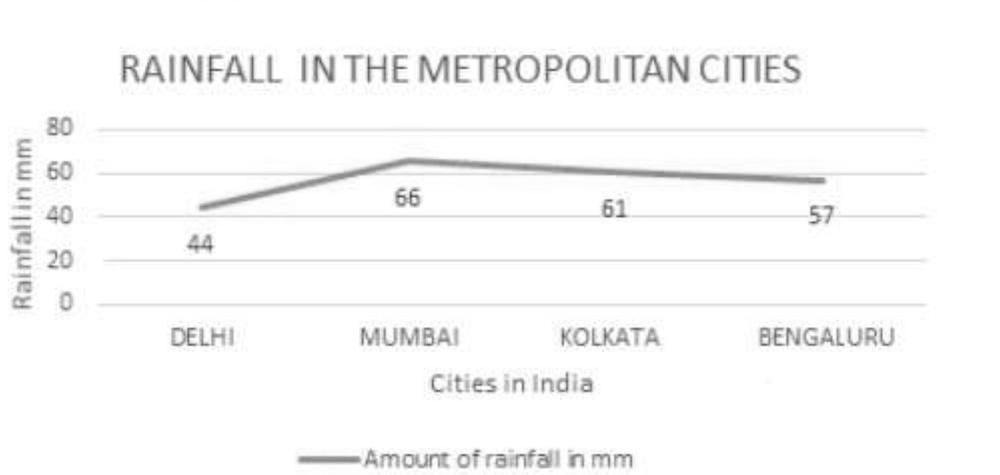
- A.
बेंगलुरु
- B.
कोलकाता
- C.
मुंबई
- D.
दिल्ली
Correct answer: A
Solution
अवधारणा: औसत (Average) = सभी मानों का योग ÷ मानों की कुल संख्या। यदि n मानों के समुच्चय में से कोई एक मान, शेष (n − 1) मानों के औसत के बराबर हो, तो वही मान पूरे समुच्चय (सभी n मानों) के औसत के भी बराबर होता है — क्योंकि यदि वह मान x है और शेष का औसत भी x है, तो कुल योग = x + (n − 1)·x = n·x, अर्थात x = कुल योग ÷ n, यानी संपूर्ण समुच्चय का औसत।
अनुप्रयोग: ग्राफ से प्राप्त वर्षा के आँकड़े निम्नानुसार हैं:
शहर
वर्षा (mm)
दिल्ली
44
मुंबई
66
कोलकाता
61
बेंगलुरु
57
चारों मानों का योग ज्ञात करें: 44 + 66 + 61 + 57 = 228 mm.
चारों शहरों का समग्र औसत ज्ञात करें: 228 ÷ 4 = 57 mm.
उपर्युक्त अवधारणा के अनुसार, वांछित शहर का अपना मान इसी समग्र औसत (57 mm) के बराबर होना चाहिए। प्रत्येक शहर के मान की समग्र औसत (57 mm) से तुलना करें: दिल्ली 44 ≠ 57, मुंबई 66 ≠ 57, कोलकाता 61 ≠ 57, परन्तु बेंगलुरु 57 = 57.
अतः बेंगलुरु की वर्षा (57 mm) समग्र औसत के बराबर है, इसलिए यही वह शहर है जिसकी वर्षा शेष तीन शहरों के औसत के बराबर है।
पुनः जांच: बेंगलुरु को छोड़कर शेष तीन शहरों — दिल्ली, मुंबई और कोलकाता — का औसत सीधे ज्ञात करें: (44 + 66 + 61) ÷ 3 = 171 ÷ 3 = 57 mm, जो बेंगलुरु की अपनी वर्षा (57 mm) से मेल खाता है। इस प्रकार उत्तर की पुष्टि हो जाती है।
- A.
- Q141.DSSSB 2025
वस्तु X और Y के क्रय मूल्यों का अनुपात 3 : 7 है। कोई व्यक्ति वस्तु X को बेचकर 25% लाभ अर्जित करता है और वस्तु Y को बेचकर 20% हानि वहन करता है। संपूर्ण लेन-देन में उसका लाभ/हानि प्रतिशत ज्ञात कीजिए।
- A.
हानि, 6.5%
- B.
लाभ, 6.5%
- C.
हानि, 6%
- D.
लाभ, 8%
Correct answer: A
Solution
अवधारणा: जब किसी व्यक्ति के पास एक निश्चित अनुपात में दो वस्तुएँ हों और प्रत्येक पर अलग-अलग प्रतिशत लाभ या हानि हो, तो समग्र लाभ/हानि प्रतिशत ज्ञात करने के लिए अनुपात के आधार पर प्रत्येक वस्तु का क्रय मूल्य (CP) मान लिया जाता है, प्रत्येक पर दिए गए प्रतिशत से विक्रय मूल्य (SP) निकाला जाता है, और अंत में कुल SP व कुल CP की तुलना से समग्र लाभ/हानि % = (कुल SP − कुल CP) / कुल CP × 100 सूत्र से प्राप्त किया जाता है।
अनुपात 3 : 7 के अनुसार वस्तु X का क्रय मूल्य = 3k तथा वस्तु Y का क्रय मूल्य = 7k मान लें, जहाँ कुल क्रय मूल्य = 10k है।
वस्तु X पर 25% लाभ होने से विक्रय मूल्य = 3k × 1.25 = 3.75k प्राप्त होता है।
वस्तु Y पर 20% हानि होने से विक्रय मूल्य = 7k × 0.80 = 5.6k प्राप्त होता है।
कुल विक्रय मूल्य = 3.75k + 5.6k = 9.35k है।
कुल विक्रय मूल्य (9.35k), कुल क्रय मूल्य (10k) से 0.65k कम है, अतः हानि = 0.65k होती है।
हानि प्रतिशत = (0.65k / 10k) × 100 = 6.5% प्राप्त होता है।
जाँच: इसे भारित औसत विधि से भी सत्यापित किया जा सकता है — वस्तु X का भार 3/10 तथा वस्तु Y का भार 7/10 है, अतः समग्र प्रतिशत परिवर्तन = (3/10 × 25%) + (7/10 × −20%) = 7.5% − 14% = −6.5%, अर्थात 6.5% की हानि, जो उपरोक्त गणना से प्राप्त परिणाम की पुष्टि करता है।
- A.
- Q142.DSSSB 2025
7230.8 × 353.5 × 0.868 का मान ______ के बराबर है।
- A.
72.308 × 3535 × 8.68
- B.
7.2308 × 35.35 × 86.8
- C.
7.2308 × 3.535 × 868
- D.
723.08 × 353.5 × 868
Correct answer: A
Solution
अवधारणा
किसी संख्या के दशमलव बिंदु को स्थानांतरित करना उसे 10 की किसी घात से गुणा करने के समान है: इसे 1 स्थान दाईं ओर ले जाने पर संख्या 10 से गुणा हो जाती है, और इसे 1 स्थान बाईं ओर ले जाने पर संख्या 10 से विभाजित हो जाती है। जब किसी गुणनफल के प्रत्येक गुणनखंड को उसके दशमलव बिंदु को स्थानांतरित करके पुनः लिखा जाता है, तो संपूर्ण गुणनफल का मान सभी अलग-अलग स्थानांतरणों के योग के बराबर 10 की घात से बदल जाता है। गुणनफल का मान अपने मूल मान के ठीक समान केवल तभी रहता है, जब 10 की घात का यह संयुक्त स्थानांतरण शून्य हो।
अनुप्रयोग
तुलना कीजिए कि प्रत्येक पुनर्लिखित व्यंजक 7230.8 × 353.5 × 0.868 के तीनों गुणनखंडों के दशमलव बिंदु को किस प्रकार स्थानांतरित करता है:
पुनर्लिखित व्यंजक
7230.8 में स्थानांतरण
353.5 में स्थानांतरण
0.868 में स्थानांतरण
10 की परिणामी घात
72.308 × 3535 × 8.68
2 स्थान बाईं ओर (10-2)
1 स्थान दाईं ओर (101)
1 स्थान दाईं ओर (101)
10-2+1+1 = 100
7.2308 × 35.35 × 86.8
3 स्थान बाईं ओर (10-3)
1 स्थान बाईं ओर (10-1)
2 स्थान दाईं ओर (102)
10-3-1+2 = 10-2
7.2308 × 3.535 × 868
3 स्थान बाईं ओर (10-3)
2 स्थान बाईं ओर (10-2)
3 स्थान दाईं ओर (103)
10-3-2+3 = 10-2
723.08 × 353.5 × 868
1 स्थान बाईं ओर (10-1)
कोई स्थानांतरण नहीं (100)
3 स्थान दाईं ओर (103)
10-1+0+3 = 102
केवल पुनर्लेखन 72.308 × 3535 × 8.68 में 10 की परिणामी घात का स्थानांतरण शून्य है, इसलिए केवल इसका मान ही मूल व्यंजक के मान के समान है।
पुनः-जाँच
दोनों गुणनफलों की प्रत्यक्ष गणना करके इसकी पुष्टि कीजिए:
7230.8 × 353.5 = 2,556,087.8
2,556,087.8 × 0.868 = 2,218,684.2104 — मूल व्यंजक का मान।
72.308 × 3535 = 255,608.78
255,608.78 × 8.68 = 2,218,684.2104 — मूल मान से पूर्णतः समान।
दशमलव-स्थानांतरण विधि और प्रत्यक्ष गणना, दोनों से समान निष्कर्ष प्राप्त होता है: 72.308 × 3535 × 8.68 मूल व्यंजक के बराबर है।
- A.
- Q143.DSSSB 2025
एक खिलौना बाइक का अंकित मूल्य ₹8,540 है और इसे ₹5,510 में बेचा जाता है। छूट प्रतिशत ज्ञात कीजिए। (दो दशमलव स्थानों तक पूर्णांकित कीजिए।)
- A.
37.38%
- B.
38.35%
- C.
38.59%
- D.
35.48%
Correct answer: D
Solution
अवधारणा: छूट प्रतिशत (Discount %) सदैव अंकित मूल्य (Marked Price) के सापेक्ष निकाला जाता है, विक्रय मूल्य (Selling Price) के सापेक्ष नहीं। सूत्र है — छूट% = [(अंकित मूल्य − विक्रय मूल्य) / अंकित मूल्य] × 100।
अंकित मूल्य (MP) = ₹8,540 तथा विक्रय मूल्य (SP) = ₹5,510 दिया गया है।
छूट की राशि = MP − SP = 8,540 − 5,510 = ₹3,030।
छूट प्रतिशत = (छूट की राशि / MP) × 100 = (3,030 / 8,540) × 100।
भाग करने पर: 3,030 ÷ 8,540 = 0.354801… ≈ 0.3548।
अतः छूट प्रतिशत ≈ 35.48% (दो दशमलव स्थानों तक पूर्णांकित)।
जांच: 35.48% छूट को पुनः अंकित मूल्य पर लागू करने पर — 8,540 × (1 − 0.3548) = 8,540 × 0.6452 ≈ ₹5,510, जो दिए गए विक्रय मूल्य से मेल खाता है और परिणाम की पुष्टि करता है।
परिणाम: बाइक पर दी गई छूट 35.48% है।
- A.
- Q144.DSSSB 2025
साक्षी को धारा की विपरीत दिशा में एक निश्चित दूरी तय करने में जितना समय लगता है, उसका तीन-चौथाई समय उतनी ही दूरी धारा की दिशा में तय करने में लगता है। शांत जल में नाव की चाल और धारा की चाल का अनुपात कितना है?
- A.
5 : 2
- B.
7 : 1
- C.
8 : 3
- D.
5 : 3
Correct answer: B
Solution
अवधारणा: नाव और धारा के प्रश्नों में, अनुप्रवाह चाल = नाव की चाल + धारा की चाल (b+s), तथा ऊर्ध्वप्रवाह चाल = नाव की चाल − धारा की चाल (b−s)। निश्चित दूरी के लिए, समय चाल के व्युत्क्रमानुपाती होता है, अतः समय1/समय2 = चाल2/चाल1।
अनुप्रयोग:
मान लें कि किसी निश्चित दूरी को ऊर्ध्वप्रवाह (धारा के विरुद्ध) तय करने में लगा समय t है। दिए गए कथन के अनुसार, उसी दूरी को अनुप्रवाह तय करने में इस समय का तीन-चौथाई, अर्थात् (3/4)t, समय लगता है।
दूरी d नियत होने पर: ऊर्ध्वप्रवाह चाल = d/t, तथा अनुप्रवाह चाल = d को (3/4)t से भाग देने पर = 4d/(3t)।
शांत जल में नाव की चाल, b = (अनुप्रवाह चाल + ऊर्ध्वप्रवाह चाल)/2 = (4d/3t + d/t)/2 = (7d/3t)/2 = 7d/(6t)।
धारा की चाल, s = (अनुप्रवाह चाल − ऊर्ध्वप्रवाह चाल)/2 = (4d/3t − d/t)/2 = (d/3t)/2 = d/(6t)।
अतः b : s = 7d/(6t) : d/(6t) = 7 : 1।
जांच: b = 7 इकाई तथा s = 1 इकाई लेने पर, अनुप्रवाह चाल = 8 इकाई और ऊर्ध्वप्रवाह चाल = 6 इकाई। समान दूरी d के लिए, ऊर्ध्वप्रवाह समय = d/6 तथा अनुप्रवाह समय = d/8। ऊर्ध्वप्रवाह समय का तीन-चौथाई = (3/4) × (d/6) = d/8, जो अनुप्रवाह समय के बराबर है—इससे 7 : 1 अनुपात की पुष्टि होती है।
- A.
- Q145.DSSSB 2025
182 km की दूरी तय करने में अभय को समीर से 5 घंटे ज्यादा लगते हैं। यदि अभय अपनी चाल को दोगुना करता है, तो उसे समीर से 8 घंटे कम लगेंगे। अभय की मूल चाल कितनी है?
- A.
14 km/h
- B.
7 km/hr
- C.
17 km/hr
- D.
1 km/hr
Correct answer: B
Solution
अवधारणा: निश्चित दूरी के लिए समय और चाल व्युत्क्रमानुपाती होते हैं: समय = दूरी ÷ चाल। जब दो व्यक्ति समान दूरी तय करते हैं, तो अलग-अलग चाल की स्थितियों में उनके समय की तुलना करने पर युगपत समीकरण प्राप्त होते हैं, जिन्हें हल करके प्रत्येक व्यक्ति की चाल ज्ञात की जा सकती है।
अनुप्रयोग:
माना अभय की प्रारंभिक चाल v km/h और समीर की चाल u km/h है; दोनों 182 km की दूरी तय करते हैं। अभय का प्रारंभिक समय = 182/v घंटे और समीर का समय = 182/u घंटे।
चूँकि अभय 182 km की दूरी तय करने में समीर से 5 घंटे अधिक लेता है: 182/v − 182/u = 5 (समीकरण 1)।
जब अभय अपनी चाल दोगुनी करके 2v km/h कर देता है, तो उसका नया समय = 182/(2v) = 91/v घंटे होता है और यह समीर के समय से 8 घंटे कम है: 182/u − 91/v = 8 (समीकरण 2)।
माना a = 182/v (अभय का प्रारंभिक समय) और b = 182/u (समीर का समय)। समीकरण 1 से a − b = 5 प्राप्त होता है, अतः a = b + 5।
समीकरण 2 का रूप b − a/2 = 8 हो जाता है। a = b + 5 प्रतिस्थापित करने पर: b − (b + 5)/2 = 8। दोनों पक्षों को 2 से गुणा करने पर: 2b − b − 5 = 16, अतः b = 21 घंटे।
तब a = b + 5 = 26 घंटे, अतः अभय की प्रारंभिक चाल v = 182/a = 182/26 = 7 km/h।
सत्यापन: समीर की चाल u = 182/21 = 26/3 km/h। अभय की चाल दोगुनी करने पर 2 × 7 = 14 km/h होती है, अतः उसका नया समय = 182/14 = 13 घंटे। समीर का समय 21 घंटे है और 21 − 13 = 8 घंटे, जो दी गई शर्त से पूर्णतः मेल खाता है—इससे पुष्टि होती है कि अभय की प्रारंभिक चाल 7 km/h है।
- A.
- Q146.DSSSB 2025
एक भंडारण टैंक में 50 लीटर पेट्रोल डालने के बाद भी वह 1% खाली रहता है। टैंक को पूरी तरह भरने के लिए कितने लीटर (दो दशमलव स्थानों तक पूर्णांकित) पेट्रोल की आवश्यकता होगी?
- A.
1.51
- B.
51.51
- C.
50.51
- D.
0.51
Correct answer: D
Solution
यदि कोई निश्चित मात्रा कुल मात्रा के p% को दर्शाती है, तो उस मात्रा को p के दशमलव रूप से भाग देकर कुल मात्रा ज्ञात की जा सकती है। पूर्ण कुल मात्रा तक पहुँचने के लिए अभी आवश्यक मात्रा, दी गई मात्रा को (1 − p) से गुणा करके p से भाग देने पर प्राप्त होती है।
माना भंडारण टंकी की पूर्ण क्षमता C लीटर है।
पहले से डाले गए 50 लीटर के बाद भी टंकी 1% खाली है; अतः डाले गए 50 लीटर, टंकी की क्षमता के 99% को दर्शाते हैं: 0.99 × C = 50।
क्षमता ज्ञात करने के लिए दोनों पक्षों को 0.99 से भाग दें: C = 50 ÷ 0.99 = 50.5050... लीटर।
आवश्यक अतिरिक्त पेट्रोल = क्षमता − पहले से डाले गए 50 लीटर: C − 50 = 50.5050... − 50 = 0.5050... लीटर।
दो दशमलव स्थानों तक पूर्णांकित करने पर आवश्यक अतिरिक्त पेट्रोल 0.51 लीटर है।
दूसरी विधि से क्रॉस-चेक: टंकी के 1% खाली भाग और 99% भरे भाग का अनुपात 1 : 99 है। चूँकि 99% भाग पहले से डाले गए 50 लीटर के बराबर है, इसलिए 1% भाग, अर्थात अभी आवश्यक आयतन, 50 × (1 ÷ 99) के बराबर है, जो लगभग 0.5051 लीटर है। इसे पूर्णांकित करने पर पुनः 0.51 लीटर प्राप्त होता है, जिससे उपर्युक्त परिणाम की पुष्टि होती है।
- A.
- Q147.DSSSB 2025
एक गोले का व्यास, एक छोटे गोले के व्यास से 14 cm अधिक है। बड़े गोले का पृष्ठीय क्षेत्रफल, छोटे गोले के पृष्ठीय क्षेत्रफल से 1232 cm² अधिक है। बड़े गोले का व्यास (cm में) ज्ञात कीजिए। (π = 22/7 का उपयोग कीजिए)
- A.
21
- B.
10.5
- C.
28
- D.
14
Correct answer: A
Solution
संकल्पना (Concept)
गोले का पृष्ठीय क्षेत्रफल A = 4πr² होता है, जहाँ r त्रिज्या है। यदि व्यास D = 2r हो, तो A = 4π(D/2)² = πD²। अतः दो गोलों के पृष्ठीय क्षेत्रफलों का अंतर होगा: A₁ − A₂ = π(D₁² − D₂²) = π(D₁ − D₂)(D₁ + D₂), जो वर्गों के अंतर की सर्वसमिका पर आधारित है।
अनुप्रयोग (Application)
मान लीजिए बड़े गोले का व्यास D तथा छोटे गोले का व्यास d है।
दिया है: D − d = 14 ... (समीकरण 1)
दिया है: π(D² − d²) = 1232
π = 22/7 रखने पर: D² − d² = 1232 × 7/22 = 392
सर्वसमिका D² − d² = (D − d)(D + d) का प्रयोग करने पर: 14 × (D + d) = 392, अतः D + d = 28 ... (समीकरण 2)
समीकरण (1) और (2) को जोड़ने पर: 2D = 42, अतः D = 21 cm
जाँच (Cross-check)
D = 21 cm तथा d = D − 14 = 7 cm रखकर स्वतंत्र रूप से पुनः जाँच करें: बड़े गोले की त्रिज्या r₁ = 10.5 cm, पृष्ठीय क्षेत्रफल = 4 × (22/7) × (10.5)² = 1386 cm². छोटे गोले की त्रिज्या r₂ = 3.5 cm, पृष्ठीय क्षेत्रफल = 4 × (22/7) × (3.5)² = 154 cm². अंतर = 1386 − 154 = 1232 cm², जो दी गई शर्त से पूर्णतः मेल खाता है, और D − d = 21 − 7 = 14 भी सत्यापित होता है।
अतः बड़े गोले का व्यास = 21 cm.
- A.
- Q148.DSSSB 2025
After decreasing 60% in the actual cost price, the reduced cost price of an article is ₹996. The actual cost price of the article (in ₹) is:
- A.
₹1,660
- B.
₹597.6
- C.
₹2,490
- D.
₹398.4
Correct answer: C
Solution
Concept
When a quantity is decreased by r%, the resulting value equals (100 minus r) percent of the original quantity. To recover the original quantity from a given reduced value, divide the reduced value by the fraction that remains, (100 minus r) divided by 100.
Applying It Here
Let the actual cost price of the article be C.
The cost price is decreased by 60%, so the reduced cost price equals (100 minus 60) percent, that is 40%, of C.
Set up the equation: 40% of C equals ₹996, that is, 0.40 times C equals 996.
Solve for C: C equals 996 divided by 0.40, which equals ₹2,490.
Cross-Check
60% of ₹2,490 is ₹1,494. Subtracting this from ₹2,490 gives ₹2,490 minus ₹1,494 equals ₹996, which matches the reduced cost price stated in the question.
Answer
The actual cost price of the article is ₹2,490.
- A.
- Q149.DSSSB 2025
Select the most appropriate option that can substitute the underlined words in the given sentence.
The author's new book was a collection of short stories.
- A.
Magazine
- B.
Anthology
- C.
Series
- D.
Novel
Correct answer: B
Solution
Concept: A one-word substitution question asks you to replace an underlined word or phrase with a single word that carries exactly the same meaning, without changing what the sentence originally conveys.
Application: Here the underlined phrase "collection of short stories" means several individual stories that have been gathered and published together in one bound volume. The single English word for exactly this idea is "anthology" — a published compilation that brings together a number of separate pieces of writing (stories, poems, or essays), often by one or several authors, in a single book.
Cross-check: None of the remaining options names a bound compilation of several stories in one volume:
Magazine — a periodical issued at regular intervals (weekly or monthly) carrying articles from multiple contributors, not a single bound volume of stories.
Series — a set of related works, such as novels or films, released one after another in succession, not a single compiled volume.
Novel — one single, continuous work of fiction built around one main plot, the opposite of a compilation of separate short pieces.
Result: "Anthology" is the word that correctly substitutes "collection of short stories" in the sentence.
- A.
- Q150.DSSSB 2025
Select the most appropriate homonym to fill in the blank.
Saraswathi relied on census data to analyse population trends in her research. Census here means __________.
- A.
criticize strongly
- B.
an official count of a population
- C.
in or near the centre
- D.
very critical
Correct answer: B
Solution
When several options list different meanings for a word or a set of similar-sounding words, the surrounding sentence decides which meaning fits: its subject matter, register, and the words that collocate with the blank point to the sense that was intended.
In this sentence, "census" appears together with "data", "analyse", "population trends", and "research" -- all terms tied to demographic and statistical study. That context signals the sense of "census" as a formal, official survey that records counts and details about a population, which is exactly what "an official count of a population" expresses.
"criticize strongly" expresses strong disapproval or condemnation -- a sense with no connection to gathering population statistics.
"in or near the centre" expresses physical or spatial position -- unrelated to demographic research.
"very critical" expresses a fault-finding personal quality -- again unrelated to a data-gathering exercise.
Since the sentence is about analysing population data through research, the meaning that fits the blank is "an official count of a population".
- A.
- Q151.DSSSB 2025
Select the most appropriate adjective to fill in the blank.
Vighnesh is always ______ while talking to his elders.
- A.
affable
- B.
plumpy
- C.
dilapidated
- D.
petite
Correct answer: A
Solution
A fill-in-the-blank vocabulary item like this calls for the adjective whose core dictionary meaning matches the trait or manner being described in the sentence, not simply a word that sounds plausible in isolation. Adjectives describing a person's temperament or manner in interaction (friendly, courteous, easy to talk to) belong to a different category than adjectives describing physical build, physical condition, or size.
Here the sentence describes how Vighnesh consistently behaves while talking to his elders — it calls for a word about his conversational manner or disposition toward older people. "Affable" denotes being friendly, warm, and easy to approach in conversation, which is exactly the kind of trait the sentence is describing about his manner of talking.
"plumpy" is an informal, non-standard variant of "plump," describing a rounded or chubby physical build — a description of body shape, not of conversational manner.
"dilapidated" describes a building, structure, or object that has fallen into disrepair through age or neglect — it does not apply to a person's demeanor.
"petite" describes a small, slender physical build, typically used for a person's stature — again a physical description, not a manner of interacting.
Checking each option against the category the sentence calls for (a trait of conversational manner, not physical build or condition) confirms that only "affable" fits, since it is the sole option describing a friendly, approachable way of talking to others.
- A.
- Q152.DSSSB 2025
Select the most appropriate meaning of the given idiom.
Make all the difference
- A.
Influence someone or something in a negative way
- B.
Influence someone or something in a positive way
- C.
Have a brief and concise summary
- D.
Have a well-mannered approach
Correct answer: B
Solution
Concept: An idiom is a fixed expression whose overall meaning differs from a literal, word-by-word reading, so it must be matched to its accepted dictionary sense rather than parsed literally.
Application: Standard usage references (such as the Cambridge and Oxford learner's dictionaries) define the idiom "make all the difference" as producing an important, beneficial effect on a situation or outcome -- that is, to influence something for the better.
Cross-check: Comparing each offered meaning against this accepted sense:
"Influence someone or something in a negative way" describes the opposite polarity of effect and does not match the idiom's established positive sense.
"Have a brief and concise summary" describes conciseness, which is the sense of a different idiom (such as "in a nutshell"), not of "make all the difference".
"Have a well-mannered approach" describes conduct or etiquette, unrelated to producing an effect on an outcome.
Result: the idiom "make all the difference" therefore means to influence someone or something in a positive way.
- A.
- Q153.DSSSB 2025
Select the most appropriate meaning of the given idiom.
Make a beeline for
- A.
To remain ideal
- B.
To think divergently
- C.
To remain in passive state
- D.
To remain focused on one goal
Correct answer: D
Solution
CONCEPT: An idiom is a fixed expression whose overall meaning is a matter of convention and is fixed by standard dictionary usage, not derived word by word; answering an idiom-meaning question correctly means matching the idiom to its accepted figurative sense(s) in standard English usage, not to a literal or partial reading of the words in it.
APPLICATION: The idiom "make a beeline for" draws on the image of a bee flying in a straight, direct line toward a flower or its hive. Standard English usage records more than one accepted paraphrase of this single underlying sense: "to go straight for something," "to not deviate when moving forward," and "to remain focused on one goal" are all listed as recognized meanings of this idiom, because the core idea in every case is the same -- moving toward, or staying fixed on, exactly one target without turning aside to anything else. Among the four given options, "to remain focused on one goal" is this recognized, dictionary-listed paraphrase of the idiom.
CROSS-CHECK (why each other option does not match):
"To remain ideal" is about maintaining a flawless or idealized state, not about any directed movement or attention toward a target.
"To think divergent" is about thought spreading outward toward multiple different directions, which is the reverse of following a single direct line.
"To remain in passive state" is about staying inactive and disengaged, which contradicts the deliberate, active thrust that "make a beeline" conveys.
"To remain focused on one goal" matches the idiom's recognized undeviating, single-target sense.
RESULT: "To remain focused on one goal" is therefore the meaning that matches the idiom "make a beeline for."
- A.
- Q154.DSSSB 2025
Select the most appropriate homonym to fill in the blank.
Vishnu checked his watch to see if he was late for school. Watch here means ______.
- A.
an act of watching
- B.
look at attentively
- C.
be careful about
- D.
a small timepiece usually worn on the wrist
Correct answer: D
Solution
A homonym is a word that shares the same spelling and pronunciation as another word but carries a different meaning depending on its grammatical function and the context it appears in; the intended sense is identified by examining the verb it pairs with and the role it plays in the sentence.
In "Vishnu checked his watch to see if he was late for school," the verb "checked" needs a noun as its object — something Vishnu can check in order to find out the time. This grammatical slot can only be filled by the noun sense of "watch" that refers to a physical timepiece.
"An act of watching" is also a noun, but it names the activity of observing (as in "keep watch"), not an object one can check for the time. "Look at attentively" and "be careful about" are both verb senses of "watch" (as in "watch the game" or "watch your step"), and a verb cannot serve as the direct object of "checked." "A small timepiece usually worn on the wrist" is the noun sense naming a device that displays time — the only sense that fits both the grammatical slot (object of "checked") and the meaning of finding out whether he was late.
Therefore, "watch" in this sentence means a small timepiece usually worn on the wrist.
- A.
- Q155.DSSSB 2025
Select the option that can be used as a one-word substitute for the group of words given in the brackets.
He adhered strictly to ______ (accepting and closely following the traditional beliefs and customs of a religion) traditions, following the customs and beliefs passed down through generations in his community.
- A.
heterodox
- B.
iconoclastic
- C.
dogmatic
- D.
orthodox
Correct answer: D
Solution
Concept: One-word-substitution questions test whether a single word precisely captures a given definition. For words describing a person's stance toward religious tradition, the key distinction is between conforming to accepted beliefs (orthodox), rejecting them (heterodox), attacking cherished beliefs and institutions (iconoclastic), and rigidly asserting one's own opinions as unquestionably true (dogmatic).
Application: The bracketed definition is “accepting and closely following the traditional beliefs and customs of a religion.” This is the standard dictionary meaning of “orthodox” (from the Greek orthodoxos, “having the right opinion”): conforming to the conventional or traditionally accepted form of a religion, in both belief and practice. Substituting it into the sentence — “He adhered strictly to orthodox traditions, following the customs and beliefs passed down through generations in his community” — reads naturally: “adhered strictly” and “passed down through generations” both reinforce continuity with established tradition, exactly what “orthodox” denotes.
Cross-check: contrast against the other options:
heterodox means holding opinions or beliefs that diverge from the accepted or traditional standard — the opposite of following tradition.
iconoclastic means attacking or seeking to overturn cherished, long-held beliefs and institutions — actively rejecting tradition rather than following it.
dogmatic means asserting one's own opinions as unquestionably true without regard to evidence — a trait about the manner of holding a view, not about adherence to religious tradition.
Only “orthodox” matches the bracketed definition.
- A.
- Q156.DSSSB 2025
Select the INCORRECTLY spelt word.
- A.
Imperturbable
- B.
Immaculate
- C.
Inarticullate
- D.
Impervious
Correct answer: C
Solution
English spelling errors in words built from a Latin prefix + root + suffix (such as in-/im- + root + -ate/-able) most often come from doubling a consonant that should appear only once, or the reverse. To check such a word, split it into its prefix, root, and suffix, and verify each segment against the word's standard dictionary form.
Imperturbable = im- (not) + perturb (Latin perturbare, to disturb) + -able: each consonant in the '-turb-' segment appears only once, matching the standard dictionary form.
Immaculate = im- (not) + maculate (Latin macula, a spot/stain): the prefix 'im-' before a root beginning with 'm' doubles the 'm', giving 'immaculate' as the standard dictionary form.
Inarticulate = in- (not) + articul- (Latin articulus, a joint) + -ate: the root segment '-articul-' takes a single 'l', so the standard dictionary form is 'inarticulate', not 'inarticullate'.
Impervious = im- (not) + pervious (Latin per, through + via, way): each consonant appears singly, matching the standard dictionary form.
Cross-checking against related word forms confirms this: 'articulate', 'articulation', and 'articulately' all use a single 'l' in the '-articul-' segment in every standard dictionary; no accepted form of this word family carries a double 'l'.
So the word given as 'Inarticullate' carries an extra 'l' that the standard spelling does not have, making it the incorrectly spelt word among the four options.
- A.
- Q157.DSSSB 2025
Select the most appropriate adjective to fill in the blank.
Amit's wedding was ______ and cost a lot of money.
- A.
extravagant
- B.
considerate
- C.
desirable
- D.
alluring
Correct answer: A
Solution
Concept
In "select the most appropriate word" fill-in-the-blank questions, the deciding factor is the specific clue given elsewhere in the sentence: near-synonym adjectives can carry very different senses, so the word chosen must match that context clue precisely, not just sound generally positive or attractive.
Application
The clause "and cost a lot of money" is the context clue here -- it points to spending that is excessive and lavish. "Extravagant" is the adjective that specifically denotes spending or costing far more than is necessary, so it fits the clue directly: "Amit's wedding was extravagant and cost a lot of money."
Contrast
The remaining adjectives describe qualities that are unrelated to lavish spending:
considerate -- thoughtful of others' feelings; not about money spent.
desirable -- worth having or wanting; carries no inherent link to cost.
alluring -- attractive or tempting; again unconnected to expense.
- A.
- Q158.DSSSB 2025
Select the most appropriate option that can substitute the underlined words in the given sentence.
Sarita's fear of confined spaces made it difficult for her to take the elevator.
- A.
Claustrophobia
- B.
Agoraphobia
- C.
Acrophobia
- D.
Xenophobia
Correct answer: A
Solution
One-word substitution questions test the ability to replace a descriptive phrase with a single precise word carrying the same meaning. Words built on the "-phobia" suffix name a specific fear, and the root before it identifies exactly what triggers that fear, so matching the correct term requires identifying the specific object or situation the phrase describes, not just recognising the general idea of fear.
The underlined phrase describes an intense, irrational fear of being shut inside small or enclosed spaces, illustrated in the sentence by Sarita's reluctance to step into a lift. The single word for this specific fear is claustrophobia, formed from the Latin root claustrum ("a bolted or enclosed place") and the Greek phobos ("fear").
Agoraphobia describes a fear centred on open, crowded, or inescapable public spaces, the opposite setting from a small enclosed lift.
Acrophobia describes a fear of heights, which is a different trigger from the confinement described in the sentence.
Xenophobia describes a fear or dislike of strangers or foreign people, unrelated to physical spaces altogether.
Since the sentence's trigger is confinement rather than height, openness, or unfamiliarity, claustrophobia is the only term that substitutes the underlined phrase without changing the sentence's meaning.
- A.
- Q159.DSSSB 2025
Select the most appropriate option to fill in the blanks.
She made ______ delicious cake for ______ eighteenth birthday of her daughter.
- A.
No article, a
- B.
a, an
- C.
the, No article
- D.
a, the
Correct answer: D
Solution
Concept
Article choice in English rests on two rules: an indefinite article ('a' or 'an') is used when a noun is introduced for the first time in a general, non-specific way, chosen by the sound that begins the next word — 'a' before a consonant sound and 'an' before a vowel sound; a definite article ('the') is used when the noun refers to something the listener can already identify as one particular thing, which is also the article that ordinal numbers such as 'first', 'second', or 'eighteenth' normally take when they mark one specific occasion.
Application
In this sentence, 'delicious cake' is mentioned for the very first time and is not yet known to the listener, so it needs an indefinite article; the following word 'delicious' begins with the consonant sound /d/, so the correct indefinite article is 'a'. 'Eighteenth birthday' is not a generic birthday — it is one specific, already-understood occasion, the daughter's eighteenth birthday — so it takes the definite article 'the', regardless of the vowel sound that 'eighteenth' begins with.
Cross-check
Substituting the chosen pair back into the sentence gives: 'She made a delicious cake for the eighteenth birthday of her daughter.' This reads naturally — 'a' correctly precedes a consonant-sound word being introduced for the first time, and 'the' correctly precedes an ordinal number that refers to one specific, identifiable event.
Why the other pairings do not fit
Leaving the first blank with no article at all is inconsistent with a singular countable noun being introduced for the first time — a bare noun like this is reserved for uncountable or plural, generic references. Placing 'a' in the second blank also clashes with the a/an sound rule, since 'eighteenth' begins with the vowel sound /eɪ/.
'an' matches the vowel sound of 'eighteenth', but 'an' is an indefinite article, while the sentence refers to one specific, already-identified birthday — a specific occasion calls for the definite article, not an indefinite one.
'the' before 'delicious cake' wrongly treats the cake as something the listener already knows about, even though the sentence introduces it for the first time; leaving 'eighteenth' with no article at all also omits any determiner before an ordinal number meant to single out one occasion.
The pairing that satisfies both rules is 'a, the'.
- A.
- Q160.DSSSB 2025
Select the most appropriate adjective to fill in the blank.
Simrin and Kannan had a ______ bond that nothing could break.
- A.
kindred
- B.
grave
- C.
frail
- D.
grumpy
Correct answer: A
Solution
Vocabulary-based fill-in-the-blank items are solved by comparing each candidate word's precise dictionary meaning against every logical requirement set by the rest of the sentence. The correct choice must be semantically consistent with the full context, not just a familiar-sounding word.
The sentence requires an adjective describing a personal connection between Simrin and Kannan that is strong enough to be unbreakable ("that nothing could break"). "Kindred" means very similar in nature, spirit, or feeling; closely related or akin (as in the common phrase "kindred spirits"). A bond rooted in this kind of deep natural affinity logically supports being described as unbreakable, so "kindred" satisfies the sentence's requirement.
"Grave" means serious, solemn, or of great importance (as in a grave expression or a grave decision). It describes tone or gravity, not the closeness or durability of a personal relationship, so it does not fit "bond."
"Frail" means physically weak, fragile, or easily damaged (as in a frail structure or frail health). This meaning is the opposite of what "that nothing could break" requires, so it directly contradicts the sentence.
"Grumpy" means easily irritated, bad-tempered, or given to complaining (as in a grumpy mood or a grumpy reply). It describes a person's temperament, not the nature of a bond between two people.
The bond between Simrin and Kannan is described as unbreakable, which matches a connection rooted in deep natural affinity. The correct adjective is "kindred."
- A.
- Q161.DSSSB 2025
Select the most appropriate option that can substitute the underlined words in the given sentence.
The criminal was given an official pardon by the President.
- A.
Amnesty
- B.
Reprieve
- C.
Clemency
- D.
Absolution
Correct answer: C
Solution
Concept: In one-word-substitution and near-synonym questions, several options often share one broad sense (for example, "being excused from a punishment"), so the task is to match the sentence's exact register and scope — individual versus group, temporary versus full, legal versus moral — to the single word whose established meaning fits precisely.
The underlined phrase describes an authority (the President) formally excusing one convicted individual from punishment for a crime.
Each option is compared against that precise sense: an act of mercy or leniency exercised by an authority toward an individual's punishment for an offence.
Clemency matches this sense directly — it names an authority's act of mercy that pardons, reduces, or excuses an individual's punishment.
Cross-check against the other options, by value:
Amnesty denotes an official pardon extended to a whole class or group of offenders, most often for political or wartime offences, rather than to one named individual for an ordinary criminal act.
Reprieve denotes only the postponement or cancellation of a scheduled punishment (most commonly a stay of execution); it does not by itself excuse or remove the punishment.
Absolution denotes a formal release from guilt or blame rooted in moral and religious usage (such as absolution from sin), rather than an authority's act on a criminal punishment.
None of these three matches the individual, authority-granted, punishment-excusing sense of "official pardon" as precisely as Clemency does, so Clemency is the word that best substitutes the underlined phrase.
- A.
- Q162.DSSSB 2025
Select the most appropriate option to fill in the blanks.
She has a degree in ______ commerce and teaches at ______ local degree college.
- A.
the, a
- B.
No article, a
- C.
the, the
- D.
a, No article
Correct answer: B
Solution
Concept: English uses three article choices for a noun: the indefinite article "a/an" before a singular countable noun mentioned for the first time; the definite article "the" before a noun referring to something specific, already known, or previously mentioned; and no article at all before an uncountable noun, an abstract concept, or the name of an academic field used in a general sense (e.g. commerce, physics, music).
In the first blank, "commerce" names an academic field used in a general sense, not one specific instance of it, so it takes no article.
In the second blank, "local degree college" is a singular countable institution being mentioned for the first time, not one already identified to the listener, so it takes the indefinite article "a".
Filling both blanks this way gives: "She has a degree in commerce and teaches at a local degree college."
Cross-check: Testing the alternative fillers confirms this reading. Placing "the" before "commerce" would incorrectly imply one particular, already-specified branch of commerce rather than the general field. Placing "the" before "college" would require that college to have been identified earlier in the conversation, which it has not been; placing "a" before "commerce" would wrongly treat an uncountable field as one countable instance; and omitting the article before "college" would wrongly treat a singular institution as an uncountable or generic category.
- A.
- Q163.DSSSB 2025
Select the INCORRECTLY spelt word from the given sentence.
Behavioural psychology delves into the realm of cognitive biases and decision making heruistics and the psychology of risk and reward.
- A.
realm
- B.
psychology
- C.
heruistics
- D.
biases
Correct answer: C
Solution
Spot-the-error / "select the incorrectly spelt word" questions test whether you can recognise a word's standard, dictionary-accepted spelling inside continuous prose. The reliable method is to isolate each candidate word from the sentence and compare its letter-by-letter sequence against the word it is meant to represent — paying special attention to words built from Greek or Latin roots, where letter order (e.g., a root beginning "heur-" as in "heuristic" or "eureka") is a common source of transposition errors.
"realm" (r-e-a-l-m) — a domain or sphere of activity; the spelling matches its standard form.
"psychology" (p-s-y-c-h-o-l-o-g-y) — from Greek psykhe + logia; the spelling matches its standard form.
"heruistics" — intended to represent "heuristics", from the Greek root heuriskein ("to find/discover"), correctly spelled h-e-u-r-i-s-t-i-c-s. The sentence's form transposes the second and third letters of the root, giving h-e-r-u-i-s-t-i-c-s — a misspelling.
"biases" (b-i-a-s-e-s) — plural of "bias"; the spelling matches its standard form.
Reading the root aloud alongside familiar cognates such as "eureka" and "heuristic" confirms the accepted letter order is h-e-u-r-, not h-e-r-u-; substituting the standard spelling "heuristics" into the sentence changes no meaning, confirming this is purely a spelling error rather than a different intended word.
Therefore, "heruistics" is the incorrectly spelt word in the sentence.
- A.
- Q164.DSSSB 2025
Comprehension:
Read the given passage and answer the questions that follow.
One potential cause of human extinction is global warming, but even without human-induced climate change, the sun's increasing radiation will eventually bring about our demise. A 2014 article in Science presents two models for this countdown, one more pessimistic than the other. Researchers from Pennsylvania State University, led by Ravi Kopparapu, predicted that with a 6% increase in solar radiation, in 150 million years, only underwater life and some resilient microbes will remain. According to this model, our species could be extinct within this timeframe.
Alternatively, if Earth's temperatures rise more gradually, we might have 600 to 700 million years left, based on the "Kopparapu model."
Wolf and Toon argue that we have 1.5 billion years left. Eventually, habitable territory would shrink to a strip around the poles. The ultimate end will come much later, in about four billion years, when the sun goes out. As the sun becomes a "red giant," it could strip away Earth's atmosphere, leaving a magma-covered surface with metal oxide icebergs floating on it.
These projections underscore the finite nature of our existence on this planet, emphasizing the importance of understanding and preparing for these eventualities.
Which of the following predictions is NOT made in the passage?
- A.
Survival of underwater life
- B.
Discovery of new life forms
- C.
Earth's atmosphere being stripped away
- D.
Human extinction within 150 million years
Correct answer: B
Solution
In a "which prediction is NOT made" question on a passage, treat every option as a claim and test it against the passage's explicit sentences: an option that restates something the passage actually asserts is a prediction the passage makes, while an option describing an idea the passage never raises is the one that is NOT made, regardless of how plausible it sounds on its own.
"Survival of underwater life" — the passage states that after a 6% rise in solar radiation, in 150 million years, "only underwater life and some resilient microbes will remain," a direct textual claim about aquatic survival.
"Earth's atmosphere being stripped away" — the passage states that as the sun becomes a "red giant," it "could strip away Earth's atmosphere," leaving a magma-covered surface, a direct textual claim about atmospheric loss.
"Human extinction within 150 million years" — the same passage states that "our species could be extinct within this timeframe" of 150 million years, a direct textual claim about a human extinction timeline.
"Discovery of new life forms" — no sentence anywhere in the passage discusses finding, discovering, or identifying any new or previously unknown organism; the passage discusses only the survival, decline, or extinction of life that already exists.
Re-reading the passage's four main claims — solar-radiation-driven extinction, the Kopparapu timeframe, the longer Wolf-and-Toon estimate, and the red-giant atmosphere-stripping endgame — confirms that none of them mentions discovering new species, independently ruling out the other three options and isolating the one with no textual anchor.
"Discovery of new life forms" is the prediction that is NOT made in the passage.
- A.
- Q165.DSSSB 2025
Comprehension:
Read the given passage and answer the questions that follow.
One potential cause of human extinction is global warming, but even without human-induced climate change, the sun's increasing radiation will eventually bring about our demise. A 2014 article in Science presents two models for this countdown, one more pessimistic than the other. Researchers from Pennsylvania State University, led by Ravi Kopparapu, predicted that with a 6% increase in solar radiation, in 150 million years, only underwater life and some resilient microbes will remain. According to this model, our species could be extinct within this timeframe.
Alternatively, if Earth's temperatures rise more gradually, we might have 600 to 700 million years left, based on the "Kopparapu model."
Wolf and Toon argue that we have 1.5 billion years left. Eventually, habitable territory would shrink to a strip around the poles. The ultimate end will come much later, in about four billion years, when the sun goes out. As the sun becomes a "red giant," it could strip away Earth's atmosphere, leaving a magma-covered surface with metal oxide icebergs floating on it.
These projections underscore the finite nature of our existence on this planet, emphasizing the importance of understanding and preparing for these eventualities.
According to Wolf and Toon, when will the ultimate end come?
- A.
600 to 700 million years
- B.
1.5 billion years
- C.
4 billion years
- D.
3 billion years
Correct answer: C
Solution
Concept
In a "according to X" reading-comprehension question, the correct answer is the fact the passage explicitly attributes to the named source X — the number, date, or claim stated in the sentence introduced by or immediately following that source's name, with no competing attribution from another named source in between.
Application
The passage lays out two separate estimates, each tied to a named source. The Kopparapu-led team (Pennsylvania State University) is credited with the 150-million-year pessimistic figure and, under a more gradual-warming scenario, the alternative 600-to-700-million-year figure — both explicitly tied to "the Kopparapu model." The passage then introduces a second, independent estimate: "Wolf and Toon argue that we have 1.5 billion years left." Everything that follows this sentence, up to the next new topic (the sun becoming a red giant and stripping Earth's atmosphere), continues within the Wolf-and-Toon estimate, since no other named researcher appears in between: "Eventually, habitable territory would shrink to a strip around the poles. The ultimate end will come much later, in about four billion years, when the sun goes out." The question asks specifically for the timeframe "the ultimate end" comes according to Wolf and Toon, and the passage states this directly: about four billion years.
Cross-check
600 to 700 million years is the Kopparapu model's gradual-warming alternative to its own 150-million-year pessimistic estimate — attributed to the Kopparapu team, not to Wolf and Toon.
1.5 billion years is the number of years Wolf and Toon estimate remain before habitable territory shrinks to a strip around the poles — an intermediate stage in their timeline, not "the ultimate end."
3 billion years is not stated anywhere in the passage.
The ultimate end, according to Wolf and Toon, comes in about four billion years, when the sun goes out — so "4 billion years" is correct.
- A.
- Q166.DSSSB 2025
Comprehension:
Read the given passage and answer the questions that follow.
One potential cause of human extinction is global warming, but even without human-induced climate change, the sun's increasing radiation will eventually bring about our demise. A 2014 article in Science presents two models for this countdown, one more pessimistic than the other. Researchers from Pennsylvania State University, led by Ravi Kopparapu, predicted that with a 6% increase in solar radiation, in 150 million years, only underwater life and some resilient microbes will remain. According to this model, our species could be extinct within this timeframe.
Alternatively, if Earth's temperatures rise more gradually, we might have 600 to 700 million years left, based on the "Kopparapu model."
Wolf and Toon argue that we have 1.5 billion years left. Eventually, habitable territory would shrink to a strip around the poles. The ultimate end will come much later, in about four billion years, when the sun goes out. As the sun becomes a "red giant," it could strip away Earth's atmosphere, leaving a magma-covered surface with metal oxide icebergs floating on it.
These projections underscore the finite nature of our existence on this planet, emphasizing the importance of understanding and preparing for these eventualities.
What does the passage imply about the survival of life on Earth?
- A.
No life will survive the next century
- B.
Life will continue indefinitely
- C.
Only microbial life will survive eventually
- D.
Atmospheric changes will prevent any form of life
Correct answer: C
Solution
An inference question does not ask for a sentence copied out of the passage. It asks which of the offered readings the passage best supports — the one the text asserts outright or directly entails. An exact restatement is not required, and is often not on offer; the task is comparative.
Two rules settle close calls. A statement the text makes flatly outranks one it hedges with a word such as “could”. And the chosen reading must answer the question actually asked: when the stem asks what survives, a reading about surviving organisms answers it, while one that only fixes a date for the end does not.
The stem asks what the passage implies about the survival of life on Earth, so the load-bearing sentence is the passage’s one direct statement about survivors: in the Pennsylvania State University projection led by Ravi Kopparapu, a 6% increase in solar radiation leaves, in 150 million years, “only underwater life and some resilient microbes”. The passage therefore asserts a middle outcome — complex life on the surface is lost, while sheltered and hardy organisms persist — and it names microbes explicitly among what remains.
Read strictly, the passage lists two survivor categories, and “only microbial life” compresses them into one; the text does not say that all underwater life is microbial. That looseness sits in the option’s wording, not in the reading it expresses. Judged comparatively — which is what an inference question demands — it is still the only offered reading on which any life persists at all; every other choice either ends all life or preserves all life.
“No life will survive the next century” — the earliest dated projection in the passage is 150 million years, and the passage assigns no outcome at all to the coming hundred years.
“Life will continue indefinitely” — the closing sentence describes these projections as underscoring the finite nature of our existence on this planet.
“Atmospheric changes will prevent any form of life” — the closest competitor, since the sun as a red giant is described stripping away the atmosphere about four billion years out. It loses on both rules above: the passage says this “could” happen, and it never states that no form of life would remain.
“Only microbial life will survive eventually” — the one reading built on the passage’s explicit survivor sentence, in which resilient microbes are among what is left once complex life, humans included, is gone.
So the inference the passage supports is that life on Earth neither ends abruptly nor continues without limit: complex life is lost, and the hardy microbial life the passage names is what eventually remains.
- A.
- Q167.DSSSB 2025
Comprehension:
Read the given passage and answer the questions that follow.
One potential cause of human extinction is global warming, but even without human-induced climate change, the sun's increasing radiation will eventually bring about our demise. A 2014 article in Science presents two models for this countdown, one more pessimistic than the other. Researchers from Pennsylvania State University, led by Ravi Kopparapu, predicted that with a 6% increase in solar radiation, in 150 million years, only underwater life and some resilient microbes will remain. According to this model, our species could be extinct within this timeframe.
Alternatively, if Earth's temperatures rise more gradually, we might have 600 to 700 million years left, based on the "Kopparapu model."
Wolf and Toon argue that we have 1.5 billion years left. Eventually, habitable territory would shrink to a strip around the poles. The ultimate end will come much later, in about four billion years, when the sun goes out. As the sun becomes a "red giant," it could strip away Earth's atmosphere, leaving a magma-covered surface with metal oxide icebergs floating on it.
These projections underscore the finite nature of our existence on this planet, emphasizing the importance of understanding and preparing for these eventualities.
Select the most appropriate ANTONYM of the given word as used in the passage.
Resilient
- A.
Uncertain
- B.
Brief
- C.
Weak
- D.
Endless
Correct answer: C
Solution
CONCEPT: An antonym is a word whose meaning is the direct opposite of another word's meaning. For a word used within a passage, the antonym must oppose the specific sense the word carries in that context, not just any dictionary sense of the word.
APPLICATION: In the passage, 'resilient' describes microbes that are predicted to withstand and survive the extremely harsh conditions caused by a 6% rise in solar radiation over 150 million years — the sense here is 'tough, hardy, able to endure hardship.' The opposite of this sense is a word meaning 'lacking strength or the ability to endure hardship.'
CROSS-CHECK: contrasting each option by value against this sense of resilient:
'Uncertain' opposes 'certain/sure' — a knowledge/certainty dimension, not a strength/endurance dimension.
'Brief' opposes 'long-lasting' — a duration dimension, not a strength/endurance dimension.
'Endless' opposes 'brief/finite' — also a duration dimension, not a strength/endurance dimension.
'Weak' opposes exactly the strength/endurance dimension that 'resilient' occupies.
Therefore, the antonym of 'resilient' as used in the passage is 'Weak.'
- A.
- Q168.DSSSB 2025
'गाँठ का पूरा, आँख का अंधा' लोकोक्ति का अर्थ क्या है?
- A.
झूठ और ढोंग रचना
- B.
सब बदमाश एक से होते हैं
- C.
पैसे वाला तो है पर मूर्ख
- D.
चंचल मन वाला
Correct answer: C
Solution
लोकोक्तियाँ और मुहावरे शब्दशः अर्थ के बजाय एक विशेष लाक्षणिक अर्थ व्यक्त करते हैं, जो शब्दों के प्रचलित प्रयोग व परंपरा से तय होता है, न कि प्रत्येक शब्द के व्यक्तिगत शब्दार्थ के योग से। अतः सही अर्थ जानने के लिए लोकोक्ति के मानक/स्थापित प्रयोग को देखना आवश्यक है।
प्रस्तुत लोकोक्ति में 'गाँठ का पूरा' का अर्थ है जिसकी गाँठ (धन रखने की पोटली) भरी हो, अर्थात् जो धनवान/पैसे वाला हो; तथा 'आँख का अंधा' का लाक्षणिक अर्थ है विवेकहीन या मूर्ख होना (आँखें होते हुए भी उचित-अनुचित न पहचान पाना)। दोनों भागों को मिलाकर यह लोकोक्ति ऐसे व्यक्ति के लिए प्रयुक्त होती है जो धनवान तो है परंतु मूर्ख/विवेकहीन है।
'झूठ और ढोंग रचना' जैसा भाव 'ऊपर से राम-राम, भीतर से घात' जैसी लोकोक्तियों से जुड़ा माना जाता है, प्रस्तुत लोकोक्ति के शब्दों से नहीं निकलता।
'सब बदमाश एक से होते हैं' का भाव 'चोर-चोर मौसेरे भाई' जैसी लोकोक्ति व्यक्त करती है, न कि यह लोकोक्ति।
'चंचल मन वाला' अर्थ मन की अस्थिरता से जुड़े किसी भिन्न मुहावरे का द्योतक है और इस लोकोक्ति के दोनों अंशों ('गाँठ' व 'आँख') से मेल नहीं खाता।
अतः 'गाँठ का पूरा, आँख का अंधा' लोकोक्ति का अर्थ है — 'पैसे वाला तो है पर मूर्ख'।
- A.
- Q169.DSSSB 2025
निम्नलिखित वाक्य में चिन्हित शब्द का उचित विलोम शब्द लिखें।
मेरे घर के निर्माण का कार्य प्रारम्भ हो गया है।
- A.
अमति
- B.
अलभ्य
- C.
अरस
- D.
अवसान
Correct answer: D
Solution
विलोम शब्द (antonym) वह शब्द होता है जिसका अर्थ किसी दिए गए शब्द के अर्थ से पूर्णतः विपरीत या विरोधी होता है। सही विलोम खोजने के लिए पहले यह पहचाना जाता है कि मूल शब्द किस भाव-अक्ष (जैसे काल-क्रम, गुण, मात्रा आदि) को व्यक्त कर रहा है, फिर उसी भाव-अक्ष पर ठीक विपरीत भाव व्यक्त करने वाला शब्द चुना जाता है।
दिए गए वाक्य ‘मेरे घर के निर्माण का कार्य प्रारम्भ हो गया है।’ में रेखांकित शब्द ‘प्रारम्भ’ का अर्थ है किसी कार्य का आरंभ या शुरुआत होना — यह काल-क्रम (समय-क्रम) से जुड़ा भाव है। अतः इसका विलोम भी उसी काल-क्रम-अक्ष पर, अर्थात कार्य की समाप्ति या अंत को दर्शाने वाला शब्द होना चाहिए। दिए गए विकल्पों में केवल ‘अवसान’ शब्द ही समाप्ति, अंत, विराम का भाव व्यक्त करता है, इसलिए यही ‘प्रारम्भ’ का उचित विलोम है।
शब्द
अर्थ / भाव
भाव-अक्ष
अमति
बुद्धि या समझ का अभाव (मूर्खता)
बौद्धिक गुण
अलभ्य
जो प्राप्त न हो सके (दुर्लभ)
प्राप्ति/सुलभता
अरस
रस या स्वाद से रहित (नीरस)
गुण/स्वाद
अवसान
समाप्ति, अंत, विराम
काल-क्रम (प्रारम्भ के विपरीत)
इस प्रकार, केवल ‘अवसान’ ही काल-क्रम की उसी धुरी पर ‘प्रारम्भ’ के ठीक विपरीत भाव को व्यक्त करता है, जबकि शेष तीन शब्द भिन्न-भिन्न (बौद्धिक, प्राप्ति-संबंधी, स्वाद-संबंधी) भाव-अक्षों से जुड़े हैं और इसलिए विलोम नहीं बनते।
- A.
- Q170.DSSSB 2025
वर्तनी की दृष्टि से दिए गए वाक्य के किस अंश में त्रुटि है, पहचानें -
मांगलिक अवसरों पर वंदनवार, चौक, कलश आदि की व्यवस्था भी दृष्टीगत होती है।
- A.
आदि की व्यवस्था
- B.
भी दृष्टीगत होती है
- C.
मांगलिक अवसरों पर
- D.
वंदनवार, चौक, कलश
Correct answer: B
Solution
हिंदी वर्तनी-त्रुटि पहचानने का सामान्य नियम यह है कि तत्सम शब्दों और प्रत्यय-निर्मित शब्दों में मात्रा (विशेषकर ह्रस्व इ/दीर्घ ई, ह्रस्व उ/दीर्घ ऊ) उच्चारण की सुविधा से नहीं, बल्कि मूल शब्द तथा उसकी व्युत्पत्ति (शब्द-रचना) से तय होती है। जब किसी मूल शब्द में प्रत्यय जोड़ा जाता है, तो मूल शब्द की मात्रा सामान्यतः अपरिवर्तित रहती है, जब तक कोई विशेष संधि-नियम लागू न हो।
'मांगलिक अवसरों पर' — 'मांगलिक' शब्द संज्ञा 'मंगल' में तद्धित प्रत्यय 'इक' जोड़ने से बनता है, जिससे मूल शब्द के पहले स्वर पर दीर्घ 'आ' की मात्रा आ जाती है (मंगल → मांगलिक); शेष शब्द भी मानक रूप में हैं, अतः यह अंश शुद्ध है।
'वंदनवार, चौक, कलश' — 'वंदनवार' के लिए मानक हिंदी शब्दकोशों में 'व' और 'ब' दोनों वर्णों वाले रूप, अर्थात 'वंदनवार' तथा 'बंदनवार', स्वतंत्र रूप से दर्ज एवं स्वीकृत पर्याय-वर्तनी के रूप में मिलते हैं; 'चौक' और 'कलश' भी अपने मानक रूप में हैं, अतः इसे त्रुटिपूर्ण नहीं माना जा सकता।
'आदि की व्यवस्था' — 'व्यवस्था' तत्सम शब्द है, जो 'वि + अव + स्था' से निर्मित हुआ है और मानक हिंदी वर्तनी में सदैव अंत में दीर्घ 'आ' की मात्रा के साथ लिखा जाता है; यहाँ यह मानक रूप में ही है।
'भी दृष्टीगत होती है' — 'दृष्टिगत' शब्द संज्ञा 'दृष्टि' (जिसकी अंतिम मात्रा ह्रस्व 'इ' है) और प्रत्यय 'गत' के योग से बनता है; प्रत्यय जुड़ने पर मूल शब्द 'दृष्टि' की ह्रस्व 'इ' मात्रा में कोई परिवर्तन नहीं होता। दिए गए वाक्य में यह शब्द दीर्घ 'ई' मात्रा के साथ 'दृष्टीगत' लिखा गया है, जो इस नियम के विपरीत है।
इसकी पुष्टि हिंदी शब्दकोशों में दर्ज मानक रूप 'दृष्टिगत' (दृष्टि + गत) से होती है, जबकि शेष तीनों अंशों के प्रमुख शब्द — 'मांगलिक', 'व्यवस्था' और 'वंदनवार' — अपने-अपने कोशीय मानक रूप में ही प्रयुक्त हुए हैं।
अतः वाक्य के जिस अंश में वर्तनी की त्रुटि है, वह है — 'भी दृष्टीगत होती है' (शुद्ध रूप: 'भी दृष्टिगत होती है')।
- A.
- Q171.DSSSB 2025
रेखांकित वर्तनी के शुद्ध रूप का चयन करें।
जैसे ही मैं उसके सन्मुख पहुँचा, उसने मुस्कुराकर मेरा स्वागत किया।
- A.
सम्मूख
- B.
संमुख
- C.
सनमुख
- D.
सम्मुख
Correct answer: D
Solution
अवधारणा (संधि नियम)
व्यंजन संधि का नियम: जब किसी उपसर्ग या शब्द के अंत में पंचम वर्ण (ङ्, ञ्, ण्, न्, म्) आता है और उसके ठीक बाद उसी वर्ग का कोई व्यंजन जुड़ता है, तो प्रायः उस पंचम वर्ण को अनुस्वार (ं) में बदला जा सकता है; परंतु यदि आगे उसी वर्ग का पंचम वर्ण (नासिक्य ध्वनि) ही दोबारा आए, तो वह अनुस्वार में नहीं बदलता — मूल व्यंजन ज्यों का त्यों द्वित्व/संयुक्त रूप (जैसे म्म) में सुरक्षित रहता है। यही मानक वर्तनी मानी जाती है।
प्रयोग (इस शब्द पर)
पूर्व-पद: ‘सम्’ — इसकी अंतिम ध्वनि म् है, जो प-वर्ग का पंचम वर्ण है।
मूल शब्द: ‘मुख’ — इसकी प्रथम ध्वनि भी म् है, अर्थात उसी प-वर्ग का पंचम वर्ण।
चूँकि दोनों ओर पंचम वर्ण (म्) है, नियमानुसार यह अनुस्वार में नहीं बदलता; दोनों म् मिलकर संयुक्ताक्षर ‘म्म’ बनाते हैं।
‘मुख’ में स्वर मात्रा ह्रस्व उ है, दीर्घ ऊ नहीं; अतः दूसरा अक्षर ‘मु’ ही रहेगा।
इस प्रकार सम् + मुख = सम्मुख (अर्थ: सामने, आगे)।
जाँच व तुलना
इसी नियम की पुष्टि ‘सम्मान’, ‘सम्मिलित’ जैसे शब्दों से होती है, जहाँ उपसर्ग ‘सम्’ के म् और मूल शब्द के आरंभिक म् मिलकर सदैव संयुक्ताक्षर ‘म्म’ बनाते हैं, अनुस्वार नहीं। इसके विपरीत, जब उपसर्ग के बाद वाला व्यंजन उसी वर्ग का पंचम वर्ण न होकर कोई अन्य व्यंजन हो (जैसे ‘सम् + बन्ध’), तब पंचम वर्ण को अनुस्वार में बदलना भी मानक रूप से स्वीकार्य होता है (सम्बन्ध/संबंध)। यह अंतर स्पष्ट करता है कि यहाँ संयुक्ताक्षर वाला रूप ही एकमात्र नियम-सम्मत रूप है।
अतः रेखांकित ‘सन्मुख’ का शुद्ध रूप ‘सम्मुख’ है।
टिप्पणी: कुछ पुराने बृहद कोश (जैसे हिंदी शब्दसागर) ‘सन्मुख’ को भी एक ऐतिहासिक शीर्षशब्द के रूप में दर्ज करते हैं, परंतु समकालीन मानक हिंदी वर्तनी तथा प्रतियोगी परीक्षाओं में स्वीकृत रूप उपर्युक्त संधि-नियम के अनुसार ‘सम्मुख’ ही है।
- A.
- Q172.DSSSB 2025
उपयुक्त क्रिया शब्दों से वाक्य पूर्ण करें।
पारुल गीत ______
- A.
गा रही है
- B.
गाई है
- C.
गाई
- D.
जाएगी है
Correct answer: A
Solution
अवधारणा: हिंदी में वर्तमान चालू (present continuous) क्रिया रूप बनाने के लिए क्रिया की धातु में 'रहा/रही/रहे' जोड़ा जाता है और साथ में सहायक क्रिया 'है/हैं/हो' प्रयुक्त होती है; यह रूप कर्ता के लिंग-वचन के अनुसार बदलता है जब कर्ता के साथ कारक चिह्न 'ने' न लगा हो। इसके विपरीत, सकर्मक क्रियाओं (जैसे 'गाना') का पूर्ण भूतकालिक कृदंत रूप (जैसे 'गाया/गाई/गाए' + है) बनाने के लिए कर्ता के साथ 'ने' कारक चिह्न आवश्यक होता है, और उस स्थिति में क्रिया कर्म (object) के लिंग-वचन के अनुसार बदलती है।
वाक्य है: 'पारुल गीत ______'। कर्ता 'पारुल' स्त्रीलिंग एकवचन है और वाक्य में 'ने' कारक चिह्न का प्रयोग नहीं हुआ है, इसलिए यहाँ वर्तमान चालू रूप उपयुक्त है: धातु 'गा' + स्त्रीलिंग सहायक रूप 'रही' (कर्ता 'पारुल' से मेल खाता हुआ) + 'है'। इस प्रकार पूर्ण वाक्य बनता है: 'पारुल गीत गा रही है'।
गाई है — यह सकर्मक क्रिया 'गाना' का पूर्ण भूतकालिक कृदंत रूप (participle + है) है, जिसके लिए सामान्यतः कर्ता के साथ 'ने' कारक चिह्न आवश्यक होता है (जैसे 'पारुल ने गीत गाया है'); यहाँ 'ने' अनुपस्थित है, इसलिए यह रूप इस वाक्य-संरचना से मेल नहीं खाता।
गाई — यह भी सकर्मक क्रिया 'गाना' के भूतकालिक कृदंत का स्त्रीलिंग रूप है, जो 'ने' कारक चिह्न होने पर अकेले भी एक पूर्ण क्रिया-पद बन सकता है (जैसे 'पारुल ने गीत गाया'); परंतु यहाँ भी 'ने' अनुपस्थित है, और भले ही 'ने' होता, कर्म 'गीत' पुल्लिंग होने से कृदंत 'गाया' (पुल्लिंग) होना चाहिए था, न कि 'गाई' (स्त्रीलिंग) — अतः यह रूप भी वाक्य-संरचना से मेल नहीं खाता।
जाएगी है — यह धातु 'जाना' का भविष्यकालिक रूप 'जाएगी' है, जो स्वयं एक सम्पूर्ण भविष्यत्-काल क्रिया-पद है और कर्ता के लिंग-वचन के अनुसार बनता है; यहाँ इसके साथ एक अतिरिक्त सहायक क्रिया 'है' भी जोड़ी गई है, और धातु भी 'गाना' के स्थान पर 'जाना' है — अतः यह रूप वाक्य से मेल नहीं खाता।
वाक्य में भरकर पढ़ने पर 'पारुल गीत गा रही है' ही व्याकरणिक रूप से सही और अर्थपूर्ण वाक्य बनता है।
- A.
- Q173.DSSSB 2025
वर्तनी के आधार पर त्रुटियां पहचान कर शुद्ध वाक्य चिन्हित कीजिए।
- A.
चरित्रवान व्यक्ति जीवन संघर्ष में विजयी होता है।
- B.
चरित्रवान व्यक्ति जिवन संघर्ष में विजयी होता है।
- C.
चरित्रवान व्यक्ति जीवन संघर्ष मे विजयी होता है।
- D.
चरित्रवन व्यक्ति जीवन संघर्ष में विजयी होता है।
Correct answer: A
Solution
अवधारणा (Concept): वर्तनी-शुद्धि प्रश्नों में सामान्यतः चार प्रकार की चूक जाँची जाती हैं — दीर्घ/ह्रस्व स्वर मात्रा का भ्रम (जैसे ई/इ), आ की मात्रा की चूक, अनुस्वार/चंद्रबिंदु जैसे अनुनासिक चिह्नों का लोप या गलत प्रयोग, और मानक वर्तनी से अन्य विचलन। शुद्ध वाक्य वही है जिसमें प्रत्येक शब्द शब्दकोश-सम्मत मानक वर्तनी में लिखा गया हो।
प्रयोग (Application): दिए गए चार वाक्यों में तीन शब्द — "चरित्रवान", "जीवन" और "में" — भिन्न-भिन्न रूपों में प्रकट होते हैं। इनकी तुलना मानक वर्तनी से करने पर:
जिस वाक्य में "जीवन" के स्थान पर ह्रस्व इ की मात्रा से "जिवन" लिखा गया है, वह मानक वर्तनी से मेल नहीं खाता, क्योंकि यह शब्द दीर्घ ई की मात्रा से "जीवन" लिखा जाता है।
जिस वाक्य में "में" के स्थान पर बिना अनुस्वार के "मे" लिखा गया है, वह भी मानक वर्तनी से मेल नहीं खाता, क्योंकि े की मात्रा शिरोरेखा के ऊपर जाने के कारण इस शब्द पर अनुस्वार (न कि चंद्रबिंदु) अनिवार्य है।
जिस वाक्य में "चरित्रवान" के स्थान पर आ की मात्रा हटाकर "चरित्रवन" लिखा गया है, वह भी मानक वर्तनी से मेल नहीं खाता, क्योंकि मानक रूप आ की मात्रा सहित "चरित्रवान" है।
जिस वाक्य में तीनों शब्द — "चरित्रवान", "जीवन" और "में" — अपने-अपने मानक रूप में ही लिखे गए हैं ("चरित्रवान व्यक्ति जीवन संघर्ष में विजयी होता है।"), उसमें उपर्युक्त तीनों में से कोई भी विचलन नहीं मिलता।
प्रति-परीक्षण (Cross-check): प्रत्येक शब्द को पुनः मानक हिंदी शब्दकोश की वर्तनी से मिलाने पर पुष्टि होती है कि केवल "चरित्रवान व्यक्ति जीवन संघर्ष में विजयी होता है।" वाक्य में तीनों शब्द शुद्ध वर्तनी में हैं; शेष तीन वाक्यों में क्रमशः एक-एक शब्द की वर्तनी त्रुटिपूर्ण है।
परिणाम (Result): अतः वर्तनी की दृष्टि से शुद्ध वाक्य है — "चरित्रवान व्यक्ति जीवन संघर्ष में विजयी होता है।"
- A.
- Q174.DSSSB 2025
निम्न वाक्य को क्रम में लिखें-
(1) उसी पर चलकर दूसरा भी
(2) कवि को अनुसरण नहीं करना चाहिए,
(3) कवि हो सके, यह संभव नहीं।
(4) क्योंकि जिस पथ पर एक कवि को सफलता हुई है
- A.
3 2 1 4
- B.
2 3 4 1
- C.
4 1 2 3
- D.
2 4 1 3
Correct answer: D
Solution
अवधारणा
वाक्य-क्रम व्यवस्थित करने वाले प्रश्नों में प्रत्येक खंड को दो कसौटियों पर परखा जाता है — व्याकरणिक सम्बद्धता (कारक-चिह्न, परसर्ग, संयोजक और सर्वनाम अपने समुचित सन्दर्भ-खंड से जुड़ें) और अर्थगत सम्बद्धता (वाक्य का भाव क्रमिक रूप से पूर्ण एवं तर्कसंगत बने)। जब कोई खंड सम्बन्धवाचक सर्वनाम (जैसे “जिस”) से आरम्भ हो, तो उसे अपना सहसम्बन्धी (जैसे “उसी”) किसी उपलब्ध खंड में खोजना होता है। दिए गए इस विशिष्ट खंड-समुच्चय में, “क्योंकि” वाला कारण-खंड उसी खंड से जुड़ता है जो एक पूर्ण, स्वतंत्र मुख्य उपवाक्य बनाता और अल्पविराम पर अधूरा छूटता है — शेष खंडों में केवल एक ही खंड यह कसौटी पूरी करता है।
अनुप्रयोग
दिए गए चार खंडों को इस कसौटी पर परखते हैं:
खंड (2) “कवि को अनुसरण नहीं करना चाहिए,” विधि-क्रिया “चाहिए” पर अल्पविराम सहित समाप्त होता है, अतः यह एक स्वतंत्र मुख्य उपवाक्य बनता है जो अपनी निरंतरता अथवा अपने कारण की प्रतीक्षा करता है — शेष तीनों खंडों में से किसी का भी अंत इस रूप में नहीं होता, इसलिए यह वाक्य का आरम्भिक खंड बनता है।
खंड (4) “क्योंकि जिस पथ पर एक कवि को सफलता हुई है” संयोजक “क्योंकि” से आरम्भ होता है, इसलिए यह खंड (2) के ठीक बाद आता है, जिसका यह कारण बताता है; साथ ही इसमें सम्बन्धवाचक “जिस” है, जिसका सहसम्बन्धी शेष दो खंडों में से आगे आना है।
खंड (1) “उसी पर चलकर दूसरा भी” ही खंड (4) के “जिस पथ” को पूरा करने वाला सहसम्बन्धी “उसी” रखता है (खंड (3) में ऐसा कोई सर्वनाम नहीं है), इसलिए खंड (1) खंड (4) के ठीक बाद आता है।
खंड (3) “कवि हो सके, यह संभव नहीं।” खंड (1) के “दूसरा भी” से आरम्भ हुए विधेय को पूरा करता है (“दूसरा भी ... कवि हो सके”) और वाक्य को पूर्ण विराम के साथ समाप्त करता है, अतः यह अंत में आता है।
इस प्रकार क्रम बनता है: खंड (2) → खंड (4) → खंड (1) → खंड (3)।
प्रति-परीक्षण
पूरा वाक्य पढ़ें: “कवि को अनुसरण नहीं करना चाहिए, क्योंकि जिस पथ पर एक कवि को सफलता हुई है, उसी पर चलकर दूसरा भी कवि हो सके, यह संभव नहीं।” इसमें प्रत्येक सम्बन्धवाचक-सहसम्बन्धी युग्म और संयोजक अपने स्थान पर पूर्ण रूप से जुड़ता है, कोई कारक-चिह्न या परसर्ग असंबद्ध नहीं रहता, और वाक्य एक ही सुसंगत भाव में समाप्त होता है — जिससे यह क्रम पुष्ट होता है।
- A.
- Q175.DSSSB 2025
'कढ़ी का सा उबाल' मुहावरे का अर्थ क्या है?
- A.
सब कुछ समझना
- B.
मामूली जोश
- C.
बाधा दूर होना
- D.
दुर्दशा करना
Correct answer: B
Solution
हिंदी मुहावरे शब्दों का रूढ़ लाक्षणिक प्रयोग होते हैं, जिनका शाब्दिक अर्थ नहीं बल्कि दीर्घकाल से प्रचलित एक विशिष्ट भावार्थ लिया जाता है। भोजन या पदार्थ की भौतिक प्रक्रियाओं (जैसे उबलना) पर आधारित कई मुहावरे किसी भाव या स्वभाव की तीव्रता तथा उसकी स्थिरता या अस्थिरता को दर्शाने के लिए प्रयुक्त होते हैं।
कढ़ी को आँच पर रखने पर वह शीघ्र ही उफान पर आ जाती है, परन्तु उतनी ही शीघ्रता से बैठ भी जाती है — यह भौतिक विशेषता 'कढ़ी का सा उबाल' मुहावरे में मानवीय स्वभाव पर आरोपित की गई है। मानक हिंदी शब्दकोशों में इसका अर्थ 'शीघ्र ही घट जाने वाला जोश' दिया गया है, अर्थात कोई उत्साह, उत्तेजना या क्रोध जो क्षण भर को उठे और शीघ्र ही शांत पड़ जाए। दिए गए विकल्पों में यह भाव 'मामूली जोश' वाक्यांश से सर्वाधिक संगत बैठता है, क्योंकि यह भी अल्प, सामान्य स्तर के उत्साह की ही बात करता है।
शेष विकल्पों की जाँच करने पर वे मुहावरे के इस भाव से मेल नहीं खाते:
'सब कुछ समझना' — यह बोध या ज्ञान प्राप्ति से जुड़ा भाव है, भाव की तीव्रता या उसकी क्षणिकता से नहीं।
'बाधा दूर होना' — यह किसी रुकावट के हटने से जुड़ा भाव है, उत्साह या भाव की अल्पकालिकता से नहीं।
'दुर्दशा करना' — यह किसी की स्थिति बिगाड़ने से जुड़ा भाव है, क्षणिक उत्साह या उत्तेजना से इसका कोई सम्बन्ध नहीं।
अतः 'कढ़ी का सा उबाल' मुहावरे का उपयुक्त अर्थ 'मामूली जोश' है।
- A.
- Q176.DSSSB 2025
'जो गिना न जा सके', वाक्यांश के लिए सार्थक शब्द होगा-
- A.
अगणित
- B.
नगण्य
- C.
गणित
- D.
संख्या
Correct answer: A
Solution
अवधारणा: हिंदी व्याकरण में 'वाक्यांश के लिए एक शब्द' का अर्थ है किसी लंबे वाक्यांश या वाक्य-खंड के ठीक उसी भाव को व्यक्त करने वाला एक सार्थक एकल शब्द खोजना। सही शब्द चुनने के लिए वाक्यांश के मूल भाव को पहचानकर प्रत्येक विकल्प के शब्दकोशीय अर्थ से उसका मिलान करना होता है।
प्रयोग: दिए गए वाक्यांश 'जो गिना न जा सके' का भाव है – जिसकी गिनती करना संभव न हो, अर्थात अत्यधिक मात्रा या संख्या में होने के कारण अगणनीय। चारों विकल्पों में से 'अगणित' शब्द ('अ' निषेधात्मक उपसर्ग + 'गणित' अर्थात गिनना) ठीक इसी भाव को व्यक्त करता है।
'नगण्य' का अर्थ है नाम मात्र का या तुच्छ, अर्थात जो गिनने योग्य ही न हो — यह 'जो गिना न जा सके' से भाव में भिन्न है।
'गणित' संख्याओं और आकृतियों के अध्ययन वाला विषय है, यह गणना-असंभवता का भाव नहीं देता।
'संख्या' गिनती की इकाई (अंक) है, यह स्वयं 'न गिने जा सकने' के भाव को नहीं दर्शाती।
अतः वाक्यांश 'जो गिना न जा सके' के लिए सर्वाधिक उपयुक्त सार्थक शब्द 'अगणित' है।
- A.
- Q177.DSSSB 2025
Comprehension:
गद्यांश के आधार पर प्रश्न का उत्तर दें।
द्विवेदी युग की काव्यधारा की मूलधारा देश-भक्ति है।
इस युग के कवियों ने समस्त जनता, विद्यार्थी, मजदूर, स्त्री, पुरुष, बूढ़े तथा बच्चों आदि को भी स्वतंत्रता एवं समृद्धि के लिए प्रेरित किया।
कवियों का विशेष आग्रह सांप्रदायिक समन्वय में दिखाई पड़ता है, क्योंकि देश की उन्नति के लिए सभी जातियों का सच्चा मेल आवश्यक है।
हरिऔध जी अपने युग के सच्चे कलाकार हैं तथा खड़ी बोली के कवि माने जाते हैं।
युग के प्रतिनिधि कवि वही हो सकता है जिसकी रचना में नवीन विचारों का समावेश हो तथा सभी से समन्वय किया हो।
हरिऔध जी का युग इतिवृत्तात्मकता एवं उपदेशात्मकता का युग था।
उस समय की रचनाओं में उपदेशात्मक प्रवृत्ति को महत्त्व दिया जाता था, अतः हरिऔध जी की रचनाओं में भी इन प्रवृत्तियों का होना स्वाभाविक है।
उन्होंने जो भी विषय अपनाये, उनमें से अधिकांश विश्लेषणात्मक हैं।
प्रिय प्रवास तथा वैदेही वनवास दोनों ही महाकाव्य हैं और दोनों ही पौराणिक हैं, इतिवृत्तात्मक एवं उपदेशात्मक शैली की दृष्टि से सर्वोत्कृष्ट हैं।
द्विवेदी युग की काव्यधारा का मूल प्रतिपाद्य क्या है ?
- A.
सामाजिकता
- B.
स्वतंत्रता
- C.
देश - भक्ति
- D.
राजनीति
Correct answer: C
Solution
संकल्पना: गद्यांश-आधारित प्रश्नों में जब किसी काव्यधारा या युग के 'मूल प्रतिपाद्य' अथवा केंद्रीय भाव के बारे में पूछा जाता है, तो उत्तर प्रायः गद्यांश के किसी एक निर्णायक वाक्य में प्रत्यक्ष रूप से घोषित होता है — शेष विवरण, उदाहरण और तथ्य उसी घोषित भाव के समर्थन या विस्तार के रूप में आते हैं। ऐसे प्रश्नों की विधि है: गद्यांश के आरंभिक/निर्णायक वाक्य में की गई सीधी घोषणा को पहचानना, फिर शेष सामग्री का उससे संबंध जाँचना।
अनुप्रयोग: गद्यांश का पहला वाक्य ही सीधे उत्तर देता है — 'द्विवेदी युग कि काव्यधारा की मूलधारा देश-भक्ति है।' इसके बाद के सभी कथन — समस्त जनता, विद्यार्थी, मजदूर आदि सभी वर्गों को प्रेरित करना, सांप्रदायिक समन्वय पर बल, सभी जातियों के सच्चे मेल की आवश्यकता, तथा हरिऔध जी की इतिवृत्तात्मक-उपदेशात्मक रचनाएँ (प्रिय प्रवास, वैदेही वनवास) — इसी आरंभिक घोषित भाव के विस्तार और समर्थन के उदाहरण हैं, कोई स्वतंत्र प्रतिपाद्य नहीं। अतः प्रश्न का उत्तर उसी आरंभिक घोषित कथन से सीधे प्राप्त होता है।
पुनः-जाँच: शेष विकल्पों की जाँच करें — सामाजिकता (जातीय एकता का भाव, प्रसंगवश उल्लेखित), स्वतंत्रता (जन-प्रेरणा का लक्ष्य, प्रसंगवश उल्लेखित), राजनीति (गद्यांश में कहीं अनुल्लेखित) — इनमें से किसी को भी गद्यांश ने युग की काव्यधारा की 'मूलधारा' के रूप में घोषित नहीं किया; केवल इसी एक भाव को प्रत्यक्ष रूप से गद्यांश के पहले वाक्य में यह विशेषण मिला है। इस प्रकार गद्यांश के अपने कथन से ही उत्तर की पुष्टि हो जाती है।
- A.
- Q178.DSSSB 2025
Comprehension:
गद्यांश के आधार पर प्रश्न का उत्तर दें।
द्विवेदी युग कि काव्यधारा की मूलधारा देश-भक्ति है इस युग के कवियों ने समस्त जनता, विद्यार्थी, मजदूर, स्त्री, पुरुष, बूढ़े,
तथा बच्चों आदि को भी स्वतंत्रता की समृधि के लिए प्रेरित किया कवियों का विशेष आग्रह सांप्रदायिक समन्वय में दिखाई
पड़ता है क्योकि देश की उन्नति के लिए सभी जातियों का सच्चा मेल आवश्यक है हरिऔध जी अपने युग के सच्चे कलाकार
हैं तथा खड़ी बोली के कवि माने जाते हैं युग के प्रतिनिधि कवि वही हो सकता है जिसकी रचना में नवीन विचारों का समावेश
हो तथा सभी से समन्वय किया हो हरिऔध जी का युग इतिवृत्तात्मकता एवं उपदेशात्मकता का युग था उस समय की
रचनाओं में उपदेशात्मक प्रवृति को महत्त्व दिया जाता था अतः हरिऔध जी कि रचनाओं में भी इन प्रवृतियों का होना
स्वाभाविक है उन्होंने जो भी विषय अपनाये उनमें से अधिकांश विश्लेषणात्मक हैं प्रिय प्रवास तथा वैदेही वनवास दोनों ही
महाकाव्य हैं और दोनों ही पौराणिक हैं इतिवृत्तात्मक एवं उपदेशात्मक शैली कि दृष्टि से सर्वोत्कृष्ट हैं
' प्रिय प्रवास ' किस विधा की रचना है ?
- A.
नाटक
- B.
महाकाव्य
- C.
निबंध
- D.
कहानी
Correct answer: B
Solution
अवधारणा
हिंदी साहित्य में गद्य और पद्य दोनों की अनेक विधाएँ होती हैं। महाकाव्य पद्य-विधा की वह रचना है जिसमें किसी नायक, युग अथवा जीवन-प्रसंग का विस्तृत, सर्गबद्ध वर्णन होता है; इसके विपरीत नाटक अभिनय व संवाद-प्रधान विधा है, निबंध किसी विषय पर तर्कपूर्ण गद्य-रचना है, और कहानी सीमित पात्रों वाली संक्षिप्त गद्य-कथा है।
प्रयोग
दिए गए गद्यांश में स्पष्ट रूप से कहा गया है — ‘प्रिय प्रवास तथा वैदेही वनवास दोनों ही महाकाव्य हैं और दोनों ही पौराणिक हैं।’ अतः गद्यांश के अनुसार ‘प्रिय प्रवास’ महाकाव्य विधा की रचना है। (ऐतिहासिक दृष्टि से भी अयोध्या सिंह उपाध्याय ‘हरिऔध’ रचित ‘प्रिय प्रवास’ (1914) खड़ी बोली का पहला सफल महाकाव्य माना जाता है और इसे मंगला प्रसाद पारितोषिक भी मिला था।)
तुलना
नाटक: संवाद व अभिनय पर आधारित मंचीय विधा है; ‘प्रिय प्रवास’ मंच के लिए नहीं बल्कि कथात्मक काव्य के रूप में रचा गया है।
निबंध: किसी विषय पर लेखक के विचारों की गद्य-रचना है, जबकि ‘प्रिय प्रवास’ पद्यबद्ध कथा-काव्य है।
कहानी: संक्षिप्त गद्य-कथा है, जबकि ‘प्रिय प्रवास’ विस्तृत सर्गबद्ध पद्य-रचना है।
निष्कर्ष
अतः गद्यांश के प्रमाण एवं साहित्यिक तथ्य — दोनों के आधार पर सही उत्तर ‘महाकाव्य’ है।
- A.
- Q179.DSSSB 2025
Comprehension:
गद्यांश के आधार पर प्रश्न का उत्तर दें।
द्विवेदी युग की काव्यधारा की मूलधारा देश-भक्ति है। इस युग के कवियों ने समस्त जनता, विद्यार्थी, मजदूर, स्त्री, पुरुष, बूढ़े,
तथा बच्चों आदि को भी स्वतंत्रता की प्राप्ति के लिए प्रेरित किया। कवियों का विशेष आग्रह सांप्रदायिक समन्वय में दिखाई
पड़ता है क्योंकि देश की उन्नति के लिए सभी जातियों का सच्चा मेल आवश्यक है। हरिऔध जी अपने युग के सच्चे कलाकार
हैं तथा खड़ी बोली के कवि माने जाते हैं। युग के प्रतिनिधि कवि वही हो सकता है जिसकी रचना में नवीन विचारों का समावेश
हो तथा सभी से समन्वय किया हो। हरिऔध जी का युग इतिवृत्तात्मकता एवं उपदेशात्मकता का युग था। उस समय की
रचनाओं में उपदेशात्मक प्रवृत्ति को महत्त्व दिया जाता था। अतः हरिऔध जी की रचनाओं में भी इन प्रवृत्तियों का होना
स्वाभाविक है। उन्होंने जो भी विषय अपनाये, उनमें से अधिकांश विश्लेषणात्मक हैं। प्रिय प्रवास तथा वैदेही वनवास दोनों ही
महाकाव्य हैं और दोनों ही पौराणिक हैं। इतिवृत्तात्मक एवं उपदेशात्मक शैली की दृष्टि से सर्वोत्कृष्ट हैं।
' स्त्री ' शब्द का पर्यायवाची है-
- A.
पद्मा
- B.
आली
- C.
कलत्र
- D.
सुमन
Correct answer: C
Solution
'पर्यायवाची शब्द' वे शब्द हैं जिनका अर्थ समान या लगभग समान होता है, परंतु रूप (वर्तनी/उच्चारण) भिन्न होता है। हिंदी की अधिकांश पर्यायवाची-शृंखलाएँ संस्कृत के तत्सम शब्दों से बनी हैं और मानक कोशों (जैसे राजभाषा शब्दावली) में सूचीबद्ध होती हैं।
प्रश्न में 'स्त्री' शब्द के पर्यायवाची शब्दों में से सही विकल्प चुनना है। भारत सरकार के राजभाषा विभाग की केंद्रीय अनुवाद ब्यूरो की शब्दावली-सूची तथा मानक हिंदी पर्यायवाची कोश 'कलत्र' शब्द को 'स्त्री/पत्नी' के अर्थ में सूचीबद्ध करते हैं। अतः दिए गए विकल्पों में से 'कलत्र' 'स्त्री' का मान्य पर्यायवाची है।
पद्मा – 'कमल' तथा देवी लक्ष्मी के नाम/विशेषण से संबंधित है, 'स्त्री' के लिए मानक कोशों में सूचीबद्ध नहीं है।
आली – 'सखी/सहेली' का पर्यायवाची है, न कि सामान्य रूप से 'स्त्री' का।
सुमन – 'फूल/पुष्प' का पर्यायवाची है (सु + मन से निर्मित), 'स्त्री' का नहीं।
इस प्रकार, चारों विकल्पों में से केवल 'कलत्र' मानक हिंदी पर्यायवाची कोशों में 'स्त्री' के अर्थ में सूचीबद्ध है।
- A.
- Q180.DSSSB 2025
हरबर्ट पाँच औपचारिक पदों (Herbartian five formal steps) का सही अनुक्रम निम्नलिखित में से कौन-सा है?
- A.
उद्देश्य कथन → पुनर्कथन → गृहकार्य → समीक्षा → प्रतिक्रिया
- B.
प्रस्तुति → अनुप्रयोग → गृहकार्य → प्रश्न → प्रतिक्रिया
- C.
तैयारी → प्रस्तुति → संबंध/तुलना → सामान्यीकरण → अनुप्रयोग
- D.
प्रस्तावना → सामान्यीकरण → अनुप्रयोग → तुलना → प्रस्तुति
Correct answer: C
Solution
हरबर्ट के पाँच औपचारिक शिक्षण पद (Herbartian Five Formal Steps), जिन्हें बाद में उनके अनुयायियों तुइस्कन ज़िलर (Tuiskon Ziller) और विल्हेम राइन (Wilhelm Rein) ने विस्तृत रूप दिया, इस सिद्धांत पर आधारित हैं कि नया ज्ञान शिक्षार्थी के पूर्व-ज्ञान (apperceptive mass) से जोड़कर ही स्थायी रूप से सीखा जाता है। इसके पाँच क्रमिक चरण हैं: तैयारी, प्रस्तुति, संबंध/तुलना, सामान्यीकरण और अनुप्रयोग।
तैयारी (Preparation) — छात्रों के पूर्व-ज्ञान की जाँच करना और नए विषय में रुचि जगाना।
प्रस्तुति (Presentation) — नई तथ्यात्मक सामग्री प्रस्तुत करना।
संबंध/तुलना (Association/Comparison) — नई सामग्री की पूर्व-ज्ञात तथ्यों से तुलना कर संबंध स्थापित करना।
सामान्यीकरण (Generalization) — तुलना किए गए तथ्यों से एक सामान्य नियम या परिभाषा निकालना (आगमन विधि)।
अनुप्रयोग (Application) — निकाले गए सामान्य नियम को नई परिस्थितियों/अभ्यासों पर लागू कर उसे पक्का करना।
विकल्प 'उद्देश्य कथन → पुनर्कथन → गृहकार्य → समीक्षा → प्रतिक्रिया' में प्रयुक्त लेबल दैनिक पाठ-योजना लिखने के ढांचे से मिलते-जुलते हैं, न कि हरबर्ट के पाँच मनोवैज्ञानिक पदों के नाम से।
विकल्प 'प्रस्तुति → अनुप्रयोग → गृहकार्य → प्रश्न → प्रतिक्रिया' में संबंध व सामान्यीकरण के चरणों को छोड़कर सीधे प्रस्तुति से अनुप्रयोग की ओर बढ़ा गया है, तथा गृहकार्य/प्रश्न/प्रतिक्रिया जैसे लेबल हरबर्ट के पाँच औपचारिक पदों में सम्मिलित नहीं हैं।
विकल्प 'प्रस्तावना → सामान्यीकरण → अनुप्रयोग → तुलना → प्रस्तुति' में सामान्यीकरण व अनुप्रयोग (अमूर्तीकरण के अंतिम चरण) को प्रस्तुति व तुलना (सामग्री-परिचय के प्रारंभिक चरण) से पहले रखा गया है — बिना सामग्री प्रस्तुत व तुलना किए सामान्यीकरण व अनुप्रयोग संभव नहीं, अतः यह क्रम मनोवैज्ञानिक दृष्टि से विपरीत है।
अतः हरबर्ट के पाँच औपचारिक पदों का सही अनुक्रम है: तैयारी → प्रस्तुति → संबंध/तुलना → सामान्यीकरण → अनुप्रयोग।
- A.
- Q181.DSSSB 2025
कौन-सा शब्द उन व्यक्तियों को संदर्भित करता है जिनकी लिंग पहचान या अभिव्यक्ति, पारंपरिक लिंग भूमिकाओं के अनुरूप नहीं होती है?
- A.
ट्रांसजेंडर (Transgender)
- B.
इंटरसेक्स (Intersex)
- C.
बायसेक्सुअल (Bisexual)
- D.
पैनसेक्सुअल (Pansexual)
Correct answer: A
Solution
लिंग पहचान (gender identity) यह दर्शाती है कि कोई व्यक्ति स्वयं को किस लिंग के रूप में अनुभव करता है, जबकि यौन अभिविन्यास (sexual orientation) यह बताता है कि वह किस लिंग के व्यक्तियों के प्रति भावनात्मक या यौन आकर्षण रखता है — ये दोनों भिन्न-भिन्न सामाजिक अवधारणाएँ हैं। जिन व्यक्तियों की लिंग पहचान या अभिव्यक्ति जन्म के समय निर्धारित लिंग या पारंपरिक लिंग भूमिकाओं से मेल नहीं खाती, उन्हें सामूहिक रूप से एक छत्र-शब्द (umbrella term) से पुकारा जाता है।
प्रश्न में ठीक उन्हीं व्यक्तियों का उल्लेख है जिनकी लिंग पहचान या अभिव्यक्ति पारंपरिक लिंग भूमिकाओं के अनुरूप नहीं होती — यह इसी छत्र-शब्द की मानक परिभाषा है, इसलिए दिए गए विकल्पों में इसी से मेल खाने वाला विकल्प सही उत्तर है।
इंटरसेक्स (Intersex) — यह जन्मजात शारीरिक/जैविक विशेषताओं (गुणसूत्र, हार्मोन या जननांग संरचना) की विविधता से संबंधित शब्द है, न कि लिंग पहचान या अभिव्यक्ति से।
बायसेक्सुअल (Bisexual) — यह यौन अभिविन्यास की श्रेणी है, जो एक से अधिक लिंगों के व्यक्तियों के प्रति आकर्षण दर्शाती है; इसका लिंग पहचान से सीधा संबंध नहीं है।
पैनसेक्सुअल (Pansexual) — यह भी यौन अभिविन्यास की श्रेणी है, जो लिंग की परवाह किए बिना आकर्षण दर्शाती है; यह भी लिंग पहचान की अवधारणा नहीं है।
अतः पारंपरिक लिंग भूमिकाओं के अनुरूप न होने वाली लिंग पहचान/अभिव्यक्ति के लिए प्रयुक्त शब्द 'ट्रांसजेंडर (Transgender)' है।
- A.
- Q182.DSSSB 2025
निम्न में से कौन-सा कथन रचनात्मक और योगात्मक आकलन के बीच सटीक अंतर करता है?
- A.
रचनात्मक को अनुदेश को सूचित करने के लिए डिज़ाइन किया गया है; योगात्मक उपलब्धि की रिपोर्ट करने के लिए डिज़ाइन किया गया है।
- B.
रचनात्मक केवल स्व-आकलन है; योगात्मक शिक्षक द्वारा किया जाने वाला है।
- C.
रचनात्मक पदोन्नति निर्धारित करता है; योगात्मक अधिगम को बढ़ाता है।
- D.
रचनात्मक कार्य की अवधि की समाप्ति पर किया जाता है; योगात्मक कार्य के दौरान निरंतर किया जाता है।
Correct answer: A
Solution
रचनात्मक आकलन (formative assessment) शिक्षण-अधिगम प्रक्रिया के दौरान किया जाने वाला सतत आकलन है, जिसका उद्देश्य विद्यार्थी की प्रगति की जानकारी देना और अनुदेश (teaching) में तत्काल सुधार लाना है। इसके विपरीत, योगात्मक आकलन (summative assessment) किसी शिक्षण-इकाई या पाठ्यक्रम-अवधि के अंत में किया जाने वाला आकलन है, जिसका उद्देश्य विद्यार्थी की समग्र उपलब्धि को किसी मानक के विरुद्ध मापकर रिपोर्ट या दर्ज करना है।
प्रस्तुत चार कथनों में से केवल वह कथन इस प्रयोजन-आधारित भेद को सही ढंग से बताता है जो रचनात्मक आकलन को 'अनुदेश को सूचित करने' के प्रयोजन से और योगात्मक आकलन को 'उपलब्धि की रिपोर्ट करने' के प्रयोजन से जोड़ता है — यही कथन सटीक अंतर दर्शाता है।
'रचनात्मक केवल स्व-आकलन है; योगात्मक शिक्षक द्वारा किया जाने वाला है' — यह कथन रचनात्मक आकलन को केवल स्व-आकलन तक सीमित करता है, जबकि रचनात्मक आकलन शिक्षक, सहपाठी और स्वयं तीनों द्वारा किया जा सकता है; अतः यह प्रयोजन-आधारित भेद को सही ढंग से नहीं दर्शाता।
'रचनात्मक पदोन्नति निर्धारित करता है; योगात्मक अधिगम को बढ़ाता है' — यह कथन दोनों की भूमिकाएँ उलट देता है; मानक अभ्यास में पदोन्नति/श्रेणीकरण जैसे निर्णय सामान्यतः योगात्मक परिणामों से जुड़े होते हैं, जबकि अधिगम में सुधार रचनात्मक प्रतिपुष्टि से जुड़ा होता है।
'रचनात्मक कार्य की अवधि की समाप्ति पर किया जाता है; योगात्मक कार्य के दौरान निरंतर किया जाता है' — यह कथन समय-बिंदु को उलट देता है; योगात्मक आकलन कार्य-अवधि के अंत में तथा रचनात्मक आकलन कार्य के दौरान निरंतर किया जाता है।
इस प्रकार, प्रयोजन (सूचित करना बनाम रिपोर्ट करना) के आधार पर भेद करने वाला कथन ही रचनात्मक और योगात्मक आकलन के बीच सटीक अंतर दर्शाता है।
- A.
- Q183.DSSSB 2025
नए (beginner) शिक्षकों के लिए पाठ योजना (lesson plan) का मुख्य कार्य क्या है?
- A.
यह सैद्धांतिक ज्ञान की आवश्यकता को समाप्त करती है।
- B.
यह दैनिक कार्ययोजना प्रदान करती है।
- C.
यह विद्यार्थियों की ग्रेडिंग करने में सहायता करती है।
- D.
यह प्रशासनिक निर्देश प्रदान करती है।
Correct answer: B
Solution
पाठ योजना शिक्षण-अधिगम प्रक्रिया के लिए शिक्षक द्वारा पहले से तैयार की गई एक संरचित रूपरेखा होती है, जिसमें शिक्षण उद्देश्यों, विषय-वस्तु के प्रस्तुतीकरण के चरणों, शिक्षण विधियों-गतिविधियों और मूल्यांकन बिंदुओं को क्रमबद्ध ढंग से लिखा जाता है। यह विशेष रूप से अनुभवहीन (beginner) शिक्षकों के लिए एक व्यावहारिक कार्य-मार्गदर्शिका का काम करती है, क्योंकि उनके पास कक्षा-प्रबंधन का पूर्व अनुभव नहीं होता।
चूँकि नए शिक्षकों के पास तात्कालिक निर्णय लेने का अनुभव नहीं होता, इसलिए पाठ योजना उन्हें बताती है कि कक्षा में किस क्रम में क्या पढ़ाना है, किन गतिविधियों-साधनों का प्रयोग करना है, और समय का बँटवारा कैसे करना है — अर्थात् यह एक ठोस दैनिक कार्ययोजना प्रदान करती है, जिसे शिक्षक कक्षा में चरण-दर-चरण अनुसरण कर सकता है। इसी कारण दिया गया विकल्प — 'यह दैनिक कार्ययोजना प्रदान करती है' — पाठ योजना के मुख्य कार्य को सही ढंग से दर्शाता है।
इसे एक वैकल्पिक कसौटी से भी जाँचा जा सकता है: पाठ योजना के प्रचलित शिक्षण-मॉडलों में से एक — हरबर्टियन चरण (प्रस्तावना, प्रस्तुतीकरण, तुलना, सामान्यीकरण, प्रयोग, पुनरावृत्ति) — भी शिक्षण के चरणों का पूर्व-निर्धारण ही दर्शाता है, जो प्रत्यक्षतः एक कार्ययोजना है, न कि सैद्धांतिक ज्ञान, मूल्यांकन प्रणाली, या प्रशासनिक दस्तावेज।
सैद्धांतिक ज्ञान की आवश्यकता समाप्त करना: पाठ योजना विषय के सैद्धांतिक ज्ञान का स्थान नहीं लेती; वह केवल उस ज्ञान को कक्षा में व्यवस्थित ढंग से प्रस्तुत करने की रूपरेखा देती है।
विद्यार्थियों की ग्रेडिंग: छात्रों का मूल्यांकन/ग्रेडिंग अलग से परीक्षा या परीक्षण उपकरणों के माध्यम से किया जाता है; यह पाठ योजना का प्राथमिक प्रयोजन नहीं है।
प्रशासनिक निर्देश: विद्यालय की प्रशासनिक व्यवस्था से जुड़े निर्देश विद्यालय प्रबंधन/परिपत्रों से आते हैं, न कि शिक्षण-केंद्रित पाठ योजना से।
- A.
- Q184.DSSSB 2025
निम्नलिखित में से कौन-सी अधिगम शैली, नई जानकारी को समझने के लिए छवियों, मानचित्रों और ग्राफिक ऑर्गनाइज़रों को प्राथमिकता देती है?
- A.
श्रवणात्मक (Auditory)
- B.
गतिसंवेदी (Kinesthetic)
- C.
वाचन/लेखन वरीयता (Reading/Writing Preference)
- D.
दृश्य (Visual)
Correct answer: D
Solution
अवधारणा: शिक्षा मनोविज्ञान में प्रचलित VARK मॉडल के अनुसार अधिगम शैलियों (learning styles) को चार व्यापक श्रेणियों में वर्गीकृत किया जाता है — श्रवणात्मक (Auditory: बोली और सुनी गई जानकारी, चर्चा एवं व्याख्यान), दृश्य (Visual: चित्र, आरेख, ग्राफ एवं स्थानिक निरूपण-प्रणालियाँ), वाचन/लेखन वरीयता (Reading/Writing: लिखित शब्द, सूचियाँ एवं पाठ्य-सामग्री), और गतिसंवेदी (Kinesthetic: प्रत्यक्ष अनुभव, गतिविधि एवं व्यावहारिक अभ्यास)। प्रत्येक शैली सूचना ग्रहण करने और समझने की भिन्न वरीयता को दर्शाती है।
अनुप्रयोग: प्रश्न में वर्णित विशेषता — नई जानकारी को समझने के लिए छवियों, मानचित्रों और ग्राफिक ऑर्गनाइज़रों को प्राथमिकता देना — ठीक दृश्य (Visual) अधिगम शैली की परिभाषित पहचान है, क्योंकि यह शैली सूचना को स्थानिक एवं सचित्र निरूपण के माध्यम से संसाधित करने पर बल देती है।
पुनः-जाँच: शेष तीन शैलियों की अपनी-अपनी भिन्न विशेषता है —
श्रवणात्मक (Auditory): यह शैली बोली और सुनी गई जानकारी — जैसे व्याख्यान, चर्चा एवं ऑडियो सामग्री — के माध्यम से सीखने की वरीयता दर्शाती है, दृश्य निरूपण के माध्यम से नहीं।
गतिसंवेदी (Kinesthetic): यह शैली प्रत्यक्ष अनुभव, गतिविधि एवं व्यावहारिक अभ्यास के माध्यम से सीखने पर आधारित है, चित्रों या मानचित्रों के अवलोकन पर नहीं।
वाचन/लेखन वरीयता (Reading/Writing): यह शैली लिखित शब्दों, सूचियों एवं पाठ्य-सामग्री को पढ़ने-लिखने के माध्यम से सूचना ग्रहण करने की वरीयता दर्शाती है, ग्राफिक निरूपण के माध्यम से नहीं।
अतः छवियों, मानचित्रों और ग्राफिक ऑर्गनाइज़रों को प्राथमिकता देने वाली अधिगम शैली दृश्य (Visual) है।
- A.
- Q185.DSSSB 2025
भावात्मक डोमेन के वर्गीकरण के अनुसार, 'ग्राही (Receiving)' स्तर में मुख्यत: क्या शामिल होता है?
- A.
व्यक्तिगत मूल्यों को व्यवस्थित करना
- B.
उद्दीपकों पर ध्यान देने के लिए संवेदनशीलता और इच्छा को दर्शाना
- C.
संतुष्टि के साथ प्रतिक्रिया देना
- D.
जीवन के एक सुसंगत दर्शन का निर्माण करना
Correct answer: B
Solution
अवधारणा: क्रैथवोल, ब्लूम और मेसिया (1964) द्वारा प्रस्तावित भावात्मक डोमेन (Affective Domain) के वर्गीकरण में शैक्षिक उद्देश्यों को पाँच अनुक्रमिक स्तरों में बाँटा गया है — ग्राही (Receiving), अनुक्रिया (Responding), मूल्यांकन (Valuing), संगठन (Organization), और चरित्रीकरण (Characterization)। प्रत्येक उच्चतर स्तर भावनाओं, अभिवृत्तियों और मूल्यों के आंतरिकीकरण (internalization) की बढ़ती हुई मात्रा को दर्शाता है।
अनुप्रयोग: इस वर्गीकरण का सबसे निचला और प्रथम स्तर उद्दीपकों (stimuli) के प्रति जागरूकता तथा उन पर ध्यान देने की संवेदनशीलता और इच्छा के रूप में परिभाषित किया जाता है — अर्थात् शिक्षार्थी किसी परिघटना के अस्तित्व के प्रति सचेत होकर उस पर चयनात्मक ध्यान (selective attention) देने को तैयार होता है। यही परिभाषा दिए गए विकल्पों में से 'उद्दीपकों पर ध्यान देने के लिए संवेदनशीलता और इच्छा को दर्शाना' से पूर्णतः मेल खाती है।
तुलना: शेष विकल्प वर्गीकरण के अन्य (उच्चतर) स्तरों का वर्णन करते हैं:
'व्यक्तिगत मूल्यों को व्यवस्थित करना' — विभिन्न मूल्यों को आपस में जोड़कर तथा उनके बीच के अंतर्विरोधों को सुलझाकर एक आंतरिक रूप से सुसंगत मूल्य-प्रणाली विकसित करने की प्रक्रिया है, जो वर्गीकरण के चौथे स्तर (संगठन/Organization) से संबंधित है।
'संतुष्टि के साथ प्रतिक्रिया देना' — किसी उद्दीपक पर सक्रिय रूप से भाग लेकर संतोषपूर्वक प्रतिक्रिया देने की प्रक्रिया है, जो वर्गीकरण के दूसरे स्तर (अनुक्रिया/Responding) से संबंधित है।
'जीवन के एक सुसंगत दर्शन का निर्माण करना' — मूल्य-प्रणाली के व्यक्ति के संपूर्ण जीवन-दर्शन और व्यवहार का स्थायी हिस्सा बन जाने की प्रक्रिया है, जो वर्गीकरण के पाँचवें व सर्वोच्च स्तर (चरित्रीकरण/Characterization) से संबंधित है।
निष्कर्ष: अतः, भावात्मक डोमेन के वर्गीकरण के अनुसार 'ग्राही (Receiving)' स्तर में मुख्यत: उद्दीपकों पर ध्यान देने के लिए संवेदनशीलता और इच्छा को दर्शाना शामिल होता है।
- A.
- Q186.DSSSB 2025
निम्नलिखित में से कौन-सी, विद्याशाखा की विशेषता नहीं है?
- A.
यह अनुसंधान और विकास के माध्यम से विकसित होता है।
- B.
यह स्थिर एवं अपरिवर्तनशील होता है।
- C.
इसमें ज्ञान का एक विशिष्ट क्षेत्र होता है।
- D.
इसकी जांच के अपने तरीके और नियम होते हैं।
Correct answer: B
Solution
शिक्षाशास्त्र में किसी 'विद्याशाखा' (अनुशासन) की पहचान सामान्यतः तीन बातों से होती है: (क) ज्ञान का एक स्पष्ट व विशिष्ट क्षेत्र होना, (ख) जांच-पड़ताल की अपनी स्वतंत्र विधियाँ, नियम व मानदंड होना, और (ग) निरंतर अनुसंधान के माध्यम से गतिशील रूप से विकसित होते रहना — अर्थात हर विद्याशाखा समय के साथ नए ज्ञान से समृद्ध होकर बदलती रहती है; वह कभी स्थिर या जड़ नहीं होती।
दिए गए चारों कथनों को इसी कसौटी पर परखें। 'अनुसंधान और विकास के माध्यम से विकसित होना' गतिशीलता वाली कसौटी को पूरा करता है। 'इसमें ज्ञान का एक विशिष्ट क्षेत्र होना' पहली कसौटी को पूरा करता है। 'इसकी जांच के अपने तरीके और नियम होना' दूसरी कसौटी को पूरा करता है। इस प्रकार तीन कथन विद्याशाखा की स्थापित विशेषताओं से पूरी तरह मेल खाते हैं, जबकि शेष एक कथन गतिशीलता वाली कसौटी के ठीक विपरीत खड़ा है — इसलिए वही कथन विद्याशाखा की विशेषता नहीं है।
अनुसंधान और विकास के माध्यम से विकसित होना — यह दर्शाता है कि किसी विद्याशाखा में निरंतर शोध से नया ज्ञान जुड़ता रहता है और मौजूदा सिद्धांत परिष्कृत होते रहते हैं।
स्थिर एवं अपरिवर्तनशील होना — यह किसी ज्ञान-क्षेत्र को ऐसी दशा में मानता है जहाँ समय के साथ कोई नया शोध, सिद्धांत या संशोधन जुड़ता ही नहीं।
ज्ञान का एक विशिष्ट क्षेत्र होना — यह किसी विद्याशाखा की विषय-वस्तु की सीमा व फोकस को दर्शाता है, अर्थात ज्ञान का कौन-सा भाग विशेष रूप से उसके अध्ययन का विषय बनता है।
अपनी जांच की विधियाँ और नियम होना — यह किसी विद्याशाखा में तथ्यों के सत्यापन व निष्कर्ष निकालने के लिए अपनाई जाने वाली स्वीकृत शोध-प्रविधियों को दर्शाता है।
इसकी स्वतंत्र रूप से पुष्टि इतिहास से भी होती है — विज्ञान, गणित और सामाजिक विज्ञान जैसी सभी स्थापित विद्याशाखाएँ समय के साथ नए सिद्धांतों व शोध-निष्कर्षों से बदलती रही हैं। अतः किसी भी विद्याशाखा के लिए 'स्थिर एवं अपरिवर्तनशील होना' सही वर्णन नहीं हो सकता; यही कारण है कि 'यह स्थिर एवं अपरिवर्तनशील होता है' विद्याशाखा की विशेषता नहीं है, और यही सही उत्तर है।
- A.
- Q187.DSSSB 2025
निम्नलिखित में से कौन-सा कार्यक्रम या योजना विशेष रूप से SEDGs सहित सभी के लिए माध्यमिक शिक्षा का लक्ष्य रखती है?
- A.
मिड-डे-मील योजना
- B.
सर्व शिक्षा अभियान
- C.
बेटी बचाओ बेटी पढ़ाओ
- D.
राष्ट्रीय माध्यमिक शिक्षा अभियान
Correct answer: D
Solution
भारत में शिक्षा से संबंधित विभिन्न केंद्र प्रायोजित योजनाएँ शिक्षा-चक्र के भिन्न-भिन्न चरणों (प्राथमिक, माध्यमिक, उच्च शिक्षा) एवं भिन्न लक्ष्य-समूहों (जैसे लिंग, सामाजिक-आर्थिक स्थिति, दिव्यांगता) को ध्यान में रखकर बनाई जाती हैं; किसी योजना की पहचान के लिए उसके लक्षित शिक्षा-स्तर तथा लक्षित समूह दोनों की जाँच आवश्यक होती है।
प्रश्न में "SEDGs सहित सभी के लिए माध्यमिक शिक्षा" के लक्ष्य वाली योजना पूछी गई है। राष्ट्रीय माध्यमिक शिक्षा अभियान (RMSA) वर्ष 2009 में माध्यमिक स्तर (कक्षा 9 एवं 10) पर सार्वभौमिक पहुँच सुनिश्चित करने तथा लैंगिक, सामाजिक-आर्थिक व दिव्यांगता-संबंधी बाधाओं को दूर कर SEDGs सहित सभी वर्गों को माध्यमिक शिक्षा उपलब्ध कराने हेतु आरंभ किया गया था (वर्ष 2018 में यह समग्र शिक्षा अभियान में समाहित हो गया)। अतः यही योजना कथन से मेल खाती है।
निकटतम विकल्पों की तुलना:
मिड-डे-मील योजना: प्राथमिक/उच्च प्राथमिक विद्यालयों में पोषण सहायता (भोजन) से संबंधित है, माध्यमिक-स्तरीय पहुँच से नहीं।
सर्व शिक्षा अभियान: कक्षा 1 से 8 तक प्रारंभिक शिक्षा के सार्वभौमीकरण पर केंद्रित है, माध्यमिक स्तर पर नहीं।
बेटी बचाओ बेटी पढ़ाओ: बाल लिंगानुपात व बालिकाओं के प्रति सामाजिक दृष्टिकोण से संबंधित एक जागरूकता योजना है, शिक्षा-स्तर विशिष्ट पहुँच योजना नहीं।
इसलिए सही उत्तर राष्ट्रीय माध्यमिक शिक्षा अभियान है।
- A.
- Q188.DSSSB 2025
अंग्रेजी वर्णमाला क्रम पर आधारित, निम्नलिखित चार अक्षर-समूह युग्मों में से तीन निश्चित तरीके से एकसमान हैं और इस प्रकार एक ग्रुप बनाते हैं। कौन-सा अक्षर-समूह युग्म उस ग्रुप से संबंधित नहीं है?
(नोट: असंगत अक्षर-समूह युग्म, व्यंजनों/स्वरों की संख्या या अक्षर-समूह में उनकी स्थिति पर आधारित नहीं है।)
- A.
SL–OQ
- B.
QJ–MO
- C.
UN–QS
- D.
OH–KN
Correct answer: D
Solution
अवधारणा: वर्णमाला-आधारित अक्षर-समूह शृंखला में प्रत्येक पद दो जुड़े हुए अक्षर-युग्मों से बना होता है। चार पदों को केवल तभी एक समूह का माना जाता है, जब प्रत्येक अक्षर को अंग्रेज़ी वर्णमाला में उसके स्थान (A = 1 से Z = 26) में बदलने पर प्राप्त समान संख्यात्मक संबंध प्रत्येक पद के अक्षरों के बीच सत्य हो। जिस पद का संबंध इस समान प्रतिरूप को भंग करता है, वही समूह से असंबंधित पद होता है।
अनुप्रयोग:
प्रत्येक अक्षर का वर्णमाला-स्थान लिखें (A = 1, B = 2, ..., Z = 26)।
प्रत्येक पद के प्रथम युग्म में पहले अक्षर के स्थान में से दूसरे अक्षर का स्थान घटाएँ: "SL-OQ" के लिए S(19) - L(12) = 7; "QJ-MO" के लिए Q(17) - J(10) = 7; "UN-QS" के लिए U(21) - N(14) = 7; "OH-KN" के लिए O(15) - H(8) = 7। चारों पदों में यह अंतर 7 है, अतः इससे उनके बीच भेद नहीं होता।
अब प्रत्येक पद के द्वितीय युग्म में यही घटाव करें: "SL-OQ" के लिए O(15) - Q(17) = -2; "QJ-MO" के लिए M(13) - O(15) = -2; "UN-QS" के लिए Q(17) - S(19) = -2; "OH-KN" के लिए K(11) - N(14) = -3।
तीन पदों ("SL-OQ", "QJ-MO", "UN-QS") के द्वितीय युग्म का अंतर समान रूप से -2 है, किंतु "OH-KN" में यह -3 है, जिससे प्रतिरूप भंग होता है।
जांच: स्वतंत्र जांच के रूप में, प्रथम युग्म के दूसरे अक्षर से द्वितीय युग्म के दूसरे अक्षर तक अग्रगामी अंतर देखें: L से Q तक +5, J से O तक +5 और N से S तक +5 है, किंतु H से N तक +6 है। यह दूसरी स्वतंत्र विधि भी पुनः उसी पद को अलग करती है।
परिणाम: अक्षर-समूह युग्म "OH-KN" में अन्य तीन पदों का समान संबंध नहीं है, अतः यही समूह से असंबंधित पद है।
- A.
- Q189.DSSSB 2025
What should come in place of the question mark (?) in the given series?
22, 34, 58, 94, 142, ?
- A.
202
- B.
204
- C.
201
- D.
203
Correct answer: A
Solution
Concept: When the differences between consecutive terms of a series themselves increase by a fixed amount (i.e., the second difference is constant), the differences form their own arithmetic progression. The next difference can be found by continuing that arithmetic progression, and the next term is obtained by adding this new difference to the last given term.
Application:
22, 34, 58, 94, 142, ? -> find the consecutive differences: 34-22=12, 58-34=24, 94-58=36, 142-94=48.
Compare these differences: 12, 24, 36, 48. Each difference is 12 more than the one before it, so the differences form an arithmetic progression with common difference 12.
Continuing this progression, the next difference is 48+12=60.
Add this difference to the last given term: 142+60=202.
Cross-check: The differences can also be written as 12x1, 12x2, 12x3, 12x4 for the 1st, 2nd, 3rd and 4th gaps respectively. The 5th gap (between the 5th and 6th terms) then follows the same rule: 12x5=60. Adding this to 142 again gives 142+60=202, confirming the result.
- A.
- Q190.DSSSB 2025
इस प्रश्न में, एक कथन के बाद I और II से क्रमांकित दो कार्यवाहियाँ दी गई हैं। आपको कथन में दी गई सभी बातों को सत्य मानना होगा, तथा कथन में दी गई जानकारी के आधार पर यह तय करना होगा कि दी गई कार्यवाहियों में से कौन-सी कार्यवाही, कथन का तार्किक रूप से अनुसरण करती है।
कथन:
कुछ प्रमुख शहरों में क्रिसमस के दौरान लगभग 100 वर्षों में सबसे अधिक तापमान देखा जा सकता है, जबकि अन्य शहरों में क्रिसमस के लिए एक बिल्कुल नई रिकॉर्ड बुक की आवश्यकता हो सकती है। विशेषज्ञों के अनुसार, यह कुछ हद तक ग्लोबल वार्मिंग से संबंधित है।
कार्यवाहियाँ:
I. नागरिकों को ग्लोबल वार्मिंग से निपटने के उपायों का पालन करने की सलाह दी जानी चाहिए।
II. सौर ऊर्जा का उपयोग ऊर्जा के नवीकरणीय स्रोत के रूप में किया जाना चाहिए।
- A.
केवल कार्यवाही II अनुसरण करती है।
- B.
न तो कार्यवाही I और न ही कार्यवाही II अनुसरण करती है।
- C.
केवल कार्यवाही I अनुसरण करती है।
- D.
कार्यवाही I और II दोनों अनुसरण करती हैं।
Correct answer: D
Solution
“कथन और कार्यवाही” वाले प्रश्नों में कार्यवाही एक सुझाया गया प्रशासनिक या व्यावहारिक कदम होती है और वह केवल तभी अनुसरण करती है, जब वह तीन मानक कसौटियों पर खरी उतरती है: प्रासंगिकता—वह कथन में उल्लिखित समस्या या उसके कारण पर केंद्रित हो; व्यावहारिकता—वह एक मान्य और क्रियान्वित करने योग्य कदम हो, जिसकी व्यवहार्यता का आकलन सामान्य पाठक अपने दैनिक सामान्य ज्ञान से कर सके; और आनुपातिकता—वह समस्या की तुलना में न तो अत्यधिक कठोर हो और न ही नगण्य। कथन को सत्य मानने का निर्देश यह सीमित करता है कि परिस्थिति से संबंधित तथ्यों के बारे में क्या मान लिया जा सकता है; यह इस आकलन के लिए आवश्यक सामान्य ज्ञान के प्रयोग को नहीं रोकता कि प्रस्तावित उपाय कारगर है या नहीं। प्रत्येक कार्यवाही की स्वतंत्र रूप से जाँच की जाती है, इसलिए एक से अधिक कार्यवाहियाँ उपयुक्त हो सकती हैं।
कथन समस्या—कई प्रमुख शहरों में क्रिसमस के दौरान लगभग 100 वर्षों का सर्वाधिक तापमान—और विशेषज्ञों द्वारा पहचाना गया कारण, अर्थात् ग्लोबल वार्मिंग, दोनों प्रस्तुत करता है। अतः ग्लोबल वार्मिंग पर केंद्रित कोई भी कदम प्रथम दृष्टया स्वयं कथन के आधार पर प्रासंगिक है।
कार्यवाही I, जिसमें नागरिकों को ग्लोबल वार्मिंग से निपटने के उपाय अपनाने की सलाह दी गई है, उस उल्लिखित कारण पर सीधे केंद्रित है। सार्वजनिक परामर्श एक मान्य प्रशासनिक कदम है, जिसे कोई प्राधिकरण तुरंत और कम लागत में जारी कर सकता है; अतः यह प्रासंगिक, व्यावहारिक और आनुपातिक है।
कार्यवाही II, जिसमें सौर ऊर्जा को ऊर्जा के नवीकरणीय स्रोत के रूप में उपयोग करने की बात कही गई है, उसी उल्लिखित कारण पर केंद्रित है: जीवाश्म ईंधन-आधारित ऊर्जा के स्थान पर नवीकरणीय स्रोतों का उपयोग ग्लोबल वार्मिंग को कम करने का एक मानक और सुस्थापित उपाय है। यह उपाय की कार्यप्रणाली से संबंधित सामान्य ज्ञान है, परिस्थिति के बारे में कोई नया तथ्य नहीं; अतः यह “केवल कथन को मानें” संबंधी निर्देश का उल्लंघन नहीं करता। नीतिगत दिशा के रूप में यह उस समस्या के लिए प्रासंगिक, व्यावहारिक और आनुपातिक है, जिसे कथन ने नगर-स्तर की समस्या के रूप में प्रस्तुत किया है।
कार्यवाही II को अस्वीकार करने के लिए ऐसी तात्कालिकता, लागत-संबंधी विवरण या व्यापकता के प्रमाण की माँग करनी होगी, जिसकी इस प्रश्न-परंपरा में किसी कार्यवाही से अपेक्षा नहीं की जाती।
कार्यवाही I को अस्वीकार करने के लिए सार्वजनिक परामर्श को अत्यधिक सामान्य मानना होगा, जबकि दोनों कदमों में परामर्श अधिक शीघ्रता से क्रियान्वित किया जा सकता है।
दोनों को अस्वीकार करने के लिए ऐसी दो कार्यवाहियाँ खारिज करनी होंगी, जिनमें से प्रत्येक स्वयं कथन में उल्लिखित मूल कारण पर केंद्रित है; इससे कथन में दी गई समस्या का कोई समाधान नहीं होता।
कार्यवाहियाँ I और II दोनों अनुसरण करती हैं।
- A.
- Q191.DSSSB 2025
Which of the given letter-number clusters will replace the question mark (?) in the following series to make it logically complete?
MPJ19, NQK31, ORL43, PSM55, ?
- A.
QTN67
- B.
QTN68
- C.
QTM67
- D.
QTM68
Correct answer: A
Solution
Concept: In an alphanumeric series built from fixed-position letter-number clusters, each column of the cluster follows its own consistent rule from one term to the next — every letter position generally advances by a constant number of alphabet steps, and the trailing number generally forms an arithmetic progression with a constant common difference. The missing term is found by extending each column's own rule independently and then recombining the results.
Applying this to the given series MPJ19, NQK31, ORL43, PSM55, ?:
First letter across the terms: M(13), N(14), O(15), P(16) — each term advances the first letter by one alphabet position, so the next first letter is Q(17).
Second letter across the terms: P(16), Q(17), R(18), S(19) — again a step of one alphabet position each time, so the next second letter is T(20).
Third letter across the terms: J(10), K(11), L(12), M(13) — the same step of one alphabet position, so the next third letter is N(14).
Trailing number across the terms: 19, 31, 43, 55 — the difference between consecutive numbers is 12 each time (31−19=12, 43−31=12, 55−43=12), so the next number is 55+12=67.
Combining the extended columns Q, T, N, and 67 gives the next cluster.
Cross-check: Checking the numeric progression independently confirms a constant gap of 12 throughout the series (12, 12, 12) rather than a widening gap, and re-checking each letter's alphabet index (Q=17, T=20, N=14) confirms every column advanced by exactly one letter from the previous term, consistent with the pattern shown across all four given terms.
The cluster that logically completes the series is QTN67.
- A.
- Q192.DSSSB 2025
In a certain code language, ‘DAYS’ is coded as ‘6958’ and ‘LADY’ is coded as ‘2958’. What is the code for ‘L’ in the given code language?
- A.
8
- B.
2
- C.
9
- D.
5
Correct answer: B
Solution
Concept: In letter-coding puzzles, when two words share some letters, compare their numeric codes: digits that appear in both codes correspond to the letters common to both words (though the exact one-to-one order among those shared letters may not be pinned down from two words alone), while a digit that appears in only one code must belong to the letter that is present in only that word.
Write down both coded words: DAYS → 6958 and LADY → 2958.
List the letters of each word: DAYS = {D, A, Y, S} and LADY = {L, A, D, Y}.
Identify the letters common to both words: A, D, and Y appear in both DAYS and LADY.
Identify the digits common to both codes by comparing 6958 and 2958: the digits 9, 5, and 8 occur in both codes, while 6 occurs only in DAYS's code and 2 occurs only in LADY's code.
Match the letters that appear in only one word to the digits that appear in only one code: S is the only letter in DAYS that is absent from LADY, so S corresponds to 6 (the only digit in DAYS's code absent from LADY's code); L is the only letter in LADY that is absent from DAYS, so L corresponds to 2 (the only digit in LADY's code absent from DAYS's code).
Therefore, the code for L is 2.
Cross-check: The three shared letters A, D, and Y must together account for the three shared digits 9, 5, and 8 — exactly matching in count. This confirms there is no leftover digit to reassign, and that 6 and 2 are correctly isolated as the unique codes for S and L respectively.
- A.
- Q193.DSSSB 2025
In a certain code language,
‘A + B’ means ‘A is the son of B’,
‘A − B’ means ‘A is the brother of B’,
‘A × B’ means ‘A is the wife of B’ and
‘A ÷ B’ means ‘A is the father of B’.
Based on the above, how is D related to J if ‘D + F ÷ G × H − J’?
- A.
Brother's wife's brother
- B.
Brother's wife's father
- C.
Wife's brother
- D.
Wife's father
Correct answer: A
Solution
In a coded blood-relation question, first decode every symbol into its literal family relation using the given key. Then read the expression left to right as a chain of consecutive pairs, converting each pair into one directed family link (parent, child, sibling, or spouse). Once all the links are known, redraw them as a small family tree and read off the relation between the two named people by combining standard kinship terms (for example, father's father = grandfather, brother's wife = sister-in-law) rather than guessing directly from the symbols. A phrasing rule decides the direction of the whole answer: ‘How is X related to Y?’ always asks for X’s relation to Y, i.e. it is answered by completing the sentence ‘X is Y’s ___’. So the chain of links is traced starting at Y and ending at X, never the other way round.
Decode the key: '+' = son of, '−' = brother of, '×' = wife of, '÷' = father of.
Split the expression 'D + F ÷ G × H − J' into consecutive pairs: D+F, F÷G, G×H, H−J.
D + F: D is the son of F, so F is D's parent (D is male, so D is F's son).
F ÷ G: F is the father of G, so F is also G's parent — D and G share the same parent F, making D and G siblings; since D is male, D is G's brother.
G × H: G is the wife of H, so G is married to H.
H − J: H is the brother of J, so H and J are siblings, with H male.
Combine the links from J's side: J's brother is H; H's wife is G; G's brother is D. So D is linked to J as J's brother's wife's brother.
Cross-check by re-tracing from J: J's sibling is H (from H − J); H's spouse is G (from G × H); G's sibling is D, since D and G share the same father F (from D + F and F ÷ G). The chain J → brother (H) → wife (G) → brother (D) reproduces the same path, confirming the link is consistent.
Note the direction once more: the question asks how D is related to J, so the answer completes ‘D is J’s ___’ and the trace runs from J outwards to D. Reading the very same links in the opposite direction would answer a different question — how J is related to D — for which J would be D’s sister’s husband’s sibling (G is D’s sister, H is G’s husband, J is H’s sibling). Be careful with gender here: ‘H is the brother of J’ fixes H as male but says nothing about J, so J’s own gender is never determined by the expression. That reversed question is not what is asked.
Therefore, D is related to J as J's brother's wife's brother.
- A.
- Q194.DSSSB 2025
Read the given statements and conclusions carefully. Assuming that the information given in the statements is true, even if it appears to be at variance with commonly known facts, decide which of the given conclusion(s) logically follow(s) from the statements.
Statements:
All mirrors are houses.
Some kites are houses.
Some figs are kites.Conclusions:
(I) Some houses are figs.
(II) Some kites are mirrors.- A.
Both conclusions (I) and (II) follow.
- B.
Only conclusion (I) follows.
- C.
Only conclusion (II) follows.
- D.
Neither conclusion (I) nor (II) follows.
Correct answer: D
Solution
In categorical syllogisms, a term is distributed only when a statement makes a claim about every member of that class. A universal statement (All A are B) distributes its subject; a particular statement (Some A are B) distributes neither term. A definite conclusion linking two end terms through a shared middle term generally needs that middle term to be distributed in at least one premise -- when the only premises connecting two terms are both particular ("Some"), no definite overlap between those two terms can be forced, because more than one diagram remains compatible with the premises.
Symbolise the statements: All mirrors (M) are houses (H), so M sits fully inside H. Some kites (K) are houses (H), so K and H share at least one point. Some figs (F) are kites (K), so F and K share at least one point.
Test "Some houses are figs": houses and figs are connected only through kites, and both the kite-house link and the kite-fig link are particular. Draw the fig portion of kites entirely in the part of K that lies outside H -- every statement still holds (M inside H, K meeting H, F meeting K), but H and F now share no point, so this overlap is not forced.
Test "Some kites are mirrors": mirrors are only known to sit inside houses, and houses can extend well beyond the mirror region, so the kite-house overlap can be drawn entirely in the part of H that lies outside M -- every statement still holds, but K and M now share no point, so this overlap is not forced either.
The diagram built for conclusion (I) directly falsifies it by placing the fig portion of kites outside houses -- this reflects that kites, the middle term linking houses and figs, is undistributed in both relevant premises (both are particular). The diagram built for conclusion (II) directly falsifies it by placing the kite-house overlap outside mirrors -- here houses is the middle term linking mirrors and kites, and houses is undistributed in both relevant premises too (the universal premise distributes only mirrors, and the particular premise distributes neither term). Each diagram is an independent countermodel for its own conclusion, so neither overlap is forced by the given statements. Hence neither conclusion (I) nor (II) follows.
- A.
- Q195.DSSSB 2025
If ‘+’ means ‘−’, ‘−’ means ‘×’, ‘×’ means ‘÷’, ‘÷’ means ‘+’, then what will come in place of the question mark (?) in the following equation?
123 + 7 − 108 × 9 ÷ 16 = ?
- A.
24
- B.
23
- C.
55
- D.
27
Correct answer: C
Solution
Concept
In symbol-substitution (interchange-of-operators) reasoning questions, every mathematical symbol stated in the expression must first be replaced by the meaning assigned to it in the question. Only after this substitution is complete should the resulting expression be evaluated, following the standard order of operations (BODMAS): multiplication and division are carried out before addition and subtraction, and operations of equal precedence are carried out from left to right.
Application
The given expression is 123 + 7 − 108 × 9 ÷ 16, with the substitution rule ‘+’ → ‘−’, ‘−’ → ‘×’, ‘×’ → ‘÷’, ‘÷’ → ‘+’.
Replacing every symbol with its assigned meaning converts the expression into 123 − 7 × 10⁸ ÷ 9 + 16.
By BODMAS, multiplication and division are evaluated first, left to right: 7 × 108 = 756, and 756 ÷ 9 = 84.
The expression now reduces to 123 − 84 + 16.
Evaluating left to right, since addition and subtraction share the same precedence: 123 − 84 = 39, and 39 + 16 = 55.
Cross-check
Since multiplication and division carry equal precedence, dividing before multiplying should give the same intermediate value: 108 ÷ 9 = 12, and 7 × 12 = 84 — identical to the value obtained above, confirming the middle term. Substituting this back, 123 − 84 + 16 = 55 either way.
Hence, the value that replaces the question mark is 55.
- A.
- Q196.DSSSB 2025
Two sets of numbers are given below. In each set of numbers, certain mathematical operation(s) on the first number result(s) in the second number. Similarly, certain mathematical operation(s) on the second number result(s) in the third number and so on. Which of the given options follows the same set of operations as in the given sets?
(NOTE: A two/three digit number cannot be broken into individual digits for operations. E.g., if 37 is followed by 0, the operation cannot be 3 + 7 as a two digit number cannot be broken into individual digits.)
8 - 32 - 128 - 139
16 - 64 - 256 - 267
- A.
28 - 112 - 784 - 795
- B.
34 - 136 - 544 - 555
- C.
50 - 155 - 775 - 787
- D.
41 - 205 - 1025 - 1036
Correct answer: B
Solution
Concept: In a number-analogy question, every given set of numbers is produced by applying the same fixed sequence of arithmetic operations, in the same order, to the first number. To find the matching option, first derive the exact operation sequence from the given sets, then check which option's numbers are generated by applying that identical sequence to its own first number.
Application:
In the first given set, 8 is multiplied by 4 to get 32.
32 is multiplied by 4 to get 128.
11 is added to 128 to get 139.
In the second given set, 16 is multiplied by 4 to get 64.
64 is multiplied by 4 to get 256.
11 is added to 256 to get 267.
Both given sets therefore follow the identical operation sequence: multiply by 4, multiply by 4, add 11.
Cross-check:
Applying multiply by 4, multiply by 4, add 11 to 28 gives 112, 448, 459, which does not match the set 28 - 112 - 784 - 795.
Applying the same rule to 34 gives 136, 544, 555, which exactly matches the set 34 - 136 - 544 - 555.
Applying the same rule to 50 gives 200, 800, 811, which does not match the set 50 - 155 - 775 - 787.
Applying the same rule to 41 gives 164, 656, 667, which does not match the set 41 - 205 - 1025 - 1036.
Therefore, the set 34 - 136 - 544 - 555 is generated by exactly the same operation sequence as the two given sets, so it is the correct match.
- A.
- Q197.DSSSB 2025
Each of G, H, I, J, M, N and O has an exam on a different day of a week starting from Monday and ending on Sunday of the same week.
Only three people have exam between H and I. I has exam on the last day of the week. Only one person has exam between G and J. N has exam immediately the day before O. M does not have exam on Friday. J has exam on some day before G. How many people have exam after M?
- A.
Three
- B.
One
- C.
Six
- D.
Four
Correct answer: C
Solution
Concept
In day-of-the-week arrangement puzzles, convert each day into a numeric position (Monday = 1, Tuesday = 2, ..., Sunday = 7).
Translate every relational clue ('between', 'immediately before', 'some day before') into a position equation or inequality, fix the day that is stated in absolute terms first, then narrow the remaining positions by testing the leftover clues against each candidate case until exactly one full arrangement survives.
Step-by-Step Solution
Assign positions Monday = 1 through Sunday = 7. Since I has exam on the last day of the week, I = 7.
Only three people have exam between H and I: exactly three positions lie strictly between H's day and day 7, so H = 7 minus 4 = 3.
J has exam on some day before G, and only one person has exam between G and J, so G = J + 2. Excluding the days already fixed for H (3) and I (7), the remaining days are 1, 2, 4, 5, 6; the only pairs fitting G = J + 2 are (J = 2, G = 4) or (J = 4, G = 6).
N has exam immediately the day before O, so O = N + 1, using whichever days remain for M, N and O once G and J are fixed.
Testing J = 4, G = 6: the three leftover days for M, N, O are 1, 2, 5. The only consecutive pair among these is (N = 1, O = 2), which forces M = 5 (Friday) -- but M does not have exam on Friday, so this case fails.
Testing J = 2, G = 4: the three leftover days for M, N, O are 1, 5, 6. The only consecutive pair among these is (N = 5, O = 6), which leaves M = 1 (Monday) -- this satisfies every clue.
The complete arrangement is: Monday = M, Tuesday = J, Wednesday = H, Thursday = G, Friday = N, Saturday = O, Sunday = I.
M's exam is on the very first day of the week (Monday), so all six of the other people (J, H, G, N, O, I) have their exam on a day after M.
Cross-Check
Day
Person
Monday
M
Tuesday
J
Wednesday
H
Thursday
G
Friday
N
Saturday
O
Sunday
I
Between H (Wednesday) and I (Sunday): the days Thursday, Friday, Saturday hold G, N, O -- exactly three people, matching the clue.
I sits on Sunday, the last day of the week, matching the clue.
Between G (Thursday) and J (Tuesday): only Wednesday (H) lies between them -- exactly one person, matching the clue.
N (Friday) is immediately followed by O (Saturday), matching the clue.
M's exam is on Monday, not Friday, matching the clue.
J (Tuesday) is before G (Thursday), matching the clue.
So the number of people with an exam after M is 6.
- A.
- Q198.DSSSB 2025
What will come in place of the question mark (?) in the following equation, if ‘+’ and ‘−’ are interchanged and ‘×’ and ‘÷’ are interchanged?
1048 ÷ 2 + 4016 × 8 − 145 = ?
- A.
1536
- B.
1842
- C.
1643
- D.
1739
Correct answer: D
Solution
Concept
When two arithmetic symbols in an expression are interchanged, replace every occurrence of each symbol with the other one throughout the expression, then evaluate the new expression using the standard order of operations: multiplication and division are carried out first (left to right), followed by addition and subtraction (left to right).
Application
The interchange '+' with '−' and '×' with '÷' turns 1048 ÷ 2 + 4016 × 8 − 145 into 1048 × 2 − 4016 ÷ 8 + 145.
Multiply 1048 by 2: 1048 × 2 = 2096.
Divide 4016 by 8: 4016 ÷ 8 = 502.
Subtract the division result from the multiplication result: 2096 − 502 = 1594.
Add 145 to the result: 1594 + 145 = 1739.
Cross-check
Regrouping the same rewritten expression as 1048 × 2 − (4016 ÷ 8 − 145) gives 2096 − (502 − 145) = 2096 − 357 = 1739, confirming the value obtained above.
- A.
- Q199.DSSSB 2025
What should come in place of the question mark (?) in the given series based on the English alphabetical order?
OHL NGK MFJ LEI ?
- A.
KDH
- B.
KDG
- C.
KCH
- D.
KCG
Correct answer: A
Solution
Concept
In a positional letter series built from three-letter groups, each of the three letter-slots (1st, 2nd, 3rd position within a group) moves through the alphabet by its own fixed step from one group to the next. Solve each slot's column independently first, then combine the three results into the missing group.
Application
1st letters of each group: O, N, M, L -> alphabet positions 15, 14, 13, 12 -> each one less than the previous -> next value is 11, i.e. K.
2nd letters of each group: H, G, F, E -> alphabet positions 8, 7, 6, 5 -> each one less than the previous -> next value is 4, i.e. D.
3rd letters of each group: L, K, J, I -> alphabet positions 12, 11, 10, 9 -> each one less than the previous -> next value is 8, i.e. H.
Combine the three slot results in order (1st, 2nd, 3rd) to form the missing group: K, D, H -> KDH.
Cross-check
Re-checking the step size across all four given groups confirms every one of the three slots decreases by exactly one letter each time (O-N-M-L, H-G-F-E, L-K-J-I), so the same step applies going into the fifth group, confirming the missing group is KDH.
- A.
- Q200.DSSSB 2025
AHEL is related to IPMT in a certain way based on the English alphabetical order. In the same way, CJGN is related to KROV. To which of the given options is ELIP related, following the same logic?
- A.
MTXQ
- B.
TMXQ
- C.
MTQX
- D.
TMQX
Correct answer: C
Solution
In an English-alphabet letter-shift coding pattern, each letter of the coded word is obtained by moving the corresponding letter of the source word forward by the same fixed number of places in the alphabet (A = 1, B = 2, ..., Z = 26), position by position. Once this fixed shift is found from a given example pair and confirmed against a second example pair, the same shift is applied to the target word to get its code.
Write the alphabet positions of the letters of AHEL: A = 1, H = 8, E = 5, L = 12.
Write the alphabet positions of the letters of IPMT: I = 9, P = 16, M = 13, T = 20.
Subtract each letter's position in AHEL from the position of the corresponding letter in IPMT: 9 - 1 = 8, 16 - 8 = 8, 13 - 5 = 8, 20 - 12 = 8. Every letter shifts forward by exactly 8 places.
Check the same shift on the second pair, CJGN to KROV: C = 3, J = 10, G = 7, N = 14 and K = 11, R = 18, O = 15, V = 22; the differences are 11 - 3 = 8, 18 - 10 = 8, 15 - 7 = 8, 22 - 14 = 8, confirming the constant +8 shift.
Apply the confirmed +8 shift to each letter of ELIP: E (5) -> M (13), L (12) -> T (20), I (9) -> Q (17), P (16) -> X (24).
Reading the shifted letters in the same left-to-right order as ELIP gives the code M, T, Q, X.
As a check, subtracting 8 from each letter's position in M, T, Q, X returns 13-8=5 (E), 20-8=12 (L), 17-8=9 (I), 24-8=16 (P), which reproduces ELIP exactly, confirming the mapping works consistently in both directions.
So, by the same +8 alphabet shift, ELIP is related to MTQX.
- A.