DSSSB 2026 Previous Year Questions (PYQs) with Solutions
Real questions from the DSSSB 2026 paper, solved. Every question below shows its options, the correct answer, and a full text solution — free to read, no login needed. Open any question to practice it interactively inside its course.
- Questions:
- 200
- With solutions:
- 200
- Tagged DSSSB 2026 in the bank:
- 1636
- Q1.DSSSB 2026
Six persons A, B, C, D, E and F are sitting in a row facing North.
B and F have exactly two persons between them. D sits immediately to the left of F.
A sits second to the right of E. C is the immediate neighbor of F.
E sits immediately to the left of B.Ques: How many persons are sitting between B and C?
- A.
1
- B.
2
- C.
3
- D.
none
Correct answer: C
Solution
Step 1: "E sits immediately to the left of B."
Arrangement so far: E, B
Step 2: "A sits second to the right of E."
Since B is immediately to the right of E, A must be to the immediate right of B.
Arrangement so far: E, B, A
Step 3: "B and F have exactly two persons between them."
Counting two spaces to the right of B gives us the position for F.
Arrangement so far: E, B, A, _, F
Step 4: "D sits immediately to the left of F."
Place D in the empty space right before F.
Arrangement so far: E, B, A, D, F
Step 5: "C is the immediate neighbor of F."
Since D is already on the left of F, C must sit on the immediate right of F.
Final Arrangement: E, B, A, D, F, C
Step 6: Count the persons between B and C. They are A, D, and F (Total = 3).Final Answer: Option C
- A.
- Q2.DSSSB 2026
Based on the order of the English alphabet, FBAB is related to CYXY in a certain way. Similarly, BXWX is related to YUTU. Following the same pattern, what is KGFG related to?
- A.
HDCD
- B.
HDBD
- C.
HCBD
- D.
HEBH
Correct answer: A
Solution
Concept: In a letter analogy, you find the fixed positional rule that maps each letter of the source group to the corresponding letter of its partner group (using A=1, B=2, ..., Z=26), then apply that same rule to the new group. Here the rule is a constant backward shift of 3 positions for every letter.
Find the rule from the given pairs (each letter moves 3 places back in the alphabet):
FBAB to CYXY: F to C, B to Y, A to X, B to Y — every letter is shifted 3 positions backward.
BXWX to YUTU: B to Y, X to U, W to T, X to U — the same 3-position backward shift holds.
Apply the same backward shift of 3 to KGFG, letter by letter:
K is the 11th letter; 11 - 3 = 8, which is H.
G is the 7th letter; 7 - 3 = 4, which is D.
F is the 6th letter; 6 - 3 = 3, which is C.
G is the 7th letter; 7 - 3 = 4, which is D.
Putting the letters together, KGFG maps to HDCD.
Cross-check: reversing the rule (shift each letter of HDCD forward by 3) gives H to K, D to G, C to F, D to G — exactly KGFG, confirming the mapping.
- A.
- Q3.DSSSB 2026
Refer to the given series and answer the question below (all numbers are single-digit numbers).
(Left) 3 7 4 5 2 4 8 4 9 4 2 1 5 3 4 6 2 1 5 7 3 7 5 9 8 5 (Right)
How many odd numbers are there in which each is preceded by an odd number and followed by an even number?
- A.
1
- B.
2
- C.
3
- D.
4
Correct answer: C
Solution
Concept: In a number-series neighbour-condition question, every digit position is checked against its immediate left and right neighbours. The target pattern here is [Odd digit] - [Odd digit] - [Even digit]: an odd digit is counted only when the digit immediately before it is also odd AND the digit immediately after it is even. Checking both neighbour conditions together (not just one) avoids over- or under-counting when the same digits repeat elsewhere in the series.
Application: The series is: 3 7 4 5 2 4 8 4 9 4 2 1 5 3 4 6 2 1 5 7 3 7 5 9 8 5. Scanning left to right and checking every odd digit against both neighbour conditions:
3 - 7 - 4: 7 is odd, its left neighbour 3 is odd, and its right neighbour 4 is even -> match.
5 - 3 - 4: 3 is odd, its left neighbour 5 is odd, and its right neighbour 4 is even -> match.
5 - 9 - 8: 9 is odd, its left neighbour 5 is odd, and its right neighbour 8 is even -> match.
Every other odd digit in the series fails at least one of the two neighbour conditions -- either its left neighbour is even, or (as with the long odd run near positions 19-24) its right neighbour is also odd -- so it is not counted.
Cross-check: Re-scanning the series a second time confirms the same three positions and no others, so no match was missed or double-counted.
The series contains exactly three numbers that are preceded by an odd number and followed by an even number.
- A.
- Q4.DSSSB 2026
Refer to the given letter series and answer the question.
(Left) T H T V Y W J C I O Q O J K L W W Z E (Right)
How many vowels are there in which each has exactly one consonant immediately before it and also exactly one consonant immediately after it?
- A.
4
- B.
3
- C.
2
- D.
1
Correct answer: D
Solution
Step 1: Identify the required pattern. We are looking for: [Consonant] - [Vowel] - [Consonant].
The target letter is the middle Vowel (A, E, I, O, U).Step 2: Scan the series from left to right, locate all vowels, and check their immediate neighbors:
Series: T H T V Y W J C I O Q O J K L W W Z ELet's test each vowel:
I: Preceded by C (Consonant), followed by O (Vowel). -> Fails
O (first): Preceded by I (Vowel), followed by Q (Consonant). -> Fails
O (second): Preceded by Q (Consonant), followed by J (Consonant). -> Passes (Q O J)
E: Preceded by Z (Consonant), followed by nothing (end of series). -> Fails
Step 3: There is exactly 1 instance that satisfies the given condition.
Final Answer: Option D
- A.
- Q5.DSSSB 2026
Refer to the given series and find what should come in place of '?'.
163 132 107 88 75 ?
- A.
59
- B.
65
- C.
68
- D.
61
Correct answer: C
Solution
Step 1: Find the first differences between the consecutive terms:
163 - 132 = 31
132 - 107 = 25
107 - 88 = 19
88 - 75 = 13
Step 2: Find the second differences (difference of the differences):
31 - 25 = 6
25 - 19 = 6
19 - 13 = 6
Step 3: Since the differences are decreasing by exactly 6 each time, the next difference should be:
13 - 6 = 7
Step 4: Subtract this final difference (7) from the last term to find the missing number:
75 - 7 = 68
Final Answer: Option C
- A.
- Q6.DSSSB 2026
In a certain coded language, 'FATE' is coded as '4265' and 'FALE' is coded as '2145'. What is the code for 'L' in that language?
- A.
1
- B.
6
- C.
3
- D.
4
Correct answer: A
Solution
Concept: In letter-to-number coding puzzles, when two coded words share some letters, the digits coding those shared letters are also common to both numeric codes (though not necessarily in the same position). A letter that appears in only one of the two words is coded by the one digit left over in that word's code after every shared digit has been removed.
Compare the letters of 'FATE' and 'FALE': both words share the letters F, A, and E; only 'T' belongs to 'FATE' alone and only 'L' belongs to 'FALE' alone.
Compare the digits of '4265' and '2145': both codes share the digits 4, 2, and 5 (listed in different order), so the shared letters {F, A, E} correspond to the shared digits {4, 2, 5} as a set.
In '4265' (the code for FATE), the digit left after removing 4, 2, and 5 is 6 — this is the code for the letter unique to FATE, i.e. T.
In '2145' (the code for FALE), the digit left after removing 4, 2, and 5 is 1 — this is the code for the letter unique to FALE, i.e. L.
Cross-check: As a check, reassembling the digits confirms the mapping: {4, 2, 5} for {F, A, E} plus 6 for T reproduces '4265' as a rearrangement of FATE's letters, and {4, 2, 5} for {F, A, E} plus 1 for L reproduces '2145' as a rearrangement of FALE's letters — both given codes are fully accounted for.
Therefore, the code for 'L' is 1.
- A.
- Q7.DSSSB 2026
L, A, Y, E, R, S and T each have their exams on different days of the same week starting from Monday and ending on Sunday. S's exam is on Thursday and Y's exam is on Saturday. R's exam is on the day just before A's exam. T's exam is on any one day after L's exam. E's exam is on the day just after A's exam. How many persons have their exams between T and E?
- A.
One
- B.
Four
- C.
Two
- D.
Three
Correct answer: D
Solution
The fixed days are S on Thursday and Y on Saturday. The block R-A-E must fit on Monday-Tuesday-Wednesday, leaving L on Friday and T on Sunday because T is after L. Thus the exams between T and E are Friday, Saturday and Thursday's position gap gives three persons between them.
- A.
- Q8.DSSSB 2026
If '+' and '-' are interchanged with each other and '×' and '÷' are interchanged with each other, then what will come in place of the question mark (?) in the following equation?
308 × 14 - 17 ÷ 9 + 124 = ?
- A.
49
- B.
51
- C.
56
- D.
45
Correct answer: B
Solution
Interchange the operators as given: '+' becomes '-', '-' becomes '+', 'x' becomes '÷', and '÷' becomes 'x'. The expression becomes 308 ÷ 14 + 17 x 9 - 124 = 22 + 153 - 124 = 51.
- A.
- Q9.DSSSB 2026
Two sets of numbers are given below. In each set of numbers, the second number is obtained by performing certain mathematical operations on the first number. Similarly, the third number is obtained by performing the same operations on the second number, and so on for the subsequent numbers. Which of the given options follows the same pattern as the given sets?
(Note: The numbers should not be split into their digits. Operations must be performed on the complete numbers. For example, for 13, operations like adding/subtracting/multiplying etc. should be performed on 13, and not by splitting 13 into 1 and 3.)
33 - 36 - 31 - 124
38 - 41 - 36 - 144- A.
32 - 36 - 31 - 155
- B.
49 - 52 - 47 - 188
- C.
31 - 33 - 28 - 112
- D.
41 - 44 - 37 - 185
Correct answer: B
Solution
Step 1: Decode the mathematical pattern in the given sets.
Set 1: 33 (+3) = 36; 36 (-5) = 31; 31 (×4) = 124.
Set 2: 38 (+3) = 41; 41 (-5) = 36; 36 (×4) = 144.
The established logic is: +3, -5, ×4.
Step 2: Test Option B with the same logic.
49 (+3) = 52
52 (-5) = 47
47 (×4) = 188.
This matches the set perfectly.Final Answer: Option B
- A.
- Q10.DSSSB 2026
If + means −, − means ×, ÷ means + and × means ÷, then what will come in place of the question mark (?) in the following equation?
156 + 22 − 3 ÷ 45 × 9 = ?
- A.
94
- B.
95
- C.
96
- D.
97
Correct answer: B
Solution
Concept
In a symbol-substitution problem, each operator in the expression is replaced by the meaning assigned to it, and only then is the resulting arithmetic expression evaluated using BODMAS (Brackets, Of, Division, Multiplication, Addition, Subtraction). The given symbols are never used with their usual meaning.
Application
Substitute every operator using the given rule (+ → −, − → ×, ÷ → +, × → ÷), then evaluate by BODMAS:
Rewrite the expression with substituted operators: 156 + 22 − 3 ÷ 45 × 9 becomes 156 − 22 × 3 + 45 ÷ 9.
Division first: 45 ÷ 9 = 5.
Multiplication next: 22 × 3 = 66.
The expression reduces to 156 − 66 + 5.
Evaluate left to right: 156 − 66 = 90, then 90 + 5 = 95.
Cross-check
Re-substitute independently: the original signs +, −, ÷, × map to −, ×, +, ÷ respectively, giving 156 − 22 × 3 + 45 ÷ 9. Computing multiplication and division before addition and subtraction again yields 156 − 66 + 5 = 95. The value is 95.
- A.
- Q11.DSSSB 2026
Which of the following letter-number groups will replace the question mark (?) and complete the given series logically?
IFK167, DAF147, YVA127, TQV107, ?
- A.
VLQ87
- B.
OLQ87
- C.
OUQ87
- D.
OLP87
Correct answer: B
Solution
Break the series down into individual letter and number sequences to identify the pattern:
First letter: I (-5) → D (-5) → Y (-5) → T (-5) → O
Second letter: F (-5) → A (-5) → V (-5) → Q (-5) → L
Third letter: K (-5) → F (-5) → A (-5) → V (-5) → Q
Number: 167 (-20) → 147 (-20) → 127 (-20) → 107 (-20) → 87
Combining all the derived elements gives us OLQ87.
Final Answer: Option B
- A.
- Q12.DSSSB 2026
Based on the English alphabetical order, three of the following four letter-groups are alike in a certain way and form a group. Which letter-group does not belong to that group?
(Note: The odd letter-group is not based on the number or position of consonants/vowels.)
- A.
NQ–SL
- B.
EH–JD
- C.
LO–QJ
- D.
HK–MF
Correct answer: B
Solution
Step 1: Analyze the alphabetical position shifts between the letters in sequence for each given option.
Option A (NQ-SL): N (14) + 3 = Q (17); Q (17) + 2 = S (19); S (19) - 7 = L (12). Pattern: +3, +2, -7
Option C (LO-QJ): L (12) + 3 = O (15); O (15) + 2 = Q (17); Q (17) - 7 = J (10). Pattern: +3, +2, -7
Option D (HK-MF): H (8) + 3 = K (11); K (11) + 2 = M (13); M (13) - 7 = F (6). Pattern: +3, +2, -7
Option B (EH-JD): E (5) + 3 = H (8); H (8) + 2 = J (10); J (10) - 6 = D (4). Pattern: +3, +2, -6
Step 2: Options A, C, and D follow a uniform logic (+3, +2, -7). Option B deviates in the final step (-6 instead of -7), making it the odd one out.
Final Answer: Option B
- A.
- Q13.DSSSB 2026
In a class of 50 students, all are standing in a straight line facing North.
Shyam is at the 9th position from the right end, while Ram is at the 15th position from the left end.
How many students are there between Shyam and Ram?- A.
25
- B.
26
- C.
27
- D.
28
Correct answer: B
Solution
Shyam is 9th from the right in a class of 50, so he is 50 - 9 + 1 = 42nd from the left. Ram is 15th from the left. Students between them = 42 - 15 - 1 = 26.
- A.
- Q14.DSSSB 2026
Study the following letter series carefully and answer the question given below. Counting is to be done from left to right only.
(Left) Q A W S E D U J Y H B V G T I O K B Y H T U I B C A D E Y E U (Right)
How many consonants are there in the series such that each of them is immediately preceded by a vowel and immediately followed by a vowel?
- A.
None
- B.
Two
- C.
Three
- D.
Four
Correct answer: C
Solution
Check consonants that are immediately preceded and followed by vowels. The valid patterns are E-D-U, A-D-E and E-Y-E. Hence there are three such consonants.
- A.
- Q15.DSSSB 2026
Based on the English alphabetical order, three of the following four letter-group pairs are alike in a certain way and form a group. Which letter-group pair belongs to that group?
(Note: The odd letter-group pair is not based on the number or position of consonants/vowels.)
- A.
IH – JH
- B.
ON – PO
- C.
GF – HG
- D.
CB – DC
Correct answer: A
Solution
Assign numerical positions to each letter: A=1, B=2, ..., I=9, H=8, J=10, O=15, N=14, P=16, G=7, F=6, C=3, D=4.
Analyze the pattern for each pair:
Option B (ON–PO): (O→P is +1), (N→O is +1).
Option C (GF–HG): (G→H is +1), (F→G is +1).
Option D (CB–DC): (C→D is +1), (B→C is +1).
Compare with Option A:
Option A (IH–JH): (I→J is +1), but (H→H is 0).
Since Option A is the only pair that does not follow the (+1, +1) pattern, it is the odd one out.
Final Answer: Option A
- A.
- Q16.DSSSB 2026
The tribal dance style "Karma" is traditionally performed by which community?
- A.
Oraon
- B.
Bhil
- C.
Apatani
- D.
Garasia
Correct answer: A
Solution
Karma is a traditional tribal dance associated with communities such as the Oraon.
- A.
- Q17.DSSSB 2026
The Harappan Civilization is famous for its well-planned cities. Which of the following features is commonly found in Harappan cities?
- A.
Circular roads
- B.
Grid pattern of streets
- C.
Irregular building construction
- D.
High skyscrapers
Correct answer: B
Solution
Harappan cities are known for well-planned grid-pattern streets and drainage. The grid pattern is a common feature.
- A.
- Q18.DSSSB 2026
In which century were the Qutb-ud-Din Aibak Mosque and Minar in Delhi constructed?
- A.
10th century
- B.
12th century
- C.
15th century
- D.
11th century
Correct answer: B
Solution
Qutb-ud-Din Aibak began the Quwwat-ul-Islam Mosque and Qutb Minar complex in Delhi in the late 12th century. Therefore the correct century is the 12th century.
- A.
- Q19.DSSSB 2026
Which of the following schemes of the Government of India provides pension to poor elderly persons who have no one to take care of them?
- A.
National Social Assistance Programme
- B.
Mahatma Gandhi National Rural Employment Guarantee Act
- C.
National Rural Employment Guarantee Scheme
- D.
Pradhan Mantri Awas Yojana
Correct answer: A
Solution
The National Social Assistance Programme provides social assistance, including old-age pension support, to poor elderly persons and other vulnerable groups.
- A.
- Q20.DSSSB 2026
The World Energy Outlook 2025 was released by which organization?
- A.
World Meteorological Organization
- B.
International Energy Agency
- C.
International Monetary Fund
- D.
Petroleum Energy Agency
Correct answer: B
Solution
International organisations are typically identified by the specific domain their official mandate covers -- a meteorological body tracks weather and climate, a monetary body tracks currency and financial stability, and an energy agency tracks global energy supply, demand and policy. Matching a report's title to the correct publisher means matching its subject to the issuing body's actual mandate, not just its geographic scope.
The World Energy Outlook is the International Energy Agency's (IEA) flagship annual publication, and the 2025 edition is officially cited as "IEA (2025), World Energy Outlook 2025, IEA, Paris." The IEA, an autonomous intergovernmental agency headquartered in Paris, produces this report every year to analyse global energy markets, demand-supply trends and policy scenarios -- exactly the domain the report's title points to.
The World Meteorological Organization publishes weather and climate reports, not energy-market outlooks.
The International Monetary Fund publishes reports on currency, fiscal policy and financial stability, not energy production or demand.
No major global body named "Petroleum Energy Agency" publishes an annual World Energy Outlook report.
Since the report's subject and its official citation both point to the IEA, and none of the other three offered bodies' mandates match an energy-market outlook, the International Energy Agency is confirmed as the publisher.
- A.
- Q21.DSSSB 2026
In a food chain, at which trophic level are small carnivores or secondary consumers found?
- A.
Second trophic level
- B.
Third trophic level
- C.
First trophic level
- D.
Fourth trophic level
Correct answer: B
Solution
In a food chain, producers are first trophic level, herbivores are second, and small carnivores or secondary consumers occupy the third trophic level.
- A.
- Q22.DSSSB 2026
Which leader founded the Indian Home Rule Society?
- A.
Mahatma Gandhi
- B.
Motilal Nehru
- C.
Shyamji Krishna Varma
- D.
Lala Lajpat Rai
Correct answer: C
Solution
Shyamji Krishna Varma founded the Indian Home Rule Society in London.
- A.
- Q23.DSSSB 2026
India’s Second Five-Year Plan was based on the ideas of whom?
- A.
R. K. Shanmukham Chetty
- B.
T. T. Krishnamachari
- C.
Dr. John Matthai
- D.
Prasanta Chandra Mahalanobis
Correct answer: D
Solution
India's Second Five-Year Plan was based on the Mahalanobis model, associated with Prasanta Chandra Mahalanobis.
- A.
- Q24.DSSSB 2026
When did India celebrate its first National Space Day?
- A.
23 November, 2024
- B.
23 July, 2024
- C.
23 August, 2024
- D.
23 October, 2024
Correct answer: C
Solution
India celebrated its first National Space Day on 23 August 2024. The date marks the successful soft landing of Chandrayaan-3 near the Moon’s south pole on 23 August 2023.
- A.
- Q25.DSSSB 2026
With reference to the tenure of the President of India, which of the following statements is correct?
- A.
The President continues to hold office even after the expiry of his/her term until the successor assumes office.
- B.
The President holds office for five years and cannot resign
- C.
The President must resign after completing five years.
- D.
The President can be removed only by the Prime Minister or Chief Justice of India.
Correct answer: A
Solution
Concept: Article 56 of the Constitution fixes the President's normal term at five years from the date of entering office. The proviso to clause (1) covers three distinct situations: (a) the President may resign in writing to the Vice-President at any time, (b) the President may be removed only through impeachment under Article 61, and (c) notwithstanding the expiry of the term, the President continues to hold office until the successor enters upon office. It is specifically this hold-over clause (c) — not the resignation or impeachment clauses — that prevents a vacancy when the normal five-year term simply expires.
Application: The statement matching Article 56(1)(c) is that the President continues to hold office even after the expiry of his/her term until the successor assumes office — this hold-over rule is exactly what the Constitution provides, so it is the correct statement about the President's tenure.
Cross-check (why the other statements fail):
"Holds office for five years and cannot resign" fails Article 56(1)(a), which lets the President resign at any time by writing to the Vice-President.
"Must resign after completing five years" fails because no such compulsory exit exists — the term length is not itself a resignation trigger.
"Removed only by the Prime Minister or Chief Justice of India" fails because removal happens solely via impeachment under Article 61, carried out by Parliament, not by the Prime Minister or the Chief Justice.
Hence, the statement that the President continues in office after term expiry until the successor takes charge is the constitutionally correct one.
- A.
- Q26.DSSSB 2026
When did NITI Aayog prepare the baseline version of the Multidimensional Poverty Index (MPI) for India?
- A.
2025
- B.
2022
- C.
2021
- D.
2023
Correct answer: C
Solution
Concept: The Multidimensional Poverty Index (MPI) measures poverty across three equally weighted dimensions — health, education, and standard of living — using the Alkire-Foster method, originally developed by UNDP/OPHI for the Global MPI. NITI Aayog adapted this method to construct a National MPI for India, tracked periodically using National Family Health Survey (NFHS) data.
Application: NITI Aayog released India's first National MPI report — the baseline edition — in 2021, using National Family Health Survey-4 (NFHS-4, 2015-16) data to compute the reference poverty values across all 12 indicators (nutrition, child mortality, maternal health, schooling, sanitation, housing, etc.) for every state and district.
Cross-check (why each other year is wrong):
2025 — no National MPI report has been published in this year.
2022 — no baseline or update edition of the index falls in this year.
2023 — this is when NITI Aayog released its second National MPI publication, a progress-review report built on newer NFHS-5 (2019-21) data comparing outcomes against the baseline — not the baseline year itself.
Result: The baseline version of the National MPI for India was therefore prepared and released in 2021.
- A.
- Q27.DSSSB 2026
In Assam, when did the Ahom revolt against British rule begin?
- A.
1830
- B.
1828
- C.
1834
- D.
1844
Correct answer: B
Solution
The 1826 Treaty of Yandaboo, which ended the First Anglo-Burmese War, brought Assam under East India Company administration. When the Company failed to honour its promise of restoring local self-rule and instead tightened direct control, the Ahom nobility organised armed uprisings against the new colonial administration.
The first of these uprisings broke out in 1828, when the Ahom prince Gomdhar Konwar was proclaimed king by his supporters and led an armed revolt against East India Company rule in Assam — marking the start of organised Ahom resistance to British annexation.
1830 is the year of a separate, later Ahom uprising led by Dhananjay Borgohain against East India Company rule — a distinct later chapter of the resistance, not this question's starting year.
1834 is not associated with any recorded Ahom uprising against British rule in Assam.
1844 falls well over a decade after the documented Ahom uprisings and is not linked to any revolt against Company rule in Assam.
- A.
- Q28.DSSSB 2026
The salary and allowances of the Chief Minister of a State are determined by ______.
- A.
State Legislature
- B.
State Pay Commission
- C.
Parliament
- D.
Governor of the State
Correct answer: A
Solution
Article 164(5) of the Constitution of India provides that the salaries and allowances of the Chief Minister and other Ministers of a State shall be such as the Legislature of that State determines by law from time to time.
Applying this to the item: the power to fix the salary and allowances of a State's Chief Minister rests with the State Legislature, which enacts a specific Salaries and Allowances of Ministers Act for the purpose - so the State Legislature is the body described in the question.
State Pay Commission - only recommends pay scales/allowances for state government employees; it holds no independent law-making power to fix a Minister's remuneration.
Parliament - fixes salary and allowances for Union-level office-holders (e.g., the President, Vice-President, and Union Ministers under Article 75(6)); it has no law-making competence over a State Chief Minister's remuneration.
Governor of the State - appoints the Chief Minister under Article 164(1) and gives assent to laws passed by the Legislature, but does not itself fix the salary figure.
- A.
- Q29.DSSSB 2026
Which ministry of the Government of India administers the Prime Minister’s Employment Generation Programme (PMEGP)?
- A.
Ministry of Home Affairs
- B.
Ministry of Rural Development
- C.
Ministry of Micro, Small and Medium Enterprises
- D.
Ministry of Labour and Employment
Correct answer: C
Solution
In India, a national scheme is administered by the ministry that owns its policy domain, and is usually delivered on the ground through a specialised nodal agency working under that ministry.
The Prime Minister's Employment Generation Programme (PMEGP) is a credit-linked subsidy scheme for setting up new micro-enterprises, which places it in the enterprise-promotion domain. It is administered by the Ministry of Micro, Small and Medium Enterprises, with the Khadi and Village Industries Commission (KVIC) serving as the national nodal agency, supported by State KVIC/KVIB boards, District Industries Centres, and banks that handle loan disbursal.
Checking the other ministries against this domain rules them out:
Ministry of Home Affairs is responsible for internal security, policing, and the administration of Union Territories.
Ministry of Rural Development runs rural livelihood and infrastructure programmes such as MGNREGA and PMAY-Gramin.
Ministry of Labour and Employment administers labour-welfare and social-security laws through bodies such as the EPFO and the ESIC.
Since PMEGP sits squarely in the enterprise-promotion domain, the Ministry of Micro, Small and Medium Enterprises is confirmed as the administering ministry.
- A.
- Q30.DSSSB 2026
Which of the following correctly describes the executive power of the Union under the Constitution of India?
- A.
It is vested in the President and is exercised by him/her either directly or through officers subordinate to him/her
- B.
It is exercised only during a national emergency
- C.
It is equally shared between the President of India and the Chief Justice of India
- D.
It is fully vested in the Prime Minister
Correct answer: A
Solution
Under Article 53(1) of the Constitution of India, the executive power of the Union is a power formally vested in a single constitutional office. That office may exercise it personally, or delegate it to officers who act as its subordinates -- a standard drafting technique that names one ultimate holder of authority while still permitting administrative delegation of day-to-day work.
Article 53(1) states: "The executive power of the Union shall be vested in the President and shall be exercised by him either directly or through officers subordinate to him in accordance with this Constitution." Applying this rule directly to the question, the Union's executive power is vested in the President, and it is exercised directly by the President or through officers subordinate to the President.
This rules out the other statements:
Exercised only during a national emergency -- incorrect: Article 352 additionally activates related provisions such as Articles 353-359 once a national emergency is proclaimed; the ordinary vesting of executive power under Article 53(1) is continuous and does not depend on any emergency being in force.
Equally shared between the President and the Chief Justice -- incorrect: the judiciary, headed by the Chief Justice, exercises judicial functions under a separate part of the Constitution; the Union's executive power is not split with the judicial branch.
Fully vested in the Prime Minister -- incorrect: the Prime Minister heads the Council of Ministers, which aids and advises the President under Article 74 and runs day-to-day governance in practice, but the Constitution's formal vesting of executive power under Article 53(1) names the President, not the Prime Minister.
So the executive power of the Union is vested in the President, exercised directly or through officers subordinate to the President.
- A.
- Q31.DSSSB 2026
According to the Census 2011, what was the sex ratio in India?
- A.
920 females per 1000 males
- B.
943 females per 1000 males
- C.
930 females per 1000 males
- D.
950 females per 1000 males
Correct answer: B
Solution
The sex ratio is a key demographic indicator recorded in every decennial Census of India, defined as the number of females per 1,000 males in the population.
As per the Census of India 2011, conducted by the Office of the Registrar General & Census Commissioner, the national sex ratio was recorded at 943 females per 1000 males, an improvement over the 933 recorded in the 2001 Census.
920 females per 1000 males does not correspond to the sex ratio recorded in any decennial Census of India between 1901 and 2011.
930 females per 1000 males was the sex ratio recorded in the 1971 Census of India, not the 2011 Census.
950 females per 1000 males was the sex ratio recorded in the 1931 Census of India, not the 2011 Census.
- A.
- Q32.DSSSB 2026
A bus travels 867 km in 17 hours. Find its speed (in km/hr).
- A.
49
- B.
55
- C.
51
- D.
60
Correct answer: C
Solution
Identify the values: Distance = 867 km, Time = 17 hours.
Apply the formula: Speed = Distance / Time.
Calculate: Speed = 867 / 17 = 51 km/hr.
Final Answer: Option 3
- A.
- Q33.DSSSB 2026
The diagonals of a rhombus-shaped field are 360 m and 66 m. What is the perimeter of the field (in meters)?
- A.
732
- B.
709
- C.
701
- D.
749
Correct answer: A
Solution
Diagonals bisect at right angles: Half-diagonals are 360/2 = 180 m and 66/2 = 33 m.
Find side length (s) using Pythagorean theorem: s = sqrt(180^2 + 33^2).
s = sqrt(32400 + 1089) = sqrt(33489) = 183 m.
Calculate perimeter: 4 * s = 4 * 183 = 732 m.
Final Answer: Option 1
- A.
- Q34.DSSSB 2026
Study the following table and answer the question.
The yearly expenditure (in lakh ₹) of a company over five years is given below: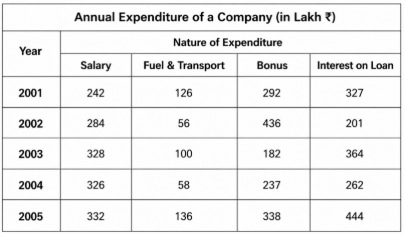
Find the average amount of interest paid by the company during these five years (in lakh ₹).
- A.
319.6
- B.
287.5
- C.
252.1
- D.
322.4
Correct answer: A
Solution
To calculate the average interest paid, we must sum the interest values for all five years and then divide by the total number of years.
Extract the interest data from the table:
2001: 327
2002: 201
2003: 364
2004: 262
2005: 444
Calculate the total sum:
Total = 327 + 201 + 364 + 262 + 444 = 1598 lakh ₹
Calculate the average:
Average = Total / Number of years
Average = 1598 / 5 = 319.6 lakh ₹
- A.
- Q35.DSSSB 2026
If the radius of a cone is 48 cm and its height is 63 cm, find its volume.
(π=22/7)- A.
1,50,624 cm³
- B.
1,50,264 cm³
- C.
1,50,064 cm³
- D.
1,52,064 cm³
Correct answer: D
Solution
Identify given values: Radius (r) = 48 cm, Height (h) = 63 cm, π = 22/7.
Apply volume formula: Volume (V) = (1/3) × π × r² × h
Substitute and calculate:
V = (1/3) × (22/7) × 48² × 63
V = (1/3) × (22/7) × 2304 × 63
V = 22 × 2304 × (63 / (3 × 7))
V = 22 × 2304 × (63 / 21)
V = 22 × 2304 × 3
V = 1,52,064 cm³Final Answer: Option 4
- A.
- Q36.DSSSB 2026
M and N start a business partnership. M invests ₹42,000 for 6 months, while N invests ₹25,600 for 5 months. If the total profit is ₹1,25,600, find M’s share.
- A.
₹1,49,825
- B.
₹1,50,000
- C.
₹1,49,969
- D.
₹83,293
Correct answer: D
Solution
Calculate investment-months:
M's investment = 42,000 × 6 = 2,52,000
N's investment = 25,600 × 5 = 1,28,000
Determine the ratio:
Ratio = 2,52,000 : 1,28,000 = 252 : 128 = 63 : 32
Calculate M's share:
Total parts = 63 + 32 = 95
M's share = (63 / 95) × 1,25,600 ≈ ₹83,293
Final Answer: Approximately ₹83,293
- A.
- Q37.DSSSB 2026
A teacher has two groups of students A and B. The average marks of group A is 84 and the average marks of group B is 78. If the total number of students in group A is 20 and in group B is 30, find the combined average marks of all students.
- A.
79
- B.
80
- C.
81
- D.
82
Correct answer: B
Solution
Calculate total marks for Group A: 84 * 20 = 1680.
Calculate total marks for Group B: 78 * 30 = 2340.
Find combined total marks: 1680 + 2340 = 4020.
Total students: 20 + 30 = 50.
Combined average: 4020 / 50 = 80.4. (Rounded to 80 as per options).
Final Answer: Option 2
- A.
- Q38.DSSSB 2026
The ratio of three numbers is
4 : 3 : 13. If their LCM is4524, find the HCF of the numbers.- A.
21
- B.
29
- C.
45
- D.
49
Correct answer: B
Solution
Let the three numbers be
4x, 3x, and 13x. Since 4, 3, and 13 are pairwise co-prime, the HCF of the three numbers isx.LCM relation:
LCM(4x, 3x, 13x) = 4 x 3 x 13 x x = 156xGiven:
156x = 4524Solve:
x = 4524 / 156 = 29
Therefore, the HCF is
29.Answer: 29
- A.
- Q39.DSSSB 2026
What principal (₹) will earn ₹1560 as simple interest in 3 years at 4% per annum?
- A.
187.2
- B.
6500
- C.
13000
- D.
26000
Correct answer: C
Solution
Concept: simple interest is charged only on the original principal and never on interest that has already been earned, so the same amount is added every year. For a principal P lent at R% per annum for T years, SI = P × R × T / 100. Since P enters that identity linearly, it rearranges directly to P = SI × 100 / (R × T) whenever the interest is the quantity that is known.
Application to this question — the interest earned is given, so the principal is the unknown:
Read off the known quantities: SI = ₹1560, R = 4% per annum, T = 3 years, and the principal P is what has to be found.
Isolate the unknown in the identity: from SI = P × R × T / 100 we get P = SI × 100 / (R × T).
Substitute the given values: P = 1560 × 100 / (4 × 3).
Simplify each side of the division: the numerator becomes 156000 and the denominator becomes 12.
Divide: P = 156000 / 12 = ₹13000.
Cross-check by a second route: 3 years at 4% per annum is 12% of the principal in total, and 12% of ₹13000 is 0.12 × 13000 = ₹1560, which is exactly the interest stated in the question. Substituting back into the original identity gives 13000 × 4 × 3 / 100 = ₹1560 as well.
Contrast — why the amount formula must not be used here:
Reading of ₹1560
Relation that applies
Principal it gives
Interest earned — what this question states
SI = P × R × T / 100
P = 1560 × 100 / (4 × 3) = ₹13000
Total amount repaid — a different question
A = P × (100 + R × T) / 100
P = 1560 × 100 / 112 ≈ ₹1392.86
The question states that the ₹1560 is earned as simple interest, so the interest-earned reading is the one that applies here and the principal comes out much larger than ₹1560, not smaller than it. The value ₹1392.86 produced by the amount relation is not offered here at all.
Result: the principal is ₹13000.
- A.
- Q40.DSSSB 2026
Find the value of the cube root of the following fraction:

That is, find the value of ∛(0.003375 / 0.004913).
- A.
13/17
- B.
17/15
- C.
15/17
- D.
12/17
Correct answer: C
Solution
Concept: The cube root distributes over a quotient — ∛(a/b) = ∛a / ∛b. A terminating decimal is a perfect cube only when its number of decimal places is a multiple of 3 (so the power of 10 is itself a perfect cube) and the integer formed by its digits is a perfect cube. Writing each decimal as that integer over a power of 10 then makes the cube root easy to read off.
Application: take the cube root of the numerator and the denominator separately.
Numerator: 0.003375 = (0.15)3, since 153 = 3375 and shifting the decimal gives 0.003375. Hence ∛0.003375 = 0.15.
Denominator: 0.004913 = (0.17)3, since 173 = 4913. Hence ∛0.004913 = 0.17.
Combine: ∛(0.003375 / 0.004913) = 0.15 / 0.17.
Clear the decimals by multiplying numerator and denominator by 100: 0.15 / 0.17 = 15 / 17.
Cross-check: cube 15/17 back — (15/17)3 = 3375 / 4913 = 0.003375 / 0.004913, which matches the original fraction. So the value is 15/17.
- A.
- Q41.DSSSB 2026
A shopkeeper claims to sell sugar at cost price, but he uses false weights. He charges for 1 kg but gives only 800 g of sugar. Find his profit percentage.
- A.
30%
- B.
20%
- C.
40%
- D.
25%
Correct answer: D
Solution
Assume cost: Let the cost price of 1g of sugar be 1 unit.
Actual Cost: The shopkeeper gives 800g, so his actual cost is 800 units.
Revenue: He charges for 1kg (1000g), so he receives 1000 units.
Profit: 1000 - 800 = 200 units.
Profit Percentage: (Profit / Actual Cost) × 100
= (200 / 800) × 100 = 25%.Final Answer: Option 4
- A.
- Q42.DSSSB 2026
A train 268 m long is moving at a speed of 17 km/h. How much time will it take to cross a tunnel 440 m long? (Round off to the nearest second)
- A.
157
- B.
153
- C.
150
- D.
165
Correct answer: C
Solution
To cross the tunnel, the train covers its own length plus the tunnel's length: 268 m + 440 m = 708 meters.
Convert speed to m/s: 17 km/h = 17 * (5/18) ≈ 4.722 m/s.
Time = Distance / Speed = 708 / 4.722 ≈ 149.93 seconds.
Rounding to the nearest second, we get 150 seconds.Final Answer: Option 3
- A.
- Q43.DSSSB 2026
Aashish’s monthly salary is ₹12,000. He spends ₹5,500 on rent, ₹2,000 on bills, and the remaining amount is his monthly saving. If he spends his entire monthly savings in his birthday month, find his annual savings (in ₹).
- A.
45,000
- B.
54,000
- C.
40,500
- D.
49,500
Correct answer: D
Solution
Step 1: Calculate total monthly expenses.
Total Expenses = Rent + Bills = ₹5,500 + ₹2,000 = ₹7,500.Step 2: Calculate the monthly saving.
Monthly Saving = Monthly Salary - Total Expenses
Monthly Saving = ₹12,000 - ₹7,500 = ₹4,500.Step 3: Calculate the annual saving.
Since he spends his entire saving in his birthday month, he only saves for 11 months of the year.
Annual Savings = Monthly Saving × 11
Annual Savings = ₹4,500 × 11 = ₹49,500.Final Answer: Option 4
- A.
- Q44.DSSSB 2026
A person sells 24 mangoes for ₹400 at a loss of 20%. To earn a profit of 20%, how many mangoes should he sell for ₹100?
- A.
2
- B.
3
- C.
4
- D.
5
Correct answer: C
Solution
For a loss of L% on cost price: Selling Price (SP) = Cost Price (CP) × (1 − L/100), so CP = SP ÷ (1 − L/100).
For a desired profit of P% on cost price: required SP = CP × (1 + P/100).
Cost price of 24 mangoes: CP = ₹400 ÷ (1 − 20/100) = ₹400 ÷ 0.80 = ₹500.
Required total selling price for a 20% profit: SP = ₹500 × 1.20 = ₹600.
Selling price per mango: ₹600 ÷ 24 = ₹25.
Number of mangoes sold for ₹100 at ₹25 each: ₹100 ÷ ₹25 = 4.
Cross-check: selling 4 mangoes at ₹25 each returns exactly ₹100; the cost price per mango is ₹500 ÷ 24 ≈ ₹20.83, and (₹25 − ₹20.83) ÷ ₹20.83 × 100 ≈ 20%, confirming the intended profit margin.
Therefore, he must sell 4 mangoes to collect ₹100 at the required 20% profit.
- A.
- Q45.DSSSB 2026
A shopkeeper offers a ‘Buy 4, get 1 free’ scheme on an item marked at ₹800 per unit. After the scheme is applied, an additional cash discount of 10% is given on the payable amount. Find the effective discount percentage on the total marked price of the five items.
- A.
30%
- B.
29%
- C.
28%
- D.
27%
Correct answer: C
Solution
Concept
For successive discounts of a% and b%, the equivalent discount is a + b − ab/100. Equivalently, multiply the fractions of the marked price that remain after each discount.
A ‘buy m, get n free’ scheme gives m + n items for the marked price of m items, so its discount fraction is n/(m+n).
Application
Under ‘Buy 4, get 1 free’, five items are received while the marked price of four items is payable. The scheme discount is (1/5) × 100 = 20%.
After the scheme, 80% of the total marked price remains payable. The extra 10% cash discount leaves 90% of that amount: 0.80 × 0.90 = 0.72.
Thus the final payable amount is 72% of the total marked price, so the effective discount is 100% − 72% = 28%.
Cross-check
For five items, the total marked price is 5 × ₹800 = ₹4,000. Paying for four items gives ₹3,200; after 10% cash discount, the payment is ₹2,880. The discount is ₹4,000 − ₹2,880 = ₹1,120, and ₹1,120/₹4,000 × 100 = 28%.
Therefore, the effective discount on the total marked price is 28%.
- A.
- Q46.DSSSB 2026
Find the difference between the average of prime numbers between 40 and 70 and the average of multiples of 2 between 10 and 60.
- A.
20
- B.
13
- C.
26
- D.
18
Correct answer: D
Solution
Prime numbers between 40 and 70: 41, 43, 47, 53, 59, 61, 67.
Sum of these primes: 41 + 43 + 47 + 53 + 59 + 61 + 67 = 371.
Average of these primes: 371 / 7 = 53.
Multiples of 2 between 10 and 60: 12, 14, ..., 58. This is an arithmetic progression.
Average of multiples of 2: (First term + Last term) / 2 = (12 + 58) / 2 = 70 / 2 = 35.
Difference between averages: 53 - 35 = 18.
Final Answer: Option 4 - A.
- Q47.DSSSB 2026
Water flows through a cylindrical pipe of internal diameter 2 cm at a rate of 6 cm per second into a cylindrical tank whose base radius is 100 cm. By how much will the water level rise in 15 minutes?
- A.
46 cm
- B.
50 cm
- C.
54 cm
- D.
62 cm
- E.
0.54 cm
Correct answer: E
Solution
Calculate flow rate: Pipe radius (r) = 1 cm; flow rate = 6 cm/s. Volume flow per second = pi * r^2 * rate = pi * 1^2 * 6 = 6pi cm^3/s.
Calculate total time in seconds: 15 minutes = 15 * 60 = 900 seconds.
Total volume of water: 6pi * 900 = 5400pi cm^3.
Calculate tank base area: Tank radius (R) = 100 cm. Area = pi * R^2 = pi * 100^2 = 10,000pi cm^2.
Calculate rise in height (h): h = Volume / Area = 5400pi / 10,000pi = 0.54 cm.
Final Answer: 0.54 cm
- A.
- Q48.DSSSB 2026
A, B and C started a business in partnership. A invested (1/5) of the total investment and B invested (1/3) of the total investment. Find the ratio of profit shares of A, B and C respectively.
- A.
3 : 4 : 5
- B.
1 : 3 : 5
- C.
2 : 3 : 5
- D.
3 : 5 : 7
Correct answer: D
Solution
A's investment = 1/5.
B's investment = 1/3.
C's share = 1 - (1/5 + 1/3) = 1 - (3/15 + 5/15) = 1 - 8/15 = 7/15.
Express A, B, and C with a common denominator of 15:
A = 1/5 = 3/15
B = 1/3 = 5/15
C = 7/15The ratio of profit shares is 3:5:7.
Final Answer: Option 4
- A.
- Q49.DSSSB 2026
A and B can complete a work in 14 days and 24 days respectively. If A alone works for 4 days, what fraction of work remains?
- A.
5/7
- B.
6/7
- C.
13/7
- D.
1/7
Correct answer: A
Solution
Step 1: Calculate A's daily work rate.
A can complete the work in 14 days, so A's 1 day's work = 1/14.Step 2: Calculate work done by A in 4 days.
Work done by A in 4 days = 4 × (1/14) = 4/14 = 2/7.Step 3: Calculate the remaining work.
Total work is considered as 1.
Remaining work = 1 - (Work done by A)
Remaining work = 1 - (2/7) = (7 - 2)/7 = 5/7.Final Answer: Option 1
- A.
- Q50.DSSSB 2026
A pipe can fill an empty tank in 10 hours. Another pipe can empty a full tank in 40 hours. If both pipes are opened together when the tank is empty, how many hours will it take to fill (3/4) of the tank?
- A.
40
- B.
30
- C.
20
- D.
10
Correct answer: D
Solution
Step 1: Calculate the individual rates.
Filling rate = 1/10 of the tank per hour.
Emptying rate = 1/40 of the tank per hour.Step 2: Calculate the net filling rate.
Subtract the emptying rate from the filling rate:
Net rate = (1/10) - (1/40) = (4/40) - (1/40) = 3/40 tank per hour.Step 3: Calculate the time to fill 3/4 of the tank.
Divide the target work by the net rate:
Time = (3/4) / (3/40) = (3/4) × (40/3) = 10 hours.Final Answer: Option 4
- A.
- Q51.DSSSB 2026
Rohini invests ₹57,500 in a bank. If the interest rate in the first year is 6% per annum and in the second year it is 2% higher than the first year, find the compound interest received in two years (compounded annually).
- A.
1,976
- B.
8,126
- C.
8,326
- D.
8,576
Correct answer: C
Solution
Step 1: Identify the rates for each year.
Principal (P) = ₹57,500
Rate for Year 1 (R₁) = 6%
Rate for Year 2 (R₂) = 6% + 2% = 8%Step 2: Calculate the total amount after 2 years.
Amount (A) = P × (1 + R₁/100) × (1 + R₂/100)
A = 57,500 × (106/100) × (108/100)
A = 57,500 × 1.06 × 1.08 = ₹65,826Step 3: Calculate the Compound Interest (CI).
CI = Amount (A) - Principal (P)
CI = 65,826 - 57,500 = ₹8,326Final Answer: Option 3
- A.
- Q52.DSSSB 2026
In the following question, a statement has been given with highlighted text. You are required to replace the text with the correct idiom from the given alternatives.
After being cheated by his new business partner once, Mahesh now invests his money very cautiously because he has become overly careful due to a past bad experience.
- A.
Once bitten, twice shy
- B.
Look before you leap
- C.
A bird in hand is worth two in the bush
- D.
All that glitters is not gold
Correct answer: A
Solution
Correct Idiom
Option A: Once bitten, twice shyDetailed Analysis
Context: The statement describes Mahesh becoming "overly careful" regarding his investments after being "cheated by his new business partner once".Explanation of Option A: The idiom "Once bitten, twice shy" perfectly captures this situation, as it describes a person who becomes cautious after suffering a specific negative experience or injury in the past.
A video solution is available for this question — log in and enroll to watch it.
- A.
- Q53.DSSSB 2026
Choose the correctly spelled word that replaces the misspelled word in the sentence below:
The manager’s consciencious decision to accommodate the supplication of the differently abled employee surprised the entire committee.
- A.
accommodate
- B.
committee
- C.
supplication
- D.
conscientious
Correct answer: D
Solution
Many English adjectives that carry the –tious/–cious sound are built around the Latin element “-scient-” (as in science, scientist, omniscient), which contributes the ‘t’ even where it is barely heard in speech. “Conscientious” is one such word: it is built on that “-scient-” element, not on the differently spelled word “conscience” (which has no ‘t’). Because the two words look and sound similar, a common misspelling confuses “conscientious” with “conscience” and replaces its ‘t’ with a ‘c’, producing a wrong form that sounds nearly identical but does not match the accepted spelling.
In the given sentence, the word filling this role is printed with that ‘t’ replaced by a ‘c’, so it is the misspelled word the question is asking about. Applying the rule above — “conscientious” takes its ‘t’ from the “-scient-” element, not from “conscience” — the correctly spelled replacement is “conscientious”.
“accommodate” is already correctly spelled in the sentence (double ‘c’, double ‘m’); it is not the word that needs replacing.
“committee” is already correctly spelled in the sentence (double ‘m’, double ‘t’, double ‘e’); it is not the word that needs replacing.
“supplication” is already correctly spelled in the sentence (the standard noun form of “supplicate”); it is not the word that needs replacing.
Since the other three words are already correctly spelled as printed, only the altered word needs correcting, and its correctly spelled replacement is “conscientious”.
- A.
- Q54.DSSSB 2026
Choose the correct option to complete the sentence.
Priya's handwriting is very _____.
- A.
neat
- B.
expensive
- C.
dusty
- D.
wooden
Correct answer: A
Solution
The sentence requires an adjective describing handwriting quality. 'Neat' means tidy and orderly, which fits the context well. Options like 'expensive', 'dusty', or 'wooden' are semantically incorrect collocations for handwriting.
A video solution is available for this question — log in and enroll to watch it.
- A.
- Q55.DSSSB 2026
Select the most appropriate article to fill in the blank. If no article is needed, select “No article required”.
Roxy is _____ wonderful dog.
- A.
a
- B.
No article required
- C.
an
- D.
the
Correct answer: A
Solution
Correct Option
Option 1: aDetailed Explanation
The indefinite article "a" is used before singular countable nouns that begin with a consonant sound.In this sentence, "wonderful" begins with a consonant sound, so "a" is the appropriate choice.
A video solution is available for this question — log in and enroll to watch it.
- A.
- Q56.DSSSB 2026
Select the option that can be used as a one-word substitute for the given group of words.
A government run by a king or queen
- A.
Monarchy
- B.
Oligarchy
- C.
Republic
- D.
Democracy
Correct answer: A
Solution
Concept
A one-word substitution question asks for the single term that captures the meaning of an entire phrase. For government-type terms, the defining features are who holds power (one person, a small group, or the general population) and how that power is acquired (by inheritance, by appointment, or by election).
Application
The phrase "a government run by a king or queen" describes rule by a single hereditary head of state. The term matching this exact meaning is Monarchy — a system of governance headed by one ruler whose position is typically inherited.
Contrast
Oligarchy: power is held collectively by a small group of people, not by one hereditary ruler.
Republic: the head of state is elected or appointed, not inherited by birth.
Democracy: power is vested in the people and exercised through elections, rather than concentrated in a hereditary ruler.
Therefore, the correct one-word substitute is Monarchy.
- A.
- Q57.DSSSB 2026
Select the most appropriate option that can substitute the underlined words in the given sentence.
He may think over deeply over the fate of empires which have always fallen because of some weakness.
- A.
bereave
- B.
accomplish
- C.
muse
- D.
seduce
Correct answer: C
Solution
Solution
The phrase "think over deeply" signifies reflecting or pondering. Therefore, "muse" is the appropriate substitute as it denotes deep thought, which is fitting for contemplating the fate of empires. - A.
- Q58.DSSSB 2026
Select the option that is the most appropriate antonym of the underlined word in the given sentence.
He displayed an obstinate refusal to compromise on his principles.
- A.
implied
- B.
categorical
- C.
emphatic
- D.
compliant
Correct answer: D
Solution
An antonym question asks for the word whose core meaning is the OPPOSITE of the underlined word's sense in context, not merely a word that differs in tone.
Here, "obstinate" means stubborn or unyielding — refusing to change one's mind despite reason or persuasion. Its antonym must describe a READINESS TO YIELD OR AGREE. Checking each option against this specific sense of yielding: "compliant" means ready to agree or yield to others' wishes, which is the direct opposite of a stubborn refusal.
"implied" means suggested indirectly rather than stated openly — this describes HOW something is communicated, not a shift in attitude toward compromise.
"categorical" means stated absolutely, unconditionally, or without exception — this reinforces a sense of firmness and certainty, the SAME register as stubbornness, not its opposite.
"emphatic" means expressed forcefully or with strong emphasis — again describing the manner of expression, not an attitude toward yielding or compromise.
Only "compliant" carries the required opposite sense of willingness to yield, making it the correct antonym.
A video solution is available for this question — log in and enroll to watch it.
- A.
- Q59.DSSSB 2026
Select the option that is the most appropriate antonym of the highlighted word in the given sentence.
The tranquil lake was a perfect place for meditation.
- A.
muffled
- B.
roaring
- C.
defunct
- D.
sulky
Correct answer: B
Solution
Correct Option: B) roaring
Solution:
The highlighted word is “tranquil”, which means calm, peaceful, quiet.
We need its antonym (opposite meaning).
Roaring means very loud, noisy, turbulent, which is the opposite of calm and peaceful.
So, “roaring” is the most appropriate antonym of “tranquil.”
A video solution is available for this question — log in and enroll to watch it.
- A.
- Q60.DSSSB 2026
Choose the correct option to complete the sentence.
The scholarship will cover expenses ______ a maximum of ₹50,000 for each selected student.
- A.
apart from
- B.
up to
- C.
instead of
- D.
across
Correct answer: B
Solution
The sentence describes a financial cap on scholarship expenses. The phrase 'up to' correctly indicates an upper limit without exceeding it, matching the context of a maximum amount.
- A.
- Q61.DSSSB 2026
Identify the correct proverb that can replace the underlined phrase in the sentence below.
Even though she has many talents, she fails to succeed because she tries to do too many things at the same time and ends up finishing none.
- A.
actions speak louder than words
- B.
birds of a feather flock together
- C.
she is a jack of all trades, master of none
- D.
a stitch in time saves nine
Correct answer: C
Solution
Correct Option
Option 3: she is a jack of all trades, master of noneDetailed Explanation
This proverb accurately describes an individual who attempts many different tasks or possesses many talents but fails to excel or achieve mastery in any single one of them.It aligns with the scenario described, where having many talents leads to failure due to a lack of focus on completing specific goals.
- A.
- Q62.DSSSB 2026
Choose the option that contains the misspelt word.
- A.
Perserverance
- B.
Idiosyncrasy
- C.
Conscientious
- D.
Meticulous
Correct answer: A
Solution
Option zero contains the misspelt word 'Perserverance'. The correct spelling is 'Perseverance' with only one 'e' after the first 'r'. All other options provided are spelled correctly according to standard English orthography.
A video solution is available for this question — log in and enroll to watch it.
- A.
- Q63.DSSSB 2026
Parts of a sentence are given below in jumbled order. Arrange the parts in the correct order to form a meaningful sentence.
(O) in rhythmic beats
(P) with his cane tapping
(Q) along the cobbled street
(R) against the stones
(S) the old man walked slowly- A.
POQRS
- B.
QPORS
- C.
SQPRO
- D.
OPQRS
Correct answer: C
Solution
Correct Option
Option 3: SQPRODetailed Explanation
The correctly rearranged sentence is: "S the old man walked slowly Q along the cobbled street P with his cane tapping R against the stones O in rhythmic beats." - A.
- Q64.DSSSB 2026
Select the most appropriate article to fill in the blank. If no article is required, select ‘No article required’.
She looked out of the window and saw ______ sun setting behind the hills.
- A.
No article required
- B.
the
- C.
a
- D.
an
Correct answer: B
Solution
Correct Option: B) the
Solution:
We use “the” before unique things in nature like the sun, the moon, the earth, etc.
So the correct sentence is:
“She looked out of the window and saw the sun setting behind the hills.”
A video solution is available for this question — log in and enroll to watch it.
- A.
- Q65.DSSSB 2026
In the given question, a statement is divided into different segments. The first segment (S1) is fixed, rearrange the other segments to form a coherent statement.
S1. Paper money
A. making it a form of currency
B. often referred to as a note or a bill
C. that is payable to the bearer on demand
D. is a type of negotiable promissory note- A.
S1-D-B-A-C
- B.
S1-C-A-B-D
- C.
S1-B-D-C-A
- D.
S1-A-C-D-B
Correct answer: C
Solution
Start with S1 'Paper money'. Segment B follows logically to describe common names. Segment D defines the legal instrument type. Segment C specifies payment conditions for that instrument. Segment A concludes by confirming its status as currency.
A video solution is available for this question — log in and enroll to watch it.
- A.
- Q66.DSSSB 2026
The debate focused on the benefits of online learning ______ traditional classroom education.
- A.
among
- B.
versus
- C.
across
- D.
besides
Correct answer: B
Solution
Correct Option: B) versus
Solution:
The sentence compares online learning with traditional classroom education.
The word “versus” is used to show a comparison or contrast between two things.So the correct sentence is:
“The debate focused on the benefits of online learning versus traditional classroom education.”
A video solution is available for this question — log in and enroll to watch it.
- A.
- Q67.DSSSB 2026
In the struggle for India’s independence, few movements were as powerful as the Salt Satyagraha. Led by Mahatma Gandhi in 1930, this nonviolent protest was a direct challenge to British rule and their oppressive salt laws. At the time, the British controlled the production and taxation of salt, making it illegal for Indians to collect or sell it. This simple necessity became a symbol of colonial exploitation, and Gandhi decided to resist.
On 12 March 1930, Gandhi, along with 78 followers, set out on a 240-mile march from his ashram in Sabarmati to the coastal village of Dandi. As they walked, thousands joined them, transforming the march into a national movement. On 6 April, Gandhi reached the seashore and picked up a handful of salt—defying British law. This act of civil disobedience sparked mass protests across India, with people making and selling salt illegally.
The British responded with brutal force, arresting over 60,000 people, including Gandhi himself. But the movement had already shaken the empire. The Salt Satyagraha proved that nonviolence could be a powerful weapon against oppression and inspired freedom struggles worldwide. It was a turning point in India’s journey to independence.
Q. What was the main objective of the Salt Satyagraha?
- A.
To fight for better wages for workers
- B.
To promote industrial development in India
- C.
To protest the British control over salt production and taxation
- D.
To demand the right to vote for Indians
Correct answer: C
Solution
Correct Option
Option C: To protest the British control over salt production and taxationDetailed Solution
The main objective of the Salt Satyagraha was to challenge British control over salt production and taxation. The text states it was a direct protest against oppressive salt laws that made collecting or selling salt illegal for Indians. - A.
- Q68.DSSSB 2026
In the struggle for India’s independence, few movements were as powerful as the Salt Satyagraha. Led by Mahatma Gandhi in 1930, this nonviolent protest was a direct challenge to British rule and their oppressive salt laws. At the time, the British controlled the production and taxation of salt, making it illegal for Indians to collect or sell it. This simple necessity became a symbol of colonial exploitation, and Gandhi decided to resist.
On 12 March 1930, Gandhi, along with 78 followers, set out on a 240-mile march from his ashram in Sabarmati to the coastal village of Dandi. As they walked, thousands joined them, transforming the march into a national movement. On 6 April, Gandhi reached the seashore and picked up a handful of salt—defying British law. This act of civil disobedience sparked mass protests across India, with people making and selling salt illegally.
The British responded with brutal force, arresting over 60,000 people, including Gandhi himself. But the movement had already shaken the empire. The Salt Satyagraha proved that nonviolence could be a powerful weapon against oppression and inspired freedom struggles worldwide. It was a turning point in India’s journey to independence.
Q. What did the British do in response to the Salt Satyagraha??
- A.
They immediately lifted the salt tax
- B.
They arrested over 60,000 people, including Gandhi
- C.
They allowed Indians to freely produce salt
- D.
They ignored the protests and took no action
Correct answer: B
Solution
Correct Option
Option B: They arrested over 60,000 people, including GandhiDetailed Solution
To answer this question, you look at the part of the passage describing the British reaction. The text states, "The British responded with brutal force, arresting over 60,000 people, including Gandhi himself". This confirms that the British utilized force and conducted mass arrests in response to the protests, rather than ignoring the movement or negotiating. - A.
- Q69.DSSSB 2026
In the struggle for India’s independence, few movements were as powerful as the Salt Satyagraha. Led by Mahatma Gandhi in 1930, this nonviolent protest was a direct challenge to British rule and their oppressive salt laws. At the time, the British controlled the production and taxation of salt, making it illegal for Indians to collect or sell it. This simple necessity became a symbol of colonial exploitation, and Gandhi decided to resist.
On 12 March 1930, Gandhi, along with 78 followers, set out on a 240-mile march from his ashram in Sabarmati to the coastal village of Dandi. As they walked, thousands joined them, transforming the march into a national movement. On 6 April, Gandhi reached the seashore and picked up a handful of salt—defying British law. This act of civil disobedience sparked mass protests across India, with people making and selling salt illegally.
The British responded with brutal force, arresting over 60,000 people, including Gandhi himself. But the movement had already shaken the empire. The Salt Satyagraha proved that nonviolence could be a powerful weapon against oppression and inspired freedom struggles worldwide. It was a turning point in India’s journey to independence.
Q. Why did Gandhi pick up salt at Dandi?
- A.
To express defiance against British salt laws
- B.
To prove his leadership in the independence movement
- C.
To set an example for the masses to follow
- D.
To show that salt production was a natural right
Correct answer: A
Solution
Correct Option
Option 1: To express defiance against British salt lawsDetailed Explanation
The text explicitly states that on 6 April, Gandhi reached the seashore and picked up a handful of salt to defy British law.This act was part of the nonviolent protest known as the Salt Satyagraha, which served as a direct challenge to British rule and their oppressive salt laws.
- A.
- Q70.DSSSB 2026
In the struggle for India’s independence, few movements were as powerful as the Salt Satyagraha. Led by Mahatma Gandhi in 1930, this nonviolent protest was a direct challenge to British rule and their oppressive salt laws. At the time, the British controlled the production and taxation of salt, making it illegal for Indians to collect or sell it. This simple necessity became a symbol of colonial exploitation, and Gandhi decided to resist.
On 12 March 1930, Gandhi, along with 78 followers, set out on a 240-mile march from his ashram in Sabarmati to the coastal village of Dandi. As they walked, thousands joined them, transforming the march into a national movement. On 6 April, Gandhi reached the seashore and picked up a handful of salt—defying British law. This act of civil disobedience sparked mass protests across India, with people making and selling salt illegally.
The British responded with brutal force, arresting over 60,000 people, including Gandhi himself. But the movement had already shaken the empire. The Salt Satyagraha proved that nonviolence could be a powerful weapon against oppression and inspired freedom struggles worldwide. It was a turning point in India's journey to independence.
Q. Select the most appropriate antonym of ‘oppressive’ as used in the passage.
- A.
Harsh
- B.
Cruel
- C.
Brutal
- D.
Just
Correct answer: D
Solution
Detailed Solution
Understanding "Oppressive": In the context of the passage, "oppressive" describes the British salt laws and rule as unjustly harsh, tyrannical, and restrictive of freedom.Analyzing the Options:
Option D: Just (Correct): This is the correct antonym because "just" signifies fairness, righteousness, and legality, which is the direct opposite of an unjust or tyrannical nature.
Option A: Harsh: This is a synonym, as it describes something severe or cruel.
Option B: Cruel: This is a synonym, as it refers to something that causes pain or suffering.
Option C: Brutal: This is a synonym, as it describes harsh or cruel treatment.
Summary: The word "oppressive" implies unfair governance. Since "Harsh," "Cruel," and "Brutal" align with the meaning of "oppressive," "Just" is the only option that serves as the appropriate antonym.
- A.
- Q71.DSSSB 2026
In the struggle for India’s independence, few movements were as powerful as the Salt Satyagraha. Led by Mahatma Gandhi in 1930, this nonviolent protest was a direct challenge to British rule and their oppressive salt laws. At the time, the British controlled the production and taxation of salt, making it illegal for Indians to collect or sell it. This simple necessity became a symbol of colonial exploitation, and Gandhi decided to resist.
On 12 March 1930, Gandhi, along with 78 followers, set out on a 240-mile march from his ashram in Sabarmati to the coastal village of Dandi. As they walked, thousands joined them, transforming the march into a national movement. On 6 April, Gandhi reached the seashore and picked up a handful of salt—defying British law. This act of civil disobedience sparked mass protests across India, with people making and selling salt illegally.
The British responded with brutal force, arresting over 60,000 people, including Gandhi himself. But the movement had already shaken the empire. The Salt Satyagraha proved that nonviolence could be a powerful weapon against oppression and inspired freedom struggles worldwide. It was a turning point in India's journey to independence.
Q. What is the overall tone of the passage?
- A.
Inspirational and reflective
- B.
Angry and confrontational
- C.
Indifferent and detached
- D.
Humorous and lighthearted
Correct answer: A
Solution
Detailed Solution
Analysis of the Tone: The tone is defined by the author's choice of language when describing the movement's impact.Inspirational Elements:
The passage highlights the Salt Satyagraha as a "powerful weapon against oppression".
It notes that the movement "inspired freedom struggles worldwide," which conveys an uplifting and motivational quality.
Reflective Elements:
The author characterizes the event as a "turning point in India’s journey to independence," indicating a retrospective look at the historical significance of the protest.
Why other options are incorrect:
The passage avoids an "angry and confrontational" tone by focusing on nonviolent resistance rather than hostility.
It is not "indifferent and detached" because it describes the significant consequences and brutality faced by participants.
It is not "humorous and lighthearted" as the subject matter deals with serious topics such as oppression and mass arrests.
- A.
- Q72.DSSSB 2026
निम्नलिखित वाक्य के रिक्त स्थान में उचित क्रिया शब्द का प्रयोग करें।
‘राहुल को रोज दूध ____ पड़ता है।’
- A.
पी
- B.
पीता
- C.
पीना
- D.
खाना
Correct answer: C
Solution
हिंदी में बाध्यता (अनिवार्यता) की रचना 'X को ... V पड़ना' यह दर्शाती है कि कर्ता X को कोई कार्य करना अनिवार्य है। इस रचना में 'पड़ना' से ठीक पहले आने वाली क्रिया सदैव अनिश्चयार्थक (infinitive) रूप में होती है। जब कर्म (object) अचिह्नित हो (अर्थात उस पर 'को' न लगा हो), तब यह अनिश्चयार्थक रूप उसी कर्म के लिंग-वचन के अनुसार बदलता है — पुल्लिंग-एकवचन कर्म के साथ '-ना' (जैसे 'दूध पीना पड़ता है'), स्त्रीलिंग कर्म के साथ '-नी' (जैसे 'रोटियाँ खानी पड़ती हैं'), और पुल्लिंग-बहुवचन कर्म के साथ '-ने' (जैसे 'कपड़े धोने पड़ते हैं'); 'को' से चिह्नित या अनुपस्थित कर्म की स्थिति में यह रूप डिफ़ॉल्ट रूप से पुल्लिंग-एकवचन ('-ना') ही रहता है। किसी भी स्थिति में यह अनिश्चयार्थक रूप न तो मूल धातु (जैसे जा, खा, पी) हो सकता है, न ही कर्ता के अनुसार रूपांतरित सामान्य वर्तमान रूप (जैसे जाता, खाता, पीता)।
इसे वाक्य 'राहुल को रोज दूध ____ पड़ता है।' पर लागू करने पर: यहाँ कर्म (object) 'दूध' अचिह्नित एवं पुल्लिंग-एकवचन है, अतः रिक्त स्थान में आने वाली क्रिया को (क) इसी के अनुरूप अनिश्चयार्थक '-ना' रूप में होना चाहिए, और (ख) तरल पदार्थ के साथ की जाने वाली क्रिया — अर्थात पीना — को दर्शाना चाहिए, खाने को नहीं। 'पीना' दोनों शर्तें पूरी करता है।
शेष विकल्प इन दोनों शर्तों में से किसी एक को पूरा नहीं करते:
पी — मूल धातु है, अनिश्चयार्थक रूप नहीं; शर्त (क) पूरी नहीं करता।
पीता — कर्ता के अनुसार रूपांतरित सामान्य वर्तमान रूप है, अनिश्चयार्थक नहीं; शर्त (क) पूरी नहीं करता।
खाना — स्वयं एक वैध अनिश्चयार्थक रूप है (शर्त (क) पूरी करता है) परन्तु ठोस भोजन की क्रिया को दर्शाता है, जो तरल 'दूध' से मेल नहीं खाती; शर्त (ख) पूरी नहीं करता।
अतः वाक्य सही रूप में इस प्रकार पूर्ण होता है: 'राहुल को रोज दूध पीना पड़ता है।', जिसमें 'पीना' सही अनिश्चयार्थक क्रिया रूप है।
- A.
- Q73.DSSSB 2026
‘घर का दीपक बुझ जाना’ मुहावरे का सही अर्थ क्या होगा?
- A.
कलह करना
- B.
अप्रभावित व्यवहार करना
- C.
अलग हो जाना
- D.
निर्वंश हो जाना
Correct answer: D
Solution
मुहावरे ऐसे स्थिर वाक्यांश होते हैं जिनका शाब्दिक नहीं बल्कि लाक्षणिक अर्थ ग्रहण किया जाता है। परिवार और वंश-परंपरा से संबंधित हिंदी मुहावरों में 'दीपक/चिराग़' शब्द पारंपरिक रूप से पुत्र या वंश चलाने वाले उत्तराधिकारी का प्रतीक माना जाता है, और उसका 'बुझना/गुल होना' उस उत्तराधिकारी की अनुपस्थिति या समाप्ति को दर्शाता है।
इसी परंपरा के अनुसार 'घर का दीपक बुझ जाना' मुहावरे में 'दीपक' परिवार के वंश-प्रतीक तथा 'बुझ जाना' उसके समाप्त होने का भाव देता है। अतः पूरे मुहावरे का अर्थ हुआ — परिवार में वंश को आगे बढ़ाने वाला कोई शेष न रहना, अर्थात 'निर्वंश हो जाना'।
शेष विकल्प इस लाक्षणिक अर्थ से मेल नहीं खाते: "कलह करना" पारस्परिक विवाद का सूचक है, न कि वंश-समाप्ति का; "अप्रभावित व्यवहार करना" भावनात्मक तटस्थता दर्शाता है, जिसका दीपक-प्रतीक से कोई संबंध नहीं; और "अलग हो जाना" केवल पृथक्करण का भाव देता है, वंश के पूर्ण अंत का नहीं। स्थापित हिंदी मुहावरा-कोशों में भी 'दीपक/चिराग़ बुझना' का यही अर्थ — पुत्र की मृत्यु और वंश का अंत — दर्ज है, जो इस मुहावरे के सही अर्थ की पुष्टि करता है।
- A.
- Q74.DSSSB 2026
निम्नलिखित वाक्य में रेखांकित शब्द के पर्यायवाची शब्द का चयन दिए गए विकल्पों में से कीजिए।
गर्मियों में सूर्य तपता है।
- A.
दिवाकर
- B.
सरिता
- C.
हिमांशु
- D.
रत्नाकर
Correct answer: A
Solution
पर्यायवाची शब्द (synonym) वे शब्द होते हैं जिनका अर्थ किसी दिए गए शब्द के समान अथवा अत्यंत निकट होता है, परंतु वे भिन्न-भिन्न स्रोतों (तत्सम शब्द, पौराणिक नाम, गुणवाचक विशेषण आदि) से निर्मित होते हैं। किसी भी शब्द के पर्यायवाची मानक हिंदी शब्दकोशों एवं व्याकरण ग्रंथों के आधार पर निर्धारित किए जाते हैं।
प्रस्तुत वाक्य में रेखांकित शब्द 'सूर्य' है। 'सूर्य' के प्रचलित पर्यायवाची शब्दों में रवि, भानु, दिनकर, भास्कर, आदित्य, अर्क, सविता और दिवाकर सम्मिलित हैं। दिए गए विकल्पों में से केवल 'दिवाकर' शब्द इस सूची में आता है — इसका शाब्दिक अर्थ 'दिन को उत्पन्न करने वाला' है, जो सूर्य के लिए एक सुस्थापित पर्यायवाची है।
'सरिता' का अर्थ नदी है — जलस्रोत-वाचक शब्द, सूर्य से असंबद्ध।
'हिमांशु' (हिम + अंशु) चंद्रमा का पर्यायवाची है — शीतल किरणों वाला खगोलीय पिंड, सूर्य नहीं।
'रत्नाकर' (रत्न + आकर) समुद्र का पर्यायवाची है — जलराशि-वाचक शब्द, आकाशीय पिंड नहीं।
अतः वाक्य में प्रयुक्त रेखांकित शब्द 'सूर्य' का पर्यायवाची 'दिवाकर' है।
- A.
- Q75.DSSSB 2026
सभी ने चित्रकार की कला की प्रशंसा की।
वाक्य में प्रयुक्त ‘प्रशंसा’ शब्द का विलोम क्या है?- A.
परिमित
- B.
त्याज्य
- C.
भर्त्सना
- D.
दीर्घकाय
Correct answer: C
Solution
विलोम शब्द वे शब्द होते हैं जिनका अर्थ किसी दिए गए शब्द के अर्थ से बिल्कुल विपरीत होता है। 'प्रशंसा' का अर्थ है किसी के गुण, कार्य या कला की सराहना या तारीफ़ करना।
अतः 'प्रशंसा' का विलोम वह शब्द होगा जो निंदा, दोष या आलोचना का भाव प्रकट करे। दिए गए विकल्पों में 'भर्त्सना' शब्द का अर्थ है कड़ी निंदा या फटकार करना, जो 'प्रशंसा' (सराहना) के ठीक विपरीत भाव को दर्शाता है। इसलिए 'भर्त्सना' ही 'प्रशंसा' का सही विलोम शब्द है।
'परिमित' का अर्थ है सीमित या नियत मात्रा में; यह प्रशंसा या निंदा किसी से भी संबंधित नहीं, बल्कि मात्रा/सीमा को दर्शाता है।
'त्याज्य' का अर्थ है त्यागने योग्य या छोड़े जाने के योग्य; यह किसी वस्तु/कार्य को छोड़ने की योग्यता बताता है, प्रशंसा के भाव से इसका कोई विपरीत संबंध नहीं।
'दीर्घकाय' का अर्थ है लंबे या बड़े शरीर वाला; यह शारीरिक बनावट को दर्शाता है, गुण-दोष के मूल्यांकन से इसका कोई संबंध नहीं।
- A.
- Q76.DSSSB 2026
दिए गए वाक्यांश के लिए निम्नलिखित विकल्पों में से सार्थक शब्द का चयन करें।
जो ओज एवं तेज से परिपूर्ण हो
- A.
ओजकार
- B.
ओजस्वी
- C.
औरस
- D.
ओझल
Correct answer: B
Solution
अवधारणा: "वाक्यांश के लिए एक शब्द" में किसी वाक्यांश या वाक्य के पूरे भाव को व्यक्त करने वाला हिंदी का वह एकल, शब्दकोश-सम्मत शब्द चुना जाता है जिसका मानक अर्थ ठीक उसी भाव से मेल खाता हो।
अनुप्रयोग: दिए गए वाक्यांश "जो ओज एवं तेज से परिपूर्ण हो" का भाव है — शक्ति (ओज) और कांति/प्रभाव (तेज) से भरपूर होना। मानक हिंदी शब्दकोश में "ओजस्वी" शब्द का ठीक यही अर्थ मिलता है — शक्तिमान्, तेजवान् और प्रभावशाली। अतः "ओजस्वी" इस वाक्यांश के लिए सार्थक शब्द है।
शेष विकल्पों की जाँच (मूल्य के आधार पर):
"ओजकार" — शब्द-रचना की दृष्टि से यह "ओज" + कर्तावाचक प्रत्यय "-कार" (जैसे रचनाकार, पत्रकार) से बनता है, अर्थात् "ओज उत्पन्न करने/देने वाला"। यह अर्थ दिए गए वाक्यांश के भाव से मेल नहीं खाता।
"औरस" — का शब्दकोशीय अर्थ है "अपना/वैध" या "वैध संतान" (जैसे औरस पुत्र); इसका ओज-तेज से कोई संबंध नहीं है।
"ओझल" — का अर्थ है "छिपा हुआ/दृष्टि से लुप्त"; यह वाक्यांश के भाव के विपरीत है।
इस प्रकार शब्दकोशीय जाँच से केवल "ओजस्वी" ही दिए गए वाक्यांश के भाव से पूरी तरह मेल खाता है।
- A.
- Q77.DSSSB 2026
Complete the following sentence with the appropriate case marker.
'Anshu has come ____ school.'
- A.
From
- B.
On
- C.
By
- D.
To
Correct answer: A
Solution
In the sentence, 'Anshu has come from school,' 'from' is the appropriate case marker.
- A.
- Q78.DSSSB 2026
‘That which is difficult to obtain’
Choose the single word that appropriately expresses the phrase:
- A.
Attached
- B.
Foul smell
- C.
Inferior
- D.
Rare
Correct answer: D
Solution
The single word for ‘that which is difficult to obtain’ is ‘rare’.
- A.
- Q79.DSSSB 2026
निम्नलिखित वाक्य के रेखांकित शब्द का पर्यायवाची कौन-सा नहीं है?
‘आज एक महात्मा द्वार पर भिक्षा के लिए आए।’
- A.
महाराज
- B.
आदमी
- C.
महापुरुष
- D.
महानुभाव
Correct answer: B
Solution
पर्यायवाची शब्द (समानार्थी शब्द) वे शब्द होते हैं जिनका अर्थ लगभग समान होता है। 'महात्मा' शब्द का भाव है 'महान आत्मा वाला व्यक्ति' — अर्थात् वह व्यक्ति जो अपने त्याग, श्रेष्ठता या आदर के कारण विशिष्ट माना जाता है, जैसे कोई संत या पूज्य पुरुष।
प्रश्न में उसी विकल्प को चुनना है जो महात्मा के इस भाव — महानता और श्रद्धा — को व्यक्त नहीं करता।
महाराज — किसी पूज्य/श्रद्धेय व्यक्ति (जैसे संत या गुरु) को संबोधित करने में प्रयुक्त होता है, अतः यह महात्मा के भाव के निकट है।
महापुरुष — सीधे 'महान पुरुष' का बोध कराता है, जो महात्मा का सुस्थापित पर्यायवाची है।
महानुभाव — श्रेष्ठ/गौरवशाली व्यक्ति के लिए प्रयुक्त सम्मानसूचक शब्द है, यह भी महात्मा का मान्य पर्यायवाची है।
आदमी — केवल एक सामान्य व्यक्ति (पुरुष/मनुष्य) के लिए प्रयुक्त तटस्थ शब्द है; इसमें महानता या सम्मान का कोई भाव नहीं है।
चूँकि 'आदमी' में महात्मा जैसी महानता या श्रद्धा का भाव बिलकुल नहीं है, जबकि शेष तीनों शब्द किसी-न-किसी रूप में यही भाव रखते हैं, अतः 'आदमी' ही वह शब्द है जो महात्मा का पर्यायवाची नहीं है।
- A.
- Q80.DSSSB 2026
उपयुक्त कारक चिन्ह का चयन कर रिक्त स्थान की पूर्ति कीजिए।
‘राहुल साइकिल ____ गिर पड़ा।’
- A.
ने
- B.
के
- C.
से
- D.
में
Correct answer: C
Solution
सिद्धांत
हिंदी में कारक किसी संज्ञा/सर्वनाम का क्रिया के साथ संबंध दर्शाते हैं, और प्रत्येक कारक की अपनी विभक्ति (चिह्न) होती है — कर्ता(ने), कर्म(को), करण(से/द्वारा), सम्प्रदान(को/के लिए), अपादान(से), सम्बन्ध(का/के/की), अधिकरण(में/पर)। अपादान कारक विशेष रूप से किसी वस्तु या स्थान से अलग होने, दूर होने या गिरने का बोध कराता है, और इसका चिह्न ‘से’ है।
प्रयोग
दिए गए वाक्य “राहुल साइकिल ____ गिर पड़ा” में क्रिया ‘गिरना’ एक अकर्मक क्रिया है जो पृथक्करण/अलगाव का भाव व्यक्त करती है — राहुल साइकिल पर से अलग होकर नीचे गिरा। चूँकि ‘साइकिल’ वह वस्तु है जिससे राहुल अलग हुआ (स्रोत), यहाँ अपादान कारक लागू होता है:
कारक-चिह्न
कारक का नाम
प्रयोग की शर्त
यहाँ लागू?
ने
कर्ता कारक
सकर्मक क्रिया + पूर्ण पक्ष कर्ता
नहीं — क्रिया अकर्मक है
के
सम्बन्ध कारक
दो संज्ञाओं में सम्बन्ध/स्वामित्व
नहीं — क्रिया से पहले सीधे अर्थहीन
से
अपादान कारक
पृथक्करण/स्रोत/गिरना
हाँ ✓
में
अधिकरण कारक
भीतर स्थित होना
नहीं — यहाँ पृथक्करण है, स्थिति नहीं
अतः पूर्ण वाक्य बनता है: “राहुल साइकिल से गिर पड़ा।”
जाँच
यदि इसके स्थान पर स्थिति सूचक क्रिया होती — जैसे “राहुल साइकिल ____ बैठा” (बैठना = स्थिति की क्रिया) — तो अधिकरण कारक चिह्न ‘पर’ उपयुक्त होता (“साइकिल पर बैठा”); एक सामान्य साइकिल के भीतर स्थिति संभव न होने से ‘में’ यहाँ भी लागू नहीं होता। परन्तु यहाँ क्रिया ‘गिरना’ स्पष्टतः पृथक्करण दर्शाती है, इसलिए अपादान कारक चिह्न ‘से’ ही एकमात्र व्याकरणिक रूप से सही चिह्न है।
- A.
- Q81.DSSSB 2026
दिए गए वाक्यों में से वर्तनी की दृष्टि से शुद्ध वाक्य का चयन कीजिए।
- A.
पूर्णिम के चाँद देखो।
- B.
पूर्णिमा के चाँद देखो।
- C.
पूर्णिमा का चाँद देखें।
- D.
पूर्णिमा का चांद देखें।
Correct answer: C
Solution
अवधारणा
मानक हिंदी वर्तनी में अनुनासिक स्वर-ध्वनि, जब आगे कोई पंचम वर्ण या संयुक्त व्यंजन न हो, चंद्रबिंदु (ँ) से लिखी जाती है — जैसे चाँद, हँसना, आँख। अनुस्वार (ं) इसका मानक विकल्प नहीं माना जाता। इसके साथ ही, पुल्लिंग एकवचन संज्ञा के साथ संबंधवाचक कारक चिह्न ‘का’ आता है, न कि ‘के’ (जो बहुवचन/तिर्यक रूपों में प्रयुक्त होता है) — जैसे ‘लड़के का बस्ता’, ‘लड़कों के बस्ते’।
प्रत्येक विकल्प पर अनुप्रयोग
‘पूर्णिम के चाँद देखो।’ — यहाँ ‘पूर्णिम’ रूप में अंत्य ‘आ’ मात्रा नहीं है (मूल शब्द ‘पूर्णिमा’ है), जो वर्तनी-दोष है।
‘पूर्णिमा के चाँद देखो।’ — यहाँ ‘पूर्णिमा’ की वर्तनी सही है, परंतु पुल्लिंग एकवचन ‘चाँद’ के साथ कारक चिह्न ‘के’ का प्रयोग मानक नहीं है; ‘का’ अपेक्षित है।
‘पूर्णिमा का चाँद देखें।’ — यहाँ ‘पूर्णिमा’ की वर्तनी सही है, कारक चिह्न ‘का’ पुल्लिंग एकवचन ‘चाँद’ के अनुरूप है, और ‘चाँद’ चंद्रबिंदु सहित मानक रूप में लिखा गया है।
‘पूर्णिमा का चांद देखें।’ — ‘पूर्णिमा’ और ‘का’ सही हैं, परंतु ‘चांद’ में चंद्रबिंदु के स्थान पर अनुस्वार का प्रयोग किया गया है, जो मानक वर्तनी नहीं है।
निष्कर्ष
जिस वाक्य में शब्द-रूप (‘पूर्णिमा’), कारक चिह्न (‘का’) और वर्ण-चिह्न (चंद्रबिंदु सहित ‘चाँद’) — तीनों मानक वर्तनी के अनुरूप हों, वही वर्तनी की दृष्टि से शुद्ध वाक्य है, अर्थात् ‘पूर्णिमा का चाँद देखें।’
- A.
- Q82.DSSSB 2026
निम्नलिखित वाक्य में रेखांकित शब्द के पर्यायवाची शब्द का चयन दिए गए विकल्पों में से कीजिए।
जंगल में मोर नाचा किसने देखा?
- A.
न्योता
- B.
पिक
- C.
अमर
- D.
केकी
Correct answer: D
Solution
पर्यायवाची शब्द (Synonym) वे शब्द हैं जिनका अर्थ किसी अन्य शब्द के समान अथवा निकटतम होता है, चाहे उनकी उत्पत्ति या वर्तनी भिन्न ही क्यों न हो। हिंदी की काव्य-परंपरा में एक ही वस्तु/प्राणी के लिए अनेक तत्सम अथवा तद्भव पर्यायवाची शब्द प्रचलित हैं।
दिए गए वाक्य में रेखांकित/मोटे शब्द 'मोर' के लिए पर्यायवाची शब्द पूछा गया है। हिंदी में मोर के प्रचलित पर्यायवाची शब्द हैं – मयूर, शिखी, केकी, कलापी, नीलकंठ आदि। दिए गए विकल्पों में से केवल 'केकी' शब्दकोश-सम्मत रूप से मोर का पर्यायवाची है।
न्योता – इसका अर्थ 'निमंत्रण/आमंत्रण' है; यह एक सामाजिक क्रिया को दर्शाता है, किसी पक्षी को नहीं।
पिक – यह 'कोयल' (एक भिन्न पक्षी) का पर्यायवाची है, मोर का नहीं।
अमर – इसका अर्थ 'अजर-अमर/चिरंजीवी' (कभी न मरने वाला) है; यह एक गुणवाचक शब्द है, प्राणीवाचक नहीं।
अतः दी गई शब्द-सूची में मोर का पर्यायवाची शब्द 'केकी' है।
- A.
- Q83.DSSSB 2026
Q.14 उपयुक्त शब्द का चयन कर वाक्य को पूर्ण कीजिए।
साक्षी का ______ उज्ज्वल है।
- A.
पुराना
- B.
पिछला
- C.
प्राचीन
- D.
भविष्य
Correct answer: D
Solution
अवधारणा: वाक्य-पूर्ति (Sentence Completion) प्रश्नों में रिक्त स्थान पर वही शब्द उपयुक्त होता है जो वाक्य के शेष भाग के साथ अर्थ की दृष्टि से स्वाभाविक रूप से मेल खाए और हिंदी में प्रचलित शब्द-युग्म (collocation) बनाए। किसी शब्द का प्रयोग वाक्य में तभी उचित माना जाता है जब वह दिए गए विशेषण/भाव के साथ मुहावरेदार व सार्थक संगति रखे।
अनुप्रयोग: दिए गए वाक्य 'साक्षी का ______ उज्ज्वल है' में 'उज्ज्वल' शब्द के साथ स्वाभाविक संगति रखने वाला शब्द चाहिए। 'भविष्य' के साथ मिलकर यह 'उज्ज्वल भविष्य' का अत्यंत प्रचलित व सुपरिचित प्रयोग बनाता है, जिससे वाक्य 'साक्षी का भविष्य उज्ज्वल है' के रूप में पूर्ण और सार्थक बन जाता है।
पुनः-जाँच (अन्य विकल्प उपयुक्त क्यों नहीं हैं):
पुराना — 'बीता हुआ समय' का भाव देता है, 'उज्ज्वल' के साथ प्रचलित संगति नहीं बनाता।
पिछला — भूतकालिक संदर्भ देता है, वाक्य के आशाजनक भाव से मेल नहीं खाता।
प्राचीन — 'अत्यंत पुराना/ऐतिहासिक' भाव देता है, सामान्यतः वस्तुओं/सभ्यताओं के संदर्भ में प्रयुक्त होता है, यहाँ उपयुक्त नहीं।
निष्कर्ष: अतः दिए गए विकल्पों में से केवल 'भविष्य' ही वाक्य को अर्थपूर्ण एवं मुहावरेदार ढंग से सही प्रकार पूर्ण करता है।
- A.
- Q84.DSSSB 2026
'उतरा घाटी हुआ माटी' लोकोक्ति का सही अर्थ क्या होगा?
- A.
पहाड़ी परिवेश से घृणा करना
- B.
कार्य सम्पन्न हो जाने पर एहसान भूल जाना
- C.
पहाड़ से मैदान में भाग आना
- D.
पतिताचारी हो जाना
Correct answer: B
Solution
लोकोक्तियाँ (कहावतें) अपने-आप में पूर्ण वाक्य होती हैं, जिनका शाब्दिक अर्थ नहीं बल्कि उनसे उपजा लाक्षणिक भाव प्रचलन में होता है। किसी लोकोक्ति का अर्थ निकालने के लिए उसमें प्रयुक्त बिंब को शब्दशः न लेकर यह देखा जाता है कि वह बिंब मानव-व्यवहार के किस सामान्य ढर्रे को दर्शाता है।
'उतरा घाटी हुआ माटी' में भोजन-ग्रहण का बिंब है: भोजन का स्वाद केवल मुँह तक अनुभव होता है, गले से नीचे उतरते ही वह माटी अर्थात् निःशेष, महत्वहीन हो जाता है। इसी बिंब से यह भाव निकलता है कि किसी सहायता या उपकार का मोल तभी तक जान पड़ता है जब तक आवश्यकता शेष रहती है; कार्य सम्पन्न होते ही उसके प्रति कृतज्ञता विस्मृत हो जाती है — यही अर्थ विकल्प 'कार्य सम्पन्न हो जाने पर एहसान भूल जाना' में है।
'पहाड़ी परिवेश से घृणा करना' — पहाड़ी वातावरण के प्रति राग-द्वेष का कोई भाव लोकोक्ति के शब्दों (उतरा, घाटी, माटी) से नहीं निकलता; यह निराधार पठन है।
'पहाड़ से मैदान में भाग आना' — यह लोकोक्ति को शाब्दिक यात्रा-वृत्तांत मान लेता है, जबकि यहाँ कोई यात्री या स्थान-परिवर्तन वर्णित नहीं है; बिंब भोजन के गले उतरने से जुड़ा है, स्थान-परिवर्तन से नहीं।
'पतिताचारी हो जाना' — यह चरित्र-पतन/नैतिकता का भाव आरोपित करता है, जबकि लोकोक्ति का बिंब भोजन के स्वाद के क्षणिक होने और कार्य पूर्ण होते ही महत्व खो देने से जुड़ा है, न कि व्यक्ति के आचरण से।
- A.
- Q85.DSSSB 2026
निम्नलिखित गद्यांश के आधार पर प्रश्नों के उत्तर दें –
जिस व्यक्ति के आदर्श उच्च होते हैं, उसके विचार स्वतः ही उच्च हो जाते हैं। उच्च विचार वाले व्यक्ति ही आगे चलकर विश्व का नेतृत्व कर पाते हैं। अब सबसे बड़ा प्रश्न है कि सादगी वास्तव में है क्या? क्या रहन-सहन और वेशभूषा संबंधी मानक ही सादगी की परिभाषा करने के लिए पर्याप्त हैं? इसका उत्तर है नहीं, क्योंकि सादगी का संबंध केवल बाहरी चीजों से नहीं है। ऊपरी तौर पर देखा जाए तो रहन-सहन, खान-पान, पहनावे, कार्य-प्रणाली आदि को सादगीपूर्ण जीवन के अंतर्गत शामिल किया जाता है, परंतु सादगी एक व्यापक विचार है। यह एक प्रकार का जीवन जीने की शैली है। किसी प्रकार के आडंबर को अपनाए बिना जीवन जीना ही सादगी है, चाहे वह रहन-सहन हो या कार्य-शैली।
Q. गद्यांश में रेखांकित शब्द 'आदर्श' का पर्यायवाची नहीं कौन-सा है?
- A.
यथार्थ
- B.
प्रतिमान
- C.
नमूना
- D.
मानक
Correct answer: A
Solution
पर्यायवाची शब्द (synonym) वे शब्द होते हैं जिनका शब्दकोशीय अर्थ लगभग समान होता है। शब्द 'आदर्श' का अर्थ है — अनुकरणीय, श्रेष्ठ तथा अनुसरण करने योग्य वह स्वरूप या प्रतिमान जिसे मानक मानकर आचरण किया जाए, अर्थात 'जो होना चाहिए' (an exemplary standard)।
दिए गए विकल्पों में से 'प्रतिमान', 'नमूना' तथा 'मानक' — ये तीनों शब्द किसी अनुसरणीय कसौटी, प्रतिनिधि स्वरूप अथवा श्रेष्ठ उदाहरण के अर्थ में प्रयुक्त होते हैं, इसलिए ये सभी 'आदर्श' के भाव के निकट हैं और इसके पर्यायवाची माने जाते हैं। इसके विपरीत 'यथार्थ' शब्द का अर्थ है — वास्तविकता, सत्य अथवा जो वस्तुतः विद्यमान है ('जो है'), जो 'आदर्श' की भावना — यानी 'जो होना चाहिए' — से मूलतः भिन्न है।
यथार्थ — वास्तविकता/सत्य का बोध कराता है; 'आदर्श' की भावना से भिन्न है, अतः पर्यायवाची नहीं।
प्रतिमान — अनुसरणीय कसौटी/मानदंड का बोध कराता है; 'आदर्श' का पर्यायवाची है।
नमूना — प्रतिनिधि/अनुकरणीय स्वरूप का बोध कराता है; 'आदर्श' का पर्यायवाची है।
मानक — श्रेष्ठ निर्धारित कसौटी का बोध कराता है; 'आदर्श' का पर्यायवाची है।
अतः शेष तीनों शब्दों से भिन्न अर्थ-भेद के कारण 'यथार्थ' 'आदर्श' का पर्यायवाची शब्द नहीं है।
- A.
- Q86.DSSSB 2026
जिस व्यक्ति के आदर्श उच्च होते हैं, उसके विचार स्वतः ही उच्च हो जाते हैं। उच्च विचार वाले व्यक्ति ही आगे चलकर विश्व का नेतृत्व कर पाते हैं। अब सबसे बड़ा प्रश्न है कि सादगी वास्तव में है क्या? क्या रहन-सहन और वेशभूषा संबंधी मानक ही सादगी की परिभाषा करने के लिए पर्याप्त हैं? इसका उत्तर है नहीं, क्योंकि इसके आधार पर सादगी को समझना पर्याप्त नहीं है। ऊपरी तौर पर देखा जाए तो रहन-सहन, खान-पान, पहनावे, कार्य-प्रणाली आदि को सादगीपूर्ण जीवन के अंतर्गत शामिल किया जाता है, परंतु सादगी एक व्यापक विचार है। यह एक प्रकार का जीवन जीने की शैली है। किसी प्रकार के आडंबर को अपनाए बिना जीवन जीना ही सादगी है, फिर चाहे वह रहन-सहन हो या कार्य-शैली।
Q. गद्यांश के रेखांकित शब्द ‘आधार’ का पर्यायवाची कौन-सा नहीं है?
- A.
बुनियाद
- B.
अवलंब
- C.
सहारा
- D.
तुलन
Correct answer: D
Solution
अवधारणा: पर्यायवाची शब्द (Synonyms) वे शब्द होते हैं जिनका अर्थ समान या लगभग समान होता है। ऐसे प्रश्नों में सबसे पहले रेखांकित शब्द का मूल अर्थ समझा जाता है, फिर प्रत्येक विकल्प के शब्दकोशीय अर्थ की उससे तुलना की जाती है कि वह अर्थ मेल खाता है या नहीं।
अनुप्रयोग: गद्यांश में प्रयुक्त शब्द 'आधार' का अर्थ है — नींव, बुनियाद, सहारा अथवा वह मूल तत्व जिस पर कोई विचार, वस्तु या विश्वास टिका होता है। इसी मूल अर्थ के आधार पर नीचे प्रत्येक विकल्प के शब्दकोशीय अर्थ की जांच की गई है:
बुनियाद — किसी वस्तु या भवन की नींव अथवा मूल आधारभूत संरचना।
अवलंब — वह सहारा या टेक, जिस पर कोई व्यक्ति या वस्तु निर्भर रहती है।
सहारा — वह संबल या टेक, जो किसी को स्थिर रखने या गिरने से बचाने का कार्य करती है।
तुलन — तौलने की क्रिया अथवा दो वस्तुओं के बीच अंतर या समानता आंकने की प्रक्रिया।
क्रॉस-चेक: बुनियाद, अवलंब और सहारा — तीनों शब्दों का भाव 'नींव/सहारा' से जुड़ा है, अतः तीनों 'आधार' के भाव के निकट हैं। इसके विपरीत, 'तुलन' शब्द का भाव तौलने/तुलना करने से है, जिसका नींव या सहारे के भाव से कोई संबंध नहीं है।
निष्कर्ष: चूँकि 'तुलन' का अर्थ शेष तीनों शब्दों से भिन्न श्रेणी (तुलना करना) का है, इसलिए यह 'आधार' का पर्यायवाची नहीं है — यही अभीष्ट उत्तर है।
- A.
- Q87.DSSSB 2026
निम्नलिखित गद्यांश के आधार पर प्रश्नों के उत्तर दें –
जिस व्यक्ति के आदर्श उच्च होते हैं, उसके विचार स्वतः ही उच्च हो जाते हैं। उच्च विचार वाले व्यक्ति ही आगे चलकर विश्व का नेतृत्व कर पाते हैं। अब सबसे बड़ा प्रश्न है कि सादगी वास्तव में है क्या? क्या रहन-सहन और वेशभूषा संबंधी मानक ही सादगी की परिभाषा करने के लिए पर्याप्त हैं? इसका उत्तर है नहीं, क्योंकि इसके आधार पर सादगी को समझना पर्याप्त नहीं है। उपरी तौर पर देखा जाए तो रहन-सहन, खान-पान, पहनावे, कार्य-प्रणाली आदि को सादगीपूर्ण जीवन के अंतर्गत शामिल किया जाता है, परंतु सादगी एक व्यापक विचार है। यह एक प्रकार का जीवन जीने की शैली है। किसी प्रकार के आडंबर को अपनाए बिना जीवन जीना ही सादगी है, फिर चाहे वह रहन-सहन हो या कार्य-शैली।
Q. गद्यांश के रेखांकित शब्द 'व्यापक' का अर्थ कौन-सा है?
- A.
संक्षिप्त
- B.
सिकुड़ा
- C.
आविष्ट
- D.
फैला हुआ
Correct answer: D
Solution
अवधारणा: शब्दार्थ (गद्यांश-आधारित) प्रश्नों में किसी शब्द का अर्थ ज्ञात करने के लिए पहले उस शब्द के मानक शब्दकोशीय अर्थ को समझा जाता है और फिर यह देखा जाता है कि गद्यांश के प्रसंग में वह अर्थ किस प्रकार फिट बैठता है।
अनुप्रयोग: गद्यांश में कहा गया है कि 'सादगी एक व्यापक विचार है', अर्थात सादगी को केवल रहन-सहन या वेशभूषा तक सीमित न मानकर एक विस्तृत अवधारणा माना गया है। 'व्यापक' शब्द का मानक हिंदी अर्थ है — विस्तृत, फैला हुआ, दूरगामी या व्यापक क्षेत्र में फैला हुआ। दिए गए विकल्पों में 'फैला हुआ' शब्द ठीक यही भाव — विस्तार और व्यापकता — व्यक्त करता है, इसलिए यही गद्यांश के प्रसंग में सर्वाधिक उपयुक्त पर्याय है।
शेष विकल्पों की जाँच (मूल्य के आधार पर):
'संक्षिप्त' — इसका अर्थ है छोटा, संक्षेप में; यह 'व्यापक' के ठीक विपरीत भाव (सीमित/छोटा) व्यक्त करता है।
'सिकुड़ा' — इसका अर्थ है सिमटा हुआ, संकुचित; यह भी विस्तार के विपरीत, संकुचन का भाव देता है।
'आविष्ट' — इसका अर्थ है किसी भाव/शक्ति से ओतप्रोत या ग्रस्त होना (जैसे भावाविष्ट); यह विस्तार से भिन्न एक मानसिक-भावनात्मक अवस्था को दर्शाता है, अतः प्रसंग से मेल नहीं खाता।
अतः शब्दकोशीय अर्थ और गद्यांश के प्रसंग दोनों की जाँच से 'फैला हुआ' ही 'व्यापक' का सही पर्याय सिद्ध होता है।
- A.
- Q88.DSSSB 2026
निम्नलिखित गद्यांश के आधार पर प्रश्नों के उत्तर दें –
जिस व्यक्ति के आदर्श उच्च होते हैं, उसके विचार स्वतः ही उच्च हो जाते हैं। उच्च विचार वाले व्यक्ति ही आगे चलकर विश्व का नेतृत्व कर पाते हैं। अब सबसे बड़ा प्रश्न है कि सादगी वास्तव में है क्या? क्या रहन-सहन और वेशभूषा संबंधी मानक ही सादगी की परिभाषा करने के लिए पर्याप्त हैं? इसका उत्तर है नहीं, क्योंकि इसके आधार पर सादगी को समझना पर्याप्त नहीं है। ऊपरी तौर पर देखा जाए तो रहन-सहन, खान-पान, पहनावे, कार्य-प्रणाली आदि को सादगीपूर्ण जीवन के अंतर्गत शामिल किया जाता है, परंतु सादगी एक व्यापक विचार है। यह एक प्रकार का जीवन जीने की शैली है। किसी प्रकार के आडंबर को अपनाए बिना जीवन जीना ही सादगी है, फिर चाहे वह रहन-सहन हो या कार्य-शैली।
Q.20 गद्यांश के रेखांकित शब्द ‘आडंबर’ का विलोम बताएं।
- A.
बनावट
- B.
सादगी
- C.
अनावश्यक
- D.
दिखावा
Correct answer: B
Solution
विलोम शब्द (antonym) वे शब्द होते हैं जिनका अर्थ किसी दिए गए शब्द के अर्थ से पूर्णतः विपरीत होता है। गद्यांश में रेखांकित शब्द 'आडंबर' का अर्थ है दिखावा, तड़क-भड़कपूर्ण प्रदर्शन या पाखंड – अर्थात् वास्तविकता से परे जाकर किया गया बाहरी प्रदर्शन।
अतः 'आडंबर' का विलोम वह शब्द होगा जो सरलता, निश्छलता या बिना दिखावे के जीवन जीने की शैली को दर्शाए। दिए गए विकल्पों में 'सादगी' शब्द का अर्थ है सरलता या निश्छलता – जो 'आडंबर' (दिखावे) के ठीक विपरीत भाव को व्यक्त करता है। अतः 'सादगी' ही 'आडंबर' का सही विलोम शब्द है।
'बनावट' का अर्थ मुख्यतः किसी वस्तु की रचना, गठन या रूप-रेखा है; बोलचाल में यह कृत्रिमता या दिखावटीपन के भाव में भी प्रयुक्त होता है, परंतु मानक कोश में इसका विलोम-संबंध 'आडंबर' से नहीं जोड़ा जाता, इसलिए यह सही विलोम नहीं है।
'अनावश्यक' का अर्थ है अनुपयोगी या जिसकी आवश्यकता न हो; यह एक विशेषण है जो आवश्यकता के अभाव को दर्शाता है, न कि दिखावे या सादगी के भाव को।
'दिखावा' का अर्थ है दिखावटी प्रदर्शन या तड़क-भड़क; यह भाव में 'आडंबर' के निकट है, इसलिए यह उसका विपरीतार्थक (antonym) नहीं है।
- A.
- Q89.DSSSB 2026
What is India declared as in the Preamble of the Indian Constitution?
- A.
Federal, Panchayati Raj, Republican Government
- B.
Socialist, Panchayati Raj, Democratic Republic
- C.
Unitary, Parliamentary, Federal State
- D.
Sovereign, Socialist, Secular, Democratic Republic
Correct answer: D
Solution
The Preamble to a Constitution is an introductory declaration that states the nature, source of authority, and objectives of the State it establishes. For India, its exact wording fixes what kind of Republic India is; it is a separate matter from how governmental power is distributed between the Centre and the States, or how local self-government is organised, both of which are dealt with elsewhere in the Constitution.
As originally adopted in 1950, the Preamble declared India a Sovereign Democratic Republic. The Constitution (Forty-second Amendment) Act, 1976 inserted two further words into that declaration, giving the Preamble its present text: India is declared a Sovereign, Socialist, Secular, Democratic Republic. These four descriptive words, in this order, together with ‘Republic’, form the Preamble's exact declaration of India's nature.
Checking the two source texts independently confirms the count: the 1950 original supplies ‘Sovereign’ and ‘Democratic Republic’, and the 1976 amendment supplies the additional ‘Socialist’ and ‘Secular’ — together all four words are accounted for, with none left over and none missing.
Federal, Panchayati Raj, Republican Government — Panchayati Raj is the system of rural local self-government under Part IX, added by the 73rd Constitutional Amendment Act, 1992; it is a governance institution, not one of the Preamble's descriptive words for the State.
Socialist, Panchayati Raj, Democratic Republic — keeps two genuine Preamble words but places Panchayati Raj, a local self-government term, where the Preamble instead uses one of its own descriptive words.
Unitary, Parliamentary, Federal State — these terms describe how governmental power is structured and distributed between the Centre and the States, and the form of government — a separate constitutional question from the Preamble's own descriptive words for the nature of the State.
The option reading Sovereign, Socialist, Secular, Democratic Republic is therefore the Preamble's declaration of India's nature.
- A.
- Q90.DSSSB 2026
Which activity best develops fine motor skills in young children?
- A.
running
- B.
skipping rope
- C.
tying shoelaces
- D.
kicking a ball
Correct answer: C
Solution
Motor development in early childhood is divided into two domains: gross motor skills, which use the large muscles of the legs, arms, and trunk to produce whole-body movements such as running, jumping, or kicking; and fine motor skills, which use the small muscles of the hands, fingers, and wrists to produce precise, controlled movements such as grasping, buttoning, or writing.
Applying this distinction here: tying shoelaces requires grasping each lace, looping it, and pulling it tight — small, controlled finger movements that build hand-eye coordination and dexterity, which is exactly what fine motor development means.
Running propels the whole body forward using the large leg and core muscles, making it a gross motor activity.
Skipping rope coordinates the legs, arms, and trunk in a rhythmic whole-body action, making it a gross motor activity.
Kicking a ball generates force and balance through the leg and hip muscles, making it a gross motor activity.
Because it is the only activity built on small-muscle hand and finger control rather than large-muscle body movement, tying shoelaces is the activity that best develops fine motor skills.
- A.
- Q91.DSSSB 2026
What is the primary objective of the phrase “social, economic and political justice” in the Preamble of the Indian Constitution?
- A.
To ensure equal distribution of wealth among all citizens
- B.
To promote religious equality among people
- C.
To guarantee equal outcomes for every individual
- D.
To establish a welfare state and eliminate institutional inequalities
Correct answer: D
Solution
Article 38 of the Directive Principles of State Policy directs the State to promote the welfare of the people by securing and protecting, as effectively as it may, a social order in which justice — social, economic and political — informs all institutions of national life, and to minimise inequalities in income, status, facilities and opportunities among individuals and groups.
Read against this Directive Principle, the Preamble's assurance of "social, economic and political justice" sets the goal of building a welfare state that dismantles the institutional structures — caste and social hierarchies, economic disparity, and unequal access to political power — that produce inequality, rather than mandating any fixed numerical equality of wealth or result.
"To ensure equal distribution of wealth among all citizens" wrongly reduces economic justice to identical asset holdings for every person; the Constitution instead seeks to check the concentration of wealth and ensure equitable access to resources, not an equal share of wealth for each citizen.
"To promote religious equality among people" addresses inequality along one dimension — freedom of religion, under the Constitution's secular character — whereas the "social, economic and political justice" assurance is comprehensive, spanning income, status, facilities and opportunities across the social, economic and political institutions of national life; religious equality alone is too narrow to express this wider objective.
"To guarantee equal outcomes for every individual" mistakes equality of status and opportunity, which the Preamble promises, for equality of outcome, which the Constitution never guarantees.
The phrase's primary objective is therefore to establish a welfare state that removes institutional inequalities across the social, economic and political spheres of national life.
- A.
- Q92.DSSSB 2026
A secondary school student begins questioning family beliefs after discussions with friends and gradually changes some of their views. Which concept of socialization does this scenario best represent?
- A.
Authoritarian behaviour in early childhood
- B.
Influence of peer group in middle childhood
- C.
Dominance of group games during adolescence
- D.
Development of moral values in childhood
Correct answer: B
Solution
Concept
Socialization is the lifelong process through which a person absorbs the norms, values and beliefs of their social groups. The family is the first (primary) agent of socialization, but the peer group is a powerful secondary agent: as a child grows, age-mates become a key point of reference, and discussion with them can lead a person to re-examine and revise beliefs that were first learned at home.
Application
In this scenario the student begins questioning family beliefs after talking with friends and adjusts some views because of the peer group. The source of the change is the age-mate group and the outcome is a reshaping of previously held attitudes. This is exactly what the influence of the peer group means within socialization.
Contrast
Authoritarian behaviour in early childhood centres on adult and parental control in the earliest years, a family-authority mechanism rather than a change driven by age-mates.
Group games describe the form of play activity, whereas the scenario is about changing ideas through discussion, not about games dominating peer time.
Development of moral values in childhood is a broad outcome produced by many agents together and is not specific to the peer-driven belief change described here.
Therefore the concept best represented by this scenario is the influence of the peer group.
- A.
- Q93.DSSSB 2026
How does the principle of justice mentioned in the Preamble influence education policies in India?
- A.
It limits education to certain social groups
- B.
It makes only higher education compulsory
- C.
It prioritizes vocational training over academic education
- D.
It ensures equal opportunities for all learners regardless of background
Correct answer: D
Solution
Concept: The Preamble to the Constitution of India commits the State to secure justice — social, economic, and political — for all citizens. Applied to education, this principle means that education policy must give every learner a fair, non-discriminatory chance to access and benefit from education, regardless of background.
Application: India's education policies operationalise this justice principle by removing background-based barriers to access — for example through free and compulsory schooling for children aged 6–14 under the Right to Education framework, reservation and scholarship provisions, and inclusive curricula — so that a learner's caste, economic status, gender, or region does not determine whether education is available to them. The effect described in the correct option, providing equal opportunity to all learners regardless of background, is exactly this operationalisation of constitutional justice.
Cross-check: Checking the constitutional meaning of justice against the remaining options confirms none of them describe this principle's actual effect:
Restricting access to particular social groups reproduces exclusion, which is the opposite of the non-discriminatory access that justice requires.
Making only higher education compulsory addresses a single stage of schooling and leaves the universal-access mandate that justice demands for all stages unmet.
Prioritising vocational training over academic education is a curriculum-track decision; it does not by itself address whether access is distributed without discrimination based on background.
So the justice principle's influence on education policy is best captured by the removal of background-based barriers to guarantee equal educational opportunity for every learner.
- A.
- Q94.DSSSB 2026
A curriculum designer is planning age-appropriate activities for children aged 6–8 years. Which activity best aligns with typical motor abilities of this age group?
- A.
Skipping rope and standing on one leg
- B.
Completing puzzles and reading books
- C.
Riding a bicycle and tying shoelaces
- D.
Drawing and coloring figures with two body parts
Correct answer: C
Solution
Planning age-appropriate activities rests on the principle of developmentally appropriate practice: a well-chosen activity should draw on the motor competencies that are characteristic of, and being consolidated during, a child's current age band, rather than resting on a skill from a much earlier stage or on a competence that is not chiefly motor. When one option pairs two abilities that are both hallmark accomplishments of the target band, it is the best-aligned choice.
Standard motor-development references place two well-documented accomplishments squarely in the 6-to-8-year window: riding a two-wheeled bicycle without support, which demands refined dynamic balance and whole-body coordination, and tying one's own shoelaces, which demands sequenced bilateral fine-motor control. Because both members of this pairing are characteristic 6-8 motor milestones, it best matches the age group's typical motor abilities.
Why the other pairings fit less well:
Skipping rope and standing on one leg: single-leg static balance is a balance skill typically consolidated in the preschool years, so the pair is anchored to a competence younger children already show; even though rope-skipping itself borders this band, the pair is not the best fit for 6-8-year-olds.
Completing puzzles and reading books: completing jigsaw puzzles is a fine-motor and visual-spatial task, but reading connected text is chiefly a language-and-literacy skill built on cognitive and perceptual development, so this pair is not primarily a motor-ability pairing.
Drawing and colouring figures with two body parts: representing a human figure with only two recognisable parts is an early benchmark on the draw-a-person figure-drawing scale, typically associated with the preschool years (around 3-4), well before this band.
Riding a bicycle and tying shoelaces is therefore the activity that best aligns with the typical motor abilities of 6-8-year-olds.
- A.
- Q95.DSSSB 2026
During adolescence, which aspect of social development is most prominent?
- A.
Becoming self-centered
- B.
Working in teams
- C.
Developing empathy
- D.
Developing prejudice
Correct answer: A
Solution
This refers to Adolescent Egocentrism, a concept pioneered by psychologist David Elkind. During early-to-mid adolescence, the brain undergoes massive restructuring. While teens are trying to figure out who they are (identity vs. role confusion), they become highly self-conscious and inward-focused.
- A.
- Q96.DSSSB 2026
What best reflects the hierarchical structure of Indian society?
- A.
Caste and class divisions are deeply embedded
- B.
Complete cultural uniformity
- C.
Only linguistic diversity determines identity
- D.
Economic uniformity across all regions
Correct answer: A
Solution
CONCEPT: Social stratification is the sociological principle that a society ranks its members hierarchically along socially valued attributes — caste, class, religion, gender, and occupation — so that access to power, prestige, and resources is unequal across groups.
APPLICATION: Applying this to India, the caste system (the varna and jati framework) overlaid with economic class distinctions has historically been the primary axis along which Indian society is ranked. This is documented through the long-standing practice of caste-based social exclusion, the constitutional reservation policy created specifically to correct caste-linked disadvantage, and census/NSSO survey data that continues to show overlap between caste identity and economic status (land ownership, occupation, income).
CROSS-CHECK: Testing the remaining descriptions against the same evidence:
A description of complete cultural uniformity is contradicted by India's 22 scheduled languages, multiple major religions, and region-specific customs coexisting side by side.
A description resting only on linguistic diversity ignores caste, religion, and regional identity as independent markers that operate alongside language, not in place of it.
A description of economic uniformity across all regions is contradicted by the wide inter-state and rural-urban income gaps recorded by NITI Aayog and NSSO data.
Only the description naming caste and class as deeply embedded divisions matches the documented sociological and empirical picture of India's social hierarchy.
- A.
- Q97.DSSSB 2026
According to Piaget’s theory, in which stage does object permanence develop?
- A.
Sensorimotor stage
- B.
Formal operational stage
- C.
Concrete operational stage
- D.
Pre-operational stage
Correct answer: A
Solution
According to Jean Piaget's theory of cognitive development, object permanence is a fundamental milestone that emerges during the Sensorimotor stage. This period spans from birth to approximately two years of age, where infants learn that objects continue to exist even when they cannot be seen.
- A.
- Q98.DSSSB 2026
Educational sociology mainly deals with the systematic study of what?
- A.
Economic growth and national development
- B.
Administrative and political control of education systems
- C.
Social activities, institutions and processes influencing education
- D.
Individual psychological development of learners
Correct answer: C
Solution
Educational sociology (sociology of education) is the branch of educational theory that studies education as a social process — it examines how social activities, institutions (family, school, community, state) and broader social processes shape, structure, and influence the aims, content, and outcomes of education. Applying this to the stem: since the discipline's core subject matter is precisely these social influences on education, the option describing social activities, institutions and processes influencing education captures its central focus. By contrast: economic growth and national development is the domain of the economics of education, which studies education's contribution to output and growth rather than the social forces shaping schooling; administrative and political control of education systems falls under educational administration and educational policy, which govern and manage the system rather than analyze its social embeddedness; individual psychological development of learners belongs to educational psychology, which studies the individual learner's mental processes rather than social structures around education. Because only the social-institutional description matches the discipline's definition, that is the option educational sociology is built around.
- A.
- Q99.DSSSB 2026
What is the primary focus of peace education?
- A.
Curriculum evaluation
- B.
Expansion of conflicts
- C.
Promoting dialogue
- D.
Economic growth
Correct answer: C
Solution
Peace education, as defined by UNESCO and used across international education frameworks, is the deliberate cultivation of the knowledge, skills, attitudes, and values needed to prevent conflict and resolve disputes without violence. Its central mechanism is building communication and mutual understanding between people who hold differing or opposing views.
Applying this definition here: "Promoting dialogue" is the option that directly operationalises this mechanism — it creates the structured, two-way communication through which people in conflict come to understand each other's perspectives and interests. This is exactly the activity that peace-education programmes are built around (conflict-resolution circles, intercultural-dialogue initiatives, UNESCO's culture-of-peace work), so it is the primary focus of peace education.
Checking this against the remaining options confirms it:
"Curriculum evaluation" is a general instructional-design and assessment activity used across all school subjects to judge how well a course meets its objectives — it is a method used in education broadly, not the defining aim of peace education specifically.
"Expansion of conflicts" describes escalation — an increase in the scale or intensity of a dispute — which is the opposite of what peace education is designed to achieve.
"Economic growth" is an outcome tracked in economics and development studies (growth in output of goods and services); it lies outside the pedagogical aims of peace education.
Hence, "Promoting dialogue" is confirmed as the correct answer.
- A.
- Q100.DSSSB 2026
In the Preamble, what does the term ‘secular’ imply in the context of the Indian state?
- A.
The state respects all religions equally
- B.
The state restricts religious freedom
- C.
The state follows one religion
- D.
The state promotes only indigenous religions
Correct answer: A
Solution
In the Indian Preamble, “secular” means that the state has no official religion and treats all religions with equal respect. It protects freedom of religion and does not promote one religion over others. Therefore, option A is correct.
- A.
- Q101.DSSSB 2026
Which approach best integrates peace education into the curriculum for long-term student change?
- A.
Integrating peace values across all subjects and activities
- B.
Organizing annual peace rallies
- C.
Focusing only on conflict resolution workshops
- D.
Treating peace education as a separate subject
Correct answer: A
Solution
Peace education theory (NCERT's National Focus Group Position Paper on Education for Peace; UNESCO's Recommendation on Education for Peace, Human Rights and Sustainable Development) recommends an infusion or integration model: values are more durably internalised when learners meet and practise them repeatedly, across many subjects and everyday school activities, rather than through an isolated activity or a walled-off block of instruction.
Applying this principle here, weaving peace values into every subject and every school activity gives students continuous, varied, real-context practice across the whole academic year -- exactly the repeated, embedded exposure the infusion model identifies as producing lasting behavioural change.
An annual rally is a single yearly event: it offers one concentrated occasion rather than the sustained, repeated exposure the infusion model calls for.
Conflict-resolution workshops address one specific skill set through scheduled sessions, leaving broader value inculcation outside the regular subject curriculum.
Treating peace education as a separate subject confines it to its own fixed timetable slot, so it does not permeate the teaching of other subjects or daily school life.
Because only the whole-curriculum, whole-activity approach matches the reinforcement pattern that produces durable change, "integrating peace values across all subjects and activities" is the approach that best supports long-term student change, per NCERT and UNESCO peace-education guidance.
- A.
- Q102.DSSSB 2026
Which of the following best represents a learner-centered approach in curriculum development?
- A.
Preparing students mainly for social roles and productivity
- B.
Organizing knowledge strictly into traditional subject areas
- C.
Designing lessons based on learners’ interests and participation
- D.
Providing fixed content with standardized evaluation
Correct answer: C
Solution
A learner-centered approach prioritizes student interests, needs, and active participation. This contrasts with teacher-centered models that focus on rigid subject structures or fixed content delivery.
- A.
- Q103.DSSSB 2026
According to Kohlberg’s theory, which stage is characterized by children obeying rules to avoid punishment?
- A.
Conventional stage
- B.
Post-conventional stage
- C.
Autonomous stage
- D.
Pre-conventional stage
Correct answer: D
Solution
Kohlberg's theory identifies the Pre-conventional level as where morality is externally controlled. Children in this stage obey rules primarily to avoid punishment or gain concrete rewards, matching the description provided.
- A.
- Q104.DSSSB 2026
What is the main objective of cooperative discipline in the classroom?
- A.
Helping students understand each other’s cooperation
- B.
Students working individually without interaction
- C.
Students listening passively to the teacher
- D.
Students studying silently without discussion
Correct answer: A
Solution
Cooperative discipline is a classroom-management model (most associated with Linda Albert's work building on Rudolf Dreikurs) in which teachers and students share responsibility for behaviour: rules and consequences are worked out together, and students are guided toward self-discipline through mutual respect and cooperation rather than through one-way control or compliance.
Among the four options, only one describes this shared, two-way element — helping students understand each other's cooperation — so that is the best-supported answer: it captures how students recognise the way their own conduct and their classmates' cooperative behaviour together keep the class running well, so order grows out of shared responsibility rather than being imposed by a single authority. The wording is broad, but it is the only choice consistent with cooperation, and it reflects the model's fuller aim of developing responsible behaviour and self-discipline through shared responsibility.
Each remaining option removes exactly this cooperative, two-way element:
Working individually without interaction takes away the shared element entirely — behaviour and outcomes depend on each student alone, with no peer cooperation at all.
Listening passively to the teacher describes one-directional, teacher-led instruction, the opposite of the mutual, two-way participation cooperative discipline is built on.
Studying silently without discussion again removes peer interaction, leaving no room for the joint problem-solving that cooperative discipline depends on.
- A.
- Q105.DSSSB 2026
A curriculum committee is revising science teaching to better reflect evolving pedagogy. Which change best aligns with contemporary pedagogical practices?
- A.
Restricting experiments to standardized procedures in manuals
- B.
Including inquiry-based exploration and encouraging students’ reasoning
- C.
Focusing only on strict discipline and traditional instruction
- D.
Making teaching independent of students’ developmental patterns
Correct answer: B
Solution
Contemporary pedagogy in science encourages students to explore, ask questions, form explanations, and reason from evidence. Inquiry-based exploration makes learners active participants rather than passive followers of fixed procedures. Therefore, including inquiry and encouraging students’ reasoning is the best change.
- A.
- Q106.DSSSB 2026
A study on Mindfulness-Based Stress Reduction (MBSR) among secondary teachers showed a significant reduction in stress. To transform emotional responses, which component of MBSR is most important?
- A.
Enhancing emotional regulation
- B.
Focusing on meditation practices
- C.
Developing physical awareness skills
- D.
Transforming cognitive self-perception
Correct answer: A
Solution
Contemporary process-based models of mindfulness training (for example, Holzel et al.'s neurocognitive framework) describe MBSR's effects through several distinguishable component mechanisms: attention regulation, body awareness, emotion regulation, and a change in perspective on the self. Each mechanism is cultivated by a different practice and produces a different kind of outcome.
In this framework, emotion regulation is the mechanism that directly governs how an emotional reaction to a stressor is generated, modulated, or changed, through processes such as reappraisal and the extinction of a learned reaction. This is exactly what is required to shift how a person emotionally responds to ongoing stress, so it is the component most responsible for the transformation the study describes. Sitting meditation and body-scan exercises are the training activities that build attention and body awareness respectively, but the transformation in emotional response itself is attributed to strengthened emotion-regulation capacity, a link consistent with mindfulness-based teacher-training trials (for example, Roeser et al., 2013), which found reduced stress following training, an outcome the broader mindfulness-mechanism literature attributes to strengthened emotion-regulation capacity.
Meditation practice names the trained activity performed during MBSR sessions, not the underlying mechanism that changes an emotional response.
Physical awareness (body awareness) is a separate mechanism tied to interoception, noticing bodily sensations, rather than to transforming an emotional reaction.
Cognitive self-perception corresponds to the change-in-perspective-on-self mechanism, which concerns self-view and identity, not the moment-to-moment emotional response.
Because the question specifically asks which component transforms emotional responses, the mechanism aligned with that outcome, emotion regulation, is the correct component.
- A.
- Q107.DSSSB 2026
In a multicultural society, a curriculum designer aims to enhance social cohesion while remaining responsive to diverse cultural backgrounds. Which approach best supports both objectives?
- A.
Emphasizing subject-specific content without group activities
- B.
Including collaborative projects and intercultural interactions in lessons
- C.
Focusing only on national symbols and traditional stories
- D.
Using teacher-centered lectures and standardized testing
Correct answer: B
Solution
Concept: Culturally responsive, cooperative-learning pedagogy holds that structured, direct contact and joint activity among students from different cultural backgrounds — not mere exposure to diverse content — is what builds mutual understanding, reduces bias, and produces a shared sense of community, while keeping each culture’s perspective visible and valued in the classroom.
Application: Applying this principle here, the approach that serves both the cohesion objective and the diversity-responsiveness objective is the one that structures cooperative, cross-cultural contact directly into lessons — including collaborative projects and intercultural interactions. Working on shared tasks with peers from different backgrounds gives students first-hand positive contact and interdependence (the mechanism that builds cohesion), while the intercultural content keeps varied cultural perspectives present and respected (the mechanism that serves responsiveness to diversity).
Cross-check: Contrasting the remaining options against the same two objectives confirms this — none of them creates the direct, cooperative cross-cultural contact the concept identifies as necessary:
Emphasizing subject content without group activities keeps students working individually, so no structured intercultural contact occurs.
Focusing only on national symbols and traditional stories foregrounds a single shared narrative and leaves the classroom's actual cultural range unaddressed.
Teacher-centered lectures with standardized testing keep students in a passive, individual role, so neither peer interaction nor intercultural exchange is built into the lesson.
Result: The approach that includes collaborative projects and intercultural interactions in lessons is therefore the one that best supports both enhancing social cohesion and remaining responsive to diverse cultural backgrounds.
- A.
- Q108.DSSSB 2026
How does the Preamble of UNESCO’s Constitution relate to the role of education in shaping societal mindset?
- A.
It emphasizes building peace in the minds of people through education
- B.
It focuses on technological advancement for all
- C.
It promotes military alliances among nations
- D.
It makes economic reforms essential for global unity
Correct answer: A
Solution
The Preamble of UNESCO’s Constitution says that since wars begin in the minds of people, the defenses of peace must also be built in people’s minds. Education is therefore linked with shaping attitudes of peace, understanding, and cooperation. Hence option A is correct.
- A.
- Q109.DSSSB 2026
A preschool child naturally learns new words through listening and interaction during play. What is this an example of?
- A.
Rote memorization of content through reading
- B.
Vocabulary practice
- C.
Language acquisition in preschool years
- D.
Formal grammar instruction
Correct answer: C
Solution
A preschool child naturally learning words through listening and interaction during play is an example of language acquisition in preschool years, not formal grammar instruction.
- A.
- Q110.DSSSB 2026
Which of the following statements best describes a common pattern of behavior in groups?
- A.
Only one person makes all the decisions
- B.
All individuals work on separate tasks without any interaction
- C.
Members avoid contacting one another
- D.
Members often share roles and responsibilities
Correct answer: D
Solution
In a group, members interact with one another and usually share roles and responsibilities to achieve a common goal. This sharing reflects cooperation and group dynamics. The other options describe isolation, avoidance, or decision-making by only one person, which are not typical patterns of healthy group behavior.
- A.
- Q111.DSSSB 2026
The maxim "From Concrete to Abstract" is most effective because concrete experiences __________.
- A.
appeal to sensory understanding and stay in memory for a long time
- B.
encourage imagination without the need for real objects
- C.
make abstract thinking unnecessary in higher classes
- D.
reduce the need for physical materials in early classes
Correct answer: A
Solution
The maxim “From Concrete to Abstract” means teaching should begin with direct, tangible, sensory experiences and then move toward general ideas or abstract concepts. Concrete experiences are easier for learners to observe, understand, and remember, so option A best completes the statement.
- A.
- Q112.DSSSB 2026
While investigating the contemporary relevance of an iconic cultural figure, which factor is most important in understanding their enduring influence on society?
- A.
Lack of criticism in modern discussions
- B.
Strict preservation of original practices
- C.
The number of statues built in their honor
- D.
The adaptability of their ideals to current problems
Correct answer: D
Solution
The enduring social influence of a cultural or historical figure is best explained by the transferability of their core ideas across time — a figure stays relevant when later generations can reapply that figure's thinking to newly-arising problems, rather than the figure simply being remembered, discussed, or commemorated in a fixed form.
In this question, only one option directly names that mechanism: the adaptability of the figure's ideals to current problems. This directly captures why people continue drawing on the figure's thinking to address today's concerns, which is exactly what keeps a legacy alive generation after generation.
Lack of criticism in modern discussions describes the tone of present-day conversation about the figure, not the mechanism that keeps the figure's ideas useful.
Strict preservation of original practices values keeping a tradition unchanged in form; it says nothing about whether the underlying ideas still solve present-day problems.
The number of statues built in their honour is a count of physical commemorative markers — evidence of memory, not of continuing practical relevance.
Because only the adaptability of ideals to current problems addresses HOW a legacy keeps functioning in the present, it is the factor that most directly explains enduring influence.
- A.
- Q113.DSSSB 2026
Why is the number of words in each language often found to be lower in bilingual children compared to monolingual children?
- A.
Because they struggle with language development
- B.
Because they learn fewer words overall
- C.
Because their vocabulary is divided between two languages
- D.
Because they have limited cognitive capacity
Correct answer: C
Solution
Bilingual children often divide their vocabulary across two languages. A word known in one language may not have an equally used equivalent in the other language, so the count within each single language can appear lower than in monolingual children. This does not mean they know fewer words overall or have weaker cognitive ability.
- A.
- Q114.DSSSB 2026
Which of the following is a key characteristic of the pre-operational stage in Piaget's theory related to mathematical learning?
- A.
Children do use symbols, but they have difficulty understanding logical operations
- B.
Children easily understand the principle of conservation of numbers
- C.
Children perform complex mental calculations
- D.
Children think abstractly about numbers
Correct answer: A
Solution
Piaget's pre-operational stage spans ages 2 to 7 and is characterized by symbolic thinking without logical operations. Children in this stage struggle with conservation tasks, meaning they cannot understand that quantity remains the same despite changes in shape or arrangement. This limitation impacts early mathematical learning, as they rely on perception rather than logical reasoning.
- A.
- Q115.DSSSB 2026
In Bloom's evaluation approach, the importance of planning and content flow shifts to which central focus?
- A.
Assimilation of prior experience
- B.
Objective-centered teaching structure
- C.
Flexible resource derivation
- D.
Memorization of content knowledge
Correct answer: B
Solution
Bloom's evaluation approach prioritizes objective-centered teaching structures. Planning and content flow must align with specific behavioral objectives to ensure mastery learning occurs effectively.
- A.
- Q116.DSSSB 2026
How can involving family participation improve the comprehensive assessment of a child's linguistic and early literacy development?
- A.
The family has more expert knowledge of language-learning theory than the teacher
- B.
Family participation provides context beyond school experiences
- C.
The family replaces the teacher's role in assessment
- D.
The family focuses only on correcting the child's language-related errors
Correct answer: B
Solution
CONCEPT: Comprehensive assessment of a young child's linguistic and literacy development follows a triangulation principle: because a child's language use differs across formal (school) and informal (home) settings, a valid picture requires observations from more than one context and observer, not a single classroom snapshot. This is the rationale behind continuous and comprehensive evaluation (CCE) and home-school partnership frameworks such as India's National Curriculum Framework for the Foundational Stage.
Applying this principle here: parents and family members see the child using language in situations a teacher never observes directly - everyday conversation, storytelling, questions to siblings, use of the home language or dialect. Feeding these observations into the assessment fills gaps that classroom-only data leaves open, so the assessment reflects the child's actual communicative and pre-literacy competence more completely, not just their classroom performance.
Contrasting each option's claim:
"The family has more expert knowledge of language-learning theory than the teacher" describes a claim about relative professional expertise, not about additional observation - families are not typically trained in language-acquisition pedagogy, so this does not capture why their input matters.
"Family participation provides context beyond school experiences" is the claim that matches the triangulation principle above: it names the additional-context contribution directly.
"The family replaces the teacher's role in assessment" describes a substitution of roles, but assessment integrates family observations alongside the teacher's own record-keeping and judgement; neither source stands alone.
"The family focuses only on correcting the child's language-related errors" narrows the family's contribution to spotting mistakes, whereas the value described above is observing the fuller range of everyday communication and literacy behaviour, not policing errors.
Official foundational-stage guidance instructs teachers to gather family input specifically to understand the child's communication outside school, while the teacher remains the one who conducts and interprets the assessment; this independently confirms that the added value of family participation is complementary context, matching the analysis above.
- A.
- Q117.DSSSB 2026
A preschool teacher recorded a four-year-old child saying "I runned fast," while the child was correctly saying "She brought the flowers." What does this consistent grammatical error primarily indicate about the process the child is engaged in?
- A.
Failure in selective memory retention
- B.
Responding to positive reinforcement
- C.
Imitating the way adults speak
- D.
Application of productive morpheme rules
Correct answer: D
Solution
Concept: Overgeneralization (also called overregularization) is a well-documented stage in child grammatical development. Once a child extracts a productive rule from the language they hear — such as the pattern of attaching a tense-marking morpheme to a verb stem — the child begins applying that rule broadly across verbs in the same category, including verbs whose past-tense form is actually irregular and does not follow the rule.
Application: Here, the child produces "runned" by attaching the regular past-tense morpheme "-ed" to the irregular verb "run," a form no adult models. At the same time, the same child correctly produces "brought," the irregular past tense of "bring." This combination — a systematic, rule-following error on one irregular verb alongside correct retrieval of another irregular form — is the signature of a child who has extracted a productive grammatical rule and is actively applying it, occasionally overextending it before learning the exceptions.
Contrast with the other options:
Failure in selective memory retention would predict inconsistent or random loss of irregular forms across different verbs, not one uniform substitution pattern that follows the regular past-tense rule.
Responding to positive reinforcement requires that a caregiver has modeled or rewarded the specific form being produced; "runned" is not a form caregivers use or reinforce.
Imitating the way adults speak requires the child to have heard the exact form from an adult; adults do not say "runned," so direct imitation cannot generate it.
Result: The systematic, rule-following nature of the error — applied to a verb whose irregular exception the child has not yet learned — identifies this as the application of a productive morpheme rule.
- A.
- Q118.DSSSB 2026
What is the primary benefit of encouraging multilingualism in early childhood education?
- A.
It eliminates the need for assessment in schools
- B.
It makes mathematical learning easier for all students
- C.
It ensures that all children speak only the national language
- D.
It promotes cognitive flexibility and cultural understanding
Correct answer: D
Solution
Developmental psychology and linguistics research on early bilingual/multilingual exposure identifies two well-documented outcomes: (1) a cognitive-flexibility advantage — practice in inhibiting one language while using another strengthens executive-function skills such as switching attention between tasks and mental sets — and (2) greater cultural understanding, since acquiring more than one language exposes a child to more than one cultural frame of reference.
The question asks for the primary benefit of encouraging multilingualism in early childhood education. Matching each offered option against this research base, only the option describing cognitive flexibility and cultural understanding names an outcome this literature actually documents as arising directly from multilingual exposure.
Checking each option against this research base:
Eliminating the need for assessment describes a change to evaluation policy, not a language-learning outcome — assessment practice is independent of the language-of-instruction model a school follows.
A blanket claim that mathematics becomes easier for every student is a separate, subject-specific claim; the multilingualism research base documents general cognitive and social effects, not a universal boost to a single subject like mathematics.
Restricting children to speaking only the national language describes a monolingual outcome — the opposite of multilingual education, which intentionally develops proficiency in more than one language.
The option naming cognitive flexibility and cultural understanding is the one supported by the research on early multilingual exposure, confirming the saved key.
- A.
- Q119.DSSSB 2026
Which of the following options best describes the application of 'learning to observe' to enhance self-awareness during group interactions?
- A.
Listening carefully to others' opinions without personal reflection
- B.
Observing one's own emotions and reflecting upon them
- C.
Predicting others' reactions by observing their body language
- D.
Focusing on achieving group goals without any distractions
Correct answer: B
Solution
Self-awareness is a core component of emotional intelligence and one of the WHO's ten core life skills. It is built primarily through introspection — observing and reflecting on one's own internal states (thoughts, emotions, physiological reactions) as they arise. The skill of 'learning to observe' becomes a self-awareness tool specifically when the lens of observation is turned inward, onto one's own responses, rather than outward onto other people's words, body language, or the shared task.
In a group interaction, a person builds self-awareness by noticing their own emotional reactions as the discussion unfolds and then reflecting on why those reactions arose. Among the four options, only 'observing one's own emotions and reflecting upon them' turns the observation skill inward in exactly this way, which is what makes it the option that directly enhances self-awareness.
Listening carefully to others' opinions without personal reflection — directed outward at others' viewpoints and explicitly excludes personal reflection, so it builds receptive listening rather than self-awareness.
Observing one's own emotions and reflecting upon them — directed inward at one's own emotional state, which is the defining mechanism of self-awareness.
Predicting others' reactions by observing their body language — directed outward at others' non-verbal cues, which supports social awareness/empathy, a different component of emotional intelligence from self-awareness.
Focusing on achieving group goals without any distractions — directed at the shared task, reflecting goal orientation rather than observation of any internal or interpersonal state.
Because self-awareness is specifically about introspective observation of one's own internal states, the option that applies observation inward, to oneself, with follow-up reflection is the one that fits what the question asks for.
- A.
- Q120.DSSSB 2026
A student tries many ways to build a stable tower by arranging blocks. After several unsuccessful attempts, the child finally manages to build a balanced structure. This illustrates __________.
- A.
Observational learning
- B.
Classical conditioning
- C.
Insight learning
- D.
Trial and error learning
Correct answer: D
Solution
Concept: Thorndike's theory of trial and error learning (connectionism) states that when an organism faces a new problem, it tries out several different responses more or less at random. A response that produces a satisfying outcome is gradually strengthened (Thorndike's law of effect), while unsuccessful responses are gradually abandoned, until through repeated practice the successful response is performed reliably.
Application: In the scenario, the child tries several different arrangements of the blocks, and each unsuccessful attempt is followed by another attempt with a different arrangement. Only after multiple failed attempts does the child arrive at the arrangement that produces a stable, balanced tower — a satisfying outcome that confirms the successful response. This pattern of varied attempts, elimination of unsuccessful ones, and eventual success through repetition is exactly what trial and error learning describes.
Cross-check: The other three learning types describe a different mechanism from the one in the scenario:
Observational learning is acquiring a behaviour by watching a model perform it and reproducing it later, without necessarily performing the response oneself during the observation stage; the scenario has no model being watched.
Classical conditioning is the pairing of a neutral stimulus with an unconditioned stimulus so that the neutral stimulus comes to trigger an automatic, reflex-like response; the scenario involves a voluntary constructive task, not a conditioned reflex.
Insight learning is characterised by a sudden, qualitative reorganisation of the problem that yields the solution as a whole, rather than a gradual build-up; in the scenario, success comes through a step-by-step improvement across varied attempts, not a sudden restructuring of the whole problem.
The scenario therefore illustrates trial and error learning.
- A.
- Q121.DSSSB 2026
Which of the following statements correctly distinguishes classical conditioning from trial-and-error learning?
- A.
Classical conditioning involves establishing a connection between stimuli, whereas trial-and-error depends on repeated attempts to solve a problem.
- B.
The approach of classical conditioning and trial-and-error learning is the same, and there is no difference in their application
- C.
Classical conditioning depends on voluntary actions to achieve goals, while trial-and-error is entirely a reflex response.
- D.
Classical conditioning requires conscious reasoning to correct errors, whereas trial-and-error involves automatic reflexes.
Correct answer: A
Solution
Classical conditioning is a form of associative learning in which a previously neutral stimulus is repeatedly paired with an unconditioned stimulus until it comes to trigger an involuntary, reflex-like response on its own. Trial-and-error learning is a form of learning in which an organism actively tries out different responses to a situation, and whichever response produces a successful, satisfying outcome is gradually strengthened and retained, while unsuccessful responses drop out.
The correct distinguishing statement must capture both halves of this contrast: classical conditioning works by forming a connection between stimuli, while trial-and-error learning works through repeated attempts at a response until one succeeds in solving the problem. This is exactly the pairing given in the statement that describes classical conditioning as establishing a connection between stimuli and trial-and-error as depending on repeated attempts to solve a problem.
Treating the two approaches as identical erases the documented separation between an associative, stimulus-linking process and an active, response-testing process; the two are studied and reported as distinct mechanisms of learning.
Assigning voluntary, goal-directed action to classical conditioning and an entirely reflexive response to trial-and-error swaps the roles: classical conditioning produces involuntary, reflex-like responses, while trial-and-error requires an organism that is actively varying its responses.
Assigning conscious, error-correcting reasoning to classical conditioning and automatic reflexes to trial-and-error also swaps the roles: conditioned responses are automatic and associative rather than consciously reasoned, and trial-and-error proceeds through active behavioural attempts rather than fixed reflexes.
So the statement pairing a connection between stimuli (classical conditioning) with repeated attempts to solve a problem (trial-and-error) is the one that correctly distinguishes the two.
- A.
- Q122.DSSSB 2026
In educational leadership, who primarily promotes a positive school culture?
- A.
Instructional trainer
- B.
Administrative staff
- C.
School leader
- D.
Student council
Correct answer: C
Solution
Concept: In educational leadership theory, school culture - the shared values, norms, and expectations that shape how a school operates day to day - is primarily built and sustained by the school's leadership. A school leader (principal/head) sets the institutional vision, models the values the school wants to see, and makes the organization-wide decisions that establish and reinforce culture; other roles support parts of school life but do not hold this vision-setting authority.
Application: Among the four roles offered, only the school leader has authority over the school's overall priorities, staff-development direction, and institution-wide policy - the levers through which a positive culture is actually created and sustained. That makes "School leader" the correct answer.
Contrast - why each other role falls short:
Instructional trainer - builds teachers' specific instructional skills and delivery techniques through targeted sessions; this improves classroom practice but does not set schoolwide vision or values.
Administrative staff - carry out the school's operational and clerical processes (records, scheduling, compliance); this keeps the school running but does not define its culture.
Student council - represents student interests and organizes student-led activities; it contributes to school life but has no authority to set institution-wide priorities or values.
Cross-check: Educational-leadership frameworks (school-effectiveness research and official school-leadership guidance, e.g. the OECD's education-leadership work and government school-leadership frameworks) consistently place culture-building at the core of the school leader's role, distinguishing it from the training, administrative, and student-representation functions above - confirming "School leader" as the best-supported answer.
- A.
- Q123.DSSSB 2026
What is the main characteristic of the lecture method of teaching mathematics?
- A.
Students conduct experiments
- B.
Students play mathematical games
- C.
Students participate actively
- D.
Students remain passive listeners
Correct answer: D
Solution
The lecture method is traditionally teacher-centered, meaning students primarily listen without active participation. Option 3 correctly identifies that students remain passive listeners during this instructional approach.
- A.
- Q124.DSSSB 2026
What does the suffix battle between '-ise' and '-ize' illustrate about English spelling?
- A.
The emergence of American English spellings
- B.
The lack of absolutes in English language rules
- C.
The role of dictionaries in standardizing language
- D.
The influence of style guides on spelling
Correct answer: B
Solution
CONCEPT: English spelling conventions for certain suffixes are not governed by one single, universally "correct" rule -- competing forms can both be linguistically valid, with the choice between them coming down to a publisher's, dictionary's, or region's own style preference rather than a grammatical error.
APPLICATION: The '-ise' vs '-ize' suffix contest -- for the eligible verbs where this alternation applies, such as 'realize/realise' and 'organize/organise' (not words like 'advertise', 'advise', 'arise', or 'comprise', which take only '-ise') -- is a textbook example of this. American English adopted '-ize' as its standard spelling following Noah Webster's early-19th-century spelling reforms. In Britain, '-ize' is itself the traditional 'Oxford spelling' (tracing the ending to its Greek root '-izo'), used by the Oxford English Dictionary and Oxford University Press, and it predates Webster's American reforms; most British newspapers and many other British publishers instead prefer '-ise'. Since British English accepts both endings as correct for these eligible verbs, and no national dictionary or style guide has produced one binding choice that all English users follow, the '-ise'/'-ize' contest shows that English spelling, for this suffix, has no single fixed rule -- both forms remain in live use depending on which convention a writer or publisher follows.
CROSS-CHECK (contrast each distractor):
'The emergence of American English spellings' overstates the case: '-ize' is itself the traditional Oxford/British spelling and predates Webster's American standardization, so American usage by itself does not explain why the debate persists.
'The role of dictionaries in standardizing language' names one contributing mechanism (dictionaries do pick a house style for their own entries), but different dictionaries pick different endings for the same verbs, so dictionaries have not actually standardized this suffix across English.
'The influence of style guides on spelling' likewise names a real mechanism (publishers do specify a house style), but different guides disagree with each other on the same verbs, which is itself evidence of the absence of one universal rule rather than a resolution of it.
Because no dictionary or style guide has produced one binding rule that all English users follow, the '-ise'/'-ize' battle is best understood as illustrating the lack of absolutes in English spelling.
- A.
- Q125.DSSSB 2026
A teacher encourages students to find multiple solutions to a problem. What does this develop?
- A.
Rote memorization
- B.
Avoiding concrete materials
- C.
Learning long definitions
- D.
Developing reasoning
Correct answer: D
Solution
In teaching-learning theory, tasks that ask learners to generate and compare multiple solutions to a single problem exercise higher-order thinking: students must analyze the problem, weigh different approaches, and justify why one path works, rather than simply recalling fixed information. This active, evaluative process is what is meant by developing reasoning.
Here, the teacher is deliberately asking students to find more than one solution to the same problem. To do this, learners must think through several possible approaches, compare their merits, and decide which one is valid — exactly the cognitive process reasoning describes.
Rote memorization involves repeating and recalling information exactly as given, without requiring analysis or comparison of different approaches.
Avoiding concrete materials is a decision about which teaching resources (physical objects, manipulatives) a lesson uses — a resource-choice question unrelated to how many solution paths a task explores.
Learning long definitions involves retaining extended, fixed wording, which is again a memory task rather than an analytical one.
Developing reasoning matches the described activity: analyzing a problem from more than one angle, comparing approaches, and justifying a valid solution path.
Because exploring multiple solution paths requires active analysis, comparison, and justification rather than memorization, this teaching practice develops reasoning — confirming 'Developing reasoning' as the correct response.
- A.
- Q126.DSSSB 2026
Which concept is defined as a social system where power has historically been held by men, systematically depriving women and maintaining unequal social relations?
- A.
Egalitarian principle
- B.
Matrilineal descent
- C.
Matriarchal structure
- D.
Patriarchal system
Correct answer: D
Solution
Concept: Patriarchy refers to a social system in which power — political, economic, and social — has historically been concentrated in the hands of men, structuring authority, decision-making, and property or inheritance rights around male lineage and control, while women are systematically excluded from these positions of power, producing durable, unequal social relations between genders.
Application: The stem describes exactly this system: power historically held by men, systematically depriving women, and maintaining unequal social relations. This is the defining description of a patriarchal system, so "Patriarchal system" is the option that matches the definition.
Contrast: Compare with the other terms offered:
Egalitarian principle describes an ideal of equal status and rights across genders — the absence of the power imbalance in the stem, i.e., the opposite pattern.
Matrilineal descent is a kinship-reckoning convention where lineage, family name, and inheritance are traced through the mother's line; it concerns how ancestry is traced, not how political or social power is distributed.
Matriarchal structure denotes a social system where women, not men, hold the central positions of authority and leadership — again the inverse of the power arrangement described in the stem.
Cross-check: Only the patriarchal-system definition satisfies both criteria in the stem — power historically concentrated with men, and systematic deprivation of women that maintains unequal social relations.
- A.
- Q127.DSSSB 2026
Which outcome best represents the goal of developing a positive attitude toward mathematics in primary school?
- A.
A student avoids asking questions
- B.
A student always completes math homework first
- C.
A student remembers all formulas
- D.
A student enjoys learning mathematics
Correct answer: D
Solution
Concept: Learning objectives are usually grouped into three domains: cognitive (knowledge and recall), affective (feelings, attitudes, and values), and psychomotor (physical skills). A goal of developing a "positive attitude" toward a subject is an AFFECTIVE-domain outcome — it is judged by whether the learner finds the subject interesting or enjoyable, not by how well facts are remembered or tasks are completed on schedule.
Application: Reading the options against this definition, an outcome that describes a student finding mathematics enjoyable is a direct statement of a favourable feeling toward the subject — exactly what an affective-domain "attitude" goal is meant to produce.
Cross-check (contrast the other outcomes):
Avoiding questions describes a classroom behaviour (whether a student asks or does not ask), not a stated feeling about the subject.
Completing homework first describes a scheduling or priority habit — how a student orders tasks — which reflects routine or discipline, not an emotional response to mathematics.
Remembering all formulas describes successful recall of content, a cognitive-domain outcome about memory, not a statement of liking or disliking the subject.
NCERT's National Curriculum Framework for the Foundational Stage lists children enjoying mathematics as part of the goal of developing a positive attitude toward the subject, confirming this affective-domain reading.
- A.
- Q128.DSSSB 2026
While finalizing a policy document, a team member writes, 'Employees should ensure he completes the training.' Which alternative best aligns with both grammatical correctness and modern appropriateness for professional communication?
- A.
All employees should ensure he completes the training.
- B.
Each employee should ensure they completes the training.
- C.
Employees should ensure they complete the training.
- D.
Employees should ensure he completes the training.
Correct answer: C
Solution
To ensure grammatical correctness and modern professional standards in workplace communication, let's analyze the options based on subject-pronoun agreement and inclusivity.
Grammatical Analysis
Original Issue: "Employees" is a plural subject. Using the singular pronoun "he" creates a number agreement error and lacks gender-neutral inclusivity.Modern Standards: In contemporary professional writing, using gender-neutral pronouns like "they" is the standard practice to ensure both grammatical accuracy and inclusivity.
Conclusion
The best alternative that aligns with grammatical accuracy and modern professional communication is Option 3: "Employees should ensure they complete the training." - A.
- Q129.DSSSB 2026
What is the main objective of educational leadership in schools?
- A.
Supervising administrative staff without involvement in classroom teaching
- B.
Managing school finances and maintaining physical infrastructure only
- C.
Improving teaching methods and effectively enhancing students' learning outcomes
- D.
Organizing school programs and extra-curricular activities specifically
Correct answer: C
Solution
Instructional leadership theory frames a school leader's core mandate as strengthening the teaching-learning process itself: setting clear instructional goals, supporting teachers' pedagogical growth, and improving students' learning outcomes, rather than any single administrative, financial, or event-management task.
Applying this principle to the given options, the objective centred on refining teaching methods and enhancing students' learning outcomes is the one that instructional-leadership theory identifies as the school leader's core objective.
Supervising administrative staff without involvement in classroom teaching is an administrative-oversight function, kept separate from the instructional process the theory places at the centre.
Managing school finances and maintaining physical infrastructure only is a resource-management function that keeps school operations running but does not itself address teaching or learning.
Organizing school programs and extra-curricular activities specifically is a co-curricular scheduling function, distinct from the instructional-improvement focus the theory describes.
Because only the teaching-methods-and-learning-outcomes objective aligns with the instructional-leadership principle, that option is the correct answer.
- A.
- Q130.DSSSB 2026
A teacher, keeping in mind the background and abilities of each learner, prepares a lesson in which learners solve problems collaboratively. Which principle of effective pedagogy is best demonstrated here?
- A.
Uniform instruction for all students
- B.
Relying only on the student's self-ability
- C.
Differentiation based on multi-dimensional learning factors
- D.
Giving special attention to environmental resources
Correct answer: C
Solution
Concept: Effective, learner-centered pedagogy rests on the principle of differentiated instruction: because learners differ across multiple dimensions — prior background, ability level, and pace — a teacher must adapt how a lesson is designed to those dimensions rather than deliver one fixed method to everyone. Structuring problem-solving as a collaborative task is a learner-centered strategy that can be layered onto such a differentiated design, letting learners build understanding through guided peer interaction.
Application: In this lesson, the teacher explicitly designs around each learner's background and abilities — the core dimensions of differentiation — and additionally structures the task as collaborative problem-solving, a learner-centered strategy that supports that differentiated design. Basing the lesson on multiple learner-specific factors, background and ability, is a direct instance of differentiating instruction.
Contrast:
Uniform instruction for all students delivers the same content, pace, and method to every learner regardless of background or ability, which is the opposite of adapting to individual differences.
Relying only on the student's self-ability leaves learners to progress unaided, without teacher-planned differentiation or a structured collaborative task.
Giving special attention to environmental resources centers the lesson on physical or material resources rather than on learners' background or ability differences.
Cross-check: The stem's central cue — attention to each learner's background and abilities — points to multiple learner-specific factors being addressed, and the collaborative problem-solving format is consistent with, though not itself the definition of, that differentiated design, confirming differentiation based on multi-dimensional learning factors as the demonstrated principle.
- A.
- Q131.DSSSB 2026
In linguistic research on vocabulary acquisition, what fundamentally distinguishes active vocabulary from passive vocabulary in terms of depth of knowledge required for effective use?
- A.
Active vocabulary involves confident production in speech or writing with full mastery of meaning, usage, and pronunciation beyond mere comprehension
- B.
Passive vocabulary prioritizes rote memorization for output whereas active focuses solely on receptive exposure without productive application demands
- C.
Both types equally emphasize immediate retrieval speed, differing only in frequency of auditory input rather than engagement level or skill application
- D.
Active vocabulary demands minimal contextual recognition while passive requires exhaustive recall for spontaneous production in varied communicative scenarios
Correct answer: A
Solution
Active vocabulary includes words a learner can use productively in speech or writing. It requires deeper knowledge of meaning, pronunciation/form, usage, and context. Passive vocabulary includes words understood during reading or listening but not necessarily used independently. Therefore, option A correctly distinguishes active vocabulary from passive vocabulary.
- A.
- Q132.DSSSB 2026
In a lesson based on 'Festivals of India', the teacher starts with a discussion on local festivals, then introduces less familiar festivals from other regions, and finally directs the students to identify common themes in them. Which principle of lesson planning does this demonstrate?
- A.
Flexibility: There is adaptability according to the reaction of the class.
- B.
Comprehensiveness: This includes introduction-main body-conclusion, supporting materials/evaluation.
- C.
Integration: Connects prior knowledge, skills/values.
- D.
Psychological sequence: It is from known to unknown, simple to complex.
Correct answer: D
Solution
Lesson-planning theory distinguishes a logical sequence from a psychological sequence when organizing content. A logical sequence follows the subject matter's own internal order (for example, cause before effect, or a strict chronological order), while a psychological sequence follows the maxims of teaching that match how a learner actually absorbs new material: known to unknown, simple to complex, concrete to abstract, and particular to general.
In the given lesson, the teacher opens with local festivals, which are already familiar to the students, then introduces less familiar festivals from other regions, and only afterward asks students to identify common themes across them. This deliberate movement from familiar, nearby content to unfamiliar, distant content is the defining signature of the psychological-sequence maxim, so the lesson demonstrates the psychological sequence principle of lesson planning.
Flexibility describes a lesson plan's capacity to be modified in response to the class's real-time reactions during the lesson — a quality about mid-lesson adjustment, not about the order in which content of varying familiarity is introduced.
The introduction–main body–conclusion, supporting materials/evaluation option describes a lesson plan's structural completeness — its component parts — rather than the rule used to sequence content by familiarity.
Integration describes connecting a lesson's content with students' prior knowledge, existing skills, or values — a linking-to-the-past function, not the known-before-unknown ordering rule that this scenario follows.
As an independent check, the near-to-far maxim (a corollary of psychological sequence) gives the same result: local festivals are experientially nearer to the students than festivals from other regions, so they are naturally introduced first — confirming the known-to-unknown ordering from a second angle.
- A.
- Q133.DSSSB 2026
NGOs are particularly effective in schools when they __________.
- A.
Operate independently from school leadership
- B.
Focus only on short-term, measurable results
- C.
Align their interventions with school goals
- D.
Replace teachers in regular classes
Correct answer: C
Solution
Effective school-NGO partnerships rest on the principle of institutional alignment: an external agency contributes the most value when its programmes are woven into a school's existing goals, curriculum, and leadership structure, rather than run as a separate, parallel effort alongside the school.
Applying that principle here: when an NGO shapes its interventions around the goals the school has already set, its activities reinforce what the school is already trying to achieve. The programme gets absorbed into the school's ongoing plans and routines instead of competing with them, which is what lets the partnership continue and scale over time.
Checking this against the other options confirms the same principle by contrast:
Operating independently from school leadership keeps the NGO's priorities outside the school's own decision-making, so the work is not woven into the school's plans.
Focusing only on short-term, measurable results centres the work on what can be captured in a limited window, which says nothing about whether the intervention connects to the school's broader objectives.
Replacing teachers in regular classes substitutes for the school's own instructional staff rather than working through the structure the school already has in place.
Only aligning interventions with the school's own goals reflects institutional alignment, which is the governing principle for effective NGO involvement in schools.
- A.
- Q134.DSSSB 2026
Seeing students losing interest during class, a teacher integrates role-play and brainstorming sessions into her lesson. Primarily, which facilitation technique is she using?
- A.
Fixed lecture format and content delivery
- B.
Exam-based assessment and grading
- C.
Adaptability and engagement strategies
- D.
Individual active work and silent study periods
Correct answer: C
Solution
Teaching-aptitude questions about facilitation classify a teacher's classroom behaviour into three broad categories: how content is delivered (lecture-based transmission), how learning is measured (assessment and grading), and how the teacher manages the learning process itself — adjusting method and activity in response to how students are responding, so as to sustain their attention and participation.
In this scenario, the teacher notices students losing interest — a real-time signal from the classroom — and responds by replacing passive delivery with role-play and brainstorming, both of which require students to actively participate rather than merely listen. This combination of changing the instructional approach in response to the class's state, and using activities designed to draw students back into participation, is exactly what adaptability and engagement strategies describes.
Fixed lecture format and content delivery describes an unchanging, one-way mode of instruction — the opposite of what the teacher does here, since she deliberately abandons a static format.
Exam-based assessment and grading belongs to evaluating learning outcomes after the fact, not to how a lesson is facilitated while it is being taught.
Individual active work and silent study periods describes solitary, non-interactive activity, whereas role-play and brainstorming are group-based and social.
Because the teacher modifies her method specifically to re-engage a disinterested class through participatory activity, adaptability and engagement strategies is the facilitation technique being used.
- A.
- Q135.DSSSB 2026
Which of the following is an objective of Environmental Studies (EVS) for children?
- A.
Learning foreign languages
- B.
Observation and reporting
- C.
Cooking traditional food
- D.
Playing video games
Correct answer: B
Solution
CONCEPT: NCERT's curriculum framework for primary-stage Environmental Studies (EVS) sets out process-based objectives: children are expected to develop scientific-inquiry skills, including observing their surroundings, exploring, discovering relationships, and reporting or communicating what they find, rather than simply receiving content.
APPLICATION: Among the given options, only 'Observation and reporting' matches this framework directly. NCERT's Learning Indicators in EVS name observation and reporting as core skill objectives for primary learners, who are expected to notice features of their environment and record or communicate their findings.
CONTRAST (each option by value):
Learning foreign languages is a language-subject skill-building goal (vocabulary, grammar, conversation), not an EVS curricular aim.
Cooking traditional food is a culinary/home-science practice that may appear as lesson content or context but is not itself a listed EVS objective.
Playing video games is a recreational, screen-based leisure activity unconnected to any academic curriculum objective.
RESULT: Because NCERT's own EVS framework explicitly lists observation and reporting as a core skill objective, and none of the other options belong to that framework, 'Observation and reporting' is the objective of EVS for children.
- A.
- Q136.DSSSB 2026
Why can the Grammar-Translation Method be suitable for large or mixed-ability classes?
- A.
It allows the teacher to explain concepts.
- B.
It focuses on speaking activities.
- C.
It prioritizes listening comprehension.
- D.
It encourages student independence.
Correct answer: A
Solution
The Grammar-Translation Method (GTM) is a teacher-centered approach to language instruction in which the teacher explicitly explains grammar rules and word meanings to the whole class, typically through translation into the learners' first language, while students work mainly through reading, writing, and translation exercises rather than open-ended spoken interaction.
In this item, because the class receives the same rule explanation from the teacher at one controlled pace, the same lesson can be delivered uniformly regardless of class size or how varied student ability levels are, with no need to organize pair or group oral practice or to assess each student's individual spoken output. This is exactly what makes the method practical for a large or mixed-ability classroom, matching the option stating that it allows the teacher to explain concepts.
Speaking activities would require organizing students into pairs or small groups and individually monitoring their oral output, which becomes harder, not easier, as class size grows, and this is not how Grammar-Translation Method lessons are actually built.
Listening comprehension work depends on recordings or spoken input and on gauging each student's aural understanding individually; the method's core classroom activity is reading and translating written text, not developing listening skill.
Student independence would mean each learner progressing at their own individual pace, which is the opposite of one teacher-directed explanation delivered uniformly to the whole class.
Hence the Grammar-Translation Method suits large or mixed-ability classes specifically because it lets the teacher explain concepts uniformly to the entire class at once.
- A.
- Q137.DSSSB 2026
A primary English teacher wants to use ICT to encourage collaboration. Which strategy is most effective?
- A.
Giving individual quizzes through ICT
- B.
Showing lessons through video lectures
- C.
Using online platforms for group projects
- D.
Assigning reading assignments with e-books
Correct answer: C
Solution
An ICT use counts as encouraging collaboration only when it structurally requires several learners to work on one shared task together — communicating, sharing material, or jointly producing a single output — rather than each learner engaging with the content or being assessed separately.
Here, students are asked to use an online platform to carry out a group project. Such a platform functions as one shared workspace that several students access together while completing the project, which is exactly the structural requirement above.
Individual quizzes through ICT: each student attempts and is scored on their own, with no shared task.
Video lectures: content flows one way, from the recording to each viewer, with no requirement for viewers to interact with one another.
Reading assignments with e-books: each student works through the assigned pages independently, at their own pace.
- A.
- Q138.DSSSB 2026
What is the main problem in assessing students using only closed-ended questions?
- A.
Reduces grading time
- B.
Promotes creativity
- C.
Limits the depth of the answer
- D.
Improves communication skills
Correct answer: C
Solution
In test-item design, closed-ended questions (MCQ, true/false, matching) restrict a student's response to one of a small, predetermined set of options, while open-ended (constructed-response) questions let the student build a free-form answer. Because the response space is fixed in advance, a closed-ended item is efficient and objective to score, but it caps how much reasoning, elaboration, or higher-order thinking (analysis, synthesis, evaluation) a student's answer can show -- the format itself sets a ceiling on the depth of what can be assessed.
Applying this to the question: if an assessment relies only on closed-ended items, every response collapses to a single selection from the given choices. A student who has a deep, well-reasoned understanding and one who merely recognizes the right label produce the same recorded answer -- there is no way for the format to capture the difference. That structural constraint on how much the answer can reveal is exactly the main problem being asked about.
Contrast with the other choices offered:
Reduces grading time -- closed-ended items do score faster because there is one fixed key to check, but that is a scoring-efficiency benefit, not a problem the format creates.
Promotes creativity -- closed-ended items ask the student to pick from options that are already written, so they do not invite the student to construct an original response at all.
Improves communication skills -- communication is exercised by composing and articulating one's own answer, which selecting a pre-written option does not require.
So among the choices offered, the one that names the format's actual limitation is that it limits the depth of the answer a student can give.
- A.
- Q139.DSSSB 2026
What is the main characteristic of pedagogical leadership in schools?
- A.
Decision-making authority
- B.
Infrastructure planning
- C.
Focus on quality of teaching
- D.
Financial management
Correct answer: C
Solution
Pedagogical leadership (also called instructional leadership) is a school-leadership approach centred on improving the quality of teaching and learning, through curriculum guidance, mentoring teachers, and monitoring classroom practice, rather than through administrative authority, facility management, or budget control.
Applying this to the question: among the four listed characteristics, only "Focus on quality of teaching" describes work aimed directly at how well teachers teach and students learn, which is the defining purpose of pedagogical leadership in a school.
Contrast by value:
Decision-making authority describes the power to make binding organizational decisions, for example on staffing or policy, a feature of general administrative leadership, not specifically instructional work.
Infrastructure planning concerns designing, allocating, and maintaining physical facilities and equipment, a facilities-management function.
Focus on quality of teaching concerns strengthening how content is taught and how well students learn it, through curriculum guidance and classroom mentoring, the defining purpose of pedagogical leadership.
Financial management concerns budgeting, resource allocation, and expenditure control, a business-administration function.
Hence, pedagogical leadership in schools is best characterised by its focus on the quality of teaching.
- A.
- Q140.DSSSB 2026
While teaching EVS, a teacher integrates stories, diagrams, and practical (hands-on) experiments. What does this represent?
- A.
Focusing on curriculum-aligned assessment
- B.
Multi-dimensional content delivery strategy
- C.
Scientific, integrated, and inclusive approach
- D.
Structured subject-centered method
Correct answer: C
Solution
Concept: The ‘integrated approach’ to teaching Environmental Studies (EVS), set out in NCF 2005 and reinforced in NCERT teacher-training material (e.g., NISHTHA Module 8 on Pedagogy of Environmental Studies), asks a teacher to combine multiple modes of engagement — narrative, visual, and activity-based — so that EVS instruction (a) builds scientific temper through direct observation and hands-on inquiry, (b) integrates knowledge across the natural and social dimensions of the environment instead of compartmentalising it into separate subjects, and (c) stays inclusive by giving learners with different strengths and backgrounds more than one way to access the same idea.
Application: In this scenario the teacher layers three distinct entry points onto the same EVS content: stories give a narrative route into the topic, diagrams give a visual route, and hands-on experiments give an experiential, inquiry-based route. Together these three channels realise exactly the scientific + integrated + inclusive design described above.
Cross-check — why the other descriptions do not fit as well:
‘Focusing on curriculum-aligned assessment’ describes evaluating learning against fixed benchmarks such as tests or rubrics — the scenario describes how content is taught, not how it is measured afterwards.
‘Multi-dimensional content delivery strategy’ only names the fact that several formats are used; it does not capture the deeper aim — scientific temper, cross-domain integration, and learner inclusivity — that this combination is designed to achieve.
‘Structured subject-centered method’ describes a single, tightly sequenced, one-discipline approach — the opposite of blending stories, diagrams, and experiments across domains.
Result: The combination described is best captured by a scientific, integrated, and inclusive approach to EVS pedagogy.
- A.
- Q141.DSSSB 2026
In the teaching-learning process, what is the primary function of textbooks?
- A.
Providing structured content
- B.
Limiting curriculum flexibility
- C.
Eliminating assessments
- D.
Replacing teacher instruction
Correct answer: A
Solution
Textbooks primarily function to provide structured content that organizes curriculum material systematically for learners. This resource supports the teaching process without replacing the teacher's role in instruction.
- A.
- Q142.DSSSB 2026
In an upper primary class lesson, students study how the local water crisis affects daily routines and family relationships. They use observation and interviews, then discuss potential solutions. Which subject-area and method combination is most evident here?
- A.
Upper Primary: Social Science including observation and interviews
- B.
Senior Secondary: Career preparation and vocational training
- C.
Primary: EVS including observation and classification methods
- D.
Secondary: Specific subjects including debate and discussion
Correct answer: A
Solution
The NCERT National Curriculum Framework (NCF 2005) organizes Indian school education into four stages. Environmental Studies (EVS) is taught as an integrated science-and-social-science subject at the Primary stage (classes 3 to 5). At the Upper Primary stage (classes 6 to 8), the curriculum splits into separate subjects, including Social Science, which is taught through inquiry-based, learner-centered methods such as observation of the immediate environment, interviews or surveys of community members, and group discussion of real-life social problems.
In this scenario, the lesson is explicitly identified as an upper primary class, and the students investigate a real social issue, the local water crisis, by observing its effects on daily routines and family relationships and by interviewing people about it, before discussing possible solutions. This matches the Upper Primary Social Science method described above: observation, interviews, and discussion applied to a lived social problem.
Checking each remaining option against its own stated stage and method confirms this is the only fit:
Senior Secondary with career preparation and vocational training describes classes 11 and 12, where the curriculum moves toward stream specialization and career-oriented or vocational components, not the observation-and-interview activity described here.
Primary with EVS including observation and classification methods describes classes 3 to 5, where Environmental Studies uses observation together with classification-type activities such as grouping or sorting, not the stated upper-primary stage.
Secondary with specific subjects including debate and discussion describes classes 9 and 10, where discrete subjects are taught using debate and structured discussion, not the observation-and-interview approach used here.
So the subject-area and method combination evident in the scenario is Upper Primary Social Science using observation and interviews.
- A.
- Q143.DSSSB 2026
How do new social values like equality and justice emerge in the modern social system?
- A.
Through the old social customs of the community
- B.
Due to avoiding technological progress in the world
- C.
As results of development and modernization
- D.
Due to the lack of diversity in the selection of practices
Correct answer: C
Solution
In a modern social system, new values such as equality, justice, liberty and dignity develop through social development, modernization, education and democratic awareness. They are not produced by clinging only to old customs or by avoiding progress. Hence the correct answer is that they emerge as results of development and modernization.
- A.
- Q144.DSSSB 2026
Which process involves reducing government control over educational institutions?
- A.
Globalization
- B.
Liberalization
- C.
Centralization
- D.
Privatization
Correct answer: B
Solution
Government policy toward institutions, including educational institutions, is commonly described using four standard governance-trend terms: liberalization (easing or removing government-imposed regulatory restrictions and controls), privatization (transferring ownership or management to private entities), centralization (concentrating decision-making authority within a central governing body), and globalization (increasing economic, cultural, and institutional integration across countries).
The question asks specifically about a reduction in government CONTROL over educational institutions, not a change in ownership, a concentration of authority, or cross-border integration. Among these four processes, the one defined purely by the loosening of government-imposed restrictions and regulatory controls, independent of who owns or manages the institution, is liberalization. That is the process the question describes.
Globalization describes growing economic and cultural integration between countries; it concerns cross-border connectivity rather than the internal regulatory relationship between a government and its own institutions.
Centralization describes an increase in the government's concentrated decision-making authority over institutions, the opposite direction from a reduction in control.
Privatization describes a transfer of ownership or management from a government body to a private entity; an institution can gain reduced regulatory control while remaining government-owned, which shows that control-reduction and ownership-transfer are separate processes.
As a quick check: a government college granted greater administrative and academic autonomy, without being handed over to a private trust or society, has undergone a reduction in control but not a change of ownership -- confirming that the process defined by control-reduction alone is liberalization, independent of who owns the institution.
- A.
- Q145.DSSSB 2026
A teacher prepares a study tour to a local nursery to connect the plant life cycle (Science) with traditional medicine preparation (Social Science). Which theme of primary EVS is being applied?
- A.
Family and friends
- B.
Things we make and do
- C.
Food
- D.
Travel
Correct answer: A
Solution
Concept: NCF 2005's Environmental Studies (EVS) syllabus for Classes III-V is deliberately organised as six integrated themes — Family and Friends, Food, Water, Shelter, Travel, and Things We Make and Do — instead of separate Science and Social Science units. Each theme is designed to braid a natural/biological process together with the social and cultural practice built around it, so a single classroom activity can cover both strands at once.
Application: The "Family and Friends" theme carries four sub-themes — Relationships, Work and Play, Animals, and Plants. The Plants sub-theme specifically pairs a biological process (such as a plant's growth or life cycle) with the community and cultural knowledge that surrounds it (such as how elders and families use plants, including in traditional medicine). The teacher's study tour links the nursery's plant life cycle (Science) to how traditional medicine is prepared from plants (Social Science) — exactly this science-plus-society pairing — so the activity falls under Family and Friends.
Cross-check — why the other themes do not fit as well:
Things We Make and Do centres on fabrication and production activities — pottery, weaving, construction — and the materials, tools, and processes involved, not on a living organism's growth stages.
Food centres on what is eaten, food sources, and everyday food habits, not on a plant's growth process or its non-food traditional uses.
Travel centres on modes of movement and reasons for journeys, not on plant biology or community knowledge practices.
Result: Because the activity pairs a Science concept (plant life cycle) with a Social Science concept (traditional medicine knowledge), it fits the Plants sub-theme of Family and Friends — the correct theme is Family and Friends.
- A.
- Q146.DSSSB 2026
Which approach is best suited for promoting conceptual understanding of numbers among primary school students?
- A.
Teaching numbers primarily through theoretical worksheets assigned for homework
- B.
Teaching numbers primarily through hands-on materials (manipulatives) and real-life examples in lessons
- C.
Teaching numbers primarily through the definitions stated in the textbook
- D.
Teaching numbers primarily through repeated recitation of multiplication tables
Correct answer: B
Solution
Concept: Young learners build genuine conceptual understanding of numbers when abstract ideas are first grounded in concrete, hands-on experience with physical objects and situations drawn from real life, before or alongside symbolic representation. This concrete-to-abstract progression helps a child construct the relationships between numbers rather than only memorising symbols or rules.
Application: Among the given options, using hands-on materials and real-life examples in lessons lets a student physically handle quantities and see numbers embedded in familiar situations, gradually linking these concrete experiences to the abstract number concept being taught.
Why the other approaches fall short:
The worksheets-based approach (teaching numbers primarily through worksheets assigned for homework) keeps a student working with numerals and operations on paper, with no accompanying activity involving physical quantities.
The textbook-definitions approach (teaching numbers primarily through the definitions stated in the textbook) gives a student a stated description of a number concept, with no activity in which that description is tested against a real quantity.
The rote-memorisation approach (teaching numbers primarily through repeated recitation of multiplication tables) trains a student to recall number facts as a fixed sequence, with no activity that surfaces the relationships among the quantities being recited.
Cross-check: This is consistent with the NCERT National Curriculum Framework for the Foundational Stage, which calls for connecting number concepts to concrete objects and everyday life, and with mathematics-education research (e.g., the US Institute of Education Sciences' What Works Clearinghouse) showing that concrete and semi-concrete representations build durable mathematical understanding.
Result: For this reason, among the options offered, using hands-on materials and real-life examples is the approach that promotes conceptual understanding of numbers.
- A.
- Q147.DSSSB 2026
Which method involves reasoning from specific observations to general principles?
- A.
Verification
- B.
Deductive reasoning
- C.
Inductive reasoning
- D.
Hypothesis testing
Correct answer: C
Solution
Inductive reasoning moves from specific observations to broader general principles. Deductive reasoning works in the opposite direction, from general rule to specific conclusion.
- A.
- Q148.DSSSB 2026
Which of the following activities is an example of recreational mathematics?
- A.
Listening to a lecture without any interaction
- B.
Solving a Sudoku puzzle
- C.
Writing multiplication tables repeatedly
- D.
Copying formulas from a textbook
Correct answer: B
Solution
Concept: Recreational mathematics refers to mathematical activity pursued primarily for enjoyment, curiosity, and intellectual challenge — puzzles, games, and brain-teasers explored voluntarily — rather than mathematics done as coursework, rote drilling, or exam-directed practice.
Application: Solving a Sudoku puzzle fits this definition directly. A Sudoku grid is filled by deducing, step by step, which digit can legally occupy each cell so that every row, column, and 3×3 box contains each digit exactly once. It is undertaken voluntarily as a logic puzzle, not because a syllabus requires it.
Contrast: The remaining activities are structurally different from a voluntary puzzle:
Listening to a lecture without any interaction is one-way delivery of pre-structured content from a speaker; the listener is not working through a puzzle or game.
Writing multiplication tables repeatedly is a repetition drill that reproduces a fixed, already-known sequence of products to build recall speed, not an open problem to be deduced.
Copying formulas from a textbook is transcription of existing printed content without deriving, altering, or applying anything new.
Result: Among the four, only solving a Sudoku puzzle is an activity pursued as a puzzle for its own sake, so it is the example of recreational mathematics.
- A.
- Q149.DSSSB 2026
Which of the following is an example of a "mathematical puzzle" commonly used in recreational teaching?
- A.
A logic-based challenge like Sudoku
- B.
A multiplayer board game like Monopoly
- C.
A timed multiplication practice
- D.
A standard classroom lecture
Correct answer: A
Solution
A mathematical puzzle used in recreational teaching is a structured problem built on logical rules, patterns, or numerical relationships that students solve through reasoning, not by following classroom instruction, playing a commercial game, or repeating a drill. Its defining feature is a self-contained rule-set where deduction — not chance, competition, or repetition — produces the solution.
Among the four activities listed, only the logic-based grid challenge in the style of Sudoku fits this definition: it presents a fixed rule (each row, column, and block must contain unique digits) that students solve purely through deduction, making it a genuine mathematical puzzle suited to recreational teaching.
A multiplayer board game like Monopoly is primarily a game of chance, turn-taking, and negotiation; while it uses arithmetic for transactions, its structure is competitive play, not a rule-based puzzle to be solved.
A timed multiplication practice is a drill for building calculation speed and fluency; it tests recall and practice under time pressure rather than posing a puzzle with a deductive solution path.
A standard classroom lecture is a one-way instructional delivery method with no problem-solving structure at all, so it does not qualify as a puzzle in any sense.
- A.
- Q150.DSSSB 2026
In Bloom's Taxonomy, the affective domain primarily focuses on which aspects of learning?
- A.
Language proficiency
- B.
Knowledge and understanding
- C.
Emotions and attitude
- D.
Physical coordination
Correct answer: C
Solution
Bloom's Taxonomy categorizes learning into three domains: cognitive, psychomotor, and affective. The affective domain specifically addresses emotions, attitudes, values, and feelings rather than intellectual knowledge.
- A.
- Q151.DSSSB 2026
How can a teacher free the resources used in the classroom from gender bias?
- A.
By reviewing biased textbooks
- B.
By giving training on gender roles
- C.
By making gender visible equally
- D.
By fixing gender quotas for leaders
Correct answer: A
Solution
Classroom resources become free from gender bias when the teacher reviews textbooks and learning materials for stereotypes, unequal representation and biased language. Such review helps identify and replace biased content with inclusive examples and images.
- A.
- Q152.DSSSB 2026
In a Class 6 science lesson, students are asked to float eggs in salt water and record their observations, then discuss why some eggs sink and some float. Which aspect of the nature of science does this activity best explain?
- A.
Empirical evidence-based investigation
- B.
Rote memorization of facts
- C.
Fixed theoretical model
- D.
Authority-based explanation
Correct answer: A
Solution
The activity asks students to perform an experiment, observe what happens, record evidence and discuss possible explanations. This reflects the nature of science as empirical and evidence-based investigation, rather than memorization, fixed theory or authority-based explanation.
- A.
- Q153.DSSSB 2026
How can a teacher best meet the needs of students with specific learning disabilities while preparing an assessment?
- A.
By making only written examinations mandatory for assessment
- B.
By making uniform timed testing conditions compulsory
- C.
By expecting only traditional essay-based answers
- D.
By providing alternative assessment methods for demonstration
Correct answer: D
Solution
Universal Design for Learning (UDL) holds that a valid assessment must measure mastery of the subject content, not a student's fluency with one fixed response format; when a specific learning disability (such as dyslexia, dysgraphia, or dyscalculia) creates a barrier in a single format, the assessment ends up measuring the disability instead of the learning.
Applying this to the question: among the choices offered, only providing alternative assessment methods for demonstration lets a student show the same subject knowledge through a format that does not run into their particular barrier, so it is the option that follows accommodation principles.
Checking each remaining choice against the same principle confirms why it falls short:
Making only written examinations mandatory fixes the response format to writing, which is exactly the channel a disability like dysgraphia can impair.
Making uniform timed testing conditions compulsory fixes the pace of response, which disadvantages a student whose disability slows reading or writing speed regardless of subject mastery.
Expecting only traditional essay-based answers combines both constraints - sustained writing plus a single format - compounding the barrier rather than removing it.
Only providing alternative assessment methods varies the format instead of the content standard, which is the accommodation UDL calls for.
- A.
- Q154.DSSSB 2026
How does using a checklist help in ensuring the assessment of pronunciation, vocabulary use, and fluency during a speaking activity?
- A.
Systematic assessment
- B.
Subjective judgment
- C.
Memorization of content
- D.
Random evaluation
Correct answer: A
Solution
A checklist gives clear criteria for observing pronunciation, vocabulary use and fluency. This makes the assessment systematic rather than random or purely subjective.
- A.
- Q155.DSSSB 2026
Which is the smallest counting (natural) number?
- A.
0
- B.
1
- C.
2
- D.
3
Correct answer: B
Solution
Step 1: Define counting/natural numbers.
Counting numbers are the set of positive integers {1, 2, 3, ...} used for the purpose of counting items in a set.Step 2: Identify the smallest value.
Since the sequence begins at 1, 1 is the smallest counting (natural) number.Final Answer: Option 2
- A.
- Q156.DSSSB 2026
Which of the following options best describes why science kits are considered necessary in science education?
- A.
They provide assessment tools only for teachers.
- B.
They focus entirely on increasing classroom discipline.
- C.
They primarily improve communication skills.
- D.
They provide practical learning that connects theory with practice.
Correct answer: D
Solution
Science kits are teaching-learning aids built on the principle of experiential learning: understanding is strengthened when abstract theoretical concepts are anchored to concrete, hands-on activity, rather than absorbed only through reading or lecture (the classic learning-by-doing, concrete-experience-to-application cycle in pedagogy).
Applied to science teaching, a science kit lets a student physically set up an experiment, observe a reaction, or test a circuit, so the theory explained in class is verified and reinforced through direct practice. This is exactly why a science kit is treated as a necessary classroom resource rather than an optional extra.
Checking the other options by what they actually describe:
“They provide assessment tools only for teachers” describes a kit's use for scoring or evaluation, which is not the defining pedagogical rationale for including it in science teaching.
“They focus entirely on increasing classroom discipline” describes a behaviour-management function, which is unrelated to the kit's role in teaching scientific content.
“They primarily improve communication skills” describes a language-development function, a different skill domain from hands-on scientific inquiry.
None of these three captures the kit's core purpose the way the practical, theory-to-practice link does, so the best description is that a science kit provides practical learning that connects theory with practice.
- A.
- Q157.DSSSB 2026
In Bloom's taxonomy, which combination of domains will be targeted by a project requiring students to research, present, and reflect on historical events?
- A.
Only affective and logical domains
- B.
Only cognitive and linguistic domains
- C.
Cognitive, affective, and psychomotor domains
- D.
Only psychomotor and musical domains
Correct answer: C
Solution
Bloom's taxonomy identifies three main domains of learning objectives. Researching historical events targets the cognitive domain through information processing. Reflecting on these events engages the affective domain regarding personal values and attitudes. Presenting findings demonstrates skills within the psychomotor domain.
- A.
- Q158.DSSSB 2026
Which of the following accurately reflects a school's commitment to working towards gender equality?
- A.
Organizing workshops on gender stereotypes
- B.
Celebrating International Women's Day only
- C.
Forming single-gender sports teams for competitions
- D.
Encouraging only girls to participate in science clubs
Correct answer: A
Solution
A school's genuine commitment to gender equality is best reflected by actions that directly work to reduce gender bias — for example, by addressing the stereotypes and assumptions that underlie unequal treatment — rather than by one-off symbolic gestures, routine organisational choices unrelated to bias, or measures that direct encouragement to only one gender.
Organizing workshops on gender stereotypes is an action that directly targets that root cause: examining and discussing gender stereotypes is a step toward reducing the very attitudes that produce gender-based inequality.
Celebrating International Women's Day only involves marking a single specified date each year; the option does not describe any further step that addresses gender bias beyond that occasion.
Forming single-gender sports teams for competitions is a routine way of organising a sporting activity; the option does not describe this as a step aimed at reducing gender bias or promoting equal treatment.
Encouraging only girls to participate in science clubs directs that encouragement to one gender rather than to every student, which the option itself does not frame as a step toward reducing gender-based inequality.
- A.
- Q159.DSSSB 2026
A school wants to address the problem of gender bias in classroom interactions. According to current theories on diversity and gender, which approach is most effective in promoting inclusive education?
- A.
Modifying only curriculum content without changing classroom practices
- B.
Training teachers to recognize and challenge inherent biases
- C.
Separating students based on gender to minimize bias
- D.
Increasing the number of female teachers in the school
Correct answer: B
Solution
Current diversity-and-gender theories in teacher education (NCERT gender-responsive pedagogy guidance, UNESCO teacher-education frameworks) locate the source of classroom gender bias in a teacher's own moment-to-moment interaction behaviour -- who is called on, how questions are framed, how discipline and encouragement are distributed -- not primarily in the printed curriculum or the composition of the staff. The prescribed remedy is therefore to work on that behaviour directly: build teachers' awareness of their own inherent biases so they can recognise and consciously correct them in practice.
Applied to this item, the approach that reaches classroom interaction itself is training teachers to recognise and challenge their inherent biases -- it changes how a teacher actually behaves toward students of every gender during lessons, which is exactly the interaction-level cause the stem describes.
Modifying only curriculum content without changing classroom practices touches what is taught, not how the teacher interacts with students day to day.
Separating students based on gender to minimize bias changes classroom composition, not the biased behaviour itself, and runs counter to the goal of an integrated, inclusive classroom.
Increasing the number of female teachers in the school changes staffing, but bias in interaction is a trained, individual behaviour that can be held by a teacher of any gender -- adding staff does not by itself remove it.
So among the offered options, teacher training that builds awareness of inherent bias is the approach that operates at the level where the problem -- biased classroom interaction -- actually occurs.
- A.
- Q160.DSSSB 2026
A science teacher wants to promote scientific thinking by involving students in an activity where they have to form hypotheses and then plan experiments to test these ideas. In this context, which teaching approach best represents the nature of science education?
- A.
Structured demonstration with explanation by the teacher
- B.
Inquiry-based experiments with student input
- C.
Memorization of factual content
- D.
Shared reading of textbook passages
Correct answer: B
Solution
Inquiry-based learning is a student-centred pedagogical approach in which learners actively generate their own hypotheses and design experiments or investigations to test those ideas, rather than receiving conclusions passively from the teacher. It is grounded in constructivist theory, which holds that scientific understanding is built through direct engagement with the process of enquiry -- questioning, predicting, testing, and revising -- rather than through transmission of ready-made facts.
The scenario describes exactly this process: students are asked to form hypotheses and then plan experiments to test their ideas. This is the defining behavioural signature of inquiry-based learning, so the teaching approach that best represents the nature of science education here is the one built around student-formed hypotheses and student-planned experiments.
Structured demonstration with explanation by the teacher: the teacher performs the procedure and explains each step; students mainly observe rather than generate or test their own hypotheses.
Inquiry-based experiments with student input: students formulate their own hypotheses and plan their own experiments, matching the described activity directly.
Memorization of factual content: students commit established facts to memory without forming or testing any hypothesis of their own.
Shared reading of textbook passages: students absorb conclusions already reached in the text, with no hypothesis generation or experimental design involved.
Only one of the four approaches requires students to originate their own hypotheses and design their own tests, which is exactly what the scenario describes.
- A.
- Q161.DSSSB 2026
When facilities like extra time, modified seating arrangements, and appropriate assistive devices are provided to students with disabilities, what does this practice reflect?
- A.
Pedagogical inclusion
- B.
Social isolation
- C.
Attitudinal exclusion
- D.
Structural discrimination
Correct answer: A
Solution
Inclusive education means adapting teaching methods, learning materials, and the classroom environment so that a student with a disability can access the same curriculum and activities as classmates, in the same classroom, without being separated out. The specific instructional and assessment adjustments used to make this happen — for example extra time, seating changes, or assistive technology — are called reasonable accommodations, and delivering them through teaching practice is what is meant by pedagogical inclusion.
In this scenario, extra time, a modified seating arrangement, and appropriate assistive devices are all accommodations built into how the lesson and assessment are delivered to the student. None of these measures separates the student from the class, lowers their access to the curriculum, or restricts them through a rule or design choice — they exist specifically to let the student learn and participate alongside peers. That is exactly what pedagogical inclusion describes: inclusion carried out through teaching practice.
Why the other options do not fit:
Social isolation describes a student being cut off from peer interaction, friendships, or participation in classroom and social life — a withdrawal from the group, not a teaching accommodation.
Attitudinal exclusion describes exclusion that comes from prejudice, stereotypes, or low expectations about disability held by teachers, peers, or the institution — a bias-driven barrier, not an instructional adjustment.
Structural discrimination describes systemic barriers built into infrastructure, curriculum design, admission rules, or institutional policy that restrict access for people with disabilities — a barrier created by system design, not an accommodation that removes one.
Because the measures described adapt teaching practice to include the student rather than separate, stigmatise, or structurally bar them, the practice reflects pedagogical inclusion.
- A.
- Q162.DSSSB 2026
A language teacher analyzes the results of a mid-semester quiz, subsequently creates a remedial group, and adjusts the pace of instruction. What primary purpose does this use of assessment data serve?
- A.
Certification of terminal skill
- B.
Feedback for pedagogical change
- C.
Numerical summary of achievement
- D.
Measurement of learning extent
Correct answer: B
Solution
Assessment purposes fall into two broad categories: formative assessment, carried out while instruction is still in progress, whose primary purpose is to generate feedback that teachers use to adjust teaching methods, pacing, or grouping in real time; and summative assessment, carried out after instruction concludes, whose purpose is to certify, record, or quantify what has already been learned.
In this scenario, the teacher analyzes quiz results midway through the semester and immediately acts on them: forming a remedial group and adjusting the pace of instruction. Both actions change how teaching proceeds while the course is still running, which is the defining function of using assessment data as feedback for pedagogical change.
Checking each remaining option against the same test confirms the fit:
Certification of terminal skill describes a formal end-of-course qualification decision, not a mid-course teaching adjustment.
A numerical summary of achievement describes condensing performance into a score or grade for reporting.
Measurement of learning extent describes quantifying how much has been learned so far, without itself producing a change to teaching.
None of these three describes an action taken on the data to alter instruction, so feedback for pedagogical change remains the option that matches what the teacher actually did.
- A.
- Q163.DSSSB 2026
What should come in place of ‘?’ in the given series?
5, 11, 23, 47, 95, ?
- A.
195
- B.
191
- C.
200
- D.
204
Correct answer: B
Solution
Step 1: Analyze the pattern between consecutive numbers.
5 × 2 + 1 = 11
11 × 2 + 1 = 23
23 × 2 + 1 = 47
47 × 2 + 1 = 95Step 2: Apply the pattern to the last given number.
The series follows the pattern: multiply by 2 and add 1.
Continuing this logic for the last term:
95 × 2 + 1 = 190 + 1 = 191.Final Answer: Option 2
- A.
- Q164.DSSSB 2026
HH 12 is related to FE -4 in a certain way. In the same way, EI 13 is related to CF -3. To which of the following is MP 20 related, following the same logic?
- A.
LM 4
- B.
KM 4
- C.
KL 6
- D.
LL 6
Correct answer: B
Solution
1. Analyze the letter pattern in the given pairs: The first letter decreases by 2 and the second letter decreases by 3 (H - 2 = F, H - 3 = E; E - 2 = C, I - 3 = F). 2. Analyze the number pattern: Subtract 16 from the given number to get the second number (12 - 16 = -4; 13 - 16 = -3). 3. Apply both patterns to 'MP 20': M - 2 = K, P - 3 = M, and 20 - 16 = 4, giving the final result as 'KM 4'. Final Answer: Option B
- A.
- Q165.DSSSB 2026
If the water source is placed along M–N, as shown in the figure, which of the given options will be the water reflection of the given figure?
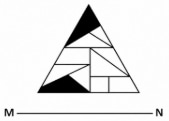
Solution
1. In a water reflection, the top and bottom of the figure interchange, while the left and right sides remain the same. 2. The original figure has a shaded triangle at the top apex. In the water reflection, this must appear at the bottom-pointing apex. This immediately eliminates Options C and D. 3. The original figure has a shaded triangle in the bottom-left corner. In the water reflection, this must appear in the top-left corner. Option B correctly represents this exact vertical inversion along with the correct orientation of all internal diagonal lines. Final Answer: Option B
- Q166.DSSSB 2026
Which letter cluster should replace the question mark (?) in the following series, based on English alphabetical order?
NIOG VQWO DYEW LGME ?
- A.
TUHG
- B.
THGV
- C.
TOUM
- D.
TOIL
Correct answer: C
Solution
Concept
In a letter-cluster series, compare corresponding letters by their alphabet positions (A = 1 to Z = 26). If every letter advances by the same number k, the next cluster follows that constant shift; after Z, counting wraps back to A.
Application
From NIOG to VQWO: N→V, I→Q, O→W, and G→O are each shifts of +8.
From VQWO to DYEW: V→D, Q→Y, W→E, and O→W are again +8, using wrap-around after Z where needed.
From DYEW to LGME: D→L, Y→G, E→M, and W→E are also +8, so the same rule holds across all given transitions.
Apply +8 to LGME: L→T, G→O, M→U, and E→M. Reading the results in order gives TOUM.
Cross-check
The shift vector from LGME to TOUM is (+8, +8, +8, +8).
For TUHG, THGV, and TOIL, the four corresponding shifts are not all equal, so those clusters do not continue the established constant-shift pattern.
Result
Therefore, the missing letter cluster is TOUM.
- A.
- Q167.DSSSB 2026
This question is based on the five, three-digit numbers given below.
(Left) 589 524 539 617 676 (Right)
(Example - 697 = First digit = 6, second digit = 9 and third digit = 7)
NOTE - All operations to be done from left to right.
What will be the resultant if the third digit of the highest number is added to the second digit of the lowest number?
- A.
5
- B.
6
- C.
7
- D.
8
Correct answer: D
Solution
1. Identify the given sequence of numbers: 589, 524, 539, 617, 676. 2. Find the highest number in the sequence, which is 676. The third digit of 676 is 6. 3. Find the lowest number in the sequence, which is 524. The second digit of 524 is 2. 4. Add the two identified digits together: 6 + 2 = 8. Final Answer: Option D
- A.
- Q168.DSSSB 2026
What will come in the place of ‘?’ in the following equation if ‘+’ and ‘−’ are interchanged and ‘×’ and ‘÷’ are interchanged?
18 × 2 + 7 − 3 ÷ 1 = ?
- A.
12
- B.
8
- C.
5
- D.
3
Correct answer: C
Solution
1. Write the original equation: 18 × 2 + 7 - 3 ÷ 1 = ? 2. Interchange the mathematical symbols as instructed (+ becomes -, - becomes +, × becomes ÷, ÷ becomes ×). The new equation is: 18 ÷ 2 - 7 + 3 × 1 = ? 3. Solve the modified equation using the BODMAS rule: (18 ÷ 2) - 7 + (3 × 1) = 9 - 7 + 3 = 2 + 3 = 5. Final Answer: Option C
- A.
- Q169.DSSSB 2026
Below are given two sets of numbers. In each set of numbers, a certain mathematical operation on first number results in the second number. Similarly, a certain mathematical operation on second number results in the third number and so on. Which of the given options follows the same set of operations as in question?
(Note: Operations should be performed on the whole numbers, without breaking down the numbers into its constituent digits. E.g. 13 − Operations on 13 such as adding/subtracting/multiplying etc. can be performed. Breaking down 13 into 1 and 3 and then performing mathematical operations on 1 and 3 is not allowed.)
38 - 266 - 532 - 544
13 - 91 - 182 - 194- A.
25 - 155 - 465 - 478
- B.
22 - 154 - 770 - 782
- C.
12 - 96 - 288 - 300
- D.
15 - 105 - 210 - 222
Correct answer: D
Solution
1. Analyze the first set: 38 - 266 - 532 - 544. The operations sequence is: 38 × 7 = 266, 266 × 2 = 532, 532 + 12 = 544. 2. Verify the logic with the second set: 13 - 91 - 182 - 194. The operations are perfectly identical: 13 × 7 = 91, 91 × 2 = 182, 182 + 12 = 194. 3. Apply this operational sequence (× 7, × 2, + 12) to the given options. Only Option D (15 - 105 - 210 - 222) satisfies this exact logic: 15 × 7 = 105, 105 × 2 = 210, 210 + 12 = 222. Final Answer: Option D
- A.
- Q170.DSSSB 2026
In a row of people all facing north, Tanya is 14th from the left end. Rahul is 29th from the left end. Rahul is exactly between Tanya and Aditya. If Aditya is 5th from the right end of the line, how many people are there in the row?
- A.
46
- B.
47
- C.
48
- D.
49
Correct answer: C
Solution
Tanya is 14th from the left and Rahul is 29th from the left, so Rahul is 15 places to the right of Tanya. Since Rahul is exactly between Tanya and Aditya, Aditya is 15 places to the right of Rahul, at position 44 from the left. If Aditya is 5th from the right, total people = 44 + 5 - 1 = 48.
- A.
- Q171.DSSSB 2026
If 2 is added to each odd digit and 1 is subtracted from each even digit in the number 2561473, then how many digits will appear more than once in the new number thus formed?
- A.
1
- B.
2
- C.
3
- D.
None
Correct answer: B
Solution
Step 1: Write down the original number and the conditions.
Original number: 2561473
Conditions: Add 2 to odd digits, subtract 1 from even digits.Step 2: Apply the conditions to each digit individually.
2 (Even) - 1 = 1
5 (Odd) + 2 = 7
6 (Even) - 1 = 5
1 (Odd) + 2 = 3
4 (Even) - 1 = 3
7 (Odd) + 2 = 9
3 (Odd) + 2 = 5
The new sequence is: 1753395Step 3: Count the distinct digits that appear more than once.
In the sequence (1, 7, 5, 3, 3, 9, 5):The digit 3 appears twice.
The digit 5 appears twice.
Thus, exactly two distinct digits appear more than once.Final Answer: Option 2
- A.
- Q172.DSSSB 2026
Based on the alphabetical order, three of the following four are alike in a certain way and thus form a group. Which is the one that does not belong to that group?
(Note: The odd one out is not based on the number of consonants/vowels or their position in the letter cluster.)
- A.
PMK
- B.
XVS
- C.
FCA
- D.
ZWU
Correct answer: B
Solution
Use alphabetical positions. PMK follows P to M = -3 and M to K = -2. FCA follows F to C = -3 and C to A = -2. ZWU follows Z to W = -3 and W to U = -2. But XVS follows X to V = -2 and V to S = -3. Therefore XVS is the odd one out.
- A.
- Q173.DSSSB 2026
Refer to the following series and answer the question. Counting to be done from left to right only. (All numbers are single digit numbers only).
(Left) 6 9 5 4 2 1 4 5 8 4 6 7 3 6 8 5 2 9 1 2 1 7 4 4 5 5 8 4 4 2 (Right)
How many such prime digits are there each of which is immediately preceded by an even digit and also immediately followed by an even digit?
- A.
More than three
- B.
One
- C.
Two
- D.
Three
Correct answer: C
Solution
1. Identify prime digits: 2, 3, 5, 7. Identify even digits: 0, 2, 4, 6, 8. 2. We need to find the specific pattern: [Even Digit] -> [Prime Digit] -> [Even Digit]. 3. Scanning the given series from left to right for prime digits and checking their neighbors: - ... 4 5 8 ... (4 is even, 5 is prime, 8 is even) -> Matches. - ... 8 5 2 ... (8 is even, 5 is prime, 2 is even) -> Matches. Other prime digits in the series either have an odd number before them or after them. 4. Total occurrences of this pattern = 2. Final Answer: Option C
- A.
- Q174.DSSSB 2026
Each of E, F, G, I, W, X and Y has an exam on a different day of a week, starting from Monday and ending on Sunday of the same week. Only three people have exams between I and F. Only three people have exams between W and X. E has exam on some day before F and on some day after Y. Only G has an exam before X. How many people have exams after I?
- A.
1
- B.
2
- C.
3
- D.
4
Correct answer: D
Solution
Only G has an exam before X, so G is on Monday and X is on Tuesday. Since W and X have three people between them, W is on Saturday. I and F also have three people between them; with F after X and E before F but after Y, the valid order is: Monday G, Tuesday X, Wednesday I, Thursday Y, Friday E, Saturday W, Sunday F. Therefore four people have exams after I.
- A.
- Q175.DSSSB 2026
In a row of 26 students facing north, Manish is 15th from the left end. If Divya is 6th to the right of Manish, what is Divya's position from the right end of the line?
- A.
6th
- B.
4th
- C.
7th
- D.
3rd
Correct answer: A
Solution
1. Find Divya's position from the left end: Manish is 15th from the left, and Divya is 6th to his right. Therefore, Divya is 15 + 6 = 21st from the left. 2. Apply the standard ranking formula for the opposite end: Position from right = Total students - Position from left + 1. 3. Substitute the values: Position from right = 26 - 21 + 1 = 5 + 1 = 6th. Final Answer: Option A
- A.
- Q176.DSSSB 2026
In a certain code language, ‘FLAT’ is coded as ‘4625’ and ‘CALF’ is coded as ‘2674’. What is the code for ‘C’ in the given code language?
- A.
2
- B.
4
- C.
6
- D.
7
Correct answer: D
Solution
Compare FLAT = 4625 and CALF = 2674. The common letters in both words are F, L and A, so their code digits must be the common digits 4, 6 and 2. The only digit in CALF's code that is not common with FLAT's code is 7; therefore C is coded as 7.
- A.
- Q177.DSSSB 2026
Each vowel in the word ABATAGES is changed to the letter immediately preceding it in the English alphabetical order and each consonant is changed to the letter immediately following it in the English alphabetical order. Which of the following letters will appear more than twice in the new group of letters thus formed?
- A.
H
- B.
Z
- C.
U
- D.
C
Correct answer: B
Solution
Apply the rule to ABATAGES: A becomes Z, B becomes C, A becomes Z, T becomes U, A becomes Z, G becomes H, E becomes D and S becomes T. The new group is ZCZUZHDT. In this group, Z appears three times, so it appears more than twice.
- A.
- Q178.DSSSB 2026
If the water source is placed along X-Y, as shown in the figure, which of the given options will be the water reflection of the given figure?

Solution
Step 1: Understand the rule for a water image: The top and bottom parts of the figure interchange, but the left and right sides remain in the same position.
Step 2: Observe the arrow at the top-left of the original figure. In the water image, it will invert and appear at the bottom-left, pointing downwards. This immediately eliminates Options A and B.
Step 3: The triangle at the bottom-left will move to the top-left. Both C and D have this.
Step 4: Compare the remaining options C and D by checking the inner jagged shape inside the square. In the original figure, it has a sharp point directed towards the top-left. In the water image, this point must direct towards the bottom-left. Option D shows this correct inversion, while Option C does not.Final Answer: Option D
- Q179.DSSSB 2026
F is the father of I. I is the brother of G. W is the father of Z. Z is the son of G. How is W related to F?
- A.
Daughter's son
- B.
Father
- C.
Husband
- D.
Daughter's husband
Correct answer: D
Solution
I and G are siblings, and F is I's father, so F is also G's father. Z is the son of G, and W is Z's father; therefore W is G's husband and F's daughter's husband.
- A.
- Q180.DSSSB 2026
Seven people, E, F, G, H, K, L and N, are sitting in a row, facing the north. Only two people sit between K and E. Only G sits to the right of H. Only one person sits between E and H. N sits at some place to the right of L but at some place to the left of F. How many people sit between F and L?
- A.
1
- B.
2
- C.
3
- D.
4
Correct answer: B
Solution
Let the seven positions from left to right be 1 to 7. Since everyone faces north, a person's right side is our right side.
Clue 1: Only G sits to the right of H.
This means H must be at position 6 and G at position 7.Clue 2: Only one person sits between E and H.
Since H is at position 6, E must be at position 4.Clue 3: Only two people sit between K and E.
Since E is at position 4, K must be at position 1. Position 7 is already occupied by G, so K cannot be there.Current arrangement:
K _ _ E _ H GClue 4: N sits somewhere to the right of L but somewhere to the left of F.
The remaining positions are 2, 3 and 5. To satisfy L ... N ... F, we get:
L at position 2, N at position 3, F at position 5.Final arrangement:
K, L, N, E, F, H, GBetween L(position 2) and F(position 5), the people are N and E. Therefore, 2 people sit between F and L.
Final answer: Option B
- A.
- Q181.DSSSB 2026
Based on the English alphabetical order, three of the following four letter-clusters are alike in a certain way and thus form a group. Which letter-cluster does not belong to that group?
(Note: The odd one out is not based on the number of consonants/vowels or their position in the letter-cluster.)
- A.
PUV
- B.
GKM
- C.
WAC
- D.
KOQ
Correct answer: A
Solution
Step 1: Check the alphabetical position gaps for each letter cluster.
Option A (PUV): P(16) + 5 = U(21); U(21) + 1 = V(22). (Gaps: +5, +1)
Option B (GKM): G(7) + 4 = K(11); K(11) + 2 = M(13). (Gaps: +4, +2)
Option C (WAC): W(23) + 4 = A(27/1); A(1) + 2 = C(3). (Gaps: +4, +2)
Option D (KOQ): K(11) + 4 = O(15); O(15) + 2 = Q(17). (Gaps: +4, +2)
Step 2: Options B, C, and D follow a uniform logic (+4, +2). Option A does not, making it the odd one out.
Final Answer: Option A
- A.
- Q182.DSSSB 2026
Refer to the following letter series and answer the question. (Counting to be done from left to right only)
(Left) P V V M H V X E L E E F T S I O X I G (Right)
How many such vowels are there each of which is immediately preceded by a consonant and also immediately followed by a vowel?
- A.
1
- B.
2
- C.
3
- D.
4
Correct answer: B
Solution
Step 1: Identify the required pattern. We are looking for: [Consonant] - [Vowel] - [Vowel].
The target letter is the middle Vowel (A, E, I, O, U).Step 2: Scan the series from left to right, locate all vowels, and check their immediate neighbors:
Series: P V V M H V X E L E E F T S I O X I GLet's test each vowel:
E (first): Preceded by X (Consonant), followed by L (Consonant). -> Fails
E (second): Preceded by L (Consonant), followed by E (Vowel). -> Passes (L E E)
E (third): Preceded by E (Vowel), followed by F (Consonant). -> Fails
I (first): Preceded by S (Consonant), followed by O (Vowel). -> Passes (S I O)
O: Preceded by I (Vowel), followed by X (Consonant). -> Fails
I (second): Preceded by X (Consonant), followed by G (Consonant). -> Fails
Step 3: There are exactly 2 instances that satisfy the given condition.
Final Answer: Option B
- A.
- Q183.DSSSB 2026
Which of the following sitar maestros is renowned for contributions to classical music in India?
- A.
R.D. Burman
- B.
Zakir Hussain
- C.
Pandit Bhimsen Joshi
- D.
Ravi Shankar
Correct answer: D
Solution
Ravi Shankar was a renowned sitar maestro known for his contributions to Indian classical music.
- A.
- Q184.DSSSB 2026
Structural unemployment occurs primarily due to:
- A.
Skill mismatch
- B.
Cyclical demand fall
- C.
Voluntary quitting
- D.
Seasonal variation
Correct answer: A
Solution
Structural unemployment mainly occurs when workers' skills do not match the structure or requirements of available jobs.
- A.
- Q185.DSSSB 2026
In Feb 2026, which Indian Special Forces unit represented India in the 13th edition of Exercise KHANJAR held in Missamari, Assam?
- A.
Parachute Regiment (Special Forces)
- B.
Garhwal Rifles Regiment (Special Forces)
- C.
Sikh Light Infantry Regiment (Special Forces)
- D.
Jat Infantry Regiment (Special Forces)
Correct answer: A
Solution
Exercise KHANJAR is a recurring bilateral joint special-forces military exercise between India and Kyrgyzstan, held alternately in each country and focused on counter-terrorism and high-altitude special operations tactics. India's contingent for such exercises is drawn from the Parachute Regiment (Special Forces) (Para SF), the Indian Army's premier special forces formation trained in airborne insertion, direct action, and counter-terrorism operations.
The 13th edition of Exercise KHANJAR was conducted from 4-17 February 2026 at the Missamari military station in Assam. As announced by the Ministry of Defence (PIB), India's participating contingent comprised troops from the Parachute Regiment (Special Forces), continuing the established pattern of Para SF representing India in this exercise.
Garhwal Rifles, Sikh Light Infantry, and the Jat Regiment are conventional infantry regiments of the Indian Army with their own distinguished service histories; none of them corresponds to the Ministry of Defence's announced contingent for this exercise.
- A.
- Q186.DSSSB 2026
What does the Indian Constitution state about the Directive Principles of State Policy?
- A.
They override rights during a national emergency period
- B.
They are optional and may be ignored by the government
- C.
They are legally binding and enforceable by the courts
- D.
They are not enforceable but guide state governance
Correct answer: D
Solution
Directive Principles of State Policy are not enforceable by courts, but they guide the State in governance and law-making.
- A.
- Q187.DSSSB 2026
Which Article contained in the Fundamental Rights of the Indian Constitution deals with the prohibition of employment of children in factories and states that “No child below the age of fourteen years shall be employed to work in any factory or mine or engaged in any other hazardous employment”?
- A.
Article 31
- B.
Article 14
- C.
Article 24
- D.
Article 19
Correct answer: C
Solution
Article 24 prohibits employment of children below 14 years in factories, mines or hazardous work.
- A.
- Q188.DSSSB 2026
Where was the capital of Alauddin Khalji built?
- A.
Tughlaqabad
- B.
Ferozabad
- C.
Siri
- D.
Jahanpanah
Correct answer: C
Solution
Alauddin Khalji built his capital at Siri in Delhi.
- A.
- Q189.DSSSB 2026
Unlike sound waves, electromagnetic waves can travel through _________.
- A.
Only solids
- B.
Only air
- C.
Vacuum
- D.
Only water
Correct answer: C
Solution
Sound waves need a material medium, but electromagnetic waves can travel through vacuum.
- A.
- Q190.DSSSB 2026
During 1820–21, the Ho community, who rose against British and landlord oppression, were primarily situated in which of the following areas?
- A.
Gumla
- B.
Saraikela
- C.
Singhbhum
- D.
Godda
Correct answer: C
Solution
The Ho uprising of 1820-21 was primarily associated with the Singhbhum region.
- A.
- Q191.DSSSB 2026
Which of the following religious groups had the smallest population share among the listed ones in Census 2011?
- A.
Sikh
- B.
Hindu
- C.
Jain
- D.
Buddhist
Correct answer: C
Solution
According to Census 2011, among the listed groups, Jains had the smallest population share.
- A.
- Q192.DSSSB 2026
Which of the following states' governor has particular responsibility for maintaining the state's law and order under Article 371 A of the Indian Constitution?
- A.
Assam
- B.
Manipur
- C.
Nagaland
- D.
Mizoram
Correct answer: C
Solution
Article 371A gives the Governor of Nagaland special responsibility for law and order in specified circumstances.
- A.
- Q193.DSSSB 2026
Who was the chronicler that recognised Raziyya's abilities as a ruler of Delhi in 1236?
- A.
Minhaj-i Siraj
- B.
Firishta
- C.
Ibn Battuta
- D.
Amir Khusrau
Correct answer: A
Solution
Minhaj-i Siraj was the chronicler who recognized Raziyya's abilities as a ruler of Delhi.
- A.
- Q194.DSSSB 2026
Who was publicly announced as the new Chief of Hezbollah after the death of Hassan Nasrallah?
- A.
Hashem Saifeddine
- B.
Zeinab Soleimani
- C.
Naim Qassem
- D.
Raeda Faqih
Correct answer: C
Solution
Hezbollah's top leadership post — Secretary-General, often referred to in media as its "chief" — is filled through a formal election by the Shura Council, the organisation's highest governing and consultative body; a public announcement, not a private or unannounced designation, is what confirms who has become the group's recognised chief.
Hassan Nasrallah, Hezbollah's Secretary-General since 1992, was killed in an Israeli airstrike on Beirut on 27 September 2024. Hashem Safieddine — the head of Hezbollah's Executive Council — was widely reported as the presumptive successor and was killed in a subsequent Israeli strike on 3 October 2024 before any public announcement of a new Secretary-General; Hezbollah later stated he had been the Shura Council's intended choice, but he never publicly assumed or exercised the post. On 29 October 2024, Hezbollah publicly announced that its Shura Council had elected Naim Qassem — the organisation's long-serving Deputy Secretary-General — as the new Secretary-General (Chief) of Hezbollah; Qassem has held and publicly exercised the post since, and remains Hezbollah's recognised chief today, as reported by Reuters, Al Jazeera, and the Associated Press.
Hashem Saifeddine: reportedly Hezbollah's intended successor, but killed before any public announcement and never publicly assumed or exercised the post of Secretary-General.
Zeinab Soleimani: not a documented figure in Hezbollah's Shura Council or Secretary-General succession reporting.
Naim Qassem: publicly announced as Secretary-General by the Shura Council on 29 October 2024 and has served in the post since — the correct answer.
Raeda Faqih: not a documented figure in Hezbollah's Shura Council or Secretary-General succession reporting.
Naim Qassem is therefore the standard and well-documented answer — publicly announced, installed, and internationally recognised as Hezbollah's Secretary-General since 29 October 2024 — though some later accounts note Safieddine had privately been the Council's chosen (but never publicly installed) successor before his death.
- A.
- Q195.DSSSB 2026
Which of the following is an incomplete protein – a protein source that does not contain all essential amino acids in adequate amounts?
- A.
Eggs
- B.
Fish
- C.
Milk
- D.
Pulses
Correct answer: D
Solution
Complete proteins contain all nine essential amino acids required by the body. Animal sources like eggs, fish, and milk are complete proteins. Pulses lack sufficient methionine, making them incomplete protein sources.
- A.
- Q196.DSSSB 2026
In what year did Qutbuddin Aibak become the ruler of Muhammad Ghori’s Indian possessions?
- A.
AD 1206
- B.
AD 1210
- C.
AD 1221
- D.
AD 1192
Correct answer: A
Solution
Qutbuddin Aibak became ruler of Muhammad Ghori's Indian possessions in AD 1206 after Ghori's death.
- A.
- Q197.DSSSB 2026
Which of the following soil types is widespread in the northern Indian plains and river valleys?
- A.
Arid soil
- B.
Laterite soil
- C.
Alluvial soil
- D.
Black soil
Correct answer: C
Solution
Alluvial soil is widespread in the northern Indian plains and river valleys because it is deposited by rivers.
- A.
- Q198.DSSSB 2026
Study the graph and answer the following question. The graph shows information about different fruits purchased by three persons A, B and C.
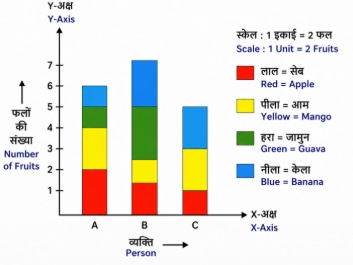
What is the total number of fruits purchased together by A, B and C?
- A.
18
- B.
24
- C.
30
- D.
36
Correct answer: D
Solution
Read bar heights from the graph:
Person A = 6 units
Person B = 7 units
Person C = 5 units
Calculate total units: 6 + 7 + 5 = 18 units.
Apply scale factor: The scale is 1 unit = 2 fruits.
Final calculation: 18 units × 2 fruits/unit = 36 fruits.
Final Answer: Option 4
- A.
- Q199.DSSSB 2026
If 9.9 : x :: x : 27.5, and x > 0, then find the value of x.
- A.
16.5
- B.
19.7
- C.
12.9
- D.
13
Correct answer: A
Solution
Step 1: Use the property of proportion.
The product of the means equals the product of the extremes.
x × x = 9.9 × 27.5Step 2: Calculate the product.
x² = 272.25Step 3: Find the square root.
Since x > 0, take the positive square root:
x = √272.25 = 16.5Final Answer: Option 1
- A.
- Q200.DSSSB 2026
A cone is inscribed in a sphere such that the radius of the cone is the same as the radius of the sphere, and the height of the cone is equal to the diameter of the sphere. What is the relationship between the volume of the sphere and the volume of the cone?
- A.
Volume of cone is one-third of volume of sphere.
- B.
Volume of sphere is twice of volume of cone.
- C.
Volume of cone is three-fourth of volume of sphere.
- D.
Volume of cone is two-third of volume of sphere.
Correct answer: B
Solution
Step 1: Define dimensions.
Let the radius of the sphere be r.
Cone radius = r.
Cone height = Diameter of sphere = 2r.
Step 2: Calculate volumes.
Volume of Sphere = (4/3) × π × r³
Volume of Cone = (1/3) × π × r² × h = (1/3) × π × r² × (2r) = (2/3) × π × r³
Step 3: Compare the volumes.
Ratio: Sphere Volume / Cone Volume = [(4/3)πr³] / [(2/3)πr³] = 4/2 = 2.
Thus, the Volume of the Sphere is twice the Volume of the Cone.
Final Answer: Option 2
- A.