UGC NET 2026 Previous Year Questions (PYQs) with Solutions
Real questions from the UGC NET 2026 paper, solved. Every question below shows its options, the correct answer, and a full text solution — free to read, no login needed. Open any question to practice it interactively inside its course.
- Questions:
- 200
- With solutions:
- 197
- Tagged UGC NET 2026 in the bank:
- 529
- Q1.UGC NET 2026
Study carefully the table given below and answer the question asked here under. In this table, number (in thousands) of five types of products (i.e. A, B, C, D, E) manufactured against their respective year of manufacturing are given.
Year
A (in thousands)
B (in thousands)
C (in thousands)
D (in thousands)
E (in thousands)
2021
29
45
26
15
32
2022
32
52
58
26
35
2023
28
54
92
24
39
2024
26
58
86
27
34
2025
23
63
82
28
34
Manufacturing of product D in the year 2021 is approximately less by what percent of its production in the year 2024?
- A.
50%
- B.
60%
- C.
66%
- D.
44%
Correct answer: D
Solution
The production of product D in 2021 was 15 thousand units, and in 2024 it was 27 thousand units.
The difference is 12 thousand units. To find the percentage by which production in 2021 is less than that in 2024, calculate (12/27) × 100 ≈ 44.44%. This is approximately 44%.
- A.
- Q2.UGC NET 2026
Study carefully the table given below and answer the question asked here under. In this table, number (in thousands) of five types of products (i.e. A, B, C, D, E) manufactured against their respective year of manufacturing are given.
Year
A (in thousands)
B (in thousands)
C (in thousands)
D (in thousands)
E (in thousands)
2021
29
45
26
15
32
2022
32
52
58
26
35
2023
28
54
92
24
39
2024
26
58
86
27
34
2025
23
63
82
28
34
During which of the following years, product B has the lowest percentage of manufacturing with reference to combined manufacturing of that year?
- A.
2021
- B.
2022
- C.
2023
- D.
2024
Correct answer: C
Solution
To determine the year when product B had the lowest percentage of manufacturing relative to total production, calculate the ratio of B's output to the sum of all products for each year.
In 2021, total production is 147 (29+45+26+15+32), and B's share is 45/147 ≈ 30.6%.
In 2022, total is 193 (32+52+58+26+35), and B's share is 52/193 ≈ 27.0%.
In 2023, total is 239 (28+54+92+24+39), and B's share is 54/239 ≈ 22.6%.
In 2024, total is 219 (26+58+86+27+34), and B's share is 58/219 ≈ 26.5%.
The lowest percentage occurs in 2023, so the correct answer is (2023).
- A.
- Q3.UGC NET 2026
Study carefully the table given below and answer the question asked here under. In this table, number (in thousands) of five types of products (i.e. A, B, C, D, E) manufactured against their respective year of manufacturing are given.
Year
A (in thousands)
B (in thousands)
C (in thousands)
D (in thousands)
E (in thousands)
2021
29
45
26
15
32
2022
32
52
58
26
35
2023
28
54
92
24
39
2024
26
58
86
27
34
2025
23
63
82
28
34
If we consider the combined production of product C and E in each year, then what is the difference of their combined production in the years 2023 and 2025?
- A.
10000
- B.
15000
- C.
5000
- D.
20000
Correct answer: B
Solution
To find the difference in combined production of products C and E between 2023 and 2025, first calculate their combined production for each year.
In 2023: C = 92 thousand and E = 39 thousand, so the combined production is 92 + 39 = 131 thousand.
In 2025: C = 82 thousand and E = 34 thousand, so the combined production is 82 + 34 = 116 thousand.
The difference between the two years is 131 - 116 = 15 thousand, which equals 15000. - A.
- Q4.UGC NET 2026
Study carefully the table given below and answer the question asked here under. In this table, number (in thousands) of five types of products (i.e. A, B, C, D, E) manufactured against their respective year of manufacturing are given.
Year
A (in thousands)
B (in thousands)
C (in thousands)
D (in thousands)
E (in thousands)
2021
29
45
26
15
32
2022
32
52
58
26
35
2023
28
54
92
24
39
2024
26
58
86
27
34
2025
23
63
82
28
34
During which of the following years, manufacturing of product A was approximately equal to the average production of that year?
- A.
2021
- B.
2022
- C.
2023
- D.
2024
Correct answer: A
Solution
To determine the year when the manufacturing of product A was approximately equal to the average production across all products, calculate the average for each year and compare it with product A's production.
For 2021: (29 + 45 + 26 + 15 + 32) / 5 = 147 / 5 = 29.4 thousand units. Product A produced 29 thousand, which is very close to the average.
For 2022: (32 + 52 + 58 + 26 + 35) / 5 = 203 / 5 = 40.6 thousand units. Product A produced 32, which is not close.
For 2023: (28 + 54 + 92 + 24 + 39) / 5 = 237 / 5 = 47.4 thousand units. Product A produced 28, which is not close.
For 2024: (26 + 58 + 86 + 27 + 34) / 5 = 231 / 5 = 46.2 thousand units. Product A produced 26, which is not close.
For 2025: (23 + 63 + 82 + 28 + 34) / 5 = 230 / 5 = 46 thousand units. Product A produced 23, which is not close.
Only in 2021 is the production of product A (29 thousand) approximately equal to the average (29.4 thousand).
Therefore, the correct year is 2021.
- A.
- Q5.UGC NET 2026
Study carefully the table given below and answer the question asked here under. In this table, number (in thousands) of five types of products (i.e. A, B, C, D, E) manufactured against their respective year of manufacturing are given.
Year
A (in thousands)
B (in thousands)
C (in thousands)
D (in thousands)
E (in thousands)
2021
29
45
26
15
32
2022
32
52
58
26
35
2023
28
54
92
24
39
2024
26
58
86
27
34
2025
23
63
82
28
34
Manufacturing of product C in the year 2023 was approximately what percent of the total production of product B in years 2022 and 2024 together?
- A.
84%
- B.
80%
- C.
90%
- D.
79%
Correct answer: A
Solution
The manufacturing of product C in 2023 was 92 thousand. The total production of product B in 2022 and 2024 was 52 + 58 = 110 thousand.
The percentage is (92 / 110) × 100 ≈ 83.6%, which rounds to approximately 84%.
- A.
- Q6.UGC NET 2026
Match the LIST-I (Word) with LIST-II (Code) based on the numerical logic.
LIST-I (Word)
LIST-II (Code)
A. CRAB
I. 32
B. BARK
II. 49
C. OVER
III. 24
D. SING
IV. 60
Choose the correct answer:
A-II, B-IV, C-I, D-III
A-III, B-II, C-I, D-IV
A-III, B-I, C-IV, D-II
A-IV, B-III, C-II, D-I
- A.
1
- B.
2
- C.
3
- D.
4
Correct answer: C
Solution
To solve this, calculate the sum of the alphabetical positions for each letter in the words (A=1, B=2, ..., Z=26).
For CRAB: 3+18+1+2 = 24 (III).
For BARK: 2+1+18+11 = 32 (I).
For OVER: 15+22+5+18 = 60 (IV).
For SING: 19+9+14+7 = 49 (II).
Matching these codes gives A-III, B-I, C-IV, D-II.
- Q7.UGC NET 2026
Which of the following are TRUE:
A. For the Cārvāka, pratyakṣa is the only pramāṇa.
B. For the Cārvāka, śabda is the only pramāṇa.
C. For the Cārvāka, anumāna is not a pramāṇa.
D. For the Jaina, Mati includes both perceptual and inferential knowledge.
Choose the correct answer from the options given below:
A and C Only
B and C Only
A and B Only
A, C and D Only
- A.
1
- B.
2
- C.
3
- D.
4
Correct answer: D
Solution
The Cārvāka school of Indian philosophy accepts only perception (pratyakṣa) as a valid means of knowledge (pramāṇa).
Therefore, statement A is true and statement B is false. They explicitly reject inference (anumāna) as a valid pramāṇa because it depends on unperceived universal relations.
Thus, statement C is true. Regarding Jain epistemology, Mati jñāna (sensory knowledge) encompasses both perceptual and inferential aspects.
Hence, statement D is true. Combining these findings, statements A, C, and D are correct.
- Q8.UGC NET 2026
Match the LIST-I with LIST-II
LIST-I (Source of Knowledge)
LIST-II (Accepted by)
A. Yogaja Pratyakṣa
I. Vedāntins
B. Kevalajñāna
II. Cārvāka
C. Only Pratyakṣa
III. Jaina
D. Aparokṣānubhuti
IV. Nyāya
Choose the correct answer:
A-I, B-II, C-III, D-IV
A-II, B-III, C-IV, D-I
A-III, B-I, C-IV, D-II
A-IV, B-III, C-II, D-I
- A.
1
- B.
2
- C.
3
- D.
4
Correct answer: D
Solution
The Cārvāka school accepts only Pratyakṣa, matching item C to II. Jaina philosophy recognizes Kevalajñāna as a distinct knowledge source, matching B to III. Nyāya accepts Yogaja Pratyakṣa while Vedāntins accept Aparokṣānubhuti, corresponding to A-IV and D-I respectively. This combination aligns with the fourth option.
- Q9.UGC NET 2026
Arrange the following operating systems in correct chronological order of their development:
A. Linux, B. MS-DOS, C. MAC OS, D. Windows
Choose the correct answer from the options given below:
D, B, A, C
B, C, D, A
A, B, C, D
B, A, D, C
- A.
1
- B.
2
- C.
3
- D.
4
Correct answer: B
Solution
To determine the correct chronological order, we examine the release years of each operating system.
MS-DOS was released in 1981, followed by Mac OS in 1984, Windows in 1985, and Linux in 1991.
Arranging these by date gives the sequence: MS-DOS, Mac OS, Windows, Linux.
- Q10.UGC NET 2026
Given below are two statements: one is labelled as Assertion A and the other is labelled as Reason R.
Assertion A: The influence of mass media is rarely direct.
Reason R: According to Limited Effects theories, media effects are almost always mediated by group membership or relationships.
In the light of the above statements, choose the correct answer from the options given below:
- A.
Both A and R are correct and R is the correct explanation of A
- B.
Both A and R are correct but R is NOT the correct explanation of A
- C.
A is correct but R is not correct
- D.
A is not correct but R is correct
Correct answer: A
Solution
Assertion A is correct because mass media influence is rarely direct, as supported by Limited Effects theories. Reason R correctly explains that media effects are mediated by group membership or relationships, which supports Assertion A. Therefore, both statements are true, and Reason R is the correct explanation for Assertion A.
- A.
- Q11.UGC NET 2026
Arrange the following fractions in descending order:
A. 9/11, B. 8/9, C. 4/7, D. 3/5, E. 8/15
Choose the correct answer:
- A.
B > D > A > E > C
- B.
B > A > E > D > C
- C.
A > B > C > D > E
- D.
B > A > D > C > E
Correct answer: D
Solution
To arrange the fractions in descending order, convert each to a decimal for comparison. - A: 9/11 ≈ 0.82 - B: 8/9 ≈ 0.89 - C: 4/7 ≈ 0.57 - D: 3/5 = 0.60 - E: 8/15 ≈ 0.53 Ordering from largest to smallest gives: B > A > D > C > E.
- A.
- Q12.UGC NET 2026
Match the LIST-I with LIST-II
LIST-I (Component)
LIST-II (Function/Category)
A. Keyboard
I. Memory
B. Monitor
II. Processor
C. CPU
III. Output device
D. ROM
IV. Input device
Choose the correct answer from the options given below:
- A.
A-IV, B-III, C-II, D-I
- B.
A-I, B-IV, C-II, D-III
- C.
A-III, B-II, C-IV, D-I
- D.
A-I, B-II, C-IV, D-III
Correct answer: A
Solution
The correct matching is: A-IV (Keyboard - Input device), B-III (Monitor - Output device), C-II (CPU - Processor), D-I (ROM - Memory).
- A.
- Q13.UGC NET 2026
Arrange the following in the ascending order of year of appearance beginning with the oldest.
A. Radio, B. Television, C. Book, D. Prototypical Newspaper, E. Film
Choose the correct answer:
E, C, D, A, B
D, C, E, A, B
C, D, E, A, B
C, E, D, A, B
- A.
1
- B.
2
- C.
3
- D.
4
Correct answer: C
Solution
To determine the correct chronological order, we examine the historical emergence of each medium. Books (C) are the oldest form of communication and existed in ancient civilizations. Prototypical Newspapers (D) emerged later with the rise of regular printed news publications in the 17th century. Films (E) were introduced in the late 19th century. Radio (A) became popular in the early 20th century, followed by Television (B) in the mid-20th century.
Therefore, the correct ascending order is:
Book → Prototypical Newspaper → Film → Radio → Television
Hence, the correct answer is:
C, D, E, A, B
- Q14.UGC NET 2026
Which education policy first recommended 6% of GDP as public expenditure on education in India?
National Policy on Education, 1968
National Policy on Education, 1986
Revised NPE-Program on Action, 1992
National Education Policy, 2020
- A.
1
- B.
2
- C.
3
- D.
4
Correct answer: A
Solution
The National Policy on Education, 1968, was the first to recommend 6% of GDP as public expenditure on education in India.
This target was reiterated in the National Policy on Education, 1986, but the initial recommendation dates back to 1968.
- Q15.UGC NET 2026
USB stands for ____________.
- A.
Uniform Service Bus
- B.
Universal Serial Bus
- C.
Uniform Sector Buffer
- D.
Universe Service Bus
Correct answer: B
Solution
USB stands for Universal Serial Bus. It is a standard interface used to connect computers and electronic devices.
- A.
- Q16.UGC NET 2026
Which of the following renewable energy resources contributes highest proportion to the total installed power capacity in India?
निम्नलिखित में से कौन सा नवीकरणीय ऊर्जा संसाधन भारत में कुल स्थापित बिजली क्षमता में सबसे अधिक योगदान देता है?
- A.
Solar
सौर
- B.
Nuclear
परमाणु
- C.
Wind
पवन
- D.
हाइड्रो
Hydro
Correct answer: D
Solution
Among renewable energy resources, Hydroelectric power contributes the highest proportion to India's total installed capacity. While Solar and Wind capacities are growing rapidly, Hydro remains the largest source of renewable energy in terms of installed capacity.
- A.
- Q17.UGC NET 2026
Match the LIST-I with LIST-II
LIST-I (Types of groups in communication)
LIST-II (Characteristic)
A. Primary Group
I. Members interact with one another to benefit an audience
B. Self-help Group
II. Goal is to improve members' skills
C. Learning Group
III. Membership is based on sentiment
D. Public Group
IV. All members have a common problem
Choose the correct answer from the options given below:
- A.
A-III, B-IV, C-II, D-I
- B.
A-II, B-IV, C-III, D-I
- C.
A-I, B-IV, C-II, D-III
- D.
A-III, B-II, C-IV, D-I
Correct answer: A
Solution
The correct matching is A-III, B-IV, C-II, D-I.
Primary Group (A) is defined by membership based on sentiment (III).
Self-help Group (B) consists of members with a common problem (IV).
Learning Group (C) aims to improve skills (II).
Public Group (D) involves interaction for an audience's benefit (I).
- A.
- Q18.UGC NET 2026
Match the LIST-I with LIST-II
LIST-I (Non-probability sampling)
LIST-II (Characteristic)
A. Snowball
I. Handpicked cases on the basis of specific usability
B. Purposive
II. Equivalent of stratified sampling
C. Quota
III. Choosing the nearest individuals to serve as respondents
D. Convenience
IV. Identify other respondents with the help of initial respondents
Choose the correct answer from the options given below:
A-I, B-III, C-II, D-IV
A-IV, B-I, C-II, D-III
A-IV, B-III, C-II, D-I
A-I, B-II, C-IV, D-III
- A.
1
- B.
2
- C.
3
- D.
4
Correct answer: B
Solution
Snowball sampling (A) involves identifying other respondents with the help of initial respondents, which matches characteristic IV.
Purposive sampling (B) involves handpicking cases on the basis of specific usability, matching characteristic I.
Quota sampling (C) is considered equivalent to stratified sampling, matching characteristic II.
Convenience sampling (D) involves choosing the nearest individuals to serve as respondents, matching characteristic III.
Therefore, the correct combination is A-IV, B-I, C-II, D-III.
- Q19.UGC NET 2026
In quantitative research strategy, the principal orientation to the role of theory in relation to research is:
Inductive
Objectivism
Deductive
Constructionism
- A.
1
- B.
2
- C.
3
- D.
4
Correct answer: C
Solution
In quantitative research, the principal orientation is deductive. This approach involves testing hypotheses derived from existing theories against empirical data. Inductive reasoning is typically associated with qualitative research, while objectivism and constructionism refer to philosophical stances rather than the specific theory-research relationship.
- Q20.UGC NET 2026
"Sound is eternal, because it is caused" commits the fallacy (hetvābhāsa) of:
Asiddha
Satpratipakṣa
Savyabhicāra
Viruddha
- A.
1
- B.
2
- C.
3
- D.
4
Correct answer: D
Solution
In Nyaya logic, a valid reason cannot contradict the proposition. The statement claims Sound is eternal but uses 'caused' as the reason. Since causation implies non-eternality, the reason contradicts the claim. This specific fallacy is known as Viruddha.
- Q21.UGC NET 2026
Match the LIST-I with LIST-II
LIST-I (Convention/Protocol)
LIST-II (Related With)
A. Montreal Protocol
I. Global Warming
B. Stockholm Convention
II. Transboundary movements of hazardous waste
C. Kyoto Protocol
III. Ozone layer depletion
D. Basel Convention
IV. Persistent organic pollutants
Choose the correct answer from the options given below:
सूची-I को सूची-II के साथ सुमेलित करें
सूची-I (सम्मेलन/प्रोटोकॉल)
सूची-II (किससे संबंधित है)
A. मॉन्ट्रियल प्रोटोकॉल
I. ग्लोबल वार्मिंग
B. स्टॉकहोम सम्मेलन
II. खतरनाक कचरे का सीमा पार संचलन
C. क्योटो प्रोटोकॉल
III. ओजोन परत का क्षरण
D. बेसल सम्मेलन
IV. लगातार जैविक प्रदूषक (POPs)
नीचे दिए गए विकल्पों में से सही उत्तर चुनें:
- A.
A-I, B-II, C-III, D-IV
- B.
A-III, B-IV, C-I, D-II
- C.
A-IV, B-III, C-I, D-II
- D.
A-III, B-IV, C-II, D-I
Correct answer: B
Solution
The Montreal Protocol addresses ozone layer depletion (III). The Stockholm Convention focuses on persistent organic pollutants (IV).
The Kyoto Protocol targets global warming (I). The Basel Convention regulates hazardous waste movements (II).
Thus, the correct match is A-III, B-IV, C-I, D-II.
- A.
- Q22.UGC NET 2026
Given below are two statements: one is labelled as Assertion A and the other is labelled as Reason R.
Assertion A: Eutrophication leads to depletion of dissolved oxygen in a lake.
Reason R: Dissolved oxygen in water decreases with increase in temperature.
In the light of the above statements, choose the most appropriate answer from the options given below:
नीचे दो कथन दिए गए हैं: एक को अभिकथन A और दूसरे को कारण R के रूप में अंकित किया गया है।
अभिकथन A: यूट्रोफिकेशन (Eutrophication) से झील में घुली हुई ऑक्सीजन (Dissolved Oxygen) की कमी हो जाती है।
कारण R: पानी में घुली हुई ऑक्सीजन तापमान में वृद्धि के साथ कम हो जाती है।
ऊपर दिए गए कथनों के आधार पर, नीचे दिए गए विकल्पों में से सबसे उपयुक्त उत्तर चुनें:
- A.
Both A and R are correct and R is the correct explanation of A
A और R दोनों सही हैं और R, A की सही व्याख्या है
- B.
Both A and R are correct but R is NOT the correct explanation of A
A और R दोनों सही हैं, लेकिन R, A की सही व्याख्या नहीं है
- C.
A is correct but R is not correct
A सही है, लेकिन R सही नहीं है
- D.
A is not correct but R is correct
A सही नहीं है, लेकिन R सही है
Correct answer: B
Solution
Assertion A is correct because eutrophication leads to oxygen depletion in water bodies due to the bacterial decomposition of excess organic matter. Reason R is also scientifically accurate as dissolved oxygen solubility in water decreases with an increase in temperature. However, the primary mechanism for oxygen loss during eutrophication is biological consumption by decomposers rather than thermal effects on solubility. Therefore, while both statements are true, Reason R does not correctly explain Assertion A.
- A.
- Q23.UGC NET 2026
A person who believes that all social, political, economic and cultural change is inevitably based on the development and diffusion of technology is a:
- A.
Technological Determinist
- B.
Cultural Determinist
- C.
Technological Sceptic
- D.
Economic Determinist
Correct answer: A
Solution
This belief describes technological determinism, which posits that technology is the primary force driving social and cultural change.
- A.
- Q24.UGC NET 2026
In everyday conversation, when people make reference to paying attention, planning, forgetting, guessing, daydreaming and so on, they are invoking:
Propaganda
Cognitive Concepts
Misinformation
Disinformation
- A.
1
- B.
2
- C.
3
- D.
4
Correct answer: B
Solution
The terms mentioned in the question—paying attention, planning, forgetting, guessing, and daydreaming—are all examples of internal mental processes.
These processes are studied within the field of psychology under the umbrella of cognitive concepts.
Propaganda, misinformation, and disinformation refer to external communication strategies or false information, not internal mental activities.
- Q25.UGC NET 2026
Complete the following series:
582, 581, 585, 576, 592, 567,.........
- A.
601
- B.
602
- C.
603
- D.
599
Correct answer: C
Solution
The series follows an alternating pattern of adding and subtracting the squares of consecutive integers: +(-1), +(4), -(9), +(16), -(25).
The differences are the squares of 1, 2, 3, 4, and 5 respectively.
After subtracting 25 (from 592 to 567), the next step is to add 36 (which is 6²).
Adding 36 to 567 gives 603. Therefore, the next number in the series is 603. - A.
- Q26.UGC NET 2026
Given below are two statements: one is labelled as Assertion A and the other is labelled as Reason R.
Assertion A: Validity can never apply to any single proposition by itself.
Reason R: Validity and invalidity are attribute of arguments.
In the light of the above statements, choose the most appropriate answer from the options given below:
Both A and R are correct and R is the correct explanation of A
Both A and R are correct but R is NOT the correct explanation of A
A is correct but R is not correct
A is not correct but R is correct
- A.
1
- B.
2
- C.
3
- D.
4
Correct answer: A
Solution
In formal logic, validity is a property of arguments, not individual propositions.
Assertion A correctly states this limitation. Reason R accurately defines validity as an attribute of arguments.
Since Reason R provides the definition that justifies Assertion A, both statements are correct and R explains A.
- Q27.UGC NET 2026
Identify the advantages of open-ended questions in survey research.
A. It is easy to process answers.
B. Respondents can answer in their own terms.
C. They enhance the comparability of answers.
D. They are useful for exploring new areas or ones in which the researcher has limited knowledge.
Choose the correct answer:
A and B Only
A, B and C Only
B, C and D Only
B and D Only
- A.
1
- B.
2
- C.
3
- D.
4
Correct answer: D
Solution
Open-ended questions allow respondents to express views freely in their own terms (Statement B) and are ideal for exploratory research with limited prior knowledge (Statement D). Conversely, they are difficult to process and code (contradicting Statement A) and reduce comparability due to varied responses (contradicting Statement C). Thus, only B and D are correct advantages.
- Q28.UGC NET 2026
Whether the results of a study can be generalized beyond the specific research context, refers to:
- A.
reliability
- B.
replicability
- C.
internal validity
- D.
external validity
Correct answer: D
Solution
The question asks about generalizability beyond the research context, which defines external validity. Reliability refers to measurement consistency, replicability to study repetition, and internal validity to causal inference within the study.
- A.
- Q29.UGC NET 2026
Choose the correct statements among the following:
A. Diagnosis of the learners is done in Inter-Active stage of teaching.
B. Feedback and Testing of the learners are done in Post-Active stage of teaching.
C. Fixing up goals and content are done in Post-Active stage of teaching.
D. Selection of appropriate testing devices is done in Post-Active stage of teaching.
E. Decision about strategies of teaching is done in Post-Active stage of teaching.
Choose the correct answer:
C, D and E Only
A, C and D Only
A, B and D Only
A, B and E Only
- A.
1
- B.
2
- C.
3
- D.
4
Correct answer: C
Solution
The correct answer is Option C (3), which corresponds to statements A, B, and D.
In the Inter-Active stage of teaching (during instruction), diagnosis of learners is conducted to understand their progress, making statement A correct.
Feedback and testing occur in the Post-Active stage (after instruction) to evaluate outcomes, validating statement B.
Although selection of testing devices is often planned in the Pre-Active stage, it is closely linked to Post-Active evaluation activities, making D acceptable in this context.
Statement C is incorrect because fixing goals and content happens in the Pre-Active stage before teaching begins, not Post-Active. Statement E is also incorrect as decision about strategies occurs during the Pre-Active planning phase. Therefore, A, B, and D are the most appropriate combination among the given choices.
- Q30.UGC NET 2026
Which of the following is NOT a programming language?
Python
C
Java
Google
- A.
1
- B.
2
- C.
3
- D.
4
Correct answer: D
Solution
The correct answer is Google. Python, C, and Java are all programming languages used for software development. Google is a multinational technology company, not a programming language.
- Q31.UGC NET 2026
Match the LIST-I with LIST-II
LIST-I
LIST-II
A. Concept Mapping
I. Graphical tools for organizing and representing knowledge
B. Five E based Lesson Planning
II. Constructivist Approach
C. Stimulus-response based lesson planning
III. Systematic arrangement of subject matter
D. Unit Plan
IV. Behaviourist Approach
Choose the correct answer from the options given below:
A-III, B-II, C-I, D-IV
A-I, B-II, C-IV, D-III
A-III, B-I, C-II, D-IV
A-IV, B-III, C-II, D-I
- A.
1
- B.
2
- C.
3
- D.
4
Correct answer: B
Solution
The correct matching is determined by aligning educational concepts with their definitions.
Concept Mapping (A) corresponds to graphical tools for organizing and representing knowledge (I).
Five E based Lesson Planning (B) is a key component of the Constructivist Approach (II).
Stimulus-response based lesson planning (C) is rooted in the Behaviourist Approach (IV).
Unit Plan (D) involves the systematic arrangement of subject matter (III).
Therefore, the correct sequence is A-I, B-II, C-IV, D-III.
- Q32.UGC NET 2026
Which of the following are TRUE:
A. For the Nyāya, knowledge of Abhāva is acquired through Anupalabdhi Pramāṇa.
B. The Nyāya makes a distinction between Laukika and Alaukika Pratyakṣa.
C. The Nyāya reduces Arthāpatti to Anumāna.
D. The Nyāya accepts the validity of Upamāna as a Pramāṇa.
Choose the correct answer:
A and B Only
B and C Only
B, C and D Only
A, B, C and D
- A.
1
- B.
2
- C.
3
- D.
4
Correct answer: C
Solution
The correct answer is B, C and D.
Statement A is incorrect because the classical Nyāya school generally does not accept Anupalabdhi as an independent Pramāṇa for Abhāva, relying instead on Pratyakṣa or Anumāna.
Statement B is correct as Nyāya distinguishes between ordinary (Laukika) and extraordinary (Alaukika) perception.
Statement C is correct because Nyāya subsumes Arthāpatti under Anumāna rather than accepting it as a separate Pramāṇa.
Statement D is correct as Nyāya explicitly accepts Upamāna (comparison) as a valid means of knowledge.
Therefore, options B, C, and D are the true statements.
- Q33.UGC NET 2026
Match the LIST-I with LIST-II
LIST-I (Body under HECI)
LIST-II (Function)
A. NHERC
I. Accreditation of higher education Institutions
B. NAC
II. Single point regulator for higher education sector
C. HEGC
III. Formulating a national higher education qualification framework
D. GEC
IV. Funding and financing of higher education
Choose the correct answer:
- A.
A-II, B-I, C-IV, D-III
- B.
A-III, B-II, C-IV, D-I
- C.
A-I, B-IV, C-II, D-III
- D.
A-IV, B-I, C-III, D-II
Correct answer: A
Solution
The correct answer is Option A (A-II, B-I, C-IV, D-III). Under the National Education Policy 2020's Higher Education Commission of India (HECI) framework, the National Higher Education Regulatory Council (NHERC) acts as a single-point regulator for higher education, matching A with II. The National Accreditation Council (NAC) is specifically tasked with accrediting higher education institutions, linking B to I. The Higher Education Grants Council (HEGC) handles funding and financing of the sector, aligning C with IV. Finally, the General Education Council (GEC) formulates a national higher education qualification framework, connecting D with III. This specific mapping is crucial for understanding the structural reforms proposed in NEP 2020, distinguishing regulatory functions from accreditation and funding roles. Other options incorrectly pair the councils with their primary mandates, such as confusing NHERC's regulatory role with accreditation or misassigning funding responsibilities.
- A.
- Q34.UGC NET 2026
National Education Policy 2020 has entrusted ____________ with the responsibility to setup the standards of content, technology and pedagogy for online/digital teaching-learning.
National Educational Technology Forum (NETF)
Central Institute of Educational Technology (CIET)
Consortium for Educational Communication (CEC)
Indira Gandhi National Open University (IGNOU)
- A.
1
- B.
2
- C.
3
- D.
4
Correct answer: A
Solution
The National Education Policy (NEP) 2020 explicitly establishes the National Educational Technology Forum (NETF) to oversee and regulate technology integration in education.
According to NEP 2020 provisions, NETF is specifically entrusted with setting standards for content, technology, and pedagogy in digital learning environments.
This makes NETF the correct answer to fill the blank.\nOption 1 (NETF) is correct because it directly aligns with NEP 2020's mandate for creating a dedicated body to ensure quality in online education.
The other options are incorrect: CIET focuses on curriculum development, CEC handles educational communication resources, and IGNOU is a distance learning university.
While these institutions support education, only NETF has the specific responsibility for setting standards in digital teaching-learning as mandated by NEP 2020.
Therefore, Option A (1) is the accurate choice.
- Q35.UGC NET 2026
Which of the following memories/storage are volatile?
A. RAM, B. ROM, C. Cache, D. SSD, E. HDD
Choose the correct answer:
- A.
A, C and D Only
- B.
B, D and E Only
- C.
A and C Only
- D.
A and B only
Correct answer: C
Solution
RAM and Cache are volatile memory types, meaning they lose data when power is removed. ROM, SSD, and HDD are non-volatile storage devices that retain data without power. Therefore, the correct answers are A (RAM) and C (Cache).
- A.
- Q36.UGC NET 2026
Arrange the following in ascending order of their moisture content.
A. Trash, B. Rubbish, C. Refuse, D. Garbage
Choose the correct answer:
A, B, C, D
B, A, C, D
A, B, D, C
D, C, B, A
- A.
1
- B.
2
- C.
3
- D.
4
Correct answer: A
Solution
Moisture content depends on waste composition and organic material presence. Trash is primarily dry combustible waste with the lowest moisture levels. Garbage consists of putrescible food scraps holding the highest water content. Rubbish and Refuse fall between these extremes, with Refuse generally containing slightly more moisture than Rubbish.
- Q37.UGC NET 2026
The Black-foot disease is caused by the contamination of ____________ in drinking water.
- A.
Arsenic
- B.
Cadmium
- C.
Mercury
- D.
Lead
Correct answer: A
Solution
Black-foot Disease (BFD) is a severe form of peripheral vascular disease (PVD) specifically associated with long-term exposure to Arsenic in drinking water.
It was first identified in Taiwan, where people consumed deep-well water with high arsenic concentrations.
- A.
- Q38.UGC NET 2026
The incomes of A and B are in the ratio of 3:2 and their expenses are in the ratio of 5:3. If each of them saves Rs. 3000, then A's income (in Rs.) is:
- A.
₹15000
- B.
₹12000
- C.
₹6000
- D.
₹18000
Correct answer: D
Solution
Let A's income be 3x and B's income be 2x. Let A's expenses be 5y and B's expenses be 3y.
Given savings are Rs. 3000 for both.
Equation 1: 3x - 5y = 3000
Equation 2: 2x - 3y = 3000
Solving the system of equations:
Multiply Eq 1 by 3: 9x - 15y = 9000
Multiply Eq 2 by 5: 10x - 15y = 15000
Subtracting gives x = 6000
A's Income = 3x = 3 * 6000 = Rs. 18000.
- A.
- Q39.UGC NET 2026
The SWAYAM was launched in ____________.
2015
2017
2019
2020
- A.
1
- B.
2
- C.
3
- D.
4
Correct answer: B
Solution
SWAYAM was officially launched by the Government of India in July 2017. Therefore, the correct year is 2017.
- Q40.UGC NET 2026
Given below are two statements: one is labelled as Assertion A and the other is labelled as Reason R.
Assertion A: Higher Education Institutions in the country with appropriate credit transfer mechanism are facilitating students to enroll themselves in pre-designed academic programmes.
Reason R: Academic Bank of Credits (ABC) works on the principle of multiple entry-multiple exit as well as any-time, any-where, and any-level learning.
Choose the correct answer:
Both A and R are correct and R is the correct explanation of A
Both A and R are correct but R is NOT the correct explanation of A
A is correct but R is not correct
A is not correct but R is correct
- A.
1
- B.
2
- C.
3
- D.
4
Correct answer: A
Solution
According to the National Education Policy (NEP) 2020, Higher Education Institutions (HEIs) implement credit transfer mechanisms to facilitate student enrollment in pre-designed academic programmes flexibly. The Academic Bank of Credits (ABC) system underpins this by enabling multiple entry-exit options and anytime, anywhere learning. Since the ABC principles directly enable the credit transfer mechanisms described in Assertion A, both statements are correct and Reason R provides the correct explanation for Assertion A.
- Q41.UGC NET 2026
Which of the following is NOT the criticism of behaviourist model of teaching?
It doesn't take into account important internal processes that take place in mind.
It is not appropriate for higher order learning.
It is not appropriate for lower order learning.
Learning is sometimes beyond the association between stimulus and response.
- A.
1
- B.
2
- C.
3
- D.
4
Correct answer: C
Solution
The question asks to identify the statement that is NOT a valid criticism of the behaviourist model.
Behaviourism focuses on observable behaviors and stimulus-response associations, often criticized for ignoring internal mental processes and being less effective for higher-order learning tasks like critical thinking.
However, behaviourism is actually considered effective for lower-order learning such as rote memorization and skill acquisition.
Therefore, the statement claiming it is not appropriate for lower-order learning is factually incorrect and does not represent a valid criticism.
The statement that learning is sometimes beyond S-R associations is also a valid criticism. Thus, the statement regarding lower-order learning is the correct answer.
- Q42.UGC NET 2026
Arrange the following phrases in the vision of National Education Policy, 2020 in the correct sequence of their appearance:
A. A conscious awareness of one's roles and responsibilities in a changing world
B. An education system rooted in Indian Ethos
C. Developing a deep sense of respect towards the fundamental duties and constitutional values
D. Transforming Bharat into an equitable and vibrant knowledge society
E. Instilling among learners a deep-rooted pride in being Indian
Choose the correct answer:
B, C, A, D, E
D, E, A, C, B
E, B, C, A, D
B, D, C, A, E
- A.
1
- B.
2
- C.
3
- D.
4
Correct answer: D
Solution
The National Education Policy (NEP) 2020 outlines a specific vision statement that must be memorized in its exact sequence.
The correct order begins with establishing the foundation of the system, which is 'An education system rooted in Indian ethos' (B).
Immediately following this foundational statement is the overarching goal: 'Transforming Bharat into an equitable and vibrant knowledge society' (D).
This establishes the sequence B-D as the starting point.
The subsequent phrases describe the outcomes for learners, including instilling pride (E), developing awareness of roles (A), and respecting constitutional values (C). Therefore, the complete sequence is B, D, C, A, E. Option 4 (B, D, C, A, E) is the only choice that correctly places B and D at the beginning.
Other options like Option 1 or 2 incorrectly position phrases related to learner outcomes (C, E) before the core societal transformation goal (D), violating the policy's structural logic. - Q43.UGC NET 2026
Arrange the educational objectives of cognitive domain from lower order to higher order skills.
A. Evaluation, B. Synthesis , C. Analysis, D. Knowledge, E. Comprehension
Choose the correct answer:
A, B, C, D, E
D, E, C, B, A
A, B, C, E, D
B, C, D, E, A
- A.
1
- B.
2
- C.
3
- D.
4
Correct answer: B
Solution
The cognitive domain of Bloom's Taxonomy arranges skills from lower order to higher order as follows:
Knowledge (D), Comprehension (E), Analysis (C), Synthesis (B), and Evaluation (A). Therefore, the correct sequence is D, E, C, B, A.
- Q44.UGC NET 2026
Read the passage given below and answer the questions:
"The use of the term dharma for law, nevertheless, was neither universal nor inevitable. This is borne out by the first century C.E. author Kautilya’s compendium Treatise on Politics (Arthaśāstra). The significance of Kautilya’s work for the history of law in India rests primarily on the fact that it provides a different and in many respects unique lens into that history. His treatise belongs to a distinct scholarly tradition with social and political priorities different from those represented by the science of dharma (dharmaśāstra), the primary discipline devoted to jurisprudential reflection within the Brahmanical scholastic tradition. Kautilya makes no attempt to reduce the variety of laws within society into the single category of dharma. Indeed, we do not find a single comprehensive term within the Treatise on Politics to refer to law as such, or even to the broad areas of religious and secular norms covered by the term dharma within the discourse of the science of dharma. What is clear, however, is that Kautilya, both formally and in obiter dicta, argues for the plurality of law; law is not one but multiple. Although his text is later than the earliest documents of the science of dharma, it nevertheless taps into an alternate intellectual history that probably ran parallel to the one represented by the science of dharma."
The work of Kautilya is of significance because:
It works as a complete view of the history of law.
It works as an alternate view of the history of law in India.
It works as a scholar's view that is identical to the science of dharma.
It works as a perspective that fits into contemporary ideas on dharma of his time.
- A.
1
- B.
2
- C.
3
- D.
4
Correct answer: B
Solution
The passage explicitly states that Kautilya's work provides a different and unique lens into the history of law in India. It belongs to a distinct scholarly tradition with priorities different from dharmaśāstra and argues for the plurality of law. The text concludes that his work taps into an alternate intellectual history running parallel to the science of dharma. Therefore, Kautilya's work is significant because it offers an alternate view of the history of law in India.
- Q45.UGC NET 2026
Read the passage given below and answer the questions:
"The use of the term dharma for law, nevertheless, was neither universal nor inevitable. This is borne out by the first century C.E. author Kautilya’s compendium Treatise on Politics (Arthaśāstra). The significance of Kautilya’s work for the history of law in India rests primarily on the fact that it provides a different and in many respects unique lens into that history. His treatise belongs to a distinct scholarly tradition with social and political priorities different from those represented by the science of dharma (dharmaśāstra), the primary discipline devoted to jurisprudential reflection within the Brahmanical scholastic tradition. Kautilya makes no attempt to reduce the variety of laws within society into the single category of dharma. Indeed, we do not find a single comprehensive term within the Treatise on Politics to refer to law as such, or even to the broad areas of religious and secular norms covered by the term dharma within the discourse of the science of dharma. What is clear, however, is that Kautilya, both formally and in obiter dicta, argues for the plurality of law; law is not one but multiple. Although his text is later than the earliest documents of the science of dharma, it nevertheless taps into an alternate intellectual history that probably ran parallel to the one represented by the science of dharma."
In simple terms, the first line of the given passage means:
There was nothing unavoidable or locally acceptable about the use of the word 'law' for 'dharma', anyway.
There was nothing inevitable or meaningful about the use of the word 'dharma' for law, anyway.
There was nothing unavoidable or globally acceptable about the use of the word 'dharma' for 'law', anyway.
There was nothing permanent or unavoidable about the use of the word 'dharma' for law, anyway.
- A.
1
- B.
2
- C.
3
- D.
4
Correct answer: C
Solution
The passage explicitly states that using the term 'dharma' for law was neither universal nor inevitable. Kautilya's Arthashastra presents a distinct tradition where laws were not reduced to 'dharma', arguing for the plurality of law. Thus, there was nothing unavoidable or globally acceptable about equating 'dharma' with law.
- Q46.UGC NET 2026
Read the passage given below and answer the questions:
"The use of the term dharma for law, nevertheless, was neither universal nor inevitable. This is borne out by the first century C.E. author Kautilya’s compendium Treatise on Politics (Arthaśāstra). The significance of Kautilya’s work for the history of law in India rests primarily on the fact that it provides a different and in many respects unique lens into that history. His treatise belongs to a distinct scholarly tradition with social and political priorities different from those represented by the science of dharma (dharmaśāstra), the primary discipline devoted to jurisprudential reflection within the Brahmanical scholastic tradition. Kautilya makes no attempt to reduce the variety of laws within society into the single category of dharma. Indeed, we do not find a single comprehensive term within the Treatise on Politics to refer to law as such, or even to the broad areas of religious and secular norms covered by the term dharma within the discourse of the science of dharma. What is clear, however, is that Kautilya, both formally and in obiter dicta, argues for the plurality of law; law is not one but multiple. Although his text is later than the earliest documents of the science of dharma, it nevertheless taps into an alternate intellectual history that probably ran parallel to the one represented by the science of dharma."
Which of the following is concerned primarily with jurisprudential reflection according to Brahmanical scholastic tradition?
Arthasastra
Nitisastra
Dharmaśāstra
Treatise on Politics
- A.
1
- B.
2
- C.
3
- D.
4
Correct answer: C
Solution
The passage explicitly identifies the science of dharma (Dharmaśāstra) as 'the primary discipline devoted to jurisprudential reflection within the Brahmanical scholastic tradition.' Kautilya's Arthaśāstra represents a distinct scholarly tradition with different priorities. Thus, Dharmaśāstra is the correct choice.
- Q47.UGC NET 2026
Read the passage given below and answer the questions:
"The use of the term dharma for law, nevertheless, was neither universal nor inevitable. This is borne out by the first century C.E. author Kautilya’s compendium Treatise on Politics (Arthaśāstra). The significance of Kautilya’s work for the history of law in India rests primarily on the fact that it provides a different and in many respects unique lens into that history. His treatise belongs to a distinct scholarly tradition with social and political priorities different from those represented by the science of dharma (dharmaśāstra), the primary discipline devoted to jurisprudential reflection within the Brahmanical scholastic tradition. Kautilya makes no attempt to reduce the variety of laws within society into the single category of dharma. Indeed, we do not find a single comprehensive term within the Treatise on Politics to refer to law as such, or even to the broad areas of religious and secular norms covered by the term dharma within the discourse of the science of dharma. What is clear, however, is that Kautilya, both formally and in obiter dicta, argues for the plurality of law; law is not one but multiple. Although his text is later than the earliest documents of the science of dharma, it nevertheless taps into an alternate intellectual history that probably ran parallel to the one represented by the science of dharma."
The passage tells the reader that Kautilya "makes no attempt to reduce the variety of laws within society to the single category of dharma". This demonstrates his argument for the ________ of law.
Plurality
Jurisprudence
Scientific View
Scholastic base
- A.
1
- B.
2
- C.
3
- D.
4
Correct answer: A
Solution
The passage explicitly states that Kautilya argues for the plurality of law, noting it is not one but multiple. Therefore, his refusal to reduce laws to the single category of dharma demonstrates an argument for the plurality of law.
- Q48.UGC NET 2026
Read the passage given below and answer the questions:
"The use of the term dharma for law, nevertheless, was neither universal nor inevitable. This is borne out by the first century C.E. author Kautilya’s compendium Treatise on Politics (Arthaśāstra). The significance of Kautilya’s work for the history of law in India rests primarily on the fact that it provides a different and in many respects unique lens into that history. His treatise belongs to a distinct scholarly tradition with social and political priorities different from those represented by the science of dharma (dharmaśāstra), the primary discipline devoted to jurisprudential reflection within the Brahmanical scholastic tradition. Kautilya makes no attempt to reduce the variety of laws within society into the single category of dharma. Indeed, we do not find a single comprehensive term within the Treatise on Politics to refer to law as such, or even to the broad areas of religious and secular norms covered by the term dharma within the discourse of the science of dharma. What is clear, however, is that Kautilya, both formally and in obiter dicta, argues for the plurality of law; law is not one but multiple. Although his text is later than the earliest documents of the science of dharma, it nevertheless taps into an alternate intellectual history that probably ran parallel to the one represented by the science of dharma."
The word "comprehensive" in the passage can be replaced by the word ________.
alternative
intriguing
amazing
all-embracing
- A.
1
- B.
2
- C.
3
- D.
4
Correct answer: D
Solution
The word comprehensive in the passage refers to a term that covers all aspects or areas. In this context, Kautilya's text lacks a single term to refer to law as such or the broad areas covered by dharma. Therefore, comprehensive means including everything within a specific scope. Among the given choices, all-embracing is the closest synonym meaning including everything or covering all aspects.
- Q49.UGC NET 2026
Identify the correct mathematical statements:
A. A batsman makes a score of 87 runs in the 17th inning and thus increases his average by 3. Then his average after 17th inning is 36.
B. The value of a number subtracted from Numerator and Denominator of the fraction 6/7 to get a fraction equal to 3/4 is 3.
C. If 15% of 40 is greater than 25% of a number by 2, then the number is 16.
D. The value of (1+1/2) (1+1/3) (1+1/4)................(1+1/120) is 60.5
Choose the correct answer from the options given below:
B, C and D Only
B and C Only
C and D Only
A and B Only
- A.
1
- B.
2
- C.
3
- D.
4
Correct answer: A
Solution
Analyze each statement to determine correctness.
A: Let initial average be x. (16x + 87)/17 = x + 3 implies x = 36. Final average is 39, not 36. False.
B: (6-x)/(7-x) = 3/4 implies x = 3. True.
C: 15% of 40 = 6. 6 - 25% of y = 2 implies y = 16. True.
D: Product telescopes to 121/2 = 60.5. True.
Correct statements are B, C, and D.
- Q50.UGC NET 2026
Arrange the following intervals of standard normal variate in increasing order of probabilities.
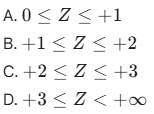
Choose the correct answer:
D, C, B, A
C, B, A, D
B, A, C, D
A, B, C, D
- A.
1
- B.
2
- C.
3
- D.
4
Correct answer: A
Solution
The standard normal distribution is bell-shaped with maximum density at the mean (Z=0).
Probability corresponds to the area under the curve, which decreases as Z moves away from 0.
Interval A is closest to the mean and has the largest area, while interval D is in the far tail with the smallest area.
Thus, the probabilities increase from D to C to B to A. - Q51.UGC NET 2026
Given below are two statements: one is labelled as Assertion A and the other is labelled as Reason R.
Assertion A: We can build an object from a class containing a pure virtual function.
Reason R: A class containing a pure virtual function is called an abstract class.
In the light of the above statements, choose the most appropriate answer from the options given below:
- A.
Both A and R are correct and R is the correct explanation of A
- B.
Both A and R are correct but R is NOT the correct explanation of A
- C.
A is correct but R is not correct
- D.
A is not correct but R is correct
Correct answer: D
Solution
A class with a pure virtual function is abstract and cannot be instantiated, making Assertion A false. Reason R correctly states that such a class is an abstract class, so it is true. Therefore, the correct choice is that Assertion A is not correct but Reason R is correct.
- A.
- Q52.UGC NET 2026
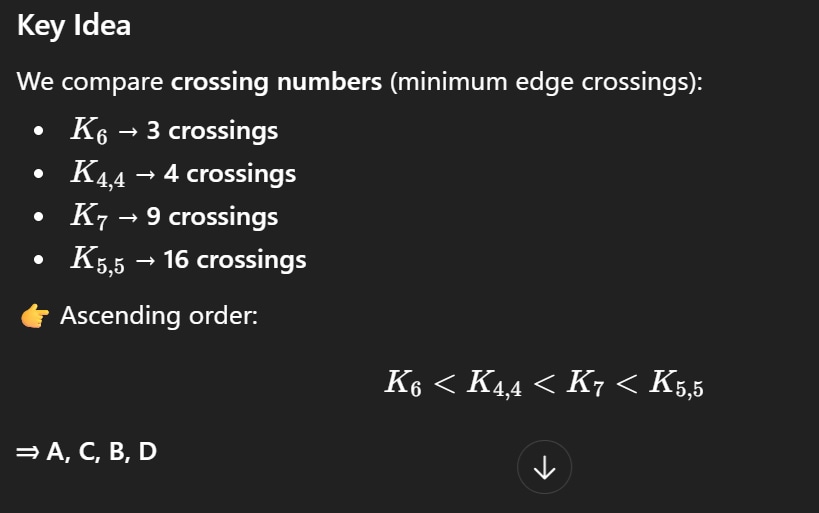
If Kn is a complete simple graph of n vertices and Km,n is a complete bipartite graph, then arrange the following non-planar graphs in ascending order on the basis of the minimum number of crossings.
A. K6
B. K7
C. K4,4
D. K5,5
Choose the correct answer from the options given below:
A, B, C, D
C, D, A, B
A, C, B, D
B, D, A, C
- A.
1
- B.
2
- C.
3
- D.
4
Correct answer: C
Solution
- Q53.UGC NET 2026
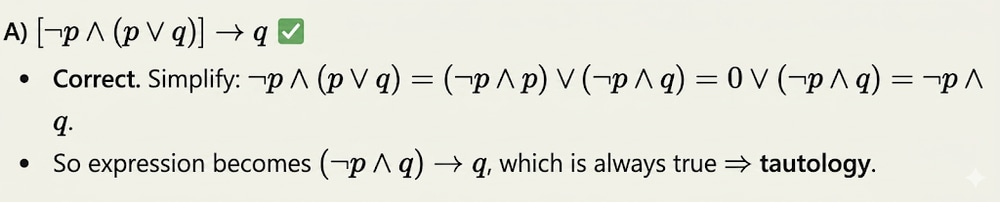
Which of the followings logical implications are tautology?
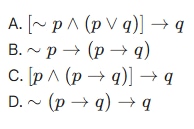
Choose the correct answer from the options given below:
A & B Only
B & D Only
A, B & C Only
B, C & D Only
- A.
1
- B.
2
- C.
3
- D.
4
Correct answer: C
Solution

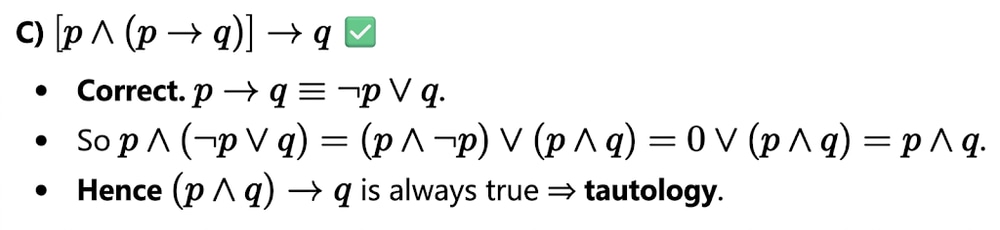
- Q54.UGC NET 2026
Given below are two statements: one is labelled as Assertion A and the other is labelled as Reason R.
Assertion A: OLAP systems are optimized for complex queries and analysis.
Reason R: OLTP systems are designed for transactions processing with large read-only queries.
In the light of the above statements, choose the most appropriate answer from the options given below:
Both A and R are correct and R is the correct explanation of A
Both A and R are correct but R is NOT the correct explanation of A
A is correct but R is not correct
A is not correct but R is correct
- A.
1
- B.
2
- C.
3
- D.
4
Correct answer: C
Solution
Assertion A is correct: OLAP (Online Analytical Processing) systems are designed for complex queries and data analysis. Reason R is incorrect: OLTP (Online Transaction Processing) systems handle transactional processing with short, frequent operations like inserts and updates, not large read-only queries. Therefore, A is correct but R is not.
- Q55.UGC NET 2026
Arrange the following in the order of execution while proving a Language is non-Regular using Pumping Lemma.
A. Split in to xyz satisfying pumping Lemma conditions.
B. Assume the language is regular.
C. Choose a string of length ≥ pumping length.
D. Show contradiction when pumping y.
Choose the correct answer from the options given below:
B, C, D, A
C, D, A, B
B, C, A, D
A, B, C, D
- A.
1
- B.
2
- C.
3
- D.
4
Correct answer: C
Solution
To prove a language is non-Regular using the Pumping Lemma, follow these steps in order:
1. Assume the language is regular (Step B).
2. Choose a string of length greater than or equal to the pumping length (Step C).
3. Split the string into xyz satisfying Pumping Lemma conditions (Step A).
4. Show contradiction when pumping y (Step D).
The correct order is B, C, A, D.
- Q56.UGC NET 2026
Which of the following is correct order of increasing time complexity of algorithms:
A. Tower of Hanoi with n disk.
B. Binary search given n sorted numbers.
C. Heap sort given n numbers at the worst case.
D. Addition of two n x n matrices.
Choose the correct answer from the options given below:
B, C, D, A
A, B, C, D
D, C, B, A
C, A, D, B
- A.
1
- B.
2
- C.
3
- D.
4
Correct answer: A
Solution
To determine the correct order, we analyze the time complexity of each algorithm provided in the question.
A. Tower of Hanoi: O(2^n). B. Binary search: O(log n). C. Heap sort: O(n log n). D. Matrix addition: O(n^2).
Ordering from smallest to largest: O(log n) < O(n log n) < O(n^2) < O(2^n). Thus, the sequence is B, C, D, A.
- Q57.UGC NET 2026
Which of the following statements are correct?
A. The HAVING CLAUSE is an optional clause which tells Oracle to group rows based on distinct values that exist for specified columns.
B. Unions can be used in subqueries.
C. The intersect clause outputs only rows produced by both the queries intersected.
D. The statement containing a subquery is called a parent statement.
E. If a select statement is defined as a subquery, the innermost select statement gets executed first.
Choose the correct answer from the options given below:
A, B, C Only
C, D, E Only
B, C, E Only
A, B, D Only
- A.
1
- B.
2
- C.
3
- D.
4
Correct answer: C
Solution
Statement A is incorrect because HAVING filters groups after aggregation, whereas GROUP BY handles distinct values. Statement B is correct as unions can be used in subqueries (derived tables). Statement C correctly defines INTERSECT, outputting only rows produced by both queries. Statement E accurately describes subquery execution order (innermost first). Thus, B, C, and E are the correct statements.
- Q58.UGC NET 2026
Which of the following is correct solution of the given recurrence relation? T(n) = 3T(n/4) + n log n
θ(n log n)
θ(n2 log n)
θ(n (log n)2)
θ(n log log n)
- A.
1
- B.
2
- C.
3
- D.
4
Correct answer: A
Solution
Solution
Step 1: Identify parameters from T(n) = 3T(n/4) + n log n. Here a = 3, b = 4, and f(n) = n log n.
Step 2: Calculate n^log_b a = n^log_4 3. Since log_4 3 is approximately 0.79, n^log_4 3 is roughly n^0.79.
Step 3: Compare f(n) with n^log_b a. The function n log n grows polynomially faster than n^0.79.
Step 4: Check regularity condition. 3(n/4)log(n/4) is less than c * n log n for c < 1. This confirms Case 3 applies.
Step 5: Conclude T(n) = Theta(f(n)) = Theta(n log n).
- Q59.UGC NET 2026
Match the LIST-I with LIST-II
LIST-I (Name of Methods)
LIST-II (Problem Type)
A. Branch and bound method
I. Integer Programming Problem
B. The North-west corner rule
II. Quadratic Programming Problem
C. Lagrange Multiplier Method
III. Transportation Problem
D. Wolfe's Modified Method
IV. Non-Linear programming problem
Choose the correct answer from the options given below:
- A.
A-III, B-II, C-IV, D-I
- B.
A-I, B-III, C-IV, D-II
- C.
A-II, B-I, C-IV, D-III
- D.
A-IV, B-I, C-II, D-III
Correct answer: B
Solution
The correct matching is A-I, B-III, C-IV, D-II. The Branch and bound method is primarily used for Integer Programming Problems (A-I). The North-west corner rule is a standard technique for Transportation Problems (B-III). Lagrange Multiplier Method addresses Non-Linear programming problems (C-IV), while Wolfe's Modified Method is specific to Quadratic Programming Problems (D-II).
- A.
- Q60.UGC NET 2026
Given below are two statements: one is labelled as Assertion A and the other is labelled as Reason R.
Assertion A: The control points have only local control over the shape of the B-Splines.
Reason R: Bezier curves do have local control.
In the light of the above statements, choose the most appropriate answer from the options given below:
- A.
Both A and R are correct and R is the correct explanation of A
- B.
Both A and R are correct but R is NOT the correct explanation of A
- C.
A is correct but R is not correct
- D.
A is not correct but R is correct
Correct answer: C
Solution
Concept: The distinguishing property between B-Spline and Bezier curves is the extent of "control" a single control point has over the curve's shape. A curve representation has LOCAL control when its basis functions have compact (bounded) support, so moving one control point reshapes only a limited nearby segment. A curve representation has GLOBAL control when its basis functions have full-domain support instead, so moving any one control point reshapes the curve throughout its span.
Application: B-Spline curves are built from piecewise polynomial basis functions defined over local knot intervals, and each basis function has compact support spanning only a few knot spans. So each control point of a B-Spline affects only that bounded segment of the curve, leaving the rest unchanged — this is exactly local control, so Assertion A is TRUE. Bezier curves, in contrast, are built from Bernstein-polynomial basis functions, each of which is strictly positive throughout the interior of the parameter interval (0, 1) and carries full-domain support rather than the piecewise compact support of B-Spline basis functions. Moving any single Bezier control point therefore reshapes the curve throughout its span, not just a local segment — Bezier curves exhibit GLOBAL control, not local control. So Reason R, which claims Bezier curves have local control, is FALSE.
Cross-check: This local-vs-global distinction is the standard textbook motivation for preferring B-Splines over a single Bezier curve in CAD and interactive design: a designer can locally edit one segment of a B-Spline without disturbing the rest of the curve, which is impossible with a single Bezier curve since every control point there influences the whole shape.
"Both A and R are correct and R is the correct explanation of A" would require R (Bezier curves have local control) to be true and to be the mechanism behind A — but R is false, since Bezier curves have global, not local, control.
"Both A and R are correct but R is NOT the correct explanation of A" would require R to be true as an independent fact — but R is false for the same reason, so this combination does not hold either.
"A is not correct but R is correct" reverses both truth values — A is in fact true (B-Splines do have local control) and R is in fact false, so this combination is also wrong.
Since Assertion A is true (B-Splines have local control) and Reason R is false (Bezier curves have global, not local, control), the correct combination is: A is correct but R is not correct.
- A.
- Q61.UGC NET 2026
Arrange the following WebApp design layers from top to bottom:
A. Navigation design, B. Aesthetic Design, C. Interface Design,
D. Content Design, E. Performance Design
Choose the correct answer from the options given below:
- A.
C, B, D, A, E
- B.
C, B, D, E, A
- C.
C, D, B, A, E
- D.
C, D, A, B, E
Correct answer: A
Solution
Web application design layers are organized hierarchically from user-facing elements to backend infrastructure. Interface and Aesthetic designs occupy the top layers for visual presentation, while Performance Design resides at the bottom supporting technical operations.
- A.
- Q62.UGC NET 2026
How many number of comparison are required in worst case to find out second smallest element of n elements list?
n + [log n]- 1
n + [log n]
[log n]
n +[log n] - 2
- A.
1
- B.
2
- C.
3
- D.
4
Correct answer: D
Solution
Finding the Second Smallest Element
To find the second smallest element in a list of n elements with the minimum number of comparisons in the worst case, we use a tournament method.
Step 1: Find the Smallest Element
We can find the smallest element by organizing the elements in a tournament structure. In each round, elements are paired and compared. The winner (smaller element) advances.
To find the minimum of n elements, we need exactly n - 1 comparisons. The smallest element will have defeated approximately log₂(n) other elements during the tournament.
Step 2: Find the Second Smallest Element
The second smallest element must be one of the elements that lost directly to the smallest element. Since the smallest element played at most ⌈log₂(n)⌉ matches, there are at most ⌈log₂(n)⌉ candidates for the second smallest.
We need to find the minimum among these candidates. This requires ⌈log₂(n)⌉ - 1 additional comparisons.
Total Comparisons
Total comparisons = (n - 1) + (⌈log₂(n)⌉ - 1) = n + ⌈log₂(n)⌉ - 2.
Thus, the number of comparisons required in the worst case is n + ⌈log n⌉ - 2.
- Q63.UGC NET 2026
Consider the following set of processes assumed to have arrived at time 0 in order P1, P2, P3, P4, and P5 with the length of CPU burst given in Milliseconds.
Process
Burst Time
Priority
P1
10
3
P2
1
1
P3
2
4
P4
1
5
P5
5
2
What is the average waiting time (in milliseconds) using priority scheduling?
8
8.2
8.3
8.4
- A.
1
- B.
2
- C.
3
- D.
4
Correct answer: B
Solution
Step 1: Identify Priority Order Processes are sorted by priority (lower number = higher priority). Order: P2 (1), P5 (2), P1 (3), P3 (4), P4 (5).
Step 2: Determine Execution Sequence Since all arrive at time 0, execution follows priority order: P2 → P5 → P1 → P3 → P4.
Step 3: Calculate Waiting Times Waiting Time = Turnaround Time - Burst Time. P2: 0 ms P5: 1 ms P1: 6 ms P3: 16 ms P4: 18 ms
Step 4: Compute Average Waiting Time Sum = 0 + 1 + 6 + 16 + 18 = 41 ms. Average = 41 / 5 = 8.2 ms.
- Q64.UGC NET 2026
In transactions, a write-item (X) command includes the following steps. Arrange the following steps in correct sequence.
A. Copy item X from the program variable named X into its correct location in the buffer.
B. Store the updated block from the buffer back to disk.
C. Find the address of the disk block that contains item.
D. Copy that disk block into a buffer in main memory.
choose the correct answer from the options given below:
C,D,A,B
A,C,D,B
C,A,B,D
D,B,C,A
- A.
1
- B.
2
- C.
3
- D.
4
Correct answer: A
Solution
Correct Sequence for Write-Item Command
To perform a write-item (X) command in a database transaction system, the following logical steps must occur in a specific order to ensure data integrity and proper buffer management.
Find the address of the disk block that contains item (Step C). The system must first locate the specific block on the disk.
Copy that disk block into a buffer in main memory (Step D). Once the address is found, the block is loaded from the disk into a buffer in RAM.
Copy item X from the program variable named X into its correct location in the buffer (Step A). The new data is then written into the specific location within the in-memory buffer.
Store the updated block from the buffer back to disk (Step B). Finally, the modified block in the buffer is written back to the permanent storage on the disk.
Therefore, the correct sequence is C → D → A → B.
- Q65.UGC NET 2026
Given below are two statements: one is labelled as Assertion A and the other is labelled as Reason R.
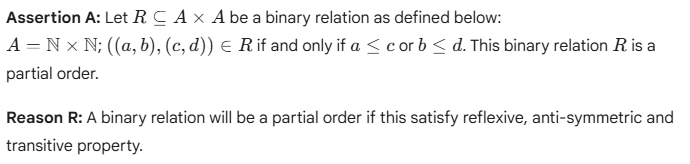
In the light of the above statements, choose the most appropriate answer from the options given below:
Both A and R are correct and R is the correct explanation of A
Both A and R are correct but R is NOT the correct explanation of A
A is correct but R is not correct
A is not correct but R is correct
- A.
1
- B.
2
- C.
3
- D.
4
Correct answer: D
Solution
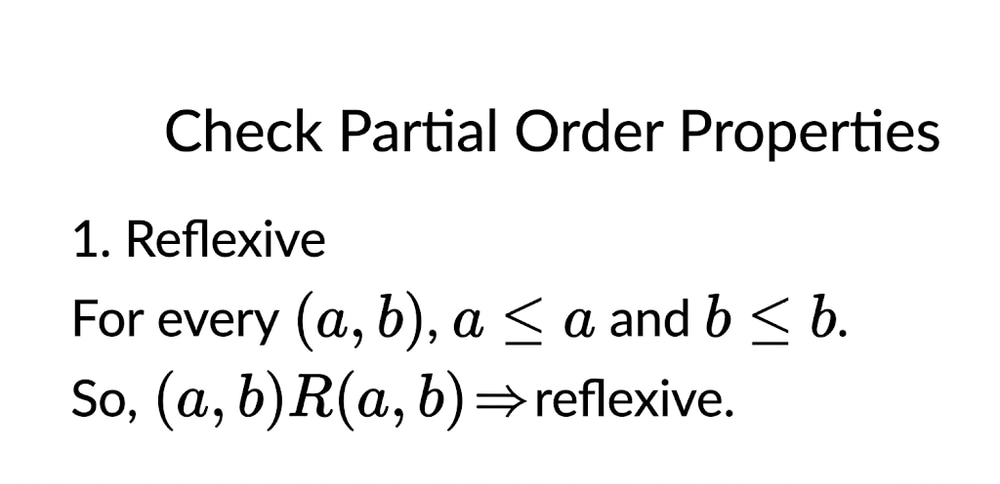
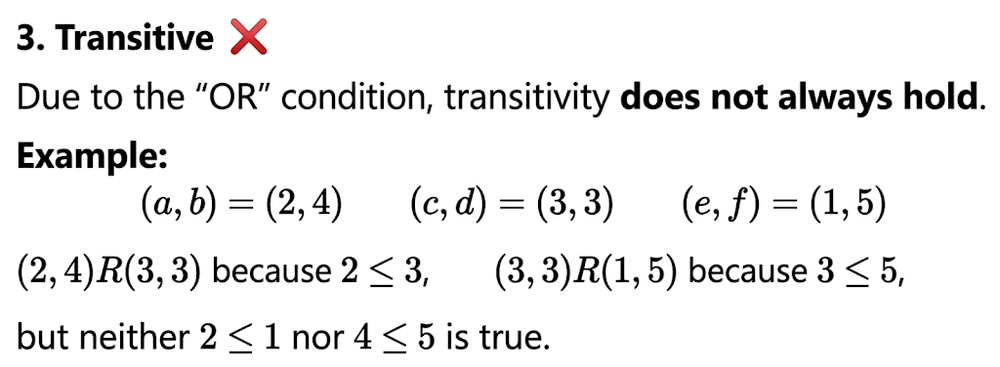
- Q66.UGC NET 2026
Which of the following is not true about constructor?
When an object is created and initialized at the same time, a copy constructor gets called.
They do not have return types, not even void.
They can be virtual.
They can not be inherited, though a derived class can call the base class constructor.
- A.
When an object is created and initialized at the same time, a copy constructor gets called.
- B.
They do not have return types, not even void.
- C.
They can be virtual.
- D.
They can not be inherited, though a derived class can call the base class constructor.
Correct answer: C
Solution
In C++, invoking a constructor always requires naming a concrete, specific class to build — for example
new Derived()— rather than reaching it indirectly through a pointer or reference to some already-existing object, the way an ordinary virtual call works. There is no such object to call the constructor through until construction actually happens. Since a constructor call has no existing object to dispatch through in the first place, the C++ grammar for a constructor declaration does not permit thevirtualspecifier at all.Checking the four statements against this rule: the claim that constructors “can be virtual” directly contradicts it — no C++ constructor declaration can carry the
virtualspecifier — so that is the statement that is not true.The copy-constructor claim holds in its intended sense: copy-initialization — declaring and initializing a new object directly from an existing object of the same class in one step, e.g.
ClassName obj2 = obj1;— invokes the copy constructor rather than the assignment operator. (Initializing from a value of a different type, or from a temporary the compiler can move from, calls a different constructor instead, but that is outside what this statement describes.)The return-type claim holds without qualification: constructors carry no return type, not even
void, since the compiler invokes them only for their initialization side effect.The inheritance claim holds too, and is phrased carefully enough to survive a stricter reading: a derived class does not receive its base class’s constructors as ordinary members, but it can invoke a specific base constructor explicitly from its own initializer list — exactly the exception the statement itself carves out. (Since C++11, a
using Base::Base;declaration can additionally bring selected base constructors into the derived class’s overload set — “inheriting constructors” — but this still requires an explicit declaration rather than happening automatically, so it does not contradict the statement as worded.)
So among the four claims, only the assertion that constructors can be virtual fails to hold outright — that is the statement the question is asking for.
- Q67.UGC NET 2026
Assume a signal travels through a transmission medium and its power is reduced to one-half, which means P2 = 1/2 P1. What is the power loss in attenuation?
- A.
-6 db
- B.
-3 db
- C.
-1.5 db
- D.
-1 db
Correct answer: B
Solution
The power loss in decibels is calculated using the formula 10 * log10(P2/P1). Given P2 = 1/2 P1, the ratio is 0.5. The logarithm of 0.5 is approximately -0.3010, and multiplying by 10 gives -3.01 dB, which rounds to -3 dB.
- A.
- Q68.UGC NET 2026
Which of the following statements are correct about a real-time operating system (RTOS)?
A. It permits creation of multiple processes within an application.
B. It does not permit priorities to be assigned to processes.
C. It permits a programmer to define interrupts and interrupt processing routines.
D. It does not use priority-driven or deadline-oriented scheduling.
E. It provides fault tolerance and graceful degradation capabilities.
Choose the correct answer from the options given below.
- A.
A, B & D only
- B.
B, C & D only
- C.
A, C & E only
- D.
B, D & E only
Correct answer: C
Solution
Correct answer: A, C & E only
A is true: RTOSs support concurrent real-time tasks/processes so time-critical activities can be handled together.
B is false: RTOSs commonly allow priorities to be assigned to tasks/processes.
C is true: RTOSs support interrupt handling, and programmers can define interrupt service routines where the platform permits it.
D is false: Priority-driven or deadline-oriented scheduling is a core RTOS feature.
E is true: RTOSs used in critical systems often provide reliability support such as fault tolerance and graceful degradation.
Therefore, the correct set is A, C and E only.
- Q69.UGC NET 2026
Arrange the following algorithms from the most efficient to least efficient using their standard worst-case time complexities:
A. Kruskal's Algorithm
B. Breadth-First Search (BFS)
C. Bellman-Ford Algorithm
D. Dijkstra's Algorithm
E. Edmonds-Karp Algorithm
Choose the correct sequence.
- A.
B, D, A, E, C
- B.
E, C, A, D, B
- C.
B, D, A, C, E
- D.
B, C, A, E, D
Correct answer: C
Solution
Correct sequence: B, D, A, C, E.
BFS: O(V + E), usually the lightest among the listed algorithms.
Dijkstra: commonly O((V + E) log V) with a priority queue for non-negative weighted graphs.
Kruskal: O(E log E), mainly due to sorting edges.
Bellman-Ford: O(VE).
Edmonds-Karp: O(VE²), which is heavier than Bellman-Ford.
So the order from most efficient to least efficient is B, D, A, C, E.
- Q70.UGC NET 2026
Match the LIST-I with LIST-II
LIST-I (Coupling Type)
LIST-II (Definition/Action)
A. Content coupling
I. Modifies internal data of another component
B. Control Coupling
II. Pass control flag to influence logic
C. Stamp Coupling
III. Uses entire structure/class as argument
D. Data Coupling
IV. Passes long list of data arguments.
Choose the correct answer from the options given below:
A-I, B-II, C-IV, D-III
A-II, B-IV, C-I, D-III
A-I, B-III, C-IV, D-II
A-I, B-II, C-III, D-IV
- A.
1
- B.
2
- C.
3
- D.
4
Correct answer: D
Solution
Content Coupling occurs when one module modifies the internal data of another (A-I). Control Coupling involves passing control flags to influence logic in the called module (B-II). Stamp Coupling happens when a data structure is passed as an argument, and the receiving module uses part or all of it (C-III). Data Coupling involves passing only necessary data items between modules (D-IV). Therefore, the correct matching is A-I, B-II, C-III, D-IV.
- Q71.UGC NET 2026
Match the LIST-I with LIST-II
LIST-I (Input)
LIST-II (Compiler Phase)
A. Syntax Tree
I. Code Generator
B. Character Stream
II. Syntax Analyzer
C. Intermediate Representation
III. Semantic Analyzer
D. Token Stream
IV. Lexical Analyzer
Choose the correct answer from the options given below:
- A.
A-II, B-III, C-IV, D-I
- B.
A-III, B-IV, C-I, D-II
- C.
A-III, B-I, C-IV, D-II
- D.
A-I, B-IV, C-II, D-III
Correct answer: B
Solution
A compiler processes source code through a fixed pipeline of phases, and each phase is defined by the specific data structure it takes as input and the one it hands off as output: raw source characters flow into Lexical Analysis, which yields a token stream; the token stream flows into Syntax Analysis, which yields a syntax tree; the syntax tree flows into Semantic Analysis, which yields an annotated form that becomes the intermediate representation; and the intermediate representation flows into Code Generation, which yields the target code.
Character Stream is the raw, untokenized source text — by definition this is the input the very first phase, the Lexical Analyzer, works on, giving B-IV.
The Lexical Analyzer's output, the Token Stream, is exactly what the next phase, the Syntax Analyzer, consumes to build a parse tree, giving D-II.
The Syntax Analyzer's output, the Syntax Tree, is exactly what the next phase, the Semantic Analyzer, consumes to check meaning and scope, giving A-III.
The Semantic Analyzer's annotated output becomes the Intermediate Representation, which is exactly what the final phase, the Code Generator, consumes to emit target code, giving C-I.
Each of the four phases (I-IV) is used exactly once and each list-I item (A-D) is used exactly once, so this is a valid one-to-one matching; it also traces the pipeline in strict order — Lexical Analyzer, then Syntax Analyzer, then Semantic Analyzer, then Code Generator — with no phase skipped or repeated, confirming the combination is internally consistent.
So the full matching is A-III, B-IV, C-I, D-II.
- A.
- Q72.UGC NET 2026
Given below are two statements: one is labelled as Assertion A and the other is labelled as Reason R.
Assertion A: If L is regular, then its complement L' is necessarily regular.
Reason R: Complement of a language can be obtained by swapping final and non-final states in a DFA.
In the light of the above statements, choose the most appropriate answer from the options given below:
Both A and R are correct and R is the correct explanation of A
Both A and R are correct but R is NOT the correct explanation of A
A is correct but R is not correct
A is not correct but R is correct
- A.
1
- B.
2
- C.
3
- D.
4
Correct answer: A
Solution
Analysis of Assertion and Reason
Step 1: Analyze Assertion A. The assertion states that if a language L is regular, its complement L' is necessarily regular. This is a fundamental property of regular languages known as closure under complementation.
Step 2: Analyze Reason R. The reason states that the complement of a language can be obtained by swapping final and non-final states in a DFA. This is the standard construction method to prove closure under complementation.
Step 3: Check Relationship. Since the method described in Reason R is exactly how the property in Assertion A is proven, R is the correct explanation of A.
Conclusion: Both A and R are correct, and R is the correct explanation of A.
- Q73.UGC NET 2026
Which planning approach is used for environment with no observations?
- A.
Hierarchical planning
- B.
Reactive planning
- C.
Conformant planning
- D.
Contingency Planning
Correct answer: C
Solution
Conformant planning is the appropriate approach for environments with no observations.
In this approach, the agent generates a single plan that must succeed across all possible initial states without relying on sensory feedback during execution. This differs from contingency planning, which requires observations to branch actions.
- A.
- Q74.UGC NET 2026
Arrange the following applet life cycles methods in sequence
A. start()
B. paint()
C. init()
D. stop()
Choose the correct answer from the options given :
- A.
A, B, C, D
- B.
C, A, B, D
- C.
A, C, B, D
- D.
B, A, C, D
Correct answer: B
Solution
The Java Applet life cycle follows a specific order. First, the init() method initializes the applet. Next, start() begins execution. Then paint() renders graphics. Finally, stop() halts execution when the applet is no longer visible. The correct sequence corresponds to C, A, B, D.
- A.
- Q75.UGC NET 2026
Match the LIST-I with LIST-II : BOOLEAN IDENTITIES
LIST-I (Name)
LIST-II (Identity)
A. Domination law
I. x + 1 = 1
B. Associative law
II. x + (yz) = (x + y)(x + z)
C. Distributive law
III. x + xy = x
D. Absorption law
IV. x + (y + z) = (x + y) + z
Choose the correct answer from the options given below:
A-I, B-II, C-IV, D-III
A-I, B-IV, C-II, D-III
A-III, B-IV, C-II, D-I
A-III, B-II, C-IV, D-I
- A.
1
- B.
2
- C.
3
- D.
4
Correct answer: B
Solution
To solve this, we match each Boolean law with its corresponding identity: 1. Domination Law: States that x + 1 = 1 and x · 0 = 0. This matches I. 2. Associative Law: States that grouping does not matter, e.g., x + (y + z) = (x + y) + z. This matches IV. 3. Distributive Law: States x + (y · z) = (x + y)(x + z) in Boolean algebra. This matches II. 4. Absorption Law: States x + xy = x. This matches III. Thus, the correct matching is A-I, B-IV, C-II, D-III.
- Q76.UGC NET 2026
Match the LIST-I with LIST-II
LIST-I (Quadric surfaces)
LIST-II (Equation)
A. One-sheeted hyperboloid
I. x2/a2 + y2/b2 = cz
B. Two-sheeted hyperboloid
II. x2/a2 + y2/b2 - z2/c2 = 1
C. Elliptic paraboloid
III. x2/a2 - y2/b2 = cz
D. Hyperbolic paraboloid
IV. z2/c2 - x2/a2 - y2/b2 = 1
Choose the correct answer from the options given below:
A-I, B-II, C-III, D-IV
A-II, B-III, C-IV, D-I
A-II, B-IV, C-I, D-III
A-IV, B-II, C-I, D-III
- A.
1
- B.
2
- C.
3
- D.
4
Correct answer: C
Solution
To solve this, recall the standard forms of quadric surfaces. A one-sheeted hyperboloid has two positive squared terms and one negative, equal to 1 (x²/a² + y²/b² - z²/c² = 1), matching A-II. A two-sheeted hyperboloid has one positive squared term and two negative, equal to 1 (-x²/a² - y²/b² + z²/c² = 1), matching B-IV. An elliptic paraboloid has one linear variable and two positive squared terms (x²/a² + y²/b² = cz), matching C-I. A hyperbolic paraboloid has one linear variable and two squared terms with opposite signs (x²/a² - y²/b² = cz), matching D-III. Thus, the correct pairing is A-II, B-IV, C-I, D-III.
- Q77.UGC NET 2026
Given below are two statements: one is labelled as Assertion A and the other is labelled as Reason R.
Assertion A: Neural networks are capable of approximating any continuous function to an arbitrary degree of accuracy.
Reason R: This is explained by the universal approximation theorem.
In the light of the above statements, choose the most appropriate answer from the options given below:
- A.
Both A and R are correct and R is the correct explanation of A
- B.
Both A and R are correct but R is NOT the correct explanation of A
- C.
A is correct but R is not correct
- D.
A is not correct but R is correct
Correct answer: A
Solution
Assertion A is correct because neural networks can approximate any continuous function to arbitrary accuracy, as established by the universal approximation theorem. Reason R is also correct and directly explains Assertion A, since the theorem provides the theoretical basis for this capability. Therefore, both statements are correct and R correctly explains A, making option 0 the most appropriate choice.
- A.
- Q78.UGC NET 2026
Arrange the following tasks of Lexical Analyzer in correct sequence:
A. Token Generation.
B. Removal of comments/White space.
C. Buffering and reading source characters.
D. Return token stream to parser.
Choose the correct answer from the options given below:
- A.
A, B, C, D
- B.
B, A, C, D
- C.
C, B, A, D
- D.
B, A, D, C
Correct answer: C
Solution
The correct sequence of tasks in a Lexical Analyzer is: C. Buffering and reading source characters, B. Removal of comments/White space, A. Token Generation, D. Return token stream to parser.
- A.
- Q79.UGC NET 2026
For implicit type conversion, arrange the following from a lower size type to a high type size.
A. double
B. unsigned long int
C. unsigned int
D. long double
E. long int
Choose the correct answer from the options given below:
- A.
E, C, B, A, D
- B.
C, B, E, D, A
- C.
E, C, A, B, D
- D.
C, B, E, A, D.
Correct answer: D
Solution
To solve this, we must arrange the data types based on their memory size in ascending order (from smallest to largest).
Step 1: Analyze Type Sizes
Assuming a standard 32-bit system architecture:
unsigned int: 4 bytes
unsigned long int: 4 bytes (on 32-bit) or 8 bytes (on 64-bit). However, in standard implicit conversion hierarchies, unsigned int is often treated as the base before long types.
long int: 4 bytes (on 32-bit) or 8 bytes (on 64-bit). Typically, long int is equal to or larger than unsigned int.
double: 8 bytes
long double: 12 bytes or 16 bytes (largest among these).
Step 2: Determine the Correct Order
The standard hierarchy for implicit conversion (promoting smaller types to larger types) generally follows this size progression:
1. unsigned int (Smallest integer type listed)
2. unsigned long int (Larger or equal to unsigned int)
3. long int (Integer type, often same size as unsigned long int but conceptually follows in hierarchy)
4. double (Floating point, 8 bytes)
5. long double (Largest floating point type)
Therefore, the correct arrangement from lower size to high type size is: unsigned int (C) → unsigned long int (B) → long int (E) → double (A) → long double (D).
This corresponds to the sequence: C, B, E, A, D.
- A.
- Q80.UGC NET 2026
A project is planned for an enterprise accounting system with an estimated size 60 KLOC. The organization applies Basic COCOMO (Semi-Detached Mode with parameters: )
Effort = 3.0 . (KLOC)1.0
Development time = 2.5 . (Effort)1/2
Average cost per person-month (pm) = $10,000
A contingency margin of 10% effort is mandatory
The client demands a detailed schedule if staff is capped at 15 engineers.
What is the estimated development time in months?
- A.
28 Months
- B.
26 Months
- C.
34 Months
- D.
12 Months
Correct answer: C
Solution
First, calculate effort using Basic COCOMO Semi-Detached parameters. Effort equals 3.0 multiplied by 60 KLOC to the power of 1.0, resulting in 180 person-months. Next, apply the development time formula: 2.5 times effort to the power of one-half. This yields approximately 33.54 months, which rounds to 34 months as the final estimated development time.
- A.
- Q81.UGC NET 2026
A project is planned for an enterprise accounting system with an estimated size 60 KLOC. The organization applies Basic COCOMO (Semi-Detached Mode with parameters: )
Effort = 3.0 . (KLOC)1.0
Development time = 2.5 . (Effort)1/2
Average cost per person-month (pm) = $10,000
A contingency margin of 10% effort is mandatory
The client demands a detailed schedule if staff is capped at 15 engineers.
Including 10% contingency margin what is the project cost?
- A.
$ 1.80 M
- B.
$ 1.98 M
- C.
$ 2.4 M
- D.
$ 2.36 M
Correct answer: B
Solution
To determine the project cost, we first calculate the base effort using the Basic COCOMO formula provided: Effort = 3.0 * (KLOC)^1.0. With a size of 60 KLOC, the base effort is 3.0 * 60 = 180 person-months (pm). The problem mandates a 10% contingency margin on effort, so we add this to the base: 180 pm + (10% of 180) = 198 pm. Finally, we calculate the total cost by multiplying the adjusted effort by the average cost per person-month ($10,000). Total Cost = 198 pm * $10,000/pm = $1,980,000 or $1.98 million.",
- A.
- Q82.UGC NET 2026
A project is planned for an enterprise accounting system with an estimated size 60 KLOC. The organization applies Basic COCOMO (Semi-Detached Mode with parameters: )
Effort = 3.0 . (KLOC)1.0
Development time = 2.5 . (Effort)1/2
Average cost per person-month (pm) = $10,000
A contingency margin of 10% effort is mandatory
The client demands a detailed schedule if staff is capped at 15 engineers.
What is the implied average staffing level?
8 Engineers
5 Engineers
10 Engineers
12 Engineers
- A.
1
- B.
2
- C.
3
- D.
4
Correct answer: B
Solution
Step-by-Step Solution
First, calculate the total effort required using the Basic COCOMO model for Semi-Detached mode.
Given:
Size (KLOC) = 60
Effort Multiplier (EM) = 3.0
Formula: Effort = EM × (Size)^1.0
Calculation: Effort = 3.0 × 60 = 180 person-months.
Next, apply the mandatory contingency margin of 10% to the effort.
Total Effort with Contingency = 180 × 1.10 = 198 person-months.
Now, calculate the development time using the given formula.
Formula: Development Time = 2.5 × (Effort)^0.5
Calculation: Development Time = 2.5 × √198 ≈ 2.5 × 14.07 ≈ 35.18 months.
Finally, determine the implied average staffing level.
Formula: Staffing Level = Total Effort / Development Time
Calculation: Staffing Level = 198 / 35.18 ≈ 5.63 engineers.
Since the staff is capped at 15 engineers, the implied average staffing level is approximately 5.63. Among the given options, 5 engineers is the closest integer value representing the implied average staffing level.
- Q83.UGC NET 2026
A project is planned for an enterprise accounting system with an estimated size 60 KLOC. The organization applies Basic COCOMO (Semi-Detached Mode with parameters: )
Effort = 3.0 . (KLOC)1.0
Development time = 2.5 . (Effort)1/2
Average cost per person-month (pm) = $10,000
A contingency margin of 10% effort is mandatory
The client demands a detailed schedule if staff is capped at 15 engineers.
If the staff is capped at 15 engineers what is the revised calendar duration?
- A.
20.0 Months
- B.
18.4 Months
- C.
13.2 Months
- D.
22.0 Months
Correct answer: C
Solution
First, calculate base effort as 3.0 multiplied by 60 KLOC to the power of 1.0, resulting in 180 person-months.
Next, apply the mandatory 10% contingency margin to get a total effort of 198 person-months.
Finally, divide the total effort by the capped staff of 15 engineers to find the revised calendar duration of 13.2 months.
- A.
- Q84.UGC NET 2026
A project is planned for an enterprise accounting system with an estimated size 60 KLOC. The organization applies Basic COCOMO (Semi-Detached Mode with parameters: )
Effort = 3.0 . (KLOC)1.0
Development time = 2.5 . (Effort)1/2
Average cost per person-month (pm) = $10,000
A contingency margin of 10% effort is mandatory
The client demands a detailed schedule if staff is capped at 15 engineers.
What is the initial effort in Person-month (PM) before adding the contingency margin?
- A.
240 PM
- B.
260 PM
- C.
180 PM
- D.
200 PM
Correct answer: C
Solution
To find the initial effort, apply the Basic COCOMO formula provided in the question. Multiply the coefficient 3.0 by the project size of 60 KLOC raised to the power of 1.0, resulting in 3.0 * 60 = 180 Person-months.
- A.
- Q85.UGC NET 2026
A system transfer data blocks of 2000 bytes with programmed I/O, each byte transfer takes 6 CPU cycles, with direct memory access (DMA), the block transfer takes 3000 Cycles total, with CPU setup overhead of 200 cycles. The CPU clock is 1 GHZ.
How much CPU time is consumed by programmed I/O?
12 μs
20 μs
24 μs
30 μs
- A.
1
- B.
2
- C.
3
- D.
4
Correct answer: A
Solution
Step-by-Step Solution
To find the CPU time consumed by programmed I/O, we calculate the total cycles and convert them to time.
1. Calculate Total Cycles
Total Cycles = Block Size × Cycles per Byte
Total Cycles = 2000 bytes × 6 cycles/byte = 12,000 cycles
2. Convert Cycles to Time
Time = Total Cycles / Clock Frequency
Clock Frequency = 1 GHz = 1 × 10^9 Hz
Time = 12,000 cycles / (1 × 10^9 cycles/second) = 0.000012 seconds
Convert to microseconds: 0.000012 seconds × 10^6 μs/s = 12 μs
Conclusion
The CPU time consumed by programmed I/O is 12 μs.
- Q86.UGC NET 2026
A system transfers data in blocks of 2000 bytes. With programmed I/O, each byte transfer consumes 6 CPU cycles. With direct memory access (DMA), the complete block transfer takes 3000 clock cycles, while the CPU setup overhead is 200 cycles. The CPU clock frequency is 1 GHz. How many CPU cycles does the CPU spend on the DMA transfer?
- A.
200 cycles
- B.
3000 cycles
- C.
3200 cycles
- D.
4000 cycles
Correct answer: A
Solution
Concept
In programmed I/O, the CPU participates in each data transfer. In DMA, the CPU configures the DMA controller, while the controller moves the block independently. Therefore, CPU cycles spent on DMA are counted from CPU overhead, not from the controller's total transfer duration.
Application
The programmed-I/O workload would be 2000 bytes × 6 CPU cycles per byte = 12,000 CPU cycles; this establishes why DMA reduces CPU involvement.
Under DMA, the 3000-cycle figure is the elapsed duration of the complete block transfer handled by the DMA controller.
The CPU's stated setup overhead is 200 cycles. No additional CPU interrupt overhead is specified, so the CPU-cycle count requested is 200 cycles.
Cross-check
The units and roles confirm the separation: 3000 cycles measure the DMA block's duration, whereas 200 cycles measure the CPU's setup work. Thus the CPU spends 200 cycles on the DMA transfer.
- A.
- Q87.UGC NET 2026
A system transfers a 2,000-byte data block using either programmed I/O or direct memory access (DMA). With programmed I/O, transferring each byte takes 6 CPU cycles. With DMA, the block transfer takes 3,000 clock cycles, and the CPU spends an additional 200 cycles on setup. The CPU clock rate is 1 GHz. Which method is more CPU-efficient for this large block transfer?
- A.
Programmed I/O
- B.
DMA
- C.
Both programmed I/O and DMA
- D.
Depends on block size
Correct answer: B
Solution
Concept
CPU efficiency is determined by the amount of processor time a transfer method occupies. Programmed I/O keeps the CPU involved in each data movement, whereas DMA delegates block movement to a controller after a short CPU setup.
At a clock rate f, time equals cycle count divided by f. For comparing CPU efficiency, distinguish CPU-busy cycles from the controller’s transfer duration.
Application
Programmed I/O CPU work: 2,000 bytes × 6 cycles per byte = 12,000 CPU cycles.
At 1 GHz, 12,000 cycles correspond to 12 microseconds of CPU involvement.
DMA CPU work: the CPU performs the stated 200-cycle setup, and the DMA controller then handles the block movement. The stated transfer duration is 3,000 cycles; even if setup and transfer durations are conservatively added, the elapsed count is 3,200 cycles.
Thus DMA reduces CPU involvement from 12,000 cycles to about 200 setup cycles and also has a smaller stated elapsed-cycle count than programmed I/O.
Cross-check
The CPU-cycle ratio is 12,000 ÷ 200 = 60, so programmed I/O occupies the CPU about 60 times as much under the given data. Even the conservative elapsed comparison gives 12,000 ÷ 3,200 = 3.75. Therefore, DMA is more CPU-efficient for the stated block.
- A.
- Q88.UGC NET 2026
A system transfers data blocks of 2,000 bytes using programmed I/O. Each byte transfer takes 6 CPU cycles. With direct memory access (DMA), the entire block transfer takes 3,000 cycles, including 200 cycles of CPU setup overhead. The CPU clock frequency is 1 GHz. How many CPU cycles are spent when programmed I/O is used?
- A.
2000
- B.
6000
- C.
12000
- D.
20000
Correct answer: C
Solution
Concept
In programmed I/O, the CPU participates in each data-unit transfer. Therefore, the total CPU-cycle cost is the number of transferred units multiplied by the CPU cycles required per unit.
Application
Number of bytes in the block = 2,000.
CPU cost per byte = 6 cycles.
Total programmed-I/O cycles = 2,000 bytes × 6 cycles/byte = 12,000 cycles.
Cross-check
The units reduce to cycles: bytes × cycles/byte = cycles. The DMA transfer time, DMA setup overhead, and 1 GHz clock frequency are not used because the question asks for a cycle count under programmed I/O.
Result: 12,000 CPU cycles.
- A.
- Q89.UGC NET 2026

If the set S = { diag(a, b) : a, b ∈ ℤ } (the 2 × 2 diagonal integer matrices) is a subring of the ring M2(ℤ) of 2 × 2 matrices over the integers, then S is a:
- A.
left ideal but not right ideal
- B.
right ideal but not left ideal
- C.
both left ideal and right ideal
- D.
neither left ideal nor right ideal
Correct answer: D
Solution
A left ideal of a ring R is a subring I such that r·x ∈ I for every r ∈ R and every x ∈ I — I must absorb multiplication by the whole ring from the left. A right ideal requires the symmetric condition x·r ∈ I for every r ∈ R and x ∈ I — absorption from the right. A subring can satisfy neither, one, or both conditions, and the only way to settle it is to test the ring’s actual multiplication rule directly.
Here R = M₂(ℤ) and S = { diag(a, b) : a, b ∈ ℤ } is the subring of diagonal integer matrices. Because absorption must hold for every matrix in R, a single matrix M for which the product leaves S is enough to rule out that side’s closure.
Left absorption: take A = [[1, 0], [0, 0]] ∈ S and M = [[0, 0], [1, 0]] ∈ M₂(ℤ). Then M·A = [[0, 0], [1, 0]], which is not diagonal, so M·A ∉ S — left absorption fails for this M.
Right absorption: take the same A = [[1, 0], [0, 0]] ∈ S and M = [[0, 1], [0, 0]] ∈ M₂(ℤ). Then A·M = [[0, 1], [0, 0]], which is not diagonal, so A·M ∉ S — right absorption fails for this M.
Cross-check: both counterexamples use a matrix with a single off-diagonal 1 multiplying a diagonal matrix; either side of that product mixes a row or column and produces an off-diagonal entry, so the failure is structural rather than a coincidence of the specific numbers chosen — any diagonal entry a ≠ 0 in A gives the same kind of counterexample on both sides.
Since a matrix M exists that breaks left absorption and a matrix M exists that breaks right absorption, S satisfies neither the left-ideal condition nor the right-ideal condition, even though it is a subring of M₂(ℤ).
- A.
- Q90.UGC NET 2026
Study carefully the table given below and answer the question asked here under. A college has four programs B.A., B.Sc., B.Com. and B.B.A. The results of the mid-semester and end-semester tests are shown in the table given below.
If the number of students passing a test be considered a criterion for comparison of difficulty level of two tests, then mid-semester test of which of the following programs was the least difficult?
- A.
B.A.
- B.
B.Sc.
- C.
B.Com.
- D.
B.B.A.
Correct answer: D
Solution
To determine which mid-semester test was the least difficult, we need to find the program with the highest number of students who passed that test. Passing the mid-semester test includes students in two categories: those who 'passed in mid-semester test but failed in end-semester test' and those who 'Passed in both tests'. Calculating the total passes for each program: - B.A.: 6 + 64 = 70 students - B.Sc.: 17 + 55 = 72 students - B.Com.: 9 + 46 = 55 students - B.B.A.: 15 + 76 = 91 students Comparing the totals, B.B.A. has the highest number of passing students (91). Therefore, the mid-semester test for B.B.A. was the least difficult.
- A.
- Q91.UGC NET 2026
Study carefully the table given below and answer the question asked here under. A college has four programs B.A., B.Sc., B.Com. and B.B.A. The results of the mid-semester and end-semester tests are shown in the table given below.
Which program has the lowest passing percentage in end-semester test?
- A.
B.A.
- B.
B.Sc.
- C.
B.Com.
- D.
B.B.A.
Correct answer: B
Solution
To determine the lowest passing percentage in the end-semester test, we first identify students who passed. These are found in two rows: 'Failed in mid-semester test but passed in end-semester test' and 'Passed in both tests'. We also calculate the total number of students for each program.
For B.A.: Passed = 14 + 64 = 78. Total = 28 + 14 + 6 + 64 = 112. Percentage ≈ (78/112) * 100 = 69.6%.
For B.Sc.: Passed = 12 + 55 = 67. Total = 23 + 12 + 17 + 55 = 107. Percentage ≈ (67/107) * 100 = 62.6%.
For B.Com.: Passed = 8 + 46 = 54. Total = 17 + 8 + 9 + 46 = 80. Percentage = (54/80) * 100 = 67.5%.
For B.B.A.: Passed = 13 + 76 = 89. Total = 27 + 13 + 15 + 76 = 131. Percentage ≈ (89/131) * 100 = 67.9%.
Comparing the results, B.Sc. has the lowest passing percentage at approximately 62.6%.
- A.
- Q92.UGC NET 2026
Study carefully the table given below and answer the question asked here under. A college has four programs B.A., B.Sc., B.Com. and B.B.A. The results of the mid-semester and end-semester tests are shown in the table given below.
Which program has the highest failure rate in the mid-semester test?
- A.
B.A.
- B.
B.Sc.
- C.
B.Com.
- D.
B.B.A.
Correct answer: A
Solution
To find the highest failure rate in the mid-semester test, we calculate the percentage of students who failed for each program. Students who failed the mid-semester test are those in the rows 'Failed in both tests' and 'Failed in mid-semester test but passed in end-semester test'.
- B.A.: Failed = 28 + 14 = 42. Total students = 28 + 14 + 6 + 64 = 112. Failure Rate = (42/112) * 100 = 37.5%.
- B.Sc.: Failed = 23 + 12 = 35. Total students = 23 + 12 + 17 + 55 = 107. Failure Rate ≈ (35/107) * 100 = 32.7%.
- B.Com.: Failed = 17 + 8 = 25. Total students = 17 + 8 + 9 + 46 = 80. Failure Rate = (25/80) * 100 = 31.25%.
- B.B.A.: Failed = 27 + 13 = 40. Total students = 27 + 13 + 15 + 76 = 131. Failure Rate ≈ (40/131) * 100 = 30.5%.
Comparing the rates, B.A. has the highest failure rate at 37.5%.
- A.
- Q93.UGC NET 2026
Study carefully the table given below and answer the question asked here under. A college has four programs B.A., B.Sc., B.Com. and B.B.A. The results of the mid-semester and end-semester tests are shown in the table given below.
How many students are there in the four programs ?
- A.
420
- B.
430
- C.
320
- D.
330
Correct answer: B
Solution
To find the total number of students in the four programs, calculate the sum for each program column and then add them together.
B.A.: 28 + 14 + 6 + 64 = 112.
B.Sc.: 23 + 12 + 17 + 55 = 107.
B.Com.: 17 + 8 + 9 + 46 = 80.
B.B.A.: 27 + 13 + 15 + 76 = 131.
Total: 112 + 107 + 80 + 131 = 430.
- A.
- Q94.UGC NET 2026
Study carefully the table given below and answer the question asked here under. A college has four programs B.A., B.Sc., B.Com. and B.B.A. The results of the mid-semester and end-semester tests are shown in the table given below.
What is the ratio of number of students in B.Sc. program to the number of students in B.Com. program ?
- A.
80:107
- B.
107:131
- C.
107:80
- D.
80:131
Correct answer: C
Solution
To find the ratio of students in B.Sc. to B.Com., first calculate the total number of students in each program by summing their respective columns.
Total B.Sc. students = 23 + 12 + 17 + 55 = 107
Total B.Com. students = 17 + 8 + 9 + 46 = 80
Ratio = 107 : 80
- A.
- Q95.UGC NET 2026
Which of the following represents the ontological orientation of qualitative research strategies?
- A.
Deductive
- B.
Positivism
- C.
Objectivism
- D.
Constructionism
Correct answer: D
Solution
Qualitative research is fundamentally concerned with understanding human experiences, meanings, and social contexts rather than testing pre-existing hypotheses. This aligns with an ontological stance known as constructionism, which posits that reality is socially constructed through human interaction and language. Therefore, Option D (Constructionism) correctly identifies the ontological orientation of qualitative research.\nIn contrast, Positivism (Option B) and Objectivism (Option C) are associated with quantitative research, as they assume a single, objective reality that exists independently of human perception. Deductive reasoning (Option A) refers to a logical approach starting from general theories, which is typical of quantitative studies rather than the inductive nature of qualitative inquiry. Thus, Constructionism best captures the belief that reality is multiple and constructed by participants.
- A.
- Q96.UGC NET 2026
Which term is NOT related to computer hardware?
- A.
Bus
- B.
Switch
- C.
Windows
- D.
Mouse
Correct answer: C
Solution
Computer hardware refers to the physical parts of a computer system. A Bus, Switch, and Mouse are all physical components or devices that can be touched. Windows is an operating system, which is a type of software that runs on the hardware. Therefore, Windows is NOT related to computer hardware.
- A.
- Q97.UGC NET 2026
Arrange the following pairs of standard deviation (σ) and total number of samples (n) pertaining to different sampling distributions in the decreasing order of their standard error.
A. σ = 1.6 , n = 16
B. σ = 1.5 , n = 25
C. σ = 0.6 , n = 36
D. σ = 1.4 , n = 49
- A.
A, B, C, D
- B.
A, B, D, C
- C.
D, C, B, A
- D.
C, B, D, A
Correct answer: B
Solution
The standard error (SE) is calculated using the formula SE = σ / √n.
Calculate SE for each option:
A: SE = 1.6 / √16 = 1.6 / 4 = 0.4
B: SE = 1.5 / √25 = 1.5 / 5 = 0.3
C: SE = 0.6 / √36 = 0.6 / 6 = 0.1
D: SE = 1.4 / √49 = 1.4 / 7 ≈ 0.2
Comparing the values: 0.4 > 0.3 > 0.2 > 0.1.
Thus, the decreasing order is A > B > D > C.
- A.
- Q98.UGC NET 2026
Given below are two statements: one is labelled as Assertion (A) and the other is labelled as Reason (R).
Assertion (A): The terms validity and invalidity do not apply to inductive arguments.
Reason (R): In an inductive argument, the conclusion does not have sufficient ground in the premises.
In the light of the above statements, choose the most appropriate answer from the options given below:
- A.
Both (A) and (R) are correct and (R) is the correct explanation of (A)
- B.
Both (A) and (R) are correct but (R) is not the correct explanation of (A)
- C.
(A) is correct but (R) is not correct
- D.
(A) is not correct but (R) is correct
Correct answer: A
Solution
Validity and invalidity are terms applicable only to deductive arguments where the conclusion is guaranteed by the premises.
In inductive reasoning, the conclusion is probable but not certain, meaning there is no sufficient logical ground for entailment. This lack of necessity means validity terms do not apply to inductive arguments, confirming Assertion (A) is true.
Reason (R) accurately states that the conclusion lacks sufficient ground in premises, which explains why validity terms do not apply. Therefore, both statements are true and Reason correctly explains Assertion.
- A.
- Q99.UGC NET 2026
Given below are two statements: one is labelled as Assertion (A) and the other is labelled as Reason (R).
Assertion (A): People, who hold views contrary to those dominant in the media, keep those views to themselves.
Reason (R): Such people fear isolation or separation from those around them.
In the light of the above statements, choose the most appropriate answer from the options given below:
- A.
Both (A) and (R) are correct and (R) is the correct explanation of (A)
- B.
Both (A) and (R) are correct but (R) is not the correct explanation of (A)
- C.
(A) is correct but (R) is not correct
- D.
(A) is not correct but (R) is correct
Correct answer: A
Solution
This question relates to Elisabeth Noelle-Neumann's Spiral of Silence theory in communication studies.
The Assertion correctly describes the phenomenon where individuals with minority opinions suppress their views to avoid conflict.
The Reason accurately identifies fear of social isolation as the psychological driver behind this behavior.
Thus, both statements are true, and the Reason explains the Assertion.
- A.
- Q100.UGC NET 2026
Arrange the following in the ascending order of adoption in terms of Diffusion of Innovation among the masses:
A. Opinion Followers
B. Opinion Leaders
C. Early Adopters
D. Change Agents
E. Laggards
- A.
A, D, C, B, E
- B.
D, C, B, A, E
- C.
C, D, B, A, E
- D.
A, B, C, D, E
Correct answer: B
Solution
According to the Diffusion of Innovation theory, Change Agents act as initiators introducing innovations first. Early Adopters follow closely to validate the concept and reduce perceived risk. Opinion Leaders influence the masses (Opinion Followers) who adopt subsequently, while Laggards are universally recognized as the final group to embrace change. Therefore, the correct chronological order is D-C-B-A-E.
- A.
- Q101.UGC NET 2026
The theory that argues that media can have a strong influence in deciding the small number of public problems or issues that people will think about at any given point in time, is:
- A.
Agenda-Setting Theory
- B.
Knowledge-Gap Theory
- C.
Limited Effects Theory
- D.
Personal Influence Theory
Correct answer: A
Solution
The correct answer is Agenda-Setting Theory.
This theory posits that the media does not tell people what to think, but rather influences what they think about by determining which issues receive attention and prominence.
This aligns with the question's description of media influence on deciding public problems or issues.
- A.
- Q102.UGC NET 2026
Arrange the following in increasing order in terms of their coverage:
A. PAN
B. MAN
C. WAN
D. LAN
- A.
D, B, A, C
- B.
A, B, D, C
- C.
A, D, B, C
- D.
B, A, D, C
Correct answer: C
Solution
Network types are classified by their geographical coverage. In increasing order of area covered, the standard hierarchy is: Personal Area Network (PAN) → Local Area Network (LAN) → Metropolitan Area Network (MAN) → Wide Area Network (WAN).
Mapping the given labels onto this hierarchy: A = PAN (smallest), D = LAN, B = MAN, C = WAN (largest). So the increasing order of coverage is A, D, B, C.
PAN covers only the space around a single device or person, typically a few metres — e.g. a Bluetooth link or a personal hotspot.
LAN covers a single building or campus, connecting nearby devices over a small area.
MAN covers a city or a large campus spanning multiple buildings, larger than any single LAN.
WAN covers countries or continents, connecting multiple LANs/MANs together — e.g. the Internet.
Since coverage strictly increases as PAN < LAN < MAN < WAN, the only sequence consistent with this hierarchy is A, D, B, C.
- A.
- Q103.UGC NET 2026
The issue related to 'traditional knowledge societies and their livelihood' is addressed in the National Mission for ___________.
- A.
Enhanced Energy Efficiency
- B.
Sustaining the Himalayan Eco-system
- C.
Sustainable Habitat
- D.
A Green India
Correct answer: B
Solution
The issue related to 'traditional knowledge societies and their livelihood' is addressed in the National Mission for Sustaining the Himalayan Ecosystem. This mission, one of the eight missions under India's National Action Plan on Climate Change (NAPCC), aims to preserve the ecological balance of the Himalayas, which includes protecting biodiversity and supporting the traditional knowledge and livelihoods of local communities dependent on these ecosystems.
- A.
- Q104.UGC NET 2026
Which of the following are not true?
A. In the argument from ignorance fallacy, something is accepted as true because it is not proven false.
B. In Hasty generalisation fallacy, a general truth is applied to a particular case ignoring its uniqueness.
C. In Begging the question fallacy, an event is wrongly accepted as the cause of some other event.
D. The fallacy of Amphiboly occurs in arguing from premises whose formulations are ambiguous because of their grammatical construction.
- A.
A, B and C only
- B.
A, B and D only
- C.
B and C only
- D.
A and D only
Correct answer: C
Solution
The question asks which statements are NOT true.
Statement A correctly defines the Argument from Ignorance fallacy.
Statement D accurately describes Amphiboly involving grammatical ambiguity.
However, Statement B incorrectly defines Hasty Generalization; applying a general rule to a specific case is actually the Fallacy of Accident.
Statement C misdefines Begging the Question; accepting an event as a cause is a causal fallacy, whereas Begging the Question involves circular reasoning.
Therefore, statements B and C are not true.
- A.
- Q105.UGC NET 2026
Active Audience Theories focus on assessing what ___________.
- A.
people do with media
- B.
media does with people
- C.
administration does with media
- D.
regulations impact media
Correct answer: A
Solution
Active Audience Theories emphasize that audiences actively interpret and use media content rather than passively receiving it.
This perspective highlights audience agency in how people do with media.
- A.
- Q106.UGC NET 2026
As per the recommendations of National Education Policy, 2020, all stand alone teacher education institutions will be required to convert into multidisciplinary institutions by :
- A.
2025
- B.
2030
- C.
2035
- D.
2040
Correct answer: B
Solution
The National Education Policy (NEP) 2020 mandates that all standalone teacher education institutions must convert into multidisciplinary institutions by the year 2030. This initiative seeks to enhance the quality of teacher education by integrating it with broader higher education frameworks.
- A.
- Q107.UGC NET 2026
Given below are two statements: one is labelled as Assertion (A) and the other is labelled as Reason (R).
Assertion (A): The projective techniques offer an approach to the measurement of the personality, which is different from the self-descriptive inventories.
Reason (R): Self-descriptive inventories require the subject to describe himself/herself while assessing personality.
In the light of the above statements, choose the most appropriate answer from the options given below:
- A.
Both (A) and (R) are correct and (R) is the correct explanation of (A)
- B.
) Both (A) and (R) are correct but (R) is not the correct explanation of (A)
- C.
(A) is correct but (R) is not correct
- D.
(A) is not correct but (R) is correct
Correct answer: A
Solution
Both Assertion (A) and Reason (R) are true, and Reason (R) is the correct explanation of Assertion (A). Projective techniques assess personality indirectly through ambiguous stimuli, while self-descriptive inventories rely on direct self-reporting. The Reason accurately describes the mechanism of self-descriptive inventories, thereby explaining why they differ from projective techniques.
- A.
- Q108.UGC NET 2026
Identify the correct mathematical statements:
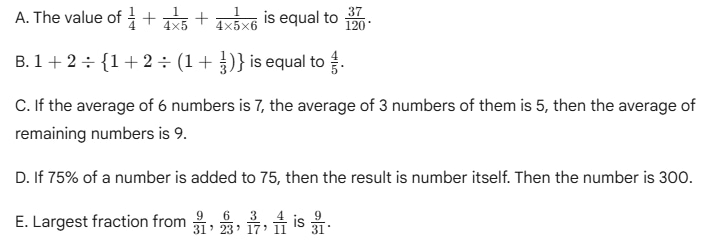
Choose the correct answer from the options given below:
- A.
A and B only
- B.
A, C and D only
- C.
C and D only
- D.
C, E and D only
Correct answer: B
Solution
We verify each statement to determine which are correct:
A. Calculate the sum: 1/4 + 1/(4×5) + 1/(4×5×6) = 30/120 + 6/120 + 1/120 = 37/120. This statement is correct.
B. Evaluate using order of operations: 1 + 2 ÷ {1 + 2 ÷ (4/3)} = 1 + 2 ÷ {1 + 3/2} = 1 + 2 ÷ (5/2) = 1 + 4/5 = 9/5. Since 9/5 ≠ 4/5, this statement is incorrect.
C. Sum of 6 numbers = 6 × 7 = 42. Sum of 3 numbers = 3 × 5 = 15. Remaining sum = 42 - 15 = 27. Average of remaining 3 numbers = 27 / 3 = 9. This statement is correct.
D. Let the number be x. Equation: 0.75x + 75 = x → 0.25x = 75 → x = 300. This statement is correct.
E. Comparing fractions: 9/31 ≈ 0.29, 6/23 ≈ 0.26, 3/17 ≈ 0.18, 4/11 ≈ 0.36. The largest is 4/11, not 9/31. This statement is incorrect.
Thus, statements A, C, and D are correct.
- A.
- Q109.UGC NET 2026
Which of the following explains the fallacy (hetvabhasa) of satpratipaksha correctly?
- A.
A fallacy where an inference is contradicted by perception or some other non-inferential pramana.
- B.
A fallacy where one inference is contradicted by another inference.
- C.
A fallacy that disproves the very proposition which it is meant to prove.
- D.
A fallacy of the irregular middle.
Correct answer: B
Solution
The fallacy of satpratipaksha in Nyaya logic is defined as a hetvabhasa where an inference is contradicted by another valid inference.
This occurs when the reason (hetu) supports both the proposition and its opposite, rendering the argument invalid.
- A.
- Q110.UGC NET 2026
Match List - I with List - II.
List - I (Type of Development)
List - II (Related with)
A. Psycho-sexual Development
I. Identity vs. Role Confusion
B. Psycho-social Development
II. Anal Stage
C. Cognitive Development
III. Hypothetical-deductive reasoning
D. Moral Development
IV. Resolving ethical dilemma
Choose the correct answer from the options given below :
- A.
A-II, B-III, C-I, D-IV
- B.
A-III, B-I, C-IV, D-II
- C.
A-I, B-IV, C-II, D-III
- D.
A-II, B-I, C-III, D-IV
Correct answer: D
Solution
The correct matching aligns developmental theories with their key concepts:
Psycho-sexual Development (Freud) matches Anal Stage (II).
Psycho-social Development (Erikson) matches Identity vs. Role Confusion (I).
Cognitive Development (Piaget) matches Hypothetical-deductive reasoning (III).
Moral Development matches Resolving ethical dilemma (IV).
Therefore, the correct code is A-II, B-I, C-III, D-IV.
- A.
- Q111.UGC NET 2026
Identify the advantages of closed ended questions in survey research :
A. It is easy to process answers.
B. Respondents can answer in their own terms.
C. They are easy for the respondents to complete.
D. They allow unusual responses to be derived.
- A.
A and B only
- B.
A and C only
- C.
A, B and C only
- D.
B, C and D only
Correct answer: B
Solution
Closed-ended questions feature predefined response options, making data processing easier (A). They are also quicker for respondents to complete, reducing burden (C). Options B and D refer to open-ended questions where responses are unique or unrestricted. Thus, A and C are the correct advantages.
- A.
- Q112.UGC NET 2026
Which of the following are application software?
A. Spreadsheet
B. Word Processor
C. Operating system
D. Database
E. Compiler
- A.
A, C and D only
- B.
B, C and E only
- C.
A, D and E only
- D.
A, B and D only
Correct answer: D
Solution
Application software is designed for end-users to perform specific tasks. Spreadsheet (A) and Word Processor (B) are classic examples of application software used for data manipulation and document creation. Database systems (D) manage data storage and retrieval, often classified as application software in this context. In contrast, Operating Systems (C) manage hardware resources and Compiler (E) translates code, both falling under system software. Therefore, the correct application software options are A, B, and D.
- A.
- Q113.UGC NET 2026
Measurement validity primarily relates to :
- A.
Qualitative research
- B.
Quantitative research
- C.
Interpretivism
- D.
Constructionism
Correct answer: B
Solution
Measurement validity is a core principle in quantitative research methodology, specifically focusing on whether an instrument accurately measures the intended construct without systematic bias or error. Unlike qualitative approaches which prioritize trustworthiness or credibility, quantitative studies rely heavily on statistical validity to ensure data integrity and generalizability across diverse populations.
- A.
- Q114.UGC NET 2026
Match List - I with List - II.
List - I
List - II
A. Independent variable in true experimental design
I. Outcome variable
B. Dependent variable
II. Control variable
C. Intervening variable
III. Spurious variable
D. Confounding variable
IV. Stands between independent variable and dependent variable
Choose the correct answer from the options given below :
- A.
A-IV, B-III, C-II, D-I
- B.
A-II, B-I, C-IV, D-III
- C.
A-I, B-II, C-III, D-IV
- D.
A-II, B-III, C-IV, D-I
Correct answer: B
Solution
To determine the correct matches, we analyze the definitions of research variables:
Dependent Variable (B) is the outcome variable measured in response to manipulation, matching with I.
Intervening Variable (C) functions as a mediator that stands between the independent and dependent variables, matching with IV.
Confounding Variable (D) introduces a spurious relationship between variables, matching with III.
Independent Variable (A) in a true experimental design is the variable controlled by the researcher, matching with II.
Therefore, the correct combination is A-II, B-I, C-IV, D-III.
- A.
- Q115.UGC NET 2026
Match List - I with List - II.
List - I (Successive discounts)
List - II (Equivalent discount)
A. 10% and 15%
I. 28%
B. 20% and 30%
II. 32.5%
C. 10% and 20%
III. 23.5%
D. 10% and 25%
IV. 44%
Choose the correct answer from the options given below :
- A.
A-I, B-II, C-IV, D-III
- B.
A-II, B-III, C-I, D-IV
- C.
A-III, B-IV, C-I, D-II
- D.
A-IV, B-I, C-II, D-III
Correct answer: C
Solution
The equivalent discount for successive discounts is calculated using the formula: d1 + d2 - (d1 * d2)/100.
For A (10% and 15%): 10 + 15 - (10 * 15)/100 = 23.5%, which matches III.
For B (20% and 30%): 20 + 30 - (20 * 30)/100 = 44%, which matches IV.
For C (10% and 20%): 10 + 20 - (10 * 20)/100 = 28%, which matches I.
For D (10% and 25%): 10 + 25 - (10 * 25)/100 = 32.5%, which matches II.
Therefore, the correct matching is A-III, B-IV, C-I, D-II.
- A.
- Q116.UGC NET 2026
Given below are two statements: one is labelled as Assertion (A) and the other is labelled as Reason (R).
Assertion (A): National Education Policy, 2020 (NEP-2020) visualized ‘Research-Intensive Universities’.
Reason (R): NEP-2020 envisioned university as a place which lays equal emphasis on teaching and research.
In the light of the above statements, choose the most appropriate answer from the options given below
नीचे दो कथन दिए गए हैं: एक को अभिकथन (A) और दूसरे को कारण (R) के रूप में अंकित किया गया है।
अभिकथन (A): राष्ट्रीय शिक्षा नीति, 2020 (NEP-2020) ने 'अनुसंधान-गहन विश्वविद्यालयों' (Research-Intensive Universities) की परिकल्पना की है।
कारण (R): NEP-2020 ने विश्वविद्यालय की कल्पना एक ऐसे स्थान के रूप में की है जो शिक्षण और अनुसंधान पर समान जोर देता है।
उपरोक्त कथनों के आलोक में, नीचे दिए गए विकल्पों में से सबसे उपयुक्त उत्तर चुनें:
- A.
Both (A) and (R) are correct and (R) is the correct explanation of (A)
- B.
Both (A) and (R) are correct but (R) is not the correct explanation of (A)
- C.
(A) is correct but (R) is not correct
- D.
(A) is not correct but (R) is correct
Correct answer: A
Solution
The National Education Policy (NEP) 2020 explicitly proposes the establishment of Research-Intensive Universities to enhance quality in higher education.
It also envisions universities as institutions that lay equal emphasis on teaching and research.
Since the vision for Research-Intensive Universities is derived from this principle of integrating teaching and research equally, Reason (R) correctly explains Assertion (A).
Therefore, both statements are true and Reason is the correct explanation of Assertion.
- A.
- Q117.UGC NET 2026
Arrange the following greenhouse gases in the increasing order of their life time in the earth's atmosphere:
A. SF6 (Sulfur Hexafluoride)
B. N2O (Nitrous Oxide)
C. H2O vapor (Water Vapor)
D. CH4 (Methane)
Choose the correct answer from the options given below:
- A.
C, D, B, A
- B.
C, D, A, B
- C.
A, B, C, D
- D.
B, A, D, C
Correct answer: A
Solution
The atmospheric lifetime of a greenhouse gas determines how long it remains in the atmosphere. Water vapor (C) has the shortest lifetime, lasting only days. Methane (D) persists for about a decade. Nitrous oxide (B) remains for over a century. Sulfur hexafluoride (A) has the longest lifetime, lasting thousands of years. Therefore, the increasing order of life time is C, D, B, A.
- A.
- Q118.UGC NET 2026
Arrange the following fractions in ascending order:
A. 2/3
B. 7/19
C. 9/11
D. 8/9
E. 7/9
Choose the correct answer from the options given below:
- A.
B, A, E, C, D
- B.
B, E, A, D, C
- C.
A, B, C, D, E
- D.
B, C, A, E, D
Correct answer: A
Solution
To arrange the fractions in ascending order, convert each to a decimal approximation.
B (7/19) ≈ 0.368, A (2/3) ≈ 0.667, E (7/9) ≈ 0.778, C (9/11) ≈ 0.818, and D (8/9) ≈ 0.889.
Comparing these values gives the order B < A < E < C < D.
- A.
- Q119.UGC NET 2026
Complete the following series:
N7V, K9T, H12R, ?, B21N
- A.
E14R
- B.
E13Q
- C.
E16P
- D.
F16R
Correct answer: C
Solution
The series follows three patterns: first letter, number, and last letter.
1. First Letter: N (14) - 3 = K, K (11) - 3 = H, so next is E (5).
2. Number: 7 + 2 = 9, 9 + 3 = 12, so next is 16 (12 + 4).
3. Last Letter: V (22) - 2 = T, T (20) - 2 = R, so next is P (16).
Combining these gives E16P.
- A.
- Q120.UGC NET 2026
Match List - I with List - II.
List - I (Types of categorical propositions)
List - II (Explanation)
A. A proposition (Universal Affirmative)
I. Distributes both subject and predicate terms
B. E proposition (Universal Negative)
II. Distributes only predicate term
C. I proposition (Particular Affirmative)
III. Distributes only subject term
D. O proposition (Particular Negative)
IV. Distributes neither subject nor predicate term
Choose the correct answer from the options given below :
- A.
A-II, B-I, C-IV, D-III
- B.
A-III, B-I, C-IV, D-II
- C.
A-I, B-II, C-III, D-IV
- D.
A-IV, B-III, C-II, D-I
Correct answer: B
Solution
In traditional (Aristotelian) categorical logic, the distribution of a term describes whether a categorical proposition refers to every member of that term's class. Each of the four standard forms — A (Universal Affirmative), E (Universal Negative), I (Particular Affirmative), and O (Particular Negative) — has a fixed, well-defined distribution pattern for its subject and predicate terms.
Proposition type
Subject term
Predicate term
A – Universal Affirmative
Distributed
Not distributed
E – Universal Negative
Distributed
Distributed
I – Particular Affirmative
Not distributed
Not distributed
O – Particular Negative
Not distributed
Distributed
A distributes only the subject term, which matches List-II item III ('Distributes only subject term'), giving A-III.
E distributes both the subject and predicate terms, which matches List-II item I ('Distributes both subject and predicate terms'), giving B-I.
I distributes neither term, which matches List-II item IV ('Distributes neither subject nor predicate term'), giving C-IV.
O distributes only the predicate term, which matches List-II item II ('Distributes only predicate term'), giving D-II.
The pairing A-II, B-I, C-IV, D-III swaps the entries for A and O, wrongly giving A the 'predicate only' property and O the 'subject only' property.
The pairing A-I, B-II, C-III, D-IV assigns every proposition the wrong property outright — for instance, it gives A the 'distributes both terms' property that actually belongs to E.
The pairing A-IV, B-III, C-II, D-I inverts the entire mapping — for instance, it gives E the 'distributes only the subject term' property that actually belongs to A.
Correct matching: A-III, B-I, C-IV, D-II.
- A.
- Q121.UGC NET 2026
Match List - I with List - II.
List - I
List - II
A. Phishing
IV. The creator sends out legitimate-looking emails to target users
B. Hacking
I. Act of gaining unauthorized access
C. Spam
II. Unsolicited email sent over the internet to a recipient on a mailing list
D. Cookies
III. Small file or code stored on user's computer
Choose the correct answer from the options given below :
- A.
A-II, B-III, C-IV, D-I
- B.
A-IV, B-I, C-III, D-II
- C.
A-IV, B-I, C-II, D-III
- D.
A-I, B-IV, C-II, D-III
Correct answer: C
Solution
Phishing involves sending deceptive emails to target users, corresponding to IV. Hacking is the act of gaining unauthorized access, matching I. Spam refers to unsolicited emails sent over the internet, aligning with II. Cookies are small files stored on a computer, matching III. Therefore, the correct combination is A-IV, B-I, C-II, D-III.
- A.
- Q122.UGC NET 2026
Arrange the following senior functionaries of a central university in the correct hierarchical order:
A. Visitor
B. Dean of the faculty
C. Chancellor
D. Head of Department
E. Vice-Chancellor
Choose the correct answer from the options given below:
केंद्रीय विश्वविद्यालय के निम्नलिखित वरिष्ठ पदाधिकारियों को सही पदानुक्रमित क्रम (hierarchical order) में व्यवस्थित करें:
A. कुलाध्यक्ष
B. संकायाध्यक्ष
C. कुलाधिपति
D. विभागाध्यक्ष
E. कुलपति
- A.
A, C, E, D, B
- B.
C, A, E, D, B
- C.
A, C, E, B, D
- D.
B, D, E, C, A
Correct answer: C
Solution
The correct hierarchical order for central university functionaries is Visitor (highest authority), Chancellor, Vice-Chancellor, Dean of Faculty, then Head of Department. Option 2 (A, C, E, B, D) matches this standard structure per Indian university regulations.
- A.
- Q123.UGC NET 2026
Which of the following is an example of biological motive?
- A.
Achievement
- B.
Hunger
- C.
Power
- D.
Affiliation
Correct answer: B
Solution
Biological motives are innate physiological drives essential for survival, such as hunger and thirst. Hunger is a primary biological motive that ensures the body maintains homeostasis.
- A.
- Q124.UGC NET 2026
The smallest unit of information a computer can understand and process is known as:
- A.
Digit
- B.
Byte
- C.
Nibble
- D.
Bit
Correct answer: D
Solution
The smallest unit of information a computer can understand and process is known as a bit. A bit represents a binary digit (0 or 1), which forms the foundation of all digital data processing.
- A.
- Q125.UGC NET 2026
Journals that prioritize self-interest at the expense of scholarship and are characterized by false or misleading information, deviation from best editorial/publication practices, lack of transparency and/or use of aggressive and indiscriminate solicitation practices, are known as:
- A.
Open access journals
- B.
Proprietary journals
- C.
Professional journals
- D.
Predatory journals
Correct answer: D
Solution
The description provided in the question matches the definition of predatory journals. These entities prioritize self-interest over scholarship, often lack transparency, and engage in unethical practices such as misleading information or aggressive solicitation.
- A.
- Q126.UGC NET 2026
Arrange the steps of creative thinking process in correct sequence:
A. Preparation B. Evaluation C. Illumination D. Revision E. Incubation
Choose the correct answer from the options given below:
- A.
A, B, C, D, E
- B.
E, D, C, B, A
- C.
D, C, B, E, A
- D.
A, E, C, B, D
Correct answer: D
Solution
The standard model for creative thinking, often attributed to Graham Wallas, dictates a specific chronological order of stages.
The process begins with Preparation (A), moves through Incubation (E) and Illumination (C), and concludes with Evaluation or Revision (B/D).
Therefore, the correct sequence is A-E-C-B-D.
- A.
- Q127.UGC NET 2026
Match List - I with List - II.
List - I
List - II
A. Primary Air pollutant
II. Carbon monoxide
B. Secondary Air pollutant
I. Peroxyacyl nitrate (PAN)
C. Ozone depleting substance
IV. Chlorofluorocarbons (CFCs)
D. Cloud Condensation Nuclei
III. Aerosols
Choose the correct answer from the options given below :
- A.
A-I, B-II, C-III, D-IV
- B.
A-II, B-I, C-IV, D-III
- C.
A-I, B-II, C-IV, D-III
- D.
A-II, B-I, C-III, D-IV
Correct answer: B
Solution
Primary air pollutants are emitted directly, such as Carbon monoxide (A-II). Secondary air pollutants form in the atmosphere, like Peroxyacyl nitrate (PAN) (B-I). Chlorofluorocarbons (CFCs) are ozone-depleting substances (C-IV). Aerosols act as Cloud Condensation Nuclei (D-III).
- A.
- Q128.UGC NET 2026
Given below are two statements: one is labelled as Assertion (A) and the other is labelled as Reason (R).
Assertion (A): A wind mill will be more effective if it is placed at a higher elevation above the ground than a lower one.
Reason (R): Generally, the wind speed increases with altitude above the earth's surface.
In the light of the above statements, choose the most appropriate answer from the options given below:
- A.
Both (A) and (R) are correct and (R) is the correct explanation of (A)
- B.
Both (A) and (R) are correct but (R) is not the correct explanation of (A)
- C.
(A) is correct but (R) is not correct
- D.
(A) is not correct but (R) is correct
Correct answer: A
Solution
Both Assertion and Reason are true, and the Reason correctly explains the Assertion. Wind speed generally increases with altitude due to reduced surface friction and turbulence. Since windmill power output depends on wind speed, placing it at a higher elevation makes it more effective.
- A.
- Q129.UGC NET 2026
The oxygen consumed in the oxidation of an organic compound by microorganisms in the aquatic ecosystem is called ___________.
जलीय पारिस्थितिकी तंत्र में सूक्ष्मजीवों द्वारा कार्बनिक यौगिक के ऑक्सीकरण में खपत होने वाली ऑक्सीजन को ___________ कहा जाता है।
- A.
Dissolved oxygen
घुलित ऑक्सीजन
- B.
Chemical oxygen demand
रासायनिक ऑक्सीजन मांग
- C.
Theoretical oxygen demand
सैद्धांतिक ऑक्सीजन मांग
- D.
Biochemical oxygen demand
जैव रासायनिक ऑक्सीजन मांग
Correct answer: D
Solution
The oxygen consumed in the oxidation of an organic compound by microorganisms in the aquatic ecosystem is called Biochemical Oxygen Demand (BOD). BOD measures the amount of dissolved oxygen required by aerobic microorganisms to decompose organic matter in water. This distinguishes it from Chemical Oxygen Demand (COD), which involves chemical oxidation, and Dissolved Oxygen (DO), which refers to the oxygen currently present in the water.
- A.
- Q130.UGC NET 2026
Which of the following is/are true:
A. The conversion of an O proposition is valid.
B. The conversion of an A proposition is an A proposition.
C. The conversion of an E proposition is conversion by limitation.
D. The conversion of an I proposition is valid.
Choose the correct answer from the options given below:
- A.
A and D only
- B.
A and B only
- C.
C only
- D.
D only
Correct answer: D
Solution
In categorical logic, conversion involves swapping the subject and predicate terms. 1. A Proposition (All S are P): Converts by limitation to an I proposition (Some P are S). Thus, statement B is false. 2. E Proposition (No S are P): Converts simply to another E proposition (No P are S). Thus, statement C is false. 3. I Proposition (Some S are P): Converts simply to another I proposition (Some P are S). This conversion is valid. Thus, statement D is true. 4. O Proposition (Some S are not P): Conversion is invalid because the predicate of an O proposition is undistributed, but becomes distributed in the converse. Thus, statement A is false. Therefore, only statement D is correct.
- A.
- Q131.UGC NET 2026
Two cyclists cover the same distance at 15 km/hr and 16 km/hr, respectively. If one cyclist takes 16 minutes longer than the other, then the distance travelled by each cyclist is:
- A.
64 KM
- B.
16 KM
- C.
68 KM
- D.
12 KM
Correct answer: A
Solution
First, convert the time difference from minutes to hours: 16 minutes = 16/60 hours = 4/15 hours.
Let the distance be d km.
The time taken by the first cyclist is d/15 hours, and for the second cyclist is d/16 hours.
Since the slower cyclist takes longer, we have: d/15 - d/16 = 4/15.
Solving for d: (16d - 15d) / 240 = 4/15 => d/240 = 4/15 => d = (4 * 240) / 15 => d = 64 km.
Thus, the distance travelled by each cyclist is 64 km. - A.
- Q132.UGC NET 2026
Which among the following is the most liberal Open Education Resource license?
- A.
CC-BY
- B.
CC-BY-SA
- C.
CC-BY-ND
- D.
CC-BY-NC
Correct answer: A
Solution
The Creative Commons Attribution (CC-BY) license is the most liberal Open Education Resource license because it only requires users to give credit to the original creator. Unlike other licenses, it does not restrict commercial use (NC), prohibit derivatives (ND), or require derivative works to be shared under the same license (SA). This allows for unrestricted use, modification, and distribution as long as attribution is provided.
- A.
- Q133.UGC NET 2026
Read the following passage and answer the questions:
Organized endeavors directed by people responsible for planning, organizing, leading and controlling activities have existed for thousands of years. The Egyptian pyramids and the Great Wall of China, for instance, are tangible evidence that projects of tremendous scope, employing tens of thousands of people, were undertaken well before modern times. The pyramids are a particularly interesting example. The construction of a single pyramid occupied more than 100,000 workers for 20 years. Who told each worker what to do? Who ensured that there would be enough stones at the site to keep workers busy? The answer to such questions is managers. Regardless of what managers were called at the time, someone had to plan what was to be done, organize people and materials to do it, lead and direct the workers, and impose some controls to ensure that everything was done as planned.
Another example of early management can be seen during the 1400s in the city of Venice, Italy, a major economic and trade center. The Venetians developed an early form of business enterprise and engaged in many activities common to today’s organizations. For instance, at the arsenal of Venice, warships were floated along the canals, and at each stop materials and riggings were added to the ship. Doesn’t that sound a lot like a car “floating” along an automobile assembly line while components are added to it? In addition to this assembly line, the Venetians also used warehouse and inventory systems to keep track of materials, human resource management systems to manage the labor force, and an accounting system to keep track of revenues and costs.
According to the passage, the role of a manager includes all of the following, except:
- A.
Stacking stones for the pyramids
- B.
Planning what is to be done
- C.
Organising people for the pyramids site
- D.
Directing the pyramid work force
Correct answer: A
Solution
The passage explicitly defines the manager's role as planning, organizing people and materials, leading workers, and imposing controls. It contrasts these supervisory duties with the manual labor performed by the 100,000 workers who built the pyramids. Therefore, tasks involving physical labor (such as stacking stones) fall outside the scope of management responsibilities described in the text. The other options align directly with the functions attributed to managers.
- A.
- Q134.UGC NET 2026
Read the following passage and answer the questions:
Organized endeavors directed by people responsible for planning, organizing, leading and controlling activities have existed for thousands of years. The Egyptian pyramids and the Great Wall of China, for instance, are tangible evidence that projects of tremendous scope, employing tens of thousands of people, were undertaken well before modern times. The pyramids are a particularly interesting example. The construction of a single pyramid occupied more than 100,000 workers for 20 years. Who told each worker what to do? Who ensured that there would be enough stones at the site to keep workers busy? The answer to such questions is managers. Regardless of what managers were called at the time, someone had to plan what was to be done, organize people and materials to do it, lead and direct the workers, and impose some controls to ensure that everything was done as planned.
Another example of early management can be seen during the 1400s in the city of Venice, Italy, a major economic and trade center. The Venetians developed an early form of business enterprise and engaged in many activities common to today’s organizations. For instance, at the arsenal of Venice, warships were floated along the canals, and at each stop materials and riggings were added to the ship. Doesn’t that sound a lot like a car “floating” along an automobile assembly line while components are added to it? In addition to this assembly line, the Venetians also used warehouse and inventory systems to keep track of materials, human resource management systems to manage the labor force, and an accounting system to keep track of revenues and costs.
According to the passage, persons responsible for the control, organisation and planning have been directing organised endeavors :
- A.
Since 1400's
- B.
For 100,000 years
- C.
For Twenty years
- D.
For Thousands of years
Correct answer: D
Solution
According to the passage, organized endeavors directed by people responsible for planning, organizing, leading and controlling activities have existed for thousands of years. The text cites examples like the Egyptian pyramids and the Great Wall of China as evidence that such management activities were undertaken well before modern times.
- A.
- Q135.UGC NET 2026
Read the following passage and answer the questions:
Organized endeavors directed by people responsible for planning, organizing, leading and controlling activities have existed for thousands of years. The Egyptian pyramids and the Great Wall of China, for instance, are tangible evidence that projects of tremendous scope, employing tens of thousands of people, were undertaken well before modern times. The pyramids are a particularly interesting example. The construction of a single pyramid occupied more than 100,000 workers for 20 years. Who told each worker what to do? Who ensured that there would be enough stones at the site to keep workers busy? The answer to such questions is managers. Regardless of what managers were called at the time, someone had to plan what was to be done, organize people and materials to do it, lead and direct the workers, and impose some controls to ensure that everything was done as planned.
Another example of early management can be seen during the 1400s in the city of Venice, Italy, a major economic and trade center. The Venetians developed an early form of business enterprise and engaged in many activities common to today’s organizations. For instance, at the arsenal of Venice, warships were floated along the canals, and at each stop materials and riggings were added to the ship. Doesn’t that sound a lot like a car “floating” along an automobile assembly line while components are added to it? In addition to this assembly line, the Venetians also used warehouse and inventory systems to keep track of materials, human resource management systems to manage the labor force, and an accounting system to keep track of revenues and costs.
According to the passage, the ancient equivalent of the assembly line was used in :
- A.
Egypt
- B.
China
- C.
Venice
- D.
Giza
Correct answer: C
Solution
The passage explicitly links the Venice arsenal process to an assembly line concept. It describes warships floating along canals where materials were added at each stop, comparing this directly to an automobile assembly line. Egypt and China are mentioned regarding pyramids and walls, not assembly lines.
- A.
- Q136.UGC NET 2026
Read the following passage and answer the questions:
Organized endeavors directed by people responsible for planning, organizing, leading and controlling activities have existed for thousands of years. The Egyptian pyramids and the Great Wall of China, for instance, are tangible evidence that projects of tremendous scope, employing tens of thousands of people, were undertaken well before modern times. The pyramids are a particularly interesting example. The construction of a single pyramid occupied more than 100,000 workers for 20 years. Who told each worker what to do? Who ensured that there would be enough stones at the site to keep workers busy? The answer to such questions is managers. Regardless of what managers were called at the time, someone had to plan what was to be done, organize people and materials to do it, lead and direct the workers, and impose some controls to ensure that everything was done as planned.
Another example of early management can be seen during the 1400s in the city of Venice, Italy, a major economic and trade center. The Venetians developed an early form of business enterprise and engaged in many activities common to today’s organizations. For instance, at the arsenal of Venice, warships were floated along the canals, and at each stop materials and riggings were added to the ship. Doesn’t that sound a lot like a car “floating” along an automobile assembly line while components are added to it? In addition to this assembly line, the Venetians also used warehouse and inventory systems to keep track of materials, human resource management systems to manage the labor force, and an accounting system to keep track of revenues and costs.
The passage documents that Egyptians involved in the construction of pyramids had:
- A.
An inventory system to keep record of the stones.
- B.
A plan for what was to be done.
- C.
An accounting system to keep the record of money.
- D.
A warehouse system to manage materials.
Correct answer: B
Solution
The passage explicitly states that for the pyramids, 'someone had to plan what was to be done,' which indicates Egyptians engaged in planning activities. In contrast, inventory systems and accounting systems are specifically attributed to the Venetians in the 1400s section of the text.
- A.
- Q137.UGC NET 2026
Read the following passage and answer the questions:
Organized endeavors directed by people responsible for planning, organizing, leading and controlling activities have existed for thousands of years. The Egyptian pyramids and the Great Wall of China, for instance, are tangible evidence that projects of tremendous scope, employing tens of thousands of people, were undertaken well before modern times. The pyramids are a particularly interesting example. The construction of a single pyramid occupied more than 100,000 workers for 20 years. Who told each worker what to do? Who ensured that there would be enough stones at the site to keep workers busy? The answer to such questions is managers. Regardless of what managers were called at the time, someone had to plan what was to be done, organize people and materials to do it, lead and direct the workers, and impose some controls to ensure that everything was done as planned.
Another example of early management can be seen during the 1400s in the city of Venice, Italy, a major economic and trade center. The Venetians developed an early form of business enterprise and engaged in many activities common to today’s organizations. For instance, at the arsenal of Venice, warships were floated along the canals, and at each stop materials and riggings were added to the ship. Doesn’t that sound a lot like a car “floating” along an automobile assembly line while components are added to it? In addition to this assembly line, the Venetians also used warehouse and inventory systems to keep track of materials, human resource management systems to manage the labor force, and an accounting system to keep track of revenues and costs.
Based on the given passage, the reader learns that:
- A.
Management is a very recent invention.
- B.
The title of 'manager' has existed since ancient times.
- C.
People guiding organized endeavors can be seen through the ages.
- D.
The assembly line system was prevalent in China, Egypt, and Italy.
Correct answer: C
Solution
The passage explicitly states that organized endeavors directed by people responsible for planning, organizing, leading and controlling have existed for thousands of years. It cites the Egyptian pyramids and the Venetian arsenal as evidence of early management practices, supporting the conclusion that people guiding such endeavors have been present throughout history.
- A.
- Q138.UGC NET 2026
Match List - I with List - II.
List - I (Communication Traditions)
List - II (Explanation/Perspective)
A. Rhetorical
III. Considering communication as a practical art
B. Semiotic
IV. Considering communication as intersubjective mediation through signs
C. Phenomenological
II. Considering communication as the experience of otherness through authentic dialogue
D. Critical
I. Considering communication as a discursive reflection on ideologically power forces
Choose the correct answer from the options given below:
- A.
A-III, B-IV, C-II, D-I
- B.
A-II, B-IV, C-III, D-I
- C.
A-I, B-IV, C-II, D-III
- D.
A-III, B-II, C-IV, D-I
Correct answer: A
Solution
The correct matching is A-III, B-IV, C-II, D-I.
The Rhetorical tradition views communication as a practical art of persuasion (A-III).
The Semiotic tradition focuses on communication as intersubjective mediation through signs (B-IV).
The Phenomenological tradition emphasizes the experience of otherness through authentic dialogue (C-II).
The Critical tradition involves discursive reflection on ideologically power forces (D-I).
- A.
- Q139.UGC NET 2026
Match List - I with List - II.
List - I (Departments of Ashram)
List - II (Subject/Topic)
A. Vishnu Sthan
III. Politics
B. Vivaswat Sthan
II. Astrology/Astronomy
C. Garuda Sthan
IV. Travel and Transport
D. Mahendra Sthan
I. Military Education
Choose the correct answer from the options given below:
- A.
A-II, B-IV, C-III, D-I
- B.
A-I, B-III, C-II, D-IV
- C.
A-III, B-II, C-IV, D-I
- D.
A-I, B-II, C-III, D-IV
Correct answer: C
Solution
The correct matching is A-III, B-II, C-IV, D-I. Vishnu Sthan relates to Politics (III), Vivaswat Sthan to Astrology/Astronomy (II), Garuda Sthan to Travel and Transport (IV), and Mahendra Sthan to Military Education (I).
- A.
- Q140.UGC NET 2026
The following table shows the marks obtained by six students A-F in six different subjects S1 to S6 having 160, 160, 120, 120, 200 and 240 as maximum marks, respectively. Based on the data in the table, answer the questions that follow:
Students-wise Details of Marks obtained
Student
S1 (160)
S2 (160)
S3 (120)
S4 (120)
S5 (200)
S6 (240)
A
80
84
66
56
154
150
B
120
100
84
76
136
132
C
128
72
64
70
144
160
D
84
130
96
84
104
168
E
64
128
90
92
174
70
F
70
96
60
56
164
100
What is the overall respective percentages of marks scored by student A and student B, in all the subjects together?
- A.
55% and 62.8%
- B.
56% and 63.8%
- C.
57% and 61.8%
- D.
59% and 64.8%
Correct answer: D
Solution
First, calculate the total maximum marks across all six subjects: 160 + 160 + 120 + 120 + 200 + 240 = 1000.
Next, find the total marks obtained by Student A: 80 + 84 + 66 + 56 + 154 + 150 = 590.
The percentage for Student A is (590 / 1000) * 100 = 59%.
Then, find the total marks obtained by Student B: 120 + 100 + 84 + 76 + 136 + 132 = 648.
The percentage for Student B is (648 / 1000) * 100 = 64.8%.
Thus, the respective percentages are 59% and 64.8%.
- A.
- Q141.UGC NET 2026
The following table shows the marks obtained by six students A-F in six different subjects S1 to S6 having 160, 160, 120, 120, 200 and 240 as maximum marks, respectively. Based on the data in the table, answer the questions that follow:
Students-wise Details of Marks obtained
Student
S1 (Out of 160)
S2 (Out of 160)
S3 (Out of 120)
S4 (Out of 120)
S5 (Out of 200)
S6 (Out of 240)
A
80
84
66
56
154
150
B
120
100
84
76
136
132
C
128
72
64
70
144
160
D
84
130
96
84
104
168
E
64
128
90
92
174
70
F
70
96
60
56
164
100
What is the ratio of the total marks scored by student B in all the subjects to the total marks scored by student E in all subjects?
- A.
26 : 27
- B.
108 : 103
- C.
16 : 17
- D.
46 : 47
Correct answer: B
Solution
To find the ratio, we first calculate the total marks scored by each student across all six subjects.
For Student B, summing the scores: 120 + 100 + 84 + 76 + 136 + 132 = 648.
For Student E, summing the scores: 64 + 128 + 90 + 92 + 174 + 70 = 618.
The required ratio is therefore 648: 618.
To simplify this fraction, we divide both terms by their greatest common divisor.
Both numbers are divisible by 6: 648 ÷ 6 = 108 and 618 ÷ 6 = 103.
Thus, the simplified ratio is 108: 103.
This matches Option B.
- A.
- Q142.UGC NET 2026
The following table shows the marks obtained by six students A-F in six different subjects S1 to S6 having 160, 160, 120, 120, 200 and 240 as maximum marks, respectively. Based on the data in the table, answer the questions that follow:
Students-wise Details of Marks obtained
Student
S1 (Out of 160)
S2 (Out of 160)
S3 (Out of 120)
S4 (Out of 120)
S5 (Out of 200)
S6 (Out of 240)
A
80
84
66
56
154
150
B
120
100
84
76
136
132
C
128
72
64
70
144
160
D
84
130
96
84
104
168
E
64
128
90
92
174
70
F
70
96
60
56
164
100
If for getting first division, a student needs to score minimum 65% marks in aggregate, then the number of students getting first division is:
- A.
5
- B.
3
- C.
2
- D.
1
Correct answer: D
Solution
First, calculate the total maximum marks across all six subjects: 160 + 160 + 120 + 120 + 200 + 240 = 1000.
To achieve first division, a student needs 65% of the total marks: 0.65 * 1000 = 650.
Next, calculate the aggregate marks for each student:
Student A: 80 + 84 + 66 + 56 + 154 + 150 = 590
Student B: 120 + 100 + 84 + 76 + 136 + 132 = 648
Student C: 128 + 72 + 64 + 70 + 144 + 160 = 638
Student D: 84 + 130 + 96 + 84 + 104 + 168 = 666
Student E: 64 + 128 + 90 + 92 + 174 + 70 = 618
Student F: 70 + 96 + 60 + 56 + 164 + 100 = 546
Only Student D scored 666, which is greater than or equal to the required 650 marks.
Therefore, exactly one student gets first division.
- A.
- Q143.UGC NET 2026
The following table shows the marks obtained by six students A-F in six different subjects S1 to S6 having 160, 160, 120, 120, 200 and 240 as maximum marks, respectively. Based on the data in the table, answer the questions that follow:
Students-wise Details of Marks obtained
Student
S1 (Out of 160)
S2 (Out of 160)
S3 (Out of 120)
S4 (Out of 120)
S5 (Out of 200)
S6 (Out of 240)
A
80
84
66
56
154
150
B
120
100
84
76
136
132
C
128
72
64
70
144
160
D
84
130
96
84
104
168
E
64
128
90
92
174
70
F
70
96
60
56
164
100
What is the average marks scored by all the students in the subjects S5 and subject S6, respectively?
- A.
142 and 130
- B.
144 and 128
- C.
146 and 130
- D.
148 and 126
Correct answer: C
Solution
To find the average marks in S5 and S6, first sum the scores for each subject across all six students.
For S5: 154 + 136 + 144 + 104 + 174 + 164 = 876.
The average is 876 / 6 = 146.
For S6: 150 + 132 + 160 + 168 + 70 + 100 = 780.
The average is 780 / 6 = 130.
- A.
- Q144.UGC NET 2026
The following table shows the marks obtained by six students A-F in six different subjects S1 to S6 having 160, 160, 120, 120, 200 and 240 as maximum marks, respectively. Based on the data in the table, answer the questions that follow:
Students-wise Details of Marks obtained
Student
S1 (Out of 160)
S2 (Out of 160)
S3 (Out of 120)
S4 (Out of 120)
S5 (Out of 200)
S6 (Out of 240)
A
80
84
66
56
154
150
B
120
100
84
76
136
132
C
128
72
64
70
144
160
D
84
130
96
84
104
168
E
64
128
90
92
174
70
F
70
96
60
56
164
100
The marks scored by student B and student C together in subject S1 is approximately ____% more than the marks scored by student A, student D and student E together in the same subject.
- A.
8.77
- B.
9.66
- C.
10.53
- D.
11.67
Correct answer: A
Solution
First, calculate the total marks obtained by students B and C in subject S1. Student B scored 120 and Student C scored 128, giving a combined total of 248.
Next, calculate the total marks obtained by students A, D, and E in subject S1. Student A scored 80, Student D scored 84, and Student E scored 64, giving a combined total of 228.
To find the percentage increase, subtract the second total from the first (248 - 228 = 20). Divide this difference by the reference total (228) and multiply by 100 to get approximately 8.77%.
- A.
- Q145.UGC NET 2026
In mediated communication audience attention is considered as a:
- A.
Human liability
- B.
Scarce resource
- C.
Visibility product
- D.
Regulated liability
Correct answer: B
Solution
In mediated communication, audience attention is considered a scarce resource. This concept stems from the 'attention economy' framework, where attention is viewed as a limited commodity that competes with various media outlets for consumption. Unlike unlimited supplies, attention must be captured and maintained amidst numerous distractions.
- A.
- Q146.UGC NET 2026
Which of the following statements are logically equivalent?
A. All non-bovines are cats
B. No cats are bovines
C. All cats are non-bovines
D. No bovines are cats
Choose the correct answer from the options given below:
- A.
B, C and D Only
- B.
A and C Only
- C.
B and D Only
- D.
A, B and C Only
Correct answer: A
Solution
Statements B, C, and D are logically equivalent. 'No cats are bovines' (B) means the set of cats and bovines have no overlap.
This is equivalent to 'All cats are non-bovines' (C) and 'No bovines are cats' (D).
Statement A ('All non-bovines are cats') is not equivalent as it makes a claim about all things that are not bovines, which is a different logical scope.
- A.
- Q147.UGC NET 2026
Match List - I with List - II.
List - I (Commission/Committee)
List - II (Chairman)
A. First Indian Education Commission
I. W. W. Hunter
B. Indian University Commission
II. T. Raleigh
C. Calcutta University Commission
II. M. E. Sadler
D. Council of Education
IV. J. E. D. Bethune
Choose the correct answer from the options given below:
- A.
A-I, B-II, C-III, D-IV
- B.
A-II, B-III, C-IV, D-I
- C.
A-III, B-IV, C-I, D-II
- D.
A-IV, B-I, C-II, D-III
Correct answer: D
Solution
The correct matching is: First Indian Education Commission (1882) with W. W. Hunter, Indian University Commission (1902) with M. E. Sadler, Calcutta University Commission (1917) with T. Raleigh, and Council of Education with J. E. D. Bethune.
- A.
- Q148.UGC NET 2026
An overestimated prediction about the probability of an event based on frequency of the event's past occurrences is known as:
- A.
Hindsight bias
- B.
Availability heuristic
- C.
Representativeness heuristic
- D.
Divergent thinking
Correct answer: B
Solution
This scenario describes the Availability Heuristic. This cognitive bias occurs when individuals estimate the probability of an event based on how easily instances come to mind, often leading to overestimation if recent or vivid past occurrences are recalled.
- A.
- Q149.UGC NET 2026
Identify the discrete variables.
A. Number of students in each class of a school
B. Number of heads obtained in ten tosses of a coin
C. Marks scored by students in an objective type examination with negative marking for incorrect responses
D. Height of students in a school
Choose the correct answer from the options given below:
- A.
A, B and C Only
- B.
A and B Only
- C.
A, B and D Only
- D.
C and D Only
Correct answer: A
Solution
A variable is discrete if it can take only distinct, separate values (usually whole numbers) obtained by counting, with no possible value between two consecutive counts. A variable is continuous if it can take any value, including fractions and decimals, within a given range, obtained by measurement.
The number of students in each class of a school is counted as whole students — 0, 1, 2, and so on — with no fractional student possible, so this is discrete.
The number of heads obtained in ten tosses of a coin can only be a whole number from 0 to 10, so this is discrete.
The marks scored in the objective exam with negative marking are built from a fixed score per question and a fixed deduction per wrong answer, so the total for a fixed-length test is always one of a finite, specific set of possible values, so this is discrete.
The height of students in a school is obtained by measurement and can take any value within a range — for example 152.3 cm or 152.34 cm — so this is continuous, not discrete.
Quantity
How its value arises
Variable type
Number of students in each class
Counting whole students
Discrete
Number of heads in ten tosses
Counting, limited to 0–10
Discrete
Marks in the objective exam with negative marking
Fixed award per correct answer minus fixed penalty per wrong answer, over a fixed number of questions
Discrete
Height of students
Measurement on a scale, any value in a range
Continuous
Cross-check: between any two heights, say 150 cm and 151 cm, infinitely many intermediate values (150.5 cm, 150.55 cm, and so on) are possible — this is exactly the property of a continuous variable, and it is why the height of students cannot be grouped with the other three quantities above. By contrast, the number of students, the number of heads, and the total marks can each only take one value from a finite, specific list for any given scenario — there is no in-between value possible the way there is for a measured quantity, confirming all three as discrete.
Hence, the number of students, the number of heads in ten tosses, and the marks scored in the objective exam are the discrete variables, while the height of students is continuous — matching the option that selects exactly these three quantities.
- A.
- Q150.UGC NET 2026
Which of the following are the core social and emotional skills and competencies of self-regulation that are listed under Collaborative for Academic, Social and Emotional Learning (CASEL)?
A. Self-Management
B. Self-Awareness
C. Relationship Skills
D. Social awareness
E. Responsible decision making
Choose the correct answer from the options given below:
- A.
C, D and E Only
- B.
A, B, C, D and E
- C.
A and D Only
- D.
B, C and E Only
Correct answer: B
Solution
The Collaborative for Academic, Social and Emotional Learning (CASEL) framework defines five core competencies:
Self-Awareness, Self-Management, Social Awareness, Relationship Skills, and Responsible Decision-Making.
All the items listed in options A through E correspond to these competencies.
- A.
- Q151.UGC NET 2026
If the statement 'No fishes are mammals' is given as false, then which of the following proposition can be immediately inferred to be true?
- A.
Some fishes are mammals
- B.
All fishes are mammals
- C.
Some fishes are not mammals
- D.
All mammals are fishes
Correct answer: A
Solution
The statement 'No fishes are mammals' is a Universal Negative (E-type) proposition.
In the Square of Opposition, E and I propositions are contradictories with opposite truth values.
Since 'No fishes are mammals' is false, its contradictory 'Some fishes are mammals' must necessarily be true.
- A.
- Q152.UGC NET 2026
Geothermal power plants are much like fossil and nuclear plants with exception of no requirements of:
A. Vapour dominated hydrothermal resources
B. Boiler
C. Fission reactor
D. Turbine generator
Choose the correct answer from the options given below:
भूतापीय बिजली संयंत्र (Geothermal power plants) काफी हद तक जीवाश्म और परमाणु संयंत्रों के समान होते हैं, सिवाय इसके कि उनमें किसकी आवश्यकता नहीं होती है:
A. वाष्प प्रधान जलतापीय संसाधन
B. बॉयलर
C. विखंडन रिएक्टर
D. टरबाइन जनरेटर
नीचे दिए गए विकल्पों में से सही उत्तर चुनें:
- A.
A, B and C Only
केवल A, B और C
- B.
B and C Only
केवल B और C
- C.
A and D Only
केवल A और D
- D.
B, C and D Only
केवल B, C और D
Correct answer: B
Solution
Geothermal power plants generate electricity using heat from beneath the Earth's surface. Unlike fossil fuel or nuclear plants, they do not require a boiler to burn fuel or a fission reactor to generate heat. Instead, they tap into natural hydrothermal resources. However, they still utilize a turbine generator to convert steam energy into electricity. Thus, the components not required are the boiler and fission reactor.
- A.
- Q153.UGC NET 2026
Which of the following is labelled as the second self?
- A.
The Telephone
- B.
The Radio
- C.
The Television
- D.
The Computer
Correct answer: D
Solution
In the context of technology and human interaction, a computer is often labelled as the 'second self' because it extends our cognitive abilities. It serves as an external memory, processing tool, and communication hub that integrates closely with our daily lives, effectively acting as an extension of our own identity and capabilities.
- A.
- Q154.UGC NET 2026
What is the correct increasing order of Global Warming Potential (GWP) of the following Green House Gases (GHGs)?
A. CFC - 11 (Chlorofluorocarbon - 11)
B. CH4 (Methane)
C. CO2 (Carbon dioxide)
D. N2O (Nitrous oxide)
Choose the correct answer from the options given below:
निम्नलिखित ग्रीनहाउस गैसों (GHGs) के ग्लोबल वार्मिंग पोटेंशियल (GWP) का सही बढ़ता क्रम क्या है?
A. CFC - 11 (क्लोरोफ्लोरोकार्बन - 11)
B. CH4 (मीथेन)
C. CO2 (कार्बन डाइऑक्साइड)
D. N2O (नाइट्रस ऑक्साइड)
नीचे दिए गए विकल्पों में से सही उत्तर चुनें:
- A.
A, B, D, C
- B.
C, B, D, A
- C.
C, D, B, A
- D.
A, D, B, C
Correct answer: B
Solution
Global Warming Potential (GWP) measures the heat-trapping ability of a gas relative to carbon dioxide. Carbon dioxide (CO2) has a baseline GWP of 1. Methane (CH4) has a GWP of approximately 28-30 over 100 years. Nitrous oxide (N2O) has a GWP of approximately 265-298. CFC-11 has a significantly higher GWP of approximately 4750. Therefore, the correct increasing order is CO2 < CH4 < N2O < CFC-11, which corresponds to C < B < D < A.
- A.
- Q155.UGC NET 2026
In a research study, a group that experiences the manipulated independent variables is generally known as:
- A.
Placebo group
- B.
Control group
- C.
Independent group
- D.
Experimental group
Correct answer: D
Solution
The group that experiences the manipulated independent variables in a research study is called the experimental group. This group receives the treatment or intervention being tested, allowing researchers to measure its effects against a control group that does not receive the manipulation.
- A.
- Q156.UGC NET 2026
The Simla conference of 1901 was described by Lord Curzon as:
- A.
High-level Education Commission
- B.
High Power Education Commission
- C.
Secret Education Commission
- D.
Confidential Education Commission
Correct answer: D
Solution
Historical records indicate Lord Curzon's Education Commission was established in 1902, not a Simla Conference of 1901. The correct term is the Indian Education Commission.
- A.
- Q157.UGC NET 2026
Identify the correct statements.
A. Panel study is a type of longitudinal research.
B. Cohort study is a type of longitudinal research.
C. Panel study is a type of cross-sectional research.
D. Cohort study is a type of cross-sectional research.
Choose the correct answer from the options given below:
- A.
A and B Only
- B.
A and D Only
- C.
B and C Only
- D.
C and D Only
Correct answer: A
Solution
Panel studies involve repeated observations of the same subjects over time, which classifies them as longitudinal research.
Cohort studies track a specific group sharing characteristics across different time points, also defining them as longitudinal methodology.
Therefore, statements A and B are correct as both represent longitudinal research types, while C and D incorrectly label them as cross-sectional.
- A.
- Q158.UGC NET 2026
Which of the following is a kind of wave generated during an earthquake?
- A.
N-Wave
- B.
O-Wave
- C.
P-Wave
- D.
Q-Wave
Correct answer: C
Solution
During an earthquake, seismic energy is released in the form of waves. P-waves (Primary waves) are compressional body waves that travel through the Earth's interior and are typically the first to be detected.
- A.
- Q159.UGC NET 2026
A car travels from city A to city B with a constant speed. If the speed of the car is increased by 20 km/h it will reach destination 1 hour earlier. On the other hand, if its speed decreases by 20 km/h, it reaches 2 hours later than scheduled time. What is the usual time if it travels with routine speed?
- A.
2 hr
- B.
4 hr
- C.
8 hr
- D.
10 hr
Correct answer: B
Solution
Let the usual speed be v km/h and usual time be t hours. Distance d = vt.
Case 1: (v + 20)(t - 1) = vt ⇒ vt - v + 20t - 20 = vt ⇒ v = 20t - 20.
Case 2: (v - 20)(t + 2) = vt ⇒ vt + 2v - 20t - 40 = vt ⇒ v = 10t + 20.
Equating expressions for v: 20t - 20 = 10t + 20 ⇒ 10t = 40 ⇒ t = 4 hours.
- A.
- Q160.UGC NET 2026
The 'interactive society' is characterized by the following:
A. Non-electronic communication
B. Networked integration
C. Multi-media
D. Digitisation
E. Uncultured media environment
Choose the correct answer from the options given below:
- A.
A, B and C Only
- B.
B, C and D Only
- C.
C, D and E Only
- D.
A, B and E Only
Correct answer: B
Solution
The concept of an 'interactive society' fundamentally relies on digital and networked technologies. Option A (Non-electronic communication) contradicts this definition as interaction is primarily mediated electronically in this context. Options B (Networked integration), C (Multi-media), and D (Digitisation) accurately describe the core characteristics of this societal shift towards connectivity. Therefore, B, C, and D are the correct features.
- A.
- Q161.UGC NET 2026
Which of the following statements are true?
A. Validity is an attribute of deductive argument.
B. Validity can be attributed to any single proposition.
C. In a valid argument all of its premises have to be true.
D. A valid deductive argument can not have all true premises and a false conclusion.
Choose the correct answer from the options given below:
- A.
B and C Only
- B.
A, C and D Only
- C.
A and D Only
- D.
C and D Only
Correct answer: C
Solution
Validity is a property of deductive arguments, not individual propositions. Therefore, statement A is true and B is false.
In a valid argument, the logical structure ensures that if premises are true, the conclusion must be true. However, the premises themselves do not need to be actually true for the argument to be valid. Thus, statement C is false.
By definition, a valid deductive argument cannot have all true premises and a false conclusion. This makes statement D true.
Consequently, the correct statements are A and D only.
- A.
- Q162.UGC NET 2026
Which of the following arguments is fallacious because the middle term is present in both positive and negative instances and violates the rule that it should not be present in the negative instances?
- A.
Fire is cold because it is a substance
- B.
The hill has fire because it is knowable
- C.
Sound is eternal because it is produced
- D.
Wherever there is fire there is smoke
Correct answer: B
Solution
The question describes a logical fallacy where the middle term appears in both positive and negative instances, violating syllogistic rules of inference. The argument 'The hill has fire because it is knowable' exemplifies this, as the term 'knowable' applies to both fire and non-fire entities like water. This makes the reason too broad, failing to establish a necessary connection between the subject and the predicate.
- A.
- Q163.UGC NET 2026
In which of the water treatment processes additional BOD (Biological Oxygen Demand) is provided to remove the biological material?
जल उपचार की किस प्रक्रिया में जैविक सामग्री को हटाने के लिए अतिरिक्त BOD (बायोलॉजिकल ऑक्सीजन डिमांड) प्रदान की जाती है?
- A.
Primary Treatment Process
प्राथमिक उपचार प्रक्रिया
- B.
Secondary Treatment Process
द्वितीयक उपचार प्रक्रिया
- C.
Tertiary Treatment Process
तृतीयक उपचार प्रक्रिया
- D.
Advanced Treatment Process
उन्नत उपचार प्रक्रिया
Correct answer: B
Solution
The correct answer is Option B (Secondary Treatment Process). In wastewater treatment, secondary treatment specifically targets the removal of dissolved and suspended biological matter using microorganisms. During this stage, aeration tanks provide oxygen to encourage bacterial growth, which consumes organic pollutants (measured as BOD). While the question phrasing about 'providing additional BOD' is technically imprecise, it refers to supplying nutrients and oxygen that support the biological activity needed for organic matter degradation. Primary treatment (Option A) focuses on physical separation of solids through settling, not biological processes. Tertiary treatment (Option C) involves advanced chemical or filtration methods for final polishing, not core biological degradation. Thus, secondary treatment is the essential stage where microorganisms break down organic material to reduce pollution levels.
- A.
- Q164.UGC NET 2026
Which of the following statements are true with reference to the evolution of WWW?
A. Web 2.0 is the "participative social web"
B. Web 1.0 is the "read-only web"
C. Three main applications of Web 2.0 are YouTube, Wikis and Blogs
D. Web 3.0 is the "read, write, execute web"
Choose the correct answer from the options given below:
- A.
A, B and C Only
- B.
A and C Only
- C.
B and D Only
- D.
A, B, C and D
Correct answer: D
Solution
The evolution of the World Wide Web is characterized by distinct phases. Statement A is correct as Web 2.0 emphasizes user participation and social interaction. Statement B accurately describes Web 1.0 as a static, read-only environment. Statement C lists key examples of Web 2.0 applications: YouTube, Wikis, and Blogs. Statement D defines Web 3.0 as the read, write, execute web involving semantic capabilities and decentralization. Therefore, all statements A, B, C, and D are correct.
- A.
- Q165.UGC NET 2026
Which of the following ancient university was situated on the banks of the river Krishna in Vidarbha?
- A.
Sridhanya Katak
- B.
Takshashila
- C.
Nalanda
- D.
Sakya
Correct answer: A
Solution
Sridhanya Katak is historically recognized as an ancient university in Vidarbha, situated near the Krishna River. Takshashila was located in Gandhara (modern Pakistan), Nalanda in Bihar, and Sakya refers to the Buddha's clan, not a university. The question specifies Vidarbha and Krishna River, aligning with Sridhanya Katak's location.
- A.
- Q166.UGC NET 2026
Which of the following can be categorized under electronically-based communication?
A. Typographic
B. Audio-visual
C. Computer-mediated
D. Personal conversation
E. Cylinder press
Choose the correct answer from the options given below:
- A.
A, B and C Only
- B.
B, C and D Only
- C.
C, D and E Only
- D.
A, D and E Only
Correct answer: A
Solution
In the standard classification used in this question, typographic, audio-visual and computer-mediated forms are categorized under electronically-based communication. Personal conversation is direct interpersonal communication, and cylinder press belongs to print/mechanical communication technology. Therefore A, B and C only are correct, so option A is the answer.
- A.
- Q167.UGC NET 2026
Just look around yourself, everything around us is so intelligently organized. Obviously this world must have been created by an intelligent God." Which of the following fallacy is committed in the above argument?
- A.
Hasty Generalization
- B.
Begging the question
- C.
Equivocation
- D.
Slippery slope
Correct answer: B
Solution
The argument asserts that the world's organization proves God's creation. However, it assumes this conclusion is true within the premise itself without providing independent evidence. This circular reasoning structure commits the fallacy of begging the question.
- A.
- Q168.UGC NET 2026
Match List - I with List - II.
List - I (Term)
List - II (Description)
A. Natural sign
II. Those things that are represented in nature
B. Artificial sign
III. Those that are constructed in the social world
C. Signal
IV. Artificial signs that produce predictable responses
D. Symbol
I. Less certainty of response in artificial signs
Choose the correct answer from the options given below:
- A.
A-II, B-III, C-IV, D-I
- B.
A-III, B-IV, C-I, D-II
- C.
A-IV, B-I, C-II, D-III
- D.
A-I, B-II, C-III, D-IV
Correct answer: A
Solution
To match the terms correctly, we apply standard semiotic definitions. A Natural sign corresponds to II (things represented in nature). An Artificial sign corresponds to III (constructed in the social world). A Signal is defined as IV (artificial signs producing predictable responses). A Symbol corresponds to I (less certainty of response in artificial signs). Therefore, the correct matching is A-II, B-III, C-IV, D-I.
- A.
- Q169.UGC NET 2026
Which of the following are the prominent features of Self-directed learning?
A. Passive learning
B. Extension of learning
C. Taking ownership of learning
D. Teacher-centered learning
E. Self-monitoring
Choose the correct answer from the options given below:
- A.
A, D and E Only
- B.
B and D Only
- C.
B, C and E Only
- D.
A and E Only
Correct answer: C
Solution
Self-directed learning emphasizes learner autonomy. Key features include taking ownership of learning (C), self-monitoring progress (E), and extending learning beyond formal settings (B). Passive learning (A) and teacher-centered approaches (D) contradict self-directed principles. Therefore, the correct combination is B, C, and E.
- A.
- Q170.UGC NET 2026
Which of the following universities were considered as Institutions of National Importance at the commencement of constitution?
A. Benares Hindu University
B. Aligarh Muslim University
C. Delhi University
D. Hyderabad University
E. Calicut University
Choose the correct answer from the options given below:
संविधान के प्रारंभ में निम्नलिखित में से किन विश्वविद्यालयों को 'राष्ट्रीय महत्व के संस्थान' के रूप में माना गया था?
A. बनारस हिंदू विश्वविद्यालय
B. अलीगढ़ मुस्लिम विश्वविद्यालय
C. दिल्ली विश्वविद्यालय
D. हैदराबाद विश्वविद्यालय
E. कालीकट विश्वविद्यालय
नीचे दिए गए विकल्पों में से सही उत्तर चुनें:
- A.
A, B and C Only
- B.
B, C and D Only
- C.
C, D and E Only
- D.
A, D and E Only
Correct answer: A
Solution
The question asks which universities were designated as Institutions of National Importance at the commencement of the Indian Constitution in 1950. Benares Hindu University (A), Aligarh Muslim University (B), and Delhi University (C) were all established before 1950. Specifically, BHU was founded in 1916, AMU in 1875 (as Muhammadan Anglo-Oriental College), and DU in 1922. These three universities were recognized with this status from the very beginning of the Republic.\nIn contrast, Hyderabad University (D) was established in 1974 and Calicut University (E) in 1968. Since both were founded well after the Constitution commenced, any option including them is incorrect. Therefore, only options A, B, and C are valid. This makes Option 0 (A, B and C Only) the correct choice.
- A.
- Q171.UGC NET 2026
In a certain coding language, if the word 'DRIVE' is coded as 'GOLSH', then the word 'COINS' will be coded as:
- A.
FKKOU
- B.
EKLPV
- C.
FLLKV
- D.
ELKPU
Correct answer: C
Solution
Given:
DRIVE → GOLSH
Shifts:
D → G (+3)
R → O (−3)
I → L (+3)
V → S (−3)
E → H (+3)Pattern: +3, −3, +3, −3, +3 (alternating)
Apply to COINS
C O I N S
Apply pattern:
C +3 → F
O −3 → L
I +3 → L
N −3 → K
S +3 → VAnswerL: FLLKV
- A.
- Q172.UGC NET 2026
When did India become party to Convention on Biodiversity (CBD)?
- A.
1992
- B.
1993
- C.
1994
- D.
1995
Correct answer: C
Solution
India became a party to the Convention on Biological Diversity (CBD) in 1994. Specifically, India ratified the convention on February 16th, 1994. While the convention was opened for signature in 1992 at the Earth Summit in Rio de Janeiro, formal ratification is required for a country to officially become a party.
- A.
- Q173.UGC NET 2026
Environmental education must include topics of:
A. Personal hygiene
B. Biological diversity
C. Waste management
D. Pollution
E. Wildlife conservation
Choose the correct answer from the options given below:
- A.
A, B and C Only
- B.
B, C, D and E Only
- C.
A, B, D and E Only
- D.
A, C, D and E Only
Correct answer: B
Solution
Environmental education focuses on understanding the relationship between humans and their natural surroundings. Core topics include biological diversity (B), waste management (C), pollution control (D), and wildlife conservation (E). These areas address critical ecological challenges and promote sustainable living. Personal hygiene (A), while important, falls under health education rather than environmental studies. Therefore, the correct combination includes B, C, D, and E only. Option 1 accurately reflects these essential environmental topics.
- A.
- Q174.UGC NET 2026
During a live online math tutorial, a teacher wants to demonstrate problem-solving techniques and equations visually. Which software/tool would best support this instructional method?
- A.
Adobe Illustrator
- B.
Camtasia
- C.
Jamboard
- D.
Kahoot
Correct answer: C
Solution
The best tool for this scenario is Jamboard. It functions as a digital whiteboard, allowing teachers to demonstrate problem-solving techniques and equations visually in real-time during live online tutorials. Unlike Adobe Illustrator (static graphics), Camtasia (video editing), or Kahoot (quiz-based), Jamboard supports the interactive, live visual demonstration required.
- A.
- Q175.UGC NET 2026
For aiming a target a person gets one rupee each time when he hits it and loses one rupee when he misses it. If he gets ₹ 40 after aiming at the target one hundred times, then how many times did he miss the target?
- A.
30
- B.
40
- C.
60
- D.
70
Correct answer: A
Solution
Let h be the number of hits and m be the number of misses.
Since there are 100 attempts in total: h + m = 100.
Now find his total money. Each hit earns +₹1 and each miss costs −₹1. So money earned from hits = +1 × h = ₹h, and money lost on misses = −1 × m = −₹m.
Total money = (money from hits) − (money lost on misses) = h − m. He ends up with ₹40, so h − m = 40. (This is where the equation h − m = 40 comes from — the ₹40 is exactly hits minus misses, because each hit adds 1 and each miss subtracts 1.)
Subtract the second equation from the first: (h + m) − (h − m) = 100 − 40, which gives 2m = 60, so m = 30.
Therefore, he missed the target 30 times. (Check: h = 70, so 70 hits × ₹1 − 30 misses × ₹1 = 70 − 30 = ₹40.)
- A.
- Q176.UGC NET 2026
Arrange the following statistical measures in increasing order of their values for a given dataset.
A. 6th decile
B. 3rd quartile
C. Median
D. 70th percentile
Choose the correct answer from the options given below:
- A.
A, B, C, D
- B.
C, A, D, B
- C.
C, B, A, D
- D.
B, C, A, D
Correct answer: B
Solution
Concept: Deciles, quartiles, and percentiles are all positional measures that divide an ordered dataset into equal parts — a decile splits the data into 10 equal parts, a quartile into 4 equal parts, and a percentile into 100 equal parts. Because a percentile always uses 100 parts, any decile or quartile can be converted onto the same percentile scale using Dk = (10k)th percentile and Qk = (25k)th percentile, while the median is by definition the 50th percentile (P50). Converting every measure onto this common percentile scale is what allows them to be directly compared and ordered.
Application: Convert each of the four measures given in the question to its percentile equivalent:
Label
Measure
Percentile equivalent
A
6th Decile
60th percentile (D6 = P60)
B
3rd Quartile
75th percentile (Q3 = P75)
C
Median
50th percentile (P50, by definition)
D
70th Percentile
70th percentile (given directly)
Arranging these percentile values from smallest to largest: 50 < 60 < 70 < 75.
Cross-check: Recomputing independently from the definitions confirms the same conversions: since a decile marks off tenths of the data, the 6th decile sits at 6 × 10 = 60 percentile-points; since a quartile marks off quarters, the 3rd quartile sits at 3 × 25 = 75 percentile-points; and the median, being the middle value, is always the 50th percentile — matching every value used above.
Result: Ordering the four labels by their percentile values gives Median (C), then 6th Decile (A), then 70th Percentile (D), then 3rd Quartile (B) — the sequence C, A, D, B.
- A.
- Q177.UGC NET 2026
If (L)M represents a number L in base M number system, then identify the correct ascending order of the following numbers A-D, when converted to decimal number system.
A. (333.2)4
B. (111111.11)2
C. (77.2)8
D. (3F.6)16
Choose the correct answer from the options given below:
- A.
B, D, A, C
- B.
C, D, A, B
- C.
A, D, B, C
- D.
C, D, B, A
Correct answer: B
Solution
To find the ascending order, convert all numbers to decimal: A: (333.2)₄ = 3×16 + 3×4 + 3×1 + 2/4 = 63.5 B: (111111.11)₂ = 63 + 0.75 = 63.75 C: (77.2)₈ = 7×8 + 7 + 2/8 = 63.25 D: (3F.6)₁₆ = 48 + 15 + 6/16 = 63.375 Order: C (63.25) < D (63.375) < A (63.5) < B (63.75).
- A.
- Q178.UGC NET 2026
An exciting new evolution of the World Wide Web (WWW) providing machine-readable and machine-comprehensible information far beyond the current capabilities is called:
- A.
Dynamic Web
- B.
Web Browser
- C.
Semantic Web
- D.
Static Web
Correct answer: C
Solution
The correct answer is the Semantic Web. The Semantic Web represents an evolution of the current World Wide Web where information is given well-defined meaning, making it easier for computers and machines to read, understand, and process data automatically. Unlike the current web which is primarily designed for human consumption with static or dynamic content, the Semantic Web focuses on machine-readable data through standards like RDF and OWL. This allows for advanced capabilities such as intelligent search, data integration, and automated reasoning far beyond current human-centric browsing. Options A (Dynamic Web) and D (Static Web) refer to how content is generated or displayed but do not inherently provide machine-comprehensible semantics. Option B (Web Browser) is a software application used to access the web, not an evolution of the web itself. Therefore, the Semantic Web is the specific term for this machine-readable evolution.
- A.
- Q179.UGC NET 2026
The present ages of three persons are in the proportion 4 : 5 : 7. Seven years ago, the sum of their ages was 59 years. The present age of youngest of them is:
- A.
15 years
- B.
20 years
- C.
25 years
- D.
35 years
Correct answer: B
Solution
Let the present ages of the three persons be 4x, 5x, and 7x respectively.
Seven years ago, their ages were (4x - 7), (5x - 7), and (7x - 7). The sum of their ages at that time was given as 59 years.
Setting up the equation: (4x - 7) + (5x - 7) + (7x - 7) = 59. Simplifying gives 16x - 21 = 59, so 16x = 80 and x = 5.
The present age of the youngest person is 4x = 4 * 5 = 20 years.
- A.
- Q180.UGC NET 2026
The SWAYAMPRABHA channel : 05 with the theme of 'Information, Communication and Management Studies' is named as:
स्वयं प्रभा चैनल : 05 जिसका विषय 'सूचना, संचार और प्रबंधन अध्ययन' है, का नाम क्या है?
- A.
SANSKRITI
संस्कृति
- B.
SAARASWAT
सारस्वत
- C.
PRABANDHAN
प्रबंधन
- D.
PRABODH
प्रबोध
Correct answer: C
Solution
SWAYAMPRABHA is a group of 32 educational DTH channels. Channel 05 is specifically dedicated to the theme 'Information, Communication and Management Studies' and is named PRABANDHAN.
- A.
- Q181.UGC NET 2026
Three successive discounts of 10%, 25% and 35% on the marked price of an item are equivalent to a single discount of:
- A.
~ 56.1%
- B.
~ 43.9%
- C.
70%
- D.
~ 50.2%
Correct answer: A
Solution
To determine the equivalent single discount, multiply the remaining price factors after each reduction.
For discounts of 10%, 25%, and 35%, the factors are 0.90, 0.75, and 0.65.
Their product is 0.90 × 0.75 × 0.65 = 0.43875, meaning the final price is 43.875% of the original.
The total discount is therefore 100% - 43.875% = 56.125%.
- A.
- Q182.UGC NET 2026
Student's t-test is useful for testing the:
A. significance of difference between two sample means
B. independence of attributes
C. significance of correlation coefficient
D. analysis of variance
Choose the correct answer from the options given below:
- A.
A and B Only
- B.
B and C Only
- C.
C and D Only
- D.
A and C Only
Correct answer: D
Solution
The Student's t-test is used to test the significance of difference between two sample means and the significance of a correlation coefficient. Independence of attributes is tested using Chi-square tests, while analysis of variance relates to ANOVA.
- A.
- Q183.UGC NET 2026
Read the passage given below and answer the question that follow:
Before delving into the role that missionary schools played in the emergence of Indian nationalism, it is necessary to understand the broader context in which Christian missionaries had been religious actors in the Indian subcontinent since the 1700s. With the rise of British power under the East India Company, and later the crown, missionaries of various denominations made India one of their largest areas of activity. This was especially true after the amendment of the company’s charter in 1813, which allowed missionaries unhindered access to the company’s domains. But it was through their involvement in new forms of education that the missionaries made a significant and perhaps the most lasting impact.
Many ‘educational missionaries’ initially saw Western learning and knowledge as a stepping stone to spreading Christianity. By the 1870s, however, this approach to the conversion of India’s Brahmans and other high castes had largely fallen out of favor. By then, the most active Anglican missionary societies – The Church Missionary Society (CMS), The London Missionary Society (LMS), The Society for the Propagation of the Gospel (SPG), and the Cambridge Mission to Delhi (CMD) – were mostly involved in teaching in high schools and colleges across North India. In the United Provinces, India’s most populous province, these societies ran half of the high schools and colleges. American missionary societies, by contrast, worked overwhelmingly with the lower-caste communities and were far less involved in higher levels of education. Anglican mission schools, therefore, interacted with the very groups and communities who would go on to lead the Indian nationalist movement.
Which of the following predominantly worked with the lower caste communities in India?
- A.
The Church Missionary Society (CMS)
- B.
American Missionary Society (AMS)
- C.
The London Missionary Society (LMS)
- D.
The Society for the Propagation of the Gospel (SPG)
Correct answer: B
Solution
According to the passage, American missionary societies worked overwhelmingly with lower-caste communities. In contrast, Anglican mission schools interacted with groups who would lead the nationalist movement (often higher castes). Therefore, American missionary societies are the correct answer.
- A.
- Q184.UGC NET 2026
Read the passage given below and answer the question that follow:
Before delving into the role that missionary schools played in the emergence of Indian nationalism, it is necessary to understand the broader context in which Christian missionaries had been religious actors in the Indian subcontinent since the 1700s. With the rise of British power under the East India Company, and later the crown, missionaries of various denominations made India one of their largest areas of activity. This was especially true after the amendment of the company’s charter in 1813, which allowed missionaries unhindered access to the company’s domains. But it was through their involvement in new forms of education that the missionaries made a significant and perhaps the most lasting impact.
Many ‘educational missionaries’ initially saw Western learning and knowledge as a stepping stone to spreading Christianity. By the 1870s, however, this approach to the conversion of India’s Brahmans and other high castes had largely fallen out of favor. By then, the most active Anglican missionary societies – The Church Missionary Society (CMS), The London Missionary Society (LMS), The Society for the Propagation of the Gospel (SPG), and the Cambridge Mission to Delhi (CMD) – were mostly involved in teaching in high schools and colleges across North India. In the United Provinces, India’s most populous province, these societies ran half of the high schools and colleges. American missionary societies, by contrast, worked overwhelmingly with the lower-caste communities and were far less involved in higher levels of education. Anglican mission schools, therefore, interacted with the very groups and communities who would go on to lead the Indian nationalist movement.
When did Christian missionaries start their activities in the Indian subcontinent?
- A.
1600s
- B.
1700s
- C.
1800s
- D.
1900s
Correct answer: B
Solution
According to the passage, Christian missionaries had been religious actors in the Indian subcontinent 'since the 1700s.' This indicates their activities began during that century.
- A.
- Q185.UGC NET 2026
Read the passage given below and answer the question that follow:
Before delving into the role that missionary schools played in the emergence of Indian nationalism, it is necessary to understand the broader context in which Christian missionaries had been religious actors in the Indian subcontinent since the 1700s. With the rise of British power under the East India Company, and later the crown, missionaries of various denominations made India one of their largest areas of activity. This was especially true after the amendment of the company’s charter in 1813, which allowed missionaries unhindered access to the company’s domains. But it was through their involvement in new forms of education that the missionaries made a significant and perhaps the most lasting impact.
Many ‘educational missionaries’ initially saw Western learning and knowledge as a stepping stone to spreading Christianity. By the 1870s, however, this approach to the conversion of India’s Brahmans and other high castes had largely fallen out of favor. By then, the most active Anglican missionary societies – The Church Missionary Society (CMS), The London Missionary Society (LMS), The Society for the Propagation of the Gospel (SPG), and the Cambridge Mission to Delhi (CMD) – were mostly involved in teaching in high schools and colleges across North India. In the United Provinces, India’s most populous province, these societies ran half of the high schools and colleges. American missionary societies, by contrast, worked overwhelmingly with the lower-caste communities and were far less involved in higher levels of education. Anglican mission schools, therefore, interacted with the very groups and communities who would go on to lead the Indian nationalist movement.
Which of the following societies was involved in teaching in high schools and colleges of North India?
- A.
American Missionary Society
- B.
European Missionary Society
- C.
Anglican Missionary Societies
- D.
Trade activities
Correct answer: C
Solution
The passage explicitly states that by the 1870s, the most active Anglican missionary societies were mostly involved in teaching in high schools and colleges across North India. In contrast, American missionary societies focused on lower-caste communities. Therefore, the correct option identifies the Anglican Missionary Societies.
- A.
- Q186.UGC NET 2026
Read the passage given below and answer the question that follow:
Before delving into the role that missionary schools played in the emergence of Indian nationalism, it is necessary to understand the broader context in which Christian missionaries had been religious actors in the Indian subcontinent since the 1700s. With the rise of British power under the East India Company, and later the crown, missionaries of various denominations made India one of their largest areas of activity. This was especially true after the amendment of the company’s charter in 1813, which allowed missionaries unhindered access to the company’s domains. But it was through their involvement in new forms of education that the missionaries made a significant and perhaps the most lasting impact.
Many ‘educational missionaries’ initially saw Western learning and knowledge as a stepping stone to spreading Christianity. By the 1870s, however, this approach to the conversion of India’s Brahmans and other high castes had largely fallen out of favor. By then, the most active Anglican missionary societies – The Church Missionary Society (CMS), The London Missionary Society (LMS), The Society for the Propagation of the Gospel (SPG), and the Cambridge Mission to Delhi (CMD) – were mostly involved in teaching in high schools and colleges across North India. In the United Provinces, India’s most populous province, these societies ran half of the high schools and colleges. American missionary societies, by contrast, worked overwhelmingly with the lower-caste communities and were far less involved in higher levels of education. Anglican mission schools, therefore, interacted with the very groups and communities who would go on to lead the Indian nationalist movement.
'Educational missionaries' initially find western learning as:
- A.
A way to spread business
- B.
A way to improve community health
- C.
A way to have a political control
- D.
A way to spread Christianity
Correct answer: D
Solution
According to the passage, many 'educational missionaries' initially viewed Western learning and knowledge as a stepping stone to spreading Christianity. This indicates that their primary initial motivation for introducing Western education was religious conversion.
- A.
- Q187.UGC NET 2026
Read the passage given below and answer the question that follow:
Before delving into the role that missionary schools played in the emergence of Indian nationalism, it is necessary to understand the broader context in which Christian missionaries had been religious actors in the Indian subcontinent since the 1700s. With the rise of British power under the East India Company, and later the crown, missionaries of various denominations made India one of their largest areas of activity. This was especially true after the amendment of the company’s charter in 1813, which allowed missionaries unhindered access to the company’s domains. But it was through their involvement in new forms of education that the missionaries made a significant and perhaps the most lasting impact.
Many ‘educational missionaries’ initially saw Western learning and knowledge as a stepping stone to spreading Christianity. By the 1870s, however, this approach to the conversion of India’s Brahmans and other high castes had largely fallen out of favor. By then, the most active Anglican missionary societies – The Church Missionary Society (CMS), The London Missionary Society (LMS), The Society for the Propagation of the Gospel (SPG), and the Cambridge Mission to Delhi (CMD) – were mostly involved in teaching in high schools and colleges across North India. In the United Provinces, India’s most populous province, these societies ran half of the high schools and colleges. American missionary societies, by contrast, worked overwhelmingly with the lower-caste communities and were far less involved in higher levels of education. Anglican mission schools, therefore, interacted with the very groups and communities who would go on to lead the Indian nationalist movement.
Which of the following was not an active Anglican missionary society?
- A.
The Church Missionary Society (CMS)
- B.
The London Missionary Society (LMS)
- C.
The Society for the Propagation of the Gospel (SPG)
- D.
American Missionary Society (AMS)
Correct answer: D
Solution
The passage explicitly identifies The Church Missionary Society (CMS), The London Missionary Society (LMS), and The Society for the Propagation of the Gospel (SPG) as active Anglican missionary societies involved in teaching high schools and colleges across North India. In contrast, the text distinguishes American missionary societies as a separate group that worked overwhelmingly with lower-caste communities and was far less involved in higher education. Therefore, the American Missionary Society (AMS) is not listed among the Anglican societies mentioned in the passage. Options A, B, and C are incorrect because they are directly named as Anglican groups in the text. Option D is correct because the passage categorizes American societies distinctly from the Anglican ones, making it the only option that was not an active Anglican missionary society in this context.
- A.
- Q188.UGC NET 2026
Match the LIST-I with LIST-II in the context of MS-EXCEL
LIST-I (Cell Reference)
LIST-II (Definition and Features)
A. $D$5
I. Mixed reference. Row is fixed and column is changeable when fill handle is used
B. D$5
II. Mixed reference. Column is fixed and row is changeable when fill handle is used
C. D5
III. Absolute reference. Column and row are fixed when fill handle is used
D. $D5
IV. Relative reference. Column and row are changeable when fill handle is used
Choose the correct answer from the options given below:
- A.
A-III, B-I, C-IV, D-II
- B.
A-II, B-I, C-IV, D-III
- C.
A-III, B-IV, C-I, D-II
- D.
A-IV, B-I, C-III, D-II
Correct answer: A
Solution
The correct matching is A-III, B-I, C-IV, D-II. $D$5 represents an absolute reference where both column and row are fixed (III). D$5 is a mixed reference with the row fixed and column changeable (I). D5 is a relative reference where both are changeable (IV). $D5 is a mixed reference with the column fixed and row changeable (II).
- A.
- Q189.UGC NET 2026
The following table shows the number of Laptops sold by five different stores A–E during the five different months from January till May in the year 2025. Based on the data in the table, answer the questions that follow:
Q.2 By store A, the number of Laptops sold in May is approximately ______ % of that in March.
- A.
94.39
- B.
84.77
- C.
92.73
- D.
88.52
Correct answer: C
Solution
From the table, for Store A:
Laptops sold in March = 440
Laptops sold in May = 408
Required percentage = (408 / 440) * 100
= 92.73% ≈ 93%
- A.
- Q190.UGC NET 2026
The following table shows the number of Laptops sold by five different stores A–E during the five different months from January till May in the year 2025. Based on the data in the table, answer the questions that follow:
Q.3 The number of Laptops sold in all the five months is more than 2000 for exactly ______ stores.
- A.
2
- B.
3
- C.
4
- D.
5
Correct answer: A
Solution
First, calculate the total number of laptops sold by each store across all five months.
Store A: 430 + 376 + 440 + 346 + 408 = 2000
Store B: 312 + 506 + 336 + 380 + 366 = 1900
Store C: 370 + 556 + 470 + 324 + 460 = 2180
Store D: 428 + 360 + 530 + 356 + 306 = 1980
Store E: 420 + 382 + 384 + 484 + 500 = 2170
The question asks for stores with sales more than 2000. Store A sold exactly 2000, so it does not count. Stores B and D are below 2000. Only Store C (2180) and Store E (2170) exceed 2000.
Therefore, exactly 2 stores satisfy the condition.
- A.
- Q191.UGC NET 2026
The following table shows the number of Laptops sold by five different stores A–E during the five different months from January till May in the year 2025. Based on the data in the table, answer the questions that follow:
Q.4 If M is the number of Laptops sold by store B and store D together in March and N is the number of Laptops sold by store A and store E together in January, then (M − N) = ______.
- A.
16
- B.
30
- C.
40
- D.
24
Correct answer: A
Solution
First, calculate M by adding the sales of Store B and Store D in March: 336 + 530 = 866.
Next, calculate N by adding the sales of Store A and Store E in January: 430 + 420 = 850.
Finally, subtract N from M to get the result: 866 - 850 = 16.
- A.
- Q192.UGC NET 2026
The following table shows the number of Laptops sold by five different stores A–E during the five different months from January till May in the year 2025. Based on the data in the table, answer the questions that follow:
Q. Number of Laptops sold by store D in February and May together is approximately ______ % more than that by store B in January and March together.
- A.
3.24
- B.
1.98
- C.
2.18
- D.
2.78
Correct answer: D
Solution
Total laptops sold by Store D in Feb and May = 360 + 306 = 666.
Total laptops sold by Store B in Jan and Mar = 312 + 336 = 648.
Required percentage = [(666 - 648) / 648] * 100 = (18/648) * 100 ≈ 2.78%.
- A.
- Q193.UGC NET 2026
Quantitative research can be characterised as exhibiting certain preoccupations the most central of which are:
A. Causality
B. Replication
C. Generalisation
D. MeasurementChoose the correct answer from the options given below:
- A.
C and D Only
- B.
A and B Only
- C.
A, B and C Only
- D.
A, B, C and D
Correct answer: D
Solution
Quantitative research is characterized by four central preoccupations identified in methodology literature: Causality, Replication, Generalisation, and Measurement. These elements ensure the rigor and validity of quantitative studies. Consequently, all four characteristics listed are central to this research approach.
- A.
- Q194.UGC NET 2026
India’s ethanol blending programme aims to achieve which of the following key objectives?
A. to promote India’s energy security.
B. to achieve reduction in Greenhouse gas emissions.
C. to promote ethanol imports at large-scale.
D. to strengthen rural economy.
E. to facilitate waste-to-wealth conversion.Choose the correct answer from the options given below:
- A.
A, B and C Only
- B.
B, C and D Only
- C.
C, D and E Only
- D.
A, B, D and E Only
Correct answer: D
Solution
India’s Ethanol Blending Programme aims to enhance energy security by reducing crude oil dependence through domestic production.
Key objectives include reducing Greenhouse gas emissions, strengthening the rural economy by supporting farmers, and facilitating waste-to-wealth conversion. Promoting ethanol imports contradicts energy security goals.
Therefore, statements A, B, D, and E are valid objectives.
- A.
- Q195.UGC NET 2026
If (L)M represents a number L in base-M number system, then identify the correct descending order of the following numbers A–D when converted to decimal number system.
A. (103.2)4
B. (100011.11)2
C. (46.2)8
D. (36.6)16Choose the correct answer from the options given below:
- A.
B, C, D, A
- B.
D, A, B, C
- C.
C, D, B, A
- D.
D, C, B, A
Correct answer: D
Solution
First, convert each number to the decimal system for accurate comparison. Number A equals 19.5, B equals 35.75, C equals 38.25, and D equals 54.375 after calculation. Arranging these calculated values in descending order yields the sequence D, C, B, A.
- A.
- Q196.UGC NET 2026
Which of the following statements are logically equivalent?
A. All pens are non-pencils.
B. All non-pencils are pens.
C. No pencils are pens.
D. No pens are pencils.Choose the correct answer from the options given below:
- A.
B and D Only
- B.
A and B Only
- C.
B, C and D Only
- D.
A, C, and D Only
Correct answer: D
Solution
Statements A, C, and D are logically equivalent because they all express the universal negative proposition that no pens are pencils.
Statement A (All pens are non-pencils) is equivalent to No pens are pencils (Statement D).
Statement C (No pencils are pens) is the converse and also equivalent.
Statement B claims all non-pencils are pens, which is a different logical relationship.
- A.
- Q197.UGC NET 2026
Which of the following statements best describes the p-value in statistical hypothesis testing?
A. The probability of failing to reject the null hypothesis, given the observed results.
B. The probability that the null hypothesis is true, given the observed results.
C. The probability that the observed results are statistically significant, given that the null hypothesis is true.
D. The probability of observing results as extreme or more extreme than currently observed, given that the null hypothesis is true.
- A.
A
- B.
B
- C.
C
- D.
D
Correct answer: D
Solution
The p-value is defined as the probability of observing results as extreme or more extreme than currently observed, assuming that the null hypothesis is true. It measures the strength of evidence against the null hypothesis based on sample data, rather than the probability that the null hypothesis itself is true.
- A.
- Q198.UGC NET 2026
“Who; Says what; In which channel; To whom; With what effect?”
The above communication model was given by:- A.
Aristotle
- B.
Shannon and Weaver
- C.
Harold D. Lasswell
- D.
Osgood and Schramm
Correct answer: C
Solution
This communication model was given by Harold D. Lasswell.
- A.
- Q199.UGC NET 2026
Given below are two statements: one is labelled as Assertion A and the other is labelled as Reason R
Assertion A: Intrinsic motivation is the most important factor for individual's learning.
Reason R: A teacher cannot motivate enough such that the learner gets interested in learning.
In the light of the above statements, choose the most appropriate answer from the options given below:
- A.
Both A and R are correct and R is the correct explanation of A
- B.
Both A and R are correct but R is NOT the correct explanation of A
- C.
A is correct but R is not correct
- D.
A is not correct but R is correct
Correct answer: C
Solution
Assertion A is correct as intrinsic motivation drives effective and sustained learning. Reason R is incorrect because teachers significantly influence learner interest through pedagogy and classroom environment. Therefore, Assertion A is true but Reason R is false.
- A.
- Q200.UGC NET 2026
If the difference between Simple Interest and Compound Interest on a certain amount of money deposited at the rate 12% per annum for two years is ₹72, then find the amount of money deposited (i.e. principal amount).
- A.
₹5700
- B.
₹5500
- C.
₹5200
- D.
₹5000
Correct answer: D
Solution
The difference between Compound Interest and Simple Interest for 2 years is given by the formula P(R/100)².
Given Difference = ₹72 and Rate (R) = 12%. Substituting the values: 72 = P(12/100)².
This simplifies to 72 = P × 0.0144. Solving for P: P = 72 / 0.0144 = ₹5000.
- A.