IBPS 2025 Previous Year Questions (PYQs) with Solutions
Real questions from the IBPS 2025 paper, solved. Every question below shows its options, the correct answer, and a full text solution — free to read, no login needed. Open any question to practice it interactively inside its course.
- Questions:
- 200
- With solutions:
- 200
- Tagged IBPS 2025 in the bank:
- 422
- Q1.IBPS 2025
Read the given instructions carefully and answer the questions:
A certain number of persons are sitting in a row facing north. Three persons sit between A and B. C sits second to the right of B. D sits fifth to the left of C. Two persons sit between D and E. The number of persons sit between D and C is one more than the number of persons sit between D and F. No one sits to the left of F. The position of A with respect to F is same as the position of C with respect to G. As many persons sit to the left of F as to the right of C.
How many persons sit between E and G?- A.
One
- B.
Two
- C.
Three
- D.
Four
- E.
More than four
Correct answer: D
Solution
Concept
In a linear arrangement where everyone faces north, treat the row as fixed positions numbered from the left end. For a north-facing person, their LEFT is toward the lower-numbered (west) end and their RIGHT is toward the higher-numbered (east) end. "X sits k-th to the right of Y" fixes a directed gap (position of X = position of Y + k), while "m persons sit between X and Y" fixes only the size of the gap |posX - posY| = m + 1, not the direction. The strategy is to anchor the absolute clues (the end constraints) first, then place the directed clues, and finally the symmetric (between) clues.
Building the row
"No one sits to the left of F" makes F the left end, so F is at position 1.
"As many persons sit to the left of F as to the right of C": F has 0 persons to its left, so C has 0 persons to its right, i.e. C is the right end.
"D sits fifth to the left of C" gives position of D = position of C - 5.
"Persons between D and C is one more than persons between D and F": between D and C there are 5 - 1 = 4 persons, so between D and F there are 3 persons, i.e. |posD - posF| = 4. With F at position 1, D is at position 5, which forces C at position 10 (D + 5). The row therefore has 10 seats.
"C sits second to the right of B" gives B at position 10 - 2 = 8. "Three persons between A and B" gives a gap of 4, and the only seat available is position 4, so A is at position 4.
"Two persons between D and E" gives a gap of 3 from D (position 5); position 8 is taken by B, so E is at position 2.
"Position of A with respect to F is the same as position of C with respect to G": A is 3 seats right of F (4 - 1), so C must be 3 seats right of G, giving G at position 10 - 3 = 7.
Final arrangement (left to right)
F (1), E (2), _ (3), A (4), D (5), _ (6), G (7), B (8), _ (9), C (10).
Answer
E is at position 2 and G is at position 7, so the persons between them sit at positions 3, 4, 5 and 6 — that is 4 persons.
Cross-check
Re-reading the clues against the row: C - B = 10 - 8 = 2 (second to right), C - D = 5 (fifth to left), gap A-B = 4 (three between), gap D-E = 3 (two between), F at the left end with C at the right end (equal counts of 0), and A-F = C-G = 3. Every clue holds, so the arrangement is unique.
- A.
- Q2.IBPS 2025
Read the given instructions carefully and answer the questions:
A certain number of persons are sitting in a row facing north. Three persons sit between A and B. C sits second to the right of B. D sits fifth to the left of C. Two persons sit between D and E. The number of persons sit between D and C is one more than the number of persons sit between D and F. No one sits to the left of F. The position of A with respect to F is same as the position of C with respect to G. As many persons sit to the left of F as to the right of C.
Who among the following sits third to the left of G?- A.
B
- B.
E
- C.
A
- D.
C
- E.
D
Correct answer: C
Solution
Concept
In a single row facing north, each person's right is toward the higher-numbered (eastern) end and their left is toward the lower-numbered (western) end. Translate every clue into a position relation: "k persons sit between X and Y" means their positions differ by k+1; "X is nth to the right of Y" means X is exactly n seats higher than Y; "no one to the left of F" fixes F at the extreme left.
Application
Number the seats 1 (far left) to 10 (far right) and place each clue in turn:
C sits second to the right of B and D is fifth to the left of C, so the three stay rigidly linked: D = C - 5 and B = C - 2.
D and C are 5 seats apart, so 4 persons sit between them; this is one more than the persons between D and F, giving 3 persons between D and F, i.e. F is 4 seats from D.
"No one sits to the left of F" puts F at seat 1, and "as many persons to the left of F as to the right of C" gives 0 = 0, making C the extreme right. Anchoring F at seat 1 then forces D = 5 and C = 10.
Three persons between A and B fixes A at seat 4 (the placement consistent with F on the far left), and two persons between D and E places E at seat 2.
A is 3 seats to the right of F; the clue "A with respect to F is the same as C with respect to G" means C is 3 seats to the right of G, so G sits at seat 7.
Final row (left to right): F(1), E(2), _(3), A(4), D(5), _(6), G(7), B(8), _(9), C(10).
Cross-check
Counting three seats to the left of G (seat 7) lands on seat 4, which is occupied by A. Re-reading every clue against this row confirms it: A and B differ by 4 (3 between), C = B + 2, D = C - 5, D and E differ by 3, F is at the extreme left, and the F/C symmetry holds. Hence the person third to the left of G is A.
- A.
- Q3.IBPS 2025
Read the given instructions carefully and answer the questions:
A certain number of persons are sitting in a row facing north. Three persons sit between A and B. C sits second to the right of B. D sits fifth to the left of C. Two persons sit between D and E. The number of persons sit between D and C is one more than the number of persons sit between D and F. No one sits to the left of F. The position of A with respect to F is same as the position of C with respect to G. As many persons sit to the left of F as to the right of C.
How many persons sit in the row?- A.
9
- B.
13
- C.
12
- D.
None of the given options
- E.
10
Correct answer: E
Solution
Concept
In a single-row arrangement, fix positions by first locking any clue that names an absolute edge ("no one sits to the left" = leftmost seat; "as many to the left of X as to the right of Y" can force an edge). Then translate every "k-th to the right/left" and "m persons sit between" clue into a fixed gap (k seats apart, or m+1 seats apart) and place people one anchor at a time, extending the row only as far as the clues require. The total head-count is just the span from the leftmost to the rightmost occupied seat.
Application
Facing north, a person's left is the lower-numbered seat and right is the higher-numbered seat. Number seats 1, 2, 3 ... from left to right.
Edges. "No one sits to the left of F" puts F at seat 1 (leftmost). "As many persons sit to the left of F as to the right of C": there are 0 seats left of F, so 0 seats lie right of C — C is the rightmost person.
Chain B → C → D. C is 2nd to the right of B, so B is 2 seats left of C. D is 5th to the left of C, so D is 5 seats left of C. Writing C at the far right, B sits at C−2 and D at C−5.
Use the "between" balance. Persons between D and C is one more than persons between D and F. With D five seats left of C there are 4 people strictly between D and C, so there must be 3 between D and F — i.e. F is 4 seats left of D. Since F is seat 1 and D = C−5, this forces C = seat 10 (because D = seat 5 leaves exactly seats 2,3,4 between F and D).
Place A. Three persons sit between A and B, so A and B are 4 seats apart. B is at seat 8, so A is at seat 4 (seat 12 would fall outside the row). A is therefore 3 seats to the right of F.
Place E and G. Two persons sit between D and E → D and E are 3 seats apart; with D at seat 5, E lands at seat 2. "Position of A with respect to F equals position of C with respect to G": A is 3 to the right of F, so C must be 3 to the right of G, putting G at seat 7.
Final row (seats 1–10): F, E, _, A, D, _, G, B, _, C.
Cross-check
Between A(4) and B(8): seats 5,6,7 → 3 persons. ✓
Between D(5) and C(10): seats 6,7,8,9 → 4; between D(5) and F(1): seats 2,3,4 → 3; 4 = 3 + 1. ✓
Between D(5) and E(2): seats 3,4 → 2 persons. ✓
F is leftmost and C is rightmost, so 0 people lie left of F and 0 right of C. ✓
The row spans seats 1 to 10, so 10 persons sit in the row.
- A.
- Q4.IBPS 2025
How many meaningful words can be formed from the 3rd, 5th, 8th and 12th letter from the left end of the word FERMENTATION. If no word is formed, then mark the answer as @ and if more than three words are formed, then mark the answer as #, else choose the correct answer from given options?
- A.
1
- B.
2
- C.
3
- D.
#
- E.
@
Correct answer: B
Solution
From FERMENTATION, the 3rd, 5th, 8th, and 12th letters are R, E, A, and N. These can form two meaningful words: EARN and NEAR. Therefore the answer is 2.
- A.
- Q5.IBPS 2025
How many pairs of digits can be formed in the number 73915243, which have the same number of digits between them as in the number series (both forward and backward direction)?
- A.
None
- B.
Two
- C.
Three
- D.
More than three
- E.
One
Correct answer: D
Solution
Concept: Write the digits 0-9 out as the natural number series. For any two DISTINCT digit-values a and b, the number of digits lying between them in that series is |a - b| - 1 (equal digit-values have no series-gap to compare, so such pairs are set aside). A pair of digits inside a given number is said to "match the series" when the number of digits lying between their positions in the number equals this value-gap. Because the series is a straight line, reading it forward (0 to 9) or backward (9 to 0) gives the identical gap, so checking "both directions" never changes a result - every position-pair needs checking only once.
Applying this to 73915243: first lay out each digit against its position.
Position
1
2
3
4
5
6
7
8
Digit
7
3
9
1
5
2
4
3
Now compare the positional gap against the value gap for every pair of positions with distinct digit-values (the repeated digit 3 at positions 2 and 8 is set aside, since equal values have no series-gap). Five pairs come out equal:
7 (position 1) and 9 (position 3): one digit lies between their positions (the 9's neighbour, digit 3); in the series 7 and 9 also have exactly one digit between them (the 8). The gaps match.
7 (position 1) and 2 (position 6): four digits lie between their positions (3, 9, 1, 5); in the series 7 and 2 also have exactly four digits between them (3, 4, 5, 6). The gaps match.
3 (position 2) and 1 (position 4): one digit lies between their positions (9); in the series 3 and 1 also have exactly one digit between them (2). The gaps match.
1 (position 4) and 4 (position 7): two digits lie between their positions (5, 2); in the series 1 and 4 also have exactly two digits between them (2, 3). The gaps match.
4 (position 7) and 3 (position 8): they sit next to each other, so zero digits lie between their positions; in the series 4 and 3 are also next to each other, giving zero digits between them. The gaps match.
That is five position-pairs whose gap matches the series gap - more than three, which is the option this settles on.
Cross-check: Running through every remaining combination of the eight positions (other than the repeated-digit pair) confirms no sixth match turns up, and since the series gives an identical gap whichever direction it is read, re-checking it backward changes none of the five results - the count holds at five.
- A.
- Q6.IBPS 2025
Study the information carefully and answer the questions given below.
Eight persons A, B, C, D, E, F, G and H are members of a three-generation family, with no single parent. G is the daughter-in-law of D. B has no daughter. H is the aunt of A. G is the sister-in-law of C. C is married member of the family. B is the grandfather of A. C and A are of opposite gender. E is the brother of F and has no child.
How is G related to E?- A.
Wife
- B.
Sister
- C.
Sister-in-law
- D.
Mother
- E.
Can’t be determined
Correct answer: C
Solution
B is the grandfather of A and G is a daughter-in-law in the family. E has no child, so E is not G's husband. G is married to E's brother, which makes G the sister-in-law of E.
- A.
- Q7.IBPS 2025
Study the information carefully and answer the question given below.
Eight persons A, B, C, D, E, F, G and H are members of a three-generation family, with no single parent. G is the daughter-in-law of D. B has no daughter. H is the aunt of A. G is the sister-in-law of C. C is a married member of the family. B is the grandfather of A. C and A are of opposite gender. E is the brother of F and has no child.
How many male members are there in the family?
- A.
Two
- B.
Three
- C.
Five
- D.
Four
- E.
None of these
Correct answer: D
Solution
Concept
In a family / blood-relation puzzle, gender and generation are fixed from the structural words. A son's wife is a daughter-in-law; an aunt who is not a blood sister of a parent must be an uncle's wife; the phrase "X has no daughter" forces every one of X's own children to be a son; and "no single parent" means every parent in the family is part of a married couple.
Application
Work through the clues one at a time:
B is the grandfather of A, so B is a male in the eldest generation; with no single parent, B has a wife in the same generation, and that wife is D (G is her daughter-in-law).
B has no daughter, so every blood child of B and D is a son.
H is the aunt of A but cannot be a blood sister of A's parent (B has no daughter), so H is an uncle's wife, i.e. H married a son of B and D.
G is the daughter-in-law of D, so G also married a son of B and D; hence B and D have at least two married sons.
C is married and G is the sister-in-law of C, so C is the brother of G's husband, which makes C yet another son of B and D.
E is the brother of F and has no child, so E and F are brothers in the middle generation (both sons of B and D, since B has no daughter); the son who actually has a child is the parent of A, and E is the childless son.
A is the grandchild; A's parents are the son married to G plus G herself; the remaining married son and his wife H are the uncle and aunt of A.
C and A are of opposite gender; C is one of the (male) sons, so A is female.
Cross-check
This assignment satisfies every clue: B has no daughter (all of B and D's children are sons), there is no single parent (B with D, the parent-son with G, and the married son with H are all couples), H is an aunt and E is childless. Now tally the members:
Males: B (grandfather) and the three brothers in the middle generation.
Females: D (grandmother), the two daughters-in-law, and the youngest-generation grandchild.
Counting the male members gives a total of four. Hence the number of male members in the family is Four.
- A.
- Q8.IBPS 2025
Study the information carefully and answer the questions given below.
Eight persons A, B, C, D, E, F, G and H are members of a three-generation family, with no single parent. G is the daughter-in-law of D. B has no daughter. H is the aunt of A. G is the sister-in-law of C. C is married member of the family. B is the grandfather of A. C and A are of opposite gender. E is the brother of F and has no child.
Who among the following is the mother of E?- A.
H
- B.
A
- C.
D
- D.
C
- E.
Can’t be determined
Correct answer: C
Solution
Concept
In a fixed-generation family puzzle, every relationship word pins a person to a generation and a gender before any seating is possible. Anchor on the definitions: a daughter-in-law marks the person above her as a parent-in-law (one generation up); “grandfather of X” fixes a two-generation gap to X; “no daughter” forces all of a person’s own children to be sons; and “no single parent” means every parent in the tree appears as a married couple. Build the three generations from these anchors, then read off the asked relation.
Application — fixing the three generations
G is the daughter-in-law of D, so D is a parent-in-law of G — D belongs to the topmost generation (Gen-1).
B is the grandfather of A, so B is also Gen-1 and A is two generations below, in Gen-3. With “no single parent,” the Gen-1 couple is B (male) and D (female).
Why B and D form one couple: there are exactly eight named people, and “no single parent” forces every parent to appear as a married pair. If B and D were two separate senior couples, each would also need a named spouse in the top generation — which, together with the two daughters-in-law and the grandchild, would need more than eight people. The only count that fits eight is a single senior couple, so B and D are husband and wife: B the grandfather (male) and D the grandmother (female).
“B has no daughter” means every child of B&D is a son, so the entire middle generation born to B&D is male.
G entered the family by marriage (daughter-in-law of D), so G married one of B&D’s sons — G sits in the middle generation (Gen-2) as an in-law.
H is the aunt of A. Since B has no daughter, A has no blood-aunt; H must be the wife of A’s father’s brother — another Gen-2 in-law.
Counting the eight: Gen-1 = B, D. The named sons of B&D must come from C, E and F (all Gen-2 males). G and H are the two daughters-in-law (Gen-2). A is the lone Gen-3 grandchild. That uses all eight exactly once.
G is the sister-in-law of C, which fits because C is a son of B&D and G married C’s brother; “C and A are of opposite gender” is consistent with C being a son (male) of B&D.
E is the brother of F with no child. E and F are two of the sons C, E, F — so E sits in Gen-2 as a son of B&D, not in Gen-3.
Cross-check
Test the marriages: C is married, and since G is C’s sister-in-law, G is not C’s wife. The wife pairings among the sons and the exact type of aunt H is need not be pinned down — none of them changes who sits in E’s generation. What every reading shares is that E is a son of the senior couple and is childless, with no contradiction.
Because E is a son of the senior couple, his mother is the female of that couple — and that is D. So the mother of E is D.
- A.
- Q9.IBPS 2025
In these questions, the relationship between different elements is shown in the statements. The statements are followed by two conclusions. Study the conclusions based on the given statements and select the appropriate answer:
(a) If only conclusion I is true
(b) If only conclusion II is true
(c) If either conclusion I or II is true
(d) If both conclusions I and II are true
(e) If neither conclusion I nor II is true
Statements: O > S = G ≤ R ≥ K; L ≤ R =P; T < J = P
Conclusions: I. S < L II. J ≥ G- A.
a
- B.
b
- C.
c
- D.
d
- E.
e
Correct answer: B
Solution
Conclusion I, S < L, is not definite because S and L are both only related through R. Conclusion II follows because R = P = J and G <= R, so J >= G. Therefore only conclusion II is true.
- A.
- Q10.IBPS 2025
In these questions, the relationship between different elements is shown in the statements. The statements are followed by two conclusions. Study the conclusions based on the given statements and select the appropriate answer:
(a) If only conclusion I is true
(b) If only conclusion II is true
(c) If either conclusion I or II is true
(d) If both conclusions I and II are true
(e) If neither conclusion I nor II is true
Statements: Q ≤ M > D > E = T; F = G ≥ H < C < T ≥ A
Conclusions:
I. A ≤ M
II. F > Q- A.
a
- B.
b
- C.
c
- D.
d
- E.
e
Correct answer: A
Solution
Concept:
In a coded-inequality chain, combining relations along one consistent overall direction keeps the strongest available link — when a chain running the same way includes even one strict step (< or >), the combined result between its endpoints is strict, even when the rest of the chain is ≤, ≥, or =. (A chain that reverses direction partway, such as X > Y < Z, does not combine at all — no relation between the endpoints can be fixed.) Once the relation between two letters is fixed, a conclusion phrased with ≤ (or ≥) is true whenever the fixed relation is any of <, =, or ≤ (respectively >, =, or ≥) — a strict result also satisfies the weaker, non-strict conclusion, because it never contradicts it. A conclusion phrased with < (or >) needs the fixed relation to be exactly that strict direction. An 'either/or' answer is valid only when both conclusions compare the very same pair of letters in complementary directions.
Given relations:
Q ≤ M > D > E = T; F = G ≥ H < C < T ≥ A.
Conclusion I — is A ≤ M definitely true?
Trace M downward: M > D, D > E, E = T, so D > T (since D > E and E = T), and hence M > T — every step in this stretch is strict, so M > T is a strict result.
Trace A: the statement gives T ≥ A directly.
Combine: M > T ≥ A. Because the M > T link is strict and the T ≥ A link continues in the same direction, the combined relation is strict: M > A, i.e., A < M.
Conclusion I asks whether A ≤ M. Since A < M is fixed, and a strict ‘<’ satisfies the weaker ‘≤’ claim (A is never established greater than M), Conclusion I is true.
Conclusion II — is F > Q definitely true?
Trace F: F = G, and G ≥ H, while H < C < T. At H the direction reverses — G ≥ H comes down to H, then H < C goes back up — so F (via G) cannot be linked past H toward C or T in a single direction.
Trace Q: Statement 1 only fixes Q ≤ M; M is linked to T (M > T, from Conclusion I above), but that link is between M and T, not between Q and T, C, or F.
With F blocked at the H reversal and Q never linked to F’s side of the puzzle, no chain connects F and Q in either direction.
Therefore F > Q is not fixed by the statements — Conclusion II is not definitely true.
Cross-check (numeric substitution):
Let T = E = 5, D = 6, M = 7, Q = 7, so Q ≤ M > D > E = T holds. With A = 5 (T = A) or A = 2 (T > A), A ≤ M (5 ≤ 7, or 2 ≤ 7) holds either way — Conclusion I holds in every valid case. For Conclusion II, keep these values and vary the second statement: F = G = 10, H = 1, C = 2 satisfies F = G ≥ H < C < T ≥ A, and here F > Q (10 > 7); but F = G = 1, H = 0, C = 0.5 also satisfies every statement, and here F > Q fails (1 > 7 is false). Since valid assignments exist on both sides, F > Q is never forced.
Result:
Only Conclusion I is true.
- A.
- Q11.IBPS 2025
In these questions, the relationship between different elements is shown in the statements. The statements are followed by two conclusions. Study the conclusions based on the given statements and select the appropriate answer:
(a) If only conclusion I is true
(b) If only conclusion II is true
(c) If either conclusion I or II is true
(d) If both conclusions I and II are true
(e) If neither conclusion I nor II is true
Statements: Z = X < Y > O ≤ W, P ≥ Q = R < S > W
Conclusions:
I. X > R
II. Z ≤ Q- A.
a
- B.
b
- C.
c
- D.
d
- E.
e
Correct answer: C
Solution
Since Z = X and Q = R, conclusion I is X > Q and conclusion II is X <= Q. For any two values, exactly one of these complementary relations must be true. Therefore either conclusion I or conclusion II is true.
- A.
- Q12.IBPS 2025
Study the following information carefully and answer the questions given below:
Six persons – A, B, C, D, E and F – were born in different months – April, July, and September – on two different dates, i.e., 9th and 26th of the same year. Each person likes a different colour – Red, Blue, Pink, Green, White, and Yellow. All the information is not necessarily used in the same order Two persons were born between F and the person who likes red. D was born immediately before F on an odd date and in the month having even number of days. The one who likes pink was born two persons before C. E was born immediately before C on an even date. Two persons were born between the ones who like pink and blue. A was born before the one who likes green and two persons after the one who likes yellow. E doesn’t like yellow.
Who among the following was born on 9th July?- A.
C
- B.
The one who likes green color
- C.
F
- D.
The one who likes pink color
- E.
D
Correct answer: D
Solution
Concept
In a sequential (date-ordered) arrangement, you first lock the most constrained clue — the one combining an "immediately before/after" link with a fixed date or month — then layer the relative-position clues on top. Convert every "two persons before / after / between" phrase into an exact gap of two slots, and the chain resolves to one seating.
Setting up the timeline
Six fixed slots in time order, with the 9th as the odd date and the 26th as the even date:
April 9 → April 26 → July 9 → July 26 → September 9 → September 26
Month sizes: April = 30 (even), July = 31 (odd), September = 30 (even).
Step-by-step deduction
D is immediately before F, D on an odd date (the 9th), and D in a month with an even number of days (April or September). So the D–F pair is April 9 → April 26, or September 9 → September 26.
E is immediately before C with E on the even date (the 26th). A 26th sitting immediately before the next slot only happens for April 26 → July 9 and July 26 → September 9, so E is a 26th and C is the 9th of the following month.
These two links can coexist only one way: D = April 9, F = April 26, which forces E = July 26 and C = September 9. The remaining people, A and B, take July 9 and September 26.
Pink is two persons before C. C sits at September 9 (slot 5), so Pink is at slot 3 = July 9.
A is two persons after Yellow and before Green. A can only be July 9 or September 26; September 26 has no later slot for Green, so A = July 9 and B = September 26. Two slots before A puts Yellow at April 9 = D.
Pink at July 9 is therefore A. Blue is two slots from Pink → September 26 = B. Red is two slots from F (April 26) → September 9 = C. Green must be later than A, leaving Green = E (July 26) and White = F (April 26). E likes Green, satisfying "E does not like Yellow."
Final arrangement
Date
Person
Colour
April 9
D
Yellow
April 26
F
White
July 9
A
Pink
July 26
E
Green
September 9
C
Red
September 26
B
Blue
Cross-check
The person born on 9th July is A, and A likes pink — so the answer is the one who likes the pink colour. Every clue holds: F and Red are three slots apart, Pink and Blue are three slots apart, and A lies between Yellow and Green.
- A.
- Q13.IBPS 2025
Study the following information carefully and answer the questions given below:
Six persons – A, B, C, D, E and F – were born in different months – April, July, and September – on two different dates, i.e., 9th and 26th of the same year. Each person likes a different colour – Red, Blue, Pink, Green, White, and Yellow. All the information is not necessarily used in the same order. Two persons were born between F and the person who likes red. D was born immediately before F on an odd date and in the month having even number of days. The one who likes pink was born two persons before C. E was born immediately before C on an even date. Two persons were born between the ones who like pink and blue. A was born before the one who likes green and two persons after the one who likes yellow. E doesn’t like yellow.
Which among the following pairs is correct?- A.
B – Green, 26th September
- B.
C – Red, 26th July
- C.
F – White, 26th April
- D.
E – Green, 26th April
- E.
D – Yellow, 9th September
Correct answer: C
Solution
Concept
In a linear month-and-date ordering puzzle, six people occupy six fixed chronological slots built from the calendar (9 April, 26 April, 9 July, 26 July, 9 September, 26 September), and six colours are distributed one per slot. “Immediately before/after” fixes two adjacent slots. A gap stated as “N persons between X and Y” counts the people strictly in between, so X and Y sit N+1 slots apart; a gap stated as “N persons before/after” is a direct offset of N slots in the stated direction — the two phrasings are different and must not be mixed up. Fixing the six people on the timeline first (from the adjacency and date/month clues), then fixing the six colours on that same timeline (from the colour-gap clues), pins down the whole grid; checking that every remaining branch breaks at least one clue is what confirms the surviving branch is unique.
Application
Place the six people on the timeline first:
D is immediately before F, D's own date is odd (a 9th), and D's own month has an even number of days — April and September both have 30 days, July has 31, so July is ruled out for D. So the (D, F) adjacent pair is either (9 April, 26 April) or (9 September, 26 September).
E is immediately before C, and E's own date is even (a 26th). The only slots where an even date is immediately followed by another slot are 26 April→9 July and 26 July→9 September (26 September has no slot after it). So the (E, C) adjacent pair is either (26 April, 9 July) or (26 July, 9 September).
The (D, F) pair and the (E, C) pair cannot overlap. If (D, F) = (9 April, 26 April), then (E, C) cannot use 26 April, so (E, C) = (26 July, 9 September); the two leftover slots, 9 July and 26 September, go to A and B. If instead (D, F) = (9 September, 26 September), then (E, C) cannot use 9 September, so (E, C) = (26 April, 9 July); the two leftover slots, 9 April and 26 July, go to A and B.
Each of these two branches now needs the colour clues checked against it before either can be accepted.
Test the first branch — D = 9 April, F = 26 April, E = 26 July, C = 9 September, with 9 July and 26 September left for A and B:
“Pink is two persons before C” is a direct 2-slot offset, so Pink sits 2 slots before C (9 September), i.e. at 9 July.
“Two persons between Pink and Blue” is a between-count, so Blue sits 3 slots from Pink (9 July), i.e. at 26 September.
So the two leftover slots, 9 July and 26 September, are exactly the Pink slot and the Blue slot — A and B take these two slots in one of two orders. “A is two persons after the one who likes Yellow” is a direct 2-slot offset, so A's slot minus Yellow's slot equals 2. If A sits at 9 July, Yellow would have to sit 2 slots earlier, at 9 April (D) — that is consistent. If A sits at 26 September instead, Yellow would have to sit at 9 July, which is already the Pink slot in this branch — impossible. So A is at 9 July (Pink) and B is at 26 September (Blue), and Yellow sits at 9 April (D).
“Two persons between F and the one who likes Red” is a between-count, so Red sits 3 slots from F (26 April), i.e. at 9 September (C).
Two colours remain, White and Green, for the two remaining slots, 26 April (F) and 26 July (E). “A was born before the one who likes Green” means Green's slot must come after A's slot (9 July); 26 July (E) qualifies and 26 April (F) does not (it is earlier than 9 July), so Green sits at 26 July (E) and White sits at 26 April (F). E doesn't like Yellow — E likes Green here, so that clue holds too. Every clue is satisfied by this branch.
The second branch — D = 9 September, F = 26 September, E = 26 April, C = 9 July, with 9 April and 26 July left for A and B — fails at the same colour-gap clue: “Pink is two persons before C” puts Pink 2 slots before 9 July, i.e. at 9 April; “A is two persons after Yellow” then forces Yellow onto 26 April, which is E's slot — making E the Yellow-liker and directly breaking the clue “E doesn't like Yellow.” This branch cannot survive, confirming the first branch is the only valid one.
Final arrangement
Slot
Person
Colour
9 April
D
Yellow
26 April
F
White
9 July
A
Pink
26 July
E
Green
9 September
C
Red
26 September
B
Blue
Cross-check
Check all seven clues against this grid: D (9 Apr) is immediately before F (26 Apr) on an odd date in a 30-day month; E (26 Jul) is immediately before C (9 Sep) on an even date; Pink (9 Jul, A) sits exactly 2 slots before C (9 Sep); two people (E, C) sit between Pink (9 Jul) and Blue (26 Sep); A (9 Jul) sits exactly 2 slots after Yellow (9 Apr, D) and before Green (26 Jul, E); two people (A, E) sit between F (26 Apr) and Red (9 Sep, C); Green (26 Jul) comes after A (9 Jul); and E likes Green, not Yellow. Every clue holds, so the pairing “F – White, 26 April” is the one that is correct.
- A.
- Q14.IBPS 2025
Study the following information carefully and answer the questions given below:
Six persons – A, B, C, D, E and F – were born in different months – April, July, and September – on two different dates, i.e., 9th and 26th of the same year. Each person likes a different colour – Red, Blue, Pink, Green, White, and Yellow. All the information is not necessarily used in the same order Two persons were born between F and the person who likes red. D was born immediately before F on an odd date and in the month having even number of days. The one who likes pink was born two persons before C. E was born immediately before C on an even date. Two persons were born between the ones who like pink and blue. A was born before the one who likes green and two persons after the one who likes yellow. E doesn’t like yellow.
How many persons were born between F and the one who likes blue color?- A.
Four
- B.
Two
- C.
One
- D.
None
- E.
Three
Correct answer: E
Solution
Concept
In a linear birth-order arrangement, fix the chronological line first using the strongest positional clues, then layer the colour clues onto it. Two standard phrasings differ by one: "two persons BETWEEN X and Y" means two people sit strictly in between (a gap of three positions), while "born two persons BEFORE/AFTER" means a separation of two positions (one person in between). The six birth dates in chronological order are Apr 9, Apr 26, Jul 9, Jul 26, Sep 9, Sep 26 — so the date is fixed once the position is fixed.
Building the order
D is immediately before F, with D on an odd date (the 9th) and in a month that has an even number of days. April and September have 30 days (even); July has 31 (odd), so D must sit in April or September. Two consecutive slots fit this — D = Apr 9 then F = Apr 26 (positions 1-2), or D = Sep 9 then F = Sep 26 (positions 5-6). Keep both candidate D-F blocks for now; the Sep block is ruled out below because it leaves no room for the E-before-C and A/Yellow chains, so D = Apr 9, F = Apr 26 (positions 1 and 2) is the surviving placement.
E is immediately before C, with E on an even date (the 26th). The remaining even-date slots are Jul 26 and Sep 26. Taking E = Jul 26 puts C = Sep 9; the only other choice (E = Sep 26) leaves no slot after it for C, so E = Jul 26, C = Sep 9 (positions 4 and 5).
The two remaining people, A and B, fill the two empty slots Jul 9 (position 3) and Sep 26 (position 6).
Placing the colours
Pink is two persons before C (position 5), so Pink is at position 3.
Two persons sit between Pink (position 3) and Blue, so Blue is at position 6.
Two persons sit between F (position 2) and Red, so Red is at position 5.
A is two persons after Yellow and is before Green. Testing A at position 3 makes Yellow position 1 and lets Green sit later; A at position 6 would force Yellow at position 4 but then nobody could be after A for Green. So A = position 3 (Yellow at position 1), which leaves B at position 6.
Green must come after A (position 3); the only free later slot consistent with the remaining colours is position 4, and White takes position 2.
Final arrangement
Position / Date
Person
Colour
1 — Apr 9
D
Yellow
2 — Apr 26
F
White
3 — Jul 9
A
Pink
4 — Jul 26
E
Green
5 — Sep 9
C
Red
6 — Sep 26
B
Blue
Answer the question
F is at position 2 and the Blue lover (B) is at position 6. The people strictly between them sit at positions 3, 4 and 5 — that is A, E and C — so three persons were born between F and the one who likes Blue.
Cross-check
Re-reading each clue against the table confirms it: D immediately before F on Apr 9; E immediately before C on the 26th; Pink (pos 3) two before C (pos 5); two persons between Pink (3) and Blue (6); two persons between F (2) and Red (5); A (pos 3) two after Yellow (pos 1) and before Green (pos 4). Every condition holds, so the count of three is consistent.
- A.
- Q15.IBPS 2025
Study the following information carefully and answer the questions given below:
Six persons – A, B, C, D, E and F – were born in different months – April, July, and September – on two different dates, i.e., 9th and 26th of the same year. Each person likes a different colour – Red, Blue, Pink, Green, White, and Yellow. All the information is not necessarily used in the same order Two persons were born between F and the person who likes red. D was born immediately before F on an odd date and in the month having even number of days. The one who likes pink was born two persons before C. E was born immediately before C on an even date. Two persons were born between the ones who like pink and blue. A was born before the one who likes green and two persons after the one who likes yellow. E doesn’t like yellow.
Who among the following likes white color?- A.
The one who was born four persons before B
- B.
C
- C.
A
- D.
The one who was born on 26th September
- E.
None of these
Correct answer: E
Solution
Concept
This is a linear (chronological) arrangement puzzle. Six people occupy six fixed time-slots ordered by month then date: April 9, April 26, July 9, July 26, September 9, September 26. Fix the most rigid clue first (an exact adjacency that also pins a month and a date), place the remaining people, then layer the colour clues, where "two persons were born between X and Y" means three positions apart and "born two persons before/after" means three positions earlier/later (two people in between).
Application — building the order
Months with an even number of days are April (30) and September (30); July has 31 (odd). D is on an odd date (the 9th) in an even-day month, so D is on April 9 or September 9, and D is immediately before F.
Both D = April 9 (with F = April 26) and D = September 9 (with F = September 26) satisfy the date clues, so check both against the colour clues. In the September-9 branch, the pink/blue-distance and red-distance clues force C and E into the third and fourth remaining slots, leaving only the first two slots for A and B; but "A is born two persons after the Yellow-liker" then needs the Yellow-liker three slots before A, a position that does not exist in either remaining slot -- so this branch cannot satisfy the colour clues and is eliminated. Only D = April 9 survives, so that is the valid branch.
Within the April-9 branch, placing E immediately before C on the 26th gives E = July 9 and C = July 26.
Two people are between F and the Red-liker (three positions apart): with F in the second slot, Red sits in the fifth slot (September 9).
The remaining two slots, September 9 and September 26, take A and B; "A is born two persons after the Yellow-liker" (three positions later) and "A before the Green-liker" fixes A = September 9 and B = September 26.
Chronological order: D, F, E, C, A, B.
Application — assigning colours
Pink is born two persons before C (three earlier): C is in the fourth slot, so Pink falls on the first slot = D. Two people are between Pink and Blue (three apart), so Blue is in the fourth slot = C. Red is in the fifth slot = A (September 9). A is three positions after Yellow, so Yellow is in the second slot = F, and "A before Green" places Green in the last slot = B. The only colour left, White, falls on the third slot = E. E does not like Yellow, which is consistent.
Person
Date
Colour
D
April 9
Pink
F
April 26
Yellow
E
July 9
White
C
July 26
Blue
A
September 9
Red
B
September 26
Green
Cross-check & result
Re-reading every clue against the grid confirms all constraints. The person who likes white is E (born July 9). Checking the listed descriptions: the person born a few places before B is not E; the directly named persons C and A take other colours; the person on September 26 takes another colour. Since none of the four descriptions identifies the white-liker, the matching answer is "None of these."
- A.
- Q16.IBPS 2025
Study the following information carefully and answer the questions given below:
Six persons – A, B, C, D, E and F – were born in different months – April, July, and September – on two different dates, i.e., 9th and 26th of the same year. Each person likes a different colour – Red, Blue, Pink, Green, White, and Yellow. All the information is not necessarily used in the same order. Two persons were born between F and the person who likes red. D was born immediately before F on an odd date and in the month having even number of days. The one who likes pink was born two persons before C. E was born immediately before C on an even date. Two persons were born between the ones who like pink and blue. A was born before the one who likes green and two persons after the one who likes yellow. E doesn’t like yellow.
Which of the following statements is/are incorrect?
I. C was born before D.
II. No person was born between F and the one who likes pink color.
III. E was born in the month having odd number of days and likes green color.- A.
Both II and III
- B.
Only I
- C.
Both I and III
- D.
Only III
- E.
All I, II and III
Correct answer: B
Solution
Concept
A linear birth-order puzzle is solved by fixing positions along a single timeline. Order the six possible birth slots chronologically first (month, then date within month), then translate every clue — "immediately before", "two persons before", "born between", "odd/even date", "month with even/odd number of days" — into a position relation on that timeline. "Born before" means an earlier slot; "X persons born between" means the two positions are X+1 apart.
Setting up the timeline
Months April (30 days, even), July (31 days, odd) and September (30 days, even), each on the 9th (odd date) and 26th (even date) of the same year, give six slots from earliest to latest:
April 9 (odd date)
April 26 (even date)
July 9 (odd date)
July 26 (even date)
September 9 (odd date)
September 26 (even date)
Applying the clues
"D was born immediately before F, on an odd date, in a month with an even number of days" — an even-days month is April or September, so D could initially be April 9 or September 9 (both are odd dates immediately followed by another slot). Testing the September-9 branch against the next clue shows it fails (below), so D = April 9 and F = April 26 is the branch that survives.
"E was born immediately before C on an even date" — testing this against the September-9 branch for D: the only even-date slots left there are April 26 and July 26, but placing E at either forces E onto the yellow slot later, which contradicts "E doesn’t like yellow" — so the September-9 branch is eliminated, confirming D = April 9. With April taken by D and F, E = July 26 and C = September 9.
"The one who likes pink was born two persons before C" — two slots before C (September 9) is July 9, so that person likes pink.
"A was born two persons after the one who likes yellow and before the one who likes green" — placing A at July 9 makes A like pink, yellow two slots earlier at April 9, and green still ahead of A.
"Two persons were born between F and the one who likes red" — three slots from F (April 26) lands on September 9, so C likes red.
"Two persons were born between pink and blue" — three slots from pink (July 9) is September 26, which likes blue; the remaining person B sits there, and the leftover person at April 26 (F) likes white, July 26 (E) likes green.
Final arrangement
Slot
Person
Colour
April 9 (odd)
D
Yellow
April 26 (even)
F
White
July 9 (odd)
A
Pink
July 26 (even)
E
Green
September 9 (odd)
C
Red
September 26 (even)
B
Blue
Checking each statement
Statement I — "C was born before D": C is at September 9 while D is at April 9, so C is actually the later of the two. The claim is false, so this statement is incorrect.
Statement II — "No person was born between F and the one who likes pink": F is at April 26 and pink is at July 9, which are consecutive slots, so indeed nobody lies between them. The claim is true, so this statement is correct.
Statement III — "E was born in the month with an odd number of days and likes green": E is at July 26; July has 31 days (odd) and E likes green. Both parts hold, so this statement is correct.
Result
Only statement I is incorrect, so the set of incorrect statements is exactly {I}.
- A.
- Q17.IBPS 2025
Read the given instructions carefully and answer the related questions:
Six persons – A, B, C, D, E and F – bought six different types of cars – Sedan, SUV, Hatchback, Limousine, Coupe, and Convertible – one after the other, but not necessarily in the same order. The one who bought Sedan purchased it three persons before F. As many persons bought car before F as after the one who purchased Hatchback. Two persons bought cars between the ones who purchased Hatchback and SUV. E bought the car before the one who purchased SUV but immediately before A. Coupe was bought two persons after A but immediately bought before convertible. Convertible was bought before B but after D.
Who among the following bought the Limousine?- A.
E
- B.
B
- C.
C
- D.
D
- E.
A
Correct answer: E
Solution
Concept
In a linear order puzzle the people buy one after another over six fixed slots (1 = first, 6 = last). The trick is to anchor the most rigid clue first – a fixed gap or an “as many … as” count fixes absolute positions – and then let the relative clues (immediately before / after) chain off that anchor until every slot is forced.
Step-by-step deduction
Combine “Sedan buyer is three persons before F” (so F can only be at slot 4, 5 or 6) with “as many bought before F as after the Hatchback buyer,” which forces Hatchback to slot 7−F. F = 5 puts both Sedan and Hatchback at slot 2, a clash, so it is out. F = 6 puts Hatchback at slot 1 and SUV at slot 4, leaving the Coupe–Convertible pair (which must be adjacent) only slots 5–6; that makes the Convertible last, but “Convertible before B” then needs a buyer after the last slot, which is impossible, so F = 6 is out. Hence F = 4, Sedan = slot 1, and Hatchback = slot 3.
“Two persons between Hatchback and SUV” means a gap of three slots; from Hatchback at slot 3 this forces SUV at slot 6.
“Coupe is two persons after A and immediately before Convertible”: the only slot left consistent with the placed cars is Coupe at slot 4, so A is at slot 2 and Convertible at slot 5; the remaining car, Limousine, takes slot 2.
“E is immediately before A” puts E at slot 1; “Convertible (slot 5) is after D and before B” puts D before slot 5 and B after it, and F already holds slot 4, leaving D at slot 3, C at slot 5 and B at slot 6.
The Limousine sits at slot 2, which is occupied by A, so A bought the Limousine.
Cross-check
Slot
Person
Car
1
E
Sedan
2
A
Limousine
3
D
Hatchback
4
F
Coupe
5
C
Convertible
6
B
SUV
Every clue holds against this single arrangement, so the Limousine buyer is A.
- A.
- Q18.IBPS 2025
Read the given instructions carefully and answer the related questions:
Six persons – A, B, C, D, E and F – bought six different types of cars – Sedan, SUV, Hatchback, Limousine, Coupe, and Convertible – one after the other, but not necessarily in the same order. The one who bought Sedan purchased it three persons before F. As many persons bought car before F as after the one who purchased Hatchback. Two persons bought cars between the ones who purchased Hatchback and SUV. E bought the car before the one who purchased SUV but immediately before A. Coupe was bought two persons after A but immediately bought before convertible. Convertible was bought before B but after D.
Who bought the car three persons after that person who bought the car immediately before D?- A.
C
- B.
B
- C.
F
- D.
A
- E.
None
Correct answer: A
Solution
Concept
In a linear arrangement puzzle, six people are placed in a fixed left-to-right order of action (here, the order of purchase, positions 1 to 6). The method is to convert each clue into a positional constraint, list the candidate placements each clue allows, and then intersect the clues until exactly one ordering survives. "X bought three persons before Y" means there are two people between them, i.e. position(X) + 3 = position(Y); "two persons between P and Q" means |position(P) - position(Q)| = 3.
Applying the clues
"As many persons bought a car before F as after the one who bought Hatchback" means position(F) - 1 = 6 - position(Hatchback), so position(F) + position(Hatchback) = 7. "The Sedan buyer purchased three persons before F" adds position(Sedan) + 3 = position(F). Together these leave two candidate pairs: F at position 4 with Hatchback at 3 (Sedan at 1), or F at position 6 with Hatchback at 1 (Sedan at 3).
"Two persons bought cars between Hatchback and SUV" gives |position(Hatchback) - position(SUV)| = 3. "E bought before the SUV buyer but immediately before A" requires the E-A block to sit left of SUV. Test the F-at-6 branch: Hatchback at 1, SUV at 4; then Coupe = position(A) + 2 with Convertible right after, and Convertible after D but before B cannot be fitted without a clash, so this branch is discarded.
That leaves the surviving branch: Sedan at 1, Hatchback at 3, F at 4, and SUV at 6 (three places from Hatchback).
Place the E-A block: "Coupe two persons after A and immediately before Convertible" with E immediately before A. Putting E at 1 and A at 2 makes Coupe position 4 and Convertible position 5, the only seating that keeps Convertible immediately after Coupe and left of SUV.
"Convertible was bought before B but after D": Convertible sits at position 5, so D precedes it and B follows. The two remaining people fall into positions 3 and 6, fixing D at 3 and B at 6.
Final arrangement
Position
Person
Car
1
E
Sedan
2
A
Limousine
3
D
Hatchback
4
F
Coupe
5
C
Convertible
6
B
SUV
Answering the question
The question asks for the person three persons after the one who bought immediately before D. D is at position 3, so the buyer immediately before D is at position 2, namely A. Three persons after position 2 is position 5, which is C. Hence the required person is C.
Cross-check
Re-test the anchors on this ordering: Sedan (position 1) is exactly three places before F (position 4); persons before F = 3 equals persons after Hatchback at position 3 = 3; Hatchback (3) and SUV (6) have two buyers between them; Coupe (4) is two after A (2) and immediately before Convertible (5); Convertible (5) lies after D (3) and before B (6). Every clue holds, confirming C.
- A.
- Q19.IBPS 2025
Read the given instructions carefully and answer the related questions:
Six persons – A, B, C, D, E and F – bought six different types of cars – Sedan, SUV, Hatchback, Limousine, Coupe, and Convertible – one after the other, but not necessarily in the same order. The one who bought Sedan purchased it three persons before F. As many persons bought car before F as after the one who purchased Hatchback. Two persons bought cars between the ones who purchased Hatchback and SUV. E bought the car before the one who purchased SUV but immediately before A. Coupe was bought two persons after A but immediately bought before convertible. Convertible was bought before B but after D.
If A is related to Hatchback and in the same way E is related to limousine then, C is related to which type of car?- A.
Coupe
- B.
Convertible
- C.
SUV
- D.
Sedan
- E.
None of these
Correct answer: C
Solution
Concept
In a linear (purchase-order) arrangement, pin down the people one by one using the fixed-gap and 'as many before/after' clues, then place the cars. A 'three persons before' clue means an exact gap of 3 places; 'as many bought before X as after Y' equates a count from the left of X to a count from the right of Y; 'two persons between' means a gap of exactly 3 places between the two items.
Building the arrangement
'Sedan was bought three persons before F' fixes Sedan at place 1 and F at place 4 (the only gap-3 fit that lets the later clues hold).
'As many bought before F as after the Hatchback buyer': 3 people are before F, so 3 people are after Hatchback, placing Hatchback at place 3.
'Two persons between Hatchback and SUV' is a gap of 3, so SUV sits at place 6.
'Coupe two places after A and immediately before Convertible', together with 'Convertible after D and before B', forces Coupe at place 4 and Convertible at place 5, so A is at place 2.
'E immediately before A' puts E at place 1, and 'E before the SUV buyer' is satisfied. D (before Convertible) takes place 3 and B (after Convertible) takes place 6; C fills place 5.
Final order (place: person - car)
Place
Person
Car
1
E
Sedan
2
A
Limousine
3
D
Hatchback
4
F
Coupe
5
C
Convertible
6
B
SUV
Applying the relationship
Read the pattern from the two given pairs. A is at place 2 and the car at the next place (3) is Hatchback, so 'A is related to Hatchback' holds. E is at place 1 and the car at the next place (2) is Limousine, so 'E is related to Limousine' holds. The rule is therefore: each person is related to the car bought by the person who came immediately after them.
Applying this to C: C is at place 5, and the car bought at the next place (6) is SUV. Hence C is related to SUV.
Cross-check
Re-verify every clue against the final order: Sedan(1) is exactly 3 places before F(4); 3 people precede F and 3 follow Hatchback(3); SUV(6) and Hatchback(3) have two people between them; Coupe(4) is two places after A(2) and immediately before Convertible(5); Convertible(5) is after D(3) and before B(6); E(1) is immediately before A(2) and before SUV(6). Every clue fits the single valid arrangement, confirming the result.
- A.
- Q20.IBPS 2025
Read the given instructions carefully and answer the related questions:
Six persons – A, B, C, D, E and F – bought six different types of cars – Sedan, SUV, Hatchback, Limousine, Coupe, and Convertible – one after the other, but not necessarily in the same order. The one who bought Sedan purchased it three persons before F. As many persons bought car before F as after the one who purchased Hatchback. Two persons bought cars between the ones who purchased Hatchback and SUV. E bought the car before the one who purchased SUV but immediately before A. Coupe was bought two persons after A but immediately bought before convertible. Convertible was bought before B but after D.
The number of cars bought between E and the one who purchased Hatchback is one more than the number of cars bought after the one who purchased _______.- A.
Convertible
- B.
SUV
- C.
Coupe
- D.
Limousine
- E.
Sedan
Correct answer: B
Solution
Concept
In a linear (single-row) arrangement, six entities occupy six fixed positions (1 to 6, earliest purchase to latest). Every clue is a positional relationship — 'before/after' fixes order, 'immediately before' fixes adjacency, 'X persons between' fixes a gap, and 'as many before as after' equates two counts. The method is to translate each sentence into a position rule, anchor the most restrictive rules first, and let the remaining clues force the rest.
Setting up the order
Count clue: 'As many persons bought a car before F as after the Hatchback buyer' means (positions before F) = (positions after Hatchback). 'Sedan was bought three persons before F' places the Sedan buyer three steps ahead of F; the only consistent placement puts F at the 4th position, so 3 persons come before F and 3 come after Hatchback, fixing Hatchback at the 3rd position.
Gap clue: 'Two persons bought cars between the Hatchback buyer and the SUV buyer' means a gap of three positions. With Hatchback at 3, the SUV buyer sits at the 6th (last) position.
Adjacency clue: 'E is immediately before A' and 'E is before the SUV buyer'. The chain that satisfies the Coupe and Convertible clues forces E into the 1st position and A into the 2nd.
Coupe/Convertible clue: 'Coupe was bought two persons after A and immediately before Convertible' places Coupe at the 4th and Convertible at the 5th position.
Final clue: 'Convertible is after D and before B' places D at the 3rd and B at the 6th, leaving F at the 4th and C at the 5th.
The complete arrangement
Position
Person
Car
1
E
Sedan
2
A
Limousine
3
D
Hatchback
4
F
Coupe
5
C
Convertible
6
B
SUV
Answering the blank
E is at position 1 and the Hatchback buyer is at position 3, so exactly one car was bought between them. The sentence needs this count (1) to be one MORE than the number of cars bought after some car X — that is, cars bought after X must equal zero. Only the car in the last (6th) position has zero cars after it.
The car at position 6 is the SUV, so the blank is SUV: cars between E and Hatchback (1) is one more than cars after SUV (0).
Cross-check
Convertible (position 5): one car after it, would need the count between E and Hatchback to be 2 — but it is 1, so it fails.
Coupe (position 4): two cars after it, would need a count of 3 — fails.
Limousine (position 2): four cars after it, would need a count of 5 — fails.
Sedan (position 1): five cars after it, would need a count of 6 — fails.
Only the last-position car gives zero cars after, matching 1 = 0 + 1.
- A.
- Q21.IBPS 2025
Read the given instructions carefully and answer the related questions:
Six persons – A, B, C, D, E and F – bought six different types of cars – Sedan, SUV, Hatchback, Limousine, Coupe, and Convertible – one after the other, but not necessarily in the same order. The one who bought Sedan purchased it three persons before F. As many persons bought car before F as after the one who purchased Hatchback. Two persons bought cars between the ones who purchased Hatchback and SUV. E bought the car before the one who purchased SUV but immediately before A. Coupe was bought two persons after A but immediately bought before convertible. Convertible was bought before B but after D.
Sedan was purchased by who among the following person?- A.
A
- B.
D
- C.
E
- D.
F
- E.
C
Correct answer: C
Solution
Concept
In a linear-order puzzle each person occupies a fixed seat (1st to 6th). Convert every clue into a numeric position relation. "X is k persons before Y" means position(Y) = position(X) + k; "k persons between X and Y" means |position(X) − position(Y)| = k + 1. When a single clue still allows more than one placement, keep both branches alive and let a later clue eliminate the impossible one, rather than assuming the first reading.
Application
Translate and chain the clues:
Combine "Sedan is three persons before F" (Sedan = F − 3) with "persons before F equal persons after the Hatchback buyer" ((F − 1) = (6 − Hatchback)). Testing the seats where Sedan = F − 3 stays valid leaves two live branches: F at seat 4 (Sedan 1, Hatchback 3) and F at seat 6 (Sedan 3, Hatchback 1); the seat that would make Sedan and Hatchback collide is rejected.
Apply "two persons between Hatchback and SUV" (|Hatchback − SUV| = 3). In the F-at-4 branch this puts SUV at seat 6; in the F-at-6 branch it puts SUV at seat 4.
Apply "Coupe = A + 2" and "Coupe is immediately before Convertible" (Convertible = Coupe + 1) to the remaining open car seats in each branch. The F-at-6 branch forces Convertible onto the last seat, seat 6.
Test "Convertible is after D and before B." Convertible needs a seat strictly after it for B, so Convertible cannot be on the last seat — this eliminates the F-at-6 branch entirely. Only the F-at-4 branch survives: Sedan 1, Hatchback 3, SUV 6, Coupe 4, Convertible 5, Limousine 2.
Now place the people. "Coupe = A + 2" with Coupe at seat 4 puts A at seat 2; "E is immediately before A" puts E at seat 1, and "E before the SUV buyer" (seat 6) holds. "Convertible (5) after D, before B" with B needing the later seat puts D at seat 3, B at seat 6, and C at seat 5.
Final arrangement:
Seat
Person
Car
1
E
Sedan
2
A
Limousine
3
D
Hatchback
4
F
Coupe
5
C
Convertible
6
B
SUV
Seat 1 holds the Sedan, and seat 1 is E, so E bought the Sedan.
Cross-check
Sedan (1) is three persons before F (4): 4 = 1 + 3. ✓
Persons before F = 3; persons after Hatchback (3) = 3. Equal. ✓
Between Hatchback (3) and SUV (6): seats 4 and 5 — two persons. ✓
E (1) is immediately before A (2) and before the SUV buyer (6). ✓
Coupe (4) = A (2) + 2, and Convertible (5) is immediately after Coupe. ✓
Convertible (5) is after D (3) and before B (6). ✓
- A.
- Q22.IBPS 2025
In this question below, some statements are given followed by two conclusions numbered I and II. You have to take the given statements to be true even if they seem to be at variance with commonly known facts. Read all the conclusions and then decide which of the given conclusions logically follows from the given statements, disregarding commonly known facts.
Give answer-
(a) If only conclusion I follows
(b) If only conclusion II follows
(c) If either conclusion I or II follows
(d) If neither conclusion I nor II follows
(e) If both conclusions I and II follow
Statements:
Only a few club is court.
Some court is allow.
No allow is revenue.
Conclusions:
I. Some club being allow is a possibility
II. Some court are not revenue.
- A.
(a) If only conclusion I follows
- B.
(b) If only conclusion II follows
- C.
(c) If either conclusion I or II follows
- D.
(d) If neither conclusion I nor II follows
- E.
(e) If both conclusions I and II follow
Correct answer: E
Solution
Concept
A definite conclusion must be true in EVERY arrangement allowed by the statements; a possibility conclusion only needs ONE allowed arrangement in which it can be true. "Only a few X is Y" means some X are Y and some X are not Y. "No A is B" makes A and B fully exclusive, so anything that is A cannot be B.
Applying the statements
Only a few club is court: the club group and the court group overlap (some club is court) and part of club lies outside court.
Some court is allow: the court group and the allow group overlap.
No allow is revenue: the allow group and the revenue group never touch.
Testing "Some court are not revenue"
Some court is allow, and no allow is revenue. The court items that fall inside allow are therefore barred from revenue. So at least those court items are outside revenue, making "some court are not revenue" true in every valid diagram. This is a definite conclusion.
Testing "Some club being allow is a possibility"
Nothing in the statements separates club from allow. Club meets court, and court meets allow, so we can legitimately draw a diagram in which the club-court overlap also sits inside allow. Because at least one valid arrangement places some club inside allow, the possibility holds.
Result
The definite "some court are not revenue" and the possibility "some club being allow" both hold, so both conclusions follow.
- A.
- Q23.IBPS 2025
Statements:
Only a few Edition is investors
All investors are verdict.
No verdict is affect
Conclusions:
I. No edition is affect
II. All investors being affect is a possibility
In this question below, some statements are given followed by two conclusions numbered I and II. You have to take the given statements to be true even if they seem to be at variance with commonly known facts. Read all the conclusions and then decide which of the given conclusions logically follows from the given statements, disregarding commonly known facts. Give answer-
(a) If only conclusion I follows
(b) If only conclusion II follows
(c) If either conclusion I or II follows
(d) If neither conclusion I nor II follows
(e) If both conclusions I and II follow- A.
(a) If only conclusion I follows
- B.
(b) If only conclusion II follows
- C.
(c) If either conclusion I or II follows
- D.
(d) If neither conclusion I nor II follows
- E.
(e) If both conclusions I and II follow
Correct answer: D
Solution
Concept
In syllogism, a conclusion follows only if it is FORCED by the statements in every possible arrangement (a definite conclusion), or, for a "possibility" conclusion, only if the statements leave room for that arrangement without contradiction. A definite negative chain "All A are B" + "No B is C" yields the definite negative "No A is C". The restricted quantifier "Only a few X is Y" means "some X are Y and some X are not Y"; the not-Y part of X is left undefined with respect to anything else.
Application
All investors are verdict; No verdict is affect. Chaining these two universals gives the definite result: No investor is affect (the investor set is fully inside verdict, and verdict is entirely outside affect).
"Only a few Edition is investors" splits Edition into two parts: the part that ARE investors (so, not affect) and the part that are NOT investors. The non-investor part of Edition has no stated link to affect, so members there may or may not be affect.
Conclusion "No edition is affect": it would need EVERY Edition to avoid affect, but the non-investor Editions are unconstrained and could be affect. Not forced — this conclusion does not follow.
Conclusion "All investors being affect is a possibility": step 1 already established that No investor is affect as a definite fact, so it is impossible for any investor — let alone all — to be affect. The possibility is blocked — this conclusion does not follow.
Cross-check
Neither conclusion is forced and the "all investors affect" possibility is contradicted by a definite negative, so neither I nor II holds. Note I and II are not a complementary pair (they are not "either/or" partners), so the either-or choice is also ruled out. The only consistent verdict is that neither conclusion follows.
- A.
- Q24.IBPS 2025
Statements:
All skipper is win
Some win is player
Only a few player is hear
Conclusions:
All skipper being hear is a possibility
No win is hear
In the question above, some statements are given followed by two conclusions numbered I and II. You have to take the given statements to be true even if they seem to be at variance with commonly known facts. Read both conclusions and decide which of them logically follows from the given statements, disregarding commonly known facts.
- A.
If only conclusion I follows
- B.
If only conclusion II follows
- C.
If either conclusion I or II follows
- D.
If neither conclusion I nor II follows
- E.
If both conclusions I and II follow
Correct answer: A
Solution
Concept
A definite conclusion must be true in every valid diagram allowed by the statements, while a possibility conclusion only needs ONE valid diagram in which it can be drawn without contradicting any statement. The form "only a few X are Y" means some X are Y and some X are not Y.
Application
"All skipper is win" places the whole skipper set inside the win set.
"Some win is player" gives an overlap between win and player; "only a few player is hear" means some players are hear and some players are not hear.
Testing "all skipper being hear is a possibility": nothing in the statements keeps skipper out of hear, so the hear region can be expanded to cover the part of win that holds the skipper set, without disturbing "only a few player is hear". A consistent diagram exists, so this possibility is established.
Testing "no win is hear": the statements never force win and hear to be disjoint, and they also do not force any win to be hear, so this definite negative is only possibly true, not certain, and cannot be drawn.
Cross-check
"All skipper being hear is a possibility" - a single consistent diagram suffices for a possibility claim, and one exists, so it follows.
"No win is hear" - a definite negative needs the diagram to be forced into that shape, but it is not forced, so it does not follow.
Therefore the answer is "only conclusion I (all skipper being hear is a possibility) follows".
- Q25.IBPS 2025
Find the odd one out?
- A.
JLMP
- B.
ACDG
- C.
EGHK
- D.
LNOR
- E.
QSTU
Correct answer: E
Solution
Concept
In a letter-series ‘odd one out’ problem, each group is built on a fixed rule: the gaps (number of alphabet positions) between consecutive letters follow one common pattern. Four groups obey the same gap pattern; the single group that breaks it is the exception.
Application
Replace each letter by its position in the alphabet (A=1, B=2, …) and read the differences between successive letters. The four matching groups all follow the gap pattern +2, +1, +3:
ACDG → 1, 3, 4, 7 → gaps +2, +1, +3
EGHK → 5, 7, 8, 11 → gaps +2, +1, +3
JLMP → 10, 12, 13, 16 → gaps +2, +1, +3
LNOR → 12, 14, 15, 18 → gaps +2, +1, +3
Now test QSTU → 17, 19, 20, 21 → gaps +2, +1, +1. The first two steps match (+2, +1), but the final step is +1 instead of +3.
Cross-check
If QSTU were to follow the same rule, its last letter would have to be 20 + 3 = 23, i.e. W, giving QSTW — not QSTU. Since every other group keeps the +3 final jump and only QSTU does not, QSTU is the odd one out.
- A.
- Q26.IBPS 2025
Read the information carefully and answer the questions given below:
Seven persons A, B, C, D, E, F and G were born on seven different years i.e., 1947, 1959, 1964, 1973, 1978, 1988 and 2001 on the same month and same date. (Base year is considered as 2025 for age calculation). The sum of the ages of C and F is equal to the age of D. G’s age is divisible by 6. The total age of A and G is a prime number. A is just older than F. The sum of the age of B and A is divisible by 5.
Who among the following was born on 1973?- A.
G
- B.
B
- C.
E
- D.
A
- E.
C
Correct answer: C
Solution
Concept
In an age-based arrangement puzzle, first convert every birth year to an age using the stated base year (age = base year − birth year). Then translate each verbal clue (sum, divisibility, prime, "just older than") into an arithmetic condition on those ages, and eliminate year assignments until only one consistent mapping survives.
Step 1 — Convert birth years to ages (base year 2025)
Age = 2025 − birth year:
1947 → 78, 1959 → 66, 1964 → 61
1973 → 52, 1978 → 47, 1988 → 37, 2001 → 24
Step 2 — Apply the clues in the most restrictive order
Sum of C and F equals D: scanning all pairs, the only two ages that add up to a third are 24 + 37 = 61. So {C, F} = {24, 37} and D = 61 (born 1964).
A is just older than F: A's age is the next value above F's. F must be 24 or 37; if F = 24 the next age up is 37, which is already the other member of the C/F pair, so that fails. Hence F = 37 (born 1988), C = 24 (born 2001), and the next age up gives A = 47 (born 1978).
G's age is divisible by 6: the ages divisible by 6 are 24, 66 and 78; since 24 is already taken by C, G is 66 or 78.
A + G is prime: A = 47, so test the two candidates — 47 + 78 = 125 (= 5×25, not prime) but 47 + 66 = 113 (prime). Therefore G = 66 (born 1959).
B + A is divisible by 5: A = 47, and the two ages still unassigned are 52 and 78. 47 + 78 = 125 is a multiple of 5 while 47 + 52 = 99 is not, so B = 78 (born 1947).
Step 3 — Final mapping
Only the age 52 is left, and it goes to E — so E was born in 1973.
Person
Age
Birth year
A
47
1978
B
78
1947
C
24
2001
D
61
1964
E
52
1973
F
37
1988
G
66
1959
Cross-check
C + F = 24 + 37 = 61 = D ✓; G = 66 is divisible by 6 ✓; A + G = 113 is prime ✓; B + A = 125 is divisible by 5 ✓. The person born in 1973 is E.
- A.
- Q27.IBPS 2025
Read the information carefully and answer the questions given below:
Seven persons A, B, C, D, E, F and G were born on seven different years i.e., 1947, 1959, 1964, 1973, 1978, 1988 and 2001 on the same month and same date. (Base year is considered as 2025 for age calculation). The sum of the ages of C and F is equal to the age of D. G’s age is divisible by 6. The total age of A and G is a prime number. A is just older than F. The sum of the age of B and A is divisible by 5.
How many persons were born between A and B?- A.
Two
- B.
More than four
- C.
Four
- D.
One
- E.
Three
Correct answer: E
Solution
Concept
In an age-based arrangement, first convert every birth year to an age using Age = Base year − Birth year, then translate each verbal clue (sum, divisibility, prime, "just older") into an arithmetic condition. Apply the most restrictive conditions first to fix unique people, then place the rest.
Application
The seven birth years give these ages (Base year 2025):
1947 → 78, 1959 → 66, 1964 → 61, 1973 → 52
1978 → 47, 1988 → 37, 2001 → 24
Now apply the clues in order:
G's age is divisible by 6. Among the ages, only 78 and 66 are multiples of 6, so G is 66 or 78.
Sum of ages of C and F equals the age of D. Searching the set, 24 + 37 = 61 is the only triple where two ages add to a third age, so {C, F} = {24, 37} and D = 61.
A is just older than F, meaning A's age is the value immediately above F's with no one in between. F must be 24 or 37 (from {C, F} = {24, 37}). If F = 24, then C = 37, and A — the next age above 24 — would also be 37, clashing with C; so this case is impossible. Hence F = 37, making A the next age up, 47, and C = 24.
Total age of A and G is a prime number. A = 47, so A + G must be prime. If G = 66, 47 + 66 = 113 (prime); if G = 78, 47 + 78 = 125 (not prime). Therefore G = 66.
Sum of B and A is divisible by 5. A = 47, and the remaining ages for B are 78 and 52. 47 + 78 = 125 is divisible by 5, while 47 + 52 = 99 is not, so B = 78 (and E = 52).
Final order from oldest to youngest: B (78), G (66), D (61), E (52), A (47), F (37), C (24).
Cross-check
C + F = 24 + 37 = 61 = D ✓; G = 66 is divisible by 6 ✓; A + G = 47 + 66 = 113 is prime ✓; A = 47 sits immediately above F = 37 ✓; B + A = 78 + 47 = 125 is divisible by 5 ✓. The persons standing between A and B in this line are G, D and E — that is 3 persons.
- A.
- Q28.IBPS 2025
Read the information carefully and answer the question given below.
Seven persons A, B, C, D, E, F and G were born in seven different years — 1947, 1959, 1964, 1973, 1978, 1988 and 2001 — on the same month and the same date. (Take 2025 as the base year for age calculation.)
• The sum of the ages of C and F is equal to the age of D.
• G's age is divisible by 6.
• The total of the ages of A and G is a prime number.
• A is just older than F.
• The sum of the ages of B and A is divisible by 5.
What is the difference between the ages of C and D?- A.
12 years
- B.
10 years
- C.
24 years
- D.
37 years
- E.
38 years
Correct answer: D
Solution
Concept
In an age-and-year puzzle, a person's age in a fixed base year is found by subtracting the birth year from the base year. Once every age is known, the verbal clues become numeric equations and divisibility/prime conditions that you test against the fixed set of ages until exactly one assignment of people to ages survives.
Step 1 — Convert birth years to ages (base year 2025)
Age = 2025 − (birth year), giving the fixed age set:
1947 → 78
1959 → 66
1964 → 61
1973 → 52
1978 → 47
1988 → 37
2001 → 24
Step 2 — Apply the clues in order
G's age is divisible by 6. Among {78, 66, 61, 52, 47, 37, 24}, the multiples of 6 are 78, 66 and 24, so G is one of these.
A + G is a prime number, and B + A is divisible by 5. Testing the allowed G values against the remaining ages, A = 47 with G = 66 gives A + G = 113 (prime) and B = 78 with B + A = 125 (divisible by 5).
A is just older than F, i.e. A's age is the next age immediately above F's in the sorted list. With A = 47, the age just below it is 37, so F = 37.
C + F = D. The ages still free are 24, 52 and 61. Choosing C = 24 gives C + F = 24 + 37 = 61, which is an available age, so D = 61 and E = 52.
Step 3 — Final assignment
A = 47, B = 78, C = 24, D = 61, E = 52, F = 37, G = 66.
Step 4 — Answer the question
Difference between the ages of C and D = |24 − 61| = 37 years.
Cross-check
C + F = 24 + 37 = 61 = D ✓; G = 66 is divisible by 6 ✓; A + G = 113 is prime ✓; B + A = 125 is divisible by 5 ✓; 47 is immediately above 37 in the sorted ages, so A is just older than F ✓. All clues hold, so the assignment is unique.
- A.
- Q29.IBPS 2025
Read the information carefully and answer the questions given below:
Seven persons A, B, C, D, E, F and G were born on seven different years i.e., 1947, 1959, 1964, 1973, 1978, 1988 and 2001 on the same month and same date. (Base year is considered as 2025 for age calculation). The sum of the ages of C and F is equal to the age of D. G’s age is divisible by 6. The total age of A and G is a prime number. A is just older than F. The sum of the age of B and A is divisible by 5.
Who among the following is the oldest person?- A.
E
- B.
B
- C.
G
- D.
D
- E.
None
Correct answer: B
Solution
Concept
In an age-arrangement puzzle, first convert every birth year to an age using the fixed base year (age = base year − birth year). Then translate each clue into an arithmetic or ordering condition on those ages, and fix the people one constraint at a time, starting with the most restrictive clues (divisibility and exact-sum clues narrow the options fastest).
Setting up the ages
With base year 2025, the seven available ages are:
1947 → 78
1959 → 66
1964 → 61
1973 → 52
1978 → 47
1988 → 37
2001 → 24
Applying the clues
"G's age is divisible by 6": among the ages only 78, 66 and 24 are multiples of 6, so G is 78, 66 or 24.
"Sum of the ages of C and F equals the age of D": the only triple from the list with this property is 24 + 37 = 61, so {C, F} take 24 and 37 (in some order) and D = 61.
"A is just older than F" (A is the immediate next age above F): F is 24 or 37. If F = 24 then C = 37, and the age just above 24 is 37 — but 37 is already taken by C, so A could not occupy it; this case is impossible. Hence F = 37, the age just above 37 is 47, so A = 47, and therefore C = 24.
"The total age of A and G is a prime number": A = 47, so 47 + G must be prime. Testing the remaining multiples of 6: G = 78 gives 125 (= 5 × 25, not prime); G = 66 gives 113 (prime). So G = 66. (G = 24 is already taken by C.)
"Sum of the ages of B and A is divisible by 5": A = 47, so B must complete a multiple of 5. Of the ages still free (78 and 52), 78 + 47 = 125 is divisible by 5 while 52 + 47 = 99 is not, so B = 78. The last remaining age, 52, goes to E.
Final ages
A = 47 (1978)
B = 78 (1947)
C = 24 (2001)
D = 61 (1964)
E = 52 (1973)
F = 37 (1988)
G = 66 (1959)
Cross-check and result
Verify every clue against these ages: 24 + 37 = 61 (C + F = D); 66 is divisible by 6 (G); 47 + 66 = 113 is prime (A + G); 47 is the age just above 37 (A just older than F); 78 + 47 = 125 is divisible by 5 (B + A). All clues hold. The largest age is 78, so the oldest person is B.
- A.
- Q30.IBPS 2025
Read the information carefully and answer the questions given below:
Seven persons A, B, C, D, E, F and G were born on seven different years i.e., 1947, 1959, 1964, 1973, 1978, 1988 and 2001 on the same month and same date. (Base year is considered as 2025 for age calculation). The sum of the ages of C and F is equal to the age of D. G’s age is divisible by 6. The total age of A and G is a prime number. A is just older than F. The sum of the age of B and A is divisible by 5.
What is the age of G?- A.
37 years
- B.
24 years
- C.
47 years
- D.
52 years
- E.
66 years
Correct answer: E
Solution
Concept
In a year-of-birth puzzle with a fixed base year, first convert every birth year into an age (age = base year − birth year). Then translate each verbal clue into an arithmetic condition on those ages, and assign the seven ages to the seven persons so that every condition holds at once. Three tools are key: divisibility (a number is divisible by 6 if it is divisible by both 2 and 3), primality (a prime has no divisor other than 1 and itself), and rank order (“just older than” means the very next higher age, with no age in between).
Application
Convert the birth years to ages using base year 2025:
Birth year
Age in 2025
1947
78
1959
66
1964
61
1973
52
1978
47
1988
37
2001
24
So the available ages are 78, 66, 61, 52, 47, 37 and 24. Now apply the clues step by step:
“The sum of the ages of C and F equals the age of D.” Search the age set for a pair that adds up to another available age. 24 + 37 = 61, which is in the set, so C and F take 24 and 37 (in some order) and D = 61. (No other pair of available ages sums to a third available age, so this is forced.)
“A is just older than F.” A must be the very next age above F. If F were 24, the next age up is 37; if F were 37, the next age up is 47. Hold both branches for now.
“The sum of B and A is divisible by 5.” Test the branches: if F = 24 then A = 37, and we would need some remaining age B with (B + 37) a multiple of 5 — the remaining ages 78, 66, 52, 47 give sums 115, 103, 89, 84, only 115 works, so B = 78. If F = 37 then A = 47, and (B + 47) must be a multiple of 5 — remaining ages 78, 66, 52, 24 give 125, 113, 99, 71, so B = 78. Both branches keep B = 78.
"The total of A and G is a prime number" and "G is divisible by 6." Among the ages, the multiples of 6 are 78 and 66; 78 is already taken by B, so G = 66. Check the prime clue: in the F = 37 branch, A = 47 and A + G = 47 + 66 = 113, which is prime. (The F = 24 branch is already dead: there F = 24 forces C = 37 from the C-F pair, while “just older than” makes A = 37 too, so A and C would share an age — impossible.) The consistent assignment is A = 47, F = 37, C = 24, D = 61, B = 78, G = 66, and E takes the last age, 52.
Therefore the age of G is 66 years.
Cross-check
Verify all clues with A = 47, B = 78, C = 24, D = 61, E = 52, F = 37, G = 66:
C + F = 24 + 37 = 61 = D ✔
G = 66 is divisible by 6 (66 = 6 × 11) ✔
A + G = 47 + 66 = 113, a prime number ✔
A = 47 is just older than F = 37 (no available age lies between 37 and 47) ✔
B + A = 78 + 47 = 125, divisible by 5 ✔
Every condition is satisfied, and the assignment is unique, so G = 66 years.
- A.
- Q31.IBPS 2025
Read the information carefully and answer the questions given below:
Fourteen persons are sitting in two parallel rows containing seven persons each. In row 1 - A, B, C, D, E, F and G are seated and all of them are facing north. While P, Q, R, S, T, U and V are sitting in row-2 and facing south direction but not necessarily in the same order. Persons of row 1 face the persons of row 2. Q sits two places away from the one who faces E. E is the only immediate neighbour of D. U faces the one who sits third to the right of C. The number of persons sit to the right of Q is same as the number of persons sit to the left of G. B sits second to the left of G. One person sits between R and V and both of them do not sit at the extreme ends. S sits right of T but not sit at the extreme ends. A faces the one who sits second to the right of R.
Who among the following faces R?- A.
G
- B.
D
- C.
B
- D.
C
- E.
A
Correct answer: D
Solution
Concept
In a two-parallel-rows arrangement, the two rows face each other, so a person in one row is fixed directly opposite exactly one person in the other row. To answer a "who faces X" question you must first fully fix BOTH rows using the clues, then read off the facing pairs seat by seat. "Right" and "left" are taken from each person's own facing direction, and the two facing rows have mirror-image left/right because they look in opposite directions.
Setting up the rows
Number the seats 1 to 7. Row 1 (A, B, C, D, E, F, G) faces north; Row 2 (P, Q, R, S, T, U, V) faces south; seat i of Row 1 faces seat i of Row 2. Because the two rows are linked by this facing relation, the Row 1 and Row 2 clues must be applied together — neither row is fully fixed on its own.
E is the only immediate neighbour of D: a person with a single neighbour must sit at an end, so D takes an extreme seat with E directly beside it (one of two end blocks).
B sits second to the left of G: this fixes the B-G gap inside Row 1 but does not yet pin every name — several Row 1 orders still survive these two clues alone.
The number of persons to the right of Q equals the number to the left of G: this links a Row 1 count (left of G) to a Row 2 count (right of Q), so once one row is constrained the other is too.
Q sits two places from the person who faces E, and U faces the person third to the right of C: these tie specific Row 2 seats to Row 1 seats through the facing relation, cutting the surviving cases sharply.
One person sits between R and V (neither at an end) and S is right of T (not at an end): these spacing rules narrow R, V, S and T to a few candidate seats within Row 2.
A faces the person second to the right of R: this last hook fixes A opposite a definite Row 2 seat, and together with all the above it pins R, V, S, T and leaves exactly ONE layout — Row 1 = A, B, C, G, F, E, D and Row 2 = P, S, R, Q, V, U, T (both read left to right).
Final facing pairs
Row 1 (north)
Faces
Row 2 (south)
A
↔
P
B
↔
S
C
↔
R
G
↔
Q
F
↔
V
E
↔
U
D
↔
T
Reading off the answer
In the final layout R sits at the third seat of Row 2 (with Q at the centre seat), and the person seated directly opposite R, in Row 1, is C. Therefore C faces R.
Cross-check
Verify every clue against the final layout: D sits at an end with only E beside it; B is two seats left of G; G has three people on its left and Q has three on its right; the gaps for R-V and the position of S relative to T all hold; and A is opposite the person two seats to R's right. Every condition is satisfied, and no other layout survives all the clues, so the arrangement is unique.
- A.
- Q32.IBPS 2025
Read the information carefully and answer the question given below. Fourteen persons sit in two parallel rows containing seven persons each. In row 1, A, B, C, D, E, F and G are seated and all of them face north. In row 2, P, Q, R, S, T, U and V are seated and all of them face south, but not necessarily in the same order. Persons of row 1 face the persons of row 2. Q sits two places away from the one who faces E. E is the only immediate neighbour of D. U faces the one who sits third to the right of C. The number of persons sitting to the right of Q is the same as the number of persons sitting to the left of G. B sits second to the left of G. One person sits between R and V, and both of them do not sit at the extreme ends. S sits to the right of T but does not sit at an extreme end. A faces the one who sits second to the right of R. Which of the following statement(s) is/are true?
- A.
Two persons sit between G and A
- B.
U faces E
- C.
V sits to the left of R
- D.
C does not sit at an extreme end
- E.
All are true
Correct answer: E
Solution
Concept
In a two-parallel-row arrangement, the two rows face each other, so 'left' and 'right' are mirror-reversed between them. A clue of the form 'X sits k-th to the right of Y' is read along each row's own facing direction, and 'P faces Q' means P and Q occupy the same column (one in each row). To pick a 'which statement is true' answer you must first FIX the whole layout, then test EVERY statement before choosing.
Building the arrangement
B sits second to the left of G, and the count of persons to the right of Q (row 2) equals the count to the left of G (row 1); together these pin G's column and place B two seats to its left.
E is the ONLY immediate neighbour of D, so D must sit at an extreme end with E next to it.
U faces the person third to the right of C, and 'Q sits two places from the one who faces E' fix Q and U in row 2.
'One person sits between R and V, neither at an end', 'S is right of T, not at an end', and 'A faces the person second to the right of R' lock the remaining seats.
Applied in turn, these clues pin every seat, so the arrangement is uniquely determined:
Position (L to R)
1
2
3
4
5
6
7
Row 1 (North)
A
B
C
G
F
E
D
Row 2 (South)
P
S
R
Q
V
U
T
Facing pairs (same column): A-P, B-S, C-R, G-Q, F-V, E-U, D-T.
Testing each statement
Two persons sit between G and A: A is at the left end and G is fourth from it, so B and C sit between them - exactly two. TRUE.
U faces E: E and U share the sixth column, so they face each other. TRUE.
V sits to the left of R: in row 2 both lie on the same side, with V farther from R's facing-right, so V is to R's left. TRUE.
C does not sit at an extreme end: C is in the third seat of row 1, an interior seat. TRUE.
Result
Every one of the four statements holds in the unique arrangement, so the statement that all of them are true is the one that is correct.
- A.
- Q33.IBPS 2025
Read the information carefully and answer the questions given below:
Fourteen persons are sitting in two parallel rows containing seven persons each. In row 1 - A, B, C, D, E, F and G are seated and all of them are facing north. While P, Q, R, S, T, U and V are sitting in row-2 and facing south direction but not necessarily in the same order. Persons of row 1 face the persons of row 2. Q sits two places away from the one who faces E. E is the only immediate neighbour of D. U faces the one who sits third to the right of C. The number of persons sit to the right of Q is same as the number of persons sit to the left of G. B sits second to the left of G. One person sits between R and V and both of them do not sit at the extreme ends. S sits right of T but not sit at the extreme ends. A faces the one who sits second to the right of R.
Four of the following five are alike in a certain way and hence form a group. Who among the following does not belong to that group?- A.
T
- B.
F
- C.
S
- D.
U
- E.
G
Correct answer: A
Solution
Concept
In an "odd-one-out" grouping question, four of the five named persons share one common positional property and the fifth is the exception. The method is fixed: first determine the complete seating from the constraints, then read off the property common to four of the listed persons and identify the one who fails it.
Building the arrangement
Two parallel rows of seven face each other. Row 1 (A, B, C, D, E, F, G) faces north; Row 2 (P, Q, R, S, T, U, V) faces south, and Row 1 position i faces Row 2 position i. Number the seats 1 to 7 from the observer's left. Apply the clues in order:
"E is the only immediate neighbour of D" forces D to an extreme end with E in the seat next to it.
"B sits second to the left of G" plus "persons to the right of Q equal persons to the left of G" place G at seat 4 of Row 1, with B at seat 2.
"U faces the one third to the right of C" places C at seat 3 (so the seat third to its right, seat 6, is the one U occupies in Row 2), and the remaining Row 1 letters A and F then sit at seats 1 and 5, giving Row 1 = A, B, C, G, F, E, D.
"A faces the one second to the right of R" fixes R at seat 3 of Row 2 (A is at seat 1, which it faces). "One person sits between R and V, neither at an end" puts V at seat 5. "Q is two seats from the person facing E": E sits at seat 6, so its facer is at seat 6, and Q lands at seat 4.
"S is right of T, neither at an end" with the remaining seats fills Row 2 = P, S, R, Q, V, U, T.
The unique seating that satisfies every clue (seats 1 to 7 left to right, facing pairs aligned vertically):
Seat (left to right)
1
2
3
4
5
6
7
Row 1 (faces north)
A
B
C
G
F
E
D
Row 2 (faces south)
P
S
R
Q
V
U
T
So the face-to-face pairs are A-P, B-S, C-R, G-Q, F-V, E-U, and D-T.
Applying the group rule
For each listed person, look at the person they face and check whether that faced person has a seat-mate immediately to the right (in that person's own facing direction):
F faces V; V has a person seated to its right.
S faces B; B has a person seated to its right.
U faces E; E has a person seated to its right.
G faces Q; Q has a person seated to its right.
T faces D; D sits at the extreme end of its row and has no one to its right.
Cross-check
The same distinction appears directly in the seats: D is the only one of the five faced persons placed at an extreme end, and equivalently T is the only one of the five listed persons seated at an extreme end of its own row (seat 7). Both readings of the common rule isolate the same person, so the choice is unambiguous.
Result
T is the person who does not belong to the group.
- A.
- Q34.IBPS 2025
Read the information carefully and answer the question given below: Fourteen persons are sitting in two parallel rows containing seven persons each. In row 1, A, B, C, D, E, F and G are seated and all of them are facing north, while P, Q, R, S, T, U and V are sitting in row 2 and facing south, but not necessarily in the same order. Persons of row 1 face the persons of row 2. Q sits two places away from the one who faces E. E is the only immediate neighbour of D. U faces the one who sits third to the right of C. The number of persons who sit to the right of Q is the same as the number of persons who sit to the left of G. B sits second to the left of G. One person sits between R and V, and both of them do not sit at the extreme ends. S sits to the right of T but does not sit at the extreme ends. A faces the one who sits second to the right of R. How many persons sit to the left of the one who faces S?
- A.
Two
- B.
More than four
- C.
Four
- D.
One
- E.
Three
Correct answer: D
Solution
Concept
In a two-parallel-rows arrangement the two rows face each other, so each person in one row sits directly opposite — and faces — exactly one person in the other row. "Left" and "right" are taken from each seated person's own viewpoint, so they run in opposite directions for the two oppositely-facing rows. The relative clues (second to the left, third to the right, number of persons on a side, who faces whom) are resolved by fixing one end with the strongest clue and propagating the rest.
Application — building the arrangement
"E is the only immediate neighbour of D" puts D at an extreme end with E directly beside it, since only an end seat has a single neighbour.
"B sits second to the left of G" places B two seats from G on G's left, and "persons to the right of Q equals persons to the left of G" fixes three persons on G's left; together these give row 1 (left to right) as A, B, C, G, F, E, D.
"Q sits two places from the one who faces E", "U faces the one third to the right of C", and "A faces the one second to the right of R" tie row-2 seats to row-1 seats column by column.
"One person sits between R and V, neither at an extreme end" and "S is to the right of T but not at an extreme end" then leave only one consistent order for row 2: P, S, R, Q, V, U, T.
Final arrangement
Row
Seat 1
Seat 2
Seat 3
Seat 4
Seat 5
Seat 6
Seat 7
Row 1 (North)
A
B
C
G
F
E
D
Row 2 (South)
P
S
R
Q
V
U
T
Answering the question
S occupies the second column from one end, so the row-1 person directly opposite S — the one who faces S — is B. Reading from B's own north-facing viewpoint, only A lies on the side the question asks about. Hence exactly one person sits there.
Cross-check
The count is taken on row 1 (B's row), so the opposite orientation of row 2 does not affect it: B sits second from the end, leaving a single person between B and that end. This confirms the result.
- A.
- Q35.IBPS 2025
Read the information carefully and answer the questions given below:
Fourteen persons are sitting in two parallel rows containing seven persons each. In row 1 - A, B, C, D, E, F and G are seated and all of them are facing north. While P, Q, R, S, T, U and V are sitting in row-2 and facing south direction but not necessarily in the same order. Persons of row 1 face the persons of row 2. Q sits two places away from the one who faces E. E is the only immediate neighbour of D. U faces the one who sits third to the right of C. The number of persons sit to the right of Q is same as the number of persons sit to the left of G. B sits second to the left of G. One person sits between R and V and both of them do not sit at the extreme ends. S sits right of T but not sit at the extreme ends. A faces the one who sits second to the right of R.
Who among the following sits second to the right of the one who faces F?- A.
V
- B.
T
- C.
R
- D.
Q
- E.
None
Correct answer: C
Solution
Concept
In a two-row facing arrangement, each person in Row 1 (facing North) sits directly opposite, and faces, exactly one person in Row 2 (facing South). Because the two rows face opposite directions, their left/right are mirror images of each other: a North-facer's right is a South-facer's left. The standard method is to first fix the row with the strongest positional clues (here Row 1, anchored by the D-E end pair and the B-G gap), then place Row 2 using the facing links and the within-row distance clues.
Application
E is the only immediate neighbour of D, so D sits at an extreme end with E next to it.
B sits second to the left of G; placed against the D-E end pair, this gives a B__G block sitting to one side of the end pair. Working this block together with the facing links below resolves Row 1 to the order A, B, C, G, F, E, D.
'Persons to the right of Q = persons to the left of G': G has three persons to its left, so Q likewise has three persons to its right, placing Q as the fourth seat counting from the corresponding end of Row 2.
U faces the person third to the right of C (in Row 1), and A faces the person second to the right of R (in Row 2); these facing links lock R, U and A's opposite.
'One person between R and V (neither at an end)' and 'S sits to the right of T, S not at an end' resolve the remaining Row 2 seats, giving Row 2 as P, S, R, Q, V, U, T.
Final arrangement (facing pairs are same-column)
Position
1
2
3
4
5
6
7
Row 1 (North)
A
B
C
G
F
E
D
Row 2 (South)
P
S
R
Q
V
U
T
Cross-check / Result
F sits opposite V, so the person who faces F is V. Counting two seats to the right of V within Row 2 lands on R. Note that because the two rows are mirror-oriented, working the same step under the opposite right/left convention still arrives at R, so the answer is direction-independent: R.
- A.
- Q36.IBPS 2025
Read the following passage and answer the given questions.
The concept of cloud kitchens, also known as virtual or ghost kitchens, has become one of the fastestgrowing trends in the food industry. Unlike traditional restaurants, cloud kitchens operate without a dine-in facility, focusing entirely on online orders and delivery services. This model has gained momentum due to changing consumer habits, technological integration, and the growing demand for convenience. One of the most significant economic advantages of cloud kitchens is cost efficiency. By eliminating the expenses of prime-location rentals, heavy de cor, and customer service staff, businesses can focus resources on food quality, marketing, and delivery logistics. For many entrepreneurs, launching a restaurant earlier seemed like an elusive dream, but cloud kitchens have made it possible with lower investment and quicker setup. The global growth of cloud kitchens is impressive. In Britain, the industry witnessed a dramatic transformation in 2023, expanding nearly threefold compared to previous years. Much of this growth has been driven by the popularity of food delivery apps where customers need to tap once on their screens to get a meal delivered. Similarly, the United States has set an ambitious target, aiming to generate around $27 billion from cloud kitchen operations between 2027 and 2032. Such projections underline the crucial role cloud kitchens will play in the food economy of the future. Beyond profits, cloud kitchens contribute positively to the overall economy by creating jobs in cooking, packaging, logistics, and technology support. They also encourage collaborations with delivery platforms and boost allied sectors like packaging manufacturing and food supply chains. Much of this work is quietly done __________________, yet it strengthens multiple layers of the economy. However, this rapid growth has raised concerns. While governments have issued regulations concerning hygiene, licensing, and safety standards, many restaurants operating as cloud kitchens fail to comply strictly with these rules. The lack of regular inspections and the rush to meet demand often lead to corners being cut, raising questions about consumer safety and long-term sustainability. In conclusion, cloud kitchens represent a transformative shift in the food and service industry. They are cost-effective, scalable, and job-generating, making them vital for economic growth. Yet, their true potential will only be realized when strict adherence to regulations ensures that quality and safety are never compromised.
What is the underlying reason cloud kitchens have enabled more entrepreneurs to enter the food business?- A.
The emergence of global food trends requiring innovative business models.
- B.
The increase in food delivery app usage that encourages mass entry
- C.
The substantial decrease in start-up and operational costs associated with running a food business.
- D.
The ability to access a wider consumer base without geographical limitations.
- E.
The availability of shared kitchen infrastructure and government subsidies in urban areas.
Correct answer: C
Solution
The passage explains that cloud kitchens avoid dine-in space, reduce fixed costs, and lower the investment needed to start a food business. That reduced cost structure enabled more entrepreneurs to enter.
- A.
- Q37.IBPS 2025
Read the following passage and answer the given questions.
The concept of cloud kitchens, also known as virtual or ghost kitchens, has become one of the fastest-growing trends in the food industry. Unlike traditional restaurants, cloud kitchens operate without a dine-in facility, focusing entirely on online orders and delivery services. This model has gained momentum due to changing consumer habits, technological integration, and the growing demand for convenience. One of the most significant economic advantages of cloud kitchens is cost efficiency. By eliminating the expenses of prime-location rentals, heavy decor, and customer service staff, businesses can focus resources on food quality, marketing, and delivery logistics. For many entrepreneurs, launching a restaurant earlier seemed like an elusive dream, but cloud kitchens have made it possible with lower investment and quicker setup. The global growth of cloud kitchens is impressive. In Britain, the industry witnessed a dramatic transformation in 2023, expanding nearly threefold compared to previous years. Much of this growth has been driven by the popularity of food delivery apps where customers need to tap once on their screens to get a meal delivered. Similarly, the United States has set an ambitious target, aiming to generate around $27 billion from cloud kitchen operations between 2027 and 2032. Such projections underline the crucial role cloud kitchens will play in the food economy of the future. Beyond profits, cloud kitchens contribute positively to the overall economy by creating jobs in cooking, packaging, logistics, and technology support. They also encourage collaborations with delivery platforms and boost allied sectors like packaging manufacturing and food supply chains. Much of this work is quietly done __________________, yet it strengthens multiple layers of the economy. However, this rapid growth has raised concerns. While governments have issued regulations concerning hygiene, licensing, and safety standards, many restaurants operating as cloud kitchens fail to comply strictly with these rules. The lack of regular inspections and the rush to meet demand often lead to corners being cut, raising questions about consumer safety and long-term sustainability. In conclusion, cloud kitchens represent a transformative shift in the food and service industry. They are cost-effective, scalable, and job-generating, making them vital for economic growth. Yet, their true potential will only be realized when strict adherence to regulations ensures that quality and safety are never compromised.
Which of the following statements is/are CORRECT according to the passage?
(I) Technological tools and mobile apps have played a significant role in the adoption of cloud kitchens.
(II) Britain experienced a stagnant cloud kitchen market until 2023.
(III) Many cloud kitchens fail to comply with food safety rules due to operational urgency.- A.
Only (I)
- B.
Both (I) and (III)
- C.
Only (II)
- D.
Both (II) and (III)
- E.
All (I), (II), and (III)
Correct answer: B
Solution
Concept
In a "which statement(s) is/are CORRECT according to the passage" question, a statement counts as correct only if it is directly stated or unambiguously supported by the text. A statement that adds an idea the passage never makes — even a plausible-sounding one — must be rejected. So the method is to test each statement against the exact wording and keep only those the passage actually supports.
Applying it to each statement
Statement (I) — technology and mobile apps drove adoption: The passage says the model "gained momentum due to changing consumer habits, technological integration" and that growth was "driven by the popularity of food delivery apps where customers need to tap once on their screens." This is directly supported — SUPPORTED.
Statement (II) — Britain's market was stagnant until 2023: The passage only says Britain "witnessed a dramatic transformation in 2023, expanding nearly threefold compared to previous years." Strong growth in 2023 does not establish that the market was flat/stagnant before it; "stagnant" is an inference the text never makes — NOT SUPPORTED.
Statement (III) — many fail to comply with safety rules due to operational urgency: The passage says "many restaurants operating as cloud kitchens fail to comply strictly with these rules" and that "the rush to meet demand often lead to corners being cut." This matches the statement — SUPPORTED.
Cross-check
Two statements are supported by the passage and one (the "stagnant until 2023" claim) is an over-reading, so the correct choice is the pair (I) and (III). Any option that includes (II), or that drops either (I) or (III), contradicts what the text actually states.
- A.
- Q38.IBPS 2025
Read the following passage and answer the given question.
The concept of cloud kitchens, also known as virtual or ghost kitchens, has become one of the fastest-growing trends in the food industry. Unlike traditional restaurants, cloud kitchens operate without a dine-in facility, focusing entirely on online orders and delivery services. This model has gained momentum due to changing consumer habits, technological integration, and the growing demand for convenience. One of the most significant economic advantages of cloud kitchens is cost efficiency. By eliminating the expenses of prime-location rentals, heavy décor, and customer service staff, businesses can focus resources on food quality, marketing, and delivery logistics. For many entrepreneurs, launching a restaurant earlier seemed like an elusive dream, but cloud kitchens have made it possible with lower investment and quicker setup. The global growth of cloud kitchens is impressive. In Britain, the industry witnessed a dramatic transformation in 2023, expanding nearly threefold compared to previous years. Much of this growth has been driven by the popularity of food delivery apps where customers need to tap once on their screens to get a meal delivered. Similarly, the United States has set an ambitious target, aiming to generate around $27 billion from cloud kitchen operations between 2027 and 2032. Such projections underline the crucial role cloud kitchens will play in the food economy of the future. Beyond profits, cloud kitchens contribute positively to the overall economy by creating jobs in cooking, packaging, logistics, and technology support. They also encourage collaborations with delivery platforms and boost allied sectors like packaging manufacturing and food supply chains. Much of this work is quietly done __________________, yet it strengthens multiple layers of the economy. However, this rapid growth has raised concerns. While governments have issued regulations concerning hygiene, licensing, and safety standards, many restaurants operating as cloud kitchens fail to comply strictly with these rules. The lack of regular inspections and the rush to meet demand often lead to corners being cut, raising questions about consumer safety and long-term sustainability. In conclusion, cloud kitchens represent a transformative shift in the food and service industry. They are cost-effective, scalable, and job-generating, making them vital for economic growth. Yet, their true potential will only be realized when strict adherence to regulations ensures that quality and safety are never compromised.
Which of the following situations best explains the concern highlighted in the passage?
- A.
A cloud kitchen receives a five-star rating for speedy delivery despite complaints about poor food quality.
- B.
A traditional restaurant installs a robot chef to improve efficiency and reduce labor costs.
- C.
A local food vendor switches to cloud kitchen services and increases profits.
- D.
A delivery app offers discounts to promote lesser-known cloud kitchens.
- E.
A food safety authority mandates regular inspections for dine-in restaurants only.
Correct answer: A
Solution
Concept
A reading-comprehension "concern" question asks you to identify the single problem the author treats as a worry, not the benefits the author praises. The strategy is to locate the passage's pivot word — here the "However" paragraph — because the writer's main concern is stated there, and then pick the scenario that is a concrete instance of exactly that worry.
Applying it to this passage
The pivot paragraph says that although hygiene, licensing and safety regulations exist, many cloud kitchens fail to comply, that a lack of regular inspections and the rush to meet demand lead to "corners being cut," and that this raises questions about consumer safety. So the author's concern is: speed and demand are being prioritized over food quality and safety.
The scenario that matches is a cloud kitchen that earns a five-star rating for speedy delivery even though customers complain about poor food quality. It shows fast service being rewarded while the quality and safety the regulations are meant to protect are neglected — a direct, concrete illustration of corners being cut.
Why the other scenarios do not fit
A traditional restaurant adding a robot chef to cut labor costs is about efficiency and automation, not about safety being compromised by cloud kitchens.
A local vendor switching to cloud kitchen services and earning higher profits is a positive economic outcome — one of the benefits the passage praises, not a worry.
A delivery app discounting to promote lesser-known kitchens is a marketing and growth point, again a benefit rather than a concern.
A food safety authority ordering inspections for dine-in restaurants only describes a regulatory scope detail; it does not depict cloud kitchens cutting corners on quality and safety, which is the concern raised.
Hence the situation about a high rating for speed despite poor food quality best explains the concern.
- A.
- Q39.IBPS 2025
Read the following passage and answer the given questions.
The concept of cloud kitchens, also known as virtual or ghost kitchens, has become one of the fastest-growing trends in the food industry. Unlike traditional restaurants, cloud kitchens operate without a dine-in facility, focusing entirely on online orders and delivery services. This model has gained momentum due to changing consumer habits, technological integration, and the growing demand for convenience. One of the most significant economic advantages of cloud kitchens is cost efficiency. By eliminating the expenses of prime-location rentals, heavy décor, and customer service staff, businesses can focus resources on food quality, marketing, and delivery logistics. For many entrepreneurs, launching a restaurant earlier seemed like an elusive dream, but cloud kitchens have made it possible with lower investment and quicker setup. The global growth of cloud kitchens is impressive. In Britain, the industry witnessed a dramatic transformation in 2023, expanding nearly threefold compared to previous years. Much of this growth has been driven by the popularity of food delivery apps where customers need to tap once on their screens to get a meal delivered. Similarly, the United States has set an ambitious target, aiming to generate around $27 billion from cloud kitchen operations between 2027 and 2032. Such projections underline the crucial role cloud kitchens will play in the food economy of the future. Beyond profits, cloud kitchens contribute positively to the overall economy by creating jobs in cooking, packaging, logistics, and technology support. They also encourage collaborations with delivery platforms and boost allied sectors like packaging manufacturing and food supply chains. Much of this work is quietly done __________________, yet it strengthens multiple layers of the economy. However, this rapid growth has raised concerns. While governments have issued regulations concerning hygiene, licensing, and safety standards, many restaurants operating as cloud kitchens fail to comply strictly with these rules. The lack of regular inspections and the rush to meet demand often lead to corners being cut, raising questions about consumer safety and long-term sustainability. In conclusion, cloud kitchens represent a transformative shift in the food and service industry. They are cost-effective, scalable, and job-generating, making them vital for economic growth. Yet, their true potential will only be realized when strict adherence to regulations ensures that quality and safety are never compromised.
What does the passage say about cloud kitchens in Britain?- A.
They were banned in 2023 due to safety issues
- B.
They grew three times larger in 2023 compared to earlier years.
- C.
They replaced all traditional restaurants by 2023.
- D.
They focused only on packaging and delivery
- E.
They were introduced for the first time in 2023
Correct answer: B
Solution
Concept
In a reading-comprehension detail question, the correct choice must restate exactly what the passage says about the named subject — no more and no less. You locate the sentence that mentions the subject, then match its literal claim against each option, rejecting any choice that adds, exaggerates, or contradicts the text.
Application
The passage discusses Britain in one specific sentence: it says the cloud-kitchen industry there witnessed a dramatic transformation in 2023, expanding nearly threefold compared to previous years.
Identify the subject in the question: cloud kitchens in Britain.
Find the matching sentence: “In Britain, the industry witnessed a dramatic transformation in 2023, expanding nearly threefold compared to previous years.”
Translate “nearly threefold compared to previous years” into plain terms: it grew about three times larger in 2023 than in earlier years.
The choice stating that they grew three times larger in 2023 compared to earlier years is an exact paraphrase of this sentence, so it is the correct reading of the passage.
Contrast
“Banned in 2023 due to safety issues” — the passage raises safety and compliance concerns but never states any ban; this contradicts the text.
“Replaced all traditional restaurants by 2023” — an extreme overstatement; the passage contrasts cloud kitchens with traditional restaurants but never claims a total replacement.
“Focused only on packaging and delivery” — packaging and delivery are mentioned as allied sectors, not as Britain’s defining trait; “only” is unsupported.
“Introduced for the first time in 2023” — the passage describes expansion in 2023, which presupposes the model already existed; first-time introduction is not stated.
- A.
- Q40.IBPS 2025
Read the following passage and answer the given questions.
The concept of cloud kitchens, also known as virtual or ghost kitchens, has become one of the fastestgrowing trends in the food industry. Unlike traditional restaurants, cloud kitchens operate without a dine-in facility, focusing entirely on online orders and delivery services. This model has gained momentum due to changing consumer habits, technological integration, and the growing demand for convenience. One of the most significant economic advantages of cloud kitchens is cost efficiency. By eliminating the expenses of prime-location rentals, heavy de cor, and customer service staff, businesses can focus resources on food quality, marketing, and delivery logistics. For many entrepreneurs, launching a restaurant earlier seemed like an elusive dream, but cloud kitchens have made it possible with lower investment and quicker setup. The global growth of cloud kitchens is impressive. In Britain, the industry witnessed a dramatic transformation in 2023, expanding nearly threefold compared to previous years. Much of this growth has been driven by the popularity of food delivery apps where customers need to tap once on their screens to get a meal delivered. Similarly, the United States has set an ambitious target, aiming to generate around $27 billion from cloud kitchen operations between 2027 and 2032. Such projections underline the crucial role cloud kitchens will play in the food economy of the future. Beyond profits, cloud kitchens contribute positively to the overall economy by creating jobs in cooking, packaging, logistics, and technology support. They also encourage collaborations with delivery platforms and boost allied sectors like packaging manufacturing and food supply chains. Much of this work is quietly done __________________, yet it strengthens multiple layers of the economy. However, this rapid growth has raised concerns. While governments have issued regulations concerning hygiene, licensing, and safety standards, many restaurants operating as cloud kitchens fail to comply strictly with these rules. The lack of regular inspections and the rush to meet demand often lead to corners being cut, raising questions about consumer safety and long-term sustainability. In conclusion, cloud kitchens represent a transformative shift in the food and service industry. They are cost-effective, scalable, and job-generating, making them vital for economic growth. Yet, their true potential will only be realized when strict adherence to regulations ensures that quality and safety are never compromised.
Which of the following statements is/are factually INCORRECT based on the passage?
(I) The global rise of cloud kitchens has had little to no impact on auxiliary sectors such as food supply chains and packaging.
(II) In the United States, cloud kitchens are projected to contribute nearly $27 billion to the economy by the year 2027 alone.
(III) One of the key reasons behind the proliferation of cloud kitchens is the substantial reduction in fixed operational costs.- A.
Only (I)
- B.
Both (I) and (II)
- C.
Only (III)
- D.
Both (I) and (III)
- E.
All (I), (II), and (III)
Correct answer: B
Solution
Statement I is incorrect because the passage says cloud kitchens support auxiliary sectors such as packaging and food supply chains. Statement II is also incorrect because the stated economic projection is not described as the United States alone. Statement III is correct because reduced fixed costs are a key reason for growth.
- A.
- Q41.IBPS 2025
Read the following passage and answer the given questions.
The concept of cloud kitchens, also known as virtual or ghost kitchens, has become one of the fastest-growing trends in the food industry. Unlike traditional restaurants, cloud kitchens operate without a dine-in facility, focusing entirely on online orders and delivery services. This model has gained momentum due to changing consumer habits, technological integration, and the growing demand for convenience. One of the most significant economic advantages of cloud kitchens is cost efficiency. By eliminating the expenses of prime-location rentals, heavy décor, and customer service staff, businesses can focus resources on food quality, marketing, and delivery logistics. For many entrepreneurs, launching a restaurant earlier seemed like an elusive dream, but cloud kitchens have made it possible with lower investment and quicker setup. The global growth of cloud kitchens is impressive. In Britain, the industry witnessed a dramatic transformation in 2023, expanding nearly threefold compared to previous years. Much of this growth has been driven by the popularity of food delivery apps where customers need to tap once on their screens to get a meal delivered. Similarly, the United States has set an ambitious target, aiming to generate around $27 billion from cloud kitchen operations between 2027 and 2032. Such projections underline the crucial role cloud kitchens will play in the food economy of the future. Beyond profits, cloud kitchens contribute positively to the overall economy by creating jobs in cooking, packaging, logistics, and technology support. They also encourage collaborations with delivery platforms and boost allied sectors like packaging manufacturing and food supply chains. Much of this work is quietly done __________________, yet it strengthens multiple layers of the economy. However, this rapid growth has raised concerns. While governments have issued regulations concerning hygiene, licensing, and safety standards, many restaurants operating as cloud kitchens fail to comply strictly with these rules. The lack of regular inspections and the rush to meet demand often lead to corners being cut, raising questions about consumer safety and long-term sustainability. In conclusion, cloud kitchens represent a transformative shift in the food and service industry. They are cost-effective, scalable, and job-generating, making them vital for economic growth. Yet, their true potential will only be realized when strict adherence to regulations ensures that quality and safety are never compromised.
Choose the most suitable phrase for the given blank.- A.
in broad daylight
- B.
without permission
- C.
on live television
- D.
behind the scenes
- E.
under pressure
Correct answer: D
Solution
Concept
Sentence-completion items test which phrase fits the meaning and tone signalled by the surrounding words. Read the clue words around the blank, decide the idea they demand, then pick the phrase whose literal sense matches that idea.
Application
The clue here is the adverb "quietly" just before the blank, followed by "yet it strengthens multiple layers of the economy." The sentence is about supporting work (cooking, packaging, logistics, tech support) that goes on unseen by the customer. A phrase meaning "out of public view" is required.
"behind the scenes" means happening privately, away from public attention. It pairs naturally with "quietly done" and fits work that is unnoticed yet important, so it completes the sentence with no contradiction.
Contrast
"in broad daylight" means openly and in full view, which clashes with "quietly".
"on live television" means broadcast publicly, the opposite of work done quietly out of sight.
"without permission" suggests something unauthorised or illegal, which does not match work that "strengthens the economy".
"under pressure" describes the manner (stress), not the unseen, private setting that "quietly" calls for.
- A.
- Q42.IBPS 2025
Read the following passage and answer the given questions.
The concept of cloud kitchens, also known as virtual or ghost kitchens, has become one of the fastest-growing trends in the food industry. Unlike traditional restaurants, cloud kitchens operate without a dine-in facility, focusing entirely on online orders and delivery services. This model has gained momentum due to changing consumer habits, technological integration, and the growing demand for convenience. One of the most significant economic advantages of cloud kitchens is cost efficiency. By eliminating the expenses of prime-location rentals, heavy decor, and customer service staff, businesses can focus resources on food quality, marketing, and delivery logistics. For many entrepreneurs, launching a restaurant earlier seemed like an elusive dream, but cloud kitchens have made it possible with lower investment and quicker setup. The global growth of cloud kitchens is impressive. In Britain, the industry witnessed a dramatic transformation in 2023, expanding nearly threefold compared to previous years. Much of this growth has been driven by the popularity of food delivery apps where customers need to tap once on their screens to get a meal delivered. Similarly, the United States has set an ambitious target, aiming to generate around $27 billion from cloud kitchen operations between 2027 and 2032. Such projections underline the crucial role cloud kitchens will play in the food economy of the future. Beyond profits, cloud kitchens contribute positively to the overall economy by creating jobs in cooking, packaging, logistics, and technology support. They also encourage collaborations with delivery platforms and boost allied sectors like packaging manufacturing and food supply chains. Much of this work is quietly done __________________, yet it strengthens multiple layers of the economy. However, this rapid growth has raised concerns. While governments have issued regulations concerning hygiene, licensing, and safety standards, many restaurants operating as cloud kitchens fail to comply strictly with these rules. The lack of regular inspections and the rush to meet demand often lead to corners being cut, raising questions about consumer safety and long-term sustainability. In conclusion, cloud kitchens represent a transformative shift in the food and service industry. They are cost-effective, scalable, and job-generating, making them vital for economic growth. Yet, their true potential will only be realized when strict adherence to regulations ensures that quality and safety are never compromised.
Choose the word that is grammatically and contextually most suitable to replace "elusive" as used in the passage:- A.
Obvious
- B.
Achievable
- C.
Unattainable
- D.
Defining
- E.
Difficult
Correct answer: C
Solution
Concept
A vocabulary-in-context replacement question tests the precise sense a word carries in its sentence, not just a dictionary synonym in isolation. The replacement must (a) keep the same meaning the author intended, (b) fit grammatically in the same slot, and (c) agree with the surrounding logic — especially any contrast signalled by words like "but".
Application
The target sentence reads: "launching a restaurant earlier seemed like an elusive dream, but cloud kitchens have made it possible." The word "elusive" describes a dream that was, in the past, hard to reach or grasp. The contrast marker "but ... made it possible" tells us the slot needs a word meaning "not able to be achieved" so that the reversal — once out of reach, now possible — makes sense. "Unattainable" means impossible to achieve or reach, and "an unattainable dream" is the natural, idiomatic collocation. It satisfies meaning, grammar, and the contrast, so Unattainable is the correct replacement.
Why the other choices fail
Obvious — means "easy to see or understand"; it is the opposite of elusive and breaks the "but ... made it possible" contrast.
Achievable — means "able to be accomplished"; this too reverses the intended sense, since the dream was described as out of reach, not within reach.
Defining — means "characteristic or decisive"; it has no meaning overlap with elusive and does not fit a "dream" that was hard to reach.
Difficult — is closer in sense, but "a difficult dream" is not idiomatic and is weaker than the impossible-to-reach idea the contrast demands; it understates the gap that cloud kitchens are said to have closed.
Cross-check
Substitute back: "an unattainable dream, but cloud kitchens have made it possible" reads cleanly and preserves the author’s contrast, confirming the choice.
- A.
- Q43.IBPS 2025
Read the following passage and answer the given questions.
The concept of cloud kitchens, also known as virtual or ghost kitchens, has become one of the fastest-growing trends in the food industry. Unlike traditional restaurants, cloud kitchens operate without a dine-in facility, focusing entirely on online orders and delivery services. This model has gained momentum due to changing consumer habits, technological integration, and the growing demand for convenience. One of the most significant economic advantages of cloud kitchens is cost efficiency. By eliminating the expenses of prime-location rentals, heavy décor, and customer service staff, businesses can focus resources on food quality, marketing, and delivery logistics. For many entrepreneurs, launching a restaurant earlier seemed like an elusive dream, but cloud kitchens have made it possible with lower investment and quicker setup. The global growth of cloud kitchens is impressive. In Britain, the industry witnessed a dramatic transformation in 2023, expanding nearly threefold compared to previous years. Much of this growth has been driven by the popularity of food delivery apps where customers need to tap once on their screens to get a meal delivered. Similarly, the United States has set an ambitious target, aiming to generate around $27 billion from cloud kitchen operations between 2027 and 2032. Such projections underline the crucial role cloud kitchens will play in the food economy of the future. Beyond profits, cloud kitchens contribute positively to the overall economy by creating jobs in cooking, packaging, logistics, and technology support. They also encourage collaborations with delivery platforms and boost allied sectors like packaging manufacturing and food supply chains. Much of this work is quietly done __________________, yet it strengthens multiple layers of the economy. However, this rapid growth has raised concerns. While governments have issued regulations concerning hygiene, licensing, and safety standards, many restaurants operating as cloud kitchens fail to comply strictly with these rules. The lack of regular inspections and the rush to meet demand often lead to corners being cut, raising questions about consumer safety and long-term sustainability. In conclusion, cloud kitchens represent a transformative shift in the food and service industry. They are cost-effective, scalable, and job-generating, making them vital for economic growth. Yet, their true potential will only be realized when strict adherence to regulations ensures that quality and safety are never compromised.
What is the closest meaning of the word “done” as used in the passage?- A.
Completed
- B.
Final
- C.
Avoided
- D.
Attained
- E.
Repeated
Correct answer: A
Solution
Concept
A vocabulary-in-context question asks for the word that could replace the target word while keeping the sentence's exact meaning. The substitute must match both the part of speech and the precise sense the word carries in that sentence, not just a dictionary synonym in some other sense.
Application
In the passage, the relevant clause is: “Much of this work is quietly done …, yet it strengthens multiple layers of the economy.” Here “done” is the past participle of “do” and describes work that is carried out or finished. Substituting “completed” gives “Much of this work is quietly completed …,” which preserves the meaning exactly: the work is performed and brought to a finish.
Contrast
Completed — means carried out and finished; “work is completed” reads identically to “work is done,” so it fits.
Final — an adjective meaning last or conclusive; “work is finally” does not capture the sense of work being performed.
Avoided — means kept away from or not done at all, which reverses the intended meaning.
Attained — means reached or achieved (as a goal or level); it applies to objectives, not to the act of performing routine work.
Repeated — means done again, which adds a meaning of repetition that the sentence never implies.
Result
The word that most closely matches “done” in this context is “Completed.”
- A.
- Q44.IBPS 2025
Read the following passage and answer the given questions.
The concept of cloud kitchens, also known as virtual or ghost kitchens, has become one of the fastest-growing trends in the food industry. Unlike traditional restaurants, cloud kitchens operate without a dine-in facility, focusing entirely on online orders and delivery services. This model has gained momentum due to changing consumer habits, technological integration, and the growing demand for convenience. One of the most significant economic advantages of cloud kitchens is cost efficiency. By eliminating the expenses of prime-location rentals, heavy decor, and customer service staff, businesses can focus resources on food quality, marketing, and delivery logistics. For many entrepreneurs, launching a restaurant earlier seemed like an elusive dream, but cloud kitchens have made it possible with lower investment and quicker setup. The global growth of cloud kitchens is impressive. In Britain, the industry witnessed a dramatic transformation in 2023, expanding nearly threefold compared to previous years. Much of this growth has been driven by the popularity of food delivery apps where customers need to tap once on their screens to get a meal delivered. Similarly, the United States has set an ambitious target, aiming to generate around $27 billion from cloud kitchen operations between 2027 and 2032. Such projections underline the crucial role cloud kitchens will play in the food economy of the future. Beyond profits, cloud kitchens contribute positively to the overall economy by creating jobs in cooking, packaging, logistics, and technology support. They also encourage collaborations with delivery platforms and boost allied sectors like packaging manufacturing and food supply chains. Much of this work is quietly done __________________, yet it strengthens multiple layers of the economy. However, this rapid growth has raised concerns. While governments have issued regulations concerning hygiene, licensing, and safety standards, many restaurants operating as cloud kitchens fail to comply strictly with these rules. The lack of regular inspections and the rush to meet demand often lead to corners being cut, raising questions about consumer safety and long-term sustainability. In conclusion, cloud kitchens represent a transformative shift in the food and service industry. They are cost-effective, scalable, and job-generating, making them vital for economic growth. Yet, their true potential will only be realized when strict adherence to regulations ensures that quality and safety are never compromised.
What is the most appropriate meaning of the word “tap” as used in this context?- A.
Strike
- B.
Click
- C.
Extract
- D.
Control
- E.
Attach
Correct answer: B
Solution
Concept
Many English words are polysemous: their exact sense is fixed by the surrounding context, not by a single dictionary gloss. To find the intended meaning, substitute each candidate into the original sentence and keep the one that preserves the writer's idea without distorting it.
Application
In the passage the word appears as: “customers need to tap once on their screens to get a meal delivered.” Here the action is a single touch/press on a smartphone touchscreen that triggers an on-screen command. The everyday word for pressing or pointing at an on-screen element to activate it is “Click”, so “Click” carries the intended sense.
Why the other senses do not fit
“Strike” means to hit forcefully — too aggressive for a light touch on a screen.
“Extract” means to draw or pull something out (as in tapping a resource); it does not describe pressing a screen.
“Control” means to direct or regulate; a single screen touch is an action, not ongoing control.
“Attach” means to fasten or join two things; nothing is being joined when a user touches the screen.
- A.
- Q45.IBPS 2025
The following question contains a sentence with a blank. Choose the most appropriate word or phrase from the given options that can most suitably replace the blank in the sentence.
The dentist had to _____________ the decayed tooth to prevent further infection.- A.
modify
- B.
excuse
- C.
recruit
- D.
amplify
- E.
remove
Correct answer: E
Solution
Concept
In a sentence-completion (fill-the-blank) item, the correct word is the one whose dictionary meaning and natural collocation match the logic the sentence sets up. Read the surrounding clue words first, decide what action they demand, then test each option for that meaning.
Applying it here
The clue is "decayed tooth ... to prevent further infection". A decayed tooth is a source of infection, so the dentist's action must eliminate that source. The verb that means "to take away / extract" is the one that fits.
Identify the goal: stop infection from spreading.
Identify the object: a decayed tooth, i.e. the source of that infection.
Choose a verb meaning to take the source away → "remove" (extract the tooth).
Contrast with the near-misses
"modify" — means to change or adjust; merely altering a decayed tooth does not stop the infection.
"excuse" — means to forgive or release from an obligation; it does not describe a physical dental action.
"recruit" — means to enlist people for a job or cause; it is meaningless applied to a tooth.
"amplify" — means to increase or intensify; intensifying anything here would worsen, not prevent, the problem.
Result: "remove" is the word that completes the sentence logically.
- A.
- Q46.IBPS 2025
The following question contains a sentence with a blank. Choose the most appropriate word or phrase from the given options that can most suitably replace the blank in the sentence.
The new technology promises to ________________ the way we perform everyday tasks.- A.
impede
- B.
acclaim
- C.
stagnate
- D.
deteriorate
- E.
augment
Correct answer: E
Solution
Concept
A single-blank sentence-completion question is solved by reading the SENSE the sentence already commits to, then choosing the word whose dictionary meaning matches that sense AND whose grammatical fit (collocation, register) is natural. The carrier phrase "promises to ____" frames the technology favourably, so the blank must take a verb with a POSITIVE, improving sense; any word carrying a negative or static sense is ruled out before meaning is even weighed in detail.
Application
The sentence is "The new technology promises to ____ the way we perform everyday tasks." A technology that "promises" something is being presented as a benefit, so the verb must describe making the way we work BETTER or GREATER. The word meaning "to make greater, to increase or enhance" supplies exactly that improving sense and reads naturally after "promises to". So the blank is filled by the verb meaning to enhance/increase.
Contrast
Testing each offered word against the required positive, enhancing sense:
A verb meaning to hinder or obstruct gives the opposite, negative sense and clashes with "promises".
A verb meaning to praise publicly applies to people or achievements, not to "the way we perform tasks", so it is a meaning-and-collocation mismatch.
A verb meaning to stop developing or become inactive is static and negative, the reverse of an improvement.
A verb meaning to grow worse describes decline, again the opposite of what a promising technology offers.
Only the verb meaning to enhance/increase carries the positive, improving sense the sentence demands, so it is the correct fit.
- A.
- Q47.IBPS 2025
The following question contains a sentence with a blank. Choose the most appropriate word or phrase from the given options that can most suitably replace the blank in the sentence.
The athlete's rigorous training and unwavering determination _________________ to their remarkable success.- A.
contributed
- B.
detracted
- C.
underestimated
- D.
isolated
- E.
impeded
Correct answer: A
Solution
CONCEPT: A verb that fills a blank must pass two tests at once — (1) its meaning must fit the logic of the sentence, and (2) its collocation (the preposition or structure it pairs with) must be grammatically correct. Here the cause (rigorous training and unwavering determination) is positive and the result (remarkable success) is positive, so the verb must express a positive cause-to-result relationship and must idiomatically take the preposition “to”.
APPLICATION: “contributed to” means “helped to bring about / played a part in”. It is positive (a cause leading to a good result) and it pairs correctly with “to”. The sentence then reads: training and determination contributed to their remarkable success — i.e. they helped cause that success. This satisfies both the meaning test and the collocation test.
CONTRAST: Compare each alternative against the same two tests:
“detracted” is negative (to take away from) and idiomatically takes “from”, not “to” — it fails both tests.
“underestimated” means to judge something as less than it is; it states no cause-to-result link and is not used with “to” here.
“isolated” means to set apart — separation, not a contribution toward an outcome.
“impeded” means to hinder or obstruct — the opposite of helping success.
Only the positive, correctly-collocating verb fits both tests, so the blank is filled by contributed.
- A.
- Q48.IBPS 2025
The following question contains a sentence with a blank. Choose the most appropriate word or phrase from the given options that can most suitably replace the blank in the sentence.
The new regulations aim to _________________ fair competition among all market participants.- A.
infringe
- B.
enforce
- C.
relinquish
- D.
constrain
- E.
fragment
Correct answer: B
Solution
Concept
In a sentence-completion task, the blank must be filled by the word whose meaning fits the logical relationship the sentence expresses. When an authority such as a regulator acts so that a desirable practice actually happens, the verb required is one of compelling or ensuring compliance — a word with a positive, upholding sense, not one that weakens, abandons, or breaks the practice.
Application
The sentence says the new regulations aim to ____ fair competition. Regulations are rules designed to make a good practice take effect and be observed. Reading the completed sentence, “The new regulations aim to enforce fair competition among all market participants” states that the rules will compel and uphold fair competition — exactly the intended, logical meaning. “Enforce” collocates naturally with “regulations,” “rules,” and “laws.”
Contrast
infringe — means to violate or breach a rule or right; regulations would not aim to break the very fairness they create.
relinquish — means to give up or surrender something; this contradicts the purpose of introducing regulations.
constrain — means to restrict or limit; it casts competition as something to be held back rather than upheld.
fragment — means to break into pieces; it implies damaging competition rather than securing it.
Result
The verb that gives the sentence its intended, logical meaning is enforce.
- A.
- Q49.IBPS 2025
The following question contains a sentence with a blank. Choose the most appropriate word or phrase from the given options that can most suitably replace the blank in the sentence.
The exam rules must be ___________ followed to ensure fairness for all students.- A.
scarcely
- B.
preciously
- C.
strictly
- D.
hardly
- E.
mostly
Correct answer: C
Solution
Concept
An adverb of manner modifies a verb by describing HOW an action is performed. In sentence-completion, the right adverb is the one whose meaning fits the logic of the clause and forms a natural collocation with the verb it modifies.
Application
The clause says the exam rules must be ______ followed so that fairness is ensured for every student. Ensuring fairness requires the rules to be obeyed completely and without exception. The adverb that carries exactly this sense and that collocates with 'followed' is "strictly" — "strictly followed" means observed rigorously and to the letter, which directly produces the intended fairness.
Contrast
"scarcely" and "hardly": both mean 'almost not at all', so they reverse the intended meaning — rules that are barely followed cannot ensure fairness.
"preciously": means 'in an affected or over-refined way' (and informally 'very'); it does not describe rigorous compliance and does not collocate with 'followed' here.
"mostly": means 'for the most part', which allows exceptions — that contradicts the goal of fairness for ALL students, which needs complete compliance.
Hence the blank requires an adverb meaning 'rigorously and without exception', which is "strictly".
- A.
- Q50.IBPS 2025
Rearrange the following sentences to form a meaningful paragraph.
(A) Many people now prefer taking extended vacations to unwind and reconnect with themselves.
(B) Travel has increasingly become a way not just to see new places but to momentarily escape the pressures of daily routines.
(C) In today’s fast-paced world, hectic schedules and constant digital connectivity often leave individuals drained.
(D) Meeting new people, exploring unfamiliar cultures, and disconnecting from work helps rejuvenate the mind.
(E) This shift in travel behavior reflects a growing awareness about mental well-being and the need for intentional breaks.
Which of the following is the FIRST sentence after rearrangement?- A.
A
- B.
B
- C.
C
- D.
D
- E.
E
Correct answer: C
Solution
Concept
A para-jumble is solved by tracing the logical flow of ideas, not by reading the sentences in their given order. Two signals fix the sequence: the OPENING sentence introduces the topic in general terms and carries no backward-referring word (no "this", "such", "that shift", no pronoun without an antecedent), while every later sentence must connect to something already stated. Find the sentence that can stand alone as a general introduction — that is the first sentence.
Application
Read each sentence for what it depends on:
The sentence about a fast-paced world, hectic schedules and digital connectivity leaving individuals drained sets up a general problem and refers to nothing earlier — it can open on its own.
The sentence stating that travel has become a way to escape the pressures of daily routines answers that problem, so it must follow the problem statement.
The sentence about meeting new people, exploring cultures and disconnecting from work expands on how travel helps, continuing the travel idea.
The sentence about people preferring extended vacations to unwind gives a concrete behaviour that grows out of the travel theme.
The sentence beginning "This shift in travel behavior reflects a growing awareness..." opens with "This shift", a backward reference, so it can only conclude.
The coherent order is: drained-by-modern-life → travel-as-escape → how-travel-helps → extended-vacations → the-concluding-reflection.
Cross-check
Test the opener: the sentence about being drained by the modern world has no pronoun or linking word pointing to an earlier idea, whereas the "This shift" sentence clearly does and must close. Reading the chain top to bottom flows without a gap, which confirms the first sentence is the one describing how a fast-paced, hyper-connected life leaves individuals drained.
- A.
- Q51.IBPS 2025
Rearrange the following sentences to form a meaningful paragraph.
(A) Many people now prefer taking extended vacations to unwind and reconnect with themselves.
(B) Travel has increasingly become a way not just to see new places but to momentarily escape the pressures of daily routines.
(C) In today’s fast-paced world, hectic schedules and constant digital connectivity often leave individuals drained.
(D) Meeting new people, exploring unfamiliar cultures, and disconnecting from work helps rejuvenate the mind.
(E) This shift in travel behavior reflects a growing awareness about mental well-being and the need for intentional breaks.
Which of the following is the SECOND sentence after rearrangement?- A.
A
- B.
B
- C.
C
- D.
D
- E.
E
Correct answer: B
Solution
The logical order is C-B-A-D-E. Sentence C introduces the pressure of fast-paced life, and sentence B then explains travel as an escape from that pressure. Therefore the second sentence is B.
- A.
- Q52.IBPS 2025
Rearrange the following sentences to form a meaningful paragraph.
(A) Many people now prefer taking extended vacations to unwind and reconnect with themselves.
(B) Travel has increasingly become a way not just to see new places but to momentarily escape the pressures of daily routines.
(C) In today's fast-paced world, hectic schedules and constant digital connectivity often leave individuals drained.
(D) Meeting new people, exploring unfamiliar cultures, and disconnecting from work helps rejuvenate the mind.
(E) This shift in travel behavior reflects a growing awareness about mental well-being and the need for intentional breaks.
Which of the following is the THIRD sentence after rearrangement?- A.
A
- B.
B
- C.
C
- D.
D
- E.
E
Correct answer: D
Solution
Concept
In a sentence-rearrangement (para-jumble), the correct order is fixed by DISCOURSE LINKS, not by sentence labels. Read the sentences for: (1) the opening sentence, which introduces the topic without referring back to anything; (2) cause-effect and general-to-specific chains; and (3) anaphoric pointers such as "this", "this shift", "such", or pronouns, each of which must point to something already stated just before it.
Application
Identify the opener and follow the links sentence by sentence:
Opener: "In today's fast-paced world... leave individuals drained" introduces the problem (stress/exhaustion) with no back-reference, so it must come first.
Next: "Travel has increasingly become a way... to escape the pressures of daily routines" responds directly to being "drained" - it offers travel as the escape.
Then: "Meeting new people, exploring unfamiliar cultures, and disconnecting from work helps rejuvenate the mind" explains HOW travel does this - the mechanism that follows naturally from calling travel an escape.
Then: "Many people now prefer taking extended vacations to unwind" states the resulting behaviour - the trend that grows out of travel's rejuvenating benefits.
Last: "This shift in travel behaviour reflects a growing awareness about mental well-being" closes the paragraph; the pointer "this shift" refers back to people now preferring extended vacations, so it must follow that sentence.
The final order is C - B - D - A - E. Counting to the third position gives D.
Cross-check
The decisive anchor is the closing pointer "this shift in travel behaviour": a shift in behaviour can only refer to people changing what they do (preferring extended vacations), not to a list of activities. That fixes A immediately before E, which in turn forces the rejuvenation-mechanism sentence to sit earlier, landing it in the third slot. The chain reads as a clean problem - escape - how-it-helps - resulting-trend - takeaway story.
- A.
- Q53.IBPS 2025
Rearrange the following sentences to form a meaningful paragraph.
(A) Within this broader travel trend, many people now prefer taking extended vacations to unwind and reconnect with themselves.
(B) Travel has therefore increasingly become a way not just to see new places but to momentarily escape the pressures of daily routines.
(C) In today’s fast-paced world, hectic schedules and constant digital connectivity often leave individuals drained.
(D) These extended vacations, through meeting new people, exploring unfamiliar cultures, and disconnecting from work, help rejuvenate the mind.
(E) This shift in travel behavior reflects a growing awareness about mental well-being and the need for intentional breaks.
Which of the following is the FOURTH sentence after rearrangement?- A.
A
- B.
B
- C.
C
- D.
D
- E.
E
Correct answer: D
Solution
Concept
A para-jumble is solved by discourse logic, not by guessing. First find the OPENER (an independent sentence that sets the general context and depends on nothing before it), then chain the rest using cohesion signals: anaphora (pronouns or demonstratives like "this" that must point back to something already stated), general-to-specific progression, and cause-to-effect links. A sentence that carries a back-reference can never be the opener; it must follow whatever it refers to.
Application
Identify each sentence's role, then order them:
(C) "In today's fast-paced world... leave individuals drained." This is the OPENER: it states the general problem (modern life drains people) and refers to nothing earlier.
(B) "Travel has therefore increasingly become a way... to escape the pressures of daily routines." The connector "therefore" explicitly presents travel as the response to the drained state set up by C.
(A) "Within this broader travel trend, many people now prefer taking extended vacations..." The phrase "this broader travel trend" points back to the travel trend introduced in B, and the sentence narrows it to a specific preference.
(D) "These extended vacations, through meeting new people, exploring unfamiliar cultures, and disconnecting from work, help rejuvenate the mind." The phrase "These extended vacations" explicitly refers back to A’s preference for extended vacations, and the sentence then explains how such breaks rejuvenate the mind.
(E) "This shift in travel behavior reflects a growing awareness about mental well-being..." The demonstrative "This shift" refers back to the complete travel trend, so the sentence closes the paragraph.
Final order: C, B, A, D, E. The fourth sentence is D.
Cross-check
Check the cohesion markers independently. The word "therefore" in B refers to the exhaustion described in C, so C precedes B. The phrase "Within this broader travel trend" in A refers to B, so B precedes A. The phrase "These extended vacations" in D refers to A, so A precedes D. The phrase "This shift" in E summarizes the complete travel trend, so E closes the paragraph. These links uniquely give C, B, A, D, E; therefore the fourth source sentence is D.
- A.
- Q54.IBPS 2025
Rearrange the following sentences to form a meaningful paragraph.
(A) Many people now prefer taking extended vacations to unwind and reconnect with themselves.
(B) Travel has increasingly become a way not just to see new places but to momentarily escape the pressures of daily routines.
(C) In today’s fast-paced world, hectic schedules and constant digital connectivity often leave individuals drained.
(D) Meeting new people, exploring unfamiliar cultures, and disconnecting from work helps rejuvenate the mind.
(E) This shift in travel behavior reflects a growing awareness about mental well-being and the need for intentional breaks.
Which of the following is the FIFTH sentence after rearrangement?- A.
A
- B.
B
- C.
C
- D.
D
- E.
E
Correct answer: E
Solution
Concept
A para-jumble is solved by finding the thread of ideas, not by guessing. Identify the OPENING sentence (it introduces the topic on its own, with no back-reference), then chain each following sentence to the one before it using connectors and pronouns such as 'this', 'such', and demonstratives. The CLOSING sentence is the one that sums up or reflects back on everything already said.
Application
Work through the links one at a time:
Opener: 'In today's fast-paced world, hectic schedules and constant digital connectivity often leave individuals drained.' It states the problem in general terms and depends on nothing before it, so it begins the paragraph.
Next: 'Travel has increasingly become a way not just to see new places but to momentarily escape the pressures of daily routines.' It presents travel as the response to that drained feeling.
Then: 'Many people now prefer taking extended vacations to unwind and reconnect with themselves.' It narrows the general trend to a specific behaviour people now adopt.
Then: 'Meeting new people, exploring unfamiliar cultures, and disconnecting from work helps rejuvenate the mind.' It explains WHY those vacations work.
Last: 'This shift in travel behavior reflects a growing awareness about mental well-being and the need for intentional breaks.' The phrase 'This shift in travel behavior' points back to everything described, making it the concluding summary.
Cross-check
Read the chain in order: drained by modern life, so travel becomes an escape, so people take long vacations, which rejuvenate the mind, and this whole shift reflects awareness of well-being. The flow is smooth and each pronoun has a clear antecedent. The fifth and final sentence is the one beginning 'This shift in travel behavior reflects a growing awareness about mental well-being.'
- A.
- Q55.IBPS 2025
In the question below, a sentence is given with four words highlighted. These four words may not be in their correct positions. The sentence is then followed by options with the correct combination of words that should replace each other in order to make the sentence grammatically and contextually correct. Find the correct combination of the words that replace each other.
Be careful (A) not to microwave (B) the hot plate (C) when you take the food out of the catch (D).
- A.
A-B
- B.
B-C & A-D
- C.
A-B & C-D
- D.
B-D
- E.
No interchange required
Correct answer: D
Solution
Concept
In a word-interchange task, four marked words may be out of place. You must find the one set of swaps that makes the sentence both grammatically well-formed and semantically sensible — and only the words that are misplaced should be moved. A swap is correct only if every interchanged word lands in a slot where it fits the meaning and the part of speech demanded by the surrounding structure.
Application
Read the sentence with the four marked items in place:
“Be careful (A) not to microwave (B) the hot plate (C) when you take the food out of the catch (D).”
Marked items: A = careful, B = microwave, C = the hot plate, D = catch.
The verb after “not to” must be an action you are warned against doing to a hot plate — you would warn someone not to catch (touch/grab) a hot plate, not to “microwave” it.
“take the food out of the ___” needs the appliance that holds the cooked food — that is the microwave, not “the catch.”
So microwave and catch must trade places (interchange B and D). After the swap:
“Be careful not to catch the hot plate when you take the food out of the microwave.” — grammatical and meaningful.
Cross-check
“careful” (A) is already correctly placed after “Be,” and “the hot plate” (C) is already the correct object of the warning, so neither A nor C needs to move. Only the B–D interchange is required, which is exactly the combination B-D.
- A.
- Q56.IBPS 2025
In the question below, a sentence is given with four words highlighted. These four words may not be in their correct position. The sentence is then followed by options with the correct combination of words that should replace each other in order to make the sentence grammatically and contextually correct. Find the correct combination of the words that replace each other.
India is system (A) digitising its healthcare rapidly (B), and artificial intelligence (AI) offers a huge transformation (C) to super-charge this opportunity (D)- A.
A-B and C-D
- B.
B-C
- C.
A-C and B-D
- D.
B-D
- E.
No interchange required
Correct answer: A
Solution
Concept
In a word-interchange (word-swap) sentence-correction item, certain highlighted words have been placed in each other's slots. To restore the sentence you must put each word back into the slot whose grammatical role (part of speech) and meaning it actually fits. The test is simple: read the rebuilt sentence and check that every word agrees in part of speech and sense with the words around it.
Application
Label the highlighted words by position: A = "system", B = "rapidly", C = "transformation", D = "opportunity". Check what each slot needs:
Slot A ("India is ___ digitising") needs an adverb to modify "digitising" → "rapidly" (B).
Slot B ("its healthcare ___") needs a noun to complete the noun phrase → "system" (A).
Slot C ("offers a huge ___") needs the thing AI provides → "opportunity" (D).
Slot D ("super-charge this ___") needs the process being accelerated → "transformation" (C).
So A must swap with B, and C must swap with D — the A-B and C-D interchange.
Cross-check
Rebuilt sentence: "India is rapidly digitising its healthcare system, and AI offers a huge opportunity to super-charge this transformation." Every phrase is now both grammatical and meaningful, and all four highlighted words have moved, confirming the A-B and C-D combination is the only one that fully repairs the sentence.
- A.
- Q57.IBPS 2025
In the question below, a sentence is given with four words highlighted. These four words may not be in their correct position. The sentence is then followed by options with the correct combination of words that should replace each other in order to make the sentence grammatically and contextually correct. Find the correct combination of the words that replace each other.
Astronomical (A) temperatures (B) are usually estimated from spectroscopic (C) measurements (D).- A.
A-B
- B.
B-C
- C.
A-C
- D.
B-D
- E.
No interchange required
Correct answer: E
Solution
Concept
In a word-swap (word-interchange) sentence, exactly two of the highlighted words may be sitting in each other's slots. The test is functional: read the sentence and ask whether every highlighted word already fits its grammatical role (right part of speech in the right place) and makes sense in context. If the sentence is already grammatical and meaningful as written, no pair needs to be exchanged.
Application
The highlighted words are A = Astronomical, B = temperatures, C = spectroscopic, D = measurements. Check each in place:
A Astronomical is an adjective modifying B temperatures — "astronomical temperatures" reads correctly (temperatures relating to astronomy / of astronomical bodies).
C spectroscopic is an adjective modifying D measurements — "spectroscopic measurements" reads correctly (measurements made using spectroscopy).
The full sentence — "Astronomical temperatures are usually estimated from spectroscopic measurements" — is true in fact: in astronomy, the temperature of a star is indeed inferred from its spectrum.
Every adjective already sits before the right noun and the meaning holds, so the sentence needs no exchange. The answer is No interchange required.
Cross-check
Confirm by testing each proposed swap and watching the meaning break:
Swapping A and B gives "Temperatures astronomical … " — the adjective lands after the noun, ungrammatical.
Swapping B and C gives "Astronomical spectroscopic are estimated from temperatures measurements" — two adjectives with no noun, and "temperatures measurements", broken.
Swapping A and C gives "Spectroscopic temperatures … from astronomical measurements" — both pairings lose their natural meaning.
Swapping B and D gives "Astronomical measurements … from spectroscopic temperatures" — "spectroscopic temperatures" is meaningless.
Each swap degrades the sentence, which confirms the original ordering is the correct one.
- A.
- Q58.IBPS 2025
In the question below, a sentence is given with four words highlighted. These four words are may not be in their correct position. The sentence is then followed by options with the correct combination of words that should replace each other in order to make the sentence grammatically and contextually correct. Find the correct combination of the words that replace each other.
Growing (A) children in involving (B) and nurturing a few plants at home can open (C) up the magical (D) world of nature and science to them- A.
A-B
- B.
B-C
- C.
A-C and B-D
- D.
B-D
- E.
No interchange required
Correct answer: A
Solution
Concept: In a word-swap (interchange) sentence, exactly the highlighted words that sit in each other's natural slot must be exchanged so that every clause becomes both grammatical and meaningful. The test is: read the sentence after the proposed swap and check that each verb takes the right form and each noun/adjective lands where sense requires.
Application: The four marked words are A = Growing, B = involving, C = open, D = magical. Work through the sentence frame:
The opening needs a gerund that takes 'children' as its object: 'Involving children in ...' is the natural subject phrase, so 'Involving' belongs at slot A.
Inside the prepositional phrase 'in ___ and nurturing a few plants', the parallel partner of 'nurturing' must be 'growing' (growing and nurturing plants), so 'growing' belongs at slot B.
'can open up the ... world' is already correct at C, and 'the magical world' is already correct at D, so C and D stay put.
Result: Only A and B must trade places. The corrected sentence reads: 'Involving children in growing and nurturing a few plants at home can open up the magical world of nature and science to them.' Hence the required interchange is A-B.
Cross-check: Re-read with C or D moved and the sentence fails: 'can magical up' is ungrammatical, and while 'the open world' is grammatical it is the wrong collocation here, so no swap involving C or D works. Leaving the sentence unchanged also fails, since it keeps the wrong 'Growing children'.
- A.
- Q59.IBPS 2025
Match the parts of sentences given in Column I and Column II to form meaningful and grammatically correct complete sentences. Choose the option that contains all the correct combinations.
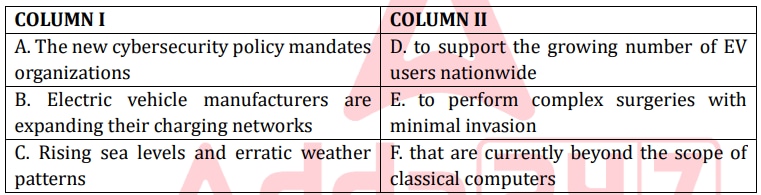
- A.
None of these
- B.
A-F
- C.
B-D
- D.
A-E, B-F
- E.
A-F, B-D, C-E
Correct answer: C
Solution
Concept: In a sentence-matching task, a Column I fragment joins a Column II fragment only when the result is both grammatically well-formed (the connector — an infinitive 'to…', a relative 'that…', or a clause — agrees with the head fragment) and semantically coherent (the two halves talk about the same idea). A pairing fails if either test fails.
Application — test each Column I head against the available continuations:
"Electric vehicle manufacturers are expanding their charging networks" needs a purpose clause; "to support the growing number of EV users nationwide" supplies exactly that purpose, and both halves are about EVs — grammatical and on-topic, so B-D holds.
"The new cybersecurity policy mandates organizations" is about data/security; none of the continuations (EV users, surgeries, classical computers) shares that topic, so A has no valid partner here.
"Rising sea levels and erratic weather patterns" is about climate; again none of the continuations is about climate, so C has no valid partner here.
Cross-check: "to perform complex surgeries with minimal invasion" fits a medical-robotics subject and "that are currently beyond the scope of classical computers" fits a quantum-computing subject — neither subject appears in Column I, confirming E and F have no head to attach to. The only combination that passes both tests is B-D, so the option naming exactly that single correct combination is right.
- A.
- Q60.IBPS 2025
A phrase has been given in the question and used in the sentences below. Identify the statements where the phrase has been used in a contextually and grammatically correct manner. DARK HORSE
(I) Nobody expected her to win the competition, but she turned out to be the dark horse of the event.
(II) The painter was a dark horse, known by few but admired once his work was revealed.
(III) The farmer bought a dark horse and a white cow from the village market.- A.
Only (I)
- B.
Only (II)
- C.
Both (I) and (II)
- D.
All of these
- E.
Both (II) and (III)
Correct answer: C
Solution
A dark horse is someone whose abilities are not well known but who succeeds unexpectedly. Statements I and II use the idiom correctly; statement III uses the words literally for an animal.
- A.
- Q61.IBPS 2025
The sentence is divided into four segments: (A), (B), (C), and (D). Identify the segment that contains a grammatical error. If the sentence is both grammatically and contextually correct, select “No error” as the correct answer.
The Prime Minister promised (A)/ to improving infrastructure (B)/ in rural districts by allocating (C)/ additional funds in the next budget. (D)- A.
A
- B.
B
- C.
C
- D.
D
- E.
No error
Correct answer: B
Solution
Concept
The infinitive marker to is always followed by the base (bare) form of a verb — "to improve", "to build", "to allocate". It is never followed by the -ing form. The -ing form (the gerund) follows prepositions such as by, for, in, of, but it must not follow the infinitive marker.
Applying it to the sentence
In the segment "to improving infrastructure", "to" is the infinitive marker introducing what the Prime Minister promised, so it must be followed by the base verb: to improve infrastructure. The form "to improving" is therefore ungrammatical, and this segment is where the error lies.
Checking the other segments
"The Prime Minister promised" — a complete subject + verb; correct.
"in rural districts by allocating" — after the preposition by the gerund "allocating" is required, so this is correct.
"additional funds in the next budget" — a well-formed noun phrase; correct.
Because one segment carries a genuine error, "No error" cannot be the answer. The corrected sentence reads: "The Prime Minister promised to improve infrastructure in rural districts by allocating additional funds in the next budget."
- A.
- Q62.IBPS 2025
The sentence is divided into four segments: (A), (B), (C), and (D). Identify the segment that contains a grammatical error. If the sentence is both grammatically and contextually correct, select “No error” as the correct answer.
She enjoys hiking in the mountains, (A)/ swimming in the lake, (B)/ and to explore ancient ruins (C)/ during her travels abroad. (D)- A.
A
- B.
B
- C.
C
- D.
D
- E.
No error
Correct answer: C
Solution
Concept
Parallelism (parallel structure) requires that two or more items joined in a series or by a coordinating conjunction such as and share the same grammatical form. When a verb like enjoys governs a list of activities, every item in that list must take the same form — most commonly the gerund (the -ing form), so that the list reads as a single consistent set.
Application
The main verb is enjoys, which introduces a list of activities the subject performs.
First item: hiking in the mountains — a gerund phrase (-ing form).
Second item: swimming in the lake — also a gerund phrase, matching the first.
Third item: to explore ancient ruins — an infinitive phrase. This switches form mid-list and breaks the parallel pattern set by the two gerunds.
The fix: change the infinitive to the gerund — exploring ancient ruins — so all three items match.
Cross-check
Rewriting the corrected sentence confirms the repair: She enjoys hiking in the mountains, swimming in the lake, and exploring ancient ruins during her travels abroad. Now all three list items are gerunds, the parallelism holds, and the sentence reads smoothly. The closing phrase during her travels abroad is an adverbial modifier, not a list item, so it does not need to match the gerund form.
Result
The error lies in the segment and to explore ancient ruins, because the infinitive to explore violates the parallel structure required by the list.
- A.
- Q63.IBPS 2025
The sentence is divided into four segments: (A), (B), (C), and (D). Identify the segment that contains a grammatical error. If the sentence is both grammatically and contextually correct, select “No error” as the correct answer.
The orchestra have (A)/ started rehearsing (B)/ for the upcoming international music festival (C)/ scheduled in Vienna next month. (D)- A.
A
- B.
B
- C.
C
- D.
D
- E.
No error
Correct answer: A
Solution
Concept
A collective noun (orchestra, team, committee, jury, family) names a group as one whole. When the group is treated as a single unit acting together, it takes a SINGULAR verb; a plural verb is used only when the members are clearly acting as separate individuals. Subject and verb must agree in number.
Application
Work through the sentence segment by segment:
Subject = "The orchestra" — a collective noun. Here the whole group does one thing together (begins rehearsing for one festival), so it is a single unit and needs a singular verb: "has started", not "have started". The wording "The orchestra have started" therefore breaks subject-verb agreement.
"started rehearsing" — correct: "rehearsing" is a gerund correctly following "started".
"for the upcoming international music festival" — correct: a well-formed prepositional phrase.
"scheduled in Vienna next month" — correct: a past-participle phrase modifying "festival".
The corrected sentence: "The orchestra has started rehearsing for the upcoming international music festival scheduled in Vienna next month."
Cross-check
Replace "The orchestra" with the singular pronoun "It": "It has started" reads correctly, while "It have started" does not — confirming the singular verb is required. Because exactly one segment carries an error, "No error" cannot apply.
- A.
- Q64.IBPS 2025
The sentence is divided into four segments: (A), (B), (C), and (D). Identify the segment that contains a grammatical error. If the sentence is both grammatically and contextually correct, select “No error” as the correct answer.
A unexpected spike in volcano activity (A)/ has forced authorities to evacuate (B)/ nearby villages as a safety (C)/ measure to prevent casualties. (D)- A.
A
- B.
B
- C.
C
- D.
D
- E.
No error
Correct answer: A
Solution
Concept
The indefinite article before a word is chosen by the word's sound, not its spelling: use "an" before a word beginning with a vowel sound, and "a" before a word beginning with a consonant sound. The article must agree with the very next word it modifies.
Application
Scan each segment for the rule:
"A unexpected spike in volcano activity" — the article sits before "unexpected", which opens with the vowel sound /ʌ/. A vowel sound requires "an", so "a unexpected" is wrong; it must read "an unexpected spike".
"has forced authorities to evacuate" — present-perfect with the singular subject "spike" is correct.
"nearby villages as a safety" — grammatically sound; "a safety" pairs with the noun "measure" that follows.
"measure to prevent casualties." — the infinitive of purpose "to prevent" is used correctly.
Cross-check
Only the segment "A unexpected spike in volcano activity" violates a rule. Replacing "a" with "an" yields the fully correct sentence: "An unexpected spike in volcano activity has forced authorities to evacuate nearby villages as a safety measure to prevent casualties." Since one segment does carry an error, "No error" cannot be chosen.
- A.
- Q65.IBPS 2025
The sentence is divided into four segments: (A), (B), (C), and (D). Identify the segment that contains a grammatical error. If the sentence is both grammatically and contextually correct, select “No error” as the correct answer.
The ambassador (A)/ said the reports have (B)/ being examined carefully by his staff (C)/ before making any comment. (D)- A.
A
- B.
B
- C.
C
- D.
D
- E.
No error
Correct answer: C
Solution
The error is in segment C. The passive perfect form should be 'have been examined', not 'have being examined'.
- A.
- Q66.IBPS 2025
In each question two equations number (I) and (II) are given. You should solve both the equations and mark appropriate answer.
I. x² – 10x+24 = 0
II. 5y² – 16y + 12 = 0- A.
If x=y or no relation can be established
- B.
If x>y
- C.
If x<y
- D.
If x≥y
- E.
If x≤y
Correct answer: B
Solution
Equation I gives x^2 - 10x + 24 = 0, so x = 4 or 6. Equation II gives 5y^2 - 16y + 12 = 0, so y = 2 or 1.2. Every x value is greater than every y value, so x > y.
- A.
- Q67.IBPS 2025
In each question two equations numbered (I) and (II) are given. You should solve both equations and mark the appropriate answer.
I. 2x2 – 9x + 10 = 0
II. y2 – 12y + 35 = 0- A.
If x=y or no relation can be established
- B.
If x>y
- C.
If x<y
- D.
If x≥y
- E.
If x≤y
Correct answer: C
Solution
Concept
In a two-equation "quadratic comparison" problem, you first find the roots of each quadratic, then compare every x-root against every y-root. A single fixed relation (x>y, x<y, x≥y, x≤y, or x=y) holds only if the comparison is consistent across all root pairs; if different pairs give opposite relations, no relation can be established.
Application
Equation I: 2x2 – 9x + 10 = 0. Factor as (2x – 5)(x – 2) = 0, giving x = 5/2 = 2.5 or x = 2.
Equation II: y2 – 12y + 35 = 0. Factor as (y – 5)(y – 7) = 0, giving y = 5 or y = 7.
So x belongs to {2, 2.5} and y belongs to {5, 7}. The largest x-value is 2.5 and the smallest y-value is 5.
Since the largest x (2.5) is still smaller than the smallest y (5), every x-value is strictly less than every y-value.
Cross-check
Compare each pair: 2 < 5, 2 < 7, 2.5 < 5, 2.5 < 7 — all four comparisons give x smaller than y.
The relation is strict (the x-values never equal any y-value) and it never reverses, so the result is the strict less-than relation, not the "or equal" variant and not the no-relation case.
Therefore the established relationship is x < y.
- A.
- Q68.IBPS 2025
In each question two equations number (I) and (II) are given. You should solve both the equations and mark appropriate answer.
I. 6x² – 7x + 2 = 0
II. 10y² – 11y + 3 = 0- A.
If x=y or no relation can be established
- B.
If x>y
- C.
If x<y
- D.
If x≥y
- E.
If x≤y
Correct answer: A
Solution
Concept
To compare the roots of two quadratic equations, first find the roots of each equation by factorisation (split the middle term so the two factors multiply to a·c and add to b). Then compare EVERY x-root against EVERY y-root. A single, definite relation (x>y, x<y, x≥y or x≤y) holds ONLY if the same inequality direction is true for all such pairings; if different pairings point in different directions, no definite relation can be established.
Application
Equation I: 6x² − 7x + 2 = 0. Split −7x as −3x − 4x:
6x² − 3x − 4x + 2 = 0
3x(2x − 1) − 2(2x − 1) = 0
(3x − 2)(2x − 1) = 0, so x = 2/3 or x = 1/2.
Equation II: 10y² − 11y + 3 = 0. Split −11y as −5y − 6y:
10y² − 5y − 6y + 3 = 0
5y(2y − 1) − 3(2y − 1) = 0
(5y − 3)(2y − 1) = 0, so y = 3/5 or y = 1/2.
Now compare each x-value with each y-value (x ∈ {1/2, 2/3}, y ∈ {1/2, 3/5}):
x
y
Relation
1/2 = 0.5
1/2 = 0.5
x = y
1/2 = 0.5
3/5 = 0.6
x < y
2/3 ≈ 0.667
1/2 = 0.5
x > y
2/3 ≈ 0.667
3/5 = 0.6
x > y
Cross-check / Result
Across the four pairings the direction is not consistent: one pairing gives x equal to y, one gives x less than y, and two give x greater than y. Because the inequality does not point the same way for every pairing, no single fixed relation between x and y is valid. Hence the correct response is that x = y or no relation can be established.
- A.
- Q69.IBPS 2025
In each question two equations numbered (I) and (II) are given. You should solve both the equations and mark the appropriate answer.
I. 2x2 + 19x + 42 = 0
II. 2y2 + 7y + 5 = 0
- A.
If x = y or no relation can be established
- B.
If x > y
- C.
If x < y
- D.
If x ≥ y
- E.
If x ≤ y
Correct answer: C
Solution
Concept
To compare the roots of two quadratic equations, first find all roots of each equation by factorisation, then compare every value of x against every value of y. A fixed relation (>, <, ≥, ≤) holds only if it is true for all pairs of roots; if the value ranges overlap or the relation flips across pairs, no fixed relation can be established.
Application
Equation I: 2x2 + 19x + 42 = 0. Factorise: 2x2 + 12x + 7x + 42 = 0 → 2x(x + 6) + 7(x + 6) = 0 → (x + 6)(2x + 7) = 0.
So x = −6 or x = −7/2 = −3.5.
Equation II: 2y2 + 7y + 5 = 0. Factorise: 2y2 + 2y + 5y + 5 = 0 → 2y(y + 1) + 5(y + 1) = 0 → (y + 1)(2y + 5) = 0.
So y = −1 or y = −5/2 = −2.5.
Compare every pair: −6 < −2.5, −6 < −1, −3.5 < −2.5, and −3.5 < −1. In all four pairings the x-value is smaller.
Cross-check
The largest possible x is −3.5 and the smallest possible y is −2.5. Since the biggest x (−3.5) is still less than the smallest y (−2.5), the value ranges do not overlap, so x is strictly less than y for every combination. Hence the relation is x < y.
- A.
- Q70.IBPS 2025
What approximate value comes in place of x in the following?

- A.
187
- B.
121
- C.
169
- D.
147
- E.
177
Correct answer: D
Solution
Concept
In an approximation problem, replace each messy number by its nearest convenient whole value, then evaluate. For an equation of the form A = x% of B, isolate x using x = (A / B) x 100. The aim is the option closest to the true value, not an exact figure.
Application
Approximate each term on the left: 779.23 / 13 is about 780 / 13 = 60; 4.98 is about 5; the last term is 23.
Add them: 60 + 5 + 23 = 88. So the left-hand side is about 88.
The right-hand side is x% of 60.03, which is about x% of 60. Setting 88 = x% of 60 gives x = (88 / 60) x 100.
Compute: (88 / 60) x 100 = 146.7, which is about 147.
Cross-check
Using the unrounded numbers: 779.23 / 13 = 59.94, plus 4.98 plus 23 = 87.92; then 87.92 / 60.03 x 100 = 146.5. This still rounds to 147, confirming the result.
- A.
- Q71.IBPS 2025
39.98% of 249.99 + √196.04 = x2 + 55.93
- A.
6
- B.
9
- C.
5
- D.
8
- E.
4
Correct answer: D
Solution
Concept
In an approximation (≈) problem, replace each messy number with the nearest convenient round value, simplify the arithmetic, then isolate the unknown. Here the equation a% of b + √c = x2 + d is solved for x by collecting the left side and subtracting d from it.
Application
Round each term: 39.98% ≈ 40%, 249.99 ≈ 250, √196.04 ≈ √196 = 14, and 55.93 ≈ 56.
Compute 40% of 250 = 0.40 × 250 = 100.
Add the square-root term: 100 + 14 = 114, so the left side ≈ 114.
Set up the equation: 114 = x2 + 56.
Isolate x2: x2 = 114 − 56 = 58.
Take the square root: x = √58 ≈ 7.62.
Cross-check
Among the offered whole numbers, 7.62 is nearest to 8 (it is only 0.38 away, versus 1.62 from 7). Verify by substituting back: 82 + 56 = 64 + 56 = 120, which is the closest match to the left side ≈ 114 among the choices. So x ≈ 8.
- A.
- Q72.IBPS 2025
20.992 − 24.97% of 220.02 − ? = 131.13
- A.
225
- B.
125
- C.
255
- D.
145
- E.
290
Correct answer: C
Solution
Concept
In an approximation (simplification) problem, replace every awkward decimal with the nearest convenient whole number, then evaluate with simple arithmetic. Two handy roundings apply here: a decimal just below a whole number is squared at that whole number, and a percentage close to 25% is treated as one-fourth (÷4).
Application
Round each term: 20.99 ≈ 21, 24.97% ≈ 25% (= 1/4), 220.02 ≈ 220, and the right side 131.13 ≈ 131.
Evaluate the square: 212 = 441.
Evaluate the percentage: 25% of 220 = 220 ÷ 4 = 55.
Substitute into the expression: 441 − 55 − ? = 131, which simplifies to 386 − ? = 131.
Solve for the blank: ? = 386 − 131 = 255.
Cross-check
Using exact values: 20.992 = 440.58, and 24.97% of 220.02 = 54.94, so 440.58 − 54.94 − 131.13 = 254.51, which rounds to 255 — confirming the rounded result.
- A.
- Q73.IBPS 2025
24.212 + 12.16 = ? × (49.99% of 55.98)
- A.
25
- B.
29
- C.
21
- D.
17
- E.
33
Correct answer: C
Solution
Concept
In an approximation (simplification) problem you replace each value by the nearest convenient round number, evaluate the expression using the order of operations (powers and brackets first, then multiply or divide), and finally pick the option closest to your estimate. The goal is a fast, reliable estimate rather than an exact figure.
Application
Round each quantity and simplify the expression step by step:
Square the first term: 24.212 ≈ 242 = 576.
Add the second term: 576 + 12.16 ≈ 576 + 12 = 588 (this is the whole left-hand side).
Simplify the bracket on the right: 49.99% of 55.98 ≈ 50% of 56 = 28.
The equation becomes 588 = ? × 28, so ? = 588 ÷ 28 = 21.
Cross-check
With the exact numbers, 24.212 + 12.16 = 598.28 and 49.99% of 55.98 = 27.98, so ? = 598.28 ÷ 27.98 ≈ 21.4, which still rounds to 21 and confirms the estimate.
- A.
- Q74.IBPS 2025
The table given below shows the total number of red and blue balls in five different bags (A, B, C, D & E). It also shows the difference between red and blue balls and percentage of red balls with respect to total balls.
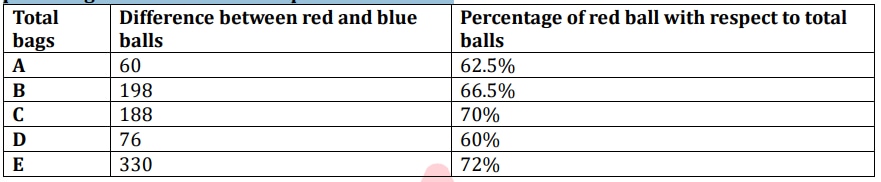
The number of red balls in A and E together is what percentage of the number of blue balls in A and E together?
- A.
230
- B.
220
- C.
240
- D.
280
- E.
260
Correct answer: A
Solution
Concept
When a quantity splits into two kinds (here red and blue) and you are told one kind's percentage of the total and the difference between the two counts, the total is fully determined. If red is p% of total T, blue is (100 - p)% of T, so red minus blue equals (2p - 100)% of T. Setting this equal to the stated difference fixes T, and each colour count then follows.
Applying it to bag A and bag E
Bag A: red is 62.5%, so blue is 37.5%; their gap is 25% of the total. Since 25% of the total = 60, total = 60 ÷ 0.25 = 240. Red = 62.5% of 240 = 150; blue = 37.5% of 240 = 90.
Bag E: red is 72%, so blue is 28%; their gap is 44% of the total. Since 44% of the total = 330, total = 330 ÷ 0.44 = 750. Red = 72% of 750 = 540; blue = 28% of 750 = 210.
Red in A and E together = 150 + 540 = 690. Blue in A and E together = 90 + 210 = 300.
Required percentage = (690 ÷ 300) × 100 = 230%.
Cross-check
Each bag matches the table: 150 - 90 = 60 for bag A and 540 - 210 = 330 for bag E. Also 690 is exactly 2.3 times 300, confirming 230%.
- A.
- Q75.IBPS 2025
The table given below shows the total number of red and blue balls in five different bags (A, B, C, D & E). it also shows the difference between red and blue balls and percentage of red balls with respect to total balls.
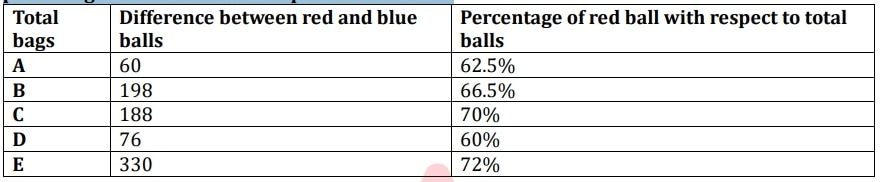
Find the ratio of number of red balls in A and E together to number of blue balls in A.
- A.
23:10
- B.
23:11
- C.
23:3
- D.
18:19
- E.
21:22
Correct answer: C
Solution
Concept
For any bag, let the total balls be T, with red = (red%)·T and blue = (blue%)·T, where blue% = 100% − red%. Since the table gives the difference (red − blue) and the red percentage, the total follows from the identity:
red − blue = (red% − blue%)·T = (2·red% − 100%)·T.
Once T is known, red and blue for that bag are just the corresponding percentages of T.
Application
Bag A — red% = 62.5%, so blue% = 37.5%. Difference factor = 62.5% − 37.5% = 25% = 1/4. Given difference = 60, so T = 60 ÷ (1/4) = 240.
Red in A = 62.5% × 240 = 150; Blue in A = 37.5% × 240 = 90.
Bag E — red% = 72%, so blue% = 28%. Difference factor = 72% − 28% = 44% = 11/25. Given difference = 330, so T = 330 ÷ (11/25) = 330 × 25/11 = 750.
Red in E = 72% × 750 = 540.
Required ratio = (Red in A + Red in E) : (Blue in A) = (150 + 540) : 90 = 690 : 90 = 23 : 3.
Cross-check
Verify the totals from the difference: for A, 150 − 90 = 60 ✓; for E, 540 − 210 = 330 ✓. Dividing 690 and 90 by their HCF 30 gives 23 : 3, so the simplified ratio is exact.
- A.
- Q76.IBPS 2025
The table given below shows the total number of red and blue balls in five different bags (A, B, C, D & E). It also shows the difference between red and blue balls and the percentage of red balls with respect to total balls.
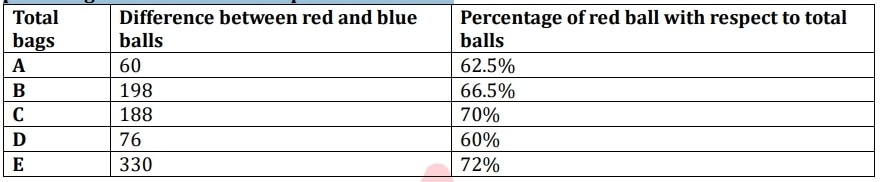
Find the average number of red balls in B, D and E.
- A.
355
- B.
353
- C.
350
- D.
389
- E.
386
Correct answer: D
Solution
Concept
When a group is split into two parts, the difference between the parts together with the share (percentage) of one part fixes the whole. If red balls are p (as a fraction) of the total T and blue balls are the rest, then red minus blue = (p - (1 - p)) x T = (2p - 1) x T. So the total is T = (red - blue difference) / (2p - 1), and the number of red balls is R = p x T.
Application
Apply this to each required bag using its given difference and red-percentage:
Bag B: difference = 198, red share = 66.5% = 0.665, so 2p - 1 = 0.33. Total = 198 / 0.33 = 600, and red = 0.665 x 600 = 399.
Bag D: difference = 76, red share = 60% = 0.60, so 2p - 1 = 0.20. Total = 76 / 0.20 = 380, and red = 0.60 x 380 = 228.
Bag E: difference = 330, red share = 72% = 0.72, so 2p - 1 = 0.44. Total = 330 / 0.44 = 750, and red = 0.72 x 750 = 540.
Average of red balls in B, D and E = (399 + 228 + 540) / 3 = 1167 / 3 = 389.
Cross-check
Verify each total reproduces the data: for B, blue = 600 - 399 = 201 and 399 - 201 = 198 (matches), and 399 / 600 = 66.5% (matches). The same check holds for D (228 - 152 = 76, 228 / 380 = 60%) and E (540 - 210 = 330, 540 / 750 = 72%). All three reconstructions are consistent, so the average is confirmed.
- A.
- Q77.IBPS 2025
The table given below shows the total number of red and blue balls in five different bags (A, B, C, D & E). it also shows the difference between red and blue balls and percentage of red balls with respect to total balls.
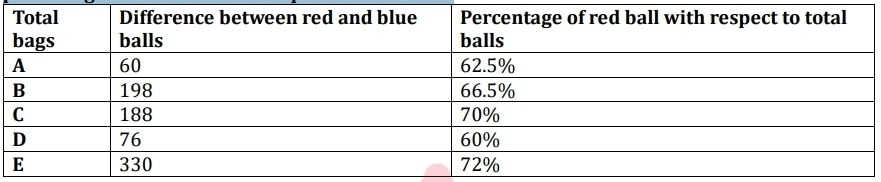
The number of balls in bag F is 25% more than red balls in E and the ratio of red balls in A and blue balls in F is 2:1. Find the red balls in F.
- A.
685
- B.
680
- C.
630
- D.
620
- E.
600
Correct answer: E
Solution
Concept
For any bag, the red-ball percentage fixes the split between red and blue. If red is p% of the total, blue is (100 − p)%, so the difference (red − blue) equals total × (2p − 100)%. From a known difference and the red-percentage you recover the total, and from the total you get the red and blue counts.
Total = Difference ÷ (2p − 100)%; then Red = Total × p% and Blue = Total × (100 − p)%.
Application
Bag A — Difference 60, red 62.5% (blue 37.5%, gap 25%). Total = 60 ÷ 0.25 = 240, so Red in A = 240 × 0.625 = 150.
Bag E — Difference 330, red 72% (blue 28%, gap 44%). Total = 330 ÷ 0.44 = 750, so Red in E = 750 × 0.72 = 540.
Bag F total — “25% more than red balls in E” = 540 × 1.25 = 675 balls.
Blue in F — ratio Red(A) : Blue(F) = 2 : 1 with Red(A) = 150, so Blue(F) = 150 ÷ 2 = 75.
Red in F — Red(F) = Total(F) − Blue(F) = 675 − 75 = 600.
Cross-check
Red(F) + Blue(F) = 600 + 75 = 675, matching the computed total for F. The stated 2 : 1 ratio also holds (150 : 75). Both independent conditions are satisfied.
- A.
- Q78.IBPS 2025
The line graph given below shows the total number of TVs sold and the difference between cell phones and TVs sold by five different shops (A, B, C, D and E). (Cell phones sold by every shop are more than TVs sold, and Items = cell phone + TV.)
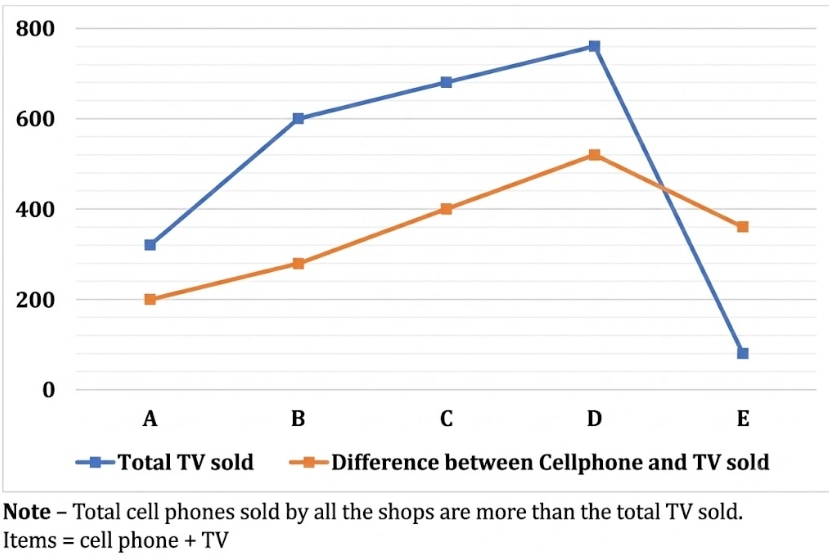
Total items sold by E is what percentage more/less than the total TVs sold by D?
- A.
31.57%
- B.
30%
- C.
36%
- D.
31%
- E.
31.25%
Correct answer: A
Solution
Concept
In this graph each shop has TVs sold (blue line) and the gap 'cell phones minus TVs' (orange line). Because cell phones exceed TVs, Cell phones = TVs + Difference, so the Total items of a shop = TV + Cell phone = (2 x TV) + Difference. To express one quantity as a percentage more or less than a base, use: Percentage change = ((Value - Base) / Base) x 100, where the BASE is the quantity that comes after the words 'more/less than'.
Application
Read shop E from the graph: TVs sold by E = 80 and the difference for E = 360.
Total items of E = (2 x 80) + 360 = 160 + 360 = 520.
Read the base, total TVs sold by D, directly from the blue line: TV sold by D = 760.
Compare E's total with D's TVs: change = 520 - 760 = -240, so E's total is LESS than D's TVs.
Percentage = (240 / 760) x 100 = 31.578...%, which the option set reports as 31.57%.
Cross-check
Verify with the exact fraction: 240/760 = 6/19 = 0.31578..., so the shortfall is 6/19 of 760 = 240, recovering E total = 760 - 240 = 520, which is exactly E's total items. Hence E is 6/19 = about 31.57% less than D's TVs (the figure 31.578...% is reported as 31.57% among the options).
- A.
- Q79.IBPS 2025
The line graph given below shows the total number of TV sold and difference between cell phone and TV sold by five different shops (A, B, C, D and E).
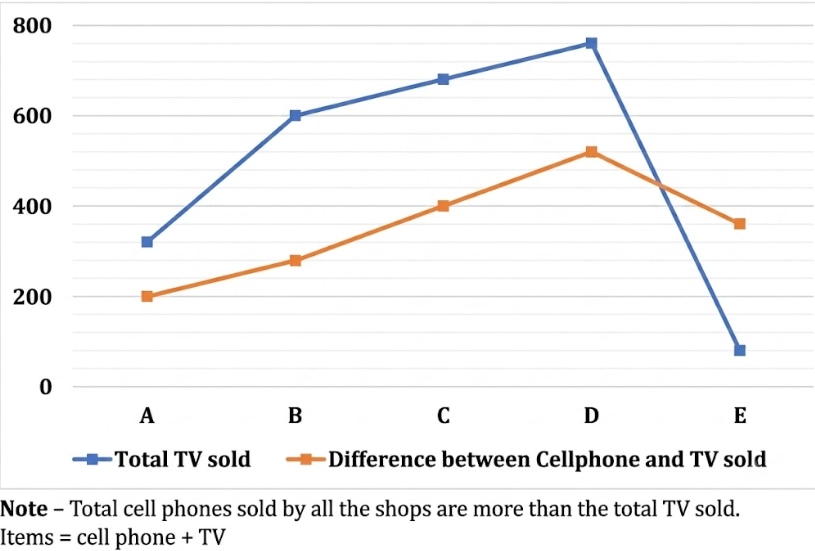
Find the ratio of TV sold by D to cell phones sold by B.
- A.
19:10
- B.
19:11
- C.
10:19
- D.
18:19
- E.
19:22
Correct answer: E
Solution
Concept
In this line graph the blue line gives the Total TV sold by each shop, while the orange line gives the Difference between Cell phones and TV sold (Cell phones − TV). The note states cell phones exceed TV at every shop, so for any shop:
Cell phones sold = TV sold + Difference.
A ratio of two such quantities is reduced to lowest terms by dividing both terms by their greatest common divisor (GCD).
Application
Read TV sold by D from the blue line: 760.
Read shop B from both lines: TV sold (blue) = 600 and Difference (orange) = 280.
Cell phones sold by B = TV + Difference = 600 + 280 = 880.
Required ratio = TV sold by D : Cell phones sold by B = 760 : 880.
Divide both terms by GCD(760, 880) = 40: 760 ÷ 40 = 19 and 880 ÷ 40 = 22, giving 19 : 22.
Cross-check
Scale the reduced ratio back up by 40: 19 × 40 = 760 and 22 × 40 = 880, which match the values just read, confirming 19 : 22.
- A.
- Q80.IBPS 2025
The line graph given below shows the total number of TV sold and difference between cell phone and TV sold by five different shops (A, B, C, D and E).
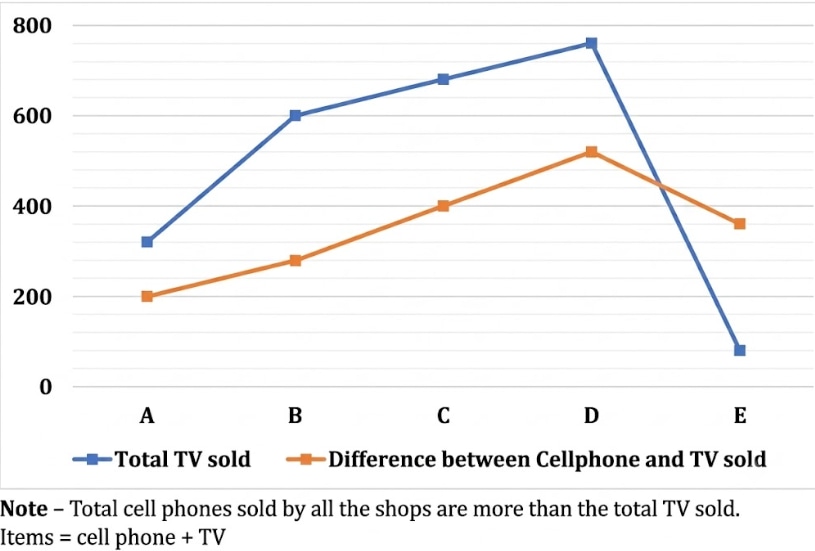
If 12.5% of TV sold by D are defective and total items sold by D that are defective is 280. Find the defective cell phones sold by D.
- A.
185
- B.
120
- C.
100
- D.
180
- E.
186
Correct answer: A
Solution
Concept
When a fixed percentage of one category is defective, the count of defective units in that category equals that percentage of its total. If the grand total of defective items across two categories is known, the defective count of the second category is found by subtraction: defective(second) = total defective − defective(first).
Application
For shop D, items sold = TV + cell phone, and only TVs have a stated defect rate, so:
Read the total TV sold by D from the blue line: 760.
Defective TVs = 12.5% of 760 = (1/8) × 760 = 95.
Total defective items sold by D = 280 (given).
Defective cell phones = total defective − defective TVs = 280 − 95 = 185.
Cross-check
Add the parts back: 95 defective TVs + 185 defective cell phones = 280 defective items, which matches the given total. Also 12.5% = 1/8, and 760 is divisible by 8 (760/8 = 95), so the defective TV count is a whole number — consistent. Hence 185 defective cell phones.
- A.
- Q81.IBPS 2025
The line graph below shows the total number of TVs sold and the difference between cell phones and TVs sold by five different shops (A, B, C, D and E). Note: for every shop the total cell phones sold is more than the total TVs sold, so cell phones sold = TVs sold + difference.
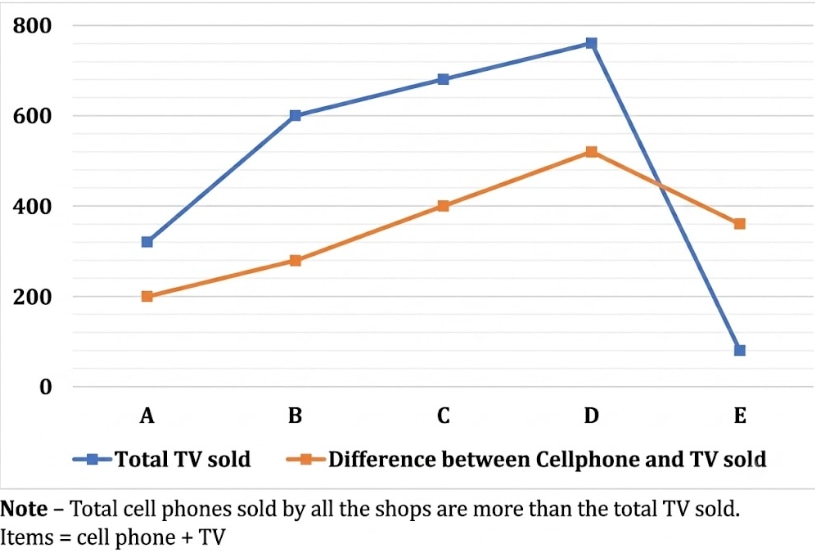
Find the average number of cell phones sold by shops B, C and E.
- A.
900
- B.
720
- C.
400
- D.
800
- E.
720
Correct answer: D
Solution
Concept
An average is the sum of the quantities divided by how many there are: Average = (sum of values) / (number of values). Here the cell-phone sales are not plotted directly — the graph gives TVs sold and the cell-phone-minus-TV difference. The note says cell phones exceed TVs at every shop, so for each shop: cell phones sold = TVs sold + difference.
Application
Read the two graph values for each required shop — Shop B: TVs = 600, difference = 280; Shop C: TVs = 680, difference = 400; Shop E: TVs = 80, difference = 360.
Reconstruct cell phones with cell phones = TVs + difference — Shop B: 600 + 280 = 880; Shop C: 680 + 400 = 1080; Shop E: 80 + 360 = 440.
Add the three cell-phone totals: 880 + 1080 + 440 = 2400.
Divide by the number of shops (3): 2400 / 3 = 800.
Cross-check
The three totals 880, 1080 and 440 are balanced around 800, and their sum 2400 is exactly divisible by 3, so the average is the clean value 800.
- A.
- Q82.IBPS 2025
Read the information given below and answer the question that follows.
The information is about the staff (lab assistants and professors) in three colleges A, B and C.
For A, the total number of lab assistants and professors together is 82.
For B, the total number of lab assistants is 4 more than the total number of lab assistants in C.
For C, the total number of lab assistants is 6 less than the total number of professors.
The total number of professors in A is 44 less than the total number of lab assistants in B.
The total staff in C is 24 more than the total staff in A.
The total number of professors in all three colleges together is 102.
Find the total staff in B.
- A.
90
- B.
80
- C.
60
- D.
65
- E.
70
Correct answer: A
Solution
Concept
Word problems with several interlinked totals are solved by translating every English statement into a linear equation in named variables, then eliminating one variable at a time. “P is k more than Q” means P = Q + k, and “P is k less than Q” means P = Q − k. The “total staff” of a college is its lab assistants plus its professors.
Set up the variables
Let the lab assistants be LA, LB, LC and the professors be PA, PB, PC for colleges A, B and C respectively.
Translate each statement
LA + PA = 82 (staff in A).
LB = LC + 4 (B’s lab assistants are 4 more than C’s).
PC = LC + 6 (C’s lab assistants are 6 less than C’s professors).
PA = LB − 44 (A’s professors are 44 less than B’s lab assistants).
LC + PC = (LA + PA) + 24 = 82 + 24 = 106 (staff in C is 24 more than staff in A).
PA + PB + PC = 102 (professors across all colleges).
Solve step by step
From (5) and (3): LC + (LC + 6) = 106, so 2LC = 100 and LC = 50; hence PC = 56.
From (2): LB = 50 + 4 = 54.
From (4): PA = 54 − 44 = 10, and from (1): LA = 82 − 10 = 72.
From (6): PB = 102 − PA − PC = 102 − 10 − 56 = 36.
Total staff in B = LB + PB = 54 + 36 = 90.
Cross-check
Staff in A = 72 + 10 = 82 ✓; staff in C = 50 + 56 = 106 = 82 + 24 ✓.
Professors total = 10 + 36 + 56 = 102 ✓. All conditions hold, so the total staff in B is 90.
- Q83.IBPS 2025
Read the information and answer the following question given below.
The information is about the staffs (lab assistant and professor) in three colleges.
For A – total lab assistant and total professor is 82.
For B – total lab assistant is 4 more than total lab assistant in C.
For C – total lab assistant is 6 less than total professor
Note – total professor in A is 44 less than total lab assistant in B.
Total staffs in C is 24 more than that in A and total professor in al the college is 102.
Find the ratio of total professors in B to total lab assistant in A.- A.
6:1
- B.
6:7
- C.
6:5
- D.
1:2
- E.
3:1
Correct answer: D
Solution
College C has 82 + 24 = 106 staff. Let C professors be P, so C lab assistants are P - 6. Then P + (P - 6) = 106, giving P = 56 and C lab assistants = 50. B lab assistants = 54 and A professors = 10, so A lab assistants = 72. Total professors are 102, so B professors = 102 - 10 - 56 = 36. The required ratio is 36 : 72 = 1 : 2.
- A.
- Q84.IBPS 2025
Read the information and answer the question given below. The information is about the staff (lab assistants and professors) in colleges A, B, C and D.
In A, the total of lab assistants and professors is 82.
In B, the total lab assistants are 4 more than the total lab assistants in C.
In C, the total lab assistants are 6 less than the total professors.
The total professors in A are 44 less than the total lab assistants in B.
The total staff in C are 24 more than that in A, and the total professors in all the colleges are 102.
The ratio of total staff in college D to lab assistants in A is 3 : 4.
The total lab assistants in D are 20 less than that in C.
Find the number of professors in D.
- A.
24
- B.
25
- C.
20
- D.
30
- E.
50
Correct answer: A
Solution
Concept
In a linear-equations word problem, translate every stated relation into an equation, then solve from the relation that involves the fewest unknowns first. A quantity is uniquely fixed once enough independent equations link it to known totals; substitute forward until every count is determined.
Setting up the equations
Let LA and P denote the number of lab assistants and professors in each college. The given relations are:
A: LA(A) + P(A) = 82.
B: LA(B) = LA(C) + 4.
C: P(C) = LA(C) + 6.
P(A) = LA(B) - 44.
Total staff in C = total staff in A + 24.
P(A) + P(B) + P(C) + P(D) = 102.
Total staff in D : LA(A) = 3 : 4.
LA(D) = LA(C) - 20.
Solving step by step
Staff in A = 82, so staff in C = 82 + 24 = 106.
In C, LA(C) + P(C) = 106 and P(C) = LA(C) + 6. Substituting: 2*LA(C) + 6 = 106, so LA(C) = 50 and P(C) = 56.
LA(B) = LA(C) + 4 = 54, hence P(A) = LA(B) - 44 = 10.
From LA(A) + P(A) = 82: LA(A) = 82 - 10 = 72.
LA(D) = LA(C) - 20 = 30.
Staff in D = (3/4)*LA(A) = (3/4)*72 = 54.
Professors in D = staff in D - LA(D) = 54 - 30 = 24.
Cross-check
Total professors = P(A) + P(B) + P(C) + P(D). With P(A)=10, P(C)=56, P(D)=24, the total 102 forces P(B)=12, a consistent positive count. Every staff total (A=82, C=106) and the 3:4 ratio (54:72) hold, confirming professors in D = 24.
- Q85.IBPS 2025
Read the information and answer the following question given below.
The information is about the staffs (lab assistant and professor) in three colleges.
For A – total lab assistant and total professor is 82.
For B – total lab assistant is 4 more than total lab assistant in C.
For C – total lab assistant is 6 less than total professor
Note – total professor in A is 44 less than total lab assistant in B.
Total staffs in C is 24 more than that in A and total professor in al the college is 102.
Total professor in A is what percentage of total staff in B.- A.
9.09%
- B.
11.11%
- C.
12.5%
- D.
30%
- E.
25%
Correct answer: B
Solution
Concept
Translate each verbal clue of a data-interpretation caselet into one linear equation in the unknown head-counts, then solve the system step by step; a percentage "X is what percent of Y" is always computed as (X / Y) x 100, where Y is the FULL base named in the question.
Application
Let the lab assistants and professors be A_LA, A_P, B_LA, B_P, C_LA, C_P. Turn the clues into equations and solve in order:
College A total: A_LA + A_P = 82.
Total staff in C is 24 more than in A, so C_LA + C_P = 82 + 24 = 106.
In C, lab assistants are 6 less than professors: C_LA = C_P - 6. Substituting into 106 gives 2*C_P - 6 = 106, so C_P = 56 and C_LA = 50.
B's lab assistants are 4 more than C's: B_LA = 50 + 4 = 54.
Professors in A are 44 less than lab assistants in B: A_P = 54 - 44 = 10 (and so A_LA = 82 - 10 = 72).
Total professors across all colleges is 102: B_P = 102 - A_P - C_P = 102 - 10 - 56 = 36.
Total staff in B = B_LA + B_P = 54 + 36 = 90.
Required percentage = (A_P / total staff in B) x 100 = (10 / 90) x 100 = 11.11%.
Cross-check
Verify every clue with the solved values: A total = 72 + 10 = 82; C total = 50 + 56 = 106 = 82 + 24; C lab assistants 50 = 56 - 6; B lab assistants 54 = 50 + 4; A professors 10 = 54 - 44; professors 10 + 36 + 56 = 102. All constraints hold, confirming 10 out of 90, i.e. 11.11%.
- A.
- Q86.IBPS 2025
Read the information and answer the question given below.
The information is about the staff (lab assistants and professors) in three colleges A, B and C.
For A – the total of lab assistants and professors is 82.
For B – the total lab assistants are 4 more than the total lab assistants in C.
For C – the total lab assistants are 6 less than the total professors.
Note – the total professors in A are 44 less than the total lab assistants in B.
The total staff in C is 24 more than that in A, and the total professors in all three colleges together are 102.
Find the average of the total lab assistants in A and C.- A.
61
- B.
62
- C.
63
- D.
64
- E.
65
Correct answer: A
Solution
Concept
A linear-equations word problem is solved by assigning a variable to each unknown quantity, translating every given statement into an equation, and then solving the system by substitution. Each “more than / less than / total” phrase becomes one equation; when the number of independent equations equals the number of unknowns, the values are fixed uniquely.
Application
Let lab assistants and professors be: A → La, Pa; B → Lb, Pb; C → Lc, Pc. Translate each statement and solve in order:
A total: La + Pa = 82.
C total is 24 more than A total: Lc + Pc = 82 + 24 = 106.
C lab assistants are 6 less than C professors: Lc = Pc − 6. Substitute into the C total: (Pc − 6) + Pc = 106 → 2Pc = 112 → Pc = 56, so Lc = 56 − 6 = 50.
B lab assistants are 4 more than C lab assistants: Lb = Lc + 4 = 50 + 4 = 54.
Professors in A are 44 less than lab assistants in B: Pa = Lb − 44 = 54 − 44 = 10.
From the A total: La = 82 − Pa = 82 − 10 = 72.
Required average = (La + Lc) / 2 = (72 + 50) / 2 = 122 / 2 = 61.
Cross-check
Verify every condition with La=72, Pa=10, Lb=54, Lc=50, Pc=56 and Pb = 102 − Pa − Pc = 102 − 10 − 56 = 36: A total 72+10=82 ✓; C total 50+56=106 = 82+24 ✓; Lb−Lc = 54−50 = 4 ✓; Pc−Lc = 56−50 = 6 ✓; Lb−Pa = 54−10 = 44 ✓; total professors 10+36+56 = 102 ✓. All conditions hold, so the average is 61.
- A.
- Q87.IBPS 2025
A boat goes downstream a distance of X kilometres in two hours. It covers the same distance upstream in three hours. If the speed of the stream is 3 km/h, then find 2X.
- A.
12
- B.
18
- C.
19
- D.
72
- E.
30
Correct answer: D
Solution
Concept
When a boat travels in a stream, the stream changes its effective speed relative to the bank: going downstream the stream adds to the boat’s still-water speed, going upstream it subtracts.
Downstream speed = still-water speed + stream speed
Upstream speed = still-water speed − stream speed
Subtracting the second from the first: Downstream speed − Upstream speed = 2 × stream speed
So the still-water speed cancels out, and the difference of the two journey speeds always equals twice the stream speed. Whenever the same distance is covered both ways, the two given times fix both speeds in terms of that distance, and this relationship then fixes the distance.
Application
Downstream leg: the boat covers X km in 2 hours, so downstream speed = X ÷ 2 = X/2 km/h.
Upstream leg: the same X km takes 3 hours, so upstream speed = X ÷ 3 = X/3 km/h.
Apply the relationship with a stream speed of 3 km/h: X/2 − X/3 = 2 × 3 = 6.
Take the LCM of 2 and 3, which is 6: 3X/6 − 2X/6 = 6, that is X/6 = 6.
Multiply both sides by 6: X = 36 km.
The question asks for 2X, not X: 2X = 2 × 36 = 72.
Cross-check
Substitute X = 36 km back into the original data and recompute the stream speed independently:
Quantity
Value from X = 36 km
Downstream speed
36 ÷ 2 = 18 km/h
Upstream speed
36 ÷ 3 = 12 km/h
Half the difference of the two speeds
(18 − 12) ÷ 2 = 3 km/h
Stream speed stated in the question
3 km/h
The recomputed stream speed of 3 km/h matches the value given in the question, so X = 36 km and the required value 2X = 72.
- A.
- Q88.IBPS 2025
A invest Rs. 6400 and B invest Rs. 7200 in a business. After 4 months, A withdrawal 30% of the initial investment and C join with 40% of initial investment of B. After one year, the total profit is 90000. Find the profit of A and C(in Rs.) approximate?
- A.
48486
- B.
42486
- C.
44494
- D.
57640
- E.
77865
Correct answer: C
Solution
A invests 6400 for 4 months and then 4480 for 8 months, so A's capital-months are 61440. B invests 7200 for 12 months, giving 86400. C invests 2880 for 8 months, giving 23040. A and C together get 84480/170880 of 90000, approximately Rs. 44494.
A video solution is available for this question — log in and enroll to watch it.
- A.
- Q89.IBPS 2025
A jar contains milk and water. The ratio of milk and water is 8 : x. When 5 liters of milk and 30 liters of water is added into the jar, then the ratio of milk to water becomes 1 : 1. Find x.
- A.
6
- B.
2
- C.
5
- D.
3
- E.
Can’t Determined
Correct answer: E
Solution
Let the initial milk and water be 8k and xk. After adding 5 litres milk and 30 litres water, 8k + 5 = xk + 30. This gives k(8 - x) = 25, which has multiple possible positive values. So x cannot be uniquely determined.
A video solution is available for this question — log in and enroll to watch it.
- A.
- Q90.IBPS 2025
The length of a rectangular park is twice its breadth. A pathway of uniform width 4 m runs across the park parallel to its breadth, and the area of this pathway is 352 m2. Find the length of the park (in metres).
- A.
92
- B.
180
- C.
184
- D.
176
- E.
88
Correct answer: D
Solution
Concept
A pathway of uniform width laid across a rectangle, parallel to one side, is itself a rectangle. Its area equals its width multiplied by the side it spans. So for a strip parallel to the breadth, Area = width × breadth. Combined with a stated relation between length and breadth, this fixes both dimensions.
Application
Let the breadth of the park be b metres. The length is twice the breadth, so length = 2b.
A pathway of width 4 m runs parallel to the breadth, so it spans the full breadth b. Its area = 4 × b.
Set this equal to the given area: 4 × b = 352.
Solve for the breadth: b = 352 ÷ 4 = 88 m.
Length = 2b = 2 × 88 = 176 m.
Cross-check
With breadth 88 m, a 4 m strip across it covers 4 × 88 = 352 m2, matching the given pathway area, and the length 176 m is exactly twice 88 m. Both conditions hold, so the length is 176 m.
- A.
- Q91.IBPS 2025
The speed of a train is 72 km/h and it crosses a platform in 25 seconds. If the train crosses an athlete whose speed is 18 km/h running in same direction of train in 10 seconds, then find the length of platform (in meters)?
- A.
150
- B.
400
- C.
450
- D.
350
- E.
500
Correct answer: D
Solution
Concept
To compare the time a train takes to pass different objects, convert all speeds to m/s and use Distance = Speed x Time. When a train passes a moving object travelling in the SAME direction, the relevant speed is the relative speed (train speed minus object speed). When it passes a point object (a person), the distance covered equals the train's own length; when it passes a platform, the distance covered equals train length plus platform length.
Application
Convert speeds: train 72 km/h = 72 x 5/18 = 20 m/s; athlete 18 km/h = 18 x 5/18 = 5 m/s.
Athlete runs in the same direction, so relative speed = 20 - 5 = 15 m/s.
Crossing the athlete (a point) covers exactly the train's length: length = relative speed x time = 15 x 10 = 150 m.
Crossing the platform, the train moves at its own 20 m/s for 25 s, covering 20 x 25 = 500 m, which equals train length + platform length.
Platform length = 500 - 150 = 350 m.
Cross-check
Reverse it: a 150 m train plus a 350 m platform is 500 m; at 20 m/s that takes 500/20 = 25 s, matching the given crossing time. So the platform is 350 m.
- A.
- Q92.IBPS 2025
The selling price of an article is Rs. 624 and a shopkeeper got a loss of 22%. If he marks up same article at 30% above the cost price and get a profit of Rs. 84, then find the discount percentage allowed by the shopkeeper?
- A.
7.5%
- B.
5%
- C.
20%
- D.
10%
- E.
15%
Correct answer: E
Solution
Concept
Cost price, marked price and discount are linked by two ratios. Loss/profit are always measured on the cost price: SP = CP*(1 - loss%) or CP*(1 + profit%). Discount is always measured on the marked price: Selling Price = MP*(1 - discount%), so discount% = (MP - SP)/MP * 100.
Application
Find CP from the loss sale. A selling price of Rs. 624 came with a 22% loss, so 624 = CP*(1 - 0.22) = 0.78*CP, giving CP = 624/0.78 = Rs. 800.
Find the marked price. The article is marked 30% above cost, so MP = 800*(1 + 0.30) = 800*1.30 = Rs. 1040.
Find the actual selling price in the profit case. A profit of Rs. 84 means SP = CP + 84 = 800 + 84 = Rs. 884.
Find the discount. Discount amount = MP - SP = 1040 - 884 = Rs. 156, so discount% = (156/1040)*100 = 15%.
Cross-check
apply 15% discount to MP directly: 1040*(1 - 0.15) = 1040*0.85 = Rs. 884, which equals CP + profit = 800 + 84. Consistent, so 15% is correct.
A video solution is available for this question — log in and enroll to watch it.
- A.
- Q93.IBPS 2025
Gopi invested Rs. X in scheme A at rate of 15% p.a. for two years. The amount received by Gopi from scheme A is reinvest in scheme B at the rate of 10% p.a. for two years on compound interest. If the difference between interest received from A and B is 32.4, then find X?
- A.
1500 Rs.
- B.
1200 Rs
- C.
1000 Rs.
- D.
1800 Rs.
- E.
800 Rs.
Correct answer: B
Solution
Interest from scheme A = 15% x 2 x X = 0.30X, so the amount reinvested is 1.30X. Compound interest for two years at 10% on 1.30X is 1.30X x (1.21 - 1) = 0.273X. Difference = 0.30X - 0.273X = 0.027X = 32.4, so X = 1200.
A video solution is available for this question — log in and enroll to watch it.
- A.
- Q94.IBPS 2025
7 men and 15 women can complete a piece of work in 15 days, and the same work is completed by 18 men and 20 women in 8 days. If X men and 20 women can complete the work in 10 days, find X.
- A.
18
- B.
16
- C.
24
- D.
12
- E.
20
Correct answer: D
Solution
Concept
In work problems the total work is constant, so for any group (combined efficiency) x (days) = total work. Equating two scenarios that finish the same work gives the ratio of one man's efficiency to one woman's; once that ratio is fixed the total work can be written in efficiency units and any unknown number of workers found.
Application
Let one man's one-day efficiency be m and one woman's be w. Equate the first two scenarios (same total work): 15(7m + 15w) = 8(18m + 20w).
Expand: 105m + 225w = 144m + 160w, so 65w = 39m, giving m : w = 65 : 39 = 5 : 3.
Take w = 3 and m = 5 (any pair in 5 : 3). Total work = (7m + 15w) x 15 = (35 + 45) x 15 = 80 x 15 = 1200 units.
Third scenario: (X men + 20 women) work 10 days, so (5X + 20x3) x 10 = 1200, i.e. 5X + 60 = 120.
Solve: 5X = 60, so X = 12.
Cross-check
With X = 12, combined efficiency = 12x5 + 20x3 = 60 + 60 = 120 units/day; over 10 days that is 1200 units, exactly the total work. Consistent, so X = 12.
- A.
- Q95.IBPS 2025
A set of four consecutive multiples of 4 has an average of 30. A second series is made up of five consecutive even numbers, and the lowest number of this second series equals the second-lowest term among the four consecutive multiples of 4. Find the highest number in the series of five consecutive even numbers.
- A.
36
- B.
34
- C.
32
- D.
30
- E.
38
Correct answer: A
Solution
Concept
When numbers are equally spaced (an arithmetic progression), their average equals the mean of the terms. For four consecutive multiples of 4 the common gap is 4, so the four terms can be written as a, a+4, a+8 and a+12, and their average is the value exactly in the middle of the set. The same idea fixes a run of consecutive even numbers once its starting value is known: each successive term is 2 more than the previous one.
Application
Let the four consecutive multiples of 4 be a, a+4, a+8, a+12. Their sum is 4a + 24.
Average = (4a + 24) / 4 = a + 6. Set a + 6 = 30, so a = 24.
The four multiples are therefore 24, 28, 32 and 36.
The second-lowest of these is 28, so the five consecutive even numbers start at 28.
Five consecutive even numbers from 28 are 28, 30, 32, 34, 36 (each 2 more than the last).
The highest term of this even series is 36.
Cross-check
Average of 24, 28, 32, 36 = 120 / 4 = 30, confirming the four multiples. Starting the even run at 28 and adding 2 four times gives 28, 30, 32, 34, 36, whose largest value is 36.
A video solution is available for this question — log in and enroll to watch it.
- A.
- Q96.IBPS 2025
The sum of the present ages of P & Q and R & Q is 64 years and 56 years, respectively. The ratio of the age of P after 12 years to the age of Q six years ago is 4 : X. If the age of R after 12 years is 32 years, then find X.
- A.
1
- B.
5
- C.
3
- D.
7
- E.
9
Correct answer: C
Solution
Concept
When ages are linked by sums and a known future/past value, set up one linear equation per stated relationship and solve them together. A person's age k years from now is (present age + k) and k years ago is (present age − k). A ratio of the form 4 : X means the two quantities, written in lowest terms, share the factor that turns 4 into the first quantity — so X is the second quantity scaled by the same factor.
Application
R after 12 years = 32, so R's present age = 32 − 12 = 20 years.
R & Q sum to 56, so Q's present age = 56 − 20 = 36 years.
P & Q sum to 64, so P's present age = 64 − 36 = 28 years.
P after 12 years = 28 + 12 = 40 years.
Q six years ago = 36 − 6 = 30 years.
Ratio (P after 12) : (Q six years ago) = 40 : 30 = 4 : 3, so X = 3.
Cross-check
Reduce 40 : 30 by dividing both by 10 to get 4 : 3; the first term matches the given 4, confirming the second term X = 3. Equivalently, 40/4 = 10 and 30/10 = 3, so X = 3.
- A.
- Q97.IBPS 2025
Eight people A, B, C, D, E, F, G and H live in a four-storey building. The ground floor is numbered 1 and the top floor is numbered 4. Each floor has two flats: flat P in the west and flat Q in the east.
C does not live on an odd-numbered floor. B lives to the south-east of A. There is exactly one floor gap between A and G, and G lives to the east of C.
H lives below B in the same named flat. F lives to the north of E in the same named flat.
Which of the following statements are true? I. A lives on the topmost floor. II. G and C live on the same floor. III. No one lives to the west of E.
- A.
Only I
- B.
Both I and II
- C.
Both II and III
- D.
Only III
- E.
All are true
Correct answer: E
Solution
The final arrangement shows A on the top floor, G and C on the same floor, and E in flat P where no flat lies to the west. Therefore statements I, II and III are all true.
- A.
- Q98.IBPS 2025
Read the information carefully and answer the questions given below:
Eight people – A, B, C, D, E, F, G and H are living in a four-storey building where the ground floor is numbered as 1, just above it is floor 2, then the topmost floor is numbered as 4. Each of the floors has 2 flats in it as flat-P and flat-Q. Flat-P is in the west of flat-Q. Flat P of floor-2 is immediately above flat P of floor 1 and immediately below flat P of floor 3, and so on. Similarly, flat Q of floor 2 is immediately above flat Q of floor 1 and immediately below flat Q of floor 3.
C doesn’t live on an odd numbered floor. B lives to the south east of A. Only one floor gap is between A and G who lives to the east of C. H lives below B and both live in the same named flat. F lives to the north of E.
Four of the following five are alike in a certain way and thus form a group. Find the one who doesn’t belong to group?- A.
F
- B.
D
- C.
B
- D.
C
- E.
G
Correct answer: B
Solution
Concept
In an 'odd one out' grouping question, four of the five named people share one common defining property and the fifth breaks it. The correct method is to first fix the complete arrangement from all the clues, then find the single property that holds for four members and fails for exactly one - never to guess from the labels.
Building the arrangement
The building has 4 floors (floor 1 = ground, floor 4 = top). Each floor has flat P (west) and flat Q (east). 'North' means a higher floor in the same column and 'south' a lower floor; 'east' is the Q side and 'west' the P side. Working through the clues step by step:
C is not on an odd floor, so C is on floor 2 or 4.
B is south-east of A: B is on a lower floor than A and in the east (Q) column while A is in the west (P) column.
There is exactly one floor gap between A and G (their floors differ by 2), and G is in the east of C on the same floor - so C takes flat P and G takes flat Q on the same floor, which (being even) places them on floor 2.
H is below B in the same-named flat (same column), and F is to the north of E, i.e. on a higher floor than E in the same column - not necessarily the floor immediately above. Combining these with the one-floor-gap and south-east links forces A to floor 4 (west) and B to floor 3 (east).
The remaining people fill the last seats uniquely: F goes to floor 3 (west) and E to floor 1 (west, in the same column as F), while D and H take the remaining seats.
This yields a single arrangement (flat P shown left/west, flat Q shown right/east):
Floor
Flat P (west)
Flat Q (east)
4 (top)
A
D
3
F
B
2
C
G
1 (ground)
E
H
Applying the grouping rule
Test the five named people - F, D, B, C and G - against one property: does each have a person living in the flat exactly one floor up in the same column?
F (floor 3, west): the flat directly above on floor 4 is occupied - yes.
B (floor 3, east): the flat directly above on floor 4 is occupied - yes.
C (floor 2, west): the flat directly above on floor 3 is occupied - yes.
G (floor 2, east): the flat directly above on floor 3 is occupied - yes.
D (floor 4, east): floor 4 is the top floor, so no flat exists one floor above - no.
Four of the five have an immediate upstairs neighbour; only the top-floor resident has none. Hence D is the one that does not belong to the group.
Cross-check
No competing property gives a clean four-versus-one split: grouping by flat column gives a 2-3 split (two in P, three in Q) and grouping by floor parity also fails to isolate exactly one. Only the 'has someone one floor directly above' property isolates a single person, confirming D.
- A.
- Q99.IBPS 2025
Eight people A, B, C, D, E, F, G and H live in a four-storey building. The ground floor is numbered 1 and the top floor is numbered 4. Each floor has two flats: flat P in the west and flat Q in the east.
C does not live on an odd-numbered floor. B lives to the south-east of A. There is exactly one floor gap between A and G, and G lives to the east of C.
H lives below B in the same named flat. F lives to the north of E in the same named flat.
Who among the following lives in flat Q of the third floor?
- A.
A
- B.
E
- C.
B
- D.
F
- E.
None of these
Correct answer: C
Solution
The arrangement places B in flat Q on the third floor. Hence B is the person living in flat Q of the third floor.
- A.
- Q100.IBPS 2025
Eight people A, B, C, D, E, F, G and H live in a four-storey building. The ground floor is numbered 1 and the top floor is numbered 4. Each floor has two flats: flat P in the west and flat Q in the east.
C does not live on an odd-numbered floor. B lives to the south-east of A. There is exactly one floor gap between A and G, and G lives to the east of C.
H lives below B in the same named flat. F lives to the north of E in the same named flat.
In which direction does F live with respect to G?
- A.
North-east
- B.
North-west
- C.
North
- D.
South- east
- E.
South-west
Correct answer: B
Solution
In the arrangement, G lives in flat Q on floor 2 and F lives in flat P on floor 3. Flat P is west of flat Q, and floor 3 is north/above floor 2. Therefore F lives north-west of G.
- A.
- Q101.IBPS 2025
Eight people A, B, C, D, E, F, G and H live in a four-storey building. The ground floor is numbered 1 and the top floor is numbered 4. Each floor has two flats: flat P in the west and flat Q in the east.
C does not live on an odd-numbered floor. B lives to the south-east of A. There is exactly one floor gap between A and G, and G lives to the east of C.
H lives below B in the same named flat. F lives to the north of E in the same named flat.
What is the sum of the floor numbers of A and H?
- A.
3
- B.
4
- C.
6
- D.
5
- E.
7
Correct answer: D
Solution
From the arrangement, A lives on floor 4 and H lives on floor 1. The sum of their floor numbers is 4 + 1 = 5.
- A.
- Q102.IBPS 2025
How many pairs of digits are there in the number 6281837, each of which has as many digits between them (in both the forward and backward direction) as they have between them in the natural number series?
- A.
Two
- B.
More than four
- C.
Four
- D.
One
- E.
Three
Correct answer: E
Solution
Concept
A qualifying pair of digits is one where the count of digits lying strictly between the two digits in the given number equals the count of whole numbers lying strictly between those two digit values in the natural number series (… 1, 2, 3, 4 …). The position-gap is checked in both directions, so the order in which the two digits appear does not matter — only the size of the gap does.
Application
Write the number with positions: 6(1), 2(2), 8(3), 1(4), 8(5), 3(6), 7(7). For every pair, compare the positional gap (digits sitting between them) with the value gap (numbers sitting between them in 1–9):
Digit pair
Gap in the number
Gap in the number series
6 and 8
1 digit between (the 2)
1 number between (the 7)
2 and 7
4 digits between (8, 1, 8, 3)
4 numbers between (3, 4, 5, 6)
1 and 3
1 digit between (the 8)
1 number between (the 2)
Each of these three pairs has equal gaps, so each one qualifies.
Cross-check
All other pairs fail. For instance, 8 and 1 sit two digits apart in the number but seven numbers apart in the series; 6 and 2 sit zero digits apart but five numbers apart. Scanning every remaining pair the same way leaves exactly three matches.
Hence the number of qualifying pairs is 3.
- A.
- Q103.IBPS 2025
In each question below, some statements are given followed by two conclusions numbered I and II. You have to take the given statements to be true even if they seem to be at variance with commonly known facts. Read all the conclusions and then decide which of the given conclusions logically follows from the given statements, disregarding commonly known facts. Give answer
Statements:
Only a few master is impressive
Some impressive is crashed
No crashed is champion
Conclusions:
I. No master is crashed
II. Some impressive are not champion- A.
If only conclusion I follows
- B.
If only conclusion II follows
- C.
If either conclusion I or II follows
- D.
If neither conclusion I nor II follows
- E.
If both conclusions I and II follow
Correct answer: B
Solution
Some impressive are crashed, and no crashed is champion. Therefore those impressive that are crashed are definitely not champions, so conclusion II follows. The statement does not prove that no master is crashed, because some masters may overlap with crashed through impressive. Hence only conclusion II follows.
- A.
- Q104.IBPS 2025
In each question below, some statements are given followed by two conclusions numbered I and II. You have to take the given statements to be true even if they seem to be at variance with commonly known facts. Read all the conclusions and then decide which of the given conclusions logically follows from the given statements, disregarding commonly known facts. Give answer
Statements:
All compare is cup.
Some cup is play Only a few play is waiting
Conclusions:
I. Some compare being waiting is a possibility
II. All cup is waiting- A.
If only conclusion I follows
- B.
If only conclusion II follows
- C.
If either conclusion I or II follows
- D.
If neither conclusion I nor II follows
- E.
If both conclusions I and II follow
Correct answer: A
Solution
All compare are cups. Some cups are plays. Only a few plays are waiting means some plays are waiting and some plays are not waiting. There is no negative relation blocking compare from being waiting, so 'some compare being waiting is a possibility' follows. But 'all cup is waiting' is not definitely proved. Hence only conclusion I follows.
- A.
- Q105.IBPS 2025
Read the following information carefully and answer the questions given below:
Six persons– A, B, C, D, E and F compare their weights on a weighing machine, but not necessarily in the same order.
B is heavier than E. F is lighter than D. A is heavier than E. F is heavier than E but lighter than B. D is heavier than B. D is not the heaviest person. E is heavier than C.
How many persons are lighter to D?- A.
Two
- B.
More than four
- C.
Four
- D.
One
- E.
Three
Correct answer: C
Solution
The confirmed chain is A > D > B > F > E > C. The persons lighter than D are B, F, E and C. Hence four persons are lighter than D.
- A.
- Q106.IBPS 2025
Read the following information carefully and answer the questions given below:
Six persons– A, B, C, D, E and F compare their weights on a weighing machine, but not necessarily in the same order.
B is heavier than E. F is lighter than D. A is heavier than E. F is heavier than E but lighter than B. D is heavier than B. D is not the heaviest person. E is heavier than C.
Who is exactly between A and E?- A.
A
- B.
C
- C.
E
- D.
B
- E.
None of these
Correct answer: D
Solution
The weight order is A > D > B > F > E > C. Between A and E there are D, B and F, and the exact middle person is B. Therefore B is exactly between A and E.
- A.
- Q107.IBPS 2025
In each question below, some statements are given followed by two conclusions numbered I and II. You have to take the given statements to be true even if they seem to be at variance with commonly known facts. Read all the conclusions and then decide which of the given conclusions logically follows from the given statements, disregarding commonly known facts. Give answer
Statements:
Only a few Trophy is good
All good is down
No down is hunger
Conclusions:
I. Some good is hunger
II. Some trophy being hunger is a possibility- A.
If only conclusion I follows
- B.
If only conclusion II follows
- C.
If either conclusion I or II follows
- D.
If neither conclusion I nor II follows
- E.
If both conclusions I and II follow
Correct answer: B
Solution
Concept
In syllogism, a definite conclusion must hold in EVERY possible diagram allowed by the statements, while a "possibility" conclusion only needs at least ONE consistent diagram in which it is true. Two rules drive this set: (i) a universal chain "All A is B" together with "No B is C" forces "No A is C" (A and C are disjoint); (ii) "Only a few A is B" means some A is B AND some A is not B, and it leaves the not-B part of A free to relate to anything else unless another statement restricts it.
Application
From "All good is down" and "No down is hunger": Good is wholly inside Down, and Down is wholly outside Hunger. So Good is entirely outside Hunger — no Good can be Hunger.
Test "Some good is hunger": this asserts an overlap between Good and Hunger, but step 1 shows they are disjoint. So this statement is definitely FALSE — it does not follow.
"Only a few Trophy is good" gives some Trophy inside Good (those are inside Down, hence outside Hunger) and some Trophy outside Good, with no rule tying that outside part to Hunger.
Test "Some trophy being hunger is a possibility": since the non-good Trophies are unrestricted with respect to Hunger, we can draw a consistent diagram where a few of them lie in Hunger. A valid possibility diagram exists, so this possibility conclusion FOLLOWS.
Cross-check
Conclusion I claims a forced overlap that the disjointness rule forbids, so it can never hold. Conclusion II only claims a possibility, and one consistent diagram is enough to establish it. Hence exactly one of the two conclusions follows: the second one alone.
- A.
- Q108.IBPS 2025
Find the odd one out?
- A.
CDF
- B.
NOQ
- C.
STW
- D.
KLN
- E.
QRT
Correct answer: C
Solution
In CDF, NOQ, KLN, and QRT, the letter gaps are +1 and then +2. In STW, the gaps are +1 and then +3. Therefore STW is the odd one out.
- A.
- Q109.IBPS 2025
Read the information carefully and answer the questions given below:
Seven persons- M, N, O, P, Q, R and S are going to Holiday trip in different months i.e. January, March, April, May, June, July and August. Each of them like different colors- Red, Green, Yellow, Blue, White, Black and Grey but not necessarily in the same order. Two persons go between N and the one who likes red. N goes in the month which has even number of days. Only one person goes between the one who likes blue and S. S likes black. The one who likes blue goes just before the one who likes green. The one who likes green goes in the month which has even number of days. P goes after N. R goes just after P. Q does not like grey. Four persons go between M and the one who likes yellow. The one who likes white goes after the one who likes yellow. N does not like white. Neither P nor O likes green and white.
Which of the following color does Q like?- A.
Green
- B.
White
- C.
Red
- D.
Yellow
- E.
None of these
Correct answer: B
Solution
In the final arrangement, Q goes in August and likes White.
Therefore Q likes White.
- A.
- Q110.IBPS 2025
Read the following information carefully and answer the questions given below:
Six persons– A, B, C, D, E and F compare their weights on a weighing machine, but not necessarily in the same order.
B is heavier than E. F is lighter than D. A is heavier than E. F is heavier than E but lighter than B. D is heavier than B. D is not the heaviest person. E is heavier than C.
Who among the following is the heaviest?- A.
A
- B.
C
- C.
E
- D.
B
- E.
None of these
Correct answer: A
Solution
The weight clues give D > B > F > E > C. Since D is not the heaviest and A is heavier than E, A must be heavier than D to satisfy the condition. Therefore A is the heaviest.
- A.
- Q111.IBPS 2025
Read the information carefully and answer the questions given below:
Seven persons- M, N, O, P, Q, R and S are going to Holiday trip in different months i.e. January, March, April, May, June, July and August. Each of them like different colors- Red, Green, Yellow, Blue, White, Black and Grey but not necessarily in the same order. Two persons go between N and the one who likes red. N goes in the month which has even number of days. Only one person goes between the one who likes blue and S. S likes black. The one who likes blue goes just before the one who likes green. The one who likes green goes in the month which has even number of days. P goes after N. R goes just after P. Q does not like grey. Four persons go between M and the one who likes yellow. The one who likes white goes after the one who likes yellow. N does not like white. Neither P nor O likes green and white.
Who among the following goes on holiday trip in July?- A.
M
- B.
P
- C.
R
- D.
O
- E.
Q
Correct answer: A
Solution
The unique arrangement gives July to M.
Therefore M goes on the holiday trip in July.
- A.
- Q112.IBPS 2025
Read the information carefully and answer the questions given below:
Seven persons- M, N, O, P, Q, R and S are going to Holiday trip in different months i.e. January, March, April, May, June, July and August. Each of them like different colors- Red, Green, Yellow, Blue, White, Black and Grey but not necessarily in the same order. Two persons go between N and the one who likes red. N goes in the month which has even number of days. Only one person goes between the one who likes blue and S. S likes black. The one who likes blue goes just before the one who likes green. The one who likes green goes in the month which has even number of days. P goes after N. R goes just after P. Q does not like grey. Four persons go between M and the one who likes yellow. The one who likes white goes after the one who likes yellow. N does not like white. Neither P nor O likes green and white.
How many persons go on trip between O and the one who likes Blue?- A.
Two
- B.
More than four
- C.
Four
- D.
One
- E.
Three
Correct answer: A
Solution
O goes in January, while the person who likes Blue goes in May.
March and April lie between January and May in the given month order.
Thus two persons go between O and the one who likes Blue.
- A.
- Q113.IBPS 2025
Read the information carefully and answer the questions given below:
Seven persons- M, N, O, P, Q, R and S are going to Holiday trip in different months i.e. January, March, April, May, June, July and August. Each of them like different colors- Red, Green, Yellow, Blue, White, Black and Grey but not necessarily in the same order. Two persons go between N and the one who likes red. N goes in the month which has even number of days. Only one person goes between the one who likes blue and S. S likes black. The one who likes blue goes just before the one who likes green. The one who likes green goes in the month which has even number of days. P goes after N. R goes just after P. Q does not like grey. Four persons go between M and the one who likes yellow. The one who likes white goes after the one who likes yellow. N does not like white. Neither P nor O likes green and white.
If all the persons go according to alphabetical order starts from January, then the position of how many persons remains unchanged?- A.
Two
- B.
More than four
- C.
Four
- D.
One
- E.
Three
Correct answer: D
Solution
Concept
In a month-scheduling puzzle, fix the timeline first, then turn every clue into a position or gap rule and lock the rigid anchors before the loose ones. "Exactly k persons go between X and Y" means their month-positions differ by k+1; "just before / just after" means consecutive months. Among these seven months only April and June have 30 days, so they are the only months with an even number of days.
Building the arrangement
N is in an even-day month (April or June). "Blue is just before green" with "green in an even-day month" gives the consecutive pair May(blue) -> June(green).
"Two persons between N and the red-liker" is a gap of 3 with N in an even-day month: N -> April and the red-liker is in July.
P goes after N and R is just after P (R = P+1). With May and June already taken by blue and green, P -> May and R -> June, so P likes blue and R likes green (allowed, since the restriction is only that P does not like green or white).
"Only one person between the blue-liker (May) and S" is a gap of 2, so S -> March; S likes black.
The red-liker is in July, and "four persons between M and the yellow-liker" is a gap of 5. Placing M -> July (red) and the yellow-liker -> January gives exactly that gap of 5; the remaining open month, August, goes to the last person.
"White goes after yellow" and N (April) is not white: yellow -> January and white -> August. O cannot like green or white, so O -> January (yellow); that leaves Q -> August (white) and the only remaining colour, grey, for N (April) - consistent with Q not liking grey.
Final schedule
Month
Person
Colour
January
O
Yellow
March
S
Black
April
N
Grey
May
P
Blue
June
R
Green
July
M
Red
August
Q
White
Applying the alphabetical re-seating
Reseat alphabetically from January: M, N, O, P, Q, R, S go to January, March, April, May, June, July, August respectively. Compare each month with the original schedule and count the months whose person is identical.
Month
Original
Alphabetical
Same?
January
O
M
no
March
S
N
no
April
N
O
no
May
P
P
yes
June
R
Q
no
July
M
R
no
August
Q
S
no
Cross-check
Only May keeps the same person, so exactly one position is unchanged. The reason it alone coincides: that person is the 4th traveller in calendar order and is also the 4th name alphabetically, so both schedules send him to the 4th month (May).
Answer: One.
- A.
- Q114.IBPS 2025
Read the information carefully and answer the questions given below:
Seven persons- M, N, O, P, Q, R and S are going to Holiday trip in different months i.e. January, March, April, May, June, July and August. Each of them like different colors- Red, Green, Yellow, Blue, White, Black and Grey but not necessarily in the same order. Two persons go between N and the one who likes red. N goes in the month which has even number of days. Only one person goes between the one who likes blue and S. S likes black. The one who likes blue goes just before the one who likes green. The one who likes green goes in the month which has even number of days. P goes after N. R goes just after P. Q does not like grey. Four persons go between M and the one who likes yellow. The one who likes white goes after the one who likes yellow. N does not like white. Neither P nor O likes green and white.
Who among the following goes just after P?- A.
M
- B.
The one who likes green
- C.
S
- D.
N
- E.
O
Correct answer: B
Solution
The final holiday arrangement is:
January: O - Yellow; March: S - Black; April: N - Grey; May: P - Blue; June: R - Green; July: M - Red; August: Q - White.
R goes just after P, and R is the one who likes Green.
Therefore the person who likes Green goes just after P.
- A.
- Q115.IBPS 2025
If the third, sixth, seventh, eighth and eleventh letters (from left) of the word “CONSEQUENCES” are combined to form a meaningful word, then what will be the third letter from the right end of the meaningful word formed? If more than one such word can be formed, mark the answer as X and if no such word can be formed, mark the answer as Y.
- A.
N
- B.
Q
- C.
E
- D.
X
- E.
Y
Correct answer: C
Solution
The 3rd, 6th, 7th, 8th, and 11th letters of CONSEQUENCES are N, Q, U, E, and E. They form the word QUEEN, whose third letter from the right is E.
- A.
- Q116.IBPS 2025
Study the following information carefully and answer the question given below. In a family of three generations, there are eight members: A, B, C, D, E, F, G, and H. F is the sister of G. A is the father of B. C is the granddaughter of G. B is the wife of D. H is the brother of D. E is the niece of H. A is the brother-in-law of F. F is not married. How is A related to C?
- A.
Father
- B.
Grandfather
- C.
Brother
- D.
Uncle
- E.
None of these
Correct answer: B
Solution
Concept
In a blood-relation puzzle, never jump to a label. First fix each person's GENERATION and GENDER from the clues, then connect couples and parent-child links. A reliable rule: a man is the brother-in-law of an unmarried woman only when he is the husband of that woman's sister (he cannot be her spouse's brother, because she has no spouse). Once couples and parents are fixed, a relationship two generations up the same line is a grandparent link.
Application (build the family tree step by step)
A is the brother-in-law of F, and F is not married. So A is not the brother of F's husband (F has none) - A must be the husband of a SISTER of F.
F is the sister of G, so G is a sibling of F. The only sister of F available to be A's wife is G, so G is female and A is married to G. (A, G) form a couple.
A is the father of B, so B is a child of the couple A and G.
B is the wife of D, so B and D form the next-generation couple.
C is the granddaughter of G. Because A and G are the same couple, C is equally A's grandchild, and C reaches that generation through B (A and G's child).
Trace the line A and G -> their child B (married to D) -> their child C. That is exactly two generations from A down to C.
A is two generations directly above C on the same family line, and A is male, so A is the grandfather of C.
Cross-check
The label one generation up (a parent of C) does not fit: A is the parent of B, and B is the parent of C, so A sits one level higher than a parent.
A same-generation label (a sibling of C) is impossible: A belongs to the oldest of the three generations while C belongs to the youngest.
A side-branch elder label (a parent's brother of C) does not fit either: A is on C's direct ancestral line through B, not on a collateral branch.
Counting generations A -> B -> C confirms exactly two steps down a direct line, which is the grandparent relationship. Result: grandfather.
- A.
- Q117.IBPS 2025
Study the following information carefully and answer the questions given below.
In a family of three generations, there are eight members: A, B, C, D, E, F, G, and H. F is the sister of G. A is father of B. C is the granddaughter of G. B is the wife of D. H is the brother of D. E is the niece of H. A is the brother-in-law of F. F is not married.
How is the sister-in-law of H related to E?- A.
Aunt
- B.
Sister
- C.
Niece
- D.
Grandmother
- E.
Mother
Correct answer: E
Solution
A is married to G because A is the brother-in-law of unmarried F, who is G's sister. B is the daughter of A and is married to D. H is D's brother, so H's sister-in-law is B. Since E is H's niece, B is E's mother. Therefore the sister-in-law of H is related to E as mother.
- A.
- Q118.IBPS 2025
Study the following information carefully and answer the questions given below.
In a family of three generations, there are eight members: A, B, C, D, E, F, G, and H. F is the sister of G. A is father of B. C is the granddaughter of G. B is the wife of D. H is the brother of D. E is the niece of H. A is the brother-in-law of F. F is not married.
How many female members are there in the family?- A.
Five
- B.
Four
- C.
Three
- D.
Two
- E.
One
Correct answer: A
Solution
F is female because she is the sister of G. B is female because she is the wife of D. C is female because she is a granddaughter. E is female because she is a niece. Since A is the brother-in-law of unmarried F and A is male, A must be married to G, so G is female. Thus the female members are F, B, C, E and G: five in total.
- A.
- Q119.IBPS 2025
Study the following information carefully and answer the questions given below:
Seven persons – A, B, C, D, E, F and G – work in a company. Each of them belongs to one of the three departments: Finance, HR and Marketing. Not less than two and more than three persons work in the same department. Each person likes a different colour among – Red, Blue, Green, Yellow, White, Black, and Orange.
F and A works in different departments but both of them doesn’t work in HR. D and the one who likes white works in the same department, but not with F and A. D doesn’t like white. E likes red and works in the same department as A. C only works with the one who likes blue. F likes yellow. C doesn’t like blue. B and E works in different department. The one who likes black and orange works in the same department. G works in Finance. A and G doesn’t like orange. The one who likes black doesn’t work in marketing.
Who among the following works in the HR department?- A.
B
- B.
D
- C.
The one who likes red colour
- D.
The one who likes green colour
- E.
None of these
Correct answer: B
Solution
The unique department arrangement is Finance: B, F, G; HR: C, D; Marketing: A, E.
So D works in the HR department.
- A.
- Q120.IBPS 2025
Study the following information carefully and answer the questions given below:
Seven persons – A, B, C, D, E, F and G – work in a company. Each of them belongs to one of the three departments: Finance, HR and Marketing. Not less than two and more than three persons work in the same department. Each person likes a different colour among – Red, Blue, Green, Yellow, White, Black, and Orange.
F and A works in different departments but both of them doesn’t work in HR. D and the one who likes white works in the same department, but not with F and A. D doesn’t like white. E likes red and works in the same department as A. C only works with the one who likes blue. F likes yellow. C doesn’t like blue. B and E works in different department. The one who likes black and orange works in the same department. G works in Finance. A and G doesn’t like orange. The one who likes black doesn’t work in marketing.
Which among the following combination is correct?- A.
B – Finance – Black
- B.
A – Marketing – Green
- C.
B – HR – Blue
- D.
G – Finance – White
- E.
D – HR – Black
Correct answer: B
Solution
The solved arrangement places A in Marketing and gives A the colour Green.
The other listed combinations do not match the arrangement.
Hence A - Marketing - Green is the correct combination.
- A.
- Q121.IBPS 2025
Study the following information carefully and answer the questions given below:
Seven persons – A, B, C, D, E, F and G – work in a company. Each of them belongs to one of the three departments: Finance, HR and Marketing. Not less than two and more than three persons work in the same department. Each person likes a different colour among – Red, Blue, Green, Yellow, White, Black, and Orange.
F and A works in different departments but both of them doesn’t work in HR. D and the one who likes white works in the same department, but not with F and A. D doesn’t like white. E likes red and works in the same department as A. C only works with the one who likes blue. F likes yellow. C doesn’t like blue. B and E works in different department. The one who likes black and orange works in the same department. G works in Finance. A and G doesn’t like orange. The one who likes black doesn’t work in marketing.
Which colour is liked by the person who works in the same department as E?- A.
Black
- B.
Orange
- C.
Yellow
- D.
White
- E.
Green
Correct answer: E
Solution
E works in Marketing with A.
In the solved arrangement, A likes Green.
Therefore the colour liked by the person who works in the same department as E is Green.
- A.
- Q122.IBPS 2025
Study the following information carefully and answer the questions given below:
Seven persons – A, B, C, D, E, F and G – work in a company. Each of them belongs to one of the three departments: Finance, HR and Marketing. Not less than two and more than three persons work in the same department. Each person likes a different colour among – Red, Blue, Green, Yellow, White, Black, and Orange.
F and A works in different departments but both of them doesn’t work in HR. D and the one who likes white works in the same department, but not with F and A. D doesn’t like white. E likes red and works in the same department as A. C only works with the one who likes blue. F likes yellow. C doesn’t like blue. B and E works in different department. The one who likes black and orange works in the same department. G works in Finance. A and G doesn’t like orange. The one who likes black doesn’t work in marketing.
Which of the following statements is not true?- A.
The one who likes blue works in HR
- B.
A works in Marketing department
- C.
B and D work in the same department
- D.
A likes Green
- E.
The one who likes orange works in Finance department
Correct answer: C
Solution
Concept
These grouping puzzles are solved by fixing the smallest, most constrained facts first, then propagating each clue until every person has exactly one department and one colour. With 7 people across 3 departments and the rule that no department holds fewer than 2 or more than 3, the only possible split of group sizes is 3, 2 and 2. Build a department-vs-colour grid and eliminate impossibilities clue by clue.
Building the arrangement
Fixed colours and seats: F likes Yellow, E likes Red, and G is in Finance. F and A are in different departments and neither is in HR, so F and A occupy Finance and Marketing in some order.
E sits with A; B sits apart from E. Since A is in Finance or Marketing, place A and E together and keep B in a different group.
The Black-liker is not in Marketing and shares a group with the Orange-liker; A and G dislike Orange. The only group that can hold both Black and Orange (size 3, not Marketing) is Finance, anchored by G.
G already dislikes Orange, so within Finance G takes Black and the third Finance member takes Orange. F likes Yellow, so the Orange-liker must be B — placing B in Finance with G, and F joins them, giving Finance = three people.
D shares a group with the White-liker but not with F or A, and D does not like White. That forces D into HR. C works only with the Blue-liker, so C and the Blue-liker form the 2-person HR group with D — meaning D likes Blue and C likes White.
The remaining group is Marketing with A and E (E = Red), leaving A = Green.
Final grid
Department
Persons
Colours
Finance
G, F, B
Black, Yellow, Orange
HR
D, C
Blue, White
Marketing
A, E
Green, Red
Cross-check the statements
The question asks which statement is NOT true. Test each against the grid:
Blue-liker (D) is in HR — true.
A is in Marketing — true.
B is in Finance and D is in HR, so they are in different departments — this statement is false, and is therefore the answer.
A likes Green — true.
Orange-liker (B) is in Finance — true.
Only the claim that B and D share a department conflicts with the unique arrangement, so it is the statement that is not true.
- A.
- Q123.IBPS 2025
Study the following information carefully and answer the questions given below:
Seven persons – A, B, C, D, E, F and G – work in a company. Each of them belongs to one of the three departments: Finance, HR and Marketing. Not less than two and more than three persons work in the same department. Each person likes a different colour among – Red, Blue, Green, Yellow, White, Black, and Orange.
F and A works in different departments but both of them doesn’t work in HR. D and the one who likes white works in the same department, but not with F and A. D doesn’t like white. E likes red and works in the same department as A. C only works with the one who likes blue. F likes yellow. C doesn’t like blue. B and E works in different department. The one who likes black and orange works in the same department. G works in Finance. A and G doesn’t like orange. The one who likes black doesn’t work in marketing.
Which of the following groups of persons definitely belong to the same department?- A.
C, D and the one who likes Green
- B.
A, E and the one who likes white
- C.
D and A
- D.
F, B and the one who likes Black
- E.
C and G
Correct answer: D
Solution
The unique arrangement is:
Finance: B (Orange), F (Yellow), G (Black).
HR: C (White), D (Blue).
Marketing: A (Green), E (Red).
Therefore F, B and the person who likes Black all belong to Finance.
- A.
- Q124.IBPS 2025
Study the following information carefully and answer the question given below:
Ritika starts walking from point A towards the east. After walking 7 m, she reaches point B; from there she turns right and walks 2 m to reach point C. Now she turns left and walks 9 m to reach point E. Then she turns left again and walks 4 m to reach point G. From there, she turns and takes two consecutive left turns and walks 2 m each to reach point D. From there, she turns right and walks 6 m to reach point K. Now finally she takes the right turn again and walks for 5 m to reach point L.
In which direction is point G with respect to point A?- A.
North
- B.
East
- C.
North-east
- D.
South-east
- E.
North-west
Correct answer: C
Solution
Concept
In a direction-sense problem, fix a compass frame (East = +x, North = +y) and convert every turn relative to the current facing: a right turn rotates the heading 90° clockwise (E→S→W→N→E), a left turn rotates it 90° anticlockwise (E→N→W→S→E). Track coordinates leg by leg; the final direction of one point relative to another is read from the signs of the differences in their x (East/West) and y (North/South) coordinates.
Application
Place A at the origin (0, 0) and follow each leg up to G:
Facing East, walk 7 m: A(0, 0) → B(7, 0).
At B turn right — East becomes South — walk 2 m: B(7, 0) → C(7, −2).
At C turn left — South becomes East — walk 9 m: C(7, −2) → E(16, −2).
At E turn left — East becomes North — walk 4 m: E(16, −2) → G(16, 2).
Comparing G(16, 2) with A(0, 0): the x-difference is +16 (G is East of A) and the y-difference is +2 (G is North of A). A point that is both East and North lies in the North-east direction.
Cross-check
The net horizontal travel is 7 m + 9 m = 16 m to the East with no westward leg, so G is firmly East of A. Vertically, Ritika first drops 2 m South then climbs 4 m North, a net of +2 m, so G ends up North of A as well. Both components confirm North-east.
- A.
- Q125.IBPS 2025
Study the following information carefully and answer the questions given below:
Ritika starts walking from point A towards the east. After walking 7m, she reaches point B, from there she turns right and walks 2m to reach point C. Now she turns left and walks 9m to reach point E. Then she turns left again and walks 4m to reach point G. From there, she turns and take two consecutive left turns and walks 2m each to reach Point D. From there, she turns right and walks 6m to reach point K. Now finally she takes the right turn again and walks for 5m to reach Point L.
What is the shortest distance between point L and point E?- A.
13m
- B.
11m
- C.
√113m
- D.
113m
- E.
√117m
Correct answer: C
Solution
Using coordinates, take A as (0, 0). The route gives E = (16, -2) and L = (8, 5). The shortest distance is sqrt((16 - 8)^2 + (-2 - 5)^2) = sqrt(64 + 49) = sqrt(113).
- A.
- Q126.IBPS 2025
Study the following information carefully and answer the questions given below:
Ritika starts walking from point A towards the east. After walking 7m, she reaches point B, from there she turns right and walks 2m to reach point C. Now she turns left and walks 9m to reach point E. Then she turns left again and walks 4m to reach point G. From there, she takes two consecutive left turns, walking 2m each, to reach point D. From there, she turns right and walks 6m to reach point K. Now finally she takes the right turn again and walks for 5m to reach Point L.
Four of the following five pairs are similar in a certain way. Which of the following pairs does not belong to the group?- A.
Point A and Point B
- B.
Point B and Point D
- C.
Point C and Point E
- D.
Point K and Point D
- E.
Point E and Point G
Correct answer: E
Solution
Concept
In a floor-plan / directions puzzle, after tracing the route on a grid each labelled point gets fixed (x, y) coordinates (east = +x, north = +y). Two points lie on the same straight line when they share one coordinate: equal y puts them on a horizontal (east–west) line, equal x puts them on a vertical (north–south) line. To find the odd pair out, plot every point and test which geometric property the majority of the given pairs share — the pair lacking that shared property is the answer.
Application — trace the route
Start at A (0, 0) facing east; walk 7 m east → B (7, 0).
Turn right (now facing south); walk 2 m → C (7, −2).
Turn left (now facing east); walk 9 m → E (16, −2).
Turn left (now facing north); walk 4 m → G (16, 2).
Two consecutive left turns, 2 m each: 2 m west to (14, 2), then 2 m south → D (14, 0).
Turn right (now facing west); walk 6 m → K (8, 0).
Turn right (now facing north); walk 5 m → L (8, 5).
Compare the pairs by coordinate
Read off the alignment of each given pair from its coordinates:
A (0, 0) & B (7, 0): equal y = 0 → horizontal line.
B (7, 0) & D (14, 0): equal y = 0 → horizontal line.
C (7, −2) & E (16, −2): equal y = −2 → horizontal line.
K (8, 0) & D (14, 0): equal y = 0 → horizontal line.
E (16, −2) & G (16, 2): equal x = 16 → vertical line.
Result
Four of the pairs share the same y-coordinate, so each of those lies on a horizontal (east–west) line. The pair E (16, −2) and G (16, 2) instead shares the same x-coordinate, so it lies on a vertical (north–south) line. Because it is the only pair with a different orientation, E and G is the pair that does not belong to the group.
- A.
- Q127.IBPS 2025
Study the following information carefully and answer the questions given below:
Eight persons – A, B, C, D, E, F, G and H are designated at the eight different designations – Chairman, Managing Director (MD), General Manager (GM), Deputy General Manager (DGM),Senior Manager (SM), Manager, Assistant Manager (AM) and Clerk, but not necessarily in the same order. The order of the designations is in decreasing order of seniority such that Chairman is the seniormost designation and Clerk is the junior-most. G is designated three designations senior to D. The number of persons designated junior to D is two more than the number of person designated senior to E. Three persons are designated between E and H. C is designated junior to H. A is designated senior to Manager. F is designated four persons junior to A. B is designated senior to DGM.
Who among the following is designated as Senior Manager (SM)?- A.
The one who is designated immediately junior to D
- B.
A
- C.
The one who is designated three persons senior to F
- D.
G
- E.
B
Correct answer: C
Solution
In the solved order, H is Senior Manager. H is also the person three positions senior to F. Therefore the option describing the person three positions senior to F is correct.
- A.
- Q128.IBPS 2025
Study the following information carefully and answer the questions given below: Eight persons – A, B, C, D, E, F, G and H are designated at the eight different designations – Chairman, Managing Director (MD), General Manager (GM), Deputy General Manager (DGM),Senior Manager (SM), Manager, Assistant Manager (AM) and Clerk, but not necessarily in the same order. The order of the designations is in decreasing order of seniority such that Chairman is the seniormost designation and Clerk is the junior-most. G is designated three designations senior to D. The number of persons designated junior to D is two more than the number of person designated senior to E. Three persons are designated between E and H. C is designated junior to H. A is designated senior to Manager. F is designated four persons junior to A. B is designated senior to DGM.
How many persons are designated between B and the one who is designated immediately senior to F?- A.
Three
- B.
Five
- C.
Four
- D.
Six
- E.
Two
Correct answer: C
Solution
Concept
In a linear ranking puzzle, fix each person to one of 8 slots ordered from the seniormost designation (Chairman) to the junior-most (Clerk). Translate every clue into a position relation: "X senior to Y" means X sits in a higher (smaller-numbered) slot, "n persons between two people" means their slots differ by n+1, and a "two more than" count clue pins absolute positions. Anchor the clues that fix absolute slots first, then place the relative ones.
Application
Persons junior to D are two more than persons senior to E: 8 minus D's slot equals (E's slot minus 1) plus 2. Together with G being three senior to D (G = D - 3), this narrows the start to a few candidate pairs, of which E at slot 1 (Chairman) with D at slot 6 (Manager) survives; the rival pair E at slot 3, D at slot 4 is ruled out later because it leaves no valid placement for A, F and B.
G is three designations senior to D, so G is at slot 3 (GM).
Three persons sit between E and H, so their slots differ by 4; since E is at slot 1, H is at slot 5 (SM).
A is senior to Manager (slot 6) and F is four persons junior to A (F = A + 4): with slots 3 and 6 taken, A lands at slot 4 (DGM) and F at slot 8 (Clerk).
B is senior to DGM (slot 4), so only slot 2 remains for B (MD).
C is junior to H (slot 5), so the last open slot 7 fits, making C the AM.
Final order, seniormost to junior-most: E (Chairman), B (MD), G (GM), A (DGM), H (SM), D (Manager), C (AM), F (Clerk).
Result
The person immediately senior to F (Clerk, slot 8) is at slot 7 — that is C. B is at slot 2. The persons strictly between slot 2 and slot 7 fill slots 3, 4, 5 and 6, which is four persons.
Cross-check
Re-test the count clue on this order: D is at slot 6, so 2 persons are junior to D; E is at slot 1, so 0 persons are senior to E; 0 + 2 = 2. Every clue holds, confirming the arrangement is unique.
- A.
- Q129.IBPS 2025
Study the following information carefully and answer the questions given below:
Eight persons – A, B, C, D, E, F, G and H are designated at the eight different designations – Chairman, Managing Director (MD), General Manager (GM), Deputy General Manager (DGM),Senior Manager (SM), Manager, Assistant Manager (AM) and Clerk, but not necessarily in the same order. The order of the designations is in decreasing order of seniority such that Chairman is the seniormost designation and Clerk is the junior-most. G is designated three designations senior to D. The number of persons designated junior to D is two more than the number of person designated senior to E. Three persons are designated between E and H. C is designated junior to H. A is designated senior to Manager. F is designated four persons junior to A. B is designated senior to DGM.
Which of the following is the designation of D?- A.
Managing Director
- B.
Deputy General Manager
- C.
Senior Manager
- D.
Manager
- E.
Assistant Manager
Correct answer: D
Solution
In the solved designation order, D is Manager.
- A.
- Q130.IBPS 2025
Study the following information carefully and answer the questions given below:
Eight persons – A, B, C, D, E, F, G and H are designated at the eight different designations – Chairman, Managing Director (MD), General Manager (GM), Deputy General Manager (DGM),Senior Manager (SM), Manager, Assistant Manager (AM) and Clerk, but not necessarily in the same order. The order of the designations is in decreasing order of seniority such that Chairman is the seniormost designation and Clerk is the junior-most. G is designated three designations senior to D. The number of persons designated junior to D is two more than the number of person designated senior to E. Three persons are designated between E and H. C is designated junior to H. A is designated senior to Manager. F is designated four persons junior to A. B is designated senior to DGM.
The number of persons designated senior to A is same as the number of persons designated junior to ______.- A.
D
- B.
H
- C.
C
- D.
G
- E.
F
Correct answer: B
Solution
A is fourth in the seniority order, with three persons senior to A. H has three persons junior to H. Therefore the answer is H.
- A.
- Q131.IBPS 2025
Study the following information carefully and answer the questions given below:
Eight persons – A, B, C, D, E, F, G and H are designated at the eight different designations – Chairman, Managing Director (MD), General Manager (GM), Deputy General Manager (DGM),Senior Manager (SM), Manager, Assistant Manager (AM) and Clerk, but not necessarily in the same order. The order of the designations is in decreasing order of seniority such that Chairman is the seniormost designation and Clerk is the junior-most. G is designated three designations senior to D. The number of persons designated junior to D is two more than the number of person designated senior to E. Three persons are designated between E and H. C is designated junior to H. A is designated senior to Manager. F is designated four persons junior to A. B is designated senior to DGM.
If B is related to Deputy General Manager and in the same way D is related to clerk then, E is related to who among the following?- A.
Managing Director
- B.
Clerk
- C.
General Manager
- D.
Manager
- E.
Senior Manager
Correct answer: C
Solution
The final designation order is E, B, G, A, H, D, C, F from senior to junior. B is related to DGM by moving two positions junior, and D is related to Clerk in the same way. Moving two positions junior from E gives General Manager.
- A.
- Q132.IBPS 2025
Rearrange the following sentences to form a meaningful paragraph.
(A) In all, this cycle repeats several times during a typical night’s sleep.
(B) Human sleep is divided into REM and non-REM stages.
(C) Whereas comparatively non-REM sleep includes stages of deep, restorative rest.
(D) During REM sleep, dreams are most vivid and brain activity is high.
(E) Each stage plays a vital role in physical and mental recovery.- A.
B – A – D – C – A
- B.
B – D – C – E – A
- C.
B – D – C – A – E
- D.
D – C– B – E – A
- E.
No rearrangement required
Correct answer: B
Solution
The coherent order is B-D-C-E-A: it introduces sleep stages, explains REM, contrasts non-REM, adds importance, and ends with the repeated cycle. Therefore the correct arrangement is B-D-C-E-A.
- A.
- Q133.IBPS 2025
Rearrange the following sentences to form a meaningful paragraph.
(A) Many users share personal data without realizing the consequences.
(B) This can lead to identity theft and targeted surveillance.
(C) Internet privacy is a growing concern in the digital age.
(D) Companies often collect and store user information for various purposes.
(E) Therefore, users must take steps to protect their online identity.- A.
C – D – A – B – E
- B.
A – D – B – C – E
- C.
B – D – A – C – E
- D.
D – A – C – B – E
- E.
No rearrangement required
Correct answer: A
Solution
The coherent order is C-D-A-B-E: introduce Internet privacy, explain company collection, mention user sharing, state consequences, and conclude with protection. Therefore the correct order is C-D-A-B-E.
- A.
- Q134.IBPS 2025
Rearrange the following sentences to form a meaningful paragraph.
(A) Oceans absorb a significant amount of the Earth's heat.
(B) This heat absorption regulates global climate and weather patterns.
(C) These changes highlight the link between oceans and climate change.
(D) Warmer oceans disrupt marine ecosystems and intensify storms.
(E) However, excess heat is causing ocean temperatures to rise.- A.
B – D – A – C – E
- B.
A – C – B – D – E
- C.
B – A – D – C – E
- D.
A – B – E – D – C
- E.
No rearrangement required
Correct answer: D
Solution
The logical order is: oceans absorb heat; that regulates climate; excess heat raises ocean temperatures; warmer oceans disrupt ecosystems and intensify storms; these changes show the ocean-climate link. So the order is A-B-E-D-C.
- A.
- Q135.IBPS 2025
Rearrange the following sentences to form a meaningful paragraph.
(A) On one hand, reading enhances vocabulary.
(B) It improves concentration and strengthens language skills.
(C) Developing a regular reading habit has multiple cognitive benefits.
(D) On the other hand, in a world of distractions, reading offers a focused mental exercise.
(E) These advantages make reading an essential lifelong habit.- A.
C – A – B – D – E
- B.
A – C – B – D – E
- C.
C – B – A – D – E
- D.
C – A – D – B – E
- E.
No rearrangement required
Correct answer: A
Solution
The coherent order is C-A-B-D-E: introduce the benefit of reading, then vocabulary, concentration/language skills, relaxation, and the conclusion. Therefore the correct order is C-A-B-D-E.
- A.
- Q136.IBPS 2025
Read the following passage and answer the given questions.
In recent years, China’s economy has expanded rapidly, with consumer spending playing a pivotal role. From groceries to luxury items, nearly every purchase now passes through digital payment gateways such as Alipay and WeChat Pay. These platforms have revolutionized the financial landscape, providing convenience and speed. However, beneath this innovation lies a growing concern: the overcharging practices of these payment firms. Merchants across sectors have complained that the transaction fees are often higher than advertised. Small firms, in particular, feel the burden, as they rely heavily on digital payments to stay competitive in a market where cash is steadily declining. Many local businesses, unable to bear the pressure of mounting costs, have folded within months of adopting these systems. This _____________ how dependence on a few gateways can distort fair competition. A recent report highlights that while international credit card companies charge between 1% and 3% per transaction, some Chinese gateways impose hidden charges that push the effective rate even higher. The issue is not just about percentages; merchants also face delays in settlement, mandatory promotional tie-ins, and penalties for using alternative platforms. These tactics create an environment where firms have little choice but to comply. Interestingly, consumers remain largely unaware of the scale of overcharging because the extra costs are often folded into the final prices of goods and services. In a way, the weather of the broader economy—rising inflation, slowing exports, and unpredictable growth—makes these charges even harder to digest. Instead of encouraging financial freedom, these practices contribute to a sense of dependency on a few dominant players. Observers warn that if unchecked, this trend could harm innovation in the long run. The monopolistic grip of payment giants not only squeezes small firms but also discourages new entrants from experimenting with alternative solutions. Unless greater transparency and regulatory oversight are introduced, the promise of a seamless digital economy may end up costing more than it delivers.
What is the central irony described in the passage regarding digital payment gateways in China?- A.
Consumers believe digital platforms are free, though they are highly profitable.
- B.
Platforms intended to help small merchants are instead contributing to their collapse.
- C.
China developed digital payment systems for rural areas but they are only used in cities.
- D.
Regulatory authorities fail to notice the dominance of platforms like Alipay and WeChat Pay.
- E.
Consumers benefit more than merchants due to government subsidies on transactions.
Correct answer: B
Solution
The central irony is that digital payment platforms meant to help small merchants are instead burdening them through high charges and dependency.
- A.
- Q137.IBPS 2025
Read the following passage and answer the given questions.
In recent years, China’s economy has expanded rapidly, with consumer spending playing a pivotal role. From groceries to luxury items, nearly every purchase now passes through digital payment gateways such as Alipay and WeChat Pay. These platforms have revolutionized the financial landscape, providing convenience and speed. However, beneath this innovation lies a growing concern: the overcharging practices of these payment firms. Merchants across sectors have complained that the transaction fees are often higher than advertised. Small firms, in particular, feel the burden, as they rely heavily on digital payments to stay competitive in a market where cash is steadily declining. Many local businesses, unable to bear the pressure of mounting costs, have folded within months of adopting these systems. This _____________ how dependence on a few gateways can distort fair competition. A recent report highlights that while international credit card companies charge between 1% and 3% per transaction, some Chinese gateways impose hidden charges that push the effective rate even higher. The issue is not just about percentages; merchants also face delays in settlement, mandatory promotional tie-ins, and penalties for using alternative platforms. These tactics create an environment where firms have little choice but to comply. Interestingly, consumers remain largely unaware of the scale of overcharging because the extra costs are often folded into the final prices of goods and services. In a way, the weather of the broader economy—rising inflation, slowing exports, and unpredictable growth—makes these charges even harder to digest. Instead of encouraging financial freedom, these practices contribute to a sense of dependency on a few dominant players. Observers warn that if unchecked, this trend could harm innovation in the long run. The monopolistic grip of payment giants not only squeezes small firms but also discourages new entrants from experimenting with alternative solutions. Unless greater transparency and regulatory oversight are introduced, the promise of a seamless digital economy may end up costing more than it delivers.
How does the overall state of the economy affect the problems caused by digital payment platforms, according to the passage?- A.
It helps small merchants adapt faster to digital systems.
- B.
It makes overcharging practices more acceptable to the public.
- C.
It increases the burden of overcharging due to financial pressures like inflation.
- D.
It incentivizes payment firms to reduce fees.
- E.
It drives consumers away from digital platforms.
Correct answer: C
Solution
Concept
This is an inference question about a cause-and-effect link stated in the passage. To answer it, do not rely on outside knowledge or general impressions: find the single sentence where the author directly connects the two ideas named in the question — here, the broader state of the economy and the problems created by the payment platforms — and read what relationship the author asserts between them.
Applying it to this passage
The passage makes the link in one specific line: “the weather of the broader economy—rising inflation, slowing exports, and unpredictable growth—makes these charges even harder to digest.” In other words, the wider economic conditions do not soften or solve the overcharging; they intensify how heavily those charges weigh on merchants. So the overall economy worsens the existing problem by adding financial pressures such as inflation on top of the hidden fees.
That is exactly what “It increases the burden of overcharging due to financial pressures like inflation” says, so it is the correct reading of the passage.
Why the other readings do not fit the passage
“It helps small merchants adapt faster to digital systems” — the passage links the economy to harder-to-bear charges, not to easier adaptation; it actually says small firms feel the burden and many folded.
“It makes overcharging practices more acceptable to the public” — the passage attributes public unawareness to costs being hidden in final prices, not to economic conditions making overcharging acceptable.
“It incentivizes payment firms to reduce fees” — nothing in the passage says the economy pushes the firms to lower fees; the author warns the monopolistic grip persists unless regulation steps in.
“It drives consumers away from digital platforms” — the passage says consumers stay largely unaware because the extra cost is folded into prices, so it does not claim the economy pushes consumers away.
- A.
- Q138.IBPS 2025
Read the following passage and answer the given questions.
In recent years, China’s economy has expanded rapidly, with consumer spending playing a pivotal role. From groceries to luxury items, nearly every purchase now passes through digital payment gateways such as Alipay and WeChat Pay. These platforms have revolutionized the financial landscape, providing convenience and speed. However, beneath this innovation lies a growing concern: the overcharging practices of these payment firms. Merchants across sectors have complained that the transaction fees are often higher than advertised. Small firms, in particular, feel the burden, as they rely heavily on digital payments to stay competitive in a market where cash is steadily declining. Many local businesses, unable to bear the pressure of mounting costs, have folded within months of adopting these systems. This _____________ how dependence on a few gateways can distort fair competition. A recent report highlights that while international credit card companies charge between 1% and 3% per transaction, some Chinese gateways impose hidden charges that push the effective rate even higher. The issue is not just about percentages; merchants also face delays in settlement, mandatory promotional tie-ins, and penalties for using alternative platforms. These tactics create an environment where firms have little choice but to comply. Interestingly, consumers remain largely unaware of the scale of overcharging because the extra costs are often folded into the final prices of goods and services. In a way, the weather of the broader economy—rising inflation, slowing exports, and unpredictable growth—makes these charges even harder to digest. Instead of encouraging financial freedom, these practices contribute to a sense of dependency on a few dominant players. Observers warn that if unchecked, this trend could harm innovation in the long run. The monopolistic grip of payment giants not only squeezes small firms but also discourages new entrants from experimenting with alternative solutions. Unless greater transparency and regulatory oversight are introduced, the promise of a seamless digital economy may end up costing more than it delivers.
Which of the following statements can be inferred to be TRUE based on the passage?
(I) Digital payment systems were initially perceived as tools to improve financial accessibility.
(II) Delays in settlement and penalties are part of the challenges faced by merchants using Chinese digital payment platforms.
(III) Consumers have protested en masse against overcharging practices by payment firms.- A.
Only (I)
- B.
Both (I) and (II)
- C.
Only (III)
- D.
Both (I) and (III)
- E.
All (I), (II) and (III)
Correct answer: B
Solution
The passage presents digital payment gateways as convenient and fast, so statement I is supported. It also explicitly mentions delays in settlement and penalties for alternative platforms, so statement II is supported. It does not say consumers protested en masse, so statement III is not supported.
- A.
- Q139.IBPS 2025
Read the following passage and answer the given questions.
In recent years, China’s economy has expanded rapidly, with consumer spending playing a pivotal role. From groceries to luxury items, nearly every purchase now passes through digital payment gateways such as Alipay and WeChat Pay. These platforms have revolutionized the financial landscape, providing convenience and speed. However, beneath this innovation lies a growing concern: the overcharging practices of these payment firms. Merchants across sectors have complained that the transaction fees are often higher than advertised. Small firms, in particular, feel the burden, as they rely heavily on digital payments to stay competitive in a market where cash is steadily declining. Many local businesses, unable to bear the pressure of mounting costs, have folded within months of adopting these systems. This _____________ how dependence on a few gateways can distort fair competition. A recent report highlights that while international credit card companies charge between 1% and 3% per transaction, some Chinese gateways impose hidden charges that push the effective rate even higher. The issue is not just about percentages; merchants also face delays in settlement, mandatory promotional tie-ins, and penalties for using alternative platforms. These tactics create an environment where firms have little choice but to comply. Interestingly, consumers remain largely unaware of the scale of overcharging because the extra costs are often folded into the final prices of goods and services. In a way, the weather of the broader economy—rising inflation, slowing exports, and unpredictable growth—makes these charges even harder to digest. Instead of encouraging financial freedom, these practices contribute to a sense of dependency on a few dominant players. Observers warn that if unchecked, this trend could harm innovation in the long run. The monopolistic grip of payment giants not only squeezes small firms but also discourages new entrants from experimenting with alternative solutions. Unless greater transparency and regulatory oversight are introduced, the promise of a seamless digital economy may end up costing more than it delivers.
Which of the following statements is/are FALSE according to the passage?
(I) The majority of consumers are well-informed about the extra transaction charges added by payment firms.
(II) The convenience of digital payments has completely eliminated financial dependency on dominant platforms.
(III) All Chinese digital gateways charge uniformly between 1% and 3% per transaction.- A.
Only (I)
- B.
Only (II)
- C.
Both (I) and (II)
- D.
Both (I) and (III)
- E.
All (I), (II), and (III)
Correct answer: E
Solution
Concept
A statement is FALSE "according to the passage" when it contradicts or overstates what the passage actually asserts. To judge each statement, match it against the passage's own claims: a universal word ("all", "completely", "majority") is false if the passage qualifies the claim ("some", "largely", "a sense of").
Applying it to each statement
(I) The passage states that consumers "remain largely unaware of the scale of overcharging" because the extra costs are folded into final prices. So claiming the majority are well-informed contradicts the passage — this statement is FALSE.
(II) The passage says these practices "contribute to a sense of dependency on a few dominant players" and warns of a "monopolistic grip". So claiming convenience has completely eliminated dependency contradicts the passage — this statement is FALSE.
(III) The passage says the 1%–3% range applies to international credit card companies, while some Chinese gateways add hidden charges that push the effective rate even higher. So claiming all Chinese gateways charge uniformly 1%–3% contradicts the passage — this statement is FALSE.
Result
All three statements (I), (II) and (III) are FALSE according to the passage, so the option naming all three is correct.
- A.
- Q140.IBPS 2025
Read the following passage and answer the given questions.
In recent years, China’s economy has expanded rapidly, with consumer spending playing a pivotal role. From groceries to luxury items, nearly every purchase now passes through digital payment gateways such as Alipay and WeChat Pay. These platforms have revolutionized the financial landscape, providing convenience and speed. However, beneath this innovation lies a growing concern: the overcharging practices of these payment firms. Merchants across sectors have complained that the transaction fees are often higher than advertised. Small firms, in particular, feel the burden, as they rely heavily on digital payments to stay competitive in a market where cash is steadily declining. Many local businesses, unable to bear the pressure of mounting costs, have folded within months of adopting these systems. This _____________ how dependence on a few gateways can distort fair competition. A recent report highlights that while international credit card companies charge between 1% and 3% per transaction, some Chinese gateways impose hidden charges that push the effective rate even higher. The issue is not just about percentages; merchants also face delays in settlement, mandatory promotional tie-ins, and penalties for using alternative platforms. These tactics create an environment where firms have little choice but to comply. Interestingly, consumers remain largely unaware of the scale of overcharging because the extra costs are often folded into the final prices of goods and services. In a way, the weather of the broader economy—rising inflation, slowing exports, and unpredictable growth—makes these charges even harder to digest. Instead of encouraging financial freedom, these practices contribute to a sense of dependency on a few dominant players. Observers warn that if unchecked, this trend could harm innovation in the long run. The monopolistic grip of payment giants not only squeezes small firms but also discourages new entrants from experimenting with alternative solutions. Unless greater transparency and regulatory oversight are introduced, the promise of a seamless digital economy may end up costing more than it delivers.
Choose the most suitable word for the given blank.- A.
informs
- B.
produces
- C.
change
- D.
highlights
- E.
payment
Correct answer: D
Solution
Concept: A blank that takes the demonstrative subject “This” followed by a “how…” clause needs a singular present-tense transitive verb whose meaning is “to draw attention to / make something clear.” The subject “This” points back to the preceding fact (local businesses folding), and the verb must let that fact stand as evidence for the statement that follows.
Application: The sentence reads “This _____ how dependence on a few gateways can distort fair competition.” The fact just stated (small firms shutting down) is being used to make a broader point visible. The verb that means “makes this point clear / emphasises it” is “highlights,” giving “This highlights how dependence … can distort fair competition” — grammatically singular, idiomatic with a “how”-clause, and matching the cause-to-evidence logic.
Contrast with the other choices, judged on their own merit:
“informs” — to “inform” normally needs a person as its object (it informs us); paired directly with “how … can distort” it reads incomplete and unidiomatic here.
“produces” — means “to bring into existence”; a fact does not “produce how something can distort competition,” so the meaning does not fit.
“change” — the base form clashes with the singular subject “This” (it would need to be “changes”), and “change how …” would mean altering the manner, not pointing it out.
“payment” — a noun, not a verb, so it cannot fill a slot that requires a finite verb after “This.”
Cross-check: substitute the chosen word back — “This highlights how dependence on a few gateways can distort fair competition” reads naturally and preserves the passage’s evidence-to-claim flow, confirming the fit.
- A.
- Q141.IBPS 2025
Read the following passage and answer the given questions.
In recent years, China’s economy has expanded rapidly, with consumer spending playing a pivotal role. From groceries to luxury items, nearly every purchase now passes through digital payment gateways such as Alipay and WeChat Pay. These platforms have revolutionized the financial landscape, providing convenience and speed. However, beneath this innovation lies a growing concern: the overcharging practices of these payment firms. Merchants across sectors have complained that the transaction fees are often higher than advertised. Small firms, in particular, feel the burden, as they rely heavily on digital payments to stay competitive in a market where cash is steadily declining. Many local businesses, unable to bear the pressure of mounting costs, have folded within months of adopting these systems. This _____________ how dependence on a few gateways can distort fair competition. A recent report highlights that while international credit card companies charge between 1% and 3% per transaction, some Chinese gateways impose hidden charges that push the effective rate even higher. The issue is not just about percentages; merchants also face delays in settlement, mandatory promotional tie-ins, and penalties for using alternative platforms. These tactics create an environment where firms have little choice but to comply. Interestingly, consumers remain largely unaware of the scale of overcharging because the extra costs are often folded into the final prices of goods and services. In a way, the weather of the broader economy—rising inflation, slowing exports, and unpredictable growth—makes these charges even harder to digest. Instead of encouraging financial freedom, these practices contribute to a sense of dependency on a few dominant players. Observers warn that if unchecked, this trend could harm innovation in the long run. The monopolistic grip of payment giants not only squeezes small firms but also discourages new entrants from experimenting with alternative solutions. Unless greater transparency and regulatory oversight are introduced, the promise of a seamless digital economy may end up costing more than it delivers.
Choose the word that can best replace the word “weather” in the passage.- A.
Atmosphere
- B.
Condition
- C.
Climate
- D.
Situation
- E.
Storm
Correct answer: D
Solution
In the phrase 'the weather of the broader economy', the intended meaning is the overall situation or condition of the economy. Among the options, situation is the best replacement.
- A.
- Q142.IBPS 2025
Read the following passage and answer the given questions.
In recent years, China’s economy has expanded rapidly, with consumer spending playing a pivotal role. From groceries to luxury items, nearly every purchase now passes through digital payment gateways such as Alipay and WeChat Pay. These platforms have revolutionized the financial landscape, providing convenience and speed. However, beneath this innovation lies a growing concern: the overcharging practices of these payment firms. Merchants across sectors have complained that the transaction fees are often higher than advertised. Small firms, in particular, feel the burden, as they rely heavily on digital payments to stay competitive in a market where cash is steadily declining. Many local businesses, unable to bear the pressure of mounting costs, have folded within months of adopting these systems. This _____________ how dependence on a few gateways can distort fair competition. A recent report highlights that while international credit card companies charge between 1% and 3% per transaction, some Chinese gateways impose hidden charges that push the effective rate even higher. The issue is not just about percentages; merchants also face delays in settlement, mandatory promotional tie-ins, and penalties for using alternative platforms. These tactics create an environment where firms have little choice but to comply. Interestingly, consumers remain largely unaware of the scale of overcharging because the extra costs are often folded into the final prices of goods and services. In a way, the weather of the broader economy—rising inflation, slowing exports, and unpredictable growth—makes these charges even harder to digest. Instead of encouraging financial freedom, these practices contribute to a sense of dependency on a few dominant players. Observers warn that if unchecked, this trend could harm innovation in the long run. The monopolistic grip of payment giants not only squeezes small firms but also discourages new entrants from experimenting with alternative solutions. Unless greater transparency and regulatory oversight are introduced, the promise of a seamless digital economy may end up costing more than it delivers.
Which of the following is the most appropriate synonym of “firms” in the context of the passage?- A.
Companies
- B.
Holds
- C.
Contracts
- D.
Stubborn
- E.
Customers
Correct answer: A
Solution
Concept
A contextual synonym is a word that can replace the target word in the sentence while keeping the same meaning the author intended. The right substitute must match both the part of speech (here a plural noun) and the sense carried by the surrounding text. So the test is: read the line, swap the candidate in, and check that the meaning is preserved.
Application
In the passage, “firms” is used as a plural noun for business organisations: “the overcharging practices of these payment firms”, “Small firms, in particular, feel the burden”, and it is restated as “Many local businesses” and “new entrants”. The author is talking about commercial enterprises. The noun that means business enterprises is “Companies”, which slots in cleanly: “Small companies feel the burden.”
Contrast
“Holds” — relates to the verb “to hold firmly” or being firm; it is not a noun for a business and breaks the sentence.
“Contracts” — means agreements, not the organisations entering them; it shifts the meaning away from enterprises.
“Stubborn” — captures the adjective sense of “firm” (resolute), but the passage uses “firms” as a noun, so an adjective cannot replace it.
“Customers” — refers to buyers; the passage distinguishes these business sellers from the consumers, so it names the wrong group.
Hence the most appropriate synonym in context is Companies.
- A.
- Q143.IBPS 2025
Read the following passage and answer the given questions.
In recent years, China’s economy has expanded rapidly, with consumer spending playing a pivotal role. From groceries to luxury items, nearly every purchase now passes through digital payment gateways such as Alipay and WeChat Pay. These platforms have revolutionized the financial landscape, providing convenience and speed. However, beneath this innovation lies a growing concern: the overcharging practices of these payment firms. Merchants across sectors have complained that the transaction fees are often higher than advertised. Small firms, in particular, feel the burden, as they rely heavily on digital payments to stay competitive in a market where cash is steadily declining. Many local businesses, unable to bear the pressure of mounting costs, have folded within months of adopting these systems. This _____________ how dependence on a few gateways can distort fair competition. A recent report highlights that while international credit card companies charge between 1% and 3% per transaction, some Chinese gateways impose hidden charges that push the effective rate even higher. The issue is not just about percentages; merchants also face delays in settlement, mandatory promotional tie-ins, and penalties for using alternative platforms. These tactics create an environment where firms have little choice but to comply. Interestingly, consumers remain largely unaware of the scale of overcharging because the extra costs are often folded into the final prices of goods and services. In a way, the weather of the broader economy—rising inflation, slowing exports, and unpredictable growth—makes these charges even harder to digest. Instead of encouraging financial freedom, these practices contribute to a sense of dependency on a few dominant players. Observers warn that if unchecked, this trend could harm innovation in the long run. The monopolistic grip of payment giants not only squeezes small firms but also discourages new entrants from experimenting with alternative solutions. Unless greater transparency and regulatory oversight are introduced, the promise of a seamless digital economy may end up costing more than it delivers.
In the sentence “Many local businesses, unable to bear the pressure of mounting costs, have folded within months of adopting these systems,” what is the most suitable synonym for the word “folded”?- A.
Expanded
- B.
Closed
- C.
Shrunk
- D.
Evolved
- E.
Joined
Correct answer: B
Solution
Concept
A contextual synonym is the word whose meaning best replaces the target word without changing the sentence's intended meaning. The right choice must fit the exact sense the word carries in this passage, not merely some dictionary meaning of the word in isolation.
Application
Target sentence: “Many local businesses, unable to bear the pressure of mounting costs, have folded within months of adopting these systems.” Here “folded” is a business idiom — a firm that “folds” ceases to operate, i.e. it shuts down because it can no longer cover its costs.
The surrounding clues confirm this sense: “unable to bear the pressure of mounting costs” signals failure and exit from the market, not growth or mere change. Substituting each candidate back into the sentence, the word that preserves this ‘went out of business’ meaning is “Closed” — “have closed within months” reads naturally and keeps the intended sense of firms ceasing to operate.
Contrast
Expanded — grew larger; the opposite of a firm forced out by mounting costs, so it contradicts the sentence.
Shrunk — reduced in size while still operating; the firms did not merely get smaller, they ceased to exist, so this is too weak.
Evolved — changed or developed into a new form; nothing here suggests transformation, only failure.
Joined — came together or merged; the passage describes firms ending operations, not partnering.
Result
The synonym that fits the contextual ‘went out of business’ sense is “Closed.”
- A.
- Q144.IBPS 2025
In the question below, four sentences have been given. Out of the four sentences, one sentence is error-free. Find out which of the following sentences is error-free. If all the given sentences have errors, then choose the option ‘None are correct’ as your answer.
- A.
The Indian Ocean is strategically important for global trade and shipping.
- B.
Front running involves illegal trading based on non-public information above transactions.
- C.
The Marrakech Agreement focuses on global climate action since sustainable development.
- D.
Blackbucks are graceful antelopes find primarily in the Indian subcontinent.
- E.
None are correct
Correct answer: A
Solution
Concept
In an error-spotting question you accept the sentence that is fully grammatical and idiomatic, and reject any sentence with a faulty preposition, a wrong conjunction, or an incorrect verb form. The correct relative/passive construction needs the past participle (found), conjunctions must match the logical relation between clauses, and prepositions must fit standard usage.
Applying it to each sentence
“The Indian Ocean is strategically important for global trade and shipping.” — subject, verb, and the preposition “for” after “important” are all correct; the two nouns are joined idiomatically by “and”. The sentence is grammatical as written.
“Front running involves illegal trading based on non-public information above transactions.” — “above” is the wrong preposition here; the idea needs “about” (or “ahead of”) upcoming transactions, so the sentence carries a preposition error.
“The Marrakech Agreement focuses on global climate action since sustainable development.” — “since” signals time or cause and does not fit; the two ideas should be joined by “and” (or “for”), so the conjunction is wrong.
“Blackbucks are graceful antelopes find primarily in the Indian subcontinent.” — the bare base form “find” cannot follow “antelopes”; the reduced relative clause needs the past participle “found”, so the verb form is wrong.
Cross-check
Only the sentence about the Indian Ocean survives every test — correct preposition, correct conjunction, correct verb form — while each of the other three has exactly one identifiable flaw. Because one sentence is error-free, the “None are correct” choice does not apply.
- A.
- Q145.IBPS 2025
In the question below, four sentences have been given. Out of four sentences, one sentence is error-free. Find out which of the following sentences is error-free. If all the given sentences have errors, then choose option ‘All are incorrect’ as your answer choice.
- A.
Patachitra painting is an ancient Indian art form known for storytelling.
- B.
Critical minerals is essential for technology, energy, and industrial applications worldwide.
- C.
Drip pricing adds extra charges to advertising prices, deceiving consumers.
- D.
Migration affects economies, creating opportunities and challenges to both regions.
- E.
None are correct
Correct answer: A
Solution
The first sentence is grammatically correct: 'Patachitra painting is an ancient Indian art form known for storytelling.' The other options contain agreement or preposition errors.
- A.
- Q146.IBPS 2025
In the question below, four sentences are given. Exactly one of them may be error-free. Identify which sentence is error-free. If every one of the given sentences contains an error, choose the option ‘None are correct’ as your answer.
- A.
Sailfin catfish is freshwater fish with distinctive fins and vibrant coloration.
- B.
Meitei Sagol is a traditional breeds of horse in Manipur.
- C.
Foot rot disease affects livestock, causing pain, lameness, and productive loss.
- D.
Areca nut is widely consumed across Asia for its stimulant properties.
- E.
None are correct
Correct answer: D
Solution
Concept
In an error-spotting task you test each sentence against three core agreement rules: (1) a singular countable noun used as a predicate needs an article (a/an/the); (2) a determiner must match the number of its noun (“a” takes a singular noun, never a plural); and (3) a word must carry the correct part of speech for its slot — a noun-modifier role needs a noun, not an adjective. A sentence is error-free only when none of these are violated.
Application
The “Sailfin catfish” sentence omits the article before the singular predicate noun “freshwater fish” — it should read “is a freshwater fish.” Article rule (1) is broken.
The “Meitei Sagol” sentence pairs the singular determiner “a” with the plural noun “breeds” — it should be “a traditional breed.” Number-agreement rule (2) is broken.
The “Foot rot disease” sentence uses the adjective “productive” where a noun-modifier is needed; the loss is to output, so it must be “production loss” (or “productivity loss”). Part-of-speech rule (3) is broken.
The “Areca nut” sentence has a correctly formed generic subject, subject–verb agreement in the passive (“is … consumed”), and the right preposition (“for its … properties”). It violates none of the three rules, so it is the error-free sentence.
Cross-check
Because the “Areca nut” sentence is clean, the choice claiming every sentence is wrong cannot hold. Re-reading the other three confirms one definite fault in each (a missing article, a number mismatch, and a wrong word form), leaving exactly one grammatically sound sentence.
- A.
- Q147.IBPS 2025
In the question below, four sentences have been given. Out of four sentences, one sentence is error-free. Find out which of the following sentences is error-free. If all the given sentences have errors, then choose the option ‘None are correct’ as your answer choice.
- A.
Bhishm Cube is an intricate puzzle challenge logical thinking and strategy.
- B.
India VIX measured market volatility and investor sentiment in Indian markets.
- C.
The paradox of thrift suggests saving most would harm economic growth.
- D.
The Panama Canal connects the Atlantic and Pacific Oceans, enabling global trade.
- E.
None are correct
Correct answer: D
Solution
Concept
In sentence-correction items the task is to find the ONE option that is grammatically error-free. A correct sentence must satisfy three core rules at once: (1) every clause needs a finite verb that links subject and predicate, (2) the verb tense must match the time-frame the sentence describes — a permanent fact or definition takes the simple present, and (3) word choice and phrasing must be idiomatic and unambiguous. Test each option against all three rules; the sentence that breaks none is the answer.
Application
Apply the three checks to each sentence:
"Bhishm Cube is an intricate puzzle challenge logical thinking and strategy." — the string "puzzle challenge logical thinking" has no finite verb joining the puzzle to the action; it needs a relative clause or participle ("a puzzle that challenges logical thinking"). It fails rule (1).
"India VIX measured market volatility and investor sentiment in Indian markets." — a statement of what the index routinely does reads as a standing fact, which standard English puts in the simple present "measures"; the simple past "measured" frames that ongoing function as a finished one-time event, the intended error. It fails rule (2) under the standard reading.
"The paradox of thrift suggests saving most would harm economic growth." — "saving most" is non-idiomatic and unclear (saving most of what?); the natural phrasing is "saving more" or "that saving too much". It fails rule (3).
"The Panama Canal connects the Atlantic and Pacific Oceans, enabling global trade." — a finite verb "connects" in the simple present states a permanent geographical fact, the two oceans are correctly named, and the participle phrase "enabling global trade" cleanly attaches to the main clause. It satisfies all three rules.
"None are correct" — only valid if every sentence above had an error; since one sentence is clean, this does not apply.
Result
Only the sentence "The Panama Canal connects the Atlantic and Pacific Oceans, enabling global trade." passes the finite-verb, tense, and phrasing checks together, so it is the error-free sentence.
- A.
- Q148.IBPS 2025
In the following passage, there are blanks, each of which has been denoted by a letter. For each blank, five options are given.
Choose the most appropriate word from the options that fits the blank appropriately.
In a healthy office environment, it is important that senior employees ___________(A) guidance and support to their juniors. Newcomers often feel ___________(B) when trying to understand their roles and responsibilities. A helpful senior can ___________(C) the learning process by sharing experiences and providing useful tips. This not only builds confidence but also ___________(D) stronger team relationships. When juniors feel respected and ___________(E), they are more likely to contribute effectively. Hence, mutual cooperation and mentorship are ___________(F) for maintaining a productive workplace.
Which of the following word best fits in blank A?- A.
demand
- B.
growth
- C.
offer
- D.
review
- E.
wait
Correct answer: C
Solution
Concept
A sentence-completion (cloze) blank is filled by the word that satisfies BOTH constraints at once: grammar (it must take the verb pattern and prepositions actually used around the blank) and meaning (it must make the sentence sensible in the wider passage). When the blank is a verb followed by an object and the preposition "to (someone)", the right word is one that means "give" and licenses the pattern give/provide something TO somebody.
Application
The clause is: "senior employees ___ guidance and support to their juniors." The frame is VERB + (guidance and support) + to + (juniors). A word meaning "to give / put forward" fits this transitive frame and the supportive theme of the passage (seniors helping newcomers).
Read the surrounding sense: the paragraph is about seniors helping juniors, so the missing verb must describe seniors GIVING help.
Test the preposition pattern "___ X to Y": the verb must take a direct object (guidance and support) and the goal phrase "to their juniors."
"offer guidance and support to their juniors" reads naturally and matches give-something-to-someone, so it is the word that fits.
Contrast
"demand" means to ask forcefully FOR something; one demands help from someone, not to someone, and seniors demanding help from juniors reverses the passage's meaning.
"growth" is a noun, so it cannot serve as the verb the slot needs.
"review" means to examine something already produced; you review work or a document, not "review support to" people.
"wait" is intransitive here and needs "for" (wait for guidance), so it breaks the "___ X to Y" pattern and the supportive sense.
- A.
- Q149.IBPS 2025
In the following passage, there are blanks, each of which has been denoted by a letter. For each blank, five options are given.
Choose the most appropriate word from the options that fits the blank appropriately.
In a healthy office environment, it is important that senior employees ___________(A) guidance and support to their juniors. Newcomers often feel ___________(B) when trying to understand their roles and responsibilities. A helpful senior can ___________(C) the learning process by sharing experiences and providing useful tips. This not only builds confidence but also ___________(D) stronger team relationships. When juniors feel respected and ___________(E), they are more likely to contribute effectively. Hence, mutual cooperation and mentorship are ___________(F) for maintaining a productive workplace.
Which of the following word best fits in blank B?- A.
nervous
- B.
lazy
- C.
empty
- D.
anxiety
- E.
complete
Correct answer: A
Solution
Concept
Sentence-completion blanks demand a word that fits the sentence's GRAMMAR (the word class the slot requires) and its MEANING (the sense the surrounding clauses set up). After a linking verb such as feel, become, or seem, the natural, idiomatic slot here takes a predicate ADJECTIVE describing a state of the subject; a bare noun, though sometimes grammatical, is the awkward register-trap, not the intended fit.
Applying it here
The clause is Newcomers often feel ___ when trying to understand their roles and responsibilities. The verb feel here calls for an adjective naming an emotional state. The context (new people, still unsure of their duties) points to unease or worry. nervous is an adjective meaning anxious or apprehensive, so feel nervous is both grammatically correct and the exact, idiomatic sense the sentence builds.
Why the other words fail
anxiety is a NOUN; although feel can take a noun, the idiomatic state-word this register wants is the adjective form, so the noun is the deliberate word-class trap rather than the natural fit.
lazy describes unwillingness to work, which contradicts juniors who are actively trying to understand their roles.
empty does not describe an emotional reaction to a new, uncertain situation and leaves the clause meaningless.
complete carries the opposite, positive sense of finished or whole, which clashes with the worry the sentence sets up.
- A.
- Q150.IBPS 2025
In the following passage, there are blanks, each of which has been denoted by a letter. For each blank, five options are given.
Choose the most appropriate word from the options that fits the blank appropriately.
In a healthy office environment, it is important that senior employees ___________(A) guidance and support to their juniors. Newcomers often feel ___________(B) when trying to understand their roles and responsibilities. A helpful senior can ___________(C) the learning process by sharing experiences and providing useful tips. This not only builds confidence but also ___________(D) stronger team relationships. When juniors feel respected and ___________(E), they are more likely to contribute effectively. Hence, mutual cooperation and mentorship are ___________(F) for maintaining a productive workplace.
Which of the following word best fits in blank C?- A.
delay
- B.
confuse
- C.
recruit
- D.
guess
- E.
speed
Correct answer: E
Solution
Concept
In a sentence-completion (cloze) item, the correct word must satisfy BOTH the grammar of the slot AND the meaning the surrounding context establishes. Read the clause around the blank, fix the polarity (positive or negative) and the relationship the sentence asserts, then pick the word whose dictionary meaning matches that relationship.
Application
The clause is: "A helpful senior can ___ the learning process by sharing experiences and providing useful tips." The framing is positive and supportive ("helpful", "useful tips"), and the cause (sharing experience) should make learning happen faster and easier. So the blank needs a verb meaning "to make quicker / accelerate" that takes "the learning process" as its object. "speed" means to accelerate or hasten a process, so "speed the learning process" means making the learning happen faster, which is exactly the helpful effect the sentence describes.
Contrast
"delay" means to postpone or slow down, the opposite of a helpful effect.
"confuse" introduces difficulty, contradicting the supportive tone.
"recruit" means to enlist people and cannot take "the learning process" as its object.
"guess" means to estimate without certainty and does not combine with "the learning process" to give a sensible meaning.
Result
The word that fits is "speed".
- A.
- Q151.IBPS 2025
In the following passage, there are blanks, each of which has been denoted by a letter. For each blank, five options are given.
Choose the most appropriate word from the options that fits the blank appropriately.
In a healthy office environment, it is important that senior employees ___________(A) guidance and support to their juniors. Newcomers often feel ___________(B) when trying to understand their roles and responsibilities. A helpful senior can ___________(C) the learning process by sharing experiences and providing useful tips. This not only builds confidence but also ___________(D) stronger team relationships. When juniors feel respected and ___________(E), they are more likely to contribute effectively. Hence, mutual cooperation and mentorship are ___________(F) for maintaining a productive workplace.
Which of the following words best fits in blank D?- A.
blocks
- B.
pursues
- C.
fulfilled
- D.
fosters
- E.
integrate
Correct answer: D
Solution
Concept: In a sentence-completion task, the chosen word must satisfy TWO constraints at once — grammar (it must agree with the subject and the verb form already in the sentence) and meaning (it must keep the sentence logically consistent). Blank D sits in a parallel structure: "This not only builds confidence but also ______ stronger team relationships." The verb after "but also" must mirror "builds" — a present-tense, third-person-singular verb whose subject is "This" — and it must carry a positive, relationship-building sense.
Application: Apply both filters to blank D.
Grammar filter: the parallel "not only builds ... but also ___" needs a singular present-tense verb ending in -s. Only a verb in the "-s" form fits cleanly here.
Meaning filter: the idea is that confidence-building also encourages stronger team relationships to grow. The needed word means "to encourage the growth or development of."
The word that means "to encourage the development of" and takes the -s form is the one that satisfies both filters, producing "...but also fosters stronger team relationships."
Cross-check / contrast: Test each candidate against the two filters:
fosters — "to encourage the growth or development of"; correct -s form and positive sense, so the sentence reads naturally as "builds confidence but also fosters stronger team relationships."
blocks — means "to prevent"; the meaning is the opposite of building relationships, so it breaks the logic.
pursues — means "to chase / try to achieve"; one does not "pursue stronger relationships" here, so the sense is unidiomatic.
fulfilled — past-tense / participle form; it does not match the present-tense parallel with "builds," so it fails the grammar filter.
integrate — base form without the -s ending; it does not agree with the singular subject "This," so it is grammatically off.
- A.
- Q152.IBPS 2025
In the following passage, there are blanks, each of which has been denoted by a letter. For each blank, five options are given.
Choose the most appropriate word from the options that fits the blank appropriately.
In a healthy office environment, it is important that senior employees ___________(A) guidance and support to their juniors. Newcomers often feel ___________(B) when trying to understand their roles and responsibilities. A helpful senior can ___________(C) the learning process by sharing experiences and providing useful tips. This not only builds confidence but also ___________(D) stronger team relationships. When juniors feel respected and ___________(E), they are more likely to contribute effectively. Hence, mutual cooperation and mentorship are ___________(F) for maintaining a productive workplace.
Which of the following word best fits in blank E?- A.
adhered
- B.
welcomed
- C.
tired
- D.
regulated
- E.
restricted
Correct answer: B
Solution
Concept
In a cloze (sentence-completion) item, the missing word must agree with the surrounding context on three levels at once: grammar (the right part of speech and form for the slot), meaning (it must make logical sense in the sentence), and tone (it must match the positive or negative direction the passage sets). The correct option is the only one that satisfies all three.
Application (blank E)
The slot sits in “When juniors feel respected and ___(E), they are more likely to contribute effectively.” It follows “feel respected and”, so it needs a past-participle adjective naming a positive emotional state of the juniors, joined by “and” to “respected”. The whole passage is supportive, and the clause leads to a positive result — contributing effectively. A word meaning the newcomers feel accepted and valued passes all three tests: that word is “welcomed”.
Contrast (the other choices)
adhered — means “stuck to / followed” and normally takes “to” (adhered to rules); as a feeling-state after “feel respected and” it is ungrammatical and meaningless.
tired — a valid adjective, but it signals fatigue, a negative idea that clashes with the encouraging, confidence-building direction of the sentence.
regulated — means “controlled / kept in check”; it describes constraint, not a welcoming feeling, so the tone is wrong.
restricted — means “limited / held back”; clearly negative, the opposite of the supportive workplace mood the passage builds.
- A.
- Q153.IBPS 2025
In the following passage, there are blanks, each of which has been denoted by a letter. For each blank, five options are given.
Choose the most appropriate word from the options that fits the blank appropriately.
In a healthy office environment, it is important that senior employees ___________(A) guidance and support to their juniors. Newcomers often feel ___________(B) when trying to understand their roles and responsibilities. A helpful senior can ___________(C) the learning process by sharing experiences and providing useful tips. This not only builds confidence but also ___________(D) stronger team relationships. When juniors feel respected and ___________(E), they are more likely to contribute effectively. Hence, mutual cooperation and mentorship are ___________(F) for maintaining a productive workplace.
Which of the following words best fits in blank F?- A.
critical
- B.
nominal
- C.
analytical
- D.
accrual
- E.
minimal
Correct answer: A
Solution
Concept
In sentence-completion, the missing word must agree with the sentence's logic, tone and grammar. When a clause frames something as a requirement or necessity for an outcome, the blank needs a degree word signalling high importance — an adjective meaning 'essential / decisively important'.
Application
Blank F reads: 'mutual cooperation and mentorship are ___ for maintaining a productive workplace.' The clause presents cooperation and mentorship as a requirement for that outcome, so the blank needs an adjective meaning 'essential / extremely important' that sits before 'for maintaining'. The word that carries exactly this sense and works grammatically as an adjective is the one meaning 'essential' — critical.
Cross-check
Substituting it back gives 'are critical for maintaining a productive workplace', which reads naturally and matches the passage's overall theme that cooperation and mentorship are necessary — confirming the choice.
- A.
- Q154.IBPS 2025
In the question below four words are given in bold. These four words may not be in their correct position. The sentence is then followed by options with the correct combination of words that should replace each other in order to make the sentence grammatically and contextually correct. Find the correct combination of the words that replace each other.
Recent space relentless (A) highlight humanity's breakthroughs (B) pursuit of cosmic knowledge, propelling (C) us toward a future of exploration (D) and discovery."- A.
B-C & A-D
- B.
A-B
- C.
C-D
- D.
A-C & B-D
- E.
No interchange required
Correct answer: B
Solution
Concept
In a word-swap (interchange) question, exactly the pair of bold words that are sitting in each other's grammatical slot must be exchanged. A correct sentence needs each slot filled by a word of the right part of speech and meaning: the subject of a clause must be a noun, an attributive modifier before a noun must be an adjective, and a participle/verb must occupy the verb position. Test a swap by checking that every slot becomes both grammatical and meaningful.
Application
Read the sentence and tag the role each slot needs:
"Recent space ___ highlight ..." — the verb "highlight" needs a plural noun subject, so this slot must hold a noun.
"humanity's ___ pursuit" — between the possessive "humanity's" and the noun "pursuit" the slot must hold an adjective.
"___ us toward a future" — this slot already holds the participle "propelling", which correctly governs "us"; it is fine as is.
"a future of ___ and discovery" — this slot already holds the noun "exploration", which pairs with "discovery"; it is fine as is.
The two misplaced words are the noun "breakthroughs" (currently in the adjective slot) and the adjective "relentless" (currently in the noun-subject slot). Interchanging the words at A and B fixes both:
Recent space breakthroughs highlight humanity's relentless pursuit of cosmic knowledge, propelling us toward a future of exploration and discovery.
Cross-check
Every other interchange breaks the sentence: leaving A and B in place keeps "relentless highlight" (adjective acting as subject) and "breakthroughs pursuit" (two nouns clashing), while touching C or D yields "exploration us toward" or "propelling highlight", both ungrammatical. Only the A-B interchange leaves all four slots correct, so it is the answer.
- A.
- Q155.IBPS 2025
In the question below four words are given in bold. These four words may not be in their correct position. The sentence is then followed by options with the correct combination of words that should replace each other in order to make the sentence grammatically and contextually correct. Find the correct combination of the words that replace each other.
Global including (A) for sustainability, initiatives (B) reforestation, signal a safeguard (C) commitment to collective (D) our planet's future.
- A.
A-D
- B.
B-C
- C.
A-B & C-D
- D.
D-B & C-A
- E.
No interchange required
Correct answer: C
Solution
Concept
In a word-swap (jumbled-word) sentence, four bold words sit in wrong slots. To fix it, find pairs of positions whose words, when exchanged, each land in the slot where they make grammatical sense and the overall sentence becomes meaningful. A noun must occupy the subject/object slot, an adjective must sit before its noun, and a verb must follow its subject.
Application
Map the four bold words to their slots in the given sentence:
A = including (sits in the opening subject slot: “Global ___ for sustainability”)
B = initiatives (sits in the apposition slot: “___ reforestation”)
C = safeguard (sits before the noun “commitment”)
D = collective (sits before “our planet’s future”)
The opening needs a noun as the subject: “Global initiatives for sustainability” works, while “Global including” is broken. So the noun initiatives (B) belongs in slot A, and the participle including (A) belongs in slot B to give “including reforestation”. That is the swap A–B.
The verb “signal a ___ commitment” needs an adjective before commitment: “collective commitment” works, so collective (D) belongs in slot C; and the verb safeguard (C) belongs in slot D to give “commitment to safeguard our planet’s future”. That is the swap C–D.
Applying both swaps (A–B and C–D) yields: “Global initiatives for sustainability, including reforestation, signal a collective commitment to safeguard our planet’s future.” — fully grammatical and meaningful.
Cross-check
No single swap, and no other pairing, fixes both halves at once: a noun is still needed at the start and an adjective is still needed before “commitment”. Leaving the sentence unchanged keeps “Global including…”, which is ungrammatical. Hence exactly the combination A–B & C–D is required.
- A.
- Q156.IBPS 2025
In the question below four words are given in bold. These four words may not be in their correct position. The sentence is then followed by options with the correct combination of words that should replace each other in order to make the sentence grammatically and contextually correct. Find the correct combination of the words that replace each other.
Innovative (A) educational tech, from (B) virtual classrooms to interactive apps, is reshaping (C) learning, offering dynamic and personalized (D) experiences.- A.
D-B & C-A
- B.
A-D
- C.
B-C
- D.
A-B & C-D
- E.
No interchange required
Correct answer: E
Solution
Concept
In a word-swap (para-jumble of words) question, each bold-marked word is a candidate that may be sitting in the wrong slot. A word is in its CORRECT position only when it satisfies two tests at once: (1) it agrees with the grammar of its slot (the right part of speech, agreement, and verb form), and (2) it carries the meaning the sentence intends in that slot. If every bold word already passes both tests, the answer is that no interchange is required.
Application
Test each bold word in its current slot against both rules:
Innovative (A): an adjective modifying the noun phrase "educational tech". An adjective belongs directly before the noun it describes, so it is correctly placed.
from (B): opens the "from ... to ..." range structure ("from virtual classrooms to interactive apps"). The matching "to" appears later, so "from" is correctly placed.
reshaping (C): the present participle completing "is reshaping" (present-continuous). The auxiliary "is" demands an -ing verb next, so "reshaping" is correctly placed.
personalized (D): an adjective modifying "experiences" in "dynamic and personalized experiences". It is parallel with the adjective "dynamic", so it is correctly placed.
Every bold word already passes both the grammar test and the meaning test in its current slot, so the sentence reads correctly as it stands: "Innovative educational tech, from virtual classrooms to interactive apps, is reshaping learning, offering dynamic and personalized experiences."
Cross-check
Confirm by attempting any swap: moving an adjective such as "Innovative" into a verb slot, or pulling "from" out of the "from ... to" pair, leaves the matching word stranded and breaks either subject-verb-object order or the range structure. Because no swap can improve a sentence that already obeys both rules, the correct response is that no interchange is required. The A–D swap ("personalized ... innovative") stays grammatical for the same part-of-speech reason but reverses two standard collocations — "innovative technology" and "personalized experiences" — into the weaker "personalized technology" and "innovative experiences", so it fails the sentence's contextual-fit test even though it passes the grammar test.
- A.
- Q157.IBPS 2025
In the question below four words are given in bold. These four words are may not be in their correct position. The sentence is then followed by options with the correct combination of words that should replace each other in order to make the sentence grammatically and contextually correct. Find the correct combination of the words that replace each other.
Artificial Intelligence transforms (A) healthcare with precise diagnostics (B) and personalized treatments, era (C) in a new ushering (D) of medical advancements.- A.
A-B & C-D
- B.
A-C & B-D
- C.
C-D
- D.
A-D
- E.
No interchange required
Correct answer: C
Solution
Concept
In a word-swap (sentence-correction) item, exactly the bold words sitting in each other's slot are interchanged so the sentence becomes both grammatically and contextually correct. The method is to first read the sentence and locate the part that already reads naturally (leave those words alone), then isolate the part that breaks down and test which single pair of bold words, when exchanged, restores correct grammar and meaning.
Applying it
The four bold words are: A = "transforms", B = "diagnostics", C = "era", D = "ushering".
Read the opening clause: "Artificial Intelligence transforms healthcare with precise diagnostics and personalized treatments". The verb "transforms" (A) agrees with the subject and "diagnostics" (B) fits "precise ___", so A and B are already in their correct slots.
Read the closing clause as given: "era in a new ushering of medical advancements". This is meaningless: "era in a new ___" has no head noun and "ushering of medical advancements" is not idiomatic.
Swap C and D. "ushering" is a present participle that introduces a result clause, and the fixed idiom is "usher in a new era". So the clause becomes "ushering in a new era of medical advancements", which is correct.
Cross-check
Reassembled sentence: "Artificial Intelligence transforms healthcare with precise diagnostics and personalized treatments, ushering in a new era of medical advancements." It is grammatical and meaningful, and only the C-D pair had to be exchanged. Hence the required interchange is C-D.
- A.
- Q158.IBPS 2025
In the question below, a few phrases are given in two columns. Choose the best possible combination of phrases, from the given options, that forms a meaningful sentence.
Column I
(A) As the orchestra played, the harmonious
(B) Setting off on an impromptu journey, they unearthed
(C) The classroom buzzed with intellectual curiosity
Column II
(D) that a well-prepared meal brings to the table
(E) at home can open up the magical world
(F) hidden treasures, crafting indelible memories
- A.
C-E & A-D
- B.
B-F
- C.
B-D & C-F
- D.
A-E
- E.
None of the above
Correct answer: B
Solution
Concept
In a sentence-completion match-the-columns task, each fragment in Column I is a sentence stem and each fragment in Column II is a possible continuation. A valid pairing must pass two independent tests at the same time:
Grammatical fit — the join must form one well-formed clause: no missing noun head, no doubled finite verb without a connector, correct relative/connector words.
Semantic fit — the joined idea must make literal sense.
A pairing that reads smoothly but is ungrammatical, or is grammatical but nonsensical, must be rejected.
Application
Test each stem against the continuations:
"Setting off on an impromptu journey, they unearthed" needs a direct object for "unearthed". Joining it with "hidden treasures, crafting indelible memories" gives "Setting off on an impromptu journey, they unearthed hidden treasures, crafting indelible memories." — a complete clause: subject "they", verb "unearthed", object "hidden treasures", plus a participial tail. Both grammar and meaning hold.
"As the orchestra played, the harmonious ___" needs a NOUN to follow the adjective "harmonious". "at home can open up the magical world" supplies no such noun, so "the harmonious at home" is broken; "that a well-prepared meal brings to the table" also leaves "harmonious" with no head noun. No continuation completes this stem.
"The classroom buzzed with intellectual curiosity" is already a complete clause. Adding "at home can open up the magical world" stacks a second finite verb with no connector, and "that a well-prepared meal brings to the table" attaches a relative clause to nothing. Neither continuation fits. F is also unavailable here: it is already the only valid continuation for B, and pairing it with C instead — "The classroom buzzed with intellectual curiosity hidden treasures, crafting indelible memories" — drops a bare noun phrase into an already-complete clause with no connecting verb or preposition, so C–F fails on grammar too.
Only the pairing B–F passes both tests, so the meaningful sentence is “Setting off on an impromptu journey, they unearthed hidden treasures, crafting indelible memories.”
Cross-check
Re-reading the discarded combinations confirms each fails on grammar: “the harmonious at home…” and “the harmonious that a well-prepared meal…” lack a noun head, while the classroom clause can absorb neither a second finite verb (C–E) nor a bare inserted noun phrase (C–F). Because B–F is the lone valid pairing, the standalone answer “None of the above” is also ruled out.
- Q159.IBPS 2025
In the question below, a few phrases are given in two columns. Choose the best possible combination of phrases as the answer from the given options, in order to form a meaningful sentence.
COLUMN I
(A) Amidst challenges, a glimmer of hope emerged,
(B) Beneath the starlit sky, the rhythmic sounds of
(C) Before sleep, dreams painted vibrant landscapes
COLUMN II
(D) echoing the timeless beauty of nature's embrace.
(E) of unexplored possibilities and aspirations
(F) while mysteries that once seemed vulnerable- A.
C-E
- B.
B-D & A-E
- C.
C-D & B-F
- D.
A-F
- E.
None of the above
Correct answer: A
Solution
Concept
In this column-matching task each option is a complete answer only if EVERY pairing it lists joins a Column I fragment (subject + main verb) to a Column II fragment so that the result is one grammatically complete, meaningful sentence. A single broken pairing inside an option makes the whole option wrong, even if its other pairing is fine.
Application
Examine the pairings that the options use:
"Before sleep, dreams painted vibrant landscapes" + "of unexplored possibilities and aspirations" -> "...painted vibrant landscapes of unexplored possibilities and aspirations." The prepositional phrase "of..." attaches to the noun "landscapes"; this is a complete sentence.
"Before sleep, dreams painted vibrant landscapes" + "echoing the timeless beauty of nature's embrace." -> "...painted vibrant landscapes echoing the timeless beauty of nature's embrace." The participial phrase "echoing..." also modifies "landscapes", so this pairing is grammatical too — but it is offered only inside an option that ALSO requires "the rhythmic sounds of" + "while...", which is broken, so that whole option fails.
"Beneath the starlit sky, the rhythmic sounds of" + "while mysteries that once seemed vulnerable" -> the preposition "of" needs a noun, not the conjunction "while"; broken.
"Amidst challenges, a glimmer of hope emerged," + "of unexplored possibilities and aspirations" -> "emerged" is intransitive and complete, so the trailing "of..." phrase dangles; broken.
"Amidst challenges, a glimmer of hope emerged," + "while mysteries that once seemed vulnerable" -> the "while" clause has no predicate and trails off; incomplete.
Cross-check
Among the OFFERED options, the one pairing "Before sleep, dreams painted vibrant landscapes" with "of unexplored possibilities and aspirations" stands alone and is fully grammatical. Every other option either uses a broken pairing or bundles a sound pairing together with a broken one, so it cannot be selected; therefore "None of the above" does not apply.
- A.
- Q160.IBPS 2025
In each question, a phrasal verb is provided. Identify the sentence(s) in which the phrasal verb has been used correctly.
Bring up
(I) She decided to bring up the issue of salary during the meeting.
(II) They had to bring up the old furniture from the basement.
(III) Her grandparents brought her up after her parents passed away.- A.
Only (I)
- B.
Only (II)
- C.
Both (I) and (II)
- D.
Both (I) and (III)
- E.
All (I), (II), and (III)
Correct answer: D
Solution
Concept
A phrasal verb is a verb combined with a particle (adverb/preposition) whose meaning is idiomatic — it is NOT simply the verb's literal action plus the particle's direction. “Bring up” as a phrasal verb has three standard idiomatic senses: (1) to introduce or mention a topic for discussion, (2) to rear or raise a child, and (3) to vomit. A sentence uses the phrasal verb correctly only when it expresses one of these idiomatic senses, not the literal “carry to a higher place.” This distinction matters here because the same two words can also occur as a literal, non-idiomatic action (verb + directional particle); a sentence counts as a correct use of the phrasal verb only when it expresses one of the established idiomatic senses, even when the surface words look identical to a literal use.
Application to each sentence
(I) “She decided to bring up the issue of salary during the meeting.” — here “bring up” means to introduce/raise a topic for discussion. This matches the idiomatic sense (1), so the usage is correct.
(II) “They had to bring up the old furniture from the basement.” — here the words mean to physically carry furniture to a higher floor. That is the literal verb “bring” plus the direction “up,” not the idiomatic phrasal verb. None of the three idiomatic senses fits, so this is not a correct use of the phrasal verb.
(III) “Her grandparents brought her up after her parents passed away.” — here “brought up” means reared/raised a child. This matches the idiomatic sense (2), so the usage is correct.
Result
Sentences (I) and (III) use the phrasal verb idiomatically and correctly; sentence (II) uses only the literal carrying sense. Therefore the correct usages are (I) and (III) together.
Cross-check
Replace “bring up” with an idiomatic paraphrase: (I) “raise the issue” works; (III) “raised her” works; but (II) “raise the old furniture” does not mean carry it upstairs — confirming (II) is only the literal sense and the idiomatic usages are (I) and (III).
- A.
- Q161.IBPS 2025
In each question, a phrasal verb is provided. Identify the sentence(s) in which the phrasal verb has been used correctly.
Look after
(I) She stayed home to look after her younger brother.
(II) The manager promised to look after the complaints personally.
(III) He wanted to look after the documents before signing the contract.- A.
Only (I)
- B.
Only (II)
- C.
Both (I) and (II)
- D.
Both (I) and (III)
- E.
All (I), (II), and (III)
Correct answer: C
Solution
To determine the correct usage of the phrasal verb "look after" in image_4d6c84.png, we must evaluate each sentence:
(I) "She stayed home to look after her younger brother.": The phrasal verb "look after" correctly means to take care of someone or something. This usage is correct.
(II) "The manager promised to look after the complaints personally.": In this context, "look after" is used to mean handling, dealing with, or taking responsibility for tasks or issues. This usage is correct.
(III) "He wanted to look after the documents before signing the contract.": This usage is incorrect. "Look after" implies caretaking or handling responsibilities, whereas a term like "look over" or "examine" would be appropriate for reviewing documents.
Based on this analysis:
Option 3: Both (I) and (II) is the correct choice, as these sentences use the phrasal verb appropriately.
- A.
- Q162.IBPS 2025
The table given below shows the total number of wooden and mechanical pencils in five shops and it also shows the price of total mechanical and wooden pencils.
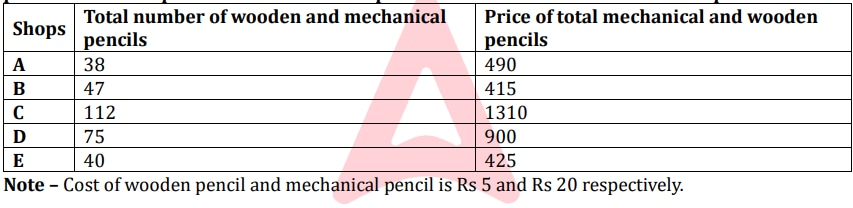
Find the ratio of cost of total mechanical pencil in A and B together to cost of total wooden pencil in D.
- A.
16:5
- B.
5:1
- C.
1:6
- D.
1:5
- E.
1:2
Correct answer: A
Solution
Concept
In this table each shop lists the TOTAL number of pencils (wooden + mechanical) and the TOTAL price of those pencils. With a fixed unit price for each kind (wooden = Rs 5, mechanical = Rs 20), the two figures give two linear equations per shop, so the split can be recovered uniquely.
Let w = wooden count and m = mechanical count in a shop. Then w + m = total count and 5w + 20m = total price. Subtracting 5 times the first equation from the second isolates the mechanical pencils:
5w + 20m = price, and 5w + 5m = 5 x (total count); subtracting gives 15m = price - 5 x (total count), so m = (price - 5 x total) / 15, and w = total - m.
Application
Compute the mechanical count for A and B, and the wooden count for D, then convert each to cost (mechanical x Rs 20, wooden x Rs 5).
Shop A: m = (490 - 5 x 38) / 15 = (490 - 190) / 15 = 300 / 15 = 20 mechanical pencils.
Shop B: m = (415 - 5 x 47) / 15 = (415 - 235) / 15 = 180 / 15 = 12 mechanical pencils.
Mechanical pencils in A and B together = 20 + 12 = 32, so their cost = 32 x 20 = Rs 640.
Shop D: m = (900 - 5 x 75) / 15 = (900 - 375) / 15 = 525 / 15 = 35 mechanical pencils, so wooden = 75 - 35 = 40.
Cost of wooden pencils in D = 40 x 5 = Rs 200.
Required ratio = 640 : 200 = 16 : 5 (dividing both by 40).
Cross-check
Verify the counts satisfy the original totals for each shop used:
Shop
Mechanical
Wooden
Check: count
Check: price
A
20
18
20 + 18 = 38
20x20 + 18x5 = 490
B
12
35
12 + 35 = 47
12x20 + 35x5 = 415
D
35
40
35 + 40 = 75
35x20 + 40x5 = 900
All counts are whole numbers and reproduce the given totals and prices, so the ratio 16 : 5 is confirmed.
- A.
- Q163.IBPS 2025
The table given below shows the total number of wooden and mechanical pencils in five shops and it also shows the price of total mechanical and wooden pencils.
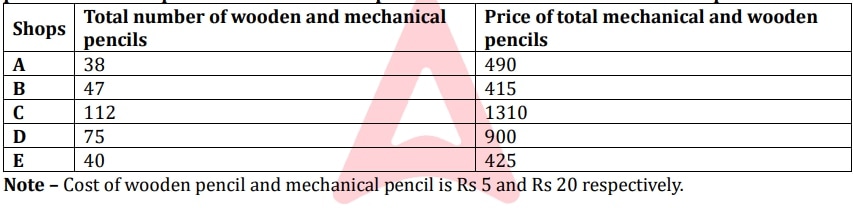
Find the total mechanical pencil in C is what percentage of total wooden pencil in E.
- A.
100
- B.
200
- C.
160
- D.
150
- E.
102
Correct answer: B
Solution
Concept:
When a group of N items of two kinds has a known total count and a known total value, and each kind has a fixed unit price, the count of each kind is found by solving two linear equations in two unknowns: (count1 + count2 = total count) and (price1·count1 + price2·count2 = total value). 'A is what percent of B' is then (A / B) × 100.
Application — Shop C (find mechanical pencils):
Let w = wooden and m = mechanical pencils in C. Total count: w + m = 112.
Total value at Rs 5 (wooden) and Rs 20 (mechanical): 5w + 20m = 1310.
Multiply the count equation by 5: 5w + 5m = 560.
Subtract from the value equation: (5w + 20m) − (5w + 5m) = 1310 − 560, i.e. 15m = 750, so m = 50. Mechanical pencils in C = 50.
Application — Shop E (find wooden pencils):
Let w = wooden and m = mechanical pencils in E. Total count: w + m = 40.
Total value: 5w + 20m = 425.
Multiply the count equation by 5: 5w + 5m = 200.
Subtract from the value equation: 15m = 225, so m = 15, and w = 40 − 15 = 25. Wooden pencils in E = 25.
Result: Mechanical in C as a percent of wooden in E = (50 ÷ 25) × 100 = 200%.
Cross-check: Put the values back. Shop C: 62 wooden × 5 + 50 mechanical × 20 = 310 + 1000 = 1310 ✓ (62 + 50 = 112 ✓). Shop E: 25 wooden × 5 + 15 mechanical × 20 = 125 + 300 = 425 ✓ (25 + 15 = 40 ✓). Both totals match, so 50 and 25 are confirmed and the ratio gives 200%.
- A.
- Q164.IBPS 2025
The table given below shows the total number of wooden and mechanical pencils in five shops and it also shows the price of total mechanical and wooden pencils.
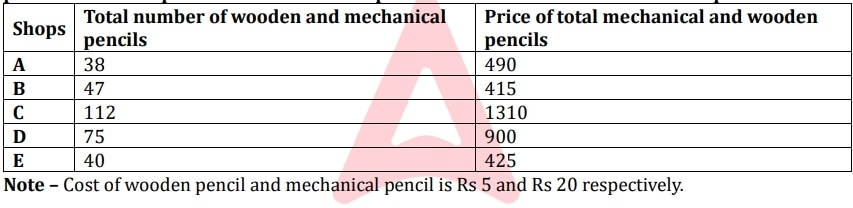
(Cost of one wooden pencil = Rs 5 and one mechanical pencil = Rs 20.)
Find the average number of wooden pencils in A, mechanical pencils in B and mechanical pencils in E.
- A.
10
- B.
5
- C.
16
- D.
15
- E.
12
Correct answer: D
Solution
Concept
Each shop gives two facts: the TOTAL pencils (wooden + mechanical) and the TOTAL price. With unit prices fixed (wooden = Rs 5, mechanical = Rs 20), each shop is a pair of linear equations in the unknown counts. Let w = wooden and m = mechanical for a shop:
Count equation: w + m = (total pencils).
Price equation: 5w + 20m = (total price).
Dividing the price equation by 5 gives w + 4m = (price ÷ 5). Subtracting the count equation eliminates w and isolates the mechanical count: 3m = (price ÷ 5) − (total pencils). Then w = total − m. Finally, average of k chosen quantities = (their sum) ÷ k.
Application
Shop A — wooden count:
w + m = 38 and 5w + 20m = 490, so w + 4m = 98.
Subtract: 3m = 98 − 38 = 60, so m = 20 and w = 38 − 20 = 18. Wooden in A = 18.
Shop B — mechanical count:
w + m = 47 and 5w + 20m = 415, so w + 4m = 83.
Subtract: 3m = 83 − 47 = 36, so m = 12. Mechanical in B = 12.
Shop E — mechanical count:
w + m = 40 and 5w + 20m = 425, so w + 4m = 85.
Subtract: 3m = 85 − 40 = 45, so m = 15. Mechanical in E = 15.
Required average = (18 + 12 + 15) ÷ 3 = 45 ÷ 3 = 15.
Cross-check
Verify each split satisfies its price equation: A → 5(18) + 20(20) = 90 + 400 = 490 ✓; B → 5(35) + 20(12) = 175 + 240 = 415 ✓; E → 5(25) + 20(15) = 125 + 300 = 425 ✓. The three required quantities (18, 12, 15) sum to 45, and 45 ÷ 3 = 15.
Shop
Total
Price
Wooden
Mechanical
A
38
490
18
20
B
47
415
35
12
E
40
425
25
15
- A.
- Q165.IBPS 2025
The table given below shows the total number of wooden and mechanical pencils in five shops and it also shows the price of total mechanical and wooden pencils.
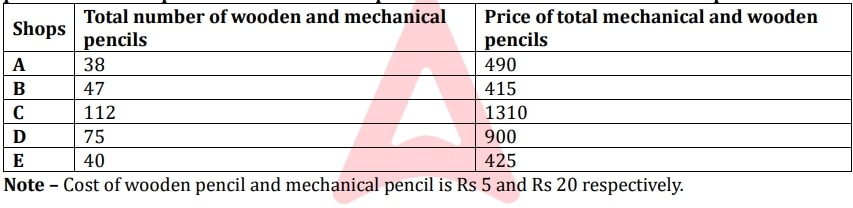
Shop B sold 20% of wooden pencil at the profit of 20% and rest at the profit of 50%. Find the total selling price of wooden pencil.
- A.
292
- B.
215
- C.
246
- D.
232
- E.
252
Correct answer: E
Solution
Concept
When two item types share a known total quantity and a known total cost, set up two linear equations — one for quantity (sum of counts) and one for value (price per unit times count) — and solve them simultaneously to recover each count. Then apply each profit rate to the cost of the relevant share: Selling Price = Cost × (1 + profit fraction).
Application
For Shop B the table gives a total of 47 pencils and a total cost of Rs 415, with wooden pencils costing Rs 5 each and mechanical pencils Rs 20 each. Let w be the number of wooden pencils and m the number of mechanical pencils:
Quantity equation: w + m = 47.
Value equation: 5w + 20m = 415.
From the first equation w = 47 − m; substitute into the second: 5(47 − m) + 20m = 415, i.e. 235 + 15m = 415.
So 15m = 180, giving m = 12 and therefore w = 47 − 12 = 35 wooden pencils.
Split the 35 wooden pencils: 20% of 35 = 7 pencils sold at 20% profit; the remaining 35 − 7 = 28 pencils sold at 50% profit.
Selling price = 7 × 5 × 1.20 + 28 × 5 × 1.50 = 42 + 210 = 252.
Hence the total selling price of the wooden pencils is Rs 252.
Cross-check
Verify the counts against the cost data: 5 × 35 + 20 × 12 = 175 + 240 = 415, which matches the table exactly. The cost of the wooden stock is 35 × 5 = Rs 175, so a total selling price of Rs 252 means an overall profit of Rs 77 on the wooden pencils — consistent with a blend of 20% and 50% margins.
- A.
- Q166.IBPS 2025
The table given below shows the total number of wooden and mechanical pencils in five shops and it also shows the price of total mechanical and wooden pencils.
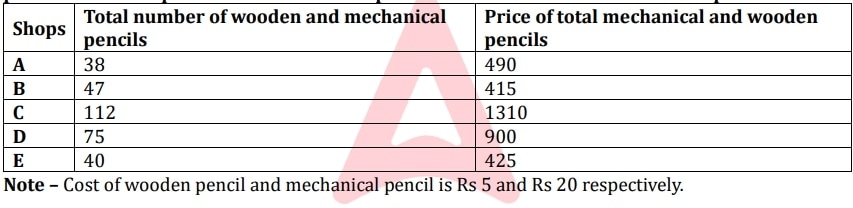
The ratio of total pencils in F to total pencils in C is 5 : 7 and shop F has 30% more wooden pencils than D. Find: the mechanical pencils in F is what percentage more/less than wooden pencils sold by E.
- A.
102%
- B.
105%
- C.
106%
- D.
112%
- E.
110%
Correct answer: D
Solution
Concept: When a fixed quantity of two item-types together has a known total count and a known total cost, the split is found by solving two linear equations. If w wooden and m mechanical pencils satisfy w + m = total and 5w + 20m = total price, subtract 5 times the first equation from the second to get 15m = (total price) - 5*(total), which isolates the mechanical count. To express one number as a percentage of another, divide it by the other and multiply by 100.
Application - find wooden pencils of E and the mechanical pencils of F:
Shop E: total = 40, price = 425. So 15m = 425 - 5*40 = 425 - 200 = 225, giving mechanical m = 15 and wooden w = 40 - 15 = 25. Wooden pencils of E = 25.
Shop D (needed for F): total = 75, price = 900. So 15m = 900 - 5*75 = 900 - 375 = 525, giving mechanical = 35 and wooden = 75 - 35 = 40. Wooden pencils of D = 40.
Shop C total = 112, and (total of F):(total of C) = 5:7, so total of F = 112*(5/7) = 80.
Shop F has 30% more wooden pencils than D, so wooden of F = 40*1.30 = 52. Hence mechanical of F = total of F - wooden of F = 80 - 52 = 28.
Compare mechanical of F (= 28) with wooden of E (= 25): 28/25 = 1.12, i.e. 28 is 112% of 25 (equivalently, 28 is 12% more than 25). Matching the offered percentage values, the answer is 112%.
Cross-check: 112% of 25 = 1.12*25 = 28, which equals the mechanical pencils of F, confirming the comparison. Also verify the splits by cost: for E, 5*25 + 20*15 = 125 + 300 = 425 (matches the table price); for D, 5*40 + 20*35 = 200 + 700 = 900 (matches). The required value is 112%.
- A.
- Q167.IBPS 2025
The bar graph shows the total item manufactured by four companies A, B, C and D. It also shows the total item sold by these companies.
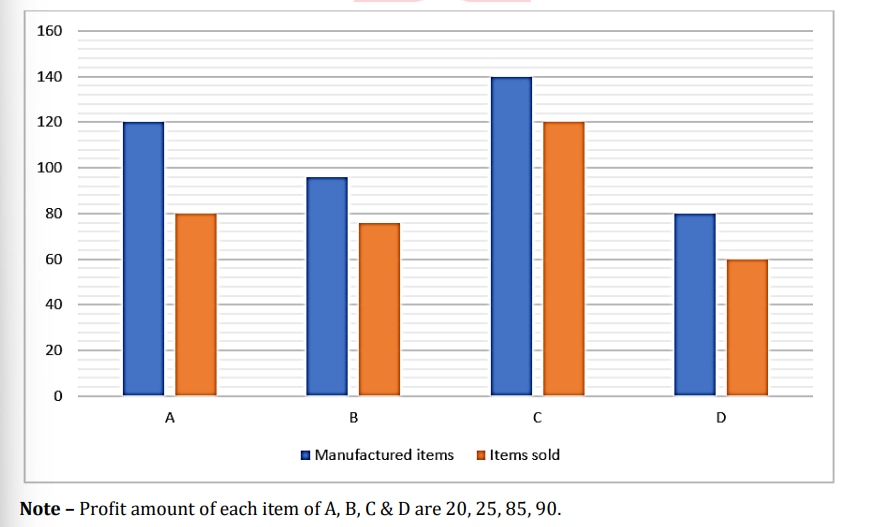
Find the ratio of items sold by A and B together to unsold items of C and D together.
- A.
39:10
- B.
20:19
- C.
40:41
- D.
32:39
- E.
22:21
Correct answer: A
Solution
Concept
In a manufactured-vs-sold bar chart, the quantity actually moved is read directly off the relevant bar, and the quantity left over (unsold) is the manufactured amount minus the sold amount for the same company. A ratio between two such groups is formed by summing the required quantities for each group and then reducing the fraction by their greatest common divisor.
Reading the values from the graph
A: manufactured = 120, sold = 80
B: manufactured = 96, sold = 76
C: manufactured = 140, sold = 120
D: manufactured = 80, sold = 60
Application
Items sold by A and B together = 80 + 76 = 156.
Unsold items of C = manufactured - sold = 140 - 120 = 20.
Unsold items of D = manufactured - sold = 80 - 60 = 20.
Unsold items of C and D together = 20 + 20 = 40.
Required ratio = 156 : 40. Divide both terms by their GCD, 4: 156 / 4 = 39 and 40 / 4 = 10, giving 39 : 10.
Cross-check
Reverse the reduction: 39 x 4 = 156 and 10 x 4 = 40, which reproduces 156 : 40, the un-reduced ratio. The profit figures printed in the note below the graph are not needed here, since the question asks only about sold and unsold quantities.
Required ratio = 39 : 10.
- A.
- Q168.IBPS 2025
The bar graph shows the total item manufactured by four companies A, B, C and D. It also shows the total item sold by these companies.
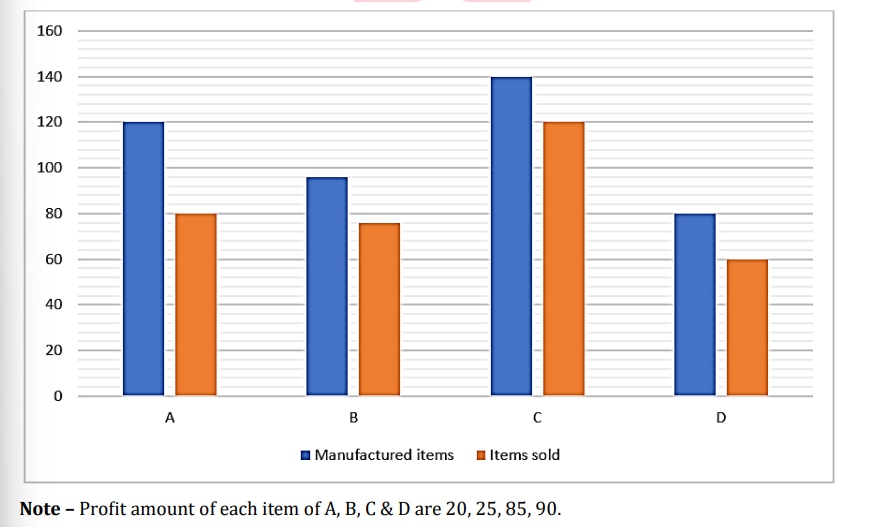
Unsold items of A, B and C is what percentage of total items sold by C.
- A.
42%
- B.
66.66%
- C.
40%
- D.
32%
- E.
33.33%
Correct answer: B
Solution
Concept
Unsold items of a company = Manufactured items − Items sold. To express one quantity as a percentage of another, divide the part by the chosen base and multiply by 100: percentage = (part / base) × 100. Here the base is fixed by the question — the items sold by company C — so identify that denominator carefully before dividing.
Application
Read the bar graph for A, B and C, then subtract sold from manufactured to get unsold for each:
Company A: 120 manufactured − 80 sold = 40 unsold.
Company B: 95 manufactured − 75 sold = 20 unsold.
Company C: 140 manufactured − 120 sold = 20 unsold.
Total unsold of A, B and C = 40 + 20 + 20 = 80.
Items sold by C (the required base) = 120.
Required percentage = (80 / 120) × 100 = 66.66% (approximately 66.67%).
Cross-check
Note that 80/120 = 2/3, and 2/3 of 100 is 66.66…, which confirms the result independently of the long division. The base must be C's SOLD count (120), not C's manufactured count (140) or any combined total — using a larger base would wrongly shrink the percentage.
- A.
- Q169.IBPS 2025
The bar graph shows the total items manufactured by four companies A, B, C and D. It also shows the total items sold by these companies.
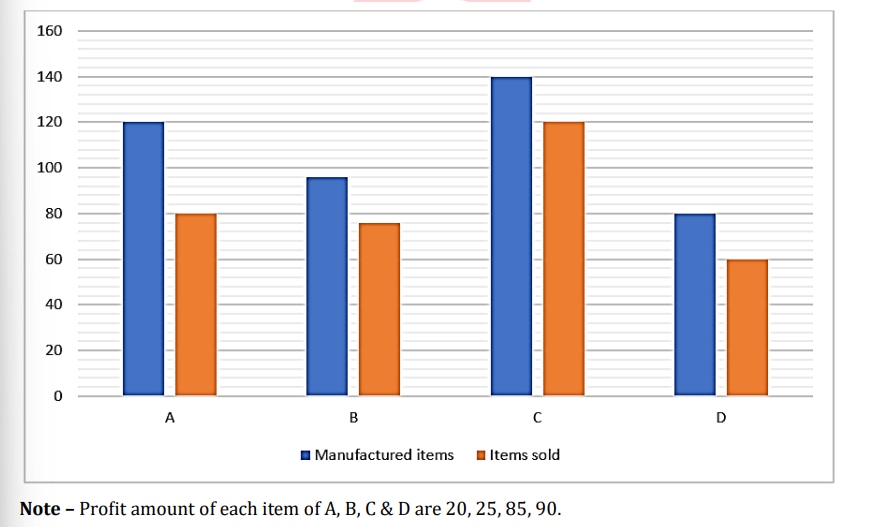
Note: The profit on each item of A, B, C and D is 20, 25, 85 and 90 respectively.
If the cost price of one item of A and one item of D is 100 and 60 respectively, find the total selling price of all the items sold by A and D together.
- A.
14800
- B.
18000
- C.
14000
- D.
31200
- E.
18600
Correct answer: E
Solution
Concept
Selling price per item = cost price per item + profit per item. The total selling price for a company equals its per-item selling price multiplied by the number of items it actually sold (not the number manufactured). So: total SP = (CP + profit) × units sold.
Reading the graph
Company A: items sold = 80; profit per item = 20; CP per item = 100.
Company D: items sold = 60; profit per item = 90; CP per item = 60.
Application
SP per item of A = 100 + 20 = 120.
Total SP of A = 120 × 80 = 9600.
SP per item of D = 60 + 90 = 150.
Total SP of D = 150 × 60 = 9000.
Total selling price of A and D together = 9600 + 9000 = 18600.
Cross-check
Verify with totals: A contributes 80 × 120 = 9600 and D contributes 60 × 150 = 9000; their sum is 18600. Note the count of items SOLD is used, not manufactured — using manufactured counts (120 and 80) would overstate the figure.
- A.
- Q170.IBPS 2025
The bar graph shows the total item manufactured by four companies A, B, C and D. It also shows the total item sold by these companies.
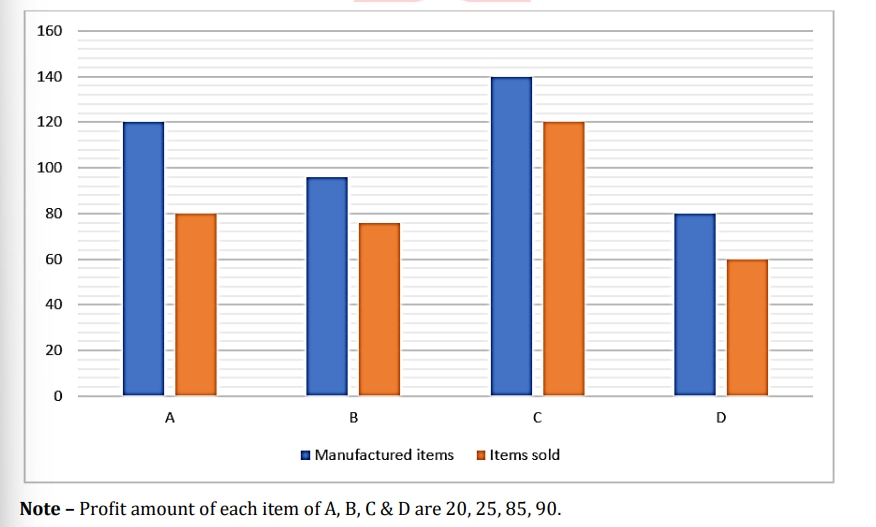
If the total selling price of all the sold items of B is Rs.15200, then find the cost price of 25% of items manufactured by B.
- A.
4200
- B.
2000
- C.
4000
- D.
3200
- E.
2200
Correct answer: A
Solution
Concept: For any item, Profit = Selling Price (SP) minus Cost Price (CP), so CP per item = SP per item minus Profit per item. To find the cost price of a given percentage of a batch of manufactured items, first find the CP of one item, then find how many items that percentage represents, and multiply the two.
Application: Reading the graph and note for Company B, and working through the calculation step by step:
From the bar graph, Company B manufactured 96 items and sold 76 items.
The total selling price of all 76 sold items is Rs. 15200, so the selling price per item = 15200 divided by 76 = Rs. 200.
From the note below the graph, the profit per item for Company B is Rs. 25, so the cost price per item = 200 minus 25 = Rs. 175.
25% of the 96 manufactured items = 0.25 times 96 = 24 items.
Cost price of these 24 items = 24 times 175 = Rs. 4200.
Cross-check: The cost price of all 96 manufactured items = 96 times 175 = Rs. 16800. 25% of Rs. 16800 = Rs. 4200, the same result reached by a different route, confirming the answer.
- A.
- Q171.IBPS 2025
The bar graph shows the total item manufactured by four companies A, B, C and D. It also shows the total item sold by these companies.
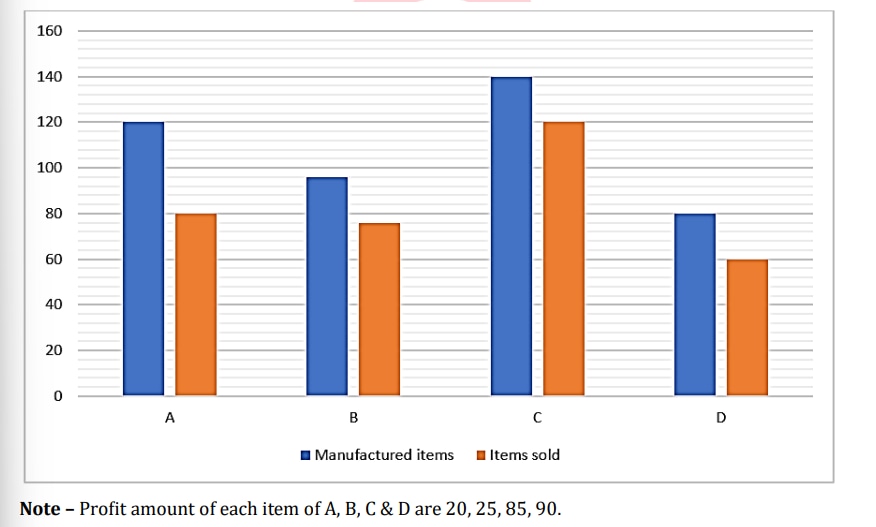
If the item C is marked up by 20% of cost price and give a discount of 10%. Find the marked price of the each item of C.
- A.
1292
- B.
1275
- C.
1245
- D.
1235
- E.
1220
Correct answer: B
Solution
Concept
When an article is sold, the seller fixes a Marked Price (MP) above the Cost Price (CP), then may allow a discount on that MP. The amount actually received is the Selling Price (SP):
MP = CP × (1 + markup%)
SP = MP × (1 − discount%)
Profit per item = SP − CP
So profit is decided by CP together with the markup and discount — not by how many items are manufactured or sold.
Application
Markup is 20% of CP, so MP = 1.20 × CP.
A discount of 10% is given on MP, so SP = 0.90 × MP = 0.90 × 1.20 × CP = 1.08 × CP.
Profit per item of C = SP − CP = 1.08×CP − CP = 0.08 × CP.
From the note, profit per item of C = 85, so 0.08 × CP = 85, giving CP = 85 ÷ 0.08 = 1062.5.
Marked Price of each item of C = 1.20 × CP = 1.20 × 1062.5 = 1275.
Cross-check
With CP = 1062.5 and MP = 1275, the discounted price is 0.90 × 1275 = 1147.5, and the profit is 1147.5 − 1062.5 = 85, exactly the given profit. The manufactured and sold bars are not needed here — the markup, discount and the stated profit alone fix the marked price.
- A.
- Q172.IBPS 2025
A shopkeeper marked up an article 2R% above cost price and allow a discount of 25% and sold it loss of 19% at Rs. 648. Find the value of ‘R’?
- A.
8
- B.
6
- C.
5
- D.
4
- E.
3
Correct answer: D
Solution
Find the Cost Price (CP):
The shopkeeper sold the article at a 19% loss for Rs. 648.
Selling Price (SP) = CP × (1 - 0.19)
648 = CP × 0.81
CP = 648 / 0.81 = 800
Find the Marked Price (MP):
The shopkeeper allowed a 25% discount on the Marked Price (MP) to sell it at Rs. 648.
SP = MP × (1 - 0.25)
648 = MP × 0.75
MP = 648 / 0.75 = 864
Find the value of R:
The article was marked up 2R% above the Cost Price.
MP = CP × (1 + 2R/100)
864 = 800 × (1 + 2R/100)
864 / 800 = 1 + 2R/100
1.08 = 1 + 2R/100
0.08 = 2R/100
8 = 2R
R = 4
The value of R is 4, which corresponds to Option 4.
A video solution is available for this question — log in and enroll to watch it.
- A.
- Q173.IBPS 2025
In each series one term is wrong. You have to find the wrong term of the series.
8, 129, 298, 587, 950, 1477, 2318- A.
8
- B.
129
- C.
1477
- D.
950
- E.
2318
Correct answer: D
Solution
Concept
In a wrong-number series, every term is generated from the previous one by a single fixed rule and exactly one term violates that rule. The method is to compute the consecutive differences and test them against a recognisable sequence — here the differences turn out to be the squares of consecutive prime numbers.
Application
Take the differences between successive terms of 8, 129, 298, 587, 950, 1477, 2318:
129 − 8 = 121 = 112
298 − 129 = 169 = 132
587 − 298 = 289 = 172
the next gap must be 192 = 361, giving 587 + 361 = 948
1477 − 948 = 529 = 232
2318 − 1477 = 841 = 292
The intended pattern adds the squares of the consecutive primes 11, 13, 17, 19, 23, 29. Five of the six gaps match exactly. The only break is at the fifth term: the series shows 950, but the prime-square rule requires 587 + 361 = 948. So 950 is the term that does not belong.
Cross-check
Rebuild the series with 948 in place of 950: 8, 129, 298, 587, 948, 1477, 2318. The differences are then exactly 121, 169, 289, 361, 529, 841 — the squares of 11, 13, 17, 19, 23, 29 with no exception. This confirms 950 (which should be 948) is the wrong term.
- A.
- Q174.IBPS 2025
In each series, one term is wrong. You have to find the wrong term of the series.
7, 8, 16, 39, 55, 180, 216- A.
8
- B.
216
- C.
180
- D.
55
- E.
16
Correct answer: E
Solution
Concept
In a wrong-number-series item, every term is produced from the one before it by a single governing rule. Here the rule alternates between adding a perfect cube and a perfect square: step 1 adds 1 cubed, step 2 adds 2 squared, step 3 adds 3 cubed, step 4 adds 4 squared, step 5 adds 5 cubed, and step 6 adds 6 squared. Exactly one given term breaks this alternating cube-square addition rule, and that broken term is the answer.
How to apply it
Step 1: 7 + 1 cubed (1) = 8, which matches the given second term.
Step 2: 8 + 2 squared (4) = 12, but the given third term is 16 -- it does not match this expected 12.
Step 3: continuing the rule from the expected 12: 12 + 3 cubed (27) = 39, which matches the given fourth term.
Step 4: 39 + 4 squared (16) = 55, which matches the given fifth term.
Step 5: 55 + 5 cubed (125) = 180, which matches the given sixth term.
Step 6: 180 + 6 squared (36) = 216, which matches the given seventh (last) term.
Cross-check
Every later term (39, 55, 180, 216) lines up exactly once the third term is treated as 12 instead of 16, and the same alternating cube-square rule accounts for all six steps without a single exception elsewhere. This confirms the rule is the series' single governing pattern and that the third term is the one place it fails.
So the wrong term in the series is 16.
- A.
- Q175.IBPS 2025
In each series, one term is wrong. Find the wrong term in the series below.
110, 115, 120, 120, 100, 125, 95
- A.
110
- B.
120
- C.
95
- D.
100
- E.
125
Correct answer: B
Solution
Concept
In an alternating (interleaved) number series, the terms at odd positions form one arithmetic progression and the terms at even positions form a separate arithmetic progression. Within each progression the common difference stays constant, so the wrong term is the single value that breaks the constant step of its own progression.
Application
Split the series 110, 115, 120, 120, 100, 125, 95 by position into its two interleaved progressions:
Progression
Terms (by position)
Step
Odd positions (1, 3, 5, 7)
110, 120, 100, 95
should be constant
Even positions (2, 4, 6)
115, 120, 125
+5, +5 (consistent)
The even-position progression 115, 120, 125 increases by a constant +5, so it is intact and acts as the anchor.
The odd-position progression should therefore also have a constant step. Reading from the two end values, 110 down to 95 over three steps gives a constant step of -5, i.e. the intended progression is 110, 105, 100, 95.
Comparing actual odd-position terms 110, 120, 100, 95 with the intended 110, 105, 100, 95, the third-position value 120 is the only mismatch; it should be 105.
So the wrong term is 120 (the value appearing at the third position); replacing it with 105 makes the odd progression a clean -5 sequence.
Cross-check
With 120 corrected to 105 the full series reads 110, 115, 105, 120, 100, 125, 95: the odd-position terms are 110, 105, 100, 95 (step -5) and the even-position terms are 115, 120, 125 (step +5). Both progressions now have a constant step, confirming 120 is the term that was wrong.
- A.
- Q176.IBPS 2025
In the following series, one term is wrong. Find the wrong term of the series.
3, 6, 27, 100, 505, 3036, 21259- A.
21259
- B.
505
- C.
6
- D.
27
- E.
100
Correct answer: C
Solution
Concept
In a wrong-term series, every term is generated from the one before it by a fixed rule whose multiplier and added constant grow by 1 at each step. Here the governing rule is: next term = (previous term × n) + n, where n increases as 2, 3, 4, 5, 6, 7. The wrong term is the single value that does not equal what this rule predicts from its neighbours.
Application
Apply the rule step by step from the start, with n = 2, 3, 4, … :
3 × 2 + 2 = 8, but the series shows 6 in that position.
Confirm the position another way — work back from the next term, 27: we need a number x with x × 3 + 3 = 27, so x = (27 − 3) ÷ 3 = 8.
Both directions agree the second term must be 8, so the printed 6 does not fit the rule.
With 8 in place the rest of the chain holds: 8 × 3 + 3 = 27, 100 × 5 + 5 = 505, 505 × 6 + 6 = 3036, and 3036 × 7 + 7 = 21259.
Cross-check
The replacement value 8 is fixed independently by two methods — forward from 3 (3 × 2 + 2) and backward from 27 ((27 − 3) ÷ 3) — and both give 8. Among the listed numbers, 6 is the only one whose correction restores the multiply-by-n-then-add-n pattern on both of its sides.
So the wrong term is 6; it should be 8.
- A.
- Q177.IBPS 2025
What approximate value should come in place of (?) in the following questions.
1620.03 ÷ 44.93+ 8836÷ (46.98)² = ?- A.
50
- B.
42
- C.
48
- D.
40
- E.
45
Correct answer: D
Solution
Approximate the expression as 1620/45 + 8836/47^2. This is about 36 + 8836/2209 = 36 + 4 = 40.
- A.
- Q178.IBPS 2025
What approximate value should come in place of (?) in the following questions.
(11.99)² + (28.86)² – {(425 + 655) ÷ (6)³} = ?- A.
1030
- B.
980
- C.
1065
- D.
1090
- E.
1025
Correct answer: B
Solution
Approximate 11.99 as 12 and 28.86 as 29. Then 12^2 + 29^2 - (1080/216) = 144 + 841 - 5 = 980.
- A.
- Q179.IBPS 2025
What approximate value should come in place of (?) in the following questions.
3875 ÷ (4.99)³ = ? – {(24)² ÷ 47.98}- A.
45
- B.
49
- C.
41
- D.
47
- E.
43
Correct answer: E
Solution
Approximate 3875/(4.99)^3 as 3875/125 = 31. Also, 24^2/47.98 is about 576/48 = 12. Since 31 = ? - 12, the required value is about 43.
- A.
- Q180.IBPS 2025
What approximate value should come in place of (?) in the following question?

- A.
662
- B.
735
- C.
679
- D.
701
- E.
726
Correct answer: A
Solution
Concept
In an "approximate value" simplification, replace every decimal by the nearest convenient whole number, then evaluate the expression using the normal order of operations (brackets and powers first, then multiply/divide, then add/subtract). The aim is the option closest to the true value, not an exact figure.
Application
Round each term: 2511.99 ≈ 2512, 26.992 ≈ 272 = 729, 138.99 ≈ 139, 360.08 ÷ 3.99 ≈ 360 ÷ 4 = 90, 9.99 ≈ 10, and √1368 ≈ √1369 = 37.
Evaluate the right-hand bracket: 729 − 139 − 90 = 500.
Divide by 10: 500 ÷ 10 = 50. So the whole right-hand side equals 50.
Set up the left-hand side: (2512 − ?) ÷ 37 = 50, hence 2512 − ? = 50 × 37 = 1850.
Solve for ?: ? = 2512 − 1850 = 662.
Cross-check
Using the unrounded numbers, the right-hand side is about 49.97 and √1368 ≈ 36.99, giving ? ≈ 2511.99 − 49.97 × 36.99 ≈ 663.7, which rounds to the nearest option, 662. The estimate is confirmed.
- A.
- Q181.IBPS 2025
What approximate value should come in place of (?) in the following questions.
(? ÷ 17.99) × 5.99 = 319.87% of 60- A.
560
- B.
568
- C.
554
- D.
576
- E.
578
Correct answer: D
Solution
319.87% of 60 is approximately 3.2 x 60 = 192. The equation becomes (? / 18) x 6 = 192, so ? / 3 = 192 and ? = 576.
- A.
- Q182.IBPS 2025
A spend 25% of his monthly income on rent and 20% of remaining in food, 40% remaining in traveling and rest he saved. If total monthly saving of A is Rs.10800, then find the monthly income of A. (in Rs.)?
- A.
25000
- B.
30000
- C.
21000
- D.
48000
- E.
40000
Correct answer: B
Solution
To find the monthly income of A based on the problem in image_4dcde4.png, let's calculate step-by-step:
Assume the total monthly income is I.
Rent Expense: A spends 25% of his income on rent.
Remaining income = I - 0.25I = 0.75I.
Food Expense: A spends 20% of the remaining income on food.
Food = 0.20 × 0.75I = 0.15I.
New remaining income = 0.75I - 0.15I = 0.60I.
Travel Expense: A spends 40% of the remaining income on traveling.
Travel = 0.40 × 0.60I = 0.24I.
Final remaining income (savings) = 0.60I - 0.24I = 0.36I.
Calculate Income:
We know the total savings is Rs. 10,800.
0.36I = 10,800.
I = 10,800 / 0.36.
I = 30,000.
The monthly income of A is 30,000, which corresponds to Option 2.
A video solution is available for this question — log in and enroll to watch it.
- A.
- Q183.IBPS 2025
Two trains, A and B, are moving at speeds of 60 km/h and 80 km/h respectively. Train A crosses a platform that is 150 meters long in 15 seconds, while Train B crosses a pole in 18 seconds. What the sum of length of both trains A and B (in meters)?
- A.
320
- B.
160
- C.
420
- D.
400
- E.
500
Correct answer: E
Solution
Train A's speed is 60 km/h = 50/3 m/s. In 15 seconds it covers 250 m, so its length is 250 - 150 = 100 m. Train B's speed is 80 km/h = 200/9 m/s; crossing a pole in 18 seconds gives length 400 m. Sum = 500 m.
- A.
- Q184.IBPS 2025
In a mixture, the ratio of milk to water is 5:1. When 20 liters of water is added into the mixture, then the ratio of milk to water becomes equal. Find the quantity of milk in the final mixture (in liter).
- A.
25
- B.
24
- C.
5
- D.
20
- E.
15
Correct answer: A
Solution
Define the initial quantities:
The initial ratio of milk to water is 5:1.
Let the quantity of milk be 5x liters and the quantity of water be 1x liters.
Account for the addition of water:
20 liters of water are added to the mixture.
The new quantity of water becomes (x + 20) liters.
Set up the equation based on the new ratio:
After adding water, the ratio of milk to water becomes equal, which means the ratio is 1:1.
Therefore, the quantity of milk equals the new quantity of water:
5x = x + 20Solve for x:
Subtract x from both sides:
4x = 20Divide by 4:
x = 5Calculate the quantity of milk:
The quantity of milk is 5x.
Substituting x = 5:
5 * 5 = 25 liters.The quantity of milk in the final mixture is 25 liters, which corresponds to Option 1.
A video solution is available for this question — log in and enroll to watch it.
- A.
- Q185.IBPS 2025
A can complete 40% of a work in 8 days, while B takes four more days than that of A to complete the same work. Find the time taken by A and B together to complete the same work (in days)?
- A.
7 10/11
- B.
8 10/11
- C.
9 10/11
- D.
10
- E.
10 10/11
Correct answer: E
Solution
A completes 40% work in 8 days, so A alone takes 20 days. B takes 24 days. Together their rate is 1/20 + 1/24 = 11/120, so time = 120/11 = 10 10/11 days.
- A.
- Q186.IBPS 2025
The length of the rectangle is 20% more than its breadth. If the side of a square is equal to the breadth of rectangle, then find the respective ratio of area of square to that of rectangle?
- A.
5 : 6
- B.
1 : 6
- C.
6 : 5
- D.
6 :7
- E.
5 :1
Correct answer: A
Solution
Let breadth be b. Rectangle length = 1.2b. Square side = b. Area ratio of square to rectangle = b^2 : 1.2b^2 = 1 : 1.2 = 5 : 6.
- A.
- Q187.IBPS 2025
A boat covers 120 km in six hours in downstream. The respective ratio of speed of boat in still water and speed of stream is 3: 1. If speed of stream is increased by 80%, then find in how much time the boat will cover 84 km in upstream?
- A.
12 hours
- B.
14 hours
- C.
10 hours
- D.
15 hours
- E.
16 hours
Correct answer: B
Solution
Downstream speed = 120/6 = 20 km/h. Boat : stream = 3 : 1, so downstream speed = 4 parts and one part = 5; boat speed = 15 and stream speed = 5. After an 80% increase, stream speed = 9, so upstream speed = 15 - 9 = 6 km/h. Time for 84 km = 14 hours.
- A.
- Q188.IBPS 2025
A invests Rs.5600 on simple interest at R% for four years and he invested Rs.4800 on compound interest at 10% p.a. for two years. If the simple interest is Rs.672 more than that of compound interest, then find the value of R.
- A.
7.5
- B.
8
- C.
1.5
- D.
10
- E.
12
Correct answer: A
Solution
Compound interest on Rs. 4800 at 10% for two years is 4800 x 21% = Rs. 1008. Simple interest is Rs. 672 more, so SI = Rs. 1680. Thus 5600 x R x 4 / 100 = 1680, giving R = 7.5.
A video solution is available for this question — log in and enroll to watch it.
- A.
- Q189.IBPS 2025
A and B started a business with an investment of Rs X and Rs X+800, respectively. After eight months A left, C joined with Rs 2400. If, at the end of the year, the profit share of B is Rs 5400 out of the total profit of Rs 9300, then find X.
- A.
2500
- B.
4000
- C.
1600
- D.
5000
- E.
6500
Correct answer: B
Solution
A's time-weighted capital = 8X. B's = 12(X + 800). C's = 2400 x 4 = 9600. B's share is 5400/9300 = 18/31, so 12(X + 800)/(8X + 12(X + 800) + 9600) = 18/31. Solving gives X = 4000.
A video solution is available for this question — log in and enroll to watch it.
- A.
- Q190.IBPS 2025
The average weight of 75 students in a class is 20 kg. The average weight of boys and girls is 22 kg and X kg, respectively. If the ratio of boys and girls in the class is 2:1, respectively, then find X?
- A.
16
- B.
24
- C.
48
- D.
8
- E.
32
Correct answer: A
Solution
There are 50 boys and 25 girls. Total class weight = 75 x 20 = 1500 kg. Boys' total weight = 50 x 22 = 1100 kg, so girls' total weight = 400 kg. Girls' average X = 400/25 = 16 kg.
A video solution is available for this question — log in and enroll to watch it.
- A.
- Q191.IBPS 2025
The ratio of present age of A to B’s is 3 : 2. Five years ago, A age was twice than that of B age at that time. Five years hence, sum of ages of A and B is equal to C age at that time. Find present age of C (in years)?
- A.
35
- B.
40
- C.
20
- D.
25
- E.
30
Correct answer: E
Solution
Define the present ages:
The ratio of A's age to B's age is 3:2. Let A = 3x and B = 2x.
Use the past condition:
Five years ago, A's age was (3x - 5) and B's age was (2x - 5).
The condition states: "A age was twice than that of B age at that time."
Equation: (3x - 5) = 2 * (2x - 5)
3x - 5 = 4x - 10
x = 5
Determine current ages of A and B:
A's present age = 3 * 5 = 15
B's present age = 2 * 5 = 10
Use the future condition:
"Five years hence, sum of ages of A and B is equal to C age at that time."
A's age in 5 years = 15 + 5 = 20
B's age in 5 years = 10 + 5 = 15
Sum = 20 + 15 = 35
So, C's age five years hence will be 35.
Calculate C's present age:
If C is 35 five years from now, C's present age = 35 - 5 = 30.
The correct answer is 30, which corresponds to Option 5.
- A.
- Q192.IBPS 2025
Set X contains seven consecutive even numbers which sum is 630. Set Y contains five consecutive odd numbers whose sum is 295.
Quantity I: What is average of first four consecutive even number of the set X.
Quantity II: 27 more than average of first two numbers of set Y.- A.
Quantity I > Quantity II
- B.
Quantity I < Quantity II
- C.
Quantity I ≥ Quantity II
- D.
Quantity I ≤ Quantity II
- E.
Quantity I = Quantity II or no relation
Correct answer: A
Solution
Set X has seven consecutive even numbers with average 630/7 = 90, so the first four are 84, 86, 88, 90 and their average is 87. Set Y has average 295/5 = 59, so the first two odd numbers are 55 and 57; their average is 56 and 27 more is 83. Hence Quantity I > Quantity II.
- A.
- Q193.IBPS 2025
What is the S.I accrued on a principle of Rs.6000 in 5 years.
Quantity I – The rate of interest for the first 2 years is 10% and for the last 3 years is 15%.
Quantity II – Rs.3900- A.
Quantity I > Quantity II
- B.
Quantity I < Quantity II
- C.
Quantity I ≥ Quantity II
- D.
Quantity I ≤ Quantity II
- E.
Quantity I = Quantity II or no relation
Correct answer: E
Solution
Quantity I simple interest = 6000 x 10% x 2 + 6000 x 15% x 3 = 1200 + 2700 = 3900. Quantity II is also 3900, so the two quantities are equal.
- A.
- Q194.IBPS 2025
In the given question, two quantities are given, one as ‘Quantity I’ and another as ‘Quantity II’. You have to determine relationship between two quantities and choose the appropriate option. Quantity I : A mixture contains 120 liters of milk and water in the ratio of 3:5, respectively. If Y liters of mixture are taken out and 10 liters of milk and 15 liters of water are added to the mixture, then the ratio of milk to water becomes 8:13. Find Y. Quantity II : 60
- A.
Quantity I > Quantity II
- B.
Quantity I < Quantity II
- C.
Quantity I ≥ Quantity II
- D.
Quantity I ≤ Quantity II
- E.
Quantity I = Quantity II or no relation
Correct answer: B
Solution
Concept
In a fixed mixture, both components are present in the same ratio everywhere, so when a portion is drawn off, milk and water leave in the SAME ratio as the original blend. The standard method: convert the starting ratio into actual quantities, remove the withdrawn part proportionally, add the new amounts, and set the resulting milk-to-water ratio equal to the target to solve for the unknown. A 'Quantity I vs Quantity II' item is then decided by comparing the two computed values.
Application
Starting amounts: 120 L in milk : water = 3 : 5, so milk = 120 x 3/8 = 45 L and water = 120 x 5/8 = 75 L.
Remove Y L of the mixture. Since the mixture is 3/8 milk and 5/8 water, milk removed = (3/8)Y and water removed = (5/8)Y, leaving milk = 45 - (3/8)Y and water = 75 - (5/8)Y.
Add 10 L milk and 15 L water: milk = 55 - (3/8)Y and water = 90 - (5/8)Y.
Target ratio milk : water = 8 : 13 gives 13(55 - (3/8)Y) = 8(90 - (5/8)Y).
Expand: 715 - (39/8)Y = 720 - (40/8)Y, so (40/8)Y - (39/8)Y = 720 - 715, i.e. (1/8)Y = 5, hence Y = 40.
So Quantity I = 40 and Quantity II = 60.
Cross-check
With Y = 40: milk = 55 - 15 = 40 L and water = 90 - 25 = 65 L, giving 40 : 65 = 8 : 13, which matches the target. Comparing 40 with 60, Quantity I is strictly less than Quantity II. Because Y is a single fixed value (40) and not 60, the comparison is determinate, so the strict 'less-than' relation is the answer rather than a non-strict (less-than-or-equal) one.
- A.
- Q195.IBPS 2025
In the given questions, two quantities are given, one as ‘Quantity I’ and another as ‘Quantity II’. You have to determine relationship between two quantities and choose the appropriate option.
Quantity I: The average age of 21 people is 64 years. If the age of a new person is added the new average age becomes 64.5 years, then find the age of new person.
Quantity II: There are 14 people in a family and the average age of all the family members is 30 years. A new baby born in a family, after 4 years what will be the average age of all the family members.- A.
Quantity I > Quantity II
- B.
Quantity I < Quantity II
- C.
Quantity I ≥ Quantity II
- D.
Quantity I ≤ Quantity II
- E.
Quantity I = Quantity II or no relation
Correct answer: A
Solution
Concept
Average = (sum of values) / (number of values), so sum = average x count. When a member is added or removed, recompute the total from the new count; and when time passes, every existing member's age rises by that same amount of time.
Quantity I - age of the new person
Total age of the 21 people = 21 x 64 = 1344 years.
After the new person joins there are 22 people with average 64.5, so new total = 22 x 64.5 = 1419 years.
Age of the new person = 1419 - 1344 = 75 years.
Quantity II - average after 4 years
Total age of the 14 members = 14 x 30 = 420 years.
A new baby (age 0) joins, so there are now 15 members and the total is still 420 years.
After 4 years every one of the 15 members is 4 years older, so total = 420 + 15 x 4 = 480 years.
Required average = 480 / 15 = 32 years.
Cross-check and result
Quantity I = 75 years and Quantity II = 32 years. Since 75 > 32, Quantity I is greater than Quantity II.
- A.
- Q196.IBPS 2025
Directions : Read the following passage and answer the given questions.
When Company X introduced its online game, the market response was immediate and overwhelming. The very next year, the company earned huge profits and quickly gained users across the globe. Reports revealed that the game generated 50 million dollars worldwide, making it one of the most successful digital launches in recent years. This sudden success was seen as a major hit, granting Company X recognition and dominance in the industry.
Yet, beneath the shining surface of profits and popularity, a darker picture began to emerge. Parents started to raise concerns over the time children were spending on this game. Many young users became addicted, unable to manage their daily schedules, and their studies suffered significantly. Teachers noticed falling grades, a decline in participation, and a visible drop in discipline. At home, the situation worsened as children grew increasingly irritable, spending less time with family and showing signs of inappropriate behavior.
Roommates, on the other hand, reported that their relationships remained smooth only during gaming sessions. Once the console was turned off, interactions were minimal, and genuine conversations reduced. What was marketed as a tool for entertainment and bonding ironically created isolation and
dependency. Parents found themselves struggling to establish healthy routines for their children, often entering into conflicts that left family ties strained.An independent organisation decided to investigate these growing concerns and carried out a large-scale survey. The data collected and the report submitted revealed an alarming trend. The impact of the game was largely negative, with cases of extreme dependency, reduced academic achievement, and antisocial tendencies being repeatedly recorded. What initially gave the company a toe hold in the international gaming market was now turning into a nationwide social concern.
The report strongly emphasized that while the company’s financial growth was undeniable, the cost to society was far greater. Addiction had begun to reshape the daily lives of thousands of children, disturbing family harmony and disrupting the overall learning environment. Based on the overwhelming findings, the organisation recommended that the game should be banned in the country. The conclusion was clear: no amount of profit could justify the erosion of discipline, values, and future prospects of the younger generation.What is the primary irony highlighted by the author regarding Company X's online game?
- A.
The company’s most profitable year was also its most controversial.
- B.
A game designed for entertainment and bonding ended up fostering addiction and isolation.
- C.
The company grew financially, but its user base started declining soon after.
- D.
Parents initially appreciated the game but later demanded it be banned.
- E.
While profits surged, the company secretly planned to shut down the game.
Correct answer: B
Solution
Concept
In a reading-comprehension item that asks for the passage’s "irony", the correct option is the one that names both the stated purpose or expectation of an action and the actual outcome that contradicts it — not a mere coincidence in timing, a change in opinion, or an unrelated business detail.
Application
The passage explicitly states that the game was "marketed as a tool for entertainment and bonding" but "ironically created isolation and dependency": children grew irritable and spent less time with family, and roommates’ "genuine conversations" reduced once the game was switched off. The stated purpose — entertainment and bonding — is directly contradicted by the stated outcome — addiction and isolation — which is exactly the irony the passage itself names.
Contrast with the other options
"The company’s most profitable year was also its most controversial" restates the timing overlap between profit and controversy but does not identify the entertainment-versus-isolation contrast the passage calls ironic.
"The company grew financially, but its user base started declining soon after" is not supported by the passage, which says the game "gained users across the globe" throughout, with no mention of a decline in users.
"Parents initially appreciated the game but later demanded it be banned" is not supported either; the passage never describes parents appreciating the game — their concern is introduced alongside the addiction discussion, with no prior stage of approval.
"While profits surged, the company secretly planned to shut down the game" is not supported; the passage describes an independent organisation recommending a ban after its own investigation, not a secret shutdown plan by the company.
Hence, the primary irony is the gap between the game's marketed purpose — entertainment and bonding — and its actual effect of fostering addiction and isolation.
- A.
- Q197.IBPS 2025
What negative consequences of the game were observed in children, as per the passage?
- A.
Children began losing interest in digital games and preferred outdoor activities instead.
- B.
Students became highly disciplined and responsible with their schoolwork and home routines.
- C.
Many children showed signs of addiction, poor academic performance, irritability, and spent less time with family members.
- D.
Young users formed better relationships with their teachers but struggled with peer pressure.
- E.
Children used the game as a stress-relief method and became more independent in their decision-making.
Correct answer: C
Solution
Concept
A “detail / explicit-information” comprehension question is answered only from what the passage states, not from outside opinion. The correct choice must restate the facts the text actually reports, and must match the polarity the question asks for — here, negative consequences. Any choice that adds a benefit, a positive habit, or information the passage never mentions is automatically wrong.
Application
Scan the passage for the harms it names. It states that many young users “became addicted,” their “studies suffered,” teachers saw “falling grades” and “poor discipline,” and at home children “grew increasingly irritable” and “spent less time with family.” Collecting these four reported harms — addiction, poor academic performance, irritability, and reduced family time — gives exactly the option that lists all of them together.
Contrast
“Losing interest in digital games / preferring outdoor activities” reverses the text — children over-used the game, they did not abandon it.
“Highly disciplined and responsible” is the opposite of the reported poor discipline and falling grades.
“Better relationships with teachers” contradicts the passage — teachers observed worsening behaviour, not improvement.
“Stress-relief / more independent” describes a benefit the passage never claims; it reports dependency, not independence.
- A.
- Q198.IBPS 2025
Directions : Read the following passage and answer the given questions.
When Company X introduced its online game, the market response was immediate and overwhelming. The very next year, the company earned huge profits and quickly gained users across the globe. Reports revealed that the game generated 50 million dollars worldwide, making it one of the most successful digital launches in recent years. This sudden success was seen as a major hit, granting Company X recognition and dominance in the industry.
Yet, beneath the shining surface of profits and popularity, a darker picture began to emerge. Parents started to raise concerns over the time children were spending on this game. Many young users became addicted, unable to manage their daily schedules, and their studies suffered significantly. Teachers noticed falling grades, a decline in participation, and a visible drop in discipline. At home, the situation worsened as children grew increasingly irritable, spending less time with family and showing signs of inappropriate behavior.
Roommates, on the other hand, reported that their relationships remained smooth only during gaming sessions. Once the console was turned off, interactions were minimal, and genuine conversations reduced. What was marketed as a tool for entertainment and bonding ironically created isolation and
dependency. Parents found themselves struggling to establish healthy routines for their children, often entering into conflicts that left family ties strained.An independent organisation decided to investigate these growing concerns and carried out a large-scale survey. The data collected and the report submitted revealed an alarming trend. The impact of the game was largely negative, with cases of extreme dependency, reduced academic achievement, and antisocial tendencies being repeatedly recorded. What initially gave the company a toe hold in the international gaming market was now turning into a nationwide social concern.
The report strongly emphasized that while the company’s financial growth was undeniable, the cost to society was far greater. Addiction had begun to reshape the daily lives of thousands of children, disturbing family harmony and disrupting the overall learning environment. Based on the overwhelming findings, the organisation recommended that the game should be banned in the country. The conclusion was clear: no amount of profit could justify the erosion of discipline, values, and future prospects of the younger generation.According to the passage, what role did roommates play in revealing the social effects of the game?
- A.
They actively tried to prevent gaming in their homes.
- B.
They became addicted and dropped out of college.
- C.
They used the game as a bonding tool but lacked real interaction otherwise.
- D.
They encouraged younger players to limit their screen time.
- E.
They often fought over gaming equipment, causing tension.
Correct answer: C
Solution
Concept: In an ‘according to the passage’ reading-comprehension question, the correct option must restate something the passage explicitly says about the specific person or group named in the question -- not a detail that belongs to a different actor in the text, and not an inference the passage does not support.
Application: The question asks specifically about roommates. The passage states: "Roommates... reported that their relationships remained smooth only during gaming sessions. Once the console was turned off, interactions were minimal, and genuine conversations reduced." This tells us exactly two things about roommates -- they bonded with each other while playing, and once play stopped, real interaction between them dropped off sharply. That two-part description is a bonding tool during play, with real interaction dropping off once play stops.
Cross-check -- ruling out the other options by what the passage actually attributes to whom:
Preventing gaming in the home is never described as an action taken by anyone in the passage -- parents are shown only as worried and struggling with routines, not actively blocking play -- and this is not attributed to roommates either way.
The passage describes addiction and declining academic performance (falling grades, reduced participation, discipline problems) for children/young users in general; it never states anyone dropped out of college, and none of this is tied to roommates.
Restricting or monitoring screen time for younger players is not a role given to roommates anywhere in the passage; struggling to set routines is described as a parental action.
No dispute over gaming equipment involving roommates appears in the passage; the conflicts described are between parents and children over routines.
Result: Only the bonding-tool-during-play-with-interaction-dropping-off-otherwise description is drawn directly from the roommates-specific sentence in the passage, so that is the answer supported by the text.
- A.
- Q199.IBPS 2025
How did teachers contribute to the concern about the game’s impact?
- A.
They partnered with the company to create school-safe gaming tools.
- B.
They observed and reported a consistent decline in student behavior and academic performance.
- C.
They welcomed the game, saying it helped students with teamwork.
- D.
They banned the use of computers in classrooms due to gaming.
- E.
They noticed students becoming physically stronger due to eye-hand coordination practice.
Correct answer: B
Solution
Concept
In a reading-comprehension item, to "contribute to a concern" about something means to supply evidence or an observation that points to the harmful effect being worried about. The right choice is the response that reports an observed negative outcome; choices describing neutral, positive, or unrelated behaviour cannot be what fuels a concern.
Application
The passage states that teachers noticed falling grades, a decline in participation, and a visible drop in discipline. Reframed, this is teachers observing and reporting a consistent decline in student behaviour and academic performance — a first-hand account of harm, which is exactly what feeds the worry about the game's impact.
Contrast
"Partnered with the company to create school-safe gaming tools" describes cooperation, not a worry, so it cannot drive a concern.
"Welcomed the game, saying it helped with teamwork" is praise; praise reduces rather than raises concern.
"Banned the use of computers in classrooms" is an administrative action that the passage never mentions and is not an observation feeding the concern.
"Students becoming physically stronger from eye-hand coordination" describes a benefit and is not referenced in the passage at all.
So the response that records an observed decline in behaviour and academic performance is the one that contributed to the concern.
- A.
- Q200.IBPS 2025
Directions : Read the following passage and answer the given questions.
When Company X introduced its online game, the market response was immediate and overwhelming. The very next year, the company earned huge profits and quickly gained users across the globe. Reports revealed that the game generated 50 million dollars worldwide, making it one of the most successful digital launches in recent years. This sudden success was seen as a major hit, granting Company X recognition and dominance in the industry.
Yet, beneath the shining surface of profits and popularity, a darker picture began to emerge. Parents started to raise concerns over the time children were spending on this game. Many young users became addicted, unable to manage their daily schedules, and their studies suffered significantly. Teachers noticed falling grades, a decline in participation, and a visible drop in discipline. At home, the situation worsened as children grew increasingly irritable, spending less time with family and showing signs of inappropriate behavior.
Roommates, on the other hand, reported that their relationships remained smooth only during gaming sessions. Once the console was turned off, interactions were minimal, and genuine conversations reduced. What was marketed as a tool for entertainment and bonding ironically created isolation and
dependency. Parents found themselves struggling to establish healthy routines for their children, often entering into conflicts that left family ties strained.An independent organisation decided to investigate these growing concerns and carried out a large-scale survey. The data collected and the report submitted revealed an alarming trend. The impact of the game was largely negative, with cases of extreme dependency, reduced academic achievement, and antisocial tendencies being repeatedly recorded. What initially gave the company a toehold in the international gaming market was now turning into a nationwide social concern.
The report strongly emphasized that while the company’s financial growth was undeniable, the cost to society was far greater. Addiction had begun to reshape the daily lives of thousands of children, disturbing family harmony and disrupting the overall learning environment. Based on the overwhelming findings, the organisation recommended that the game should be banned in the country. The conclusion was clear: no amount of profit could justify the erosion of discipline, values, and future prospects of the younger generation.Which of the following options can most appropriately replace the word given in bold in the passage above? If the word given in bold is already correct, select the same word as your answer.
- A.
downfall
- B.
shortcut
- C.
toehold
- D.
decline
- E.
conclusion
Correct answer: C
Solution
Concept
A collocation is a word or fixed phrase that habitually pairs with a particular context; the test is which option produces an idiomatic, meaningful expression rather than merely a grammatically possible one. The idiom "toehold" denotes a small but secure initial position from which one can advance — a foothold that enables further progress or expansion.
Application
The required word names an initial, modest position that leads to growth or expansion (for example, a firm gaining a small but firm starting presence). Among the offered words, "toehold" is the one that carries exactly this sense of a secure starting foothold, so it is the most appropriate choice.
Contrast
"downfall" — a ruin or collapse; it signals an ending in failure, the opposite of a starting position that grows.
"shortcut" — a quicker route or method; it speaks to the speed of a path, not to gaining a secure initial position.
"toehold" — a small, secure initial foothold from which one advances; this matches the needed sense of a starting position that enables progress.
"decline" — a decrease or refusal; it denotes downward movement, not the establishing of a position.
"conclusion" — an end or final part; it marks a finish, not an initial foothold that leads to expansion.
- A.