The table given below shows the total number of red and blue balls in five…
2025
The table given below shows the total number of red and blue balls in five different bags (A, B, C, D & E). it also shows the difference between red and blue balls and percentage of red balls with respect to total balls.
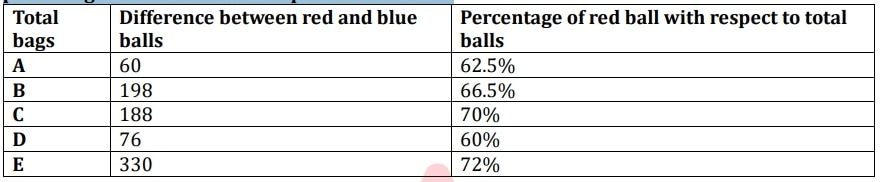
Find the ratio of number of red balls in A and E together to number of blue balls in A.
Answer: C. 23:3 — ConceptFor any bag, let the total balls be T, with red = (red%)·T and blue = (blue%)·T, where blue% = 100% − red%. Since the table gives the difference (red −…
- A.
23:10
- B.
23:11
- C.
23:3
- D.
18:19
- E.
21:22
Attempted by 22 students.
Show answer & explanation
Correct answer: C
Concept
For any bag, let the total balls be T, with red = (red%)·T and blue = (blue%)·T, where blue% = 100% − red%. Since the table gives the difference (red − blue) and the red percentage, the total follows from the identity:
red − blue = (red% − blue%)·T = (2·red% − 100%)·T.
Once T is known, red and blue for that bag are just the corresponding percentages of T.
Application
Bag A — red% = 62.5%, so blue% = 37.5%. Difference factor = 62.5% − 37.5% = 25% = 1/4. Given difference = 60, so T = 60 ÷ (1/4) = 240.
Red in A = 62.5% × 240 = 150; Blue in A = 37.5% × 240 = 90.
Bag E — red% = 72%, so blue% = 28%. Difference factor = 72% − 28% = 44% = 11/25. Given difference = 330, so T = 330 ÷ (11/25) = 330 × 25/11 = 750.
Red in E = 72% × 750 = 540.
Required ratio = (Red in A + Red in E) : (Blue in A) = (150 + 540) : 90 = 690 : 90 = 23 : 3.
Cross-check
Verify the totals from the difference: for A, 150 − 90 = 60 ✓; for E, 540 − 210 = 330 ✓. Dividing 690 and 90 by their HCF 30 gives 23 : 3, so the simplified ratio is exact.