The bar graph shows the total item manufactured by four companies A, B, C and…
2025
The bar graph shows the total item manufactured by four companies A, B, C and D. It also shows the total item sold by these companies.
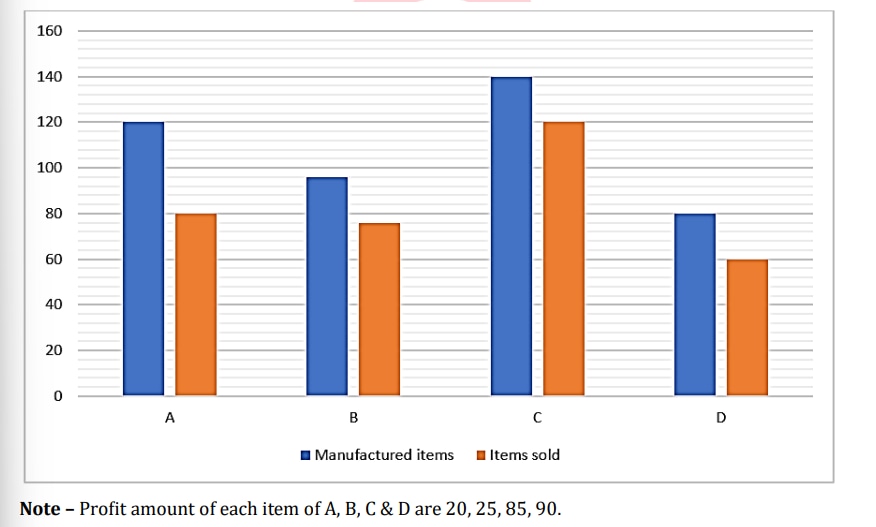
If the item C is marked up by 20% of cost price and give a discount of 10%. Find the marked price of the each item of C.
Answer: B. 1275 — ConceptWhen an article is sold, the seller fixes a Marked Price (MP) above the Cost Price (CP), then may allow a discount on that MP. The amount actually…
- A.
1292
- B.
1275
- C.
1245
- D.
1235
- E.
1220
Attempted by 10 students.
Show answer & explanation
Correct answer: B
Concept
When an article is sold, the seller fixes a Marked Price (MP) above the Cost Price (CP), then may allow a discount on that MP. The amount actually received is the Selling Price (SP):
MP = CP × (1 + markup%)
SP = MP × (1 − discount%)
Profit per item = SP − CP
So profit is decided by CP together with the markup and discount — not by how many items are manufactured or sold.
Application
Markup is 20% of CP, so MP = 1.20 × CP.
A discount of 10% is given on MP, so SP = 0.90 × MP = 0.90 × 1.20 × CP = 1.08 × CP.
Profit per item of C = SP − CP = 1.08×CP − CP = 0.08 × CP.
From the note, profit per item of C = 85, so 0.08 × CP = 85, giving CP = 85 ÷ 0.08 = 1062.5.
Marked Price of each item of C = 1.20 × CP = 1.20 × 1062.5 = 1275.
Cross-check
With CP = 1062.5 and MP = 1275, the discounted price is 0.90 × 1275 = 1147.5, and the profit is 1147.5 − 1062.5 = 85, exactly the given profit. The manufactured and sold bars are not needed here — the markup, discount and the stated profit alone fix the marked price.