The table given below shows the total number of red and blue balls in five…
2025
The table given below shows the total number of red and blue balls in five different bags (A, B, C, D & E). it also shows the difference between red and blue balls and percentage of red balls with respect to total balls.
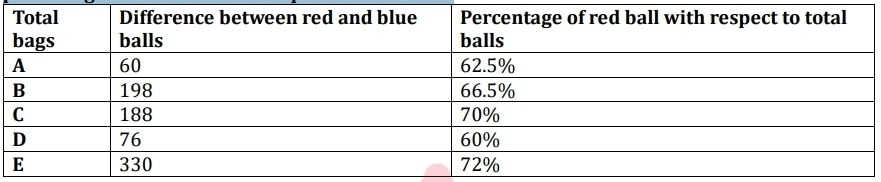
The number of balls in bag F is 25% more than red balls in E and the ratio of red balls in A and blue balls in F is 2:1. Find the red balls in F.
Answer: E. 600 — ConceptFor any bag, the red-ball percentage fixes the split between red and blue. If red is p% of the total, blue is (100 − p)%, so the difference (red −…
- A.
685
- B.
680
- C.
630
- D.
620
- E.
600
Attempted by 13 students.
Show answer & explanation
Correct answer: E
Concept
For any bag, the red-ball percentage fixes the split between red and blue. If red is p% of the total, blue is (100 − p)%, so the difference (red − blue) equals total × (2p − 100)%. From a known difference and the red-percentage you recover the total, and from the total you get the red and blue counts.
Total = Difference ÷ (2p − 100)%; then Red = Total × p% and Blue = Total × (100 − p)%.
Application
Bag A — Difference 60, red 62.5% (blue 37.5%, gap 25%). Total = 60 ÷ 0.25 = 240, so Red in A = 240 × 0.625 = 150.
Bag E — Difference 330, red 72% (blue 28%, gap 44%). Total = 330 ÷ 0.44 = 750, so Red in E = 750 × 0.72 = 540.
Bag F total — “25% more than red balls in E” = 540 × 1.25 = 675 balls.
Blue in F — ratio Red(A) : Blue(F) = 2 : 1 with Red(A) = 150, so Blue(F) = 150 ÷ 2 = 75.
Red in F — Red(F) = Total(F) − Blue(F) = 675 − 75 = 600.
Cross-check
Red(F) + Blue(F) = 600 + 75 = 675, matching the computed total for F. The stated 2 : 1 ratio also holds (150 : 75). Both independent conditions are satisfied.