The table given below shows the total number of red and blue balls in five…
2025
The table given below shows the total number of red and blue balls in five different bags (A, B, C, D & E). It also shows the difference between red and blue balls and percentage of red balls with respect to total balls.
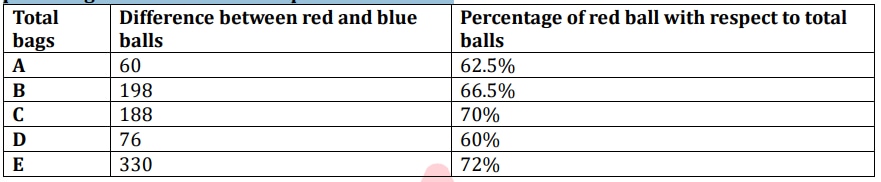
The number of red balls in A and E together is what percentage of the number of blue balls in A and E together?
Answer: A. 230 — Concept When a quantity splits into two kinds (here red and blue) and you are told one kind's percentage of the total and the difference between the two…
- A.
230
- B.
220
- C.
240
- D.
280
- E.
260
Attempted by 18 students.
Show answer & explanation
Correct answer: A
Concept
When a quantity splits into two kinds (here red and blue) and you are told one kind's percentage of the total and the difference between the two counts, the total is fully determined. If red is p% of total T, blue is (100 - p)% of T, so red minus blue equals (2p - 100)% of T. Setting this equal to the stated difference fixes T, and each colour count then follows.
Applying it to bag A and bag E
Bag A: red is 62.5%, so blue is 37.5%; their gap is 25% of the total. Since 25% of the total = 60, total = 60 ÷ 0.25 = 240. Red = 62.5% of 240 = 150; blue = 37.5% of 240 = 90.
Bag E: red is 72%, so blue is 28%; their gap is 44% of the total. Since 44% of the total = 330, total = 330 ÷ 0.44 = 750. Red = 72% of 750 = 540; blue = 28% of 750 = 210.
Red in A and E together = 150 + 540 = 690. Blue in A and E together = 90 + 210 = 300.
Required percentage = (690 ÷ 300) × 100 = 230%.
Cross-check
Each bag matches the table: 150 - 90 = 60 for bag A and 540 - 210 = 330 for bag E. Also 690 is exactly 2.3 times 300, confirming 230%.