Match the parts of sentences given in Column I and Column II to form…
2025
Match the parts of sentences given in Column I and Column II to form meaningful and grammatically correct complete sentences. Choose the option that contains all the correct combinations.
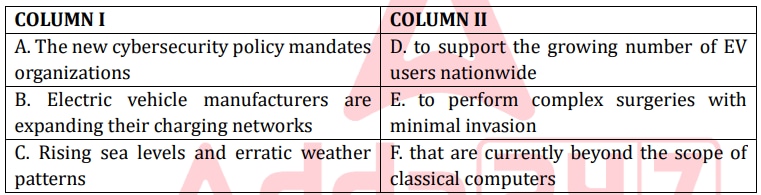
Answer: C. B-D — Concept: In a sentence-matching task, a Column I fragment joins a Column II fragment only when the result is both grammatically well-formed (the connector —…
- A.
None of these
- B.
A-F
- C.
B-D
- D.
A-E, B-F
- E.
A-F, B-D, C-E
Attempted by 23 students.
Show answer & explanation
Correct answer: C
Concept: In a sentence-matching task, a Column I fragment joins a Column II fragment only when the result is both grammatically well-formed (the connector — an infinitive 'to…', a relative 'that…', or a clause — agrees with the head fragment) and semantically coherent (the two halves talk about the same idea). A pairing fails if either test fails.
Application — test each Column I head against the available continuations:
"Electric vehicle manufacturers are expanding their charging networks" needs a purpose clause; "to support the growing number of EV users nationwide" supplies exactly that purpose, and both halves are about EVs — grammatical and on-topic, so B-D holds.
"The new cybersecurity policy mandates organizations" is about data/security; none of the continuations (EV users, surgeries, classical computers) shares that topic, so A has no valid partner here.
"Rising sea levels and erratic weather patterns" is about climate; again none of the continuations is about climate, so C has no valid partner here.
Cross-check: "to perform complex surgeries with minimal invasion" fits a medical-robotics subject and "that are currently beyond the scope of classical computers" fits a quantum-computing subject — neither subject appears in Column I, confirming E and F have no head to attach to. The only combination that passes both tests is B-D, so the option naming exactly that single correct combination is right.