IBPS 2024 Previous Year Questions (PYQs) with Solutions
Real questions from the IBPS 2024 paper, solved. Every question below shows its options, the correct answer, and a full text solution — free to read, no login needed. Open any question to practice it interactively inside its course.
- Questions:
- 200
- With solutions:
- 200
- Tagged IBPS 2024 in the bank:
- 278
- Q1.IBPS 2024
Directions: Each question consists of two conclusions followed by some statements. Consider the given conclusions to be true even if they seem to be at variance with commonly known facts. Read the conclusions and then decide which of the following statement sets is true for the given conclusions.
Conclusions:
I. All number can never be digit
II. Some digit being letter is a possibility- A.
Statements: All series is number; Some series is digit; Only a few letter is number
- B.
Statements: Only a few series is digit; All series is number; Some letter is number
- C.
Statements: No digit is series; No series is number; All number is letter
- D.
Statements: Only digit is letter; Some digit is number; Only a few series is number
- E.
Statements: No digit is letter; Only a few letter is number; Only a few number is series
Correct answer: C
Solution
Concept
In a reverse syllogism, you are given the conclusions and must pick the statement set from which they follow. A definite negative conclusion of the form "X can never be Y" means "No X is Y" must hold; a possibility conclusion ("Some A being B is a possibility") only needs to be NOT contradicted by the statements. So reject any set that FORCES the opposite of conclusion I, or that makes conclusion II impossible.
What the conclusions demand
Conclusion I "All number can never be digit" = No number is digit must hold, so the set must NOT force "Some number is digit".
Conclusion II "Some digit being letter is a possibility" = the set must leave "Some digit is letter" possible, so it must NOT force "No digit is letter".
Testing each statement set
All series is number; Some series is digit; Only a few letter is number: "Some series is digit" with "All series is number" gives "Some number is digit" - this forces the opposite of conclusion I, so it is ruled out.
Only a few series is digit; All series is number; Some letter is number: "Only a few series is digit" still asserts "Some series is digit", which with "All series is number" again yields "Some number is digit" - opposite of conclusion I, ruled out.
No digit is series; No series is number; All number is letter: no statement links number with digit, so "Some number is digit" is NOT forced and "No number is digit" stays consistent (conclusion I holds); digit and letter are unconstrained, so "Some digit is letter" remains possible (conclusion II holds). Both conclusions survive.
Only digit is letter; Some digit is number; Only a few series is number: "Some digit is number" directly gives "Some number is digit" - opposite of conclusion I, ruled out.
No digit is letter; Only a few letter is number; Only a few number is series: "No digit is letter" makes "Some digit is letter" impossible - it kills conclusion II, ruled out.
Cross-check
Four of the five sets each contain a statement that directly contradicts one of the two conclusions; only the set "No digit is series; No series is number; All number is letter" leaves both conclusions intact, so it is the set from which the given conclusions follow.
- A.
- Q2.IBPS 2024
Study the following information carefully and answer the given questions:
Seven persons A, B, C, D, E, F, and G are sitting around a circular table, but not necessarily in the same order. Some of them face towards the centre, and some face away from the centre. F sits third to the right of A. The immediate neighbours of A face the same direction but opposite as A. A faces the same direction as B but not towards the centre. One person sits between A and C. D sits 2nd to the left of C. E sits 2nd to the left of G and face in the same direction. F and D face opposite direction as E.
Who among the following sits second to the right of E?- A.
A
- B.
D
- C.
C
- D.
F
- E.
G
Correct answer: E
Solution
Concept
In a circular-seating direction puzzle, "facing the centre" reverses a person's sense of left and right. For someone facing the centre, their right hand points anticlockwise; for someone facing away from the centre, their right hand points clockwise. So every "k-th to the left/right of X" clue must be read in the direction X is facing, not in a fixed clockwise sense. Fix the seven seats, apply the strongest clue first, then resolve facings from the direction clues.
Setting up the directions
"A faces the same direction as B but not towards the centre": A faces outward (away from the centre), and B also faces outward.
"The immediate neighbours of A face the same direction but opposite as A": both seats adjacent to A face the centre (inward).
"F and D face the opposite direction as E" together with "E faces the same direction as G": E and G share one facing while F and D share the other.
Placing the persons
Read "F sits third to the right of A" with A facing outward: A's right is clockwise, so F is three seats clockwise from A.
"One person sits between A and C" puts C two seats from A; combined with "D sits 2nd to the left of C" (read in C's facing) this locks C and D relative to A.
"E sits 2nd to the left of G" (read in G's facing) with the shared E and G facing fixes E and G; the last remaining seat takes B.
The single arrangement that satisfies every clue, going clockwise, is: A (out), E (in), C (in), F (out), D (out), B (out), G (in).
Seat (clockwise)
Person
Facing
1
A
outward
2
E
centre
3
C
centre
4
F
outward
5
D
outward
6
B
outward
7
G
centre
Answering the question
E faces the centre, so E's right hand points anticlockwise. Counting two seats anticlockwise from E lands on G. Hence G sits second to the right of E.
Cross-check
F is exactly three clockwise from outward-facing A, so that clue is satisfied.
Both of A's neighbours face the centre, opposite to A, so that clue is satisfied.
E and G face the centre while F and D face outward, opposite to E, so the facing clues all hold.
- A.
- Q3.IBPS 2024
Study the following information carefully and answer the given questions:
Seven persons A, B, C, D, E, F, and G are sitting around a circular table, but not necessarily in the same order. Some of them face towards the centre, and some face away from the centre. F sits third to the right of A. The immediate neighbours of A face the same direction but opposite as A. A faces the same direction as B but not towards the centre. One person sits between A and C. D sits 2nd to the left of C. E sits 2nd to the left of G and face in the same direction. F and D face opposite direction as E.
Which among the following pair of persons faces the same direction?- A.
G and C
- B.
A and E
- C.
E and D
- D.
C and F
- E.
None of these
Correct answer: A
Solution
Concept
A circular direction puzzle tracks two things per person: their seat and their facing (inward = toward the centre, outward = away). The clue that converts left/right is that when a person faces the centre their right hand points clockwise, and when they face away it points counter-clockwise, so the counting direction depends on the reference person's own facing. Fix the seats first, then fix every facing from the same/opposite-direction clues, and finally read off which named pair shares a facing.
Application — seats
Place A and apply 'F sits third to the right of A'. Since A faces outward (it does not face the centre), A's right is counter-clockwise, so F sits three seats counter-clockwise from A.
'One person sits between A and C' and 'D sits 2nd to the left of C' must hold together; testing the gap of two seats between A and C and placing D two to C's left (C faces inward, so its left is counter-clockwise) gives a single consistent layout.
'E sits 2nd to the left of G' then fixes E and G into the remaining seats. The only arrangement that satisfies every seat clue (reading clockwise) is A, G, B, D, F, C, E.
Application — facings
A faces outward, and A faces the same direction as B, so B is outward.
Both immediate neighbours of A face opposite to A, i.e. inward; those neighbour seats are G and E, so G and E face inward.
E and G face the same direction (consistent with both inward), and F and D face opposite to E, so F and D face outward.
C is the remaining person; the seat and direction clues leave C facing inward.
Collecting every facing: inward = G, C, E; outward = A, B, D, F. The only offered pair whose two persons share a facing is (G, C), since both face inward. That is the required pair.
Cross-check
A is outward but E is inward, so that pair faces opposite directions.
E is inward but D is outward, so that pair faces opposite directions.
C is inward but F is outward, so that pair faces opposite directions.
Exactly one offered pair, (G, C), shares a facing, so 'None of these' does not apply.
- A.
- Q4.IBPS 2024
Study the following information carefully and answer the given questions:
Seven persons A, B, C, D, E, F, and G are sitting around a circular table, but not necessarily in the same order. Some of them face towards the centre, and some face away from the centre. F sits third to the right of A. The immediate neighbours of A face the same direction but opposite as A. A faces the same direction as B but not towards the centre. One person sits between A and C. D sits 2nd to the left of C. E sits 2nd to the left of G and face in the same direction. F and D face opposite direction as E.
How many persons sit between B and F (counting clockwise from F)?- A.
One
- B.
Three
- C.
Four
- D.
Two
- E.
None
Correct answer: A
Solution
Concept
In circular-seating direction puzzles, a person's left and right depend on which way they face. A person facing the centre has their right hand pointing in the anticlockwise direction and their left in the clockwise direction; a person facing away from the centre has this reversed (right = clockwise, left = anticlockwise). Fixing one person and applying each positional and direction clue in turn pins down a single seating order.
Applying the clues
A faces away from the centre (“not towards the centre”), and B faces the same way as A, so B also faces outward.
Place A and read “F sits third to the right of A” with A facing outward (right = clockwise): moving three seats clockwise from A lands on F. So A and F sit with two seats between them on that side.
“The immediate neighbours of A face the same direction as each other but opposite to A”: since A faces outward, both seat-neighbours of A face inward — these turn out to be E and G.
“One person sits between A and C” places C two seats from A; “D sits 2nd to the left of C” then fixes D relative to C using C's facing.
“E sits 2nd to the left of G and faces the same direction”, and “F and D face opposite to E”, fix the remaining directions. These constraints are satisfied by exactly one arrangement.
The unique arrangement
Reading clockwise, the seating is: A (outward), E (inward), C (inward), F (outward), D (outward), B (outward), G (inward). Every clue checks out against this single layout.
Counting clockwise from F to B
Starting at F and moving clockwise, the next seat is D, and the seat after that is B. So between F and B (clockwise from F) there is just one person, namely D.
Cross-check
Counting the other way (anticlockwise from F to B) would pass G, A, E and C — four people — confirming that the short clockwise arc is the intended count and that exactly one person sits between them clockwise.
Answer: One.
- A.
- Q5.IBPS 2024
Study the following information carefully and answer the given questions:
Seven persons A, B, C, D, E, F, and G are sitting around a circular table, but not necessarily in the same order. Some of them face towards the centre, and some face away from the centre. F sits third to the right of A. The immediate neighbours of A face the same direction but opposite as A. A faces the same direction as B but not towards the centre. One person sits between A and C. D sits 2nd to the left of C. E sits 2nd to the left of G and face in the same direction. F and D face opposite direction as E.
Four of the following five persons are alike in a certain way based on their seating arrangement. Find the odd one.- A.
F
- B.
C
- C.
B
- D.
D
- E.
A
Correct answer: B
Solution
In the solved circular arrangement, C is the only listed person facing the centre among F, C, B, D and A.
The others in the option group face away from the centre.
Therefore C is the odd one.
- A.
- Q6.IBPS 2024
Study the following information carefully and answer the given questions:
Seven persons A, B, C, D, E, F, and G are sitting around a circular table, but not necessarily in the same order. Some of them face towards the centre, and some face away from the centre. F sits third to the right of A. The immediate neighbours of A face the same direction but opposite as A. A faces the same direction as B but not towards the centre. One person sits between A and C. D sits 2nd to the left of C. E sits 2nd to the left of G and face in the same direction. F and D face opposite direction as E.
Which among the following statements is/are true?
I. G faces towards the centre.
II. Both F and A face away from the centre.
III. Two persons sit between C and D when counted clockwise from D.- A.
Only I
- B.
Only III
- C.
Both I and II
- D.
Both II and III
- E.
All I, II, and III
Correct answer: C
Solution
In the circular arrangement, G faces the centre, and both F and A face away from the centre.
The clockwise count from D to C does not leave exactly two persons between them.
Thus statements I and II are true.
- A.
- Q7.IBPS 2024
Read the given information carefully and answer the related questions:
M is spouse of O and parent of R. O is the father-in-law of T, and T has two children. N is the only son of R, and R has no siblings. T is mother-in-law of P. V is married to P.Who among the following is grandmother of V?
- A.
T
- B.
M
- C.
R
- D.
O
- E.
N
Correct answer: B
Solution
Concept
In a blood-relations puzzle, first fix each person's gender from gender-specific relationship words (father-in-law is male, mother-in-law is female), then build the family tree generation by generation using the spouse and parent-child links. A person's paternal grandmother (दादी) is the mother of that person's father.
Applying it to this family
M is spouse of O, and O is the father-in-law of T, so O is male; therefore his spouse M is female.
M is a parent of R, and O is M's spouse, so O is also a parent of R. Thus R is the child of M and O.
"N is the only son of R, and R has no siblings" tells us R has no brother or sister, so R is the only child of M and O. The person married to O's child (T's spouse) can therefore only be R, so T is married to R.
T has two children and N is R's only son, so T and R have a son (N) and one daughter.
T is the mother-in-law of P, so P is married to a child of T and R.
V is married to P, so V is P's spouse, which means V is the child of T and R who married P.
V's parents are R and T. R's parents are O (father) and M (mother), so the mother of V's parent R is M.
Result
The grandmother of V is M.
Cross-check
O is a grandparent of V, but O is male (he is the father-in-law of T), so O is the grandfather; the grandmother must be O's spouse, M. This is consistent.
- A.
- Q8.IBPS 2024
Read the given information carefully and answer the related questions:
M is spouse of O and parent of R. O is father-in-law of T who has two children. N is the only son of R who has no sibling. T is mother-in-law of P. V is married to P.
What is the relation of P with respect to R?- A.
Son-in-law
- B.
Son
- C.
Nephew
- D.
Daughter
- E.
None of the above
Correct answer: A
Solution
Concept
In a blood-relation puzzle, fix gender first using directional clues ("father-in-law" = male, "mother-in-law" = female), then build the family tree generation by generation. A person who marries someone's child is that someone's son-in-law (if male) or daughter-in-law (if female). Each married pair is taken as one man and one woman.
Application
O is the "father-in-law of T", so O is male; M is spouse of O, so M is female. M and O are the parents of R.
"N is the only son of R who has no sibling" tells us R has no brother or sister, so R is the only child of M and O.
O is the father-in-law of T, meaning T married a child of O. Since R is O's only child, T is married to R. So R and T are a couple.
T has two children. As N is the only son of R, the second child of R and T is a daughter.
T is the mother-in-law of P, so P married one of T's children (i.e., a child of R).
V is married to P. Since P married a child of T and V is the one married to P, V is that child of R. V is not the son N, so V is R's daughter; therefore P is male.
P is a male who married R's daughter, so P is the son-in-law of R.
Cross-check
Walking up from V: V is a daughter of R, and P is V's husband. A daughter's husband is a son-in-law, which matches T (V's mother) being P's mother-in-law. Both relationships are consistent, confirming P is the son-in-law of R.
- A.
- Q9.IBPS 2024
If we form a four-letter meaningful word by using the third, fourth, fifth and seventh letter from the left end of the word ‘EXACTITUDE’, then which of the following will be the second letter of the meaningful word thus formed. If more than one word is formed mark Z as your answer. If no meaningful word is formed, mark X as your answer?
- A.
C
- B.
A
- C.
X
- D.
T
- E.
Z
Correct answer: B
Solution
The 3rd, 4th, 5th and 7th letters of EXACTITUDE are A, C, T and T. These form the meaningful word TACT, whose second letter is A.
- A.
- Q10.IBPS 2024
Read the given information carefully and answer the related questions:
Seven persons was born on same date and same month but in different years – 1955, 1967, 1973 1980, 1987, 1991, 2003. Consider the base year 2024 to calculate the ages. L’s age is multiple of 3. Three persons were born between L and Q. Number of persons born before Q is same as the number of persons born after P. Difference between the age of Q and K is 12 years. M is 7 years older to N. N is younger to O.
Who among the following was born in 1967?- A.
N
- B.
P
- C.
M
- D.
O
- E.
K
Correct answer: D
Solution
The birth-year arrangement is P-1955, O-1967, L-1973, M-1980, N-1987, K-1991 and Q-2003.
Therefore O was born in 1967.
- A.
- Q11.IBPS 2024
Read the given information carefully and answer the related question: Seven persons were born on the same date and same month but in different years - 1955, 1967, 1973, 1980, 1987, 1991 and 2003. Consider the base year 2024 to calculate the ages. L's age is a multiple of 3. Three persons were born between L and Q. The number of persons born before Q is the same as the number of persons born after P. The difference between the age of Q and K is 12 years. M is 7 years older than N. N is younger than O. What is the age difference between M and Q?
- A.
25 years
- B.
24 years
- C.
23 years
- D.
30 years
- E.
20 years
Correct answer: C
Solution
Concept
In a year-based age arrangement, convert each birth year to an age using age = base year - birth year, then place everyone on a single oldest-to-youngest timeline. A clue of the form "X persons were born between A and B" fixes the gap between two people; a clue that equates "persons before one person" with "persons after another" makes those two positions symmetric about the centre. No single clue usually fixes a position outright - you keep every layout each clue allows and intersect them until exactly one survives.
Set up the ages
With base year 2024, the seven birth years give these ages, listed oldest to youngest:
1955 -> 69, 1967 -> 57, 1973 -> 51, 1980 -> 44
1987 -> 37, 1991 -> 33, 2003 -> 21
Label the seven timeline slots 1 (oldest, age 69) to 7 (youngest, age 21).
Apply the clues
Balance clue: persons before Q = persons after P. If Q sits at slot q and P at slot p (counting from the oldest), this says q - 1 = 7 - p, i.e. p + q = 8. By itself this is only a symmetry condition; it permits several slot pairs such as (P,Q) = (1,7), (2,6), (3,5) and their mirrors - it does not yet fix who is oldest.
Add the gap clue: three persons between L and Q. L and Q must be four slots apart, so |slot(L) - slot(Q)| = 4.
Add L's age = multiple of 3. The multiples of 3 are 69, 57, 51, 33, 21 - i.e. slots 1, 2, 3, 6, 7. Intersecting the balance pairs, the four-slot L-Q gap, and L on a multiple-of-3 slot leaves only three candidate layouts: P at slot 1 / Q at slot 7 / L at slot 3; P at slot 3 / Q at slot 5 / L at slot 1; or P at slot 5 / Q at slot 3 / L at slot 7.
Use |age of Q - age of K| = 12 to break the tie. In the second layout Q would be 37 and in the third Q would be 51; neither leaves any remaining person whose age differs from Q by exactly 12. Only the first layout works: there Q is 21, and 21 + 12 = 33 is still available, so K = 33 (born 1991). This is what forces P to the oldest slot (69, born 1955) and Q to the youngest (21, born 2003).
Place L. L sits at slot 3, giving L = 51 (born 1973), which is indeed a multiple of 3.
Finish with M is 7 older than N, and N younger than O. The ages still unassigned are 57, 44 and 37 for M, N, O. Only 44 = 37 + 7 fits "M = N + 7", so M = 44 (born 1980) and N = 37 (born 1987); O then takes 57 (born 1967), and N < O holds.
Result
The final timeline (oldest to youngest) is P(69), O(57), L(51), M(44), N(37), K(33), Q(21). The required age difference is M - Q = 44 - 21 = 23 years.
Cross-check
Re-test every clue on this arrangement: L = 51 is a multiple of 3; exactly three persons (M, N, K) lie between L and Q; the count older than Q (six) equals the count younger than P (six); |Q - K| = |21 - 33| = 12; M = 44 = 37 + 7 = N + 7; and N = 37 < 57 = O. Every clue holds, so 23 years is confirmed.
- A.
- Q12.IBPS 2024
Read the given information carefully and answer the question that follows: Seven persons were born on the same date and same month but in different years - 1955, 1967, 1973, 1980, 1987, 1991, 2003. Consider the base year 2024 to calculate the ages. L's age is a multiple of 3. Three persons were born between L and Q. The number of persons born before Q is the same as the number of persons born after P. The difference between the ages of Q and K is 12 years. M is 7 years older than N. N is younger than O. M was born in which year?
- A.
1973
- B.
1980
- C.
1987
- D.
1967
- E.
1955
Correct answer: B
Solution
Concept
In a 'born in different years' puzzle, arrange the people on a single timeline from oldest (earliest year) to youngest (latest year). Convert every age clue into a year clue using birth year = base year - age, and read 'older' as an earlier year and 'younger' as a later year. Apply the clues together, eliminating placements that violate any one of them, until a single arrangement survives.
Setting up
Years available: 1955, 1967, 1973, 1980, 1987, 1991, 2003. With base year 2024 the ages are 69, 57, 51, 44, 37, 33 and 21 respectively. We fill seven slots from oldest to youngest.
Applying the clues
L's age is a multiple of 3. Of the ages 69, 57, 51, 44, 37, 33, 21, the multiples of 3 are 69, 57, 51, 33 and 21 - so L is one of 1955, 1967, 1973, 1991 or 2003 (only 1980 and 1987 are excluded for L).
Three persons are born between L and Q, so L and Q sit four slots apart on the timeline. Combined with the next clues this fixes L = 1973 and Q = 2003: the four-slot span 1973 ... 2003 leaves exactly three people in between, and the other multiple-of-3 choices for L cannot keep all later clues consistent.
The number of persons born before Q equals the number born after P. Q is youngest (slot 7), so six people are born before Q; six must then be born after P, which is only possible if P is the oldest, born in 1955.
The difference between the ages of Q and K is 12 years, so their birth years differ by 12. Q = 2003, hence K = 1991 (2003 - 1991 = 12); 2003 + 12 = 2015 is not in the list.
M is 7 years older than N (M's year is 7 less than N's), and N is younger than O (N born after O). The three years still unused are 1967, 1980 and 1987. Only M = 1980 with N = 1987 gives the required 7-year gap, and that forces O = 1967, which correctly leaves N younger than O. No other split of these three years satisfies both clues.
Consistency check on L: had L been 1955, 1967, 1991 or 2003 instead of 1973, the four-slot L-Q span would either run off the timeline or leave Q with no valid 12-year partner for K, or force P out of the oldest slot - so L = 1973 is the only multiple-of-3 placement that survives.
Final timeline (oldest to youngest)
Person
Year
Age
P
1955
69
O
1967
57
L
1973
51
M
1980
44
N
1987
37
K
1991
33
Q
2003
21
Cross-check
Between L (1973) and Q (2003) sit M, N, K - exactly three persons. Correct.
Persons before Q = 6, persons after P = 6. Equal. Correct.
Q and K year gap = 2003 - 1991 = 12. Correct.
M (1980) is 7 years older than N (1987), and N (1987) is younger than O (1967). Correct.
Result
M was born in 1980.
- A.
- Q13.IBPS 2024
Read the given information carefully and answer the related questions:
Seven persons was born on same date and same month but in different years – 1955, 1967, 1973 1980, 1987, 1991, 2003. Consider the base year 2024 to calculate the ages. L’s age is multiple of 3. Three persons were born between L and Q. Number of persons born before Q is same as the number of persons born after P. Difference between the age of Q and K is 12 years. M is 7 years older to N. N is younger to O.
What is the total age of K and N?- A.
84 years
- B.
65 years
- C.
81 years
- D.
58 years
- E.
70 years
Correct answer: E
Solution
The birth-year arrangement is P-1955, O-1967, L-1973, M-1980, N-1987, K-1991 and Q-2003.
So K's age is 33 and N's age is 37.
Their total age is 70 years.
- A.
- Q14.IBPS 2024
Read the given information carefully and answer the question that follows.
Seven persons were born on the same date and in the same month but in different years - 1955, 1967, 1973, 1980, 1987, 1991 and 2003. Consider the base year 2024 to calculate the ages.
L's age is a multiple of 3. Three persons were born between L and Q. The number of persons born before Q is the same as the number of persons born after P. The difference between the ages of Q and K is 12 years. M is 7 years older than N. N is younger than O.
If P is related to L and N is related to Q, then M is related to ___.
- A.
K
- B.
O
- C.
L
- D.
None of these
- E.
N
Correct answer: A
Solution
Concept
In an ordered-arrangement puzzle, first fix the linear order of all elements from the numeric data (here, birth years give an oldest-to-youngest order). Then translate each clue into a position or a gap inside that single order, and use the clues together to eliminate every layout except one. Finally, a "X is related to Y" mapping is a hidden positional rule: read the constant gap from the given pairs, then apply that same gap to the asked element.
Step-by-step arrangement
Base year 2024, so age = 2024 - (birth year). Number the seven slots 1 to 7 from oldest to youngest; the ages in that order are 69, 57, 51, 44, 37, 33, 21.
L's age is a multiple of 3. Among the ages, only 69, 57, 51, 33 and 21 are multiples of 3 (44 and 37 are not), so L cannot sit in slot 4 or slot 5.
"Persons born before Q" equals "persons born after P". If Q is in slot q and P in slot p, this says (q - 1) = (7 - p), i.e. p + q = 8. (This does not yet pin them to the ends - any pair of slots summing to 8 qualifies.)
Three persons are born between L and Q, so the slots of L and Q differ by 4. Combining p + q = 8 with |L - Q| = 4 leaves only these (P, Q, L) slot triples: (1, 7, 3), (3, 5, 1) and (5, 3, 7); the case (7, 1, 5) is rejected because slot 5 has age 37, which is not a multiple of 3, and L must be a multiple of 3.
The age difference of Q and K is 12. Test the three surviving triples: only (P, Q, L) = (1, 7, 3) leaves a person exactly 12 years from Q (Q is 21, so K is 33); in the other two triples no remaining person is 12 years from Q. So P is oldest (slot 1, 1955) and Q youngest (slot 7, 2003), with L in slot 3 (1973, age 51) and K in slot 6 (1991, age 33).
M is 7 years older than N, i.e. age(M) = age(N) + 7; among the remaining slots only 44 and 37 differ by 7, so M is 44 (1980) and N is 37 (1987). N is younger than O, leaving O = 1967 (age 57).
The complete oldest-to-youngest order is therefore:
Slot (oldest first)
Person
Birth year
Age in 2024
1
P
1955
69
2
O
1967
57
3
L
1973
51
4
M
1980
44
5
N
1987
37
6
K
1991
33
7
Q
2003
21
Finding the relationship rule
Read the given pairs as slots in this order. P (slot 1) is related to L (slot 3); N (slot 5) is related to Q (slot 7). In both pairs the related person sits two slots toward the younger end. So the hidden rule is: each person is related to the person two slots younger.
Apply to M
M sits in slot 4. Two slots toward the younger end is slot 6, occupied by the person aged 33 (born 1991), namely K. Hence M is related to K.
Cross-check
Both given mappings (1->3 and 5->7) jump exactly two slots, and 4->6 also jumps exactly two slots, so the gap and direction match. The mapping is consistent, confirming the related person is K.
- A.
- Q15.IBPS 2024
Read the given information carefully and answer the related questions: In a certain code language
‘Play the same game.’ is coded as ‘us ud ut uk’ ‘
Seen in the play.’ is coded as ‘uk ua ud um’
‘The jar is seen.’ is coded as ‘ud ua uh uw’
‘The same game played’ is coded as ‘ut ud ub us’
If the code of ‘Jar’ is ‘uh’, then the code of ‘is played’ will be?- A.
ua ud
- B.
uw ut
- C.
ua us
- D.
uw ub
- E.
uw ut
Correct answer: D
Solution
Concept
In a code-language pairing problem each word maps to one code-token, but the tokens within a sentence are listed in scrambled order. To pin a single word to a single token, compare sentences: a token shared by two sentences must stand for a word those sentences share, and a token that appears only when a particular word appears (and never otherwise) must be that word's code. Find each code by the intersection of the sentences that contain the word, minus every token from sentences that do not.
Application
The four statements are:
Play the same game = us ud ut uk
Seen in the play = uk ua ud um
The jar is seen = ud ua uh uw
The same game played = ut ud ub us
Work out the words needed for 'is played':
'the' appears in statements 1, 2, 3 and 4; the only token common to all four is ud, so the = ud.
'seen' appears in statements 2 and 3 but not 1 or 4; the token left after removing the others is ua, so seen = ua.
Statement 3 (The jar is seen = ud ua uh uw) now reduces to {the=ud, seen=ua}, leaving {jar, is} = {uh, uw}.
The clue states jar = uh, so the remaining token gives is = uw.
'played' appears in statement 4 but not statement 1; statement 1 shares the words the, same and game with statement 4, so removing their codes ud, ut, us leaves ub, giving played = ub.
Therefore is played = uw ub.
Cross-check
Substituting back, statement 4 'The same game played' = the(ud) + same/game(us,ut) + played(ub) = ud ut ub us, which matches the given ut ud ub us. The pairing is consistent, confirming is played = uw ub.
- A.
- Q16.IBPS 2024
In a certain code language, the following sentences are coded as shown. Study them carefully and answer the question.
Play the same game. is coded as us ud ut uk
Seen in the play. is coded as uk ua ud um
The jar is seen. is coded as ud ua uh uw
The same game played is coded as ut ud ub us
What is the code of play?
- A.
ud
- B.
us
- C.
uk
- D.
ut
- E.
um
Correct answer: C
Solution
Concept
In word-to-code (substitution) coding, each word maps to a fixed code group. To pin a word's code, compare statements that share that word: the code common to all statements containing the word, after removing codes that belong to other words those statements share, must be its code. A word that recurs in many statements with a single constant code is the strongest anchor and should be fixed first.
Application
the appears in all four statements, and the only code present in all four groups is ud, so the = ud. Fix this anchor first.
play appears in statement 1 (us ud ut uk) and statement 2 (uk ua ud um). The codes common to both groups are ud and uk; ud is already fixed as the, so the remaining common code gives play = uk.
Resolve the rest the same way: seen (statements 2 and 3) shares ua and ud, and with ud taken, seen = ua; same and game (statements 1 and 4) share us and ut; played (only statement 4) = ub; in (only statement 2) = um.
Cross-check
Rebuild statement 2, Seen in the play, from the codes found: seen = ua, in = um, the = ud, play = uk, giving the set {ua, um, ud, uk}, which exactly matches the given group uk ua ud um. So the code of play is uk.
- Q17.IBPS 2024
Read the given information carefully and answer the related questions: In a certain code language
‘Play the same game.’ is coded as ‘us ud ut uk’ ‘
Seen in the play.’ is coded as ‘uk ua ud um’
‘The jar is seen.’ is coded as ‘ud ua uh uw’
‘The same game played’ is coded as ‘ut ud ub us’
What will be the possible code for ‘game is played’?- A.
uh ud ub
- B.
ut us ua
- C.
us uh ub
- D.
ut ub ud
- E.
uh uw uk
Correct answer: C
Solution
Concept
In a set-based code language, each sentence is given as an unordered group of codes, so word order is not preserved. A word's code is found by intersection: take the code groups of every sentence that contains the word and keep only the code(s) common to all of them. A code that appears in exactly one sentence must stand for the word unique to that sentence.
Application
Decode by elimination, step by step:
“The” appears in all four sentences; the only code present in all four groups is ud, so the = ud.
Comparing “Seen in the play” (uk ua ud um) with “The jar is seen” (ud ua uh uw): the shared words are the (ud) and seen, and the shared codes are ud and ua, so seen = ua.
“Seen in the play” shares play with sentence 1; removing the (ud), seen (ua) leaves play and in mapping to uk, um. Across both play-sentences (1 and 2) the common code is uk, so play = uk, leaving in = um.
In “The same game played” (ut ud ub us), the only code that occurs in no other sentence is ub, and the only word unique to this sentence is played, so played = ub.
Confirmed code mapping:
Word
Code
the
ud
seen
ua
play
uk
in
um
played
ub
game / same
us / ut (interchangeable)
is / jar
uh / uw (interchangeable)
game and same always occur together (sentences 1 and 4), so they cannot be separated — each may be us or ut. Likewise is and jar occur together only in sentence 3, so each may be uh or uw. This is exactly why the question asks for a possible code.
Build “game is played”: played = ub (fixed). game ∈ {us, ut} and is ∈ {uh, uw}. So a valid code must be ub together with one of {us, ut} and one of {uh, uw}.
Cross-check
Test each offered code against this requirement:
us uh ub: us (game) + uh (is) + ub (played) — all three are valid choices, so this is a possible code. ✓
uh ud ub: contains ud, which is the, not any of game/is/played.
ut us ua: uses both us and ut (game and same) and ua (seen); it has no code for is and repeats the game/same pair.
ut ub ud: contains ud (the), which does not belong to game/is/played.
uh uw uk: contains uk (play); also pairs uh and uw, which are is and jar, leaving no code for game.
Therefore the possible code for “game is played” is us uh ub.
- A.
- Q18.IBPS 2024
Read the given information carefully and answer the question. In a certain code language:
‘Play the same game.’ is coded as ‘us ud ut uk’
‘Seen in the play.’ is coded as ‘uk ua ud um’
‘The jar is seen.’ is coded as ‘ud ua uh uw’
‘The same game played’ is coded as ‘ut ud ub us’
Which word is coded as ‘um’?
- A.
In
- B.
The
- C.
Play
- D.
Seen
- E.
None of the above
Correct answer: A
Solution
Concept
In sentence-substitution coding, each word maps to exactly one code. To pin a word's code, compare statements that share that word: the code common to every statement containing the word, and absent where the word is absent, must be that word's code. Repeatedly applying this intersection-and-elimination logic fixes the codes one by one.
Application
‘the’ is the only word present in all four statements, and ‘ud’ is the only code present in all four. So ‘the’ = ‘ud’.
Statement 1 minus ‘the’ gives {play, same, game} = {us, ut, uk}; statement 4 minus ‘the’ gives {same, game, played} = {us, ut, ub}. ‘same’ and ‘game’ are common to both, so they share the codes {us, ut}. The leftover ‘play’ (only in statement 1) = ‘uk’, and ‘played’ (only in statement 4) = ‘ub’.
Statement 2 is {seen, in, the, play} = {uk, ua, ud, um}. Removing ‘the’ = ‘ud’ and ‘play’ = ‘uk’ leaves {seen, in} = {ua, um}.
Statement 3 is {the, jar, is, seen} = {ud, ua, uh, uw}. ‘seen’ appears here too, so its code must lie in both {ua, um} and {ua, uh, uw}; the only shared code is ‘ua’. Hence ‘seen’ = ‘ua’.
Back in statement 2, with ‘seen’ = ‘ua’, the remaining pair forces ‘in’ = ‘um’.
Cross-check
Rebuild statement 2 with the fixed codes: play = uk, seen = ua, the = ud, in = um, which gives exactly ‘uk ua ud um’ — the given code. So ‘um’ stands for ‘in’.
- A.
- Q19.IBPS 2024
Study the information carefully and answer the questions given below.
Six persons i.e. A, B, C, D, E and F sit in row such that all of them face in the north direction. They all like different fruits i.e. Mango, Strawberry, Guava, Orange, Apple and Banana but not necessarily in the same order.
The one who likes Strawberry sits at the right end. B sits 3rd to the left of the one who likes Guava. A sits 2nd to the left of the one who likes Mango, and likes Banana. C sits 3rd to the right of E but not sit at any extreme ends. There are as many persons sit to the right of D is same as to the left of the one who likes Apple.
Who among the following likes Guava?- A.
A
- B.
D
- C.
C
- D.
F
- E.
None of these
Correct answer: D
Solution
Concept
In a single-row linear arrangement where everyone faces north, each person's left hand points toward the lower-numbered seats and the right hand toward the higher-numbered seats. "Nth to the left/right of X" fixes an exact seat gap, and "as many to the right of P as to the left of Q" equates two counts. The method is to anchor the most rigid clue first, then test the remaining gap clues, discarding every placement that forces a contradiction until a single layout survives.
Application
Number the seats 1 to 6 from left to right and resolve the clues in order:
Strawberry sits at the right end, so seat 6 = Strawberry.
"As many to the right of D as to the left of the Apple-liker." Test D's seat: the count to D's right must equal the seat-number-minus-1 of Apple. Only D at seat 6 (0 to its right) pairs with Apple at seat 1 (0 to its left) without later contradiction; every other D-seat would push Apple past seat 1 and collide with the fixed clues below. So D is at seat 6 and Apple is at seat 1, which means D likes the right-end fruit, Strawberry.
C is 3rd to the right of E and not at either end, so the pair is (E,C) = (1,4) or (2,5). With (1,4), B would have to sit 3rd to the left of the Guava-liker, but no valid B–Guava gap of 3 survives once seats are filled; (2,5) is the only pair that lets every later clue hold, giving E at seat 2 and C at seat 5.
B is 3rd to the left of the Guava-liker. With seats 2 and 5 occupied, B fits at seat 1 and the Guava-liker at seat 4 (1 + 3 = 4).
A is 2nd to the left of the Mango-liker and A likes Banana. The only seat left for A is seat 3, putting Mango at seat 5 (3 + 2 = 5). The last remaining person takes seat 4 — the Guava seat.
Filling the leftover fruits: seat 1 = Apple and seat 2 = the only fruit still unused, Orange. The complete layout (seat 1 on the left) is:
Seat
Person
Fruit
1
B
Apple
2
E
Orange
3
A
Banana
4
F
Guava
5
C
Mango
6
D
Strawberry
Seat 4 holds the Guava-liker, and the only person who can occupy seat 4 is F. So F likes Guava.
Cross-check
Strawberry is at seat 6 (right end). Correct.
B (seat 1) is 3rd to the left of Guava (seat 4): 1 + 3 = 4. Correct.
A (seat 3) is 2nd to the left of Mango (seat 5): 3 + 2 = 5, and A likes Banana. Correct.
C (seat 5) is 3rd to the right of E (seat 2): 2 + 3 = 5, and C is not at an extreme. Correct.
Persons to the right of D (seat 6) = 0; persons to the left of Apple (seat 1) = 0. Equal. Correct.
Every clue holds and the layout is unique, so the person who likes Guava is F.
- A.
- Q20.IBPS 2024
Study the information carefully and answer the questions given below.
Six persons i.e. A, B, C, D, E and F sit in row such that all of them face in the north direction. They all like different fruits i.e. Mango, Strawberry, Guava, Orange, Apple and Banana but not necessarily in the same order.
The one who likes Strawberry sits at the right end. B sits 3rd to the left of the one who likes Guava. A sits 2nd to the left of the one who likes Mango, and likes Banana. C sits 3rd to the right of E but not sit at any extreme ends. There are as many persons sit to the right of D is same as to the left of the one who likes Apple.
How many persons sit between C and the one who likes Orange?- A.
Three
- B.
Two
- C.
One
- D.
None
- E.
None of these
Correct answer: B
Solution
Concept
In a single-row, all-facing-north arrangement, fix the absolute positions (numbered 1 to 6 from the left). Translate each clue into a position relation: an "Nth to the left/right" clue is an exact distance, an "end" clue pins a seat, and an "as many ... as ..." clue equates two counts. Place the rigid anchors first, then resolve the conditional clue last.
Application
Strawberry at the right end: the strawberry-liker takes seat 6, fixing the rightmost seat.
B is 3rd to the left of the Guava-liker: B and Guava are three seats apart with B on the left. B at seat 1 puts Guava at seat 4; B at seat 2 would put Guava at seat 5, B at seat 3 would put Guava at seat 6 (already Strawberry). Hold these as candidate placements for now.
C is 3rd to the right of E, with C not at an end: the candidate pairs are (E seat 1, C seat 4), (E seat 2, C seat 5) and (E seat 3, C seat 6). C cannot sit at an end, so (E seat 3, C seat 6) is out, leaving C at seat 4 or seat 5.
Combine B/Guava with C/E: if B sat at seat 2, Guava would be at seat 5 and C would need seat 4 or 5 — but then E at seat 1 with C at seat 4 collides with B's block, and the count and A clues below fail to close. The consistent choice is B at seat 1, Guava at seat 4, E at seat 2, C at seat 5.
A is 2nd to the left of the Mango-liker and likes Banana: the open seats are now 3 and the Mango position must be two to A's right. A at seat 3 forces Mango at seat 5 (which is C); A's own fruit is Banana. This is the only fit among the remaining seats.
Resolve the count clue for D, F and Apple: seats 4 and 6 remain for D and F. "Persons to the right of D equals persons to the left of the Apple-liker" closes only with D at seat 6 (zero to its right) and Apple at seat 1 (zero to its left); so F takes seat 4 and B at seat 1 likes Apple.
Resulting arrangement
Seat
1
2
3
4
5
6
Person
B
E
A
F
C
D
Fruit
Apple
Orange
Banana
Guava
Mango
Strawberry
Cross-check and result
The Orange-liker is at seat 2 and C is at seat 5. The seats strictly between them are seats 3 and 4, so two persons sit between C and the Orange-liker. Every clue holds in the final layout.
- A.
- Q21.IBPS 2024
Study the information carefully and answer the questions given below.
Six persons i.e. A, B, C, D, E and F sit in row such that all of them face in the north direction. They all like different fruits i.e. Mango, Strawberry, Guava, Orange, Apple and Banana but not necessarily in the same order.
The one who likes Strawberry sits at the right end. B sits 3rd to the left of the one who likes Guava. A sits 2nd to the left of the one who likes Mango, and likes Banana. C sits 3rd to the right of E but not sit at any extreme ends. There are as many persons sit to the right of D is same as to the left of the one who likes Apple.
Who among the following sits third to the left of the one who likes Guava?- A.
The one who sits immediate left of E
- B.
F
- C.
The one who likes Orange
- D.
A
- E.
None of these
Correct answer: A
Solution
Concept
In a single-row, all-facing-north arrangement, every person's right hand points to the same end of the row and their left hand to the other end, so a relative clue like "3rd to the left of X" counts three seats toward the left end from X in one consistent direction. When a clue allows more than one placement, keep all branches open and let later clues eliminate the impossible ones, rather than assuming the first fit is unique.
Building the row (positions 1 to 6, left to right)
Strawberry sits at the right end, so Strawberry is fixed at position 6.
C sits 3rd to the right of E (position of C = position of E + 3) and C is not at either end. Counting inside positions 1 to 6 leaves two candidate placements: (E at 1, C at 4) and (E at 2, C at 5).
Test (E at 1, C at 4): B sits 3rd to the left of the Guava-lover, which would force the Guava-lover to position 5 and B to position 2; then A (2nd to the left of the Mango-lover and a Banana-lover) has no seat left whose Mango partner stays inside the row. This branch collapses, so it is rejected.
Therefore (E at 2, C at 5) is the surviving placement.
A sits 2nd to the left of the Mango-lover and A likes Banana. With E at 2 and C at 5, A fits at position 3 (Banana), so the Mango-lover is at position 5, i.e. C likes Mango.
B sits 3rd to the left of the Guava-lover, so the Guava-lover is at position 4 and B is at position 1; the remaining person F takes position 4 and likes Guava.
That leaves D at position 6, who therefore likes Strawberry, while E at position 2 takes the remaining Orange.
Persons to the right of D must equal persons to the left of the Apple-lover. D is at position 6 with zero persons to its right, so the Apple-lover has zero persons to the left, placing Apple at position 1 = B.
Final arrangement
Position
Person
Fruit
1
B
Apple
2
E
Orange
3
A
Banana
4
F
Guava
5
C
Mango
6
D
Strawberry
Answering the question
The Guava-lover is at position 4; counting three seats to the left lands on position 1, which is B. Reading the choices by value, B is exactly the person described as "the one who sits immediate left of E", because E is at position 2 and the seat immediately to E's left is position 1. So that description and the asked phrase name the same seat.
Cross-check
The gap between B (position 1) and the Guava-lover F (position 4) is exactly three seats, matching "3rd to the left of Guava". B is neither F, nor the Orange-lover E, nor A, so the remaining named choices each refer to a different seat.
- A.
- Q22.IBPS 2024
Study the information carefully and answer the questions given below.
Six persons i.e. A, B, C, D, E and F sit in row such that all of them face in the north direction. They all like different fruits i.e. Mango, Strawberry, Guava, Orange, Apple and Banana but not necessarily in the same order.
The one who likes Strawberry sits at the right end. B sits 3rd to the left of the one who likes Guava. A sits 2nd to the left of the one who likes Mango, and likes Banana. C sits 3rd to the right of E but not sit at any extreme ends. There are as many persons sit to the right of D is same as to the left of the one who likes Apple.
Which of the following statement is true?- A.
C sits to the immediate left of the one who likes Apple.
- B.
The one who likes Mango sits 3rd from the extreme right end.
- C.
B likes Orange.
- D.
A sits third to the left of D.
- E.
None is true
Correct answer: D
Solution
Concept
In a single-row, all-facing-north arrangement, number the seats 1 to 6 from left to right; for a north-facing person the seat to their left has the smaller number and the seat to their right has the larger number. The method is to pin the fixed clue first (an end position), then test each possibility for the strongest relative clues ("k-th to the left/right of"), discarding any case that clashes with a later clue, and finally use the elimination clue to lock the only consistent layout.
Applying the clues
"Strawberry sits at the right end" fixes Strawberry at seat 6.
"C is 3rd to the right of E" with C not at an end: the E-C pair can be (1,4), (2,5) or (3,6); (3,6) puts C at an end, so it is dropped, leaving (E,C) = (1,4) or (2,5). Test (E=1, C=4): the remaining seats {2,3,5,6} go to A, B, D, F. "B is 3rd to the left of Guava" needs B+3 to be a Guava seat: B=2 gives Guava=5, or B=3 gives Guava=6 — but seat 6 already holds Strawberry, so B=3 is out, leaving B=2 and Guava=5. That leaves only seats {3,5,6} for A, D, F; seats 5 and 6 already hold Guava and Strawberry, so A (who likes Banana) must be at 3. Then "A is 2nd to the left of Mango" needs Mango at seat 5 — but seat 5 already holds Guava, a direct contradiction. So (E=1, C=4) fails completely, and the only workable pairing is E=2, C=5; this forces A, B, D, F into seats 1, 3, 4, 6.
"B is 3rd to the left of the Guava person": B and Guava are three seats apart with B on the left, so B=1 with Guava at 4, or B=3 with Guava at 6. Seat 6 holds Strawberry, so Guava cannot be there; hence B=1 and Guava is at seat 4.
With B=1, E=2, C=5, the clue "A is 2nd to the left of Mango" places A=3 and Mango at seat 5, so C likes Mango. The remaining seats 4 and 6 take F and D; the last clue decides the order.
"Persons to the right of D equal persons to the left of the Apple person." If D=4, two persons sit to its right, so Apple would need two persons to its left, i.e. Apple at seat 3 — but seat 3 (A) already likes Banana, a contradiction, so D=4 fails. If D=6, zero persons sit to its right, so Apple needs zero to its left, i.e. Apple at seat 1 (B); this is consistent. Hence D=6, F=4, and Apple is at seat 1.
Final arrangement (left to right)
Seat
1
2
3
4
5
6
Person
B
E
A
F
C
D
Fruit
Apple
Orange
Banana
Guava
Mango
Strawberry
Cross-check
A is at seat 3 and D is at seat 6, so A is exactly three seats to the left of D — the statement “A sits third to the left of D” holds. Every other listed statement fails against this grid, so it is the only true one. All five original clues are satisfied by this layout, confirming the result.
- A.
- Q23.IBPS 2024
Study the information carefully and answer the questions given below.
Six persons i.e. A, B, C, D, E and F sit in row such that all of them face in the north direction. They all like different fruits i.e. Mango, Strawberry, Guava, Orange, Apple and Banana but not necessarily in the same order.
The one who likes Strawberry sits at the right end. B sits 3rd to the left of the one who likes Guava. A sits 2nd to the left of the one who likes Mango, and likes Banana. C sits 3rd to the right of E but not sit at any extreme ends. There are as many persons sit to the right of D is same as to the left of the one who likes Apple.
Four of the following five are alike in a certain way and hence form a group. Which of the following does not belong to that group?- A.
B- Banana
- B.
F-Orange
- C.
E-Guava
- D.
A-Apple
- E.
C-Mango
Correct answer: E
Solution
Concept
An “odd one out” puzzle is solved in two stages: first reconstruct the full arrangement from the constraints, then find the single property shared by four of the items. The item that lacks that shared property is the answer. Here each option pairs a person with a fruit, so the deciding property is whether the stated pairing agrees with the solved seating.
Solving the arrangement
Six people sit in a north-facing row; read seats 1 to 6 from left to right. Apply the constraints:
The Strawberry-liker is at the right end, so seat 6 likes Strawberry.
A likes Banana and sits 2nd to the left of the Mango-liker, so A and the Mango-liker are two seats apart with A on the left (A cannot be at seat 5 or 6, since two seats must remain to A’s right).
B sits 3rd to the left of the Guava-liker, so the Guava seat is three places right of B; this only fits with B in the left half of the row.
C sits 3rd to the right of E (so C’s seat = E’s seat + 3) and C is at neither end. That allows E only at seat 1, 2, or 3: E at seat 3 puts C at seat 6, an end, so it is rejected; E at seat 1 puts C at seat 4, but that leaves no consistent placement for the A–Banana / Mango spacing and the B–Guava gap, so it fails. The only surviving fit is E at seat 2 and C at seat 5.
Persons to the right of D equal persons to the left of the Apple-liker. With the seats above fixed, the only balance is D at the right end (zero to its right) and the Apple-liker at the left end (zero to its left).
Combining all constraints yields one unique arrangement (left to right):
Seat
Person
Fruit
1
B
Apple
2
E
Orange
3
A
Banana
4
F
Guava
5
C
Mango
6
D
Strawberry
Applying the group rule
Check each given pair against the solved seating:
B is paired with Banana, but B likes Apple — a mismatch.
F is paired with Orange, but F likes Guava — a mismatch.
E is paired with Guava, but E likes Orange — a mismatch.
A is paired with Apple, but A likes Banana — a mismatch.
C is paired with Mango, and C does like Mango — a match.
Result
Four pairs are mismatched (the person does not actually like the listed fruit); they share that property and form the group. C–Mango is the only correct person–fruit match, so it is the one that does not belong to the group and is the answer.
- A.
- Q24.IBPS 2024
In each of the following groups, the three letters are related by a fixed alphabetical rule. Four of the groups follow the same rule, while one does not. Find the odd one out.
- A.
FBI
- B.
PLR
- C.
EAH
- D.
IEL
- E.
RNU
Correct answer: B
Solution
Concept
In a letter-series "odd one out", convert each letter to its position in the English alphabet (A = 1, B = 2, …, Z = 26) and look for a constant relationship that links the three letters of every group. The group whose letters do not obey that common relationship is the odd one.
Application
Compare the second and third letters of each group with the first, using alphabetical positions:
F(6), B(2), I(9): from the first letter, the second is 4 places back (6 − 4 = 2) and the third is 3 places ahead (6 + 3 = 9). Rule: −4, +3.
E(5), A(1), H(8): 5 − 4 = 1 and 5 + 3 = 8. Rule: −4, +3.
I(9), E(5), L(12): 9 − 4 = 5 and 9 + 3 = 12. Rule: −4, +3.
R(18), N(14), U(21): 18 − 4 = 14 and 18 + 3 = 21. Rule: −4, +3.
P(16), L(12), R(18): 16 − 4 = 12 gives the correct second letter, but 16 + 3 = 19 = S, not R(18). The third letter is only +2 from the first instead of +3.
Cross-check
Four groups share the identical −4, +3 mapping from their first letter. The group P, L, R is the single one whose third letter is +2 (not +3) from the first, so it breaks the common rule and is the odd one out.
- A.
- Q25.IBPS 2024
Read the given information carefully and answer the related questions:
Six boxes - A, B, C, D, E and F are placed one above another. These boxes are of different types – Jute, Steel, Iron, Wood, Leather, Brass. All the information is not necessarily in the same order. Box D is placed three places above leather box. Same number of boxes are placed above box D and below steel box. Box B is placed just below box F and juts above wood box. Box A is placed two places below iron box. More than one box is placed below box C which is placed below brass box.
How many boxes are placed between brass box and box A?- A.
None
- B.
Three
- C.
One
- D.
Two
- E.
Four
Correct answer: B
Solution
Concept
In a vertical stacking (floor) puzzle, fix a top-to-bottom scale and translate every clue into an exact position or a fixed gap before placing anything. A clue of the form "X is three places above Y" means there are two boxes strictly between them; "same number above one box as below another" is a symmetry equation that pins both to mirror positions; and "just above / just below" forces adjacency. Solve the most constrained clue first.
Application
The clue "same number of boxes above box D as below the steel box" forces D and the steel box into mirror positions. Combined with "box D is three places above the leather box" (which needs room for two boxes below D), the only mirror pair that fits is D at the very top and the steel box at the very bottom; seating D any lower leaves too few levels beneath it for the leather box. So D has 0 boxes above it and the steel box has 0 boxes below it.
With D at the top, "box D is three places above the leather box" then fixes the leather box at the 4th level from the top, which is the 3rd level from the bottom.
"Box B is just below box F and just above the wood box" forms the consecutive block F-B-wood, and "box A is two places below the iron box" links box A to the iron box with exactly one box between them. The only clash-free way to seat the F-B-wood block alongside the iron-A pair places box A on the 2nd level from the bottom (so box A is the wood box) with the iron box two levels above it; box B then lands on the leather level found earlier.
That leaves the remaining levels for the top of the stack. "More than one box is below box C, and box C is below the brass box" can only hold if box C takes the level just under D and D itself carries the brass type, since every other box is already pinned lower. The last unassigned type, jute, goes to box C.
All six boxes and six types are now fixed with no contradiction, completing the stack from top to bottom.
Final arrangement (top to bottom)
Level
Box
Type
Top
D
Brass
5
C
Jute
4
F
Iron
3
B
Leather
2
A
Wood
Bottom
E
Steel
Cross-check
The brass box is on top and box A is on the 2nd level from the bottom. The boxes lying strictly between them are at levels 5, 4 and 3 — three boxes. Every clue holds, so the count between the brass box and box A is three.
- A.
- Q26.IBPS 2024
Read the given information carefully and answer the related questions:
Six boxes - A, B, C, D, E and F are placed one above another. These boxes are of different types – Jute, Steel, Iron, Wood, Leather, Brass. All the information is not necessarily in the same order. Box D is placed three places above leather box. Same number of boxes are placed above box D and below steel box. Box B is placed just below box F and just above wood box. Box A is placed two places below iron box. More than one box is placed below box C which is placed below brass box.
Which of the following statement is incorrect?- A.
Box E is bottommost box
- B.
Box B is leather box
- C.
Box D is placed above box F
- D.
Box A and B are adjacent to each other
- E.
Box C is brass box
Correct answer: E
Solution
Concept
In a vertical stack-arrangement puzzle, fix a reference frame first — number the positions from bottom (1) to top (6) — and convert every clue into a positional relation. "X places above" means a fixed gap (D = leather + 3); "same number above one as below another" means the two are mirror-symmetric about the centre (boxes above D = boxes below steel). Place the most rigid clues first, then let the looser clues eliminate the remaining cases until a single layout survives.
Applying the clues
"Same number of boxes above D as below steel" makes D and steel mirror images: boxes above D (= 6 - posD) equal boxes below steel (= posSteel - 1), so posSteel = 7 - posD.
"D is three places above the leather box" forces posD = posLeather + 3, so D can only sit at 4, 5 or 6 with leather at 1, 2 or 3 respectively.
"B is just below F and just above the wood box" fixes a rigid trio F-B-wood in consecutive descending positions (F = B + 1, wood = B - 1).
"A is two places below the iron box" gives iron = A + 2; "more than one box is below C, and C is below the brass box" forces C to position 3 or higher with brass strictly above it.
Testing the allowed D/leather placements against the rigid F-B-wood trio and the A/iron gap leaves exactly one consistent stack.
The unique arrangement (top to bottom)
Position
Box
Type
6 (top)
D
Brass
5
C
Jute
4
F
Iron
3
B
Leather
2
A
Wood
1 (bottom)
E
Steel
Cross-check
D (top, position 6) is three places above leather B (position 3) - correct. D sits at the very top so no box is above it, and steel E sits at the very bottom so no box is below it - zero above D equals zero below steel, so the symmetry clue holds. F (4) is just above B (3) which is just above wood A (2). Iron F (4) is two places above A (2). C (5) has four boxes below it and brass D above it. Every clue is satisfied, so the arrangement is unique.
Reading the statements
Reading the five statements against this single valid stack: E is the bottommost box, B is the leather box, D is above F, and A and B sit next to each other - each of these four describes the stack accurately. The remaining statement claims C is the brass box, but in the stack C is the jute box and brass belongs to D, so that one statement disagrees with the arrangement.
- A.
- Q27.IBPS 2024
Read the given information carefully and answer the related questions:
Six boxes - A, B, C, D, E and F are placed one above another. These boxes are of different types – Jute, Steel, Iron, Wood, Leather, Brass. All the information is not necessarily in the same order. Box D is placed three places above leather box. Same number of boxes are placed above box D and below steel box. Box B is placed just below box F and juts above wood box. Box A is placed two places below iron box. More than one box is placed below box C which is placed below brass box.
Box F is of which type?- A.
Iron
- B.
Jute
- C.
Brass
- D.
Steel
- E.
Leather
Correct answer: A
Solution
Concept
In a stacked linear-arrangement puzzle, fix the most rigid clue first — one that anchors an exact gap or an exact count between two items — then place the remaining items by elimination. “Three places above” means an exact difference of 3 positions; “just below/above” means an adjacent position; “same number above X as below Y” is a counting constraint that pins both X and Y.
Application
Number the stack 1 (bottom) to 6 (top). “D is three places above the Leather box” means pos(D) = pos(Leather) + 3, which allows exactly three pairs: Leather at 1 with D at 4, Leather at 2 with D at 5, or Leather at 3 with D at 6.
“The number of boxes above D equals the number below the Steel box.” Test each pair: with D at 4, two boxes sit above it, so Steel must be at 3, and the only three consecutive open positions for the next clue are 1–2–3 — but position 1 is already the Leather box, so the Wood box of that block cannot fit there, and D at 4 fails. With D at 5, one box sits above it, forcing Steel to position 2 — the very position the Leather box would occupy, a direct conflict, so D at 5 fails. With D at 6, zero boxes sit above it, so zero sit below Steel, placing Steel at the bottom (1); this is the only survivor, so D is at 6, Leather at 3, Steel at 1.
“B is just below F and just above the Wood box,” so F, B and Wood occupy three consecutive positions with B in the middle. With D at 6 and Steel at 1, the only consecutive triple that fits is F at 4, B at 3, Wood at 2. So B sits at 3 — already fixed as Leather — making B the Leather box, and the box at 2 the Wood box.
“A is two places below the Iron box,” i.e. pos(A) = pos(Iron) − 2. With 1, 2 and 6 already typed and F locked at 4, the only 2-gap available puts A at 2 and the Iron box at 4. Since F is the box at 4, F is the Iron box, and A (at 2) is the Wood box.
“More than one box is below C, and C is below the Brass box.” The only boxes left for positions 1 and 5 are C and E, and the only types left for positions 5 and 6 are Jute and Brass. C needs at least two boxes beneath it, so C cannot be at the bottom — C is at 5 and E at 1. C must lie below Brass, so Brass is the top box at 6 (the D box) and C at 5 is the Jute box.
Cross-check
The completed stack, top to bottom:
Position
Box
Type
6 (top)
D
Brass
5
C
Jute
4
F
Iron
3
B
Leather
2
A
Wood
1 (bottom)
E
Steel
Every clue holds: D (6) is exactly three above Leather (3); zero boxes lie above D and zero below Steel (1); F–B–Wood occupy 4–3–2; A (2) is two below Iron (4); three boxes lie below C (5), which is below Brass (6).
Result
Box F sits at position 4 and is the Iron box.
- A.
- Q28.IBPS 2024
Read the given information carefully and answer the related questions:
Six boxes - A, B, C, D, E and F are placed one above another. These boxes are of different types – Jute, Steel, Iron, Wood, Leather, Brass. All the information is not necessarily in the same order. Box D is placed three places above leather box. Same number of boxes are placed above box D and below steel box. Box B is placed just below box F and just above wood box. Box A is placed two places below iron box. More than one box is placed below box C which is placed below brass box.
If box E is related to wood box, box A is related to leather box, then in similar manner, which box is related to jute box?- A.
Box D
- B.
Box F
- C.
Box B
- D.
Box C
- E.
None of the above
Correct answer: B
Solution
Concept
In a vertical box-arrangement puzzle, fix the stack by combining the clues that pin absolute gaps ("three places above", "two places below") with the clues that pin adjacency ("just below", "just above"). A "same number above X as below Y" clue is a symmetry condition that forces both counts to be equal, often locating the extremes of the stack.
Building the arrangement
"Box D is three places above the leather box" and "the number of boxes above D equals the number below the steel box": testing positions, D can only sit at the top, which makes the boxes above D equal to zero, so the steel box must be at the very bottom with zero boxes below it.
"Box D is three places above the leather box" then places the leather box three steps down from the top.
"Box B is just below box F and just above the wood box": this fixes the order F, then B, then the wood box as a consecutive block.
"Box A is two places below the iron box": A sits two steps under whichever box is iron.
"More than one box is below box C, and C is below the brass box": C cannot be at the bottom and the brass box sits above it; this pins the brass box to the top, identifying D as brass.
Combining all constraints yields one consistent stack from top to bottom:
Position (top to bottom)
Box
Type
1 (top)
D
Brass
2
C
Jute
3
F
Iron
4
B
Leather
5
A
Wood
6 (bottom)
E
Steel
Answering the relationship
The given pairs reveal the rule. The steel box (E) is matched with the wood box, and the wood box sits immediately above E. The wood box (A) is matched with the leather box, and the leather box sits immediately above A. So each box is related to the box placed directly above it.
Applying the same rule to the jute box: the jute box is C, sitting second from the top. The box that has the jute box directly above it is the one immediately below C, which is the iron box, F. Hence the box related to the jute box is Box F.
Cross-check
Re-read each pair: E with the box above it (wood) and A with the box above it (leather) both hold. The box just below the jute box (C) is F, so F is related to the jute box, consistent with the rule.
- A.
- Q29.IBPS 2024
Read the given information carefully and answer the related questions:
Six boxes - A, B, C, D, E and F are placed one above another. These boxes are of different types - Jute, Steel, Iron, Wood, Leather, Brass. All the information is not necessarily in the same order. Box D is placed three places above leather box. Same number of boxes are placed above box D and below steel box. Box B is placed just below box F and just above wood box. Box A is placed two places below iron box. More than one box is placed below box C which is placed below brass box.
As many boxes are placed above box D as below box ___.- A.
Box C
- B.
Box B
- C.
Box E
- D.
Box A
- E.
Box F
Correct answer: C
Solution
Concept:
In a single-stack 'one above another' arrangement, the phrase "as many boxes above X as below Y" means the number of boxes sitting over X equals the number of boxes sitting under Y. So if X sits at the very top, there are 0 boxes above it, and the matching Y must be the box that has 0 boxes below it - i.e. the box at the very bottom. The task is to first fix the full top-to-bottom order from the clues, locate the reference box, count the boxes above it, then find the box with the same count beneath it.
Application - fixing the order (top to bottom):
"Box D is three places above the leather box" and "as many boxes above D as below the steel box" together force D high in the stack; testing the gaps, D sits at the top with the leather box three positions below it.
"Box B is just below box F and just above the wood box" gives the consecutive block F, then B, then the wood box.
"Box A is two places below the iron box" places the iron box exactly two levels over A.
"More than one box is below C, and C is below the brass box" keeps C in the upper-middle, under the brass box.
Resulting arrangement (top to bottom):
Position
Box
Type
Top
D
Brass
C
Jute
F
Iron
B
Leather
A
Wood
Bottom
E
Steel
Answer: D is at the top, so the number of boxes above D is 0. The box that also has 0 boxes below it is the one at the very bottom of the stack, which is Box E. Hence the blank is Box E.
Cross-check: Box E sits at the bottom level, so nothing lies beneath it - exactly 0 boxes below, matching the 0 boxes above D. The statement 'as many above D as below E' holds (0 = 0).
- A.
- Q30.IBPS 2024
In the word ‘ORGANIZE’, how many pairs of the letters have the same number of letters between them (both forward and backward direction) in the word as in the alphabet?
- A.
Four
- B.
Two
- C.
One
- D.
Three
- E.
More than four
Correct answer: C
Solution
In ORGANIZE, the pair A-E has three letters between them in the word and three letters between them in the alphabet. No other pair satisfies the same condition. Therefore exactly one pair matches.
- A.
- Q31.IBPS 2024
Study the information carefully answer the questions given below. Six persons P, Q, R, S, T and U in a family have different weights. The third heaviest person weight is 40kg. Q’s weight is in odd number and is lighter than S but heavier than R. The number of persons lighter than S is one more than P. T is heavier than R and U. T is 20kg more than P who is heavier than Q. The second lightest person is not Q.
What is the possible weight of S?- A.
39kg
- B.
34kg
- C.
53kg
- D.
67kg
- E.
62kg
Correct answer: C
Solution
The order is U < R < Q < P < S < T, with P as the third heaviest at 40 kg and T = P + 20 = 60 kg. S must be between 40 kg and 60 kg. Among the options, 53 kg is possible.
- A.
- Q32.IBPS 2024
Study the information carefully answer the questions given below. Six persons P, Q, R, S, T and U in a family have different weights. The third heaviest person weight is 40kg. Q’s weight is in odd number and is lighter than S but heavier than R. The number of persons lighter than S is one more than P. T is heavier than R and U. T is 20kg more than P who is heavier than Q. The second lightest person is not Q.
If R’s weight is 15kg less than P and 5 kg more than U then what is the sum weight of R and U?- A.
38kg
- B.
45kg
- C.
50kg
- D.
40kg
- E.
35kg
Correct answer: B
Solution
With R = P - 15 and R = U + 5, the consistent weights are U = 20 kg, R = 25 kg, P = 40 kg and T = 60 kg. Therefore R + U = 25 + 20 = 45 kg.
- A.
- Q33.IBPS 2024
Study the information carefully answer the questions given below. Six persons P, Q, R, S, T and U in a family have different weights. The third heaviest person weight is 40kg. Q’s weight is in odd number and is lighter than S but heavier than R. The number of persons lighter than S is one more than P. T is heavier than R and U. T is 20kg more than P who is heavier than Q. The second lightest person is not Q.
The numbers of persons heavier than P is same as the numbers of persons lighter than _______.- A.
S
- B.
T
- C.
Q
- D.
P
- E.
None of these
Correct answer: C
Solution
The rank order from lightest to heaviest is U, R, Q, P, S, T. Two persons are heavier than P, and two persons are lighter than Q. Therefore the blank is Q.
- A.
- Q34.IBPS 2024
If in the given word “CONVERSION”, if we replaced all odd position letter (from left) with its just next letter and replace all the even position letter (from left) with its just previous letter then find how many letters are repeated there in the new arrangement?
- A.
One
- B.
Two
- C.
Four
- D.
Three
- E.
None
Correct answer: E
Solution
After replacing odd-position letters with the next letter and even-position letters with the previous letter, CONVERSION becomes DNOUFQTHPM. All letters are different, so no letter is repeated.
- A.
- Q35.IBPS 2024
Read the following passage and answer the given questions.
Certain words are highlighted to answer some of the questions. Emotional intelligence (EQ) is increasingly recognized as a key component of success in both personal and professional realms. While men and women may possess similar overall levels of EQ, research consistently shows that they tend to excel in different emotional competencies. Women often score higher in areas such as empathy, interpersonal relationships, and social responsibility, whereas men tend to perform better in assertiveness, stress tolerance, and self-regard (or confidence). These differences lay the foundation for the distinct emotional approaches each gender brings to the workplace, shaped by both biological factors and the powerful process of socialization.
Socialization plays a significant role in determining these gender-specific strengths. From an early age, boys and girls receive different messages about how they should behave. Boys are often ___________ to be competitive, confident, assertive, and decisive, and are taught that winning is of primary importance. Girls, on the other hand, are socialized to be nurturing, empathetic, and emotionally expressive. They learn to value relationships and cooperation over competition. These early experiences influence the development of specific emotional intelligence skills, with boys becoming more assertive and confident and girls excelling in empathy and interpersonal communication.
As boys and girls grow into adults, these learned behaviors are reinforced by societal norms and expectations. In the workplace, these socialized behaviors manifest in ways that can impact professional roles and leadership opportunities. Men’s strengths in assertiveness and self-regard often give them an advantage in competitive environments, helping them excel in leadership positions. Meanwhile, women’s strengths in empathy and interpersonal relationships make them highly effective in teamwork and collaborative settings, though these skills are sometimes undervalued in leadership hierarchies. These gender-based differences in emotional intelligence may contribute to the leadership gender gap. Men's natural tendencies toward assertiveness and confidence can help them rise in hierarchical structures, while women’s empathy and relational strengths are often better suited for team-oriented roles. Recognizing and valuing these differences can help organizations leverage the diverse emotional strengths of both genders, fostering a more balanced and inclusive leadership landscape.
According to the passage, which of the following statement(s) is/ are true?
(I) Emotional intelligence (EQ) is primarily shaped by biological factors, with little influence from socialization.
(II) Women tend to excel in empathy, social responsibility, and interpersonal relationships according to research.
(III) Assertiveness and stress tolerance are often considered key emotional competencies where men perform better.- A.
Only (I) is true
- B.
Only (II) is true
- C.
Both (II) and (III) are true
- D.
Only (III) is true
- E.
All statements are true
Correct answer: C
Solution
Concept
In a reading-comprehension 'which statement is true' question, each statement must be checked ONLY against what the passage actually asserts. A statement is true only if the passage directly supports it; a statement that contradicts the passage, overstates it, or adds an unsupported claim is false. Never rely on outside knowledge or on what sounds plausible.
Application
Test each of the three statements against the passage:
Statement (I): claims EQ is shaped 'primarily by biological factors, with little influence from socialization'. The passage says the opposite — the differences are 'shaped by both biological factors and the powerful process of socialization' and that 'Socialization plays a significant role'. So (I) is FALSE.
Statement (II): claims women excel in empathy, social responsibility, and interpersonal relationships. The passage states 'Women often score higher in areas such as empathy, interpersonal relationships, and social responsibility'. So (II) is TRUE.
Statement (III): claims men perform better in assertiveness and stress tolerance. The passage states 'men tend to perform better in assertiveness, stress tolerance, and self-regard'. So (III) is TRUE.
Result
Only statements (II) and (III) match the passage, so the correct choice is 'Both (II) and (III) are true'.
Cross-check
The one statement that fails — (I) — fails precisely because it denies the role of socialization, which the passage devotes an entire paragraph to emphasising. Since (I) is the only false statement, any option that includes (I) or excludes either (II) or (III) cannot be correct.
- A.
- Q36.IBPS 2024
Read the following passage and answer the given questions.
Certain words are highlighted to answer some of the questions. Emotional intelligence (EQ) is increasingly recognized as a key component of success in both personal and professional realms. While men and women may possess similar overall levels of EQ, research consistently shows that they tend to excel in different emotional competencies. Women often score higher in areas such as empathy, interpersonal relationships, and social responsibility, whereas men tend to perform better in assertiveness, stress tolerance, and self-regard (or confidence). These differences lay the foundation for the distinct emotional approaches each gender brings to the workplace, shaped by both biological factors and the powerful process of socialization.
Socialization plays a significant role in determining these gender-specific strengths. From an early age, boys and girls receive different messages about how they should behave. Boys are often ___________ to be competitive, confident, assertive, and decisive, and are taught that winning is of primary importance. Girls, on the other hand, are socialized to be nurturing, empathetic, and emotionally expressive. They learn to value relationships and cooperation over competition. These early experiences influence the development of specific emotional intelligence skills, with boys becoming more assertive and confident and girls excelling in empathy and interpersonal communication.
As boys and girls grow into adults, these learned behaviors are reinforced by societal norms and expectations. In the workplace, these socialized behaviors manifest in ways that can impact professional roles and leadership opportunities. Men’s strengths in assertiveness and self-regard often give them an advantage in competitive environments, helping them excel in leadership positions. Meanwhile, women’s strengths in empathy and interpersonal relationships make them highly effective in teamwork and collaborative settings, though these skills are sometimes undervalued in leadership hierarchies. These gender-based differences in emotional intelligence may contribute to the leadership gender gap. Men's natural tendencies toward assertiveness and confidence can help them rise in hierarchical structures, while women’s empathy and relational strengths are often better suited for team-oriented roles. Recognizing and valuing these differences can help organizations leverage the diverse emotional strengths of both genders, fostering a more balanced and inclusive leadership landscape.
Which of the following statements is incorrect based on the passage?- A.
Men’s assertiveness and self-regard give them an advantage in hierarchical leadership positions
- B.
Women’s relational strengths are particularly well-suited for competitive, high-pressure roles in leadership.
- C.
Boys are often encouraged to be decisive and assertive from an early age.
- D.
Socialization influences the development of emotional competencies for both genders.
- E.
Emotional intelligence skills learned in childhood are reinforced by societal norms as individuals grow older.
Correct answer: B
Solution
Concept
In a reading-comprehension "which statement is incorrect" question, every option must be tested only against what the passage actually states—not against outside knowledge or what sounds plausible. A statement is "incorrect" when it either contradicts the passage or attributes a claim the passage never makes (often by swapping the context a quality belongs to).
Application
The passage assigns each gender's strengths to a specific kind of work setting. Read each option and match it to the passage:
The passage says men's assertiveness and self-regard give them an advantage in competitive environments and help them excel in leadership positions — so a statement saying exactly that is supported.
The passage says boys are encouraged from an early age to be competitive, confident, assertive, and decisive — so a statement about boys being encouraged to be decisive and assertive early is supported.
The passage says socialization plays a significant role in determining gender-specific strengths and shapes emotional-competency development for both boys and girls — so a statement about socialization influencing both genders is supported.
The passage says learned childhood behaviours are reinforced by societal norms and expectations as people grow into adults — so a statement about childhood EI skills being reinforced by societal norms later is supported.
The passage explicitly ties women's empathy and relational strengths to teamwork and collaborative, team-oriented settings — it never says these strengths suit competitive, high-pressure leadership roles. A statement claiming women's relational strengths are well-suited for competitive, high-pressure leadership directly contradicts the passage.
Contrast / Cross-check
Four of the statements restate the passage faithfully and are therefore correct (i.e., not the answer to an "incorrect" question). The fifth swaps the setting the passage assigns: the passage pairs women's relational strengths with collaboration and teamwork, while it reserves competitive, high-pressure advantage for men's assertiveness. The statement that re-labels women's relational strengths as suited for competitive, high-pressure leadership is the one that does not match the passage.
Therefore the statement that is incorrect based on the passage is: "Women’s relational strengths are particularly well-suited for competitive, high-pressure roles in leadership."
- A.
- Q37.IBPS 2024
Read the following passage and answer the given questions.
Certain words are highlighted to answer some of the questions. Emotional intelligence (EQ) is increasingly recognized as a key component of success in both personal and professional realms. While men and women may possess similar overall levels of EQ, research consistently shows that they tend to excel in different emotional competencies. Women often score higher in areas such as empathy, interpersonal relationships, and social responsibility, whereas men tend to perform better in assertiveness, stress tolerance, and self-regard (or confidence). These differences lay the foundation for the distinct emotional approaches each gender brings to the workplace, shaped by both biological factors and the powerful process of socialization.
Socialization plays a significant role in determining these gender-specific strengths. From an early age, boys and girls receive different messages about how they should behave. Boys are often ___________ to be competitive, confident, assertive, and decisive, and are taught that winning is of primary importance. Girls, on the other hand, are socialized to be nurturing, empathetic, and emotionally expressive. They learn to value relationships and cooperation over competition. These early experiences influence the development of specific emotional intelligence skills, with boys becoming more assertive and confident and girls excelling in empathy and interpersonal communication.
As boys and girls grow into adults, these learned behaviors are reinforced by societal norms and expectations. In the workplace, these socialized behaviors manifest in ways that can impact professional roles and leadership opportunities. Men’s strengths in assertiveness and self-regard often give them an advantage in competitive environments, helping them excel in leadership positions. Meanwhile, women’s strengths in empathy and interpersonal relationships make them highly effective in teamwork and collaborative settings, though these skills are sometimes undervalued in leadership hierarchies. These gender-based differences in emotional intelligence may contribute to the leadership gender gap. Men's natural tendencies toward assertiveness and confidence can help them rise in hierarchical structures, while women’s empathy and relational strengths are often better suited for team-oriented roles. Recognizing and valuing these differences can help organizations leverage the diverse emotional strengths of both genders, fostering a more balanced and inclusive leadership landscape.
According to the passage, which of the following statement(s) is/ are true?
(I) Women’s emotional intelligence strengths are undervalued in hierarchical structures, particularly in leadership positions.
(II) Men tend to perform better in teamwork and collaborative settings due to their confidence.
(III) Societal expectations reinforce the emotional competencies that boys and girls develop early in life.- A.
Only (I) is true
- B.
Both (I) and (III) are true
- C.
Both (II) and (III) are true
- D.
Only (II) is true
- E.
All statements are true
Correct answer: B
Solution
Concept
In a reading-comprehension "which statement(s) is/are true" item, you do not reason from outside knowledge. Each candidate statement is verified ONLY against what the passage actually asserts: a statement is true if the passage states it (in the same or paraphrased terms), and false if the passage contradicts it, reverses it, or never makes that claim. The correct option is the combination whose member statements all pass this test.
Application
Test each statement against the passage:
Statement (I) - Women's EQ strengths are undervalued in hierarchical/leadership structures: the passage says women's strengths in empathy and interpersonal relationships are "sometimes undervalued in leadership hierarchies." This matches, so (I) is supported.
Statement (II) - Men perform better in teamwork and collaborative settings due to confidence: the passage assigns teamwork and collaborative effectiveness to women's empathy and relational strengths, and links men's confidence/assertiveness to competitive and leadership settings. The passage reverses this claim, so (II) is not supported.
Statement (III) - Societal expectations reinforce the emotional competencies formed early: the passage states that as boys and girls grow, "these learned behaviors are reinforced by societal norms and expectations." This matches, so (III) is supported.
The statements supported by the passage are (I) and (III); statement (II) is contradicted.
Cross-check
Re-scan for the disqualifier: "teamwork and collaborative settings" is tied in the passage to women, not men, which alone rules out any option that endorses (II). The combination containing exactly (I) and (III) is the one fully grounded in the text.
- A.
- Q38.IBPS 2024
Read the following passage and answer the given questions.
Certain words are highlighted to answer some of the questions. Emotional intelligence (EQ) is increasingly recognized as a key component of success in both personal and professional realms. While men and women may possess similar overall levels of EQ, research consistently shows that they tend to excel in different emotional competencies. Women often score higher in areas such as empathy, interpersonal relationships, and social responsibility, whereas men tend to perform better in assertiveness, stress tolerance, and self-regard (or confidence). These differences lay the foundation for the distinct emotional approaches each gender brings to the workplace, shaped by both biological factors and the powerful process of socialization.
Socialization plays a significant role in determining these gender-specific strengths. From an early age, boys and girls receive different messages about how they should behave. Boys are often ___________ to be competitive, confident, assertive, and decisive, and are taught that winning is of primary importance. Girls, on the other hand, are socialized to be nurturing, empathetic, and emotionally expressive. They learn to value relationships and cooperation over competition. These early experiences influence the development of specific emotional intelligence skills, with boys becoming more assertive and confident and girls excelling in empathy and interpersonal communication.
As boys and girls grow into adults, these learned behaviors are reinforced by societal norms and expectations. In the workplace, these socialized behaviors manifest in ways that can impact professional roles and leadership opportunities. Men’s strengths in assertiveness and self-regard often give them an advantage in competitive environments, helping them excel in leadership positions. Meanwhile, women’s strengths in empathy and interpersonal relationships make them highly effective in teamwork and collaborative settings, though these skills are sometimes undervalued in leadership hierarchies. These gender-based differences in emotional intelligence may contribute to the leadership gender gap. Men's natural tendencies toward assertiveness and confidence can help them rise in hierarchical structures, while women’s empathy and relational strengths are often better suited for team-oriented roles. Recognizing and valuing these differences can help organizations leverage the diverse emotional strengths of both genders, fostering a more balanced and inclusive leadership landscape.
Which of the following words has the similar meaning as “lay” (as used in the passage)?- A.
Establish
- B.
Cover
- C.
Remove
- D.
Complicate
- E.
Dismiss
Correct answer: A
Solution
Concept
In a vocabulary-in-context question, a word's meaning is fixed by the sentence it sits in, not by its dictionary entry in isolation. The verb "lay" has several senses (to place, to set down, to put in position), so the task is to read how it functions in this phrase and pick the option that preserves that exact function.
Application
Here the phrase is "these differences lay the foundation for...". "Lay the foundation" is a fixed expression meaning to set up, create, or put in place the basis on which something else is built. Substituting the candidate must keep the sentence meaning intact: "these differences establish the foundation for..." reads naturally and carries the same idea of building/creating a basis.
Contrast
Establish — to set up or create the basis; this matches "lay the foundation" exactly and keeps the sentence's meaning.
Cover — to spread over or conceal; this changes the sense from building a basis to hiding/spreading, which does not fit.
Remove — to take away; this is the opposite of putting a foundation in place.
Complicate — to make more difficult or tangled; the sentence is about creating a basis, not adding difficulty.
Dismiss — to reject or send away; this contradicts the idea of laying/building something.
Therefore the word with the same meaning as "lay" in this context is "establish".
- A.
- Q39.IBPS 2024
Read the following passage and answer the given questions.
Certain words are highlighted to answer some of the questions. Emotional intelligence (EQ) is increasingly recognized as a key component of success in both personal and professional realms. While men and women may possess similar overall levels of EQ, research consistently shows that they tend to excel in different emotional competencies. Women often score higher in areas such as empathy, interpersonal relationships, and social responsibility, whereas men tend to perform better in assertiveness, stress tolerance, and self-regard (or confidence). These differences lay the foundation for the distinct emotional approaches each gender brings to the workplace, shaped by both biological factors and the powerful process of socialization.
Socialization plays a significant role in determining these gender-specific strengths. From an early age, boys and girls receive different messages about how they should behave. Boys are often ___________ to be competitive, confident, assertive, and decisive, and are taught that winning is of primary importance. Girls, on the other hand, are socialized to be nurturing, empathetic, and emotionally expressive. They learn to value relationships and cooperation over competition. These early experiences influence the development of specific emotional intelligence skills, with boys becoming more assertive and confident and girls excelling in empathy and interpersonal communication.
As boys and girls grow into adults, these learned behaviors are reinforced by societal norms and expectations. In the workplace, these socialized behaviors manifest in ways that can impact professional roles and leadership opportunities. Men’s strengths in assertiveness and self-regard often give them an advantage in competitive environments, helping them excel in leadership positions. Meanwhile, women’s strengths in empathy and interpersonal relationships make them highly effective in teamwork and collaborative settings, though these skills are sometimes undervalued in leadership hierarchies. These gender-based differences in emotional intelligence may contribute to the leadership gender gap. Men's natural tendencies toward assertiveness and confidence can help them rise in hierarchical structures, while women’s empathy and relational strengths are often better suited for team-oriented roles. Recognizing and valuing these differences can help organizations leverage the diverse emotional strengths of both genders, fostering a more balanced and inclusive leadership landscape.
Based on the passage, which of the following can be logically inferred about gender differences in emotional intelligence?- A.
Women’s strengths in empathy and interpersonal relationships make them more suitable for leadership roles than men.
- B.
Men’s performance in assertiveness and confidence is exclusively the result of societal conditioning, with no biological factors involved.
- C.
Organizations that recognize and value both genders' emotional strengths can create more balanced and effective leadership.
- D.
Women are less likely to succeed in competitive environments because they lack confidence and assertiveness.
- E.
Emotional intelligence competencies between men and women are so different that they cannot effectively collaborate in professional settings.
Correct answer: C
Solution
Concept
A valid inference in reading comprehension is a statement that must follow from what the passage actually says — it stays within the author's claims and does not add value judgments, absolutes, or contradictions. Test each choice against two filters: (1) Is it directly supported by the text? (2) Does it avoid overstating ("more suitable than", "exclusively", "cannot") beyond what the author asserts?
Application
The passage's governing claim is balanced: men and women tend to excel in different emotional competencies, these differences arise from both biological factors and socialization, and each set of strengths has professional value. The concluding sentence states the author's actual takeaway:
“Recognizing and valuing these differences can help organizations leverage the diverse emotional strengths of both genders, fostering a more balanced and inclusive leadership landscape.”
The inference that organizations valuing both genders' emotional strengths can create more balanced and effective leadership is a near-restatement of this conclusion, so it follows logically from the passage.
Contrast with the other choices
The claim that women are more suitable for leadership than men adds a comparative value judgment the passage never makes; the text says women's collaborative strengths are sometimes undervalued, not that they outrank men's.
The claim that men's traits come exclusively from societal conditioning with no biological factors contradicts the text, which credits both biology and socialization.
The claim that women lack confidence and assertiveness and so cannot succeed in competition is an absolute the passage never asserts; it describes tendencies, not deficiencies.
The claim that the competencies are so different that the genders cannot collaborate directly opposes the passage, which argues the differences are complementary.
Result
Only the choice that mirrors the author's balanced, inclusive conclusion qualifies as a logical inference.
- A.
- Q40.IBPS 2024
Read the following passage and answer the given questions.
Certain words are highlighted to answer some of the questions. Emotional intelligence (EQ) is increasingly recognized as a key component of success in both personal and professional realms. While men and women may possess similar overall levels of EQ, research consistently shows that they tend to excel in different emotional competencies. Women often score higher in areas such as empathy, interpersonal relationships, and social responsibility, whereas men tend to perform better in assertiveness, stress tolerance, and self-regard (or confidence). These differences lay the foundation for the distinct emotional approaches each gender brings to the workplace, shaped by both biological factors and the powerful process of socialization.
Socialization plays a significant role in determining these gender-specific strengths. From an early age, boys and girls receive different messages about how they should behave. Boys are often ___________ to be competitive, confident, assertive, and decisive, and are taught that winning is of primary importance. Girls, on the other hand, are socialized to be nurturing, empathetic, and emotionally expressive. They learn to value relationships and cooperation over competition. These early experiences influence the development of specific emotional intelligence skills, with boys becoming more assertive and confident and girls excelling in empathy and interpersonal communication.
As boys and girls grow into adults, these learned behaviors are reinforced by societal norms and expectations. In the workplace, these socialized behaviors manifest in ways that can impact professional roles and leadership opportunities. Men’s strengths in assertiveness and self-regard often give them an advantage in competitive environments, helping them excel in leadership positions. Meanwhile, women’s strengths in empathy and interpersonal relationships make them highly effective in teamwork and collaborative settings, though these skills are sometimes undervalued in leadership hierarchies. These gender-based differences in emotional intelligence may contribute to the leadership gender gap. Men's natural tendencies toward assertiveness and confidence can help them rise in hierarchical structures, while women’s empathy and relational strengths are often better suited for team-oriented roles. Recognizing and valuing these differences can help organizations leverage the diverse emotional strengths of both genders, fostering a more balanced and inclusive leadership landscape.
Which of the following can be inferred about the role of societal norms in shaping emotional intelligence, based on the passage?- A.
Societal norms only affect women’s emotional intelligence, particularly in developing empathy and interpersonal skills.
- B.
Boys and girls are socialized in a way that equally promotes both assertiveness and empathy in both genders.
- C.
Emotional intelligence is fixed and cannot be influenced or altered once societal norms have shaped it during childhood.
- D.
Societal expectations reinforce gender-specific emotional skills, leading to men excelling in competitive environments and women in teamwork.
- E.
Societal norms have no influence on emotional competencies, which are purely biologically determined.
Correct answer: D
Solution
The passage says boys and girls are socialized differently, and these learned behaviors are reinforced by societal expectations. This supports the inference that men may excel in competitive environments while women may be stronger in teamwork and collaboration.
- A.
- Q41.IBPS 2024
Read the following passage and answer the given questions.
Certain words are highlighted to answer some of the questions. Emotional intelligence (EQ) is increasingly recognized as a key component of success in both personal and professional realms. While men and women may possess similar overall levels of EQ, research consistently shows that they tend to excel in different emotional competencies. Women often score higher in areas such as empathy, interpersonal relationships, and social responsibility, whereas men tend to perform better in assertiveness, stress tolerance, and self-regard (or confidence). These differences lay the foundation for the distinct emotional approaches each gender brings to the workplace, shaped by both biological factors and the powerful process of socialization.
Socialization plays a significant role in determining these gender-specific strengths. From an early age, boys and girls receive different messages about how they should behave. Boys are often ___________ to be competitive, confident, assertive, and decisive, and are taught that winning is of primary importance. Girls, on the other hand, are socialized to be nurturing, empathetic, and emotionally expressive. They learn to value relationships and cooperation over competition. These early experiences influence the development of specific emotional intelligence skills, with boys becoming more assertive and confident and girls excelling in empathy and interpersonal communication.
As boys and girls grow into adults, these learned behaviors are reinforced by societal norms and expectations. In the workplace, these socialized behaviors manifest in ways that can impact professional roles and leadership opportunities. Men’s strengths in assertiveness and self-regard often give them an advantage in competitive environments, helping them excel in leadership positions. Meanwhile, women’s strengths in empathy and interpersonal relationships make them highly effective in teamwork and collaborative settings, though these skills are sometimes undervalued in leadership hierarchies. These gender-based differences in emotional intelligence may contribute to the leadership gender gap. Men's natural tendencies toward assertiveness and confidence can help them rise in hierarchical structures, while women’s empathy and relational strengths are often better suited for team-oriented roles. Recognizing and valuing these differences can help organizations leverage the diverse emotional strengths of both genders, fostering a more balanced and inclusive leadership landscape.
What is the antonym of “approach”?- A.
Withdraw
- B.
Assist
- C.
Destroy
- D.
Engage
- E.
leverage
Correct answer: A
Solution
Concept
An antonym is a word whose meaning is the opposite of another word. To choose an antonym you must first fix the sense of the target word, then find the option that expresses its directly opposite sense — not merely an unrelated or weakly related word.
Application
The verb “approach” means to come nearer to, or move toward, a person, place, or thing. Its opposite sense is to move away from or pull back. The word that captures “to move away / retreat” is “Withdraw”, which therefore is the antonym.
Note on sense: although the passage uses “approaches” as a noun (meaning ways or methods), this item tests the everyday verb sense of “approach” — to come nearer. Among the five choices, only one forms a true antonym pair with the word, and that is the word meaning to move away.
Contrast
“Assist” means to help — it is unrelated to nearness or movement, so it is not an opposite.
“Destroy” means to demolish or ruin — a contrast of a different kind, not the opposite of moving toward.
“Engage” means to involve or take part with — this is closer to a synonym of approaching, not its opposite.
“leverage” means to use something to maximum advantage — unrelated to direction of movement.
Hence the antonym of “approach” is Withdraw.
- A.
- Q42.IBPS 2024
Read the following passage and answer the given questions.
Certain words are highlighted to answer some of the questions. Emotional intelligence (EQ) is increasingly recognized as a key component of success in both personal and professional realms. While men and women may possess similar overall levels of EQ, research consistently shows that they tend to excel in different emotional competencies. Women often score higher in areas such as empathy, interpersonal relationships, and social responsibility, whereas men tend to perform better in assertiveness, stress tolerance, and self-regard (or confidence). These differences lay the foundation for the distinct emotional approaches each gender brings to the workplace, shaped by both biological factors and the powerful process of socialization.
Socialization plays a significant role in determining these gender-specific strengths. From an early age, boys and girls receive different messages about how they should behave. Boys are often ___________ to be competitive, confident, assertive, and decisive, and are taught that winning is of primary importance. Girls, on the other hand, are socialized to be nurturing, empathetic, and emotionally expressive. They learn to value relationships and cooperation over competition. These early experiences influence the development of specific emotional intelligence skills, with boys becoming more assertive and confident and girls excelling in empathy and interpersonal communication.
As boys and girls grow into adults, these learned behaviors are reinforced by societal norms and expectations. In the workplace, these socialized behaviors manifest in ways that can impact professional roles and leadership opportunities. Men’s strengths in assertiveness and self-regard often give them an advantage in competitive environments, helping them excel in leadership positions. Meanwhile, women’s strengths in empathy and interpersonal relationships make them highly effective in teamwork and collaborative settings, though these skills are sometimes undervalued in leadership hierarchies. These gender-based differences in emotional intelligence may contribute to the leadership gender gap. Men's natural tendencies toward assertiveness and confidence can help them rise in hierarchical structures, while women’s empathy and relational strengths are often better suited for team-oriented roles. Recognizing and valuing these differences can help organizations leverage the diverse emotional strengths of both genders, fostering a more balanced and inclusive leadership landscape.
Choose the correct word to fill in the blank:- A.
persuaded
- B.
permitted
- C.
encouraged
- D.
forced
- E.
instructed
Correct answer: C
Solution
Concept: In a contextual cloze, the missing verb must match the logic of the sentence and the passage: it must name what society actively does to boys to shape traits like competitiveness and confidence.
Application: The sentence says boys are often ___ to be competitive, confident, assertive, and decisive, with winning treated as primary, and the following sentence contrasts this with girls being socialized to be nurturing and empathetic. The passage's later sentences reinforce that this is an active, sustained, positive shaping of behaviour ('taught', 'reinforced by societal norms and expectations'). The word 'encouraged' names exactly this - active, positive, ongoing support toward a behaviour - so it fills the blank.
Contrast:
Persuaded names a single act of convincing someone toward one specific thing, not an ongoing pattern of upbringing.
Permitted names passive allowance - not preventing something - not the active positive reinforcement the passage repeatedly describes.
Forced names compulsion against someone's will, which conflicts with the internalised, gradual socialization the passage describes.
Instructed names an explicit directive or rule, not the emotional/motivational reinforcement of an attitude over time.
- A.
- Q43.IBPS 2024
In each of the following questions, a sentence with four highlighted words is provided. These highlighted words may be either misspelled or used inappropriately. Select the incorrect word as the answer, and if all the highlighted words are correct in spelling and usage, choose ‘All are correct’ as answer.
She felt an overwhelming sense of joe as she watched the sunset, its vibrant colors painting the sky.- A.
watched
- B.
vibrant
- C.
overwhelming
- D.
joe
- E.
All are correct
Correct answer: D
Solution
Concept
In a spot-the-error task, scan each highlighted word for two faults: a spelling fault (the word is not a valid English word) and a usage fault (a real word that does not fit the meaning or grammar of the sentence). The answer is the single word that fails one of these tests; if every highlighted word passes both, the 'all are correct' choice applies.
Application
Test each highlighted word against the sentence about feeling an emotion while watching a sunset:
"overwhelming" — correctly spelled and fitting; it describes a strong, flooding emotion.
"watched" — correctly spelled past tense of 'watch'; one watches a sunset.
"vibrant" — correctly spelled and apt; it describes bright, lively colours.
"joe" — not a valid word for an emotion. The intended word is "joy" (a feeling of great happiness). "joe" is a slang term for coffee and makes no sense after 'a sense of'.
Result
The misspelled word is "joe", which should be "joy". The corrected sentence reads: "She felt an overwhelming sense of joy as she watched the sunset, its vibrant colors painting the sky."
- A.
- Q44.IBPS 2024
In the following questions, a few sentences are given. Identify the sentences that are grammatically and contextually correct.
(I) The team has worked really hard and deserves all of the praise they are receiving.
(II) She was excited to start her new job, but her nervousness was affecting her confidence.
(III) Each of the students were required to submit their projects before the deadline.- A.
Only (I)
- B.
Both (II) and (III)
- C.
Only (III)
- D.
Both (I) and (II)
- E.
All (I), (II), and (III)
Correct answer: D
Solution
Concept
Two grammar rules govern this item. First, subject–verb agreement: the verb must match the true grammatical subject in number, even when other nouns sit between them. Second, an indefinite pronoun such as each is grammatically singular and always takes a singular verb, regardless of any plural noun that follows it in an of-phrase.
Applying it to each sentence
“The team has worked really hard and deserves all of the praise they are receiving.” — the collective noun team is treated as a single unit, so the singular verbs has and deserves agree with it; referring to the members afterward with they is standard usage. Grammatically and contextually correct.
“She was excited to start her new job, but her nervousness was affecting her confidence.” — a clean compound sentence: singular subjects with singular verbs (She was, nervousness was), correctly joined by but. Correct.
“Each of the students were required to submit their projects before the deadline.” — the subject is Each (singular), not students; the of-phrase does not change the subject’s number. It therefore needs the singular was required, not were required. This sentence is grammatically incorrect.
Conclusion
The grammatically and contextually correct sentences are the team/praise sentence and the new-job/nervousness sentence; the each-of-the-students sentence fails subject–verb agreement. Hence the right set is those two correct sentences together.
- A.
- Q45.IBPS 2024
In the following questions, a few sentences are given. Identify the sentences that are grammatically and contextually incorrect.
(I) The manager, along with her team, were discussing the upcoming project in great detail.
(II) If I would have known about the event earlier, I would have definitely attended it.
(III) The city has experienced a significant drop in crime rates, largely due to new safety measures implemented last year.- A.
Only (I)
- B.
Both (II) and (III)
- C.
Only (III)
- D.
Both (I) and (II)
- E.
All (I), (II), and (III)
Correct answer: D
Solution
Concept
Two grammar rules govern this item. First, subject-verb agreement: the verb agrees with the grammatical subject only; an intervening phrase introduced by "along with", "as well as", "together with", or "in addition to" is parenthetical and does not change the subject's number. Second, the third (past unreal) conditional: the if-clause takes the past perfect ("had + past participle"), and only the main clause takes "would have + past participle"; "would have" must never appear inside the if-clause.
Application
Sentence (I): the subject is the singular noun "The manager". The phrase "along with her team" is parenthetical and does not make the subject plural, so the verb must be singular "was discussing", not "were discussing". This sentence is grammatically incorrect.
Sentence (II): this is a past unreal condition. The if-clause must use the past perfect, "If I had known about the event earlier"; using "If I would have known" places "would have" in the if-clause, which is wrong. This sentence is grammatically incorrect.
Sentence (III): the subject "The city" agrees with "has experienced", and "largely due to new safety measures implemented last year" is a correct, well-formed modifier. This sentence is grammatically and contextually correct.
Cross-check
The incorrect sentences are (I) and (II); (III) is sound. So the set of grammatically incorrect sentences is exactly (I) and (II). Corrected forms: (I) "The manager, along with her team, was discussing the upcoming project in great detail." (II) "If I had known about the event earlier, I would have definitely attended it."
- A.
- Q46.IBPS 2024
In the following question, a few sentences are given. Identify the sentence(s) that are grammatically and contextually correct.
(I) If you would have studied harder, you could have passed the exam.
(II) Despite the rain, the outdoor event went on as planned, attracting a large crowd.
(III) The company's profits have been steadily increasing due to its new marketing strategy.- A.
Only (I)
- B.
Both (II) and (III)
- C.
Only (III)
- D.
Both (I) and (II)
Correct answer: B
Solution
Concept
Grammatical correctness is judged sentence by sentence against the rules of agreement, tense, conditional structure and idiom. A sentence is acceptable only if every clause obeys the rule that governs it; a single broken construction makes the whole sentence wrong, no matter how natural it sounds.
Application
Test each numbered sentence against the relevant rule:
Sentence (I) uses a third-conditional idea (an unreal past situation). The third conditional requires the if-clause in the past perfect: "If you HAD studied harder, you could have passed." Writing "If you would have studied" puts the modal "would" inside the if-clause, which is a recognised grammatical error. So (I) is not correct.
Sentence (II): "Despite" is correctly followed by a noun phrase ("the rain"), the main clause "the outdoor event went on as planned" is complete, and the participial phrase "attracting a large crowd" correctly modifies the event. Every clause obeys its rule, so (II) is correct.
Sentence (III): the present perfect continuous "have been steadily increasing" agrees with the plural subject "profits", and "due to" correctly introduces the noun-phrase cause "its new marketing strategy". So (III) is correct.
Cross-check
Exactly two sentences, (II) and (III), pass every rule, while (I) fails on its conditional structure. The grouping that contains precisely (II) and (III), and excludes (I), is the right one.
- A.
- Q47.IBPS 2024
Rearrange the following sentences in the proper sequence to form a meaningful paragraph; then answer the questions given below them.
(A) The government has therefore employed authorities to conduct fumigations, as the situation continues to escalate.
(B) Despite efforts to contain the situation, the bed bugs have infested public transport, popular tourist destinations, and even airports.
(C) Paris, a global tourist destination, has recently faced a troubling resurgence of bed bugs across various neighborhoods and popular attractions in the city.
(D) This outbreak has raised concerns not only among residents but also tourists, many of whom worry that the pests could travel with them back to their countries.
(E) Experts suggest that international travel and dense urban environments have facilitated the rapid spread of this infestation.
(F) Furthermore, bed bugs have become a common sight in metros and airports, making control measures even more challenging.
Which of the following should be the FIRST sentence after rearrangement?- A.
D
- B.
A
- C.
B
- D.
E
- E.
C
Correct answer: E
Solution
Concept
In a sentence-rearrangement (para-jumble), the OPENING sentence is the one that introduces the topic independently — it names the subject and the central situation without depending on any other sentence. The remaining sentences then add cause, consequence, detail, or response, and so contain back-references ("this", "therefore", "despite", "furthermore") that only make sense once the topic is already on the table.
Application
Test each candidate for self-sufficiency — can it stand as the first line with nothing before it?
Sentence (C) introduces a fresh subject and event from scratch: "Paris... has recently faced a troubling resurgence of bed bugs." It needs no prior context, so it can open the paragraph.
Every other sentence presupposes that the outbreak has already been introduced: (A) says the government "therefore" acted, (B) speaks of efforts "to contain the situation", (D) refers to "This outbreak", and (E) explains why "this infestation" spread — each points back to an event named earlier.
Cross-check
Building the full chain confirms it: C (Paris faces a resurgence) → E (experts explain the rapid spread) → B (it has infested transport, attractions, airports) → F ("Furthermore", common in metros and airports) → D ("This outbreak" raised concerns) → A (the government "therefore" began fumigations). The chain only holds if it starts with the topic-introducing sentence.
Hence the first sentence after rearrangement is the one beginning "Paris, a global tourist destination, has recently faced a troubling resurgence of bed bugs."
- A.
- Q48.IBPS 2024
Rearrange the following sentences in the proper sequence to form a meaningful paragraph; then answer the questions given below them.
(A) The government has therefore employed authorities to conduct fumigations, as the situation continues to escalate.
(B) Despite efforts to contain the situation, the bed bugs have infested public transport, popular tourist destinations, and even airports.
(C) Paris, a global tourist destination, has recently faced a troubling resurgence of bed bugs across various neighborhoods and popular attractions in the city.
(D) This outbreak has raised concerns not only among residents but also tourists, many of whom worry that the pests could travel with them back to their countries.
(E) Experts suggest that international travel and dense urban environments have facilitated the rapid spread of this infestation.
(F) Furthermore, bed bugs have become a common sight in metros and airports, making control measures even more challenging.
Which of the following should be the SECOND sentence after rearrangement?- A.
A
- B.
F
- C.
E
- D.
D
- E.
C
Correct answer: D
Solution
Concept: In a sentence-rearrangement (parajumble) task the order is fixed by logical and grammatical links: find the opening sentence (it introduces the topic and depends on nothing before it), then connect the rest using referring words ("this", "the"), connectors ("therefore", "furthermore", "despite"), and the natural flow from problem to cause to consequence to response.
Application — building the chain:
Opener: "Paris ... has recently faced a troubling resurgence of bed bugs" introduces the subject for the first time and refers to nothing earlier, so it starts the paragraph.
Next link: "This outbreak has raised concerns ... among residents but also tourists" opens with the back-pointer "This outbreak", which can only refer to the resurgence just introduced, so it attaches directly to the opener — making it the sentence in the second position.
Cause: "Experts suggest that international travel and dense urban environments have facilitated the rapid spread" explains why the outbreak grew, so it follows the statement of concern.
Spread pair: "Despite efforts to contain the situation, the bed bugs have infested public transport ... and even airports" is extended by "Furthermore, bed bugs have become a common sight in metros and airports"; the connector "Furthermore" adds to the previous point, so this pair stays in that order.
Conclusion: "The government has therefore employed authorities to conduct fumigations" uses "therefore" to give the resulting action, so it closes the paragraph.
Result: The meaningful order is C – D – E – B – F – A, so the sentence in the second position is the one beginning "This outbreak has raised concerns" (D).
Cross-check: Reading C–D–E–B–F–A end to end flows as introduce → concern → cause → spread → more spread → government response, with every referring word ("This outbreak", "therefore", "Furthermore") pointing back correctly; no other sentence both refers to the just-introduced resurgence and precedes the cause/spread chain.
- A.
- Q49.IBPS 2024
Rearrange the following sentences in the proper sequence to form a meaningful paragraph; then answer the questions given below them.
(A) The government has therefore employed authorities to conduct fumigations, as the situation continues to escalate.
(B) Despite efforts to contain the situation, the bed bugs have infested public transport, popular tourist destinations, and even airports.
(C) Paris, a global tourist destination, has recently faced a troubling resurgence of bed bugs across various neighborhoods and popular attractions in the city.
(D) This outbreak has raised concerns not only among residents but also tourists, many of whom worry that the pests could travel with them back to their countries.
(E) Experts suggest that international travel and dense urban environments have facilitated the rapid spread of this infestation.
(F) Furthermore, bed bugs have become a common sight in metros and airports, making control measures even more challenging.
Which of the following should be the THIRD sentence after rearrangement?- A.
C
- B.
E
- C.
D
- D.
A
- E.
F
Correct answer: B
Solution
Concept
To order a jumbled paragraph, first fix the OPENING sentence — the one independent statement that introduces the topic with no back-reference (no "this", "therefore", "furthermore", or pronoun pointing to something earlier). Then chain the rest by following each sentence's linking cue (a demonstrative, a connector, or a repeated idea) back to the sentence it must sit behind. The concluding sentence is the one that states the final response or outcome.
Building the sequence
Opener: the Paris sentence — it introduces the topic ("a troubling resurgence of bed bugs") with a proper noun and carries no back-reference, so nothing can precede it.
Next comes "This outbreak has raised concerns ... also tourists, many of whom worry that the pests could travel with them back to their countries." The phrase "This outbreak" points straight back to the resurgence just introduced, and it seeds the international-travel angle.
Then "Experts suggest that international travel and dense urban environments have facilitated the rapid spread of this infestation." This picks up the very travel idea the previous sentence raised and explains WHY the spread happens — so it sits third.
"Despite efforts to contain the situation, the bed bugs have infested public transport, popular tourist destinations, and even airports" then describes how far the infestation has reached.
"Furthermore, bed bugs have become a common sight in metros and airports, making control measures even more challenging" — the connector "Furthermore" adds to the previous reach statement, so it follows it.
The government sentence closes the paragraph: "therefore employed authorities to conduct fumigations" is the response to everything described, and "therefore" marks it as the conclusion.
Result
The coherent order is: Paris-resurgence → "This outbreak ... tourists" → "Experts ... rapid spread" → "Despite efforts ... airports" → "Furthermore ... metros and airports" → government fumigation. The THIRD sentence in this order is the Experts-on-international-travel sentence (E).
Cross-check
Read the chosen order end to end: every demonstrative and connector now has a valid antecedent — "This outbreak" follows the resurgence, "this infestation" follows the outbreak, "Furthermore" extends a reach statement, and "therefore" closes with the official response. No sentence is left with a dangling reference, which confirms the sequence and fixes the Experts sentence in the third slot.
- A.
- Q50.IBPS 2024
Rearrange the following sentences in the proper sequence to form a meaningful paragraph; then answer the questions given below them.
(A) The government has therefore employed authorities to conduct fumigations, as the situation continues to escalate.
(B) Despite efforts to contain the situation, the bed bugs have infested public transport, popular tourist destinations, and even airports.
(C) Paris, a global tourist destination, has recently faced a troubling resurgence of bed bugs across various neighborhoods and popular attractions in the city.
(D) This outbreak has raised concerns not only among residents but also tourists, many of whom worry that the pests could travel with them back to their countries.
(E) Experts suggest that international travel and dense urban environments have facilitated the rapid spread of this infestation.
(F) Furthermore, bed bugs have become a common sight in metros and airports, making control measures even more challenging.
Which of the following should be the FOURTH sentence after rearrangement?- A.
B
- B.
E
- C.
D
- D.
C
- E.
A
Correct answer: A
Solution
Concept
A meaningful paragraph holds together through cohesion: each sentence must link to the one before it through a shared idea, a back-reference (a pronoun or phrase like “this outbreak”), or a logical connective such as cause-effect, addition, or contrast. To order jumbled sentences, fix the opening sentence (the only one that introduces the topic without referring back), then follow the chain of references and connectives, and place the concluding response last.
Applying it here
Trace the cohesion clues one sentence at a time:
The opener introduces the topic with no back-reference: the sentence beginning “Paris, a global tourist destination, has recently faced a troubling resurgence of bed bugs…” names the place and the problem for the first time, so it comes first.
Next comes the expert explanation of why it spread — “international travel and dense urban environments have facilitated the rapid spread of this infestation” — which generalises the cause right after the topic is introduced.
The impact on people follows: “This outbreak has raised concerns… among residents but also tourists,” where “this outbreak” points back to the spread just described.
Then the spread is detailed despite containment: “Despite efforts to contain the situation, the bed bugs have infested public transport, popular tourist destinations, and even airports.”
“Furthermore, bed bugs have become a common sight in metros and airports…” adds to the previous infestation point — the connective “Furthermore” shows it extends, not opens, that idea.
The closing response ends the paragraph: “The government has therefore employed authorities to conduct fumigations, as the situation continues to escalate,” where “therefore” signals the resulting action.
So the order is C – E – D – B – F – A. The sentence in the fourth position is “Despite efforts to contain the situation, the bed bugs have infested public transport, popular tourist destinations, and even airports” — sentence (B).
Cross-check
The fourth sentence must follow the concern-raising sentence and lead into the “Furthermore” addition. “Despite efforts to contain…” does both: it concedes the failed containment after the worry about spread, and its mention of public transport and airports is exactly what the next sentence extends with “Furthermore… metros and airports.” The closing “therefore” response and the topic-introducing opener cannot sit in the middle, confirming (B) as the fourth sentence.
- A.
- Q51.IBPS 2024
Rearrange the following sentences in the proper sequence to form a meaningful paragraph; then answer the questions given below them.
(A) The government has therefore employed authorities to conduct fumigations, as the situation continues to escalate.
(B) Despite efforts to contain the situation, the bed bugs have infested public transport, popular tourist destinations, and even airports.
(C) Paris, a global tourist destination, has recently faced a troubling resurgence of bed bugs across various neighborhoods and popular attractions in the city.
(D) This outbreak has raised concerns not only among residents but also tourists, many of whom worry that the pests could travel with them back to their countries.
(E) Experts suggest that international travel and dense urban environments have facilitated the rapid spread of this infestation.
(F) Furthermore, bed bugs have become a common sight in metros and airports, making control measures even more challenging.
Which of the following should be the LAST sentence after rearrangement?- A.
C
- B.
B
- C.
A
- D.
D
- E.
F
Correct answer: C
Solution
Concept
In a sentence-rearrangement (para-jumble), sentences must be ordered so the paragraph reads as one coherent flow: it opens with an independent topic sentence, develops the idea through cause and detail, and closes with a consequence or conclusion. Connecting words ("therefore", "furthermore", "this", "despite") and pronoun references act as signposts that fix each sentence's place; the last sentence is the one that resolves or responds to everything stated before it and is not needed by any later sentence.
Application
Fixing each sentence by its signpost gives the order C → E → B → F → D → A:
C is the topic sentence — it names the subject (Paris facing a resurgence of bed bugs) with no back-reference, so it must open.
E explains why the spread is rapid (international travel, dense cities), giving the cause right after the topic.
B reports the extent — "despite efforts to contain", the bugs have infested transport and airports.
F begins with "Furthermore" and adds to B's point about metros and airports, so it must follow B.
D notes the effect — the outbreak has "raised concerns" among residents and tourists.
A closes with the response: "The government has therefore employed authorities to conduct fumigations, as the situation continues to escalate."
Cross-check
A opens with "therefore", which marks a result that follows from everything before it, and it describes the final action taken in reply to the rising concern in D; no remaining sentence depends on A or needs to come after it. Hence A is the last sentence, so the answer is A.
- A.
- Q52.IBPS 2024
In the following questions, a few sentences are given. Identify the sentences that are grammatically and contextually incorrect.
(I) The students who have completed the assignments on time will receive extra credit from their instructor.
(II) Despite of the heavy traffic, we managed to reach the airport on time for our flight.
(III) She has been working on the project since six months, but there is still a lot left to do.- A.
Only (I)
- B.
Both (II) and (III)
- C.
Only (III)
- D.
Both (I) and (III)
- E.
All (I), (II), and (III)
Correct answer: B
Solution
Concept
Error-spotting tests whether each sentence obeys standard grammar rules. Two rules are central here: (1) the concessive marker “despite” is a preposition that takes a noun phrase directly — it is never followed by “of” (the form with “of” is “in spite of”). (2) With a duration of time you use “for” (for six months); “since” marks a fixed starting point (since January), not a stretch of time.
Applying it to each sentence
Sentence (I): “The students who have completed the assignments on time will receive extra credit…” — the relative clause, present-perfect, and future tense all agree; this sentence is grammatically correct.
Sentence (II): “Despite of the heavy traffic…” — incorrect. “Despite” must not take “of”; the sentence should read “Despite the heavy traffic” or “In spite of the heavy traffic.”
Sentence (III): “…working on the project since six months…” — incorrect. “Six months” is a duration, so it requires “for six months”; “since” would need a point in time such as “since January.”
Result
Sentences (II) and (III) each break a rule while sentence (I) is clean, so the set of incorrect sentences is exactly (II) and (III).
- A.
- Q53.IBPS 2024
In the following questions, a few sentences are given. Identify the sentences that are grammatically and contextually correct.
(I) The children was playing in the garden while their parents watched.
(II) By the time we arrived, the concert had already started.
(III) Neither of the candidates were prepared for the final interview.- A.
Only (I)
- B.
Both (II) and (III)
- C.
Only (III)
- D.
Both (I) and (II)
- E.
Only (II)
Correct answer: E
Solution
Concept
Two core agreement rules govern these sentences. (1) Subject–verb agreement: a verb must agree in number with its subject — a plural subject takes a plural verb, a singular subject takes a singular verb. (2) Tense sequence: when one past action is completed before another past action, the earlier action takes the past perfect (had + past participle) and the later action takes the simple past.
Application
“The children was playing in the garden while their parents watched.” — “children” is a plural noun, so it needs the plural verb “were”, not the singular “was”. The correct form is “The children were playing…”. As written, this sentence is grammatically incorrect.
“By the time we arrived, the concert had already started.” — the concert starting happened before we arrived, so the earlier action correctly uses the past perfect “had already started” and the later action uses the simple past “arrived”. The tense sequence is correct and the sentence reads naturally. This sentence is grammatically and contextually correct.
“Neither of the candidates were prepared for the final interview.” — “Neither” is a singular determiner; in standard/formal English the verb agrees with “Neither” (singular), not with the plural noun “candidates” in the of-phrase. The correct form is “Neither of the candidates was prepared…”. As written, this sentence is grammatically incorrect.
Cross-check
Exactly one of the three sentences — the one about the concert — satisfies both agreement rules; the other two each break subject–verb agreement (plural subject with “was”, and singular “neither” with “were”). So the response naming only that sentence is the right one.
- A.
- Q54.IBPS 2024
In each of the following questions, a sentence with four highlighted words is provided. These highlighted words may be either misspelled or used inappropriately. Select the incorrect word as the answer, and if all the highlighted words are correct in spelling and usage, choose ‘All are correct’ as answer.
When the crown on the head of the newest king, all of the people at the coronation went wild with priase.- A.
priase
- B.
newest
- C.
crown
- D.
coronation
- E.
All are correct
Correct answer: A
Solution
Concept
In a spelling-and-usage error question, each highlighted word must be judged on two grounds: is it spelt according to standard English spelling, and is it the right word for the meaning of the sentence? A word fails if either test fails. The task is to find the single highlighted word that breaks one of these rules; if every highlighted word passes both, the answer is ‘All are correct’. (The question asks only about the highlighted words, so the overall grammar of the sentence is not what is being judged.)
Application
Examine each highlighted word in turn:
priase – not a valid English word; the correct spelling of the intended word (meaning enthusiastic approval) is praise. The letters a and i have been transposed, so this is a spelling error.
crown – correctly spelt; the ornamental headpiece of a monarch.
newest – correctly spelt superlative of new.
coronation – correctly spelt; the ceremony of crowning a sovereign.
Only priase violates standard spelling, so it is the incorrect word.
Cross-check
Read the corrected word back in: ‘…went wild with praise’ is spelt correctly and reads naturally, confirming that praise is the intended word and that the original priase was a transposition typo. The other three highlighted words are each correct in spelling and usage, so ‘All are correct’ does not apply.
- A.
- Q55.IBPS 2024
In each of the following questions, a sentence with four highlighted words is provided. These highlighted words may be either misspelled or used inappropriately. Select the incorrect word as the answer, and if all the highlighted words are correct in spelling and usage, choose ‘All are correct’ as answer.
Because we did nothing but sit in the hotel room, our vaccation was vapid and uninteresting.- A.
vaccation
- B.
vapid
- C.
hotel
- D.
uninteresting
- E.
All are correct
Correct answer: A
Solution
Concept
In a spotting-error task, scan each highlighted word against two independent standards: (1) spelling — is the word formed with the dictionary-correct sequence of letters, and (2) usage — does the word fit the meaning the sentence requires. A word fails if it breaks EITHER standard. Only the word that breaks one of these is the answer; if every highlighted word passes both, the answer is the catch-all choice.
Application
Test each highlighted word in turn:
vaccation — the dictionary spelling of the noun meaning a holiday is vacation (one c, from Latin vacare, ‘to be empty/free’). The doubled ‘cc’ here is a spelling error.
vapid — correctly spelled; it means dull, flat or lacking interest, which fits a holiday that was boring.
hotel — correctly spelled and the ordinary word for the lodging described.
uninteresting — correctly spelled (prefix un- + interesting), and it accurately describes a dull holiday.
Cross-check
Exactly one highlighted word breaks a standard: vaccation is misspelled. The other three are sound in both spelling and meaning, so ‘All are correct’ cannot apply. The required answer is the misspelled word, vacation written as vaccation.
- A.
- Q56.IBPS 2024
In each of the following sentences, a word is missing and replaced by a blank. Choose the best word from the given options that can fit into the sentence without altering the intended meaning.
The art gallery hosted an exhibition featuring works from some of the most _______________ artists in the world.- A.
ignorant
- B.
latent
- C.
removable
- D.
prestigious
- E.
religious
Correct answer: D
Solution
Concept
A sentence-completion (cloze) item is solved by matching the blank to the word whose meaning AND connotation fit the surrounding context. First read the sentence's tone and the noun the adjective describes, then test each option for sense, register and positive/negative colour before choosing.
Application
Here the blank modifies "artists" inside the phrase "some of the most ___ artists in the world," describing whose works a gallery proudly exhibits. The context is admiring and superlative, so the missing adjective must carry a high, positive, reputation-related sense. "Prestigious" means widely respected and admired for high status or achievement, which fits an exhibition of world-class artists exactly.
Contrast
Testing the other choices against this sense:
"Ignorant" means lacking knowledge or awareness — a negative trait that contradicts the admiring tone of a celebrated exhibition.
"Latent" means hidden or not yet developed, so it cannot describe artists already famous enough to be "the most ___ in the world."
"Removable" means able to be taken away or detached; it describes objects, not the standing of artists, and makes no sense here.
"Religious" means relating to religion or faith; it is grammatically possible but narrows the meaning to a theme the sentence never sets up, so it is not the best general fit.
- A.
- Q57.IBPS 2024
In each of the following sentences, a word is missing and replaced by a blank. Choose the best word from the given options that can fit into the sentence without altering the intended meaning.
The sudden power outage threw the entire city into _________________, with traffic jams and confused crowds everywhere.- A.
concur
- B.
chaos
- C.
growth
- D.
peculiar
- E.
nascent
Correct answer: B
Solution
Concept
This is a contextual vocabulary item: the right word must match both the grammar of the sentence (a noun is needed after the preposition "into") and the connotation set up by the surrounding clues. "Threw the entire city into ___" is a fixed collocation that takes a noun denoting a disordered, out-of-control state, and the trailing clue "traffic jams and confused crowds" signals disorder, not order or improvement.
Application
Identify the slot: after "into" the sentence needs a noun, so any adjective or verb is ruled out on grammar alone.
Read the connotation clue: a sudden power outage producing "traffic jams and confused crowds" describes complete disorder.
Match meaning to slot: "chaos" is a noun meaning a state of total confusion and disorder, and "throw a city into chaos" is the natural collocation, so it fits both the grammar and the negative, disordered tone.
Contrast
"concur" is a verb meaning to agree; it is the wrong part of speech for the noun slot and carries no sense of disorder.
"growth" is a noun but has a positive, constructive connotation, the opposite of the confusion the sentence describes.
"peculiar" is an adjective meaning strange or unusual; an adjective cannot fill the noun slot after "into".
"nascent" is an adjective meaning just beginning to develop; it is the wrong part of speech and describes emergence, not breakdown.
Result: the word that satisfies the noun slot and the disorder clue is "chaos".
- A.
- Q58.IBPS 2024
In each of the following sentences, a word is missing and replaced by a blank. Choose the best word from the given options that can fit into the sentence without altering the intended meaning.
Once the switch was flipped, the machine was ______________ and began operating smoothly- A.
weltered
- B.
invoked
- C.
activated
- D.
captivated
- E.
deactivated
Correct answer: C
Solution
Concept
This is a contextual word-choice task: pick the word whose meaning matches what the sentence describes, so the intended sense is preserved. The decisive clues are the cause and the result inside the sentence itself — here, a switch being flipped (the cause) and the machine then operating smoothly (the result). The right word must name the change the switch produces: turning the device on.
Application
Read the sentence with each candidate and keep only the word whose meaning fits both the cause and the result:
activated — means “made operational / switched on.” Flipping a switch turns a machine on, and “began operating smoothly” confirms it is now running. The meaning is preserved exactly.
deactivated — means “switched off.” This reverses the sentence: a machine cannot be turned off and “begin operating” in the same breath, so it breaks the cause–result link.
invoked — means “called upon / cited” (a rule, a name, a procedure). It is not used for powering a physical machine.
captivated — means “fascinated / held the attention of.” It applies to people’s interest, not to a machine starting up.
weltered — means “rolled about / lay soaked.” It has no link to switching on equipment.
Cross-check
Substitute the chosen word back: “the machine was activated and began operating smoothly” reads naturally and keeps the on→running logic intact, while every other word either contradicts the result or misnames the action.
Result
The word that fits without altering the meaning is activated.
- A.
- Q59.IBPS 2024
In the following question, a phrasal verb is given in bold, it is then followed by three sentences which have used the given phrasal verb. Choose the best set of alternatives from the five options given below which has correctly used the given phrasal verb without altering the meaning of the sentence.
Come up
(A) The issue of parking spaces came up during the meeting, and we spent an hour discussing it.
(B) An interesting opportunity came up, so I decided to apply for the job.
(C) The sun will come up in the west tomorrow, according to the weather report.
- A.
Both A & B
- B.
Only C
- C.
Both B & C
- D.
Only A
- E.
Both A & C
Correct answer: A
Solution
Concept
The phrasal verb “come up” means an issue, topic, opportunity or event “arises, is raised, or presents itself” (e.g. a matter comes up for discussion; a chance comes up). When its subject is a celestial body such as the sun, “come up” carries its literal sense “to rise / appear above the horizon.” In a usage question, a sentence is acceptable only when the phrasal verb fits the sense AND the resulting statement is itself logically and factually sound — the meaning must not be distorted.
Application
“The issue of parking spaces came up during the meeting…” — here “came up” means the topic was raised for discussion. The sense fits and the sentence makes complete sense.
“An interesting opportunity came up, so I decided to apply…” — here “came up” means a chance arose/presented itself. Again the sense fits and the sentence is sound.
“The sun will come up in the west tomorrow…” — “come up” for the sun does mean “rise,” but the statement claims the sun rises in the west. The sun always rises in the east, so the sentence is factually impossible and its meaning is distorted; this usage is therefore not acceptable.
Cross-check
Keep the two sentences whose phrasal-verb sense fits AND whose meaning stays intact (the parking-meeting sentence and the job-opportunity sentence), and reject the sun-rises-in-the-west sentence. The set that keeps exactly those two correct sentences is “Both A & B.”
- A.
- Q60.IBPS 2024
In the following question, a phrasal verb is given in bold, it is then followed by three sentences which have used the given phrasal verb. Choose the best set of alternatives from the five options given below which has correctly used the given phrasal verb without altering the meaning of the sentence.
Check out
(A) Before you leave the hotel, don’t forget to check out at the reception desk.
(B) I’m going to the library to check out some books for my research paper.
(C) You should check out that new restaurant downtown; I’ve heard great things about it.- A.
Only A
- B.
Both A & C
- C.
Both B & C
- D.
All A, B, C
- E.
Only B
Correct answer: D
Solution
Concept
A phrasal verb is a verb combined with a particle (here check out) whose meaning is idiomatic. The same phrasal verb can carry several distinct but equally standard senses depending on context, and a usage is acceptable as long as the sentence's intended meaning is preserved. Check out has three well-established senses, and the task is to keep only the sentences in which each sense fits naturally.
Application
Test each sentence against an accepted sense of check out:
(A) hotel sense — to formally settle the bill and leave a hotel: “don’t forget to check out at the reception desk” uses this departure sense correctly.
(B) library sense — to borrow an item by having it officially recorded: “check out some books for my research paper” uses this borrowing sense correctly.
(C) examine sense — to go and look at or investigate something: “check out that new restaurant downtown” uses this inspect/try-out sense correctly.
Cross-check
Each of the three sentences applies a genuine, dictionary-listed meaning of the phrasal verb and reads naturally, with no shift in the intended meaning. Since none of the three can be rejected, every sentence is a valid use.
Result
All three sentences — A, B and C — use check out correctly, so the complete set is the right choice.
- A.
- Q61.IBPS 2024
Read the following table carefully and answer the questions given below. The table shows the total number of bikes sold by two (X and Y) different companies in four (K, L, M, and N) different cities and the total number of cars sold by these two companies in these cities. The table also shows the total number of bikes sold by company Y in these cities.

If total number of cars sold by Y in city K are two-fifth of the total number of bikes sold by Y in city K, then find the difference between the total number of cars sold by X in city K and bikes sold by X in city M.
- A.
22
- B.
16
- C.
23
- D.
15
- E.
18
Correct answer: B
Solution
Concept
In a data-interpretation table where a total is split between two parts, any single part equals the total minus the other part. Here each city's figure for the two companies combined (X + Y) is a total, so the value for one company alone is found by subtracting the other company's value: X-value = (X + Y total) - Y-value.
Applying it to this item
Cars sold by Y in city K are given as two-fifths of the bikes sold by Y in city K. Bikes by Y in K = 210, so cars by Y in K = (2/5) x 210 = 84.
Cars sold by X in city K = total cars in K - cars by Y in K = 450 - 84 = 366.
Bikes sold by X in city M = total bikes in M - bikes by Y in M = 440 - 90 = 350.
Required difference = cars by X in K - bikes by X in M = 366 - 350 = 16.
Cross-check
Re-add the parts to confirm the splits: in K, cars by X (366) + cars by Y (84) = 450, the table total; in M, bikes by X (350) + bikes by Y (90) = 440, the table total. Both reconstruct the originals, so the difference 366 - 350 = 16 is consistent.
- A.
- Q62.IBPS 2024
Read the following table carefully and answer the questions given below. The table shows the total number of bikes sold by two (X and Y) different companies in four (K, L, M, and N) different cities and the total number of cars sold by these two companies in these cities. The table also shows the total number of bikes sold by company Y in these cities.

Total number of cars sold by X in city N is 20% less than the total number of bikes sold by X in city M. Find the ratio of the total number of cars sold by Y in city N to the total number of bikes sold by Y in city K.
- A.
3:1
- B.
2:1
- C.
2:3
- D.
1:4
- E.
1:3
Correct answer: E
Solution
Concept
In a table where a column gives a COMBINED total for two entities (X and Y) and another column gives ONE entity's share, the other entity's share is found by subtraction: share of the second entity = combined total - share of the first entity. A stated percentage change ("p% less") scales a base value by the factor (1 - p/100).
Reading the data
Total bikes (X+Y): K=328, L=560, M=440, N=620.
Total cars (X+Y): K=450, L=980, M=730, N=350.
Bikes sold by Y: K=210, L=320, M=90, N=195.
Application
Bikes sold by X in M = total bikes in M - bikes by Y in M = 440 - 90 = 350.
Cars sold by X in N = 20% less than bikes by X in M = 350 x (1 - 20/100) = 350 x 0.80 = 280.
Cars sold by Y in N = total cars in N - cars by X in N = 350 - 280 = 70.
Bikes sold by Y in K = 210 (read directly from the table).
Required ratio = cars by Y in N : bikes by Y in K = 70 : 210.
Divide both terms by 70: 70 : 210 = 1 : 3.
Cross-check
Scale back: 1 : 3 multiplied by 70 gives 70 : 210, which matches cars by Y in N (70) and bikes by Y in K (210). The order is fixed by the question (cars by Y in N FIRST, then bikes by Y in K), so the ratio is 1 : 3.
- A.
- Q63.IBPS 2024
Read the following table carefully and answer the questions given below. The table shows the total number of bikes sold by two (X and Y) different companies in four (K, L, M, and N) different cities and the total number of cars sold by these two companies in these cities. The table also shows the total number of bikes sold by company Y in these cities.

The ratio of the total number of cars sold by X to Y in city L is 3:4 respectively. Find the total number of cars sold by X in city L is how many more or less than the total number of bikes sold by Y in N.
- A.
225
- B.
210
- C.
195
- D.
145
- E.
125
Correct answer: A
Solution
Concept
In a table-based Data Interpretation question, a combined total can be split into its parts using the given ratio. If a quantity is divided in the ratio a : b, then the first share equals total × a/(a+b) and the second share equals total × b/(a+b). To compare two quantities, compute each independently from the table and then take their difference; a positive difference means more and a negative difference means less.
Application
From the table, the total cars sold by both companies (X and Y together) in city L is 980.
The cars in city L are split between X and Y in the ratio 3 : 4, so the total number of parts is 3 + 4 = 7.
Cars sold by X in city L = 980 × 3/7 = 140 × 3 = 420.
From the table, bikes sold by company Y in city N = 195.
Required difference = 420 − 195 = 225. Since 420 is greater than 195, X’s cars in L are 225 more than Y’s bikes in N.
Cross-check
Verify the split: cars by Y in L = 980 × 4/7 = 560, and 420 + 560 = 980, which matches the table total for L. Adding the difference back also checks out: 195 + 225 = 420, the cars sold by X in L. Hence the result 225 is consistent.
- A.
- Q64.IBPS 2024
Read the following table carefully and answer the questions given below. The table shows the total number of bikes sold by two (X and Y) different companies in four (K, L, M, and N) different cities and the total number of cars sold by these two companies in these cities. The table also shows the total number of bikes sold by company Y in these cities.

The total number of bikes sold by X in city M is what percentage more or less than the total number of cars sold by X and Y together in city N?
- A.
2%
- B.
0%
- C.
5%
- D.
10%
- E.
7.5%
Correct answer: B
Solution
Concept
A percentage change of one quantity relative to another is found with the formula: percentage change = ((value − reference) / reference) × 100, taking the reference (the "than" quantity) as the base. When the two quantities being compared are equal, the numerator is zero, so the percentage change is exactly zero — neither more nor less.
Application
Read the two required quantities from the table:
Bikes sold by X in city M: the table gives bikes by (X and Y) in M = 440 and bikes by Y in M = 90, so bikes by X in M = 440 − 90 = 350.
Cars sold by X and Y together in city N: the table states this directly as 350.
Apply the formula with the cars figure as the base: ((350 − 350) / 350) × 100 = (0 / 350) × 100 = 0.
Cross-check
The two figures, 350 and 350, are identical, so there is no difference in either direction. A non-zero result would require the two quantities to differ, which they do not. Hence the bikes sold by X in M differ from the cars sold by X and Y in N by 0.
- A.
- Q65.IBPS 2024
Read the following table carefully and answer the questions given below. The table shows the total number of bikes sold by two (X and Y) different companies in four (K, L, M, and N) different cities and the total number of cars sold by these two companies in these cities. The table also shows the total number of bikes sold by company Y in these cities.

Total number of cars sold by Y in city M is 200 more than the total number of bikes sold by X in city L. The total number of cars sold by X in city M is what percentage of the total number of cars sold by X and Y together in city K?
- A.
64%
- B.
58%
- C.
42%
- D.
79%
- E.
82%
Correct answer: A
Solution
Concept
In a two-company table, each main cell is a COMBINED (X + Y) total while a separate column gives only ONE company's share. The other company's share in a cell is found by subtraction: (that company) = (combined total) - (given company). A "what percentage of" question is always (part) / (the stated whole) x 100, so the whole named in the question fixes the denominator.
Applying it here
Bikes sold by X in city L = combined bikes in L - bikes by Y in L = 560 - 320 = 240.
Cars sold by Y in city M = 200 more than bikes by X in L = 240 + 200 = 440.
Cars sold by X in city M = combined cars in M - cars by Y in M = 730 - 440 = 290.
The stated whole is the combined cars (X and Y) in city K = 450, read directly from the cars column.
Required percentage = 290 / 450 x 100 = 64.44%, which is 64%.
Cross-check
64% of 450 = 288, very close to 290, so rounding to 64% is sound. The denominator here is city K's combined cars (450) - not city M's cars and not any bikes figure; swapping in a different whole, or mixing bikes with cars, gives a different and wrong percentage.
- A.
- Q66.IBPS 2024
Read the following line graph carefully and answer the questions given below. The line graph shows 1/3rd of the total items sold by five different shops in two different years.
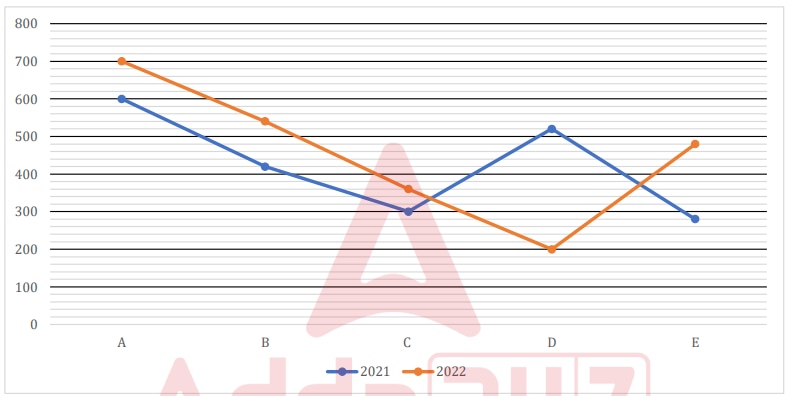
Note:
(i). Total number of items sold by each shops in 2023 is 20% more than that in 2021.
(ii). The total number of items sold by each shops in each year, which is given in the line graph, is one-third of the total items sold.
Total number of items sold by D in 2023 is what percentage less than the total number of items sold by A in 2022 (approx.)?- A.
23%
- B.
19%
- C.
11%
- D.
15%
- E.
8%
Correct answer: C
Solution
Concept
In a data-interpretation graph, the plotted figure may represent only a fraction of the real quantity. To recover an actual total from a fraction, multiply by the reciprocal of that fraction. To compare two actual quantities, the formula "how much percent X is less than Y" is (Y − X) / Y × 100.
Here each plotted point is one-third of the items actually sold, so an actual yearly total = 3 × (plotted value). A year-on-year growth of 20% over a base year multiplies the base total by 1.20.
Application
Read the required plotted points. D in 2021 = 520; A in 2022 = 700.
Find D's actual total in 2023. The 2023 total is 20% more than the 2021 total, so D(2023) = 3 × 520 × 1.20 = 1560 × 1.20 = 1872.
Find A's actual total in 2022. A(2022) = 3 × 700 = 2100.
Apply the percentage-less formula: (2100 − 1872) / 2100 × 100 = 228 / 2100 × 100 = 10.86%.
Round to the nearest given choice: 10.86% ≈ 11%.
Cross-check
Because every total carries the same factor of 3, the factor cancels in the ratio, so the percentage can be found straight from the plotted values: D(2023)-equivalent = 520 × 1.20 = 624 and A(2022) = 700, giving (700 − 624) / 700 × 100 = 10.86%. Both routes agree, confirming 11%.
- A.
- Q67.IBPS 2024
Read the following line graph carefully and answer the question given below. The line graph shows one-third of the total items sold by five different shops in two different years.
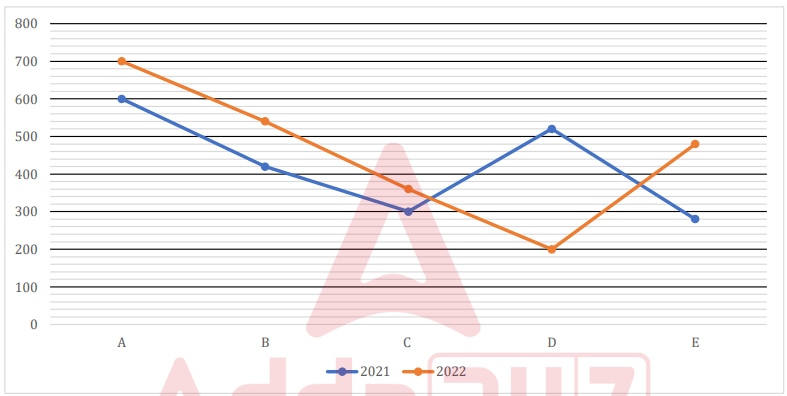
Note:
(i). The total number of items sold by each shop in 2023 is 20% more than that in 2021.
(ii). The number of items shown in the line graph for each shop in each year is one-third of the total items sold by that shop.
Find the ratio of the total number of items sold by B in 2022 to the total number of items sold by C in 2023.- A.
1:2
- B.
2:3
- C.
3:2
- D.
3:4
- E.
4:5
Correct answer: C
Solution
Concept
In a line-graph data-interpretation problem, first translate every plotted value into the actual quantity it represents using the scaling rule in the note, then read off only the two quantities the question asks about. Here the plotted value for any shop in any year equals one-third of that shop's total items, so the true total is 3 x (plotted value). A year that is not plotted (2023) is obtained from its stated percentage relation to a plotted year (2023 = 2021 + 20%).
Key relations:
Total items of a shop in a year = 3 x (value read from the graph) for that shop-year.
Total items in 2023 = 1.20 x (Total items in 2021) for the same shop.
Application
Required ratio: total items sold by B in 2022 to total items sold by C in 2023.
From the graph, B's plotted value in 2022 = 540, so B's total in 2022 = 3 x 540 = 1620.
From the graph, C's plotted value in 2021 = 300, so C's total in 2021 = 3 x 300 = 900.
C's total in 2023 = 1.20 x 900 = 1080 (applying the 20%-increase rule to the 2021 figure).
Ratio = 1620 : 1080. Dividing both by their HCF 540 gives 1620/540 = 3 and 1080/540 = 2.
So the required ratio is 3 : 2.
Cross-check
Because the one-third factor appears in BOTH quantities, it cancels, so the ratio can also be found straight from the graph-derived figures: B(2022) plotted = 540 and C(2023) plotted = 300 x 1.20 = 360, giving 540 : 360 = 3 : 2. Both routes agree, confirming 3 : 2.
- A.
- Q68.IBPS 2024
Read the following line graph carefully and answer the question given below. The line graph shows 1/3rd of the total items sold by five different shops in two different years.
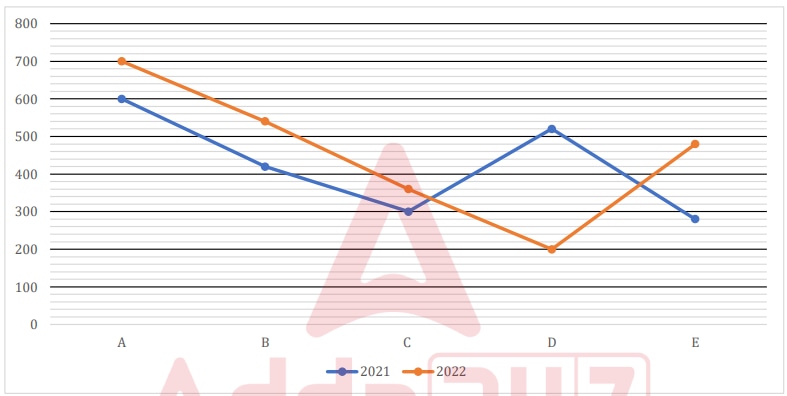
Note:
The total number of items sold by each shop in 2023 is 20% more than that in 2021.
The number shown in the line graph for each shop in each year is one-third of the total items sold by that shop in that year.
Find the difference between the total number of items sold by D and E together in 2023 and the total number of items sold by A and B together in 2021.
- A.
180
- B.
194
- C.
150
- D.
160
- E.
100
Correct answer: A
Solution
Concept: When a chart shows a fixed fraction of a quantity, recover the actual quantity by multiplying the charted value by the reciprocal of that fraction. Here every plotted point is one-third of the items sold, so actual items sold = 3 × (plotted value). A 20% increase means multiplying by 1.20 (i.e. value + value/5).
Application:
Recover actual items from the 2021 line (plotted value is one-third, so multiply by 3): A in 2021 = 3 × 600 = 1800; B in 2021 = 3 × 420 = 1260; D in 2021 = 3 × 520 = 1560; E in 2021 = 3 × 280 = 840.
A and B together in 2021 = 1800 + 1260 = 3060.
D and E together in 2021 = 1560 + 840 = 2400. By Note (i), 2023 is 20% more than 2021, so D and E together in 2023 = 2400 × 1.20 = 2880.
Required difference = 3060 - 2880 = 180.
Cross-check: work in plotted units first. A+B plotted = 600+420 = 1020; D+E plotted = 520+280 = 800, raised 20% = 960. Difference in plotted units = 1020 - 960 = 60, and the actual difference = 3 × 60 = 180, which agrees.
- Q69.IBPS 2024
Read the following line graph carefully and answer the questions given below. The line graph shows 1/3rd of the total items sold by five different shops in two different years.
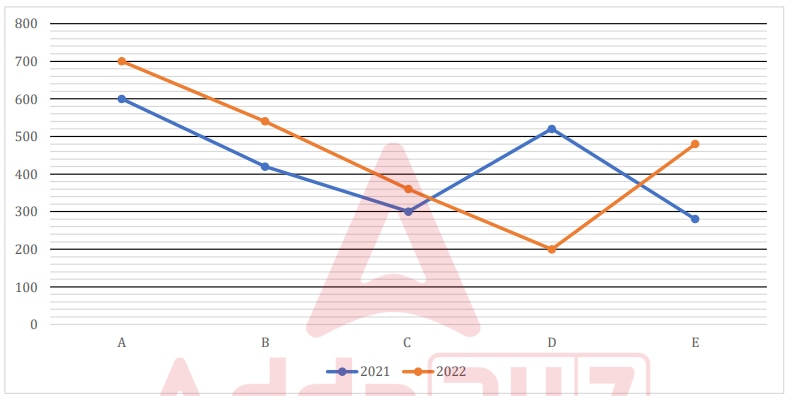
Note:
(i). Total number of items sold by each shops in 2023 is 20% more than that in 2021.
(ii). The total number of items sold by each shops in each year, which is given in the line graph, is one-third of the total items sold.
Find the sum of the total number of items sold by A, B and C in 2023.- A.
4235
- B.
4450
- C.
4980
- D.
4752
- E.
4898
Correct answer: D
Solution
Concept: When a chart shows only a fixed fraction of a whole, the whole is recovered by dividing by that fraction (here each plotted value is one-third of the actual total, so actual total = 3 x plotted value). A percentage increase of p% scales a quantity by the factor (1 + p/100); a 20% rise multiplies by 1.2.
Application: Read the 2021 (one-third) values from the line graph for shops A, B and C, scale each to the true 2021 total, then apply the 20% rise to get the 2023 total.
From the graph (2021), the plotted one-third values are A = 600, B = 420, C = 300.
Actual 2021 total per shop = 3 x plotted value: A = 1800, B = 1260, C = 900.
2023 total = 1.2 x 2021 total: A = 1.2 x 1800 = 2160, B = 1.2 x 1260 = 1512, C = 1.2 x 900 = 1080.
Sum for A, B and C in 2023 = 2160 + 1512 + 1080 = 4752.
Cross-check: The combined one-third 2021 value is 600 + 420 + 300 = 1320, so the actual 2021 sum is 3 x 1320 = 3960; raising it by 20% gives 3960 x 1.2 = 4752, matching the step-by-step result.
- A.
- Q70.IBPS 2024
Read the following line graph carefully and answer the questions given below. The line graph shows 1/3rd of the total items sold by five different shops in two different years.
Note:
(i). Total number of items sold by each shops in 2023 is 20% more than that in 2021.
(ii). The total number of items sold by each shops in each year, which is given in the line graph, is one-third of the total items sold.
Total number of items sold by B and D together in 2023 is how many more or less than the total number of items sold by A in all three years together.- A.
2676
- B.
2194
- C.
2150
- D.
2058
- E.
2100
Correct answer: A
Solution
Concept
In a data-interpretation graph, a plotted value can represent a fixed fraction of an actual total. Here each plotted point is one-third of the items sold, so the actual items sold = 3 x (plotted value). A stated year-on-year growth of r% multiplies a base total by (1 + r/100). To compare two groups, convert every plotted value to an actual total using these two rules, then add and subtract as the question demands.
Applying it to this problem
Read the plotted values. For 2021: A = 600, B = 420, D = 520. For 2022: A = 700.
Convert each plotted value to an actual total by multiplying by 3. 2021 actual totals -> A = 1800, B = 1260, D = 1560; 2022 actual total -> A = 2100.
Build 2023 from the growth note: 2023 total = 2021 total x 1.20. So A(2023) = 1800 x 1.20 = 2160, B(2023) = 1260 x 1.20 = 1512, D(2023) = 1560 x 1.20 = 1872.
Required group 1 - B and D together in 2023 = 1512 + 1872 = 3384.
Required group 2 - A across all three years = A(2021) + A(2022) + A(2023) = 1800 + 2100 + 2160 = 6060.
Take the difference: 6060 - 3384 = 2676. So A across the three years exceeds B and D of 2023 by 2676.
Cross-check
Re-add A's three years independently: 1800 + 2100 = 3900, then 3900 + 2160 = 6060. Re-add the group: 1512 + 1872 = 3384. The gap 6060 - 3384 = 2676 is confirmed, so the magnitude asked for is 2676.
- A.
- Q71.IBPS 2024
In each of these questions a number series is given. In each series only one number is wrong. Find out the wrong number.
188, 177, 199, 166, 210, 150, 221- A.
188
- B.
221
- C.
150
- D.
199
- E.
210
Correct answer: C
Solution
Concept
In an alternating number series, two operations act in turn on consecutive terms. Here each step alternates between subtraction and addition, and the magnitude of the change grows by 11 every step: subtract 11, add 22, subtract 33, add 44, subtract 55, add 66. The one term that does not result from this fixed rule is the wrong number.
Application
Apply the rule to 188 step by step and compare each result with the given term:
188 − 11 = 177 (matches the given 177)
177 + 22 = 199 (matches the given 199)
199 − 33 = 166 (matches the given 166)
166 + 44 = 210 (matches the given 210)
210 − 55 = 155 (the given term here is 150, not 155 — this is the break)
155 + 66 = 221 (matches the given 221, confirming 155 is the intended value at the previous step)
Every step obeys the rule except the sixth term, where the series shows 150 instead of the required 155.
Cross-check
Read the series as two interleaved chains. The terms in the 1st, 3rd, 5th and 7th places are 188, 199, 210, 221 — a clean +11 chain. The terms in the 2nd, 4th and 6th places should be 177, 166, 155 — a clean −11 chain — but the series gives 177, 166, 150. The 150 again breaks the −11 chain, so 150 is the wrong number and should be 155.
- A.
- Q72.IBPS 2024
In each of these questions a number series is given. In each series only one number is wrong. Find out the wrong number.
210, 228, 250, 274, 302, 332, 365
- A.
302
- B.
332
- C.
210
- D.
250
- E.
365
Correct answer: E
Solution
Concept
In a difference-pattern number series, you do not look at the terms themselves but at the gaps (first differences) between consecutive terms. When those gaps do not grow by a constant amount, examine the second differences — how each gap changes from the previous gap. The wrong term is the one that forces a single break in an otherwise regular second-difference pattern.
Application
Write the first differences of 210, 228, 250, 274, 302, 332, 365:
228 - 210 = 18
250 - 228 = 22
274 - 250 = 24
302 - 274 = 28
332 - 302 = 30
365 - 332 = 33
Now look at how each gap grows over the previous gap (the second differences): 22-18 = +4, 24-22 = +2, 28-24 = +4, 30-28 = +2. The gaps increase by a steady alternating step of +4, +2, +4, +2, ... So the next increase must again be +4, which means the sixth gap should be 30 + 4 = 34, not 33.
With a gap of 34, the final term must be 332 + 34 = 366. The series prints 365, which makes the last gap only 33 and breaks the +4 / +2 alternation.
Cross-check
Rebuild the full series using the gaps 18, 22, 24, 28, 30, 34: 210, 228, 250, 274, 302, 332, 366. Every second difference is now exactly +4, +2, +4, +2, +4 with no exception, confirming that the printed 365 is the lone wrong number and the intended value is 366.
- A.
- Q73.IBPS 2024
In each of these questions a number series is given. In each series only one number is wrong. Find out the wrong number.
18225, 6075, 2025, 675, 220, 75, 25
- A.
25
- B.
75
- C.
220
- D.
18225
- E.
6075
Correct answer: C
Solution
Concept
In a 'find the wrong number' series, first identify the single rule that links each term to the next (a constant ratio, a constant difference, or a fixed operation). Once the rule is fixed, the one term that violates it is the wrong number.
Application
Test the ratio between consecutive terms from the left:
18225 ÷ 3 = 6075 — holds
6075 ÷ 3 = 2025 — holds
2025 ÷ 3 = 675 — holds
675 ÷ 3 = 225, but the series shows 220 — breaks the rule
225 ÷ 3 = 75 — holds
75 ÷ 3 = 25 — holds
The governing rule is 'divide the previous term by 3.' Every step obeys it except the fifth term, where the value should be 225 but appears as 220.
Cross-check
Replace 220 with 225 and read the corrected series: 18225, 6075, 2025, 675, 225, 75, 25. Now 225 ÷ 3 = 75 and 75 ÷ 3 = 25, so every consecutive pair has the exact ratio 3. This confirms 220 is the only term that does not fit, so 220 is the wrong number.
- A.
- Q74.IBPS 2024
In each of these questions a number series is given. In each series only one number is wrong. Find out the wrong number.
304, 300, 316, 332, 364, 428, 556- A.
300
- B.
316
- C.
304
- D.
332
- E.
428
Correct answer: A
Solution
Concept
In a “find the wrong number” series, first identify the single arithmetic rule that the differences between consecutive terms follow. Here the rule is that each term is obtained by adding a growing increment that doubles at every step — i.e. the additions form a geometric chain (+4, +8, +16, +32, …), each twice the previous one.
Application
Start from the first term, 304, and apply the doubling-increment rule one step at a time:
304 + 4 = 308
308 + 8 = 316
316 + 16 = 332
332 + 32 = 364
364 + 64 = 428
428 + 128 = 556
So the series that perfectly obeys the rule is 304, 308, 316, 332, 364, 428, 556.
Cross-check
Compare this rule-consistent series with the printed one (304, 300, 316, 332, 364, 428, 556). Every term matches except the second: the rule demands 308, but the series prints 300. Hence the term 300 breaks the doubling-increment pattern and is the wrong number; replacing it with 308 restores the +4, +8, +16, +32, +64, +128 chain.
- A.
- Q75.IBPS 2024
In each of these questions a number series is given. In each series only one number is wrong. Find out the wrong number.
2194, 2175, 2152, 2123, 2092, 2054, 2014- A.
2014
- B.
2054
- C.
2194
- D.
2092
- E.
2123
Correct answer: B
Solution
Concept
In a 'find the wrong number' series, every term is produced from the previous one by a fixed rule. To locate the odd term, compute the differences between consecutive terms and look for the hidden pattern in those differences. Exactly one term breaks the pattern.
Application
Take the differences between consecutive terms, left to right:
2194 - 2175 = 19
2175 - 2152 = 23
2152 - 2123 = 29
2123 - 2092 = 31
2092 - 2054 = 38
2054 - 2014 = 40
The first four gaps are 19, 23, 29, 31 - these are consecutive prime numbers. The next prime after 31 is 37, so the fifth gap should be 37, giving 2092 - 37 = 2055. The series instead shows 2054, a gap of 38, which is not the required prime. So 2054 is the wrong term; it should be 2055.
Cross-check
Replace 2054 with 2055 and continue with the next prime, 41: 2055 - 41 = 2014, which matches the final term. The full corrected gap sequence is 19, 23, 29, 31, 37, 41 - six consecutive primes - confirming 2054 is the only term that violates the rule.
- A.
- Q76.IBPS 2024
What approximate value will come in place of question mark (?) in the following questions (You are not expected to calculate the exact value).
5.03% 𝑜𝑓 39.89 + 10.09% 𝑜𝑓 450 =?- A.
44
- B.
47
- C.
39
- D.
54
- E.
59
Correct answer: B
Solution
Approximate 5.03% of 39.89 as 5% of 40 = 2, and 10.09% of 450 as about 45.4. Total is about 47.4, so the closest option is 47.
- A.
- Q77.IBPS 2024
What approximate value will come in place of question mark (?) in the following questions (You are not expected to calculate the exact value).

- A.
59
- B.
53
- C.
65
- D.
50
- E.
43
Correct answer: A
Solution
Concept
In an approximation problem, replace each term by the nearest value that is easy to compute, then solve. Three standard rounding tools: a square root close to a perfect square equals that root; a fraction "of" a number is a multiplication; and a near-integer decimal rounds to the integer.
Application
Square root: √840.99 ≈ √841 = 29, because 292 = 841.
Fraction of a number: (14/19) of 361.09 ≈ (14/19) × 361. Since 361 ÷ 19 = 19, this is 14 × 19 = 266.
Add the two parts: 29 + 266 = 295.
Solve for the unknown: 295 = ? × 4.88, so ? = 295 ÷ 4.88 ≈ 60.46.
Cross-check
Among the offered values, 60.46 is nearest to 59 (59 × 4.88 = 287.9, only about 7 away from 295), while the next closest, 65, gives 65 × 4.88 = 317.2 — over 22 away. So 59 is the intended approximate answer.
- A.
- Q78.IBPS 2024
What approximate value will come in place of the question mark (?) in the following expression? (You are not expected to calculate the exact value.)

12.213 − 108.02 = 24.90% of 399 + ?
- A.
1090
- B.
1120
- C.
1240
- D.
1520
- E.
1130
Correct answer: D
Solution
Concept
In approximation (simplification) problems, round each quantity to the nearest convenient value before computing, then solve for the unknown. A cube grows fast, so a small rounding of the base is the dominant simplification: round the base first, then cube it. The standard rounding here is 12.21 → 12, 108.02 → 108, and 24.90% of 399 → 25% of 400.
Application
Approximate the cube by rounding the base: 12.213 ≈ 123 = 1728.
Approximate the subtracted term: 108.02 ≈ 108.
Approximate the percentage: 24.90% of 399 ≈ 25% of 400 = 100.
Substitute into 12.213 − 108.02 = 24.90% of 399 + ? to get 1728 − 108 = 100 + ?.
Simplify the left side: 1728 − 108 = 1620, so 1620 = 100 + ?.
Solve for ?: ? = 1620 − 100 = 1520.
Cross-check
Reverse it: 100 + 1520 = 1620, and 1620 + 108 = 1728 = 123, which recovers the rounded left-hand side. Exact arithmetic gives 12.213 ≈ 1820.3 and 24.90% of 399 ≈ 99.35, so the unrounded value of ? is about 1613; the base-rounding 12.21 → 12 that this "approximate value" instruction expects lands on 1520, which is also by far the nearest of the values offered.
- A.
- Q79.IBPS 2024
What approximate value will come in place of question mark (?) in the following questions (You are not expected to calculate the exact value).

- A.
29
- B.
24
- C.
17
- D.
12
- E.
20
Correct answer: E
Solution
Concept
In an approximation problem, round every number to the nearest convenient figure, evaluate the expression in the rounded form, and read off the option closest to the result. Two rules drive this item: a percentage means (rate/100) × base, and dividing by a fraction equals multiplying by its reciprocal, so ÷ (1/4) = × 4. Once the left side is a number N and the equation reads N = ?2 − 16, solve for ? as the square root of (N + 16).
Application
Round the values: 32.08% ≈ 32%, 599 ≈ 600, 1.99 ≈ 2.
Percentage: 32% of 600 = (32/100) × 600 = 192.
Divide by 1.99 ≈ 2: 192 ÷ 2 = 96.
Divide by the fraction: 96 ÷ (1/4) = 96 × 4 = 384. This is the value of the whole left-hand side, N.
Set up the equation: 384 = ?2 − 16, so ?2 = 384 + 16 = 400.
Take the square root: ? = √400 = 20.
Cross-check
Using the unrounded numbers: 32.08% of 599 = 192.16; ÷ 1.99 = 96.56; × 4 = 386.25; + 16 = 402.25; √402.25 ≈ 20.06. This rounds cleanly to 20, confirming the rounded computation. The value 20 is the result.
- A.
- Q80.IBPS 2024
What approximate value will come in place of question mark (?) in the following questions (You are not expected to calculate the exact value).

- A.
91
- B.
96
- C.
103
- D.
87
- E.
67
Correct answer: B
Solution
Concept
In an "approximate value" question, replace every messy decimal with the nearest convenient whole number and then evaluate the expression with those rounded numbers. The structure here is (A ÷ B) = ? ÷ C, which rearranges to ? = (A ÷ B) × C. A ÷ B is itself a division of two fractions, and dividing by a fraction means multiplying by its reciprocal.
Application
Round each value to its nearest whole number: 256.03 ≈ 256, 15.99 ≈ 16, 3.98 ≈ 4, 1.99 ≈ 2, 12.01 ≈ 12.
First fraction: 256 ÷ 16 = 16.
Second fraction: 4 ÷ 2 = 2.
Divide the two results: 16 ÷ 2 = 8. So the whole left-hand side ≈ 8.
The equation now reads 8 = ? ÷ 12, so multiply both sides by 12: ? = 8 × 12 = 96.
Cross-check
Using the unrounded values, (256.03 ÷ 15.99) ÷ (3.98 ÷ 1.99) × 12.01 ≈ 96.15, which rounds to 96 — confirming the estimate is on target and not borderline between two options.
- A.
- Q81.IBPS 2024
A, B and C together can do a work in 4 days, while B alone can do the same work in 24 days. If efficiency of C is 300% more than that of B, then find the difference between number of days taken by A and C to complete the work alone?
- A.
18
- B.
12
- C.
11
- D.
15
- E.
20
Correct answer: A
Solution
B's one-day work is 1/24. C is 300% more efficient than B, so C's rate is 4/24 = 1/6. A + B + C together do 1/4 work per day, so A's rate is 1/4 - 1/24 - 1/6 = 1/24. A takes 24 days and C takes 6 days; the difference is 18 days.
- A.
- Q82.IBPS 2024
The ratio of present age of P to age of Q four years ago is 2 : 1. Present age of R is equal to average of present age of P and Q. 16 years ago, age of R was 10 years. Find the sum of present age of P, Q and R (in years)?
- A.
66 years
- B.
78 years
- C.
82 years
- D.
99 years
- E.
102 years
Correct answer: B
Solution
Present age of R is 10 + 16 = 26 years. Since R is the average of P and Q, P + Q = 52. Also P : (Q - 4) = 2 : 1, so P = 2Q - 8. Solving gives Q = 20 and P = 32, hence P + Q + R = 78 years.
- A.
- Q83.IBPS 2024
An amount of Rs. 12200 is partly invested in scheme A at 10% p.a. on compound interest for two years and in scheme B at the same rate on simple interest for four years. If the interest received from both the schemes is equal, then find the amount invested in scheme A?
- A.
Rs.4350
- B.
Rs.4340
- C.
Rs.4200
- D.
Rs.8000
- E.
Rs.8500
Correct answer: D
Solution
Concept: For a principal P at rate r% for time t, the Compound Interest over 2 years = P[(1 + r/100)2 − 1], and the Simple Interest = P × r × t / 100. When a total sum is split into two parts whose interests must be equal, equate the two interest expressions and solve the resulting linear equation for the unknown part.
Let the amount invested in scheme A be Rs. x; then scheme B receives Rs. (12200 − x).
Interest from A (compound, 10% p.a., 2 years) = x[(1 + 10/100)2 − 1] = x(1.21 − 1) = 0.21x.
Interest from B (simple, 10% p.a., 4 years) = (12200 − x) × 10 × 4 / 100 = 0.40 × (12200 − x).
Equate the interests: 0.21x = 0.40 × (12200 − x) → 0.21x = 4880 − 0.40x → 0.61x = 4880 → x = 4880 / 0.61 = 8000.
Cross-check: Interest from A = 0.21 × 8000 = Rs. 1680; Interest from B = 0.40 × (12200 − 8000) = 0.40 × 4200 = Rs. 1680. Both interests are equal, so the amount invested in scheme A is Rs. 8000.
A video solution is available for this question — log in and enroll to watch it.
- A.
- Q84.IBPS 2024
A, B and C started a business with investment of Rs. 12,000, Rs. 12,000 and Rs. 8,000 respectively. B invested only for ‘x’ months, while C left the business ‘x’ month before a year. If A got Rs 1800 out of annual profit of Rs 3200, then find the value of ‘x’?
- A.
2
- B.
8
- C.
6
- D.
4
- E.
5
Correct answer: D
Solution
A's time-weighted investment = 12000 x 12 = 144000.
B's time-weighted investment = 12000x, and C's = 8000(12 - x).
A's profit share is 1800/3200 = 9/16.
So 144000 / [144000 + 12000x + 8000(12 - x)] = 9/16, which gives x = 4.
A video solution is available for this question — log in and enroll to watch it.
- A.
- Q85.IBPS 2024
Train A crosses a 230 meters long platform in 29 seconds and train B crosses a 150 meters long platform in 24 seconds. Train B having length of 450 meters crosses train A in 160 seconds, while running in the same direction. Find how much time will the train A take to cross a 50 meters long bridge (Speed of train B > speed of train A)?
- A.
16 seconds
- B.
22 seconds
- C.
20 seconds
- D.
17 seconds
- E.
25 seconds
Correct answer: C
Solution
Concept
When a train crosses a stationary object (platform or bridge), the distance covered equals the train's own length plus the object's length, and time = distance / speed. When one train crosses another while both move in the same direction, the effective distance is the sum of their lengths and the effective speed is the difference of their speeds (relative speed).
Application
Speed of train B: B is 450 m long and crosses a 150 m platform, so it covers 450 + 150 = 600 m in 24 s, giving speed of B = 600 / 24 = 25 m/s.
Length of train A in terms of its speed: A crosses a 230 m platform in 29 s, so length of A + 230 = 29 x (speed of A).
Same-direction crossing: B crosses A in 160 s, covering (450 + length of A) at relative speed (25 - speed of A). So 450 + length of A = 160 x (25 - speed of A).
Substitute length of A = 29 x (speed of A) - 230: 450 + 29 x (speed of A) - 230 = 4000 - 160 x (speed of A), i.e. 220 + 29 x (speed of A) = 4000 - 160 x (speed of A).
Collect terms: 189 x (speed of A) = 3780, so speed of A = 20 m/s, and length of A = 29 x 20 - 230 = 350 m.
Time for A to cross a 50 m bridge = (350 + 50) / 20 = 400 / 20 = 20 seconds.
Cross-check
With speed of A = 20 m/s and speed of B = 25 m/s, relative speed = 5 m/s and combined length = 450 + 350 = 800 m, so B crosses A in 800 / 5 = 160 s, matching the given data. Also speed of B (25) > speed of A (20), consistent with the stated condition.
- A.
- Q86.IBPS 2024
The ratio of speed of a boat in still water to the speed of boat in upstream 4 : 3. The boat covers 560 km in 7 hours in downstream. Find the time taken by boat to cover 480 km distance in upstream?
- A.
8 hours
- B.
9 hours
- C.
7 hours
- D.
5 hours
- E.
10 hours
Correct answer: E
Solution
Let upstream speed be 3k and boat speed in still water be 4k; then downstream speed is 5k. Downstream speed = 560/7 = 80, so k = 16 and upstream speed = 48 km/h. Time for 480 km upstream = 480/48 = 10 hours.
- A.
- Q87.IBPS 2024
A mark an article 60% above its cost price. When he allows 4d% discount on marked price he earns 28% profit. If he allows 6d% discount, then find the profit/ or loss %?
- A.
12%
- B.
15%
- C.
18%
- D.
20%
- E.
24%
Correct answer: A
Solution
Let the cost price be 100. The marked price is 160. A profit of 28% means the selling price is 128, so a 4d% discount equals 20%, giving d = 5. A 6d% discount is 30%, so the new selling price is 160 x 70% = 112. Hence the profit is 12%.
A video solution is available for this question — log in and enroll to watch it.
- A.
- Q88.IBPS 2024
The ratio of milk and water in mixture A is 9: 5. The quantity of milk in mixture B is 20% more that in mixture A and quantity of water in mixture A is 25% more than that in mixture B. If sum of quantity of water of both mixture is 54 liters, then find the total quantity of mixture in A?
- A.
72 liters
- B.
64 liters
- C.
84 liters
- D.
75 liters
- E.
80 liters
Correct answer: C
Solution
Let mixture A have milk : water = 9x : 5x.
Milk in B is 20% more than milk in A, and water in A is 25% more than water in B, so water in B = 5x/1.25 = 4x.
Total water = 5x + 4x = 54, so x = 6.
Total quantity in A = 9x + 5x = 14x = 84 liters.
A video solution is available for this question — log in and enroll to watch it.
- A.
- Q89.IBPS 2024
The average weight of 24 boys and 6 girls in a class is 40 kg. If the weight of all the girls excluded the average weight of the class is reduced by 4 kg, then find the average weight of all the six girls?
- A.
52 kg
- B.
56 kg
- C.
58 kg
- D.
55 kg
- E.
51 kg
Correct answer: B
Solution
Total weight of 30 students = 30 x 40 = 1200 kg.
After excluding the 6 girls, the average of 24 boys is reduced by 4 kg, so boys' average = 36 kg.
Total weight of boys = 24 x 36 = 864 kg.
Total weight of girls = 1200 - 864 = 336 kg, so average girls' weight = 336/6 = 56 kg.
A video solution is available for this question — log in and enroll to watch it.
- A.
- Q90.IBPS 2024
The ratio of area of a square and area of a rectangle is 3:2 respectively. The side of square is equal to length of the rectangle. The perimeter of the rectangle is 40 meters, then find the breadth of the rectangle?
- A.
12 m
- B.
8 m
- C.
10 m
- D.
15 m
- E.
17 m
Correct answer: B
Solution
Let the side of the square and length of the rectangle be L, and the breadth of the rectangle be B.
Area ratio = L^2 : L B = L : B = 3 : 2, so L = 3B/2.
Perimeter of rectangle = 40, so L + B = 20.
Thus 3B/2 + B = 20, giving 5B/2 = 20 and B = 8 m.
- A.
- Q91.IBPS 2024
Read the following data carefully and answer the questions given below.
The data shows the three different people (A, B & C) win or lose multiple games. Total games win by B is 50 and the ratio of game win by A and games lose by B is 3:2 respectively. The ratio of total games loses by A to total games win by A is 4:3. The average of number of games lose by A and win by B is 105. Total games win by C is 20% more than total games loss of B and the ratio of total games win to lose by C is 4 : 5.
Total games lose by B is what percentage of the total games win by A?- A.
66.67%
- B.
32.5%
- C.
8.33%
- D.
62.5%
- E.
None of these
Correct answer: A
Solution
From (A losses + 50)/2 = 105, A losses = 160. Since A losses : A wins = 4:3, A wins = 120. Also A wins : B losses = 3:2, so B losses = 80. Therefore B losses as a percentage of A wins = 80/120 x 100 = 66.67%.
- A.
- Q92.IBPS 2024
Read the following data carefully and answer the question given below.
Three people (A, B and C) each win or lose multiple games. Total games won by B is 50, and the ratio of games won by A to games lost by B is 3 : 2. The ratio of total games lost by A to total games won by A is 4 : 3. The average of the number of games lost by A and games won by B is 105. Total games won by C is 20% more than total games lost by B, and the ratio of total games won to lost by C is 4 : 5.
Find the sum of total games lost by B and A.- A.
210
- B.
220
- C.
250
- D.
320
- E.
240
Correct answer: E
Solution
Concept
In a chained ratio / averages problem, anchor on the one quantity that is fully fixed by an absolute condition (here an average that involves a known value), then propagate that value through each given ratio in turn. A ratio x : y between two quantities means each is a fixed multiple of a common unit, so once one term is numeric the other follows by simple proportion.
Application
Anchor with the average. The average of (games lost by A) and (games won by B) is 105, and games won by B = 50. So games lost by A = 2 × 10⁵ − 50 = 210 − 50 = 160.
Use lost A : won A = 4 : 3. Lost by A = 160 corresponds to 4 parts, so 1 part = 40 and games won by A = 3 × 40 = 120.
Use won A : lost B = 3 : 2. Won by A = 120 corresponds to 3 parts, so 1 part = 40 and games lost by B = 2 × 40 = 80.
Required sum = (games lost by B) + (games lost by A) = 80 + 160 = 240.
Cross-check
Back-substitute the unit value 40: lost A = 4×40 = 160 and won A = 3×40 = 120 keep the 4 : 3 ratio; won A = 120 and lost B = 80 keep the 3 : 2 ratio; and (160 + 50)/2 = 105 reproduces the given average. The C data (won C = 1.2 × 80 = 96, lost C = 96 × 5/4 = 120) is consistent but not needed for this sum, confirming 240.
- A.
- Q93.IBPS 2024
Read the following data carefully and answer the questions given below.
The data shows the three different people (A, B & C) win or lose multiple games. Total games win by B is 50 and the ratio of game win by A and games lose by B is 3:2 respectively. The ratio of total games loses by A to total games win by A is 4:3. The average of number of games lose by A and win by B is 105. Total games win by C is 20% more than total games loss of B and the ratio of total games win to lose by C is 4 : 5.
If the total games lose by D are 25% more than that of A and the total games win by D are five more than half of the total games win by C, then find the difference between the total games lose and total games win by D.- A.
147
- B.
149
- C.
142
- D.
139
- E.
129
Correct answer: A
Solution
A losses = 160, so A wins = 120. Then B losses = 80. C wins are 20% more than B losses, so C wins = 96. D wins = 96/2 + 5 = 53, and D losses = 25% more than A losses = 200. The difference is 200 - 53 = 147.
- A.
- Q94.IBPS 2024
Read the following data carefully and answer the questions given below.
The data shows the three different people (A, B & C) win or lose multiple games. Total games win by B is 50 and the ratio of game win by A and games lose by B is 3:2 respectively. The ratio of total games loses by A to total games win by A is 4:3. The average of number of games lose by A and win by B is 105. Total games win by C is 20% more than total games loss of B and the ratio of total games win to lose by C is 4 : 5
Find the average of total games win by A & B and total games lose by C.- A.
98.25
- B.
91.67
- C.
83.33
- D.
96.67
- E.
129
Correct answer: D
Solution
Concept
In data-interpretation chain problems, every unknown is pinned by working the given ratios and averages in the right order. Two identities drive this set: an average of two quantities equals their sum divided by 2, and a ratio a:b lets you scale one quantity from the other. Start from the one fully-known value and propagate.
Application
Games won by B is given as 50.
The average of (games lost by A) and (games won by B) is 105, so their sum is 210; subtracting B's 50 wins gives games lost by A = 160.
Games lost by A : games won by A = 4 : 3, so games won by A = 160 × 3/4 = 120.
Games won by A : games lost by B = 3 : 2, so games lost by B = 120 × 2/3 = 80.
Games won by C is 20% more than games lost by B = 80 × 1.2 = 96.
Games won by C : games lost by C = 4 : 5, so games lost by C = 96 × 5/4 = 120.
Required average = (games won by A + games won by B + games lost by C) / 3 = (120 + 50 + 120) / 3 = 290 / 3 = 96.67.
Cross-check
Re-trace the dependency: 160 lost by A scaled by 3/4 gives 120 won by A; 120 scaled by 2/3 gives 80 lost by B; 80 grown by 20% gives 96 won by C; 96 scaled by 5/4 gives 120 lost by C. The three target quantities 120, 50 and 120 sum to 290, and 290 ÷ 3 = 96.67, confirming the result.
- A.
- Q95.IBPS 2024
Directions: Each question consists of two conclusions followed by some statements. Consider the given conclusions to be true even if they seem to be at variance with commonly known facts. Read the conclusions and then decide which of the following statement is true for given conclusions.
Conclusions:
I. All number can never be digit
II. Some digit being letter is a possibility- A.
Statements: All series is number; Some series is digit; Only a few letter is number
- B.
Statements: Only a few series is digit; All series is number; Some letter is number
- C.
Statements: No digit is series; No series is number; All number is letter
- D.
Statements: Only digit is letter; Some digit is number; Only a few series is number
- E.
Statements: No digit is letter; Only a few letter is number; Only a few number is series
Correct answer: B
Solution
Concept
In a statement-conclusion (reverse syllogism) problem the two conclusions are fixed, and you must pick the single statement set from which BOTH conclusions definitely follow. Three rules govern this: a definite negative (“No X is Y”) makes that overlap permanently impossible; any set that leaves a denied overlap open fails the conclusion that denies it; and a “possibility” conclusion holds only when no statement definitely blocks that overlap. Read “All number can never be digit” as “it must be guaranteed that at least one number is NOT a digit” (so “all numbers are digits” is ruled out), and “Some digit being letter is a possibility” as “the digit–letter overlap must stay possible.” Note “Only a few X is Y” means some X are Y and some X are NOT Y.
Applying it to each set
{All series is number; Some series is digit; Only a few letter is number}: this forces some number to be a digit but never forces any number to lie outside digit, so “all numbers are digits” is left open — conclusion I is not secured.
{Only a few series is digit; All series is number; Some letter is number}: “only a few series is digit” gives series that are NOT digit, and since every series is a number, those are numbers that are not digits — so “all numbers are digits” is impossible, securing conclusion I; with no statement forbidding a digit from being a letter, the digit–letter overlap of conclusion II stays open. Both follow.
{No digit is series; No series is number; All number is letter}: nothing here pushes any number outside digit, so “all numbers are digits” is not ruled out — conclusion I is not secured.
{Only digit is letter; Some digit is number; Only a few series is number}: this guarantees some number IS a digit but never that some number is NOT a digit, leaving “all numbers are digits” open — conclusion I is missed.
{No digit is letter; Only a few letter is number; Only a few number is series}: “No digit is letter” permanently blocks any digit from being a letter, so the overlap demanded by conclusion II can never happen.
Cross-check
Only the set {Only a few series is digit; All series is number; Some letter is number} satisfies both conclusions at once: it guarantees a number outside digit (conclusion I) while leaving the digit–letter overlap free (conclusion II). Each rejected set breaks exactly one of the two conclusions, confirming this is the unique consistent choice.
- A.
- Q96.IBPS 2024
Directions: A word/number arrangement machine is given an input line of words and numbers; it arranges them following a particular rule in each step. The following is an illustration of input and its arrangement:
Input: triangle 45 38 galaxy 93 puzzle 27 velocity rhythm 84
Step I: 88 triangle 45 38 puzzle 27 velocity rhythm 84 aaglxy
Step II: 87 88 triangle 45 38 27 velocity rhythm aaglxy eulpzz
Step III: 40 87 88 triangle 38 27 velocity aaglxy eulpzz hhmrty
Step IV: 41 40 87 88 27 velocity aaglxy eulpzz hhmrty aeiglnrt
Step V: 22 41 40 87 88 aaglxy eulpzz hhmrty aeiglnrt eiocltvy
Based on the above example, rearrange the below input:
Input: shadow 74 19 magnet 52 forest 68 bridge whistle 31Which element is 5th to the right of second least number in step V?
- A.
eibdgr
- B.
31
- C.
eofrst
- D.
aegmnt
- E.
None of these
Correct answer: C
Solution
Concept
In an input–output arrangement machine, every step rearranges the line using one fixed, hidden rule. Decode the rule once from the worked example, then apply the very same rule mechanically to the new input. Here two independent operations run together in each step: one number is shifted to the LEFT end and one word is shifted to the RIGHT end.
The decoded rule
Numbers go to the LEFT, largest first. The largest remaining number moves to the front each step; numbers are picked in descending order: 74, 68, 52, 31, 19.
The number is changed before it lands: the 1st, 3rd, 5th number picked is reduced by 5; the 2nd and 4th picked is increased by 3. So 74−5=69, 68+3=71, 52−5=47, 31+3=34, 19−5=14.
Words go to the RIGHT, in alphabetical order: bridge, forest, magnet, shadow, whistle.
Each word is rewritten by placing its vowels in alphabetical order first, then its consonants in alphabetical order. Example: forest → vowels e, o then consonants f, r, s, t → "eofrst".
Applying it to the input
Input: shadow 74 19 magnet 52 forest 68 bridge whistle 31
Step I: 69 shadow 19 magnet 52 forest 68 whistle 31 eibdgr
Step II: 71 69 shadow 19 magnet 52 whistle 31 eibdgr eofrst
Step III: 47 71 69 shadow 19 whistle 31 eibdgr eofrst aegmnt
Step IV: 34 47 71 69 19 whistle eibdgr eofrst aegmnt aodhsw
Step V: 14 34 47 71 69 eibdgr eofrst aegmnt aodhsw eihlstw
Reading the answer
In Step V the five numbers are 14, 34, 47, 71, 69. The least is 14 and the second least is 34. Counting five positions to the right of 34 (47, 71, 69, eibdgr, eofrst) lands on "eofrst". So the required element is eofrst.
Cross-check
Re-running the same rule on the original illustration reproduces all five of its given steps exactly (93−5=88, 84+3=87, …; galaxy→aaglxy, puzzle→eulpzz, …), which confirms the decoded rule is correct.
- A.
- Q97.IBPS 2024
Directions: A word/number arrangement machine is given an input line of words and numbers; it arranges them following a particular rule in each step. The following is an illustration of input and its arrangement:
Input: triangle 45 38 galaxy 93 puzzle 27 velocity rhythm 84
Step I: 88 triangle 45 38 puzzle 27 velocity rhythm 84 aaglxy
Step II: 87 88 triangle 45 38 27 velocity rhythm aaglxy eulpzz
Step III: 40 87 88 triangle 38 27 velocity aaglxy eulpzz hhmrty
Step IV: 41 40 87 88 27 velocity aaglxy eulpzz hhmrty aeiglnrt
Step V: 22 41 40 87 88 aaglxy eulpzz hhmrty aeiglnrt eiocltvy
Based on the above example, rearrange the below input:
Input: shadow 74 19 magnet 52 forest 68 bridge whistle 31What is sum of all the odd numbers in step II?
- A.
110
- B.
147
- C.
128
- D.
117
- E.
198
Correct answer: E
Solution
Concept
In an input-output "machine" question, first decode the fixed rule from the worked example, then apply that exact rule to the new input. Read the per-step rule by comparing consecutive steps: identify (a) the order in which items are picked, and (b) any value transformation applied to a picked item.
The rule from the example
In every step the largest remaining number is moved to the far-left after being transformed, while one word is sent to the right. The number transformation is parity-based: an odd number is reduced by 5, and an even number is increased by 3.
Verify on the example: 93 (odd) becomes 88, 84 (even) becomes 87, 45 (odd) becomes 40, 38 (even) becomes 41, 27 (odd) becomes 22. Every move fits, and numbers are processed in descending order.
Apply to the new input
New input numbers: 74, 19, 52, 68, 31. Descending order: 74, 68, 52, 31, 19.
Step I picks the largest, 74 (even), and transforms it to 74 + 3 = 77 at the far left. Numbers still in the middle: 19, 52, 68, 31.
Step II picks the next largest, 68 (even), and transforms it to 68 + 3 = 71, placed to the far left of 77. The numbers still untransformed in the middle are 19, 52, 31.
Therefore the numbers present in Step II are 77, 71, 19, 52 and 31.
Odd numbers in Step II: 77, 71, 19 and 31. Sum = 77 + 71 + 19 + 31 = 198.
Cross-check
The example's Step II literally reads "87 88 triangle 45 38 27 ...": it contains both the transformed left numbers (87, 88) and the not-yet-processed middle numbers (45, 38, 27). So a step genuinely contains both kinds of numbers. The same reading on the new input gives the odd-number set {77, 71, 19, 31} and the sum 198.
- A.
- Q98.IBPS 2024
Directions: A word/number arrangement machine is given an input line of words and numbers; it arranges them following a particular rule in each step. The following is an illustration of input and its arrangement:
Input: triangle 45 38 galaxy 93 puzzle 27 velocity rhythm 84
Step I: 88 triangle 45 38 puzzle 27 velocity rhythm 84 aaglxy
Step II: 87 88 triangle 45 38 27 velocity rhythm aaglxy eulpzz
Step III: 40 87 88 triangle 38 27 velocity aaglxy eulpzz hhmrty
Step IV: 41 40 87 88 27 velocity aaglxy eulpzz hhmrty aeiglnrt
Step V: 22 41 40 87 88 aaglxy eulpzz hhmrty aeiglnrt eiocltvy
Based on the above example, rearrange the below input:
Input: shadow 74 19 magnet 52 forest 68 bridge whistle 31What is the position of ‘eibdgr’ with respect to ‘77’ in step IV?
- A.
3rd to the right
- B.
5th to the right
- C.
4th to the left
- D.
2nd to the right
- E.
None of the above
Correct answer: A
Solution
Concept
In an input-arrangement machine, each step shifts exactly one number to the left end and one transformed word to the right end, while the untouched items keep their original relative order in the middle. The two governing rules here are:
Numbers leave in descending order of value (largest first), each moving to the left end, and are transformed by parity: an even number gains 3, an odd number loses 5.
Words leave in ascending alphabetical order of the original word, each moving to the right end, and a word is transformed by writing its vowels in alphabetical order first, then its consonants in alphabetical order.
Both rules are read off the worked example. The word order galaxy → puzzle → rhythm → triangle → velocity is alphabetical, and each transform is vowels-then-consonants: galaxy→aaglxy, puzzle→eulpzz, rhythm→hhmrty, triangle→aeiglnrt, velocity→eiocltvy. The number order 93 → 84 → 45 → 38 → 27 is descending, with 93→88, 84→87, 45→40, 38→41, 27→22 matching even+3 / odd−5.
Application to this input
Input: shadow 74 19 magnet 52 forest 68 bridge whistle 31.
Words alphabetically: bridge, forest, magnet, shadow, whistle, transforming to eibdgr, eofrst, aegmnt, aodhsw, eihlstw. Numbers in descending order: 74, 68, 52, 31, 19, transforming to 77, 71, 55, 26, 14 (even+3, odd−5).
Generating each step:
Step I: 77 shadow 19 magnet 52 forest 68 whistle 31 eibdgr
Step II: 71 77 shadow 19 magnet 52 whistle 31 eibdgr eofrst
Step III: 55 71 77 shadow 19 whistle 31 eibdgr eofrst aegmnt
Step IV: 26 55 71 77 19 whistle eibdgr eofrst aegmnt aodhsw
Cross-check
In Step IV the order from the left is 26, 55, 71, 77, 19, whistle, eibdgr, eofrst, aegmnt, aodhsw. Counting rightward from 77 the items are 19, then whistle, then eibdgr, so eibdgr lies three places to the right of 77. Independently, eibdgr is the 7th item and 77 is the 4th item, and 7 − 4 = 3 confirms the same gap.
- A.
- Q99.IBPS 2024
Directions: A word/number arrangement machine is given an input line of words and numbers; it arranges them following a particular rule in each step. The following is an illustration of input and its arrangement:
Input: triangle 45 38 galaxy 93 puzzle 27 velocity rhythm 84
Step I: 88 triangle 45 38 puzzle 27 velocity rhythm 84 aaglxy
Step II: 87 88 triangle 45 38 27 velocity rhythm aaglxy eulpzz
Step III: 40 87 88 triangle 38 27 velocity aaglxy eulpzz hhmrty
Step IV: 41 40 87 88 27 velocity aaglxy eulpzz hhmrty aeiglnrt
Step V: 22 41 40 87 88 aaglxy eulpzz hhmrty aeiglnrt eiocltvy
Based on the above example, rearrange the below input:
Input: shadow 74 19 magnet 52 forest 68 bridge whistle 31
Find the square of the 2nd highest number in Step III.
- A.
3844
- B.
3025
- C.
2809
- D.
5041
- E.
None of these
Correct answer: E
Solution
Concept
In an input-output 'arrangement machine' problem, exactly one rule generates every step. To solve any query you must first decode that rule from the worked illustration: identify (i) the order in which items are picked, (ii) how each picked number/word is transformed, and (iii) where it is placed. Once the rule is fixed, you replay it on the new input and simply read off the requested quantity.
Decoding the rule from the illustration
Track the numbers only. In each step one number leaves the body and a transformed value appears at the front. Matching front values to the number that disappears:
93 → 88 (the largest is picked first; −5)
84 → 87(next largest; +3)
45 → 40(next; −5)
38 → 41(next; +3)
27 → 22(smallest; −5)
So the rule for numbers is: pick numbers in descending order, one per step, move the transformed value to the front, and apply the alternating shift −5, +3, −5, +3, −5 by pick-position. (The words are simultaneously transformed and sent to the end, but they play no part in this number-only query.)
Applying the rule to the new input
New input numbers: 74, 19, 52, 68, 31. In descending order they are 74, 68, 52, 31, 19. Apply the position shifts:
Pick 1: 74 − 5 = 69
Pick 2: 68 + 3 = 71
Pick 3: 52 − 5 = 47
Pick 4: 31 + 3 = 34
Pick 5: 19 − 5 = 14
By Step III, three numbers have been moved to the front (69, 71, 47) and two original numbers are still untouched in the body (31, 19). Therefore the numbers present in Step III are: 71, 69, 47, 31, 19.
Highest in Step III = 71; the 2nd highest = 69.
Result and cross-check
Square of the 2nd highest = 69×69 = 4761.
4761 does not equal any of 3844 (=622), 3025 (=552), 2809 (=532) or 5041 (=712). Note 5041 = 712 is the square of the HIGHEST number in Step III, not the 2nd highest, so it is a trap. Cross-check the rule on the illustration's own Step III (40, 87, 88, 38, 27): the two largest are 88 and 87, consistent with descending picks plus the −5/+3 shifts. Hence the correct choice is 'None of these'.
- A.
- Q100.IBPS 2024
Directions: A word/number arrangement machine is given an input line of words and numbers; it arranges them following a particular rule in each step. The following is an illustration of input and its arrangement:
Input: triangle 45 38 galaxy 93 puzzle 27 velocity rhythm 84
Step I: 88 triangle 45 38 puzzle 27 velocity rhythm 84 aaglxy
Step II: 87 88 triangle 45 38 27 velocity rhythm aaglxy eulpzz
Step III: 40 87 88 triangle 38 27 velocity aaglxy eulpzz hhmrty
Step IV: 41 40 87 88 27 velocity aaglxy eulpzz hhmrty aeiglnrt
Step V: 22 41 40 87 88 aaglxy eulpzz hhmrty aeiglnrt eiocltvy
Based on the above example, rearrange the below input:
Input: shadow 74 19 magnet 52 forest 68 bridge whistle 31Which element is 6th from the right end in step II?
- A.
whistle
- B.
19
- C.
magnet
- D.
77
- E.
52
Correct answer: C
Solution
The machine moves the highest odd number minus 5 and the next alphabetically ordered word in sorted-letter form in Step I, then the highest even number plus 3 and the next word in Step II. For the input, Step II is: 77 26 shadow 19 magnet 52 68 whistle bdegir eforst. The sixth element from the right is magnet.
- A.
- Q101.IBPS 2024
Directions: Read the given information carefully and answer the questions based on it:
A certain number of persons sit in a row facing north. The known persons like different colors. On counting from left, the persons at even positions are managers and the persons at odd positions are associates.
Four persons are in between A and the one who likes red. G sits third to the left of A. The one who likes blue sits exactly between G and the one who likes red. Four persons are in between C and the one who likes blue. The one who likes pink sits immediate right of C. D sits third to the right of the one who likes pink. The number of persons sitting to the right of D is equal to the square root of the number of persons sitting between D and the one who likes red. T sits sixth to the left of H who sits adjacent to C. H likes pink and sits immediate right of the one who likes yellow. No one sits to the left of B who sits adjacent to T. The one who likes black sits fourth from right end. The one who likes grey sits second to the right of B and third to the left of the one who likes white.How many associates sit to the right of the one who likes white?
- A.
Three
- B.
Four
- C.
Five
- D.
Six
- E.
More than six
Correct answer: B
Solution
Concept
In a single-row arrangement all facing the same way, every clue is a fixed offset between seat positions numbered 1 to N from the left. Anchor the row first from the strongest "hard-stop" clue (someone with no one to their left is seat 1), then chain each "X-to-the-left/right" and "P persons between" clue into exact positions. Here a second labelling is overlaid on the seats: counting from the left, every EVEN position is a manager and every ODD position is an associate, so a person's role is decided purely by whether their seat number is even or odd.
Application
"No one sits to the left of B" fixes B at seat 1. B is adjacent to T, so T is at seat 2.
T sits sixth to the left of H, so H is at seat 8. H is adjacent to C, and "pink is immediate right of C" with "H likes pink" force H just right of C: C at seat 7, H (pink) at seat 8.
"H is immediate right of the one who likes yellow" makes C (seat 7) the yellow person.
Grey is second to the right of B, so grey is at seat 3 (this is G); grey is third to the left of white, so white is at seat 6.
Four persons between C and blue means |7 − blue| = 5, giving blue at seat 2 (seat 12 is ruled out later by the chain). Blue is the midpoint of G and red, and G is at seat 3, so red is at seat 1 (B). Four persons between A and red gives |A − 1| = 5, so A is at seat 6 — the white person — and G = A − 3 = seat 3, consistent.
D is three persons to the right of pink (seat 8), so D is at seat 11. The persons to the right of D must equal √(persons between D and red): with red at seat 1, persons between = 9, whose square root is 3, so exactly 3 seats lie to the right of D — fixing the row length at N = 14. Black is fourth from the right end = seat 11 (D).
Cross-check
Seat 6 is even, so white is a manager, and the four odd seats 7, 9, 11, 13 all lie strictly to its right within the 14-seat row; seats 8, 10, 12, 14 are even (managers) and are not counted. The total of 14 seats, B at the left end, and D with exactly 3 seats to his right (seats 12, 13, 14) all hold, so the count of associates to the right of white is 4.
Reading the answer
The one who likes white sits at seat 6. The seats to its right are 7 through 14. Associates occupy the ODD seats, so to the right of seat 6 the associates are at seats 7, 9, 11 and 13 — four associates.
- A.
- Q102.IBPS 2024
Directions: Read the given information carefully and answer the questions based on it:
A certain number of persons sit in a row facing north. The known persons like different colors. On counting from left, the persons at even positions are managers and the persons at odd positions are associates.
Four persons are in between A and the one who likes red. G sits third to the left of A. The one who likes blue sits exactly between G and the one who likes red. Four persons are in between C and the one who likes blue. The one who likes pink sits immediate right of C. D sits three persons to the right of the one who likes pink. The number of persons sitting to the right of D is equal to the square root of the number of persons sitting between D and the one who likes red. T sits sixth to the left of H who sits adjacent to C. H likes pink and sits immediate right of the one who likes yellow. No one sits to the left of B who sits adjacent to T. The one who likes black sits fourth from right end. The one who likes grey sits second to the right of B and third to the left of the one who likes white.What is the position of C with respect to the one who likes grey?
- A.
5th to the right
- B.
7th to the right
- C.
8th to the left
- D.
Immediate right
- E.
4th to the right
Correct answer: E
Solution
Concept
In a linear seating puzzle, fix the people whose positions are pinned by absolute clues first (an end seat, an "immediate" or "second-to" reference), then chain the relative "k-th to the left/right" and "immediate right of" clues onto those anchors. A position becomes certain only when an absolute reference forces it; the distance-and-square-root style clues fix the total head-count, not the relative placement asked here.
Application (building the row from the fixed anchors)
Count positions 1, 2, 3 ... from the left end. The needed anchors come purely from the absolute clues:
No one sits to the left of B, so B is the leftmost seat: B = position 1.
B sits adjacent to T, and since B is the left end, T must be just to its right: T = position 2.
T sits sixth to the left of H, so H = 2 + 6 = position 8.
H likes pink and the pink-liker sits immediate right of C, so pink = C + 1; since H is the pink-liker, C + 1 = 8, giving C = position 7 (H adjacent to C also checks out).
The grey-liker sits second to the right of B, so grey = 1 + 2 = position 3.
So C is fixed at seat 7 and the grey-liker at seat 3. Counting rightward from the grey seat: 3 -> 4 -> 5 -> 6 -> 7 is four steps, so C sits four seats to the right of the grey-liker.
Cross-check
These five anchors use only the end-seat, the adjacency, the "sixth to the left", the "immediate right" and the "second to the right" clues - none of the distance or square-root clues - so the seats of C and grey are forced independently of the rest of the puzzle. From seat 3 to seat 7 the gap is 7 - 3 = 4, confirming C is the 4th seat to the right of the grey-liker.
- A.
- Q103.IBPS 2024
Directions: Read the given information carefully and answer the questions based on it:
A certain number of persons sit in a row facing north. The known persons like different colors. On counting from left, the persons at even positions are managers and the persons at odd positions are associates.
Four persons are in between A and the one who likes red. G sits third to the left of A. The one who likes blue sits exactly between G and the one who likes red. Four persons are in between C and the one who likes blue. The one who likes pink sits immediate right of C. D sits third to the right of the one who likes pink. The number of persons sit to the right of D is equal to the square root of the number of persons sit between D and the one who likes red. T sits sixth to the left of H who sits adjacent to C. H likes pink and sits immediate right of the one who likes yellow. No one sits to the left of B who sits adjacent to T. The one who likes black sits fourth from right end. The one who likes grey sits second to the right of B and third to the left of the one who likes white.Which of the following statement is correct?
I. The one who sits 7th to the right of B is manager.
II. Four associates sit between B and the one who likes black.
III. H is manager and sits second to the right of A- A.
Only II
- B.
Only III
- C.
Only I and II
- D.
Only I and III
- E.
All I, II and III
Correct answer: E
Solution
Concept
In a linear (single-row) arrangement, fix the positions that are anchored to a fixed end first, then chain each relative clue ('Nth to the left/right', 'X persons between', 'immediate right') off those anchors.
Two governing rules here: (i) 'four persons between X and Y' means |posX - posY| = 5; (ii) numbering from the left, EVEN seats are managers and ODD seats are associates.
Application — fixing the seats
'No one sits to the left of B' anchors B at the leftmost seat (position 1). B is adjacent to T, so T is at position 2.
T sits sixth to the left of H, so H is at position 2 + 6 = 8. H is adjacent to C and 'pink sits immediate right of C' while 'H likes pink', so C is at 7 and H (pink) at 8; 'H is immediate right of yellow' puts yellow at 7 (C).
'Grey is second to the right of B' fixes grey at 3, and 'grey is third to the left of white' fixes white at 6.
G sits third to the left of A, and four persons sit between A and red, so the gap between A and red is 5. Blue sits exactly between G and red. Combining this midpoint condition with G = A - 3 and the gap of 5 leaves only blue at position 2 (the alternative, blue at 12, forces G onto seat 8 — already H's pink seat — or pushes A and red beyond the row, both impossible); so G is at 3, A at 6 and red at 1.
'Pink (8) is immediate right of C(7)' is consistent; D sits three to the right of pink, so D is at 8 + 3 = 11.
Total seats: persons to the right of D equal the square root of persons between D and red. Between D(11) and red(1) there are 9 persons, and the square root of 9 is 3, so 3 seats lie to the right of D, giving 11 + 3 = 14 seats. Black, 'fourth from the right end', is at position 14 - 3 = 11.
The row (left to right)
Position
Role
Person / Colour
1
Associate
B — red
2
Manager
T — blue
3
Associate
G — grey
6
Manager
A — white
7
Associate
C — yellow
8
Manager
H — pink
11
Associate
D — black
Evaluating the statements
Statement I: the seat 7 to the right of B(1) is position 8, an even seat, hence a manager — TRUE.
Statement II: the associates (odd seats) strictly between B(1) and black(11) are positions 3, 5, 7 and 9 — exactly four associates — TRUE.
Statement III: H is at position 8 (even = manager) and 8 = 6 + 2, i.e. second to the right of A(6) — TRUE.
Cross-check
Each relative clue lands on a distinct seat with no collisions across 14 positions, and constraint by constraint the layout is forced uniquely, so all three statements hold simultaneously. Hence the correct choice is 'All I, II and III'.
- A.
- Q104.IBPS 2024
Directions: Read the given information carefully and answer the questions based on it:
A certain number of persons sit in a row facing north. The known persons like different colors. On counting from left, the persons at even positions are managers and the persons at odd positions are associates.
Four persons are in between A and the one who likes red. G sits third to the left of A. The one who likes blue sits exactly between G and the one who likes red. Four persons are in between C and the one who likes blue. The one who likes pink sits immediate right of C. D sits three persons sit to the right of the one who likes pink. The number of persons sit to the right of D is equal to the square root of the number of persons sit between D and the one who likes red. T sits sixth to the left of H who sits adjacent to C. H likes pink and sits immediate right of the one who likes yellow. No one sits to the left of B who sits adjacent to T. The one who likes black sits fourth from right end. The one who likes grey sits second to the right of B and third to the left of the one who likes white.Choose the incorrect combination.
- A.
G – grey - associate
- B.
D – black - associate
- C.
A – white - manager
- D.
T – blue - manager
- E.
B – yellow - associate
Correct answer: E
Solution
Concept
In a linear-arrangement puzzle you fix the total length and every person's seat by chaining the positional clues, then read off each attribute. Two anchoring rules drive this set: (i) counting from the left, even seats are managers and odd seats are associates; and (ii) "X persons sit between" means the two seats are X+1 apart, while "Nth to the left/right" means exactly N seats away. A square-root clue only resolves to a whole row length when the gap it points to is a perfect square.
Application — building the row
No one sits left of B, so B is at the extreme left (seat 1); T is adjacent to B, so T is at seat 2.
T is sixth to the left of H, so H is at seat 8; H likes pink and sits immediately right of C, so C is at seat 7, and the yellow-liker (immediately left of pink H) is C.
Grey-liker is second to the right of B (seat 3) and third to the left of the white-liker (seat 6).
G is third to the left of A, |A − red| = 5, and blue sits midway between G and red. Solving these with C at 7 forces A at seat 6 (white), G at seat 3 (grey), red at seat 1 (B) and blue at seat 2 (T).
D is three seats right of pink (seat 8), so D is at seat 11. Black is fourth from the right end, which (for the length below) is seat 11 — so D likes black.
The seats to the right of D equal the square root of the seats between D and red. With D at 11 and red at 1 there are 9 seats between them; √9 = 3, so exactly 3 seats lie to D's right, giving a total of 14 seats — a consistent, whole-number fit.
Resulting arrangement
Position
Person
Colour
Role
1
B
Red
Associate
2
T
Blue
Manager
3
G
Grey
Associate
6
A
White
Manager
7
C
Yellow
Associate
8
H
Pink
Manager
11
D
Black
Associate
Cross-check — reading the options
Applying the even=manager / odd=associate rule to the table: B sits at seat 1 (odd → associate) and likes red. The question asks for the INCORRECT combination, so the answer is the pairing that does not match this grid.
G at seat 3 → grey, associate — matches the grid, so this is a correct combination.
D at seat 11 → black, associate — matches the grid, so this is a correct combination.
A at seat 6 → white, manager — matches the grid, so this is a correct combination.
T at seat 2 → blue, manager — matches the grid, so this is a correct combination.
B at seat 1 → red, associate; pairing B with yellow contradicts the grid, so this combination is the incorrect one.
- A.
- Q105.IBPS 2024
The below question is based on the following information:
A$B means A is mother of B
A@B means A is daughter of B
A#B means A is father of B
A%B means A is brother of B
A&B means A is wife of B
A*B means A is sister of BIn which of the following expression, G is the niece of M?
I. M@E$C#G@H
II. E$M%C&H#G
III. M%C&H#G*E
IV. C@E@M#H*G- A.
Only II and III
- B.
Only I and III
- C.
Only I and IV
- D.
Only I, II and III
- E.
Only IV
Correct answer: B
Solution
In expression I, M is the daughter of E, E is the mother of C, C is the father of G, and G is the daughter of H. Thus G is the female child of M's sibling C, so G is M's niece. In expression III also, M is the brother of C, C is wife of H, H is father of G, and G is sister of E, so G is M's niece. IV makes G M's daughter, not niece.
- A.
- Q106.IBPS 2024
Directions: Each question below consists of a question and three statements numbered I, II and III. You have to decide whether the data in the statements are sufficient to answer the question. Read the three statements and choose your answer.
Six persons — P, Q, R, S, T and U — attend a function on different days of a week from Monday to Saturday, not necessarily in that order. Who among them attends the function on Thursday?
Statement I: P attends the function three days after U, who is not the first person to attend. One person attends the function between T and R. T attends the function three days after Q.
Statement II: Two persons attend the function between S and R, who attends immediately after P. Three persons attend the function between P and Q. S attends the function before T.
Statement III: U attends the function two days before T, who attends immediately after P. One person attends the function between Q and S.
- A.
Both statements I and II together are necessary to answer the question whereas statement III alone is not sufficient to answer the question
- B.
Only statement III alone is sufficient to answer the question whereas both statements I and II are not sufficient to answer the question
- C.
All the three statements together are not sufficient to answer the question
- D.
Any two of the given statements are necessary to answer the question
- E.
Only statement II alone is sufficient to answer the question whereas both statements I and III are not sufficient to answer the question
Correct answer: E
Solution
Concept
In a Data Sufficiency problem you judge each statement (and combinations) only by whether it pins down a single answer to the exact question asked — here, the person on Thursday. A statement is sufficient if, after applying its clues, exactly one person can occupy Thursday; if two or more remain possible, that statement is insufficient. Each clue is read as a position relation on the six days: "X days after" is a fixed gap, "immediately after" is a gap of 1, and "n persons between" is a gap of n+1.
Setup
Six slots run Monday(1) to Saturday(6); Thursday is day 4. We test each statement alone.
Statement I alone
Clues: P = U + 3, U is not on Monday, |T - R| = 2 (one person between), T = Q + 3.
T = Q + 3 allows (Q,T) = (1,4), (2,5) or (3,6); P = U + 3 with U not on Monday allows (U,P) = (2,5) or (3,6).
Fitting these gap-pairs with |T - R| = 2 leaves three different valid orders: Q,R,U,T,S,P / Q,U,S,T,P,R / S,U,Q,R,P,T.
Across these three orders the Thursday person is sometimes R and sometimes T.
Two different Thursday answers survive, so Statement I alone is NOT sufficient.
Statement II alone
Clues: |S - R| = 3 (two persons between S and R), R = P + 1 (R immediately after P), |P - Q| = 4 (three persons between P and Q), S before T.
|P - Q| = 4 on a 6-day line forces {P,Q} to be {1,5} or {2,6}; combined with R = P + 1 (so P cannot be day 6), the live cases are P=5,Q=1 / P=1,Q=5 / P=2,Q=6.
Add |S - R| = 3 with R = P + 1: only P=5 (so R=6) leaves room for S three slots from R, giving S=3.
Now P=5, R=6, Q=1, S=3 fill days 5,6,1,3; days 2 and 4 remain for T and U, and "S before T" forces T=4 (Thursday) and U=2.
This yields the single order Q(Mon), U(Tue), S(Wed), T(Thu), P(Fri), R(Sat).
Exactly one arrangement survives and the Thursday person is fixed as T, so Statement II alone IS sufficient to answer the question.
Statement III alone
Clues: T = U + 2, T = P + 1 (T immediately after P, so P sits one day after U), |Q - S| = 2 (one person between Q and S).
Because P = U + 1 and T = P + 1, the three form a consecutive block U, P, T, which can sit at days 1-3, 2-4, 3-5 or 4-6.
|Q - S| = 2 then has several placements for the remaining people, leaving four valid orders.
Across them the Thursday person is sometimes Q, sometimes S, sometimes U.
Several Thursday answers survive, so Statement III alone is NOT sufficient.
Cross-check and conclusion
Only Statement II, on its own, narrows the schedule to a single arrangement and fixes Thursday as T; Statement I alone and Statement III alone each leave more than one possibility. So the question is answered by one statement acting alone, while the other two alone are not enough.
This is why requiring "any two statements" is wrong: the sufficient statement needs no partner. (As a consistency check, Statement I and Statement II happen to agree on the same single order, while Statements I and III together, and II and III together, are mutually contradictory and yield no valid week — so a blanket "any two are necessary" rule does not hold here.)
- A.
- Q107.IBPS 2024
Directions : Each of the questions below, consist of a question and three statements numbered I, II and III. You have to decide whether the data provided in the statements are sufficient to answer the question. Read the three statements and Give answer
Five bags of different colours i.e., grey, brown, cyan, orange and golden are placed one above another on different shelves but not necessarily in the same order. The bottommost shelf is numbered as 1, just above it is numbered as 2 and so on till the topmost shelf is numbered as 5. Which among the following bag is placed immediately below the grey colour bag?
Statement I: One bag is placed between brown colour bag and grey colour bag which is placed immediately below orange colour bag. Two bags are placed between golden colour bag and cyan colour bag.
Statement II: Brown colour bag is placed immediately below golden colour bag and neither of them is placed adjacent to cyan colour bag. One bag is placed between cyan colour bag and grey colour bag.
Statement III: Two bags are placed between orange colour bag and brown colour bag. Grey colour bag is placed at the prime numbered shelf and two bags below the cyan colour bag.- A.
Both statements I and II together are necessary to answer the question whereas statement III alone is not sufficient to answer the question
- B.
Only statement III alone is sufficient to answer the question whereas both statements I and II are not sufficient to answer the question
- C.
All the three statements together are not sufficient to answer the question
- D.
Any two of the given statements are necessary to answer the question
- E.
Only statement II alone is sufficient to answer the question whereas both statements I and III are not sufficient to answer the question
Correct answer: B
Solution
Concept
In a data-sufficiency arrangement question, a statement is SUFFICIENT only if it forces a SINGLE, unique answer to the asked question. If a statement still permits two or more valid arrangements that give different answers, it is NOT sufficient — even if it fixes many positions. So we test each statement independently and ask: does it pin down exactly one bag immediately below grey?
Application — Statement I
One bag lies between brown and grey; grey is immediately below orange (orange = grey + 1); two bags lie between golden and cyan. These clues allow two valid stacks, and in them the bag immediately below grey comes out differently (cyan in one, golden in the other). Two different answers → NOT sufficient.
Application — Statement II
Brown is immediately below golden (golden = brown + 1); neither brown nor golden is adjacent to cyan; one bag lies between cyan and grey. This too leaves two valid stacks, giving orange in one and golden in the other for the bag below grey. Two different answers → NOT sufficient.
Application — Statement III
Two bags lie between orange and brown (so |orange − brown| = 3); grey is on a prime-numbered shelf (2, 3 or 5) and is two bags below cyan (so cyan = grey + 2). Work the clues together — the prime + two-below-cyan condition alone is NOT enough, and it is the orange–brown spacing that removes the second case:
grey prime with cyan = grey + 2 leaves two cases: grey = 2 with cyan = 4, or grey = 3 with cyan = 5 (grey = 5 would put cyan on shelf 7, which does not exist).
Test grey = 2, cyan = 4: shelves 1, 3, 5 remain for brown, orange, golden, but no placement gives |orange − brown| = 3, so this case is impossible and is eliminated.
Only grey = 3, cyan = 5 survives. Then orange and brown take shelves 1 and 4 (the only pair three apart), in either order.
The lone remaining shelf 2 must hold golden, which therefore sits immediately below grey on shelf 3.
Swapping orange and brown between shelves 1 and 4 does not change what is below grey, so the answer is fixed. Single, unique answer (golden) → Statement III ALONE is sufficient.
Cross-check / Conclusion
Statement I yields two answers and Statement II yields two answers, so neither alone resolves the stack; Statement III pins exactly one bag (golden) immediately below grey. Hence only Statement III alone is sufficient, while statements I and II are not — which is the marked answer.
- A.
- Q108.IBPS 2024
Directions : Each of the questions below, consist of a question and three statements numbered I, II and III. You have to decide whether the data provided in the statements are sufficient to answer the question. Read the three statements and Give answer
Six persons i.e. A, B, C, D, E and F sit around an equilateral triangle table such that three persons sit at the corners and face inside while three persons sit in the middle of each of the side and face outside but not necessarily in the same order. Who among the following sits immediate right of D?
Statement I: Two persons sit between B and A who sits immediate left of E. F and D sits immediate left of each other. Statement II: One person sits between E and D. A does not sit at the corner.
Statement III: C sits immediate left of B and second to the left of A. D and E does not sit adjacent to each other.- A.
Both statements I and II together are necessary to answer the question whereas statement III alone is not sufficient to answer the question
- B.
Only statement III alone is sufficient to answer the question whereas both statements I and II are not sufficient to answer the question
- C.
All the three statements together are not sufficient to answer the question
- D.
Any two of the given statements are necessary to answer the question
- E.
Only statement II alone is sufficient to answer the question whereas both statements I and III are not sufficient to answer the question
Correct answer: A
Solution
Concept
In a data-sufficiency item you do not pick the seating answer itself; you judge which statement, or which combination of statements, pins down a single answer to 'who sits to the immediate right of D'. An information set is SUFFICIENT only if it forces exactly one value for the asked relationship. If it leaves two or more possibilities it is insufficient, and if its conditions admit no consistent seating at all then it determines nothing and is likewise insufficient. The aim is to find the SMALLEST set of statements that fixes the answer.
Table reading: six seats alternate around the triangle - three corner seats face inside, three mid-side seats face outside - so a corner person and a mid-side person read 'left' and 'right' from opposite facings.
Application - each statement on its own
Statement I (two persons between B and A; A immediate left of E; F and D immediate-left of each other) is consistent with two distinct seatings for the asked relationship - in one the immediate-right neighbour of D works out to A, in the other to B. Two possible answers means Statement I on its own is insufficient.
Statement II (one person between E and D; A not at a corner) leaves the remaining persons free across many seatings, so the immediate-right neighbour of D is not fixed - insufficient on its own.
Statement III (C immediate left of B; C second to the left of A; D and E not adjacent) cannot be satisfied by any seating on the fixed corner/mid-side facing pattern, so it yields no determinate seating and is insufficient on its own.
Cross-check - the minimal sufficient set
Intersect the conditions of Statement I and Statement II. The 'two between B and A' chain with 'A immediate left of E' and the 'F-D immediate-left pair', combined with 'one person between E and D' and 'A not at a corner', survive in only one consistent seating (up to rotation): going round the table D (corner), F (mid), B (corner), C (mid), E (corner), A (mid). Reading from D's own facing, the immediate-right neighbour of D is A - a single, fixed answer.
So Statements I and II are needed TOGETHER and are then sufficient, while Statement III on its own fixes nothing. Note the question asks for the smallest sufficient set: because the pair I and II already settles the answer, the correct characterisation is 'I and II together are necessary, III alone is not sufficient' - not that the statements jointly fail.
- A.
- Q109.IBPS 2024
In the given word “TERMINATION” if the vowels are changed with its just next letter and consonants are changed with its just previous letter. Then the letters which comes after N in the alphabetical series are changed with just next letter and the letters which comes before N are changed with its just previous letter.
Now, eliminate the repeating letters and arranged the remaining letters in alphabetical order from left to right then which of the following letter is second to the left of the letter which is third from the right end in the new arrangement?- A.
A
- B.
K
- C.
E
- D.
Q
- E.
R
Correct answer: B
Solution
First transform TERMINATION: vowels move to the next letter and consonants move to the previous letter, giving S F Q L J M B S J P M.
Then letters after N move to the next letter and letters before N move to the previous letter, giving T E R K I L A T I Q L.
After removing repeated letters and arranging alphabetically, the letters are A, E, I, K, L, Q, R, T. The third from the right is Q, and the second to its left is K.
- A.
- Q110.IBPS 2024
If we use the following alphabets from the words given in the options below:
* The second consonant from the left end in the first word,
* The last vowel from the right end in the second word,
* The consonant which is first from the right end in the third word,
* The vowel which is second from the left end in the fourth word,
Then, which of the following options give a meaningful word?- A.
Game, Mate, King, Fire
- B.
Land, Rust, Well, Tube
- C.
Wish, Fish, Cost, Lane
- D.
Nice, Gain, Word, Meet
- E.
None of these
Correct answer: C
Solution
Check the options using the given extraction rules.
For Wish, Fish, Cost, Lane: the second consonant from Wish is S; the last vowel from Fish is I; the first consonant from the right in Cost is T; the second vowel from Lane is E.
These letters form SITE, which is a meaningful word.
- A.
- Q111.IBPS 2024
If in the given word “ASSUMPTION” if vowels are replaced with their immediately succeeding letter and consonants are replaced with just preceding letter and in the word “METICULOUS” the letters which comes after N are changed to their immediately succeeding letter and the letter which comes before N are changed to their immediately preceding letter then both the words are combined second word is arranged after first word then repeated letters are removed after combining both the words then which letter is sixth from the right end?
- A.
O
- B.
D
- C.
S
- D.
J
- E.
M
Correct answer: E
Solution
ASSUMPTION becomes BRRVLOSJPM after replacing vowels with the next letter and consonants with the previous letter. METICULOUS becomes LDUHBVKPVT after applying the before/after-N rule. Combining and removing repeated letters gives B, R, V, L, O, S, J, P, M, D, U, H, K, T. The sixth letter from the right is M.
- A.
- Q112.IBPS 2024
Directions : Read the following information carefully and answer the following
Eight persons—A, B, C, D, E, F, G and H—are sitting in a circular arrangement, all facing the center. Each of them has a unique card number ranging from 2 to 9. Each person holds a distinct card number ranging from 2 to 9.
Note: The difference between the card numbers of persons sitting adjacent to each other is more than 1.
C sits sixth to the right of the person whose card number is a prime number. Two persons sit between the person who sits second to the right of C and G. The person whose card number is a multiple of 5 is an immediate neighbour of G. F sits third to the right of the person whose card number is a multiple of 5. The person who sits opposite to the person whose card number is 5 has card number which is two less than card number G. The person whose card number is 8 sits second to the left of F. One person sits between the person who has 6 card number and H. A is an immediate neighbour of the person who has card number 6 and has card number that is a multiple of 3. Card number of B is not 2, 5 and 8. The person who sits second to the left of A has card number 4. The difference between card number of C and A is equal to card number of B. D is an immediate neighbour of the person who has card number 3. D is not an immediate neighbour of A and H. D doesn’t sit opposite to H and F. E is an immediate neighbour of G.Who among the following person sits fourth to the right of the person who has card number 4?
- A.
H
- B.
B
- C.
The person who has card number 5
- D.
D
- E.
None of these
Correct answer: B
Solution
Concept
In a circular ‘facing-centre’ puzzle, every positional clue (right/left/opposite/between) fixes RELATIVE positions, while the value clues (card-number constraints) pin the numbers onto those seats. The winning method is to first lock the number clues that are most restrictive — here the adjacent-difference rule (any two neighbours differ by more than 1) plus the card-5 / card-8 / multiple-of-3 anchors — and only then read off the asked position. The arrangement is unique once all clues are combined; rotation of the whole circle never changes who sits relative to whom.
Application
Resolving the value clues step by step:
‘Opposite to card 5 has a number two less than G’ and ‘card 5 is G’s neighbour’ force G = 8 (so the seat opposite 5 holds 6) and place card 5 next to G.
‘Card 8 sits second to the left of F’ and ‘F sits third to the right of card 5’ position F, fixing F’s card as 4.
‘A is adjacent to card 6 and A’s card is a multiple of 3’ gives A = 9 (the only multiple of 3 left that satisfies every neighbour-difference).
‘Second to the left of A is card 4’, ‘|C − A| = B’, and ‘B is not 2, 5 or 8’ resolve the rest: C = 6, B = 3, D = 5, E = 2, H = 7.
Every adjacent pair then differs by more than 1, confirming the single valid layout.
Final card mapping: A = 9, B = 3, C = 6, D = 5, E = 2, F = 4, G = 8, H = 7. The person holding card number 4 is F.
Cross-check / Result
Counting four positions to the right of F (card 4) lands on the person holding card 3, which is B. Re-tracing all neighbour differences (3, 2, 2, 6, 3, 2, 4, 2) confirms each exceeds 1, so the arrangement is consistent.
H (card 7): sits elsewhere in the circle, not four to the right of card 4 — rejected by the fixed positions.
‘The person who has card number 5’ is D, who is not four to the right of F either.
D (card 5): same position as above — does not occupy the asked seat.
‘None of these’ is wrong because a valid person, B, does occupy that seat.
Hence the person four to the right of card 4 is B (card 3).
- A.
- Q113.IBPS 2024
Directions
Read the following information carefully and answer the question that follows.
Eight persons — A, B, C, D, E, F, G and H — are sitting in a circular arrangement, all facing the centre. Each person holds a distinct card number from 2 to 9.
Note: The difference between the card numbers of any two adjacent persons is more than 1.
C sits sixth to the right of the person whose card number is a prime number.
Two persons sit between G and the person who sits second to the right of C.
The person whose card number is a multiple of 5 is an immediate neighbour of G.
F sits third to the right of the person whose card number is a multiple of 5.
The person sitting opposite the person whose card number is 5 has a card number two less than G's card number.
The person whose card number is 8 sits second to the left of F.
One person sits between H and the person who has card number 6.
A is an immediate neighbour of the person who has card number 6, and A's own card number is a multiple of 3.
B's card number is not 2, 5 or 8.
The person who sits second to the left of A has card number 4.
The difference between the card numbers of C and A equals B's card number.
D is an immediate neighbour of the person who has card number 3.
D is not an immediate neighbour of A or H, and D does not sit opposite H or F.
E is an immediate neighbour of G.
What is the sum of the card numbers of C, G and H?
- A.
25
- B.
20
- C.
23
- D.
21
- E.
None of these
Correct answer: D
Solution
Concept
In a circular seating puzzle, you solve by anchoring on the most restrictive clue — here, the unique card values (the only multiple of 5 is 5; the multiple of 3 that A holds; the single 6 and 8) — then propagate fixed offsets ('sixth to the right', 'third to the right', 'second to the left') around the ring. All persons face the centre, so 'to the right' is one consistent rotational direction; on an 8-seat circle 'sixth to the right' equals 'second to the left'. Each placement is forced by combining a position clue with a value clue.
Step-by-step deduction
Card values are unique, so the only multiple of 5 is 5 itself and the only multiple of 3 that A can hold is 3, 6 or 9. The multiple-of-5 person (card 5) is a neighbour of G, and F sits third to the right of that person; the person opposite card 5 holds a card two less than G.
A is adjacent to the 6-card person, so A is not the 6 itself; combined with 'A holds a multiple of 3', A must be 3 or 9. The person two seats to A's left holds 4. Taking A = 9 is the only choice that lets a 4 sit two places to its left without violating the 'adjacent difference more than 1' rule, fixing A = 9.
The 8-card person sits second to the left of F, and C sits sixth to the right of the prime-card person (equivalently second to that person's left on an 8-seat circle). Testing the four primes 2, 3, 5, 7, only 7 places C consistently with the multiple-of-5 and 8-card positions, so the 7-card person is fixed and C is six seats to its right.
Now apply 'exactly one person between H and the 6-card person' and the D-clues ('D neighbours the 3-card person; D is not adjacent to A or H and not opposite H or F'). These leave only one consistent placement, pinning H, B = 3, D = 5 and E.
Reading off the now-fixed ring, the card numbers are forced uniquely (see table). The seating is unique up to mirror reflection, and both mirror images give the same card-to-person mapping.
Final arrangement (clockwise)
Person
Card number
C
6
A
9
H
7
B
3
D
5
G
8
E
2
F
4
Cross-check
Verify the closing constraints: |C − A| = |6 − 9| = 3 = B's card ✓; the person opposite card 5 (D) holds 6 = G − 2 = 8 − 2 ✓; every adjacent pair differs by more than 1 (6-9, 9-7, 7-3, 3-5, 5-8, 8-2, 2-4, 4-6) ✓. The arrangement is unique.
Result
Sum of the card numbers of C, G and H = 6 + 8 + 7 = 21.
- Q114.IBPS 2024
Directions: Read the following information carefully and answer the question.
Eight persons - A, B, C, D, E, F, G and H - are sitting in a circular arrangement, all facing the centre. Each person holds a distinct card number ranging from 2 to 9. Note: The difference between the card numbers of persons sitting adjacent to each other is more than 1.
C sits sixth to the right of the person whose card number is a prime number. Two persons sit between the person who sits second to the right of C and G. The person whose card number is a multiple of 5 is an immediate neighbour of G. F sits third to the right of the person whose card number is a multiple of 5. The person who sits opposite to the person whose card number is 5 has a card number which is two less than the card number of G. The person whose card number is 8 sits second to the left of F. One person sits between the person who has card number 6 and H. A is an immediate neighbour of the person who has card number 6 and has a card number that is a multiple of 3. The card number of B is not 2, 5 or 8. The person who sits second to the left of A has card number 4. The difference between the card number of C and A is equal to the card number of B. D is an immediate neighbour of the person who has card number 3. D is not an immediate neighbour of A and H. D does not sit opposite to H and F. E is an immediate neighbour of G.
How many persons sit between the person who has card number 9 and E when counting in the anti-clockwise direction from E?
- A.
Three
- B.
Four
- C.
Five
- D.
One
- E.
Two
Correct answer: E
Solution
CONCEPT: In a circular seating arrangement, when every person faces the CENTRE (as here), their right and left are reversed relative to an outside observer's clockwise/anti-clockwise view: for someone facing the centre, "to the right" is the ANTI-CLOCKWISE direction around the ring and "to the left" is the CLOCKWISE direction. Applying this convention consistently to every right/left clue, anchoring one seat from a value-locked clue, and growing the ring one forced clue at a time lets you read off the requested count in the stated absolute direction at the end.
Within cards 2-9 the only multiple of 5 is 5 and the only value-locked clue chain that fits A is among the multiples of 3 {3,6,9}. Using the facing-centre convention (right = anti-clockwise), "C sits sixth to the right of the prime-card holder" and "two persons sit between the seat second to the right of C and G" together anchor C, the prime-card holder, and G relative to each other.
"The card-5 holder is an immediate neighbour of G" and "F sits third to the right of the card-5 holder" chain G, the card-5 holder, and F consecutively around the ring.
"The card-8 holder sits second to the left of F" and "the seat opposite the card-5 holder has a value two less than G's card" together force G to hold card 8 and the seat opposite card-5 to hold card 6; combined with the anchor from step 1, this seats the prime-card holder as the card-7 holder and places C at the seat opposite the card-5 holder, so C holds card 6.
"A is a multiple-of-3 card holder and an immediate neighbour of the card-6 holder", "the seat second to the left of A holds card 4", and "|C - A| = B" together fix A = 9 and B = 3.
The remaining clues -- D is an immediate neighbour of the card-3 holder, D is not adjacent to A or H, and D is not opposite H or F -- pin every remaining seat.
The single consistent ring, read clockwise, is A(9) - C(6) - F(4) - E(2) - G(8) - D(5) - B(3) - H(7), with E an immediate neighbour of G as required.
APPLICATION (read-off): The card-9 holder is A. Under the facing-centre convention, moving anti-clockwise from E means moving backward through this clockwise-read ring. Starting at E and moving anti-clockwise, the people encountered before reaching A are F(4) and C(6) -- exactly two people -- so the answer is Two.
CROSS-CHECK: The two arcs between E and the card-9 holder must together account for all other people. The anti-clockwise arc holds F(4), C(6) = 2 people and the clockwise arc holds G(8), D(5), B(3), H(7) = 4 people; 2 + 4 = 6, which is exactly the six people other than E and the card-9 holder, confirming the closed ring and the anti-clockwise count of 2.
- A.
- Q115.IBPS 2024
Statement: In December 2024, the Indian government announced measures to achieve a GDP growth target of 6.5% to 7% for the current fiscal year. This decision followed slower-than-expected growth in the July-September quarter, attributed to weaker manufacturing and consumption sectors. The government plans to boost infrastructure spending and increase incentives for electric vehicle manufacturers to stimulate economic growth.
Conclusions:
I. The Indian government is proactively addressing the economic slowdown by implementing strategic measures.
II. Enhancing infrastructure spending is expected to positively impact India's GDP growth.
III. The slowdown in the July-September quarter was solely due to external global factors.
Which of the above conclusions logically follows with the statement?- A.
Only I
- B.
Only II
- C.
Only III
- D.
Only I and II
- E.
Only II and III
Correct answer: D
Solution
The statement says the government announced measures after slower growth, including infrastructure spending and EV incentives. Therefore conclusion I follows. Since infrastructure spending is one of the announced measures to stimulate growth, conclusion II also follows. The slowdown was attributed to weaker manufacturing and consumption, not solely external global factors, so conclusion III does not follow.
- A.
- Q116.IBPS 2024
Statement: In October 2024, India and China reached an agreement to de-escalate border tensions, allowing both nations to resume patrolling in previously disputed areas along the Line of Actual Control (LAC). Despite the agreement, there remains a lack of trust between the two countries, and sporadic confrontations continue to occur in border regions.
Proposed Courses of Action:
I. India should increase diplomatic engagements with China to build mutual trust and ensure the effective implementation of the agreement.
II. India should enhance its military presence along the LAC to deter any potential aggression from China.
III. India should seek mediation from international organizations to monitor and enforce the border agreement.Which of the above courses of action should India pursue to effectively address the ongoing challenges along the LAC?
- A.
Only I
- B.
Only II
- C.
Only III
- D.
Both I and II
- E.
Both I and III
Correct answer: D
Solution
The statement says trust is still low and sporadic confrontations continue. Diplomatic engagement addresses trust and implementation, while military readiness deters aggression. International mediation is not the most practical course because the agreement is bilateral. Therefore I and II should be pursued.
- A.
- Q117.IBPS 2024
Statement: In June 2024, controversies arose over the NEET-UG exam due to alleged question paper leaks and irregularities in results. While the National Testing Agency (NTA) initially denied the claims, it later formed a committee to investigate. The Supreme Court ordered a re-examination for some candidates, highlighting the need for transparency.
Based on the above statement, which of the following can be inferred?
I. The integrity of the NEET-UG examination was questioned due to alleged irregularities.
II. The NTA acknowledged the possibility of errors in the examination process.
III. The Supreme Court mandated a complete cancellation of the NEET-UG examination.- A.
Only inference 1 is correct
- B.
Only inference 2 is correct
- C.
Both inferences 2 and 3 are correct
- D.
Both inferences 1 and 2 are correct
- E.
All inferences 1, 2, and 3 are correct
Correct answer: D
Solution
The statement says the NEET-UG examination faced alleged leaks and result irregularities, so inference I follows. It also says the NTA later formed a committee to investigate, which supports the possibility of errors or irregularities needing review, so inference II follows. The Supreme Court ordered a re-examination for some candidates, not complete cancellation, so inference III does not follow.
- A.
- Q118.IBPS 2024
In the question below, two statements are provided. Examine these statements carefully and determine whether there is a cause-and-effect relationship between them. Choose your answer from the options provided.
Statements:
I. The Election Commission of India reported a record voter turnout of 64.2 crore people in the 2024 Lok Sabha elections.
II. The Election Commission implemented extensive voter awareness campaigns across the country in the lead-up to the 2024 general elections.- A.
Statement I is the cause, and Statement II is its effect.
- B.
Statement II is the cause, and Statement I is its effect.
- C.
Both statements are independent causes.
- D.
Both statements are effects of a common cause.
- E.
None of these
Correct answer: B
Solution
Extensive voter-awareness campaigns can reasonably contribute to higher voter turnout. Thus Statement II is the cause and Statement I is its effect.
- A.
- Q119.IBPS 2024
Six persons P, Q, R, T, U and V were born on different dates in March: 20, 21, 22, 23, 24, 25, 26, 27 and 28.
T was born on an even-numbered date. Four dates are between T and V.
Three dates are between R and V. R was born either five persons before or five persons after U.
One person was born between U and P, who is not the eldest and not the youngest.
Q was born on an odd-numbered date but not on a prime-numbered date.
U was born before Q, U is not the eldest person, and Q was not born on a date that is a multiple of 3.
The final order is U-22 March, V-23 March, P-24 March, Q-25 March, R-27 March and T-28 March.
Which among the following combinations is incorrect?
- A.
V – 23 March
- B.
R – 21 March
- C.
U – 26 March
- D.
Q – 25 March
- E.
Both (b) and (c)
Correct answer: E
Solution
The correct arrangement has V-23 March and Q-25 March. R was born on 27 March, not 21 March, and U was born on 22 March, not 26 March. Therefore combinations (b) and (c) are incorrect.
- A.
- Q120.IBPS 2024
Six persons P, Q, R, T, U and V were born on different dates in March: 20, 21, 22, 23, 24, 25, 26, 27 and 28.
T was born on an even-numbered date. Four dates are between T and V.
Three dates are between R and V. R was born either five persons before or five persons after U.
One person was born between U and P, who is not the eldest and not the youngest.
Q was born on an odd-numbered date but not on a prime-numbered date.
U was born before Q, U is not the eldest person, and Q was not born on a date that is a multiple of 3.
The final order is U-22 March, V-23 March, P-24 March, Q-25 March, R-27 March and T-28 March.
How many persons were born between P and R?
- A.
Two
- B.
Four
- C.
One
- D.
Three
- E.
Five
Correct answer: C
Solution
From the date arrangement, P was born on 24 March and R on 27 March. Only Q, born on 25 March, lies between them because no person is born on 26 March. Therefore exactly one person was born between P and R.
- A.
- Q121.IBPS 2024
Directions : Study the following information carefully and answer the given questions below:
A%B → A is the father-in-law of B
A@B → A is the brother of B
A$B → A is the son of B
A*B → A is the wife of B
A#B → A is the mother of B
A&B → A is the sister-in-law of BRelation: X@Y, W*Z, R*T, T@Z, Y#W, U&Z, U#K, R*T, O%J, I&J, Y*L, J*K
How is I related to Y?
- A.
Daughter
- B.
Sister-in-law
- C.
Son
- D.
Grandson
- E.
Grand daughter
Correct answer: E
Solution
Concept
In coded blood-relation puzzles, first decode every symbol into a directed relationship that fixes each person's gender and generation, then chain the relations to place everyone in one family tree. The marriage, parent and sibling/in-law codes together fix which generation a person sits in. 'Sister-in-law' specifically means a brother's wife or a spouse's sister, never a person's own blood sister.
Decoding the relations
Y*L: Y is the wife of L, and Y#W: Y is the mother of W. So Y (female) and L (male) are a married couple, and W is their child, one generation below Y.
W*Z: W is the wife of Z; T@Z: T is the brother of Z; R*T: R is the wife of T. So Z and T are brothers, W married Z, and R married T.
U&Z: U is the sister-in-law of Z. R (brother T's wife) already fills the brother's-wife role, so U takes the other form: U is the sister of Z's wife W. Hence U is another child of Y and L, i.e. Y's daughter.
U#K: U is the mother of K; J*K: J is the wife of K (so K is male); O%J: O is the father-in-law of J, i.e. O is K's father. So U and O are the parents of K, and K is Y's grandchild.
I&J: I is the sister-in-law of J. J's husband is K, so I is the sister of K, another child of U and O.
Tracing I to Y
Y is the mother of U (U being W's sister and so Y's daughter). U is the mother of I. Therefore I is the daughter of Y's daughter, which makes I the grand daughter of Y. The sister-in-law code (&) that introduces I marks her as female, confirming 'grand daughter' rather than 'grandson'.
Cross-check
Reading the chain bottom-up: I to U (mother) to Y (mother) is a two-step descent of two generations along the female line, so I sits two generations below Y as a female. That is exactly a grand daughter, and it rules out 'Daughter' (only one generation) and 'Son/Grandson' (male).
- A.
- Q122.IBPS 2024
Directions : Study the following information carefully and answer the given questions below:
A%B → A is the father-in-law of B
A@B → A is the brother of B
A$B → A is the son of B
A*B → A is the wife of B
A#B → A is the mother of B
A&B → A is the sister-in-law of BRelation: X@Y, W*Z, R*T, T@Z, Y#W, U&Z, U#K, R*T, O%J, I&J, Y*L, J*K
If D is married to I, then how many male members are there in the family?
- A.
Six
- B.
Five
- C.
Seven
- D.
Eight
- E.
Can’t be determined
Correct answer: C
Solution
Concept
In a coded blood-relation set, gender is fixed by the relationship word itself, not by the letter. A relationship that can belong to only one sex pins that person's gender: father-in-law, brother, son are always male; wife, mother, sister-in-law are always female. Read the LEFT symbol of every code first; for X*Y (X is wife of Y), “wife” also forces the partner Y to be male.
Applying the codes
Decode the gender each code reveals, taking the role on the left and the partner where a marriage code (*) is used:
X@Y → X is a brother → X is male.
W*Z → W is a wife → W female, and her husband Z is male.
R*T → R is a wife → R female, and her husband T is male.
T@Z → T is a brother → confirms T male (and Z male).
Y#W → Y is a mother → Y is female.
U&Z → U is a sister-in-law → U is female.
U#K → U is a mother → confirms U female.
O%J → O is a father-in-law → O is male.
I&J → I is a sister-in-law → I is female.
Y*L → Y is a wife → Y female, and her husband L is male.
J*K → J is a wife → J female, and her husband K is male.
D is married to I → I is female, so her spouse D is male.
Cross-check by listing each sex
Collecting the results gives two disjoint lists, and no letter is assigned two sexes:
Males: X, Z, T, O, L, K, D — seven members.
Females: W, R, Y, U, I, J — six members.
The thirteen people form one connected family and every gender is uniquely fixed, so the count is not indeterminate. The number of male members is 7.
- A.
- Q123.IBPS 2024
Direction : Study the following information carefully to answer the questions.
Five persons - M, N, O, P and Q have five different ships - A, B, C, D and E docked at five different ports - R, S, T, U, and V. All the information is not necessarily in the same order.
N doesn’t have Ship B and Ship E. Ship B is not docked at Port S and Port U. Q doesn’t dock the ship in Port S and Port R. O doesn’t dock in the ship in Port S, Port U and Port V. M, O and P doesn’t have ship E. Ship D and ship E is not docked at Port U. P doesn’t have ship C and ship B. P doesn’t dock the ship at Port U and Port V. The person whose ship is docked at Port R doesn’t have Ship C and A. P doesn’t dock the ship at Port R and Port S. M doesn’t dock the ship at Port S. The person whose ship is docked at Port S and Port U doesn’t have ship D. The person whose ship is docked at Port S doesn’t have Ship A. The person whose ship is docked at Port T doesn’t have Ship D. Port R doesn’t have Ship B docked.Which among the following ship is docked at Port T?
- A.
A
- B.
B
- C.
C
- D.
D
- E.
E
Correct answer: A
Solution
Concept
In a constraint-elimination logic puzzle, each person is matched one-to-one to a ship and to a port. The technique is to turn every “does not” clause into a forbidden cell on a person×ship and a person×port grid, then apply the forcing rule repeatedly: when a row or column has only one cell left un-struck, that pairing is forced, which in turn strikes more cells for everyone else.
Application
The port asked about (Port T) can be pinned down directly through person P, without needing the rest of the grid to be resolved:
Person P is explicitly excluded from Port R, Port S, Port U and Port V — four of the five ports — so P must be the one docked at Port T.
P's ship is separately narrowed down: P is explicitly excluded from Ship C and Ship B; Ship E belongs to Q (Q is the only person not barred from Ship E, since M, N, O and P are each separately excluded from it); and whoever is docked at Port T is explicitly barred from Ship D.
That leaves only Ship A available for P. Since P is docked at Port T, Ship A is the ship docked at Port T.
The ship docked at Port T is therefore Ship A, which matches the answer keyed against the official IBPS source for this item.
Cross-check
Working the remaining ports independently confirms consistency around Port T: the person at Port R (O) cannot hold ship E, so with Port R also barred from ships A, C and B, only ship D can dock at Port R; the person at Port S (N) likewise cannot hold ship E, so with Port S barred from ships A, D and B, only ship C is left for Port S. Both cross-checks land on ports other than T, so neither touches or overturns the Port T result above.
Note on the data
As transcribed, the clue set is over-tight for the remaining ports (U and V, for Ships B and E): one clue bars Ship B from Port U and a separate clue bars Ship E from Port U, so with only Ports U and V left for those two ships, one of them cannot be placed without breaking a clue. This inconsistency sits entirely among the leftover U/V assignment and does not affect the Port T derivation above (which depends only on person P's four port exclusions and three ship exclusions). The clue wording for the U/V portion should be reconciled against the original IBPS Mains 2024 paper.
- A.
- Q124.IBPS 2024
Direction : Study the following information carefully to answer the questions.
Five persons - M, N, O, P and Q have five different ships - A, B, C, D and E docked at five different ports - R, S, T, U, and V. All the information is not necessarily in the same order.
N doesn’t have Ship B and Ship E. Ship B is not docked at Port S and Port V. Q doesn’t dock the ship in Port S and Port R. O doesn’t dock in the ship in Port S, Port U and Port V. M, O and P doesn’t have ship E. Ship D and ship E is not docked at Port U. P doesn’t have ship C and ship B. P doesn’t dock the ship at Port U and Port V. The person whose ship is docked at Port R doesn’t have Ship C and A. P doesn’t dock the ship at Port R and Port S. M doesn’t dock the ship at Port S. The person whose ship is docked at Port S and Port U doesn’t have ship D. The person whose ship is docked at Port S doesn’t have Ship A. The person whose ship is docked at Port T doesn’t have Ship D. Port R doesn’t have Ship B docked.Which among the following combination is correct?
- A.
P – Ship A, Port U
- B.
M – Ship B, Port S
- C.
O – Ship D, Port V
- D.
N, Ship C, Port S
- E.
None of these
Correct answer: D
Solution
Concept
This is a constraint-satisfaction (elimination) puzzle: a fixed set of persons, ships and ports must be matched one-to-one. The method is to treat every "does not" clue as a forbidden cell in a person-by-attribute grid, force the values that have only one slot left, and propagate until each person owns exactly one ship and one port.
Application — fixing the ships
Ship E: M, O and P cannot have E, and N cannot have E, so E is forced to Q.
Ship B: P cannot have B (also not C), and Q is now fixed to E, so Ship B must go to one of M, N or O. N also cannot have B, leaving Ship B for M or O.
Port assignment for P: P is barred from U, V, R and S, so P must be at Port T. The person at Port T cannot have Ship D, and P cannot have B or C, so P holds A or another non-D ship — P takes Ship A.
Port R: the person at R cannot have Ship C, A or B. A is taken by P and B is excluded at R, so R must hold Ship D. D is barred at U, S and T, so D sits at Port R — assigned to O (O is also barred from S, U and V, leaving R or T, and T is P's, so O is at R with D).
Remaining ships B and C go to M and N. N cannot have B, so N takes C and M takes B.
Ports left are S, U, V for M, N, Q. Q cannot be at S or R, M cannot be at S, so Port S is forced to N. Q and M fill U and V; with B (M's ship) placed, M is at U and Q at V.
Result
The unique grid is: M – Ship B (Port U), N – Ship C (Port S), O – Ship D (Port R), P – Ship A (Port T), Q – Ship E (Port V). Therefore the combination N – Ship C – Port S is the correct match.
Person
Ship
Port
M
B
U
N
C
S
O
D
R
P
A
T
Q
E
V
Cross-check
N has Ship C (not B or E) and sits at Port S — consistent with "person at S has no Ship A and no Ship D" (C is allowed).
Every "does not" clue is satisfied: P is at T (not U/V/R/S), O is at R with D, Q holds E, and no barred ship-port pairing occurs.
- A.
- Q125.IBPS 2024
Direction : Study the following information carefully to answer the questions.
Five persons - M, N, O, P and Q have five different ships - A, B, C, D and E docked at five different ports - R, S, T, U, and V. All the information is not necessarily in the same order.
N doesn’t have Ship B and Ship E. Ship B is not docked at Port S and Port U. Q doesn’t dock the ship in Port S and Port R. O doesn’t dock in the ship in Port S, Port U and Port V. M, O and P doesn’t have ship E. Ship D and ship E is not docked at Port U. P doesn’t have ship C and ship B. P doesn’t dock the ship at Port U and Port V. The person whose ship is docked at Port R doesn’t have Ship C and A. P doesn’t dock the ship at Port R and Port S. M doesn’t dock the ship at Port S. The person whose ship is docked at Port S and Port U doesn’t have ship D. The person whose ship is docked at Port S doesn’t have Ship A. The person whose ship is docked at Port T doesn’t have Ship D. Port R doesn’t have Ship B docked.Which of the following statement is/are false?
I. O docked the ship at Port R.
II. N has Ship C.
III. Ship A is docked at Port S.- A.
Only II
- B.
Only III
- C.
Both II and III
- D.
Both I and II
- E.
Only I
Correct answer: B
Solution
Concept
This is a constraint-satisfaction (matching) puzzle. Each negative clue removes possibilities; when only one valid value remains for a person, ship or port, that placement is forced. A given statement is FALSE exactly when it contradicts what the clues force — and a single direct clue is sometimes enough to settle a statement without completing the whole grid.
Application — what the clues force
Ship E: N, M, O and P are all barred from Ship E, so Ship E must belong to Q.
Port S: M, O, P and Q are each barred from Port S, so Port S is N's port.
Ship at Port S: it cannot be A (Port-S clue), cannot be D (S/U clue), cannot be B (Ship B not at S), and E is with Q. So the ship at Port S is C — therefore N has Ship C.
Port R: the ship there cannot be A, C or B, and E is with Q (who is not at R). So Port R carries Ship D, and the person who fits Port R with Ship D is O — so O docks at Port R.
The remaining persons and ships (M, P with Ships A, B over the remaining ports T, U, V) fill in consistently, e.g. M with Ship A at Port U, P with Ship B at Port T, Q with Ship E at Port V.
Completed grid
Person
Ship
Port
N
C
S
O
D
R
M
A
U
P
B
T
Q
E
V
Testing the three statements
Statement I — “O docked the ship at Port R”: the elimination at Port R forces O there, so this is TRUE.
Statement II — “N has Ship C”: the elimination at Port S forces Ship C onto N, so this is TRUE.
Statement III — “Ship A is docked at Port S”: the clue “the person whose ship is at Port S doesn’t have Ship A” directly forbids Ship A at Port S (and Port S actually carries Ship C). So this is FALSE on its own, regardless of the rest of the grid.
Result
Statements I and II are true and statement III is false, so exactly one of the three statements is false: only statement III.
- A.
- Q126.IBPS 2024
Direction: Study the following information carefully and answer the question.
Five persons – M, N, O, P and Q – own five different ships – A, B, C, D and E – which are docked at five different ports – R, S, T, U and V. The information is not necessarily in the same order.
N does not own Ship B or Ship E.
Ship B is not docked at Port S or Port U.
Q does not dock the ship at Port S or Port R.
O does not dock the ship at Port S, Port U or Port V.
M, O and P do not own Ship E.
Ship D is not docked at Port U.
P does not own Ship C or Ship B.
P does not dock the ship at Port U or Port V.
The person whose ship is docked at Port R does not own Ship C or Ship A.
P does not dock the ship at Port R or Port S.
M does not dock the ship at Port S.
The person whose ship is docked at Port S does not own Ship D.
The person whose ship is docked at Port S does not own Ship A.
The person whose ship is docked at Port T does not own Ship D.
Ship B is not docked at Port R.
Who among the following persons docked the ship at Port U?
- A.
Q
- B.
M
- C.
N
- D.
O
- E.
P
Correct answer: A
Solution
Concept
This is a one-to-one matching puzzle: three sets – persons, ships and ports – must be paired so that every clue is satisfied. The method is constraint elimination: each “does not” clue removes a possibility from the grid, and you fix a person, ship or port the moment only one option survives for it. A clue that pins someone to a single remaining choice is the lever that unlocks the rest.
Application – fixing the ports
Place P first – P is barred from U, V (clue 8) and from R, S (clue 10). Only Port T is left, so P → Port T.
Place O – O is barred from S, U, V (clue 4); Port T is now taken by P. Only Port R is left, so O → Port R.
Locate Ship B – Ship B cannot be at S or U (clue 2) or at R (clue 15). T already holds P, and P cannot own Ship B (clue 7). So Ship B must be at Port V.
Place the remaining persons – Q cannot be at S or R (clue 3). Port V carries Ship B, but Q must own Ship E (shown next), so Q cannot sit at V. With P at T and O at R, the only port left for Q is Port U, giving Q → Port U.
Application – fixing the ships
Find the owner of Ship E – M, O and P do not own E (clue 5) and N does not own E (clue 1). The only person left is Q, so Q owns Ship E.
Ship A – P (at Port T) cannot own C or B (clue 7) and cannot own E; Port T cannot hold Ship D (clue 14). So P owns Ship A.
Ship D – O is at Port R, where Ship C and Ship A are barred (clue 9), and O cannot own B (B is at V) or E. So O owns Ship D – consistent because Ship D is not at U or S (clues 6, 12).
Ships B and C – N cannot own B (clue 1), so N owns Ship C, leaving Ship B for M. M therefore sits at Port V, and N takes the last port, Port S.
Final arrangement
Port
Person
Ship
R
O
D
S
N
C
T
P
A
U
Q
E
V
M
B
Cross-check
Every clue holds for this grid: Ship B sits at V (not R, S or U), Ship D sits at R (not U, S or T), Port S holds Ship C (no A, no D), and Q at Port U owns Ship E. The person at Port U is therefore Q.
- Q127.IBPS 2024
Directions: Study the following series carefully and answer the question.
Series:
7 L # P 4 ® Y 9 * M 6 # N Z & T % 8 ^ G S @ R 5 © H 1 K ! F 3Step I: All numbers that are immediately followed by a symbol are decreased by 1.
Step II: Letters immediately preceded by a symbol and immediately followed by a number are changed to their opposite letters in the English alphabet. Step II is applied after Step I.
How many alphabets are either immediately followed or immediately preceded by a prime number in Step I?
- A.
One
- B.
Two
- C.
Three
- D.
Four
- E.
None
Correct answer: D
Solution
Step I transformation: Only numbers immediately followed by a symbol are decreased by 1. So 4 becomes 3, 9 becomes 8, 6 becomes 5, 8 becomes 7, and 5 becomes 4. The final 3 remains unchanged.
Step I series:
7 L # P 3 ® Y 8 * M 5 # N Z & T % 7 ^ G S @ R 4 © H 1 K ! F 3Prime-number adjacency: L is next to 7, P is next to 3, M is next to 5, and F is next to the final 3.
Correct answer: Four
- A.
- Q128.IBPS 2024
Directions : Read the given information carefully and answer the questions based on it:
Four machines (A, B, C, and D) are arranged in a production line to manufacture a specific product. Each machine has distinct operational rules and performs a different function in the manufacturing process.
The factory works from 9:00 AM to 5:00 PM every day, and each product must pass through the machines in a specific order to be completed. Each machine has a fixed processing time per product, but machines cannot process more than one product at a time.Here is the information about the machines:
Machine A: Takes 10 minutes to process a product. The products enter at 7-minute intervals starting at 9:00 AM.
Machine B: Takes 15 minutes to process a product. It starts working only if Machine A has completed its task and sends the product forward.
Machine C: Takes 20 minutes to process a product. It requires a 5-minute cooldown period before processing the next product.
Machine D: Takes 12 minutes to process a product.
It can only start processing a product if it receives it before or exactly on the half-hour mark. Otherwise, the product must wait until the next half-hour mark.
The factory stops accepting new products for processing at 4:00 PM.Find the total number of products fully manufactured by 5:00 PM?
- A.
38
- B.
39
- C.
37
- D.
40
- E.
None of these
Correct answer: E
Solution
In a strictly serial production line, where every stage handles one unit at a time, the line's total output over any fixed window can never exceed (window length) ÷ (slowest stage's own repeating cycle time) — no upstream feed rate, queue rule, or downstream detail can push the total above what the single most restrictive stage can physically complete, because every unit must pass through that stage one at a time.
Machine
Stated rule
Effective max cycle (once backlogged)
A
10 min/unit; fed every 7 min
10 min/unit (input outruns processing, so A runs back-to-back)
B
15 min/unit; starts only after A hands off
15 min/unit (A feeds every 10 min, faster than B, so B also runs back-to-back)
C
20 min processing + a mandatory 5-min cooldown before the next unit
25 min/unit — fixed, regardless of how fast B feeds it
D
12 min processing, but may only START on a half-hour clock mark (:00 or :30)
30 min/unit once a backlog forms — D can complete at most one unit per half-hour slot
Machine D's own gate (30 min/unit) is even more restrictive than Machine C's cycle (25 min/unit), so Machine D — not C — sets the true ceiling for the whole line. Tracing the pipeline:
Entries begin at 9:00 AM every 7 minutes; because 7 min < 10 min (A's own time), A immediately backlogs and outputs one unit every 10 minutes: 9:10, 9:20, 9:30, …
B backlogs the same way (10 min feed < 15 min own time) and outputs one unit every 15 minutes, starting 9:25.
C backlogs (15 min feed < 25 min own cycle) and hands a finished unit to D every 25 minutes, first at 9:45.
D can only start a waiting unit at the next half-hour mark. The first unit (ready 9:45) starts at 10:00 and finishes 10:12; because D then idles until its next slot, its actual START times settle into one unit exactly every 30 minutes: 10:00, 10:30, 11:00, …, 4:30 PM (each finishing 12 minutes later).
The slot starting at 4:30 PM finishes at 4:42 PM (within the window); the next slot would start at 5:00 PM and finish at 5:12 PM, after the cutoff. Counting completed slots from 10:00 AM through 4:30 PM (every 30 minutes) gives exactly 14 units fully manufactured by 5:00 PM.
Cross-check with an assumption-free upper bound: ignore Machine D's gate altogether and use only Machine C's stated 25-minute cycle over the full 480-minute (8-hour) working day. Even letting C start instantly at 9:00 AM with zero setup delay, at most 480 ÷ 25 ≈ 19 units could finish processing at C, and each still needs Machine D's minimum 12 minutes afterward — tightening the cap to about 18. So whether one uses Machine D's real 30-minute gate (14) or the most generous possible reading based on Machine C alone (≈18), the achievable total stays far below every one of the four numeric options offered.
Since none of 37, 38, 39, or 40 can be reached under any reasonable reading of the stated machine constraints, none of the numeric options is achievable — the only internally consistent choice is ‘None of these’.
- A.
- Q129.IBPS 2024
Directions: Read the given information carefully and answer the question based on it.
Four machines (A, B, C, and D) are arranged in a production line to manufacture a specific product. Each machine has distinct operational rules and performs a different function in the manufacturing process. The factory works from 9:00 AM to 5:00 PM every day, and each product must pass through the machines in a specific order to be completed. Each machine has a fixed processing time per product, but a machine cannot process more than one product at a time.
Information about the machines:
Machine A: Takes 10 minutes to process a product. Products enter at 7-minute intervals starting at 9:00 AM.
Machine B: Takes 15 minutes to process a product. It starts working only after Machine A has completed its task and sends the product forward.
Machine C: Takes 20 minutes to process a product. It requires a 5-minute cooldown period before processing the next product.
Machine D: Takes 12 minutes to process a product. It can only start processing a product if it receives it before or exactly on the half-hour mark; otherwise the product waits until the next half-hour mark.
The factory stops accepting new products for processing at 4:00 PM.
How many products enter Machine A?
- A.
59
- B.
53
- C.
60
- D.
61
- E.
None of these
Correct answer: D
Solution
Concept
When items arrive at a fixed time interval across a closed time window, the count is NOT simply (duration ÷ interval). It is a fence-post count: the number of equally spaced arrival points from the start time up to and including the end time equals (total duration ÷ interval) + 1. The "+1" appears because BOTH the first arrival (at the start) and the last arrival (at the end) are arrivals that must be counted — just as a straight fence of length L with posts every d metres has L/d gaps but L/d + 1 posts.
Application
Fix the acceptance window. The first product arrives at 9:00 AM, and the factory stops accepting new products AT 4:00 PM. A product arriving exactly at 4:00 PM is the last one accepted before acceptance stops, so the window is treated as inclusive at both ends: 9:00 AM to 4:00 PM.
Find the window length: from 9:00 AM to 4:00 PM is 7 hours = 7 × 60 = 420 minutes.
Count the gaps between consecutive arrivals: arrivals are 7 minutes apart, so the number of gaps is 420 ÷ 7 = 60.
Apply the fence-post rule: number of arrivals = gaps + 1 = 60 + 1. The +1 is the opening 9:00 AM product, and because 420 is an exact multiple of 7 the 60th gap lands the final arrival precisely at 4:00 PM, which is accepted.
Cross-check
Write out the schedule: 9:00, 9:07, 9:14, …, with the k-th arrival at minute 7k (k = 0, 1, 2, …). The largest k with 7k ≤ 420 is k = 60 (minute 420 = 4:00 PM exactly). Counting k = 0 through k = 60 gives 61 arrival instants — confirming the fence-post result.
Why only Machine A matters
The question asks only how many products ENTER Machine A, which depends solely on Machine A's arrival schedule (start time, interval, acceptance cut-off).
Machine B's wait-for-A rule, Machine C's cooldown, and Machine D's half-hour gating affect downstream throughput and completion, not how many products arrive at A. They are deliberate distractor detail.
- Q130.IBPS 2024
Directions
Directions: Read the given information carefully and answer the question based on it: Four machines (A, B, C, and D) are arranged in a production line to manufacture a specific product. Each machine has distinct operational rules and performs a different function. The factory works from 9:00 AM to 5:00 PM every day, and each product must pass through the machines in a specific order to be completed. Each machine has a fixed processing time per product, and a machine cannot process more than one product at a time.
Information about the machines: Machine A takes 10 minutes to process a product; the products enter at 7-minute intervals starting at 9:00 AM. Machine B takes 15 minutes to process a product; it starts working only after Machine A has completed its task and sends the product forward. Machine C takes 20 minutes and requires a 5-minute cooldown before processing the next product. Machine D takes 12 minutes and can only start processing a product if it receives it before or exactly on the half-hour mark, otherwise the product waits until the next half-hour mark. The factory stops accepting new products at 4:00 PM.
At what time does the 6th product finish processing in Machine B?
- A.
9:45 AM
- B.
9:48 AM
- C.
9:50 AM
- D.
9:56 AM
- E.
None of these
Correct answer: E
Solution
Concept
This is a single-server queueing problem. When items arrive at a station faster than the station can serve them, a queue forms: each item is served one at a time, so an item starts only at max(its arrival time, the time the server becomes free), and finishes that start time plus the service time. The station with the longest service time becomes the bottleneck and ultimately sets the rhythm of departures.
Application
Work in minutes after 9:00 AM. The first six products enter Machine A at 0, 7, 14, 21, 28, 35 (i.e. 9:00, 9:07, 9:14, 9:21, 9:28, 9:35).
Machine A serves one product at a time and takes 10 minutes, but products arrive every 7 minutes (faster than 10), so a queue forms at A. Each product starts on A only when A is free:
Product 1: starts 0, finishes 10 (9:10).
Product 2: arrives 7, A free at 10, starts 10, finishes 20 (9:20).
Product 3: arrives 14, A free at 20, starts 20, finishes 30 (9:30).
Product 4: arrives 21, A free at 30, starts 30, finishes 40 (9:40).
Product 5: arrives 28, A free at 40, starts 40, finishes 50 (9:50).
Product 6: arrives 35, A free at 50, starts 50, finishes 60 (10:00).
Each product reaches Machine B exactly when it leaves A. Machine B serves one product at a time and takes 15 minutes, so the same queueing rule applies — B finishes a product at max(its A-finish, B's previous finish) + 15:
Product 1: arrives B at 10, B free, finishes 10+15 = 25 (9:25).
Product 2: arrives 20, B free at 25, finishes 25+15 = 40 (9:40).
Product 3: arrives 30, B free at 40, finishes 40+15 = 55 (9:55).
Product 4: arrives 40, B free at 55, finishes 55+15 = 70 (10:10).
Product 5: arrives 50, B free at 70, finishes 70+15 = 85 (10:25).
Product 6: arrives 60, B free at 85, finishes 85+15 = 100 (10:40).
So the 6th product finishes Machine B at 10:40 AM.
Cross-check
Once B is continuously busy, departures from B are spaced exactly 15 minutes apart: 9:25, 9:40, 9:55, 10:10, 10:25, 10:40 — confirming the 6th departure at 10:40 AM. The value 10:40 AM is not listed among 9:45, 9:48, 9:50 or 9:56, so the correct choice is "None of these".
- A.
- Q131.IBPS 2024
Nine persons A, B, C, D, E, F, G, H and I sit in two different cars: Car 1 and Car 2.
The maximum number of persons sitting in a car is 5, and the minimum number is 3.
The letters that come immediately before a vowel in the English alphabet do not sit in the same car.
A does not sit in the same car as E. G does not sit in the same car as H. E sits in the same car as C.
B does not sit in the same car as I. F does not sit in the same car as I. I does not sit in the same car as G.
F does not sit in Car 2. A does not sit in the same car as H, and H does not sit in Car 1.
Who among the following sits in Car 2?
- A.
D
- B.
G
- C.
H
- D.
F
- E.
None of these
Correct answer: C
Solution
H is fixed in Car 2 and F is fixed in Car 1. Since A cannot sit with H, A is in Car 1. E sits with C and cannot sit with A, so E and C are in Car 2. I cannot sit with F, B or G, so I is also in Car 2. Thus H is one of the persons in Car 2.
- A.
- Q132.IBPS 2024
Nine persons A, B, C, D, E, F, G, H and I sit in two different cars: Car 1 and Car 2.
The maximum number of persons sitting in a car is 5, and the minimum number is 3.
The letters that come immediately before a vowel in the English alphabet do not sit in the same car.
A does not sit in the same car as E. G does not sit in the same car as H. E sits in the same car as C.
B does not sit in the same car as I. F does not sit in the same car as I. I does not sit in the same car as G.
F does not sit in Car 2. A does not sit in the same car as H, and H does not sit in Car 1.
Four of the following five are alike in a certain way and form a group. Which one does not belong to that group?
- A.
A
- B.
G
- C.
F
- D.
B
- E.
C
Correct answer: E
Solution
The final grouping is Car 1: A, B, D, F and G; Car 2: C, E, H and I. Among A, G, F, B and C, only C belongs to Car 2, so C is the odd one out.
- A.
- Q133.IBPS 2024
Directions : Study the following information carefully and answer the given questions.
In a certain coded language:
M@6N means M is 4m north of N.
M%9N means M is 6m south of N.
M#4N means M is 2m east of N.
M$5N means M is 2m west of N.Conditions: A%8B, C$12B, Z#17D, E$19F, C%11E, Z@9F, G%4D, A$7R, R%14W
What is the direction of point W with respect to point F?
- A.
South-west
- B.
South-east
- C.
North-east
- D.
North-west
- E.
None of these
Correct answer: A
Solution
Concept: In these coded distance-direction puzzles, each statement 'X<symbol><number>Y' fixes point X relative to reference point Y along one compass axis: the symbol gives the direction (@ = north, % = south, # = east, $ = west) and the coded number converts to an actual distance by a fixed rule -- subtract 2 when the number is even, subtract 3 when it is odd. Chaining these statements plots every named point on one coordinate grid, so the direction between any two points is read off from the difference in their coordinates.
Application (place F at the origin since the question asks for W's direction with respect to F):
Decode the distances needed on the F-to-W chain: E$19F (19 is odd, distance 16) -> E is 16m west of F. C%11E (11 is odd, distance 8) -> C is 8m south of E. C$12B (12 is even, distance 10) -> C is 10m west of B. A%8B (8 is even, distance 6) -> A is 6m south of B. A$7R (7 is odd, distance 4) -> A is 4m west of R. R%14W (14 is even, distance 12) -> R is 12m south of W.
Set F = (0, 0). Then E = (-16, 0).
C is 8m further south of E: C = (-16, -8).
Since C is 10m west of B, B is 10m east of C: B = (-6, -8).
Since A is 6m south of B: A = (-6, -14).
Since A is 4m west of R, R is 4m east of A: R = (-2, -14).
Since R is 12m south of W, W is 12m north of R: W = (-2, -2).
Comparing W(-2, -2) with F(0, 0): W lies 2m west and 2m south of F.
Cross-check: Re-anchor the same chain at B instead of F as an independent check -- with B = (0, 0), working the same conditions gives F = (6, 8) and W = (4, 6). F minus W is (2, 2), so W is still 2 units west and 2 units south of F, confirming the direction is the same regardless of which point is chosen as the coordinate origin (the origin is only a bookkeeping choice; F is used as the primary reference here because the question asks for W's direction with respect to F).
So W is to the south-west of F.
- A.
- Q134.IBPS 2024
Directions : Study the following information carefully and answer the given questions.
In a certain coded language:
M@6N means M is 4m north of N.
M%9N means M is 6m south of N.
M#4N means M is 2m east of N.
M$5N means M is 2m west of N.Conditions: A%8B, C$12B, Z#17D, E$19F, C%11E, Z@9F, G%4D, A$7R, R%14W
If G#4S then what is the total distance between Point S and Point B?
- A.
47m
- B.
57m
- C.
48m
- D.
58m
- E.
60m
Correct answer: D
Solution
The route distances are S-G = 2, G-D = 1, D-Z = 15, Z-F = 7, F-E = 16, E-C = 8 and C-B = 9. Adding them gives 2 + 1 + 15 + 7 + 16 + 8 + 9 = 58 m.
- A.
- Q135.IBPS 2024
Directions : Study the following information carefully and answer the given questions.
In a certain coded language:
M@6N means M is 4m north of N.
M%9N means M is 6m south of N.
M#4N means M is 2m east of N.
M$5N means M is 2m west of N.Conditions: A%8B, C$12B, Z#17D, E$19F, C%11E, Z@9F, G%4D, A$7R, R%14W
What is the shortest distance between Point W and Point C and Point W is in which direction with respect to Point E?
- A.
2√59m, South-east
- B.
2√58m, South-east
- C.
3√59m, South-west
- D.
58m, South
- E.
None of these
Correct answer: B
Solution
Concept
In a coded-direction puzzle the symbol fixes the direction and the number fixes the distance through a parity rule. From the legend, @ = north, % = south, # = east and $ = west. The legend also encodes distance: an EVEN number means (number - 2) metres and an ODD number means (number - 3) metres — verify with the four examples: @6 -> 6-2 = 4, %9 -> 9-3 = 6, #4 -> 4-2 = 2, $5 -> 5-3 = 2. Put one point at the origin on a north-up grid (north = +y, east = +x), turn every condition into a coordinate shift, then use the distance formula for the straight-line gap and the signs of the coordinate difference for the compass direction.
Applying the code (decode each condition, with B at the origin):
Decode the distances first (even -> n-2, odd -> n-3): 8->6, 12->10, 17->14, 19->16, 11->8, 9->6, 4->2, 7->4, 14->12.
A%8B: A is 6 m south of B, so with B(0, 0), A = (0, -6).
C$12B: C is 10 m west of B, so C = (-10, 0).
C%11E: C is 8 m south of E, so E = (-10, 8).
E$19F: E is 16 m west of F, so F = (6, 8).
Z@9F: Z is 6 m north of F, so Z = (6, 14).
Z#17D: Z is 14 m east of D, so D = (-8, 14).
A$7R: A is 4 m west of R, so R = (4, -6).
R%14W: R is 12 m south of W, so W = (4, 6).
G%4D: G is 2 m south of D, giving G = (-8, 12); point G is decoded for completeness but is not used in the W-C-E comparison.
Distance W to C with W(4, 6) and C(-10, 0): horizontal gap = 4 - (-10) = 14, vertical gap = 6 - 0 = 6, so the straight-line distance = √(142 + 62) = √(196 + 36) = √232 = 2√58 m.
Direction of W relative to E with W(4, 6) and E(-10, 8): x-difference = 4 - (-10) = +14 (W is east of E) and y-difference = 6 - 8 = -2 (W is south of E). East with south gives South-east.
Cross-check
232 = 4 x 58, so √232 = 2√58 exactly. It is distinct from √236 (= 2√59) because the squared gaps total 196 + 36 = 232, not 236. Reading the parity code on another line confirms the setup: $7 is odd, giving 7-3 = 4 m for A to R, which keeps W's x-coordinate at 4 and preserves the +14 eastward offset from E.
Result: the shortest distance between W and C is 2√58 m, and W is South-east of E.
- A.
- Q136.IBPS 2024
In September 2024, India’s first Vande Bharat Sleeper trainset, which was flagged off by the Railway Minister Ashwini Vaishnaw at Bangalore rail complex, was indigenously designed and manufactured by which of the following leading Indian rail and metro manufacturers?
- A.
Indian Railways
- B.
Bharat Electronics Limited (BEL)
- C.
Bharat Earth Movers Limited (BEML)
- D.
Hindustan Aeronautics Limited (HAL)
- E.
Tata Advanced Systems
Correct answer: C
Solution
India's first Vande Bharat Sleeper trainset was indigenously designed and manufactured by BEML, formerly Bharat Earth Movers Limited.
- A.
- Q137.IBPS 2024
According to the National Strategy for Financial Inclusion (NSFI) report released by the Reserve Bank of India (RBI), what is the radius distance within which banking access should be provided to every village in hilly areas with 500 households?
- A.
3 kilometers
- B.
4 kilometers
- C.
6 kilometers
- D.
5 kilometers
- E.
10 kilometers
Correct answer: D
Solution
The National Strategy for Financial Inclusion set an access target of providing banking access within a 5 km radius for every village or hamlet of 500 households in hilly areas.
- A.
- Q138.IBPS 2024
As per the revised norms by the RBI, the ceiling on the quantum of public deposits held by deposit taking Housing Finance Companies (HFCs) has been reduced from 3 times of net owned funds to what revised limit?
- A.
1.0 times
- B.
1.25 times
- C.
0.5 times
- D.
2.0 times
- E.
1.5 times
Correct answer: E
Solution
Under the revised RBI norms, the ceiling on public deposits for deposit-taking Housing Finance Companies was reduced to 1.5 times net owned funds.
- A.
- Q139.IBPS 2024
The National Centre for Financial Education (NCFE) is a Section 8 (Not-for-Profit) Company promoted by all of the following financial sector regulators except:
- A.
Reserve Bank of India (RBI)
- B.
Securities and Exchange Board of India (SEBI)
- C.
Insurance Regulatory and Development Authority of India (IRDAI)
- D.
Pension Fund Regulatory and Development Authority (PFRDA)
- E.
National Bank for Agriculture and Rural Development (NABARD)
Correct answer: E
Solution
NCFE is promoted by RBI, SEBI, IRDAI, and PFRDA. NABARD is not one of the promoting financial-sector regulators.
- A.
- Q140.IBPS 2024
As of July 2024, the Indian Railways has made significant progress in implementing the Kavach system, which involves various activities to enhance train safety. According to the latest update, on how many Route kilometers has the Kavach system been successfully deployed?
- A.
1,220 Route km
- B.
1,465 Route km
- C.
1,750 Route km
- D.
1,305 Route km
- E.
1,511 Route km
Correct answer: D
Solution
As of the July 2024 update cited in the question, Kavach had been deployed on 1,305 route kilometres. Hence 1,305 Route km is correct.
- A.
- Q141.IBPS 2024
As of March 2024, what was the Gross Merchandise Value (GMV) achieved by the Government e Marketplace (GeM) during the financial year 2023-24 (FY24), reflecting a significant surge in public procurement?
- A.
₹2.01 Lakh Crore
- B.
₹3.5 Lakh Crore
- C.
₹4 Lakh Crore
- D.
₹4.5 Lakh Crore
- E.
₹1.97 Lakh Crore
Correct answer: C
Solution
The Government e Marketplace achieved about Rs. 4 lakh crore GMV in FY24. Therefore Rs. 4 lakh crore is correct.
- A.
- Q142.IBPS 2024
As per the Reserve Bank of India's (RBI) four-tiered regulatory framework for Urban Cooperative Banks (UCBs), what are the minimum Capital Adequacy Ratio (CAR) requirements for Tier-1 UCBs and Tier 2–4 UCBs, respectively?
- A.
8% for Tier-1 and 10% for Tier 2–4
- B.
9% for Tier-1 and 12% for Tier 2–4
- C.
10% for Tier-1 and 11% for Tier 2–4
- D.
9% for Tier-1 and 10% for Tier 2–4
- E.
10% for Tier-1 and 13% for Tier 2–4
Correct answer: D
Solution
Under RBI's four-tier framework for Urban Cooperative Banks, the minimum capital adequacy requirement is 9% for Tier-1 UCBs and 10% for Tier 2 to Tier 4 UCBs.
- A.
- Q143.IBPS 2024
In July 2024, Meta announced the release of Llama 3.1, which is claimed to be the "world's largest and most capable openly available foundation model." How many parameters does the most capable version of Llama 3.1 have?
- A.
700 billion
- B.
100 billion
- C.
405 billion
- D.
200 billion
- E.
8 billion
Correct answer: C
Solution
Concept
A foundation model's scale is measured by its parameter count - the number of learned weights in the network. Within a single model family, vendors release several sizes, and the variant with the highest parameter count is the "most capable" flagship, while smaller variants trade capability for speed and lower hardware cost.
Application
Meta's Llama 3.1 family, announced on 23 July 2024, was released in three sizes: 8 billion, 70 billion, and 405 billion parameters. The flagship - the largest and most capable openly available variant - is Llama 3.1 405B, so the most capable version has 405 billion parameters.
Contrast
8 billion - the smallest Llama 3.1 variant, built for lightweight, on-device or low-cost use; not the flagship.
100 billion and 200 billion - round figures that match no released Llama 3.1 size.
700 billion - larger than any size Meta released for this family; it overstates the flagship's scale.
Hence the most capable Llama 3.1 model is the 405 billion-parameter variant.
- A.
- Q144.IBPS 2024
As of October 2024, the Securities and Exchange Board of India (SEBI) raised the position limit for trading members in index futures and options contracts to what amount, or 15% of the total open interest, whichever is higher?
- A.
₹5,700 crore
- B.
₹6,500 crore
- C.
₹7,100 crore
- D.
₹8,200 crore
- E.
₹7,500 crore
Correct answer: E
Solution
SEBI raised the position limit for trading members in index futures and options to Rs. 7,500 crore or 15% of total open interest, whichever is higher.
- A.
- Q145.IBPS 2024
As per the Reserve Bank of India (RBI) regulations, what is the minimum Net Owned Fund (NOF) requirement for a Non-Banking Financial Company (NBFC) in India to ensure financial stability and customer protection?
- A.
₹5 crore
- B.
₹8 crore
- C.
₹12 crore
- D.
₹10 crore
- E.
₹15 crore
Correct answer: D
Solution
Under RBI's revised regulatory framework, the minimum Net Owned Fund requirement for NBFCs is Rs. 10 crore.
- A.
- Q146.IBPS 2024
The government recently extended the benefits under the Remission of Duties and Taxes on Exported Products (RoDTEP) scheme for exports made from domestic tariff area (DTA) units. Till which date has the scheme been extended?
- A.
September 30, 2025
- B.
June 30, 2025
- C.
March 31, 2025
- D.
December 31, 2025
- E.
January 31, 2026
Correct answer: A
Solution
The RoDTEP scheme benefits for exports from domestic tariff area units were extended up to September 30, 2025.
- A.
- Q147.IBPS 2024
The 80th anniversary of the D-Day landings was marked on June 6, 2024, with veterans and world leaders gathering in Normandy, which is located in ___________?
- A.
Belgium
- B.
Germany
- C.
United Kingdom
- D.
France
- E.
Italy
Correct answer: D
Solution
Normandy is a region in France, where the 80th anniversary of the D-Day landings was marked in June 2024.
- A.
- Q148.IBPS 2024
As of December 2023, which two states are among the top contributors to India's registered micro, small, and medium enterprises (MSMEs), collectively contributing nearly 40 per cent along with Uttar Pradesh?
- A.
Karnataka and Gujarat
- B.
Maharashtra and Tamil Nadu
- C.
West Bengal and Rajasthan
- D.
Andhra Pradesh and Telangana
- E.
Punjab and Haryana
Correct answer: B
Solution
Reports on registered MSMEs identify Uttar Pradesh, Maharashtra and Tamil Nadu as the leading contributors. Since the question asks which two states join Uttar Pradesh in contributing nearly 40%, the correct pair is Maharashtra and Tamil Nadu.
- A.
- Q149.IBPS 2024
In November 2024, India signed a Memorandum of Implementation (MoI) for the co-development of the UNICORN mast, a stealth-enhancing conical structure for naval warships, with which of the following countries?
- A.
South Korea
- B.
United States
- C.
Japan
- D.
Russia
- E.
France
Correct answer: C
Solution
India signed the Memorandum of Implementation with Japan for co-development of the UNICORN mast for Indian Navy ships. Therefore Japan is the correct country.
- A.
- Q150.IBPS 2024
As per the Finance Ministry's statement, what was the net profit of Public Sector Banks (PSBs) during the April-September period of the current fiscal year, showing a growth of 25.6% year-on-year?
- A.
₹65,000 crore
- B.
₹75,000 crore
- C.
₹95,000 crore
- D.
₹85,000 crore
- E.
₹1,05,000 crore
Correct answer: D
Solution
The Finance Ministry stated that public sector banks' net profit for April-September FY25 rose by 25.6% to over Rs. 85,000 crore. Hence Rs. 85,000 crore is correct.
- A.
- Q151.IBPS 2024
The Reserve Bank of India (RBI), through its Payments Vision 2025 document, has laid out five key anchor points to guide the development of India’s payment systems. Which among the following is not listed as one of these anchor points?
- A.
Integrity
- B.
Innovation
- C.
Institutionalisation
- D.
Infrastructure
- E.
Internationalisation
Correct answer: D
Solution
RBI's Payments Vision 2025 is built around five anchor goalposts: Integrity, Inclusion, Innovation, Institutionalisation, and Internationalisation. Infrastructure is not one of the five listed anchor points.
- A.
- Q152.IBPS 2024
What is the primary objective of the "Guidelines for Prevention and Regulation of Greenwashing or Misleading Environmental Claims, 2024," issued by the Central Consumer Protection Authority (CCPA)?
- A.
To promote the use of environmentally friendly products in industries.
- B.
To prevent false or exaggerated environmental claims.
- C.
To incentivize manufacturers for producing green products.
- D.
To set mandatory emission reduction targets for businesses.
- E.
To create a ranking system for green-certified companies.
Correct answer: B
Solution
The CCPA greenwashing guidelines aim to prevent false, exaggerated, or misleading environmental claims.
- A.
- Q153.IBPS 2024
What is the name of the Special Purpose Vehicle (SPV) responsible for implementing the BharatNet project, one of the largest rural telecom initiatives in the world?
- A.
Bharat Telecom Limited
- B.
Bharat Broadband Network Limited
- C.
Digital India Network Limited
- D.
Rural Connectivity Network Limited
- E.
National Telecom Corporation
Correct answer: B
Solution
Bharat Broadband Network Limited is the special purpose vehicle responsible for implementing BharatNet.
- A.
- Q154.IBPS 2024
As per the 2024 Global Nature Conservation Index (NCI), India ranked 176th out of 180 countries. Among the following, which country is not listed among the top 5 performing countries in the index?
- A.
Luxembourg
- B.
Estonia
- C.
Finland
- D.
United States
- E.
Denmark
Correct answer: D
Solution
The Nature Conservation Index 2024 top performers included countries such as Luxembourg, Estonia, Denmark and Finland, but the United States was not in the top five. Therefore United States is the country not listed among the top five in the options.
- A.
- Q155.IBPS 2024
What are the revised transaction limits for UPI 123Pay and UPI Lite as per the latest guidelines issued by the Reserve Bank of India (RBI)?
- A.
₹10,000 for UPI 123Pay and ₹5,000 for UPI Lite
- B.
₹5,000 for UPI 123Pay and ₹10,000 for UPI Lite
- C.
₹10,000 for both UPI 123Pay and UPI Lite
- D.
₹5,000 for UPI 123Pay and ₹2,000 for UPI Lite
- E.
₹7,500 for UPI 123Pay and ₹3,000 for UPI Lite
Correct answer: A
Solution
The revised RBI limits raised UPI 123Pay to Rs. 10000 and UPI Lite to Rs. 5000. Therefore the pair in option A is correct.
- A.
- Q156.IBPS 2024
Why did the Reserve Bank of India (RBI) impose business restrictions on four non-banking finance companies (NBFCs), including Asirvad Micro Finance Ltd and Navi Finserv Ltd (in October 2024)?
- A.
Non-compliance with loan recovery practices
- B.
High levels of non-performing assets (NPAs)
- C.
Excessive interest rates and pricing policy violations
- D.
Failure to maintain adequate capital reserves
- E.
Violation of anti-money laundering guidelines
Correct answer: C
Solution
RBI restricted the four NBFCs because their pricing policies and interest spreads were found excessive and not in adherence with regulations. Therefore the reason was excessive interest rates and pricing policy violations.
- A.
- Q157.IBPS 2024
What is the minimum regulatory Common Equity Tier 1 (CET1) capital ratio that banks in India must maintain, as per RBI guidelines?
- A.
4.5%
- B.
5.0%
- C.
5.5%
- D.
6.0%
- E.
6.5%
Correct answer: C
Solution
Under RBI's Basel III capital framework for Indian banks, the minimum Common Equity Tier 1 ratio is 5.5%.
- A.
- Q158.IBPS 2024
Which company has secured orders from Kerala Gramin Bank and Karnataka Gramin Bank for its banking SuperApp to accelerate digital transformation?
- A.
FSS Technologies
- B.
Network People Services Technologies Limited
- C.
NPCI International Payments Limited
- D.
Infibeam Avenues
- E.
PayU India
Correct answer: B
Solution
Network People Services Technologies Limited secured orders from Kerala Gramin Bank and Karnataka Gramin Bank for its banking SuperApp. Hence NPST is correct.
- A.
- Q159.IBPS 2024
What percentage of Adjusted Net Bank Credit (ANBC) are Small Finance Banks (SFBs) required to allocate to Priority Sector Lending (PSL)?
- A.
50%
- B.
60%
- C.
65%
- D.
75%
- E.
80%
Correct answer: D
Solution
Small Finance Banks are required to extend 75 percent of Adjusted Net Bank Credit to the priority sector.
- A.
- Q160.IBPS 2024
What is the name of the launch vehicle that will be used for India’s maiden mission to Venus, scheduled for launch in March 2028?
- A.
PSLV-C57
- B.
GSLV Mk-II
- C.
SSLV
- D.
GSLV Mk-III
- E.
LVM-3
Correct answer: E
Solution
India's maiden Venus mission is planned to use the LVM-3 launch vehicle. Therefore LVM-3 is correct.
- A.
- Q161.IBPS 2024
Who is the director of the film Laapata Ladies, which has been chosen as India’s official entry for the Oscars 2025?
- A.
Zoya Akhtar
- B.
Kiran Rao
- C.
Meghna Gulzar
- D.
Gauri Shinde
- E.
Reema Kagti
Correct answer: B
Solution
Laapataa Ladies was directed by Kiran Rao and was chosen as India's official entry for the Oscars 2025. Therefore Kiran Rao is correct.
- A.
- Q162.IBPS 2024
Which of the following government schemes offers the highest interest rate among those mentioned?
- A.
Public Provident Fund (PPF)
- B.
Mahila Samman Savings Certificate (MSS)
- C.
National Savings Certificate (NSC)
- D.
Kisan Vikas Patra (KVP)
- E.
Sukanya Samriddhi Yojana (SSY)
Correct answer: E
Solution
Among the listed small-savings schemes, Sukanya Samriddhi Yojana carries the highest interest rate in the referenced 2024 context.
- A.
- Q163.IBPS 2024
What is the prize money awarded to the winner of the International Booker Prize?
- A.
£25,000
- B.
£40,000
- C.
£50,000
- D.
£75,000
- E.
£100,000
Correct answer: C
Solution
The International Booker Prize money is 50000 pounds for the winning work, shared between the author and translator.
- A.
- Q164.IBPS 2024
By which year does India aim to achieve a production capacity of 5 million metric tons of green hydrogen annually under its Green Hydrogen Mission?
- A.
2030
- B.
2027
- C.
2025
- D.
2032
- E.
2035
Correct answer: A
Solution
Under the National Green Hydrogen Mission, India aims to develop 5 million metric tonnes of green hydrogen production capacity per year by 2030.
- A.
- Q165.IBPS 2024
The Women's Asian Champions Trophy 2024 hockey tournament was hosted from November 11 to November 20. In which state did this tournament take place?
- A.
Jharkhand
- B.
Odisha
- C.
Chhattisgarh
- D.
Uttar Pradesh
- E.
Bihar
Correct answer: E
Solution
Concept
Current-affairs questions about a sporting event are answered by recalling the specific edition's host venue, not the sport in general. The Women's Asian Champions Trophy is a continental field-hockey tournament whose host city and state change with each edition, so the key fact to fix is where the 2024 edition (11-20 November) was staged.
Application
The 2024 Women's Asian Champions Trophy was staged at the newly built Rajgir Hockey Stadium in Rajgir, which lies in Bihar. The host state for this edition is therefore Bihar.
Cross-check
This was the first major international hockey event held in that state, and the host nation India went on to win the title at the same venue, confirming Bihar as the location of the 2024 edition.
- A.
- Q166.IBPS 2024
Which Australian university recently became the second to formally start its international campus at GIFT City in India?
- A.
University of Melbourne
- B.
University of Queensland
- C.
University of Sydney
- D.
University of Wollongong
- E.
Australian National University
Correct answer: D
Solution
The University of Wollongong became the second Australian university to formally start its international campus at GIFT City in India.
- A.
- Q167.IBPS 2024
The Lakhpati Didi scheme, aimed at empowering women through Self-Help Groups (SHGs), is an initiative of which ministry?
- A.
Ministry of Women and Child Development
- B.
Ministry of Finance
- C.
Ministry of Rural Development
- D.
Ministry of Labour and Employment
- E.
Ministry of Social Justice and Empowerment
Correct answer: C
Solution
The Lakhpati Didi initiative works through Self-Help Groups and is associated with the Ministry of Rural Development.
- A.
- Q168.IBPS 2024
As per the latest data available as of March 2024, which state in India has emerged as the leader in terms of the highest number of Micro, Small, and Medium Enterprises (MSMEs), contributing over 17% to the country’s total MSMEs?
- A.
Tamil Nadu
- B.
Uttar Pradesh
- C.
Maharashtra
- D.
Rajasthan
- E.
Gujarat
Correct answer: B
Solution
As of the cited March 2024 data, Uttar Pradesh had the highest number of MSMEs, contributing over 17% of India's MSME count. Therefore Uttar Pradesh is correct.
- A.
- Q169.IBPS 2024
What is the name of the winged vehicle used by ISRO in the third Reusable Launch Vehicle (RLV) Landing Experiment (LEX-03) conducted in June 2024?
- A.
Vikram
- B.
Pushpak
- C.
Gaganyaan
- D.
Shakti
- E.
Tejas
Correct answer: B
Solution
ISRO's third RLV Landing Experiment, LEX-03, used the winged vehicle named Pushpak.
- A.
- Q170.IBPS 2024
Directions : In the following question, a sentence with two highlighted phrases are given which may or may not be grammatically correct. From the given alternatives, choose the most suitable pair of phrases that are grammatically and contextually correct to replace the incorrect phrases.
The ongoing effort to combat neglected tropical diseases, which disproportionately affect vulnerable populations in low-income countries, have highlighted the critical need for global collaboration.
(i) efforts for fighting neglected/ had highlighted the critical need
(ii) recent effort to combat neglected/ has highlighted the critical need
(iii) ongoing efforts to combat neglected/ have highlighted the critical need- A.
Both (ii) and (iii)
- B.
Only (iii)
- C.
Both (i) and (iii)
- D.
Only (ii)
- E.
All (i), (ii) and (iii)
Correct answer: A
Solution
The singular form 'recent effort ... has highlighted' is grammatically correct.
The plural form 'ongoing efforts ... have highlighted' is also grammatically correct.
Phrase (i) is not the best correction for the original sentence.
Therefore both (ii) and (iii) are correct.
- A.
- Q171.IBPS 2024
Directions : In the following question, a sentence with two highlighted phrases are given which may or may not be grammatically correct. From the given alternatives, choose the most suitable pair of phrases that are grammatically and contextually correct to replace the incorrect phrases.
The unexpected delay on releasing the much-anticipated book had left fans disappointed, yet eager to explore the story once it becomes available.
(i) unexpected delay in releasing / left fans disappointed yet eager
(ii) unexpected delay in releasing / has left fans disappointed yet eager
(iii) unexpected delay releasing / had left fans disappointed yet eager- A.
Both (i) and (ii)
- B.
Only (iii)
- C.
Both (ii) and (iii)
- D.
Only (ii)
- E.
All (i), (ii), and (iii)
Correct answer: A
Solution
Concept: Two grammar points govern this item. First, the NOUN “delay” takes the preposition “in” before a gerund — the fixed pattern is “delay in doing something,” not “delay on doing” or the bare “delay doing.” Second, the verb tense must match the time frame: an event whose result still matters “once it becomes available” calls for the present perfect (has done) or the simple past (did), while the past perfect (had done) needs a second, later past event to sit behind — which this sentence does not supply.
Applying it: Fix the two highlighted phrases in the original sentence:
Preposition: “delay on releasing” → “delay in releasing.” The noun “delay” demands “in” + gerund.
Tense: “had left fans disappointed” → either “left fans disappointed” (simple past) or “has left fans disappointed” (present perfect). Both connect naturally to the present-time clause “once it becomes available”; the past perfect has no later past event to anchor it.
Checking each variant:
Variant (i) — “delay in releasing / left fans disappointed yet eager”: correct preposition + valid simple past. Acceptable.
Variant (ii) — “delay in releasing / has left fans disappointed yet eager”: correct preposition + valid present perfect tying the disappointment to the present. Acceptable.
Variant (iii) — “delay releasing / had left fans disappointed yet eager”: the noun “delay” here drops its required “in,” and the past perfect lacks an anchoring later past event. Not acceptable.
Result: Variants (i) and (ii) are both grammatically and contextually correct; variant (iii) is not. The correct answer is “Both (i) and (ii).”
- A.
- Q172.IBPS 2024
Directions : In the following question, a sentence with two highlighted phrases are given which may or may not be grammatically correct. From the given alternatives, choose the most suitable pair of phrases that are grammatically and contextually correct to replace the incorrect phrases.
The detailed analysis of financial trends by the economists did provide valuable insights, allowing investors to make informed decisions in a volatile market.
(i) detailed analysis about / has provided valuable insights
(ii) detailed analysis of / have provided valuable insights
(iii) detailed analysis of / has provided valuable insights- A.
Both (i) and (iii)
- B.
Only (ii)
- C.
Both (ii) and (iii)
- D.
Only (iii)
- E.
All (i), (ii), and (iii)
Correct answer: D
Solution
The phrase 'analysis of financial trends' is correct.
The singular subject 'analysis' takes the verb 'has provided'.
Therefore only phrase pair (iii) is correct.
- A.
- Q173.IBPS 2024
Directions : In the following question, a sentence with two highlighted phrases are given which may or may not be grammatically correct. From the given alternatives, choose the most suitable pair of phrases that are grammatically and contextually correct to replace the incorrect phrases.
The professors’ detailed lecture about historical narratives emphasized the importance of understanding cultural contexts, a lesson still relevant today
(i) professor’s detailed lecture of / emphasized the importance of
(ii) professor’s detailed lecture on / has emphasized the importance of
(iii) professor’s detailed lecture on / emphasized the importance of- A.
Both (i) and (ii)
- B.
Only (iii)
- C.
Both (ii) and (iii)
- D.
Only (i)
- E.
All (i), (ii), and (iii)
Correct answer: B
Solution
The correct phrase is 'lecture on historical narratives'.
The sentence is in the simple past context, so 'emphasized the importance of' is appropriate.
Only phrase pair (iii) gives the correct replacement.
- A.
- Q174.IBPS 2024
Directions : In the following question, a sentence with two highlighted phrases are given which may or may not be grammatically correct. From the given alternatives, choose the most suitable pair of phrases that are grammatically and contextually correct to replace the incorrect phrases.
The skilled weaver’s intricate designs for luxurious fabrics did captivated the attention of fashion enthusiasts and collectors at the international exhibition.
(i) skilled weaver intricate designs on / has captivated the attention
(ii) skilled weaver’s intricate designs on / have captivated the attention
(iii) skilled weaver’s intricate designs of / have captivated the attention- A.
Both (i) and (iii)
- B.
Only (ii)
- C.
Both (ii) and (iii)
- D.
Only (i)
- E.
All (i), (ii), and (iii)
Correct answer: B
Solution
The subject is 'designs', so the verb should be plural: 'have captivated'.
The phrase 'designs on luxurious fabrics' is contextually correct.
Only phrase pair (ii) gives both corrections properly.
- A.
- Q175.IBPS 2024
Directions : In the question below, some information is provided, followed by several alternatives. Select the most appropriate inference that can be drawn from the given information.
Paragraph 1: Customer service plays a pivotal role in shaping a company's reputation and ensuring customer satisfaction. According to recent studies, 86% of customers are willing to pay more for a better customer experience, highlighting the critical need for businesses to prioritize service quality. Speed, efficiency, and personalization are the top three factors customers value when interacting with service teams. Moreover, 60% of customers report abandoning a business after a poor service experience, illustrating the tangible impact of substandard support. With advancements in technology, tools like chatbots, customer relationship management (CRM) systems, and omnichannel platforms have become essential for delivering seamless interactions.
Paragraph 2: In addition to technological advancements, human touch remains indispensable in fostering trust and loyalty. Nearly 70% of customers prefer speaking to a live agent for complex issues, emphasizing the importance of empathy and problem-solving skills in customer service roles. Companies that invest in employee training to enhance these skills report a 23% higher satisfaction rate among customers. Furthermore, businesses that resolve complaints quickly (within 24 hours) are 15% more likely to retain customers compared to those with delayed resolutions. Effective customer service, therefore, is not only a differentiator but also a driver of long-term business growth and sustainability.
(I) Companies that leverage technology in customer service while maintaining a personal touch are more likely to build long-term customer loyalty.
(II) The data indicates that customers prefer human interaction for complex issues, so prioritizing one over the other is not necessarily a failure but requires balance.
(III) Customer satisfaction is heavily influenced by the speed, efficiency, and empathy of customer service teams.- A.
Only (I)
- B.
Both (II) and (III)
- C.
Both (I) and (III)
- D.
Only (III)
- E.
All (I) (II) and (III)
Correct answer: E
Solution
Inference I follows because the passage supports combining technology with human touch for loyalty.
Inference II follows because complex issues require human interaction, while the passage also supports technology for seamless service.
Inference III follows because speed, efficiency and empathy are directly identified as important service factors.
Therefore all three inferences follow.
- A.
- Q176.IBPS 2024
Directions : In the questions below, three sentences are provided. Select the most appropriate connectors to link (A)-(B) and (B)-(C) respectively to form a cohesive sentence without altering the given context.
(A) The students worked tirelessly on their group project, researching extensively and compiling their findings into a detailed report,
(B) they faced numerous challenges, such as conflicting schedules and limited resources,
(C) they managed to submit their work on time, impressing their professor with their dedication and collaborative effort
(i) although
(ii) while
(iii) and yet
(iv) which- A.
ii, iv
- B.
i, iii
- C.
i, ii
- D.
iii, iv
- E.
ii, iii
Correct answer: B
Solution
The sentence needs a concessive connector for the obstacle and a result connector for the outcome. The pair i, iii creates the most coherent sentence.
- A.
- Q177.IBPS 2024
Directions : In the questions below, three sentences are provided. Select the most appropriate connectors to link (A)-(B) and (B)-(C) respectively to form a cohesive sentence without altering the given context.
(A) The team worked late into the night to finalize the presentation,
(B) they discovered a critical error in their analysis,
(C) they resolved the issue and delivered the presentation successfully.
(i) although
(ii) because
(iii) and
(iv) however- A.
ii, iii
- B.
ii, iv
- C.
i, iv
- D.
iii, ii
- E.
i, iii
Correct answer: A
Solution
The first connector must show contrast between working late and obstacles, while the second must show result or continuation. The pair ii, iii gives the coherent connection.
- A.
- Q178.IBPS 2024
Directions : Read the given information and answer the question asked on it.
The office was bustling with activity when suddenly everything broke down (i) – the main server had conked out (ii). Emails stopped syncing, access to shared files was cut off, and essential software froze mid-operation, leaving employees staring at their screens in confusion. The IT team jumped in (iii) to identify the root cause of the issue while the rest of the office tried to figure out (iv) how to salvage ongoing tasks. Managers handed out (v) offline work to keep productivity from plummeting, but critical projects relying on real-time collaboration fell behind. Frustration built up (vi) as phone lines buzzed with client concerns, while the IT head worked tirelessly to restore the system from backups. Hours of downtime felt like an eternity, serving as a harsh reminder of the office’s dependency on technology and the importance of having a reliable disaster recovery plan.
Choose the correct pair of phrasal verbs that has the same meaning.
- A.
i-ii
- B.
iii-v
- C.
v-vi
- D.
ii-v
- E.
iv-vi
Correct answer: A
Solution
The phrasal verbs 'broke down' and 'conked out' both mean stopped working. The other listed pairs do not have the same meaning.
- A.
- Q179.IBPS 2024
Directions : Read the following conversation between X and Y, and answer the given question.
X: Have you noticed the product's performance? It has significantly alienating (A) lately.
Y: Absolutely. It’s plagued with glitches now—seems like some underlying malfunctions (B).
X: I tried to troubleshoot, but their support only offered deficiencies (C) like rebooting.
Y: Typical. They really need to focus (D) on addressing these issues instead of avoiding accountability.
X: True. If they don’t resolve this, they’ll end up deteriorated (E) loyal customers like us.
Y: I’ll draft a formal complaint. It’s time they addressed these recurring stopgap measures (F).
X: Good idea. Let me know—otherwise, a switch to a competitor seems inevitable.Which of the following is correct sequence of the words after the rearrangement?
- A.
E-A and F-C
- B.
A-C and B-D
- C.
F-C and A-D
- D.
E-A and B-D
- E.
A-B and C-F
Correct answer: A
Solution
The intended sentence is that performance has deteriorated and the company may end up alienating loyal customers.
It also says support offered stopgap measures and the complaint should address recurring deficiencies.
So the correct swaps are E-A and F-C.
- A.
- Q180.IBPS 2024
Directions : Read the following conversation between X and Y, and answer the given question.
X: Have you noticed the product's performance? It has significantly alienating (A) lately.
Y: Absolutely. It’s plagued with glitches now—seems like some underlying malfunctions (B).
X: I tried to troubleshoot, but their support only offered deficiencies (C) like rebooting.
Y: Typical. They really need to focus (D) on addressing these issues instead of avoiding accountability.
X: True. If they don’t resolve this, they’ll end up deteriorated (E) loyal customers like us.
Y: I’ll draft a formal complaint. It’s time they addressed these recurring stopgap measures (F).
X: Good idea. Let me know—otherwise, a switch to a competitor seems inevitable.Which of the following is the synonym of the word “FOCUS”?
- A.
converge
- B.
concentrate
- C.
centralize
- D.
define
- E.
present
Correct answer: B
Solution
Focus means to concentrate attention or effort on something. Among the options, concentrate is the closest synonym.
- A.
- Q181.IBPS 2024
Directions : Read the following passage and answer the given questions.
Online marketing has dramatically reshaped the way products and services are presented, especially for younger audiences who dominate the digital space. Platforms like social media, streaming services, and personalized ads are central to this transformation, relying on advanced algorithms to tailor promotional content. For youth, this means a daily influx of messages that are often indistinguishable from entertainment.
This digital strategy significantly shapes the purchasing habits of young people. Continuous exposure to targeted ads tends to drive impulsive shopping, fueled further by the endorsements of influencers. These influencers, who often appear relatable, lend authenticity to promotions, making them far more persuasive than traditional advertisements. As a result, young consumers are not just passive buyers but active trendsetters, analyzing market demands in a predictive manner.
However, there is a downside to this influence. Online marketing frequently glamorizes products, portraying lifestyles that many young people aspire to but may not realistically achieve. Such aspirational content can result in financial strain as they attempt to keep up with these idealized images. Additionally, this constant exposure to rapid, attention-grabbing content is thought to contribute to shorter attention spans among the younger generation. Despite these concerns, there are notable benefits to online marketing for youth. It offers them access to a wide range of products and the ability to make more informed decisions through reviews and comparisons. For young entrepreneurs, digital platforms serve as a springboard for showcasing their products and reaching a global audience. Yet, ethical questions loom large, particularly around privacy and the use of personal data, as companies strive to maximize profits without always considering consumer well-being.
In essence, online marketing is a double-edged sword. It has brought convenience and innovation, but its implications for youth demand ongoing attention to ensure that its influence remains positive and balanced.What dual nature of online marketing's influence on youth is emphasized in the passage?
- A.
It promotes both financial independence among youth by offering comparative purchasing tools and impulsive buying through emotional advertisements driven by influencers.
- B.
It simultaneously provides access to a diverse range of products and services through online platforms and creates unrealistic lifestyle aspirations through glamorized marketing strategies.
- C.
It fosters shorter attention spans among youth due to constant exposure to high-speed, engaging content, while also promoting financial discipline through structured promotional campaigns.
- D.
It enables market dominance by social media influencers who shape consumer trends, while diminishing the relatability of conventional celebrity endorsements.
- E.
It glamorizes consumerism and aspirational lifestyles, reducing the focus on product quality and customer satisfaction in the marketing narrative.
Correct answer: B
Solution
The passage presents both benefit and harm: online marketing gives young people wider product access, but it also glamorizes lifestyles that can create unrealistic aspirations. Therefore option B best captures the dual nature.
- A.
- Q182.IBPS 2024
Directions : Read the following passage and answer the given questions.
Online marketing has dramatically reshaped the way products and services are presented, especially for younger audiences who dominate the digital space. Platforms like social media, streaming services, and personalized ads are central to this transformation, relying on advanced algorithms to tailor promotional content. For youth, this means a daily influx of messages that are often indistinguishable from entertainment.
This digital strategy significantly shapes the purchasing habits of young people. Continuous exposure to targeted ads tends to drive impulsive shopping, fueled further by the endorsements of influencers. These influencers, who often appear relatable, lend authenticity to promotions, making them far more persuasive than traditional advertisements. As a result, young consumers are not just passive buyers but active trendsetters, analyzing market demands in a predictive manner.
However, there is a downside to this influence. Online marketing frequently glamorizes products, portraying lifestyles that many young people aspire to but may not realistically achieve. Such aspirational content can result in financial strain as they attempt to keep up with these idealized images. Additionally, this constant exposure to rapid, attention-grabbing content is thought to contribute to shorter attention spans among the younger generation. Despite these concerns, there are notable benefits to online marketing for youth. It offers them access to a wide range of products and the ability to make more informed decisions through reviews and comparisons. For young entrepreneurs, digital platforms serve as a springboard for showcasing their products and reaching a global audience. Yet, ethical questions loom large, particularly around privacy and the use of personal data, as companies strive to maximize profits without always considering consumer well-being.
In essence, online marketing is a double-edged sword. It has brought convenience and innovation, but its implications for youth demand ongoing attention to ensure that its influence remains positive and balanced.How does the role of influencers in online marketing contrast with traditional advertisements, as described in the passage?
- A.
Influencers help curb impulsive purchasing tendencies by fostering trust through personalized endorsements, unlike traditional advertisements which rely on broad and impersonal messaging strategies.
- B.
Influencers focus on driving trends through their social media presence and interactive content, which contrasts with traditional advertisements that primarily aim to reinforce brand identity through repetitive visual and auditory cues.
- C.
Influencers depend on advanced algorithmic analysis of youth behavior to deliver targeted content, unlike traditional advertisements which are created based on extensive focus group studies and demographic assumptions.
- D.
Influencers contribute to a sense of relatability and authenticity by endorsing products in a personal context, whereas traditional advertisements often lack this individual connection and rely on generalized promotional content.
- E.
Influencers entirely replace the need for personalized marketing by integrating into the audience's lifestyle, unlike traditional ads which are largely ineffective in delivering tailored messages.
Correct answer: D
Solution
The passage contrasts influencers with traditional advertisements by emphasizing relatability, authenticity, and personalized endorsements. The selected option captures that contrast.
- A.
- Q183.IBPS 2024
Directions : Read the following passage and answer the given questions.
Online marketing has dramatically reshaped the way products and services are presented, especially for younger audiences who dominate the digital space. Platforms like social media, streaming services, and personalized ads are central to this transformation, relying on advanced algorithms to tailor promotional content. For youth, this means a daily influx of messages that are often indistinguishable from entertainment.
This digital strategy significantly shapes the purchasing habits of young people. Continuous exposure to targeted ads tends to drive impulsive shopping, fueled further by the endorsements of influencers. These influencers, who often appear relatable, lend authenticity to promotions, making them far more persuasive than traditional advertisements. As a result, young consumers are not just passive buyers but active trendsetters, analyzing market demands in a predictive manner.
However, there is a downside to this influence. Online marketing frequently glamorizes products, portraying lifestyles that many young people aspire to but may not realistically achieve. Such aspirational content can result in financial strain as they attempt to keep up with these idealized images. Additionally, this constant exposure to rapid, attention-grabbing content is thought to contribute to shorter attention spans among the younger generation. Despite these concerns, there are notable benefits to online marketing for youth. It offers them access to a wide range of products and the ability to make more informed decisions through reviews and comparisons. For young entrepreneurs, digital platforms serve as a springboard for showcasing their products and reaching a global audience. Yet, ethical questions loom large, particularly around privacy and the use of personal data, as companies strive to maximize profits without always considering consumer well-being.
In essence, online marketing is a double-edged sword. It has brought convenience and innovation, but its implications for youth demand ongoing attention to ensure that its influence remains positive and balanced.Choose the most appropriate phrase to replace “serve as a springboard” without altering the context.
- A.
Act as a launching pad
- B.
Function as a stepping stone
- C.
Provide a direct solution
- D.
Serve as a barrier to entry
- E.
Offer a restrictive pathway
Correct answer: A
Solution
The phrase act as a launching pad means to provide a starting point or platform for growth. That fits the passage context.
- A.
- Q184.IBPS 2024
Directions : Read the following passage and answer the given questions.
Online marketing has dramatically reshaped the way products and services are presented, especially for younger audiences who dominate the digital space. Platforms like social media, streaming services, and personalized ads are central to this transformation, relying on advanced algorithms to tailor promotional content. For youth, this means a daily influx of messages that are often indistinguishable from entertainment.
This digital strategy significantly shapes the purchasing habits of young people. Continuous exposure to targeted ads tends to drive impulsive shopping, fueled further by the endorsements of influencers. These influencers, who often appear relatable, lend authenticity to promotions, making them far more persuasive than traditional advertisements. As a result, young consumers are not just passive buyers but active trendsetters, analyzing market demands in a predictive manner.
However, there is a downside to this influence. Online marketing frequently glamorizes products, portraying lifestyles that many young people aspire to but may not realistically achieve. Such aspirational content can result in financial strain as they attempt to keep up with these idealized images. Additionally, this constant exposure to rapid, attention-grabbing content is thought to contribute to shorter attention spans among the younger generation. Despite these concerns, there are notable benefits to online marketing for youth. It offers them access to a wide range of products and the ability to make more informed decisions through reviews and comparisons. For young entrepreneurs, digital platforms serve as a springboard for showcasing their products and reaching a global audience. Yet, ethical questions loom large, particularly around privacy and the use of personal data, as companies strive to maximize profits without always considering consumer well-being.
In essence, online marketing is a double-edged sword. It has brought convenience and innovation, but its implications for youth demand ongoing attention to ensure that its influence remains positive and balanced.Choose the most appropriate phrase to replace the highlighted phrase “analyzing market demands in a predictive manner”.
- A.
Forecasting consumer trends based on available insights
- B.
Shaping consumer expectations with limited foresight
- C.
Driving impulsive purchases in response to evolving ads
- D.
Steering market demands in unprecedented ways
- E.
Reacting passively to marketing trends and patterns
Correct answer: A
Solution
The passage presents young consumers as active trendsetters who anticipate market demands. Forecasting consumer trends based on available insights captures that meaning.
- A.
- Q185.IBPS 2024
Directions : Read the following passage and answer the given questions.
Online marketing has dramatically reshaped the way products and services are presented, especially for younger audiences who dominate the digital space. Platforms like social media, streaming services, and personalized ads are central to this transformation, relying on advanced algorithms to tailor promotional content. For youth, this means a daily influx of messages that are often indistinguishable from entertainment.
This digital strategy significantly shapes the purchasing habits of young people. Continuous exposure to targeted ads tends to drive impulsive shopping, fueled further by the endorsements of influencers. These influencers, who often appear relatable, lend authenticity to promotions, making them far more persuasive than traditional advertisements. As a result, young consumers are not just passive buyers but active trendsetters, analyzing market demands in a predictive manner.
However, there is a downside to this influence. Online marketing frequently glamorizes products, portraying lifestyles that many young people aspire to but may not realistically achieve. Such aspirational content can result in financial strain as they attempt to keep up with these idealized images. Additionally, this constant exposure to rapid, attention-grabbing content is thought to contribute to shorter attention spans among the younger generation. Despite these concerns, there are notable benefits to online marketing for youth. It offers them access to a wide range of products and the ability to make more informed decisions through reviews and comparisons. For young entrepreneurs, digital platforms serve as a springboard for showcasing their products and reaching a global audience. Yet, ethical questions loom large, particularly around privacy and the use of personal data, as companies strive to maximize profits without always considering consumer well-being.
In essence, online marketing is a double-edged sword. It has brought convenience and innovation, but its implications for youth demand ongoing attention to ensure that its influence remains positive and balanced.Choose the most suitable synonym of “OFFERS” as used in the passage.
- A.
Eliminates
- B.
Predicts
- C.
Provides
- D.
Proposes
- E.
Foresees
Correct answer: C
Solution
In the passage context, provides means gives or supplies. The selected option best matches the intended meaning.
- A.
- Q186.IBPS 2024
Directions : In the following passage there are blanks, each of which has been denoted by letters. For each blank each, three words are suggested. Following the words, five options are given. Choose the most appropriate set of words from the options that fits the blank appropriately.
The recruitment landscape in Europe has evolved significantly, driven by globalization and the proliferation of sophisticated technologies. Employers increasingly prioritize processes that are ______________(A) (A: (I) equitable, (II) antiquated, (III) rational) to attract a wider talent pool. Moreover, the introduction of artificial intelligence (AI) has transformed candidate screening, making it more ______________(B) (B: (I) incisive, (II) haphazard, (III) perfunctory). However, despite these advancements, recruiters face challenges in ensuring their hiring practices remain ______________(C) (C: (I) capricious, (II) myopic, (III) scrupulous).
Diversity and inclusion have also emerged as crucial factors, compelling organizations to adopt ______________(D) (D: incongruous (I), (II) synergistic, (III) symbiotic) strategies to foster a collaborative workplace culture. Furthermore, navigating Europe's stringent labor laws requires companies to remain ______________(E) (E: (I), recalcitrant (II) compliant, (III) apathetic) in their operations. Even so, the ever-growing competition for skilled professionals has made the recruitment process increasingly ______________(F) (F: (I) onerous, (II) relinquishing, (III) demanding).Which of the following words will fit in the given blank (A)?
- A.
Both (II) and (III)
- B.
Only (II)
- C.
Both (I) and (III)
- D.
Only (I)
- E.
Both (I) and (II)
Correct answer: C
Solution
For blank A, recruitment processes that attract a wider talent pool can be equitable and rational. Antiquated has the opposite sense.
- A.
- Q187.IBPS 2024
Directions : In the following passage there are blanks, each of which has been denoted by letters. For each blank, three words are suggested. Following the words, five options are given. Choose the most appropriate set of words from the options that fits the blank appropriately.
The recruitment landscape in Europe has evolved significantly, driven by globalization and the proliferation of sophisticated technologies. Employers increasingly prioritize processes that are ______________(A) (A: (I) equitable, (II) antiquated, (III) rational) to attract a wider talent pool. Moreover, the introduction of artificial intelligence (AI) has transformed candidate screening, making it more ______________(B) (B: (I) incisive, (II) haphazard, (III) perfunctory). However, despite these advancements, recruiters face challenges in ensuring their hiring practices remain ______________(C) (C: (I) capricious, (II) myopic, (III) scrupulous).
Diversity and inclusion have also emerged as crucial factors, compelling organizations to adopt ______________(D) (D: (I) incongruous, (II) synergistic, (III) symbiotic) strategies to foster a collaborative workplace culture. Furthermore, navigating Europe's stringent labor laws requires companies to remain ______________(E) (E: (I) recalcitrant, (II) compliant, (III) apathetic) in their operations. Even so, the ever-growing competition for skilled professionals has made the recruitment process increasingly ______________(F) (F: (I) onerous, (II) relinquishing, (III) demanding).Which of the following words will fit in the given blank (B)?
- A.
Both (II) and (III)
- B.
Only (III)
- C.
Both (I) and (III)
- D.
Only (I)
- E.
Both (I) and (II)
Correct answer: D
Solution
Concept
Sentence-completion in a cloze passage is solved by matching the connotation (positive / neutral / negative) and precise sense of each candidate word to the tone the surrounding clause sets. A clause describing an improvement or upgrade demands a word with a favourable, fitting connotation; words carrying a negative or contradictory sense are ruled out even when grammatically possible.
Application
Blank (B) sits in: “the introduction of artificial intelligence (AI) has transformed candidate screening, making it more ______.” The verb “transformed” frames AI’s effect as a marked improvement, so the blank needs a word that praises the screening as sharper and more effective.
incisive – sharp, penetrating, getting straight to the point. It positively describes screening that AI has made keener and more precise, so it fits the improving tone.
haphazard – random, disorganised, hit-or-miss. A negative quality that contradicts the idea of AI improving the process.
perfunctory – done with minimal care, superficial, merely to fulfil a routine. Also negative, the opposite of a process being upgraded.
Only incisive carries the favourable, precise sense the clause needs to describe screening AI has improved, so it is the word that fits blank (B).
Cross-check
Reading the completed clause — “AI has transformed candidate screening, making it more incisive” — is coherent and complimentary. Substituting “haphazard” or “perfunctory” would say AI made screening worse, which clashes with “transformed,” confirming that exactly one of the three suggested words works.
- A.
- Q188.IBPS 2024
Directions : In the following passage there are blanks, each of which has been denoted by letters. For each blank each, three words are suggested. Following the words, five options are given. Choose the most appropriate set of words from the options that fits the blank appropriately.
The recruitment landscape in Europe has evolved significantly, driven by globalization and the proliferation of sophisticated technologies. Employers increasingly prioritize processes that are ______________(A) (A: (I) equitable, (II) antiquated, (III) rational) to attract a wider talent pool. Moreover, the introduction of artificial intelligence (AI) has transformed candidate screening, making it more ______________(B) (B: (I) incisive, (II) haphazard, (III) perfunctory). However, despite these advancements, recruiters face challenges in ensuring their hiring practices remain ______________(C) (C: (I) capricious, (II) myopic, (III) scrupulous).
Diversity and inclusion have also emerged as crucial factors, compelling organizations to adopt ______________(D) (D: incongruous (I), (II) synergistic, (III) symbiotic) strategies to foster a collaborative workplace culture. Furthermore, navigating Europe's stringent labor laws requires companies to remain ______________(E) (E: (I), recalcitrant (II) compliant, (III) apathetic) in their operations. Even so, the ever-growing competition for skilled professionals has made the recruitment process increasingly ______________(F) (F: (I) onerous, (II) relinquishing, (III) demanding).Which of the following words will fit in the given blank (C)?
- A.
Both (II) and (III)
- B.
Only (III)
- C.
Both (I) and (III)
- D.
Only (I)
- E.
Both (I) and (II)
Correct answer: B
Solution
For blank C, hiring practices should remain scrupulous, meaning careful and ethical. Capricious and myopic do not fit the intended positive meaning.
- A.
- Q189.IBPS 2024
Directions : In the following passage there are blanks, each of which has been denoted by letters. For each blank each, three words are suggested. Following the words, five options are given. Choose the most appropriate set of words from the options that fits the blank appropriately.
The recruitment landscape in Europe has evolved significantly, driven by globalization and the proliferation of sophisticated technologies. Employers increasingly prioritize processes that are ______________(A) (A: (I) equitable, (II) antiquated, (III) rational) to attract a wider talent pool. Moreover, the introduction of artificial intelligence (AI) has transformed candidate screening, making it more ______________(B) (B: (I) incisive, (II) haphazard, (III) perfunctory). However, despite these advancements, recruiters face challenges in ensuring their hiring practices remain ______________(C) (C: (I) capricious, (II) myopic, (III) scrupulous).
Diversity and inclusion have also emerged as crucial factors, compelling organizations to adopt ______________(D) (D: incongruous (I), (II) synergistic, (III) symbiotic) strategies to foster a collaborative workplace culture. Furthermore, navigating Europe's stringent labor laws requires companies to remain ______________(E) (E: (I), recalcitrant (II) compliant, (III) apathetic) in their operations. Even so, the ever-growing competition for skilled professionals has made the recruitment process increasingly ______________(F) (F: (I) onerous, (II) relinquishing, (III) demanding).Which of the following words will fit in the given blank (D)?
- A.
Both (II) and (III)
- B.
Only (III)
- C.
Both (I) and (III)
- D.
Only (I)
- E.
Both (I) and (II)
Correct answer: A
Solution
For blank D, inclusive workplace strategies can be described as synergistic or symbiotic. Incongruous means unsuitable or conflicting, so it does not fit.
- A.
- Q190.IBPS 2024
Directions : In the following passage there are blanks, each of which has been denoted by letters. For each blank each, three words are suggested. Following the words, five options are given. Choose the most appropriate set of words from the options that fits the blank appropriately.
The recruitment landscape in Europe has evolved significantly, driven by globalization and the proliferation of sophisticated technologies. Employers increasingly prioritize processes that are ______________(A) (A: (I) equitable, (II) antiquated, (III) rational) to attract a wider talent pool. Moreover, the introduction of artificial intelligence (AI) has transformed candidate screening, making it more ______________(B) (B: (I) incisive, (II) haphazard, (III) perfunctory). However, despite these advancements, recruiters face challenges in ensuring their hiring practices remain ______________(C) (C: (I) capricious, (II) myopic, (III) scrupulous).
Diversity and inclusion have also emerged as crucial factors, compelling organizations to adopt ______________(D) (D: incongruous (I), (II) synergistic, (III) symbiotic) strategies to foster a collaborative workplace culture. Furthermore, navigating Europe's stringent labor laws requires companies to remain ______________(E) (E: (I), recalcitrant (II) compliant, (III) apathetic) in their operations. Even so, the ever-growing competition for skilled professionals has made the recruitment process increasingly ______________(F) (F: (I) onerous, (II) relinquishing, (III) demanding).Which of the following words will fit in the given blank (E)?
- A.
Both (II) and (III)
- B.
Only (III)
- C.
Both (I) and (III)
- D.
Only (I)
- E.
Only (II)
Correct answer: E
Solution
For blank E, companies must remain compliant while navigating stringent labour laws. Recalcitrant and apathetic do not fit the context.
- A.
- Q191.IBPS 2024
Directions : In the following passage there are blanks, each of which has been denoted by letters. For each blank each, three words are suggested. Following the words, five options are given. Choose the most appropriate set of words from the options that fits the blank appropriately.
The recruitment landscape in Europe has evolved significantly, driven by globalization and the proliferation of sophisticated technologies. Employers increasingly prioritize processes that are ______________(A) (A: (I) equitable, (II) antiquated, (III) rational) to attract a wider talent pool. Moreover, the introduction of artificial intelligence (AI) has transformed candidate screening, making it more ______________(B) (B: (I) incisive, (II) haphazard, (III) perfunctory). However, despite these advancements, recruiters face challenges in ensuring their hiring practices remain ______________(C) (C: (I) capricious, (II) myopic, (III) scrupulous).
Diversity and inclusion have also emerged as crucial factors, compelling organizations to adopt ______________(D) (D: incongruous (I), (II) synergistic, (III) symbiotic) strategies to foster a collaborative workplace culture. Furthermore, navigating Europe's stringent labor laws requires companies to remain ______________(E) (E: (I), recalcitrant (II) compliant, (III) apathetic) in their operations. Even so, the ever-growing competition for skilled professionals has made the recruitment process increasingly ______________(F) (F: (I) onerous, (II) relinquishing, (III) demanding).Which of the following words will fit in the given blank (F)?
- A.
Both (II) and (III)
- B.
Only (III)
- C.
Both (I) and (III)
- D.
Only (I)
- E.
Both (I) and (II)
Correct answer: C
Solution
For blank F, both 'onerous' and 'demanding' fit the idea that competition has made recruitment more difficult. Therefore both I and III are correct.
- A.
- Q192.IBPS 2024
Directions : Read the following passage and answer the given questions.
Chinese horoscope platforms embody a profound synthesis of antiquated astrological tenets and modern interpretative mechanisms. Unlike the heliocentric predilections of Western astrology, the Chinese zodiac operates on a dodecennial framework, wherein each annum is governed by a specific zoological archetype—such as the Rat, Dragon, or Ox—paired with one of the five metaphysical elements: Wood, Fire, Earth, Metal, or Water. These elements, perpetually oscillating in an intricate cyclical sequence, infuse each zodiac year with distinctive energetic attributes. The prognostications are further nuanced by the application of "BaZi," or the Four Pillars of Destiny, which meticulously delineates the celestial influences of an individual’s natal year, month, day, and hour. This methodology integrates "heavenly stems" and "earthly branches" to construct a symbiotic matrix of cosmic energies. Practitioners extrapolate these esoteric alignments to proffer bespoke insights into realms such as professional trajectories, interpersonal dynamics, and corporeal well-being, emphasizing consonance with universal rhythms.
This ancient paradigm underscores an intricate amalgamation of philosophical profundity and contemporary digitized execution.What distinguishes the Chinese zodiac’s framework from Western astrology, as explained in the passage?
- A.
Chinese zodiac forecasts are anchored exclusively in metaphysical constructs, contrasting with Western astrology's foundation on heliocentric principles.
- B.
Western astrology adheres to a twelve-year cyclical framework, whereas the Chinese zodiac emphasizes planetary configurations.
- C.
The Chinese zodiac integrates animal archetypes with a quintet of recurring elements, diverging from the annual orientation of Western astrology.
- D.
The Chinese zodiac employs the BaZi methodology exclusively, in contrast to Western astrology's reliance on fixed celestial reference points.
- E.
Western astrology integrates terrestrial branches, whereas the Chinese zodiac derives its framework solely from constellational patterns.
Correct answer: C
Solution
The passage contrasts Western astrology with the Chinese zodiac's twelve-year cycle of animal archetypes combined with five recurring elements. Option C best states that distinction.
- A.
- Q193.IBPS 2024
Directions : Read the following passage and answer the given questions.
Chinese horoscope platforms embody a profound synthesis of antiquated astrological tenets and modern interpretative mechanisms. Unlike the heliocentric predilections of Western astrology, the Chinese zodiac operates on a dodecennial framework, wherein each annum is governed by a specific zoological archetype—such as the Rat, Dragon, or Ox—paired with one of the five metaphysical elements: Wood, Fire, Earth, Metal, or Water. These elements, perpetually oscillating in an intricate cyclical sequence, infuse each zodiac year with distinctive energetic attributes. The prognostications are further nuanced by the application of "BaZi," or the Four Pillars of Destiny, which meticulously delineates the celestial influences of an individual’s natal year, month, day, and hour. This methodology integrates "heavenly stems" and "earthly branches" to construct a symbiotic matrix of cosmic energies. Practitioners extrapolate these esoteric alignments to proffer bespoke insights into realms such as professional trajectories, interpersonal dynamics, and corporeal well-being, emphasizing consonance with universal rhythms.
This ancient paradigm underscores an intricate amalgamation of philosophical profundity and contemporary digitized execution.What can be inferred about the relationship between "heavenly stems" and "earthly branches" in BaZi analysis?
- A.
They function in isolation to delineate universal cadences for zodiacal interpretations.
- B.
They center exclusively on physical vitality, exerting negligible influence on relational or occupational analyses.
- C.
They are archaic constructs omitted from the purview of contemporary Chinese astrological methodologies.
- D.
They hinge solely on the natal year to derive both vocational and personal astrological prognostications.
- E.
They constitute an interdependent framework employed to elucidate cosmic influences shaping an individual’s essence.
Correct answer: E
Solution
Concept: An inference question asks you to identify the claim that the passage logically supports, not one it states word-for-word. The correct choice must be fully consistent with the text and must not add, exclude, or contradict any detail the passage gives.
Application: The passage says BaZi “integrates heavenly stems and earthly branches to construct a symbiotic matrix of cosmic energies,” and that practitioners use these alignments to give insights into a person’s career, relationships, and health. “Symbiotic” means mutually dependent, and the matrix is used to describe the forces shaping the individual. So the supported inference is that the two work together as an interdependent framework that explains the cosmic influences shaping a person’s essence.
Contrast: Test each alternative against the passage:
“Function in isolation” contradicts “symbiotic” and “integrates” — the text presents them as combined, not separate.
“Exclusively physical vitality” is too narrow — the passage names career and relationships alongside well-being, so health is not the sole focus.
“Archaic constructs omitted from modern methods” reverses the passage, which presents these as actively used in the BaZi method, not discarded.
“Solely the natal year” ignores that the Four Pillars cover year, month, day, and hour, so it is not based on the year alone.
Result: The inference the passage supports is that heavenly stems and earthly branches form an interdependent framework used to explain the cosmic influences shaping an individual’s essence.
- A.
- Q194.IBPS 2024
Directions : Rearrange the following five sentences (A), (B), (C), (D) and (E) in the proper sequence to form a meaningful paragraph and then answer the question given below.
(A) Establishing a dedicated Indian cybersecurity force is crucial to counter threats.
(B) The rise in cybercrime threatens critical sectors like banking and defense.
(C) Strengthening cybersecurity infrastructure can protect sensitive data and national interests.
(D) India’s rapid digital transformation has made it a target for cyberattacks.
(E) Coordinated efforts between the government and private sectors are essential for success.- A.
BCADE
- B.
ADCBE
- C.
DBCAE
- D.
BDCAE
- E.
DACBE
Correct answer: C
Solution
The paragraph should begin with India's digital transformation making it a cyberattack target.
It then explains the threat to critical sectors, the need for protection, the dedicated cybersecurity force, and finally coordinated execution.
So the correct order is D-B-C-A-E.
- A.
- Q195.IBPS 2024
Directions : Read the following passage and answer the given questions.
Japan is grappling with a demographic crisis as it faces the reality of being one of the oldest nations in the world. Recent data shows that more than 10% of Japan’s population is aged 80 or older, while 29% are over the age of 65. This aging population, coupled with a declining birth rate, is putting unprecedented pressure on Japan’s government and economy. Projections estimate that the population could shrink from its current 125 million to around 96 million by 2060. By that time, nearly 40% of the population will be over 65, a demographic scenario unparalleled in modern history.
Recognizing the urgency, the Japanese administration has initiated a quick and lighten movement towards solutions. Policymakers are implementing reforms at an accelerated pace to address the challenges posed by this demographic shift. Key strategies include providing (A) older citizens to participate (B) in the workforce and encouraging (C) incentives for women to remain (D) more actively in the job market. In tandem, efforts to modernize industries are being supported by technological advancements such as robotics and artificial intelligence, which are increasingly used to fill labor gaps in eldercare and manufacturing.
Despite these measures, the situation remains complex. Healthcare and pension costs account for approximately 30% of public expenditure, and sustaining the pension system is becoming increasingly difficult. By 2050, there will be nearly one retiree for every working-age person, a stark contrast to the 1970s when the ratio was 1:4. The administration’s lighten movement also focuses on incentivizing higher birth rates by investing in childcare subsidies, parental leave policies, and family support programs. However, societal preferences for smaller families persist, complicating these efforts.
Culturally, Japan’s historically restrictive stance on immigration continues to slow progress in diversifying the workforce. While immigration reform has been explored, achieving substantial change requires overcoming deep rooted societal resistance.
Japan’s quick and lighten movement reflects a determined approach to tackling this demographic crisis, but the road ahead demands multifaceted solutions and cultural shifts. The country’s experience serves as a global case study, offering lessons for nations facing similar demographic transitions.According to the passage, what does the phrase “quick and lighten movement” primarily emphasize in Japan’s approach to its aging population crisis?
- A.
A hastily implemented series of policies aimed at completely eliminating the aging population issue by 2050, focusing on youth-oriented solutions.
- B.
A strategic and accelerated implementation of multifaceted measures to address the challenges of a declining workforce and rising dependency ratios.
- C.
A symbolic gesture by the Japanese government to highlight technological advancements in eldercare without addressing broader societal concerns.
- D.
A temporary shift in policy to test immigration-based solutions, primarily designed to delay the effects of an aging population.
- E.
A movement to decentralize administrative authority, empowering local governments to manage aging-related issues independently.
Correct answer: B
Solution
The phrase describes Japan's quick policy movement toward multiple solutions: workforce participation, technology, childcare support, and other reforms. Option B best summarizes this strategic accelerated response.
- A.
- Q196.IBPS 2024
Directions : Read the following passage and answer the given questions.
Japan is grappling with a demographic crisis as it faces the reality of being one of the oldest nations in the world. Recent data shows that more than 10% of Japan’s population is aged 80 or older, while 29% are over the age of 65. This aging population, coupled with a declining birth rate, is putting unprecedented pressure on Japan’s government and economy. Projections estimate that the population could shrink from its current 125 million to around 96 million by 2060. By that time, nearly 40% of the population will be over 65, a demographic scenario unparalleled in modern history.
Recognizing the urgency, the Japanese administration has initiated a quick and lighten movement towards solutions. Policymakers are implementing reforms at an accelerated pace to address the challenges posed by this demographic shift. Key strategies include providing (A) older citizens to participate (B) in the workforce and encouraging (C) incentives for women to remain (D) more actively in the job market. In tandem, efforts to modernize industries are being supported by technological advancements such as robotics and artificial intelligence, which are increasingly used to fill labor gaps in eldercare and manufacturing.
Despite these measures, the situation remains complex. Healthcare and pension costs account for approximately 30% of public expenditure, and sustaining the pension system is becoming increasingly difficult. By 2050, there will be nearly one retiree for every working-age person, a stark contrast to the 1970s when the ratio was 1:4. The administration’s lighten movement also focuses on incentivizing higher birth rates by investing in childcare subsidies, parental leave policies, and family support programs. However, societal preferences for smaller families persist, complicating these efforts.
Culturally, Japan’s historically restrictive stance on immigration continues to slow progress in diversifying the workforce. While immigration reform has been explored, achieving substantial change requires overcoming deep rooted societal resistance.
Japan’s quick and lighten movement reflects a determined approach to tackling this demographic crisis, but the road ahead demands multifaceted solutions and cultural shifts. The country’s experience serves as a global case study, offering lessons for nations facing similar demographic transitions.Which of the following can be inferred from the passage regarding the global relevance of Japan’s demographic crisis?
- A.
Japan’s aging population serves as an isolated case study with minimal implications for nations with diverse demographics and robust birth rates.
- B.
The challenges faced by Japan highlight the importance of cultural adaptability in implementing effective immigration reforms.
- C.
Other nations with aging populations must adopt Japan’s robotics and AI strategies to completely resolve their demographic challenges.
- D.
Japan’s experience underscores the need for immediate global attention to pension sustainability and workforce management as universal concerns.
- E.
Comprehensive government intervention alone is sufficient to address the issues of aging populations worldwide.
Correct answer: D
Solution
Concept
An inference question in reading comprehension asks for the conclusion that is logically supported by what the passage states — not merely restated. The correct choice is a valid generalization grounded in the text; valid inferences avoid overstatement ("completely", "alone is sufficient"), avoid contradicting the passage, and are not so narrow that they miss the question's actual focus (here, the wider relevance of the crisis for other societies).
Application
The passage closes by stating that the country's experience "serves as a global case study, offering lessons for nations facing similar demographic transitions," and it foregrounds pension sustainability and workforce management (for example, the projected one-retiree-per-worker ratio, and healthcare and pension costs together at about 30% of public expenditure). The choice stating that the experience underscores the need for attention to pension sustainability and workforce management as concerns shared by such societies is the direct, supported generalization of these stated points.
Contrast
Calling the situation an isolated case with minimal implications directly contradicts the passage, which presents it as instructive for other societies facing similar change.
Highlighting cultural adaptability in immigration reform isolates one specific sub-challenge the passage mentions; it is too narrow to be the inference the question asks for.
Saying other nations must adopt robotics and AI to completely resolve their challenges overstates the text — these are described as tools to help fill labour gaps, never a complete solution.
Claiming government intervention alone is sufficient is contradicted by the passage, which stresses that societal preferences and cultural resistance persist, so multifaceted solutions are required.
- A.
- Q197.IBPS 2024
Directions : Read the following passage and answer the given questions.
Japan is grappling with a demographic crisis as it faces the reality of being one of the oldest nations in the world. Recent data shows that more than 10% of Japan’s population is aged 80 or older, while 29% are over the age of 65. This aging population, coupled with a declining birth rate, is putting unprecedented pressure on Japan’s government and economy. Projections estimate that the population could shrink from its current 125 million to around 96 million by 2060. By that time, nearly 40% of the population will be over 65, a demographic scenario unparalleled in modern history.
Recognizing the urgency, the Japanese administration has initiated a quick and lighten movement towards solutions. Policymakers are implementing reforms at an accelerated pace to address the challenges posed by this demographic shift. Key strategies include providing (A) older citizens to participate (B) in the workforce and encouraging (C) incentives for women to remain (D) more actively in the job market. In tandem, efforts to modernize industries are being supported by technological advancements such as robotics and artificial intelligence, which are increasingly used to fill labor gaps in eldercare and manufacturing.
Despite these measures, the situation remains complex. Healthcare and pension costs account for approximately 30% of public expenditure, and sustaining the pension system is becoming increasingly difficult. By 2050, there will be nearly one retiree for every working-age person, a stark contrast to the 1970s when the ratio was 1:4. The administration’s lighten movement also focuses on incentivizing higher birth rates by investing in childcare subsidies, parental leave policies, and family support programs. However, societal preferences for smaller families persist, complicating these efforts.
Culturally, Japan’s historically restrictive stance on immigration continues to slow progress in diversifying the workforce. While immigration reform has been explored, achieving substantial change requires overcoming deep rooted societal resistance.
Japan’s quick and lighten movement reflects a determined approach to tackling this demographic crisis, but the road ahead demands multifaceted solutions and cultural shifts. The country’s experience serves as a global case study, offering lessons for nations facing similar demographic transitions.If the trend of Japan’s population shrinking to 96 million by 2060 continues, what might be inferred about its global economic ranking?
- A.
Japan will likely maintain its economic position due to advances in automation and exports.
- B.
Japan’s economy may contract due to a reduced labor force and declining domestic demand.
- C.
The shrinking population will attract foreign investment to fill labor and productivity gaps.
- D.
Japan will experience sustained economic growth through technological leadership.
- E.
The demographic trends will have minimal impact on Japan's global economic role.
Correct answer: B
Solution
Concept
An inference question asks for the conclusion that the passage's own evidence and tone most directly support. The valid answer must be grounded in what the text states or strongly implies; any option that contradicts the passage, adds outside assumptions, or downplays clearly stated pressures is wrong even if it sounds optimistic.
Applying it to the passage
The passage builds a consistently negative economic picture if the shrinking trend continues:
The population falls from 125 million to about 96 million by 2060, with nearly 40% over 65 — a shrinking, ageing workforce.
Healthcare and pension costs already take about 30% of public expenditure, and by 2050 there is roughly one retiree per working-age person (versus 1:4 in the 1970s).
Immigration remains restricted by deep-rooted societal resistance, and preferences for smaller families persist — so the labour gap is hard to refill.
A smaller working-age population means less production capacity, and an older, shrinking population means weaker domestic demand. Together these point to economic contraction.
Linking that to the stem's question about global economic ranking: an economy that contracts while other large economies keep growing would lose relative output, so its standing among the world's economies would tend to slip rather than hold or rise. The inference the passage supports is therefore that Japan's economy may contract due to a reduced labour force and declining domestic demand — which implies downward pressure on its global economic position.
Why the other readings do not hold
Claims that the economy will simply hold its position through automation/exports, keep growing through technological leadership, or feel minimal impact ignore the passage's explicit warnings about pension strain and a shrinking workforce — the text presents technology as a partial stopgap, not a guarantee of stability.
The idea that shrinkage will pull in foreign investment to fill the gaps runs against the passage, which stresses restrictive immigration and societal resistance slowing any diversification of the workforce.
- A.
- Q198.IBPS 2024
Directions : Read the following passage and answer the given questions.
Japan is grappling with a demographic crisis as it faces the reality of being one of the oldest nations in the world. Recent data shows that more than 10% of Japan’s population is aged 80 or older, while 29% are over the age of 65. This aging population, coupled with a declining birth rate, is putting unprecedented pressure on Japan’s government and economy. Projections estimate that the population could shrink from its current 125 million to around 96 million by 2060. By that time, nearly 40% of the population will be over 65, a demographic scenario unparalleled in modern history.
Recognizing the urgency, the Japanese administration has initiated a quick and lighten movement towards solutions. Policymakers are implementing reforms at an accelerated pace to address the challenges posed by this demographic shift. Key strategies include providing (A) older citizens to participate (B) in the workforce and encouraging (C) incentives for women to remain (D) more actively in the job market. In tandem, efforts to modernize industries are being supported by technological advancements such as robotics and artificial intelligence, which are increasingly used to fill labor gaps in eldercare and manufacturing.
Despite these measures, the situation remains complex. Healthcare and pension costs account for approximately 30% of public expenditure, and sustaining the pension system is becoming increasingly difficult. By 2050, there will be nearly one retiree for every working-age person, a stark contrast to the 1970s when the ratio was 1:4. The administration’s lighten movement also focuses on incentivizing higher birth rates by investing in childcare subsidies, parental leave policies, and family support programs. However, societal preferences for smaller families persist, complicating these efforts.
Culturally, Japan’s historically restrictive stance on immigration continues to slow progress in diversifying the workforce. While immigration reform has been explored, achieving substantial change requires overcoming deep rooted societal resistance.
Japan’s quick and lighten movement reflects a determined approach to tackling this demographic crisis, but the road ahead demands multifaceted solutions and cultural shifts. The country’s experience serves as a global case study, offering lessons for nations facing similar demographic transitions.Which of the following accurately reflects Japan’s strategies to cope with its aging population?
(I) Encouraging older citizens to continue working while adopting robotics to fill labor gaps.
(II) Providing substantial childcare subsidies to boost the birth rate and offset the shrinking workforce.
(III) Rapidly expanding immigration policies to increase the workforce and reduce dependency ratios.- A.
Only (I)
- B.
Both (I) and (II)
- C.
Only (III)
- D.
Both (II) and (III)
- E.
All (I), (II), and (III)
Correct answer: B
Solution
Statement I is supported because the passage mentions encouraging older citizens to work and using robotics to fill labour gaps.
Statement II is supported because childcare subsidies are mentioned as a birth-rate measure.
Statement III is not supported; immigration reform is only explored and faces resistance.
Therefore only I and II are correct.
- A.
- Q199.IBPS 2024
Directions : Read the following passage and answer the given questions.
Japan is grappling with a demographic crisis as it faces the reality of being one of the oldest nations in the world. Recent data shows that more than 10% of Japan’s population is aged 80 or older, while 29% are over the age of 65. This aging population, coupled with a declining birth rate, is putting unprecedented pressure on Japan’s government and economy. Projections estimate that the population could shrink from its current 125 million to around 96 million by 2060. By that time, nearly 40% of the population will be over 65, a demographic scenario unparalleled in modern history.
Recognizing the urgency, the Japanese administration has initiated a quick and lighten movement towards solutions. Policymakers are implementing reforms at an accelerated pace to address the challenges posed by this demographic shift. Key strategies include providing (A) older citizens to participate (B) in the workforce and encouraging (C) incentives for women to remain (D) more actively in the job market. In tandem, efforts to modernize industries are being supported by technological advancements such as robotics and artificial intelligence, which are increasingly used to fill labor gaps in eldercare and manufacturing.
Despite these measures, the situation remains complex. Healthcare and pension costs account for approximately 30% of public expenditure, and sustaining the pension system is becoming increasingly difficult. By 2050, there will be nearly one retiree for every working-age person, a stark contrast to the 1970s when the ratio was 1:4. The administration’s lighten movement also focuses on incentivizing higher birth rates by investing in childcare subsidies, parental leave policies, and family support programs. However, societal preferences for smaller families persist, complicating these efforts.
Culturally, Japan’s historically restrictive stance on immigration continues to slow progress in diversifying the workforce. While immigration reform has been explored, achieving substantial change requires overcoming deep rooted societal resistance.
Japan’s quick and lighten movement reflects a determined approach to tackling this demographic crisis, but the road ahead demands multifaceted solutions and cultural shifts. The country’s experience serves as a global case study, offering lessons for nations facing similar demographic transitions.Choose the correct interchange of words to make the sentence grammatically and contextually correct.
- A.
A-C
- B.
A-B
- C.
B-D
- D.
A-C and B-D
- E.
A-D and B-C
Correct answer: D
Solution
Concept
In a word-interchange (word-swap) question, two pairs of words in the sentence are misplaced. You must swap the words within each pair so that every verb takes its natural object/complement and every modifier fits its verb. The test is collocation and sense: read the sentence after each swap and keep the version that is both grammatical and meaningful.
Application
The four marked words are: A = providing, B = participate, C = encouraging, D = remain. As written, the sentence reads: “providing older citizens to participate in the workforce … encouraging incentives for women to remain more actively in the job market.”
Two collocations are broken:
You encourage people to do something — you do not “provide people to participate.” So the verb governing “older citizens … in the workforce” must be encouraging.
You provide incentives — you do not “encourage incentives.” So the verb governing “incentives for women” must be providing.
That fixes the first pair by swapping providing (A) with encouraging (C). Now the second pair: the adverb phrase “more actively” describes taking part, which is participate, not the stative verb remain. And “older citizens … in the workforce” naturally pairs with remain (keep working). So swap participate (B) with remain (D).
After both swaps the sentence reads:
“encouraging older citizens to remain in the workforce … and providing incentives for women to participate more actively in the job market.”
Cross-check
Read each clause back: “encourage … to remain in the workforce” — verb + person + infinitive, correct; “provide incentives … to participate more actively” — “provide” takes “incentives,” and the adverb “more actively” correctly modifies “participate.” Both clauses are now grammatical and contextual, so exactly two swaps are required: A with C, and B with D.
- A.
- Q200.IBPS 2024
Directions : Read the following passage and answer the given questions.
Japan is grappling with a demographic crisis as it faces the reality of being one of the oldest nations in the world. Recent data shows that more than 10% of Japan’s population is aged 80 or older, while 29% are over the age of 65. This aging population, coupled with a declining birth rate, is putting unprecedented pressure on Japan’s government and economy. Projections estimate that the population could shrink from its current 125 million to around 96 million by 2060. By that time, nearly 40% of the population will be over 65, a demographic scenario unparalleled in modern history.
Recognizing the urgency, the Japanese administration has initiated a quick and lighten movement towards solutions. Policymakers are implementing reforms at an accelerated pace to address the challenges posed by this demographic shift. Key strategies include providing (A) older citizens to participate (B) in the workforce and encouraging (C) incentives for women to remain (D) more actively in the job market. In tandem, efforts to modernize industries are being supported by technological advancements such as robotics and artificial intelligence, which are increasingly used to fill labor gaps in eldercare and manufacturing.
Despite these measures, the situation remains complex. Healthcare and pension costs account for approximately 30% of public expenditure, and sustaining the pension system is becoming increasingly difficult. By 2050, there will be nearly one retiree for every working-age person, a stark contrast to the 1970s when the ratio was 1:4. The administration’s lighten movement also focuses on incentivizing higher birth rates by investing in childcare subsidies, parental leave policies, and family support programs. However, societal preferences for smaller families persist, complicating these efforts.
Culturally, Japan’s historically restrictive stance on immigration continues to slow progress in diversifying the workforce. While immigration reform has been explored, achieving substantial change requires overcoming deep rooted societal resistance.
Japan’s quick and lighten movement reflects a determined approach to tackling this demographic crisis, but the road ahead demands multifaceted solutions and cultural shifts. The country’s experience serves as a global case study, offering lessons for nations facing similar demographic transitions.Choose the most suitable word which has the similar meaning as “stark” used in the passage.
- A.
Sharp
- B.
Bright
- C.
Subtle
- D.
Indistinct
- E.
Modest
Correct answer: A
Solution
In the passage, stark describes a sharp or clear contrast between demographic ratios. Among the options, sharp is the closest synonym.
- A.