The table given below shows the total number of red and blue balls in five…
2025
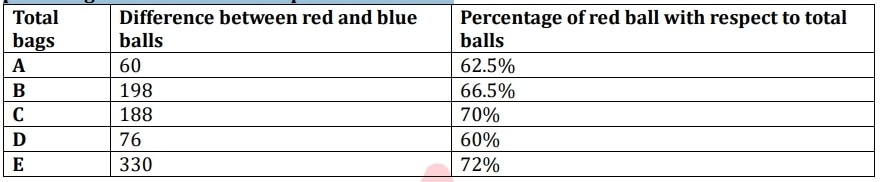
The table given below shows the total number of red and blue balls in five different bags (A, B, C, D & E). It also shows the difference between red and blue balls and the percentage of red balls with respect to total balls.
Find the average number of red balls in B, D and E.
Answer: D. 389 — ConceptWhen a group is split into two parts, the difference between the parts together with the share (percentage) of one part fixes the whole. If red balls…
- A.
355
- B.
353
- C.
350
- D.
389
- E.
386
Attempted by 11 students.
Show answer & explanation
Correct answer: D
Concept
When a group is split into two parts, the difference between the parts together with the share (percentage) of one part fixes the whole. If red balls are p (as a fraction) of the total T and blue balls are the rest, then red minus blue = (p - (1 - p)) x T = (2p - 1) x T. So the total is T = (red - blue difference) / (2p - 1), and the number of red balls is R = p x T.
Application
Apply this to each required bag using its given difference and red-percentage:
Bag B: difference = 198, red share = 66.5% = 0.665, so 2p - 1 = 0.33. Total = 198 / 0.33 = 600, and red = 0.665 x 600 = 399.
Bag D: difference = 76, red share = 60% = 0.60, so 2p - 1 = 0.20. Total = 76 / 0.20 = 380, and red = 0.60 x 380 = 228.
Bag E: difference = 330, red share = 72% = 0.72, so 2p - 1 = 0.44. Total = 330 / 0.44 = 750, and red = 0.72 x 750 = 540.
Average of red balls in B, D and E = (399 + 228 + 540) / 3 = 1167 / 3 = 389.
Cross-check
Verify each total reproduces the data: for B, blue = 600 - 399 = 201 and 399 - 201 = 198 (matches), and 399 / 600 = 66.5% (matches). The same check holds for D (228 - 152 = 76, 228 / 380 = 60%) and E (540 - 210 = 330, 540 / 750 = 72%). All three reconstructions are consistent, so the average is confirmed.