

Maxima and Minima Questions with Solutions: 12 Worked Problems
Practise 12 maxima and minima problems with compact, step-by-step solutions covering stationary points, closed intervals, corners and optimisation.
KnowledgeGate Team
Exam prep & CS education
Updated 26 Nov 20267 min read
A stationary point alone does not settle a maxima or minima problem. Closed-interval endpoints, repeated derivative roots, and absolute-value corners can change the answer. Work through the 12 questions by testing the domain, candidates, classification, and endpoint values before checking each solution.
Use one four-step check before choosing an option
Use the same order every time:
State the domain.
List interior points where
f'(x)=0orf'does not exist.Classify them using a sign change in
f'or the value off''.On a closed interval, compare every candidate value with both endpoint values.
For calibration, take g(x)=x^2-6x+5 on [0,5]. Here g'(x)=2x-6=0 gives x=3. Now compare g(0)=5, g(3)=9-18+5=-4, and g(5)=25-30+5=0. The absolute minimum is -4 at x=3, while the absolute maximum is 5 at x=0. Checking only the stationary point would miss that maximum.
Remember two warnings. The condition f''(c)>0 proves a local minimum, not automatically a global one. Also, an even-multiplicity factor such as (x-2)^2 may leave the sign of f' unchanged. For a structured review of these tools, use the Engineering Mathematics for GATE course.
Questions 1-3: quadratics and closed-interval comparison
Question 1
(DSSSB 2021, Computer Science, TGT - Shift 1)
What is the minimum value of function y = x^2 in the interval [1, 6] ?
(a) 2
(b) 1
(c) 3
(d) 4
Correct answer: (b) 1.
Differentiate to get dy/dx=2x. Since 2x>0 throughout [1,6], the function is increasing across the interval. Its minimum is therefore at the left endpoint, where y(1)=1^2=1; the other endpoint gives y(6)=36. The required minimum value is 1, not merely its location x=1.
Question 2
(Indian Space Research Organization 2009, Computer Science.)
The value of x at which y is minimum for y = x^2 - 3x + 1 is
(a) -3/2
(b) 3/2
(c) 0
(d) -5/4
Correct answer: (b) 3/2.
We have dy/dx=2x-3, so 2x-3=0 gives x=3/2. Since d^2y/dx^2=2>0, this point is a local minimum; because the quadratic opens upward, it is also the global minimum. The vertex formula confirms it: x=-b/(2a)=-(-3)/(2*1)=3/2.
Question 3
(Indian Space Research Organization 2013, Computer Science.)
What is the least value of the function f(x) = 2x^2- 8x - 3 in the interval [ 0 , 5] ?
(a) -15
(b) 7
(c) -11
(d) -3
Correct answer: (c) -11.
Here f'(x)=4x-8, so the interior critical point is x=2. Compare every candidate: f(0)=-3, f(2)=2(4)-16-3=-11, and f(5)=50-40-3=7. The least of these values is -11. Unlike Question 2, this problem has a closed domain, so the endpoint comparison is compulsory.
Questions 4-5: absolute values and a factored quadratic
Question 4
(GATE 2015, Computer Science, Set 2)
Consider a function f(x) = 1 - |x| on -1 <= x <= 1. The value of x at which the function attains a maximum and the maximum value of the function are:
(a) 0, -1
(b) -1, 0
(c) 0, 1
(d) -1, 2
Correct answer: (c) 0, 1.
Because |x|>=0, with equality only at x=0, we have 1-|x|<=1. The upper bound is attained because f(0)=1. At the endpoints, f(-1)=f(1)=0, which is smaller. The maximum occurs at the nondifferentiable corner x=0, so searching only for points where f'(x)=0 would fail.
Question 5
(UPTET 2018, Paper 2.)
The minimum value of (x - 2)(x - 9) is
(a) 49/4
(b) 0
(c) 11/4
(d) -49/4
Correct answer: (d) -49/4.
Complete the square: (x-2)(x-9)=x^2-11x+18=(x-11/2)^2-49/4. A square is at least 0, so the minimum value is -49/4, attained at x=11/2. The roots 2 and 9 both produce 0, but neither produces the minimum.
If the algebra in this step felt slower than the calculus, follow MCA Entrance Mathematics: Algebra to Calculus Order before returning to derivative-based questions.
Questions 6-8: classify critical points without overclaiming
Question 6
(GATE 2024, Data Analytics.)
For any twice differentiable function f: R -> R, if at some x* in R, f' (x* ) = 0 and f''(x* ) > 0, then the function f necessarily has a ______ at x = x* .
Note: R denotes the set of real numbers.
(a) local minimum
(b) global minimum
(c) local maximum
(d) global maximum
Correct answer: (a) local minimum.
The condition f'(x*)=0 makes x* stationary, while f''(x*)>0 makes the graph locally concave upward. Thus nearby values exceed f(x*), proving a local minimum only. For example, h(x)=x^2-x^4 has h'(0)=0 and h''(0)=2>0, yet h(x)->-infinity as |x|->infinity, so the minimum at 0 is not global.
Question 7
(GATE 2023, Computer Science; MSQ.)
Let
f(x) = x^3 + 15x^2 - 33x - 36
be a real-valued function. Which of the following statements is/are TRUE?
(a) f(x) does not have a local maximum.
(b) f(x) has a local maximum.
(c) f(x) does not have a local minimum.
(d) f(x) has a local minimum.
Correct answers: (b) and (d).
Differentiate to get f'(x)=3x^2+30x-33=3(x-1)(x+11), so the critical points are x=1 and x=-11. Next, f''(x)=6x+30. Since f''(-11)=-36<0, there is a local maximum at x=-11; since f''(1)=36>0, there is a local minimum at x=1. Both existence statements are true.
Question 8
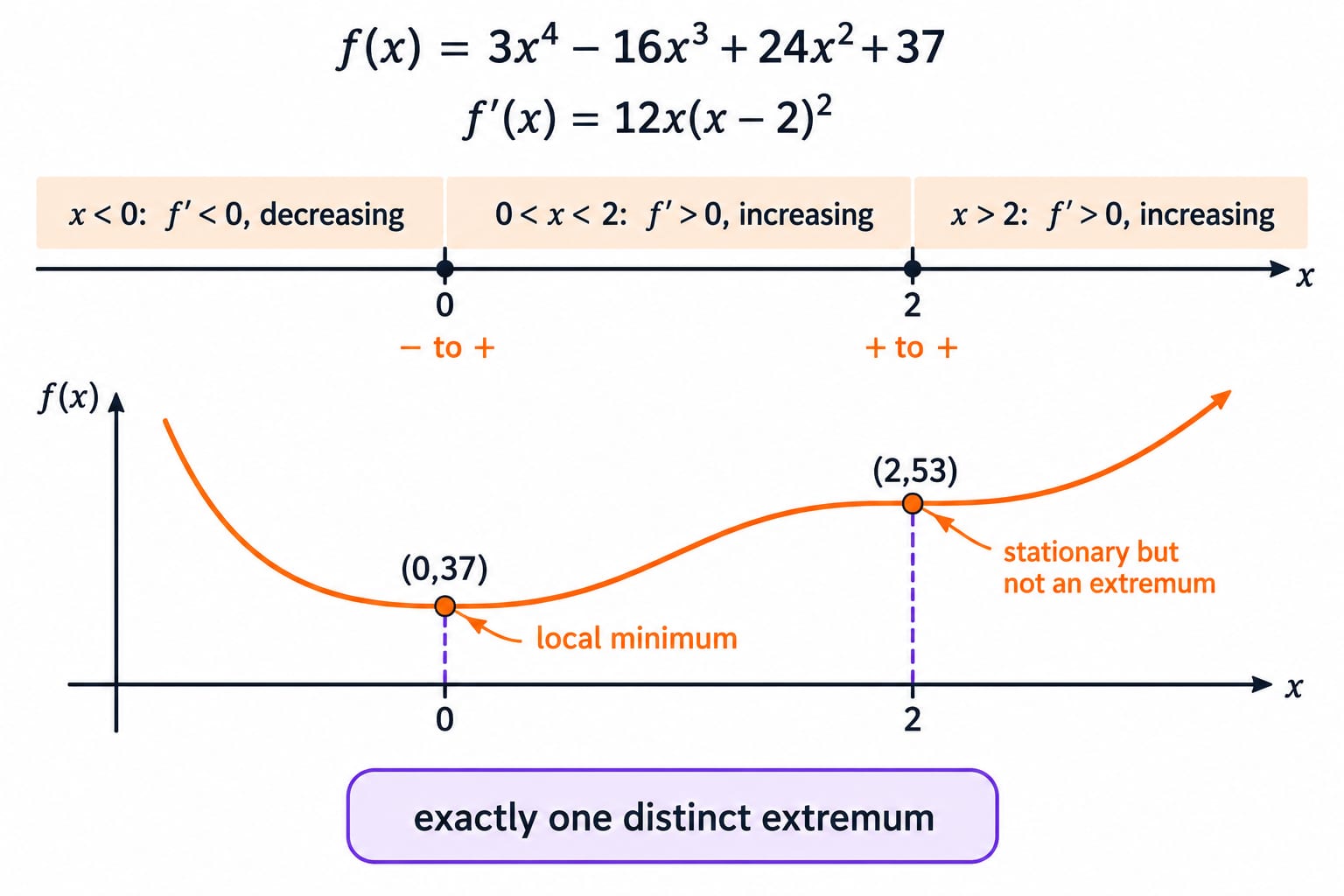
A point on a curve is said to be an extremum if it is a local minimum or a local maximum. The number of distinct extrema for the curve f(x) = 3x^4 - 16x^3 + 24x^2 + 37 is
(a) 0
(b) 1
(c) 2
(d) 3
Correct answer: (b) 1.
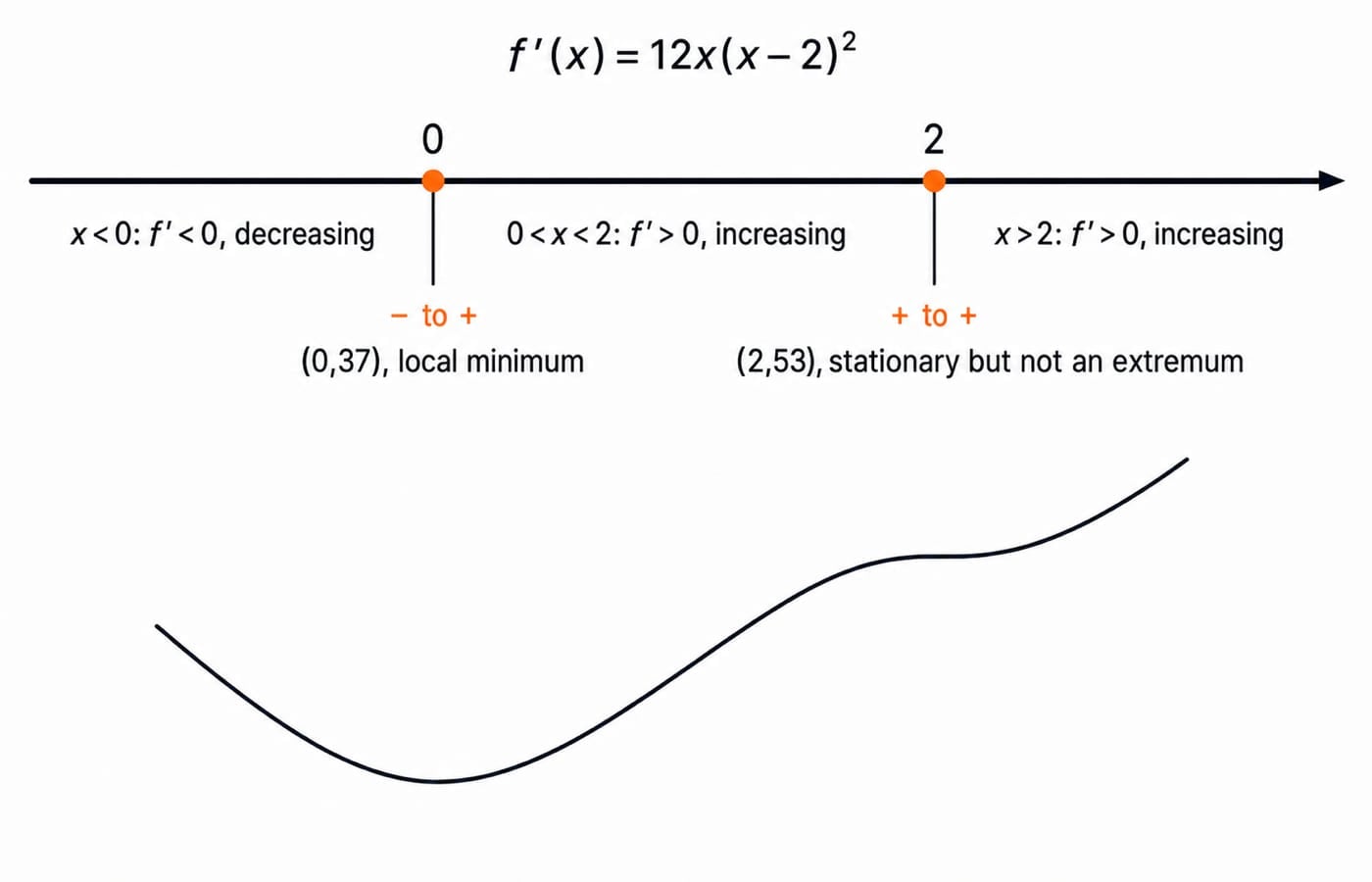
Compute f'(x)=12x^3-48x^2+48x=12x(x-2)^2, whose zeros are x=0 and x=2. The sign is negative for x<0, positive for 0<x<2, and still positive for x>2. Therefore x=0 is a local minimum, but x=2 is stationary without being an extremum. Indeed, f(0)=37 and f(2)=48-128+96+37=53, so there is exactly one distinct extremum.
For a structured route containing this Engineering Mathematics lesson, continue with GATE Guidance by Sanchit Sir.
Questions 9-10: use convexity and include domain endpoints
Question 9
(GATE 2017, Computer Science, Set 2.)
The number of roots of e^{x}+0.5x^{2}-2=0 in the range [-5,5] is
(a) 0
(b) 1
(c) 2
(d) 3
Correct answer: (c) 2.
Let g(x)=e^x+0.5x^2-2. Since g''(x)=e^x+1>0, the function is strictly convex and can cross the axis at most twice. We have g(-5)=e^-5+12.5-2~10.51>0, g(0)=1-2=-1<0, and g(5)=e^5+12.5-2~158.91>0. Continuity gives one root in (-5,0) and one in (0,5); strict convexity excludes another, so there are exactly 2 roots.
Question 10
(GATE 2012, Computer Science.)
Consider the function f(x) = sin(x) in the interval x in [pi/4, 7pi/4]. The number and location(s) of the local minima of this function are
(a) One, at pi/2
(b) One, at 3pi/2
(c) Two, at pi/2 and 3pi/2
(d) Two, at pi/4 and 3pi/2
Correct answer: (d) Two, at pi/4 and 3pi/2.
Inside the interval, f'(x)=cos x=0 at pi/2 and 3pi/2. Since f''(x)=-sin x, f''(pi/2)=-1 gives a local maximum, while f''(3pi/2)=1 gives a local minimum. At the left endpoint pi/4, the function initially increases because cos(pi/4)>0, so pi/4 is also a one-sided local minimum relative to the stated domain. The two locations are pi/4 and 3pi/2.
Questions 11-12: optimisation and a piecewise derivative trap
Question 11
(GATE 2011, Computer Science.)
The variable cost (V) of manufacturing a product varies according to the equation V=4q, where q is the quantity produced. The fixed cost (F) of production of same product reduces with q according to the equation F=100/q. How many units should be produced to minimize the total cost (V+F)?
(a) 5
(b) 4
(c) 7
(d) 6
Correct answer: (a) 5.
The physical domain is q>0, and the total cost is C(q)=4q+100/q. Then C'(q)=4-100/q^2=0 gives q^2=25, so the admissible point is q=5, not q=-5. Also, C''(q)=200/q^3>0 at q=5, confirming a minimum. Numerically, C(5)=20+20=40, compared with C(4)=16+25=41 and C(6)=24+100/6~40.67.
Question 12
(GATE 2026, Computer Science, Set 1; MSQ)
Let f:R->R be defined as follows:
f(x)=(|x|/2 -x)(x-|x|/2 )
Which of the following statements is/are true?
(a) f has a local maximum
(b) f has a local minimum
(c) f' is continuous over R
(d) f' is not differentiable over R
Correct answers: (a), (c) and (d).
Split at x=0. For x>=0, substitute |x|=x to get f(x)=-x^2/4; for x<0, use |x|=-x to get f(x)=-9x^2/4. Thus f(0)=0, while every nearby nonzero value is negative, so x=0 is a local maximum and not a local minimum. The derivatives are f'(x)=-9x/2 for x<0, f'(0)=0, and f'(x)=-x/2 for x>0, making f' continuous at 0. But the left and right derivatives of f' there are -9/2 and -1/2, so f' is not differentiable over all of R.
Finish with a six-check error log, then choose the next route
Before accepting an answer, check: domain written; endpoints tested; nondifferentiable points included; f' sign change checked; local not confused with global; value not confused with location.
Now redo Questions 3, 4, 8, 10 and 12 without options. Your checkpoints are f(0), f(2), f(5); |x|=0 at x=0; f'=12x(x-2)^2; one-sided endpoint logic at pi/4; and the piecewise forms -9x^2/4, -x^2/4.
Use the NIMCET mathematics weekly revision system for a timed-practice framework, or browse the GATE CS Exam Preparation Courses & Test Series for broader course navigation.
Go deeper with the full courseEngineering Mathematics for GATE Exam
Keep learning
Calculus for GATE CS: Limits, Continuity and Maxima-Minima Questions, Fully Solved
Work through one complete limit, continuity and extrema problem, then use a compact checklist to avoid the setup errors that turn simple calculus into lost marks.
Updated 22 Sep 20265 min read115 viewsGATE Strategy & Roadmap
Simplification Based Problems: 12 Solved Questions with Step-by-Step Solutions
Solve 12 simplification questions step by step, from nested signs and mixed fractions to continued fractions, approximation and structural shortcuts.
Updated 17 Nov 20266 min readAptitude & Reasoning

Age Ratio-Based Problems: 12 Questions with Step-by-Step Solutions
Solve 12 age ratio-based questions from the KnowledgeGate practice bank. Each fresh solution shows how to form the equation, shift every age correctly, and verify the answer.
Updated 29 Oct 20267 min read85 viewsAptitude & Reasoning
Continuity Questions with Solutions: 10 Solved MCQ and NAT Problems
Solve 10 continuity problems step by step, covering one-sided limits, removable holes, absolute-value corners, hinge functions and the squeeze theorem.
Updated 24 Nov 20268 min readEngineering Mathematics