

Simplification Based Problems: 12 Solved Questions with Step-by-Step Solutions
Solve 12 simplification questions step by step, from nested signs and mixed fractions to continued fractions, approximation and structural shortcuts.
KnowledgeGate Team
Exam prep & CS education
Updated 17 Nov 20266 min read
Simplification Based Problems: 12 Solved Questions with Step-by-Step Solutions
Simplification questions look easy until brackets, signs, mixed fractions, "of", roots and left-to-right precedence appear in the same line. One skipped step can turn a sound method into the wrong option. The challenge is deciding which operation must be completed before the next.
These 12 questions move from BODMAS and signed integers to compound fractions, approximation and structural shortcuts. Work one intermediate line before checking each explanation. For more quantitative aptitude practice, use Aptitude Courses for Exams & Placements.
Simplification rules to use before the questions
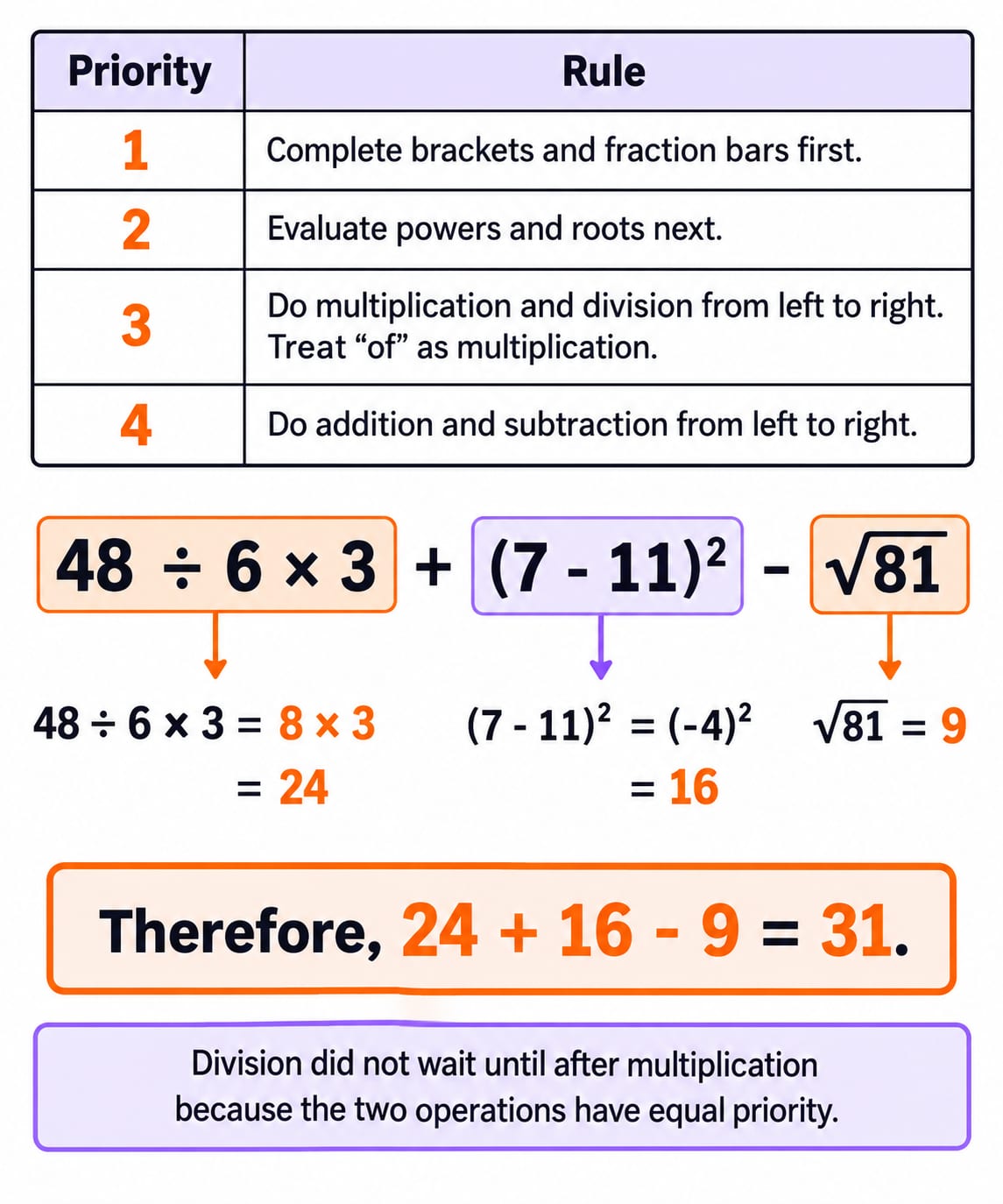
Priority | Rule |
|---|---|
1 | Complete brackets and fraction bars first. |
2 | Evaluate powers and roots next. |
3 | Do multiplication and division from left to right. Treat "of" as multiplication. |
4 | Do addition and subtraction from left to right. |
Also convert mixed numbers to improper fractions before operating, and round only when a question explicitly asks for an approximate value. For example:
48 / 6 * 3 + (7 - 11)^2 - sqrt81
48 / 6 * 3 = 8 * 3 = 24, (7 - 11)^2 = (-4)^2 = 16, and sqrt81 = 9.
Therefore, 24 + 16 - 9 = 31. Division did not wait until after multiplication because the two operations have equal priority. For a broader view of where simplification fits in quant practice, see Bank PO Quant: High-Yield Topics First.
Simplification questions 1-3: roots, nested brackets and absolute values
Question 1
Evaluate: 11 + sqrt(-4 + 6*4/3)
(a) 26
(b) 12
(c) 13
(d) 11
Answer: (c) 13. Work inside the radical first: 6 * 4 / 3 = 24 / 3 = 8. Then -4 + 8 = 4, so sqrt4 = 2, and 11 + 2 = 13. As a check, 2^2 = 4, which recovers the radicand.
Question 2
Simplify (-9) - {(-8) + [24 / (13 - 7)]}
(a) 5
(b) -8
(c) -5
(d) None of these
Answer: (c) -5. Move outwards: 13 - 7 = 6, 24 / 6 = 4, and (-8) + 4 = -4. Thus (-9) - (-4) = -9 + 4 = -5. Distributing the signs gives the same check: -9 + 8 - 4 = -5.
Question 3
Evaluate: -|4 - 8(3 - 12)| - |5 - 11| = ?
(a) 70
(b) 76
(c) 50
(d) 55
Answer: (a) 70. Read the :- after "Evaluate" as punctuation. First, 3 - 12 = -9, then 8(-9) = -72. The first absolute value is |4 - (-72)| = |76| = 76; the second is |5 - 11| = |-6| = 6. Hence 76 - 6 = 70. Simplify inside absolute-value bars before removing them.
Simplification questions 4-6: signed equations and unknown fractions
Question 4
If -12 * (-3) + [20 / (-4) - (-24) / 8] - [16 / (-2)] = (-28 / 7) + x, then the value of x is
(a) 29
(b) 39
(c) 46
(d) 47
Answer: (c) 46. On the left, -12 * -3 = 36, -5 - (-3) = -2, and 16 / -2 = -8. Therefore the left side is 36 - 2 - (-8) = 42. The right side is -4 + x, so 42 = -4 + x and x = 46. Substitution gives -4 + 46 = 42.
Question 5
8/9 + 3/7 + 2/3 + ? = 158/63
(a) 145/21
(b) 11/21
(c) 111/63
(d) 145/63
Answer: (b) 11/21. With denominator 63, the known fractions are 56/63, 27/63 and 42/63. Their sum is 125/63, so the missing term is 158/63 - 125/63 = 33/63 = 11/21. Checking, 56 + 27 + 42 + 33 = 158.
Question 6
The value of x in 3 1/5 / 2/7 * x/5 = 1 2/5 * 1 3/5 is:-
(a) 3
(b) 1
(c) 0
(d) 5
Answer: (b) 1. Convert the mixed numbers: 3 1/5 = 16/5, 1 2/5 = 7/5, and 1 3/5 = 8/5. The sides become 16/5 * 7/2 * x/5 = 56x/25 and 7/5 * 8/5 = 56/25. Therefore x = 1, which makes both sides exactly equal.
Simplification questions 7-9: compound fractions, cancellation and continued fractions
Question 7
Simplify ((17/2) + (18/7) of (7/2)) / (14 - (15/7) / (2/7))
(a) 35/13
(b) 28/22
(c) 45/23
(d) 43/20
Answer: (a) 35/13. In the numerator, (18/7) * (7/2) = 9, so 17/2 + 9 = 35/2. In the denominator, (15/7) / (2/7) = 15/2, so 14 - 15/2 = 13/2. The full result is (35/2) / (13/2) = 35/13.
Question 8
On simplification of the following, the result will be: (1 - 1/2)(1 - 1/3)(1 - 1/4) ... (1 - 1/100)
(a) 0.01
(b) 0.001
(c) 1
(d) 0.1
Answer: (a) 0.01. Rewrite the product as (1/2) * (2/3) * (3/4) * ... * (99/100). The interior factors cancel, leaving 1/100 = 0.01. The smaller case (1/2)(2/3) = 1/3 shows the same end-term pattern.
Question 9
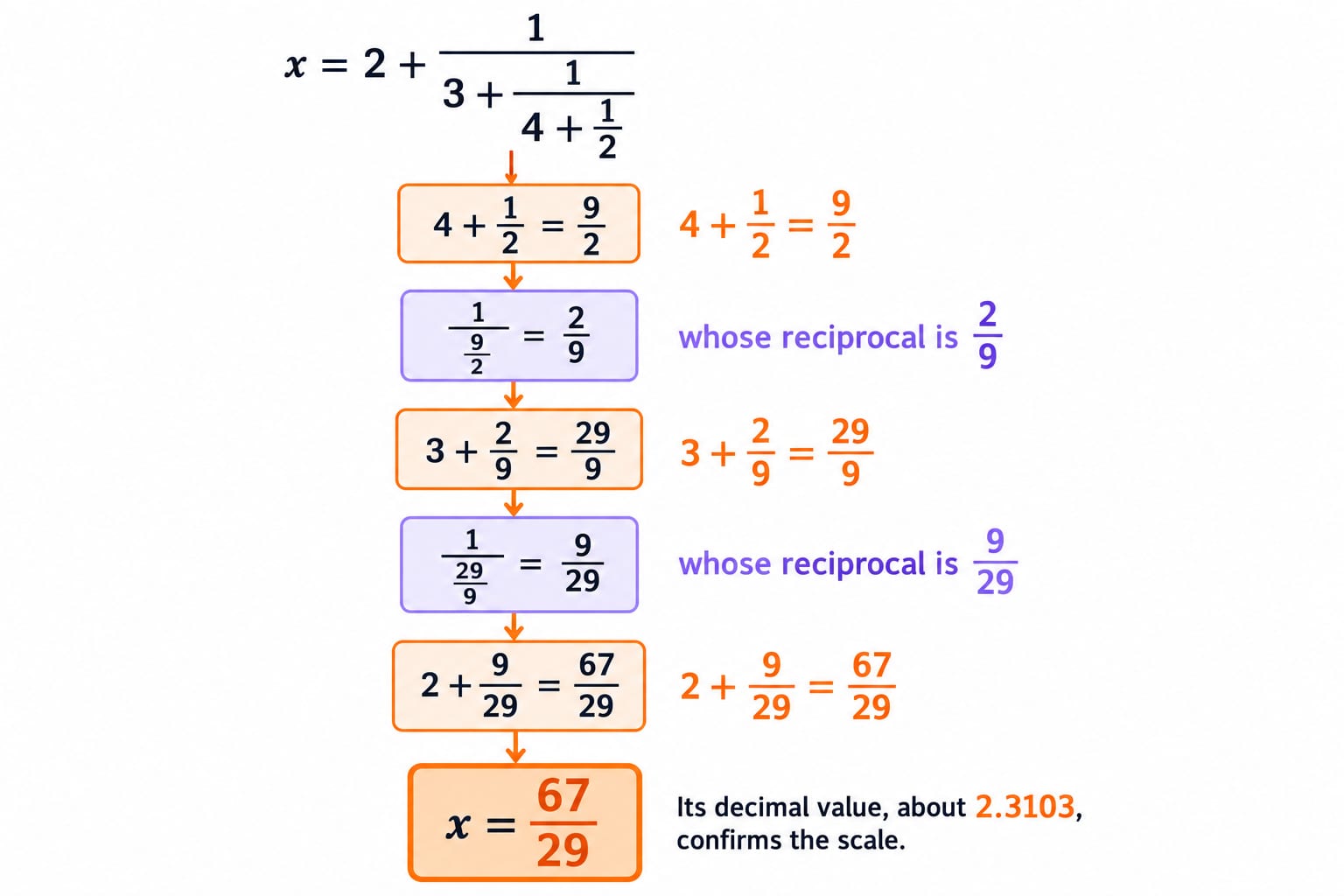
Evaluate the continued fraction:
In symbols: x = 2 + 1/(3 + 1/(4 + 1/2)).
(a) 67/29
(b) 41/17
(c) 45/19
(d) 47/20
Answer: (a) 67/29. Build outwards from the deepest level: 4 + 1/2 = 9/2, whose reciprocal is 2/9. Next, 3 + 2/9 = 29/9, whose reciprocal is 9/29. Finally, 2 + 9/29 = 67/29. Its decimal value, about 2.3103, confirms the scale.
Simplification questions 10-12: approximation, mixed numbers and structural shortcuts
Question 10
What is the approximate value of 149.832 / 25.0138 + 7.10 * 2.008?
(a) 35
(b) 20
(c) 11
(d) 27
Answer: (b) 20. The question asks for an approximate value, so use compatible rounding: 149.832 about 150, 25.0138 about 25, and 2.008 about 2. Then 150 / 25 = 6 and 7.10 * 2 = 14.2, giving about 20.2. The nearest option is 20. Do not use this rounding for an exact-value question.
Question 11
The value of 6 2/3 / 2 1/2 * 3 3/4 - 5 1/2 * 4 1/4 + 1 2/3 (7/8 + 3/4 * 2/3) is
(a) -11 1/12
(b) 11 1/12
(c) 6 1/2
(d) -6 1/2
Answer: (a) -11 1/12. Converting to improper fractions, the first chain is 20/3 / 5/2 * 15/4 = 10; the second is 11/2 * 17/4 = 187/8. Inside the bracket, 3/4 * 2/3 = 1/2, then 7/8 + 1/2 = 11/8, and 5/3 * 11/8 = 55/24. Thus 240/24 - 561/24 + 55/24 = -266/24 = -133/12 = -11 1/12.
Question 12
Find the value of (0.22^3 + 0.022^3) / (0.66^3 + 0.066^3).
(a) 2/27
(b) 1/25
(c) 1/27
(d) 1/23
(0.22^3 + 0.022^3) / (0.66^3 + 0.066^3)
The traps these 12 simplification questions expose
Trap or technique | Questions |
|---|---|
Complete a root before outside addition | Q1 |
Preserve nested signs | Q2 and Q4 |
Simplify inside absolute-value bars | Q3 |
Use an LCM and improper fractions | Q5, Q6 and Q11 |
Respect fraction bars and telescoping cancellation | Q7 and Q8 |
Round only on instruction, then look for scale factors | Q10 and Q12 |
Use the same short routine under time pressure: circle the instruction word, such as simplify, evaluate or approximate. Mark the innermost group, write one result per line, and keep fractions exact until the last step. When an unknown is involved, reject an option if substituting it does not reproduce both sides. For focused work on calculation fluency, use the SBI Clerk Quant: 6-Week Calculation Speed Routine.
Simplification based problems: the next practice step
Redo Q4, Q7, Q9, Q11 and Q12 without looking at the solutions. Together they test signed arithmetic, "of" and division inside a fraction, bottom-up nesting, mixed-number conversion and structural factoring.
For a broader placement-oriented route, continue with Aptitude for Placement. For a GATE-oriented route, use Aptitude for GATE Exam. Both let you move beyond one question type while keeping quantitative practice organised.
The short version is simple: work from the inside out, preserve every sign, keep fractions exact where possible, and approximate only when the question asks.
Keep learning

Age Ratio-Based Problems: 12 Questions with Step-by-Step Solutions
Solve 12 age ratio-based questions from the KnowledgeGate practice bank. Each fresh solution shows how to form the equation, shift every age correctly, and verify the answer.
Updated 29 Oct 20267 min read72 viewsAptitude & Reasoning
Quantifiers and Predicate Logic Practice Problems: Step-by-Step Solutions
Solve quantifier problems with a fixed routine, then test it on complete predicate tables, nested relations, negations and five rapid checks.
Updated 13 Sep 20265 min read79 viewsEngineering Mathematics
Simplification of CFG: Remove Epsilon, Unit and Useless Productions Step by Step
Simplify one context-free grammar from nine nonterminals to six. See each intermediate grammar, complete unit closures, symbol checks and final derivations.
Updated 30 Oct 20266 min read62 viewsCompiler Design

Simplification of CFG: Eliminate Epsilon, Unit and Useless Productions Step by Step
Learn the safe order for simplifying a context-free grammar. One example tracks every production through epsilon removal, unit closure, and useless-symbol removal.
Updated 27 Aug 20266 min read58 viewsTheory of Computation