

Continuity Questions with Solutions: 10 Solved MCQ and NAT Problems
Solve 10 continuity problems step by step, covering one-sided limits, removable holes, absolute-value corners, hinge functions and the squeeze theorem.
KnowledgeGate Team
Exam prep & CS education
Updated 24 Nov 20268 min read
Continuity problems become manageable when you check the domain point, the left-hand limit, the right-hand limit and the assigned value in that order. A corner can remain continuous, while cancelling a factor can leave a hole. The ten problems below move from one-sided matching to removable holes, hinge functions, oscillation and continuity on an interval. Attempt each problem before reading its solution. GATE CS Exam Preparation provides the broader preparation path.
Continuity checklist: domain, one-sided limits and value
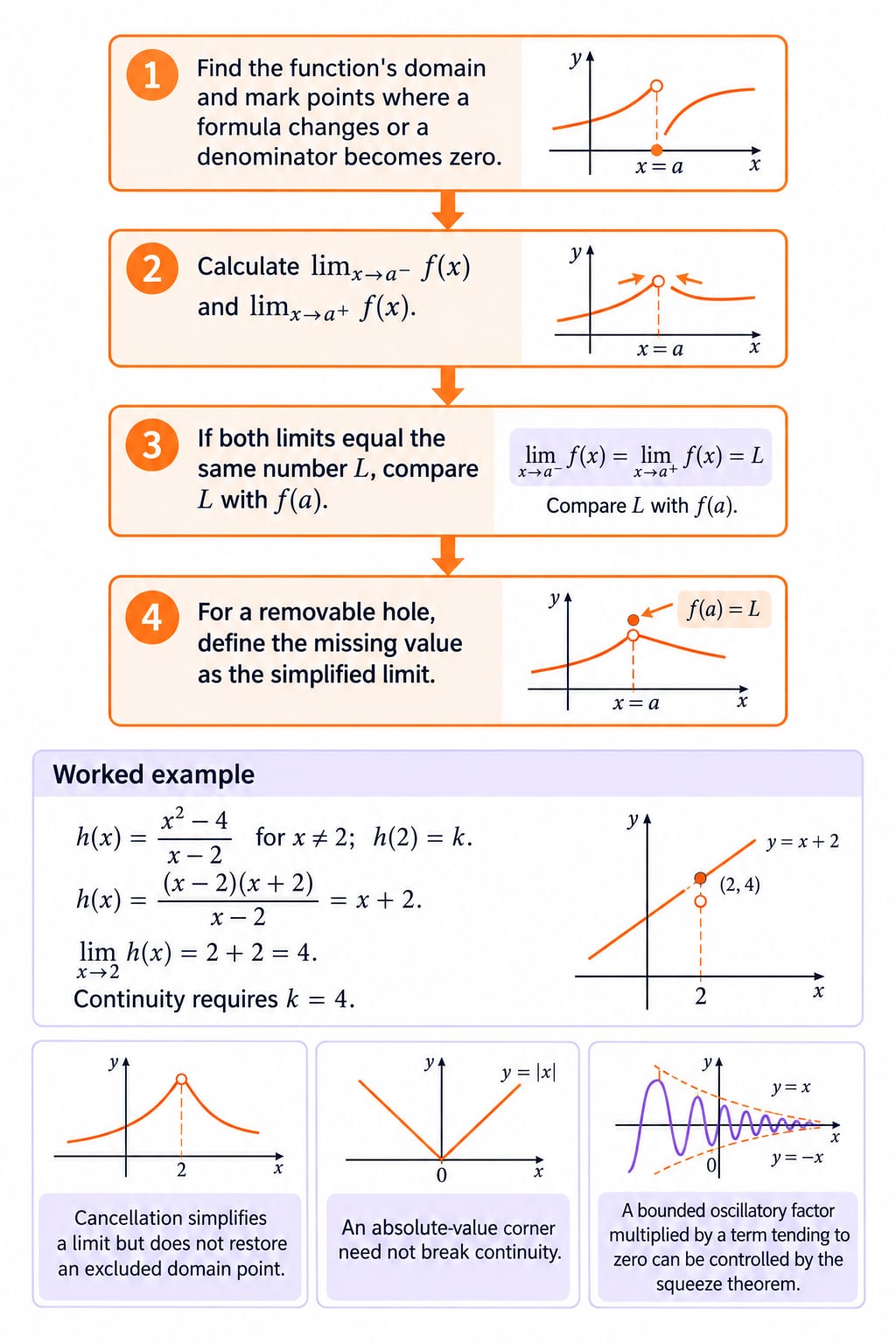
At a suspect point x = a, use this order:
Find the function's domain and mark points where a formula changes or a denominator becomes zero.
Calculate the left-hand limit and right-hand limit as x approaches a.
If both limits equal the same number L, compare L with f(a).
For a removable hole, define the missing value as the simplified limit.
Remember three distinctions. Cancellation simplifies a limit but does not restore an excluded domain point. An absolute-value corner need not break continuity. Also, a bounded oscillatory factor multiplied by a term tending to zero can be controlled by the squeeze theorem.
A removable-hole example makes the test concrete. Let h(x) = (x^2 - 4) / (x - 2) for x != 2, and let h(2) = k. For x != 2, h(x) = ((x - 2)(x + 2)) / (x - 2) = x + 2.
Therefore, the limit as x -> 2 is 2 + 2 = 4. Continuity requires k = 4. For more calculus practice, use the Engineering Mathematics for GATE Exam course.
2. Questions 1-3: one-sided limits, denominator zeros and a removable value
Question 1: match both sides and the point value
Which one of the following functions is continuous at x = 3?
(a) f(3) = 2; f(x) = x - 1 for x > 3; f(x) = (x + 3) / 3 for x < 3.
(b) f(3) = 4; f(x) = 8 - x for x != 3
(c) f(x) = x + 3 for x <= 3; f(x) = x - 4 for x > 3
(d) f(x) = 1 / (x^3 - 27) for x != 3
Answer: (a). For (a), the left-hand limit is (3+3)/3=2, the right-hand limit is 3-1=2, and f(3)=2. All three match. In (b), the limit is 8-3=5, not f(3)=4. In (c), the left limit and value are 6, but the right limit is -1. In (d), x^3-27=0 at 3 and creates a non-removable pole.
Question 2: find every denominator zero before testing cancellation
Find the values where the given function is not continuous
f(x) = (x^3 - 4x + 5) / (3x^2 - x - 2)
(a) 5 and 4
(b) 2/3 and 1
(c) 3/2 and 1
(d) -2/3 and 1
Answer: (d), -2/3 and 1. Factor the denominator:
3x^2-x-2=(3x+2)(x-1).
Its zeros are x = -2/3 and x = 1. At 1, the numerator is 1 - 4 + 5 = 2. At x = -2/3, it is
-(8)/(27)+(8)/(3)+5=(-8+72+135)/(27)=(199)/(27).
The numerator is non-zero at both denominator zeros, so neither factor cancels. Both points are discontinuities.
Question 3: fill a removable hole with K
The function f is defined as follows:
f(x) = (x - x^2) / (2x), for x != 0
f(x) = K, for x = 0
If f is continuous at x = 0, then the value of K is:
(a) 2
(b) 1/2
(c) 1
(d) None
Answer: (b), 1/2. For x != 0,
(x-x^2)/(2x)=(x(1-x))/(2x)=(1-x)/(2).
Its limit at 0 is 1/2, so continuity requires the assigned value K = 1/2.
3. Questions 4-6: count jumps, read a hinge graph and tame a logarithmic branch
Question 4: count discontinuities from a decimal-digit rule
Consider a function f: (0, 1) -> {0, 1}. For a real number r in (0, 1), f(r) = 1 if the second digit after the decimal point in r is one of 2, 3, 6 and 7; otherwise f(r) = 0. How many points in (0, 1) are discontinuities? (Answer with an integer.)
Answer: 40. In each tenth block, the output changes at the hundredths-digit transitions 1 -> 2, 3 -> 4, 5 -> 6 and 7 -> 8. That gives four jumps. The 9 -> 0 transition into the next tenth causes no jump because both digits produce 0. Across 10 tenth blocks, the count is 10 x 4 = 40. The first block contributes 0.02, 0.04, 0.06 and 0.08, while the last contributes 0.92, 0.94, 0.96 and 0.98, confirming that no endpoint was added or lost.
Question 5: express a capped ramp with hinge functions
For positive real numbers S and K, define H_K(S) = max(S - K, 0). The max function is max(a, b) = a when a > b, and b when a <= b.
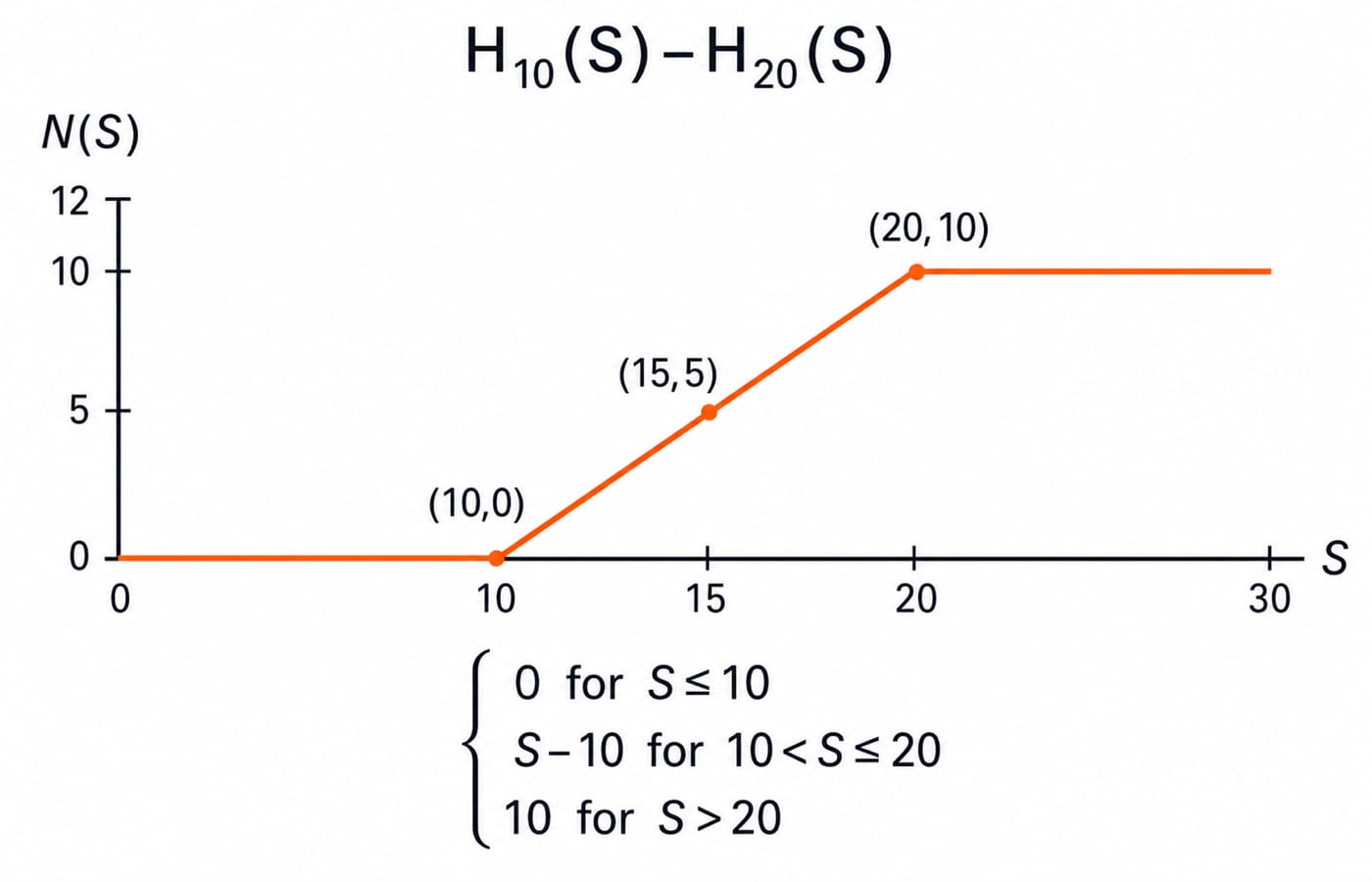
The graph below shows the plot of a function N(S) versus S.
N(S) can be expressed as _____.
(a) H_10(S) - H_20(S)
(b) H_10(S) - 2H_20(S)
(c) -H_10(S) + H_20(S)
(d) H_15(S) - H_20(S)
Answer: (a), H_10(S) - H_20(S). Test it interval by interval. For S <= 10, both hinges are 0, so N = 0. For 10 < S <= 20, only H_10 is active, so N = S - 10. For S > 20,
N=(S-10)-(S-20)=10.
Thus S=5 gives 0, S=15 gives 5, and S=25 gives 10. These values and both continuous joins match the graph.
Question 6: force the divergent logarithmic coefficient to zero
Consider the function f: R -> R defined as follows.
f(x) = c1 * e^x - c2 * log_e(1/x), if x > 0; 3 otherwise
where c1 and c2 are real numbers.
If f is continuous at x = 0, then c1 + c2 = _________. (Answer with an integer.)
Answer: 3. The left-hand limit and f(0) are both 3. As x -> 0+, log_e(1/x) -> infinity, while e^x -> 1. A finite right-hand limit therefore requires c2 = 0. The right-hand limit then equals c1, so continuity requires c1 = 3. Hence c1 + c2 = 3 + 0 = 3.
4. Questions 7-8: squeeze an oscillation and repair a cancelled cubic
Question 7: decide continuity for two real parameters
Let f: R -> R be a function defined by
f(x) = |x|^alpha * sin(|x|^(-beta)) for x != 0
f(x) = 0 for x = 0
where alpha and beta are real. The absolute-value convention makes the function real-valued for negative x as well.
Which of the following is true?
(a) f(x) is continuous at x = 0 only when alpha > 0 and beta > 0
(b) f(x) is continuous at x = 0 for every alpha > 0 and beta in R
(c) f(x) is differentiable at x = 0 for every alpha > 0 and beta > 0
(d) f(x) is continuous at x = 0 for every alpha in R and beta in R
Answer: (b). Since |sin t| <= 1, the absolute-value convention gives
The absolute-value bound is |f(x)| <= |x|^alpha.
For every alpha > 0, the right side tends to 0, whatever real value beta has. The squeeze theorem gives limit f(x) = 0 = f(0) as x -> 0, so (a) is too narrow. For (d), alpha = 0 and beta = 0 gives sin(1) away from 0, not a limit of 0. For (c), choose alpha = 1 and beta = 1. The difference quotient contains sin(1 / |x|), which has no limit.
Question 8: define the value at a cancelled factor
If f(x) = (x^3 + 1) / (x + 1) is continuous at x = -1, find f(-1).
Answer: 3. Factor x^3 + 1 = (x + 1)(x^2 - x + 1). For x != -1, cancel x + 1. Then
The limit as x -> -1 of x^2 - x + 1 is (-1)^2 - (-1) + 1 = 1 + 1 + 1 = 3.
The original quotient is undefined at -1, so continuity requires filling the hole with f(-1) = 3.
5. Questions 9-10: distinguish a corner from a discontinuity
Question 9: split an absolute-value function at zero
f(x) = x + |x| is continuous for
(a) x in (-infinity, infinity)
(b) x in (-infinity, infinity) except 0
(c) only x > 0
(d) No value of x
Answer: (a), x in (-infinity, infinity). Rewrite the function as
f(x) = 0 for x < 0, and f(x) = 2x for x >= 0.
Each branch is continuous. At x=0, the left-hand limit, right-hand limit and function value are all 0. The slope changes there, so the graph has a corner, but it does not break.
Question 10: count non-continuous points in a sum
The number of points where f(x) = |x - 1| + |x - 2| + cos(x), for x in [0, 4], is not continuous:
Answer: 0. The functions |x - 1|, |x - 2| and cos(x) are each continuous on [0, 4]. A finite sum of continuous functions is continuous. The absolute-value terms have corners at 1 and 2, but corners affect differentiability, not continuity. Therefore, the number of discontinuities is 0.
6. The trap audit after all 10 questions
Trap | Wrong move | Repair |
|---|---|---|
Unequal side limits | Average them | Require the left and right limits to be equal first |
Cancelled factor | Forget the excluded point | Return to the original domain and fill the hole only when asked |
Absolute-value corner | Call every corner a break | Check the value and both side limits |
Oscillatory sine | Declare that no limit exists | Check whether its amplitude tends to zero and apply the squeeze theorem |
Answer strip: Questions 1-3: A, D, B. Questions 4-6: 40, A, 3. Questions 7-10: B, 3, A, 0.
If your function and limit foundations need repair, use MCA Entrance Mathematics: Algebra to Calculus Order. For a separate mathematics-planning companion, see Discrete Mathematics for GATE: Syllabus and 6-Week Plan.
7. Short version and the next practice step
At a suspect point, check the domain, left limit, right limit and function value in that order. A removable hole needs the limit value, a corner can still pass the continuity test, and a bounded oscillation can be squeezed. After 48 hours, redo Questions 1, 4, 7 and 9 without notes. Together they test piecewise matching, systematic counting, squeeze-theorem control and the difference between continuity and differentiability. For the next structured practice route, continue with GATE Guidance by Sanchit Sir.
Go deeper with the full courseEngineering Mathematics for GATE Exam
Keep learning

Advanced Counting Theorems Questions with Solutions: 10 Worked Problems
Choose the counting model before reaching for a formula. Solve six MCQs and four numerical-answer questions, with worked explanations of overlaps, initial conditions and identical objects.
Updated 6 Nov 20268 min readDiscrete Mathematics MCQs

Transport Layer Cross-Concept MCQs: 10 Solved MCQ, MSQ and NAT Questions
Solve ten published cross-concept questions spanning transport, network, data-link and physical-layer decisions, with fresh explanations and checked arithmetic.
Updated 20 Nov 20267 min readComputer Networks MCQs
Quantifiers and Predicate Logic Practice Problems: Step-by-Step Solutions
Solve quantifier problems with a fixed routine, then test it on complete predicate tables, nested relations, negations and five rapid checks.
Updated 13 Sep 20265 min read98 viewsEngineering Mathematics

Simplification Based Problems: 12 Solved Questions with Step-by-Step Solutions
Solve 12 simplification questions step by step, from nested signs and mixed fractions to continued fractions, approximation and structural shortcuts.
Updated 17 Nov 20266 min readAptitude & Reasoning