Calculus questions often go wrong before the calculation begins. You apply L'Hopital's rule without checking the form, match a limit but forget the function value, or find a critical point and stop before testing it. These are setup errors, not difficult theory.
The cure is a fixed sequence of checks. Apply that sequence to limits, continuity and maxima-minima problems, and verify the arithmetic a second time wherever it can slip.
1. The three things GATE actually asks in calculus
Most single-variable calculus questions fall into three families:
Limits: evaluate a limit by simplification, a standard identity or L'Hopital's rule.
Continuity: choose a parameter that makes a piecewise function continuous, or identify the type of discontinuity.
Maxima and minima: locate local extrema with derivatives, or find absolute extrema on a closed interval.
One implication links these ideas: differentiability at a point implies continuity there. The converse is false. For example, f(x) = |x| is continuous at 0, but its left derivative is -1 and its right derivative is 1, so it is not differentiable there.
Treat that implication as a one-way arrow. Reversing it is a common conceptual trap.
2. Limits: worked example using L'Hopital's rule
Evaluate lim(x→0) (1 − cos x)/x².
First substitute x = 0. The numerator becomes 1 − 1 = 0, and the denominator becomes 0. The form is 0/0, so L'Hopital's rule is allowed.
Differentiate numerator and denominator once. The expression becomes lim(x→0) sin x/(2x). Direct substitution still gives 0/0, so apply the rule again:
lim(x→0) cos x/2 = cos 0/2 = 1/2
Now verify the answer without L'Hopital. Use 1 − cos x = 2 sin²(x/2):
(1 − cos x)/x² = 2 sin²(x/2)/x² = (1/2)[sin(x/2)/(x/2)]²
As x→0, the bracket tends to 1. The limit is again 1/2. Two independent routes agree.
The important habit is the first line: identify 0/0 or ∞/∞ before differentiating. L'Hopital's rule is not a general permission to differentiate any numerator and denominator separately.
3. Continuity: worked example for a missing value
Suppose f(x) = (x² − 4)/(x − 2) for x ≠ 2, while f(2) = k. Find k so that f is continuous at x = 2.
Continuity at 2 requires three quantities to agree: the left-hand limit, the right-hand limit and f(2). Factor the expression for x ≠ 2:
(x² − 4)/(x − 2) = (x − 2)(x + 2)/(x − 2) = x + 2
Therefore, lim(x→2⁻) f(x) = 4 and lim(x→2⁺) f(x) = 4.
The two-sided limit exists and equals 4. We need f(2) = k = 4. Before assigning that value, the simplified line has a hole at (2,4). Setting k = 4 fills the hole, so the discontinuity is removable.
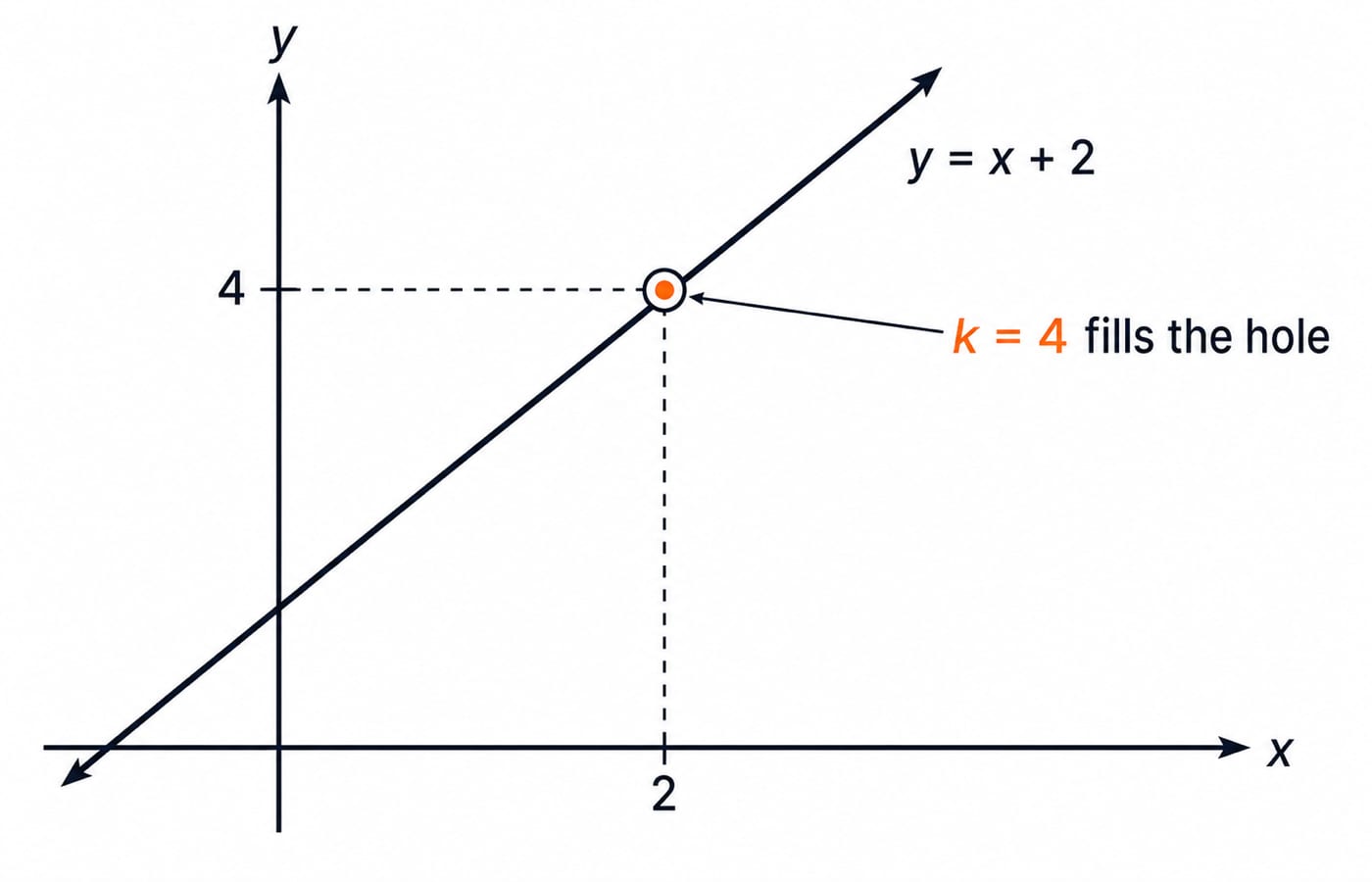
Notice what cancellation does and does not say. It tells us the values away from x = 2 behave like x + 2. It does not define the original quotient at x = 2. The separate value k must do that job.
4. Maxima-minima: the worked template to remember
Take f(x) = x³ − 6x² + 9x + 1.
Differentiate and factor:
f'(x) = 3x² − 12x + 9 = 3(x − 1)(x − 3)
Thus the critical points are x = 1 and x = 3. The second derivative is f''(x) = 6x − 12.
At x = 1, f''(1) = 6 − 12 = −6 < 0, so the curve is locally concave down and x = 1 is a local maximum. Its value is f(1) = 1 − 6 + 9 + 1 = 5.
At x = 3, f''(3) = 18 − 12 = 6 > 0, so x = 3 is a local minimum. Its value is f(3) = 27 − 54 + 27 + 1 = 1.
That settles local extrema. For absolute extrema on [0,4], also test both endpoints:
f(0) = 1 and f(4) = 64 − 96 + 36 + 1 = 5
Compare the four values. The absolute maximum is 5, attained at x = 1 and x = 4. The absolute minimum is 1, attained at x = 0 and x = 3.
We can verify the classification through the sign of f'(x). The factors are both negative for x < 1, so their product is positive and f' > 0. Between 1 and 3, one factor is positive and one is negative, so f' < 0. For x > 3, both are positive. The curve rises, falls and rises, confirming a maximum at 1 and a minimum at 3.
![Graph of f(x) = x³ − 6x² + 9x + 1 on [0, 4] with a maximum at (1, 5), a minimum at (3, 1), and a sign chart for f'(x).](https://cdn.knowledgegate.ai/blog-assets/blog_asset_1784086555087_rdhsss.jpg)
5. The traps GATE plants
Use L'Hopital's rule only after confirming
0/0or∞/∞. A form such as3/1already has a value.For continuity, check both one-sided limits and the defined function value. A common limit alone is not enough.
If
f''(c) = 0, the second-derivative test says nothing. Use the sign change off'. Forf(x) = x⁴,f''(0) = 0, yet0is a minimum.On a closed interval, include endpoints in the comparison. Critical points alone answer a different question.
Re-expand a factored derivative when signs matter. Here
3(x − 1)(x − 3) = 3x² − 12x + 9, which matches the derivative.
Keep the wording precise too. A critical point is only a candidate. It becomes a maximum or minimum after a derivative test or a direct comparison establishes that fact.
6. How the exam tests this
Typical questions ask for the value of a limit, the parameter k for continuity, the number of local maxima, or the absolute maximum on [a,b]. A point of inflection may also appear, which requires a change in concavity rather than merely f''(x) = 0.
The official GATE 2027 syllabus and paper page is the source of truth for the current CS syllabus and paper pattern. The broader GATE CS subject weightage guide can help you place calculus inside your revision plan, while the GATE category keeps the wider preparation path together.
For practice volume, the Calculus collection offers nearly 300 questions within a much larger quantitative mathematics collection. Use them to repeat the method, not to memorise isolated answers.
7. The short version and your next step
Confirm the indeterminate form before L'Hopital, match both limits with the function value for continuity, and test critical points plus endpoints for absolute extrema. Those three routines handle most avoidable errors in this cluster.
Build the method in the Engineering Mathematics for GATE course, then turn it into timed recall with the GATE Test Series. Redo the three worked examples without looking at the solution, and write every check explicitly.