MCA Entrance Mathematics Study Order: Algebra to Calculus Without Gaps
Build MCA entrance mathematics in dependency order, then use one quadratic to connect factorisation, graphs, limits, differentiation and area.
KnowledgeGate Team
Exam prep & CS education
Updated 2 Aug 20266 min read
MCA entrance mathematics can feel like unrelated chapters. You may jump to derivatives before controlling functions, or keep revising algebra without reaching calculus. One quadratic, f(x) = x^2 - 4x + 3, carries the whole chain: its factors give roots 1 and 3, its graph has vertex (2, -1), dividing it by (x - 3) leaves a removable hole whose limit at x = 3 is 2, its derivative is 2x - 4, and the area it cuts below the axis between the roots is 4/3. The MCA entrance exam preparation category carries the reasoning, computer-awareness and eligibility material that sits alongside this mathematics.
MCA Entrance Mathematics Study Order: Follow Dependencies, Not the Textbook Index
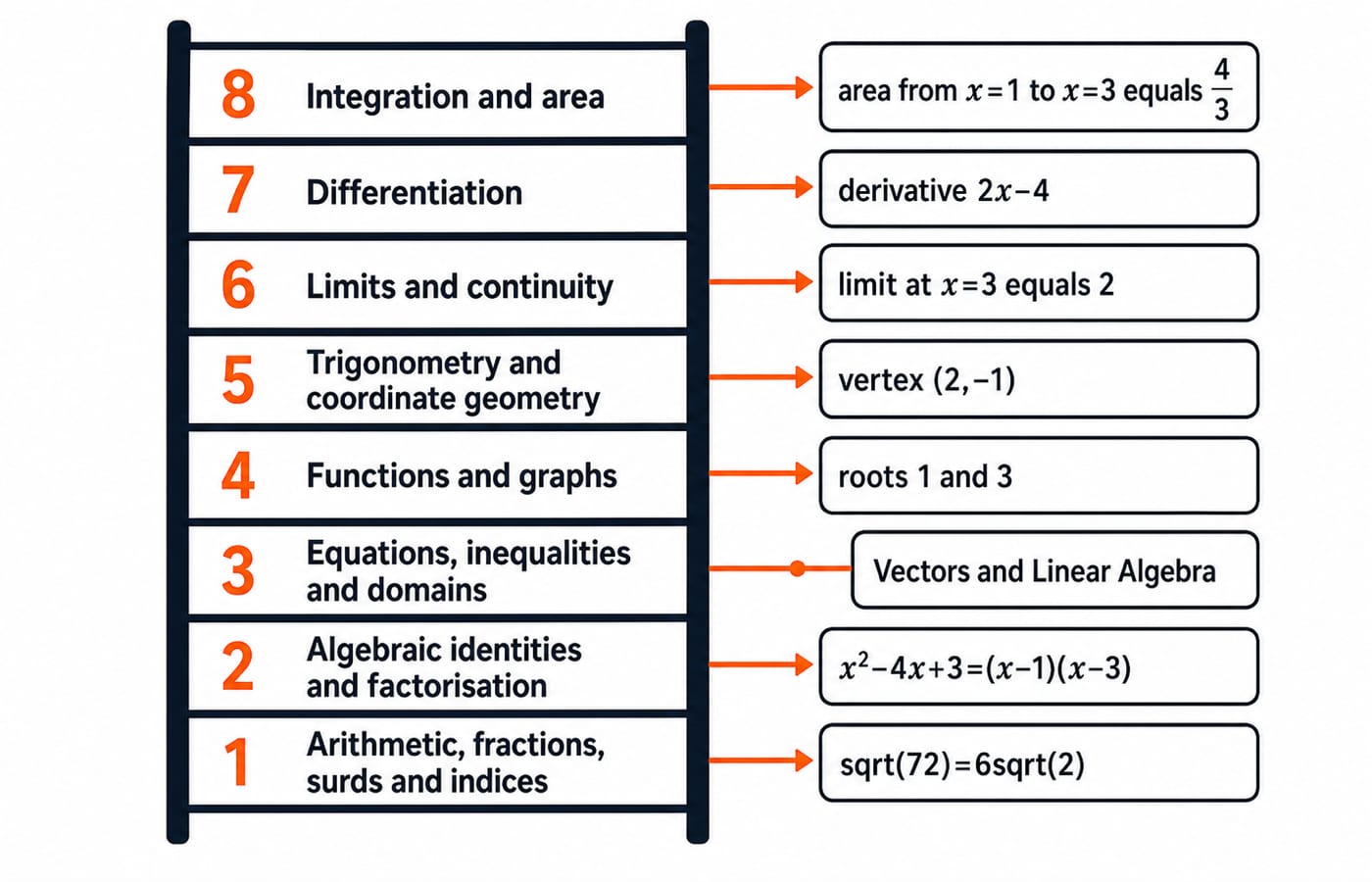
Follow the dependency order:
Stage | Learn | Mastery gate | Why it comes next |
|---|---|---|---|
1 | Arithmetic, fractions, surds and indices |
| Enables later simplification. |
2 | Algebraic identities and factorisation |
| Exposes roots and factors. |
3 | Equations, inequalities and domains |
| Defines valid inputs. |
4 | Functions and graphs |
| Makes behaviour visible. |
5 | Trigonometric identities and coordinate geometry |
| Prepares you to read curves. |
6 | Limits and continuity |
| Defines approach. |
7 | Differentiation and applications |
| Measures local change. |
8 | Integration and area |
| Accumulates change and area. |
Each gate is a two-minute self-check: if you cannot produce that line unaided, the stage is not finished. Stage 1 rests on speed arithmetic, and quantitative aptitude high-yield topics ranks those chapters by how often they pay off. Vectors and linear algebra can run in parallel once equations are fluent, because they are not prerequisites for this calculus chain.
MCA Entrance Algebra: Build the Function Before Using Calculus
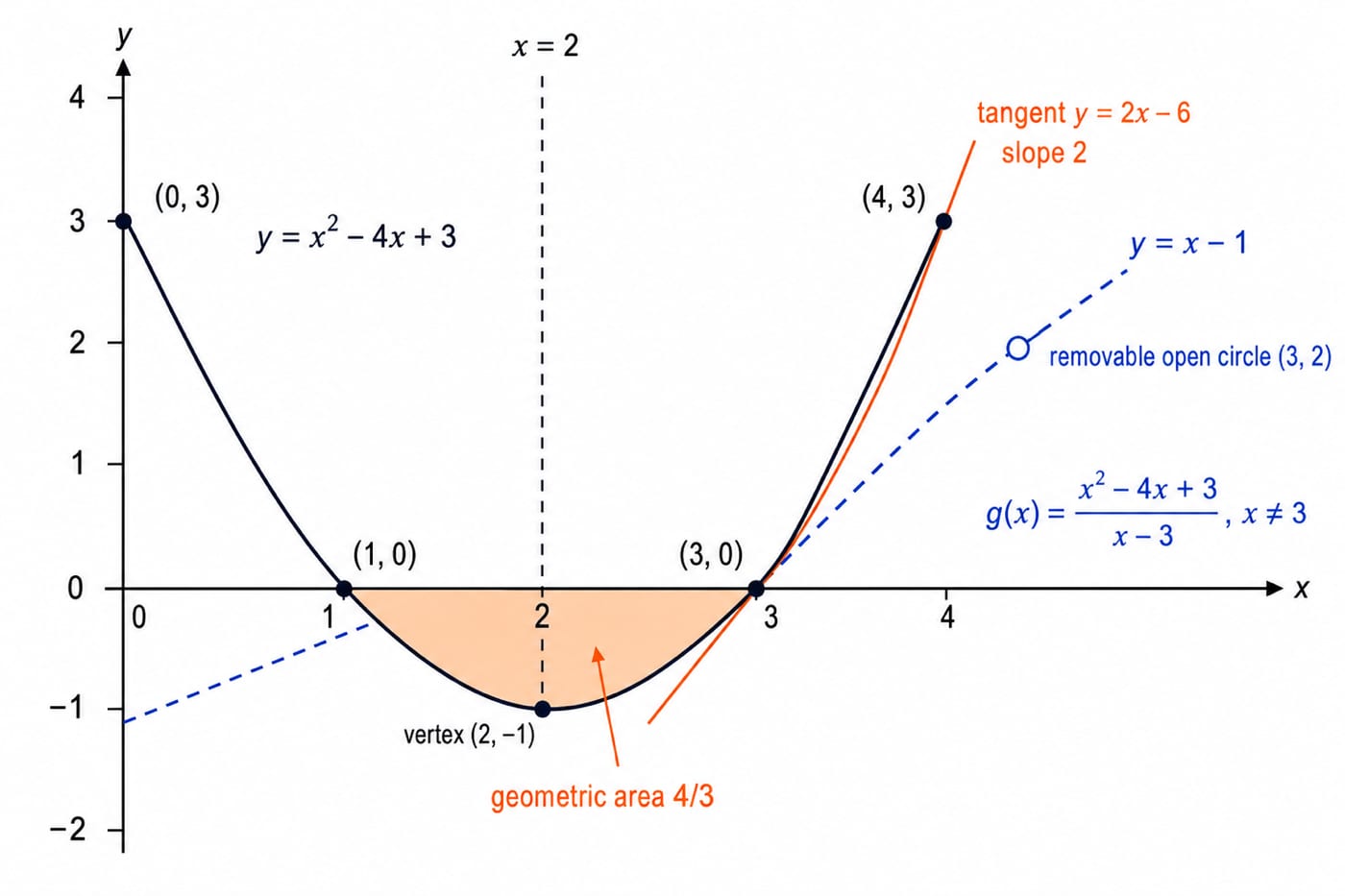
Use f(x) = x^2 - 4x + 3 throughout. The factorised form f(x) = (x - 1)(x - 3) shows the zeros x = 1 and x = 3. The completed-square form f(x) = (x - 2)^2 - 1 shows vertex (2, -1) and axis x = 2.
For g(x) = f(x)/(x - 3), the original domain excludes x = 3. Cancellation gives g(x) = x - 1 only for x != 3, so g(3) does not exist. Only its limiting value is 2.
Three traps deserve immediate correction:
Cancel factors, not terms. Factor the numerator before cancelling
(x - 3).Keep the excluded value. The simpler expression does not restore
x = 3.Read
(x - 2)^2 - 1as vertex(2, -1), not(-2, -1). Vertex form is(x - h)^2 + k.
Functions and Graphs: The Bridge From Algebra to Calculus
For f(x), the x-intercepts are (1, 0) and (3, 0), the vertex is (2, -1), and the y-intercept is (0, 3). The parabola opens upward because the coefficient of x^2 is positive. It lies below the x-axis only when 1 < x < 3.
x | 0 | 1 | 2 | 3 | 4 |
|---|---|---|---|---|---|
| 3 | 0 | -1 | 0 | 3 |
With t = 2, symmetry gives f(2 - t) = f(2 + t), so f(0) = f(4) = 3. A limit asks which y-value is approached, a derivative asks for local slope, and a definite integral accumulates signed area.
Limits: Use Algebraic Simplification Without Losing the Hole
Consider lim(x->3) [(x^2 - 4x + 3)/(x - 3)]. Direct substitution gives 0/0, an indeterminate form, not the answer. Factor first:
[(x - 1)(x - 3)]/(x - 3) = x - 1 for x != 3.
Thus lim(x->3) (x - 1) = 3 - 1 = 2. Here g(3) is undefined, while lim(x->3) g(x) = 2. Defining a new value g(3) = 2 would fill the removable hole and make that extension continuous, but cancellation does not change the original domain.
A two-sided check agrees: g(2.9) = 1.9 and g(3.1) = 2.1. These values approach 2, though the numerical check does not replace the factorisation proof.
Differentiation: Read Slope and Turning Point From the Same Function
Derive the derivative once from first principles:
[f(x+h) - f(x)]/h = [(x+h)^2 - 4(x+h) + 3 - (x^2 - 4x + 3)]/h
= [2xh + h^2 - 4h]/h = 2x + h - 4.
Letting h -> 0 gives f'(x) = 2x - 4. Since f'(2) = 0 and f(2) = -1, the vertex is confirmed. Also, f'(3) = 2, so the tangent through (3, 0) is y - 0 = 2(x - 3), or y = 2x - 6. The value f'(1) = -2 matches the descending graph.
The factorised form gives roots, the completed-square form gives the vertex, and the derivative confirms the stationary point and slopes. The representations must agree.
Integration: Reverse the Derivative and Correct the Sign of Area
An antiderivative is F(x) = x^3/3 - 2x^2 + 3x. Differentiation verifies F'(x) = x^2 - 4x + 3 = f(x), connecting integration back to differentiation.
For the signed integral, F(3) = 9 - 18 + 9 = 0, while F(1) = 1/3 - 2 + 3 = 4/3. Hence:
integral from 1 to 3 of f(x) dx = F(3) - F(1) = -4/3.
The negative value is correct because f(x) < 0 between its roots. A definite integral is signed, but geometric area cannot be negative. Therefore integral from 1 to 3 of |f(x)| dx = 4/3.
MCA Entrance Mathematics Practice: Test the Chain, Then Repair the Weak Link
Work a 50-minute diagnostic block, ten minutes per group: two algebra and domain questions, one graph table, two limits, two derivatives, and one definite-integral check. Score stages separately. A correct derivative with a wrong vertex means repairing functions and graphs before calculus.
Run this five-question mixed check:
Factor
f(x)and find its roots:(x - 1)(x - 3), roots1and3.State the excluded value of
g(x):x = 3.Evaluate the limit at 3:
2.Find the tangent at
(3, 0):y = 2x - 6.Compute the signed integral and geometric area from 1 to 3:
-4/3and4/3.
The 30-day aptitude practice routine turns this order into a daily cadence, one stage per sitting. The question families that recur across MCA entrance papers are simplification, equation solving, graph interpretation, limits, derivatives and definite integrals. NIMCET, CUET PG and MAH CET weight this mathematics differently, so take your marks, timing and section counts from the notification for the exam you are writing. The official NIMCET website carries the current NIMCET one.
MCA Entrance Mathematics: The Short Version and Next Step
Algebra exposes structure, graphs make it visible, limits handle approach, derivatives measure local change, and integrals accumulate signed change. Audit the chain with roots 1 and 3, vertex (2, -1), the removable-hole limit 2, tangent slope 2, signed integral -4/3, and area 4/3.
For a transfer exercise, set p(x) = x^2 - 4x. Factor it as x(x - 4), find roots 0 and 4, vertex (2, -4), derivative p'(x) = 2x - 4, integral -32/3 from 0 to 4, and geometric area 32/3.
The MCA Entrance Exam 2026 Course structures Algebra, Calculus, Trigonometry, Vectors and Linear Algebra together. If you only need the dependency chain repaired, the five-question mixed check above is enough on its own: repeat it until all five land unaided, then move on.
Keep learning

CUET-PG CS vs NIMCET: One Shared-Core Plan for MCA Entrance Prep
Prepare for both MCA entrances with one shared core and two thin exam-specific wrappers: an overlap sheet built from the official documents, a coverage-and-accuracy diagnostic, and a twelve-hour week that survives missed days.
Updated 22 Aug 20266 min readMCA Entrance

CUET PG Computer Science Mock Analysis: Build a Study Plan From Every Error
A mock score cannot tell you what to revise next. Use an error log, timed re-solves, priority weights and fresh-question retests to build a practical seven-day repair plan.
Updated 20 Aug 20266 min readMCA Entrance

NIMCET vs CUET PG MCA: Choose One Exam or Prepare for Both
Compare the two MCA entrance routes, calculate mock scores correctly, and use a personal decision matrix plus a 168-hour bridge plan to choose one or both.
Updated 18 Aug 20265 min readMCA Entrance

CUET PG Computer Science Preparation: 12-Week BCA Bridge Plan
Turn familiar BCA subjects into an entrance-ready system with a baseline audit, two maths routes, mixed objective sets and a realistic recovery calendar.
Updated 16 Aug 20266 min readMCA Entrance