DBMS
53 articles in this topic
SQL Joins Explained: INNER, LEFT, RIGHT, FULL, CROSS and SELF with Runnable Examples
Trace all six SQL join types on one support-agent dataset, with runnable queries, exact outputs, NULL behaviour, row counts and filter-placement traps.
Updated 21 Oct 20265 min readDBMS
GROUP BY and HAVING in SQL: Syntax and Worked Examples
Trace eight sales rows through WHERE, GROUP BY, aggregates, and HAVING, then tackle multiple columns, NULLs, COUNT variants, and common query traps.
Updated 17 Oct 20265 min readDBMS
SQL Aggregate Functions: COUNT, SUM, AVG, MIN and MAX with Examples
Use one runnable sales table to see exactly how SQL aggregates treat rows, NULL values, duplicates and groups. Every result includes the arithmetic behind it.
Updated 13 Oct 20265 min readDBMS
Query Languages in DBMS: Relational Algebra, SQL and a Worked Query
Follow one database request from plain English to relational algebra, intermediate relations, relational calculus and SQL, with every result traced.
Updated 9 Oct 20265 min readDBMS
Data Mining and Data Warehouse Explained: Concepts, OLAP and Worked Examples
Follow six orders from operational sources into a warehouse, calculate OLAP totals, and test an association rule on five shopping baskets.
Updated 4 Oct 20266 min readDBMS
Set Operations and Cartesian Product in Relational Algebra: Worked Examples and Exam Traps
Learn when relational set operations are legal, calculate exact union and difference results, enumerate a Cartesian product, and trace how a join filters it.
Updated 29 Sep 20266 min readDBMS
DBMS Interview Questions: Keys, Normalisation and Transactions Through One Worked Schema
Build defensible DBMS interview answers by tracing keys, normal forms, ACID and isolation through one university-enrolment database.
Updated 25 Sep 20265 min readDBMS
Super Key, Candidate Key and Primary Key: A Worked DBMS Example
Use one ENROLMENT relation to derive two candidate keys, enumerate every super key, select a primary key and translate the result into SQL.
Updated 24 Sep 20266 min readDBMS
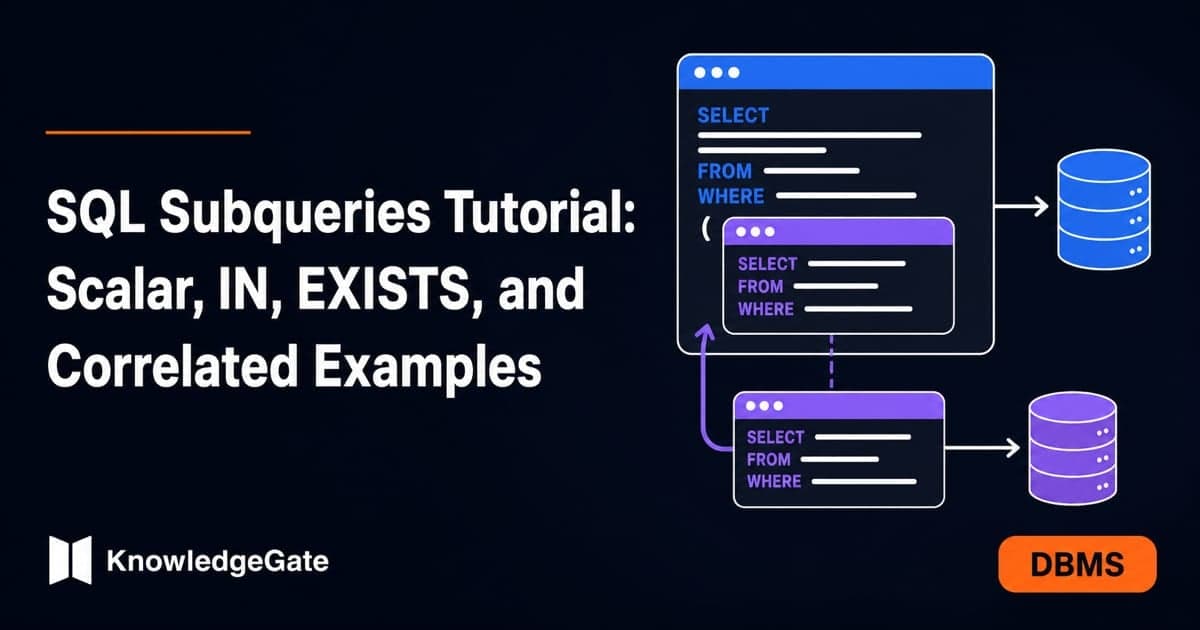
SQL Subqueries Tutorial: Scalar, IN, EXISTS, and Correlated Examples
Learn SQL subqueries from one small employee database. Trace each inner result, compare the main query forms, handle NULL safely, and check your understanding with four exercises.
Updated 23 Sep 20265 min readDBMS
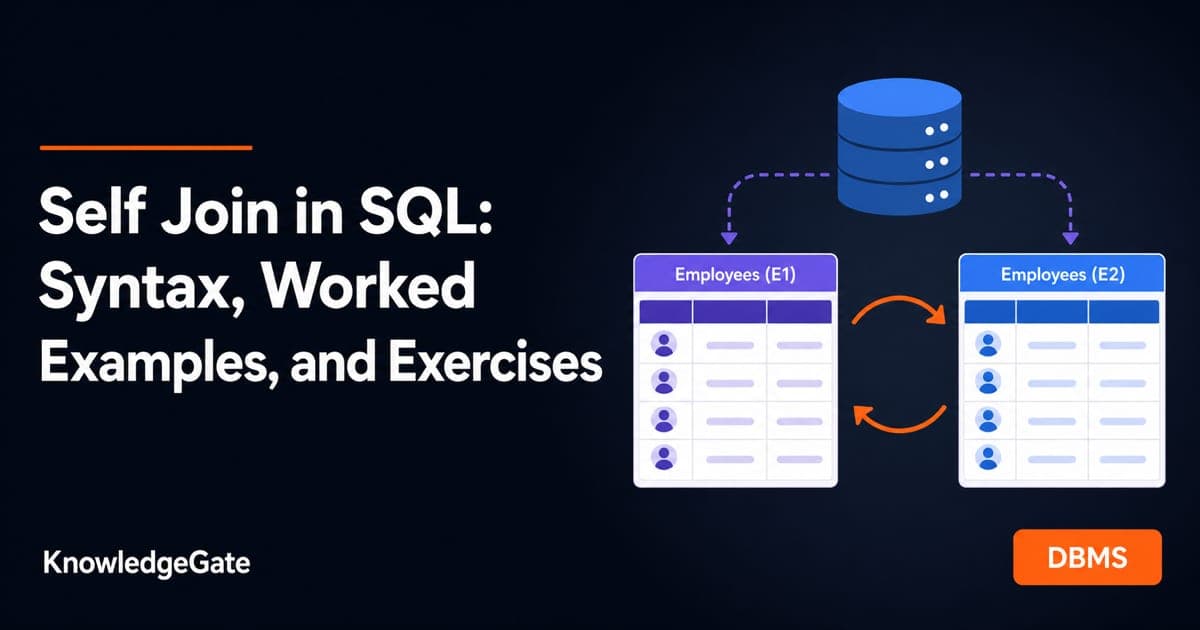
Self Join in SQL: Syntax, Worked Examples, and Exercises
Learn how SQL aliases let one table play several roles. Run exact examples for reporting lines, salary comparisons, city pairs, revision changes, and three-level chains.
Updated 22 Sep 20266 min readDBMS
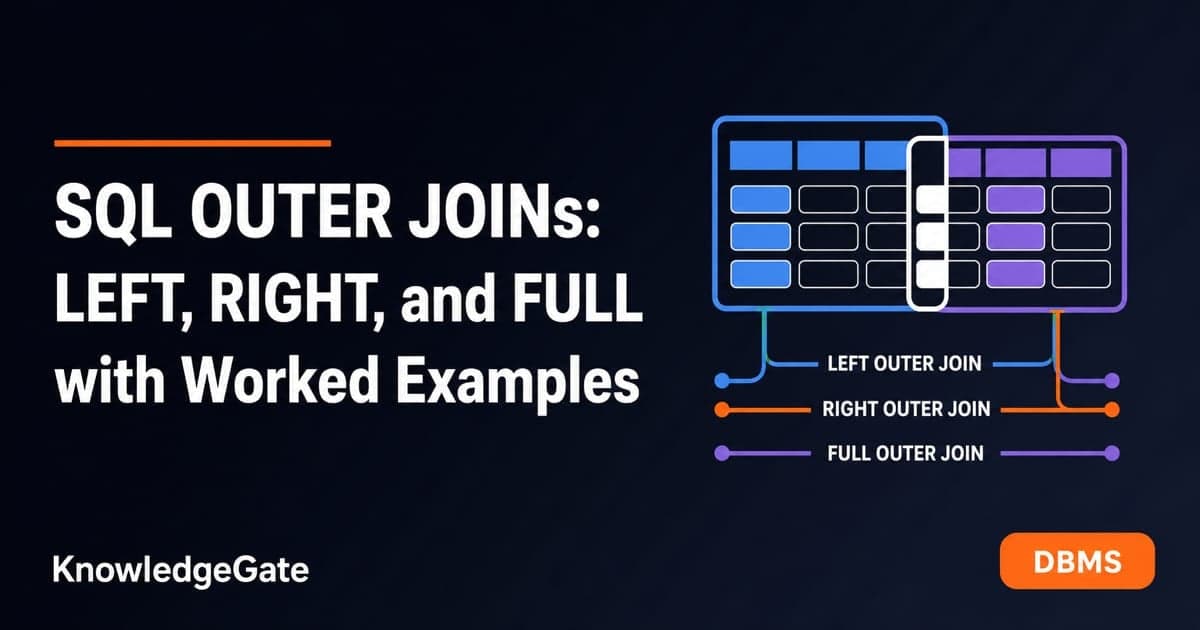
SQL OUTER JOINs: LEFT, RIGHT, and FULL with Worked Examples
Learn outer joins from a five-employee, four-department dataset. Trace preserved rows, NULLs, filter placement, row counts, and four exact exercise answers.
Updated 20 Sep 20266 min readDBMS

ORDER BY and LIMIT in SQL: Tutorial with Exact Outputs
Learn to sort SQL results deterministically, resolve ties, select top rows, and paginate with LIMIT and OFFSET using one eight-row orders table.
Updated 19 Sep 20266 min readDBMS