

GATE CS Engineering Mathematics Roadmap: 8 Weeks to Timed Practice
Build accuracy across discrete mathematics, linear algebra, calculus and probability, then earn your move into timed mixed practice through clear evidence.
KnowledgeGate Team
Exam prep & CS education
Updated 25 Nov 20265 min read

Engineering Mathematics preparation often gets trapped in one of two modes: slow chapter-by-chapter study with no time pressure, or premature mixed tests that hide whether a miss came from the concept, an algebra step or a rushed decision. This eight-week route moves through discrete mathematics, linear algebra, calculus and probability, establishing accuracy before compressing familiar methods into timed sets. If the evidence says a phase is not ready, stretch the calendar instead of forcing the date.
1. Begin with a 32-question diagnostic, not a guessed timetable
Run a closed-note 60-minute diagnostic: eight fresh questions from each area. Record correct, wrong, unattempted and minutes, then use the result to plan your work.
Suppose the record is:
Area | Correct | Wrong | Unattempted | Minutes |
|---|---|---|---|---|
Discrete mathematics | 6 | 1 | 1 | 13 |
Linear algebra | 3 | 3 | 2 | 18 |
Calculus | 4 | 2 | 2 | 16 |
Probability | 5 | 1 | 2 | 13 |
Totals: 18 correct, 7 wrong and 7 unattempted in 60 minutes. Attempted accuracy is 18 / (18 + 7) = 18/25 = 72%. By area: discrete 6/7 = 85.7%, linear algebra 3/6 = 50%, calculus 4/6 = 66.7%, probability 5/6 = 83.3%. Linear algebra gets the largest repair block; discrete remains. The diagnostic orders attention, deleting no phase.
2. Fit the roadmap into an honest 10-hour week
Each week:
Monday and Tuesday: 75 minutes each, concept recall and worked examples.
Wednesday and Thursday: 75 minutes each, closed-note problems.
Friday: 60 minutes, formula recall and error-log repair.
Saturday: 120 minutes, topic or mixed set plus review.
Sunday: 60 minutes timed practice, then 60 minutes analysis.
Total: 4 x 75 + 60 + 120 + 120 = 600 minutes = 10 hours. Each weekday produces a half-page recall sheet, two worked examples and one error tag: concept, setup, calculation or time choice. Copied notes without a cold attempt do not count.
Start timing a method only after two fresh 10-question sets each reach 8 correct.
3. Weeks 1 and 2 make discrete mathematics reproducible
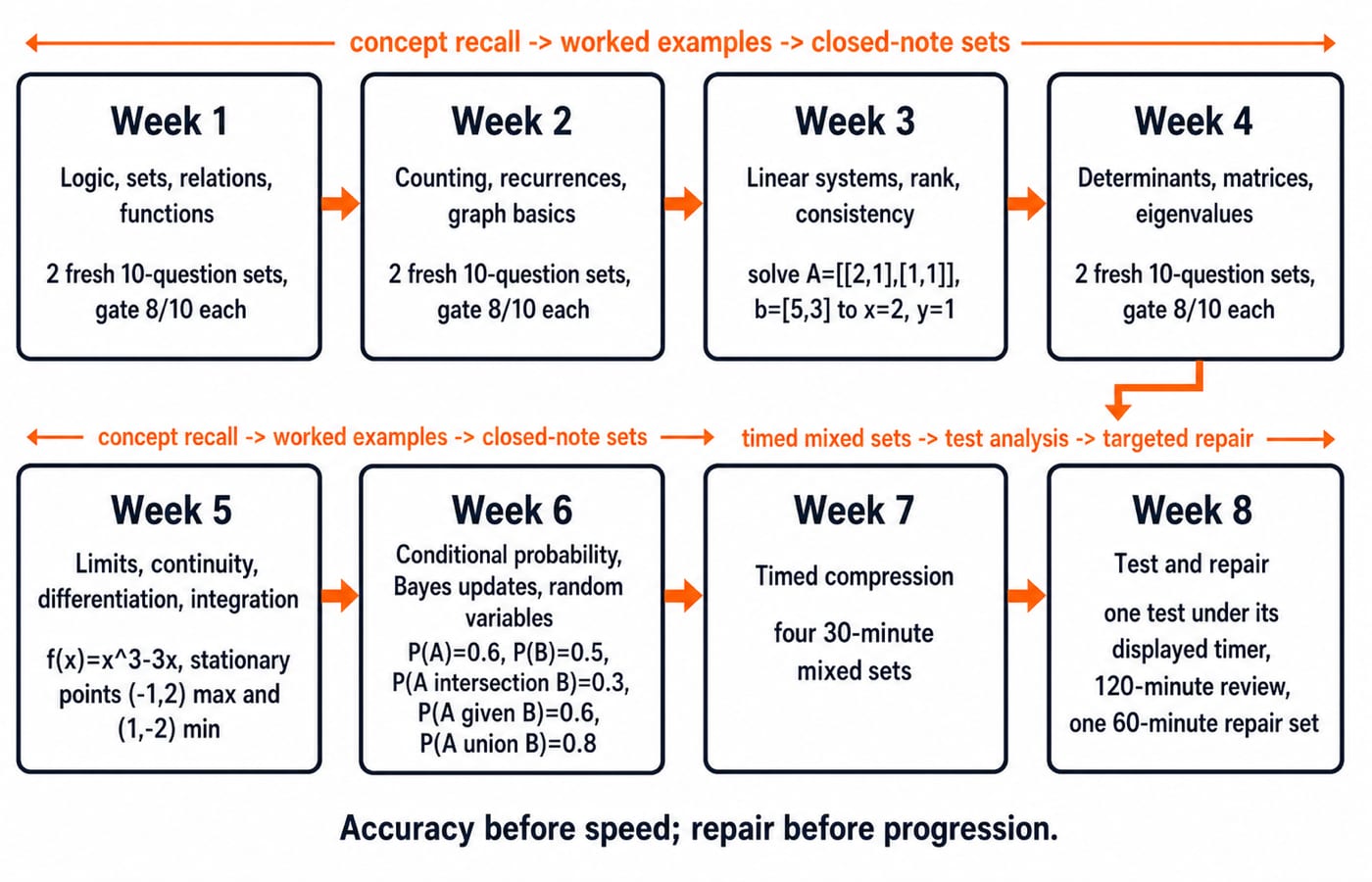
Week 1 covers logic, sets, relations and functions. Week 2 covers counting, recurrence patterns and graph basics. Relation language supports later work, which is why it comes first. The earlier Discrete Mathematics for GATE: A 6-Week Topic-by-Topic Study Plan owns the discrete-only sequence and missed-day recovery; this roadmap uses discrete mathematics for Weeks 1-2 before allocating the remaining six weeks to linear algebra, calculus and probability.
For a relation exercise, take S = {1, 2, 3, 6} and define aRb when a divides b. Then
R = {(1,1),(1,2),(1,3),(1,6),(2,2),(2,6),(3,3),(3,6),(6,6)}.
Justify reflexivity, antisymmetry and transitivity before drawing. Hasse cover edges are 1-2, 1-3, 2-6 and 3-6; omit reflexive pairs and transitive edge 1-6.
4. Weeks 3 to 6 move from algebraic structure to uncertainty
Week 3 covers systems, rank and consistency; Week 4, determinants, matrices and eigenvalues; Week 5, limits, continuity, differentiation and integration; Week 6, counting-to-probability bridges, conditional probability, Bayes updates and random variables. Repeat a week if either fresh 10-question set is below 8/10.
Solve 2x + y = 5, x + y = 3, with A = [[2,1],[1,1]], b = [5,3]. Compute det(A) = 2(1) - 1(1) = 1. Subtraction gives x = 2, then y = 1. Check: 2(2) + 1 = 5; 2 + 1 = 3. Use Linear Algebra for GATE CS for more rank-and-consistency work.
For f(x) = x^3 - 3x, f'(x) = 3x^2 - 3 = 0 at x = -1, 1. Since f''(x) = 6x, (-1, 2) is a local maximum and (1, -2) a local minimum. If P(A) = 0.6, P(B) = 0.5, P(A intersection B) = 0.3, then P(A given B) = 0.3/0.5 = 0.6 and P(A union B) = 0.6 + 0.5 - 0.3 = 0.8. Continue this drill with Probability for GATE CS.
Use the Engineering Mathematics for GATE course for structured support in the linear-algebra and calculus phases.
5. Week 7 compresses known methods without rewarding panic
After passing the accuracy gate, use this ladder:
Work one example with notes in 8 minutes.
Solve a fresh variant without notes in 6 minutes.
Solve three same-method questions in 12 minutes, with at least two correct.
Solve five mixed questions in 20 minutes, with at least four correct.
Advance only after checking the calculation. At rung 2, try 3x + y = 7, x + y = 3. Subtraction gives 2x = 4, so x = 2, y = 1. Check: 3(2) + 1 = 7; 2 + 1 = 3. Finishing in 4 minutes but skipping verification and changing a correct sign during review is calculation, not fast success.
Below 80% across two timed sets, return to one closed-note untimed set. Repair the dominant error before going faster.
6. Week 8 turns one mixed set into the next repair plan
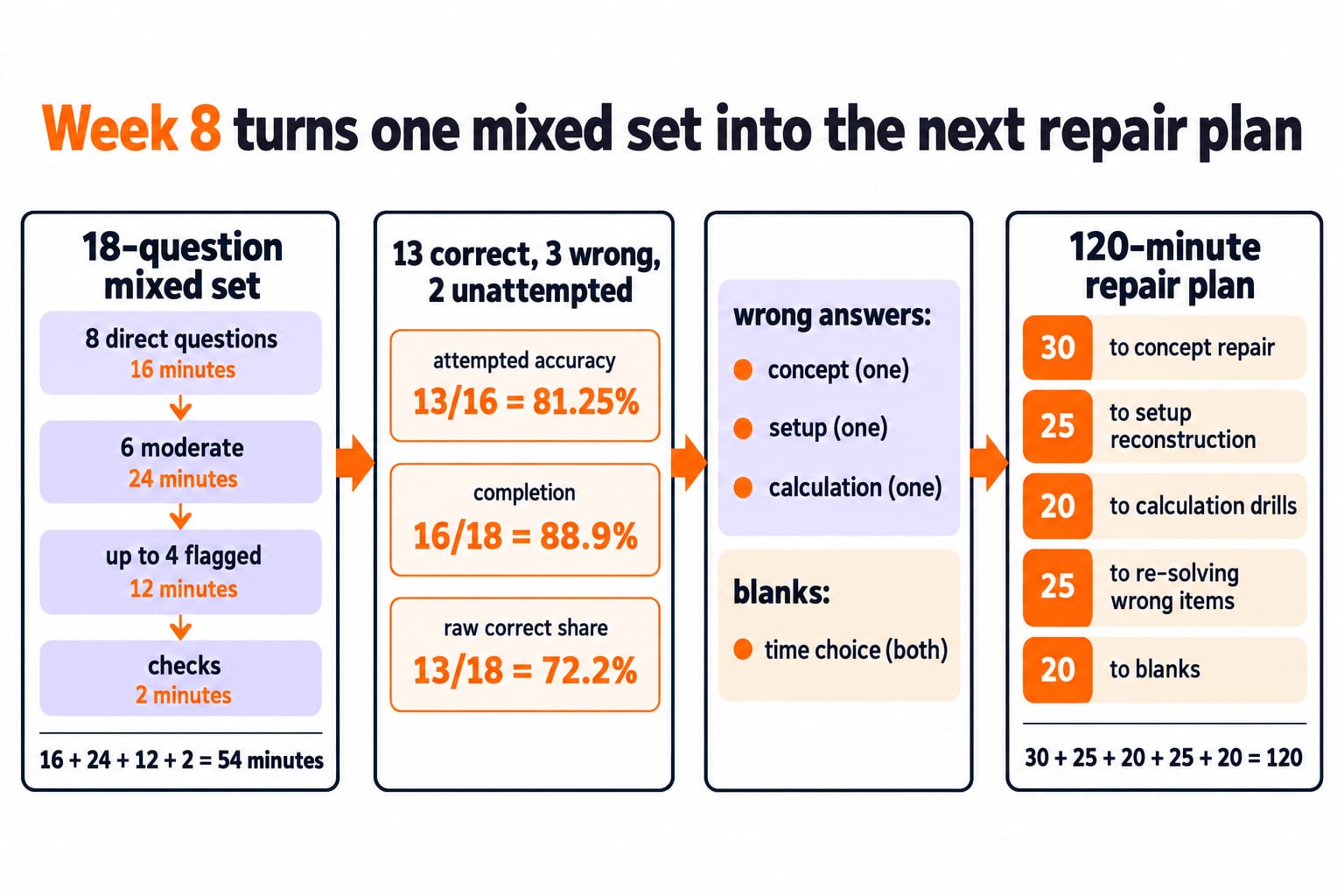
Build an 18-question mixed set: eight direct questions in 16 minutes, six moderate in 24, up to four flagged in 12, then 2 for checks. So 16 + 24 + 12 + 2 = 54 minutes.
With 13 correct, 3 wrong and 2 unattempted, attempted accuracy is 13/16 = 81.25%, completion 16/18 = 88.9%, and raw correct share 13/18 = 72.2%. Tag the wrong answers concept, setup and calculation, one each; tag both blanks time choice.
Allocate the next 120 minutes: 30 to concept repair, 25 to setup reconstruction, 20 to calculation drills, 25 to re-solving wrong items and 20 to blanks. Check: 30 + 25 + 20 + 25 + 20 = 120.
After analysing a mixed block this way, move to a prepared GATE Test Series and follow its displayed timer and instructions.
7. Missed days stretch the roadmap; they do not trigger a study binge
Miss one 75-minute weekday? Move its priority concept or example into Saturday's first 75 minutes and reduce new questions. Never double the next weekday. Miss two or more? Repeat the subject week with its 8/10 gate. Eight weeks can become nine.
The short version
Diagnose 32 questions, complete six subject weeks, earn timing through two 8/10 gates, then repair errors. Book the 60-minute diagnostic and create a four-column error log. For wider subject and testing routes, browse the GATE CS course category.
Go deeper with the full courseEngineering Mathematics for GATE Exam
Keep learning

TypeScript Learning Roadmap: 20 Weeks from Everyday Types to a Full-Stack App
Follow a dependency-led TypeScript plan through BudgetLens, IssueBoard and TaskBoard, with exact weekly gates, strict checks and tested API boundaries.
Updated 28 Sep 20265 min readProgramming Languages Survey

C# Learning Roadmap: 24 Weeks from Basics to ASP.NET Core
Follow an ordered 24-week C# plan that turns one console StudyTracker into a tested ASP.NET Core API, with clear phase gates and worked results.
Updated 30 Oct 20265 min readProgramming Languages Survey

Backend Language Roadmap: Choose Go, Rust, Kotlin, C# or PHP in Six Weeks
Stop comparing backend ecosystems in the abstract. Use one scorecard and a 42-hour API project to decide whether to continue, switch, or strengthen your foundations.
Updated 30 Oct 20265 min readProgramming Languages Survey

Graph Theory for GATE CS: Concepts and Worked Examples
Build graph theory from two fully specified examples. Work through degree counts, connectivity, spanning trees, bipartiteness, planarity, and Euler and Hamilton checks.
Updated 8 Aug 20266 min read51 viewsEngineering Mathematics