NIMCET Mathematics Topic Priority: A Weekly Revision System
Stop revising whichever chapter feels urgent. Use dependencies, diagnostic errors, recall checks, and an eight-week loop to decide what to study next.
KnowledgeGate Team
Exam prep & CS education
Updated 14 Aug 20266 min read
You revise whichever chapter feels urgent, then discover that last week's formulas have faded. Completion does not prove that you can solve under time pressure. Replace that cycle with a dependency order, an eight-week cumulative loop, and closed-book recall.
The official syllabus fixes what you must cover, but it does not rank the six Mathematics families against one another. The working order therefore has to come from two things you can actually measure: which topics other topics feed into, and where your own fresh-set errors cluster.
Start with the official NIMCET Mathematics map
NIT Tiruchirappalli's official NIMCET Syllabus 2026 is the revised version, effective from this admission cycle. It states that Mathematics contains 50 questions and lists six families: Set Theory and Logic, Probability and Statistics, Algebra, Coordinate Geometry, Calculus, and Trigonometry. It gives no chapter-wise question count, so any topic-wise split you meet in a coaching list is somebody's estimate rather than an official figure.
Put those six families on one tracker page with four columns of evidence, the same shape that works for any of the other PG Entrance Exams you are sitting.
Official family | Not started | Can solve untimed | Can solve timed | Can recall after 7 days |
|---|---|---|---|---|
Set Theory and Logic | □ | □ | □ | □ |
Probability and Statistics | □ | □ | □ | □ |
Algebra | □ | □ | □ | □ |
Coordinate Geometry | □ | □ | □ | □ |
Calculus | □ | □ | □ | □ |
Trigonometry | □ | □ | □ | □ |
A chapter moves forward only after evidence, such as at least 8 correct answers in a fresh 10-question set. Finishing lectures is not evidence.
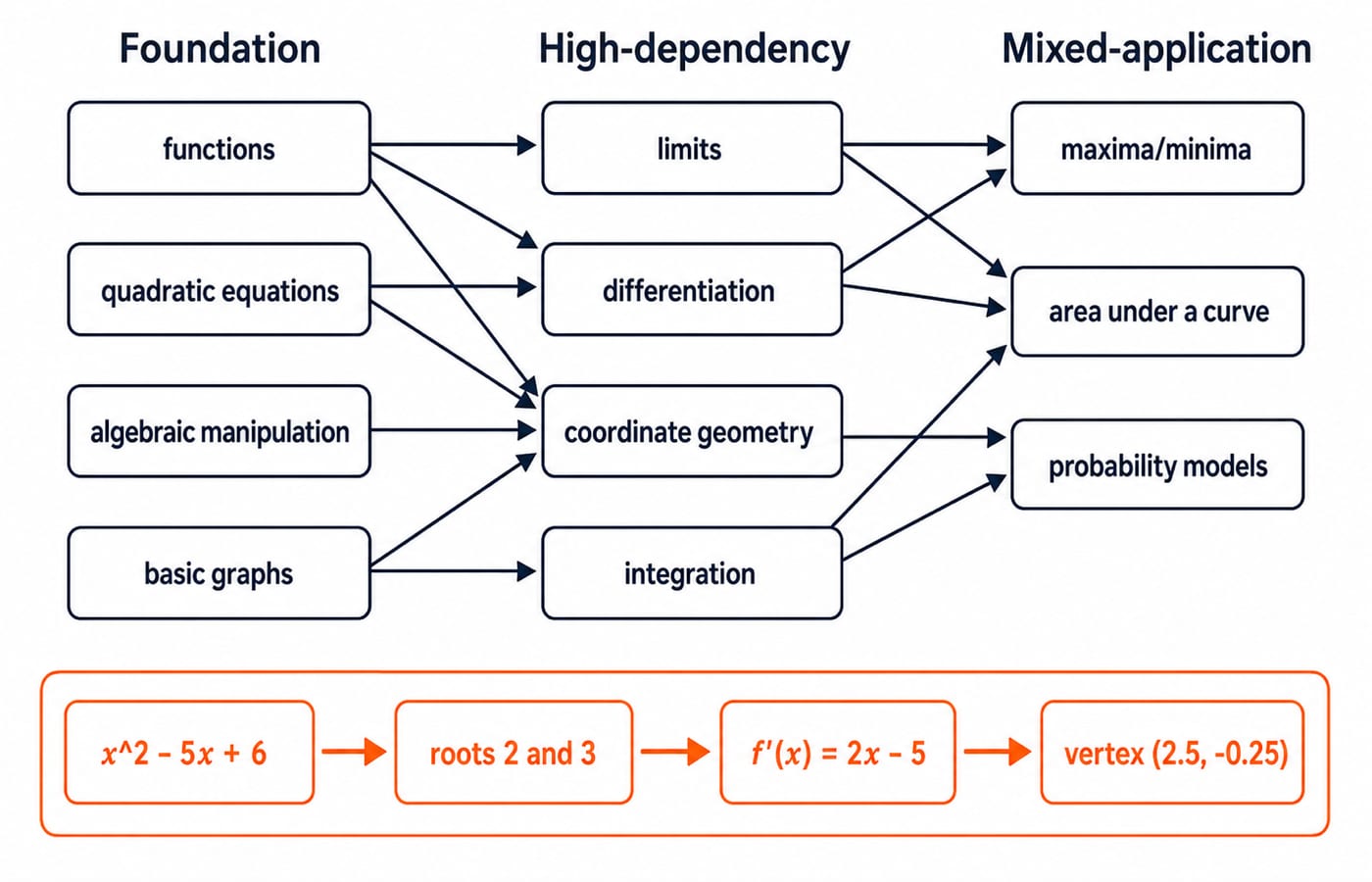
Put topics into three dependency blocks
Foundation contains sets, functions and relations, algebraic operations, indices, logarithms, quadratics, basic graphs, and core trigonometric identities. Functions precede limits, algebraic manipulation precedes integration, and equations precede coordinate geometry.
High-dependency topics combine those tools: progressions, matrices and determinants, coordinate geometry, limits, differentiation, integration, and trigonometric equations. Mixed-application topics include permutations and combinations, probability and statistics, conics, maxima and minima, definite-integral area, and multi-family questions.
Order inside a block matters little; order between blocks decides everything. Nothing in the High-dependency list is worth deep work until its Foundation feeders clear a fresh-set check. For the wider topic map beyond NIMCET, see Engineering Mathematics. If sets and relations are the weak feeder, work through Set Theory and Relations MCQs.
Calculate a priority score instead of guessing
Score every topic on three inputs:
Dependency, D, from 0 to 2: use 2 when many later topics rely on it, 1 for a narrower connection, and 0 for maintenance.
Diagnostic error, E, from 0 to 2: use 0 for an error rate below 15%, 1 for 15% to 30%, and 2 for above 30%.
Recall gap, R, from 0 to 1: use 1 when you recall fewer than 8 of 10 formula prompts within 30 seconds. Otherwise use 0.
Use Priority = D + E + R, with a maximum of 5.
Algebra has D = 2. You answer 6 of 10 fresh questions correctly, so 4/10 × 100 = 40% and E = 2. You recall 7 of 10 prompts, so R = 1. Priority is 2 + 2 + 1 = 5.
Statistics has D = 0. Getting 9 of 10 correct gives 1/10 × 100 = 10% and E = 0. Recalling 9 of 10 gives R = 0. Priority is 0 + 0 + 0 = 0, so Statistics stays in maintenance while Algebra gets deep work.
Recalculate every Sunday with fresh questions. A chapter does not gain priority because it is popular, comfortable, or merely unfinished.
Worked example: make one quadratic support three chapters
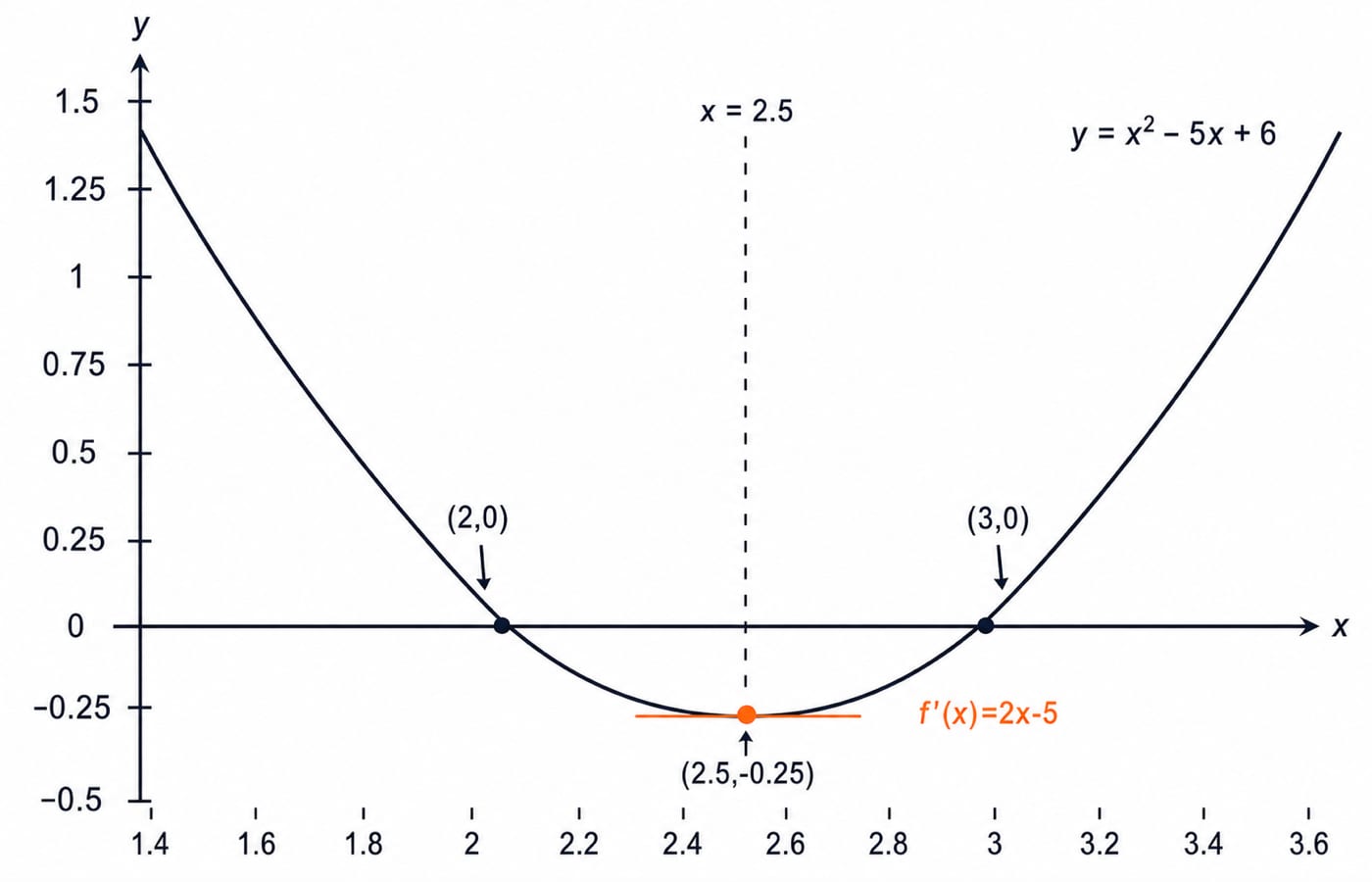
Take f(x) = x^2 - 5x + 6.
Algebra layer:
Factor:
x^2 - 5x + 6 = (x - 2)(x - 3).Set each factor to zero, giving roots
alpha = 2andbeta = 3.Check the relations:
alpha + beta = 2 + 3 = 5andalpha beta = 2 × 3 = 6.
Calculus layer:
Differentiate:
f'(x) = 2x - 5.Set
f'(x) = 0:2x - 5 = 0, sox = 5/2.Evaluate:
f(5/2) = 25/4 - 25/2 + 6 = 25/4 - 50/4 + 24/4 = -1/4.The coefficient of
x^2is positive, so(5/2, -1/4)is the minimum.
Check independently: f(x) = (x - 5/2)^2 - 1/4. The square cannot be negative, confirming the minimum and vertex.
Coordinate Geometry layer: the parabola crosses the x-axis at (2, 0) and (3, 0), its axis of symmetry is x = 5/2, and its vertex is (5/2, -1/4).
Close the notes and retrieve the roots, the vertex, and the derivative from memory before you move on. Matrices and determinants need a drill of exactly this shape; Linear Algebra for GATE CS carries the rank and eigenvalue practice.
Run an eight-week cumulative practice loop
Weeks 1 and 2 cover Foundation, Weeks 3 to 5 High-dependency topics, Weeks 6 and 7 Mixed-application topics, and Week 8 consolidation. From Week 2, retain older material.
An 11-hour week can be fixed precisely:
Day | Minutes | Work |
|---|---|---|
Monday to Friday | 90 each day | 35 concept or correction, 40 fresh problems, 15 closed-book recall |
Saturday | 150 | 30 old errors, 90 mixed set, 30 analysis |
Sunday | 60 | 20 formula prompts, 20 ledger update, 20 planning |
The total is 5 × 90 + 150 + 60 = 660 minutes = 11 hours. If you miss a weekday, move only its 40-minute problem set to Sunday. Do not double the next day.
In Week 5, make a 20-question pool with 12 from the current High-dependency block, 5 from Foundation, and 3 from the error log. The check is 12 + 5 + 3 = 20. In Week 8, mix all 20 across the official families.
Build a formula-recall system that forces retrieval
Use two-sided prompt cards, not a copied formula sheet.
Front:
For x^2 - 5x + 6 = 0, recall the root relations and rootsBack:
alpha + beta = 5, alpha beta = 6, roots 2 and 3Front:
Derivative and stationary x-value of f(x) = x^2 - 5x + 6Back:
f'(x) = 2x - 5; x = 5/2
Review each card on Day 0, Day 2, Day 7, and Day 14. Taking over 30 seconds or making a sign error resets it to Day 0. A correct Day 14 answer moves to weekly maintenance.
Keep an error log labelled concept, algebra, formula, or time choice. Every entry needs one corrected solution and one fresh variation. For example, use x^2 - 7x + 12 = (x - 3)(x - 4), then recover roots 3, 4, sum 7, and product 12 without notes.
Avoid the traps that create false confidence
Trap | What goes wrong | Replacement |
|---|---|---|
Ranking topics through an unsupported “high weightage” list | You neglect an official syllabus family. | Cover every family, then order work by dependencies and your own error data. |
Finishing Calculus lectures while algebraic manipulation is slow | Factoring, fraction, and sign errors look like a Calculus weakness. | First pass the 8-of-10 fresh-set gate in prerequisite Algebra and Functions. |
Rereading formulas and solving only single-chapter sets | Recognition feels like recall, and the chapter label reveals the method. | Use 30-second closed-book cards and the 12-current, 5-old, 3-error mix. |
The short version and the NIMCET next step
For 2026, Mathematics carries 50 of the paper's 120 questions, spread across the six named families, with 40 on analytical ability and logical reasoning, 20 on computer awareness and 10 on general English. That balance rewards full-family coverage and fast method selection far more than any guessed topic frequency. If you are preparing for a later admission cycle, check the official NIMCET portal for that year's syllabus first.
The short version is simple: map every official topic, study prerequisites first, assign a 0-to-5 priority score, preserve older work every week, and let timed mixed sets plus the error log choose the next week's order.
If you are sitting other MCA entrances as well, the MCA Entrance Exam 2026 Course covers NIMCET alongside them, so this Mathematics work carries across instead of being rebuilt exam by exam. Either way, start this week: fill the tracker, score every family on Sunday, and open the highest-priority Foundation topic first.
Keep learning
CUET-PG CS vs NIMCET: One Shared-Core Plan for MCA Entrance Prep
Prepare for both MCA entrances with one shared core and two thin exam-specific wrappers: an overlap sheet built from the official documents, a coverage-and-accuracy diagnostic, and a twelve-hour week that survives missed days.
Updated 22 Aug 20266 min readMCA Entrance

CUET PG Computer Science Mock Analysis: Build a Study Plan From Every Error
A mock score cannot tell you what to revise next. Use an error log, timed re-solves, priority weights and fresh-question retests to build a practical seven-day repair plan.
Updated 20 Aug 20266 min readMCA Entrance
NIMCET vs CUET PG MCA: Choose One Exam or Prepare for Both
Compare the two MCA entrance routes, calculate mock scores correctly, and use a personal decision matrix plus a 168-hour bridge plan to choose one or both.
Updated 18 Aug 20265 min read52 viewsMCA Entrance

CUET PG Computer Science Preparation: 12-Week BCA Bridge Plan
Turn familiar BCA subjects into an entrance-ready system with a baseline audit, two maths routes, mixed objective sets and a realistic recovery calendar.
Updated 16 Aug 20266 min readMCA Entrance