Compiler Design
50 articles in this topic

Code Optimization Mistakes in Compiler Design: How to Avoid Losing GATE Marks
A rewrite that looks familiar is not necessarily safe. Trace six common optimization errors, learn why each one changes program meaning, and use a five-step check before accepting an answer.
Updated 22 Oct 20265 min readCompiler Design
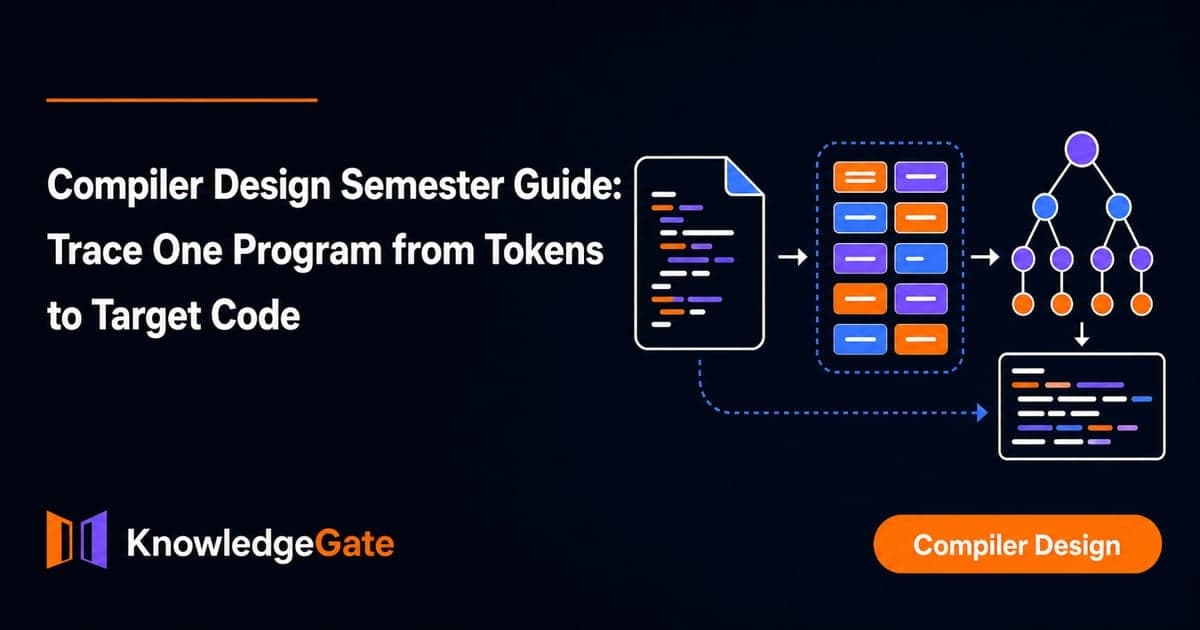
Compiler Design Semester Guide: Trace One Program from Tokens to Target Code
Follow one assignment through lexical analysis, parsing, semantic checks, TAC, optimization and abstract target instructions, with every hand-off made visible.
Updated 18 Oct 20267 min readCompiler Design
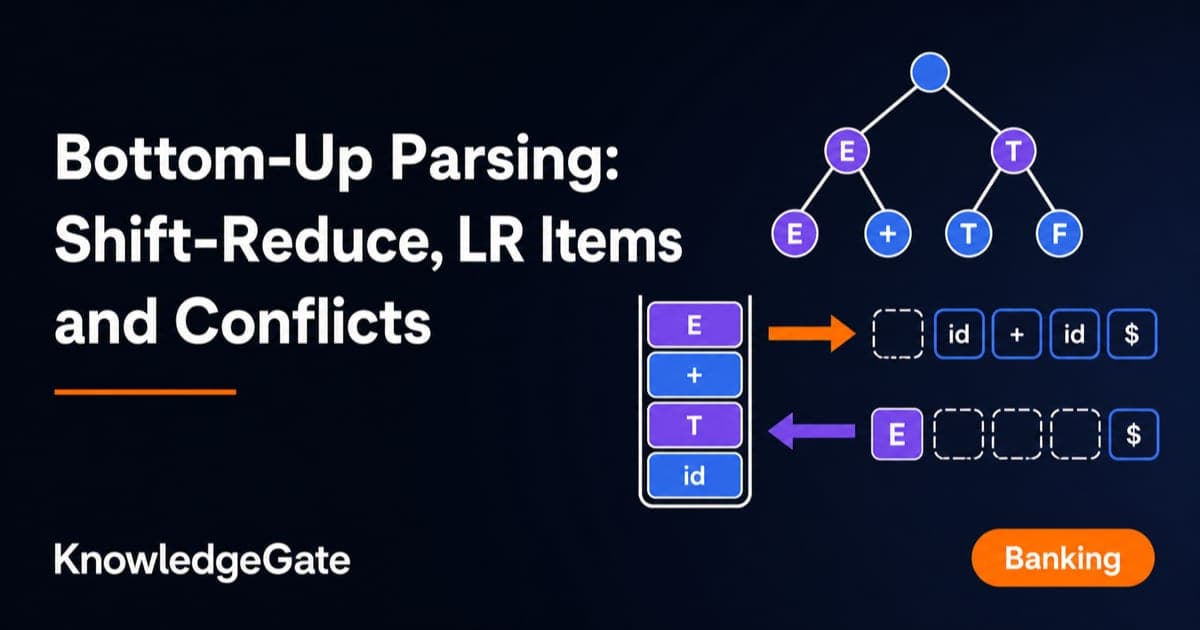
Bottom-Up Parsing in Compiler Design: Shift-Reduce Trace, LR Items and Conflicts
Follow a nested-parentheses LR(0) parse from input to acceptance, derive every item set, and see why lookahead changes parser-family conflicts.
Updated 14 Oct 20265 min readCompiler Design
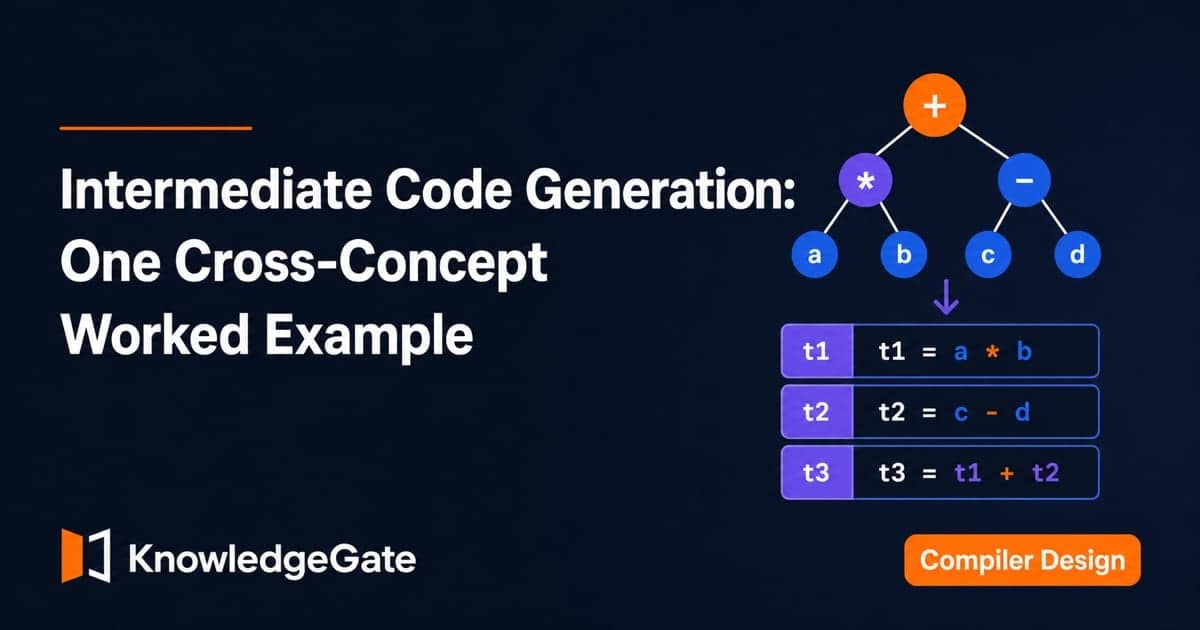
Intermediate Code Generation in Compiler Design: One Cross-Concept Worked Example
Carry one C-like fragment from its source facts to typed temporaries, three-address code, quadruples and a control-flow graph, with every value traced.
Updated 10 Oct 20266 min readCompiler Design
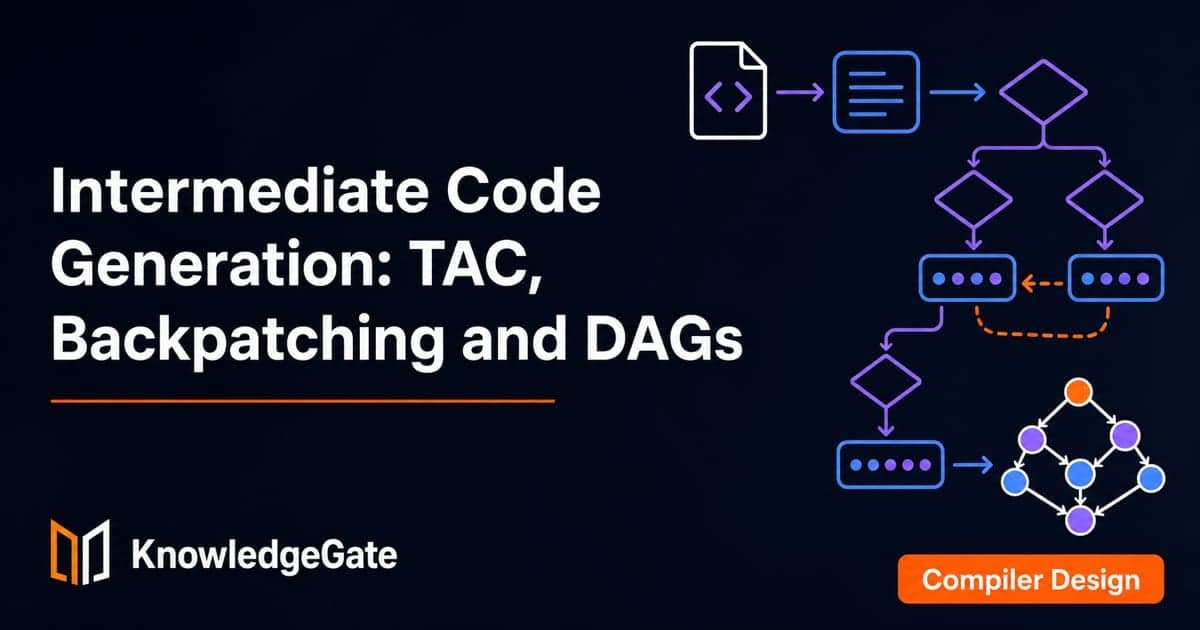
Intermediate Code Generation in Compiler Design: TAC, Backpatching and DAGs
Connect expressions, short-circuit control flow and local optimisation through a single worked translation, from source code to resolved TAC and a reusable DAG.
Updated 5 Oct 20265 min readCompiler Design
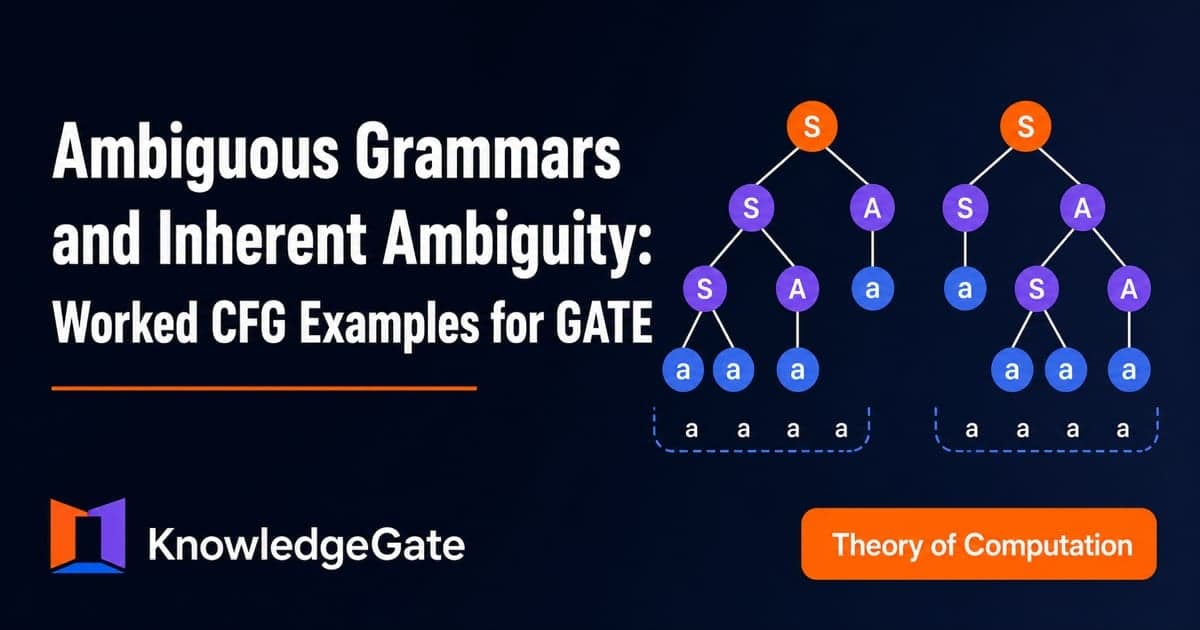
Ambiguous Grammars and Inherent Ambiguity: Worked CFG Examples for GATE
Learn what two derivations really prove, resolve expression ambiguity with precedence, and trace the classic inherently ambiguous language through aabbcc.
Updated 1 Oct 20266 min readCompiler Design
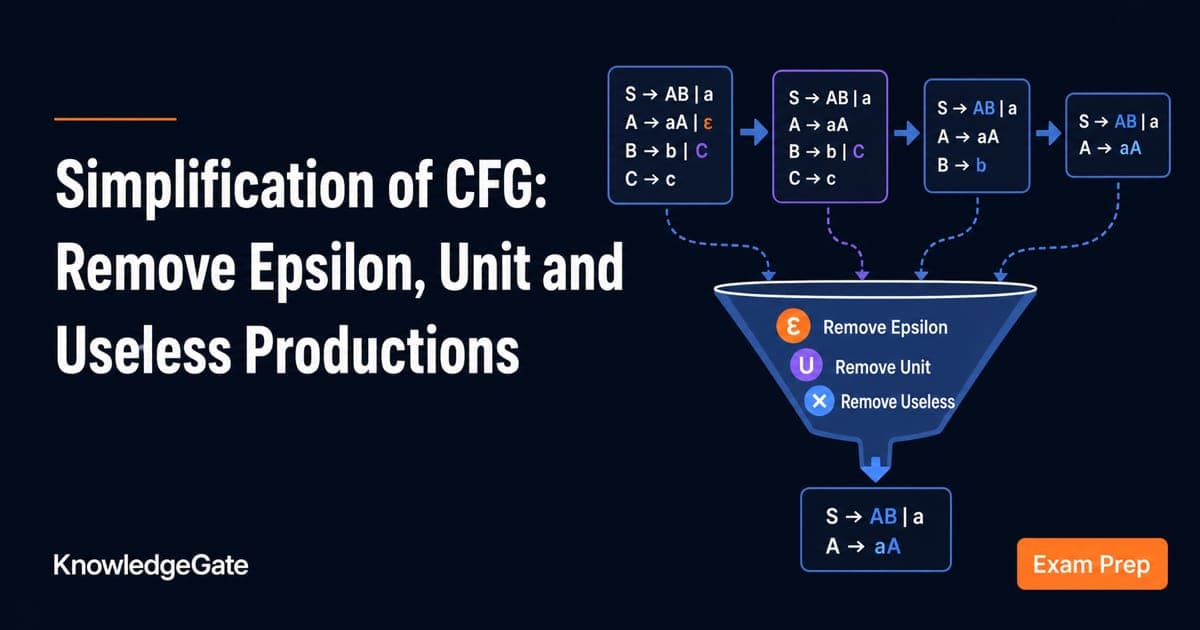
Simplification of CFG: Remove Epsilon, Unit and Useless Productions Step by Step
Simplify one context-free grammar from nine nonterminals to six. See each intermediate grammar, complete unit closures, symbol checks and final derivations.
Updated 26 Sep 20266 min readCompiler Design
Phases of Compiler Explained: Worked Example from Tokens to Target Code
Follow one four-line program through lexical, syntax and semantic analysis, then see its intermediate code optimized to a final stored value of 24.0.
Updated 24 Sep 20266 min readCompiler Design
Normal Forms and BNF in Compiler Design: CNF, GNF and Worked CFG Conversions
Separate grammar notation from production restrictions, then convert one CFG into CNF and GNF with exact derivations and rule-by-rule checks.
Updated 23 Sep 20266 min readCompiler Design
Intermediate Code Generation Across Compiler Concepts: Worked TAC, Quadruples and DAG Optimisation
Follow one parenthesised expression from source semantics to naive TAC, record layouts and a four-instruction DAG optimisation, with checks for safe reuse.
Updated 22 Sep 20265 min readCompiler Design
Activation Records and Function Calls: Stack Frames, Worked Trace and Exam Traps
Build a reliable stack-frame model with exact call, return, recursion and nested-procedure traces, plus a fully mapped 72-byte teaching layout.
Updated 20 Sep 20266 min readCompiler Design
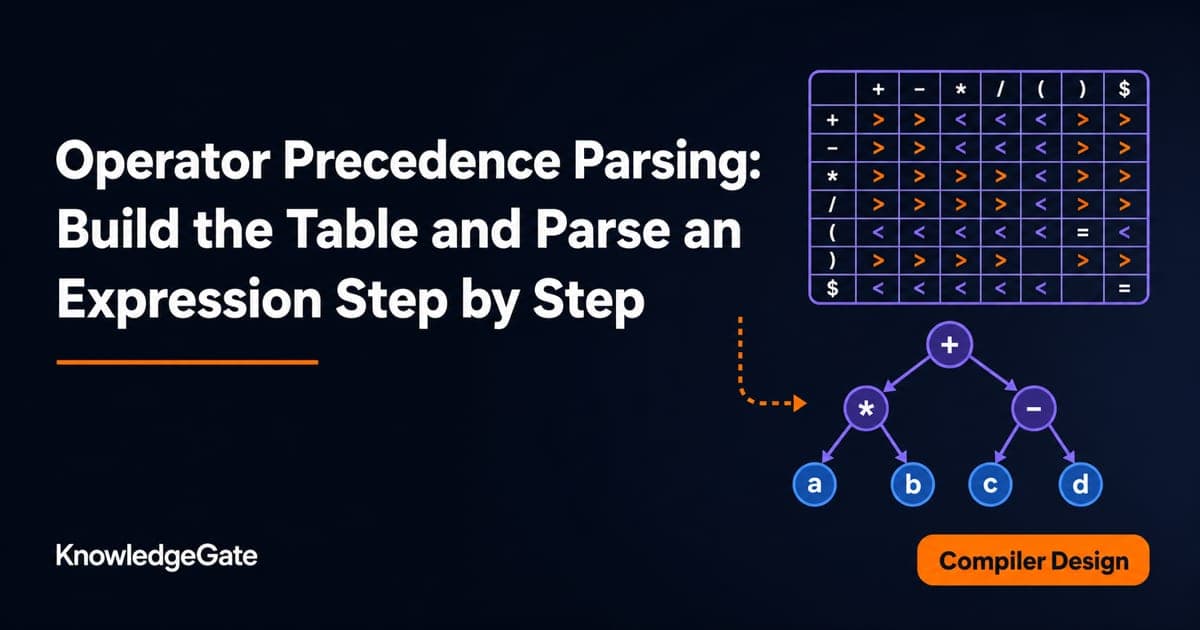
Operator Precedence Parsing: Build the Table and Parse an Expression Step by Step
Build an operator-precedence table from a grammar, then use it to trace every shift and reduction for i+i*i.
Updated 19 Sep 20266 min readCompiler Design