

Eigen Values and Eigen Vectors Questions with Solutions: 12-Question Practice Set
Use this 12-question set to practise the right shortcut for each matrix, from diagonal entries and invariants to symmetry, quadratic forms and block structure. Attempt every question before reading its concise solution.
KnowledgeGate Team
Exam prep & CS education
Updated 27 Nov 20266 min read
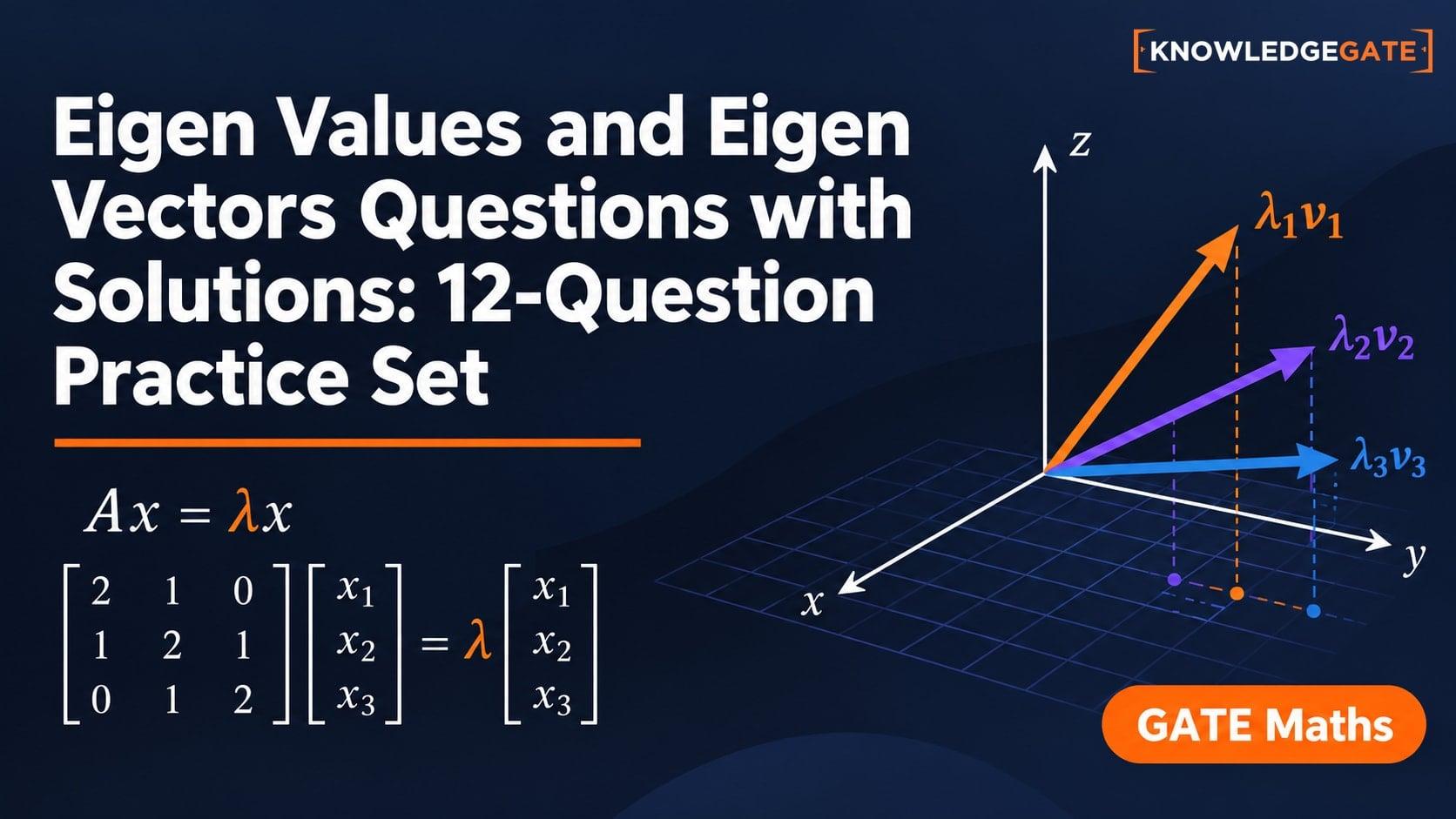
Eigenvalue questions look repetitive, but the fastest valid method changes with the matrix: read the diagonal, use trace and determinant, solve the characteristic equation, or exploit symmetry and block structure. Before starting, review rank, consistency and eigenvalue basics if any of those ideas feel rusty. Work each question before reading its solution; the explanations keep the deciding algebra visible. Treat these problems as a focused first pass, then revisit the method behind every miss.
1. A one-minute eigenvalue method map before the questions
Signal in the question | First move | Check |
|---|---|---|
Triangular matrix | Read the diagonal | Sum equals the trace |
Eigenvalues supplied, or their product requested | Use the product of eigenvalues | Compare with the determinant |
General 2 by 2 matrix | Solve lambda^2-(trace(A))lambda+det(A)=0 | Check the sum and product |
Symmetric or structured matrix | Use orthogonality, the Rayleigh quotient, or the row and block pattern | Verify with one direct multiplication |
The two invariants are
sum_i lambda_i=trace(A); prod_i lambda_i=det(A),
with algebraic multiplicity counted. Use the broader engineering-mathematics map when you want to connect these shortcuts with the rest of the subject.
2. Fast invariant questions: diagonal, determinant, trace and unknown entries
Question 1
(GATE 2011)
Consider the matrix as given below.
[1, 2, 3; 0, 4, 7; 0, 0, 3]
Which one of the following options provides the CORRECT values of the eigenvalues of the matrix?
(a) 1, 4, 3
(b) 3, 7, 3
(c) 7, 3, 2
(d) 1, 2, 3
Answer: (a) 1, 4, 3.
An upper-triangular matrix has its eigenvalues on the diagonal, so they are 1,4,3. Their sum 1+4+3=8 matches the trace.
Question 2
(GATE 2024, Computer Science, Set 1)
The product of all eigenvalues of the matrix
[1, 2, 3; 4, 5, 6; 7, 8, 9]
is
(a) -1
(b) 0
(c) 1
(d) 2
Answer: (b) 0.
The eigenvalue product is det(A). Since
(7,8,9)=-(1,2,3)+2(4,5,6),
the rows are linearly dependent. Thus det(A)=0, so the product is 0.
Question 3
(GATE 2015, Computer Science, Set 1)
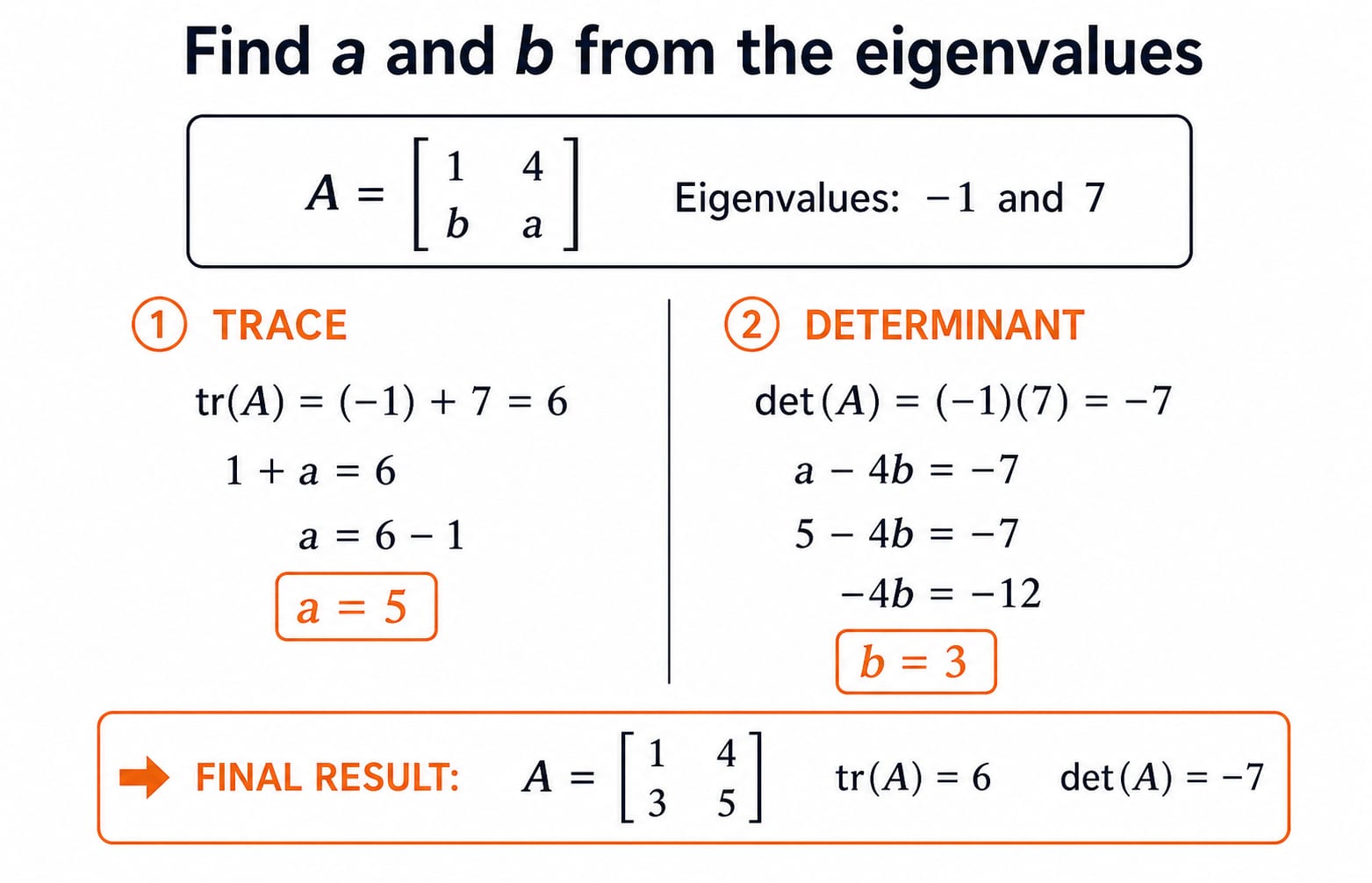
Consider the following 2 x 2 matrix A where two elements are unknown and are marked by a and b. The eigenvalues of this matrix are -1 and 7. What are the values of a and b?
A=[1, 4; b, a]
(a) a=6, b=4
(b) a=4, b=6
(c) a=3, b=5
(d) a=5, b=3
Answer: (d) a=5, b=3.
From the trace,
1+a=-1+7=6,
so a=5. From the determinant,
a-4b=(-1)(7)=-7.
Substitution gives 5-4b=-7, so b=3. The checks are trace 1+5=6 and determinant 1(5)-4(3)=-7.
3. Characteristic-equation questions: real roots, complex pairs and conjugates
Question 4
(GATE 2005, Computer Science)
What are the eigenvalues of the matrix
A=[2, -1; -4, 5]?
(a) -1 and 1
(b) 1 and 6
(c) 2 and 5
(d) 4 and -1
Answer: (b) 1 and 6.
The characteristic equation is
det(A-lambda I)=(2-lambda)(5-lambda)-4
=lambda^2-7lambda+6=0.
Factoring gives (lambda-1)(lambda-6)=0, so the roots are 1 and 6. Their sum is 7 and product is 6, matching the trace and determinant.
Question 5
Consider the matrix M=[2, -1; 3, 1].
Which ONE of the following statements is TRUE?
(a) The eigenvalues of M are non-negative and real.
(b) The eigenvalues of M are complex conjugate pairs.
(c) One eigenvalue of M is positive and real, and another eigenvalue of M is zero.
(d) One eigenvalue of M is non-negative and real, and another eigenvalue of M is negative and real.
Answer: (b) The eigenvalues of M are a complex-conjugate pair.
Here trace(M)=3 and
det(M)=2(1)-(-1)(3)=5.
Thus the polynomial is lambda^2-3lambda+5, with discriminant 3^2-4(5)=-11<0. Its roots are
lambda=(3+/- i sqrt(11))/(2).
The nonzero determinant excludes option (c), while the negative discriminant excludes all real-eigenvalue options.
Question 6
(GATE 2016, Computer Science, Set 1)
Two eigenvalues of a 3 x 3 real matrix P are (2+sqrt(-1)) and 3. The determinant of P is ______.
Answer: 15.
Write sqrt(-1)=i. Because P is real, the missing eigenvalue is the conjugate 2-i. Therefore
det(P)=(2+i)(2-i)(3)=(4-i^2)(3)=5(3)=15.
For a structured route through more linear-algebra practice, continue with Engineering Mathematics for GATE Exam and work through each method in sequence.
4. Symmetric-matrix questions: orthogonality and Frobenius-norm constraints
Question 7
(GATE 2014, Computer Science, Set 1)
The value of the dot product of the eigenvectors corresponding to any pair of different eigenvalues of a 4-by-4 symmetric positive definite matrix is _____________________.
Answer: 0.
Let Av=lambda v and Aw=mu w, with lambda!=mu. Symmetry gives v^TAw=(Av)^Tw, while
v^TAw=mu v^Tw; (Av)^Tw=lambda v^Tw.
Hence (lambda-mu)v^Tw=0, so v^Tw=0. Positive definiteness makes the eigenvalues positive, but symmetry alone gives orthogonality.
Question 8
(GATE 2017, Computer Science, Set 1)
Let A be an n x n real valued square symmetric matrix of rank 2 with
sum(i=1..n) sum(j=1..n) A^2_ij=50.
Consider the following statements.
I. One eigenvalue must be in [-5,5].
II. The eigenvalue with the largest magnitude must be strictly greater than 5.
Which of the above statements about eigenvalues of A is/are necessarily CORRECT?
(a) Both I and II
(b) I only
(c) II only
(d) Neither I nor II
Answer: (b) I only.
For symmetric A, the squared Frobenius norm equals the sum of squared eigenvalues. Rank 2 gives
lambda_1^2+lambda_2^2=50.
If both magnitudes exceeded 5, this sum would exceed 50, so statement I is true. Statement II fails for the valid spectrum 5,5,0,...,0: its squared sum is 50, but its largest magnitude is exactly 5.
5. Rayleigh-quotient and block-matrix questions: exploit structure before expansion
Question 9
(GATE 2007, Information Technology)
Let A=[3, 1; 1, 2]. What is the maximum value of x^TAx, where the maximum is taken over all x that are unit eigenvectors of A?
(a) 5
(b) (5+sqrt(5))/2
(c) 3
(d) (5-sqrt(5))/2
Answer: (b) (5+sqrt(5))/2.
For a unit eigenvector, Ax=lambda x and x^Tx=1, so
x^TAx=lambda x^Tx=lambda.
The maximum is the largest eigenvalue. Since det(A-lambda I)=lambda^2-5lambda+5,
lambda=(5+/-sqrt(5))/(2),
and the larger root is (5+sqrt(5))/2.
Question 10
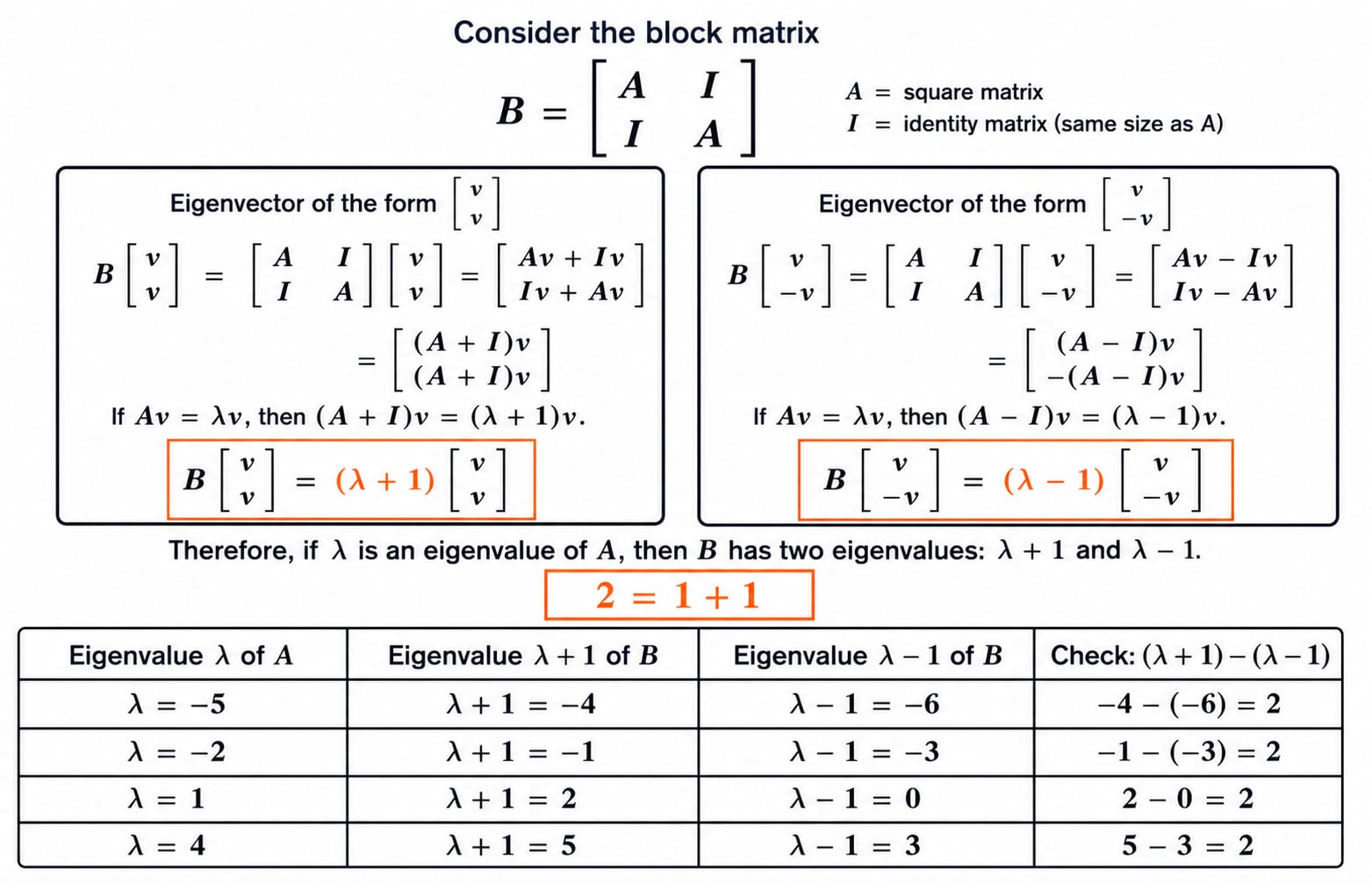
Let A be a 4 x 4 matrix with eigenvalues -5,-2,1, and 4. Which of the following is an eigenvalue of the block matrix
[A, I; I, A],
where I is the 4 x 4 identity matrix?
(a) -5
(b) -7
(c) 2
(d) 1
Answer: (c) 2.
If Av=lambda v, then
[A, I; I, A]
[v; v]
=(lambda+1)[v; v],
while [v; -v] gives eigenvalue lambda-1. Map each supplied eigenvalue:
lambda | lambda+1 | lambda-1 |
|---|---|---|
-5 | -4 | -6 |
-2 | -1 | -3 |
1 | 2 | 0 |
4 | 5 | 3 |
Only 2 appears among the options.
6. Direct tests and multiplicity: use det(M - I), then apply polynomial degree
Question 11
(GATE 2008, Computer Science)
How many of the following matrices have an eigenvalue 1?
A=[1, 0; 0, 0],
B=[0, 1; 0, 0],
C=[1, -1; 1, 1],
D=[-1, 0; 1, -1]
(a) Four
(b) Three
(c) Two
(d) One
Answer: (d) One.
Test det(M-I) for each matrix:
Matrix | det(M-I) | Does it have eigenvalue 1? |
|---|---|---|
A | 0 | Yes |
B | 1 | No |
C | 1 | No |
D | 4 | No |
Only A-I has determinant zero. Therefore only A has eigenvalue 1.
Question 12
(GATE 2026, Computer Science, Set 1)
For n>1, the maximum multiplicity of any eigenvalue of an n x n matrix with elements from R is
(a) n
(b) n-1
(c) 1
(d) n+1
Answer: (a) n.
Multiplicity here means algebraic multiplicity. A degree-n characteristic polynomial has total multiplicity n, so one eigenvalue can occur at most n times. The matrix A=3I_n attains the limit because eigenvalue 3 has multiplicity n.
Place this linear-algebra practice inside the broader GATE, PSU, Engineering & Technical Exams roadmap.
7. A 25-minute retest and the next mathematics block
On the second pass, give Questions 1 to 6 twelve minutes and Questions 7 to 12 ten minutes. Use the final three minutes to label every miss as shortcut missed, characteristic equation, structure theorem, or arithmetic. After attempting the full set unaided, revisit only Questions 2, 5, 9 and 10 through their linked attributions above.
Remember these checks:
Triangular matrices reveal their eigenvalues on the diagonal.
Trace and determinant control the sum and product of eigenvalues.
Symmetry gives orthogonality and useful spectral identities.
Block and quadratic-form structure is faster than brute-force expansion.
Use Probability for GATE CS: Conditional, Bayes and Expectation as the next mathematics practice block. For a structured whole-syllabus route after that, continue with GATE Guidance by Sanchit Sir.
Go deeper with the full courseEngineering Mathematics for GATE Exam
Keep learning

Cyber Threats and Malware Attacks: Types, Attack Vectors, and Worked Security Problems
Learn to distinguish malware classes, map attacks to the CIA triad, and solve password, cipher, and key-count numericals. The guide also covers common attack vectors and a safe way to study Indian cyber law.
Updated 30 Oct 20266 min readGATE Strategy & Roadmap
Maxima and Minima Questions with Solutions: 12 Worked Problems
Practise 12 maxima and minima problems with compact, step-by-step solutions covering stationary points, closed intervals, corners and optimisation.
Updated 26 Nov 20267 min readEngineering Mathematics

Limits Questions with Solutions: 12 Worked MCQs and PYQs
Attempt 12 limits MCQs before reading their step-by-step solutions. The set moves from indeterminate forms to squeezing, series, recurrences and nested radicals.
Updated 24 Nov 20268 min readEngineering Mathematics

Average Basic Concepts and Formulas: 12 Solved MCQs
Build a reliable average-solving method with 12 step-by-step MCQs covering direct means, missing values, overlapping groups, transformations, ratios and real-use models.
Updated 21 Nov 20267 min readAptitude & Reasoning