Theory of Computation
49 articles in this topic
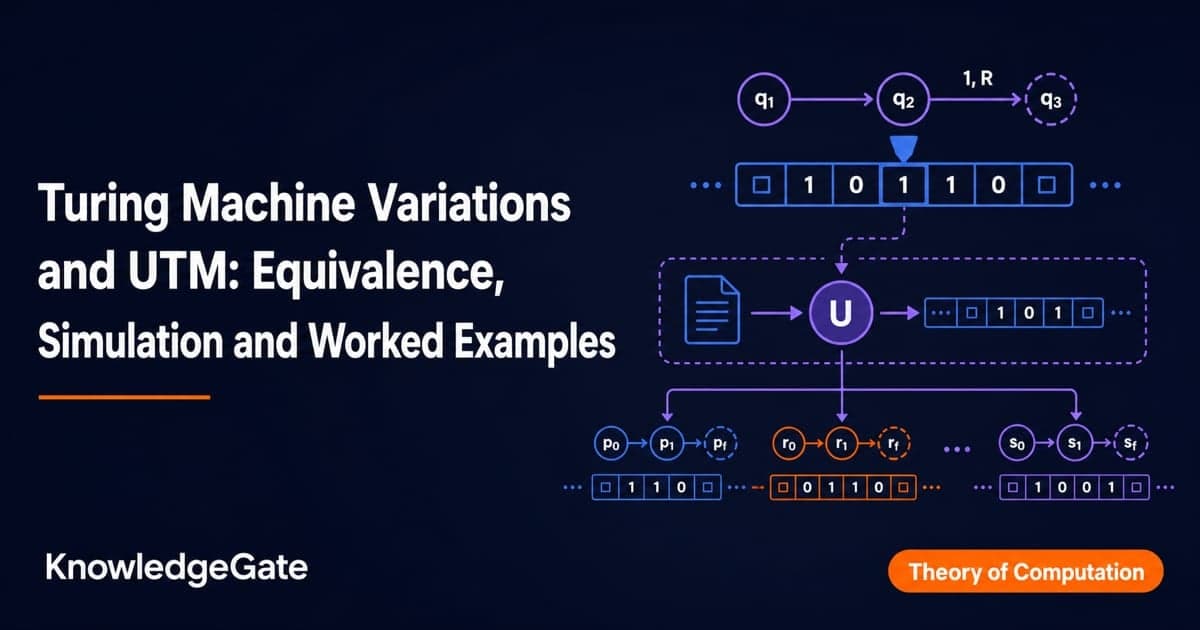
Turing Machine Variations and UTM: Equivalence, Simulation and Worked Examples
Compare major Turing machine variants, trace a two-tape decider, and decode one transition of a universal Turing machine without confusing simulation with decidability.
Updated 25 Oct 20265 min readTheory of Computation
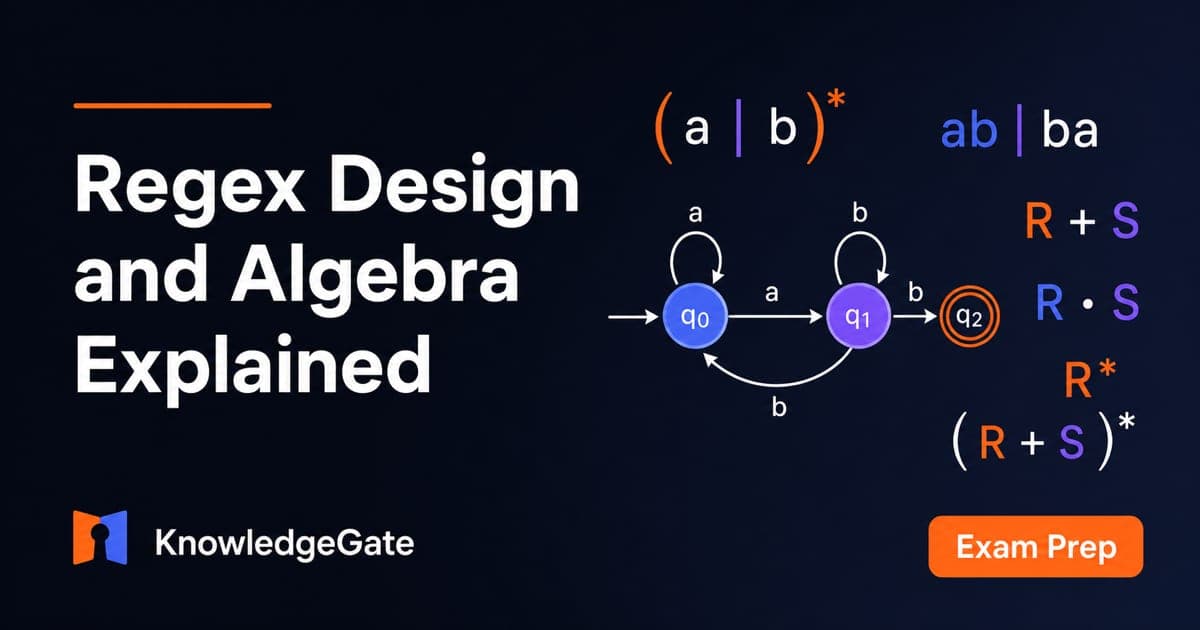
Regex Design and Algebra Explained: Identities, Arden's Theorem, and Worked Examples
Build regular expressions from language constraints, simplify them with safe identities, prove the result, and solve a recursive equation with Arden's theorem.
Updated 24 Oct 20265 min readTheory of Computation
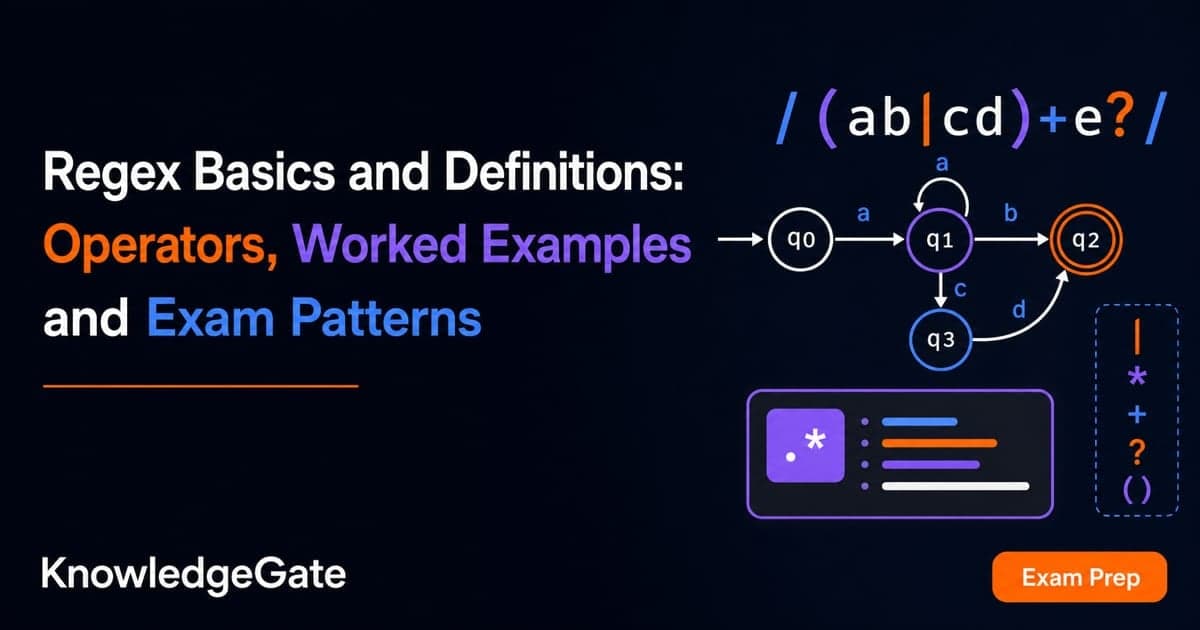
Regex Basics and Definitions: Operators, Worked Examples and Exam Patterns
Learn how regular expressions denote languages, how their three core operators bind, and how to build and check expressions with exact binary examples.
Updated 21 Oct 20265 min readTheory of Computation
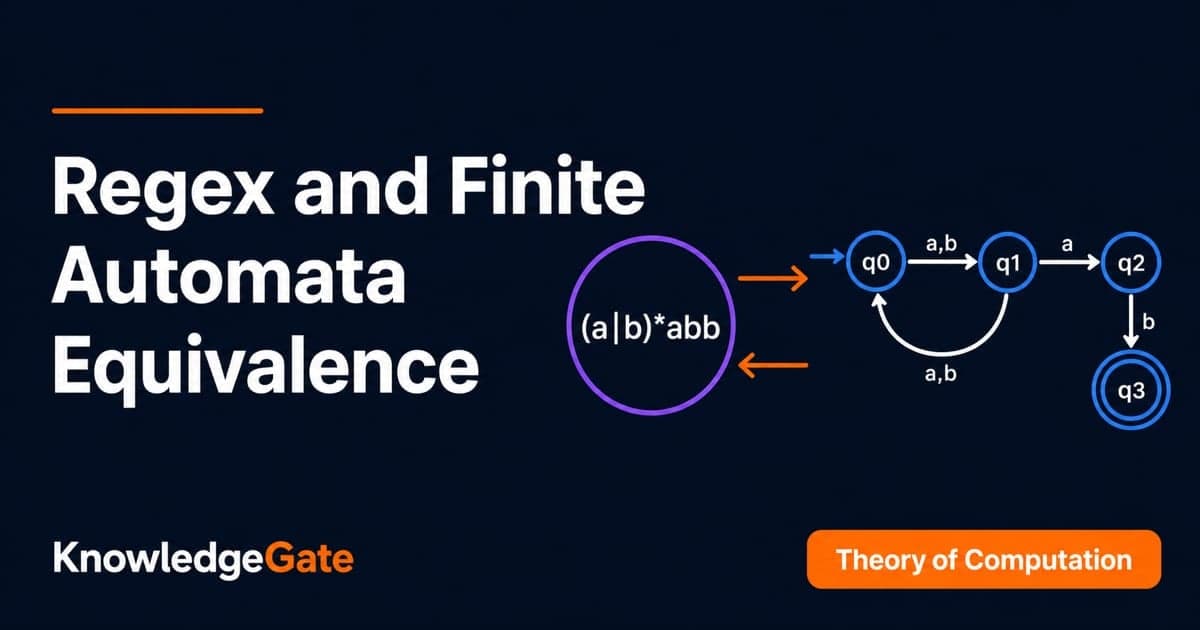
Regex and Finite Automata Equivalence: Conversions, Worked Examples and Exam Traps
Build and verify equivalent regex, NFA and DFA descriptions step by step. The worked conversions show what each state means and how to catch a false match.
Updated 17 Oct 20266 min readTheory of Computation
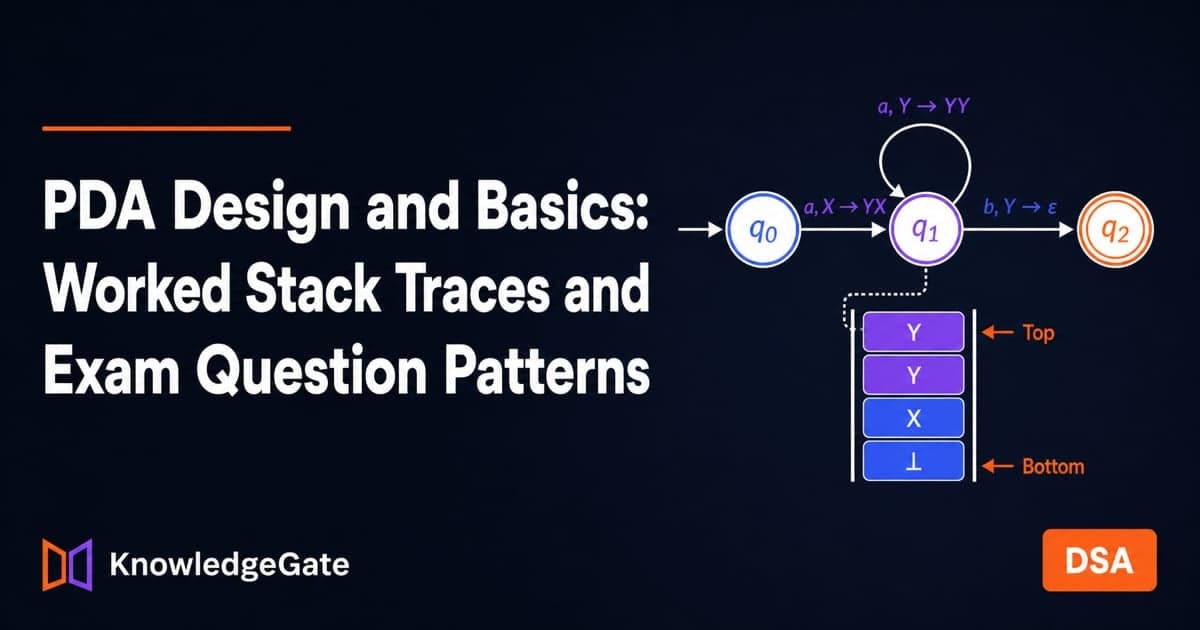
PDA Design and Basics: Worked Stack Traces and Exam Question Patterns
Learn how a pushdown automaton uses its stack, then design and trace a complete machine for a^n b^n. The worked CFG conversion and rejection checks make every move testable.
Updated 13 Oct 20266 min readTheory of Computation
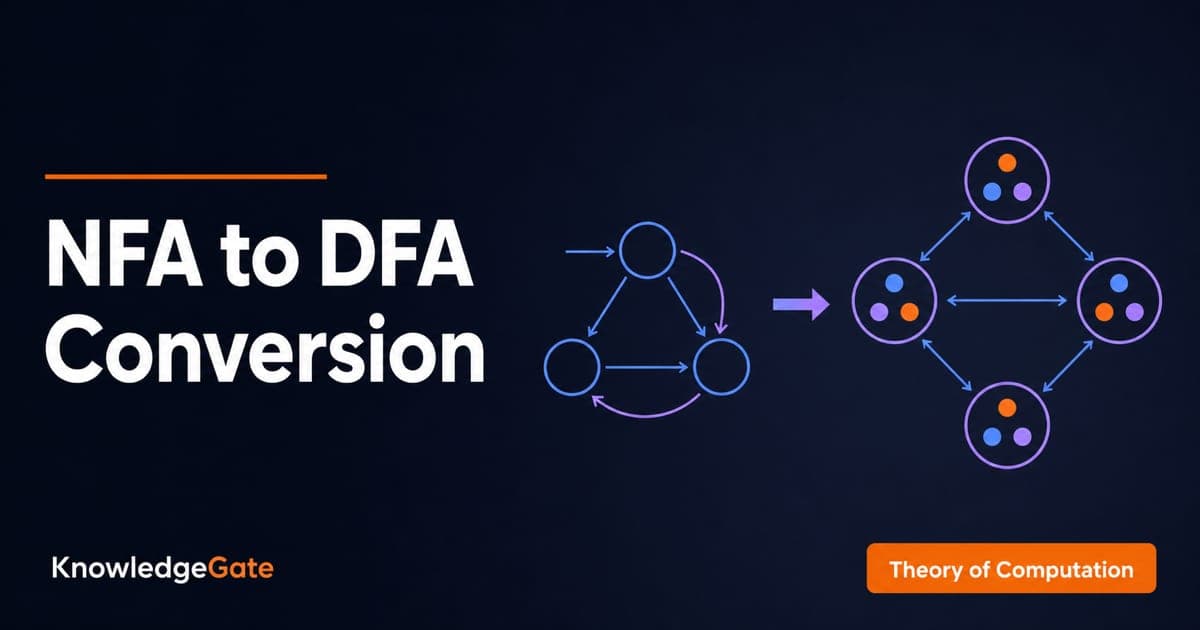
NFA to DFA Conversion: Subset Construction, Worked Example, and Exam Traps
Learn subset construction by converting one three-state NFA row by row, checking the result with strings, and then minimising the reachable DFA.
Updated 9 Oct 20265 min read52 viewsTheory of Computation
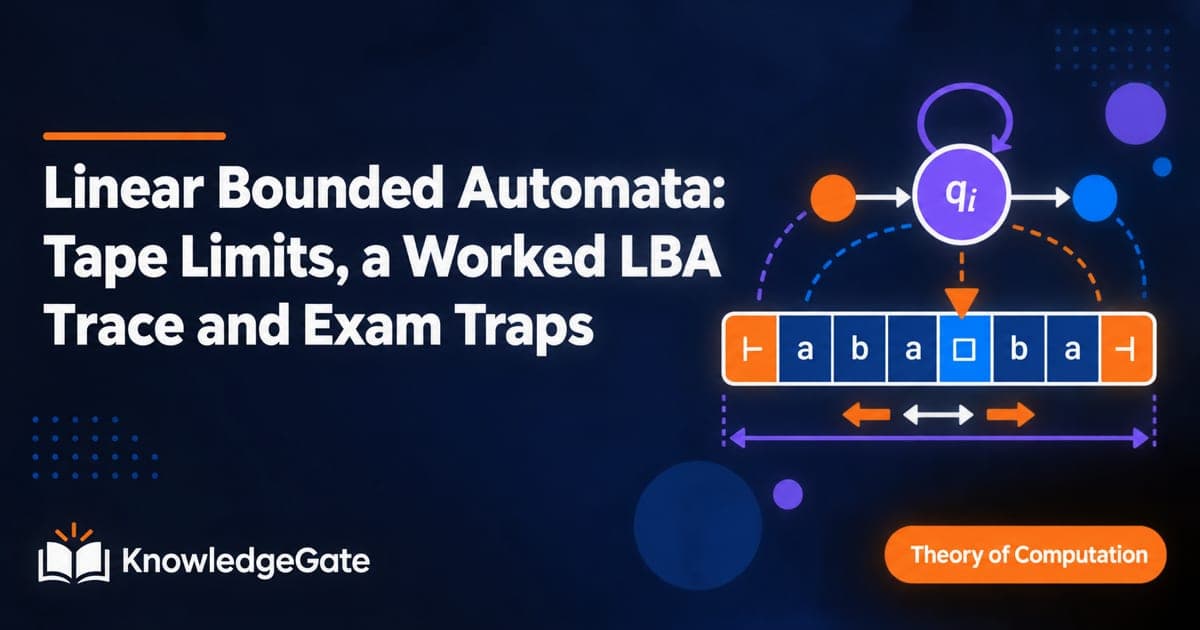
Linear Bounded Automata: Tape Limits, a Worked LBA Trace and Exam Traps
See exactly what an LBA bounds, where it sits in the language hierarchy, and how a six-cell marking machine accepts aabbcc while rejecting three near misses.
Updated 4 Oct 20266 min readTheory of Computation
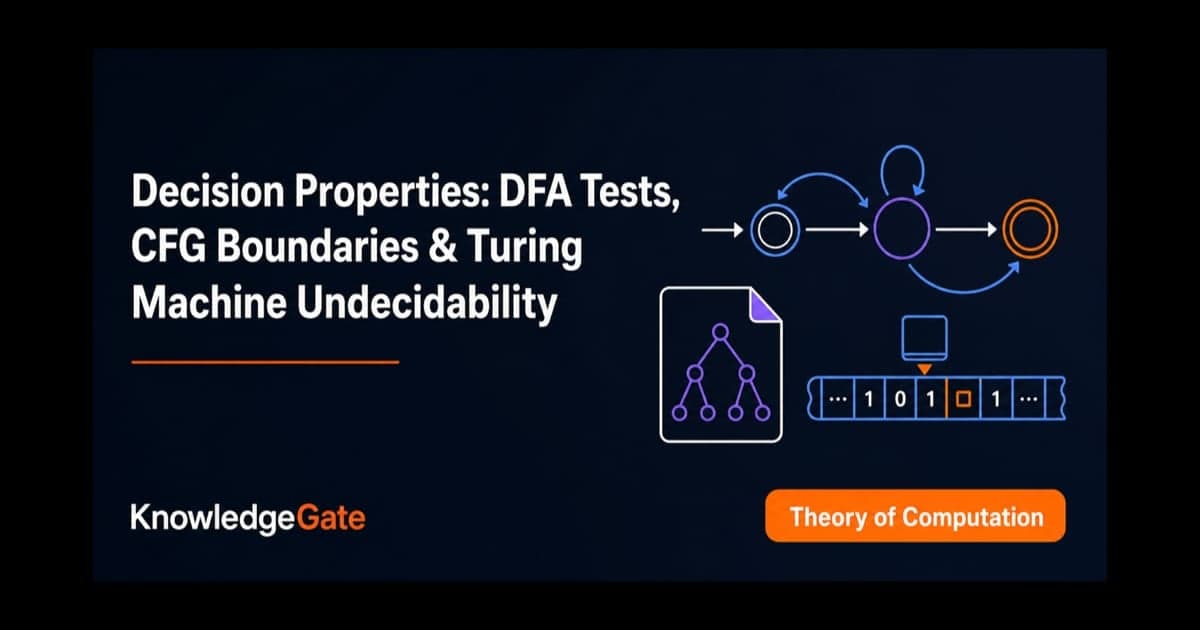
Decision Properties in Theory of Computation: DFA Tests, CFG Boundaries and Turing Machine Undecidability
Learn an algorithm-first way to classify membership, emptiness, finiteness, inclusion, equivalence and universality for DFAs, CFGs and Turing machines.
Updated 29 Sep 20266 min readTheory of Computation
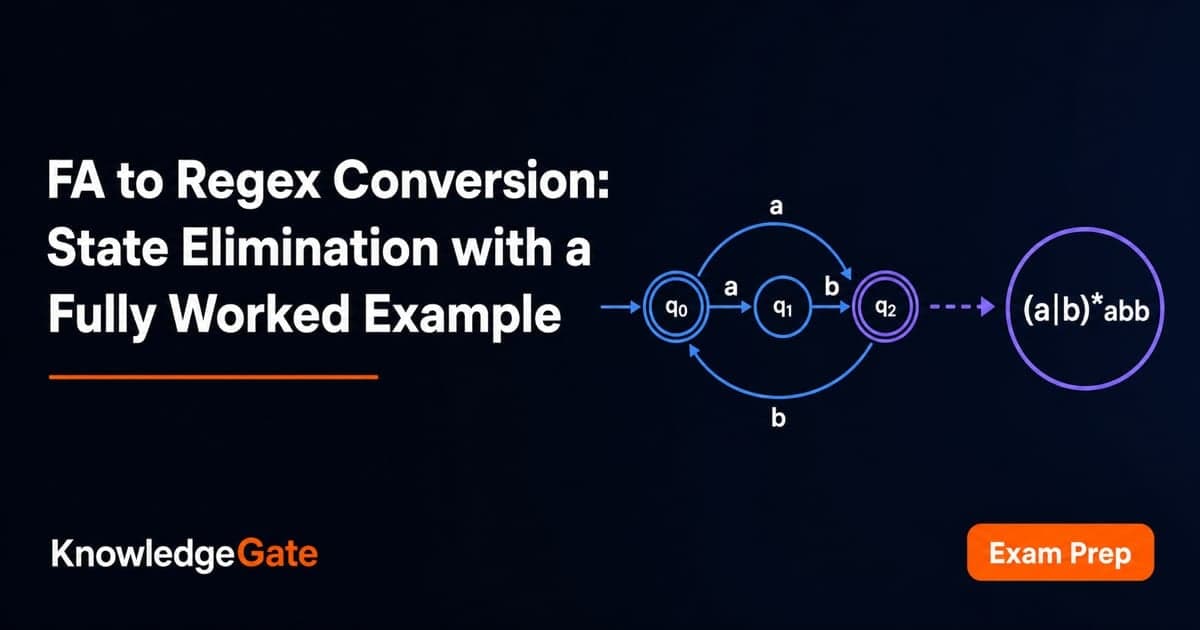
FA to Regex Conversion: State Elimination with a Fully Worked Example
Learn a mechanical state-elimination method for converting a finite automaton to a regular expression, then verify the result with a second order and short strings.
Updated 25 Sep 20265 min readTheory of Computation
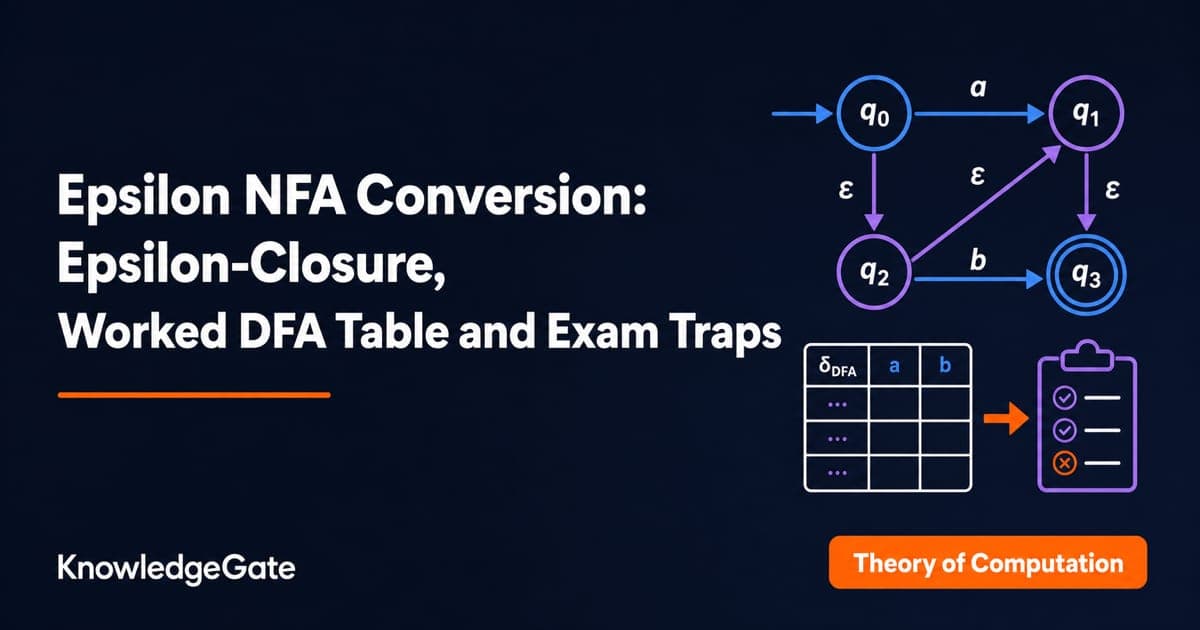
Epsilon NFA Conversion: Epsilon-Closure, Worked DFA Table and Exam Traps
Learn a mechanical epsilon-NFA conversion method through one four-state machine, complete set traces, a reachable-subset DFA table, and epsilon elimination.
Updated 24 Sep 20266 min readTheory of Computation
Closure Properties in Theory of Computation: Proof Methods, Worked Examples and Exam Traps
Learn how to prove closure with machine constructions and disprove it with counterexamples across regular, context-free, decidable and recognisable languages.
Updated 22 Sep 20265 min readTheory of Computation
Closure Properties of Formal Languages: Worked Examples and Exam Traps
Learn what closure means at the language-class level. Build a product DFA, disprove CFL intersection closure, and use known results without falling into common traps.
Updated 20 Sep 20265 min readTheory of Computation