Digital Logic
47 articles in this topic
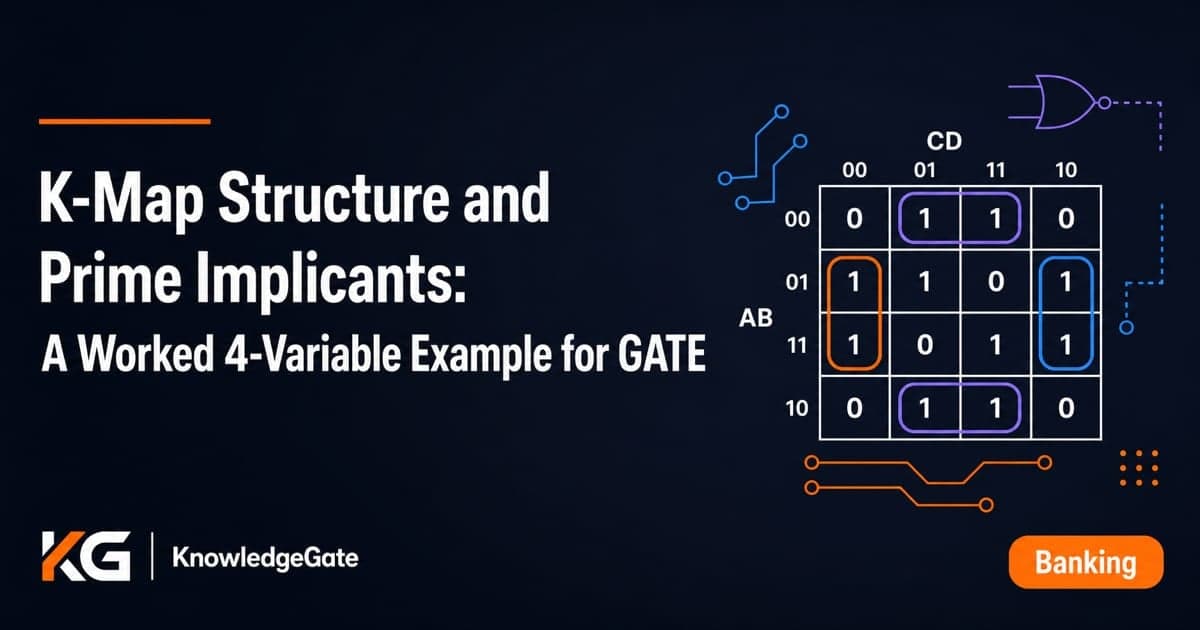
K-Map Structure and Prime Implicants: A Worked 4-Variable Example for GATE
Learn how a 4-variable K-map is laid out, why Gray-code adjacency matters, and how one eight-minterm example leads to three PIs, two EPIs, and a minimum SOP.
Updated 17 Sep 20265 min read56 viewsDigital Logic
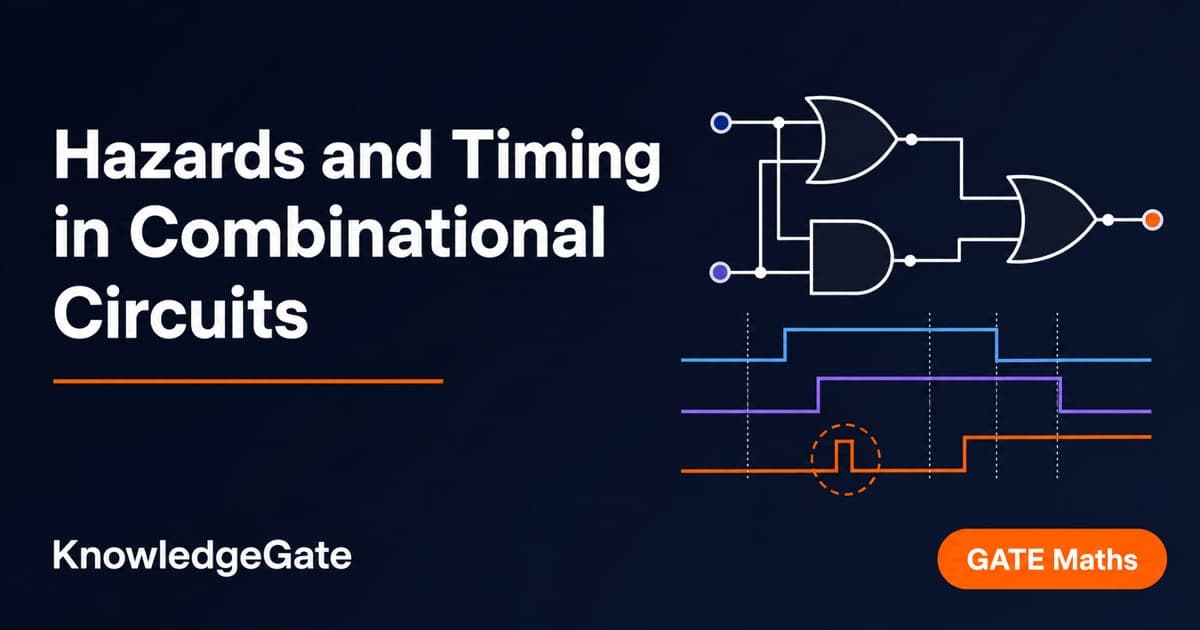
Hazards and Timing in Combinational Circuits: Worked Glitch Analysis and Exam Traps
Learn why correct Boolean logic can still glitch. Trace one static-1 hazard from gate delays to its 2 ns pulse, repair it with a consensus term, and check the timing safely.
Updated 15 Sep 20266 min readDigital Logic
Function Equivalence in Boolean Algebra: Three Proof Methods for GATE
Two Boolean expressions can look different yet describe the same function. Prove equivalence exactly with a truth table, Boolean algebra, a K-map, or an XOR miter.
Updated 14 Sep 20265 min readDigital Logic
Digital Fundamentals and Boolean Algebra Explained: Gates, Laws and Simplification
Connect bits, gates, truth tables and Boolean expressions, then simplify a three-input majority function and verify that the reduced circuit is equivalent.
Updated 12 Sep 20265 min read80 viewsDigital Logic

DeMUX, Decoder and Encoder Explained: Truth Tables, Worked Circuits and Exam Traps
Follow binary 101 through a decoder, a DeMUX and an encoder, then use the same logic to realise a Boolean function and solve common exam checks.
Updated 11 Sep 20266 min readDigital Logic
Carry Look-Ahead Adder (CLA) and Arithmetic Logic: Equations, Worked Examples and Exam Questions
Derive CLA carry equations from a full adder, solve a four-bit addition, and separate carry-out from signed overflow with exact add-subtract examples.
Updated 10 Sep 20265 min read57 viewsDigital Logic
Advanced Boolean Algebra Laws and Logic Optimization: Worked Examples for GATE
Learn when a Boolean term can disappear and when hardware timing may justify keeping it. The worked example is checked by algebra, a truth table, a K-map, and circuit cost.
Updated 8 Sep 20265 min read59 viewsDigital Logic
Digital Electronics for GATE: A 6-Week Topic-by-Topic Study Plan
Build Digital Electronics in dependency order with seven focused hours each week. The plan includes worked examples, timed practice and an error-log routine.
Updated 7 Sep 20265 min readDigital Logic
BCD and Special Codes Explained: 8421, Excess-3, Gray Code and Worked Examples
Learn how to encode, decode and add BCD values, use 2421 and Excess-3 correctly, and convert between binary and Gray code through checked examples.
Updated 5 Sep 20266 min read64 viewsDigital Logic
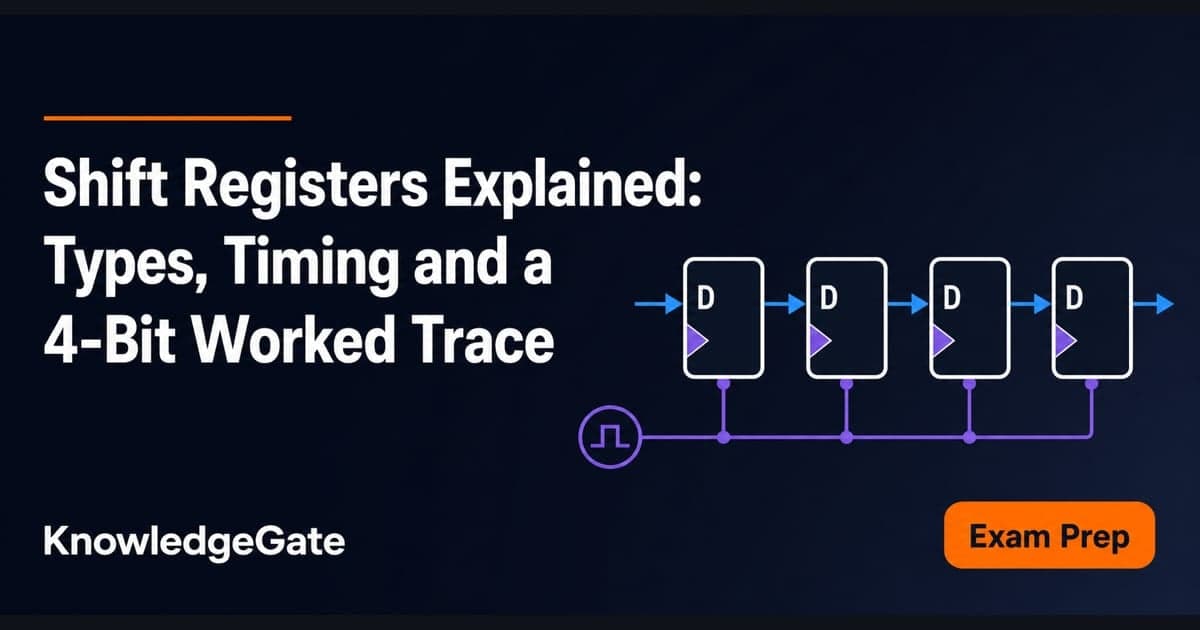
Shift Registers Explained: Types, Timing and a 4-Bit Worked Trace
Learn one reliable method for tracing shift registers. Fix the bit order, apply simultaneous next-state equations, and follow a complete four-clock example.
Updated 4 Sep 20266 min readDigital Logic
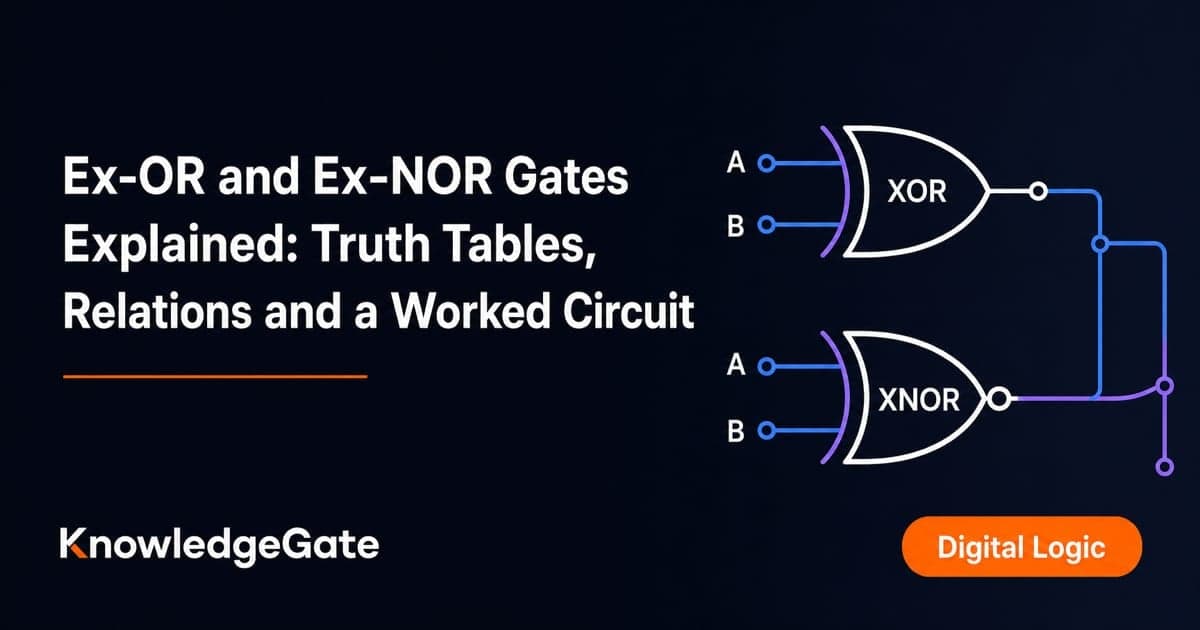
Ex-OR and Ex-NOR Gates Explained: Truth Tables, Relations and a Worked Circuit
Learn why Ex-OR detects difference and Ex-NOR detects equality, then trace a three-input circuit and avoid the binary-cascade trap.
Updated 2 Sep 20266 min read53 viewsDigital Logic
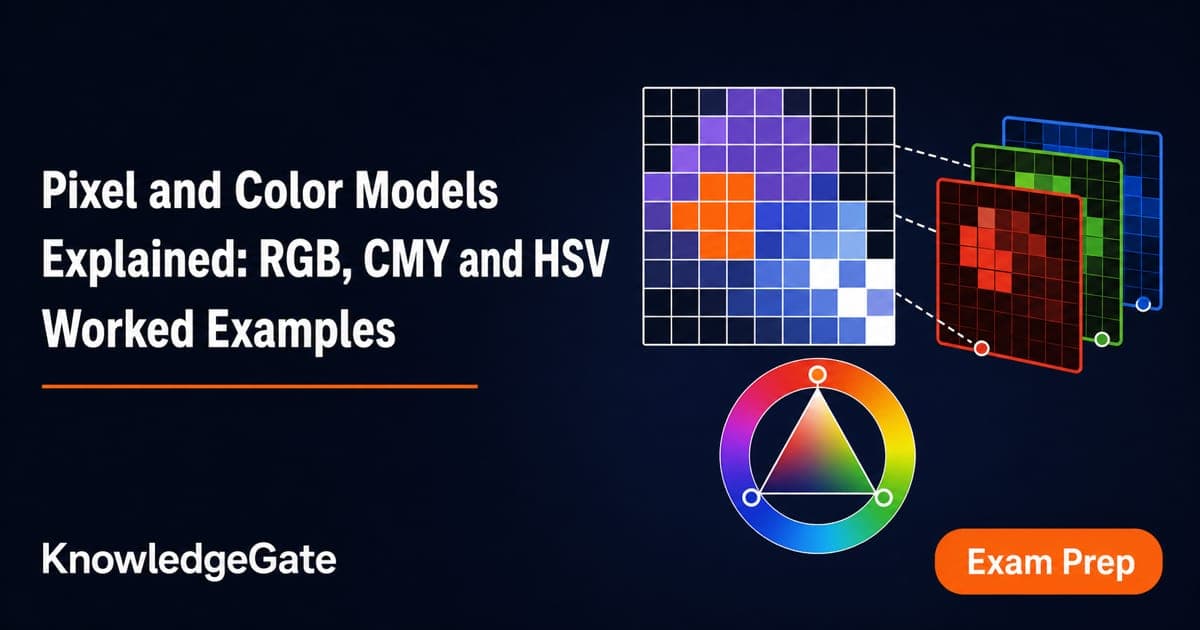
Pixel and Color Models Explained: RGB, CMY and HSV Worked Examples
Follow one 8-bit RGB pixel through raster coordinates, raw storage, ideal CMY, HSV, two grayscale rules and 2-bit quantisation, with every convention stated.
Updated 31 Aug 20266 min readDigital Logic