Advanced Boolean Algebra Laws and Logic Optimization: Worked Examples for GATE
Learn when a Boolean term can disappear and when hardware timing may justify keeping it. The worked example is checked by algebra, a truth table, a K-map, and circuit cost.
KnowledgeGate Team
Exam prep & CS education
Updated 8 Sep 20265 min read56 views
Boolean expressions can look different while implementing the same function, and a law table alone cannot identify every redundant term. A reduction is trustworthy only when algebra, the truth table, the K-map, implementation cost, and timing behaviour agree.
Related reading: K-map minimization and Boolean algebra basics.
Boolean logic optimization starts with the function
Each variable is 0 or 1. X' means NOT X, XY means X AND Y, and X + Y means X OR Y, not arithmetic addition or XOR. Remember X + X = X, XX = X, X + X' = 1, XX' = 0, and 1 + 1 = 1.
Optimization preserves every output while improving a stated cost. In the wider GATE CS Exam Preparation, the objective is to reduce logic without changing the function.
Consider
F(A,B,C) = AB + A'C + BC
with local A' generation and multi-input gates allowed.
Cost measure | Unminimized value |
|---|---|
Product terms | 3 |
Product-literal occurrences | 6 |
Inverters | 1 |
AND gates | 3 two-input |
OR gates | 1 three-input |
Gate-input pins | 10 |
Logic depth on the longest path | 3 gates |
Fewer literals need not mean lower delay after technology mapping.
Advanced Boolean algebra laws that remove terms
For a dual, swap OR with AND and 0 with 1; complements stay unchanged.
Law | Dual | Main use |
|---|---|---|
|
| Absorb a contained term |
|
| Combine complementary cases |
|
| Remove a redundant condition |
|
| Remove a consensus term |
For redundancy, distributivity gives
X + X'Y = (X + X')(X + Y) = 1(X + Y) = X + Y.
For consensus, insert X + X' = 1:
YZ = YZ(X + X')
XY + X'Z + YZ = XY + XYZ + X'YZ + X'Z
= XY(1 + Z) + X'Z(1 + Y) = XY + X'Z.
De Morgan gives (XYZ)' = X' + Y' + Z' and (X + Y + Z)' = X'Y'Z'. A dual is another valid identity, not the complement of the original.
Worked example: simplify AB + A'C + BC
Map the consensus theorem carefully: X = A, Y = B, and Z = C. Then XY = AB, X'Z = A'C, and YZ = BC. Therefore,
F = AB + A'C + BC = AB + A'C.
Now check every input:
A | B | C | AB | A'C | BC | F original | F reduced |
|---|---|---|---|---|---|---|---|
0 | 0 | 0 | 0 | 0 | 0 | 0 | 0 |
0 | 0 | 1 | 0 | 1 | 0 | 1 | 1 |
0 | 1 | 0 | 0 | 0 | 0 | 0 | 0 |
0 | 1 | 1 | 0 | 1 | 1 | 1 | 1 |
1 | 0 | 0 | 0 | 0 | 0 | 0 | 0 |
1 | 0 | 1 | 0 | 0 | 0 | 0 | 0 |
1 | 1 | 0 | 1 | 0 | 0 | 1 | 1 |
1 | 1 | 1 | 1 | 0 | 1 | 1 | 1 |
The output sequence is 0,1,0,1,0,0,1,1, so F = Σm(1,3,6,7). A reduction is valid if every row agrees, or the forms' XOR is proved always 0.
Circuit reduction measured with one convention
Use the same cost convention before and after simplification.
Implementation | Gates | Literals | Gate-input pins |
|---|---|---|---|
| 1 NOT + 3 AND + 1 OR = 5 | 6 |
|
| 1 NOT + 2 AND + 1 OR = 4 | 4 |
|
This saves one AND gate, two literal occurrences, and three input pins. The worst path can still be three gates: local inverter, AND, then OR. Cost changes if A' already exists or the library decomposes the three-input OR.
For the broader SOP-versus-POS, don't-care, and essential-prime-implicant workflow, use Boolean Minimization: SOP vs POS, Don't-Cares, Essential PIs. Here the narrower decision is whether the consensus term BC should be deleted for cost or retained against a hazard.
Algebra, K-map, or Quine-McCluskey
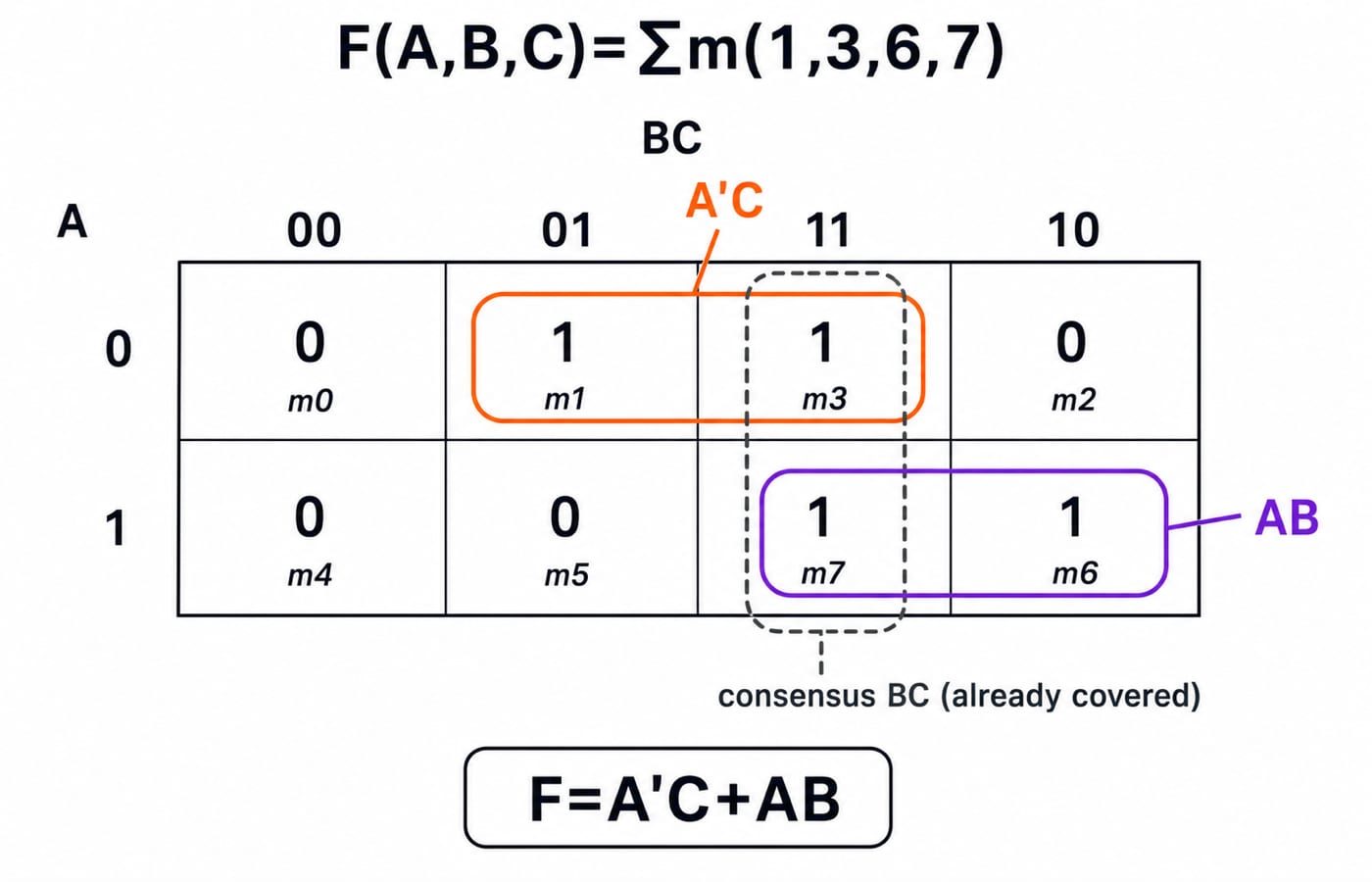
All three views agree: consensus deletes BC; the K-map shows m3 covered by A'C and m7 by AB; the truth table proves no output changes.
Use algebra for a visible law, a K-map for safe visual adjacency, and tabulation when variable count or minterms make grouping unreliable. Prime Implicants and Quine-McCluskey Method for GATE develops tabulation.
Stop deleting when each remaining term covers a 1 uncovered by the others. Here A'C uniquely covers m1, and AB uniquely covers m6, so both are essential.
Why a redundant consensus term can prevent a static-1 hazard
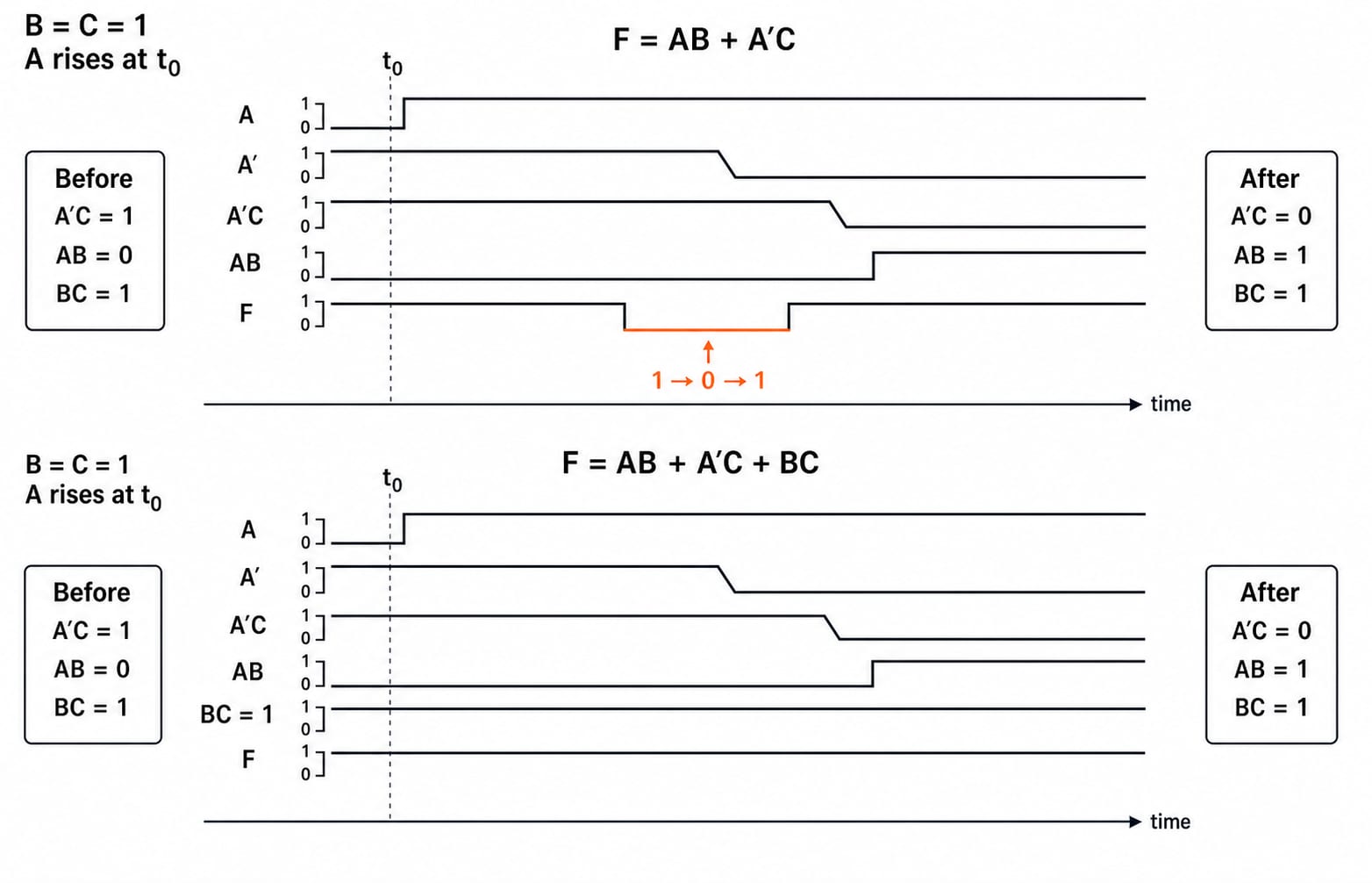
Hold B = C = 1 while A changes from 0 to 1. Ideally F stays 1: before, A'C = 1; after, AB = 1. Unequal delays can briefly make both terms 0, causing a static-1 glitch.
The removed term changes hardware, not the truth table. Since BC = 1 throughout, it bridges the gap. Thus AB + A'C is the logical minimum, while AB + A'C + BC can protect an asynchronous control path.
Not every circuit needs it. A synchronous design may tolerate a glitch before sampling. Timing assumptions distinguish minimum logic from hazard-free behaviour.
GATE-style question families and common traps
Representative GATE-style questions test equivalent expressions, redundant terms, minimized gate counts, SOP-to-K-map matching, NAND or NOR realization, and hazard-protective terms.
Mistake | Counterexample | Repair |
|---|---|---|
Replace | At | Apply only a named valid law |
Treat OR as arithmetic addition | Boolean | Read |
Delete a term too early | It may uniquely cover a minterm | Check every covered minterm |
Confuse | At | Write the operator explicitly |
Equate fewer literals with lower delay | Technology mapping may change paths | Count mapped depth and gates |
For a 30-second check, name and map the law, test one suspicious assignment, then use a truth table or K-map. Follow with Boolean Algebra and K-Map MCQs for practice.
Advanced Boolean laws and optimization: the short version
Revision card: absorb X + XY, combine XY + XY', remove YZ only from XY + X'Z + YZ, apply De Morgan throughout, and verify before counting savings. Here AB + A'C + BC = AB + A'C, but BC may control a hazard.
Reproduce three checkpoints: outputs 0,1,0,1,0,0,1,1; minterms 1,3,6,7; and gate count 5 -> 4. If one differs, find the first disagreeing truth-table row.
Use GATE Guidance by Sanchit Sir for structured exam strategy. If Boolean algebra is the only weak area, repeat the worked checkpoints before moving to a broader course.
Keep learning
Functional Completeness in Digital Logic: NAND, NOR and Worked Examples
Learn what makes a Boolean operator set complete, how NAND and NOR recover a standard basis, and how to verify a four-gate NAND construction.
Updated 2 Oct 20266 min readDigital Logic
Boolean Function Counts: Formulas, Worked Examples and Exam Traps
Build the master Boolean-function formula from output choices, then learn how common restrictions change the count through combinations, pairing and inclusion-exclusion.
Updated 27 Sep 20266 min readDigital Logic

Analog-Digital Conversion Basics: ADC, DAC, Worked Examples and Exam Patterns
Build ADC and DAC basics from one consistent transfer model, then practise code selection, reconstruction error, flash and SAR conversion, and bit-depth calculations.
Updated 25 Sep 20266 min readDigital Logic

Universal Realization with NAND and NOR Gates: Concepts, Worked Example and Exam Patterns
Learn why NAND and NOR are universal, then implement one three-variable function using four NAND gates and four NOR gates with verified input traces.
Updated 23 Sep 20265 min readDigital Logic