Ex-OR and Ex-NOR Gates Explained: Truth Tables, Relations and a Worked Circuit
Learn why Ex-OR detects difference and Ex-NOR detects equality, then trace a three-input circuit and avoid the binary-cascade trap.
KnowledgeGate Team
Exam prep & CS education
Updated 2 Sep 20266 min read54 views
Many learners remember that Ex-OR means “different” and Ex-NOR means “same”, but lose the result when these symbols appear inside a three-input circuit. Ex-OR and Ex-NOR have distinct truth tables and Boolean forms. At A = 1, B = 0, C = 1, the circuit result exposes a common cascade trap. The same skills support wider GATE CS exam preparation, where a small output bubble or misplaced complement can change the entire trace.
Related reading: canonical SOP and POS and Boolean algebra and K-map minimisation.
Ex-OR and Ex-NOR gates: start with equality versus difference
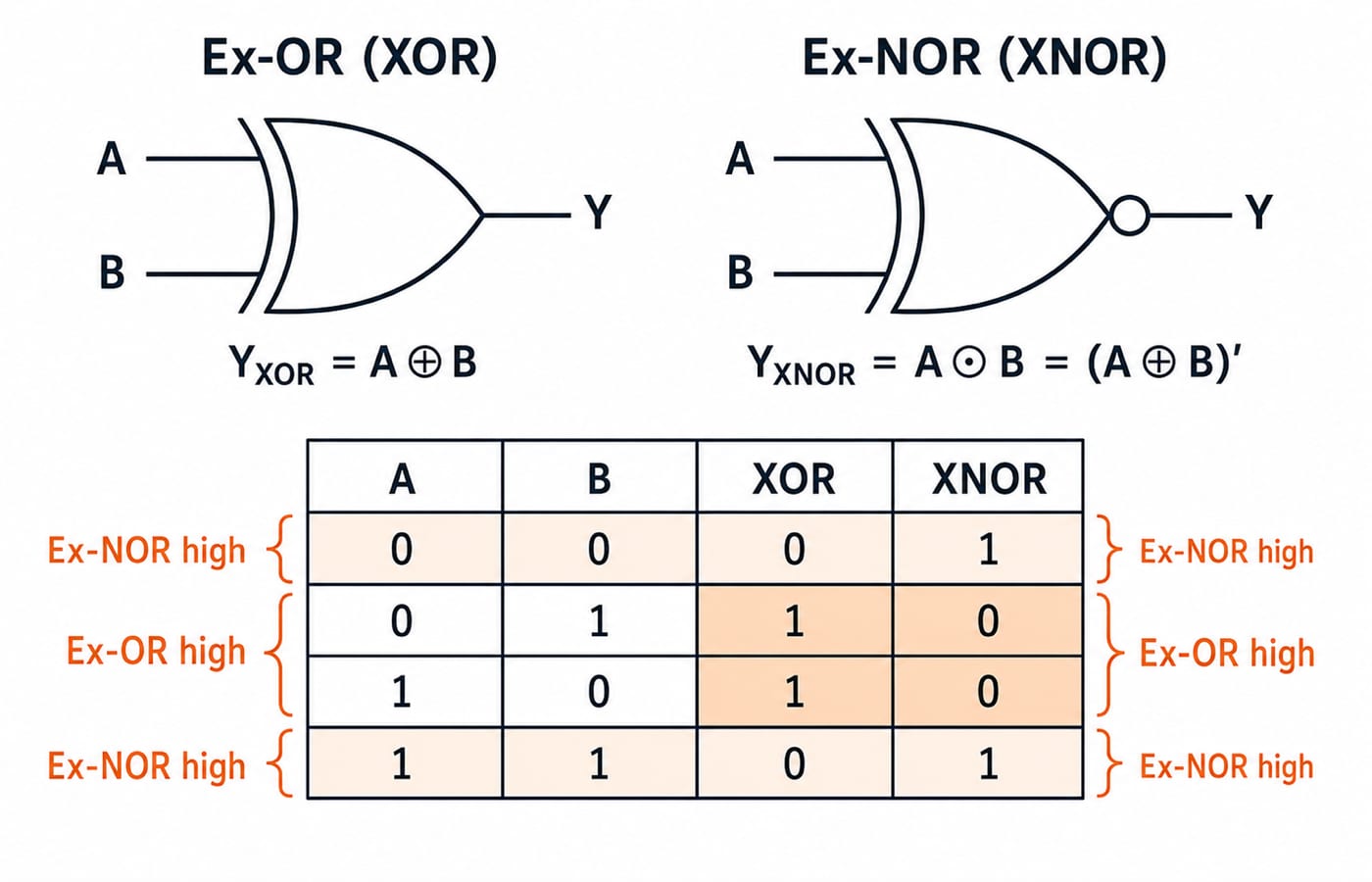
For two inputs, Y_XOR = A ⊕ B is 1 exactly when A and B differ. Here, ⊕ means Ex-OR or XOR. Y_XNOR = A ⊙ B is 1 exactly when the inputs match, and ⊙ means Ex-NOR or XNOR.
A | B | A ⊕ B | A ⊙ B |
|---|---|---|---|
0 | 0 | 0 | 1 |
0 | 1 | 1 | 0 |
1 | 0 | 1 | 0 |
1 | 1 | 0 | 1 |
Read every row. At 00, XOR is 0 and XNOR is 1. At 01, they are 1 and 0. At 10, they are 1 and 0. At 11, they are 0 and 1. In every row, the XNOR output is the complement of the XOR output.
Boolean expressions and the Ex-OR/Ex-NOR relation
Build each expression from its high rows. For XOR, 01 contributes A'B, while 10 contributes AB'. Therefore:
A ⊕ B = A'B + AB'
For XNOR, rows 00 and 11 contribute A'B' and AB:
A ⊙ B = A'B' + AB
Here, juxtaposition means AND, + means OR, and a prime means NOT. The complement relation also follows algebraically:
A ⊙ B = (A ⊕ B)' = (A'B + AB')' = (A + B')(A' + B) = AB + A'B'
The final terms cover 11 and 00, so XNOR is an equality detector. In Digital Logic, XOR detects inequality and XNOR detects equality.
Ex-OR and Ex-NOR identities that turn inputs into controls
Use these four XOR identities:
Identity | Meaning |
|---|---|
|
|
|
|
| equal inputs give |
| complementary inputs differ |
Check the inverter identity for both possible values. If A = 0, then A ⊕ 1 = 0 ⊕ 1 = 1 = A'. If A = 1, then A ⊕ 1 = 1 ⊕ 1 = 0 = A'. Thus a second XOR input of 0 passes A, while 1 inverts it.
The corresponding XNOR identities are:
Identity | Meaning |
|---|---|
|
|
|
|
| equal inputs give |
| complementary inputs differ |
For the exact check A = 1, 1 ⊙ 1 = 1, while 1 ⊙ 0 = 0. In a circuit, first look for a tied input, constant input, or repeated signal. One identity may replace a full truth-table calculation.
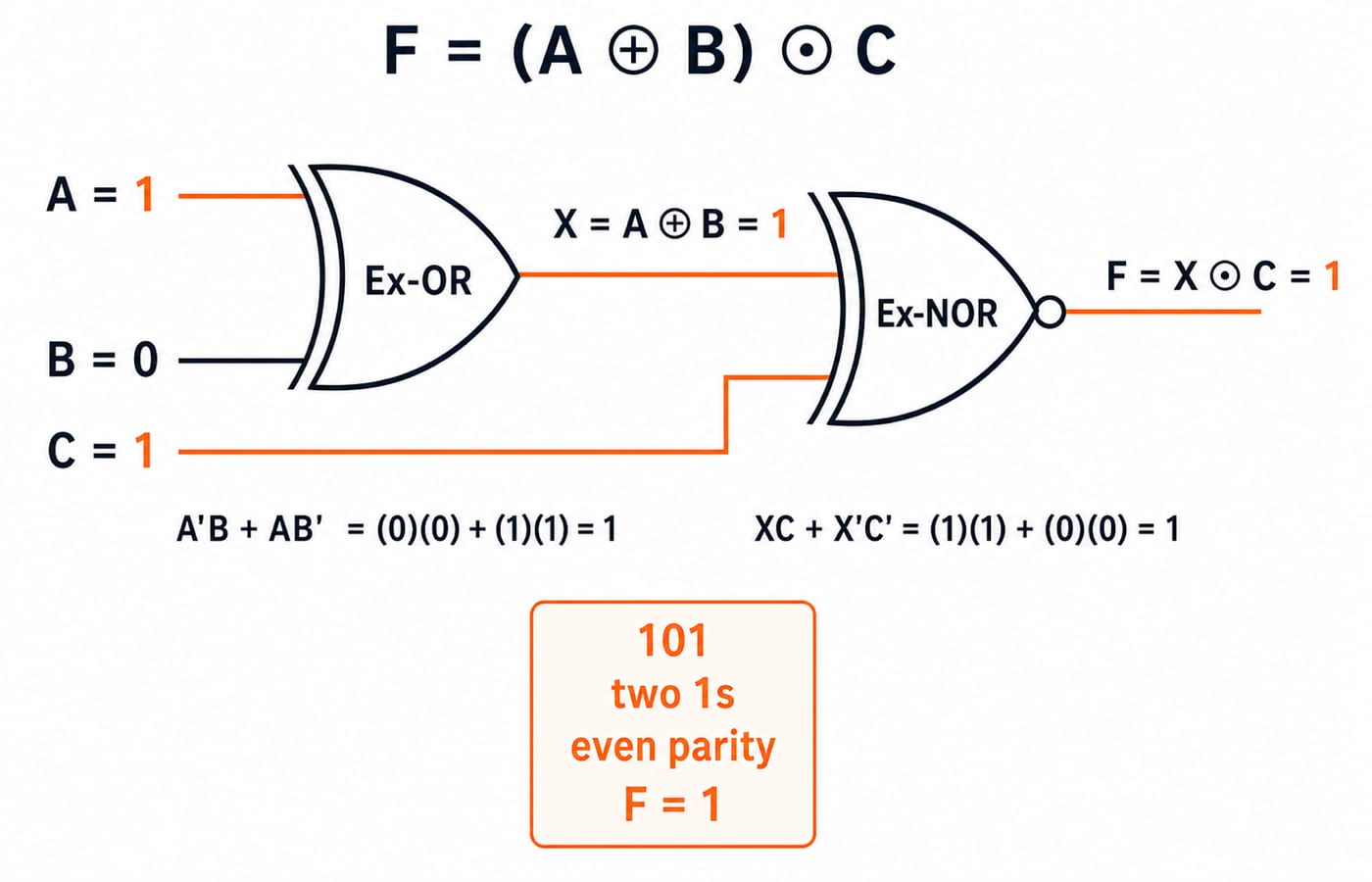
Worked example: solve F = (A ⊕ B) ⊙ C at A = 1, B = 0, C = 1
Name the intermediate node before substituting values:
X = A ⊕ B
F = X ⊙ C
Calculate X from the XOR form:
X = A'B + AB' = (0)(0) + (1)(1) = 0 + 1 = 1
Then calculate F:
F = XC + X'C' = (1)(1) + (0)(0) = 1 + 0 = 1
Cross-check in words: A and B differ, so X = 1; X and C match, so F = 1.
In general, F = (A ⊕ B) ⊙ C = (A ⊕ B ⊕ C)'. Verify it with the complete table:
A | B | C | X = A ⊕ B | F = X ⊙ C |
|---|---|---|---|---|
0 | 0 | 0 | 0 | 1 |
0 | 0 | 1 | 0 | 0 |
0 | 1 | 0 | 1 | 0 |
0 | 1 | 1 | 1 | 1 |
1 | 0 | 0 | 1 | 0 |
1 | 0 | 1 | 1 | 1 |
1 | 1 | 0 | 0 | 1 |
1 | 1 | 1 | 0 | 0 |
The high rows give F = Σm(0,3,5,6). Each contains an even number of 1s, so this circuit produces an even-parity output.
The multi-input Ex-NOR trap and other common mistakes
A genuine three-input XNOR, defined as the complement of three-input XOR, gives:
(A ⊕ B ⊕ C)' = (1 ⊕ 0 ⊕ 1)' = 0' = 1
But cascading two binary XNOR gates gives a different result:
(A ⊙ B) ⊙ C = (1 ⊙ 0) ⊙ 1 = 0 ⊙ 1 = 0
Algebraically, (A ⊙ B) ⊙ C = A ⊕ B ⊕ C. The circuits disagree for 101. Follow the drawn output bubbles and parentheses, not the verbal gate label alone.
Each binary XNOR stage introduces one complement. Two cascaded stages therefore contribute two complements and return odd parity, while a three-input XNOR symbol complements the three-input XOR result once.
Check three more traps:
Reading XOR as ordinary OR: row
11becomes1incorrectly. For two inputs, ask whether exactly one input is1.Forgetting the XNOR output bubble: the XOR column gets copied. Fix it by complementing every row once.
Expanding with wrong complements: one high row disappears. Rebuild
A'B + AB'directly from01and10.
Use A = 1, B = 1 as a rapid diagnostic. OR gives 1, XOR gives 0, and XNOR gives 1. That one row separates all three operations.
How exams and practice sets test Ex-OR and Ex-NOR
Questions can ask you to complete a truth table, recognise A'B + AB' or AB + A'B', trace an intermediate node, apply a constant-input identity, identify parity, or compare a direct multi-input symbol with a binary cascade.
For example, F = Σm(0,3,5,6) is (A ⊕ B ⊕ C)'. At input 110, the table gives F = 1 because the input has two 1s.
Before choosing an option, write one line per gate and preserve every output bubble. For a sum-of-minterms expression, count the 1s in each listed input: even-parity rows map to XNOR, while odd-parity rows map to XOR. If two options differ only by a complement, test 000 or 111 first.
For targeted follow-up, use Digital Electronics MCQs for topic practice and the GATE Test Series for timed diagnosis. In both settings, compute every intermediate node before the final output instead of evaluating the whole diagram mentally.
Ex-OR and Ex-NOR gates: the short version and next step
Ex-OR means different:
A ⊕ B = A'B + AB'.Ex-NOR means same:
A ⊙ B = AB + A'B'.Ex-NOR is the complement of Ex-OR.
For
F = (A ⊕ B) ⊙ Cat101,X = 1andF = 1.
Do not assume that a cascade of binary XNOR gates is a multi-input XNOR.
For a five-minute check, trace the same circuit at A = 0, B = 1, C = 0. First, X = 0 ⊕ 1 = 1. Then F = 1 ⊙ 0 = 0. The input word 010 has one 1, so its even-parity output is correctly 0.
Readers who want digital logic inside a sequenced GATE CS study path can use GATE Guidance by Sanchit Sir. For this concept alone, redraw the two diagrams and reproduce both truth tables from memory.
Keep learning
NOT, OR and AND Gates: Evolution, Truth Tables and a Worked Circuit
Learn how NOT, OR and AND gates developed from switching ideas, then trace F=(A+B')C node by node and confirm it with a complete truth table.
Updated 23 Oct 20265 min readDigital Logic
Binary Arithmetic Operations Explained: Rules and Worked Examples
Learn binary addition, subtraction, multiplication and division with aligned worked examples, then separate carry, borrow and two's-complement overflow.
Updated 19 Oct 20266 min readDigital Logic
1's Complement Explained: Binary Conversion, Addition and Worked Examples
Learn how fixed-width 1's complement numbers represent negatives, why zero has two encodings, and how end-around carry works through exact examples.
Updated 15 Oct 20266 min readDigital Logic
Decimal Conversion Explained: Binary, Octal and Hexadecimal Worked Examples
Learn one dependable method for converting values between decimal, binary, octal and hexadecimal, including fractions, shortcuts and checks.
Updated 11 Oct 20265 min readDigital Logic