Carry Look-Ahead Adder (CLA) and Arithmetic Logic: Equations, Worked Examples and Exam Questions
Derive CLA carry equations from a full adder, solve a four-bit addition, and separate carry-out from signed overflow with exact add-subtract examples.
KnowledgeGate Team
Exam prep & CS education
Updated 10 Sep 20265 min read
A ripple-carry adder is easy to draw, but CLA questions become confusing when bit order, P_i, G_i, carry equations, two's-complement subtraction, and overflow appear together. Carry look-ahead addition uses one notation system from a one-bit full adder through a complete four-bit addition, then applies it to an add-subtract circuit and exact overflow checks. Derive a carry equation instead of memorising it, calculate the result, and distinguish carry-out from signed overflow.
Related reading: Adders and subtractors and Combinational circuits.
1. Arithmetic logic starts with one full-adder bit
Number bits from i=0 at the least significant bit to i=3 at the most significant bit. C_i enters bit i; C_{i+1} leaves it. In Boolean equations, + means OR, adjacency means AND, and XOR means exclusive OR, not arithmetic addition.
A half adder gives S=A XOR B and C=AB. An input carry produces the full-adder equations:
S_i=A_i XOR B_i XOR C_i
C_{i+1}=A_iB_i+(A_i XOR B_i)C_i
|
|
|
|
| Output |
|---|---|---|---|---|---|
0 | 0 | 0 | 0 | 0 |
|
0 | 0 | 1 | 1 | 0 |
|
0 | 1 | 0 | 1 | 0 |
|
0 | 1 | 1 | 0 | 1 |
|
1 | 0 | 0 | 1 | 0 |
|
1 | 0 | 1 | 0 | 1 |
|
1 | 1 | 0 | 0 | 1 |
|
1 | 1 | 1 | 1 | 1 |
|
For A_i=1, B_i=0, and C_i=1, the arithmetic total is 2, so the output is sum 0, carry 1. Arithmetic logic belongs inside the wider Digital Logic preparation covered by GATE CS Exam Preparation.
2. Ripple carry versus carry look-ahead
A four-bit ripple adder chains full adders through C_1, C_2, and C_3. Bit 3 waits for the lower carries. If each stage hypothetically needs 2 ns after receiving its carry, C_0 to C_4 takes 4 x 2 = 8 ns. This is not a universal hardware delay.
CLA starts by defining XOR-propagate and generate:
P_i=A_i XOR B_i and G_i=A_iB_i
|
|
|
|---|---|---|
| 0 | 0 |
| 1 | 0 |
| 1 | 0 |
| 0 | 1 |
G_i=1 creates a carry regardless of C_i; P_i=1 passes C_i onward. The full-adder equation becomes C_{i+1}=G_i+P_iC_i. CLA uses the original P, G, and C_0 inputs instead of waiting serially. Gate depth, fan-in, wiring, and hierarchy still cause delay. See Combinational Circuits: MUX, Decoders, Adders for truth tables and hardware roles across MUXes, decoders, and adders; the CLA treatment here focuses on parallel carry equations and block propagation.
3. Derive every four-bit CLA carry equation
Begin with C_1=G_0+P_0C_0. Now substitute it into the next recurrence:
C_2=G_1+P_1C_1
C_2=G_1+P_1(G_0+P_0C_0)=G_1+P_1G_0+P_1P_0C_0
Continuing the same expansion gives:
C_3=G_2+P_2G_1+P_2P_1G_0+P_2P_1P_0C_0C_4=G_3+P_3G_2+P_3P_2G_1+P_3P_2P_1G_0+P_3P_2P_1P_0C_0
The sum remains S_i=P_i XOR C_i. Look-ahead changes carry calculation, not the arithmetic definition of the sum.
For the whole block, define P_G=P_3P_2P_1P_0 and G_G=G_3+P_3G_2+P_3P_2G_1+P_3P_2P_1G_0. Therefore, C_4=G_G+P_GC_0.
Some sources use A_i+B_i as propagate for carry-only reasoning. Here it is A_i XOR B_i, which supports S_i=P_i XOR C_i. Never mix the conventions.
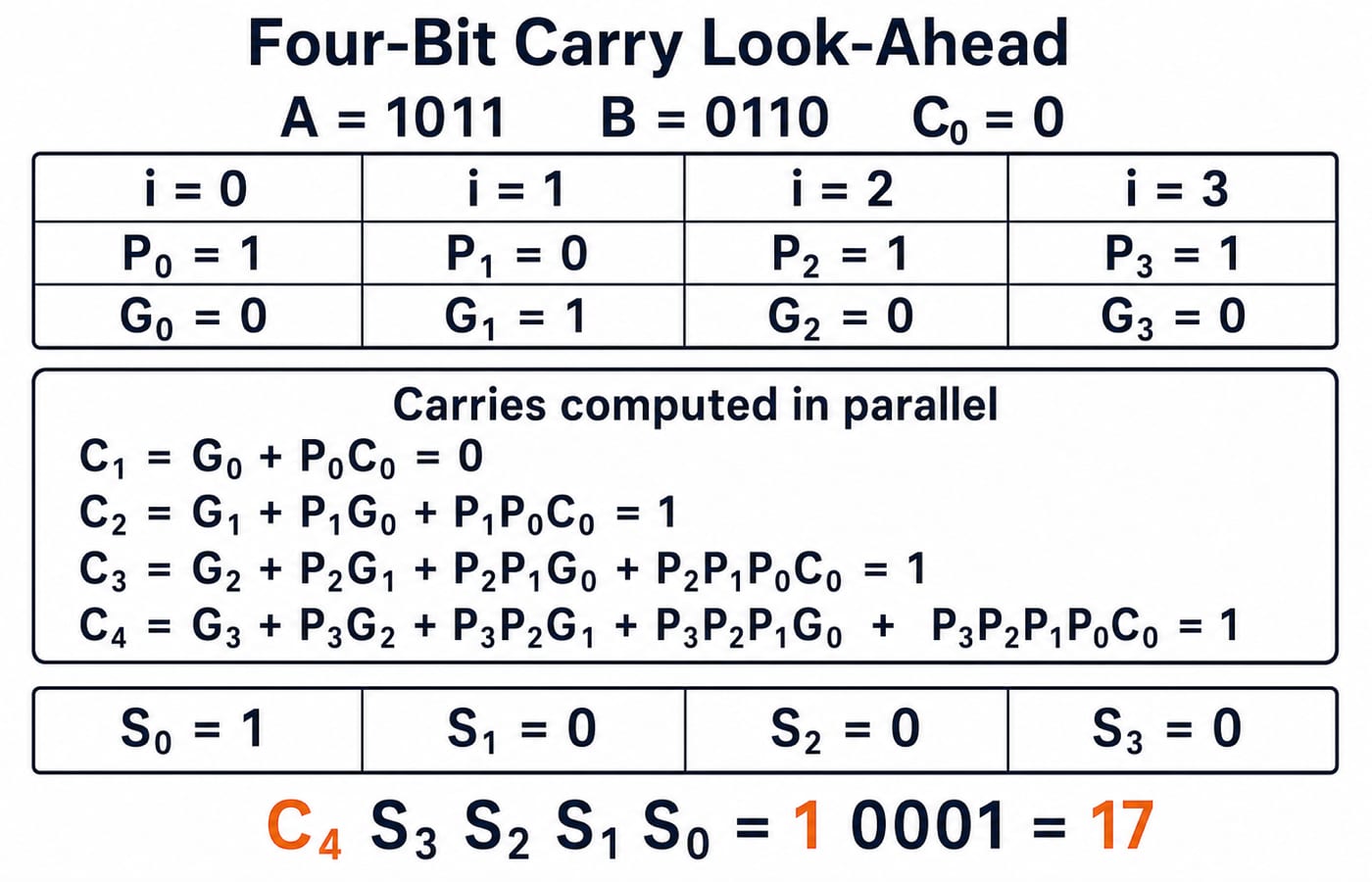
4. Four-bit CLA worked example: 1011 + 0110
Let A=1011 (11 unsigned), B=0110 (6 unsigned), and C_0=0. Words are written most significant bit first, but calculate from i=0.
|
|
|
|
|
|
|
|
|---|---|---|---|---|---|---|---|
0 | 1 | 0 | 1 | 0 | 0 | 1 | 0 |
1 | 1 | 1 | 0 | 1 | 0 | 0 | 1 |
2 | 0 | 1 | 1 | 0 | 1 | 0 | 1 |
3 | 1 | 0 | 1 | 0 | 1 | 0 | 1 |
Evaluate the look-ahead expressions: C_1=0; C_2=G_1=1; C_3=G_2+P_2G_1=0+1(1)=1; and C_4=G_3+P_3G_2+P_3P_2G_1=0+1(0)+1(1)(1)=1. Every term containing C_0=0 vanishes.
Read back S_3S_2S_1S_0=0001. With C_4=1, the result is 10001_2=17, matching 11+6=17. Also, P_G=1(1)(0)(1)=0 and G_G=0+1(0)+1(1)(1)+1(1)(0)(0)=1, so C_4=1+0(C_0)=1.
5. Group propagate and generate for larger adders
P_G=1 means every bit in the block propagates its input carry to the output. G_G=1 means the block creates an output carry even when its input carry is 0. Above, P_G=0 and G_G=1, so the block creates C_4=1 independently of C_0.
For a hypothetical 16-bit hierarchy, use four four-bit blocks numbered low to high. Let their (P_G,G_G) values be (1,0), (1,0), (0,1), (1,0), with K_0=1. The block recurrence gives K_1=0+1(1)=1, K_2=0+1(1)=1, K_3=1+0(1)=1, and K_4=0+1(1)=1.
Expanded equations become wide and expensive, so practical designs use block look-ahead levels or other prefix structures.
6. Add-subtract logic and exact overflow checks
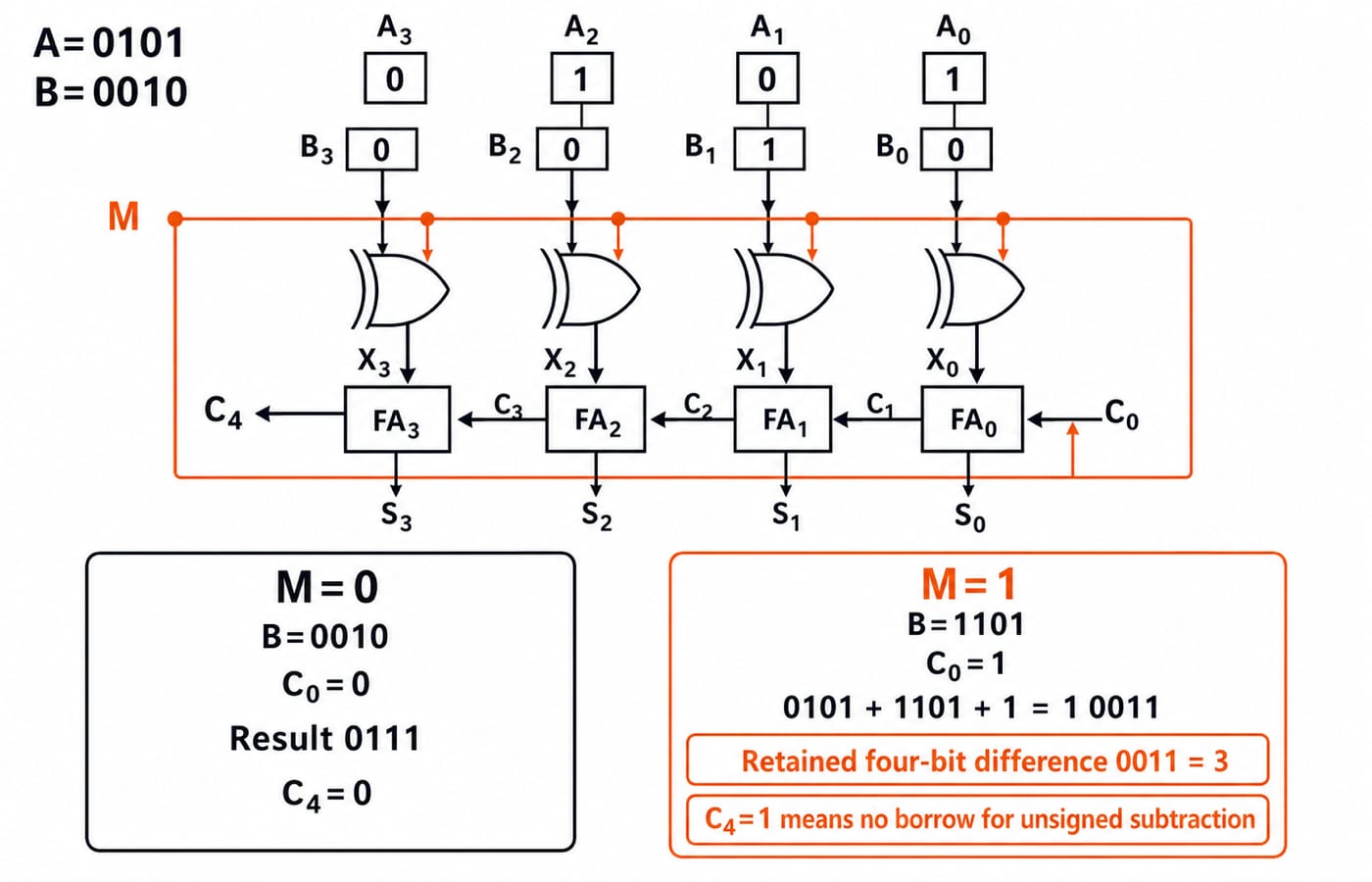
In a four-bit add-subtract path, use B_i^*=B_i XOR M and C_0=M. Then M=0 gives A+B; M=1 gives A+B'+1=A-B in two's complement. Refresh representation with Number Systems and Base Conversions: GATE Worked Examples.
For A=0101 (5) and B=0010 (2):
|
|
| Computation | Four-bit result |
|
|---|---|---|---|---|---|
0 |
| 0 |
|
| 0 |
1 |
| 1 |
|
| 1 |
For unsigned subtraction, discard C_4; here C_4=1 means no borrow.
Carry-out is not signed overflow. Four-bit signed 0111 (+7) plus 0011 (+3) produces 1010. The carry into the sign bit is C_3=1, while C_4=0, so V=C_3 XOR C_4=1. Two positive inputs produced a negative-sign result. By contrast, 1111+0001=1 0000 has C_3=1 and C_4=1, so V=0; as signed values, -1+1=0 is valid.
7. Representative CLA exam questions and traps
Solve each pattern by keeping the bit width fixed, expanding carries from i=0, and checking whether the question asks for carry-out or signed overflow.
Given
P_3P_2P_1P_0=1101,G_3G_2G_1G_0=0010, andC_0=0, findC_4. Substitution gives0+1(0)+1(1)(1)=1.In the hypothetical ripple model above, four carry stages at
2 nseach give8 ns. That result belongs only to the stated model.For
0111+0011=1010, carry-out is0, while signed overflow is1.With
M=1, forgetting theBinversion orC_0=1breaks subtraction.0101+1101truncates to0010, not0011.
Mistake | Why it fails | Repair |
|---|---|---|
Reversing bit order | Carries begin at the least significant end | Label |
Treating | They are Boolean signals | Use AND, OR, and XOR rules |
Mixing XOR and OR propagate | Their formula sets differ | Declare the convention first |
Finding only | The sum bits are still missing | Use |
Calling every | Carry and signed overflow test different ranges | Compute |
Calling CLA instantaneous | Physical logic still has delay | Discuss reduced dependency, not zero delay |
Use Combinational Circuits MCQs: 12 Solved GATE Questions as timed follow-on practice.
8. Carry look-ahead and arithmetic logic: the short version
Keep this recall card:
P_i=A_i XOR B_iG_i=A_iB_iC_{i+1}=G_i+P_iC_iS_i=P_i XOR C_iFour-bit signed overflow:
V=C_3 XOR C_4
For controlled subtraction, B^*=B XOR M and C_0=M.
Now reproduce this without looking. For 1011+0110, P_3P_2P_1P_0=1101, G_3G_2G_1G_0=0010, carries C_1,C_2,C_3,C_4 are 0,1,1,1, and the result is 1 0001.
For a sequenced route through GATE CS preparation, continue with GATE Guidance by Sanchit Sir.
Keep learning

Functional Completeness in Digital Logic: NAND, NOR and Worked Examples
Learn what makes a Boolean operator set complete, how NAND and NOR recover a standard basis, and how to verify a four-gate NAND construction.
Updated 2 Oct 20266 min readDigital Logic
Boolean Function Counts: Formulas, Worked Examples and Exam Traps
Build the master Boolean-function formula from output choices, then learn how common restrictions change the count through combinations, pairing and inclusion-exclusion.
Updated 27 Sep 20266 min readDigital Logic

Analog-Digital Conversion Basics: ADC, DAC, Worked Examples and Exam Patterns
Build ADC and DAC basics from one consistent transfer model, then practise code selection, reconstruction error, flash and SAR conversion, and bit-depth calculations.
Updated 25 Sep 20266 min readDigital Logic

Universal Realization with NAND and NOR Gates: Concepts, Worked Example and Exam Patterns
Learn why NAND and NOR are universal, then implement one three-variable function using four NAND gates and four NOR gates with verified input traces.
Updated 23 Sep 20265 min readDigital Logic