Digital Logic
47 articles in this topic
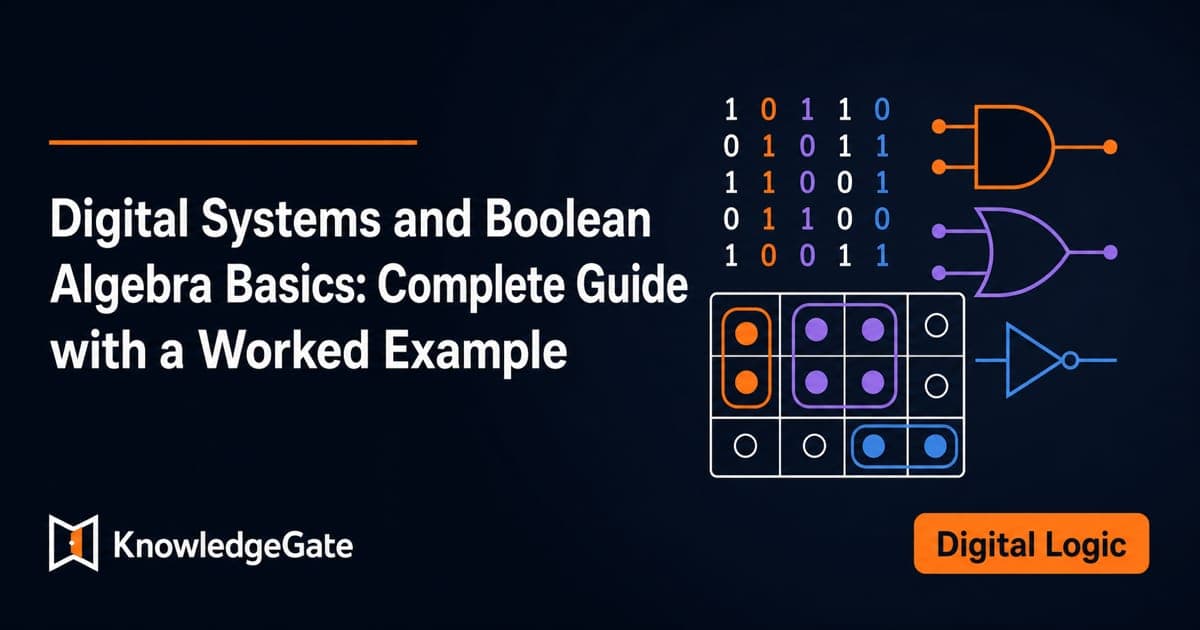
Digital Systems and Boolean Algebra Basics: Complete Guide with a Worked Example
Connect bits, truth tables, Boolean laws, canonical forms, K-maps, and gates by following one three-input function from specification to a simplified circuit.
Updated 7 Aug 20266 min readDigital Logic
Digital Electronics for GATE: Official Syllabus Map, Weightage Logic and Prep Order
Turn the compact GATE CS Digital Logic syllabus into a practical study sequence, then learn how to audit past-paper weightage without treating it as a forecast.
Updated 4 Aug 20265 min readDigital Logic
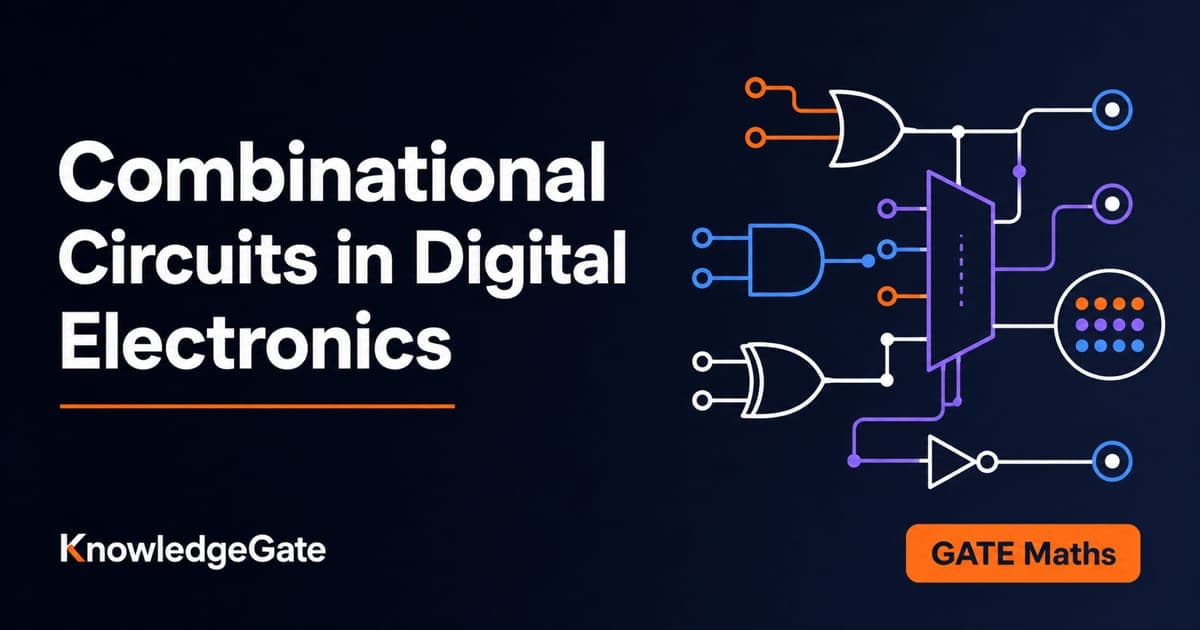
Combinational Circuits in Digital Electronics: Design, MUX, Decoders and Worked Examples
Learn a repeatable method for converting a logic specification into a verified combinational circuit, then apply it to adders, multiplexers, decoders, parity and hazards.
Updated 2 Aug 20266 min read95 viewsDigital Logic
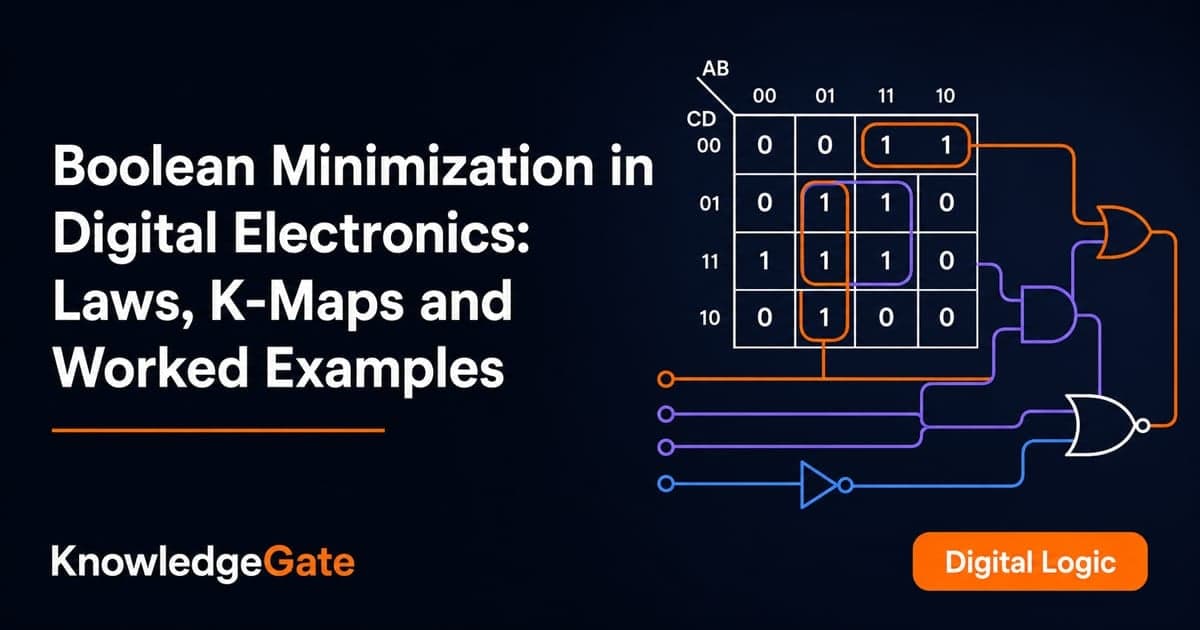
Boolean Minimization in Digital Electronics: Laws, K-Maps and Worked Examples
Learn to reduce Boolean expressions with auditable algebra, legal K-map groups, don't-cares, and truth-table checks. Includes complete SOP and POS examples.
Updated 30 Jul 20267 min readDigital Logic
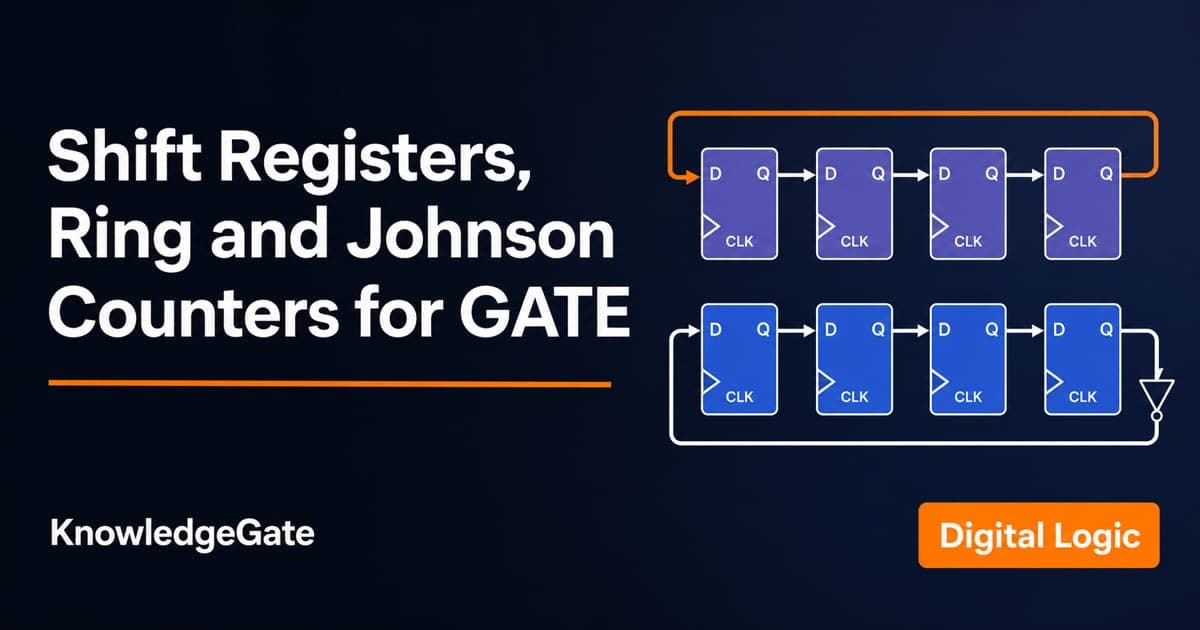
Shift Registers, Ring and Johnson Counters for GATE: Frequency Division and Timing Numericals Solved
Build a 4-bit ring counter and Johnson counter state by state, then use their mod values to solve frequency-division and maximum-clock questions.
Updated 29 Jul 20265 min readDigital Logic

Universal Gates for GATE: Realizing Any Function with Only NAND or Only NOR, and Counting the Minimum Gates
Turn SOP into NAND-only and POS into NOR-only circuits, count every gate, and learn the exact two-input counts for AND, OR, XOR and XNOR.
Updated 25 Jul 20266 min read134 viewsDigital Logic

Multiplexer Realization for GATE: Implementing Any Boolean Function with a Smaller MUX, Solved
Learn why a smaller MUX is enough for a Boolean function, then wire a complete 4:1 example without guessing any data input.
Updated 22 Jul 20265 min read194 viewsDigital Logic

Flip-Flop Conversion for GATE: Excitation Tables and the SR, JK, D, T Conversion Recipe, Solved
Convert one flip-flop into another with the target transition, the available device's excitation table and a K-map. The solved JK-to-T case shows every row.
Updated 20 Jul 20266 min read95 viewsDigital Logic
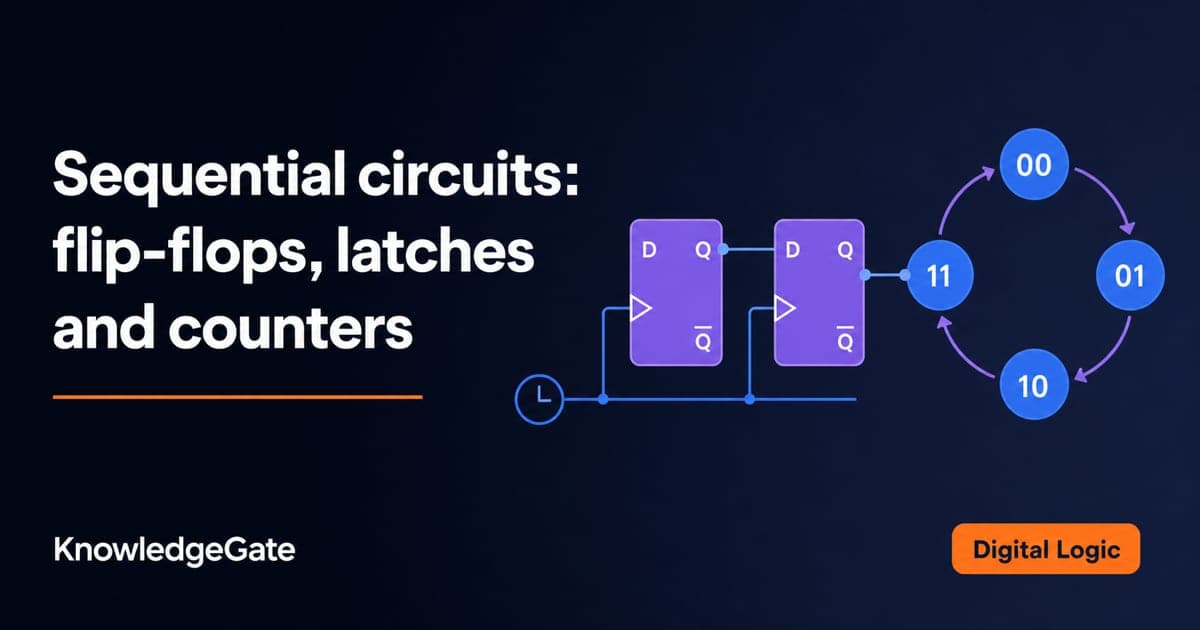
Sequential circuits: flip-flops, latches and counters explained
Sequential circuits for GATE: SR, D, JK and T flip-flops, excitation tables, latch versus flip-flop, and a fully worked synchronous counter design example.
Updated 15 Jul 20265 min read61 viewsDigital Logic
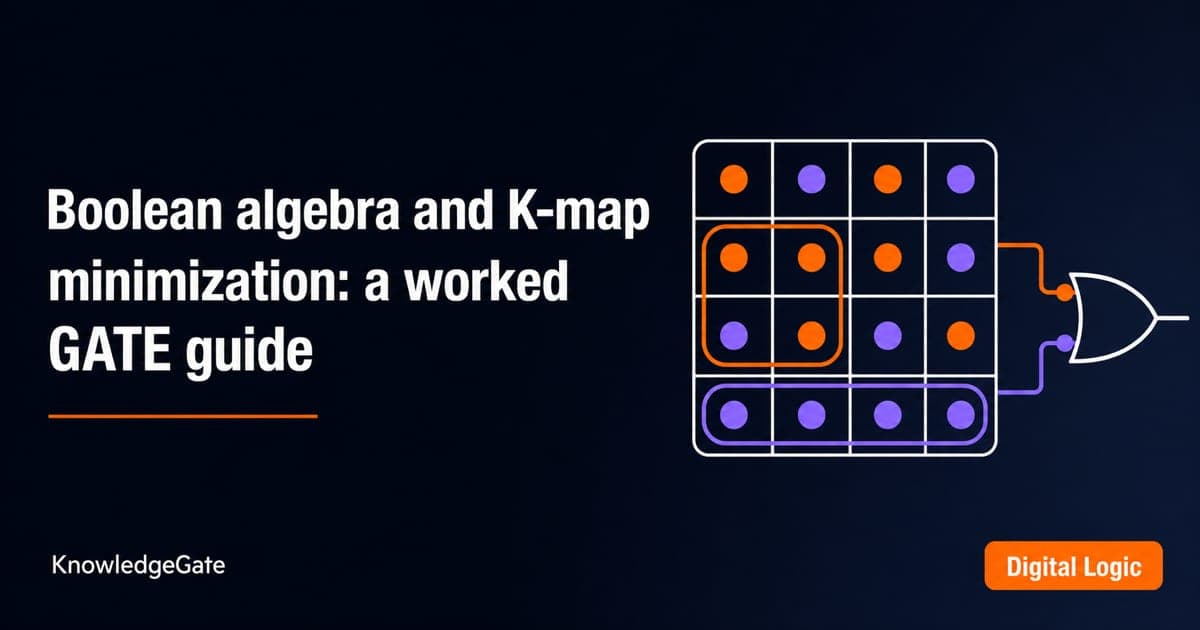
Boolean algebra and K-map minimization: a worked GATE guide
K-map minimization becomes routine once you can read the groupings. Six Boolean identity pairs, DeMorgan's two theorems, the SOP and POS canonical forms, and a four-variable map traced loop by loop from seven minterms and three don't-cares down to F = B' + A'D.
Updated 15 Jul 20265 min read105 viewsDigital Logic
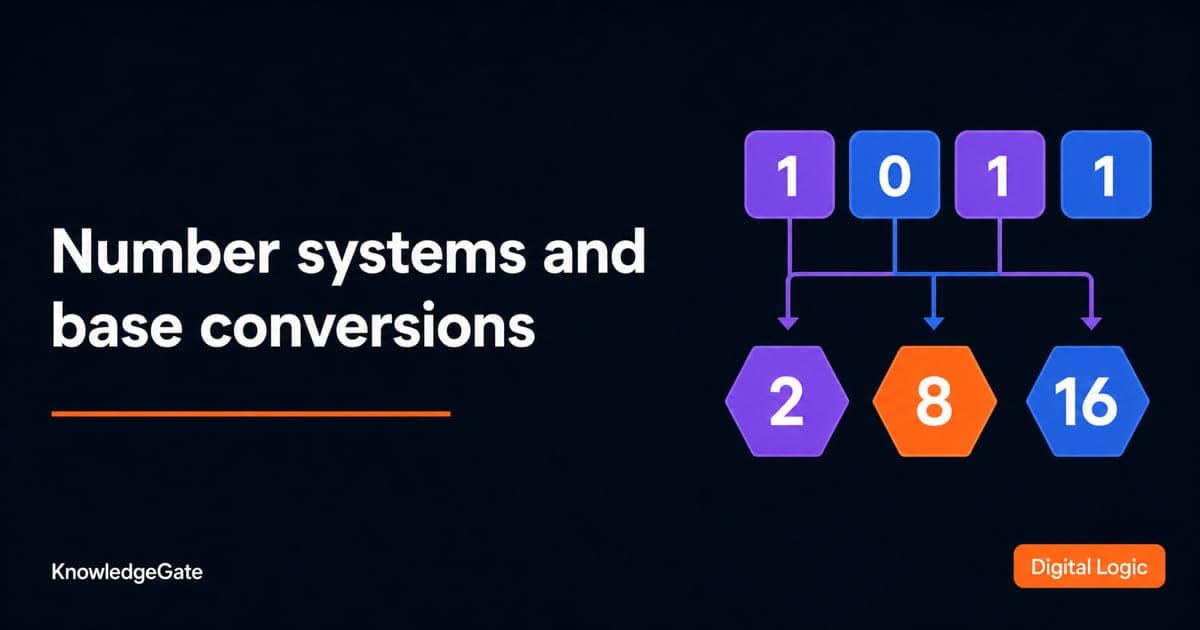
Number systems and base conversions: binary, octal and hexadecimal explained
Number systems for GATE: binary, octal and hexadecimal, base conversion, r's and (r-1)'s complement, signed representation, BCD and Gray code, worked.
Updated 15 Jul 20265 min read91 viewsDigital Logic