Digital Electronics for GATE: A 6-Week Topic-by-Topic Study Plan
Build Digital Electronics in dependency order with seven focused hours each week. The plan includes worked examples, timed practice and an error-log routine.
KnowledgeGate Team
Exam prep & CS education
Updated 7 Sep 20265 min read

You may recognise individual logic gates and solve textbook problems one at a time, yet lose the thread across the topic chain under exam time and doubt your revision order. Study representations, minimisation, combinational circuits, sequential circuits and mixed practice in 42 honest hours, supported by focused worked examples.
Digital Electronics for GATE: fix the order and weekly budget
Use seven hours each week: 45 minutes Monday to Thursday, two hours Saturday and two hours Sunday. Friday is a buffer only for a missed weekday block.
In Weeks 1 to 4, spend three hours on concepts and derivations, two on untimed problems, 90 minutes timed and 30 minutes on the error log. Use a 12-question diagnostic across representations, minimisation, combinational design, sequential circuits and timing. Label each miss concept, algebra, circuit tracing or time pressure.
Representations support arithmetic, Boolean fluency speeds minimisation, and minimised expressions simplify circuit implementation. Use the Digital Electronics for GATE: Syllabus Map and Prep Order to set the official topic boundary and choose preparation depth, then apply the 42-hour sequence as weekly drills, timed sets and missed-day recovery. For the wider exam plan, use GATE CS Exam Preparation Courses & Test Series.
Week 1: number systems, signed values and arithmetic
Begin with positional notation and bidirectional base conversion because they form the foundation for everything that follows. On that base, build the signed and fractional layer through signed magnitude, one's complement, two's complement, fixed-point arithmetic, overflow and representation logic.
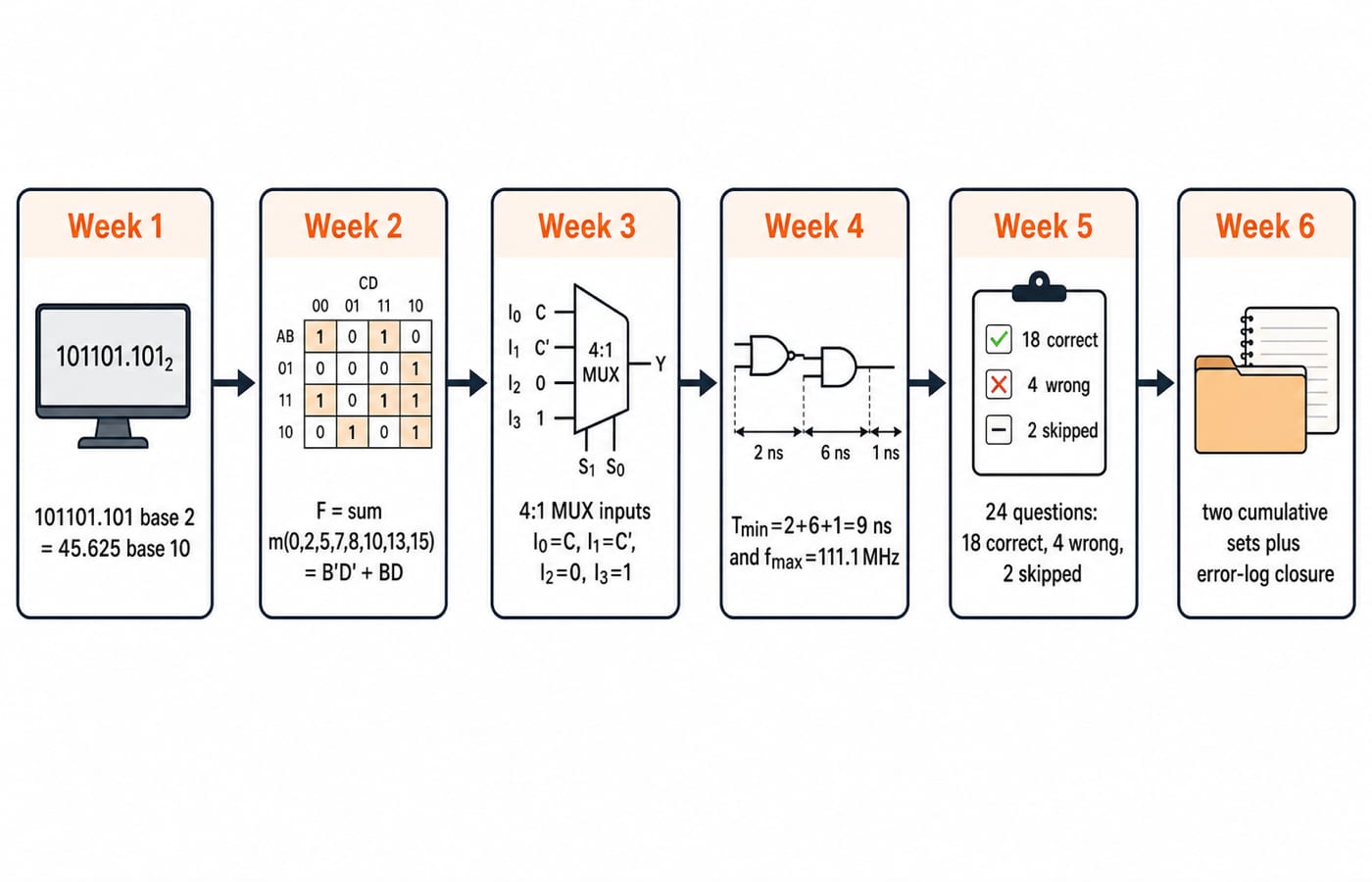
Convert (101101.101)₂ to decimal by place value:
32 + 8 + 4 + 1 + 1/2 + 1/8 = 45.625
For octal, regroup as 101 101 . 101. Each group becomes one octal digit, so the answer is (55.5)₈.
For -13 in 8-bit two's complement, start with 00001101, invert it to 11110010, then add 1 to get 11110011. Reverse the check: invert 11110011 to 00001100, add 1, and recover 00001101, or 13.
Do 20 untimed conversions or representations, then 10 timed signed-addition or subtraction items. For each arithmetic miss, record whether carry-out, sign handling or overflow caused it; for each representation miss, record the exact conversion step.
Week 2: Boolean algebra and K-map minimisation
Start with the identities and De Morgan's laws, because every later simplification leans on them, then learn to write any function canonically in SOP and POS form through its minterms and maxterms. With that language in place, minimise on two-variable to four-variable K-maps, treating don't-care cells as free choices when you group, and finish by realising the result with NAND or NOR gates. Check every grouping algebraically. Use the Boolean Algebra and K-map Minimization Guide for a deeper refresher.
For F(A,B,C,D) = Σm(0,2,3,6,7,8,10,11), place rows AB and columns CD in Gray order 00, 01, 11, 10. Group {0,2,8,10} to get B'D', group {2,3,10,11} to get B'C, and group {2,3,6,7} to get A'C. Overlap is allowed because every group remains a power-of-two rectangle. Therefore:
F = B'D' + B'C + A'C
The three implicants cover exactly the listed minterms. For included input 0,1,1,0 (m6), A'C = 1, so F = 1. For excluded input 1,1,0,1 (m13), all three terms are 0, so F = 0. Finish with six algebra-to-K-map and six K-map-to-gate problems.
Week 3: combinational circuits from truth table to implementation
Study adders and subtractors first, then multiplexers, demultiplexers, encoders, decoders, comparators and code conversion. Practise universal-gate implementations. For each block, move from specification to truth table to expression to circuit, then trace backwards.
Implement F(A,B,C) = Σm(1,2,6,7) with a 4:1 MUX and A,B as selects. For AB=00, outputs over C=0,1 are 0,1, so I0=C. For 01, they are 1,0, so I1=C'. For 10, they are 0,0, so I2=0. For 11, they are 1,1, so I3=1.
Check each included minterm: m1 selects I0 with C=1; m2 selects I1 with C=0; and m6, m7 select I3=1. Split the weekend into 45 minutes each for truth tables and implementation, then 30 minutes for reverse tracing.
Week 4: sequential circuits, states and timing
Begin with latches, then SR, JK, D and T flip-flops and their conversions. Build registers and counters after their tables are secure, then analyse state tables and timing. Always write present state, input, next state and output.
For a synchronous mod-3 counter, use 00 -> 01 -> 10 -> 00 and send unused state 11 -> 00. The next-state equations are D1 = Q1'Q0 and D0 = Q1'Q0'. Checking all states gives:
Present | Required next | Equation output |
|---|---|---|
|
|
|
|
|
|
|
|
|
|
|
|
With clock-to-Q delay 2 ns, worst combinational delay 6 ns, setup time 1 ns and zero assumed skew, Tmin = 2 + 6 + 1 = 9 ns. Thus fmax = 1/(9 ns) = 111.1 MHz.
Week 5: turn topic knowledge into timed problem solving
Stop adding theory. Use one hour for closed-book recall, two for single-topic questions, two for mixed questions, one for a timed subject test and one for analysis. Combine every topic.
Suppose a 24-question constructed set has 18 correct, 4 wrong and 2 skipped. You attempted 22, so attempted accuracy is 18/22 = 81.8%, while completion is 22/24 = 91.7%. High completion with lower accuracy makes correctness the constraint. Repair two concept misses first, then one Boolean slip, then one rushed circuit trace. Missing concepts re-break downstream work; a trace miss after correct setup points instead to timing or attention.
Use the GATE Test Series when you need structured subject and mock practice.
Week 6: cumulative revision and recovery from missed days
Use the four weekday blocks as fast single-topic refreshers: 45 minutes on number systems on Monday, K-maps on Tuesday, combinational design on Wednesday and sequential timing on Thursday. At the weekend, shift to work that forces the topics to interleave as they do in the exam. On Saturday, complete two 45-minute mixed sets followed by 30 minutes of analysis. On Sunday, do one 60-minute cumulative set and 60 minutes of error-log repair. Together, these blocks maintain the same seven-hour week.
On a separate 24-question baseline, scores of 14, 18 and 19 across three passes show that interleaving is holding. Any concept missed twice gets a short concept-plus-three-problems repair loop.
One missed weekday block moves to Friday. If you lose two blocks or a weekend, protect the timed set and analysis, move unfinished material into a seventh week, and do not double the next week's load.
Digital Electronics for GATE: six-week sequence
Represent numbers, simplify logic, build combinational circuits, trace sequential circuits, solve mixed questions, then repair repeat errors. Seven completed hours each week beat a larger timetable that keeps getting deferred.
Choose GATE Guidance by Sanchit Sir if you want the wider GATE plan organised. If your concepts are already covered and testing is the gap, continue with the GATE Test Series instead of beginning another theory pass.
Keep learning

Functional Completeness in Digital Logic: NAND, NOR and Worked Examples
Learn what makes a Boolean operator set complete, how NAND and NOR recover a standard basis, and how to verify a four-gate NAND construction.
Updated 2 Oct 20266 min readDigital Logic
Boolean Function Counts: Formulas, Worked Examples and Exam Traps
Build the master Boolean-function formula from output choices, then learn how common restrictions change the count through combinations, pairing and inclusion-exclusion.
Updated 27 Sep 20266 min readDigital Logic

Analog-Digital Conversion Basics: ADC, DAC, Worked Examples and Exam Patterns
Build ADC and DAC basics from one consistent transfer model, then practise code selection, reconstruction error, flash and SAR conversion, and bit-depth calculations.
Updated 25 Sep 20266 min readDigital Logic

Universal Realization with NAND and NOR Gates: Concepts, Worked Example and Exam Patterns
Learn why NAND and NOR are universal, then implement one three-variable function using four NAND gates and four NOR gates with verified input traces.
Updated 23 Sep 20265 min readDigital Logic