You may understand every sentence in a syllogism and still choose a conclusion because it sounds reasonable. The cure is to stop adding real-world knowledge. Convert only the stated relationships into nested circles, excluded regions and existence dots. This method, useful within broader aptitude preparation for exams and placements, lets you prove definite conclusions, test possibility conclusions and build countermodels for claims that do not follow.
Translate each statement before judging a conclusion
Statement | Set form | Drawing instruction |
|---|---|---|
All A are B |
| Draw A fully inside B. |
No A is B |
| Keep the circles disjoint. |
Some A are B | At least one member is in | Put an existence dot in the overlap. |
Some A are not B | At least one member is in A but outside B | Put a dot inside A and outside B. |
A dot proves existence. An undotted region may still contain members unless a premise excludes it.
“All engineers are graduates” puts Engineers inside Graduates, leaving room for graduates who are not engineers. “Only engineers are graduates” reverses it: every graduate is an engineer. Rewrite “only” before drawing.
Definite conclusions hold in every valid diagram; possibility conclusions need one. The Logical Reasoning for Placement Tests combines basic Venn syllogisms with number-series and seating-puzzle methods. The principles and Venn-diagram foundation sit in Logical Reasoning Principles: Core Rules and Worked Examples. This post owns the drill and speed method: translating statements, placing witnesses, testing each conclusion and building countermodels under time pressure.
Work a definite-conclusion chain from statements to witnesses
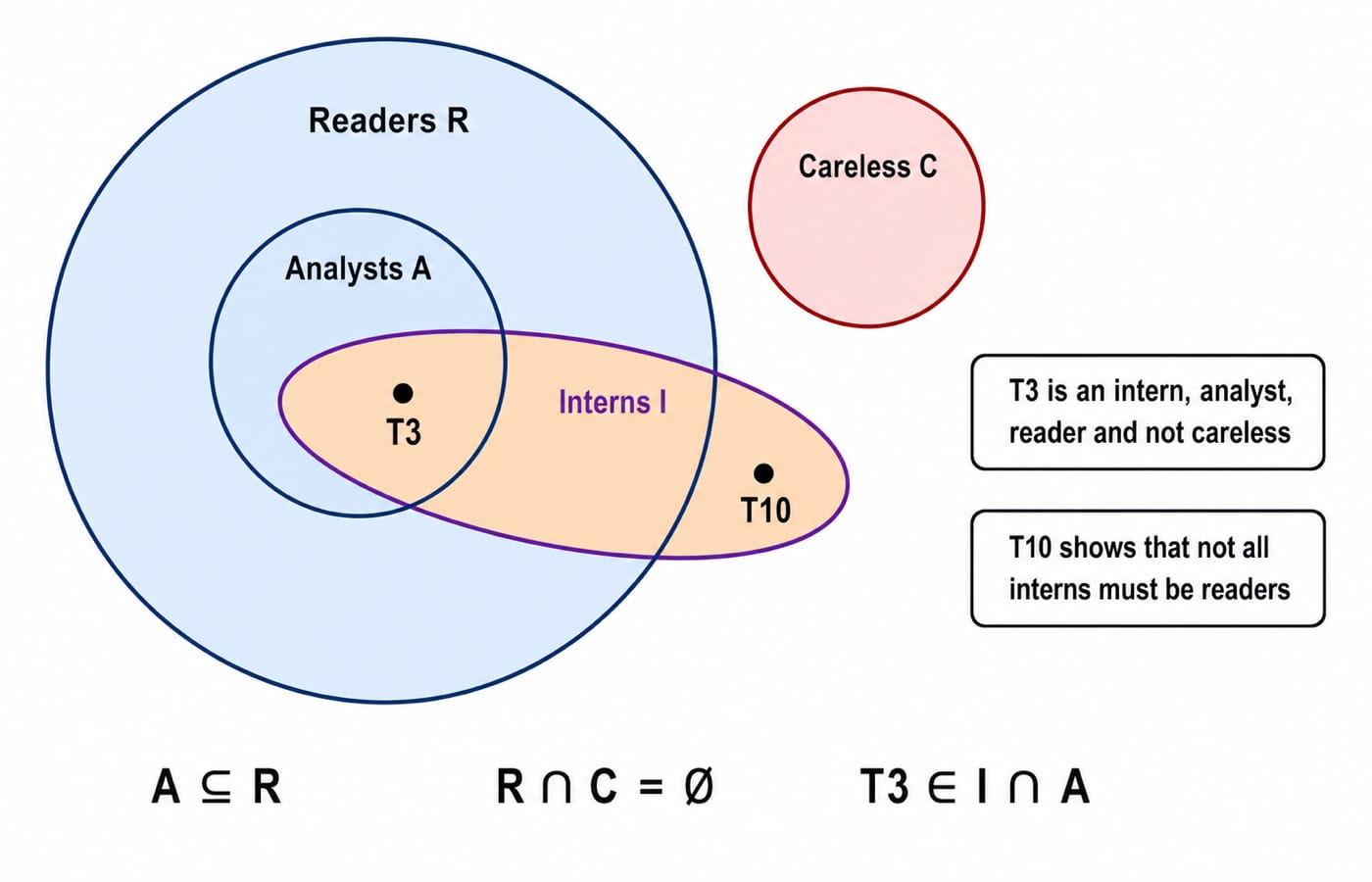
“All analysts are readers. No reader is careless. Some interns are analysts” means A subset of R, R intersection C = empty, and at least one member in I intersection A. That intern witness lies inside R and outside C.
Therefore:
“Some interns are readers” follows.
“Some interns are not careless” follows.
“No analyst is careless” follows.
“All interns are readers” does not follow. Only the intern or interns who are analysts are constrained.
Check 12 trainees, T1 to T12: R={T1,T2,T3,T4,T5,T6,T7}, A={T2,T3,T4}, C={T8,T9}, and I={T3,T5,T10,T11}. T3 is the required intern-analyst witness. T10, legally outside R, disproves conclusion IV. The roster checks consistency and supplies a counterexample; logical proof comes from inclusion, exclusion and existence.
Learn which conversions and chains are safe
Original | Conversion | Safe? |
|---|---|---|
No A is B | No B is A | Yes, disjointness is symmetric. |
Some A are B | Some B are A | Yes, it is the same overlap. |
All A are B | All B are A | No. |
Some A are not B | Some B are not A | No. |
“All roses are flowers” plus “All flowers are plants” gives “All roses are plants”. “Some interns are analysts” plus “All analysts are readers” gives “Some interns are readers”. “All analysts are readers” plus “No reader is careless” gives “No analyst is careless”. Track each carried set or dot.
Under strict set logic, “All pilots are graduates” does not guarantee a pilot exists, so “Some graduates are pilots” needs an existence premise. Follow stated test conventions. Create dots only for “some” or another explicit existence statement, never for “all” or “no”.
Treat possibility as a model-building test
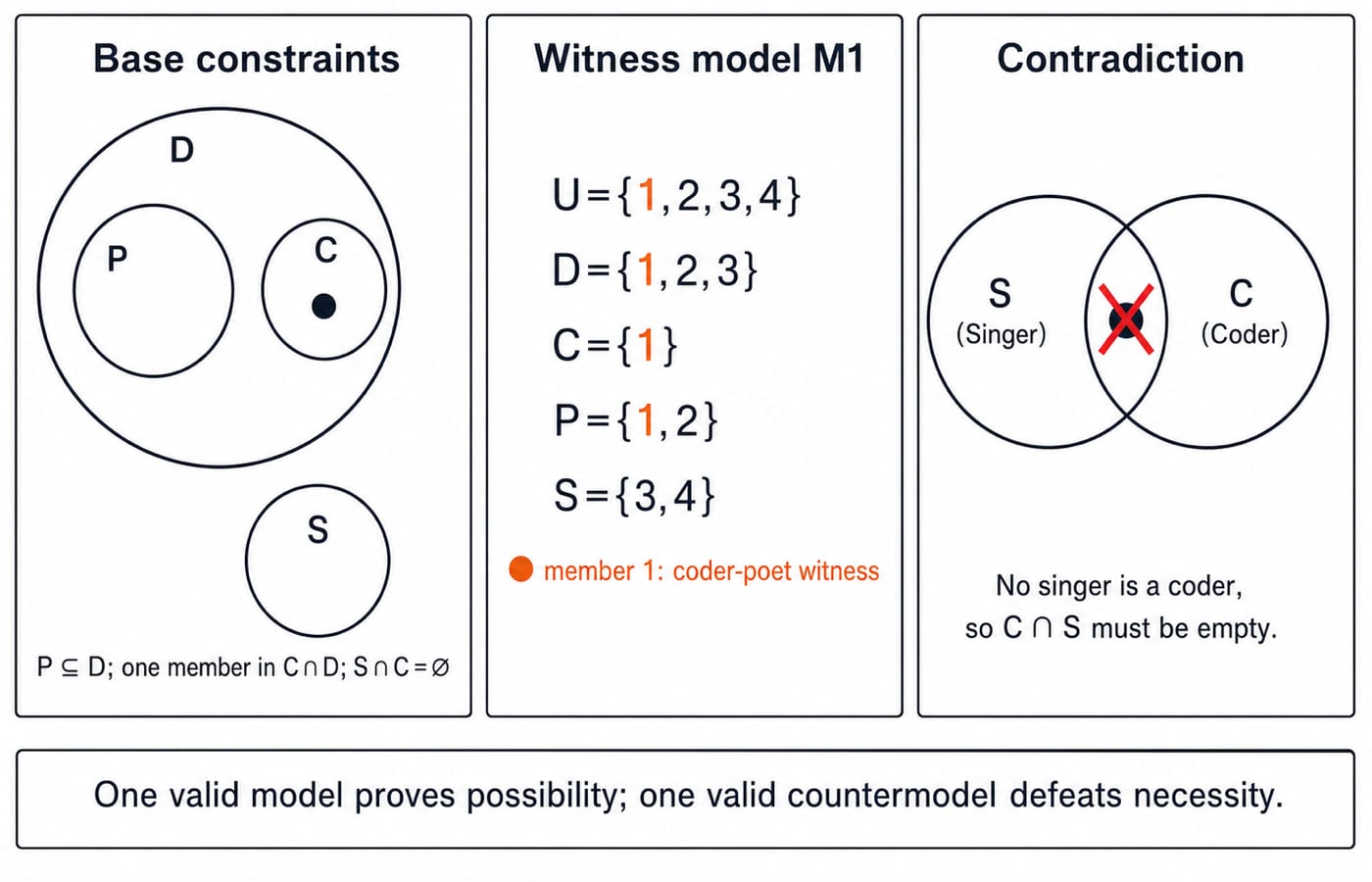
“All poets are dreamers. Some coders are dreamers. No singer is a coder” means P subset of D, at least one member in C intersection D, and S intersection C = empty. Poets versus Coders and Poets versus Singers remain unfixed.
I. “Some coders being poets is a possibility.” Yes. M1 uses U={1,2,3,4}, D={1,2,3}, C={1}, P={1,2}, and S={3,4}. The premises hold, and 1 is in C intersection P.
II. “All poets being singers is a possibility.” Yes, assessed separately. M2 has D={1,2,3}, C={1}, P={2,3}, and S={2,3,4}.
III. “Some coders being singers is a possibility.” No. Such a member would be in S intersection C, contradicting “No singer is a coder.” Check conclusions separately. Do not merge M1 and M2 unless asked whether both can hold together.
Use countermodels to reject plausible conclusions
To reject a definite conclusion, keep every premise true and make the conclusion false. For “All architects are planners. Some planners are musicians,” “Some musicians are architects” is not definite. Use U={1,2,3}, Architects={1}, Planners={1,2}, and Musicians={2}. Both premises hold without an Architects-Musicians overlap.
“Some musicians being architects is a possibility” is yes. The alternative Architects={1}, Planners={1,2}, Musicians={1,2} satisfies both premises and puts 1 in the overlap. An optional overlap proves possibility, not necessity.
Use two passes: draw forced containment, exclusion and existence, then move unconstrained circles or dots. Every legal move must preserve a definite conclusion; one countermodel defeats it.
Recognise how questions package the same logic
Use this five-step routine:
Label each set with one letter.
Translate every statement.
Place explicit existence dots.
Test each conclusion independently, starting with definite positive or negative chains.
For “does not follow”, construct a countermodel instead of trusting intuition.
Prompts may ask what follows, what is possible, what is invalid, or how a conclusion pair behaves. “Only”, “only a few”, “unless” and “either-or” need their stated convention, not silent reduction to the four basic forms.
Repair the traps behind wrong answers
Trap | Repair |
|---|---|
Reverse “all” | Preserve the containment direction. |
Treat one drawn overlap as forced | Ask whether the overlap can be removed. |
Ignore a “no” statement | Mark the excluded intersection before placing dots. |
Invent existence from a universal statement | Do not invent an analyst or pilot without an existence premise. |
Confuse possible with necessary | M1 proves coder-poet is possible, not that coders must be poets. |
Merge separate possibility models | Do not combine M1 and M2 when each conclusion is assessed separately. |
Speed cannot rescue a mistranslated premise, a broader lesson in 7 Placement Preparation Mistakes to Avoid. Before answering, check that the terms, direction, quantifier, and positive or negative wording match the diagram exactly.
Syllogism rules and a focused drill
Circles show sets.
Nesting shows “all”.
Separation shows “no”.
A dot shows “some”.
A definite conclusion must survive every valid diagram.
A possibility conclusion needs one valid diagram.
Remember: forced relationship = proof, legal countermodel = not definite, legal witness model = possible.
Draw each check before reading its verdict:
A: “All lamps are devices; no device is wooden” gives “No lamp is wooden”, definite yes.
B: “Some doctors are singers; all singers are artists” gives “Some doctors are artists”, definite yes.
C: “All engineers are graduates; some graduates are swimmers” gives “Some swimmers are engineers”, definite no but possible yes.
D: “No poets are traders; some traders are cyclists” does not entail “Some cyclists are poets”. The trader-cyclist witness cannot be a poet, but a different cyclist-poet remains possible.
For broad aptitude, reasoning and verbal fundamentals, continue with Aptitude for Placement. Every correct answer begins with an exact translation, not a plausible story.