
Logarithm questions often look like a formula-memory test. The costly mistakes, however, come from losing the exponential meaning, combining terms illegally, or accepting a root outside the domain. Logarithms are defined by exponentiation, and their laws, equations, change of base, common-log calculations and exact speed checks follow from that definition. Place it within a wider quantitative-aptitude foundation, but learn each move from its exponent logic rather than treating identities as unexplained shortcuts.
1. Logarithms reverse exponentiation under strict rules
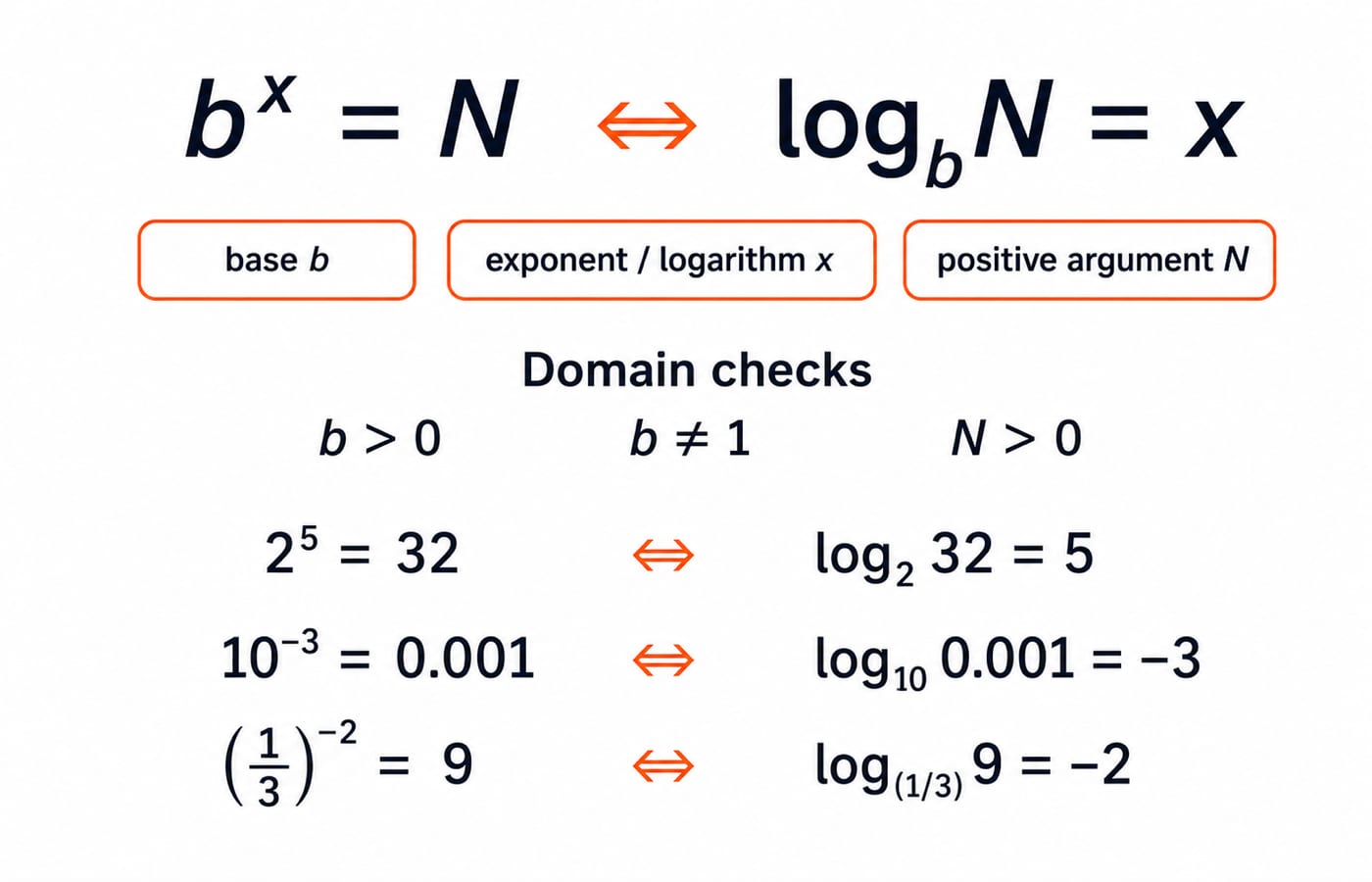
For real numbers, log_b N = x if and only if b^x = N. Here b is the base, N is the positive argument, and x is the exponent, also called the logarithm. The conditions are b > 0, b != 1, and N > 0.
Read every logarithm in both directions:
2^5 = 32 <=> log_2 32 = 510^-3 = 0.001 <=> log_10 0.001 = -3(1/3)^-2 = 9 <=> log_(1/3) 9 = -2
The third pair shows that a valid base can lie between 0 and 1. For such a base, the logarithm decreases as its argument grows.
Two anchor values follow directly from exponents. Since b^0 = 1, log_b 1 = 0. Since b^1 = b, log_b b = 1. In this real-number treatment, log_b 0 and logarithms of negative arguments are undefined. Bases 0, 1, and negative numbers are also invalid. These are domain rules, not optional conventions.
2. Logarithm laws compress products, quotients and powers
Assume b > 0, b != 1, and positive M and N. If M = b^p and N = b^q, then MN = b^(p+q), M/N = b^(p-q), and M^k = b^(kp). Therefore:
log_b(MN) = log_b M + log_b Nlog_b(M/N) = log_b M - log_b Nlog_b(M^k) = k log_b M
There is no matching split for log_b(M + N) or log_b(M - N).
Each law is exponent arithmetic written in logarithmic form.
Now simplify log_2 40 + log_2(8/5) - 2 log_2 2. Combine only the product and power structures:
log_2[40 × (8/5)] - log_2(2^2) = log_2 64 - log_2 4 = 6 - 2 = 4.
The one-line check is log_2(64/4) = log_2 16 = 4.
The sum trap fails numerically too. log_2(2 + 6) = log_2 8 = 3, whereas log_2 2 + log_2 6 = 1 + log_2 6, which is not 3 because log_2 6 is not 2. Before choosing a law, mark the top-level operation inside the argument.
3. Logarithmic equations require a domain filter
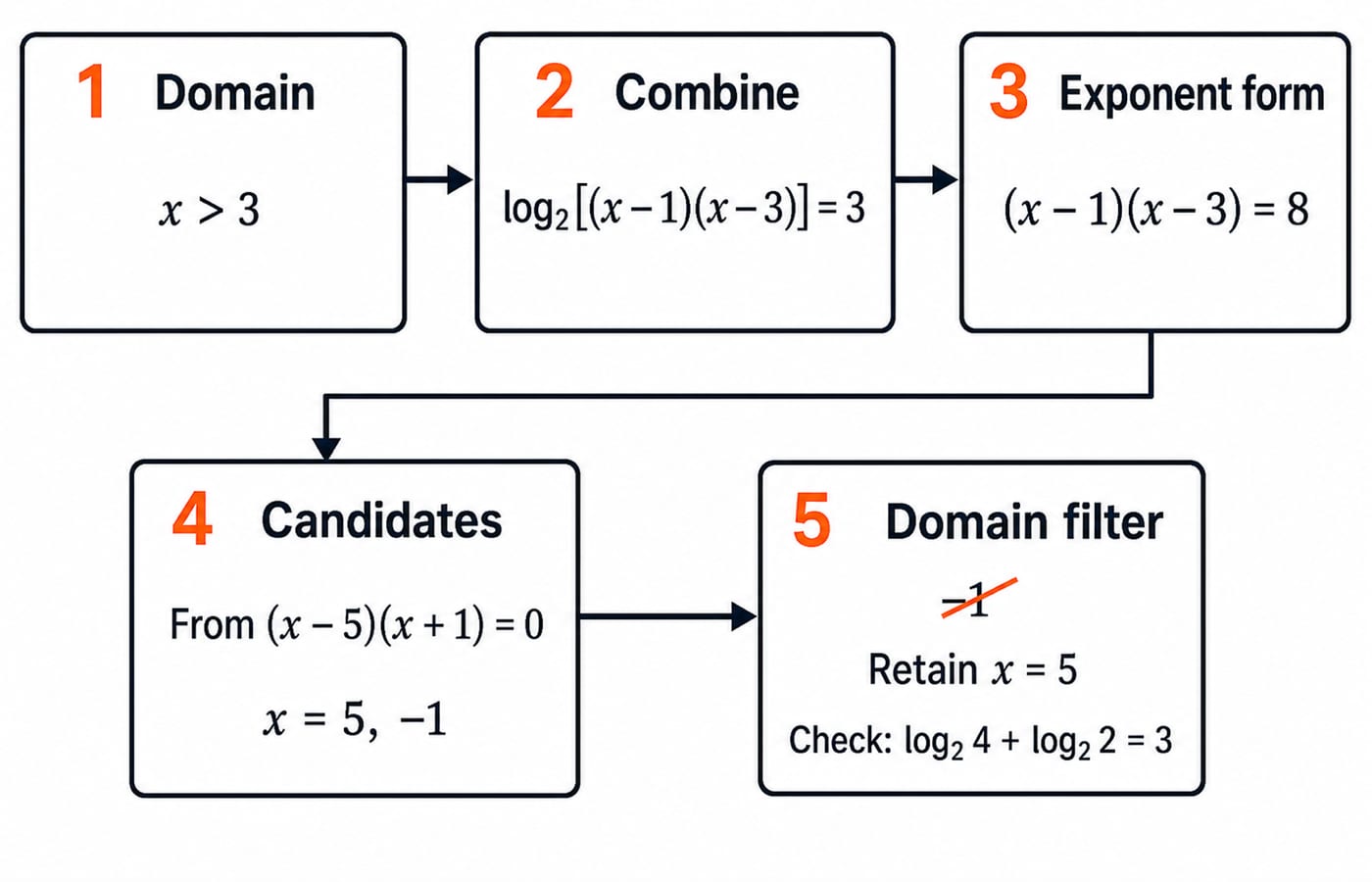
Use the same sequence every time: write the domain, combine only legal terms, convert to exponential form, solve the algebra, and test every candidate in the original equation.
Solve log_2(x - 1) + log_2(x - 3) = 3. The two arguments require x - 1 > 0 and x - 3 > 0, so x > 3. Now combine:
log_2[(x - 1)(x - 3)] = 3
Convert to exponent form:
(x - 1)(x - 3) = 2^3 = 8
Expanding gives x^2 - 4x - 5 = 0, which factors as (x - 5)(x + 1) = 0. The algebra produces x = 5 and x = -1, but algebra alone has not finished the question.
The candidate x = -1 is invalid because both original arguments are negative. For x = 5, the original left side is log_2 4 + log_2 2 = 2 + 1 = 3. Therefore the only real solution is x = 5.
Writing the domain first exposes this rejection even when later algebra temporarily hides the original arguments.
4. Change of base creates exact telescoping shortcuts
To derive change of base, set x = log_a b, so a^x = b. Take logarithm base c on both sides: x log_c a = log_c b. Hence log_a b = log_c b / log_c a, with valid bases and positive arguments. Choosing base 10 or base e lets a calculator handle a base with no direct key.
Consider log_2 8 × log_8 16. Change both factors to the same base:
(log 8 / log 2) × (log 16 / log 8) = log 16 / log 2 = log_2 16 = 4.
The numerical check agrees: log_2 8 = 3 and log_8 16 = 4/3, so their product is 4.
The same cancellation extends to log_2 3 × log_3 5 × log_5 16 = log_2 16 = 4. It also gives the reciprocal identity log_a b × log_b a = 1. Keep such products exact because early decimal rounding can hide the cancellation.
5. Common logarithms support fast supplied-value calculations
In aptitude arithmetic, log N commonly means log_10 N when the base is omitted by convention, while ln N means base e. If a question defines another convention, follow that definition.
Suppose the question supplies log 2 = 0.3010 and log 3 = 0.4771. To calculate log 72, first factor 72 = 2^3 × 3^2. Then:
log 72 = 3 log 2 + 2 log 3
= 3(0.3010) + 2(0.4771)
= 0.9030 + 0.9542 = 1.8572.
The same supplied approximation finds the number of decimal digits in 2^50. For a positive integer N, digits = floor(log_10 N) + 1. Therefore:
floor(50 × 0.3010) + 1 = floor(15.05) + 1 = 16.
The floor appears because all positive integers with d digits have logarithms from d - 1 up to, but not including, d.
Rounded inputs can shift a result near an integer boundary, so keep the supplied precision through the last step. For aptitude, reasoning and recruitment-test practice beyond this topic, use the broader placement preparation route.
6. Logarithm traps begin with domain or direction errors
Use cause, consequence and repair:
Do not split a sum. The product law does not apply, so keep
log_b(M + N)intact.Base
1is invalid. Check the base before calculating.Algebra can create invalid roots. Test that original arguments remain positive.
Early decimals introduce rounding. Cancel telescoping products exactly.
For
0 < b < 1, the logarithm decreases. Reverse the inequality direction.
For log_(1/2)(x - 1) > -2, first require x - 1 > 0, so x > 1. Since the base 1/2 is between 0 and 1, returning to exponential form reverses the inequality: x - 1 < (1/2)^-2 = 4, so x < 5. The answer is 1 < x < 5.
Check x = 3: log_(1/2) 2 = -1 > -2. But x = 6 fails because log_(1/2) 5 < -2; the function is decreasing and 5 > 4 = (1/2)^-2.
7. Competitive-exam questions reuse a small method set
Stable question forms include exponent-log conversion, law-based simplification, equations with domain filtering, change-of-base chains, supplied common-log approximations, digit counts, and inequalities whose bases lie between 0 and 1.
Use this 30-second order: inspect base and argument validity; rewrite simple values as powers; mark product, quotient or power structure; keep the work exact; solve; then substitute or estimate. Always add one reasonableness check. For example, log_2 12 must lie between 3 and 4 because 2^3 = 8 < 12 < 16 = 2^4.
For broader topic planning, see SSC CGL Quantitative Aptitude: High-Yield Topics and Bank PO Quant: High-Yield Topics First.
8. The short version and the next practice step
Logarithms ask for exponents. Arguments stay positive; products add, quotients subtract, powers move in front, and sums do not split. Change-of-base chains cancel exactly, and every equation ends with a domain check.
Now do a no-notes drill: translate (1/3)^-2 = 9, simplify the expression in Section 2 to 4, solve the equation in Section 3 to retain only x = 5, and explain why the inequality gives 1 < x < 5. The Aptitude for Placement course is a structured next step because its live curriculum includes Logarithm alongside broader aptitude practice.