Logical Reasoning Principles: Core Rules and Worked Examples
Learn a five-step method for translating reasoning questions into constraints, then apply it to arrangements, syllogisms, series and data sufficiency.
KnowledgeGate Team
Exam prep & CS education
Updated 23 Aug 20265 min read
You may solve a series, syllogism or seating puzzle in isolation, then freeze as soon as the wording changes. The missing piece is usually not another shortcut. It is a clear set of reasoning rules. Use one reusable process: translate sentences into constraints, separate what must be true from what may be true, derive only supported conclusions, and test the result. A six-seat arrangement uses positional constraints, while a syllogism uses set relationships. KnowledgeGate has about 6,900 Reasoning practice questions, and its Aptitude Courses for Exams & Placements page gives you a broader route into the subject.
Logical reasoning starts with premises, constraints and conclusions
A premise is a stated fact. A constraint limits allowed cases. An inference is forced by the premises. A conclusion is the tested claim. Validity asks whether it follows, not whether the story sounds realistic.
Keep three labels separate:
must be true in every valid case
may be true in at least one valid case
cannot be true in any valid case
One valid case proves possibility. Impossibility requires a contradiction in every allowed case, while necessity requires the claim to survive every allowed case.
From P -> Q, you may infer the contrapositive not Q -> not P. The converse Q -> P and inverse not P -> not Q do not automatically follow. If the rule says, "If a badge is red, it has a triangle," a triangle badge need not be red.
Use the five-step constraint method on every question
Identify the question family and requested output.
Translate every sentence into a symbol, slot, set or edge.
Place fixed and most restrictive conditions first.
Derive forced facts before shortcuts.
Test the question wording against the completed case or all remaining valid cases.
Use slots for order and seating, circles for syllogisms, arrows for directions and family relations, difference rows for series, and case tables for selection or data sufficiency.
A trial that violates a stated condition is a contradiction, so discard it. If several cases remain valid, keep them all. Never invent a tie-breaker.
Worked example: solve a six-person linear arrangement
Six people, Asha, Bharat, Charu, Deepak, Esha and Farhan, occupy seats 1 through 6 from left to right. Charu is in seat 4. Deepak is at one end. Asha is exactly two seats to the right of Deepak. Bharat sits immediately left of Esha. Farhan sits somewhere to the left of Bharat. Who is exactly two seats to the right of Asha?
Deepak cannot occupy seat 6 because no seat lies two places to its right. Therefore Deepak is in seat 1, Asha in seat 3, and Charu remains fixed in seat 4.
The empty seats are 2, 5 and 6. Bharat and Esha need consecutive seats in that order, so they take 5 and 6. Farhan takes 2. The unique order is 1 Deepak, 2 Farhan, 3 Asha, 4 Charu, 5 Bharat, 6 Esha. Therefore Bharat is exactly two seats to Asha's right.
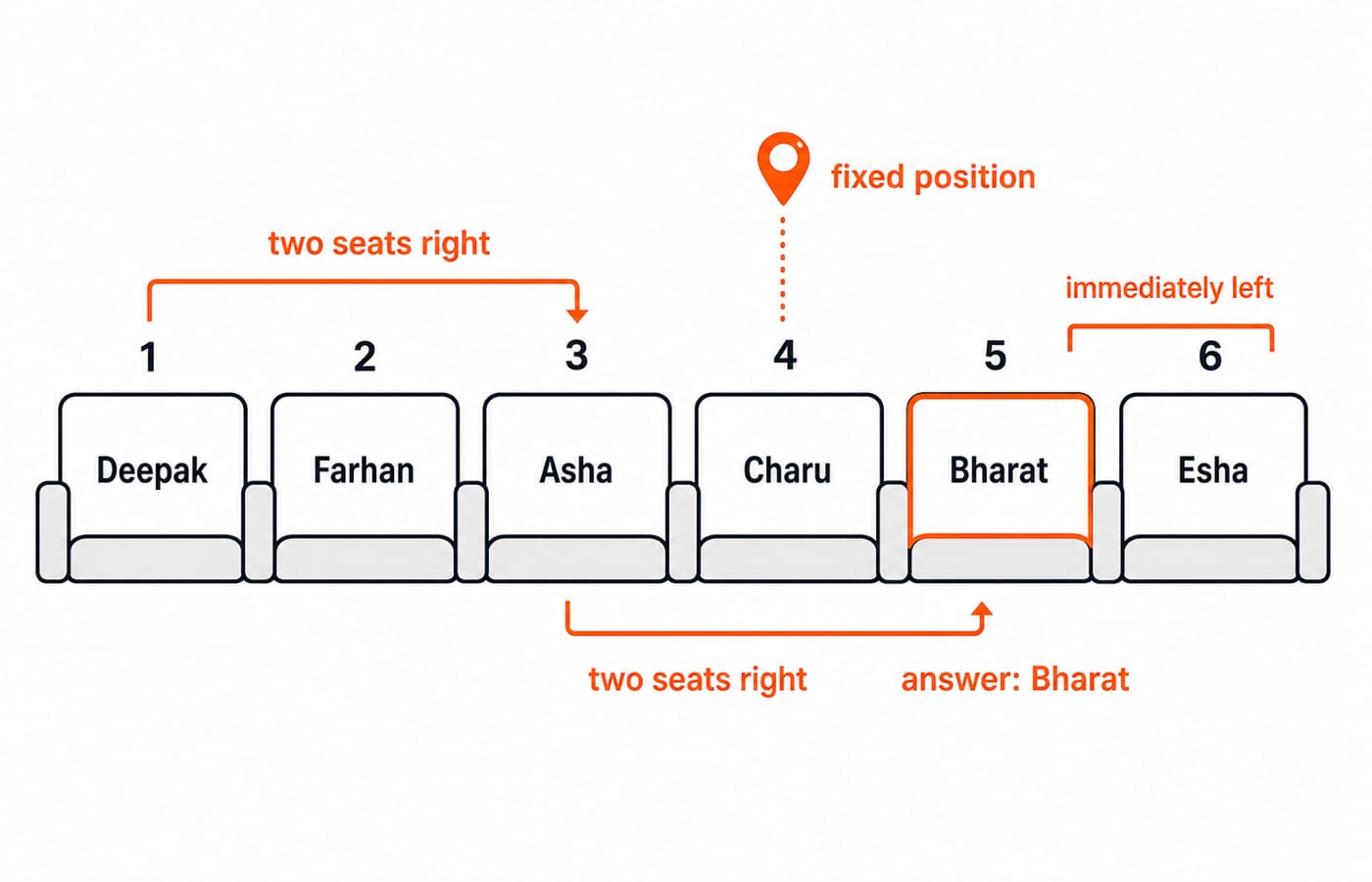
Use boundaries and fixed positions first. The consecutive pair becomes forced after those deductions, without testing all 6! = 720 possible orders.
Worked example: test a syllogism without over-inference
Consider these premises:
All designers are readers.
Some readers are coders.
No coder is a tester.
Test three conclusions: I. Some designers are coders. II. Some readers are not testers. III. No designer is a tester.
Conclusion I does not follow because the reader-coders need not be designers. Conclusion II follows: at least one reader is a coder, and no coder is a tester. Conclusion III does not follow because designers are not forced to be coders, so a designer may be a tester. Only conclusion II follows.
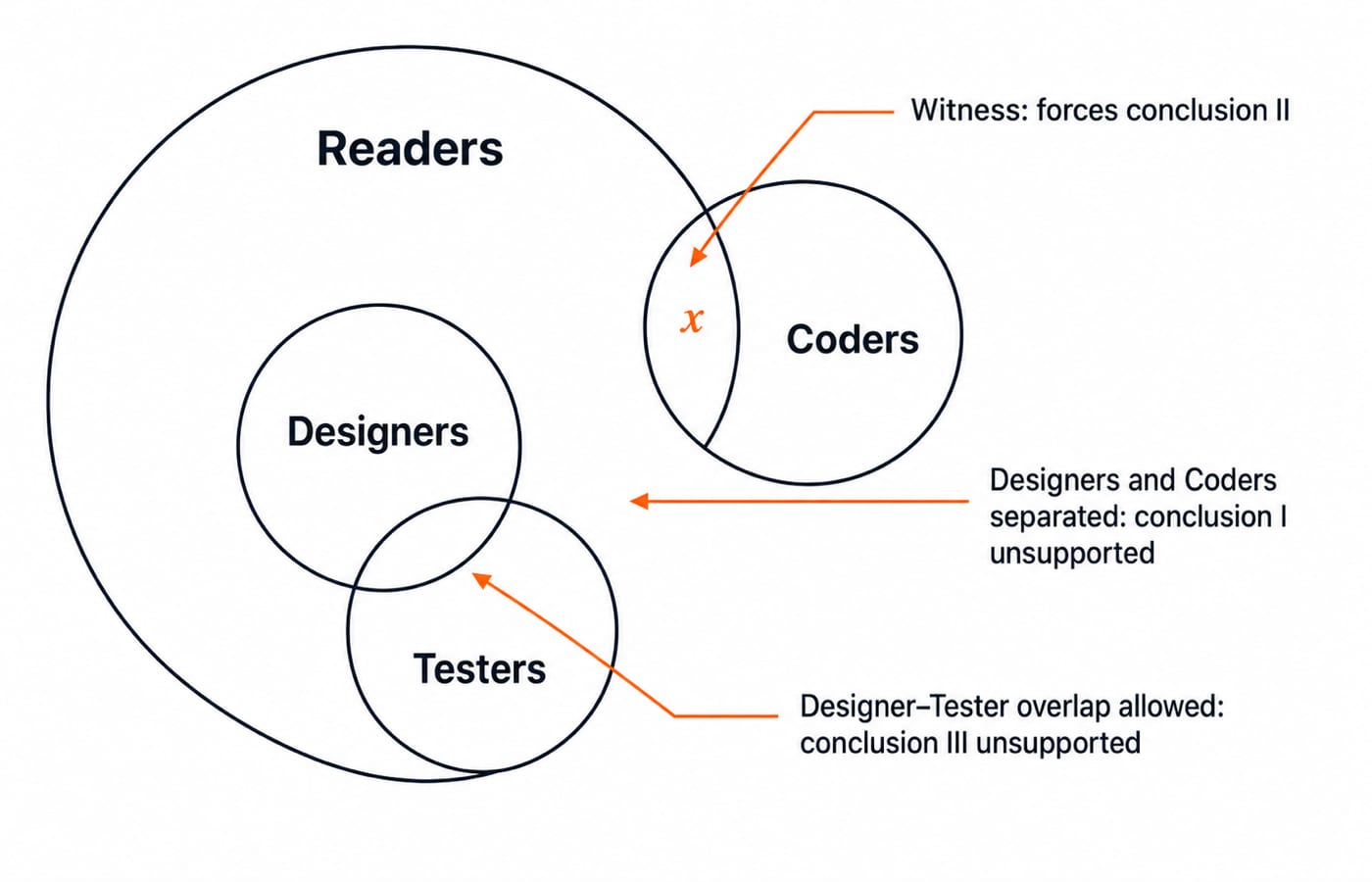
Some creates at least one required member. All describes containment but does not prove that the smaller set has members. Test an unsupported conclusion by making it false while keeping every premise true.
Match each reasoning family to the right representation
Question family | Representation | First move | Quick check |
|---|---|---|---|
Arrangements | Numbered slots | Place fixed positions | Check neighbour and order rules |
Syllogisms | Sets and an existence marker | Draw | Check unsupported overlaps |
Directions or family relations | Labelled graph | Fix one origin or person | Trace each arrow |
Series or coding | Differences, ratios or mappings | Compare adjacent terms | Test every transition |
Data sufficiency | Separate case lists | Test each statement alone | Check uniqueness |
For 3, 8, 15, 24, the differences are 5, 7, 9. They rise by 2, so the next difference is 11 and the next term is 24 + 11 = 35.
For integer x, Statement 1, x^2 = 49, leaves x = 7 or x = -7. Statement 2, x > 0, is insufficient alone. Together they remove -7 and force x = 7.
Representation exposes contradictions and shows whether a result is unique.
The traps that make a plausible answer look necessary
Assuming the converse: all red badges have triangles, but a triangle badge need not be red. Use only the stated direction or its contrapositive.
Importing real-world knowledge: a familiar story may suggest an unsupported answer. Use only stated facts.
Turning
someintoall: one reader-coder does not prove any designer is a coder. Preserve the quantity word.Stopping at one possible case: one arrangement proves
may be true, notmust be true. Test every valid case for necessity.Solving the wrong data-sufficiency task:
x^2 = 49allows7and-7. Check uniqueness before choosing.
Point to the premise or chain that forces an answer. If its justification depends on "usually", "probably" or outside knowledge, it is not established.
How aptitude tests turn these principles into questions
Direct rules test implications. Series and coding test transformations. Syllogisms test set boundaries, data sufficiency tests uniqueness, and arrangements combine constraints.
The same rules appear across the puzzle, seating, syllogism, inequality and coding-decoding formats in Bank PO Reasoning: High-Yield Topics. For mixed aptitude rounds, Aptitude for Placements: Quant, Reasoning, Verbal widens the plan beyond reasoning.
GATE-oriented readers can use the Aptitude for GATE Exam course for areas such as syllogisms, seating arrangements, coding-decoding, data arrangement and data sufficiency. Check any current exam-specific structure on that exam's official notification or test page.
The short version and the next practice step
Keep the process compact:
Translate each sentence.
Choose the right representation.
Apply the strongest constraint first.
Separate what must be true from what may be true.
Test the answer for contradiction.
The arrangement found a unique order from boundaries. The syllogism found one forced conclusion from set boundaries and existence. Both used the same process.
Solve one set from each representation family. Record whether each error came from translation, deduction or checking, then redo the failed family. For a structured route through logical reasoning alongside quantitative aptitude and verbal ability, continue with Aptitude for Placement.
Keep learning
Partnership Aptitude: Concepts, Shortcuts and Solved Examples
Learn one reliable capital-time method for partnership problems, then apply it to delayed entry, changing investments, allowances and reverse calculations.
Updated 24 Oct 20265 min readAptitude & Reasoning
Number System Concepts and Shortcuts: Solved Examples for Competitive Exams
Learn how to classify numbers, choose the right divisibility or prime-factor method, and verify remainders, factors, HCF, LCM, and unit digits.
Updated 22 Oct 20266 min readAptitude & Reasoning
Age Ratio-Based Problems: 12 Questions with Step-by-Step Solutions
Solve 12 age ratio-based questions from the KnowledgeGate practice bank. Each fresh solution shows how to form the equation, shift every age correctly, and verify the answer.
18 Oct 20267 min readAptitude & Reasoning
Mixture and Alligation: Rules, Shortcuts and Solved Examples for Exams
Learn how concentration, alligation and the retention factor solve the main mixture question types, with step-by-step examples and arithmetic checks.
Updated 14 Oct 20265 min readAptitude & Reasoning