The arithmetic in a table-chart question is usually simple. The real time loss comes from reading the wrong row, using the wrong percentage base, or calculating a total the question never requested. A question-first method turns each prompt into one clear task: lookup, difference, ratio, percentage, total, or average. It keeps every calculation tied closely to the wording. For the wider learning path, see Aptitude Courses for Exams & Placements.
Read the table before calculating anything
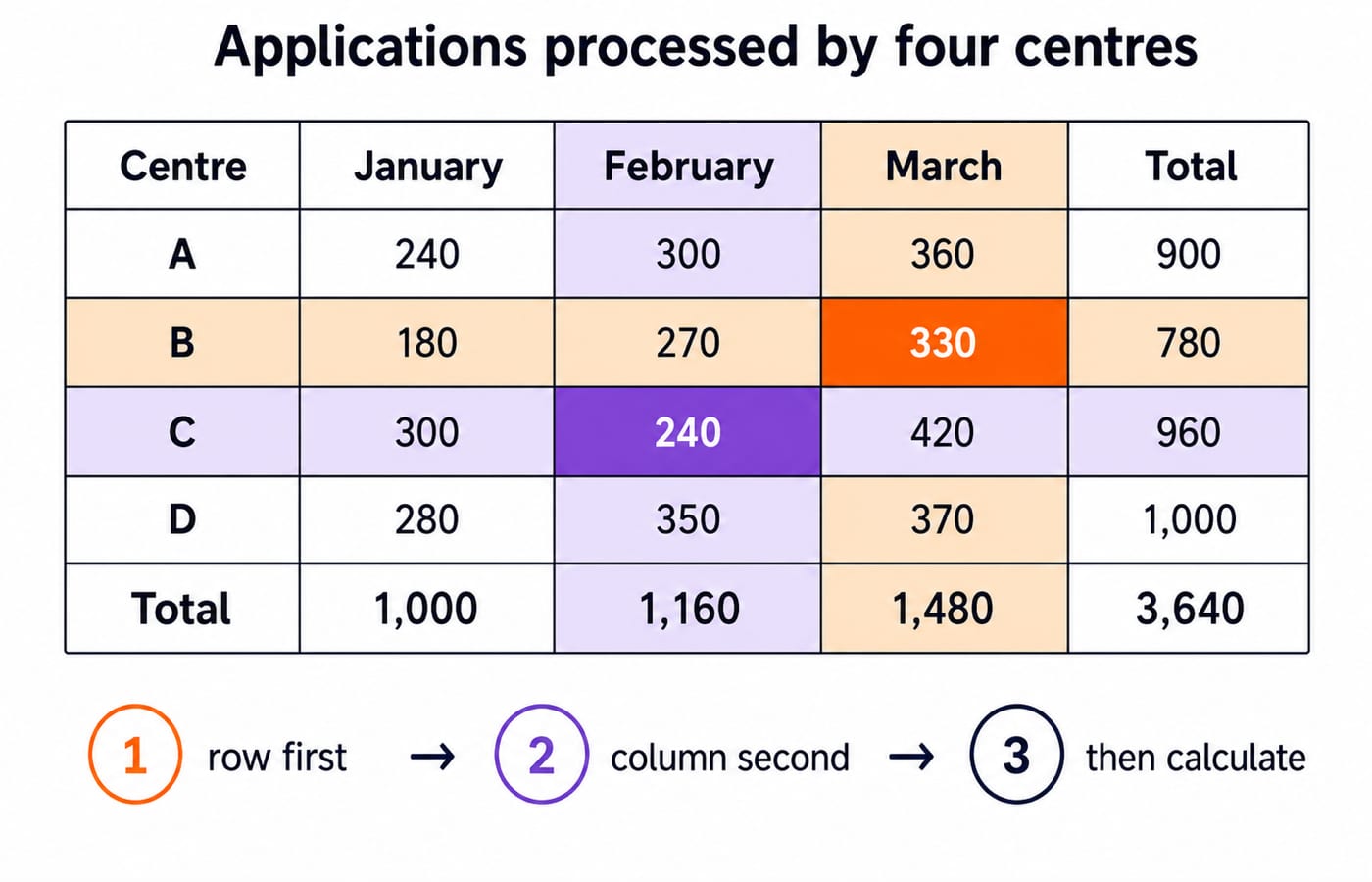
Suppose four centres, A to D, process applications over three months. The figures are invented for practice.
Applications processed by four centres
Unit: number of applications
Centre | January | February | March |
|---|---|---|---|
A | 240 | 300 | 360 |
B | 180 | 270 | 330 |
C | 300 | 240 | 420 |
D | 280 | 350 | 370 |
Give the table a 20-second scan. Read its title and unit, identify the rows and columns, note supplied totals, and mark the requested intersection. Centre B in March is 330, while Centre C in February is 240.
Build reusable margins once. Row totals are A = 900, B = 780, C = 960, and D = 1,000. Column totals are January = 1,000, February = 1,160, and March = 1,480. Both routes confirm the grand total:
Row route: 900 + 780 + 960 + 1,000 = 3,640
Column route: 1,000 + 1,160 + 1,480 = 3,640
Separate direct lookup, difference, and percentage comparison
In February, A = 300, B = 270, C = 240, and D = 350. D is highest and C is lowest. Asking how many more D processed than C requires subtraction:
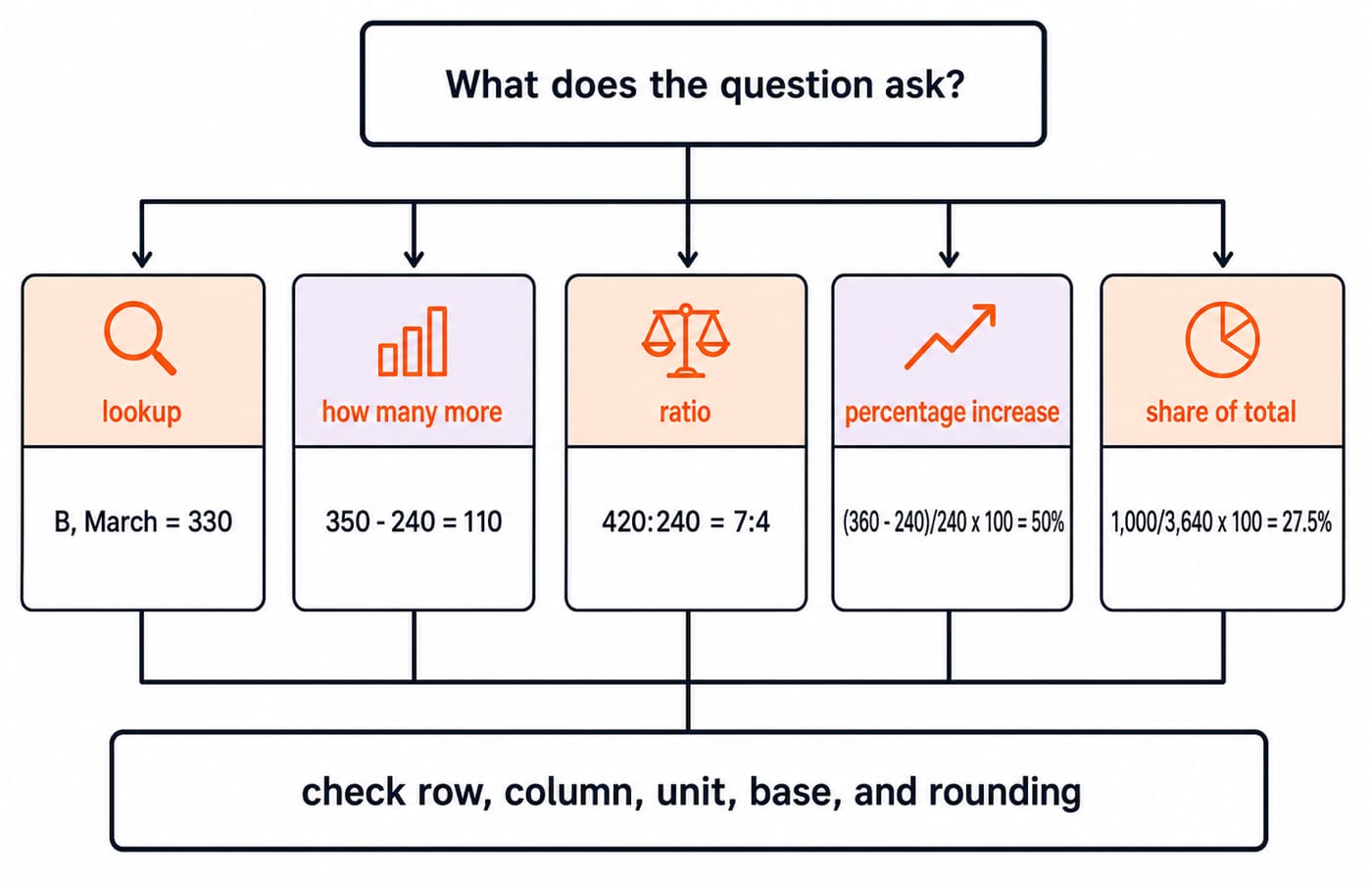
350 - 240 = 110 applications.
If it asks, "By what percentage is D higher than C?", C is the reference because D is being compared with C:
(350 - 240) / 240 x 100 = 110 / 240 x 100 = 45.83%, or about 45.8%.
Reverse the wording and the denominator changes. "C is what percentage lower than D?" becomes:
(350 - 240) / 350 x 100 = 31.43%, or about 31.4%.
Both answers are valid. Their bases differ.
Calculate percentage change from the starting value
Centre A rises from 240 in January to 360 in March. The change is 120 and the starting value is 240:
Percentage increase = 120 / 240 x 100 = 50%.
The multiplier check gives 240 x 1.5 = 360.
March exceeds January by 1,480 - 1,000 = 480, so the increase is 480 / 1,000 x 100 = 48%. March is 148% of January, but 48% more than January. The first uses the full value, the second only the change.
Fractions can make the work faster. Centre C rises from 300 to 420, an increase of 120. Since 120 / 300 = 2 / 5, the increase is 40%.
Turn table entries into ratios and shares
Centre C's March-to-February ratio is 420:240. Divide both terms by their greatest common divisor, 60:
420:240 = 7:4.
Order matters. February-to-March would be 4:7. Similarly, D:A in February is 350:300 = 7:6 after dividing by 50. Scale back to check: 7 x 50 = 350 and 6 x 50 = 300.
A share uses the whole as denominator. Centre D contributes 1,000 of 3,640:
1,000 / 3,640 x 100 = 27.4725...%, reported as 27.5% if one decimal place is allowed.
Do not confuse that part-to-whole share with the part-to-part ratio D:A = 1,000:900 = 10:9.
Use totals and averages for multi-step questions
A and B together in March processed 360 + 330 = 690 applications. C and D together in February processed 240 + 350 = 590. The first group exceeds the second by 690 - 590 = 100. If the question asks for the percentage excess, the second group is the reference:
100 / 590 x 100 = 16.949...%, or about 16.9%.
Centre D's monthly average is 1,000 / 3 = 333.33 applications, while A's is 900 / 3 = 300. Dividing by 3 is valid for three equally weighted months. Do not average percentages without justified equal weighting.
An average can recover a missing entry. If B's three-month average is 260, its total is 260 x 3 = 780. With January at 180 and March at 330, February is:
780 - 180 - 330 = 270.
Substitution confirms it: 180 + 270 + 330 = 780.
Choose the operation from the wording and control the clock
Translate the wording before calculating:
Question wording | Operation |
|---|---|
How many more? | Subtract |
In the ratio? | Divide and simplify in the named order |
Percentage increase? | Change divided by starting value |
What percentage of the total? | Part divided by whole |
Average? | Total divided by count |
Table DI sits inside wider quant, reasoning, and verbal preparation. Continue with Aptitude for Placements: Section Topics and Weekly Plan.
Use two passes. First answer direct lookups and one-step comparisons. Then return to totals, percentages, and missing values. Read the question before summing, underline the reference group, and keep reusable totals in one margin.
Estimation is useful when answer choices are far apart. D's share, 1,000 / 3,640, is close to 1,000 / 3,600 = 27.8%, so an option near 27.5% is plausible. If options are close, calculate the exact 27.4725...%. Keep full values until the final line.
Wrong cell, wrong base, wrong total: repairing the five table traps
Trap | Exact warning | Repair |
|---|---|---|
Swapped row and column | B in March is 330, not C in February's 240 | Trace the row-column crosshair |
Wrong percentage base | D higher than C in February uses 240, not 350 | Ask, "Compared with what?" |
Wrong total | March's total is 1,480, not D's row total of 1,000 | Circle the requested dimension |
Reversed ratio | C March:February is 7:4, not 4:7 | Write labels above both terms |
Early rounding | 1,000 / 3,640 is 27.4725...% | Retain the fraction to the final answer |
Use two quick validation habits. An average must lie between the smallest and largest contributing values, so D's 333.33 must sit between 280 and 370. Also, all centre shares of the grand total must add to about 100%, allowing only for stated rounding.
One table, many question forms: what exams actually ask
A table question may ask for one cell, rank rows, compare two cells, combine rows or columns, find percentage change, recover a missing entry, or test whether a statement follows from the data. The mix of these forms differs across placement platforms; see AMCAT, CoCubes, eLitmus: Aptitude Tests Compared for the differences.
The whole method in five moves
Identify the requested cell or group. Choose the operation from the wording, write the comparison base before dividing, calculate once, and check direction, unit, and scale.
For the next practice step, use the Aptitude for Placement course for placement-focused preparation or the IBPS PO Mains course for the bank-exam route.