
Knowing the average formula is not enough when a quick solution uses the wrong denominator. Averages for Aptitude: Concepts, Shortcuts and Solved Examples explains how to select the direct, weighted, deviation or change-in-total route. After choosing a route, verify it independently: reconstruct the total, check range and direction, track membership, respect weights and preserve units. These checks expose a shortcut used in the wrong situation before it costs marks.
Average invariants: total, count, range and units must agree
Arithmetic mean is:
average = total of observations / number of observations
Rearrange it into the more useful working identity:
total = average x count, or T = nA
The average is an equal-share value, not necessarily one of the observations. For equally weighted positive values, it must lie between the smallest and largest values. The product of average and count must also reconstruct the total, with the same units as the observations.
Suppose questions solved over five days are 18, 23, 27, 32, 40.
Total
= 18 + 23 + 27 + 32 + 40 = 140Average
= 140 / 5 = 28 questions per dayRange check:
28lies between18and40
In reverse, 8 practice sets averaging 24 total 8 x 24 = 192.
Whenever a count and average appear, write T = nA. The Aptitude Courses for Exams & Placements path connects this topic to broader quantitative aptitude, reasoning and verbal preparation.
Assumed-mean audit: recover the ordinary total
When values cluster near a convenient centre a, calculate each deviation x - a, then use:
actual average = a + (sum of deviations / count)
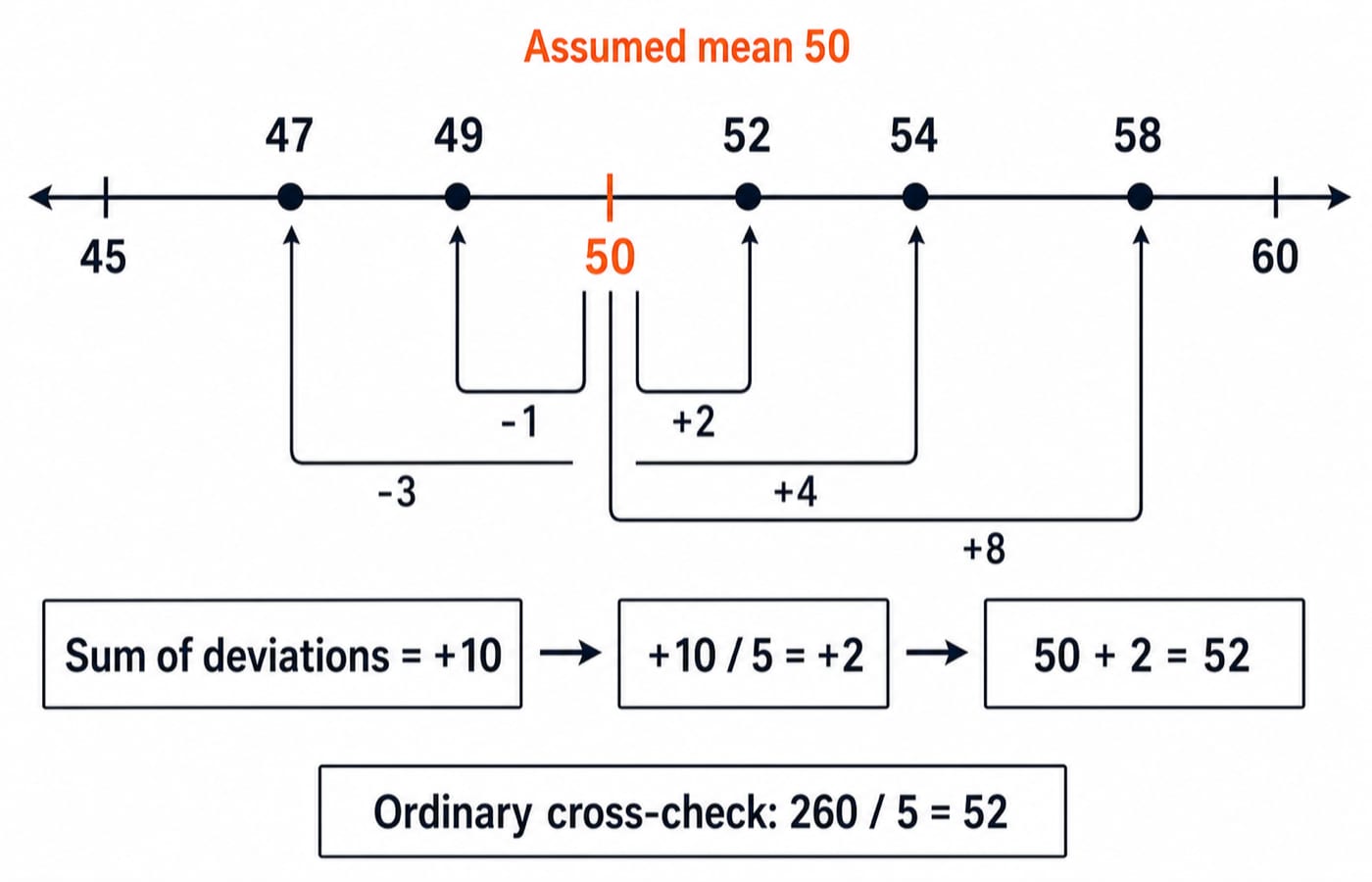
For 47, 49, 52, 54, 58, choose a = 50. Deviations are -3, -1, +2, +4, +8, totalling +10:
average = 50 + 10/5 = 50 + 2 = 52
Independent total audit: 47 + 49 + 52 + 54 + 58 = 260, then 260/5 = 52. The deviation shortcut and ordinary total agree.
Direction and scale checks catch a misplaced adjustment. Adding 3 to every value gives 50, 52, 55, 57, 61, averaging 55. Doubling every original value doubles the average to 104. Adding 3 to only one value raises this five-value average by only 3/5 = 0.6.
Missing-value and correction audits: keep membership explicit
Six mock scores average 72, requiring 6 x 72 = 432. The known scores total 68 + 75 + 70 + 74 + 69 = 356. Therefore:
missing score = 432 - 356 = 76
Substitution audit: (356 + 76)/6 = 432/6 = 72, so the recovered value restores the stated average.
For a correction, avoid recomputing every observation. 20 readings reported at average 35 total 700. A reading of 43 was copied as 34, so add 43 - 34 = 9. The corrected total is 709, and average 709/20 = 35.45.
For a correction, use correct total = reported total - wrong value + correct value. The count remains fixed because membership did not change. A missing value also keeps the intended count fixed, but it starts from a required total rather than a reported one.
Joining and replacement audits: decide whether count changes
Eight students average 18 years, so their total is 8 x 18 = 144. After one joins, 9 students average 19, totalling 9 x 19 = 171. The new student is 171 - 144 = 27 years old. Do not multiply the new average by the old count.
For a fixed group, ten players averaging 26 total 260. A player aged 20 is replaced and the average becomes 27. The new total is 270, up 10, so the incoming player is 20 + 10 = 30 years old.
Replacement therefore gives:
incoming value - outgoing value = n x change in average
The rise audit gives 10 x (27 - 26) = 10. Replacement keeps ten players; joining changes the count from eight to nine. Writing old count and new count before multiplying prevents the two cases from being confused.
Weighted-average audit: let the larger weight pull harder
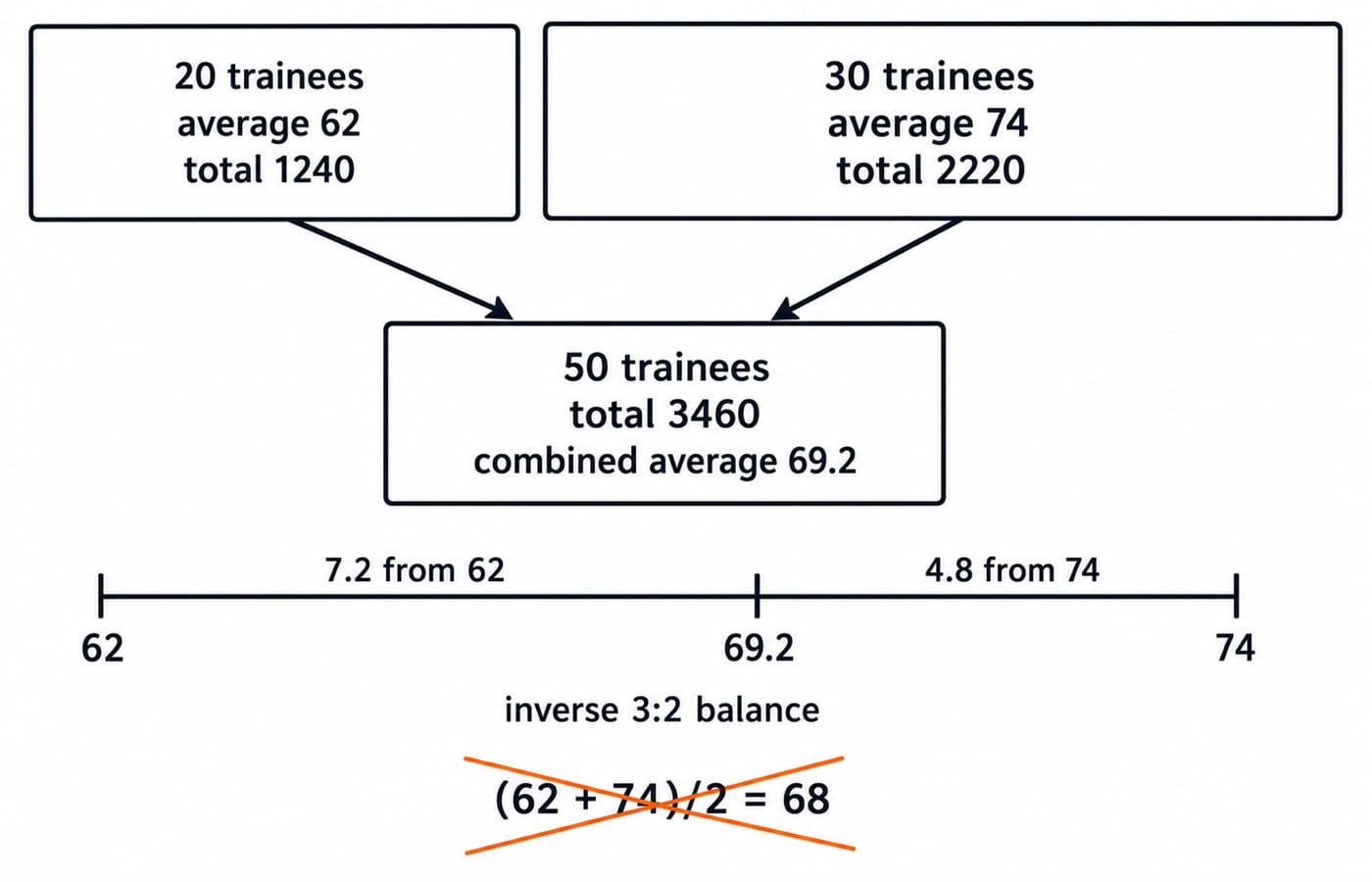
Group A has 20 trainees averaging 62, total 1240. Group B has 30 averaging 74, total 2220.
Combined total
= 1240 + 2220 = 3460Combined count
= 20 + 30 = 50Combined average
= 3460/50 = 69.2
The tempting (62 + 74)/2 = 68 treats the groups as equal. Two independent checks reject it. First, totals give 3460/50 = 69.2. Second, the sizes are 2:3 and the gap is 12, so move 3/5 above 62: 62 + (3/5 x 12) = 69.2. The result is closer to the larger group at 74.
For a test weighted 40% at score 70 and an interview weighted 60% at 80, the result is 0.40 x 70 + 0.60 x 80 = 28 + 48 = 76. The weight audit confirms that the weights sum to 1 and the result lies between 70 and 80.
Shortcut eligibility checks: symmetry, targets and rates
Symmetry works only when deviations cancel. For 14, 18, 22, 26, 30, deviations from 22 are -8, -4, 0, +4, +8, so the average is 22. An equally spaced list also permits average = (first + last)/2. The uneven list 14, 18, 22, 30 fails that eligibility check and averages 84/4 = 21, not 22.
Five values averaging 40 total 200. Raising the average to 43 requires 5 x 43 = 215, up 15. One changed value must rise by 15; if all rise equally, each rises by 3.
A rate needs a unit audit. Two 60 km legs at 40 km/h and 60 km/h take 1.5 h and 1 h. Total distance divided by total time gives 120/2.5 = 48 km/h, not 50 km/h. Speeds are weighted by time unless travel times are equal.
Competitive-exam average audits: match each trap to a check
Before calculating, name the invariant that will verify the result: average plus count must reconstruct the total; a missing value must restore the required total; replacement keeps the count fixed; combined groups need total weight; and a rate must preserve quantity per unit time.
Suspicious result | Failed invariant | Independent check |
|---|---|---|
Multiply the joining average by | The new group has | Use the final count |
Use | It ignores group sizes | Add totals and counts to get |
Assume the mean must appear in the data | A mean is a balance value | Check only that it lies within the range |
Use first and last on uneven spacing | Interior values do not cancel | Sum the values normally |
Treat joining as replacement | Joining changes the count | Rebuild old and new totals |
Average the two speeds to get | Travel times differ | Use total distance divided by total time to get |
The SSC CGL Quantitative Aptitude: High-Yield Topics and a Strategy to Master Them guide applies quantitative methods to one exam context. Check the current official notification and syllabus for weightage, marks, question counts and pattern because those details can change. For averages, the decisive audits are mathematical: count, total, range, direction, weights and units.
Average shortcuts: a verification sequence and final drill
After solving, run this six-step audit:
State what each observation and weight represents.
Reconstruct the expected total with T = nA.
Confirm that the denominator matches final group membership.
Compare old and new totals for a correction, replacement or joining event.
For positive weights, check that the result lies between the component values and is pulled toward the larger weight.
Check units, direction and the original condition by substitution.
Run the audit on one mixed problem. A class of 15 has reported average 24, but one score of 48 should be 18. Membership stays fixed, so this is a correction rather than a replacement. Reported total is 15 x 24 = 360; corrected total is 360 - 48 + 18 = 330; corrected average is 330/15 = 22. The lower corrected value makes the average fall, and 15 x 22 = 330 reconstructs the corrected total.
For structured practice, use Aptitude for Placement. For GATE-focused preparation, choose APTITUDE for GATE Exam. Keep the verification habit: convert averages to totals, make the change, then test the result against count, range, direction, weights and units.