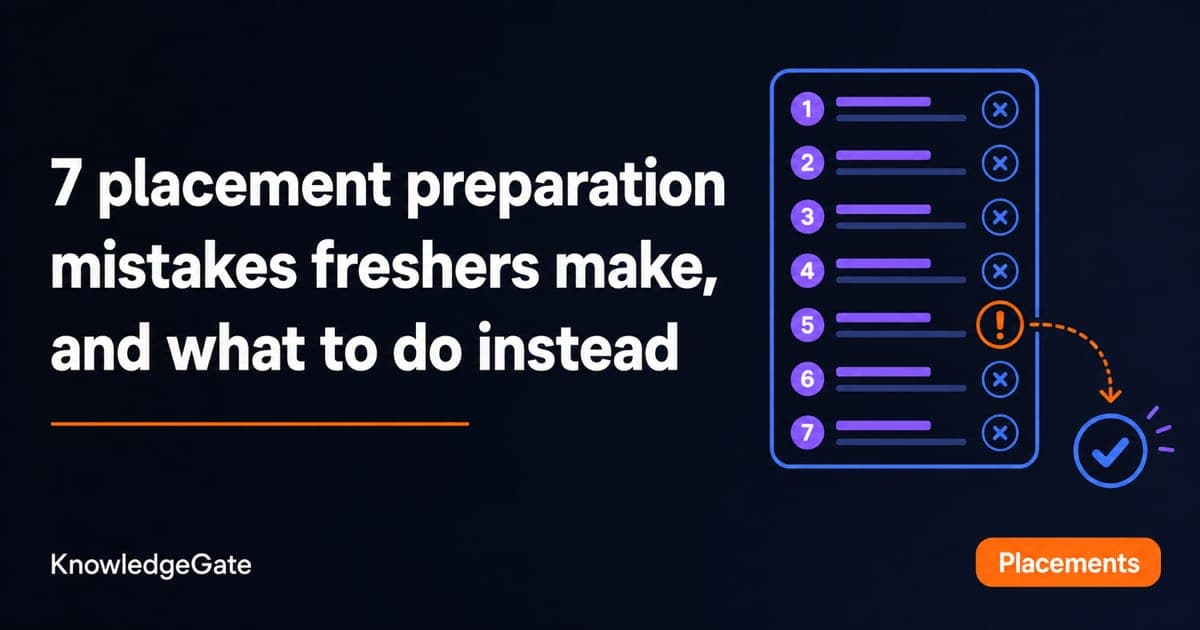
7 placement preparation mistakes freshers make, and what to do instead
Most freshers who miss placements are not short on ability. They are short on balance. They pour months into one part of the drive and leave the parts that actually eliminate them untouched. A placement drive has several stages, and each one rejects candidates independently, so a brilliant score in
KnowledgeGate Team
Exam prep & CS education
18 Jul 20264 min read
Most freshers who miss placements are not short on ability. They are short on balance. They pour months into one part of the drive and leave the parts that actually eliminate them untouched. A placement drive has several stages, and each one rejects candidates independently, so a brilliant score in one stage cannot rescue a zero in another.
The habits behind that imbalance are ordinary and reasonable-seeming: practising what already feels comfortable, postponing whatever looks easy enough to cram later, and treating every stage that is not coding as a formality.
1. Grinding LeetCode without learning the patterns
Why it happens: solving problems feels productive, and a rising "solved" count feels like progress.
What goes wrong: you solve 300 problems as 300 unrelated puzzles, so a slightly reworded question in the actual round feels brand new. Volume without pattern recognition does not transfer.
Do instead: learn the underlying patterns (sliding window, two pointers, recursion and backtracking, the common dynamic programming shapes) and group your practice by pattern rather than by random difficulty. A structured path like our DSA using Java course teaches the patterns first, so each new problem maps to something you already know.
2. Skipping aptitude until it is too late
Why it happens: aptitude feels like school maths, so you assume you will "revise it in the last week".
What goes wrong: the aptitude round is usually the very first filter, it is timed, and it eliminates strong coders who never practised for speed. You cannot cram three sections in a weekend.
Do instead: give aptitude a fixed weekly slot from day one across quant, reasoning and verbal. Our aptitude for placements guide lays out the high-yield topics and a realistic weekly plan with timed practice built in.
3. Ignoring core CS subjects
Why it happens: DSA gets all the attention online, so Operating Systems, DBMS, Computer Networks and OOP feel optional.
What goes wrong: the technical interview is half coding and half core subjects. Candidates who "only did DSA" freeze on a normalization or TCP-versus-UDP question that a few hours of prep would have covered.
Do instead: revise the fundamentals in interview-ready form. Our technical interview CS subjects guide covers the exact OS, DBMS, CN and OOP concepts freshers get asked, with crisp answers you can rehearse.
4. Sending out a weak, generic resume
Why it happens: the resume feels like a formality once you have "done the real prep", so it gets thrown together the night before applications open.
What goes wrong: a recruiter spends seconds per resume and an automated filter screens it before that. A generic objective line and vague bullets get you screened out before anyone sees your skills.
Do instead: lead with projects, write quantified action-first bullets, keep it to one ATS-safe page, and match the role's keywords honestly. A resume that a recruiter and an automated filter can both read in seconds is what gets you past the screen. Our Resume & Interview Preparation courses cover the resume itself and both the technical and HR rounds it gets you into.
5. Never doing a single mock interview
Why it happens: mocks are uncomfortable. It is easier to keep studying quietly than to be evaluated out loud.
What goes wrong: you discover on the real interview that you cannot explain your own project, or that you go blank under mild pressure. The gap between knowing something and saying it clearly only closes with practice.
Do instead: do mock interviews well before the drive, technical and HR both, and treat each one as data on what to fix. Explaining your solution out loud is a separate skill from solving it, and it is trainable only by doing it.
6. Over-preparing for one dream company
Why it happens: one company becomes the whole goal, so all energy funnels into its specific pattern.
What goes wrong: if that one drive does not go through, a year of narrow preparation has little to show, and you have neglected the shared skills every other company also tests.
Do instead: prepare the common core (aptitude, DSA, core CS, communication) that serves every drive, and treat any single company as one application of it rather than the entire plan. Breadth first protects you from a single bad day.
7. Neglecting communication and the HR round
Why it happens: the technical rounds feel like the "real" test, so the HR conversation is treated as a formality you will improvise.
What goes wrong: offers are lost at the last step by candidates who cleared everything harder, simply because they never prepared honest, structured answers to standard HR questions.
Do instead: prepare short, honest frameworks for the common HR questions and rehearse them aloud until they sound like you. No other round in the drive costs so little to protect.
The short version
None of these mistakes are about raw talent. They are about balance: patterns over volume, aptitude alongside coding, core subjects alongside DSA, a resume that clears the screen, mocks before the real thing, breadth over a single company, and communication as a real round. Fix these and you are competing on your actual ability instead of losing to an avoidable gap.
If you would rather have the whole drive sequenced in one place, the Mera Placement Hoga bundle covers the stages together instead of leaving you to assemble them stage by stage. You already have the ability. The rest is balance and discipline.
Keep learning
Number System Concepts and Shortcuts: Solved Examples for Competitive Exams
Learn how to classify numbers, choose the right divisibility or prime-factor method, and verify remainders, factors, HCF, LCM, and unit digits.
Updated 22 Oct 20266 min readAptitude & Reasoning

Age Ratio-Based Problems: 12 Questions with Step-by-Step Solutions
Solve 12 age ratio-based questions from the KnowledgeGate practice bank. Each fresh solution shows how to form the equation, shift every age correctly, and verify the answer.
18 Oct 20267 min readAptitude & Reasoning

Mixture and Alligation: Rules, Shortcuts and Solved Examples for Exams
Learn how concentration, alligation and the retention factor solve the main mixture question types, with step-by-step examples and arithmetic checks.
Updated 14 Oct 20265 min readAptitude & Reasoning

Mental Ability Concepts and Shortcuts: Solved Examples for Competitive Exams
Learn a four-step reasoning process, then apply it to number patterns, mirror coding, directions, syllogisms, blood relations and ranking problems.
Updated 10 Oct 20267 min readAptitude & Reasoning