
HCF and LCM can look interchangeable under time pressure, but choosing the wrong operation ruins the calculation. HCF finds the greatest common grouping, while LCM finds the earliest common repetition; prime factorisation, Euclid's method, product shortcuts and remainder questions apply these ideas. For a wider aptitude foundation for placements, use this lesson as focused practice.
HCF and LCM select opposite powers from the same prime factors
The HCF, or GCD, is the greatest positive integer dividing every given number exactly. The LCM is the least positive integer divisible by every given number.
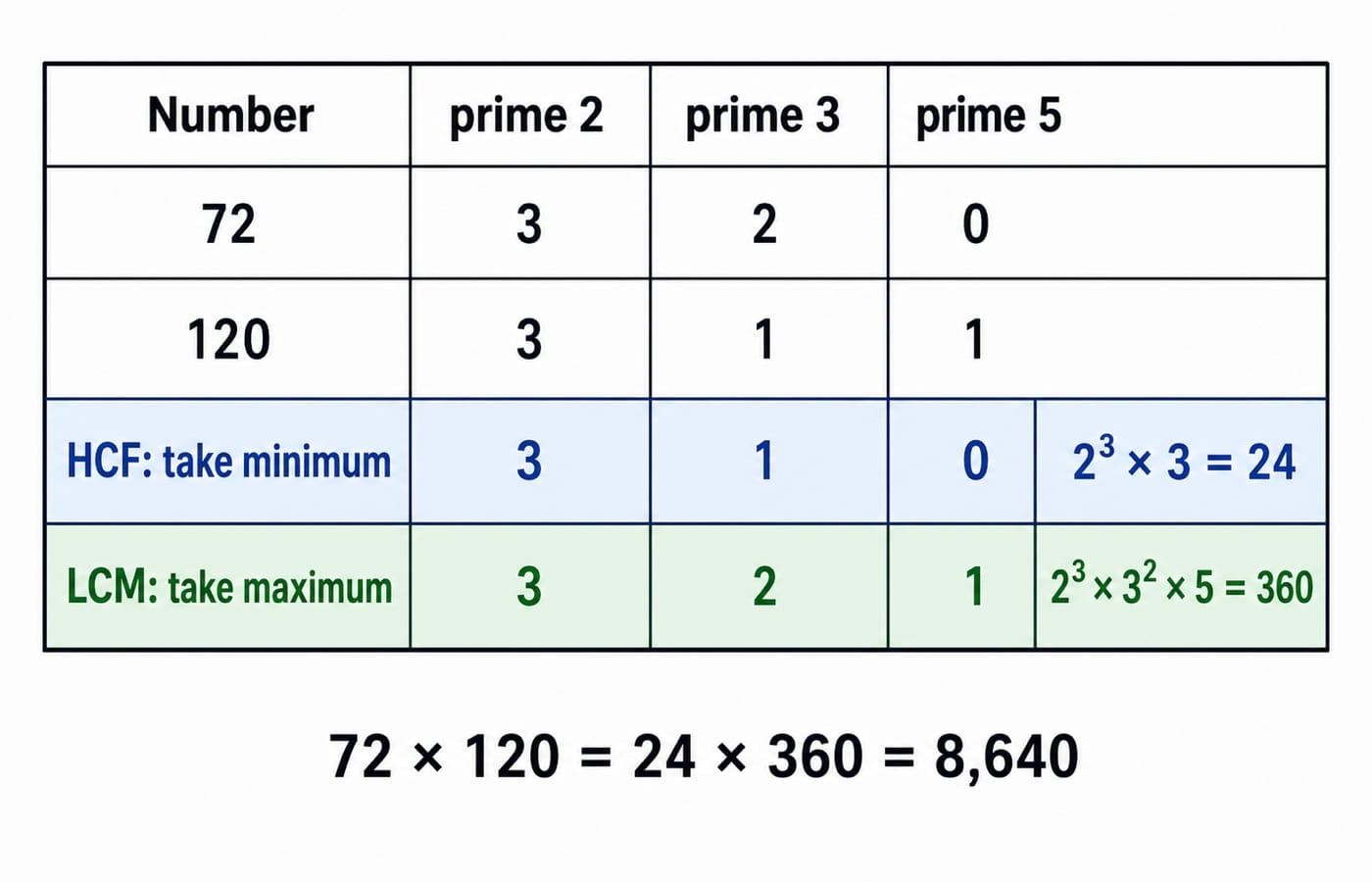
Prime factorisation makes the choice mechanical: use common primes at their lowest powers for HCF, and every required prime at its highest power for LCM.
For example:
72 = 2^3 × 3^2
120 = 2^3 × 3 × 5
Therefore, HCF = 2^3 × 3 = 24, while LCM = 2^3 × 3^2 × 5 = 360.
Check the definitions: 72 ÷ 24 = 3 and 120 ÷ 24 = 5, so 24 divides both. Also, 360 ÷ 72 = 5 and 360 ÷ 120 = 3, so 360 is a common multiple.
The pair also demonstrates 72 × 120 = 8,640 and 24 × 360 = 8,640. Generally, a × b = HCF(a,b) × LCM(a,b) for two positive integers, not three or more.
Choose prime factorisation or Euclid's division method
Prime factorisation suits numbers that split quickly, especially when both answers are needed. For the HCF of larger numbers, Euclid is often faster: divide the larger number by the smaller, replace the pair with the divisor and remainder, and repeat until the remainder is 0. The last non-zero remainder is the HCF.
For 252 and 198, prime factorisation gives:
252 = 2^2 × 3^2 × 7
198 = 2 × 3^2 × 11
So HCF = 2 × 3^2 = 18, and LCM = 2^2 × 3^2 × 7 × 11 = 2,772.
Euclid reaches the same HCF:
252 = 198 × 1 + 54198 = 54 × 3 + 3654 = 36 × 1 + 1836 = 18 × 2 + 0
The last non-zero remainder is 18, the HCF. The identity then gives (252 ÷ 18) × 198 = 14 × 198 = 2,772. Divide before multiplying to simplify the arithmetic.
Use the two-number identity and special cases safely
Suppose HCF is 18, LCM is 756, one number is 108, and the other is x:
108 × x = 18 × 756
x = (18 × 756) ÷ 108 = 126
Verify it: 108 = 2^2 × 3^3 and 126 = 2 × 3^2 × 7. Lowest common powers give HCF = 2 × 3^2 = 18; highest powers give LCM = 2^2 × 3^3 × 7 = 756.
Two special cases help. If 18 divides 72, then HCF(18,72) = 18 and LCM(18,72) = 72. Coprime 35 and 48 have HCF 1, so 35 × 48 = 1,680 is their LCM.
A visible common factor also helps. Since 84 = 42 × 2 and 126 = 42 × 3, with 2 and 3 coprime, HCF = 42 and LCM = 42 × 2 × 3 = 252. The shared factor is the HCF only if the reduced parts are coprime.
Decode word problems before calculating
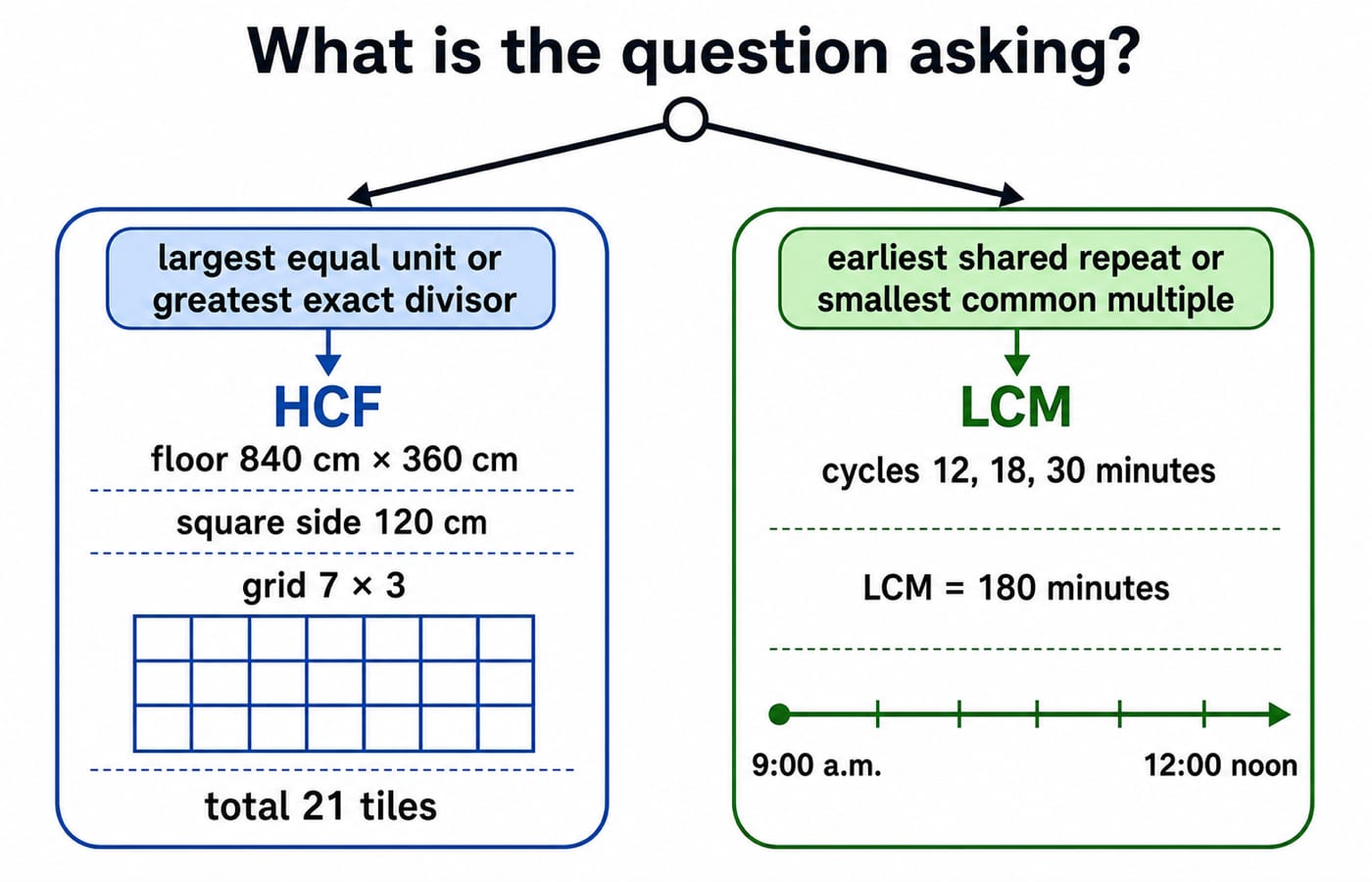
First identify the required quantity. greatest size, largest equal piece, maximum length and greatest number of equal groups suggest HCF. least time, first time together, smallest number divisible by all and repeating cycles suggest LCM. Keep the unit.
For HCF, cover a 840 cm × 360 cm floor with the largest identical square tiles, without cutting. HCF(840,360) = 120, so each tile is 120 cm × 120 cm. The sides need 840 ÷ 120 = 7 and 360 ÷ 120 = 3 tiles, giving 7 × 3 = 21 tiles.
For LCM, three alarms ring every 12, 18 and 30 minutes, together at 9:00 a.m. Their LCM is 180 minutes, so they next meet 3 hours later, at 12:00 noon.
These decisions also sit inside wider placement preparation, alongside quantitative aptitude, reasoning and verbal practice.
Convert remainder questions into exact conditions
If one divisor leaves the same remainder on several numbers, it divides their pairwise differences. For 187, 233 and 325, the differences are:
233 - 187 = 46
325 - 233 = 92
325 - 187 = 138
Thus HCF(46,92,138) = 46, so the required divisor is 46. Check: 187 = 46 × 4 + 3, 233 = 46 × 5 + 3, and 325 = 46 × 7 + 3.
For unequal remainders, subtract each first. For 251 leaving 5 and 334 leaving 4, use 251 - 5 = 246 and 334 - 4 = 330. The greatest candidate is HCF(246,330) = 6, which exceeds both remainders; 251 = 6 × 41 + 5 and 334 = 6 × 55 + 4 confirm it.
For the LCM form, the least number greater than the divisors leaving remainder 5 with 12, 18 and 24 is LCM(12,18,24) + 5 = 72 + 5 = 77. Check: 77 = 12 × 6 + 5 = 18 × 4 + 5 = 24 × 3 + 5.
Avoid shortcuts that answer the wrong question
Check every shortcut against its meaning. LCM may not divide dimensions into largest equal pieces; HCF may not synchronise repeating cycles. In the two-number identity, divide before multiplying, and do not assume a visible common factor is the greatest.
Do not extend the identity to three numbers. For 2, 3, 6, the product is 36, but HCF is 1 and LCM is 6; HCF × LCM = 6, not 36.
For remainder problems, ensure the divisor exceeds every remainder and satisfies every original division statement.
How exams vary the same HCF-LCM decision
Questions may ask for direct calculation, a missing number from the two-number identity, greatest equal grouping, synchronised cycles, or remainder patterns. Solve in order: label the quantity and unit, choose HCF or LCM, factor or apply Euclid, compute, then substitute into the original condition.
For broader topic planning, see the SSC CGL quantitative aptitude strategy and Bank PO quantitative aptitude topics. The SSC CGL Tier 1 Complete Preparation course is a structured government-exam preparation option.
The arithmetic is stable, but formats, syllabus wording, marks, timing and weightage vary by recruiting body and cycle. Confirm them in your current official notification.
The short version and the next practice step
HCF asks how large a common exact unit can be; LCM asks how soon, or how small, a common multiple can be. Minimum prime powers build HCF, maximum powers build LCM, Euclid speeds HCF calculation, and the product identity belongs to exactly two positive integers.
Now redo HCF/LCM(72,120) without notes. Recover 126 when HCF = 18, LCM = 756 and one number is 108. Then explain aloud why the floor uses HCF while the alarms use LCM. For a structured next step, continue with the Aptitude for Placement course.