
A long number can look calculation-heavy when the question only needs one digit, a digit sum, or a three-digit block. Divisibility rules are compact remainder tests, not magic tricks. Knowing what each test preserves helps you choose instead of guess. Start with the logic, then apply it to worked checks, missing-digit questions, and a quick exam process. You can also build the wider quant foundation around these shortcuts.
Divisibility means zero remainder, not “looks divisible”
An integer N is divisible by d when N = d × q for some integer q. Equivalently, dividing N by d leaves remainder 0.
For example, 438 ÷ 3 = 146, so 438 is divisible by 3. But 438 ÷ 9 = 48 remainder 6, so it is not divisible by 9.
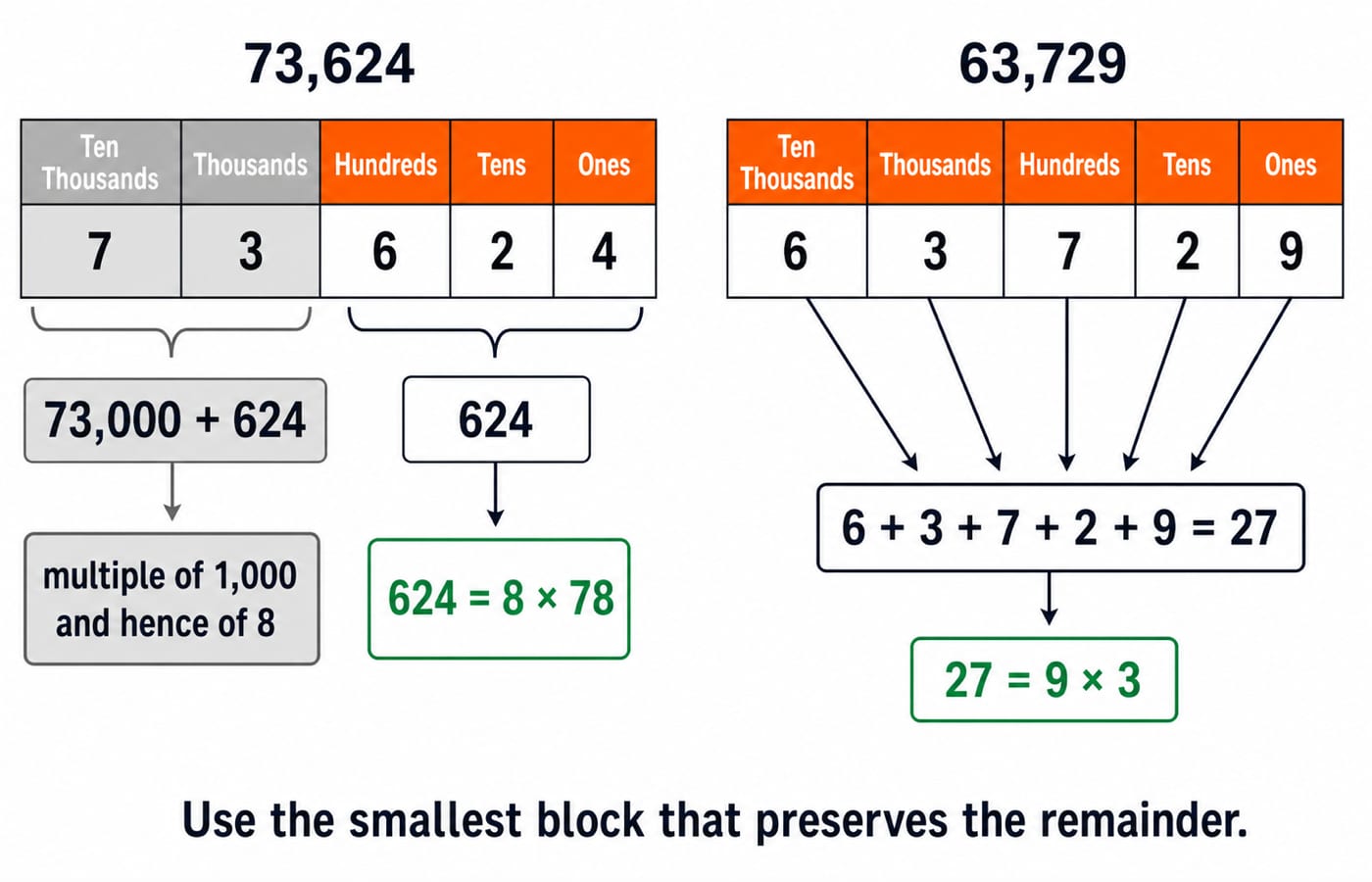
The digit-sum rule explains both results. In base 10, 10, 100, 1000, and higher powers leave remainder 1 when divided by 3 or 9. Therefore, 438 has the same remainder as 4 + 3 + 8 = 15. The sum passes the test for 3 but fails the test for 9.
Use the same method throughout: identify the divisor, choose the correct test, reduce the number, and confirm the conclusion. Every valid shortcut preserves the remainder information that matters.
Core divisibility rules for 2, 3, 4, 5, 6, 8, 9, 10, 11 and 12
Divisor | Test | Checked example |
|---|---|---|
| The last digit is even. |
|
| The digit sum is divisible by |
|
| The last two digits are divisible by |
|
| The last digit is |
|
| The number passes both |
|
| The last three digits are divisible by |
|
| The digit sum is divisible by |
|
| The last digit is |
|
| The alternating sum is a multiple of |
|
| The number passes both |
|
Only the last two digits matter for 4 because 100 is divisible by 4. Only the last three matter for 8 because 1000 is divisible by 8. Earlier place-value blocks contribute zero remainder.
Divisibility rules for 7, 13 and 17 without long division
For these divisors, repeat the transformation until the result is easy to test.
For
7, remove the last digit and subtract twice that digit:2,058 → 205 - 2 × 8 = 189 → 18 - 2 × 9 = 0. Therefore,2,058is divisible by7, and2,058 = 7 × 294.For
13, remove the last digit and add four times that digit:858 → 85 + 4 × 8 = 117 → 11 + 4 × 7 = 39. Since39is divisible by13, so is858, and858 = 13 × 66.For
17, remove the last digit and subtract five times that digit:697 → 69 - 5 × 7 = 34. Since34is divisible by17, so is697, and697 = 17 × 41.
These transformations are divisor-specific. Do not mix the multipliers for 7, 13, and 17. If recalling a rule takes longer than ordinary division, use ordinary division.
Composite divisors: break the test into coprime factors
For a composite divisor, factor it into pairwise coprime parts with easy tests. To test divisibility by 72, use 72 = 8 × 9. Passing both tests is sufficient because 8 and 9 are coprime.
Consider 77,760. Its last three digits give 760 = 8 × 95, so it passes the test for 8. Its digit sum is 7 + 7 + 7 + 6 + 0 = 27, which is divisible by 9. Therefore, 77,760 is divisible by 72. The direct confirmation is 77,760 ÷ 72 = 1,080.
Now test 74,872. Its last three digits pass because 872 = 8 × 10⁹, but its digit sum is 28, which fails the test for 9. The number is not divisible by 72.
Do not split 16 as 4 × 4 and assume one test for 4 proves divisibility by 16. These factors are repeated, not coprime. For mixed practice, use placement-preparation questions.
Missing-digit questions turn rules into constraints
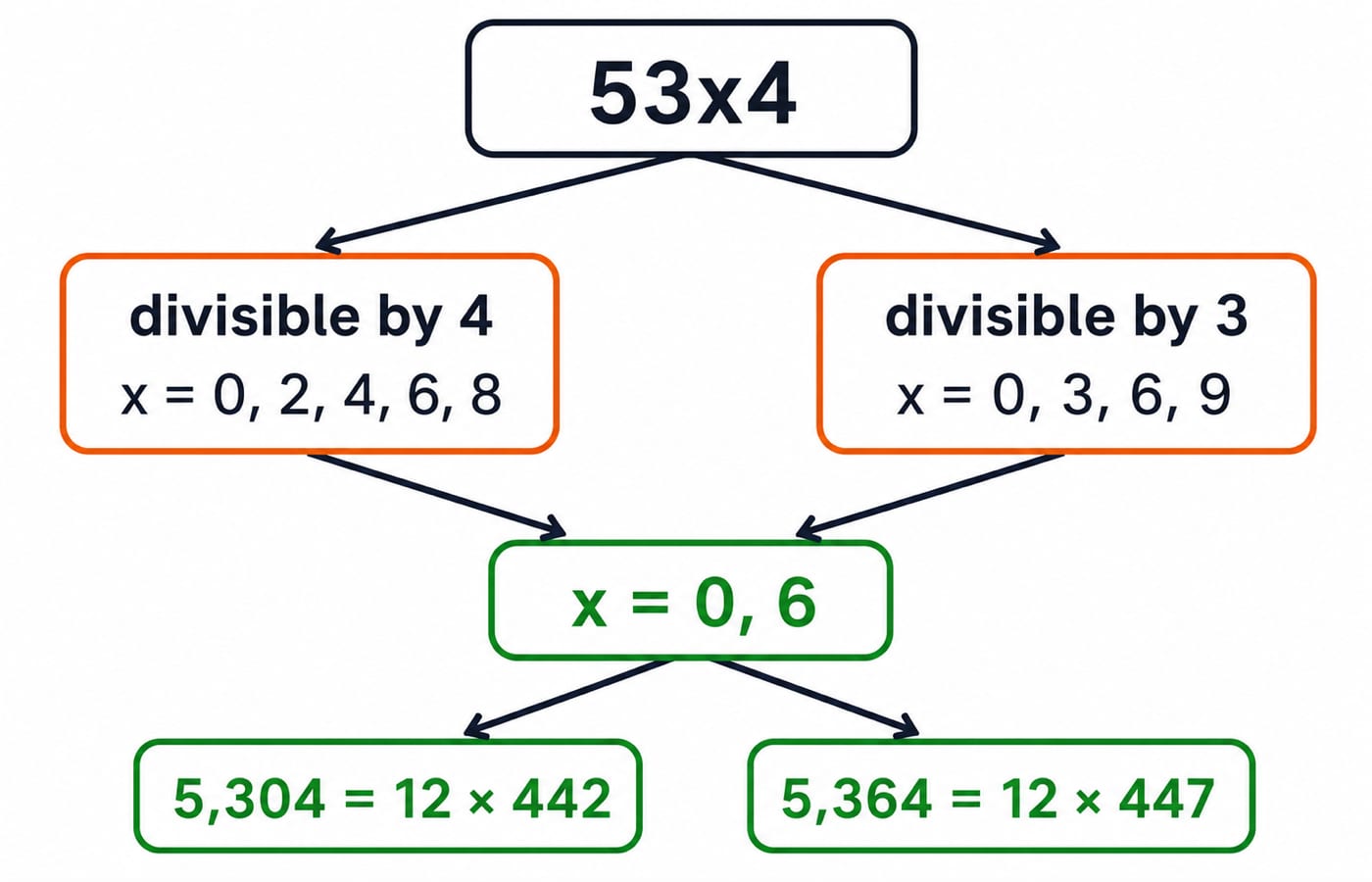
Find every digit x for which 53x4 is divisible by 12. Since 12 = 3 × 4, the number must pass both tests.
For divisibility by 4, the final two-digit number x4 must be one of 04, 24, 44, 64, 84. Thus, x ∈ {0, 2, 4, 6, 8}.
For divisibility by 3, the digit sum 5 + 3 + x + 4 = 12 + x must be a multiple of 3. Thus, x ∈ {0, 3, 6, 9}. The intersection is {0, 6}. Both answers check directly: 5,304 = 12 × 442 and 5,364 = 12 × 447.
For 11, find x if 72x49 is divisible by 11. Its alternating sum is 7 - 2 + x - 4 + 9 = 10 + x. Only x = 1 makes this a multiple of 11. Indeed, 72,149 = 11 × 6,559.
How competitive exams turn the rules into different questions
The rules can appear as a yes-or-no check, option selection, a missing-digit constraint, a composite test, or a remainder problem. For 7,654,321, the digit sum is 28. Since 28 leaves remainder 1 on division by 9, so does the original number.
Use this quick decision sequence:
Scan the divisor before touching the number.
For
2,5, or10, inspect the last digit.For
3or9, add the digits.For
4or8, inspect the last two or three digits.For
11, take an alternating sum.For a composite divisor, factor it only when the chosen factors are coprime.
This order avoids work on the full number.
For broader preparation, see this SSC CGL quantitative aptitude strategy and these Bank PO quantitative aptitude topics. The divisibility logic stays the same across formats.
Traps, final checklist and the next practice step
Avoid five common errors:
Divisibility by
6requires both2and3.Divisibility by
12requires both3and4.The test for
8uses the last three digits, not two.An alternating sum of
0also passes the test for11.A composite test works only when every required factor condition is satisfied.
The short version: learn rules by the part of the number they inspect, derive unfamiliar checks from remainders, and test each missing-digit answer against every constraint.
Now redo 77,760 ÷ 72, 53x4 ÷ 12, and 72x49 ÷ 11 without looking. Then practise mixed quantitative aptitude through the Aptitude for Placement course.