Reasoning sections in placement tests are winnable because each common question type has a procedure. Students lose time by staring at the wording and trying to "think harder" from scratch. A trusted diagram or calculation is faster and easier to check under pressure.
Why reasoning is the most gameable section
Quantitative aptitude often asks you to recall a formula before applying it. Logical reasoning is usually more procedural. Draw only what a syllogism guarantees, write the differences in a series, or anchor the fixed positions in a puzzle. Once the setup is correct, the answer follows.
Three methods carry most of the marks:
Venn diagrams for syllogisms
First and second differences for number series
Certain positions first for seating puzzles
KnowledgeGate's question bank holds about 6,000 logical-reasoning questions across these areas. The number matters less than the practice loop: use the same method, check the result, identify the exact step that failed, and repeat until the setup becomes automatic. The aptitude for placements guide sets that loop inside a weekly schedule.
Syllogisms: draw the Venn, do not argue verbally
Use this three-step method:
Translate each statement into circles or regions.
Mark only what must be true. Do not add a convenient overlap.
Accept a conclusion only when it holds in every diagram allowed by the statements and the test's stated conventions.
Work this example:
Statements
All pens are books.
Some books are red.
Conclusions
I. Some pens are red.
II. Some books are pens.
"All pens are books" puts the complete Pens circle inside Books. "Some books are red" forces at least one point in the overlap of Books and Red. It does not say that this point lies inside Pens. The Red circle can overlap a part of Books outside the Pens circle.
Therefore conclusion I does not follow. The statements allow a valid diagram in which no pen is red.
For conclusion II, common placement-test syllogism convention treats the named Pens class in the universal statement as non-empty. Under that convention, a pen exists, every pen is a book, and therefore some book is a pen. Conclusion II does follow. This is sometimes called conversion by limitation.
There is a formal-logic nuance worth knowing. In modern predicate logic, "All pens are books" alone does not assert that any pens exist. Under that strict convention, conclusion II would require an existence premise. Follow the convention given by the test. When an aptitude question uses the usual non-empty-class convention, use the verdict above.
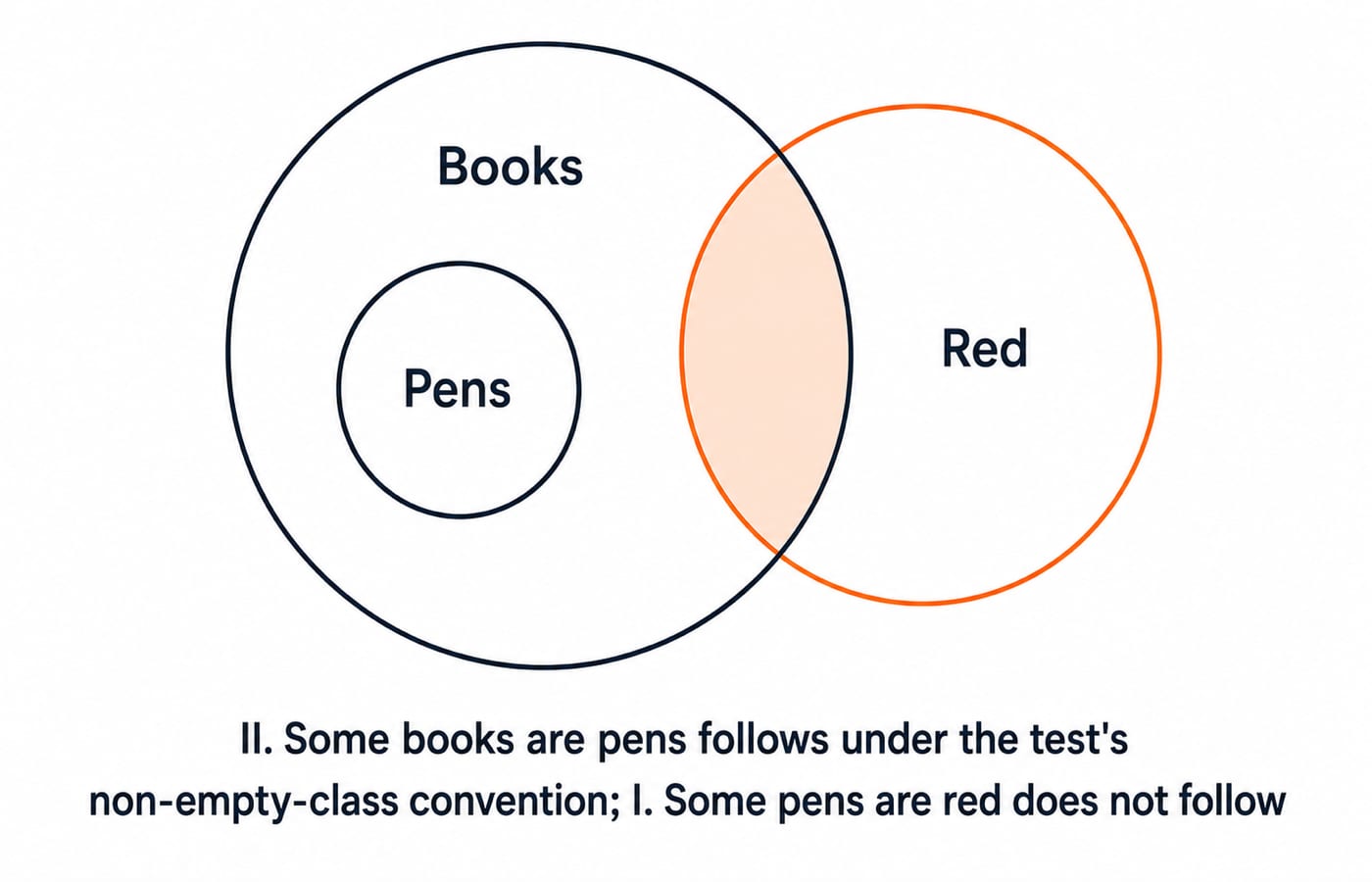
This diagram kills the common middle-term trap. An overlap somewhere inside Books does not force an overlap with every subset of Books.
Number series: calculate the differences first
When terms grow by addition, write the gap between every adjacent pair. If the gaps are constant, the series is arithmetic. If the gaps themselves follow a pattern, extend that pattern before returning to the original series.
Consider:
3, 6, 11, 18, 27, ?
Compute every first difference:
6 - 3 = 311 - 6 = 518 - 11 = 727 - 18 = 9
The gaps are 3, 5, 7, 9, consecutive odd numbers. The next gap is 11. Add it to the last given term:
27 + 11 = 38
So the missing term is 38.
Check it a second way. The second differences are 5-3=2, 7-5=2, and 9-7=2. A constant second difference of 2 predicts the next first difference as 9+2=11, again giving 27+11=38.
If differences do not settle quickly, scan for three other structures:
Ratios: a geometric sequence multiplies by a constant or patterned factor.
Alternation: odd-position and even-position terms may form separate sequences.
Squares or cubes with an offset: for example,
3 = 1² + 2and6 = 2² + 2suggestn² + 2.
Do not force the first plausible pattern. Prefer the simple rule that explains every transition and matches the answer options without exceptions.
Seating puzzles: fix certain positions first
Draw the seats before placing anybody. Anchors such as an extreme end or a fixed numbered position go first. Immediate-left and immediate-right clues come next. Leave uncertain people unplaced until a clue forces them.
Five friends P, Q, R, S and T sit in a row facing north. The clues are:
P is at the extreme left.
T is at the extreme right.
Q sits immediately to the right of P.
R sits immediately to the left of T.
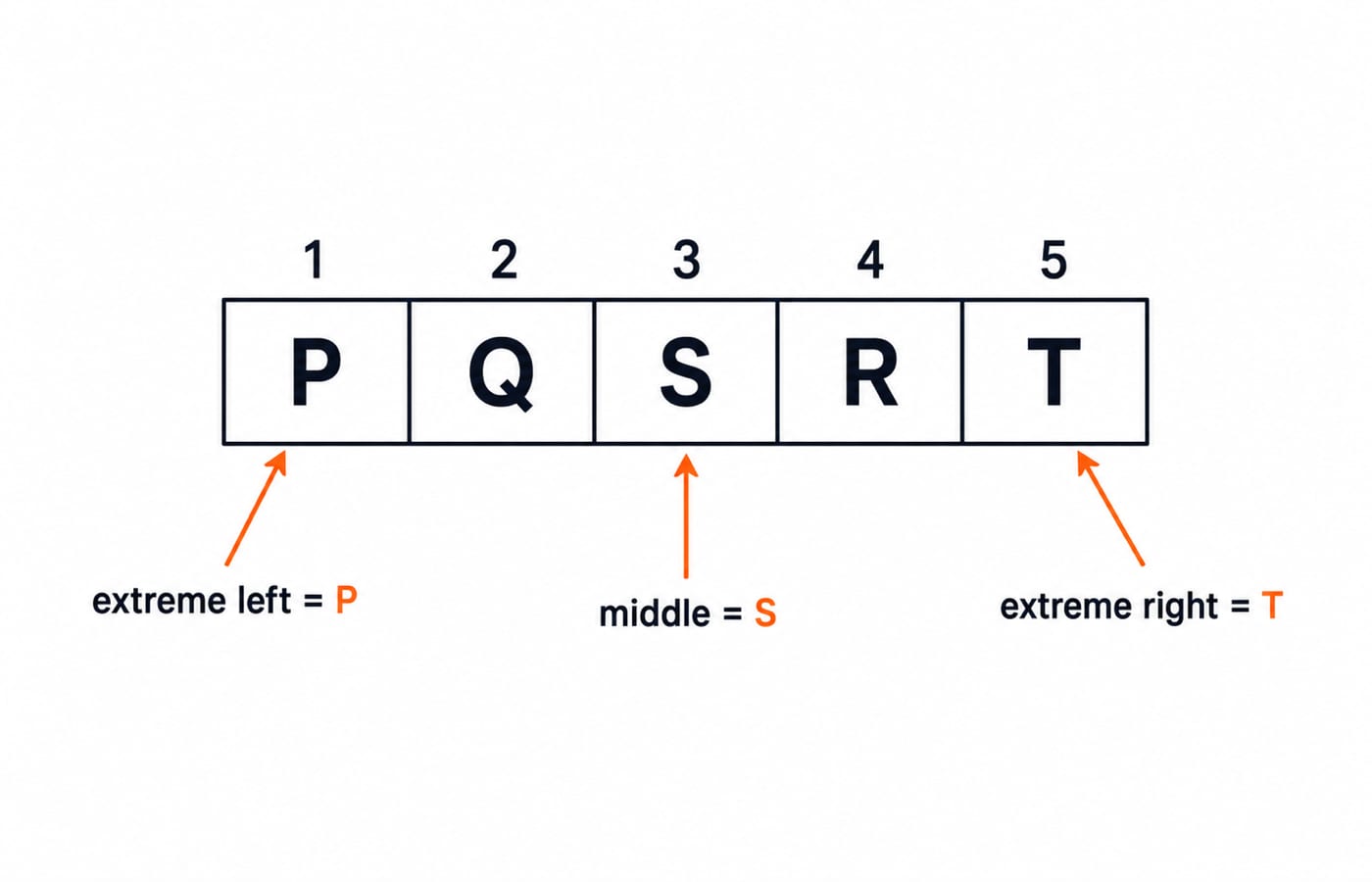
Number the seats 1 to 5 from left to right. Because everyone faces north, the row's left and right match the diagram.
P takes position 1.
T takes position 5.
Q is immediately right of P, so Q takes position 2.
R is immediately left of T, so R takes position 4.
Position 3 is the only seat left, so S takes it.
The final order is:
P, Q, S, R, T
The middle seat is position 3, so S is in the middle. Recheck every clue against the completed row. All four match exactly, which is the last step of the method, not optional cleanup.
Traps that cost placement-test time
From "some A are B", do not assume "some A are not B". The first statement says nothing about members outside the overlap.
A possibility conclusion is not a certainty conclusion. "Can be" and "must be" require different tests.
If first differences look irregular, check alternating terms or second differences before abandoning the series.
In a puzzle, distinguish a definite clue from an either-or possibility. A premature placement creates a chain of false deductions.
Do not keep wrestling with one long puzzle set while short independent questions remain. Mark it for return and protect the rest of the section.
How placement tests frame these questions
AMCAT, CoCubes and eLitmus and company online tests commonly place series and syllogisms as independent logical questions. Seating arrangements often appear as one paragraph followed by several questions, so a correct setup pays more than once.
Rehearse with a time target, but treat it as a personal practice target rather than a rule of any platform. A useful starting target is roughly 30 to 45 seconds for a straightforward series, about 45 seconds for a single syllogism, and 3 to 4 minutes to set up and answer a small puzzle set. Adjust after measuring your own accuracy. Speed without a checkable method simply produces faster mistakes.
The short version and next step
Use a must-be-true Venn diagram for syllogisms, differences and then second differences for series, and anchor-first placement for puzzles. Write the setup on paper so the result can be verified instead of remembered.
Build a structured routine with the Aptitude for Placement course, and use the placement preparation category for the wider interview path. Before your next mock, take one syllogism, one series and one puzzle, solve each on paper by the method above, and time yourself.