You may solve x + 4 = 9 easily, then lose accuracy when brackets, fractions, a second variable or a word problem hides the same idea. The cure is not another sign-changing shortcut. It is a method: identify the equation type, preserve equality, choose substitution or elimination deliberately, and verify the answer in the original condition. In aptitude practice, the same balance-preserving method works whether the equation appears directly or inside a story. Use the Aptitude category for adjacent quantitative practice.
1. What makes an equation linear, and what counts as a solution
A one-variable linear equation is ax + b = 0, with a != 0. A two-variable one is ax + by = c, where a and b are not both zero. Variables have only first powers. Thus, 3x - 7 = 11 and 2x + 5y = 19 are linear; x^2 + 3 = 7, xy = 12 and 1/x = 4 are not. An expression such as 4x - 9 has no equality sign. The equation 4x - 9 = 15 does.
Solve it by balancing: 4x - 9 = 15, then 4x = 24 after adding 9 to both sides, then x = 6 after dividing both sides by 4. Check: 4(6) - 9 = 24 - 9 = 15. "Take -9 to the other side" is shorthand for that addition, not another rule.
For x + y = 8, (0, 8), (3, 5) and (8, 0) all work. A second independent equation may select one pair. Two lines have one solution when they intersect, none when parallel, and infinitely many when identical.
2. Solve one-variable equations by balancing, expanding and clearing fractions
Use this order: open brackets, clear fractions, collect variable terms and constants on opposite sides, divide by the non-zero coefficient, then verify. Apply each operation to both complete sides.
For 5 - 2(x - 4) = 17, expand and simplify: 5 - 2x + 8 = 17, then 13 - 2x = 17, -2x = 4, and x = -2. Check: 5 - 2(-2 - 4) = 5 - 2(-6) = 5 + 12 = 17.
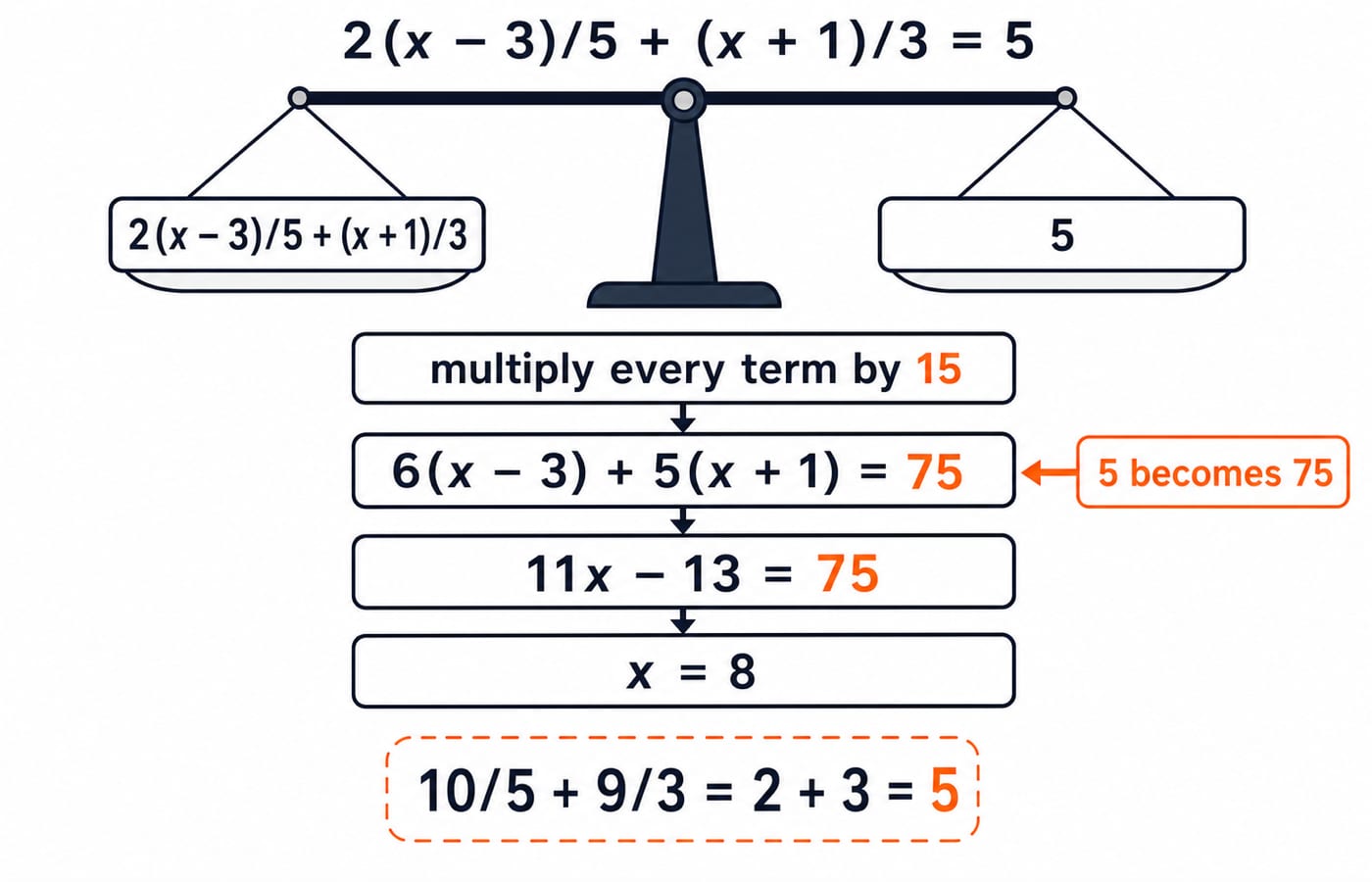
For 2(x - 3)/5 + (x + 1)/3 = 5, multiply every term by LCM 15: 6(x - 3) + 5(x + 1) = 75. Expand to 6x - 18 + 5x + 5 = 75, simplify to 11x - 13 = 75, then 11x = 88, so x = 8.
Check in the original: 2(8 - 3)/5 + (8 + 1)/3 = 10/5 + 9/3 = 2 + 3 = 5.
Clear denominators once. Cancel only factors: 3(x + 2)/3 = x + 2 is valid, but cancelling x from (x + 2)/x is not.
3. Solve two-variable systems with substitution and elimination
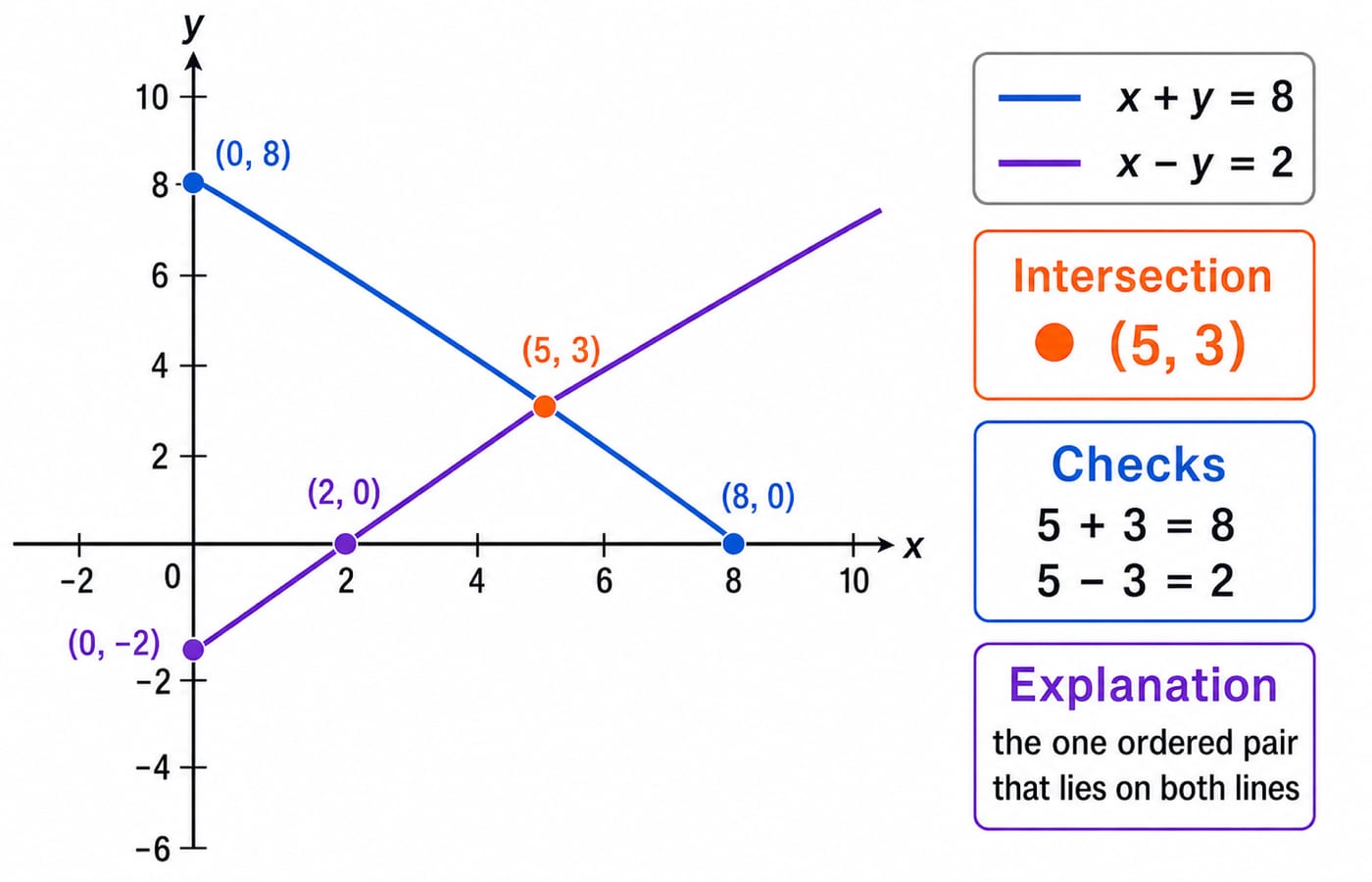
For x + y = 8 and x - y = 2, add the equations to eliminate y: 2x = 10, so x = 5. Then 5 + y = 8, hence y = 3. Check both: 5 + 3 = 8 and 5 - 3 = 2.
By substitution, x - y = 2 gives x = y + 2. Insert it into the first equation: y + 2 + y = 8, so 2y = 6, y = 3, and x = 5. Choose substitution when isolation is easy; choose elimination when small multipliers align coefficients.
The lines y = 8 - x and y = x - 2 meet at (5, 3). Graphing explains why; algebra is usually quicker. For identities, quadratics and substitution shortcuts beyond linear systems, use Algebra for Aptitude Tests: Fast Methods for Equations, Identities and Substitution. Algebra for Competitive Exams: Concepts, Shortcuts and Solved Examples adds inequalities and root checks. This section stays with the linear-equation decision: substitute when isolation is easy; eliminate when coefficients align.
4. Translate aptitude word problems before doing arithmetic
Use four scratch columns: unknowns | relationship | equation | domain/check.
One-third of a number plus 7 equals one-half of it minus 1. Let it be n: n/3 + 7 = n/2 - 1. Multiply by 6: 2n + 42 = 3n - 6, so n = 48. Check both descriptions: 48/3 + 7 = 16 + 7 = 23 and 48/2 - 1 = 24 - 1 = 23.
A two-digit number has digit sum 11 and is 27 greater than its reversal. With tens digit a and units digit b, write a + b = 11 and 10a + b = 10b + a + 27. The second becomes a - b = 3. Add: 2a = 14, so a = 7, b = 4, and the number is 74. Check 7 + 4 = 11 and 74 - 47 = 27. Also, 0 <= a,b <= 9 and a != 0.
If two numbers total 46 and differ by 12, declare p larger: p + q = 46 and p - q = 12. Adding gives 2p = 58, so p = 29, q = 17. "Total" signals addition; "differ" requires a declared larger number. Check both sentences.
5. Recognise unique, impossible and identity cases before forcing a value
3(x + 2) = 3x + 6 reduces to 0 = 0, so every real x works. 5(x - 1) = 5x + 2 reduces to the false statement -5 = 2, so none works. Neither result permits division by zero.
For systems, 2x + y = 7 and 4x + 2y = 18 conflict as 2x + y = 7 and 2x + y = 9, so no solution exists. But 3x - 2y = 6 and 6x - 4y = 12 are the same line, so infinitely many pairs work. The earlier (5, 3) is unique.
For simplified forms a1x + b1y = c1 and a2x + b2y = c2, unequal a1/a2 and b1/b2 means one solution. Equal variable ratios but a different constant ratio means none. All three equal means infinitely many. If a denominator coefficient is zero, rearrange safely before comparing.
6. Common traps and how aptitude tests vary the same skill
Trap | What goes wrong | Repair |
|---|---|---|
Expand | The multiplier misses | Write |
Clear only selected fractions | Equality changes | Multiply every term on both sides |
Cancel across | Terms are treated as factors | Factor first, then cancel common factors only |
Divide by a variable | A possible zero case is lost | Separate and test the zero case |
Check only one equation | A false pair survives | Check both originals |
Ignore the story domain | An impossible answer survives | Check digits, signs and declared constraints |
For example, (6, 2) passes x + y = 8 but fails x - y = 2, so it is not a system solution.
Aptitude questions vary the surface while preserving the same algebra. A direct equation tests balancing; brackets and fractions test legal transformations; an ordered-pair item tests whether both equations hold; a classification item tests zero, one or infinitely many solutions; and a number, age or work story tests translation plus domain checks.
7. Linear equations: the short version and next practice step
Keep this six-line retrieval card:
Identify the variables and their domain.
Reduce the relationship to linear form.
Preserve equality at every step.
Clear fractions across every term.
Choose substitution for easy isolation and elimination for aligned coefficients.
Verify in every original equation or sentence.
Without looking, redo x = -2, x = 8, (x, y) = (5, 3), n = 48 and 74.
Build accuracy first: solve 8 direct equations untimed and verify each; solve 6 bracket or fraction equations in 12 minutes; solve 6 systems by both methods; then translate 5 word problems before calculating. Label errors translation, algebra, method choice or verification, and redo them the next day.
Use the Aptitude for Placement course for structured quantitative, reasoning and verbal preparation, and the Aptitude category for adjacent lessons. A linear equation stays manageable when every transformation preserves the same solution set.