CS Fundamentals
477 articles in this topic
Boolean Expressions in Digital Electronics: Laws, Canonical Forms and Worked Simplification
Learn one Boolean function from notation to truth table, canonical forms, simplification and NAND gates, with checks that expose common errors.
Updated 15 Aug 20265 min read54 viewsDigital Logic
Instruction Formats and Expanding Opcode for GATE: Solved Encoding Numericals
Treat every instruction format as a bit budget. A four-level worked example shows exactly how unused opcode patterns expand into the next instruction class.
Updated 15 Aug 20265 min readC Programming & Data Structures
Ethernet in the Data Link Layer: Frame Format, CSMA/CD, and Worked GATE Examples
Build Ethernet from its frame fields upward, then solve collision-window, back-off, efficiency, and domain-counting problems with the reasoning shown.
Updated 15 Aug 20266 min read60 viewsComputer Networks
Semantic Analysis and SDT in Compiler Design: Attributes, Worked Examples, and How GATE Tests It
Learn how semantic analysis validates meaning, how SDDs and SDTs evaluate attributes, and how to trace two common exam-style problems to their final answers.
Updated 15 Aug 20266 min readCompiler Design
Set Theory in Discrete Mathematics: Operations, Laws and Worked Examples
Build set theory from elements and subsets to algebra, inclusion-exclusion and Cartesian products, with every important result worked out step by step.
Updated 15 Aug 20265 min read94 viewsEngineering Mathematics
Operating System for GATE: Syllabus, Weightage Pattern and Prep Order
See what GATE officially includes under Operating System, how we classified two 2026 CS papers, and how to turn that scope into a 30-hour study plan.
Updated 15 Aug 20265 min read164 viewsOperating Systems
Data Warehousing and Data Mining in DBMS: Star Schema, OLAP Operations and Apriori with Worked Examples
Move from warehouse vocabulary to hand-worked answers. Build a star schema, operate on a data cube, run Apriori, and follow two k-means iterations.
Updated 15 Aug 20266 min readDBMS
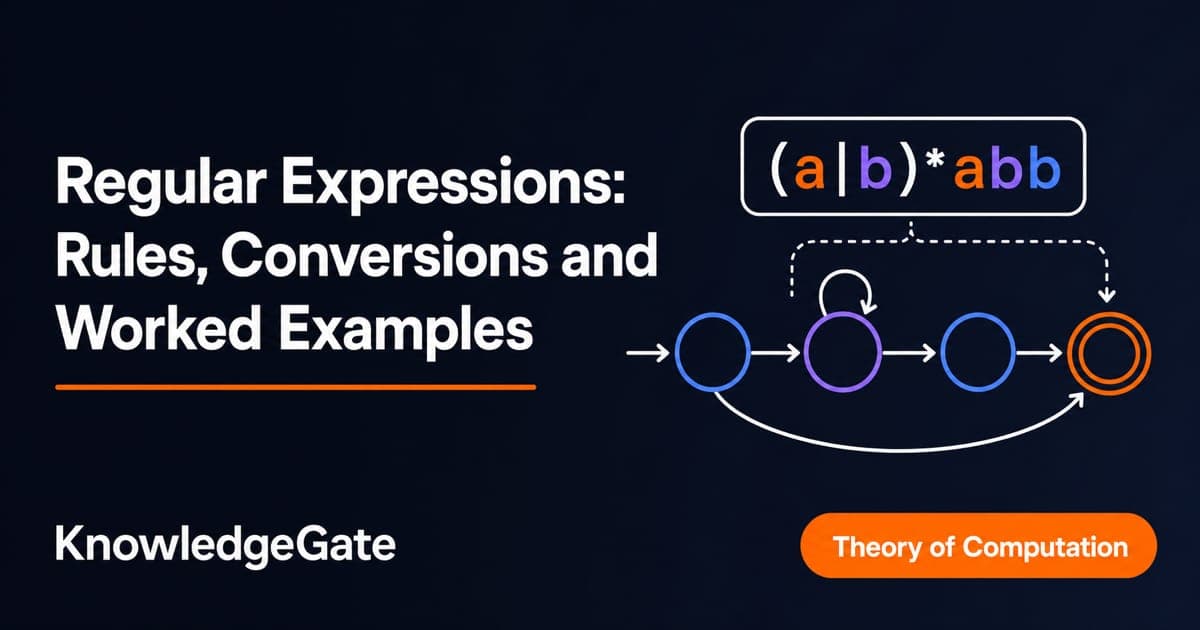
Regular Expressions in Theory of Computation: Rules, Conversions and Worked Examples
Learn what classical regular expressions denote, construct one from a language condition, convert it through NFA and DFA, and check equivalence with worked examples.
Updated 15 Aug 20266 min read111 viewsTheory of Computation
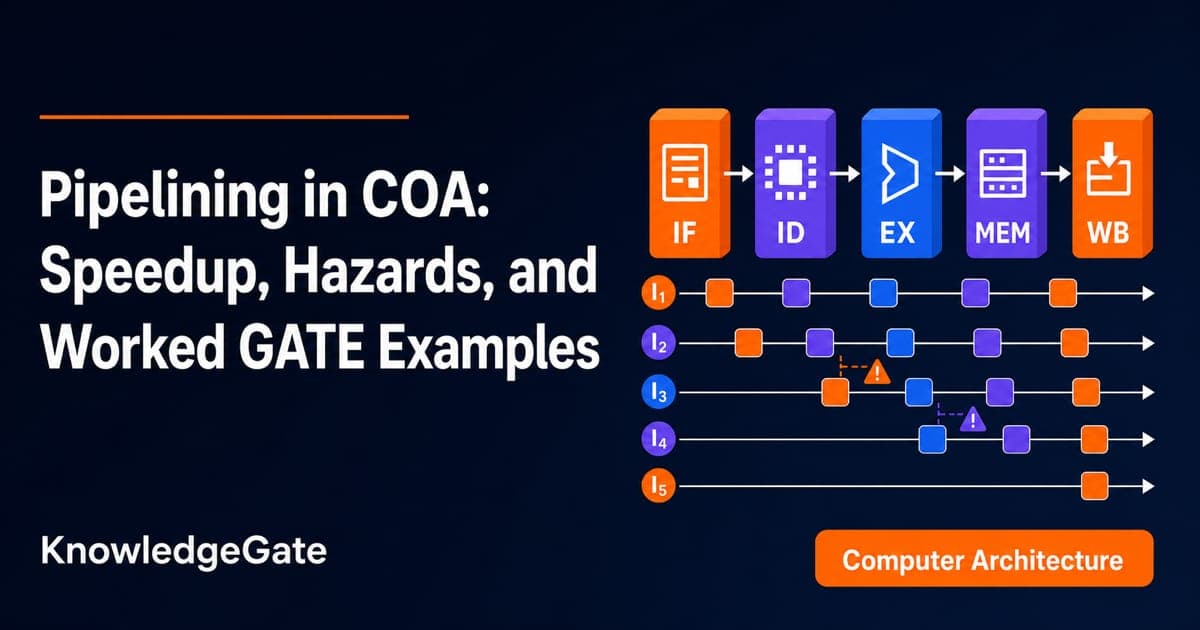
Pipelining in COA: Speedup, Hazards, and Worked GATE Examples
Build a clear mental model of pipelining, then use it to solve clock-period, speedup, throughput, efficiency, and hazard questions step by step.
Updated 13 Aug 20266 min read59 viewsComputer Organization & Architecture
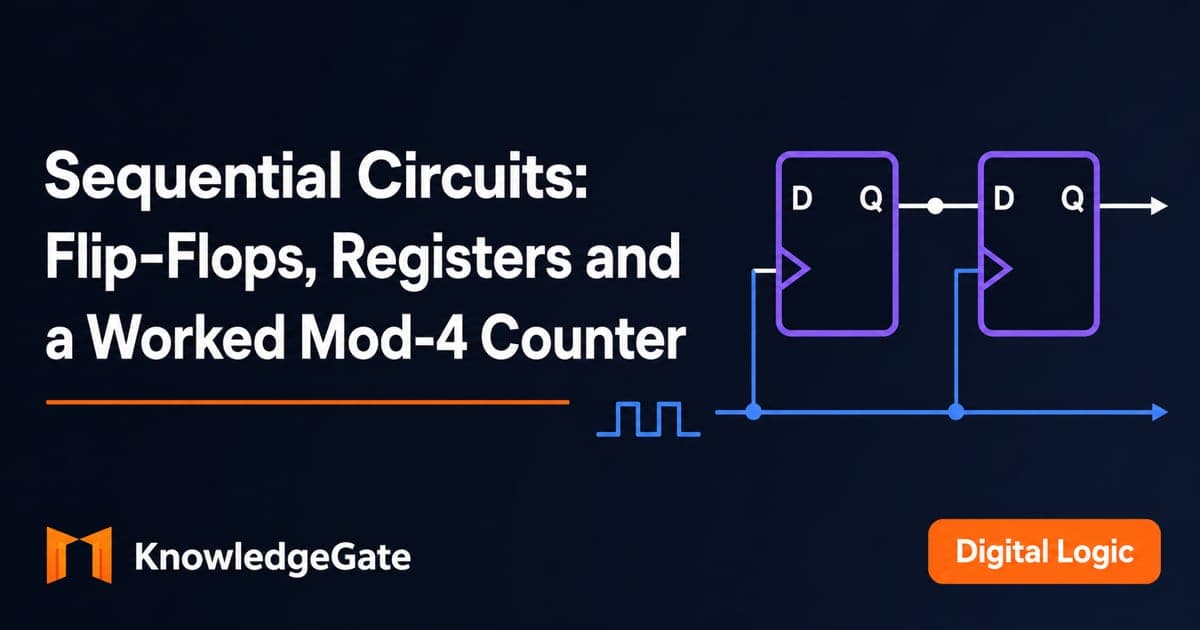
Sequential Circuits in Digital Electronics: Flip-Flops, Registers and a Worked Mod-4 Counter
Learn to trace sequential logic edge by edge, then design and verify a two-bit synchronous counter using state tables, D-input equations and timing constraints.
Updated 13 Aug 20266 min readDigital Logic
C Programming Fundamentals: Complete Guide with Worked Examples for GATE and Placements
Build a reliable C foundation through traced outputs, pointer arithmetic, function calls, arrays, structures, recursion, and memory allocation.
Updated 13 Aug 20267 min readC Programming & Data Structures
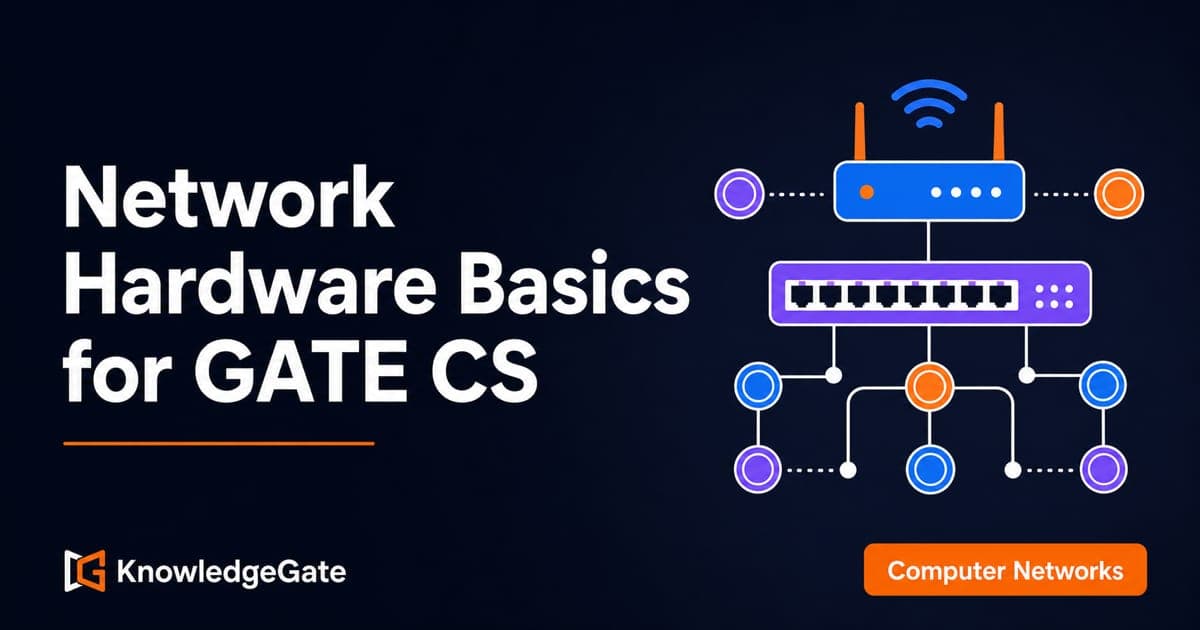
Network Hardware Basics for GATE CS: Devices, OSI Layers, and Collision Domain Counting
Stop mixing up hubs, switches, and routers. Learn the device layers, domain-counting rules, transmission media, and a worked topology for GATE and interviews.
Updated 13 Aug 20266 min readComputer Networks