Operating System for GATE: Syllabus, Weightage Pattern and Prep Order
See what GATE officially includes under Operating System, how we classified two 2026 CS papers, and how to turn that scope into a 30-hour study plan.
KnowledgeGate Team
Exam prep & CS education
Updated 15 Aug 20265 min read132 views
Operating System spans scheduling, concurrency, memory and files, but a recent paper's marks do not guarantee the next paper's weightage. There is no official fixed OS-only quota. The official syllabus fixes the boundary, the two completed 2026 CS master papers show what that boundary was worth in marks there, and dependency order decides what to study first inside your broader GATE CS preparation.
Operating System syllabus for GATE: the official boundary
IIT Guwahati's GATE 2026 CS syllabus lists system calls, processes, threads, inter-process communication, concurrency and synchronization, deadlock, CPU and I/O scheduling, memory management and virtual memory, and file systems.
For study, arrange those terms into four study clusters:
Process model, system calls, threads and IPC
Synchronization, concurrency and deadlock
CPU and I/O scheduling
Memory, virtual memory and file systems
These clusters are a learning map, not an official marks split. Use Operating Systems for GATE: Deadlocks, Scheduling, Memory for concept-by-concept revision.
Where OS sits inside the GATE CS paper pattern
The completed official 2026 pattern sets 100 marks and 180 minutes: 15 marks for General Aptitude, 13 for Engineering Mathematics and 72 for subject questions. OS has no reserved allocation inside that 72-mark portion.
Questions are 1-mark or 2-mark MCQ, MSQ and NAT. Wrong MCQs lose one-third mark for a 1-mark question or two-thirds for a 2-mark question. MSQ and NAT have no negative marking, and MSQ has no partial marking.
For example, one wrong 2-mark MCQ gives -2/3, an incorrect 2-mark MSQ gives 0, and a correct 1-mark NAT gives +1. The net is -2/3 + 0 + 1 = +1/3 mark.
What the weightage pattern can and cannot tell you
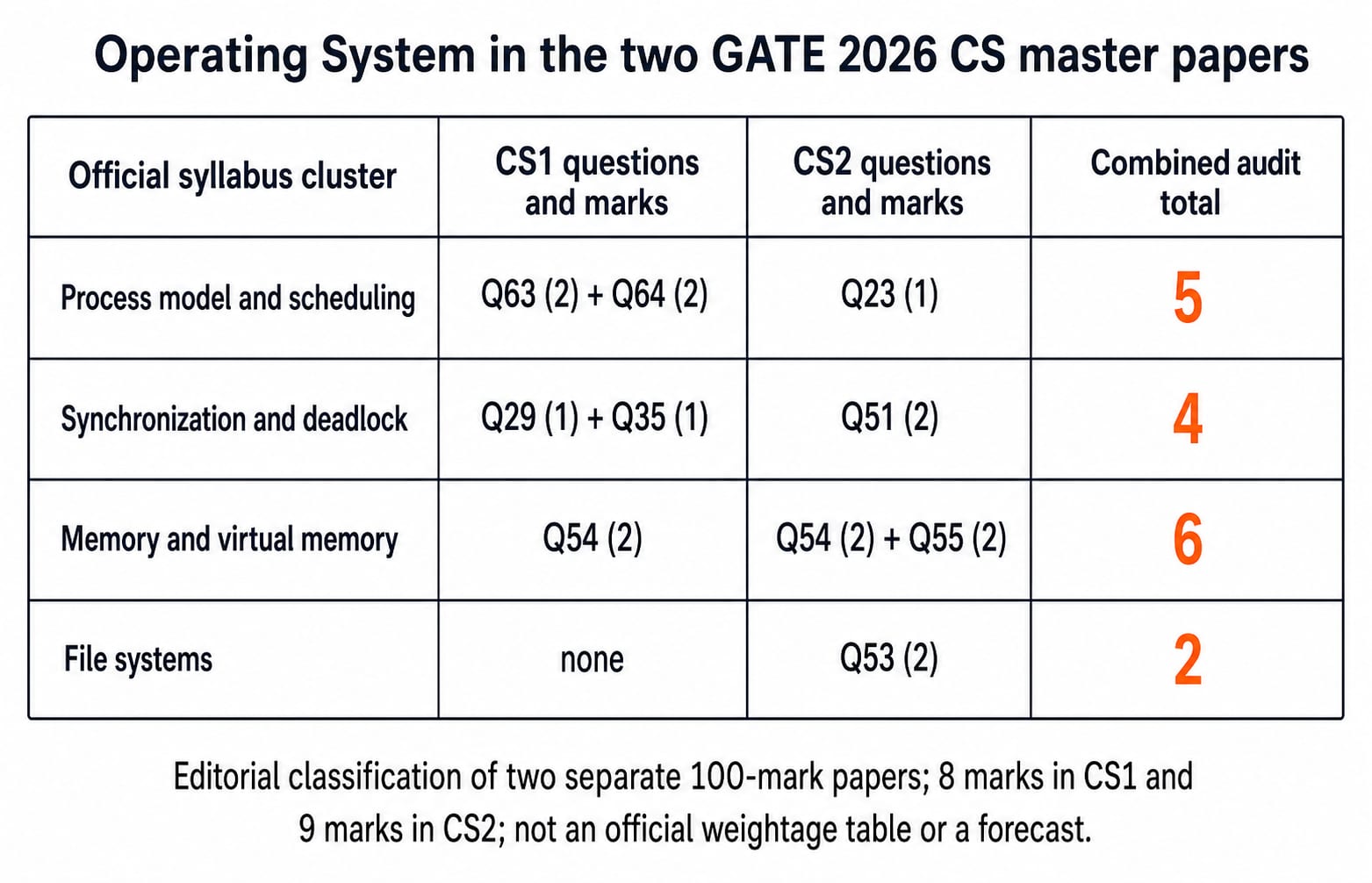
A defensible subject-weightage audit classifies official questions against the syllabus, records their values, and publishes question numbers. Classifying the two completed 2026 CS papers that way gives:
Paper | OS questions | Arithmetic |
|---|---|---|
CS1 | Q29, Q35, Q54, Q63, Q64 | 1 + 1 + 2 + 2 + 2 = 8 marks |
CS2 | Q23, Q51, Q53, Q54, Q55 | 1 + 2 + 2 + 2 + 2 = 9 marks |
These are two separate 100-mark papers, not 17 OS marks in one paper. A borderline cross-topic question can move a mark either way, and 8 and 9 describe what those two completed papers did, not what the next one will do.
Build the subject in dependency order, not syllabus order
Study process states and context switching before scheduling; atomicity and races before semaphores; synchronization before deadlock; logical and physical addresses before paging and TLB; blocks before file allocation. Round Robin waiting time stays confusing until you can update the ready queue at every arrival and quantum boundary.
Produce six revision artefacts: a process-state queue sketch, scheduling Gantt chart, semaphore trace, Banker's or resource-allocation table, address-translation calculation, and file-allocation calculation. They add no new syllabus terms, only a way to check that you can execute each one. KnowledgeGate's 2,000+ Operating System questions offer practice depth, but choose from them using the official syllabus coverage and your own error log, not the size of a question set.
Two worked GATE 2026 examples: FCFS waiting time and best fit
Example 1: FCFS average waiting time
Official 2026 CS1 Q64 schedules ten bursts in arrival order, labelled A1 to A5 at 6 seconds each and C1 to C5 at 8 seconds each. Under FCFS each burst starts at the later of its own arrival and the previous burst's completion, which gives A1 10-16, C1 16-24, A2 24-30, C2 30-38, A3 38-44, C3 44-52, A4 52-58, C4 58-66, A5 66-72, C5 72-80.
Waiting time is start time minus arrival time. The arrivals are 10, 11, 20, 22, 30, 33, 40, 44, 50 and 55 seconds, so the waits are 0, 5, 4, 8, 8, 11, 12, 14, 16 and 17 seconds. Their sum is 95, and 95 / 10 = 9.5 seconds.
Example 2: best fit and the leftover holes
Official 2026 CS2 Q55 starts with holes of 20, 4, 25, 18, 7, 9, 15 and 12 KB. Best fit puts P1 = 16 KB in the 18 KB hole, leaving 18 - 16 = 2 KB. It puts P2 = 9 KB in the exact 9 KB hole.
The remaining holes are 20, 4, 25, 2, 7, 15 and 12 KB. The holes below 8 KB are 4, 2 and 7 KB, so the answer is 3. Check the inputs and question numbers in IIT Guwahati's GATE 2026 master-paper index.
A 30-hour Operating System preparation order
Use three passes:
12 hours: concepts and compact notes across all four clusters.
12 hours: topic-wise problems with a timed set per cluster. Allocate 3 hours to processes and scheduling, 3 to synchronization and deadlock, 4 to memory and virtual memory, and 2 to file systems.
6 hours: two mixed tests, error classification, and missed questions re-solved without notes.
This allocation follows dependency breadth, not predicted marks. After the first mixed test, move up to 2 hours from your strongest cluster to your weakest. If you miss a day, move the unfinished block forward instead of compressing two blocks into one sitting. Use GATE Guidance by Sanchit Sir for structured subject-wise coverage and the GATE Test Series for mixed tests under exam conditions.
Common traps, a final checklist and the next step
Do not memorise the 8 or 9-mark observation as a promise. Build a multi-paper audit. Do not treat the number of available practice questions as exam frequency. Cover the syllabus and use an error log. Do not solve scheduling or paging mentally. Draw a timeline or state table.
Before moving on, check that you can:
Name every official OS syllabus term.
Distinguish MCQ, MSQ and NAT risk.
Audit a paper by question number and marks.
Reproduce the FCFS and best-fit solutions cleanly.
Complete one mixed timed test and re-solve every error.
The short version is to cover the full official boundary, treat past-paper marks as evidence rather than prophecy, and practise in dependency order. Beginners can start with GATE Guidance, while prepared learners can validate under time pressure with the GATE Test Series. Confirm the syllabus and marking scheme for your own cycle on the organising institute's official GATE site.
Keep learning
Paging and TLB Explained: Address Translation, EMAT and Exam Traps
Follow one virtual address from its VPN through the TLB to a physical frame, then calculate page-table size, TLB reach and effective memory access time.
Updated 4 Oct 20266 min readOperating Systems
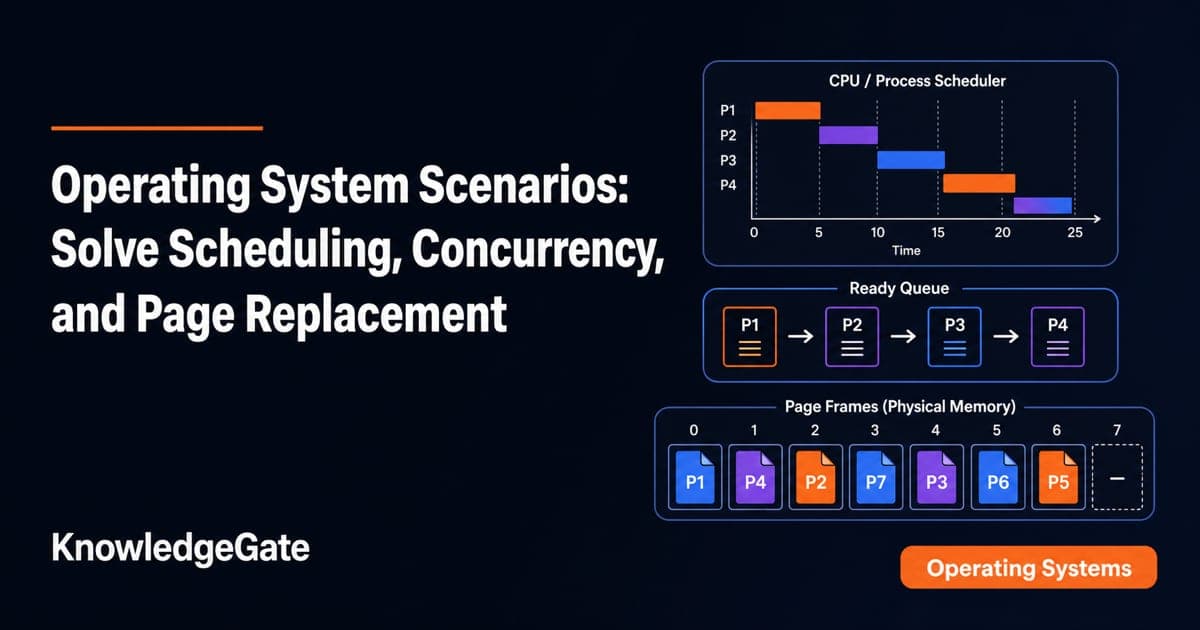
Operating System Scenarios: Solve Scheduling, Concurrency, and Page Replacement
Learn one state-trace method for three common OS problem families, then apply it to complete Round Robin, concurrency, FIFO, and LRU examples.
Updated 29 Sep 20265 min readOperating Systems
Tower Research Hiring Process: Stage-by-Stage Prep for Quant and Dev Roles
Prepare for a Tower Research application without treating one online account as a universal process. Use this role-led map, worked drills, and seven-day plan.
Updated 25 Sep 20265 min readOperating Systems

Capital One Recruitment Process: Stage-by-Stage Guide for India Applicants
Prepare for a Capital One India application with a cautious five-stage map, worked technical and case drills, and a practical 14-hour schedule.
Updated 24 Sep 20265 min readOperating Systems