Ethernet in the Data Link Layer: Frame Format, CSMA/CD, and Worked GATE Examples
Build Ethernet from its frame fields upward, then solve collision-window, back-off, efficiency, and domain-counting problems with the reasoning shown.
KnowledgeGate Team
Exam prep & CS education
Updated 15 Aug 20266 min read
You may know Ethernet as the technology used in a LAN and still freeze when a GATE numerical asks for the minimum frame size or a back-off probability. Interviews expose the same gap by asking what actually happens when two machines transmit together. Both answers come from one condition: a sender must still be transmitting when a worst-case collision gets back to it. The 64-byte floor, the 51.2 microsecond slot, the back-off probabilities and the efficiency ratio all fall out of that single requirement.
Where Ethernet sits in the data link layer
The data link layer is commonly described using two sublayers. Logical Link Control, standardised as IEEE 802.2, sits above Media Access Control. Ethernet, standardised as IEEE 802.3, covers the MAC sublayer and also defines physical-layer behaviour.
Ethernet II and IEEE 802.3 use the same position for one important 2-byte field. In Ethernet II it is a Type value of at least 1536, such as 0x0800 for IPv4. In 802.3 it is a payload Length of at most 1500. Modern LAN traffic uses Ethernet II framing in most cases.
At this layer, Ethernet provides framing, 48-bit physical addressing, access control on a shared medium, and error detection through CRC. It detects corruption but does not correct it. Logical addressing and path selection belong one layer up, where the choice between distance vector and link state routing settles which path a packet takes.
The Ethernet frame, field by field
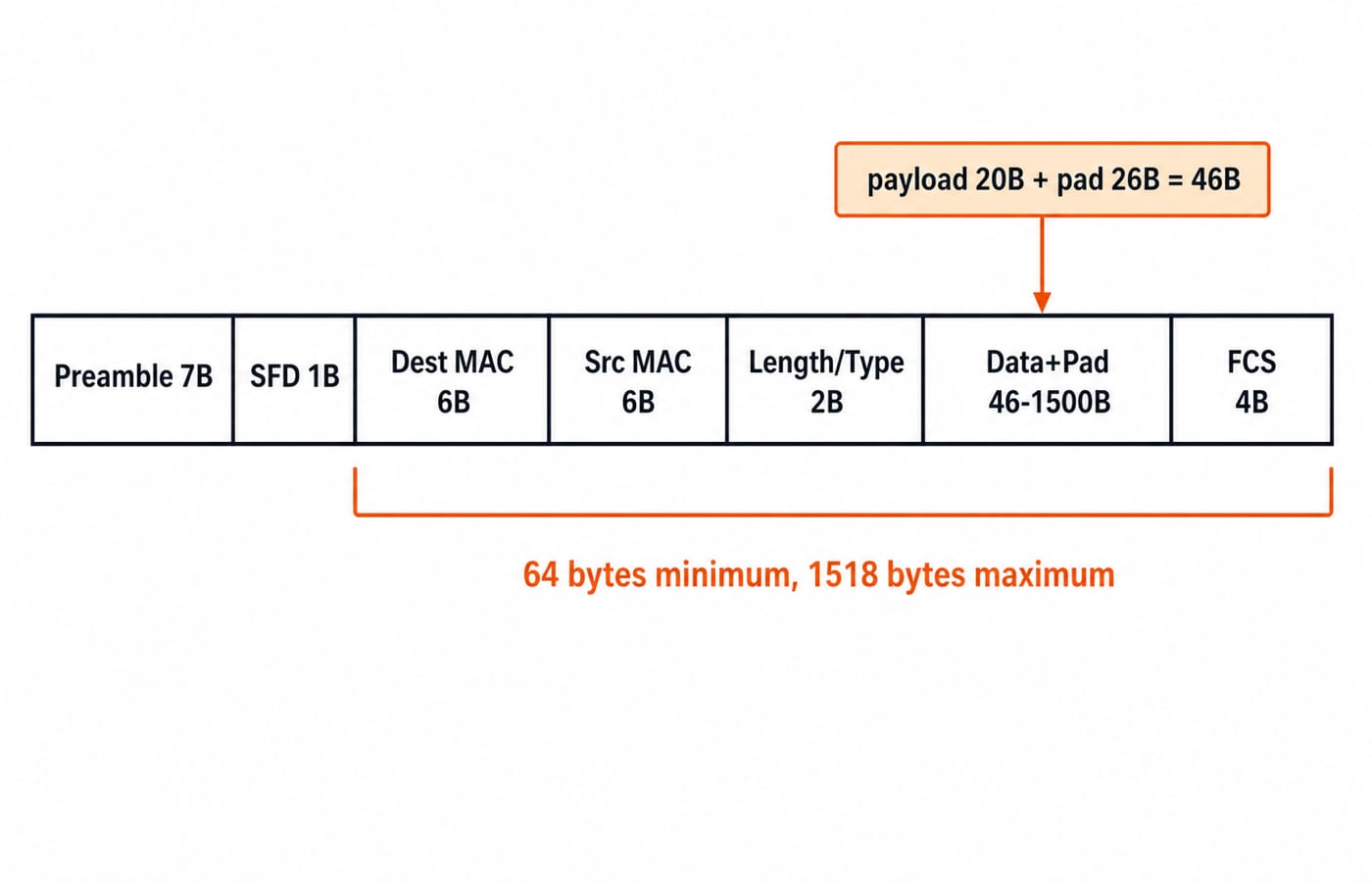
Read an untagged 802.3 frame from left to right:
Field | Size | Purpose |
|---|---|---|
Preamble | 7 bytes | Alternating |
Start Frame Delimiter | 1 byte |
|
Destination MAC | 6 bytes | Identifies the intended receiver |
Source MAC | 6 bytes | Identifies the sender |
Length/Type | 2 bytes | Carries either payload length or protocol type |
Data and pad | 46 to 1500 bytes | Carries the payload and any required padding |
Frame Check Sequence | 4 bytes | Carries the CRC-32 result for error detection |
The preamble and SFD are physical-layer overhead, so they are not counted inside the familiar Ethernet frame bounds. The minimum is 6 + 6 + 2 + 46 + 4 = 64 bytes. The maximum is 6 + 6 + 2 + 1500 + 4 = 1518 bytes.
If a higher-layer packet supplies only 20 bytes of payload, Ethernet adds 26 bytes of padding to reach the 46-byte data-field minimum. The classic 1500-byte maximum payload is also the MTU value that appears in IP fragmentation problems.
MAC addresses and how a switch uses them
A MAC address is 48 bits, or 6 bytes, normally written as 12 hexadecimal digits. For a globally assigned address, the first 3 bytes identify the organisationally unique identifier and the last 3 are vendor-assigned. The I/G bit, the least significant bit of the first byte, distinguishes an individual address from a group address. FF:FF:FF:FF:FF:FF is the broadcast address.
A switch acts through three verbs. It learns the source MAC and incoming port, forwards a frame to the port for a known destination, and floods a frame when the destination is unknown or broadcast. Flooding sends the frame through every relevant port except the one on which it arrived. This is the direct answer when an interviewer asks what a switch does with a destination it has never seen.
CSMA/CD and the collision window: a worked example
On shared half-duplex Ethernet, Carrier Sense Multiple Access with Collision Detection means listen before transmitting, keep listening while transmitting, and send a jam signal if a collision is detected. The station then waits for a random back-off interval before retrying.
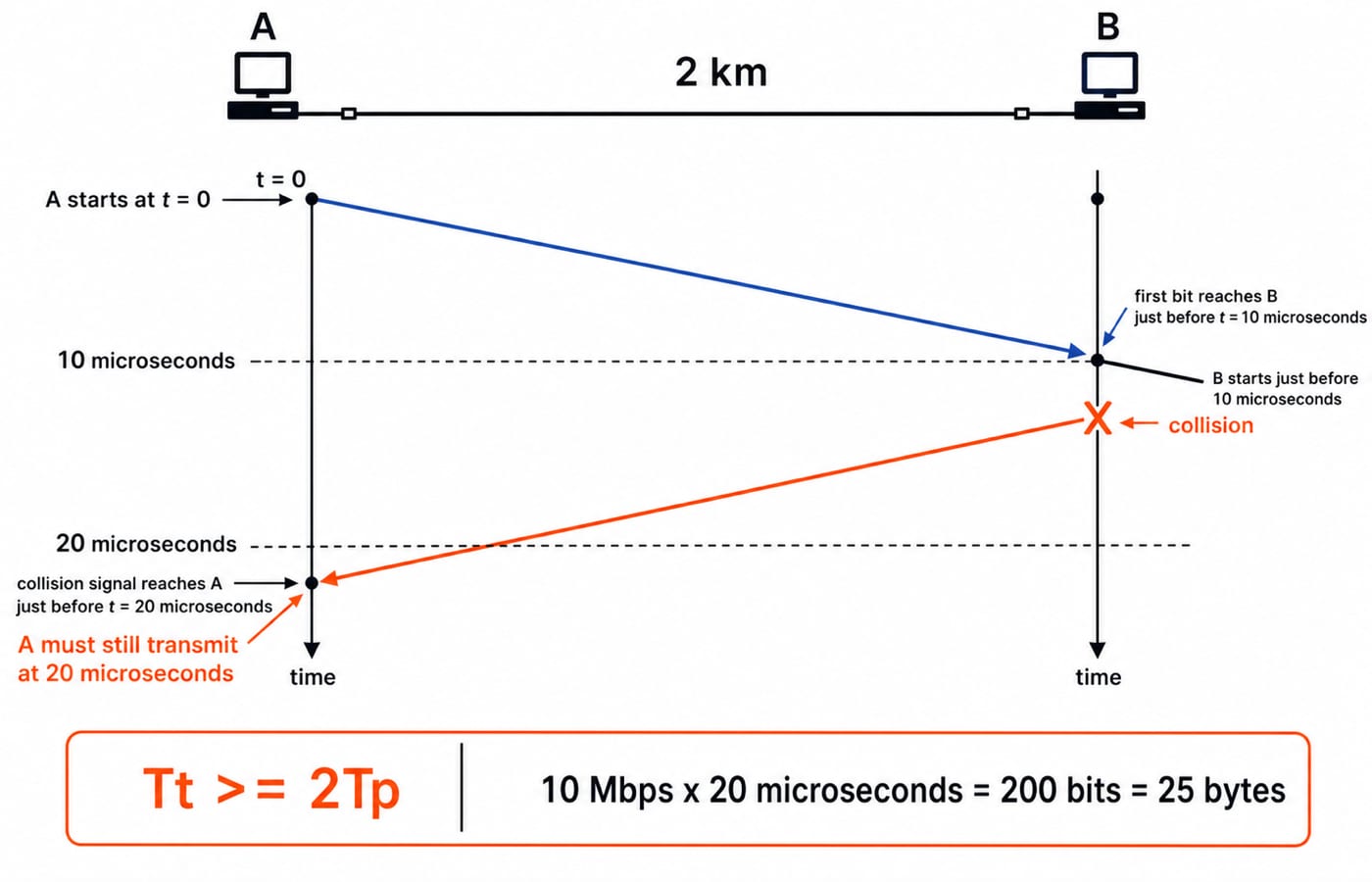
The governing condition is Tt >= 2 x Tp. A sender must still be transmitting when a worst-case collision returns from the far end of the network.
Consider a 10 Mbps Ethernet bus that is 2 km long, with propagation speed 2 x 10^8 m/s.
One-way propagation delay is
Tp = 2000 / (2 x 10^8) = 10^-5 s = 10 microseconds.The collision round trip is
2 x Tp = 20 microseconds.Minimum frame length is
L = bandwidth x 2Tp = 10^7 x 20 x 10^-6 = 200 bits.Therefore, this network's theoretical minimum is
200 / 8 = 25 bytes.
Classic 10 Mbps Ethernet standardised a 51.2 microsecond slot time. Applying the same reasoning gives 10^7 x 51.2 x 10^-6 = 512 bits = 64 bytes. That slot is sized for the standard's worst-case path, roughly 2500 m of cable through repeaters rather than one 2 km segment, which is why 64 bytes comes out larger than the 25 bytes above. The 64-byte minimum in the frame format is therefore a collision-detection requirement, not an arbitrary number.
Binary exponential back-off and Ethernet efficiency
After the nth consecutive collision, a station chooses an integer k uniformly from 0 through 2^n - 1, with the exponent capped at 10. It waits k slot times before trying again, and abandons the frame after 16 collisions.
After a third collision, k is one of 0 through 7, so each value has probability 1/8. With a 51.2 microsecond slot, the wait ranges from zero to 7 x 51.2 = 358.4 microseconds. If stations A and B draw independently, A wins by choosing the smaller value in 28 of the 64 ordered pairs. Thus P(A wins) = 28/64 = 7/16, while a tie has probability 8/64 = 1/8.
The common Ethernet efficiency approximation is 1 / (1 + 6.44a), where a = Tp/Tt. For a 1000-byte frame at 10 Mbps, Tt = 8000 / 10^7 = 800 microseconds. Using Tp = 10 microseconds, a = 10/800 = 0.0125. Efficiency is therefore 1 / (1 + 6.44 x 0.0125) = 1/1.0805, approximately 0.925, or 92.5%.
Larger frames and shorter cables improve efficiency because transmission occupies more time relative to propagation. That is the same trade-off behind minimum frame size and maximum network diameter.
Hubs, bridges, and switches: count the domains
A hub repeats bits, so every device attached through it shares one collision domain and one broadcast domain. A bridge or switch creates one collision domain per port, but its ports remain in one broadcast domain unless a VLAN or router separates them. A router separates broadcast domains.
Suppose two hubs feed one switch and three more hosts connect directly to that switch. The two hub-facing ports contribute two collision domains, and the three host-facing ports contribute three more. The total is 5 collision domains and 1 broadcast domain.
On a full-duplex switched link, each endpoint has separate transmit and receive paths. There is no shared medium and no collision, so CSMA/CD is effectively retired. Modern gigabit Ethernet still retains the 64-byte minimum for frame-format compatibility.
How GATE and interviews test Ethernet
GATE commonly flips one unknown in the collision-window relation: minimum frame length, bandwidth, propagation delay, or cable length. It also tests back-off probabilities, the efficiency ratio a = Tp/Tt, frame fields, and collision-domain versus broadcast-domain counts. The listed subtopics and the marking scheme change with the cycle, so read them from the official GATE information brochure published by that year's organising institute.
Interviews ask how a switch learns, why the MTU is 1500 bytes, what CRC detects, and whether a full-duplex switch port can have collisions. They often move next to IP addressing and subnetting, then to the difference between reliable and best-effort transport.
The short version, and your next step
An untagged Ethernet frame spans 64 to 1518 bytes, excluding preamble and SFD.
Tt >= 2Tpis the central CSMA/CD condition.Binary exponential back-off widens the random choice after each collision.
A switch learns source addresses, forwards known destinations, and floods unknown ones.
Full-duplex switching removes collisions, but not the established frame format.
Practise collision, efficiency, and domain-counting numericals under time in the GATE Test Series, Mocks and Topic-wise Tests. If the whole subject needs rebuilding, GATE Guidance by Sanchit Sir provides a structured route through Computer Networks. If you want to compare the available paths first, browse the GATE CS Exam Preparation Courses and Test Series category.
Keep learning
Computer Networks Hardware Basics: Devices, Domains and Worked Examples
Learn what hubs, switches, routers, gateways and access points actually do, then count network domains and trace frames through a two-LAN topology.
Updated 6 Oct 20266 min readComputer Networks
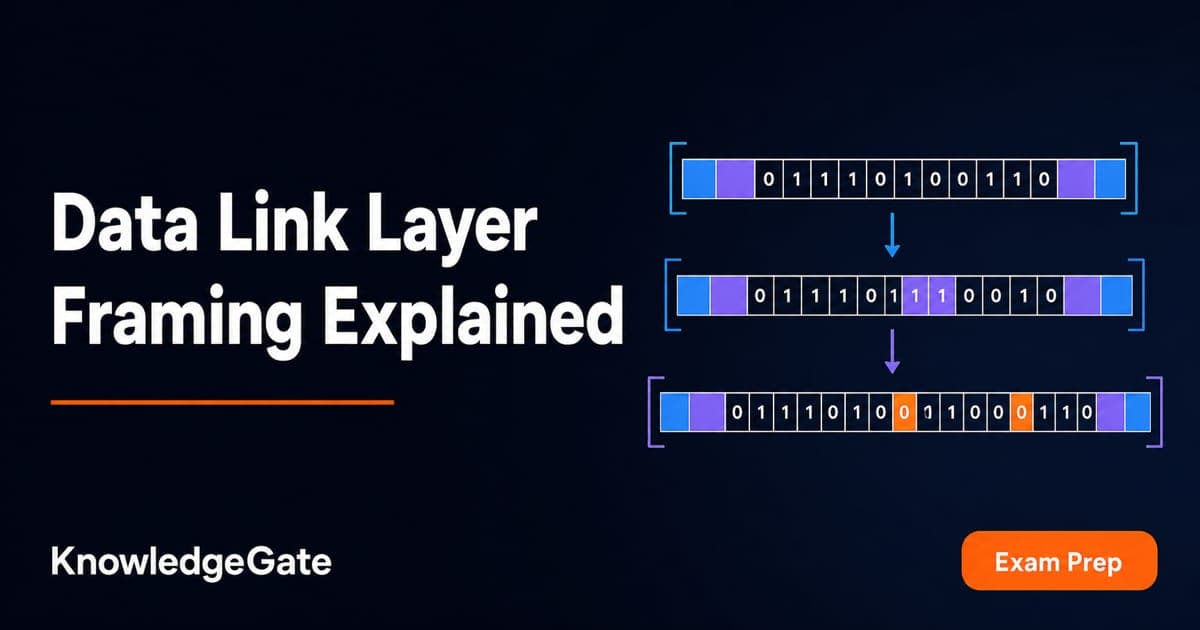
Data Link Layer Framing Explained: Byte Stuffing, Bit Stuffing and a Cross-Concept Numerical
Frame one four-byte payload in two ways, decode it, and then reuse the verified frame sizes in link-load and Stop-and-Wait calculations.
Updated 1 Oct 20266 min readComputer Networks
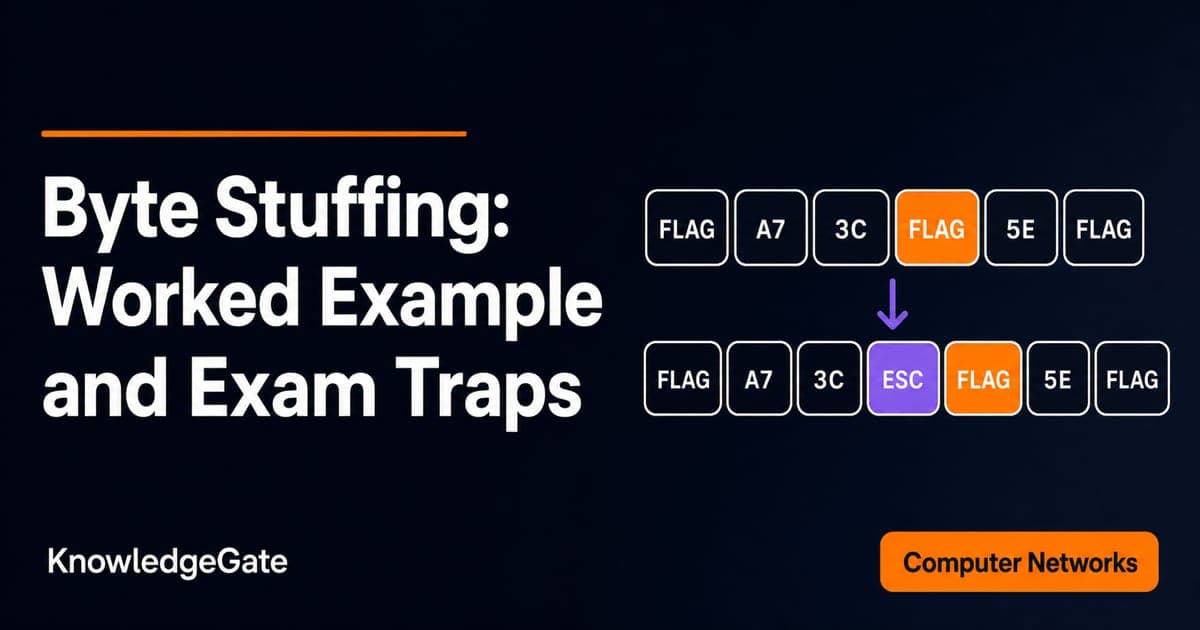
Byte Stuffing in Computer Networks: Worked Framing Example and Exam Traps
Learn a precise byte-stuffing convention, trace a payload containing both FLAG and ESC, reverse it safely, and calculate frame overhead and transmission time.
Updated 26 Sep 20266 min readComputer Networks
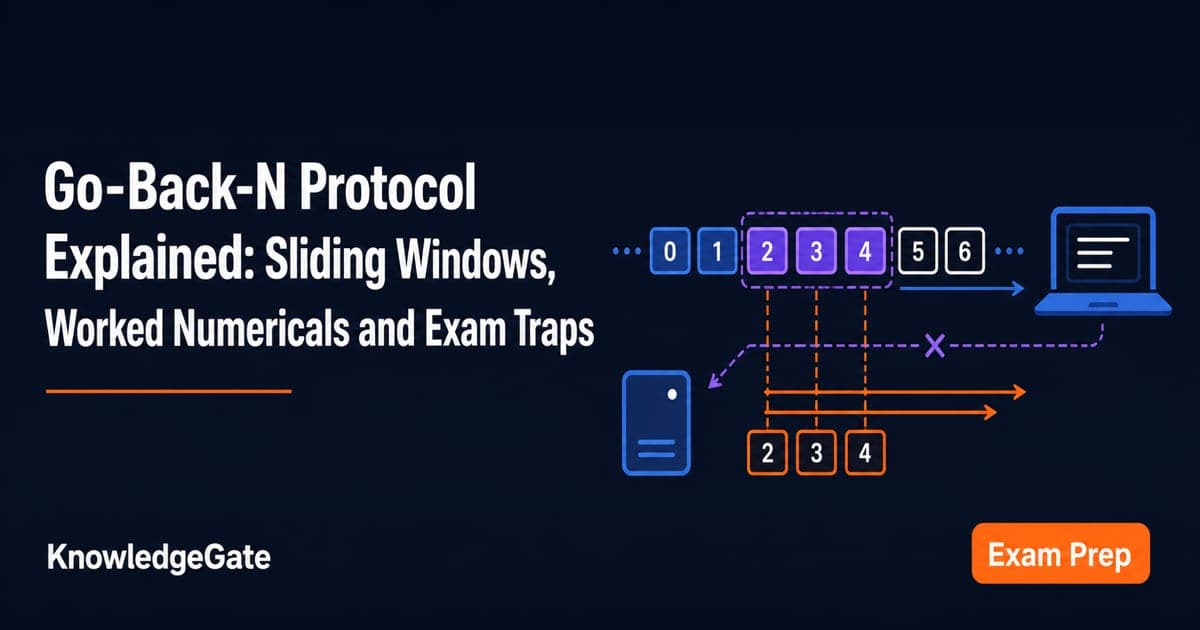
Go-Back-N Protocol Explained: Sliding Windows, Worked Numericals and Exam Traps
Trace Go-Back-N through a lost frame, calculate its legal window and link utilisation, and avoid the ACK and wrap-around traps that spoil numericals.
Updated 24 Sep 20266 min readComputer Networks