UPPSC Polytechnic Lecturer (CS): Eligibility and the Full Selection Process
A B.Tech or M.Tech label alone does not settle lecturer eligibility, and the written exam may not be the final stage. Read the complete funnel before planning.
KnowledgeGate Team
Exam prep & CS education
Updated 1 Aug 20265 min read78 views
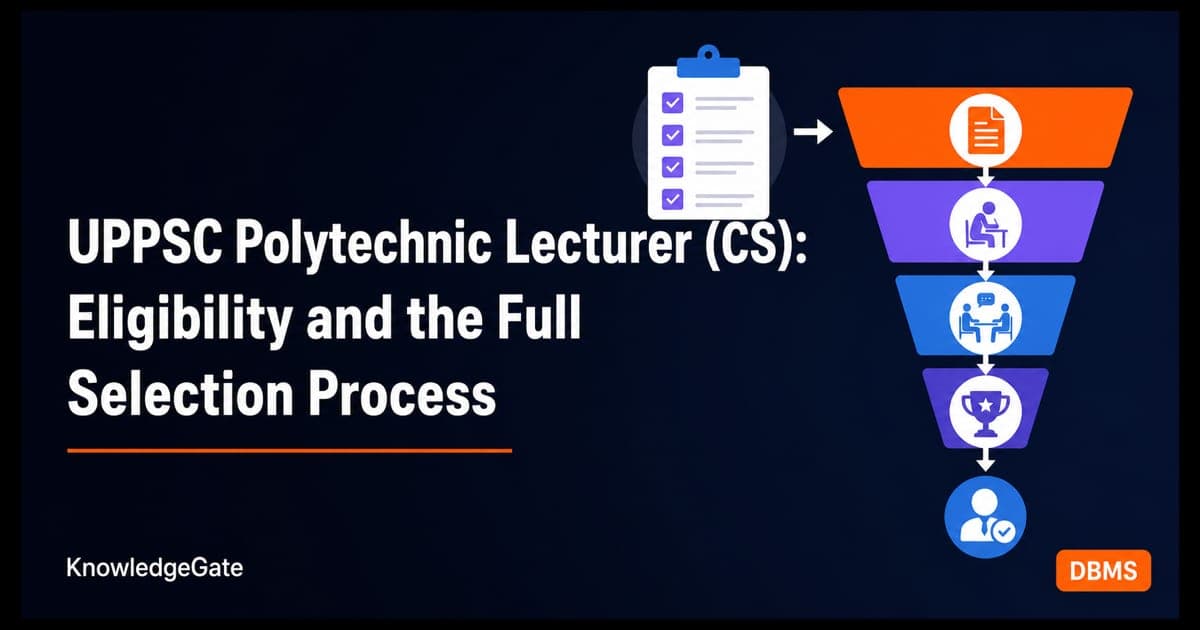
Before you open the UPPSC Polytechnic Lecturer Computer Science syllabus, settle two things: whether your B.Tech, BE, or M.Tech matches the subject entry, and what follows the written exam. Get the first wrong and the application is invalid; get the second wrong and you peak for a stage that is not the last one. UPPSC files its recruitments under five selection routes, and the one yours falls under decides whether there is an interview at all.
Related reading: UP teaching eligibility and Assistant Professor degree rules.
Polytechnic lecturer eligibility: degree, branch, and class
A polytechnic lecturer teaches diploma-level engineering, so what is tested is your engineering degree, not a teaching certificate. The requirement is written as a first class degree in the relevant Computer Science, IT, or notified equivalent branch, with bachelor's and master's routes set by the recruitment rules. Three phrases carry the weight: first class, relevant branch, equivalent.
Whether a master's degree repairs a mismatch in the qualifying bachelor's branch is settled by the rule wording, not by how relevant the subject feels, and not every computer-related title counts as CS or IT. Take the degree list, the class requirement, and the recognition condition from the official UPPSC notification. Where your title differs from the listed one, rely on an explicit equivalence rule rather than similar course content.
Use this sequence when checking your qualification:
Match your degree title to the subject entry word for word, branch included.
Check whether the clause asks for a bachelor's degree, a master's route, or a stated alternative.
Apply the class or marks rule using the conversion method the advertisement permits.
Confirm the university and the programme meet the recognition conditions.
For equivalence, find the explicit rule, never a similar syllabus.
Collect the degree certificate, every semester marksheet, the grade-to-percentage conversion rule, and any equivalence material before the window opens. Academic, age, and category claims are entered once in UPPSC's OTR (One Time Registration) profile and carried into the form, so an error there repeats. If your degree does not clear that sequence, the government teaching jobs category lists other teaching exams worth comparing.
Age limits: the reference date decides the answer
The advertisement fixes two separate things, the age band and the date your age is measured on, and both can move between cycles. Read them off the current advertisement, not an older summary.
Three habits cost candidates an otherwise valid age claim: computing age on the last date of application instead of the advertisement's reference date, claiming a relaxation whose certificate is in the wrong format or from the wrong authority, and assuming two relaxations add together.
So keep five fields in your eligibility sheet: date of birth, the reference date, your age on it, the relaxation claimed, and the certificate for it. Ticking a category does not establish the claim. The certificate does, and scrutiny checks it.
UPPSC selection stages, application to appointment
UPPSC does not run one selection pattern for everything it recruits. Under Recruitment on the commission's own site, advertisements sit under five routes: Interview Only, Screening Test And Interview, Examination Only, Examination And Interview Only, and Pre Examination, Main Examination And Interview. Find yours there first: the heading tells you whether an interview exists and whether the first paper only shortlists.
Whichever route applies, the cycle around it runs:
Online application. Educational, category, and age claims are declared here.
Document scrutiny. UPPSC tests the evidence behind each claim, including the subject qualification.
Written examination. One paper, or screening plus mains, on the notified conditions.
Interview, where the route includes one. Confirm its weight for your cycle.
Final merit list. Stage results combine by the notified rule, after verification.
Appointment. Recommended candidates complete the departmental formalities.
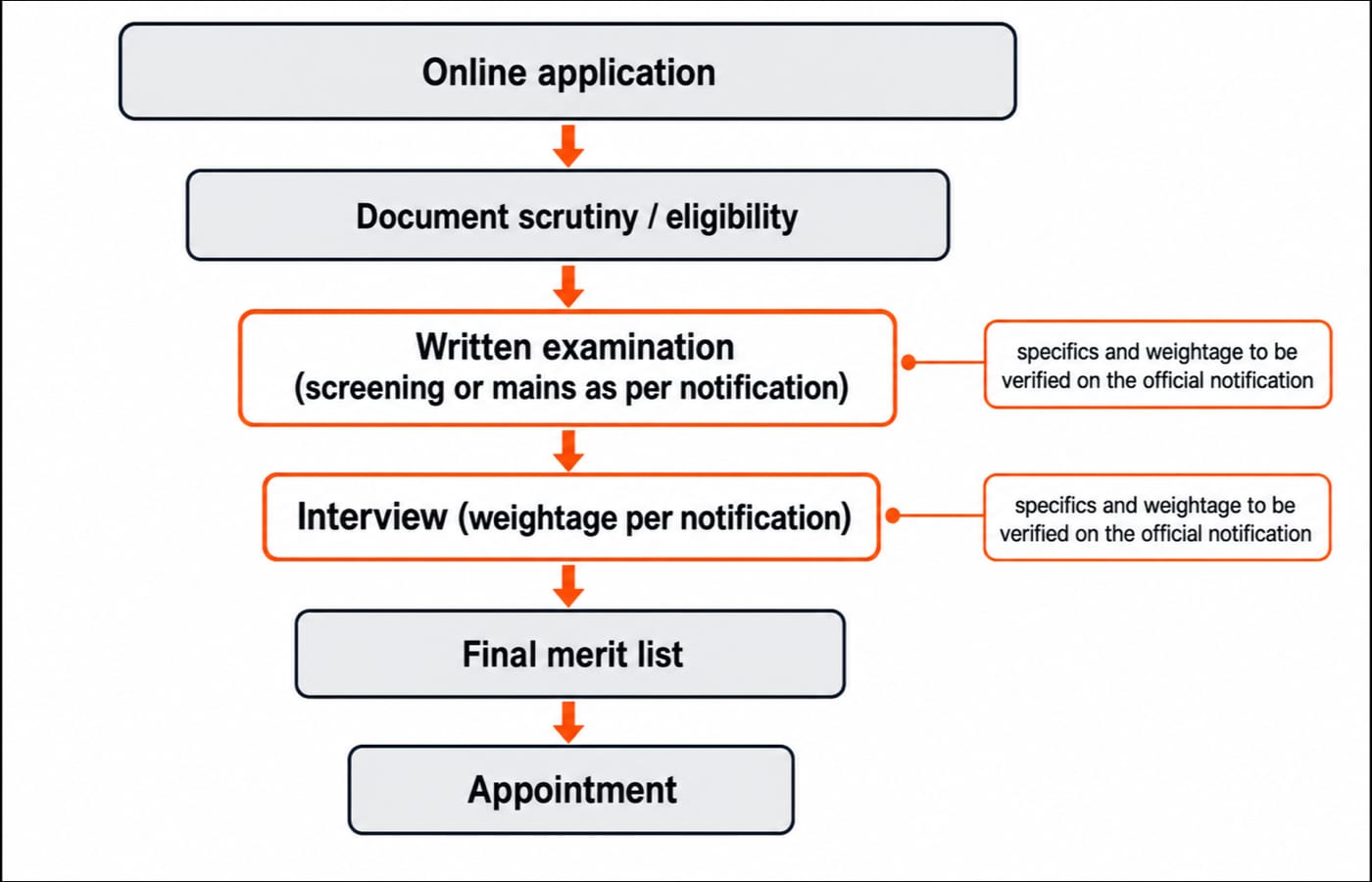
Being allowed to sit a paper is not proof of eligibility, and a screening stage's marks may never reach the final list. Watch two things while a cycle is live: the Candidate's Corner, which carries the application-status check and the objections raised on applications, and the advertisement's addenda, where a stage or condition is sometimes amended after publication.
How the merit or final list is built
The route name is the clue and the advertisement is the authority. A route named for a screening test says that stage exists to shortlist; one named for examination and interview says both count. What each contributes appears only in your own advertisement, so never copy a weightage or tie rule from another UPPSC recruitment.
Make a selection-rule card with four questions:
Which stage only screens candidates forward?
Which stage contributes to final merit?
Is there a separate qualifying condition for any paper or for the interview?
At what point are original documents checked?
Answer all four from the current notice and its addenda, then plan around the stages that count. If the route includes an interview, practise aloud before the written result, not after the call.
What decides it once you are eligible: the CS written paper
Eligibility is binary; the written paper is the part you control. Cover the notified syllabus deeply enough to solve, not to recognise. Programming and Data Structures, DBMS, Operating Systems, Computer Networks, Theory of Computation, Computer Architecture, and Software Engineering are the base it draws on.
KnowledgeGate's question bank carries about 2,000 Operating Systems questions, so OS is a fair model for working through any of them:
Learn one bounded topic: scheduling, synchronisation, deadlocks, or memory management.
Solve focused questions on it without a timer.
Label every error as concept, calculation, reading, or speed.
Repair the weakest label, then retest on unseen questions.
Mix in DBMS, Networks, and programming once topic accuracy is stable.
The UPPSC Polytechnic Lecturer 2025 CS course gives that work a structured order. Tick a subtopic off only when the concept study and the question practice are both done.
Interview preparation comes out of the same work. After solving a question, explain the concept as though teaching a first-year diploma student: define the term, give one small example, name the usual misconception, and say where it is used.
If you are not eligible, or choosing among teaching exams
If the degree, class, or age requirement does not fit, do not force an equivalence. Which teaching Computer Science exam should you target? sets the teaching posts side by side, and the UPTET eligibility and exam structure guide shows why a school-teaching framework needs its own check.
Programming, databases, operating systems, and networks carry across these exams, but the depth expected and the selection funnel change. Choose by eligibility first, and never carry another exam's degree rule across.
The short version and next step
The pattern is a first class Computer Science, IT, or notified equivalent engineering qualification, then application, scrutiny, the written stage, an interview where the route includes one, merit, and appointment. Every degree, marks, age, and interview figure belongs to the current advertisement, and the route it sits under is where you start reading.
Check the advertisement, build the document matrix and the selection-rule card, and put the technical stage on a course rather than a reading list. A clean eligibility answer saves months, and the full funnel tells you which stages your marks actually reach.
Keep learning
Paging and TLB Explained: Address Translation, EMAT and Exam Traps
Follow one virtual address from its VPN through the TLB to a physical frame, then calculate page-table size, TLB reach and effective memory access time.
Updated 4 Oct 20266 min readOperating Systems
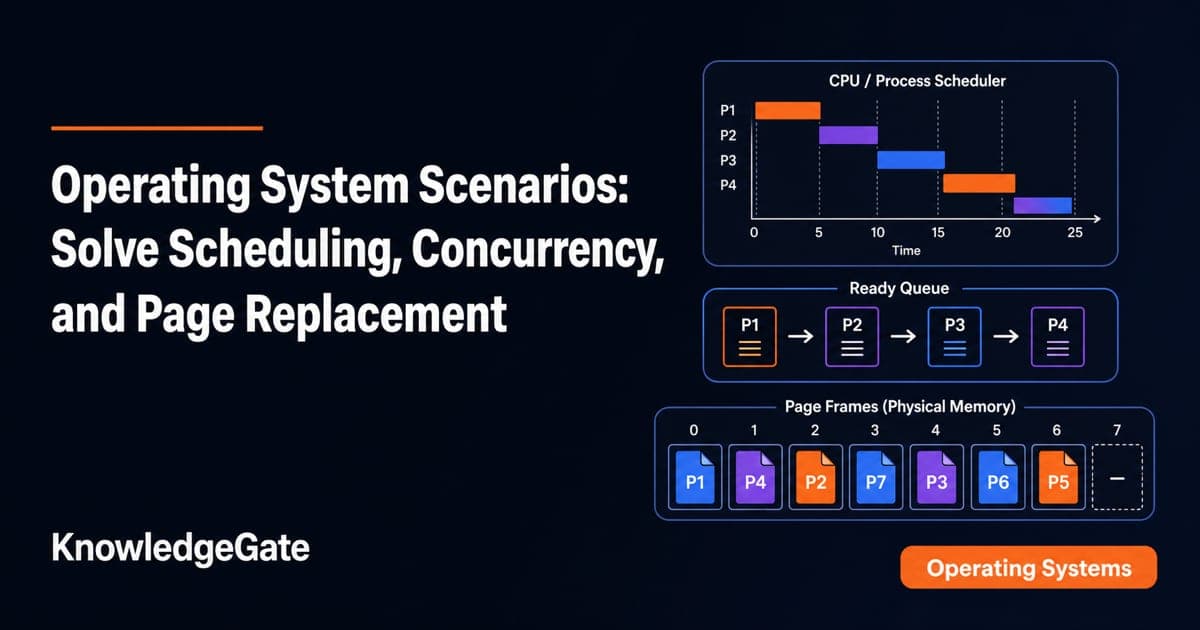
Operating System Scenarios: Solve Scheduling, Concurrency, and Page Replacement
Learn one state-trace method for three common OS problem families, then apply it to complete Round Robin, concurrency, FIFO, and LRU examples.
Updated 29 Sep 20265 min readOperating Systems
Tower Research Hiring Process: Stage-by-Stage Prep for Quant and Dev Roles
Prepare for a Tower Research application without treating one online account as a universal process. Use this role-led map, worked drills, and seven-day plan.
Updated 25 Sep 20265 min readOperating Systems
Capital One Recruitment Process: Stage-by-Stage Guide for India Applicants
Prepare for a Capital One India application with a cautious five-stage map, worked technical and case drills, and a practical 14-hour schedule.
Updated 24 Sep 20265 min readOperating Systems