UPPSC Polytechnic Lecturer CS Syllabus: Complete Topic Map
Build a bounded UPPSC Polytechnic Lecturer Computer syllabus tracker from official headings, then turn diagnostic scores and prerequisites into a weekly plan.
KnowledgeGate Team
Exam prep & CS education
Updated 28 Jul 20265 min read800 views
“UPPSC teaching syllabus” is not one list: the commission recruits several teaching posts. A Polytechnic Lecturer Computer map does not fit Assistant Teacher, Principal or another subject. The Computer Lecturer notice dated 02.12.2025 yields a finite inventory: 19 technical headings across two Computer papers, plus General Hindi and General Studies. Those headings carry dependencies worth studying in order, and the same five-field audit rebuilds the inventory from whichever advertisement is current when you apply.
1. Freeze the exact UPPSC post before copying a syllabus
Before collecting resources, write: commission -> advertisement number and date -> service or examination -> post -> subject.
For the 2025 advertisement, that line reads:
UPPSC -> A-11/E-1/2025, 02.12.2025 -> U.P. Technical Education (Teaching) Service Examination-2025 -> Lecturer -> Computer
Matching only “UPPSC” or “teaching” is insufficient. If any field changes, rebuild from the latest post-specific advertisement, syllabus, corrigenda and instructions in the UPPSC Notifications/Advertisements area. Still choosing between state teaching routes? Teaching CS Exams Compared: DSSSB, KVS, RSSB puts the options side by side.
2. Paper 1 and Paper 2: Computer, Hindi and General Studies on one page
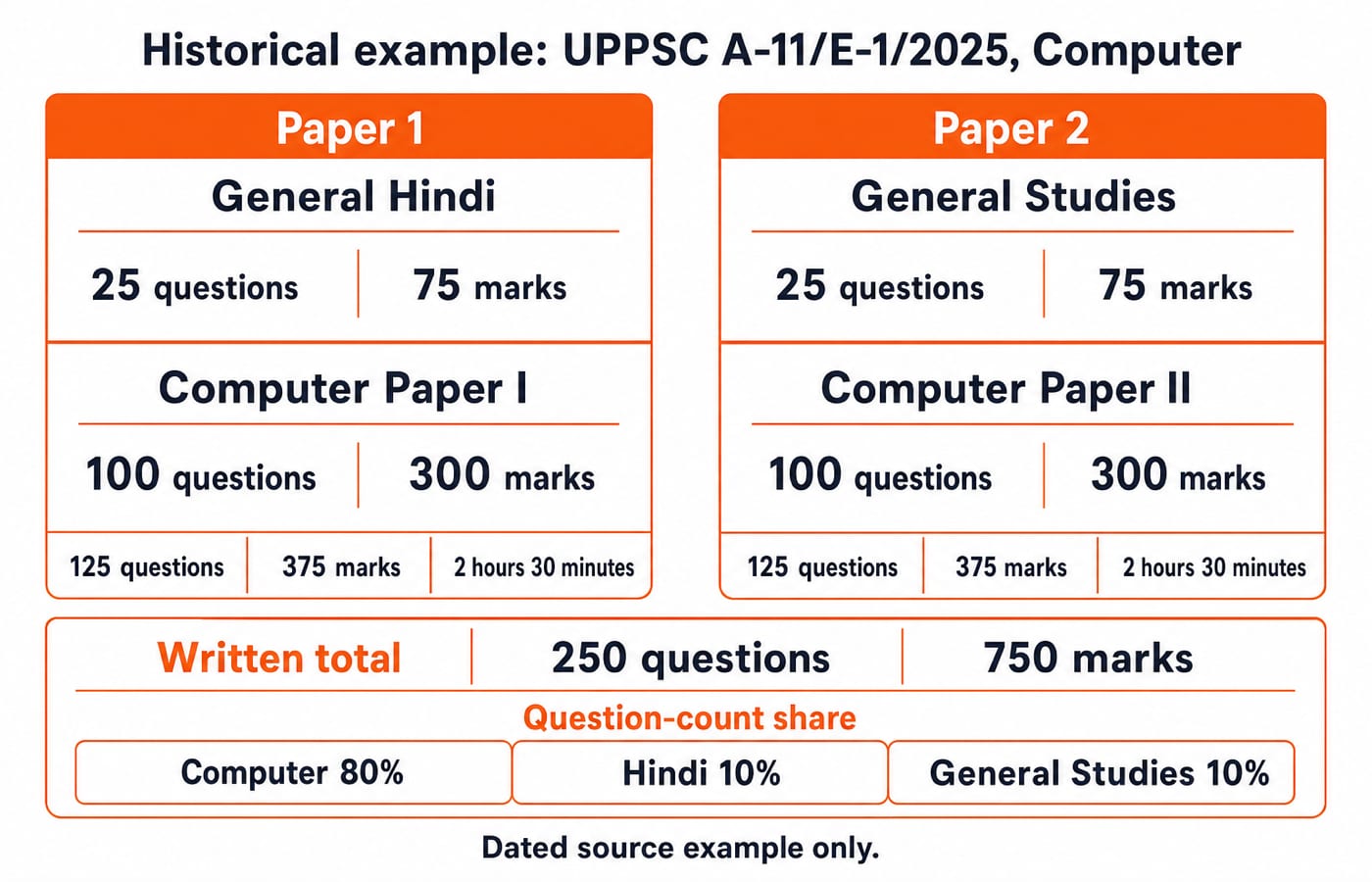
Advertisement A-11/E-1/2025 gave Paper 1 as 25 General Hindi questions for 75 marks plus 100 Computer Paper I questions for 300 marks. That is 125 questions and 375 marks in 2 hours 30 minutes. Paper 2 used 25 General Studies questions for 75 marks plus 100 Computer Paper II questions for 300 marks, again totalling 125 questions and 375 marks in 2 hours 30 minutes.
Across the written papers, 125 + 125 = 250 questions and 375 + 375 = 750 marks. By question count on that dated structure, Computer contributes 200/250 = 80%, Hindi 25/250 = 10%, and General Studies 25/250 = 10%. Keep interview and eligibility outside this syllabus inventory because neither becomes a Paper I or Paper II study heading.
3. Computer Paper I: nine headings from machine foundation to delivery
The dated syllabus names nine Paper I headings. Keep every label visible when grouping them for navigation:
Machine foundation:
Computer Organization and Architecture.Mathematical and algorithmic foundation:
Discrete Structures & Theory of Logic;Data Structures;Design and Analysis of Algorithm.Data and communication:
Database Management Systems;Computer Networks;Cyber Security.Language and delivery:
Principles of Programming Languages;Software Project Management.
These folders aid study; they are not UPPSC groupings. Repair machine basics before Computer Organization if needed, but retain the official heading. Track all nine exact labels, source pages, lessons, practice and revision state.
4. Computer Paper II: ten headings across systems, software, AI and graphics
The dated Paper II syllabus contains ten headings:
Systems and scale:
Operating Systems;Distributed System;High Performance Computing.Software and language translation:
Compiler Design;Software Engineering;Web Technologies.Intelligent computation:
Artificial Intelligence;Soft Computing.Visual computation:
Computer Graphics;Image Processing: Digital Image Fundamentals.
The completeness equation is 9 Paper I headings + 10 Paper II headings = 19 technical headings. The map is incomplete if one heading lacks a source, practice set or revision status. Do not split marks equally across the 19: the source names scope, never per-heading question counts.
5. General Hindi, General Studies, and why pedagogy is not on this list
Give General Hindi and General Studies separate rows because each had 25 questions. Copy their exact subtopics from the applicable official syllabus, not memory or a generic coaching list.
The Polytechnic Lecturer Computer syllabus names no teaching-aptitude or pedagogy heading, so a pedagogy percentage, chapter or marks split in your tracker would invent scope. Add that row only when a current post-specific advertisement names it, and if one does, Teaching Aptitude for CS Recruitment Exams covers what those sections usually ask.
6. Draw dependencies before tackling advanced subjects
Use dependencies as teaching guidance, not commission priority:
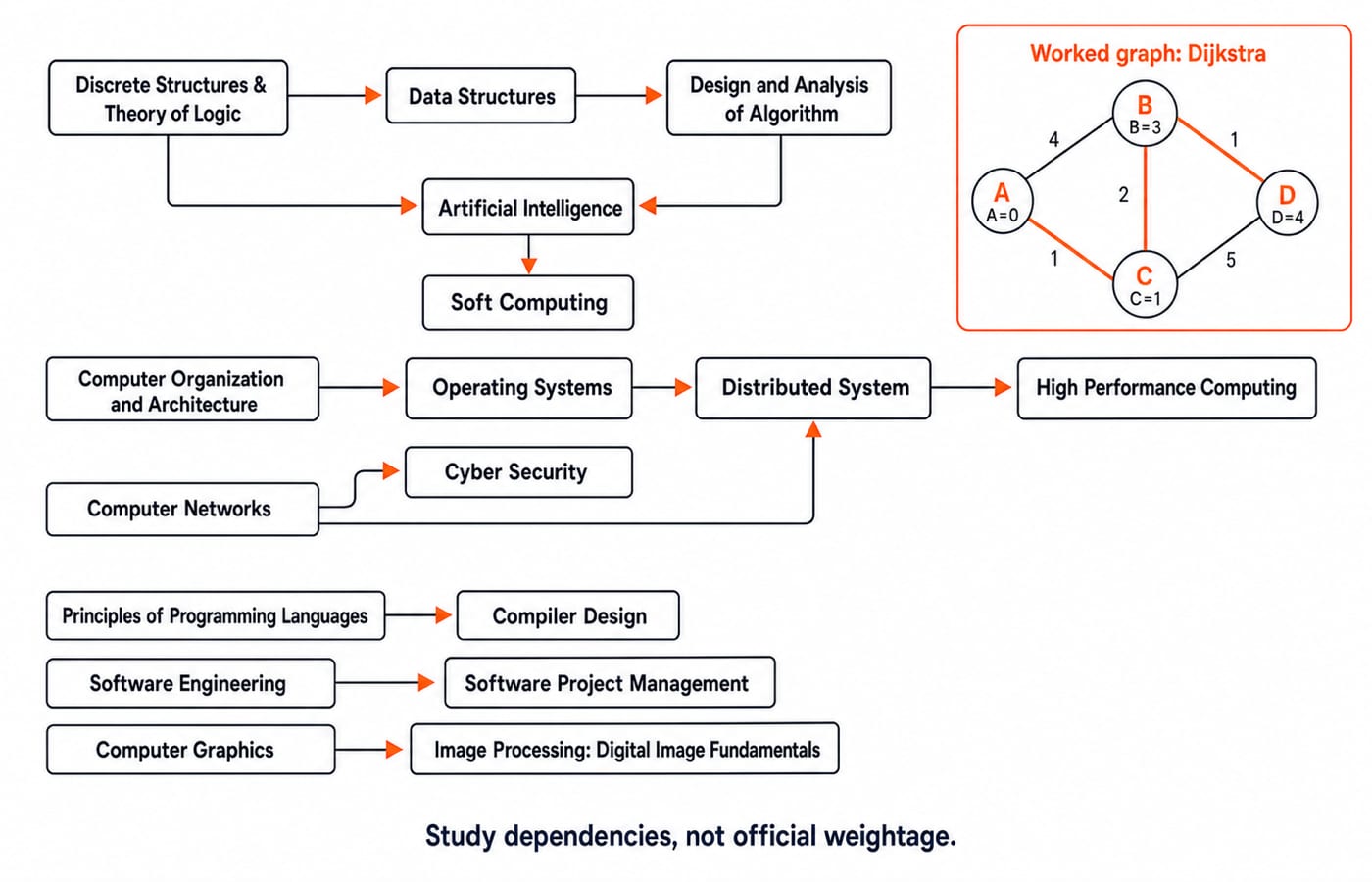
Discrete Structures -> Data Structures -> Design and Analysis of AlgorithmComputer Organization -> Operating Systems -> Distributed System -> High Performance ComputingComputer Networks -> Cyber Security and Distributed SystemPrinciples of Programming Languages -> Compiler DesignSoftware Engineering -> Software Project ManagementComputer Graphics -> Image ProcessingDiscrete Structures + Algorithms -> Artificial Intelligence -> Soft Computing
Now check the algorithm foundation on a small weighted graph with edges A-B=4, A-C=1, C-B=2, B-D=1, C-D=5. Dijkstra from A starts with A=0, then fixes C=1. Through C, B improves from 4 to 1 + 2 = 3, while D becomes 1 + 5 = 6. Through B, D improves to 3 + 1 = 4. Final distances are A=0, C=1, B=3, D=4, with path A-C-B-D to D. If you cannot reproduce those values unaided, keep Algorithms amber before closing routing or distributed-system optimisation.
7. Turn a 19-heading diagnostic into a weekly plan
Suppose you attempt five questions per technical heading, so 19 x 5 = 95 questions in all. Say the Paper I scores come out as COA 4, Data Structures 4, Discrete Structures 3, DBMS 4, Algorithms 3, Networks 3, Programming Languages 4, Software Project Management 2, and Cyber Security 2. They total 29/45.
The Paper II scores are OS 4, Graphics 2, AI 3, Compiler 3, Software Engineering 4, Distributed System 2, Web Technologies 3, Image Processing 2, Soft Computing 2, and HPC 1. They total 26/50, giving 29 + 26 = 55/95 overall.
Define green as 4-5/5, amber as 3/5, and red as 0-2/5. The result is 6 green + 6 amber + 7 red = 19, so every heading is accounted for.
As a planning heuristic, apply the dated 80:10:10 question-count share to 20 weekly sessions: 16 Computer + 2 Hindi + 2 General Studies = 20. Split the Computer sessions into 8 red repair + 5 amber practice + 3 green retention = 16. Recalculate after every diagnostic.
8. The short version: audit the source, then choose a route
Build a 21-row tracker: 19 technical headings, General Hindi and General Studies. Use official label, paper, PDF and page, resource, practice, last score, status, and next action. A blank source cell means unfrozen scope.
Audit in order: confirm the advertisement, download the subject syllabus, add corrigenda, preserve each heading, map resources, then test dependencies and diagnostics. Afterwards, use the UPPSC Polytechnic Lecturer CS preparation category, UPPSC Polytechnic Lecturer Computer Science course, and UPPSC Polytechnic Lecturer test series. None replaces commission documents.
Keep learning
UPPSC Teaching vs UP LT Grade: Choose by Role, Eligibility and Syllabus
Choose between the Polytechnic Lecturer and LT Grade routes by checking the current notice first, then testing role fit, syllabus overlap and available hours.
Updated 7 Aug 20267 min readUPPSC Teaching
UPPSC Computer Science Problem Types: Solve Algorithms, DBMS and OS
Use one four-process dataset to practise insertion-sort traces, candidate-key and 3NF reasoning, and non-preemptive SJF calculations with reliable checks.
Updated 4 Aug 20266 min readUPPSC Teaching
UPPSC Teaching Eligibility and Selection Structure: Verify the Right Post Before Applying
A practical worksheet-based method to check the exact UPPSC post, qualification route, equivalence evidence and notified selection sequence before applying.
Updated 2 Aug 20266 min read61 viewsUPPSC Teaching
UPPSC Teaching PYQ Analysis: Build an Error-Led Revision Plan
Learn a repeatable way to verify teaching PYQs, separate topic from reasoning demand, diagnose errors and convert the evidence into next week's study calendar.
Updated 30 Jul 20266 min readUPPSC Teaching