MPPSC Assistant Professor Eligibility: NET, Ph.D and Age Rules Explained
Check your MPPSC Assistant Professor eligibility route in the right order: postgraduate degree, qualifying test or Ph.D, age, domicile benefits and documents.
KnowledgeGate Team
Exam prep & CS education
Updated 9 Sep 20265 min read92 views

MPPSC Advertisement No. 28/2025 turns Computer Science eligibility into six gates: the printed postgraduate degree, marks, qualifying route, age on the reference date, category or domicile evidence, and qualifications held by the deadline. A NET result does not cure a degree title outside the printed list, and a Ph.D does not create an automatic exemption.
The MPPSC eligibility and selection guide owns the route from the written examination through scrutiny, interview and final merit. Before that route begins, complete the document audit below and resolve every row marked unclear.
1. MPPSC academic eligibility: 55% and the accepted CS degree list
For the worked Computer Science cycle, official MPPSC Advertisement No. 28/2025 sets a 55% postgraduate-marks floor for the general route. It provides a five-percentage-point relaxation, bringing the floor to 50%, for the eligible categories it names. A later notice or corrigendum can change these figures.
The printed Computer Science and allied-subject table names these postgraduate routes:
M.Sc. Computer Science or M.Sc. Information Technology.
Master of Computer Applications (MCA).
M.Tech in Computer Science, Computer Science and Engineering, or Information Technology.
M.E. in Computer Science, Computer Engineering, or Information Technology.
Match the wording on the degree and marksheets to the printed row. M.Tech Data Science is not the same title as M.Tech Computer Science merely because coursework overlaps. An official clarification must settle an unlisted title.
For CGPA, attach the university's conversion formula, calculate the percentage, and compare it with the applicable threshold. Do not round a shortfall into eligibility.
2. MPPSC NET, SET, SLET and Ph.D routes
The postgraduate qualification and qualifying route are separate gates. Advertisement No. 28/2025 combines the relevant master's qualification with NET or the specified SLET or SET route, while allowing a Ph.D exemption only when the evidence satisfies its UGC-regulation clause.
NET route: match the test, subject and issuing body to the notice, including UGC or CSIR where specified.
SLET or SET route: check the state-level test named by the advertisement. A similarly named test from another state is not automatically interchangeable.
Ph.D route: prove the applicable UGC-regulation conditions, including the registration-date branch and the required university certifications. The degree title by itself is not enough.
These are alternative qualifying routes, not four certificates that every applicant must collect. A candidate with a valid notified NET route does not also need SET, SLET and a Ph.D; a candidate relying on the Ph.D exemption must prove every condition attached to that exemption.
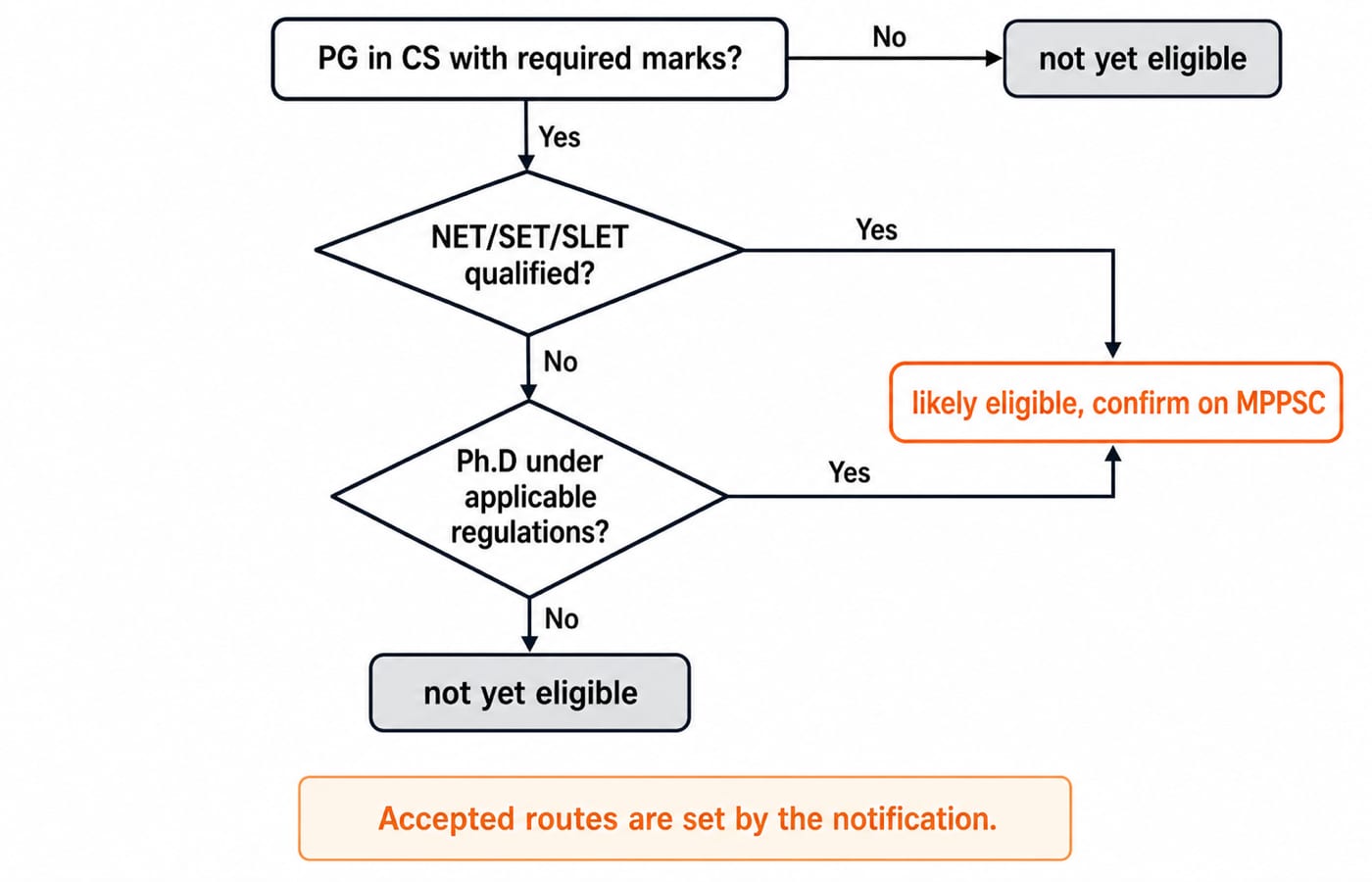
The flowchart identifies the route, but MPPSC document verification and any later clarification decide borderline cases.
3. MPPSC age rule: 21 to under 40 on 1 January 2026
For Advertisement No. 28/2025, the base age band runs from 21 to under 40 on 1 January 2026. The reference date matters: age on the application day, examination day or document-scrutiny day does not replace age on 1 January 2026.
A candidate born on 2 January 1986 is 39 years, 11 months and 30 days on the reference date and remains inside the unrelaxed upper boundary. A candidate born on 1 January 1986 is exactly 40 on that date and falls outside an “under 40” base rule unless a valid relaxation changes the applicable ceiling.
Read each relaxation with its eligibility condition. Category, sex, disability, service status and domicile provisions cannot be added together unless the advertisement permits it. Record the base result, the applicable relaxed ceiling and its supporting certificate.
4. MP domicile and reservation evidence
Madhya Pradesh domicile can control access to state reservation treatment and state-specific age relaxations. A certificate from another state with the same category label does not automatically create the same MPPSC benefit.
Check whether the provision is restricted to MP domicile, whether the competent authority issued the certificate, and whether its format and validity satisfy this recruitment. Apply under the category the documents support, not the most favourable threshold on an unofficial summary.
Keep the advertisement page and annexure used for the claim. If the category name, certificate date or domicile condition does not line up, obtain an official clarification before applying.
5. MPPSC documents and common disqualifiers
Build one folder containing the evidence for every gate before completing the application. Include, as applicable:
Postgraduate degree certificate and all marksheets.
The university's official CGPA-to-percentage formula or conversion certificate.
NET, SET or SLET certificate and result details.
Ph.D degree plus registration-date and UGC-compliance evidence.
Class 10 or other accepted date-of-birth proof.
Category, domicile, disability or relaxation certificates in the prescribed form.
Name-change or identity-linking documents where names, dates or parent details differ across records.
Common failures are an unlisted degree title, marks below the floor, a mismatched test certificate, a qualification obtained after the deadline, age calculated on the wrong date, or an unsupported reservation claim. Resolve mismatched names and dates before scrutiny.
6. MPPSC eligibility matrix: record yes, no or clarification needed
Use one row for each gate and record the rule, the document and one of three outcomes: yes, no, or clarification needed. The matrix should contain:
Degree title: the exact wording on the degree beside the matching advertisement row.
Marks: the transcript value, conversion method, applicable 55% or 50% threshold, and the calculated result.
Qualifying route: NET, the specified SET or SLET, or the exact Ph.D exemption branch with its evidence.
Age: date of birth, 1 January 2026 reference date, base-band result, and any documented relaxed ceiling.
Qualification deadline: proof that every required qualification was held by 16 May 2026 for this advertisement.
Category and domicile: the claimed provision, issuing authority, certificate date and required format.
A “clarification needed” row is not a provisional yes. Save the relevant official page, ask MPPSC through its stated channel, and keep the written response with the application records.
If the matrix shows that another recruitment fits better, use Which Teaching CS Exam to Target: 4 Filters to compare routes without importing another commission's eligibility rules into MPPSC.
7. MPPSC eligibility: the short version and next step
For Computer Science Advertisement No. 28/2025, start with a listed postgraduate degree and the applicable 55% or 50% academic floor. Then prove one accepted qualifying route, satisfy the 21-to-under-40 base age rule on 1 January 2026 or a documented relaxation, and hold every required qualification by 16 May 2026. Category and domicile benefits count only when the prescribed evidence supports them.
After every matrix row is supported, prepare with MPPSC Assistant Professor Paper 1 (General Knowledge) and the MPPSC Assistant Professor Computer Science Test Series. The Govt Teaching Job Exam Preparation category provides related routes if the MPPSC matrix produces a documented no. Verify eligibility first, then invest preparation time in the matching examination.
Keep learning
Browsers and Search Engines MCQs: 9 Solved Questions with Explanations
Solve nine published browser and search engine questions, check each answer, and rebuild the browser, cache, crawler and indexing distinctions that exam distractors blur.
Updated 6 Oct 20267 min readTeaching Recruitment (Computer Science)
IT Act, 2000 Explained: Key Sections, Digital Signatures and Worked Exam Examples
Build an exam-ready map of the IT Act, then apply it to an exact digital-signature walkthrough and a section 43, 66, 66C and 66D caselet.
Updated 2 Oct 20266 min readTeaching Recruitment (Computer Science)
Emerging Trends Introduction MCQs: 12 Solved Questions with Explanations
Solve 12 Emerging Trends Introduction questions with clear answer logic, exam-year labels and a compact trap check for focused revision.
Updated 27 Sep 20268 min readTeaching Recruitment (Computer Science)
MS Word Basics MCQs with Answers: 12 Solved Questions Explained
Work through 12 MS Word questions covering everyday commands, page layout, formatting, links, file features and mail merge. Each answer explains the decisive clue and the closest distractor.
Updated 25 Sep 20267 min readTeaching Recruitment (Computer Science)