UPPSC Polytechnic Lecturer (CS) Previous-Year Analysis: Which Topics Carry the Paper
Skip ready-made weightage tables: find official UPPSC question booklets, tag and count questions in a tracker, and band the CS syllabus into an honest prep order.
KnowledgeGate Team
Exam prep & CS education
Updated 12 Sep 20264 min read60 views
The UPPSC Polytechnic Lecturer Computer Science syllabus is broad enough to make every subject look equally urgent. Previous papers create a better study order only when the questions come from UPPSC and the count stays auditable. Build one row per question, calculate each block's share, and convert the result into three preparation bands.
1. What a previous-year analysis can and cannot tell you
A previous-year analysis shows which subject blocks recur across the papers you counted. It cannot predict the next paper, promise a fixed mark share or replace the current syllabus.
Use three safeguards:
Treat recurrence as a pattern across several papers, not a copy of the latest paper.
Count frequency separately from difficulty; one hard question does not make a topic high recurrence.
Keep every topic in the current syllabus eligible, even when older papers did not test it.
Keep the UPPSC Polytechnic Lecturer CS syllabus guide beside the tracker. The syllabus defines what is testable; recurrence decides what to secure first.
2. Where the official papers live
Work from the commission's own material, not screenshots. Start at the official UPPSC portal and open its previous-question-paper and answer-key sections. Search for technical-education lecturer advertisements and record the recruitment year against every file. Some cycles provide a complete booklet; others provide an answer key tied to a booklet series.
Use three collection rules:
Keep every direct Computer Science lecturer booklet and its matching answer key together.
Tag adjacent UPPSC lecturer or technical CS papers as secondary evidence, never as direct UPPSC Polytechnic Lecturer evidence.
Check any coaching-site copy against an official booklet or key before counting it; discard an unverifiable copy.
3. The tracker: how to tag and count
Give every question one spreadsheet row with the paper year, question number, subject block, finer topic and question form. Use a fixed block list: programming and algorithms, data structures, DBMS, Computer Networks, Operating Systems, organisation and microprocessors, digital electronics, software engineering, theory and compilers, and mathematics.
Apply four counting rules:
Tag what the question tests, not a topic it merely mentions.
Assign one block per question; note a close pair without double-counting.
Convert each block count into a percentage of that paper, so different paper lengths remain comparable.
Use the high band only for a solid share across several papers; record a one-paper spike separately.
Add each new official paper to the same sheet. The raw rows preserve the evidence behind every band and make later corrections easy.
4. UPPSC CS priority bands to verify
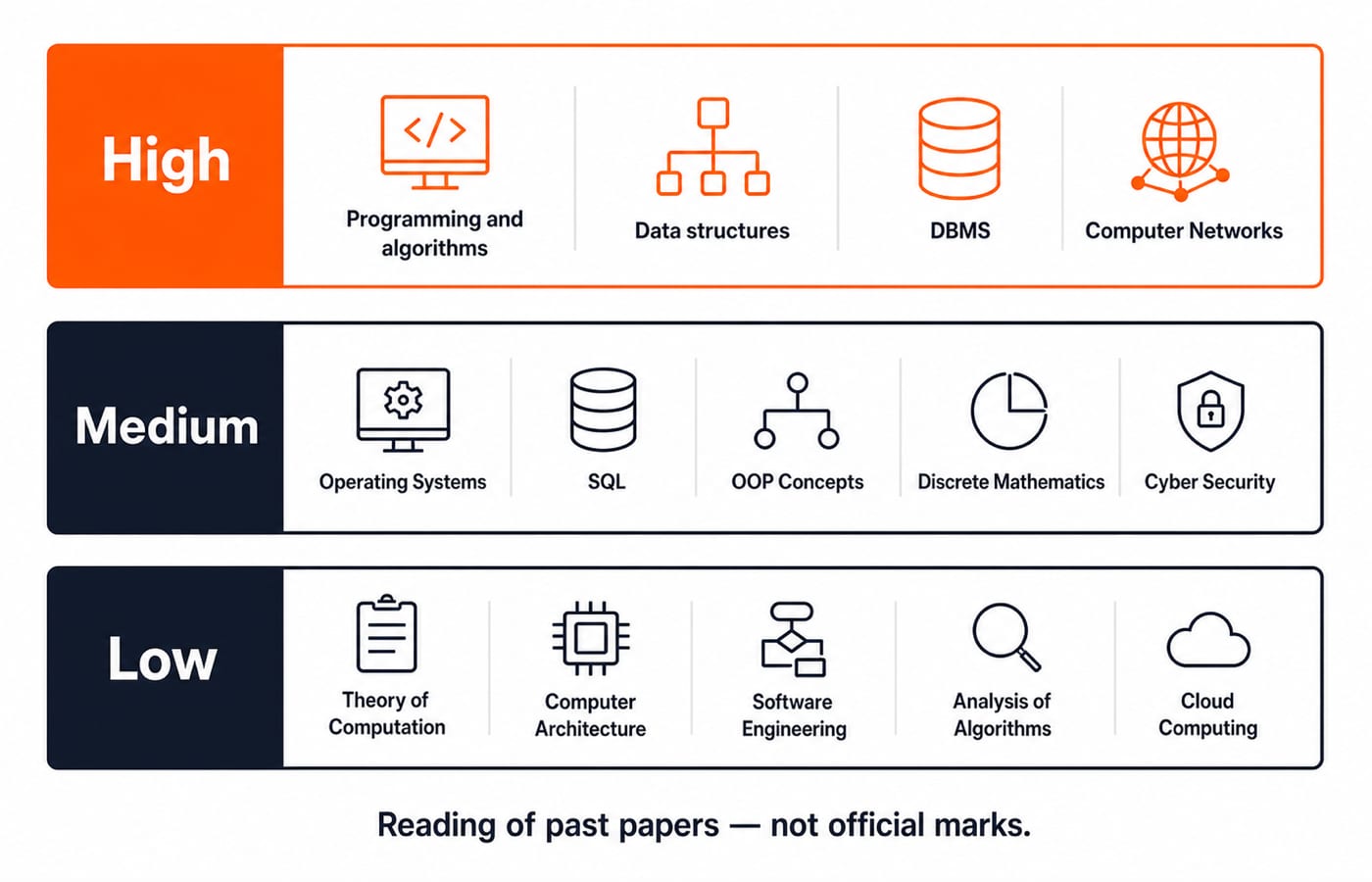
The working high band is programming and algorithms, data structures, DBMS and Computer Networks. These blocks combine definitions with traces, queries and standard numericals, so a weak method quickly becomes a wrong option. Confirm this starting order against the UPPSC papers you collected, and move any block whose measured recurrence differs.
Prepare the high band in connected pairs:
Pair | Core work |
Programming and algorithms | Output tracing, functions, recursion, basic complexity, searching and sorting |
Data structures | Arrays, stacks, queues, linked structures, trees, hashing and operation costs |
DBMS | Keys, relational algebra, SQL, normalisation, transactions and indexing basics |
Computer Networks | Layered models, protocols, addressing, routing and standard performance ideas |
After learning one procedure, solve an untimed set, explain every miss, and then return to a mixed timed set. Select questions by topic and error type rather than raw volume.
5. The middle band and the capped tail
Operating Systems, organisation and microprocessors, digital electronics and software engineering form the working middle band. Secure standard patterns: scheduling and memory in OS, data paths and interfacing in organisation, number systems and circuits in digital electronics, and lifecycle, testing and design distinctions in software engineering.
Theory of computation, detailed compiler design and heavier discrete mathematics form the provisional tail. Cover their central definitions and standard problem forms after the high and middle bands. Low recurrence limits first-pass depth; it never removes a current-syllabus topic.
6. Separate paper priority from personal weakness
Keep two rankings in the tracker: paper priority from recurrence, and repair priority from your own accuracy, time and error type. Do not rewrite the historical count to reflect a personal weakness; use the second ranking to decide the next study session.
Apply the two rankings together:
High recurrence and weak performance needs immediate concept repair and retesting.
High recurrence and stable performance needs short mixed maintenance sets.
Middle recurrence with repeated errors needs a bounded repair block before full mocks.
Tail topics still need one syllabus-coverage pass, even when recurrence is low.
Use the UPPSC Polytechnic Lecturer CS Test Series to populate the performance ranking. A high-band topic with unstable accuracy remains urgent even when its notes feel complete.
7. Traps when reading old papers
Do not copy the latest paper's sequence, ignore a new syllabus topic, let one difficult question distort the count, or mix another commission's paper into UPPSC evidence. Recurrence needs several comparable papers, while the current UPPSC notification remains the authority for syllabus, structure, marks, stages and dates.
For comparison, the DSSSB TGT Computer Science previous-year analysis provides a ready recurrence map and typical question shapes, while the HPSC PGT Computer Science recurrence guide adds a worked technical trace and a separate Haryana-general lane. Neither pattern is UPPSC evidence. Keep UPPSC question-booklet counts as the only basis for moving a topic between bands.
The government teaching jobs category collects related preparation routes, but the UPPSC documents govern this examination.
8. Your first working session
Download the available UPPSC Computer Science lecturer booklets and answer keys, build the one-row-per-question tracker, and calculate High, Medium and Low bands against the syllabus. Begin one measured high-band topic, solve a diagnostic set and record its error pattern. Timed retests will then show whether the order is producing faster, more reliable answers.
Keep learning

Browsers and Search Engines MCQs: 9 Solved Questions with Explanations
Solve nine published browser and search engine questions, check each answer, and rebuild the browser, cache, crawler and indexing distinctions that exam distractors blur.
Updated 6 Oct 20267 min readTeaching Recruitment (Computer Science)
IT Act, 2000 Explained: Key Sections, Digital Signatures and Worked Exam Examples
Build an exam-ready map of the IT Act, then apply it to an exact digital-signature walkthrough and a section 43, 66, 66C and 66D caselet.
Updated 2 Oct 20266 min readTeaching Recruitment (Computer Science)
Emerging Trends Introduction MCQs: 12 Solved Questions with Explanations
Solve 12 Emerging Trends Introduction questions with clear answer logic, exam-year labels and a compact trap check for focused revision.
Updated 27 Sep 20268 min readTeaching Recruitment (Computer Science)
MS Word Basics MCQs with Answers: 12 Solved Questions Explained
Work through 12 MS Word questions covering everyday commands, page layout, formatting, links, file features and mail merge. Each answer explains the decisive clue and the closest distractor.
Updated 25 Sep 20267 min readTeaching Recruitment (Computer Science)