Coal India MT Eligibility and Selection Process: What the Notification Actually Says
Use the current Coal India notification to verify your degree, percentage, age and selection route before you prepare for a CBT or depend on a GATE score.
KnowledgeGate Team
Exam prep & CS education
Updated 3 Aug 20266 min read
Coal India MT eligibility gets muddled when candidates treat one recruitment cycle as a permanent rule. One coaching summary says the selection is a computer-based test, the next says a GATE score decides it, and neither names the notification it is describing.
Both can be true of different cycles, and that is exactly the problem. What gates your application is the advertisement for the cycle you are applying to: the accepted degree titles, the minimum result for your category, the date your age is measured on, the relaxation you can actually document, and the route that decides your first exam.
1. Why what the notification says is the only safe answer
Coal India Limited can define the recruitment route separately for each Management Trainee cycle and discipline. That means a method used earlier is context, not a promise about the next notice.
On the official Coal India website, locate the recruitment or careers notice for the exact MT cycle. Download the detailed advertisement, not just the short notice or a third-party summary.
Before preparing, make a one-page fact sheet with these fields:
Check | What to copy from the current notice |
|---|---|
Post and discipline | Exact post name and discipline code |
Qualification | Accepted degree titles and branches |
Minimum result | Required percentage or equivalent rule by category |
Age | Upper limit, reference date and relaxations |
Selection mode | CBT, GATE-based shortlisting, or another stated route |
Later stages | Document verification, interview if listed, and medical requirements |
Copy the relevant clause or page number beside each answer so a coaching summary cannot replace the rule.
2. Educational eligibility
Past MT (Systems) recruitment material has commonly named a B.E. or B.Tech in Computer Science or Information Technology, or an MCA. Take the accepted degrees, related branches and equivalence conditions from the current notification.
Do not reduce educational eligibility to "I have a computer degree." Check four separate points:
Degree title: Does your certificate use one of the listed titles?
Branch or specialisation: Is your branch named or covered by an explicit equivalence clause?
Minimum result: Does your aggregate meet the category rule stated in the notice?
Completion status: Does the notice allow final-year candidates, and by what date must the result be declared?
If your university reports CGPA, use only the conversion method accepted by the notice and university. Keep the official conversion certificate or formula ready if required. Never invent a percentage by multiplying CGPA by a convenient number.
Screening is done against the advertised rule. A related syllabus or a similar degree name does not establish eligibility if your branch is absent from the accepted list.
3. Age limit and relaxations
An age rule is two things at once: an upper limit, and a fixed calendar date on which your age is measured. That reference date is set by the advertisement, and it is usually neither the day you apply nor the day you sit the exam, so a birthday in between changes nothing.
Create this check from the current notice:
Age on the stated cut-off date ≤ applicable upper limit after permitted relaxation
Then verify each component:
the base upper age for the post;
the cut-off date used to calculate age;
the relaxation for your category, if any;
the certificate format and validity conditions needed to claim that relaxation;
any special rules for departmental candidates or other groups named in the notice.
Relaxation is not automatic based on category identity. The claim must match the notification and the documents it requires, in the format it requires them.
4. The selection process
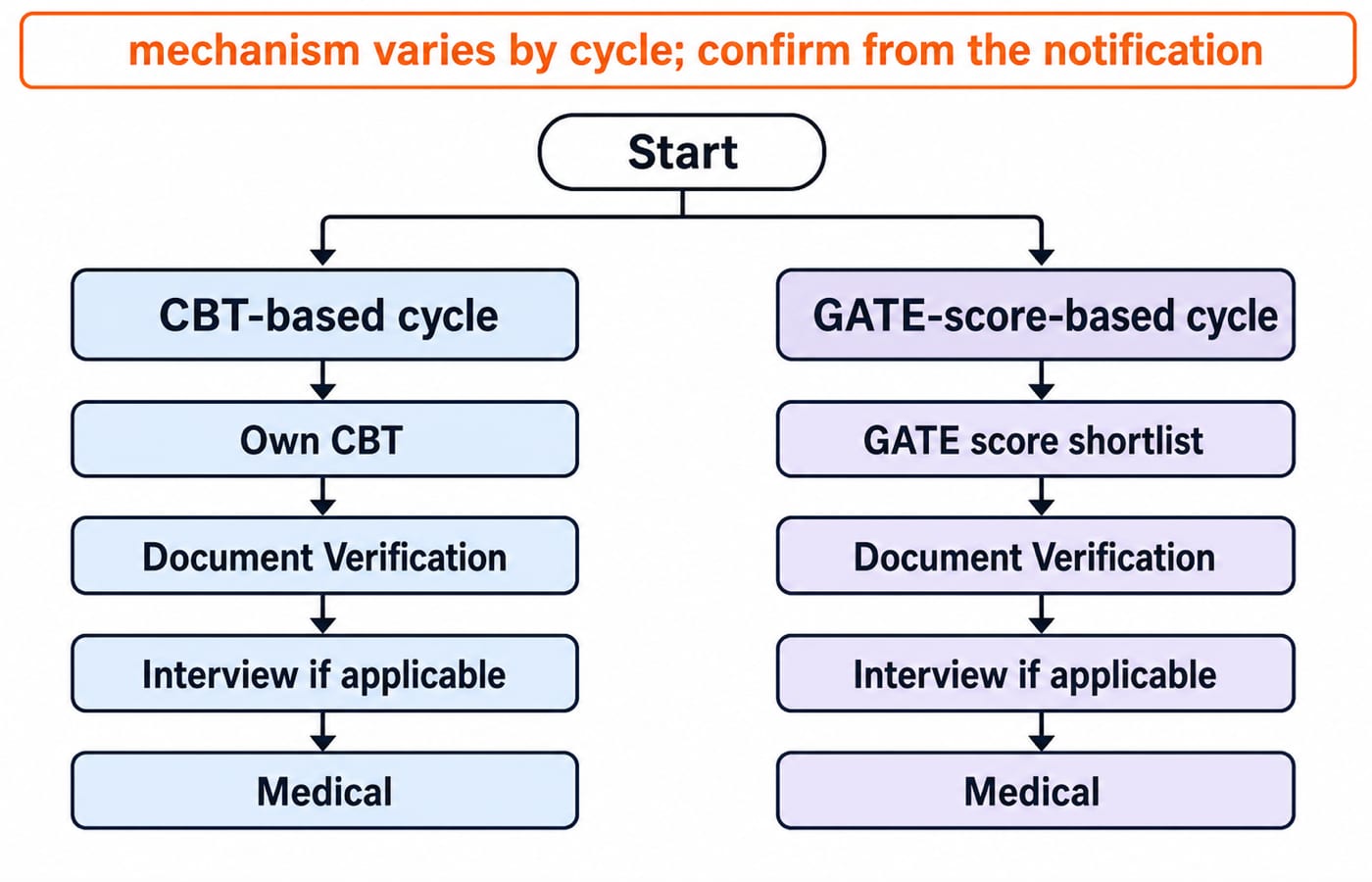
The key planning question is whether the cycle uses Coal India's own computer-based test or shortlists through a valid GATE score. That single clause decides what you study for the next several months.
In a CBT-based cycle, the notice names the tested sections, the qualifying method and the later stages. For the Computer Science discipline the load splits across two papers. Paper 1 is the non-technical half: General Awareness, Logical Reasoning, Quantitative Aptitude and English. Paper 2 is the discipline paper, covering programming and data structures, DBMS and SQL, algorithms, computer networks and security, digital logic, operating systems, theory of computation, computer organisation and architecture, and compiler design, with engineering mathematics alongside. Match the current notice's section list against that before you decide what to skip; the marks, question counts and qualifying rule per paper come from the notice, never from a past cycle.
In a GATE-score-based cycle, the notice should identify the accepted GATE paper, score conditions and shortlisting method. A score from an unlisted paper or an ineligible year does not become valid through subject overlap.
Later stages may include document verification, an interview where listed, and a medical examination. Treat "may" literally: the stages that exist are the stages the notice lists.
The PSU preparation category can organise the broader plan around whichever route the notice sets.
5. What the notification says versus common myths
Myth 1: Coal India MT always has its own CBT
No permanent assumption is safe. Check the selection clause for the cycle. If it says GATE-based shortlisting, a CBT-only plan is pointed at the wrong first gate.
Myth 2: A GATE score is always compulsory
The cycle decides, and the two routes ask for different documents. A GATE-based advertisement turns your scorecard into an eligibility document: the paper it names, the year and the registration details all have to satisfy the notice. A CBT-based advertisement asks for none of that and puts the whole first gate inside a test Coal India sets. Settle which one applies before you pay a GATE fee.
Myth 3: An interview is guaranteed after shortlisting
Look for an interview stage in the detailed process and weightage clauses. If it is present, prepare for it. If it is absent, do not add an imaginary stage to your timeline.
Myth 4: Medical fitness is a routine formality
Coal India is a mining PSU, so its medical requirements can matter. Read the standard, examination process and disqualification conditions stated or incorporated by the notification. Raise a genuine doubt through the official route before relying on an informal assurance.
6. The eligibility traps
Preparing for a fixed CBT when the current cycle uses GATE shortlisting, or doing the reverse.
Reading the headline qualification but missing an excluded branch or equivalence condition.
Checking the age limit without calculating age on the stated cut-off date.
Claiming relaxation without the required certificate format.
Entering a discipline code from memory instead of the current application instructions.
Waiting until document verification to discover that the name on one certificate does not match the application.
Run the checklist before paying a fee or building a study calendar. If a condition is ambiguous, save the clause and ask the official help channel a narrow question that quotes it.
7. The short version and your next step
Verify the exact degree, minimum result, age reference date, relaxation, selection mode and later stages from the current Coal India notification. Your first preparation decision is whether the cycle is CBT-based, GATE-score-based, or uses another defined route.
Once the route is clear, structure the technical core with the Coal India Management Trainee course and use the Coal India MT CS recruitment test series if it matches the notified mode. The practice bank behind both carries more than 18,000 questions across the Paper 2 computer-science subjects and more than 8,000 in quantitative aptitude.
The SSC CGL tier-structure explainer applies the same principle to a different exam: map every gate, then prepare for the stage where it is tested.
Keep learning
Paging and TLB Explained: Address Translation, EMAT and Exam Traps
Follow one virtual address from its VPN through the TLB to a physical frame, then calculate page-table size, TLB reach and effective memory access time.
Updated 4 Oct 20266 min readOperating Systems
Operating System Scenarios: Solve Scheduling, Concurrency, and Page Replacement
Learn one state-trace method for three common OS problem families, then apply it to complete Round Robin, concurrency, FIFO, and LRU examples.
Updated 29 Sep 20265 min readOperating Systems

Tower Research Hiring Process: Stage-by-Stage Prep for Quant and Dev Roles
Prepare for a Tower Research application without treating one online account as a universal process. Use this role-led map, worked drills, and seven-day plan.
Updated 25 Sep 20265 min readOperating Systems
Capital One Recruitment Process: Stage-by-Stage Guide for India Applicants
Prepare for a Capital One India application with a cautious five-stage map, worked technical and case drills, and a practical 14-hour schedule.
Updated 24 Sep 20265 min readOperating Systems