UP LT Grade Eligibility and Exam Pattern: Verify Your Subject Route
Read the Computer subject route correctly, check three hypothetical profiles, calculate the 2025 age boundary, and turn the notified paper structure into a practice plan.
KnowledgeGate Team
Exam prep & CS education
Updated 2 Aug 20264 min read87 views
The label "UP LT Grade" does not prove that your degree matches your intended teaching subject. You need the subject row, age clause and selection structure. The Computer row in UPPSC Advertisement No. A-5/E-1/2025 dated 28 July 2025 supplies all three, and the operative advertisement plus its corrigenda override any summary that differs from them.
Related reading: DSSSB TGT CS route and PGT training requirements.
UP LT Grade is a subject-specific Assistant Teacher recruitment
UP LT Grade here means UPPSC recruitment for Assistant Teacher, Trained Graduate Grade, in male and female branches. It is not one eligibility test for every graduate.
Match three labels before examining your qualifications:
Recruiting body: UPPSC.
Post and branch: Assistant Teacher, Trained Graduate Grade, male or female branch.
Chosen subject: Computer or another subject named in the notice.
Use the UP LT Grade preparation hub after this match is clear.
Read UP LT Grade eligibility in the right order
Use a four-step notice-reading method:
Locate the exact row for your chosen subject.
Separate essential qualifications from preferential qualifications.
Apply the notification's age cut-off and the rules for your category.
Collect documents that prove every qualification, category and domicile claim.
A shortcut such as "graduation plus B.Ed" can be wrong for a subject. In Advertisement No. A-5/E-1/2025, the Computer essentials used these routes: B.Tech./B.E. (Computer Science), Graduate in Computer Science, Graduate in Computer Application, Graduate with NIELIT 'A' Level, or the separately worded B.Tech. (Computer Science) and MCA route. An NCTE-recognised B.Ed was preferential, not mandatory.
The DSSSB TGT Computer Science eligibility and CBT marking rules show why another recruitment's qualification rule cannot be borrowed.
Three hypothetical Computer eligibility checks
Each row tests the printed 2025 wording alone. No summary decides a real candidate's file; only UPPSC does.
Candidate | Qualifications | Reading of the 2025 Computer row |
|---|---|---|
Asha | B.Tech Computer Science, 2022; no B.Ed | The degree matches an essential route. She does not have the listed preference. |
Bharat | BCA, 2021; NCTE-recognised B.Ed, 2023 | BCA maps to "Graduate in Computer Application". The B.Ed supplies the listed preference. |
Charu | B.Sc Information Technology, 2022; B.Ed, 2024 | Needs official clarification because "Information Technology" is not the exact wording in this Computer row. Do not guess eligible or ineligible. |
Test the printed degree title against the essentials, then test training credentials separately. No provider summary or calculator overrides UPPSC.
Calculate age from the notified cut-off
Advertisement No. A-5/E-1/2025 required age 21 to 40 on 1 July 2025, with a birth-date window from 2 July 1985 through 1 July 2004. These historical values do not govern another cycle.
Check the lower boundary:
A candidate born on 1 July 2004 attained 21 on 1 July 2025, so the candidate was inside that boundary.
A candidate born on 2 July 2004 had not attained 21 on the cut-off, so the candidate was outside it.
Use the notice's date window, not today's date. The advertisement also provided category, domicile and service-specific relaxations. Read the row matching your category and Uttar Pradesh status rather than a universal summary.
The notified prelims-to-mains exam pattern
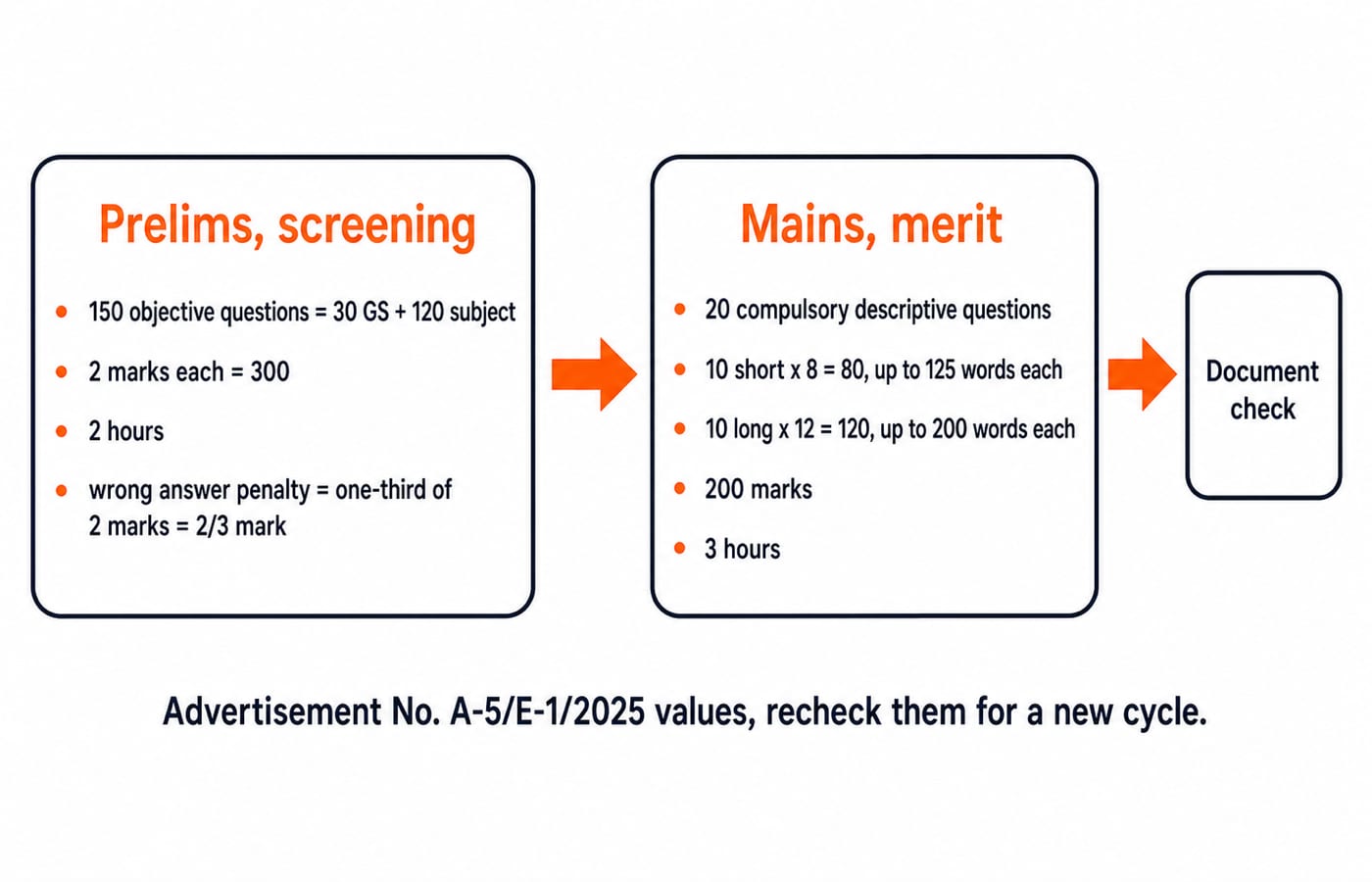
Appendix 2 of the advertisement described one objective prelims paper: 30 General Studies plus 120 concerned-subject questions. At 2 marks each, 150 questions made 300 marks in 2 hours. A wrong answer lost one-third of 2 marks, or 2/3 mark. A blank had no penalty.
The mains stage was one conventional paper with 20 compulsory questions, 200 marks and 3 hours. Section A had 10 short answers, up to 125 words, at 8 marks each: 10 x 8 = 80. Section B had 10 long answers, up to 200 words, at 12 marks each: 10 x 12 = 120. Thus, 80 + 120 = 200. Selection used total mains marks after prelims screening. The advertisement did not add an interview.
Two worked calculations for practical preparation
Prelims score example
Suppose a candidate has 90 correct, 30 wrong and 30 blank. First check: 90 + 30 + 30 = 150 questions.
Marks from correct answers: 90 x 2 = 180.
Wrong-answer penalty: 30 x (2/3) = 20.
Net score: 180 - 20 = 160 out of 300.
That 160 is only what the notified marking rule produces for that answer sheet. It is not a target score or a cut-off.
Mains time example
From 180 minutes, reserve 10 to read and order answers and 10 to review. That leaves 180 - 20 = 160 minutes.
The 80 and 120 marks form a 40:60 split. Give 40% of 160, or 64 minutes, to 10 short answers, about 6.4 minutes each. Give 60%, or 96 minutes, to 10 long answers, about 9.6 minutes each. Check: 64 + 96 + 10 + 10 = 180.
Those minute budgets are a practice allocation, not an instruction from the advertisement. Use the UP LT Grade Test Series only after matching its coverage against the current notice.
The short version: verify first, then prepare
Before applying or building a study plan:
Download the operative advertisement and every corrigendum from the UPPSC website.
Circle the exact subject row.
Mark every qualification as essential or preferential.
Calculate age on the stated cut-off date.
Copy the current paper pattern onto one page.
Do not reuse the 2025 numbers if a new notice changes them. For a matching Computer candidate, compare the UP LT Grade Assistant Teacher Computer Science course with the current official syllabus before starting. Still choosing? The teaching Computer Science exams comparison compares eligibility, post level and region without mixing their rules.
Keep learning
UP LT Grade CS Weightage: Rank What to Revise First
Stop treating topic weightage as a marks forecast. Rank five unfinished CS topics on breadth, prerequisite reach and sourced recurrence, then split 18 revision hours across them.
Updated 7 Aug 20265 min readUP LT Grade
UP LT Grade CS PYQs: A Topic-Wise Practice System
Stop solving previous papers once and forgetting the mistakes. This system indexes every question by concept, schedules three attempts and turns each error into a measurable repair task.
Updated 5 Aug 20266 min readUP LT Grade
UP LT Grade Computer Science Syllabus: A Prerequisite-First Study Map
Turn the official UPPSC Computer Science syllabus into a practical study sequence, with worked checks, an eight-week overlay and a coverage diagnostic.
Updated 31 Jul 20265 min readUP LT Grade
UP LT Grade Computer Science 14-Week Study Plan for Working Aspirants
A realistic weekly system for candidates preparing beside a degree, job or teaching workload. It turns 14 weeks into planned study, recovery and review.
Updated 28 Jul 20266 min readUP LT Grade