Which teaching Computer Science exam should you target? A decision guide
A decision guide for CS graduates choosing a teaching exam: pick by eligibility, post level, region and calendar across DSSSB, KVS, EMRS and RSSB posts.
KnowledgeGate Team
Exam prep & CS education
10 Jul 20265 min read
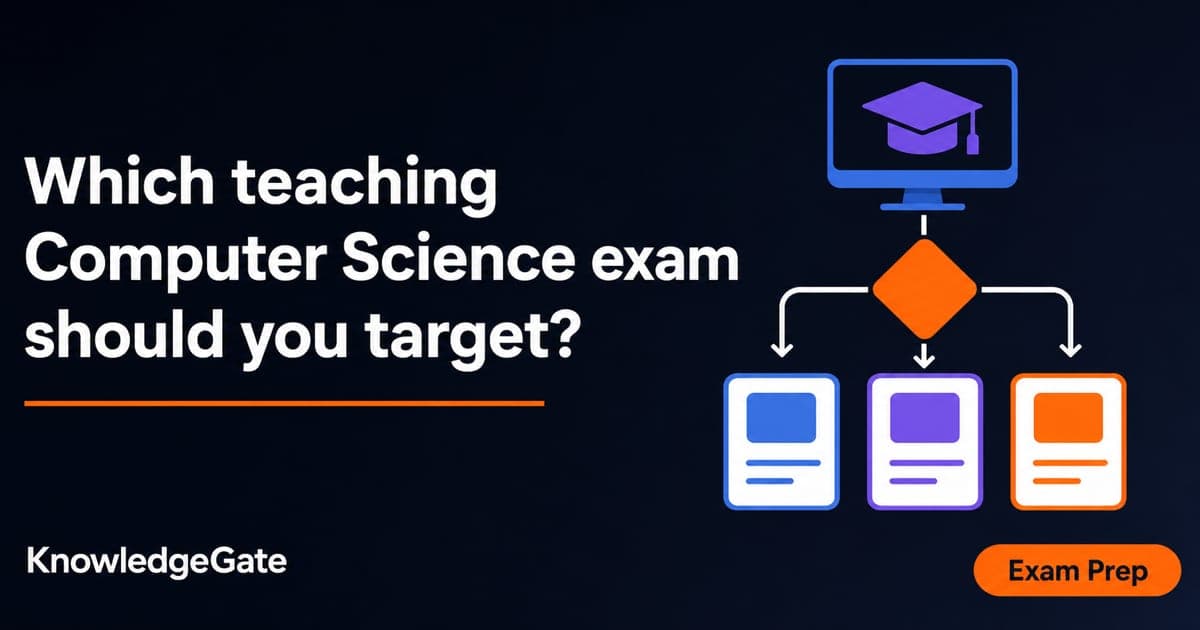
The hardest decision for a Computer Science graduate who wants to teach is not how to study. It is which exam to aim at. DSSSB, KVS, NVS, EMRS, RSSB, and a spread of state PGT and TGT computer posts all want CS teachers, and picking wrong, on eligibility or on level, can burn a whole cycle before you even sit the paper.
Four things actually narrow the field: eligibility, post level, region, and calendar. Apply them in that order and most of the list falls away before you have committed a single week of study. What is left is a shortlist you can prepare for together, rather than a year bet on one notification.
Filter 1: eligibility decides where you can even apply
Before anything else, eligibility removes most of the confusion. Qualification, age, and required teaching credentials differ by body and post, and they are non-negotiable filters.
Check the essential qualification named for that exact post, not for the exam body as a whole, against what you already hold.
Check whether that specific post requires a teaching credential.
Read the age limit and the category relaxation that applies to you.
Every one of these specifics lives in the official notification for that post, and it can change between cycles, so read the eligibility section at the source before anything else. The post names themselves carry the level: a PGT (Post Graduate Teacher) post asks a higher qualification than a TGT (Trained Graduate Teacher) post under the same body, and RSSB's Senior Computer Instructor sits above its Basic Computer Instructor on the same logic. Which side of that line you fall on is settled by the degree you already hold, not by how hard you are willing to work.
Filter 2: post level, match depth to the paper
Once eligibility narrows the field, post level tells you how deep to go.
TGT and Basic Computer Instructor posts reward accuracy and clear explanation across computer fundamentals, MS Office and ICT, programming basics, and the standard data structures.
PGT and Senior Instructor posts ask the same spine at greater depth: DBMS and normalisation, operating-system scheduling and deadlocks, computer networks and addressing, algorithms and their complexity, plus the pedagogy of teaching Computer Science.
Go through that list area by area and mark each entry strong or still consolidating.
Be honest in that marking, because it is the count of still-consolidating entries, not your ambition, that decides the level worth targeting this cycle. A CS graduate who can hold DBMS, operating systems, and networks at real depth should aim at the higher level; someone still shoring up the fundamentals is better served clearing a foundational post first and building up. Neither choice is wrong; a mismatch is.
Filter 3: region and mobility
Some posts are national in reach; others are tied to a state.
Central options like KVS, NVS, and EMRS can post you across the country, which suits candidates open to relocating. EMRS posts sit in residential schools, so the move is to a campus you live on, not simply to another city.
State posts like DSSSB (Delhi), RSSB (Rajasthan), HPSC (Haryana), and the UP posts keep you in one region, which suits candidates who need to stay put.
Decide how mobile you genuinely are before you invest months. A national post you cannot actually relocate for, or a single-state post when you would move anywhere for a job, both waste options.
Filter 4: the calendar, and why you should not wait
Notifications open on their own schedules, and they do not coordinate. Waiting for your one "ideal" exam usually means sitting idle while three others you were eligible for come and go.
The fix is not to pick harder. It is to prepare so you are ready for whichever opens next. Because the subject core is shared, being ready for one eligible post makes you close to ready for the others, so treat the calendar as a reason to prepare broadly, not to wait narrowly.
Do not over-optimise the choice
Aspirants lose weeks trying to rank exams by "which is easiest" or "which pays best", as if there were a single right answer. There is not. Difficulty depends on your own strengths, and vacancy counts and cutoffs shift every cycle, so a post that looked hard last year can be the open one this year. Chasing the perfect target is how people end up preparing for nothing.
A healthier frame: your goal is not to pick the one exam, it is to become the kind of candidate several exams want. Eligibility and mobility genuinely constrain you, so respect those. Beyond them, the deciding factor is your subject depth, and that improves with study no matter which notification you eventually sit. Pick a first target to give your preparation a shape, then let the shared core keep the rest of the doors open.
A quick decision path
Run your options through this order:
List every post you are eligible for. Cut everything else. (Filter 1.)
Within those, match post level to your real subject depth. (Filter 2.)
Filter by how mobile you actually are. (Filter 3.)
Among what remains, target the next one to open, and keep the shared core warm for the rest. (Filter 4.)
Teaching jobs for Computer Science graduates compared puts the whole field in one table, post level against our coverage, if you want to see it before you start cutting. Run two candidates through the same order and you can watch it work: a Delhi-based graduate open to a foundational start ends up with DSSSB and the central-school posts on one shortlist, while a Rajasthan candidate who cannot relocate ends up choosing a level, weighing the RSSB Basic and Senior Computer Instructor bundle against their genuine depth.
Prepare so you keep options open
Whichever exam you target first, prepare the shared CS-teaching core to real depth and adapt the general section per exam. That way an eligible notification opening anywhere finds you ready, not scrambling.
The practical test of whether you have kept your options open: if a second eligible notification lands mid-preparation, you should be able to add it to your form list without rebuilding your study plan. If adding it would mean starting a subject from scratch, your first target was narrower than you thought.
The Teaching Recruitment Exams bundle is built for exactly this multi-exam approach, one core that serves several forms, and the full list of posts sits on the government teaching jobs category.
Which teaching CS exam: the short version
Choose in order: eligibility (where you can apply), post level (match depth), region (how mobile you are), then calendar (target the next to open). Do not wait for one ideal exam. Prepare the shared core once, keep several eligible options alive, and confirm every specific on each body's official notification before you commit. The subject you already have; the decision is just discipline about where to point it.
Keep learning
Common Editing Ctrl Keys Explained: Copy, Cut, Paste, Undo and Redo with Worked Examples
Learn what each common Ctrl key does, then trace the document, clipboard, cursor and edit history through precise examples without confusing Copy, Cut or Undo.
Updated 11 Oct 20266 min readTeaching Recruitment (Computer Science)
Browsers and Search Engines MCQs: 9 Solved Questions with Explanations
Solve nine published browser and search engine questions, check each answer, and rebuild the browser, cache, crawler and indexing distinctions that exam distractors blur.
Updated 6 Oct 20267 min readTeaching Recruitment (Computer Science)
IT Act, 2000 Explained: Key Sections, Digital Signatures and Worked Exam Examples
Build an exam-ready map of the IT Act, then apply it to an exact digital-signature walkthrough and a section 43, 66, 66C and 66D caselet.
Updated 2 Oct 20266 min readTeaching Recruitment (Computer Science)
Emerging Trends Introduction MCQs: 12 Solved Questions with Explanations
Solve 12 Emerging Trends Introduction questions with clear answer logic, exam-year labels and a compact trap check for focused revision.
Updated 27 Sep 20268 min readTeaching Recruitment (Computer Science)