UPPSC Polytechnic Lecturer CS: A Practical 16-Week Preparation Strategy
Build a realistic 16-week UPPSC Polytechnic Lecturer CS plan with weekly outputs, cumulative recall, diagnostic drills, two revision cycles and a recovery rule.
KnowledgeGate Team
Exam prep & CS education
Updated 22 Jul 20266 min read50 views
Sixteen weeks looks generous until you count what UPPSC Polytechnic Lecturer CS actually asks for: two full Computer papers, with General Hindi sitting inside Paper 1 and General Studies inside Paper 2. Hours logged will not tell you whether you are on track. Weekly outputs will, and they let a bad week cost one block instead of a month.
1. Fix the weekly capacity before assigning subjects
Plan 18 hours: five weekdays × 2 hours = 10, while two weekend days × 4 hours = 8. Total: 10 + 8 = 18 hours.
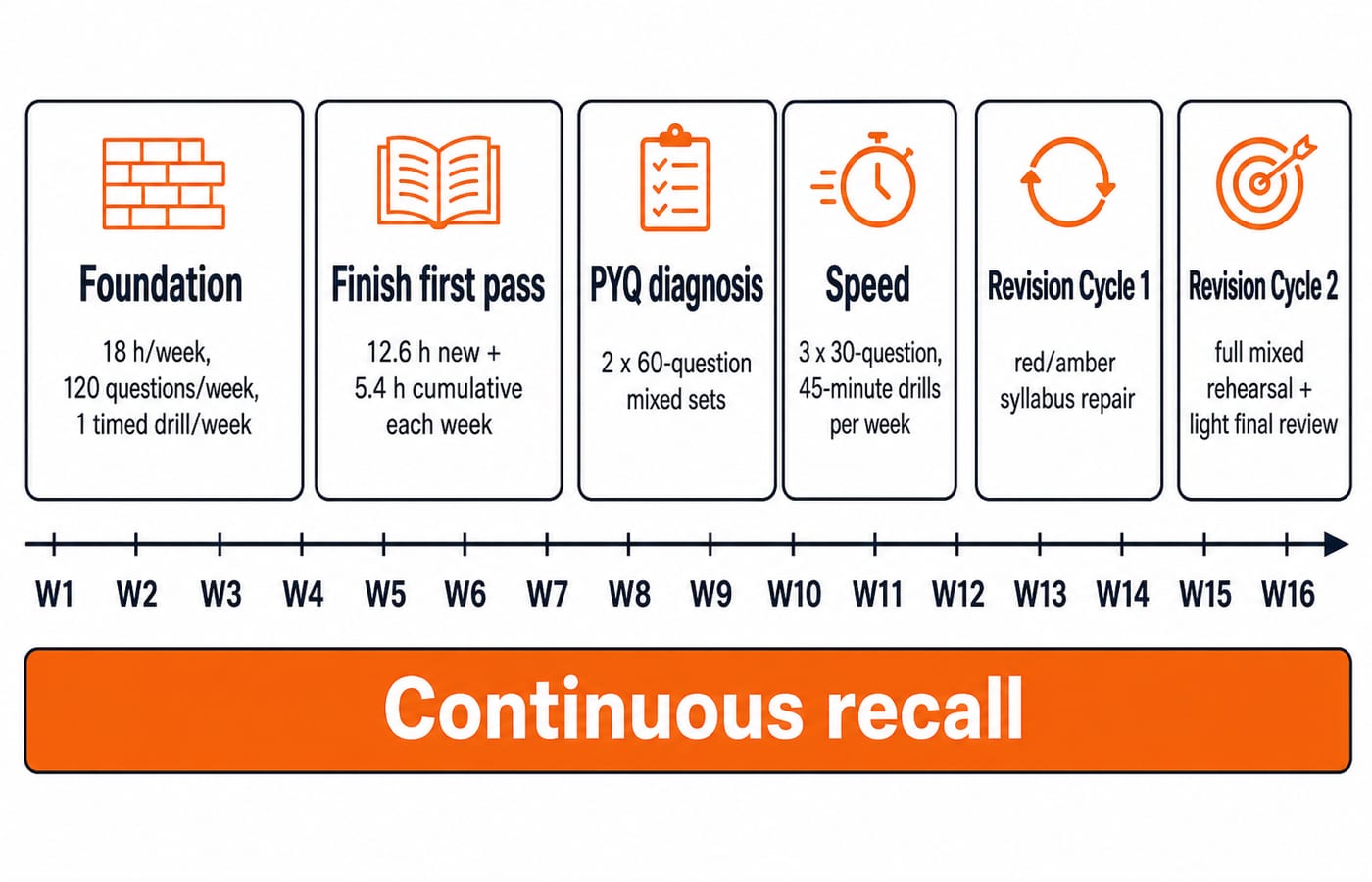
Split this into 9 hours of Computer concepts, 4 of closed-book recall and questions, 2 for General Hindi and General Studies, 1 of review and 2 of buffer: 9 + 4 + 2 + 1 + 2 = 18. Hindi and General Studies are the two blocks aspirants quietly drop, and the two that need the least time to hold. For a 12-hour week, multiply each block by two-thirds: 6 hours, 2 hours 40 minutes, 1 hour 20 minutes, 40 minutes and 1 hour 20 minutes. Keep recall and review.
A completed week means two concept blocks, 120 questions, one 45-minute drill, one Sunday Hindi and General Studies session and one error-log review. Copy each official syllabus line into a tracker and mark it strong, partial or unseen. The Govt Teaching Jobs category lists the UPPSC Polytechnic Lecturer course and its test series if a heading you mark unseen needs a source.
2. Weeks 1-4: build foundations and the first recall loop
Weeks 1 to 4 belong to Computer Paper I, so one paper closes before the second opens. Inside it, let the red and amber marks in your tracker set the order:
Week | Paper I work |
|---|---|
1 | Syllabus audit, diagnostic, Discrete Structures and Theory of Logic |
2 | Data Structures, Design and Analysis of Algorithms |
3 | Database Management Systems, Computer Networks |
4 | Computer Organization and Architecture, Programming Languages, Cyber Security |
Three dependencies fix this order. Discrete Structures feeds Data Structures and then algorithm analysis. Cyber Security only makes sense after Computer Networks. And Computer Organization has to be solid before Operating Systems opens Paper II in Week 5, which is why it sits in Week 4.
Each weekday is 70 minutes of concepts + 30 of retrieval + 20 of questions = 120 minutes. Saturday has 2 hours of concepts and 2 hours for 60 mixed questions. Sunday has 2 hours for General Hindi and General Studies, 1 for last week's cards and 1 for misses and spillover.
Finish with a one-page sheet of at most 12 prompts. For DBMS, include conflict serialisability, recoverable versus cascadeless schedules, lossless join and three normalisation traps. Retest after 24 hours and 7 days.
3. Weeks 5-8: finish the first pass without forgetting
Weeks 5 to 8 open Computer Paper II, continuing Paper I rather than restarting. Operating Systems comes first, because Week 4 has just finished Computer Organization. Compiler Design follows in Week 6 once Programming Languages is behind you, with Software Engineering beside it. Week 7 takes Artificial Intelligence, High Performance Computing and Soft Computing. Week 8 closes with Computer Graphics, Image Processing, Web Technologies and Distributed System.
Use a 70:30 split: 18 × 0.70 = 12.6 hours of new coverage and 18 × 0.30 = 5.4 hours of cumulative practice. Total: 12.6 + 5.4 = 18. Zero old-topic contact creates a later revision crisis.
In Week 6, suppose you recall 15 of 24 old prompts and 14 of 16 current prompts. Old recall is 15 ÷ 24 × 100 = 62.5%; current recall is 14 ÷ 16 × 100 = 87.5%. Give the next 90-minute repair block to the weakest old unit.
4. Weeks 9-10: turn PYQs and mixed sets into a diagnosis
Use only papers and keys from UPPSC's previous-year question-paper area, and read each paper's instruction page before scoring yourself against it. Follow Teaching-exam mock strategy: using mocks across DSSSB, KVS and state CS papers for full reviews.
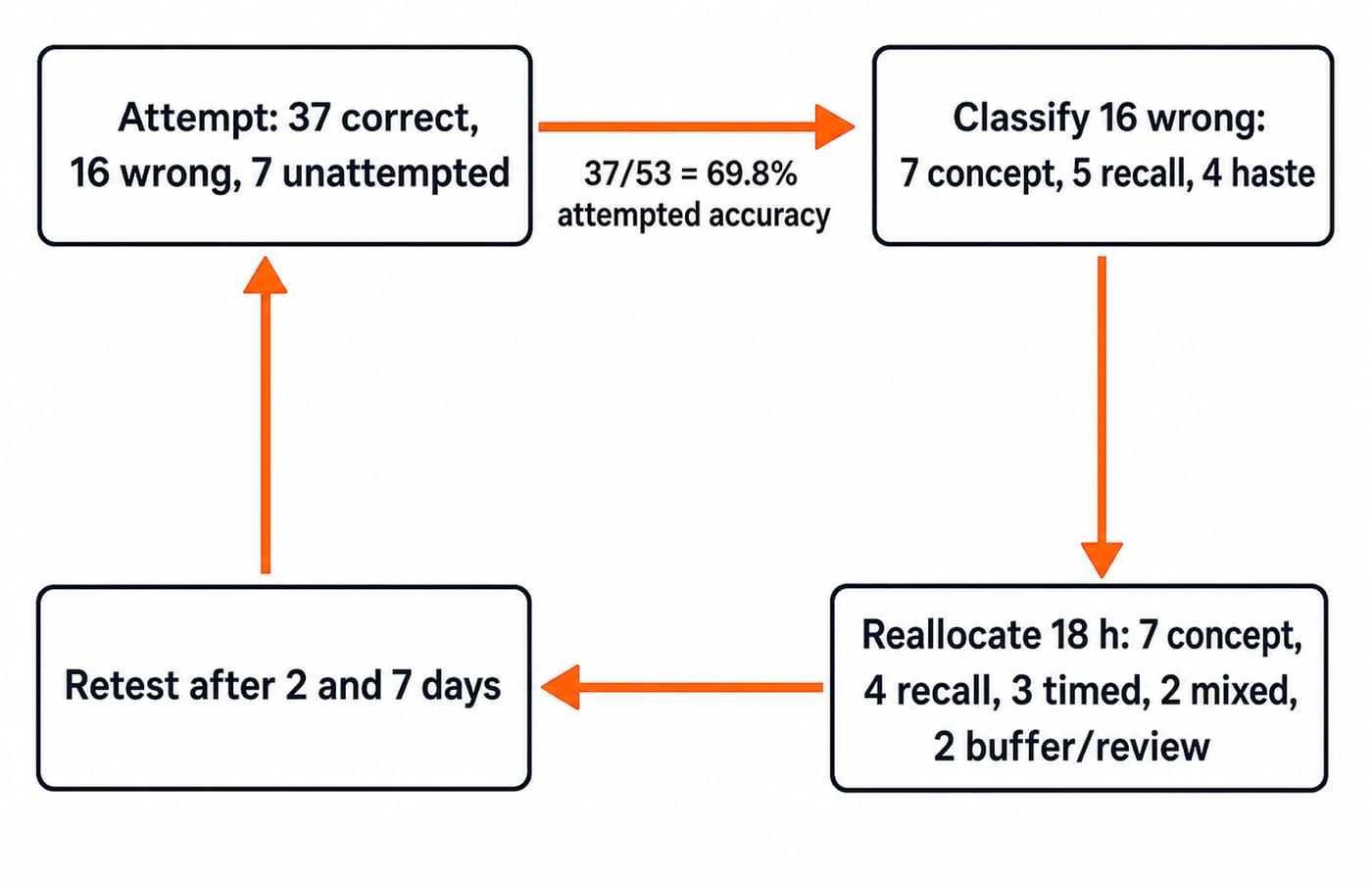
For one of two 60-question sets, suppose you get 37 correct, 16 wrong and 7 unattempted. Attempts = 37 + 16 = 53. Attempted accuracy = 37 ÷ 53 × 100 = 69.8%. Classify the wrong answers: 7 concept + 5 recall + 4 haste = 16.
Next week becomes 7 hours concept repair + 4 recall + 3 timed + 2 mixed + 2 buffer or review = 18 hours.
Log source or question ID, topic, chosen reason, correct rule and next retest date. Retest after 2 and 7 days.
5. Weeks 11-12: train speed without rewarding guesses
Run three private 30-question, 45-minute drills weekly. If Drill 1 has 18 correct and 6 wrong, attempts = 24 and accuracy = 18 ÷ 24 × 100 = 75%. Target 26 attempts in Drill 2 at 75% or better, then 28 only if that floor holds. Raising attempts while accuracy falls is guessing with a stopwatch.
Use three passes: immediate recalls, calculation or elimination, then flagged items. A split of 18 + 20 + 7 = 45 minutes exposes slow reading, recall or calculation. Keep one untimed repair session. For organised practice, use the UPPSC Polytechnic Lecturer CS test series.
6. Weeks 13-14: Revision Cycle 1 repairs the syllabus
Of 18 hours, 50% is 9 for red units, 30% is 5.4 for amber and 20% is 3.6 for green. Round to 9, 5.5 and 3.5, which still totals 18.
Use 20 minutes of blank-page recall, 40 of repair and 30 of questions. Retrieving 6 of 10 operating-system prompts leaves 4 to repair. Then 12 correct of 15 questions = 80%. Keep it amber until the 7-day retest reaches your threshold.
End Week 14 with a mixed rehearsal and the 20 rules or formulas you forget most. Start no large new resource.
7. Weeks 15-16: Revision Cycle 2 stabilises recall
Week 15 is 6 hours of weak-topic repair + 6 mixed or timed + 4 error retests + 2 buffer = 18. Week 16 is 4 repair + 6 mixed + 4 retrieval + 2 official-notice check + 2 light review = 18.
Three 30-question drills with 24, 25 and 24 correct contain 6 + 5 + 6 = 17 misses. Review those 17 instead of opening a new source. Two weeks out, a miss you can explain is worth more than a chapter you have not read.
8. Recover missed days without destroying the plan
Move one missed 2-hour session into the buffer. After two misses, remove the lowest-priority new block but protect recall and the timed drill. At 6 completed hours or fewer, repeat the week in compressed form. Avoid unsafe marathon catch-up days.
If Week 7 delivers 12 of 18 hours, keep 4 recall and questions + 2 review + 6 on the highest-priority new unit = 12. Move one content block to Week 8 and drop source-hopping. The plan slips by one block, not a month.
The short version
Map both Computer papers, protect weekly capacity, keep General Hindi and General Studies on Sundays, recall from Week 1, diagnose errors in Weeks 9-10, train speed in Weeks 11-12 and revise twice. UPPSC Polytechnic Lecturer 2025 (CS) is a structured next step. Still choosing? Read Which teaching Computer Science exam should you target? A decision guide first.
Keep learning
UPPSC Teaching vs UP LT Grade: Choose by Role, Eligibility and Syllabus
Choose between the Polytechnic Lecturer and LT Grade routes by checking the current notice first, then testing role fit, syllabus overlap and available hours.
Updated 7 Aug 20267 min readUPPSC Teaching
UPPSC Computer Science Problem Types: Solve Algorithms, DBMS and OS
Use one four-process dataset to practise insertion-sort traces, candidate-key and 3NF reasoning, and non-preemptive SJF calculations with reliable checks.
Updated 4 Aug 20266 min readUPPSC Teaching
UPPSC Teaching Eligibility and Selection Structure: Verify the Right Post Before Applying
A practical worksheet-based method to check the exact UPPSC post, qualification route, equivalence evidence and notified selection sequence before applying.
Updated 2 Aug 20266 min read62 viewsUPPSC Teaching
UPPSC Teaching PYQ Analysis: Build an Error-Led Revision Plan
Learn a repeatable way to verify teaching PYQs, separate topic from reasoning demand, diagnose errors and convert the evidence into next week's study calendar.
Updated 30 Jul 20266 min readUPPSC Teaching