How to Become a Professor in India: NET, PhD and the Recruitment Path
Separate eligibility, research funding and appointment, then build a realistic NET study schedule and shortlist only the Assistant Professor notices that match your profile.
KnowledgeGate Team
Exam prep & CS education
Updated 28 Jul 20266 min read56 views

Many candidates use "professor" for every college teacher, then treat a master's degree, NET, JRF, a PhD and an Assistant Professor appointment as interchangeable milestones. They are not. A master's degree is the base qualification, NET/SET/SLET is the usual eligibility route, JRF is research funding, and the appointment itself is a separate selection decision taken by one institution against one advertised notice. Sorting those four into the right order is what turns a vague ambition into a shortlist you can actually apply to.
Related reading: Assistant Professor eligibility and UGC NET Paper I preparation.
How to become a professor in India: start with the actual role ladder
Professor is a senior academic rank, not an immediate post-NET title. The route is:
master's -> eligibility route -> Assistant Professor selection -> research and teaching record -> Associate Professor/Professor
This is a map, not a guaranteed conveyor belt. Selection sits between eligibility and appointment. Later ranks require a longer teaching, research and service record.
Milestone | What it proves | What it does not prove |
|---|---|---|
Master's degree | Postgraduate subject preparation | Appointment |
NET/SET/SLET | The applicable eligibility outcome | Selection |
JRF | Support for a research route | A requirement merely to hold Assistant Professor eligibility |
PhD | Doctoral research training | Permission to override every live recruitment notice |
Assistant Professor eligibility: test the master's, NET and PhD conditions separately
The official UGC Compendium of Regulations 1957-2023 provides the baseline. Its 2018 minimum-qualification regulations set a 55% master's-level minimum, subject to stated relaxations and relevant-subject rules, and contain NET/SLET/SET plus qualifying-PhD provisions. The 2023 amendment removed the blanket PhD mandate and restated NET/SET/SLET as the minimum criterion for direct Assistant Professor recruitment.
Check each notice for the post, discipline, relaxation and exemption. If another statutory body governs the discipline, its rules and the notice prevail.
Asha: 62% in a relevant master's degree, Assistant Professor eligibility through NET, and no PhD. She crosses the default gates but still needs a matching notice and selection.
Bharat: an unreserved candidate with 54% in the relevant master's degree and NET. NET does not repair the missing 55% baseline.
Charu: 67% in a relevant master's degree and a PhD under applicable UGC standards, but no NET. She should shortlist only notices accepting the compliant-PhD route.
Use one rule: essential first, desirable second. A desirable PhD cannot repair a failed essential condition. An essential PhD cannot be replaced by NET because it is the default elsewhere.
UGC NET and JRF: separate eligibility from research funding
Target the Assistant Professor eligibility outcome. A stronger outcome may also carry JRF, making a funded PhD route practical. JRF supports doctoral planning but is not a universal requirement for Assistant Professor applications.
Read the result and notice exactly. A result valid only for PhD admission is not Assistant Professor eligibility. Check validity periods, age rules and cutoffs in the current official UGC-NET bulletin. Start with UGC NET Computer Science for an exam-specific overview.
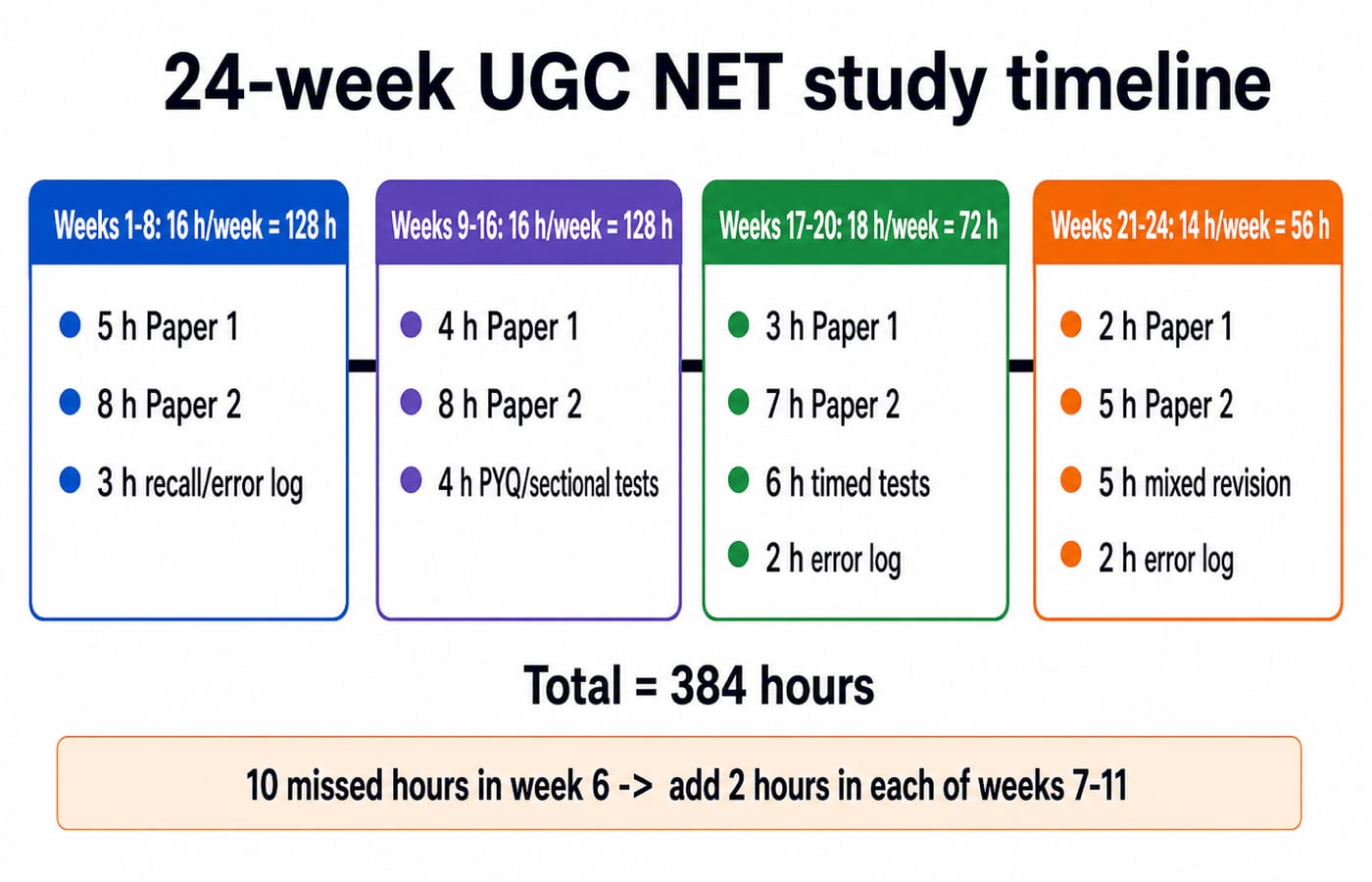
UGC NET preparation: use a 24-week, 384-hour plan
For Computer Science, use this weekly split:
Weeks | Weekly split | Calculation |
|---|---|---|
1-8 | 5 h Paper 1, 8 h Paper 2, 3 h recall and error log | 16 x 8 = 128 h |
9-16 | 4 h Paper 1, 8 h Paper 2, 4 h PYQs or sectional tests | 16 x 8 = 128 h |
17-20 | 3 h Paper 1, 7 h Paper 2, 6 h timed tests, 2 h error log | 18 x 4 = 72 h |
21-24 | 2 h Paper 1, 5 h Paper 2, 5 h mixed revision, 2 h error log | 14 x 4 = 56 h |
Total: 128 + 128 + 72 + 56 = 384 hours. The UGC NET CS Exam Preparation category separates Paper 1, Paper 2 and test-series routes, but the official syllabus remains your authority.
If week 6 drops from 16 hours to 6, the deficit is 16 - 6 = 10 hours. Add only 2 hours in each of weeks 7-11: 2 x 5 = 10 hours. Do not create a 26-hour punishment week. Near the exam, cut low-priority new coverage and protect mixed revision, timed work and the error log.
PhD after NET: decide by career goal, not by a blanket rule
Choice | Best fit |
|---|---|
Apply now | Matching notices accept the master's plus NET/SET/SLET route |
Apply and explore PhD together | You want teaching entry now but research-intensive roles may prefer a PhD |
Prioritise JRF and PhD | Your main goal is funded research and a long-term university research career |
None promises admission, funding or appointment. From 12 weekly hours, allocate 5 to subject depth and a teaching demonstration, 3 to reading and summarising two research papers, 2 to a proposal draft, and 2 to vacancy and PhD documents. Thus, 5 + 3 + 2 + 2 = 12 hours. After four weeks: teaching 5 x 4 = 20, research reading 3 x 4 = 12, proposal 2 x 4 = 8, and documents 2 x 4 = 8 hours.
A PhD is not a blanket entry requirement under the cited 2023 change, but matters more for research-intensive shortlists and senior ranks. The notice decides whether it is essential, an accepted exemption route or desirable.
Assistant Professor recruitment: turn eligibility into a notice audit
Capture exact wording. Do not assume a common screening score, interview format or teaching demonstration.
Check | Exact line to capture | Decision |
|---|---|---|
Institution and governing rules | Named regulation or statutory body | Apply rule set |
Post title and department | Exact advertised role | Match or reject |
Essential degree and subject | Required degree and discipline | Match or reject |
Minimum marks or grade | Threshold and relaxation | Eligible or not |
NET/SET/SLET or PhD route | Accepted eligibility wording | Match or investigate |
Experience or research | Essential versus desirable | Meet, investigate or reject |
Documents | Required proofs and format | Ready or incomplete |
Selection stages | Listed screening and assessment | Prepare accordingly |
Of ten notices, four accept Asha's relevant master's plus NET route, three require a PhD, two follow other statutory rules, and one requires another subject. She applies to four, parks three, investigates two and rejects one. 4 + 3 + 2 + 1 = 10. This does not forecast four interviews.
To compare university NET with other paths, use Which teaching Computer Science exam should you target? A decision guide. A school-teaching exam cannot replace a university Assistant Professor requirement.
From Assistant Professor to Professor: the short version and next step
NET can open an Assistant Professor eligibility route. Associate Professor and Professor are later ranks, reached either by promotion under your institution's career-advancement rules or by direct recruitment against an advertised post. Both are judged on the record you build after appointment: years of teaching, published research, doctoral supervision, and academic or administrative service. The required years and counts differ by institution and by the regulation in force, so read your own institution's promotion rules and the current recruitment notice rather than assuming a fixed timeline or publication count.
Recall four lines: relevant master's first; NET/SET/SLET is the safe default route; JRF supports research and a PhD but is not an appointment; a PhD is strategically important and sometimes essential, but the notice determines its effect.
Choose: prepare for NET, apply to matching Assistant Professor notices, or build the PhD and research route. CS candidates can use NTA-UGC-NET Paper - 1 for the general paper and NTA-UGC-NET Paper - 2 for subject preparation. In another discipline, keep the method but follow the official syllabus and use a subject-matched resource.
Keep learning

Scope and Importance of International Business: UGC NET Commerce Examples
Exports, licensing and foreign investment cross borders in different ways. Separate their roles, compare entry modes and work through the opportunity-cost arithmetic behind comparative advantage.
Updated 13 Oct 20266 min readNET Strategy & Updates
FEMA Explained: Objectives, Key Provisions and UGC NET Commerce Examples
Two equal overseas payments can fall into different FEMA categories. Learn to classify transactions, apply an exporter checklist and calculate a penalty ceiling without counting the first day twice.
Updated 9 Oct 20265 min readNET Strategy & Updates
CSIR NET Normalization: Percentile and Normalised Marks Worked Out
Can 120 and 130 raw marks mean the same percentile? Follow a two-shift example from raw marks to percentile and normalised marks, then check which number belongs beside a cutoff.
Updated 5 Oct 20265 min readNET Strategy & Updates
UGC NET Eligibility for CA Holders: Equivalence, Marks and Subject Choice
Completed CA but have no MCom certificate? Understand the equivalence route, check the percentage requirement and resolve marks or subject-entry doubts before applying for NET.
30 Sep 20264 min readNET Strategy & Updates